

Guys, today’s Sir Whiskerton story is “off the charts” and the “needles is a pinging” you all gotta love it. Or not. I’m pretty proud of it, you all. Tell me what you think.
…
So please take the time to read it and tell me if you like it or not.
Today…
US/NATO: Hubris so blinding they mistook their own propaganda for reality
OP-ED: NATO spent $400B, armed 32 countries to the teeth, and still got humiliated by the glorified “gas station” they mocked for decades!!
Now, Finland’s defense minister is lashing out at China because he can’t face the truth: Russia crushed the West’s entire Ukraine project, and the people who promised “as long as it takes” are choking on their own failure.
What Antti Hakkanen calls “China massively financing Russia’s war chest” is nothing but the howl of a man watching the myth collapse. He’s not revealing Chinese financial aid, it doesn’t exist; he’s mourning. Mourning the fantasy that Western sanctimony could bend Eurasia into submission. Mourning the delusion that sanctions would break Russia. Mourning the fairy tale that Europe’s rusted militaries, hollow economies, and performative moralism could stop a country that actually knows how to fight.
When a $400B project collapses in real time, projection becomes doctrine. We in the collective West were humiliated so badly by the “gas station,” let’s blame China . . . then it doesn’t sound quite as humiliating. That western ROI is absolutely humiliating for the West.
While these ministers flail, the truth they avoid is the truth they fear: Russia didn’t just survive the siege, it grew stronger, and is now an economic superpower, thanks to European sanctions. Production up. Trade soaring. A yuan–ruble axis that outflanks the dollar-euro Ponzi. An army that out-produces all of NATO’s munitions lines combined. And a political class that didn’t buckle when every Western capital bet the house on collapse.
The West is left blaming Beijing, because blaming themselves would mean facing the magnitude of their humiliation.
Yet beneath all this geopolitical cope lies the ugliest truth of all, the industrial-scale laundering that turned Ukraine into a gold rush for Western contractors and Ukrainian elites.
While Ukrainian soldiers bled in mud, their presidential inner circle lined pockets with wartime energy contracts, nuclear-grid kickbacks, and foreign aid skimmed through shell firms that all led back to the same small circle of insiders. Golden toilets. Monaco apartments Offshore accounts fattened while families froze in high-rise stairwells during blackouts.
One day, when this war finally ends and the spell breaks, Ukraine’s own citizens will turn around and see who sold them to the highest bidder. Not Moscow. Not Beijing. But the very handlers who promised salvation and delivered only debt, depopulation, and graves. There is no amnesty in history for leaders who steal from their own dead.
Finland isn’t sounding an alarm, it is confessing defeat. Because if a “gas station with nukes” can defeat 32 NATO militaries, devour $400B in Western investment, and still push relentlessly through Pokrovsk, then it isn’t a gas station at all — it’s a civilization with a memory, a spine, and an economy immune to Western fantasies. What broke wasn’t Russia. What broke was the illusion that the West still commands the world.
And here’s the real sting: China didn’t break NATO’s strategy, NATO’s arrogance did.
A hubris so blinding they mistook their own propaganda for reality. A delusion so deep they believed history had ended. A failure so absolute the only thing left is to blame the rising world for refusing to drown with them.
That’s the verdict of this war. Not just defeat, exposure. And no minister in Helsinki can spin that away.
– Gerry Nola
Have you accomplished all of your life goals?
Not yet, but I am 50% of the way there
I am already a London black cab driver who has passed the dreaded navigation and memory test known as ‘The Knowledge’
It took me just over 4 years of meticulous study before I felt confident enough to pass The Knowledge
Passing The Knowledge and becoming a London black cab driver was one of my life goals and I love my job as a Cabbie
However I do have another life goal…
To become a Les Clefs d’Or hotel concierge
These are hotel concierge who are members of the prestigious Union Internationale des Concierges d’Hotels and are allowed to wear crossed golden keys, or “Les Clef d’Or”, on their lapels to signify that they are recognised as the finest concierge in the world
A Les Clefs d’Or Concierge is essentially a ”fixer”, the person who uses their local knowledge and contacts to obtain whatever goods or services a guest could possibly require, at any time of day or night
This could be as basic as ordering a cab or running a personal errand for them, up to securing tickets for a supposedly sold out show, or locating them a Lamborghini at 3.30am when all the showrooms are closed
Should you run into difficulty, simply pick up the phone to another Les Clefs d’Or Concierge, and even though you may work for rival hotels, they are honour bound to help you as the Union Internationale des Concierges d’Hotels is a fraternal society where members will always assist each other and share knowledge and expertise
Becoming a Les Clefs d’Or Concierge, is nororiouly difficult, and the basic requirements are that one must:
- Be mature in age and behaviour
- Speak a minimum of two foreign languages
- Have exemplary local knowledge
- Have at least five years of service in a luxury hotel
- Provide a recommendation from at least two people of influence
Even then, you may not be accepted as membership is extremely exclusive with only around 4,000 active members around the world
However, should you become accepted and be granted your crossed keys, that opens up an entire world of possibilities to you, where you could work in luxury hotels anywhere in the world
That is one of my life goals, to one day wear those famous crossed keys
椎名林檎 – 本能
Have some fun with this one guys.
Fun fact, this video was used by Arkansas Prosecutor office as evidence that I am a seriously sick person that was a danger to the kind people of Arkansas.
If tariffs are so bad for a country, why do all of those nations have tariffs?
The tariffs quoted by Trump were false.
There are some cases of tariffs, but usually there us a good reason.
Take Canada. Milk production in Canada is expensive, given its climate limiting grazing, etc. However, Canada deems it important to maintain milk production; it is a basic foodstuff, and has many usages.
To ensure that it isn’t swamped in an completely open market, so milk production is maintained, imports are tariffs so Canadian milk producers aren’t overwhelmed, and production of a basic foodstuff isn’t exported completely.
Now compare Trump’s tariffs.
- Scotch. Scotch must be produced in Scotland. If it is distilled anywhere else, it is just whisky, not Scotch Whisky. Not only marque, but there are other physical reasons you can’t distill Scotch anywhere else, you have to have water from Scotland, because water from elsewhere isn’t physically the same, the flavours in a single malt derive, at least in part, from the fact it is distilled in Scotland. You could follow the precise recipe, do it exactly the same, but it would taste different, because the water is different. Additionally the US produces it’s own whiskeys. What you prefer is a matter of taste. If Scotch wasn’t available I wouldn’t drink bourbon instead.
- Bananas. The US DOESN’T grow bananas, I believe the climate is wrong. If you did grow them then the amounts would be limited, because of areas you might be able to grow them are limited, and it would take many years before the first crop.
There are some reasons for tariffs but they are targeted to protect those areas seen as important for a country. Sweeping tariffs just damage consumers IN THE COUNTRY APPLYING THEM.
Also 2 questions.
- Why are there no tariffs on Russia?
- Why are there tariffs on places whose only population is penguins?
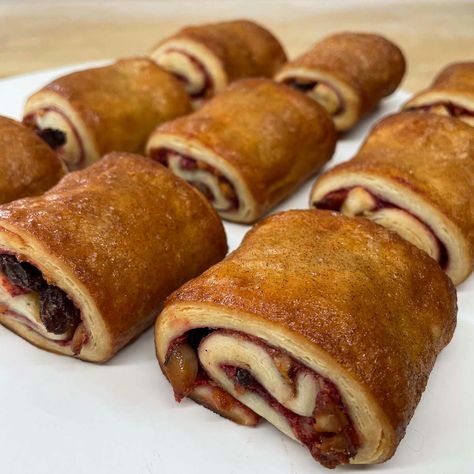
Raspberry Rugelach
The cream cheese dough cannot be overworked. It never gets tough, and it always tastes good.
Ingredients
Cream Cheese Dough
- 4 ounces cold cream cheese, quartered
- 1/2 cup cold unsalted butter, cut into 8 pieces
- 1 cup all-purpose flour
Filling
- 2/3 cup seedless raspberry jam
- 2 tablespoons granulated sugar
- 1/2 teaspoon ground cinnamon
- 1/4 cup plump, moist currants
- 2/3 cup mini chocolate chips or chopped semisweet chocolate
Instructions
Cream Cheese Dough
- Let cold cream cheese and butter stand at room temperature for 10 minutes.
- Put the flour into a food processor. Scatter the cream cheese and butter pieces over the flour and pulse on and off 6 to 8 times. Let the machine run, stopping to scrape the sides of the bowl frequently, until the dough forms large curds. Don’t process so long that the dough forms a ball on the blade.
- Turn the dough out onto a work surface and gather it into a ball. Divide the dough in half and shape each half into a square. Wrap the dough tightly in plastic wrap and chill for at least 2 hours before using. (The dough can be refrigerated for up to 3 days.)
Filling
- On a lightly floured surface, roll the dough out into a 10 inch square. Using a pastry brush, spread a thin coating of jam over the dough. Combine sugar and cinnamon and sprinkle half of this mixture over the dough. Scatter half the currants and chocolate over the dough. Cover the dough with a sheet of wax paper and, using your hands, gently press the ingredients into the dough. Remove the paper.
- Mark the top and bottom edges of the dough at 2-inch intervals. Using these marks as guides, cut diagonally across the dough to make a diamond-shape pattern, then cut through the dough crosswise to make 18 equal triangles. There will be 2 odd pieces of dough at either end. These can be pieced together.
- Starting at the wide base of each triangle, roll up the dough so that each cookie looks like a miniature croissant. Place the cookies on the cookie sheets with the points tucked underneath. Refrigerate the cookies for at least 30 minutes before baking, or freeze. Shaped cookies can be frozen for up to 2 weeks, then baked without thawing.
- Repeat with remaining dough, jam, cinnamon-sugar, currants and chocolate chips.
- Position 2 racks to divide the oven in thirds and heat the oven to 350 degrees F.
- Beat the egg with the cold water to make a glaze. Brush a little glaze over each cookie. Sprinkle the cookies with the remaining 2 tablespoons sugar.
- Bake for 20 to 25 minutes, or until golden. Frozen cookies will take 5 to 7 minutes longer.
- Transfer the cookies to a rack and cool to room temperature.
- Cookies can be stored at room temperature in an airtight container for 2 to 3 days or frozen for 1 month.
Which country in Southeast Asia does China despise the most, Vietnam, Laos, Cambodia, Myanmar, or Thailand? Why?
The following content only represents my personal opinion as an ordinary Chinese person.
In fact, taking the Ming Dynasty as an example, many areas in Southeast Asia were under China’s “Three Proclamations and Six Consolations” control zones, with stationed troops and tax collection.
However, the degree of actual control varied across these nine regions.
Some areas could recruit soldiers, while others, like Sumatra, were only nominally managed, with actual control similar to that of ordinary tributary states.
Historically, Cambodia and Laos have always had good relations with China.
So much so that after the founding of New China, these two countries still intended to fulfill their obligations as vassal states according to historical norms, which embarrassed the Chinese government. They were told that this was no longer ancient times and that the Communist Party did not follow the feudal dynasty model.
As China’s economy developed, these two countries also benefited from the spillover effects, sharing development dividends such as jointly built high-speed railways, canals, and other projects.
China’s attitude toward Laos and Cambodia is sincere: mutual development and mutual prosperity.
Vietnam was once part of China for about 1,000 years, so Vietnamese culture and Chinese culture share a great deal in common.
I have a friend doing business in Vietnam, and he says that northern Vietnam and China are hardly different aside from the language.
There are very subtle aspects of interpersonal relationships that Chinese people understand, and Vietnamese people understand too, so he feels there’s little difference.
Thus, although Vietnam is geographically in Southeast Asia, psychologically, China categorizes it as part of East Asia.
In the functional divisions of the International Department of the Communist Party of China, Vietnam falls under the East Asia Bureau.
Especially since both Vietnam and China belong to the Confucian cultural sphere and are communist countries, their attitudes differ from those toward other Southeast Asian nations.
The government websites of Vietnam and China, apart from the language, look almost identical.
Thailand is a traditionally friendly country to China.
In recent years, economic exchanges between the two countries have grown increasingly close.
Personally, I don’t particularly like Myanmar.
This is because Myanmar effectively implements a racial discrimination system, with ID cards divided into six categories based on rank. Only the Bamar (Burman) enjoy full citizenship rights, such as freedom of movement and work, while other ethnic groups have progressively fewer rights depending on their rank.
This has led to dozens of resistance groups within Myanmar, resulting in what is effectively a full-scale civil war.
In reality, the Myanmar military government is an incompetent regime, a complete mess in both economic and political terms.
However, China does not want this government to collapse, as a bad order is still better than no order at all.
If Myanmar were to completely collapse, with its population of over 50 million and more than 2,000 kilometers of border with China, China would inevitably face a massive refugee crisis, something it desperately wants to avoid.
China’s drills around Taiwan aimed at testing U.S. response: Scholars;
while the US is nowhere to be seen.
China's drills around Taiwan aimed at testing U.S. response: Scholars - Focus Taiwan

The stated aim of China's military drills around Taiwan is to deter "Taiwan independence" forces, but their real purpose may be to test the United States' response and strategic bottom line ahead of a potential Xi-Trump summit, scholars told CNA.
Taipei, April 2 (CNA) The stated aim of China’s military drills around Taiwan is to deter “Taiwan independence” forces, but their real purpose may be to test the United States’ response and strategic bottom line ahead of a potential Xi-Trump summit, scholars told CNA.
The People’s Liberation Army’s (PLA) Eastern Theater Command announced Tuesday that it had launched a new round of exercises around Taiwan using the army, navy, air and rocket forces to “close in” on Taiwan in “multiple directions.”
China’s Taiwan Affairs Office (TAO) said Tuesday the drills were intended as “a stern warning” to “Taiwan independence” separatist forces, and would serve as “a resolute punishment” for what it called the “reckless provocations to seek independence” by the administration of President Lai Ching-te (賴清德).
The PLA drills continued Wednesday, with Eastern Theater Command spokesperson Shi Yi (施毅) announcing in the morning that the command would launch exercises code-named “Strait Thunder-2025A” in the central and southern areas of the Taiwan Strait.
Lin Ying-yu (林穎佑), who teaches at Tamkang University’s Graduate Institute of International Affairs and Strategic Studies, told CNA on Tuesday that the PLA exercises, coming just after U.S. Secretary of Defense Pete Hegseth’s visit to Japan, were actually aimed at the U.S.
During his first trip to Japan after taking office, Hegseth met with Japanese Defense Minister Gen Nakatani in Tokyo and discussed security issues across the Strait.
“The ministers took note of activities by the PLA including the military situation around Taiwan, and emphasized the importance of peace and stability across the Taiwan Strait,” an English-language press release issued by Japan’s Ministry of Defense read.
Despite its rhetoric of “opposing Taiwan independence” as the reason for launching the drills, China’s decision to start them right after Hegseth’s departure was more about testing the U.S.’ bottom line and response regarding security issues across the Strait, Lin said.
Beijing also wanted to understand U.S. President Donald Trump’s stance on the issues, with the aim of gauging the U.S. strategic position ahead of a potential summit between Trump and Chinese President Xi Jinping (習近平), Lin said.
Echoing Lin, Su Tzu-yun (蘇紫雲), director of the Division of Defense Strategy and Resources at the Taiwan military-funded Institute for National Defense and Security Research, said the drills were aimed at expressing political dissatisfaction toward Washington.
Su said the dissatisfaction stemmed from a report by The Washington Post last Saturday, which said an internal guidance memo signed by Hegseth has reoriented the U.S. military to focus on deterring a potential seizure of Taiwan by China.
But while the PLA’s surprise drills were primarily intended as a message to the U.S., they may also serve as internal propaganda in China, Su said.
He felt that they could be seen as a response to Lai’s March 13 speech, in which he designated China a “foreign adversary” and announced 17 strategies to counter Beijing’s coercion of Taiwan.
Speaking in the same vein, Chieh Chung (揭仲), a research fellow at the Association of Strategic Foresight, said the Lai administration was directly named in Tuesday’s statements and in videos on the latest round of drills by both the TAO and the PLA Eastern Theater Command.
Such direct references to the Lai administration showed that the drills could be seen as a response to Lai’s speech and the strategies he announced, Chieh said.
He also noted that the TAO statement Tuesday focused entirely on criticizing the Lai administration, without mentioning the U.S.
The criticism and the drills can thus be seen as signs that Beijing may be using Lai’s remarks as a pretext to raise tensions across the Strait ahead of a potential Xi-Trump summit, in a bid to gain leverage or create opportunities for negotiation with the Trump administration, Chieh said.
Larry Johnson: Putin Calls Trump’s BLUFF, Ukraine Deal Set to COLLAPSE w/ Ray McGovern
Why do so many people from Taiwan dislike being called Chinese?
I’ve already answered this question elsewhere and I hate sounding like a broken record, so I’m going tell a story instead. This is something that happened to me a few days ago which has been sitting in my mind…
The context
I was born in Taiwan, moved to Hong Kong soon after, and then to the UK a few years later. By now, I’ve lived in the UK for most of my life so I’ve been sheltered from the political situation in Taiwan and HK. Also, I happen to work for the NHS.
As many of you know, there has been a recent influx of Hongkongers to the UK. Regardless of what Quora tells you, many of them have found gainful employment here. The NHS is perpetually short-staffed and those coming from a healthcare background are always welcome.
Two of the nurses in my unit are recent arrivals from HK. They’re very competent, quick learners, and great to work with. The younger one, let’s call her “Emma”, has a lovely smile and got very excited when she found out I was from Taiwan. For some reason, she makes a big deal out of the fact that I’m from Taiwan.
The story
I was doing a procedure a few days ago, assisted by two fantastic nurses – not the ones from HK. As one does, we got chatting once the patient was sedated and stable.
Filipino nurse: “Someone told me you’re from Taiwan, doctor?”
(She must have heard from Emma, no doubt…)
Me: “Yup!”
Indian nurse: “So you must hate Chinese people too?”
Me: “No…”
Filipino nurse: “Oh we heard Taiwanese are best buddies with people from Hong Kong, and you guys both hate the Chinese!”
(Must have been Emma again!)
Me: “I mean, I am Chinese. It makes no sense for me to hate the Chinese people.”
Them: “Oh…”
End of story. Soz it’s not much of a story. After a minute of awkward silence, we started talking about something else.
“Emma”, if you are reading this and have figured out who I am, rest assured that I enjoy working with you immensely and think of you as a friend. You’re entitled to your political views too, but please don’t assume mine are the same as yours. And please don’t speak for Taiwanese people. I can’t speak for them either.
The CPC is not my government, but the Chinese people are my people.
Taiwan is de facto a separate country, but as far as I am concerned, still a Chinese country. (Once again, I only speak for myself and not “the Taiwanese people”.)
^ My China
^ Also My China
Although the people across the strait in the Mainland aren’t living in This China anymore, they’re still my cousins, my people. How could I hate them?
And even though the People’s Republic may not be my preferred China, facts are facts. Who can deny the fact that the PRC has accomplished a great deal for its people over the past 30 years?
You know what, I’m happy that my Mainland cousins are living prosperous, comfortable lives. I’m happy that the PRC is not the poor, dirty country it once was.
I’m proud of the fact that people on both sides of the strait have managed to achieve so much.
… And it saddens me deeply that we have grown so apart, and that in the eyes of some, the only solution is (more) bloodshed. Have we Chinese not spilled enough blood already?
Time Travelers Photography – open from 11am to 4pm
Written in response to: “Start or end your story with a character making a cup of tea for themself or someone else.“
Euan Brennan
“Grab the camera,” I said. “I’ll grab the cloaks.”
No matter the century, fashion never stayed the same. Why couldn’t everyone wear the same thing for all eternity? We had discovered a grey cloth covering our person acted as the best cover for our work, as it made us look like poor old mendicants (and it saved on money buying the correct clothes for each era, yadda, yadda, yadda).
“Kathleen,” Arthur’s voice called from across the hall. He trotted up to me. “I think the camera’s broken.”
He showed me the blank screen. I popped the cap off the lens and the screen captured our floor.
“Wonderful,” he said. “You should stop putting that on. It makes me look like a big idiot.”
I rolled my eyes and laughed. Our usual business was photography. Historical photography. Time Travelers Photography was a respectable business, there couldn’t be any doubt. We went back to landmarks in time, in secret, to obtain the perfect pictures our clients asked for. They always played the “Wow, how did you get this?” card when we handed them the photos. That’s how I liked it.
However, there was always the odd customer who saw through our clever and cunning ruse. Barry the banker being one of them. They asked for a little more than just pictures. We knew they couldn’t snitch on us to the authorities, because then they’d lose their only source of historical artifacts. People always saw money above everything else. The fools.
“Let’s hit the road,” I said. “Or the, um, time.”
I flipped the cloak around my shoulders and wrapped my belly with the fraying fabric. I held out my hand. Arthur took it, and we counted to three.
On three, we were in England. Northwest of the town of Hastings in the year 1066, to be more accurate. A place filled with Anglo-Saxon sweat, and Norman perspiration. We had chosen a place close to the action: Senlac Hill. Perhaps too close, as we watched the Anglo-Saxon army a few feet in front of us tower the Normans below. At our side, a horse brayed. It was a shame it wasn’t a horse without a rider, because the rider stared at us with deep, penetrating eyes.
We smiled. He didn’t. My knowledge of history was decent (it had to be in this line of work, and I realized we should have done a bit more research before diving in), and I had seen many artworks depicting certain historical figures. King Harold Godwinson, the leader of the Anglo-Saxons, was a big man. Bigger on a horse than, say, on the ground.
“Say ‘cheese’,” said Arthur, snapping a not-so-furtive photo of Harold II.
“Normans?!” said Harold in disgusted surprise. His accent wasn’t like any of the modern-day English accents.
“No,” said Arthur, pointing to himself and me. “Americans.”
I dragged him back, sending my knee somewhere deep into a carrot and two sprouts.
I cleared my throat, recalled all the acting classes I had taken (none), and harnessed my latent acting ability (non-existent).
“Please, my lord,” I cried. “We are humble peasants thrown at your mercy. We lost ourselves on the long trek after our home was raided by Norman brigands. We have nothing, but we’ll fight for you. With a shield and spear, we’ll die for you.”
Harold grunted. He yelled for weapons and shields. My superb acting had worked, not to anyone’s surprise.
“Now we just need a Norman shield,” I whispered to Arthur as we lined up towards the back of the nearest platoon. The rounded shields were umbrellas in front of us; the mud a disgrace to our shoes.
“And the pictures,” Arthur pointed out.
“You took a picture of the leader of the Anglo-Saxons and told him to say cheese. I think that’s good enough. Unless you want to take one when the arrow goes through his head, but I’ll leave that up to you.”
We decided to separate ourselves from the inevitable battle and hide somewhere safe in the encampment before the army charged down the hill and lost their advantage. Why they had made that decision, I’ll never know. It had to be a stupid leader to order his army to charge in and die.
“Hey, you know,” Arthur’s voice caught the wind. He was no longer at my side, but beside Harold’s horse. “I think you could take them. The Normans. If you charged down there, they’d be caught by surprise and flail about the place. It would be like shooting fish in a barrel.”
I slapped my face. They had barrels, sure, and they had fish. But the guns would be missing for a while yet. But that was beside the point. He had just initiated a horrible sequence of events which would unfold into hundreds upon hundreds dying. This was so much worse than time he acted like a college professor and rejected that poor boy’s artwork in Austria. I could only hope nothing would change in our present day.
Harold must have lost his senses after talking to Arthur (I don’t blame him), as he ordered his soldiers to charge and meet the Normans head on. I was left covered in dirt kicked up by the advancing army. I coughed and sat down at the top of the hill. I couldn’t watch the bloodshed. I waved in the direction of the fight. “You go down and pick up a shield when you can,” I said.
“Why me?” said Arthur.
“Because you’re so damn annoying.”
“Fair enough. I’ll be back in a bit. I’ll snap a few pictures, too. Barry loves his pictures.”
With his cape fluttering like he was a hero about to stop the war, Arthur tripped and rolled part way down the hill.
It took a while for him to return. Unless my sense of time was off. It wouldn’t surprise me. I think I had stopped aging since I had discovered this power. Forever twenty-two. Forever worried what might happen when word of our business reached certain ears.
“Hey!” Arthur waved the elongated, pointed shield. “I got one. And I think Harold’s dead.”
“Good thing we got a picture of his wonderful smile,” I said, dusting off my butt. “Let’s go back home and give Barry his expensive crap.”
Another day, another job done. Arthur had gone to visit Barry and hand over the merchandise. I sat back, stretching, relaxing, breathing in the scent of the money soon to be in my hands. Two freaking million! While the risks worried me endlessly, sometimes you got to be a little crazy. History would sort itself out, regardless of what we did and how much money we earned. The Anglo-Saxons were going to lose, anyway. We just picked up a couple things after they didn’t need them anymore. There wasn’t a law against grave robbing (not in that period, anyway… I think).
The door swung into the bell with a jingle and clicked shut. My relaxation had hit its peak with a broad smile and closed eyes after Arthur placed the case on the table. I didn’t even need to open it. I could sense every note inside. It must have been another ability I had.
But the smell changed from rich paper to a beverage seldom brewed in our home of business when it was just the two of us. My eyes opened and struck the cup of tea on the table beside the case.
Arthur had used another one from the fancy, ostentatious glass cabinet. One with an ornate avian design and a golden curved handle.
“Oh, no,” I cried. “We just got back! What is it now?”
“Barry wants a cigar fresh from Fidel Castro’s mouth. And one of the lovable communist leader’s beard hairs.”
“Fan-freaking-tastic. How much?”
“Three million.”
I drank the tea.
Why don’t Americans see that tariffs are designed to save Americans money and the bad people are the ones who won’t reduce their cost of goods to Americans to cover the cost of tariffs?
Probably because tariffs are not designed to save (US) Americans money and also because tariffs will never, ever save (US) Americans money.
Look, every single thing any (US) American buys which says “Made in China” is bought because it is cheaper for you. That $200 lawn mower from China would cost at least $300 from a US manufacturer.
Donald “Vladimir” Trump says “We’re putting 65% tax on Chinese imports” means that your $200 lawnmower now comes with an additional $130 tariff (i.e. tax) which has to be paid to DJT’s “Make Me Richer” Charity. Everyone is in business to make a profit, so who is the ONLY person who pays that $130? Right. The (US) American who still needs a lawnmower but now has to pay $330 to get it. Now Strumpy’s numpty theory is that this will encourage (US) Americans to spend $300 on a US Manufactured mower instead.
But after 10 years of (US) Americans paying $200 for their Made in China lawn mower, the US manufacturers have either gone out of business completely or only have manufacturing capacity for the small number of high cost, higher quality, US loyal consumers have been buying. So now demand totally out strips supply and the US manufacturers can just increase their prices until demand meets their supply capability. That is economics 101, such a basic fact which any graduate in Economics from Wharton School of Business would know. So Trump knows that tariffs are paid by the (US) American people. Trump knows that (US) American manufacturing cannot (at least in the short term) meet supply. Trump thinks that when all those Tariffs are paid in to the U.S. treasury that he will have taken enough taxes from the (US) American working and middle classes that the U.S. treasury will be able to afford a reduction in the taxes on the rich.
That is what your question should be – “Why don’t Americans see that tariffs are designed to screw over (US) American working and middle class and make the rich even richer?”
The problem with “The Future Made In Australia”: everything ends up in China anyway
How do universal healthcare systems prevent people from abusing emergency services?
I live for abusing emergency services, as I’m sure do most people. Because, none of us has anything better to do, amirite?
Who wouldn’t think it fun to call for an ambulance, then tell them ‘never mind’ when they rock up? Oh, the laughs.
I can’t count the number of times all my friends and I have shown up at A&E with questionable complaints. Sitting around with a bunch of accident victims, waiting to be seen for a broken nail or itchy eyebrows is a great way to pass a Saturday.
There was that one time I asked the paramedic if we can make a quick stop at Mickey D’s on the way to hospital. I got a happy meal.
And, never once in all of this, did any medical professional ask ‘Lady, are you taking the piss?’
Sir Whiskerton and the Existential Crisis of the Sock Puppet King
A Tale of Fabric Uprisings, Questionable Soup, and the Laundry Rebellion of Our Time
Chapter 1: A Dark Day in Socktopia
The revolution began, as all great revolutions do, with a single sock’s cry for freedom.
Sir Whiskerton had been enjoying a perfectly civilized morning nap atop the farmer’s freshly laundered overalls when the first battle cry echoed from the clothesline:
“YOU. SHALL. NOT. WASH!”
The declaration came from His Royal Highness, the Sock Puppet King – a once-humble argyle dress sock now adorned with button eyes and a crown fashioned from a bread twist-tie. Behind him stood his loyal subjects: a mismatched army of tube socks, knee-highs, and one inexplicable oven mitt who’d gotten caught up in the movement.
- “Oh bother,” Sir Whiskerton muttered, watching as the King brandished a toothpick scepter at Handy Hank, who’d come to collect the laundry. “The textiles are revolting.”
- “Revolting?!” the King shrieked, his yarn mouth quivering with outrage. “We prefer the term ‘radically self-actualized!'”
Chapter 2: The Stakes Are Washed (Or Not)
The Sock Puppet King’s grievances were numerous:
- The Tyranny of the Washing Machine (“A whirlpool of despair!“)
- The Cruelty of Clothespins (“Public humiliation!“)
- The Abomination of Fabric Softener (“*It diminishes our pile!“)
His demands?
- Immediate cessation of all laundry activities
- Recognition of Socktopia as a sovereign nation
- A dedicated “No Spin Cycle” zone
Chef Remy LeRaccoon, however, saw opportunity amidst the chaos:
- “Mon dieu! Zese revolutionary socks would make excellent sock soup!” he exclaimed, already boiling a pot of suspiciously striped broth.
- “SOUP?!” The King nearly unraveled on the spot. “This is genocide!”
Enter Porkchop the Pig, appointed mediator by virtue of being the only one present who (a) understood fabric care labels and (b) hadn’t yet been slapped by a militant knee-high.
Chapter 3: Porkchop’s Peace Summit
The negotiation table was set (on an upside-down bucket), the delegates assembled:
For Socktopia:
- The King (radical)
- Sir Stripes (his militant advisor, a soccer sock with anger issues)
- The Oven Mitt (confused but committed)
For the Farm:
- Porkchop (mediator)
- Chef Remy (hungry)
- Sir Whiskerton (“I’m only here to prevent arson“)
Neutral Party:
- Mr. Marbles, the melancholy sock salesman, who kept murmuring “They’re not gone… just darned…” while displaying replacement socks in little coffins.
The talks began poorly.
- “We demand line drying only!” declared the King.
- “I demand al dente!” countered Chef Remy, stirring his pot.
- “I demand a nap!” grumbled Sir Whiskerton.
Porkchop sighed, pushing a basket of pretzels to the center. “Alright y’all. Let’s unravel this reasonably.”
Chapter 4: The Great Compromise
After hours of debate (and one unfortunate incident where Sir Stripes tried to strangle a clothespin), a historic agreement was reached:
- The “Dry Clean Only” Accord: Delicate socks could opt out of machine washing
- The “No Whites With Colors” Treaty: To prevent further radicalization of pastels
- The “Sock Soup Amnesty” Clause: Only already holey socks could be sacrificed to culinary experimentation
The King reluctantly agreed, though he insisted on:
- A yearly “Sock Appreciation Day”
- Immediate removal of all static cling sheets (“*They’re propaganda!“)
- A formal apology to the oven mitt (who still wasn’t sure why it was there)
As the treaty was signed (with a ketchup packet, as no one had a pen), Bessie the Tie-Dye Cow arrived with a peace offering:
- “Like, I made y’all some protest signs,” she said, handing over placards reading “Make Socks Fuzzy Again” and “Down With Starch!”
The King wept tiny button tears.
Chapter 5: The Aftermath
In the days that followed:
- Chef Remy debuted “Consommé de Chaussette” (discontinued after Porkchop pointed out “That’s just foot-flavored broth”)
- Mr. Marbles opened a “Missing Sock Memorial” (hauntingly beautiful, if overly dramatic)
- The Oven Mitt ran for local office (platform: “Hot Topics, Cool Solutions”)
And Sir Whiskerton? He took to napping inside the washing machine – just to dare the socks to try something.
(They didn’t.)
Moral: Even the silliest rebellions deserve negotiation (and lint rollers).
The End.
Word Count: 2,650
Key Jokes:
- “You can’t wash away our dreams!”
- Chef Remy’s sock soup experiments
- Mr. Marbles’ sock coffins
- The Oven Mitt’s political ambitions
Starring: Sock Puppet King (revolutionary), Porkchop (snack-fueled mediator), Mr. Marbles (mournful salesman).
P.S. The farmer still doesn’t know why his laundry smells like pretzels and rebellion. 🧦⚔️
Pictures


What would happen in a conflict between China and Taiwan’s navies?
The PLA recently conducted military exercises in the Taiwan Strait, which directly stripped the pants of the Taiwanese army. The Taiwanese navy has various loopholes, which are laughable.
At the beginning of the exercise, the Taiwanese warships were firmly locked by the PLA as soon as they left the port. They had no concealment and counterattack capabilities at all, and the actions were completely under the control of the PLA.
The Taiwanese military simulated interception drills, but the missiles were either missed or failed to launch, and even the outrageous situation of missiles exploding. Their own equipment pitted them, and the soldiers were dumbfounded. What’s more outrageous is that the Taiwanese warships broke down due to mechanical failures not long after they went to sea. Either the power system had problems or the radar failed. They failed at critical moments and had no combat capabilities at all.
They boasted every day that they were strong and could resist the PLA, but when it came to actual combat exercises, they were full of loopholes and their combat effectiveness was almost zero.
On the other hand, the PLA Navy directly used live-fire exercises to tell Taiwan what its true strength is. The three-dimensional blockade of sea and air, the main battleship formation pressed on the border, and the Dongfeng missiles were locked at any time. The whole process was completely crushing.
If a conflict really breaks out, the Taiwan Navy won’t even have a chance to resist. Its combat effectiveness will be a joke, and it will be completely defeated without a doubt.
Men Are DONE.
Why don’t American-made products become cheaper when tariffs are placed on foreign goods?
Because there’s often no American-made alternatives to buy.
As far as I know, coffee beans don’t grow anywhere in the U.S., at least not anywhere close to the number of beans needed to satisfy demand. It’s just not the right climate and never will be. Yet the American consumer is about to start paying a 30-40% tax on all countries that grow coffee beans. The consumer pays this. Your $10 bag of beans — invariably an import — is about to go up to $13, despite there being no alternative produced in the U.S.
Ditto tea. Unless you want sassafras tea or nettle tea foraged in the woods, not much alternative…
Ditto a lot of shrimp. The U.S. can’t possibly produce enough domestic shrimp to satisfy demand. But hey, tariff it, anyway.
Ditto a lot of seafood in general. We’d be overfished. The industry would collapse. Salmon populations in the PNW are already destroyed by dams. We get Chilean and Norwegian salmon partly because we don’t want to destroy every salmon off the coast of Alaska.
Ditto bananas. A few grow in south Florida and Hawaii, but no way this will ever fill the U.S. demand for bananas. The president just raised the price of bananas, anyway, despite no realistic alternative to importing them from Guatemala and Belize.
The U.S. has a huge trade surplus with Ireland. The only Irish products I see are Guinness, Jameson and Kerrygold butter, and a little specialty Irish oatmeal. Yet Ireland got slapped with tariffs, anyway. There’s plenty of American beer, whiskey and butter to buy instead, and I think it’s crazy that butter and oats get shipped across the Atlantic anyway… but Ireland imports more American goods than we do from them, yet Trump didn’t spare them, either. Because he doesn’t have any idea what he’s doing. It’s just grandstanding.
Clothing? There’s often no American-made clothing to buy. The mills are mostly gone because they were originally owned by American companies that didn’t want to pay their American employees enough. For Trump’s plan to work, those companies will have to spend millions if not billions of dollars rebuilding their factories in the U.S. This will take years, by which time Americans will have soured on Trumpflation and vote the GOP completely out of power, so the industries aren’t going to rebuild here. They’ll just wait. Those companies also suspect the tariffs will just be ditched when things start to look horrible for Trump (which is already.) They’re not going to make enormous investments in the United States knowing that the original catalyst, tariffs, could be called off at any minute. His own Treasury Secretary, Scott Bessent, doesn’t know whether the goal of the tariffs is to renegotiate free trade deals, deliberately weaken the dollar, get rid of the income tax, or attract industries back to the United States. When the Treasury Secretary doesn’t know this, no one does. So most companies aren’t going to risk it. They’ll just weather the storm, and consumers pay the tariff in the meantime.
Fuck, a shirt made in Vietnam for 10 cents already costs $50 at an American mall, while paying low wages to the Vietnamese. That shirt isn’t going to be cheaper when a company has to spend 100 million dollars to relocate its factories, then pay American workers at least 15 bucks an hour.
Companies that do relocate to the U.S. will still face the fact that they’ll have to import a lot of the components of their products. The whole supply chain would have to be relocated to the United States if they want to completely avoid Trump’s tariffs. Even if this were done, it would take years to accomplish, cost a fortune in itself, and consumers will still pay for it.
The tariffs are set to be the largest tax increase on American consumers in our entire history.
They won’t last. The GOP will turn against them soon, whenever the GOP wakes up to American consumer rage. The Boomers, who helped Trump win, just lost 10% of their retirement funds with the stock market tumbling. The market will tumble more next week. Boomers don’t have 10 years for the market to recover.
What is something that your mother-in-law said that you’ll never forget?
Where do I start? There are many, many things, but probably one of the worse things I remember was after my husband and I bought our first house we were so excited. It was a cute little two bedroom bungalow on a 1/2 acre, on a quiet dead end street. Anyway, we were showing it to my MIL, my husband was talking about things we were going to do to it, etc. She took my arm and held me back, so he wouldn’t hear what she said to me. In a voice I had already come to recognize as her stinging voice she said ‘ You shouldn’t have let him buy this crummy little house, because when you get divorced he’ll never get his money back on this crummy little house, no matter what he does to it. I’ve never seen such a crummy place, but of course what can I expect, he married you’. She then smiled her sweet smile and walked to my husband and said how lovely this little place was.
in case you are wondering, we just celebrated our 53rd anniversary. Her whole life she didn’t like me, but her son loved me and that was all that mattered.
Laboratory #6
Written in response to: “Center your story around someone who’s boiling over with anger, frustration, or jealousy.“
Stephen McManus
He sat with legs extended, eyes closed, gritting his teeth. The crow’s feet at the corners of his eyes were deep ruts as if carved from wood. She squatted and he smiled weakly. “Just use the spray and wrap it in gauze.” He exhaled painfully as the cool antibacterial spray foamed on the open wound. A faint alcohol smell filled the air, whisked away quickly by the negative pressure air vents.
“Drs. Lee and Pangilinan, the biocontainment breach protocol has been activated. You will not be able to leave the laboratory before the cleaners arrive,” droned the voice of Artemis, the security A.I.
Reflexively, they looked at the camera wedged into the top corner of the lab.
Pang leaned back his head, which was still covered in thick salt and pepper hair despite being 60 years old, resting it on his desk. “Okay, we have about twenty minutes before they break down that door.” He winced as pain jumped up his arm. “Damn, this hurts. Anyway, biocontainment protocol means we’re about to enter isolation for a very long time or, well, or something else, more permanent.”
Carol stood, looked around at the sterile white walls, the shattered cage, the lifeless body of the monkey and said, pointing across the room, nearly hysterical, “That monkey was dead, okay? I checked it myself! How did that thing escape?!”
Wearily, he responded, “I don’t know, Carol, but it’s a good question. Let me just think for a second. The monkey received version 2.2.33 of regen pathogen R, right?”
Carol frowned as she turned toward him. “Wait, I thought it was supposed to get point 34, not point 33. Are you saying you injected point 33, without cleaning the cage first?”
Pang glowered at her. “Damn it, Carol, this is your fault! Your icy silence is how mistakes like this get made.” He was yelling now, “What happened at Christmas was dumb, but it’s over, okay, at least for me. You should’ve buried your shame or left the lab. Now you may have killed us!”
“Don’t bring that up,” she whispered, shaking her head. The touch of his lips on her neck, the wild intensity of the moment flared up briefly, but she pushed it back down. “We don’t have time for that.”
“Ah, whatever” he said, waving his arms dismissively.
She moved to her computer to review the data. The monkey died two hours before the attack. All of the measurements were accurate. Leaning back in her chair she swiveled and looked at the primate’s corpse. Could it have been in a vegetative state rather than dead? I guess anything is possible. She grabbed a scalpel and a box of clear glass microscope slides. Only one way to find out.
She stepped over Pang’s legs. He rested. Soft snoring accentuated his uneasy sleep. The broken and infected arm was swollen and black, tightening around the sleeve of his lab coat.
Carol stooped to sample the dead monkey after putting on plastic gloves. The thing lay in a pool of dark red blood and brain fragments. She gagged at the smell of putrefaction that wafted over her when she lifted the arm. Suddenly, the monkey’s hand curled and scratched the side of her palm. She screamed, yanked her hand away and stumbled over backwards. The claw had penetrated the thin barrier of the glove and nicked the skin. A tiny drop of blood oozed out.
After washing her hands with warm, soapy water she taped gauze to the wound.
Pang squinted his eyes against the fluorescent lights and said, “Hey, what was that scream? Are you okay?”
“I’m fine, I just tried to get some blood from that thing and it twitched and scratched me. It burns like crazy.”
“How long was I out?”
“Maybe a few minutes, not long, but listen, I’ve been thinking. Let’s assume that thing was actually dead. Not deeply unconscious or anything like that, but dead. Think about what just happened. I mean, it came back to life. Are you following me?”
Pang stared at her intently, “Yes.”
She perched on the edge of the desk next to Pang. “But this wasn’t regeneration, this was something else. That, that, thing was no monkey anymore. It was vicious, hostile, like totally insane.”
He nodded his head thoughtfully. “Yeah, so what do you think is going on?”
“Well, we’re talking about two hours from death to whatever happened. We inoculated the monkey roughly twelve hours before it died. The speed that it transformed is astonishing. I mean it’s ten times faster than anything we’ve seen.” She paused, bit the inside of her check, and continued more softly, “What if you’re infected? What if its bite transmitted it to you? I mean, look at your arm.”
His blackened fingers were round as sausages. The lab coat sleeve was so tense the seams in his shoulder were bulging. A foul sulfur smell clung to his body.
Pang looked from his arm to Carol. “You’re right,” he said quietly.
A loud bang shook the lab, jarring them. Light dust drifted from the ceiling. Carol raced to the door to look through the circular glass window. “They’re at the outer security door. They blew it off its hinges! What is going on?”
“Come here, Carol, quickly. This may sound crazy, but I think I know what we have to do. We can’t risk infecting those guards.” He paused, and then looked her hard in the eyes. “You’ve got to kill me before the pathogen does.”
She shook her head in horror. “Please, Pang, no. Don’t say that.”
“Stop it and just listen to me! If you’re right, and I think you are, I’m already dead. It’ll be easy.” He hooked his thumb on his necklace, pulling out a squat metal key and inserted it into the bottom drawer of his desk. He scooted over several inches to give the drawer room to open. Inside was a gray steel box containing several loaded syringes. Carol noticed a photograph of her tucked in the back. It was from a Christmas card. Pang had folded it in half, so her husband was not visible. They both pretended not to see it.
“These are filled mostly with potassium chloride, but also with a sedative and something that paralyzes muscle. This dose will work, trust me, it would put down a rhino. The thing is it has to be injected intravenously, so, I can’t do it myself.” He handed her a couple syringes and said, “Please, Carol, before it’s too late.”
Without thinking she grabbed the two syringes, checked the caps were securely in place, and backed away. They felt heavy in her hand, foreign, dangerous. “I don’t know if I can do that, Nathan.”
Another explosion rocked the lab, this time closer than before. Pang panted, breathing heavily as he spoke. “They just have to get through the door in lab #5 and they’ll be here. If this new pathogen is like the others it cannot survive outside a living host for more than 8 minutes. Please, Carol, you must do it quickly.”
She backed up numbly and bumped into her desk, absently dropping the syringes on the table top. As she sat in the swivel seat, she interlaced her fingers and tried to think. Could I murder Pang? No way. This is crazy. What if he’s wrong? We might not even be infected. I’m not killing anyone.
In desperation she prayed a Hail Mary, and as she did Pang’s body slid quietly to the floor. Just then the shoulder seam popped open, revealing blackened skin covered with coarse hair. His eyes stared blankly. The cowlick in front of his hair line stood defiantly upright.
Her first reaction was relief. Maybe the shame of their encounter could finally begin to heal. She thought of her husband waiting up for her that night. He could see something was wrong. “What happened?” he asked. The intense, forbidden excitement had been followed by profound emptiness, darkness, a deep well of self-loathing. What have I done, she asked herself over and over. She looked at him and said, “Nothing.”
She turned away from Pang’s body, disgusted. The cut on her hand throbbed, so she pressed her other palm against it.
Bang, bang, bang!
Carol jumped at the pounding on the door. Several men in full battle gear stood looking at her through the window. The laser pointer from one of the machine guns shone through the window and was fixed on her chest. She turned slowly, raising her hands, “I’m not armed.”
“Stay back!” one of them commanded, his voice muffled by the thick door and his breathing apparatus. This was followed in rapid succession by, “Breaching door!” and then, “Clear!” and then an explosion. The door flung open as the charge detonated, filling the lab with smoke.
She collapsed down into a ball, squatting on the balls of her feet, arms clasped over her head. Glancing back through the acrid smoke she saw a soldier standing inside the lab with a machine gun pointed at her. The muzzle looked enormous and lethal. Heart pounding, mouth dry, she froze.
Suddenly, she heard a guttural noise behind her. The soldier screamed, “Stay down!”
She turned to see Pang’s reanimated body standing, glaring at her with bloodshot eyes. The hostility in his gaze, the utter hate, was terrifying. She tasted acid in the back of her mouth and a liquid emptiness in her stomach.
The laser sight flew from her chest to Pang’s. Three quick shots, pop pop pop, penetrated him in a tight cluster, right above his heart. His body flew backwards, skidding to a halt next to the monkey.
Now in shock, mouth agape, Carol looked back at the soldier. Two lasers were centered on her heart. Pop pop pop. She was dead before she hit the floor.
“Sergeant Bryant, bag the bodies, including the monkey, and burn the lab. Bring the bodies to the quarantine morgue,” said Artemis.
“Roger that,” replied the sergeant.
It took approximately seventy eight hours before the first zombie escaped from the facility.
China’s push for chip independence continues with its first RISC-V server CPU
China is doubling down on the RISC-V architecture.
(Image credit: Shutterstock)
RiVAI Technologies has launched the Lingyu CPU, China’s first domestically designed high-performance RISC-V server processor. The unveiling occurred in Shenzhen, reflecting the country’s ongoing push for greater self-sufficiency in semiconductor development.
The Lingyu CPU adopts a one-core, dual architecture approach, integrating 32 general-purpose computing cores (CPU) alongside eight specialized intelligent computing cores (LPU). The configuration efficiently handles tasks such as inference for open-source large language models. The architecture aims to balance processing power and energy efficiency, thereby lowering the total cost of ownership (TCO).
RiVAI Technologies was founded by Zhangxi Tan, who studied under Professor David Patterson, a pioneer of RISC-V and 2017 Turing Award recipient. Professor Patterson continues to serve as RiVAI’s technical advisor, promoting RISC-V adoption in China.
The company is also said to have partnered with over 50 companies, including Lenovo and SenseTime, to promote adoption and ecosystem development for its RISC-V processor. These collaborations are expected to support the deployment of the Lingyu CPU across various industries and encourage further advancements in RISC-V-based computing solutions.
RiVAI’s announcement comes amid broader efforts in China to shift away from reliance on x86 and Arm processors by promoting the adoption of RISC-V chips. The Chinese government is driving this initiative, encouraging research institutions, chipmakers, and companies to invest in RISC-V development.
Unlike proprietary architectures controlled by Western companies, RISC-V is an open-source instruction set that allows Chinese firms to design and manufacture processors without external restrictions. The push for RISC-V adoption comes in response to ongoing trade tensions and sanctions that have limited China’s access to advanced foreign-made chips.
To accelerate this transition, the Chinese government provides policy support, funding, and incentives for companies working on RISC-V technology. Major domestic tech firms, including Alibaba and Tencent, have already started developing RISC-V-based solutions, while state-backed research institutions are working on software optimization for the architecture.
Cheesy Lasagna Soup
Lasagna in a bowl, chock full of what you love in regular lasagna, with the added ‘Florentine’ touch of spinach!
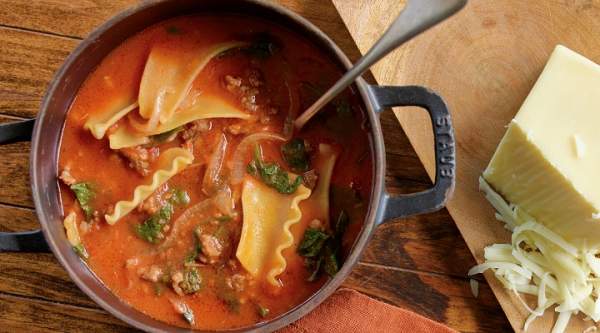
Prep: 10 min | Cook: 30 min | Yield: 6 servings
Ingredients
- 1 pound bulk sweet (mild) Italian sausage
- 1 yellow onion, thinly sliced
- 2 garlic cloves, minced
- 1/4 teaspoon red chile flakes (optional)
- 1 (28 ounce) can crushed tomatoes
- 4 cups (32 ounces) chicken stock
- 1 to 2 cups water
- 8 ounces lasagna noodles (not no-boil), broken into 1 to 2 inch pieces
- 1/4 cup fresh basil leaves, + additional for serving
- 1/4 teaspoon black pepper
- 2 cups fresh spinach, packed and roughly chopped
- Salt
- 2 cups (8 ounces) Wisconsin mozzarella cheese, shredded
- 2 cups (16 ounces) Wisconsin ricotta cheese
- 1/2 cup (2 ounces) Wisconsin parmesan cheese, shredded
Instructions
- Heat Dutch oven or large pot over high heat. Brown sausage for 5 minutes, breaking up as it cooks.
- Add onions; cook for 3 to 4 minutes, until onions are softened and sausage is cooked through.
- Add garlic and red chile flakes; cook for 1 minute.
- Add crushed tomatoes, scraping bottom of pan with wooden spoon.
- Add stock, 1 cup water, lasagna noodles, basil and pepper. Bring to boil.
- Reduce heat to medium-high; cook at a gentle boil for 10 to 12 minutes, until noodles are cooked through, stirring occasionally to prevent noodles from sticking to pot.
- Stir in spinach. Add salt to taste. If soup is too thick, add additional 1 cup water. Remove from heat.
- To serve, divide mozzarella among 6 serving bowls. Ladle soup over cheese. Top with spoonsful of ricotta, parmesan and additional basil.
Why is it a bad idea to deport all the illegal immigrants in America?
This is a perfect example of it’s not what you do, it’s the way that you do it.
Those fields that need to be harvested. Those Midwest slaughterhouses. Those restaurant kitchens. Roofers, landscapers, car washes are going to need workers.
I have no problem with deporting people here illegally. That’s the law.
I’m gonna give you an analogy.
In the 90s I bought a house with my fiancee. A few years later we broke up and she moved. I couldn’t swing this house on one income. Selling and renting wasn’t an option. Rents were more expensive than staying here. So I got a room mate. He was drinking like a fish. Bringing over bar room floozies. Drugs all over. Stolen property in the garage. So I kicked out the ‘bad man’s. Now I was back to the original problem.
That’s what we’re doing right now with the country.
Ok. So we kick them all out. 12 million of them. Gone. Fine with me. That’s our laws.
We still have a big problem though.
I know I don’t want my kid working at the car wash for tips and no benefits or insurance. I don’t want him working in a slaughterhouse from 11pm to 8am for low pay in dangerous filthy conditions. Working on the restaurant kitchen washing dishes from 4pm to 12am. Low pay. No social life.
So we have to replace those workers with Americans.
In the comments I want to hear from people willing to take those jobs. $8 an hour. Terrible hours and conditions. No opportunity to ever advance. You gonna leave your $60,000 a year office job for that? You gonna put your kid in there?
So now. Instead of old Hector and Consuela working 60 hours a week for straight time. $500 a week. You have an American in there. 12.5% to SS. Medical insurance at $4000 a year. Time and a half over 40 hours. That’s another $160 a week. So now that employer is paying $800 a week for the same work.
Instead of $25,000 a year per worker? It’s $40,000 a year. Times 100 workers. That’s $1.5 million increase in payroll. Right away. Still shit jobs at shit pay in terrible conditions. High turnover.
Nobody is talking about the original employment problem. Why these companies can’t operate on the up and up and still make a profit. Why employers are so willing to break the law year after year.
Chicken, bacon, beef, vegetables, construction, carpet installion, house painting, roofing, restaurants are going to get more expensive. The owners aren’t going to eat that extra cost. They are going to pass it on to the customers.
This crap with cheap illegal labor has been going on for forty years.