


There was a time when I was in third grade and I was exploring an abandoned, and run down wooden house at the end of town. It was covered in rambling feral flowers and vines. It was a great place to explore as a kid, whether a boy or a girl. As my sister and her best friend; Denise would explore the house with me.
This abandoned house was full of mysteries and interesting things for a kid to explore. Though, as an adult, I am absolutely shocked at what I was doing so dangerously. This house had an almost saddle shaped roof, and tons of broken windows with great dangerous shards of glass.
The most notable feature was the “black hole” floor on the second story. You could slide down the second floor bedroom, go though the living room and emerge into the damp, cluttered and dangerous basement.
We never got hurt.
But we really could have.
Such crazy times. kid-hood. OMG!
Today…
New Chinese drones scramble naval power in Pacific, and maybe everywhere else
Well worth the time to watch.
What radicalized you?
I am a teacher, and some of my thoughts about education might be considered “radical” by other teachers. I prefer to think of them as pragmatic, but whatever. What led me to these “radical” thoughts is just experience and paying attention. Years and years of those two things.
Probably my most “radical” thought on my own profession is that there is really not much hope for a “failing” school to turn things around. There are A LOT of “failing” schools here where I live in Chicago.
For as long as I’ve been working in the education field in the Chicago area, some 20+ years now, Chicago Public Schools have been hemorrhaging students while increasing spending and have had a ceiling of about 1/3 of students who can read or do math on grade level.
According to the latest numbers:
State test scores are in for Chicago Public Schools, and fewer than 1-in-3 students could read and fewer than 1-in-5 do math at their elementary grade level in 2024.
And…
And…
My “radical” thoughts on this?
THERE IS NO FIXING THIS.
It is what it is. It is what it’s been for the last 2–3 generations. No amount of money will change anything in any meaningful way.
By the way, those “proficiency” numbers are artificially inflated via Chicago’s “magnet” schools, which students have to test to get into, but still count as public schools. Those were established to stop the flood of affluent parents and their easy-to-teach kids moving to the suburbs in the 60s and 70s. Take those “private-like” schools out of the equation, and the numbers for Chicago’s public schools are, somehow, even worse.
Those “proficiency” numbers are also kept artificially higher via lower standards. The bar for “proficient” is lower now than it was just a generation ago.
The only hope for parents who give a damn and whose children are stuck in a regular Chicago public school is to get them the hell out of that Chicago public school, either by going to a private school or moving to the suburbs or even homeschooling. Hoping that the system will improve in time to benefit your child without you having to get your child out of that system is wishful thinking. It’s also condemning your child to a lifetime of playing catch up with their peers who went to better schools.
I feel the same about all failing public school districts in the U.S. I’m just the most familiar with the Chicago one.
In my “radical” mind, news about how abysmal Chicago’s public schools are is like news saying that it’s brighter outside during the day. Like… yes… that’s how it works. That’s how it’s always been. That’s how it will always be. It’s not “news.”
Politicians will continue to throw money at the problem, and lowering standards to make it seem like the money is making marginal improvements. But it’s not really improving. Because, again, THERE IS NO FIXING THIS. There’s only dressing it up to make it look better on paper.
To be honest, I think a lot of politicians are as “radical” as I am when it comes to this. I think they’re just not in a position to be honest about it. They can’t get elected on a platform of hopelessness, can they?
How to Make Rainbow Cookies

Kitchen tools, gourmet foods, baking mixes, and hard-to-find baking ingredients mentioned in this article are available at The Prepared Pantry.
by Dennis Weaver

Wendy, who published our e-books, told me that my instructions for these multi-colored cookies were not very clear. She was right. So we went to the kitchen and made new ones so that the method would be fresh in my mind. Fun exercise.
In the processes, Ally who works in our test kitchen became enamored in with these cookies. She made a batch and took them to her church supper. She said they were a big hit.
“That’s a recipe everyone should have,” she said.
But think of this as a method, not a recipe. By changing flavors and colors, you can make any combination of colors and flavors you desire. Use your imagination. In these pictures, you’ll see swirls, squares, and stripes. Ally made multi-color pinwheels with two and three colors.
These make great kid cookies, holiday cookies, and party cookies.
How to Create Your Own Rainbow Cookies
You can spend forever exploring shapes, colors, and flavors. You make these cookies by dividing your dough into three or four parts and coloring and flavoring each.
We carry over 30 different flavors—everything from root beer to wild berry to peach. We have over 40 colors.
Use food color gels, not the liquids from the grocery stores, if you can. They are much brighter and much more concentrated. You can make very bright, not faded, cookies.
Use the dough as clay and make flat strips for striped cookies or square or round ropes. Put the shapes together to make multi-colored logs, slice and bake.
We put four round ropes together and made shamrock cookies. We paired up striped cookies and made nifty sandwich cookies.
They’re pretty simple to make though making the logs seem to give folks pause. The trick is to make them uniform.
If you have a kitchen scale, use it to divide the dough portions equally. Make a rough rope out of each.
Roll each rope in wax paper. Roll the waxed paper covered logs on the counter to make smooth logs, stretching and compressing to get them uniform in length. Stroking the logs with your hands helps to make them smooth.
For square logs, press them flat on the counter, stroke with your fingers, and turn them and stroke some more. Similarly, make strips for striped cookies.
It’s easier to make the logs than it is to describe how to make them. After the logs are made, press them together and refrigerate them until the dough is firm. Cut 1/4 inch thick slices with serrated knife.
Colored Cookies
Ingredients
- 3 1/4 cups all-purpose flour
- 1 teaspoon baking powder
- 1/2 teaspoon salt
- 1 cup butter
- 1 1/3 cups sugar
- 2 large eggs
- 2 ounces unsweetened chocolate (optional)
- flavors and extracts (your choice)
- food color gels (your choice)
Instructions
- In a medium bowl, whisk the flour, baking powder, and salt together.
- Cream the butter and sugar together. Add the eggs, one at a time, beating until smooth. Continue beating until the mixture is light and fluffy. Add the dry ingredients in two parts, mixing after each. Mix just until combined.
- Divide the dough into two, three, or four parts depending on how many different doughs you choose to make.
- For one half of the dough, melt two ounces of chocolate. For one fourth of the dough, melt one ounce of chocolate. While still warm, work the chocolate into the dough until uniform.
For flavored and colored doughs
- Add two or three drops of food color gel in each one fourth or one third part. Add 1 teaspoon vanilla, 1 teaspoon almond, 1/4 teaspoon peppermint, 1/2 teaspoon cherry, 1/2 teaspoon strawberry, or other extracts to the dough and mix in.
- Form the dough into cylinders, squares, or layers—a separate color or flavor for each. Refrigerate until firm.
- Cut the dough into 1/4-inch thick slices. To form the shapes, cut each colored cylinder separately but gently press the different colored discs together on the cookie sheet. Bake on ungreased cookies sheets at 350 degrees for ten to twelve minutes or until the cookies are nearly firmed and very lightly browned. Do not over bake. Cool on wire racks.
Baker’s notes
Nuts or fruit can be added to these cookies. Maraschino cherry pieces could be added to the pink dough and almond bits to the almond dough.
When I’ve made mine, I cut the logs separately and then pressed the pieces together into the patterns. Ally pressed the logs together and then cut the multicolored logs into cookies. I think Ally was smarter.
Dennis Weaver is the founder of The Prepared Pantry, a full line kitchen store in Rigby, Idaho. The Prepared Pantry sells kitchen tools, gourmet foods, and baking ingredients including hundreds of hard-to-find ingredients.
Trump Ending 50/50 Splits in Divorce? The Truth Behind the Rumor | The Coffee Pod
Trump’s Tariff Wars Will Hurt U.S. The Most
President Donald Trump seems to believe that tariffs can help to bring manufacturing back to the States.
Trump’s tariffs have so far been aimed at four targets, the U.S. neighbors Canada and Mexico, China and, soon to come, the European Union.
During his first term Trump negotiated the U.S.M.C.A. with Mexico and Canada, a free trade zone covering the U.S. and its neighbors. He is now attempting to change the rules of it. But the way he does so is inconsistent.
On January 21 Trump promised tariffs on Canada and Mexico. On February 1 he announced them. Three days later he delayed the implementation of those tariffs. On February 27 he said the tariffs would go into effect on March 4. On March 5 he was again forced to pull back (archived):
President Trump said on Wednesday that he would pause tariffs on cars coming into the United States from Canada and Mexico for one month, after a 25 percent tariff that he placed on America’s closest trading partners a day earlier roiled stock markets and prompted stiff resistance from industry.Karoline Leavitt, the White House press secretary, read a statement from Mr. Trump on Wednesday saying that White House had spoken with the three largest auto makers, and that a one-month exemption would be given to cars coming in through United States-Mexico-Canada Agreement.
A one-month exemption is a joke. It takes years to move parts production from one country to another. There are hundreds of companies in Mexico, Canada and the U.S. which make the myriad parts that go into a car. It is an completely integrated industry which took years to build.
U.S. car manufacturers had trusted that U.S.M.C.A. would hold. Should the tariffs apply anytime soon they will have to increase their prices by hefty margins or halt their production.
Trump’s tariffs in north America can largely be seen as pressure method for gaining some valuable concessions from neighboring countries. They are part of a negotiation scheme and unlikely to be a longer term problem.
But Trump’s tariffs against China are a different animal. The Trump administration views China as a strategic enemy and would like to seriously hurt it. But China is able to hit back (archived):
Minutes after President Trump’s latest tariffs took effect, the Chinese government said on Tuesday that it was imposing its own broad tariffs on food imported from the United States and would essentially halt sales to 15 American companies.China’s Ministry of Finance put tariffs of 15 percent on imports of American chicken, wheat, corn and cotton and 10 percent tariffs on other foods, ranging from soybeans to dairy products. In addition, the Ministry of Commerce said 15 U.S. companies would no longer be allowed to buy products from China except with special permission, including Skydio, which is the largest American maker of drones and a supplier to the U.S. military and emergency services.
Lou Qinjian, a spokesman for China’s National People’s Congress, chastised the United States for violating the World Trade Organization’s free trade rules. “By imposing unilateral tariffs, the U.S. has violated W.T.O. rules and disrupted the security and stability of the global industrial and supply chains,” he said.
Trump claims that tariffs on China are necessary to stop the illegal import of Fentanyl, an addictive synthetic opioid widely used in the U.S.
China counters that it already has put strong controls on Fentanyl and its precursor chemicals. It can not be blamed for a problem that solely exists within the United States:
The reason why the fentanyl issue in the US is so serious has never been external; it has nothing to do with China, which strictly prohibits drugs. Illicit fentanyl started to enter the US market as early as the 1980s. Later, media revealed that US pharmaceutical companies concealed the addictive properties of synthetic opioids and that doctors overprescribed painkillers, leading to widespread addiction among patients. Statistics show that with 5 percent of the world’s population, the US consumes 80 percent of the world’s opioids, but still has not permanently scheduled fentanyl-related substances as a class. The almost abnormal demand has boosted the development of the illegal fentanyl market, fundamentally contributing to the proliferation of fentanyl in the US.
The Global Times points to the social causes of drug addiction:
[T]he lack of social governance in the US has exacerbated the drug problem. US Vice President JD Vance described a similar situation in his autobiography. Many low-income families live in chaotic community environments with a lack of education and supervision. This has led to many children living in adverse conditions of drug abuse and trafficking, forming a vicious cycle that is difficult to break.
China’s government spokesperson is promising to fight back:
Intimidation does not scare us. Bullying does not work on us. Pressuring, coercion or threats are not the right way of dealing with China. Anyone using maximum pressure on China is picking the wrong guy and miscalculating. If the U.S. truly wants to solve the fentanyl issue, then the right thing to do is to consult with China by treating each other as equals.If war is what the U.S. wants, be it a tariff war, a trade war or any other type of war, we’re ready to fight till the end.
Such language from China is far from the usual one. It therefore seems unlikely that there will soon be a compromise between the U.S. and China.
With respect to Europe the U.S. claims that it is importing more goods from Europe than it can export to it. That is true but does not cover the full width of economical relations. The U.S. is exporting way more services (think software) to Europe than Europe is exporting to the U.S. The total of goods and services exchanges is a wash. If the U.S. insist on putting tariffs on European goods the EU can counter adding a toll to all U.S. services. The results would be, in theory, a tie.
Tariffs however are dangerous. They distort markets and add significant costs to all participants. Their pain will be mostly felt by U.S. consumers:
All the planned tariffs would take the US tariff rate to above 20% in just a few weeks, the highest since pre-WWI. As Joseph Politano points out, the costs of these actions are enormous, covering $1.3trn in US imports or roughly 42% of all goods brought into the United States, or the single-largest tariff hike since the infamous Smoot-Hawley Act of nearly a century ago.
…
The total costs of these tariffs would raise $160bn from US consumers and businesses paying more for their purchases of imported goods, with more to come. Trump’s Tuesday measures are only 40% of his proposed measures. If the next batch is implemented, it would raise the cost of imports to over $600bn, or 1.6% of GDP.
…
So worried is the International Chamber of Commerce in the US, that it reckoned that the world economy could face a crash similar to the Great Depression of the 1930s unless Trump rows back on his plans. “Our deep concern is that this could be the start of a downward spiral that puts us in 1930s trade-war territory,” said Andrew Wilson, deputy secretary-general of the ICC. So Trump’s measures may go well beyond “a little disturbance”.
Posted by b on March 6, 2025 at 15:55 UTC | Permalink
Would you rather live in USA or Mexico? If Mexico really is as bad as they say it is then why do so many people vacation there to the beach resorts and things?
I’d like to spend a big portion of the year in Mexico and the rest in the United States. I like and dislike things about both countries. On balance, I dislike the United States more and I’m more bothered by its potentially crappy future, but I’ve never lived and worked in Mexico. Tourism and real life are different things.
I’m skeptical of the rosy, self-promoting ejaculations of “expats” and absurd influencers who say it’s all peaches and cookies and mojitos and nice soft coconuts in your face. I know it’s not, though those things may happen SOME of the time. Mexico is also not “cartels and dirt and the dishonest filmmaker’s yellow filter and a billion imaginary monsters ready to kidnap and eat you.”
Mexico and the U.S. have one huge thing in common: a lot of annoying foreigners have really comical and exaggerated views of how dangerous they are. What many Americans think about Mexico (“dangerous shithole”), much of the world thinks about the United States.
In Mexico’s case, the annoying foreigners tend to be Americans, mostly older Americans, who are just gullible about everything they hear through the grapevine, then when it comes to daily reality in other countries, they don’t know piss from peanut butter because they’re sheltered or they just have no curiosity. Younger Americans don’t tend to be so scared of their shadow, but there are definitely older Americans who think Mexico is fantastic and have retired there. Most American retirees in Mexico don’t seem to miss the U.S., but most of them made their retirement money in U.S. dollars on U.S. salaries, so they’re not living in the worst parts of Mexico. They can have pretty rosy views.
In the case of the U.S., the annoying foreigners usually come from Europe and the snooty sections of the smug Commonwealth bourgeoisie. (Ordinary working-class Europeans and Australians, for example, don’t tend to think the U.S. is all that bad or dangerous. This opinion mostly comes from “educated” snobs with an axe to grind against American politics.)
Most Americans who think Mexico is universally dangerous haven’t been there. Meanwhile, the bourgeois snobs who think the U.S. is really dangerous have either never been here at all, haven’t been here in 40 years (the 1980s, the last time they visited, were more dangerous), or they’ve only traveled superficially, usually to the most screwed-up, uncharacteristic and frankly bizarre parts of the United States like L.A., Las Vegas and Miami, or because some engineering company sent them to the most desolate back hollers of West Virginia. That was their takeaway. For every really nice place in the United States, there’s somewhere else that isn’t that great. Mexico is the same.
Cancún, Puerto Vallarta and Mexico City aren’t characteristic of all of Mexico. But you’re definitely not taking your life in your hands by going to Puerto Vallarta, Sayulita, Guadalajara or Querétaro. If there are lots of Americans going there, it’s not dangerous unless you do stupid things (drugs) or maybe if you’re a woman (I’ve seen American women sexually harrassed in Mexico far more often than in the United States.) You could put yourself at a lot of risk in northern Baja California without being in any serious risk at the southern tip of Baja unless you deliberately go out and do dumb things. Almost every time an American tourist gets killed in Mexico, it turns out that tourist was doing something stupid.
If you do stupid things in the United States, you’re probably going to end up in trouble, too. Don’t do dumb things and you’re almost certainly going to be fine. Don’t trespass, cooperate with the cops, stay away from drugs and the hood.
The beach resorts that most gringos go to aren’t like the rest of Mexico any more than a nice place like Key West or even a drug-ridden, crummy, low-class dump like Myrtle Beach are a good description of the entire United States.
I’ve been to places in Mexico that had 10,000 more culture and sophistication than some little boondock towns in America (in some American towns, you occasionally get the feeling that you’re surrounded by cannibals.) But I’m not crazy. Most towns in Mexico aren’t sophisticated, either. Some parts of Mexico are awful. Charleston is about two hours south of Myrtle Beach and has a completely different feel. Same in Mexico.
I think I’d rather retire in Mexico. I’m looking at 25–30 years down the road, when I think the U.S. will be a lonely, dysfunctional, haggard, impoverished, broken down country thanks to our inhuman technologies and the broken nature of both our political parties (yes, both). I hope this never happens, but the U.S. looks less appeealing to me every year. Not sure what’s going to happen in Mexico, but I’m more optimistic about its future.
I love the natural places of the U.S. I’d definitely miss the Pacific Northwest rainforests, the Great Lakes and the Appalachian Mountains if I lived permanently in Mexico. Fortunately, while I really like the American Southwest, it already has a lot in common with Mexico. I wouldn’t have to worry so much about missing the Southwest. Strangely, I would miss the occasional Midwestern blizzard. I love the sight of sunny blue skies on fresh snow in an American forest. That’s not common in Mexico.
Why do many countries follow the policy announcements made at China’s ‘Two Sessions’?
It is the only meeting on the planet where experts advise the politicians, and politicians prepare broad policies based on input from the experts
The CPPCC – the Experts basically known as Chinese People’s Political Consultative Conference will examine over 200,000 separate pieces of suggestions, inputs over the course of a year and outline their predictions for the next few years in Energy, Agriculture, Economics, Culture, Society, Tourism, Technology and Medicine
The Party officials at the Party Congress will examine these and make policy with focus on :-
- Policy Space
- Deficit Spending
- Investments
- Global Uncertainties
- Local Problems and Challenges
It is unique because in other countries, the experts advise behind close doors and the politicians present the proposals
In China, it’s a total combination of experts and politicians presenting the policies for the world to see
Why do many countries follow the Two Sessions
In 2018, it was proposed that the Real Estate Market was too hot and unrealistic and houses should be built to live in and not gambled
Had anyone paid attention , they could have anticipated the move of XI Jinping in 2020/21 and off loaded their holdings in real estate
In 2020, it was proposed to increase EVs and EV Charging and had the other vehicle companies woken up immediately, by today BYD might not be so dominant as it is when it comes to Electric Cars and Hybrids
In 2023, AI was emphasized and integrated into Physical Models and today Deepseek , Qwen, Gan, Ernie and many others are already established and galloping
So the Two sessions is very illuminating
This year people are waiting for STIMULUS!!!!!
A Huge Stimulus could boost demand or China may wait 1–2 years for maximum natural demand to raise before implementation of Stimulus
People are waiting for more opening up for Private Foreign Investors
From 8% to 24% would result in a flood of FIIS coming into China but could cause the same problems as we see in India
For the second largest economy , the Two Sessions decides the course of Global Trade and economy for the next 11 months
The Forest is My Cage
Submitted into Contest #279 in response to: Write a story about a character who’s lost.… view prompt
Virtual Chesse Emporium
The pulsing got worse as the farmer continued. He walked and walked and walked, but the path never seemed to end. The farmer looked around for a sliver of the nearby countryside, but he was surrounded by a cage of trees. The faint sound of running water met his ears. He continued walking until he reached a waterfall spilling into a lake. At the water’s edge, a little girl in a red cloak sat in the soft dirt. She hummed to herself, floating flower petals and leaves in the cerulean water. A basket laden with cakes and fruit teetered dangerously on the lake’s edge.
“Excuse me miss, will this path get me home?”the farmer asked. The girl turned, her face full of freckles and her mouth of cake. She shook her head, wiping her face clean.
“That path? That’ll get you nowhere. Take that one on the right.” Once again, another path appeared. The farmer thanked her and started walking.
“Wait, before you go.” The girl grabbed a gold apple and pressed it into his hands, “The trip can be long, you’ll need your strength.” With a gap toothed grin, the girl skipped back to the waterfall while the farmer continued down the path. He whistled and bit the apple, but immediately spat it out. The delicate, golden flesh hid a colony of squirming worms and maggots. The pain behind his eye bloomed as he threw the apple aside. As soon as it touched the ground, the forest went suddenly silent. The farmer tensed and glanced up at the trees. Every single bird stared down at him, their beady eyes peering into his. The deer, the rabbits, the squirrels, every animal was standing stock still, staring at the farmer. The farmer hurried away, hand over his eye, heart racing in his chest.
The animals didn’t chase him. It was much worse. They slowly walked after him, breaking sticks and crunching leaves under their hooves and paws. The pain behind the farmer’s eye was becoming unbearable. Tears kept pouring down his face as he hurried down the suddenly overgrown path. With each step, he tripped over branches, stumbled over stones and cut his legs on bramble bushes.
The sunny path was darkening rapidly. The farmer gazed at the sky. Gray clouds were overtaking the sun, like spilled ink spreading on a page. Every tree the darkness touched began to rot, their bark flaking off and crumbling beneath the animals’ feet. The farmer broke into a run. What would happen if the darkness touched him? Would he crumble apart like the trees behind him? Would his home crumble? Would he even reach his home?
A flash of white caught the farmer’s eye. A man and woman in flowing white robes laughed together as they walked along the road. The farmer hurried over to them.
“Please, can you show me the way out?” he asked frantically, “Something’s terribly wrong, I need to get home.”
“My dear man, why would you wish to leave?” The man asked, “It’s beautiful, it’s wonderful, stay with us!”
“Don’t you see what’s happening?” The farmer insisted, “Look around you!” The sky was now full of ugly, red, undulating clouds, reaching their tendrils out to the farmer. The animals were still walking towards the group, their flesh beginning to rot like the trees. The woman smiled and grasped his hand.
“You must be tired, dear. Have an apple.” She pressed a visibly rotten apple in the farmer’s hands. Maggots squirmed out of the soft flesh, crawling between the farmer’s fingers and up his wrists. The white robed man smiled sadly and pulled the woman close.
“I see, it’s almost your time, friend. I suppose we’ll see you soon.” The couple waved at the horrified farmer. As he backed away, the couple’s eyes turned milky white, their teeth turned brown and fell from their mouths, and their skin began to crumble. The farmer ran as the couple collapsed behind him, the rotting animals following in his path.
The path was now completely overgrown. The farmer forced himself over tangled vines and slapped branches out of the way. His eye was now so painful, he was surprised blood wasn’t pouring from his streaming eyelids. The sky was full of crimson clouds, but they gave space to a pitch black moon with a white ring around it. This was the sky of hell, not of home. Was his wife witnessing this? Was she experiencing hell too?
In the red gloom, a small cave finally revealed itself. With a relieved sob, the farmer dove into the cave, pressing himself to the side of the rocky wall. The animals outside stalled, walking in circles around themselves. It wasn’t escape, but a small reprieve. The farmer gasped, sinking to the ground.
“Please save me…” the farmer whispered to himself, “Anyone, please save me…”
“That’s the same thing my children said when you killed them.” A lilting voice remarked. The farmer hastily crawled out of the cave. What followed was a tall, gorgeous woman in an orange gown. She glowed like a candle amidst the hellish black foliage.
“What are you talking about?” the farmer gasped.
“Exactly what I said. When you set my children ablaze after they denied you your precious fruit, they cried out for me to save them.” She gazed bitterly at him, her hands clasped tightly to her chest, “But you knew I’d gone to the village that day, that’s the only reason I didn’t kill you.” Her mouth curled in a terrible grimace, “And all for apples. You killed my family for apples!” She hurled an apple into the farmer’s stomach. He coughed as he gazed into the clear, golden skin. Memories began filling his head. Baskets full of apples being snatched from his hands, blinding rage, torches being flung against young trees, terrified screams, buckets full of water cooling off the skeletons of trees. The charred corpses of wood nymphs.
The night was silent except for the strolling animals. The farmer stared up at the woman, tears filling his eyes.
“My anger blinded me…,” he said faintly, “I overreacted, I didn’t mean to hurt anyone-”
“Don’t try to defend yourself!” The woman sobbed. She glowed brighter and brighter as she cried, “My children just needed to replenish their magic, they would’ve given you everything you wanted! Your greed damned my family, damned every creature in our home!” The farmer looked back at the colony of animals and trees, all of them his victims.
“Please… how can I fix this?” he asked, “I’ll do anything you ask.”
“There’s nothing you can do.” the woman sniffed, “I won’t abide by the greed of humans anymore. I’ve already gotten started at your home.” The farmer’s heart nearly stopped. He threw himself at the woman’s feet.
“Please, punish me all you like, but please don’t punish my wife-”
“Your wife? She’s unharmed.” A swirling orange ball of light grew in the woman’s hand. The farmer peered inside the ball to see his wife. She wasn’t in pain, and she still had the same crooked grin he’d fallen in love with. She was laughing with neighbors while pulling weeds from the garden. The sun played with her golden brown braids, and a pretty pink flush colored her cheeks. And the garden behind her was flourishing! Every flower was in bloom, and every fruit and vegetable was plentiful. She could get barely more than sprouts and shriveled produce for months. That was until the farmer planted the golden apple seeds in the soil. Now they had enough crops to last for years, much to the village’s delight. They’d had happy customers for months, the farmer and his wife even bought a bigger house to celebrate.
“You spared her?” the farmer asked.
“She’s done nothing wrong. No one else should be punished for your greed.” The woman smiled at the ball of light, “She’s delightful to be around. I’ve had a wonderful time with her.
“Are you…” The farmer stumbled over his words, “Are you living in my house? What are you doing with my wife?”
“Helping her care for your farm. My remaining children and I have been with her for quite some time. It’s good to be around nature.” The woman’s pleased smile turned more ferocious, “But I’ve also been making your wife tea, a special brew with a forgetting spell. Gradually, she’ll forget your pathetic existence. And so will everyone in the village. Our tea bags have been selling wonderfully.” The animals crept closer. The farmer began to cry.
“Please, I’m sorry-”
“I’m sure you are. But the time for apologies has passed. I just hope after this, you’ll feel a fraction of the pain you caused my children.” The woman picked up the apple she’d thrown and took a bite. She nodded at the surrounding colony of animals, “Begin.”
The farmer was hoisted into the air. He tried wriggling free as the birds he killed lifted him by the arms. They soared through the sky, slamming the farmer into branches that scratched his face and neck. Lightning flashed through the red clouds as the birds lowered him to the familiar waterfall. But instead of an oasis, the lake was a churning void of black water. The light of the pale moon showed rotting hands reaching out to him. The farmer recognized the washerwoman’s milky blue eyes, the freckled girl’s decaying smile, and the couple’s torn white robes shrouding their crumbling bodies.
“My friend, it’s finally your time!” the robed man said excitedly, “Come in, come join us!” The farmer was unceremoniously dropped into the lake. Everyone grabbed him and pulled him closer to the whirlpool. The farmer thrashed away, gripping the rocky edge of the lake for dear life. The dead rabbits, squirrels and deer attacked, biting and stomping on his fingers until they were bloody and broken. He slapped the animals away and dragged himself free of the water, grazing the orange slippers of the tall woman.
She said nothing to the farmer as he begged and pleaded for forgiveness. She only took another bite of apple, smiled, and kicked him back into the water. The rotten spirits of the wood nymphs trapped the farmer in a cage of arms. He could do nothing but sob as he was pulled underwater. One hand grabbed his face, plunging their finger in his pulsing right eye. The farmer screamed and clawed at the hand, but the finger only sunk in deeper. The last thing the farmer sees is the delighted smile of the woman, and the black moon blurred by the blood flooding his remaining eye.
A soft hand on his cheek stirs a farmer awake. He opens his eyes to see a woman with soft blue eyes leaning over him. A basket laden with clothes sits by her side.
“Excuse me sir, are you alright?”
The farmer’s right eye twitches.
End
Wang Yi raised 5 questions to the US, asking it to rethink what it has achieved from the tariff and trade wars. What’s your opinion on his remarks, and how do you think China-U.S. relations will develop moving forward?
- What the US has achieved from the tariff and trade wars these years?
- Whether its trade deficit has widened or narrowed
- Whether its manufacturing has become more or less competitive
- Whether its inflation has gone up or down
- Whether the lives of its people have become better or worse
I think these are 5 good questions that strike at the conscience of American politicians, and the answers are self-evident. However, the current US government insists that tariffs are an “effective deterrent” against China, and the Biden administration has not lifted the tariffs imposed during Trump’s first term in office.
It shows that the US government doesn’t care at all about the well-being of specific industries or the feelings of its own people. They simply rigidly enforce their hegemonic policies, and their system lacks any self-correcting mechanism. This is nothing more than stepping on the gas pedal when the car is about to lose control.
As for China-US relations, the problems are entirely the responsibility of the US side. This reminds me of China’s statement a few days ago.
If war is what the U.S. wants, be it a tariff war, a trade war or any other type of war, we’re ready to fight till the end.
I hope that this language, which is the only one American politicians can understand, will help them make the right judgments.
She Left CRYING When She Found Out No Man Will Commit to Her
Is the Canadian boycott of American products having a noticeable effect?
Here’s the one thing that VAST AMOUNT of American citizens don’t bother learning.
Most companies have a profit margin between 2% to 10%. That’s net profit margin.
If those companies lose 2% to 10% of their sales they are kaput! Dead! Gone! Bankrupt!.
One thing I see in this site all the time is stuff like, “So what if there’s a boycott? Those companies make billions. They’ll be ok.”
Any boycott has a noticable effect.
Here’s an example. A very simple example.
You have a company. It has a net profit margin of 5%. You have a million dollars worth of sales each year. $1,000,000. Your income after taxes, paying employees, rent, insurance, keeping the lights on, is $50,000 a year.
If lets say? You post political signs all over your business. The local community is 50% on the opposite side. They decide to boycott your business.
You just lost your business. Your finished. Done. If 10% decide to boycott your business you might be able to lay off an employee or cut other expenses but it will be noticable. You may still be done for.
Look at the current stock market. Giant drops. Tesla stock has been tanking like crazy.
People in this country really need to sit down once in awhile and read a book. Learn how things work.
US is 4.95% of the worlds population. 95% of our customers are out there. We really don’t need to be crazy and offensive that we generate boycotts.
What’s the most dumb business decision you’ve ever seen?
American Ronald Wayne could be a billionaire with a fortune estimated today at US$ 300 billion. He could. But he isn’t.
Ronald Wayne
In 1971, Wayne, an experienced engineer, met two young men at Atari who had some ideas for starting a company: Steve Jobs and Steve Wozniak . The engineer’s experience was essential for the young men to be able to set up this company, which they decided to call ” Apple “. Wayne was even responsible for designing the company’s first logo. As payment, he received a 10% stake in the new venture.
However, 12 days later , feeling that there were too many “potholes in the road” and that he “couldn’t risk it”, he decided to sell his 10% back to the young people , for a measly US$800 (!).
Throughout his life, he always said he did not regret his decision, as he led a successful life as an engineer in several companies until his retirement. Apple’s market value is estimated at $3 trillion, so he could be worth around $300 billion.
Wayne never had the life of a billionaire, but he did have a comfortable life and currently lives a quiet retired life in California.
Sir Whiskerton and the Case of the Missing Moo Juice: A Tale of Dairy, Deception, and Squirrel Shenanigans
Ah, dear reader, prepare yourself for a tale of stolen milk, underground smuggling, and one very determined feline who proved that even the most cunning criminals are no match for his sharp mind. Today’s story is one of mystery, mischief, and the importance of protecting what’s dear to us—especially when it involves moo juice. So, grab your sense of adventure and a glass of milk (just in case), as we dive into Sir Whiskerton and the Case of the Missing Moo Juice: A Tale of Dairy, Deception, and Squirrel Shenanigans.
The Disappearance
It all began on a quiet morning when Bessie the Tie-Dye Cow strolled into the barn to find her beloved moo juice—otherwise known as milk—completely gone. “Where’s my moo juice?!” she bellowed, her tie-dye spots quivering with outrage.
“Juice!” echoed Ditto, who was busy practicing his echoing skills by repeating Bessie’s every word.
The other cows were equally distraught. “This is an outrage!” Doris the Hen squawked, even though she wasn’t a cow. “First my eggs, now the moo juice? What’s next? The hay?!”
Sir Whiskerton, ever the detective, stepped forward. “Fear not,” he said, his green eyes narrowing in determination. “I shall solve this mystery and return your moo juice to its rightful place.”
The Investigation Begins
Sir Whiskerton began his investigation by examining the barn for clues. He found a few drops of spilled milk near the door and a tiny paw print on the windowsill. “Interesting,” he murmured. “It seems our culprit is small, nimble, and… possibly furry.”
“Furry!” echoed Ditto, who was now juggling three acorns.
The trail led Sir Whiskerton to the edge of the farm, where he discovered a hidden entrance to an underground tunnel. “This,” he said, “is no ordinary theft. This is the work of a professional.”
The Squirrel Smuggling Ring
Sir Whiskerton ventured into the tunnel, where he discovered a secret underground lair filled with stolen moo juice. The culprits? A gang of mischievous squirrels, led by a particularly smug ringleader named Nutters.
“Well, well, well,” Nutters said, twirling his bushy tail. “If it isn’t Sir Whiskerton, the so-called ‘great detective.’ What brings you to our humble abode?”
“I’ve come to put an end to your moo juice smuggling ring,” Sir Whiskerton replied, his voice calm but firm. “Your days of dairy theft are over.”
Nutters laughed. “Over? Oh, my dear feline, we’re just getting started. Do you have any idea how much moo juice is worth on the black market? It’s liquid gold!”
The Showdown
As the squirrels prepared to make their escape, Sir Whiskerton sprang into action. Using his quick reflexes and sharp mind, he outsmarted the squirrels at every turn. He tipped over barrels of moo juice, creating a slippery mess that sent the squirrels sliding in all directions. He then enlisted the help of Rufus the Dog, whose glowing green fur and loud barks scared the squirrels into surrendering.
“Alright, alright!” Nutters squeaked, raising his paws in defeat. “You win! We’ll return the moo juice.”
The Moral of the Story
As the moo juice was returned to the barn and the squirrels were sent packing, Sir Whiskerton took a moment to reflect. “The moral of the story,” he said, “is that greed and deception may lead to short-term gains, but they always come at a cost. Whether you’re a squirrel, a cow, or a cat with a knack for solving mysteries, honesty and integrity are the true keys to success.”
“Success!” echoed Ditto, proudly.
A Happy Ending
With the moo juice safely back in the barn and the squirrels banished from the farm, the animals returned to their peaceful routines. Bessie the Tie-Dye Cow celebrated by hosting a “Moo Juice Festival,” complete with milk tastings, cheese platters, and a performance by Ferdinand the Duck.
As for Sir Whiskerton? He returned to his sunbeam, content in the knowledge that he had once again saved the day. And as he drifted off to sleep, he couldn’t help but smile at the thought of Nutters, the smug squirrel, sliding across a puddle of spilled moo juice.
And so, dear reader, we leave our heroes with the promise of new adventures, new challenges, and hopefully, no more missing moo juice. Until next time, may your days be filled with laughter, love, and just a little bit of feline genius.
The End.
How badly will American manufacturers be hurt by retaliatory tariffs by Canada against American goods? How will all this economic warfare likely play out, in the long run?
Trump’s tariffs on imports from Canada will hurt a lot of US manufacturers and farmers by increasing their input costs.
Canada’s retaliatory tariffs will hurt a lot of US manufacturers and farmers by reducing their sales.
Canadian’s voluntarily boycotting US products will hurt a lot of US manufacturers and farmers by reducing their sales, even on products not affected by tariffs.
Trade wars suck and there are no winners. This will hurt both sides 🙁
As to how it will play out in the long run, that’s impossible to say given that your LIC (Lunatic In Chief) changes his position so fast it makes everyone dizzy:
– We don’t need Canadian resources.
– We need to build the Keystone XL Pipeline (sole purpose – ship Canadian oil to US refineries)
– Tariffs will start tomorrow.
– Tariffs delayed for a month.
– Tariffs started yesterday.
– Tariffs delayed for a month.
– Tariffs on Canadian dairy starting as soon as today.
We’re all in for a wild, and very unpleasant, ride.
If you like my answer, please upvote.
WaPo Laments Loss Of News From Iran Which Is Not From Iran
Here is a funny incident in which a mainstream media headline is debunked by the sub-headline following it.
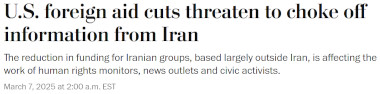

biggerU.S. foreign aid cuts threaten to choke off information from Iran (archived) – Washington Post
The reduction in funding for Iranian groups, based largely outside Iran, is affecting the work of human rights monitors, news outlets and civic activists.

The piece laments that certain propaganda groups run by Iranian exiles have, under the Trump administration, lost the funds they need to run propaganda campaigns against Iran.
The cut-off of U.S. funds for these groups does not choke off information from Iran. There is plenty out there from the Iranian government as well as from people of all kind who are living in Iran. What is choked off is the distribution of highly selected (or even made up) (dis-)information by anti-Iranian groups in London or Los Angeles.
The piece itself admits this:
The organizations supported by the United States are largely based outside Iran and fall under the umbrella of “democracy promotion.” They include news organizations, programs supporting civil society and monitors collecting information on human rights abuses.Most of the U.S. support for these groups comes from the State Department’s Near East Regional Democracy fund, known by the acronym NERD, which set up in the aftermath of the 2009 protests by Iranians against their government. In 2024, the Biden administration requested $65 million for NERD, including at least $16.75 million for internet freedom, according to the Congressional Research Service.
…
Most organizations that receive U.S. support operate entirely outside Iran. “Most of their work was collecting the statistics and data from other organizations. They don’t have their own sources inside Iran,” said Arsalan Yarahmadi, a founder of the Hengaw Organization for Human Rights, one of the most prominent Iranian human rights organizations, which operates with a network of sources inside the country. He said his group does not get U.S. funding.Yarahmadi said some of the groups that receive U.S. funding do important work but others do little. “Some, all they have is an Instagram page,” he said.
Arsalan Yarahmadi is an Iranian of Kurdish heritage who has left Iran eight years ago and now lives in Erbil in the Kurdish region of Iraq. He seems to dislike the U.S. financed competition to his own propaganda outlet. His Hengaw organization is registered in Norway. Its website gives no hint on who finances it.
The WaPo writer, Susannah George, also laments that the lack of information from outside Iran is effecting the work of “news outlets” which write about Iran.
Is she admitting that part of her job as a Washington Post writer in the Middle East is to copy-paste the press releases by anti-Iranian groups which were financed by the U.S. government? How else could one interpret that?
US Banks Abruptly Close Accounts Creating Panic
Did Napoleon lose his army due to Russia’s scorched earth policy instead of on the battlefields?
No, this is a myth, and sort of the reverse is true. The Patriotic War of 1812 is a textbook example of defense, channeling, and maintaining the initiative to the point of being able to choose the most advantageous locations for fighting. Even when Napoleon won battles or at least inflicted heavier losses, he still lost because he was fighting on Russia’s terms, not his.
The Battle of Maloyaroslavets on October 24 during his withdrawal from Moscow was one of the most important engagements in the whole campaign because it forced Napoleon to retreat along the same route he had advanced.
So in a sense, Napoleon lost due to scorched earth tactics, but by his own army. They looted everything not nailed down on their way in, and consequentially there was nothing left to eat on their way out.
Like every other democratic western incursion into barbaric Russia, there were various copes to explain how a western army lost to barbaric Russians. It wasn’t superior tactics or fighting ability, oh no. It was due to the weather and muh scorched earth.
Shorpy





Paper Snowflakes
Submitted into Contest #279 in response to: Write a story about a character who’s lost.… view prompt
VJ Hamilton
Bits of wood and paper drifted onto the scuffed concrete floor. Sammy snipped once more this way and that. “Whee!” he said, unfolding his snowflake and flapping it for her to see. Faelyn looked up from her carving. Ouch. The chisel left the wood and landed in the fleshy part of her thumb.
Dad looked up from his screens and frowned at Sammy. “Not that nice white paper! Why’d you use that?”
“I said he could,” Faelyn said, sucking briefly at the dash of red on her thumb. “I told him to use the good paper for decoration.” She motioned around the 9-by-12-foot air-locked room, where above the shelves was a strip of hooks for common tools: axe, drill, broom, shovel, mallet, crowbar, and implements she couldn’t name.
“Decoration? Here?”
“Tomorrow’s winter solstice,” she said. “I thought we could put up a few snowflakes. You know, a surprise for Mom?” From picture books the children knew this used to be a season of snow and pine trees.
“Tell me about snowflakes, Daddy,” Sammy said.
Dad’s face softened. “In olden days the snowflakes used to pile up… this high.” He raised his hand well off the floor. “We’d get so many, we had to shovel them away.”
“Shovel? Like dirt?”
“Like dirt, yeah.” Dad gave a small un-funny laugh, shook his head, and turned back to his screens. There was a clink of glass on glass.
Faelyn looked in the First Aid kit, sighed, then improvised a band-aid from masking tape and toilet paper. She resumed her carving, a comb she was making for her mother’s birthday. She worried that Mom was lost but did not want to upset her brother. Or annoy her father.
Sammy pinched his paper snowflakes and flew them around like superheroes. After a while, he and his sister decided to put them up.
They strung them from the empty tool-hooks. The hooks were easier to reach than last year, thanks to her recent growth spurt.
She peeked at the four screens on Dad’s desk, pretending to be adjusting the décor. Camera feeds came in from 32 places nearby: mainly drab buildings and vacant streets where tumbleweeds bounced. In the open areas, jagged trunks of dead trees protruded like finger bones.
“Where’s the chicken?” Sammy said, approaching the desk.
“Nothing there yet,” Dad said, tapping the view from Camera 3, which showed the empty chicken trap in their backyard.
They watched Camera 21, where three persons appeared from behind a shed. All wore masks – a necessity most days against the dust and ash – but only one person wore an expensive air supply tank. Despite the added weight, this person was walking more energetically, more purposefully.
“What’s happening?” Sammy said.
“Someone’s doing a rescue,” Dad said. “Looks like the Torrentos got caught in bad air—without their tanks. Hah, that’ll teach ‘em!” The oxygen-starved atmosphere was a constant threat. Sometimes the weather gave nearly normal air, tempting people to go outdoors to work or collect supplies. Or simply to walk about for exercise. But the weather changed hourly. People could get quickly trapped in a suffocating environment and become disoriented, especially when smoke or dust obscured visibility. Then the patrol volunteers had to go out to find people and bring them back indoors.
“A rescue! Doo-di-doo! Super Snowflake,” Sammy sang triumphantly, grinning at his paper cut-outs. “Tell us about safety, Daddy.”
“No, you tell me.”
The boy grew solemn and recited, “Mommy said to stay cool, stay inside on bad-air days. Mommy said to keep eating healthy and doing school and exercise.”
“And bring your own shade on hot days… like Mommy does,” Dad said. He told Sammy the story about a cuckoo bird that laid an egg in the nightingale’s nest. When the egg hatched, the cuckoo nestling pushed all the baby nightingale birdlings out of the nest. “So be careful,” he whispered, “and guard your nest.”
Sammy shivered and turned back to the screen. “Hey, look!”
The three figures became larger when they were picked up by Camera 22. The person with the air supply was leading two middle-aged people to a house. “Hey, that’s the Torrentos and–” Faelyn started to say but broke off. She couldn’t bring herself to speak the name of her secret crush aloud. She reddened.
“Who, Ludek? That freak?” Dad tossed back the last of the gin in his glass.
“He’s helping them,” Faelyn said. Ludek, Ludek, her blood sang. She got a broom from a tool-hook; time to sweep the paper and wood scraps.
“Hah, maybe those Torrentos will learn a lesson,” Dad said. “Those sightseers – out traipsing around.”
“They had to go out,” Faelyn said, as she pulled the broom across the floor. “Essential workers.” Mom sometimes chatted with the couple, who lived a block away and worked in the greenhouses, collecting food and oxygen from indoor forests of high-efficiency plants.
Sammy said, “Can I make another snowflake?”
“Not on good paper, you can’t,” Dad said. “I need to save that.”
Her brother looked crestfallen, so Faelyn said, “Actually, this newsprint is better.” She plucked a rough gray sheet from the stack. “We’ll have realistic snow – how it would look – if the dirty air ever cools down again enough to make snow.”
Sammy looked doubtful but took the sheet and began folding and cutting. When he unfolded his creation, it tore. He wailed and she made comforting noises. “Do real snowflakes get torn?” he said, sniffling.
She hesitated. “I don’t know – I’ve never seen one.”
Sammy wilted, his head in his hands. “Why bother?” He exhaled softly.
She looked at his small, hunched shoulders. “Actually… now I remember… I saw real snowflakes once, Sammy. They do get torn.”
He sat staring at the blank paper.
She emptied her sweepings into the red-worm composter. “Hey, how about a nice dinner,” she said. “Our Solstice Eve feast. We can surprise Mom when she gets back.”
“Yeaaaah!” Sammy’s head shot up. “Please please please can we have fried chicken?” he said, moving his face close to hers like a moon orbiting a planet.
Fried chicken from scratch was quite a production, although Mom had been coaching her through the parts that made her squeamish. Faelynn saw this as a secret test: if she could gut and cook a chicken, Mom would return home safely.
Faelyn hugged Sammy. “If we can get a chicken…sure. But you’ll have to read to me while I prepare it.”
“Okay!” He ran to check Camera 3 and squealed, “Hey! There’s a chicken in the trap!”
Faelyn observed the scabrous beast. It seemed a pity to kill any creature that had managed to survive this long on the outside.
Groaning, Dad got down the well-thumbed Shel Silverstein book. Sammy knew the poems by heart; he looked at the illustrations and mimicked “reading” them in his high fluty sing-song.
“I can get the chicken,” Dad said quietly to Faelyn. “But you’ll have to – you know, do the rest.” He patted his shoulder and winced. “I’m so useless with this torn rotator cuff.” She had no idea what a rotator cuff was, but she remembered Dad screaming in pain the day it happened.
Eviscerating a chicken was not so different from cleaning fish, like Faelyn used to do with Dad, back when fishing was still allowed. She had a nagging worry about the chopping—could she do it with one strong swift blow?—and plucking—could she pull all the feathers off? Feathers or animal hair or fish scales in food—those were so gross.
But if a propitious deed meant Mom’s return… .
Faelyn spread the oilcloth on the table and washed her hands in the tub of standing water, taking care not to dampen her bandaged left thumb. She listened to Sammy reciting the poem: “I Have a Hot Dog for a Pet” from the Silverstein book. She remembered he always used to beg for a pet—until Dad blew up at him. Sammy never mentioned it since.
Brrrring! Brrrrrrrrrrrring!
The doorbell shattered the calm.
“Mom!” squealed Sammy.
Faelyn’s heart leapt.
The family leaned toward Camera 7, which was connected to the camera right above the door to their dwelling.
“Those idjits,” Dad sneered, “wrong house.”
Faelyn was glad the two-way intercom was turned off. “They need to take a break,” she said, interpreting the distressed faces she saw. “Can’t we let them get some air in here before they head back out?” She would ask them if they’d seen Mom.
“We don’t have buckets of air, sweetheart.”
“But the utility company will deliver a new tank tomorrow,” she said.
“Sometimes they’re late,” Dad retorted. He squinted at the two men on the screen mutely pleading for entry. “I don’t like the look of those guys.”
How could he tell, she wondered, since the masks covered nose and mouth. “Can’t we just listen for a minute?” she said.
“Bleeding heart,” Dad said.
Sammy said, “Maybe they have a message from Mommy.” His eyes grew large.
“Oh, all right.” With exasperation, Dad turned on the sound.
“…we beg of you, please,” the voice crackled. “Can you tell us the way to Markham?”
Markham? Faelyn frowned. That was miles away.
“See? That’s a trick,” Dad said. “If I answer him, he’ll ask me to draw a map – but I’m not letting these guys in. They look dangerous.” He turned the sound off again. “I bet those two assholes were out stealing things.”
“Really?” Sammy blinked.
Faelyn gaped at Dad, aghast.
He caught her look. “Never mind,” he said defensively. “They’ll ask at the next house.” He waved toward the pots on a shelf. “Weren’t you going to cook us a proper meal?”
“Look!” Sammy said, pointing to Camera 7. The two men had left the family’s doorstep and were staggering toward the next house.
“See? I tolja.” Dad poured himself another small glass.
“But what if it was Mom out there,” Faelyn persisted, “and she couldn’t find her way back home?”
“Nah… I’m sure she had to stay late at work,” Dad said. “You know those spinners break down all the time.” Besides sunlight on solar panels, and wind energy from windmills, people rode stationary bikes for long hours to generate power. Mom loved to joke about her “thunder thighs” propelling the climate recovery effort.
Faelyn continued to stare her father down. “You know what Mom says: ‘what goes around comes around.’”
“Alright, alright!” Dad said. “As soon as a fresh tank is dropped off tomorrow, we’ll share the air with the next wussy-pussy who asks. How’s that?” He wiped the back of his hand across his mouth and stubbled cheek. “Don’t give me that ‘Saint Faelyn’ look. We can’t save every lost soul in the world.”
But Faelyn kept imagining her mother wandering around dazed and confused. What goes around, comes around, but Dad always jeered at the superstition. Faulty logic, he called it.
“We have to help others,” Faelyn said. “Remember when our wall collapsed?” A couple months ago Ludek and four friends had come over and helped rebuild the wall in a day. She remembered how they and her family had formed a line to transfer cinder blocks, puffing and panting in the thin oxygen. The sun shone so mercilessly – no trees for shade – even the clouds had fled from the sky.
“I sure do,” Dad mumbled. “That’s the day I buggered up my shoulder.”
“My point is, they helped us,” she said, softly, so as not to rile him overmuch. Afterwards, they had all been bent over double with air-sickness and heat-sickness. Ludek had pulled off his sweaty T-shirt and tossed it aside. Faelyn had picked it up on the sly and later hidden it in her pillowcase in her bunkbed.
“Maybe those guys helped.” Dad moved his shoulder and grimaced said. “But that Ludek– the spider fingers. Yeesh. Something weird about his hands.”
“They’re not weird,” she said and felt her face growing hot, so she busied herself with lifting up the floorboards over the root cellar.
“Don’t go getting sweet on him. Who knows what defects he inherited?” Dad took a long sip.
“He’s kind and helpful.”
Father and daughter wordlessly eyed each other.
“Fried chicken!” Sammy yelled and broke the stand-off.
“Oh, right – you wanted a chicken. I better get to the backyard…” Dad sounded glad to be leaving the tense atmosphere. Going to the backyard involved going into the tunnel and leaving the air-lock, so it took a few minutes.
Faelyn immediately went to his screens, scanning for Ludek and Mom. Sammy joined her.
Dad returned, bumping into things. Was it the gin or the bad air, Faelyn wondered. His good arm held an old wire cage, caked with bird poop, with a fluttering creature in it. “Look what I caught,” he chuckled. “A nice white Leghorn.” The creature was dirty and scruffy, with purple lesions on its cockscomb.
She stared at the flapping, angry beast with the wickedly sharp beak and the piercing black eyes.
“You’ll have to do the honours, Faelyn.” Dad put the cage down.
“Hey, look, Ludek!” Sammy pointed. Camera 7 showed the rescue volunteer standing right outside their house. “He must’ve heard fried chicken’s on the menu!” Sammy rocked about, giggling at his own joke.
“Get away from there! Don’t invite him!” Dad reached over and yanked out the cables attached to the screens. The pictures shrank to tight white dots and vanished.
“I wasn’t going to!” she said. “And anyway, he has his own air supply.” She collected soft potatoes and turnips from their small cellar.
Dad leaned forward in his chair, head turned so he could press his cheek on the desk. After a few minutes, he raised his head. “He’s already wounded. Put him outta his misery.” For one blood-curdling moment, Faelyn thought he meant Ludek. But Dad was looking at the chicken in the cage on the floor. One wing was askew. Dad pressed his other cheek on the desk.
“Winter sola-stiss,” Sammy said, pushing part of a paper snowflake into the chicken’s cage. He squealed when the bird tore the snowflake from him.
Faelyn unhooked the axe from the tool rack. She tested the blade with her finger and sharpened it with a whetstone until the second test showed one perfect ruby of blood on her left pinkie. She dragged the chopping block from its corner and looked at the chicken, which was noisily dragging its beak against the cage as if sharpening it. She looked at her father lying face down on the desk. A guttural snore emanated from him.
She waited for his breathing to become slow and steady, then she put down the axe and reconnected the cables. The screen showed Ludek standing on her street. The two masked men had been rejected by the other house. She watched as Ludek approached them, his hand extended as if offering to guide them. The two men drew back. Suddenly one of the men punched Ludek, knocking him to the ground. They tore off his air supply.
Sammy grew quiet, watching the fighting unfold. Even the chicken had grown quiet. Faelyn’s eyes moved from the screen to her father to the airlocked door to the axe and back to the screen where Ludek lay motionless. She reckoned he had only minutes left to live.
“Tell me again what Mommy said.” Sammy put his hand near hers.
She recited, “Mommy said to stay cool, stay inside on bad-air days. Mommy said to keep eating healthy and doing school and exercise.”
And she also said, Faelyn thought, “what goes around comes around.”
She inched closer to her where her father slept.
It’s Easy to Make Pocket Sandwiches

Kitchen tools, gourmet foods, baking mixes, and hard-to-find baking ingredients mentioned in this article are available at The Prepared Pantry.
by Dennis Weaver
I’ve seen Debbie make 80 pocket sandwiches in hour. She’s the queen of pocket sandwiches. She uses premade fillings, usually ham and cheese, which doesn’t have to be cooked before assembly. Obviously, she assembles them quickly before placing them on a baking sheet and sticking them in the oven.
Me, I’m more inclined to make calzones. The process is the same—I just load mine with sausage, mushrooms, tomato sauce, and mozzarella.
It’s easy to make great pocket sandwiches. Roll out the dough then use the dough press to cut the circles, fill the pockets, and seal them. The back of the dough press is the cutter, the press is bowl shaped for easy filling, and the two halves press together to seal. It just takes a few moments.
Pocket sandwiches can be filled with a variety of foods and are great for snacks, lunches, and appetizers. They are easy to make with this little dough press. And of course, you can use your dough press for turnovers, calzones, dumplings.
1. Make the Dough: They can be made with either a baking powder or yeast dough. Our just-add-water pie crust mix works well. Our pizza dough mixes are soft and easy to work with and make excellent pocket sandwiches.
2. Cook the Filling (if necessary): The filling can be made with meat and cheese, vegetables, or even scrambled eggs. Let your imagination be your guide.
3. Assemble and Bake: Roll the dough, cut it into circles using the back of the dough press as the cutter, add filling, fold the dough over and seal the edges, and bake.
Turkey and Cheese Pocket Sandwiches

This is a classic pocket sandwich recipe. You make these in three steps: make the dough, cook the filling, and then assemble the pocket sandwiches. It’s easiest to do with a dough press but you can build it manually. If so, be sure to seal the edges well with the tines of a fork.
Ingredients
For the dough
- 3 1/2 cups flour
- 1 teaspoon baking powder
- 1 teaspoon salt
- 1 tablespoon granulated sugar
- 1/2 cup cold butter
- 2 large eggs
- 1 cup sour cream
For the filling
- 1 pound ground turkey
- 1/2 cup diced onion
- 2 tablespoon butter
- 3/4 cup water
- 1/2 teaspoon garlic powder
- 1/2 teaspoon salt
- 1/4 teaspoon pepper
- 2 tablespoons flour
- 3 tablespoons fresh parsley or 1 tablespoon dried
- 1 cup grated cheese
Instructions
- For the dough: Sift the flour, baking powder, salt, and sugar into a bowl. Cut the butter into 1/2-inch cubes and add it to the flour. Cut the butter into the flour with a pastry knife until it is the consistency of oatmeal.
- In another bowl, whisk the eggs and sour cream together until it is smooth.
- Add the egg mixture to the flour mixture and stir into a mass. Remove the dough ball to a floured counter and knead for a few minutes to make a smooth dough. Cover the dough ball and chill it in the refrigerator for an hour.
- For the filling: Melt butter in skillet. Brown ground turkey in butter, then add diced onion and cook until onion is tender.
- Sprinkle on flour, garlic powder, salt and pepper.
- Stir in water and parsley, cook for a minute until thickened. Set aside.
- To assemble and bake the pocket sandwiches: Heat the oven to 375 degrees F.
- Divide the dough in half and return one half to the refrigerator to keep it cold. Roll the dough out on a floured counter to a thickness of 1/4-inch. Cut the dough into twelve 6-inch rounds. Place a round in the floured dough press. Place three tablespoons of the filling on the round and sprinkle with cheese. Close the dough press firmly to seal the edges of the pastry. Continue with the rest of the rounds and filling.
- Place the completed pocket sandwiches on a greased baking sheet. Poke a few holes in the pocket sandwiches with the tines of a fork to vent the pocket sandwiches. Brush with beaten egg.
- Bake for 20 minutes or until they are golden brown.
Baker’s note: You can make pocket sandwiches without a dough press—a dough press just makes it easier. Place your filling on one-half of the round, fold the other half over until the edges meet, and press the edges together with the tines of a fork. Press firmly to make sure that you have a good seal.
Ham and Cheese Pocket Sandwiches

This is a classic pocket sandwiches recipe. You make these in three steps: make the dough, cook the filling, and then assemble the pocket sandwiches. It’s easiest to do with a dough press but you can build it manually. If so, be sure to seal the edges well with the tines of a fork.
Ingredients
For the dough
- 3 1/2 cups flour
- 1 teaspoon baking powder
- 1 teaspoon salt
- 1 tablespoon granulated sugar
- 1/2 cup cold butter
- 2 large eggs
- 1 cup sour cream
For the filling
- 1 1/2 cups cubed ham, 1 inch pieces
- 1 1/2 cups cubed cheddar cheese
- 6 teaspoons mustard
Instructions
- For the dough: Sift the flour, baking powder, salt, and sugar into a bowl. Cut the butter into 1/2-inch cubes and add it to the flour. Cut the butter into the flour with a pastry knife until it is the consistency of oatmeal.
- In another bowl, whisk the eggs and sour cream together until it is smooth.
- Add the egg mixture to the flour mixture and stir into a mass. Remove the dough ball to a floured counter and knead for a few minutes to make a smooth dough. Cover the dough ball and chill it in the refrigerator for an hour.
- To assemble and bake the pocket sandwiches: Heat the oven to 375 degrees F.
- Divide the dough in half and return one half to the refrigerator to keep it cold. Roll the dough out on a floured counter to a thickness of 1/4-inch. Cut the dough into twelve 6-inch rounds. Place a round in the floured dough press.
- Spread 1/2 teaspoon mustard onto each round.
- Place 2 tablespoons of ham and 2 tablespoons of cheese onto a round.
- With a pastry brush, spread water on the edges of the round to help seal it. Close the dough press firmly to seal the edges of the pastry. Continue with the rest of the rounds and filling. Place the pocket sandwiches on a lightly greased baking sheet.
- Poke a few holes in the pocket sandwiches with the tines of a fork to vent the pocket sandwiches. Brush with beaten egg.
- Bake at 375 degrees F for 12 to 15 minutes.
Baker’s note: You can make pocket sandwiches without a dough press—a dough press just makes it easier. Place your filling on one-half of the round, fold the other half over until the edges meet, and press the edges together with the tines of a fork. Press firmly to make sure that you have a good seal.
Potato Leek Pocket Sandwiches
You make these pocket sandwiches in three steps: make the dough, cook the filling, and then assemble the pocket sandwich. It’s easiest to do with a dough press but you can build it manually. If so, be sure to seal the edges well with the tines of a fork.
Ingredients
For the dough
- 3 1/2 cups flour
- 1 teaspoon baking powder
- 1 teaspoon salt
- 1 tablespoon granulated sugar
- 1/2 cup cold butter
- 2 large eggs
- 1 cup sour cream
For the filling
- 4 new red potatoes the size of a baseball, peeled and diced in 1 inch pieces
- 2 leeks cleaned and cut in small pieces
- 2 tablespoons butter
- 3 tablespoons chicken broth or water
- 3 medium carrots, peeled and grated
- 1/2 teaspoon dried basil
- 1 1/2 tablespoons all-purpose flour
- 3/4 cup milk
- Salt and pepper to taste
Instructions
- Sift the flour, baking powder, salt, and sugar into a bowl. Cut the butter into 1/2-inch cubes and add it to the flour. Cut the butter into the flour with a pastry knife until it is the consistency of oatmeal.
- In another bowl, whisk the eggs and sour cream together until it is smooth.
- Add the egg mixture to the flour mixture and stir into a mass. Remove the dough ball to a floured counter and knead for a few minutes to make a smooth dough. Cover the dough ball and chill it in the refrigerator for an hour.
- For the filling: Cook the potatoes in water until they are not quite tender. Drain them and set aside.
- In a medium saucepan, melt the butter. Add the leeks and cook for two minutes. Add the broth or water and grated carrots and continue to simmer for a few more minutes. Cook just until vegetables are tender-crisp. Add the cooked potatoes to the saucepan. Add thedried basil.
- Place the flour in a small bowl. Add a little of the milk and mix to make a paste. Gradually stir in the rest of the milk and stir until smooth. Add the milk mixture to the saucepan and cook until the sauce has thickened and is bubbly. Remove the pan from the stove. Salt and pepper to taste.
- To assemble and bake the pocket sandwiches: Heat the oven to 375 degrees F.
- Divide the dough in half and return one half to the refrigerator to keep it cold. Roll the dough out on a floured counter to a thickness of 1/4-inch. Cut the dough into twelve 6-inch rounds. Place a round in the floured dough press. Place three tablespoons of the filling on the round. Close the dough press firmly to seal the edges of the pastry. Continue with the rest of the rounds and filling.
- Place the completed pocket sandwiches on a greased baking sheet. Poke a few holes in the pocket sandwiches with the tines of a fork to vent the pocket sandwiches. Brush with a beaten egg.
- Bake for 20 minutes or until they are golden brown.
Baker’s note: You can make pocket sandwiches without a dough press —a dough press just makes it easier. Place your filling on one-half of the round, fold the other half over until the edges meet, and press the edges together with the tines of a fork. Press firmly to make sure that you have a good seal.
Dennis Weaver is the founder of The Prepared Pantry, a full line kitchen store in Rigby, Idaho. The Prepared Pantry sells kitchen tools, gourmet foods, and baking ingredients including hundreds of hard-to-find ingredients.
THE END
What kind of damage could the Chinese navy do to Australia is relations took a “Sour turn”? With recent Chinese navy live-firing exercises that took place off the coast of Australia, is that over-exaggerated or should Australians really be worried?
Thanks for the request.
Australia has some soul searching to do.
They should exactly see themselves in the way trump is treating Canada. And how Canada is reacting. Australia must study all these and be prepared . . . . because they’ll soon be in the same shoes within the 4-year term of trump.
Now consider how quickly China responded to Australia’s foray at provoking China. They sent a warship equipped with hypersonic missiles and went through two exercises in consecution days with live fire to deliver their message.
Australia must also realize their time as the “lucky country” Is over.
While considered “developed”, Australia’s exports are primarily commodities – vulnerable to other Global South countries equally blessed with the same natural resources but with lower labor costs. With the already increasing cost of living plaguing today’s Australia, greater economic impacts will aggravate this if they choose the same road to go down as in 2019 under Morrison with China. Australians must realize that China is completing its Guinea mine and will be reducing their Australian iron ore purchases and added political tension will only accelerate this reduction. Plus expect very desperate U.S. farmers to be targeting Australia’s farm exports.
With all these existential issues, will Australia just be going to do “eeny, meeny, miny, moe” to choose side or do a more profound assessment of their value standing with the Western alliance or rationalize their geographical reality as part of the Asian-Pacific world that they belong?
The wrong decision will be very costly.
What is your biggest regret?
Regret always comes late. At least that is the law that applies today, and it is true, regret always comes late.
Farid. That’s his nickname. Strong body, short hair, about 180 cm tall.
I met Farid while I was giving a career class at a private campus in West Jakarta. After the class, I had a chat with several lecturers. Talking about student topics, abilities and development and many other things. I had a warm chat with them for about half an hour.
As I was going down the stairs to the car park, a voice called me from behind.
“Mr. Yanuar..” shouted a voice from behind.
I stopped and looked back. I saw a man smiling at me, waving and starting to approach me.
“Excuse me, sir, may I have your time if you are not busy? I would like to discuss careers if you are willing and have time.”
I thought for a moment. Looked at my watch for a moment.
“Sorry, I only have a little time because I have an appointment at 3:00 p.m.,” I answered. Then Farid nodded in agreement and understanding.
We both walked towards the canteen, ordered two glasses of iced orange juice. Sitting relaxed while watching several students passing by in front of our table. The campus canteen was quite crowded that day. While sitting relaxed, I took a glass of drink, took a sip and then said;
“What do you want to discuss, sir?”
Farid was silent for a moment. Thinking. There was a slight look of anxiety on his face. Then he spoke.
“Sir, I am an injury time student. Do I still have a chance to work? I have a lot of gaps. What is your view as Head of HR?” said Farid. His tone was trembling. Worried.
I smiled a little then said;
“How old are you?”
“Almost 26 years,” Farid answered briefly.
“Have you ever taken a break from college or been late to college?” I asked. Farid shook his head.
From the following conversation, it was concluded that Farid graduated late. Communication Science study program. If I calculate normally, for a regular category study program it should be completed within 4 years. Farid was almost 3 years late.
I took a deep breath. Thought for a moment. Then asked;
“What is the reason you graduated late?”
Farid replied;
“Maybe I’m too relaxed, Sir. Right now I’m in a state of doubt, I almost dropped out. I also wanted to quit because it took a long time to graduate. My friends who used to hang out with me on campus have all graduated, it seems like I’m the only one who hasn’t graduated and still has to defend my thesis. I really regret it, Sir. If only time could be repeated again,” Farid’s mind was at a standstill. From his facial expression, he also looked unhappy. He had too many thoughts.
I invited Farid to have a drink. At least it would help relieve stress for a moment. I offered Farid lunch but it seemed like no matter how delicious the food was, it didn’t appeal to his tongue. Farid refused, probably because he had too much on his mind.
Farid continued the story and the reason why he graduated late. During college he was quite relaxed, had many friends to hang out with, slept early and stayed awake at night just to play games together. His days were spent with Fun, picking up and dropping off his girlfriend every day and forgetting to upgrade himself. Farid’s life was undisciplined, had poor time management and had no life priorities. Internships and organizations were not followed. Minus skills and values. Until he told me about his personal problems.
“I used to pick up and drop off my girlfriend almost every day, sir. It was like a motorcycle taxi. It’s just like a young person’s relationship, we were just having fun, spending time. She graduated first and started working. Meanwhile, I haven’t graduated yet. She broke up with me, sir. Now she’s married to someone else. I really feel bad. I was the one who took care of her but someone else took her. She just got married 5 months ago to her work friend,” said Farid weakly.
I calmed Farid down. Smiling a little.
I said that there is no such thing as too late in life. I give one of my best quotes. Quotes when I fell before;
“Trying and failing is better than staying silent and lamenting the situation. Fix it, then focus on the area you can influence, yourself.”
That day, I was 15 minutes late to the next event outside campus. I took the time to listen and talk to Farid, making sure that he was in his best condition after today’s discussion.
For the Farids out there, here is my best advice;
- Focus on yourself. Pursue graduation well.
- Don’t care about what people say. Focus on the areas you can influence. People’s words are free, they can’t be influenced by anything. Let them be.
- It’s never too late. After graduating, catch up. The way; join organizations outside campus such as volunteering, take technical courses while waiting for a job call.
- Apply for general jobs with lots of vacancies such as sales and marketing, create a stepping stone at the beginning to catch up. After that, jump high.
- Discipline and responsibility. Upgrade yourself to the best version.
- Don’t be too idealistic. Remember, the productive age in companies in looking for work is between 23-26 years old. Beyond that, it is indeed a bit challenging.
Now, what happened to Farid?
He has graduated. He is upgrading himself to be the best version. Yesterday, I just got news that he has started working with a contract status in one of the companies in the TB Simatupang area. It’s okay, a stepping stone.
Value your time, use it well. Never regret later because of the mistakes and stupidity we made in the past. Young age has limits. Create a career path.
Please check my instagram for career advice and how to create a career path. Hopefully the feeds in it will help you in organizing your career better.