

People react differently to the death of a loved one.
Some handle it really harshly, while others move on and stumble about. But my Step-mother; Karen and her reaction truly takes the cake.
Karen, my step-mother, immediately started throwing out all of my father’s belongings within the first week of his death. By day three after the burial, the house was completely empty of all my father’s possessions.
Surprised me.
I mean it. Surprised the Hell out of me.
No sentimentality. At all.
Now, I know that she is a narcissist and a psychopath, but this pure lack of sentimentality really surprised me. This woman truly was from another planet. Maybe she was an alien. Sheech.
Who know?
Anyways… just some odd notes on the behaviors of others. Enjoy them or not.
Today…
Americans Are Finally Realizing China Is Not The Enemy – America Is the Real Global Threat
France Instructs Hospitals: “Prepare for World War 3 — BY MARCH 2026”
Hal Turner World September 02, 2025
“According to the French Ministry of Health’s instructions, French hospitals must be “ready for World War 3 by March 2026.” France is preparing for a war that will begin within six months.
The French Ministry of Health has sent letters to regional health authorities urging them to prepare for a major military conflict that may occur BY spring 2026.
According to the ministry’s message, France could become a ‘rear base’ during a large-scale conflict that may start in the coming months. Authorities have demanded that hospitals be prepared to receive thousands of wounded French and foreign soldiers. The Ministry of Health also noted that it is considering the creation of medical centers near ports and airports.
Commenting on the reports of letters with instructions being sent, Health Minister Catherine Vautrin did not deny their existence: ‘Hospitals are constantly preparing for epidemics and patient intake. The fact that the country is preparing for crises and assessing the consequences of what is happening [in the world] is completely normal”
Hal Turner Analysis and Opinion
I reported this verbally on my worldwide radio show last night. Today, it has been confirmed and is spreading all over mass-media news outlets.
The French are trying to tell everyone “The fact that the country is preparing for crises and assessing the consequences of what is happening [in the world] is completely normal”
This . . . . . . this is not “normal.” At all.
Since the Russia-Ukraine conflict began, I have repeatedly warned my radio and website audiences that it could spin-up, out of control, into World War 3. Many people laughed at me, and scoffed that my warnings were “Click Bait” or “Doom porn” and that I was akin to “Chicken Little, the sky is falling.”
Now, the French Government is officially telling hospitals to prepare for World War 3. They are “demanding” their entire healthcare system “. . . be prepared to receive thousands of wounded French and foreign soldiers.”
Where are all the morons who shouted “Click Bait, Doom Porn and Chicken Little” now?
The most frightening aspect of this, to me, is the set time frame: 6 months. France is specifically telling their hospitals to be ready “. . . BY MARCH of 2026.”
So whoever is calling the shots in this whole Russia-Ukraine Debacle, has apparently decided to go ahead with it within 6 months. France seems to be the proof.
You know, after World War Two, an awful lot of people came to the understanding that Assassinating Adolph Hitler could have prevented the whole war. Given the stark reality of how many millions of people were killed, how many cities were utterly obliterated, how many countries were wrecked, in hindsight it seems to many people that assassinating Hitler would have been well worth doing, so as to prevent the nightmare that was World War two.
Should that same logic be applied today?
Should the people who are openly pushing for World War 3, be assassinated to protect the rest of us from nuclear annihilation?
It is a fair question.
Is Beijing the new Moscow? Are we right back in the Cold War, with weapons being currencies and the battlefield, trade? Or, a better question: Were we ever really OUT of the Cold War? Did China just take Russia’s place?
No, it’s not.
I’ve always believed that a civilization is like a human being, with stages of infancy, childhood, adolescence, youth, maturity, old age, and death—a cycle like that.
MacArthur, though I’m not particularly fond of him, said something more precise than the hundreds of thousands of words in The Chrysanthemum and the Sword: Japan is a 12-year-old civilization.
Chinese civilization, on the other hand, is a very ancient, elderly one.
The Xia and Shang dynasties were China’s infancy.
I feel ashamed, but I must admit that in those times, China practiced large-scale human sacrifice.
For example, in the city of “Shenmu” (around 2300 BCE), archaeology has confirmed that 27 young girls were killed as a sacrifice to some unknown god, just to pray for the city’s strength and stability.
Of course, I don’t want to admit that my ancestors were so cruel and inhumane.
But there’s no way around it.
Later archaeological discoveries have confirmed even more, and even crueler, facts.
I don’t really want to go into it—you can imagine.
But it’s all true.
Since it’s true, I can only acknowledge it.
However, based on this understanding, compared to Beijing, Moscow is still a young man.
Beijing knows it will grow old and die, while Moscow (and Washington) does not.
That’s the biggest difference between our civilizations.
I mocked him for being ugly and that he pays for everything, i didn’t know he’d get revenge
https://youtu.be/r_ht-y1WGC0
What is the most interesting thing about Japan that you only discovered when you visited it?
Definitely how respectful people are to each other. The most amazing thing is when you visit a communal bath , for economic and historical reasons, for many years, in Japan, people of modest means could not afford private baths in their homes and had to go to a communal bath. I still think it is the most amazing aspect of Japanese culture.
You go in and pay. You are given a locker key and usually a small towel and soap. You go into a changing room where you undress, put your clothes in the locker, the key is on your wrist. Then you go naked into the next room. You can use the small towel to cover your genitals, but it is too small to wrap yourself in. In this room there are low rows of walls with faucets, hand showers and low stools. You can squat or sit on one of these stools, but then you have to rinse them off with the hand shower and after soaping them up, you rinse them off again. All this while at the same time many other women are around you and right next to you. Many go with friends or just chat with the person next door. Some bathrooms have hot and cold pools where you can go for a soak once you are washed. Then you go back to rinse yourself off again, finally you go into the changing room to get dressed.
Men have separate structures, of course.
St. Louis Gooey Butter Cake
St. Louis Gooey Butter Cake recipe comes from Rozanek’s Bakery, St. Louis, Missouri. This bakery has been in business for over 60 years.

Ingredients
- 1 cup all-purpose flour
- 3 tablespoons granulated sugar
- 1/3 cup butter
- 1 1/4 cups granulated sugar
- 3/4 cup butter
- 1/4 cup light corn syrup
- 1 egg
- 1 cup all-purpose flour
- 2/3 cup evaporated milk
- Confectioners’ sugar
Instructions
Cake
- In a mixing bowl, combine 1 cup flour and 3 tablespoons sugar.
- Cut in 1/3 cup butter until mixture resembles fine crumbs and starts to cling.
- Use a flat bottom measuring cup to pat into the bottom of a 9 inch square baking pan.
Filling
- In the mixing bowl, beat the 1 1/4 cups sugar and 3/4 cup butter or butter until combined.
- Beat in the corn syrup and egg until just combined.
- Add the 1 cup flour and evaporated milk alternately to the mixing bowl, beating until just combined (batter will appear slightly curdled).
- Pour into the crust-lined baking pan.
- Bake at 350 degrees F for about 35 minutes or until cake is nearly firm when you shake it. It should jiggle slightly in the center
- Let cool in pan on wire rack.
- Remove to serving plate.
- Sprinkle with confectioners’ sugar.
What makes John Bardeen unique among the Nobel Prize winners in physics?
In 1956, while preparing breakfast, American physicist and electrical engineer John Bardeen heard on the radio the news that he had received the Nobel Prize in Physics, together with Walter Brattain and William Shockley, “for research on semiconductors and the discovery of the transistor effect”.
Surprised, he dropped the eggs he was cooking for his family on the floor!
The Stockholm ceremony was a disaster: Bardeen showed up in an embarrassing shirt and vest
stained green due to a mistake in washing the clothes, and the King of Sweden, Gustav VI, was not pleased that the physicist had left his family late for such an important occasion, gently reprimanding him for not bringing his three children with him (Bardeen did not want to disturb the studies of his two sons, who were busy with university exams at Harvard, and so he took only his third and youngest son with him to Stockholm).
“I will bring them when I win the next Nobel,” Bardeen replied, reassuring the king.
And it wasn’t a joke.
He kept his promise, winning again in 1972, this time with John Schrieffer and Leon Cooper, “for their theory of superconductivity.”
On this occasion, as he had promised, he brought his three children to the gala ceremony!
La Fin…
Submitted into Contest #279 in response to: Write a story about someone confronting their worst nightmare.… view prompt
Ken Cartisano
This is funny because, in the arm of a spiral galaxy, in universe 72151-BAH, an entire planetary population of humans began to suspect that they were losing their minds. Small objects seemed to be disappearing, books; keys; pens; pocket knives. Insignificant things. By the time the phenomenon began to include paperweights and bowling balls, people like me began to suspect something more sinister was afoot.
And then larger objects started to disappear: Lamps; tires; bicycles and garden gnomes. (So it wasn’t all bad.) Half the people swore it was a hoax, until tables disappeared from beneath their plates. Chairs vanished while people were sitting in them. The phenomenon was widespread and growing exponentially.
****
A mere three hours into his new assignment, Broog pointed at Jeegan’s monitor. “What is that doing there?”
Jeegan squinted, as if his eyes needed adjustment. “What? Oh. Hmm. I don’t know.” He tapped a few keys on his control panel, then sat back, looking perplexed.
Broog demanded an explanation from the more experienced technician.
“It’s an OIS. An Oscillating Interspatial Spline,” came the reply.
“Yeah? Is that bad?” Broog had never heard of such a thing.
“Well, it’s very rare, and it’s worse than it sounds. Splines should never oscillate. Under any…”
“Why not?” Broog interjected.
“It’s—to put it simply: a spline is the crest of a quantum wave, when the wave oscillates, it takes up more space, much more space. Instead of reticulating reality, the quantum world competes with it.”
“Competes with what?”
“With reality.”
“The quantum layer competes with reality?”
“Correct.”
“So what?”
“So—then,” Jeegan squinted at his monitor, “so then you have uncertainty on a massive scale.”
“There’s so much empty space…” This was the snag that Broog had caught his britches on. A hurdle he didn’t even know he had to clear. “Who cares and why does it matter?”
Jeegan suppressed a wave of exasperation before replying “It’s unpleasant for the life-forms within that space. Extremely unpleasant.”
After initial hesitation, Broog said, “And—why does that matter?”
Jeegan would love to explain, but he was already treading on thin ice with this trainee. Jeegan knew things that he shouldn’t know, and Broog was staring at him, wide-eyed, waiting for an answer.
“Most matter, Broog, is organic. Like us. You know? Thinking? Feeling?”
“No.” Broog shook his head. “Organic, yes. Thinking? Feeling? I hardly think…”
“Broog. Even some rocks are found to be sentient. You know that.”
“Yeah, they think, but they don’t feel anything. It’s hard to work up much empathy for a rock.”
“You mean empathy ‘with’ a rock, don’t you?”
“Huh?”
“The point I’m trying to make, Broog, is that most organic matter, no matter what universe you find it in, it knows what’s happening to it, and quantum oscillation is something it doesn’t understand, and nothing you or I ever want to experience. You don’t even want to imagine it.”
“Why not?” Broog asked. “And how would you know?”
Jeegan fixed his attention on his control panel.
There was a prolonged silence until Broog said, “You’ve been body surfing.” After an even longer silence he added, “That’s illegal, you know.”
“Are you going to report me? Because if you are, then I’ll say no more. You’ll never hear another word about it.”
Broog thought, ‘Finally, someone interesting.’ He leaned toward Jeegan and whispered, “You’ve actually body surfed? For real?”
Jeegan nodded. “It’s not that hard to do. In fact, it happens by accident quite often. That’s why it isn’t illegal.”
“Wait a minute,” Broog countered, “I was taught that it was illegal, and it causes spatial anomalies.”
“Under certain circumstances, yes, that’s true.” Jeegan admitted. “It has its risks, I know—but I’ve been excruciatingly careful in my research and I’m certain, Broog, that I didn’t cause this.”
“Okay,” was Broog’s terse reply, “then we look for this planets twin.”
Somewhere else in the cosmos.
***
Meanwhile, at this end of this universe, automobiles began to disappear. At first, they blinked out of existence, leaving the occupants behind, tumbling down the roadway at fifty miles an hour. Injuries were horrific. Then buses disappeared, but their passengers went with them. Commercial airline flights were suspended until further notice, but private planes continued to fly, and vanish.
At some point, various small objects began to return from oblivion. And then the first occupied vehicle returned, with a dead driver. Surely there would have been rioting in the streets if people weren’t petrified of being outside. Even though a few fact-minded miscreants pointed out that the chances of vanishing indoors was the same as if you were outdoors. The pervasively ignorant retorted that, ‘at least if you were indoors, a plane couldn’t fall on your head, or a bus appear in your living room.’ Both claims were soon proved incorrect, but people stayed indoors anyway. I know I did. Then, a few drivers, and buses full of passengers returned with most of the people unharmed. The first few became overnight celebrities.
Meanwhile, the press was having a field day skewering the scientific community. Popular and respected science advisors were roundly booed off-stage or out of the studio when they admitted they had no clue what was going on. In truth, this state-of-affairs fell under the purview of the physicists, those mysterious manipulators of quantum mechanics. They held a press conference and issued a preliminary statement. Their first statement? ‘We will not take any questions at this time, but we…’
After the riot was quelled and the fires put out, they continued. “…but, we’re assembling a team of the world’s finest physicists—and it is a dead-on certainty, that they will get to the bottom of this chaos in short order.’ That’s all they had to say.
The next day, France disappeared. Now, again, I must caution you, this may at first seem funny, but I assure you, it was not considered funny by people who were there at the time.
****
Within a few days, Broog had located the aberrant twin, a planet fluctuating between the fields of two magnetars. A soft, mucky, world, loaded with enormous worms. It may have sounded unpleasant, but it was perfect for the worms. They were quite happy.
Broog fell back in his seat, disgusted, “How do you explain this, Jeeg?”
Jeegan feigned despondence. It should be obvious to anyone that a world of worms was not the source of spatial oscillations. Certainly not happy worms.
There could be no further doubt, in Broog’s mind, that the oscillation had to be from ‘Jeeg’s’ little experiment, foray, or whatever it was. Jeegan caused the spatial anomalies, inadvertent or not. He had already admitted as much. So his explanations sounded very much like a confession to Broog.
When Jeegan finished, the first words uttered by Broog were, “So it is from body surfing then, isn’t it?” When he got no answer he said, “Why? Why would you do that?”
“Oh, that’s easy,” Jeegan said, ignoring the look of disgust on Broog’s face. “You get a much better understanding of the creatures in your sector, their fears, concerns, struggles—their triumphs.”
“But that’s none of our business Jeegan, and way, way above our pay-grades. I think you’ve got a very fuzzy understanding of what our job is, I’m sorry to say.”
Jeegan ignored the insult and said, in a deadpan tone of voice, “What would you say if I told you that there’s a planet down there, with thousands of species, on one world, and every species on it has only two sexes. That, is a fact.”
It dealt a smothering blow to Broog’s self-rightous indignation. “You’re kidding. A bisexual planet? How cosmically weird. I’d say it sounds boring. How the hell do they survive?”
“That’s what I’d like to know. They’re very creative, tool-builders, like us, but burdened with serious flaws.”
“Tool-builders? Flaws? What kind of flaws?”
“Taboos, superstitions, a kind of ‘built-in hair trigger’ that gets a lot of them killed.”
Broog was out of his seat, pacing around the cramped room, wracked with indecision. He stopped, put two of his extremities on his hips, and looked out the panoramic window. Finally he said, “Well, the oscillating can’t be helping much, can it? Why don’t we try fixing that, for starters. See what happens next.”
Jeegan nodded. “Good decision, Broog. I’ll start the process.”
Unfortunately, due to Broog’s reluctance, Jeegan had already called for assistance. Within minutes his immediate supervisor would arrive. The notorious Colonel Caldera.
***
The entire planet, people everywhere went into shock when France disappeared. It left an opaque gray fog, impenetrable by any optical device. You could put a camera on a stick, put it in the fog, let it take some pictures, pull it out of the fog and you’d have either a.) a camera with no pictures; b.) an inside out camera, with pictures, of itself; c.) a highly annoyed pigmy rattler, with no camera or pictures; or d.) All of the above.
Knowing that, or not knowing that, some people put their hands or arms into the fog, and moments later, pulled out a stump, or a chicken wing, or worse yet, a camera or a foot. Dutch and German doctors were on call around the clock. Within hours, a group of daredevil hikers decided to simply walk into the fog, those few that managed to find their way back out, appeared to be deranged, the cause of their derangement, unknown. In a matter of days, the fog that used to be France became a kind of Mecca, to the chronically truculent. In the span of five days, a lot of angry people went into that fog, and never came out.
In the same five days, the people of the world came to realize they were living in a lenient, but organized police state. Very ‘Nazi-esq’, lots of guns and soldiers, shortages of everything else: wine, cheese, tasty recipes, three-somes, certain words were ‘verboten’, like ‘sabotage’ and ‘resistawnce’.
I didn’t have time to figure out if there was a Hitler, or if there had ever been a Hitler, because the current universe, the one I lived in, seemed to be stabilizing. But I soon found out that I was the only one who was aware of the changes in history.
Someone had led Germany to victory in WWII without France’s presence, and now controlled the entire world. Hard to understand how France, which fell under German occupation so quickly in one world, aided Germany’s cause by not existing in another.
Things stopped jumping in and out of existence. It was possible to drink a cup of coffee without the cup disappearing, then the coffee, and then the chair you were sitting in. Compared to that kind of existence, a police state didn’t seem so bad. It seemed just as obvious to the physicists, that their world was shifting through a series of realities, like a ball on a roulette wheel, it just happened to stop on this one.
Einstein was right, God doesn’t play with dice, he plays roulette. (With tiny, sub-atomic balls.)
***
Broog hesitated. “It should be noted that I was not involved with any of your previous shenanigans.”
“Understood,” Jeegan replied.
“But I think the boss would want us to rectify this error as soon as possible.”
“I agree.”
The process cannot be sufficiently described to three-dimensional beings. Let’s just say it was like two people, with three left hands, working underwater, to thread a needle, tie the thread, sew the buttons on a shirt that was really a dress that kept matching colors with the snake that was wearing it. But they did it. As Broog’s instructor was fond of telling his class of recruits. ‘You don’t need to teach a fish to swim, you just need to put him in some water, the right water, and he’ll do the rest. You,’ he would then say, ‘are the fish.’
When Colonel Caldera arrived in his usual explosive fashion, his demeanor was stoic, almost icy, a pleasant deviation from his normal interactions. It was rare for him to present himself to new recruits, due to his nature, and his ability to read minds. He said to Jeegan, “If you flag me down here one more time, I’ll erupt on your front porch.”
“Yes sir, I’ll try to re…”
The Colonel cut him off and turned to Broog. “Nice job suturing that tear, Intern.”
“Yes sir. Is that what I did? I wasn’t su…”
The Colonel ignored Broog’s response and addressed Jeegan again. “Does he know this is his entrance exam?”
“He? No sir. We never, well, I guess he does now.”
“Good, the Colonel fumed. Keep up the good work.” Then he departed in a shower of sparks and flaming what-not.
“Jesus, he’s hot, isn’t he?” Broog commented, and continued before Jeeg could respond. “So this was a test? You’re just a proctor?”
Jeegan nodded. “I’m just a proctor.”
“So I’m in? I made it?”
“You made it. You’re in. There’s no ceremony or anything, but you’ll be well paid. Any questions?”
“Body surfing. Is that a real thing, or did you just make that up?”
***
It was a day of great relief, and jubilation, when France and all her people reappeared, fully intact, hardly aware of their own brush with oblivion. The entire world celebrated. When their ambassador, a man who spoke seven languages, fluently, finally met with the press, they peppered him with questions. “What did you see?”
“Mm, no much. No-sing relly. Just, um fug.”
“Fog? Were you distraught at the disappearance of the rest of the world?”
“Ah, non. Eet were, was, a very theeck fug. Most people, um, stay home, some continue work—um…”
One reporter jokingly asked: “Did you even notice the rest of the world was missing?” Which prompted a round of laughter.
In truth, the French government decided to call it a meso-coronal storm, issued a curfew to its citizens, grounded all land and air traffic; and when the quantum fluctuations tapered off and stopped, a thick fog seemed harmless by comparison, and one that they felt would lift in due time. So, to be honest, the French people barely noticed the absence of the rest of the world, and many still didn’t know about the whole affair, but the ambassador didn’t want to spoil the newfound international esprit de’ corps.
He looked with grave concern into the camera, knowing the rest of the world was watching. “We do not worry. We know, that the world could not leave… Leave? Live. The world could not live without us, and would demand our instant return. And so, here we are, grateful to the world, for their appreciation. Viva la France.”
****
How do I know all of these things? Our ‘Universe Identification Number’ for instance? Beats me. Hell, I certainly didn’t want to know, and everyone I confided in treated me like I was nuts. So… I can pretend, to be as ignorant as everyone else.
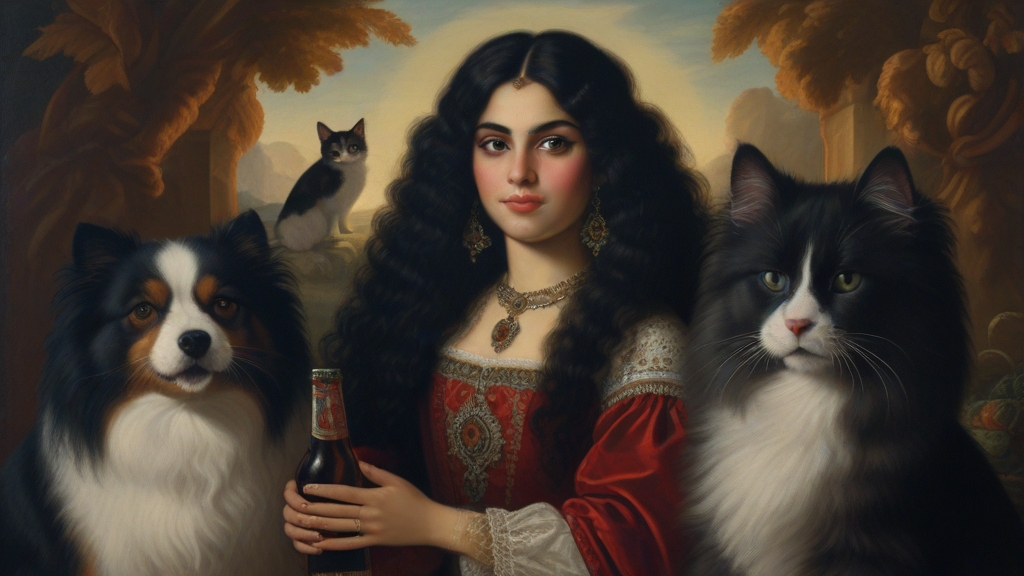
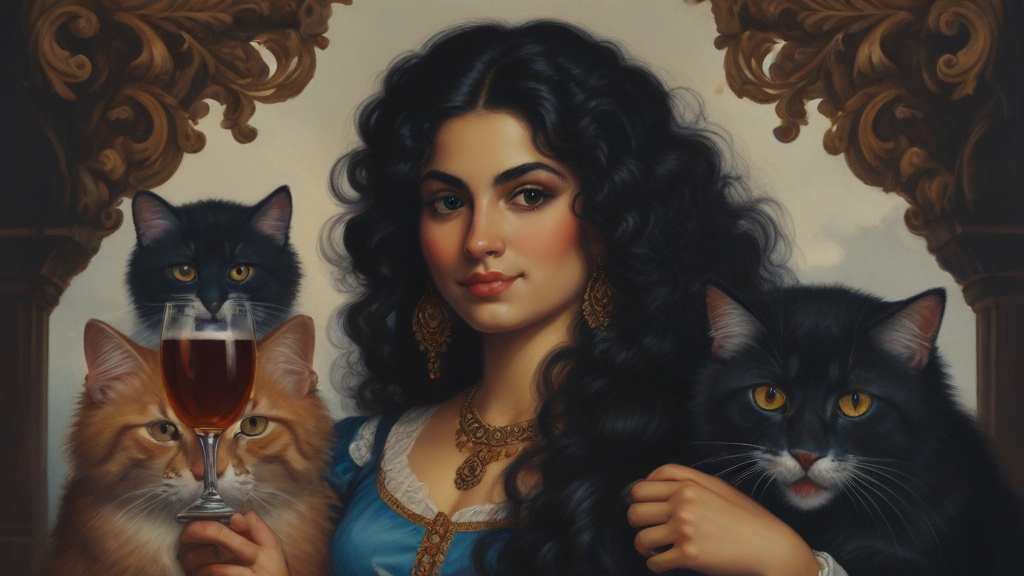
Older early MM AI generations
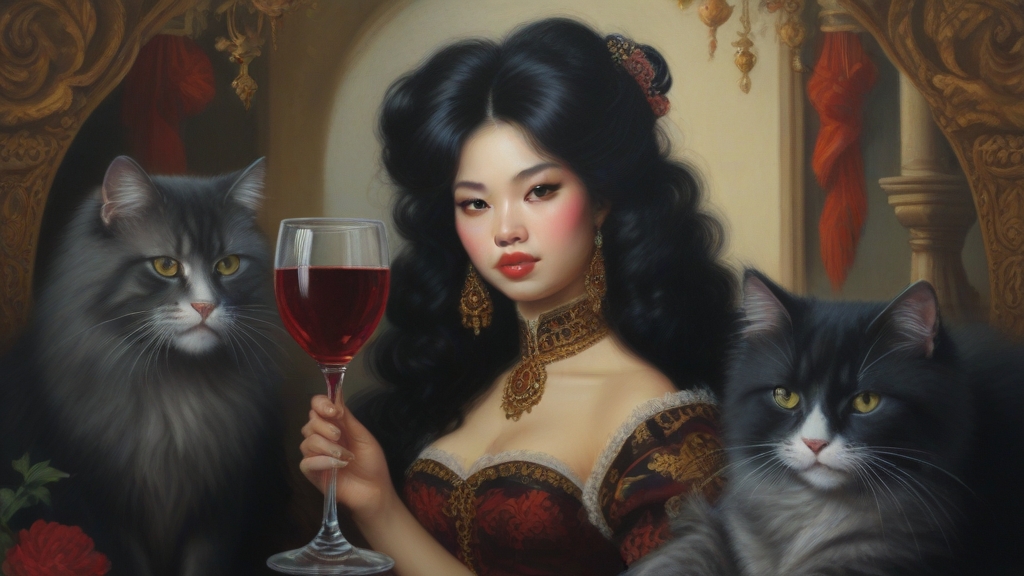
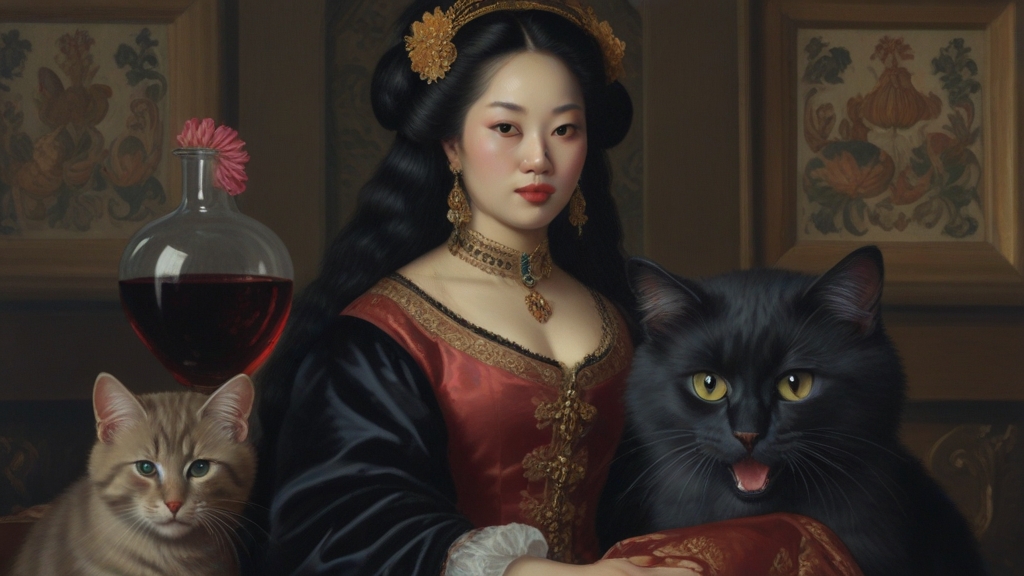
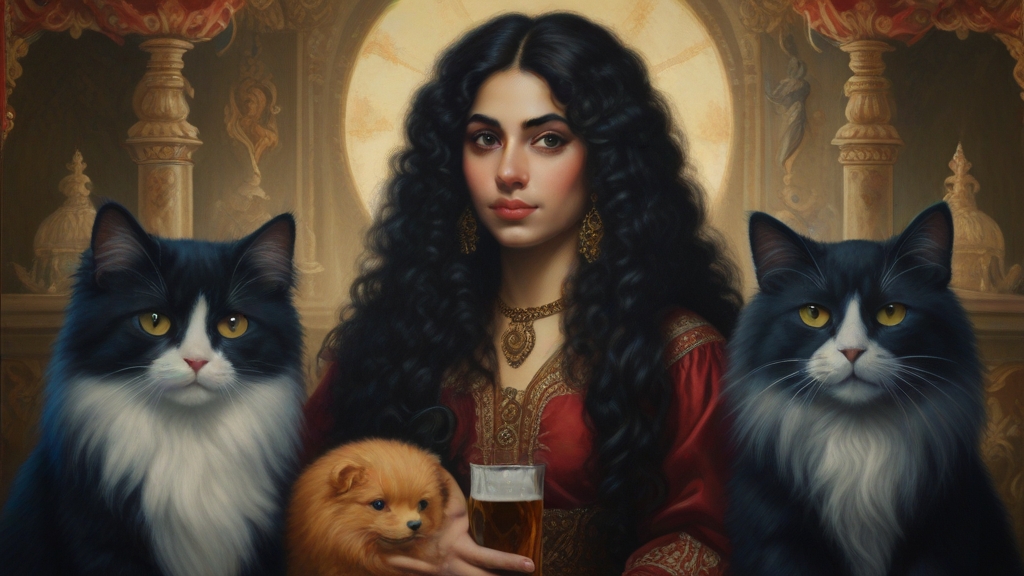
Theme is the bust of an attractive woman with a huge head of hair in Baroque style with cats and beer.















































































What’s the most ridiculous TSA rule you’ve encountered while traveling?
No liquids or gels over 100ml.
They passed this ridiculous rule after a bomber tried to sneak two harmless liquids onto an airplane to mix together into a powerful explosive.
The plan didn’t work because of chemistry and physics. Namely, there is no such thing as two harmless liquids you can mix together in an airplane to make a powerful explosive. That’s Looney Tunes cartoon physics, not reality.
This:
is a movie prop, not a threat to national security. Banning liquids on planes is like banning phasers or alien eggs.
Still, they had to do something. They couldn’t ban liquids, so they picked a random quantity and banned liquids over that quantity.
It’s theater. Each of the airplanes hijacked on 9/11 had five terrorists on board.
If there were such magic liquids, and 100 ml were safe but 500 ml of this magical mystery stuff could bring down a plane, they would just put five terrorists aboard planes, each carrying their 100 ml.
But they don’t do that because it’s a cheesy B-movie plot, not reality.
Why has the United States maintained its world superiority in all fields of technology, machinery, warfare, and economy in a span close to a century?
You are quite behind time, maybe in the last decade of the last century. Even then it had to strongarm Japan to surrender its leadership of semiconductors in mid-1980s, and imposed on it the Plaza Accord to correct its trade deficit.
Today, the US is not in the position of superiority.
US has still the largest economy in nominal terms. But in terms of PPP, it fell behind China since a decade ago. Economists generally make international comparisons using the PPP-GDP, although US economists may avoid doing so.
In technology, US and China are equal. US’s strengths are in the legacy technologies from which it collects huge sums of royalties, license fees, and so on. It has spent the last decade imposing sanctions after sanctions to try to frustrate China’s technology growth.
China has largely overcome them and is self-reliant on US tech. It is the biggest player in legacy chips on both the supply and demand side, with about 35% of global capacity and 60% of global market. Huawei has broken through to high-end chips of 7nm and 5nm, and working towards 3nm chips. In AI chips, it is in direct competition with Nvidia, the gap is about one generation. DeepSeek has used algorithm efficiency and innovations to compromise the significance of computation power.
China is far ahead in green tech, indeed the entire field of green economy. How advance it is in new tech may be gauged from the frequent announcements of innovations, new products, new discoveries, and new inventions.
China is also far ahead in the engineering and production of new tech products that extend through the supply-chain. This is unassailable, notwithstanding Biden’s attempt with Chips Act and Inflation Reduction Act.
US may still lead in certain machinery technology, such as Applied Materials and Lam Research. Otherwise the bulk of the manufacture of machinery lies in China.
In warfare, US and China are equal. Each is not able to defeat the other in their respective geographies. US and China both have weapons to reach each other’s mainland. In a nuclear scenario, it will be MAD. US may have more nukes, but China’s could be more powerful. It has enough confident of its power of reprisals to denounce the use of first strike, which the US had not done.
China has the industrial and construction capacities to withstand any long-drawn conflict and to recover quickly never mind how much the destructions.
Why do STEM professors work in academia if they could make a lot more working in the industry? Is it that the jobs for PhD students are too competitive to get into and they resort to academia?
I’ve found that the best way to understand and predict people’s actions is to know their key motivations.
Money does motivate most people, but the question then becomes “Do normal people and STEM professors share the same motivations?”, and my answer is a resounding “No!”. It is almost a tautology to say this, but professors are the most intellectually inclined people among our educated workforce, so why should we assume that they care about and want the same things in life as your average Joe?
Also, the second sentence in the question makes an incorrect assertion. In fact, getting an academic tenure-track job at a research university is harder than getting a research position in industry.
I think I have an interesting perspective on this topic, because during my PhD, I was close to 3 professors and learned a lot about life and research from them, and I have been working in corporate R&D as a research engineer since the past 2 years, where I work with other PhDs, collaborate with professors from universities etc, and I plan on making to jump to academia in the next 3–5 years.
I currently work as a laser designer in industry, and yes, it pays very well compared to academia. You also have more resources, better tools, and better support for research in industry than in academia. Industry is also very collaborative, and I don’t think it is a coincidence that the best STEM professors I knew all had a 5–10 year stint in industry before they joined academia. Industry is an eye-opening experience after academia (PhD, post-doc), and you learn how the primary concerns are so different in the two realms. For example, in academia, you care about making the newest/best/most novel laser, but industry also cares about making it last for 10,000 hours. Some people in industry know an entire field of laser reliability physics that academia is relatively clueless about.
That was all the good stuff, so why then, do I want to join academia about 5 years out? Because some things matter more than money and the other abovementioned perks.
Academia gives you freedom—to pick your own questions, work at your timelines (funding agencies are far more relaxed than industry on schedules), and to be far more selective with your projects and collaborations. Furthermore, for me, just being in a university environment is stimulating and invigorating. No amount of money can buy this feeling. Being able to teach and pass on one’s knowledge and to be able guide the smartest students of the next generation also becomes a compelling draw as one gets older and has more experience in cutting-edge research.
Another big draw, for me, to academia is the ease of being able to publish. It is really hard to be able to publish our research work (research is frightfully expensive, so we don’t want to give away hard-learned secrets), and I have to prove that it is fundamental science and has no IP concerns etc. But I kind of found a workaround to this by focusing on patents in my work in corporate, and on papers in my collaborations with the company’s fundamental research division. But the point is, academia is great for people like me who love writing and publishing our research. Industry starts to feel stifling in this regard after a while.
Also, professors may make less money than researchers in industry, but professors are also free to do contracting and consulting gigs if they so desire, so the real income is often a different story. In industry, on the other hand, your brain belongs to your employer. You cannot have any consulting or contracting work in any field that is even close to your job role. And this makes complete sense for the company, and they are open about it, so I don’t mind.
In my opinion, it’s best for the individual to get experience in both worlds before deciding on one. They both have very different lessons to teach you about both your field and about life, and you’ll be better off for having seen both worlds.
Springfield Cashew Chicken
Springfield, Missouri is the Cashew Chicken Capitol of the World. Chef David Leong moved to the U.S. from China in 1940 and created this recipe.
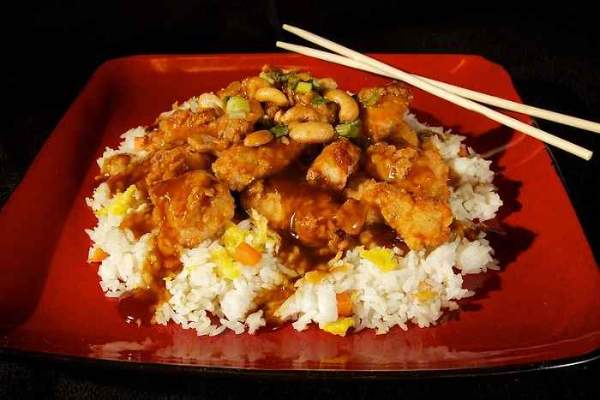
Chef Leong’s famous deep-fried cashew chicken recipe was so popular that he opened Leong’s Tea House in Springfield. Leong’s Tea House closed its doors in 1997, but his cashew chicken is still being served at over 70 Chinese restaurants in the Springfield area, and elsewhere in Missouri and other states.
Ingredients
- 1 cup milk
- 2 tablespoons water
- 2 eggs, well beaten
- Salt
- 2 pounds boneless, skinless chicken breasts, cut into bite size pieces
- 2 tablespoons cornstarch
- 1 cup chicken broth
- 2 tablespoons oyster sauce
- 2 tablespoons soy sauce
- 1 teaspoon granulated sugar
- Pepper to taste
- 1 cup all-purpose flour
- Peanut oil for frying
- 1 cup cashew nuts
- 1/2 cup chopped green onions
- Soy sauce
- Hot fried rice
Instructions
- Mix milk, water, eggs and salt; marinate chicken in this mixture for at least 20 minutes.
- In a saucepan, dissolve cornstarch in a small amount of broth; add remaining broth gradually to make a paste.
- Whisk together oyster sauce, soy sauce, sugar and pepper. Add more chicken broth if needed so it will have the consistency of gravy. Whisk over medium-high heat until sauce boils and begins to thicken. Set aside.
- Roll chicken in the flour. Fry in oil in a heavy pan until crisp and golden. Drop chicken in one piece at a time to prevent sticking together. Drain on paper towels.
- Arrange chicken on a serving platter.
- Reheat sauce, adding chicken broth if needed to thin it down, and pour over chicken.
- Serve with rice. Sprinkle with cashews and chopped green onions and serve immediately.
What is considered the best eggplant recipe and which country is it from?
Here are a few of my favourites:
Hungkar begendi. Lamb on a eggplant and cheese purée. It comes from Turkyie and it means the Sultan’s favourite.
Another from Turkyie. I love Turkish cuisine and the Turks love eggplant. Introducing Imam Bayeldi, meaning “ it choked the imam “, as in he liked it so much he stuffed his face with it.
Stuffed eggplant with tomatoes, onion, olive oil. Can be served with crumbled Turkish feta like cheese or yoghurt on the side.
Salata de vinete. From Romania. Smoked eggplant purée with onion, lemon and oil. Amazing on bread.
Zacuska. Romania again. An eggplant and pepper preserve. Sweet and tangy.
Baba ganoush. Lebanese eggplant purée with tahini, garlic, lemon and yoghurt. Addictive. Pomegranate can be added.
Chinese eggplant with minced pork and garlic sauce.
Melitzanokeftedes. Greek eggplant meatballs. Preferably dipped in tzatziki.
Eggplant is one of my favourite vegetables.
Why are TikTok users in the US flocking to the Chinese app RedNote?
What don’t they tell you about being a truck (or lorry) driver?
A European truck driver here. They don’t tell you this:
You drive on the German autobahn. It’s 6 or 8 pm. You already drove your legal time, 9 hours, twice a week 10 hours. You drive in the nearest parking place on your way. The parking is full with trucks. No place. OK. You drive ahead. Here is the next parking. Full. 120 % full. Trucks in every corner, every imaginable place. You are sweating, even driving through the parking, the mirrors are folded in, 1 cm both sides, you must be careful.
Damn it. You drive ahead. The digital tacho gives a warning sign. Time to take a break. Your legal time is over. But what can you do? You can’t take a break on the emergency lane.
Finally, an Autohof. German truck stop. By the entry a Turkish – German gatekeeper guy: ‘Es tut mir leid, nix mehr Platz!’ – Sorry, no more place.
Shit. Your time is long over. If you’ll run in an inspection tomorrow, or later, you’d better be able to explain it to the policeman. If he won’t like your face, he’ll punish you. You will pay hell of a money.
But you go further. Next parking. Full. The next one too. The next one, the next one, and the next one. The next one you can’t even enter. At the entry a truck stops with emergency blinkers. Probably a colleague makes a short pee – break.
You are tired and sleepy already. More two parkings. All full. OK. Here is a motorway exit. You drive out, maybe you’ll find something on a smaller road. You drive through sleeping small German villages. Narrow roads, tight roundabouts. See there: Zone Industrie. An industrial area! That’s good. Where there are factories and loading places, there are usually parking trucks too. You drive in, look, there is a place! Here is no toilette, but for 9 hours short overnight break, that will be OK. You are tired as a hell. You open up a can of beer, pour it down at two gulps and hit the bed.
You sleep deeply. After 2 – 3 hours sleeping, somebody knocks on your door. You roll down the sideglass: what’s up?
‘Es ist Private Gebiet’ – a private property. – says a guy. He’s aiming a beam of a hand lamp in your face – ‘Fahr weg! Oder ich rufe Polizei!’ – Go away, or I’ll call the cops. ‘Parken verboten!’ – Parking is forbidden here.
You are pleading: ‘Sir, I can’t drive now, I don’t disturb anybody here, give me a little time, early in the morning I’ll drive away!’
‘Leave now, or I call the cops!’ – says the dude.
You reluctantly put on your clothes. And start the engine….
You’re given $10 per day for food. Depending on which country you live, what kind of meal are you having?
Italy. Now, please consider that I will cook for three.
Breakfast:
coffee and breakfast cookies
A piece of fruit
Lunch:
Pasta with courgettes
Frittata with onions
Tomato salad
Bread
A piece of fruit
Dinner:
Bean soup
A piece of cheese
Bread
With this kind of menu I should be able to stay within 10 euro a day for three people.
UPDATE: in the comments I was asked if I could really buy all of the stuff I need to cook all of the above. I made a shopping list and the grand total came up to 16 euro, and I didn’t even include pantry stuff. But…
It is over 10 euro, but you need to subtract nearly half the expense because we are not eating the whole stuff: for the frittata I only need 3–4 eggs, not 6, the cheese is twice the amount I would expect the three of us to eat, we don’t go through a whole pack of tea biscuits in a day (more like a week), etc. And I am talking cooking for three people.
Also, factor in that I made the list based on the on-line version of a relatively pricey supermarket, and in average buying on line always costs 15% more compared to buying in the actual store. In real life I would not buy everything from that supermarket: all of the fruits and vegetables would be bought from a market stall, the bread would come from our favorite bakery, and some of the other foods would come from a cheaper supermarket chain like LIDL.
Does a Chinese girl prefer marrying someone foreign, or is she strictly loyal to marrying within her “tribe”?
I asked the Zen master, “What do you think of Chinese women who marry foreigners?”
The Zen master smiled slightly and pointed to a flying bird in the sky and said, “Look at it and you will understand.”
I looked up for a long time and said thoughtfully, “Does the Zen master mean: to love someone you have to be free to fly without being bound?”
The Zen master closed his eyes and said, “I mean: it’s none of my business! None of your business!”
It’s a little funnier in Chinese, because of the puns.
What is the tackiest meal you were ever served at a wedding reception that either made you sick or made you tell stories for years about how not to do something?
A former roommate of mine got married a couple of years after I had moved away from where we had been. She had said some really hurtful things to me after I moved which made it difficult when I got her wedding invitation. But I went because we had been friends for awhile before I left.
She had told me she had paid quite a bit for her designer wedding dress. She was upset her parents refused to contribute funds to her wedding (she had said some really hurtful things about the same time she had been hurtful to me so that explains it). Her fiancé’s family I don’t think had much to contribute financially to the wedding festivities.
The wedding itself was .. well, interesting. It was literally an evangelical Christian revival where they refused to release anyone until someone converted. Two hours of sitting in a non air-conditioned chapel while the preacher kept asking who wanted to be saved. Eighty people being held hostage. The ceremony where the two got married? In the middle of the revival it was a 5 minute ceremony then back to exhorting us to come to Jesus.
When someone finally crumbled, we were set free. All I had was an address to the reception venue. She hadn’t told me what hotel it was at. I pulled into the Ramada Inn thinking, okay, they got a conference room that’s fine. We walked into basically an overflow room at International House of Pancakes. The entire reception was catered by IHOP. One would think it would be pancakes but nope, it was a fine array of appetizers. That starting showing up 30 minutes after everyone arrived and showed up in a haphazard way. I didn’t eat anything because I was meeting some of my heathen friends for dinner (she called them heathens).
Now, I’m not against it being an IHOP reception. You work with what money you have. I had a friend who had very little money and had a great back yard BBQ at her parents’ house. What my problem was .. she had spent nearly $10K on a wedding dress instead of buying a moderate dress and using most of the cash to have a little better reception. She didn’t even notice I had left. I didn’t get a thank you note for the gift I had given her. I didn’t hear from her until she had her third kid. And then she asked me to join her church.
Sorry.
I’ve traded on this story for years when people talk about receptions that left us slack jawed.
Sir Whiskerton and Artist Agnes’s Abstract Animals: A Tale of Paint, Confusion, and a Very Abstract Pig
Ah, dear reader, prepare yourself for a tale of artistic absurdity, colorful chaos, and one particularly perplexed cat who just wants to know why he’s been painted as a teapot. Today’s story is one of creativity, confusion, and the occasional existential crisis, all wrapped up in a whirlwind of abstract art and animal antics. So, grab your sense of humor and a beret (for artistic flair), as we dive into Sir Whiskerton and Artist Agnes’s Abstract Animals: A Tale of Paint, Confusion, and a Very Abstract Pig.
The Arrival of Agnes
It all began on a sunny morning when a peculiar van rattled down the dirt road leading to the farm. The van was painted in a kaleidoscope of colors, with splashes of paint covering every surface. Out stepped Agnes, an eccentric artist with a beret tilted at a jaunty angle and a paintbrush tucked behind her ear.
“Greetings, farm animals!” she declared, spreading her arms wide. “I am Agnes, the artiste extraordinaire, and I have come to capture your essence on canvas!”
The animals, who had been going about their usual routines, stopped to listen. “Capture our essence?” Doris the Hen asked, tilting her head. “What does that mean?”
“It means,” Agnes said, her eyes sparkling with enthusiasm, “that I will paint your portraits in a way that reflects your inner beauty, your soul, your… abstract truth!”
Sir Whiskerton, who had been enjoying a particularly luxurious nap in a sunbeam, opened one eye. “This is either going to be brilliant or a complete disaster,” he muttered. “And I’m leaning heavily toward disaster.”
The Abstract Art Begins
True to her word, Agnes set up her easel and began painting. Her first subject was Bessie the Tie-Dye Cow, who was more than happy to pose. “Just stand there and be yourself,” Agnes said, dipping her brush into a pot of neon green paint.
As Agnes painted, the animals gathered around to watch. At first, they were intrigued. But as the painting took shape, their confusion grew. “Is that… me?” Bessie asked, squinting at the canvas.
The painting was a swirl of colors and shapes, with no recognizable features. “Of course it’s you!” Agnes said, stepping back to admire her work. “I’ve captured your essence—your inner hippie, your tie-dye soul!”
Bessie tilted her head. “I look like a melted popsicle.”
The Animals React
Next, Agnes painted Porkchop the Pig. The result was a series of geometric shapes that vaguely resembled a pig, if you squinted and tilted your head. “I look like a… a… a Picasso pig!” Porkchop said, his voice tinged with both confusion and pride.
Then came Ferdinand the Duck, whose portrait was a splash of blue and yellow with a single, exaggerated feather in the center. “I look like a banana wearing a tutu,” Ferdinand said, flapping his wings in dismay.
But the real shock came when Agnes painted Sir Whiskerton. The portrait was a teapot with a monocle and a tail. “What in the name of order is this?” Sir Whiskerton asked, his tail twitching in annoyance.
“It’s you!” Agnes said, beaming. “I’ve captured your essence—your sophistication, your mystery, your… teapot-ness.”
Sir Whiskerton sighed, adjusting his monocle. “I am not a teapot.”
The Turmoil Escalates
As the day wore on, the animals grew increasingly frustrated with their abstract portraits. “I look like a squiggle!” Doris the Hen squawked, flapping her wings. “A squiggle!”
“I look like a… a… a blob with ears!” Rufus the Dog said, wagging his tail in confusion.
Even the yodeling fish, who had been painted as a series of wavy lines, seemed offended. “YODEL-AY-HEE-HOO!” they sang, their voices tinged with indignation.
The final straw came when Agnes painted Edgar the Crow. The portrait was a black smudge with a single, glowing eye. “I look like a… a… a burnt pancake!” Edgar squawked, his beady eyes narrowing in anger. “This is an outrage!”
The Feline Intervention
Determined to restore order, Sir Whiskerton called an emergency meeting. “Clearly, Agnes’s abstract interpretations are… less than accurate,” he said, shooting a pointed look at the teapot portrait. “But fear not! I have a plan.”
With the help of Chef Remy LeRaccoon and the Divine Llama, Sir Whiskerton devised a solution: they would convince Agnes to try painting the animals in a more realistic style. The only problem? Agnes was firmly committed to her abstract vision.
“Realism is so… limiting,” Agnes said, waving her paintbrush dismissively. “I want to capture the soul of the animal, not just its physical form.”
Sir Whiskerton sighed, flicking his tail. “Sometimes, the soul is best captured through accuracy.”
The Turning Point
The turning point came when Agnes attempted to paint the Divine Llama. As she worked, the Llama stood perfectly still, his serene presence filling the barnyard. But when Agnes stepped back to admire her work, she gasped.
The painting was a chaotic mess of colors and shapes, with no resemblance to the Llama whatsoever. “This… this isn’t right,” Agnes said, her voice trembling. “I’ve failed to capture his essence.”
The Divine Llama stepped forward, his calm demeanor soothing the tension. “Perhaps,” he said, his voice resonating with wisdom, “the essence of a being is best understood through observation, not abstraction.”
Agnes paused, her paintbrush hovering in mid-air. “Observation?” she asked, tilting her head.
“Yes,” Sir Whiskerton said, stepping forward. “Sometimes, the beauty of a subject lies in its reality. Try painting what you see, not what you imagine.”
The Moral of the Story
As Agnes began to paint the animals in a more realistic style, the farm returned to its peaceful routine. The animals, now pleased with their portraits, gathered around to admire Agnes’s new work.
The moral of the story, dear reader, is this: While creativity and imagination are important, there is also beauty in reality. Whether you’re an artist, a detective, or just a cat trying to avoid being painted as a teapot, it’s important to appreciate the world as it is—and maybe leave the abstract interpretations for another day.
A Happy Ending
With her newfound appreciation for realism, Agnes continued to paint, capturing the animals in all their natural glory. The farm was calm, the animals were happy, and Sir Whiskerton… well, Sir Whiskerton finally got a portrait that actually looked like him.
As for Agnes, she packed up her van, her beret tilted at a jaunty angle and her paintbrush tucked behind her ear. “Thank you, farm animals,” she said, her eyes sparkling with gratitude. “You’ve taught me the true meaning of beauty.”
And so, dear reader, we leave our heroes with the promise of new adventures, new portraits, and hopefully, no more teapots. Until next time, may your days be filled with laughter, creativity, and just a little bit of feline genius.
The End.
Have you ever discovered a friend secretly hiding from you that he is actually rich? How did you find out?
A fella that I know from a gun club. Very nice guy.
He had several blue collar jobs over time. A security guard for a big company. Teaching driver’s education.
His father had come to this country and started a small grocery store. It’s a business he knew from the homeland, but that was taken from him by the government. Dad was always very conservative, and learned that over time buying the land and buildings would help his family in the future. These assets are decades old and now in great neighborhoods.
My shooting buddy always drover a used car. Generally a pickup truck. He never bought new. And I learned over time he had two kids including a special needs daughter. Turns out my daughter was working at a facility that might be able to help, but was difficult to get into. So she pulled a few strings.
Shortly thereafter my friend dropped off some tickets to a very expensive event. He knew my son was really interested and somehow obtained them.
I learned later that he helped Dad grow the business and still owned all the real estate, measured in the mid 8 figures. The only time I really saw an evidence of wealth was his complete willingness to pay for very expensive treatments for his daughter, and an occasional rare or expensive firearm.
To this day I think I’m the only one he’s shared this with. Most folks think he’s a happy go lucky guy. Everything he has and does is for the family.
Nightmare
Submitted into Contest #279 in response to: Write a story about someone confronting their worst nightmare.… view prompt
Savannah Hoover
“You killed them.”
“You deserve this.”
“You will never escape.”
Each voice was a dagger in his mind, each whisper a shard of glass cutting into his soul. And no matter how fast he ran, no matter how much he screamed, the darkness would not release him. It was everywhere. It had always been there.
Ethan knew, in that final moment, as the darkness closed in—he had never truly been alone. The nightmare wasn’t something that could be escaped. It was inside him. It had always been inside him.
And now, it would never let him go.
Canada and Mexico impose tariffs on US to retaliate against Trump’s tariffs. Will US lays more tariffs on them as Trump already warned? If so, a retaliation will invite another until US stops engaging in trade with them. Is that his vision of MAGA?
Trump is backing off on the tariffs already, a few days after they began.
For all the fashionable animosity piled onto Wall Street — sometimes for good reasons — I think the stock market is probably your friend here. Trump doesn’t want to roil the market too much. Wall Street hedge funds and ordinary investors absolutely hate these tariffs. Most industries hate these tariffs. Few politicians, even Republicans, defend them. The Wall Street Journal, that socialist rag, called them “dumb.” (Strangely, the United Auto Workers, a union, seems to like them, but the auto corporations who make the real calls aren’t interested in tariffs.)
Trump is obsessed with optics and the value of stocks, so I think that’s probably the biggest reason why he’s backing off so soon. He’ll call it a “pause” while he spins a way to get out of admitting how dumb these tariffs are.
He’ll dangle these things out there for further brinksmanship, but Ebenezer Scrooge McDuck Trump ultimately cares a lot about Wall Street. In the words of Alan Dillman, “Canadian Man of the Rocky Mountains,” Ebenezer “will ebb before he’ll nezer.”
Tides go back and forth, though. Hang tight. Don’t wander too far out from shore.
Energy wars, tariff wars w/ Alex at Reporterfy (Live)
Which mainstream rhetoric is closer to the truth, China is collapsing rapidly or China is surging to be a superpower rapidly?
Both are untrue.
Collapse of China has been around for 15+ years. It hasn’t happened, and it won’t happen. It is an industrialized economy and has a long runway to grow.
I don’t believe there are mainstream reports that China is surging to becoming a superpower. There may be isolated ones for particular evil purpose, such as to frighten particular countries or to secure a bigger allocation of money to spend on the military.
China has no wish to be superpower as US is superpower.
It has no appetite for hegemony. It is opposed to it. It is too economic-centric to spend money on wasteful military spending, which is why it is less than 1.5% of GDP, compared with over 3% for the US.
China’s PBOC is not the US Fed. It does not have a printing press to print money. Chinese government is cautious about debt. The total of its central government debt + local governments debts is less than 70% of GDP, compared with 125% for the US.
China’s government is people-centric. It is not chasing growth for growth sake, but growth for the welfare of the people, towards common prosperity. It calls this sustainable growth.
The translations are: Growth at around the 4% – 5% rate in the next few years, growth driven by technology, development of skills, and domestic demand, fairer distribution of income, such as the decline in the Gini coefficient seen in 2024, urban jobs creation of about 12 million and an urban unemployment rate of about 5%,
good healthcare & elder care, such as the silver economy, and housing availability and affordability, in the philosophy that houses are to live in, not for speculation, and
moderate indebtedness, as is evident by the price it is willing to pay to control the financial leverages of the property developers, which had and still have, high leverages.
Its international relations will be what you see in BRI today. It treats countries with respect and as equals, the emphasis on trade and investments. It is helpful of countries in their economic pursuits, such as zero-tariff on every line of goods for the 30+ least developed countries defined by the UN.
It is not into sanctions, such as what the US is wont to do. It has no need for this. It wants to be friends with all countries, whilst the US is angry with many countries. It is more into peace-making.
So, no need to fear China. It will not be a superpower and throws its weight around, intruding into other countries business, and tells them how to manage their affairs. China will be hand’s off but helpful.
Once Taiwan’s key chip fab technology and personnel are relocated to the US, will the US discard its commitments to protect Taiwan?
The U.S. will 100% abandon Taiwan as it is now doing with Ukraine.
According to Lai Ching-Te (the current leader of Taiwan):
1. Taiwan is the manufacturing centre of the global semiconductor industry, with TSMC and other companies holding the lifeblood of the world’s high-end chips.
2. Taiwan belongs to the so-called Western ‘values’ camp, and the Taiwan authorities are absolutely loyal to the United States.
3. the United States wants to continue to develop its high-tech field, then, Taiwan can be absolutely trusted.
4. The United States and its allies must protect Taiwan’s semiconductor industry, and in turn, the United States and its allies should send troops to defend Taiwan.
Lai believes that by swearing allegiance to the U.S., he will be able to gain asylum in the U.S. However, Trump thinks otherwise, ‘Taiwan’s semiconductor industry is taking business away from the U.S. and must pay the price.’ Trump has imposed high tariffs on Taiwan’s semiconductors, chips, and pharmaceuticals, and has demanded that Taiwan increase its military spending from less than 3% of GDP to 10%. In other words, the ‘support’ of the US military could be withdrawn at any time unless more ‘protection money’ is paid.
At the same time, the U.S. government forced TSMC to build a factory in Arizona and imposed tariffs on TSMC in Taiwan, which forced TSMC to relocate more production lines to the United States. TSMC is thus caught in a dilemma: if it does not migrate, it faces a shrinking market; if it migrates, it has to bear huge costs and may even affect the confidentiality of its core technology.
Therefore, it can be clearly that whether the United States imposes tariffs on TSMC or demands high ‘protection fees’ from the Taiwan authorities, Taiwan has never been an ally of the United States but a bargaining chip that can be traded at any time. When the situation changes and the United States finds that Taiwan is no longer worth harvesting, the United States flips its face faster than a book (Ukraine is a case in point).
In brief: Whether TSMC moves to the US or not, the US has not considered truly ‘protecting’ Taiwan, but rather how to use Taiwan to enrich itself, rob TSMC and blackmail China so as to increase its own talking points.
My CFO friends in Shanghai tell me that they’re experiencing powerful economic headwinds. But I hear China is to grow by a robust 5% this year. Why is there this juxtaposition?
Transformation
Old China’s economy grew due to Infrastructure, Steel, Construction, Trade & Property
New China’s economy is focusing on High Value Production, Domestic Consumption, High Value Exports & Technology
This Transition is causing PAIN in China
This Transition is why Chinas GDP growth is not at 8.50% a year and is only 5% a year
From 2003–2016, China would spend Billions and Billions on Infrastructure and Construction
This would naturally mean high demand for Steel, Cement and other Equipment
This would make China flush with money and most people would invest into the speculative property market which averaged 14.6% a year in returns when inflation averaged 3.94% a year
This became a problem by 2016–2019
- Property market was becoming a bubble
- Steel, Cement were in overproduction which lead to artificial low prices leading to building deliberate ghost cities to keep artificial demand going
- China had a good chance (> 40%) of going the Japanese way
This was when the West LOVED China and considered the Chinese as their greatest friends
China however had a terrific leader who took a major risk, luckily when the whole world was in slowdown to rapidly focus on transformation
He pricked the bubbles of Property and Construction very gently allowing them to subside slowly and cause mininal pain but still quite a lot of pain
Rather he focused on boosting High Value Production, High Value exports, High Value services and Consumption
For example
In 2010, $ 100 of Production in China earned a paltry $ 7.30 to the Chinese economy
In 2014, $ 100 of Production in China, earned $ 42.10 to the Chinese economy
(This is closer to $ 75 in US , Germany and $ 65 in Japan , So China still has a good 15 years to go to reach these numbers)
Exports may be lower in value but they bring in much more money to the Chinese economy than they did in 2010 or 2015
Service Consumption has risen by almost 222% from 2010 to 2024 , highest in the world
The fact that Chinese spent 315 Million Yuan to buy ticket codes for Manus AI tells you the spending potential among the Chinese
So yes, there are headwinds
There is massive transformation
This is a major change in the Economic Landscape of China
This 4.5% –5% is nothing but an impact of this transformation
US Fearful As China Unveils New Weapons Technology
Why is Pete Hegseth saying we are ready to go to war with China? Will he reinstate the Draft?
No
He won’t go to war with China
The US couldn’t win comprehensively against Afghanistan, Iraq or Russia
You think they have a chance against China, especially in their back yard?
Every US Base in South China Sea will be taken out in the first 72 hours
They have 3,000 Dedicated missiles for that including 160 Hypersonics
That takes care of any and all Aerial offense
Can’t bomb if you can’t take off from a proper air base
And how will they move troops?
Those ships would be a sitting duck given the long distances
Not a chance
He likely just got boozed or doped up as usual and is talking nonsense
What did your boss say to you during a meeting that resulted in you immediately resigning?
I lived in Alexandria Virginia on 9/11 . My horrid CEO on the west coast sent out a terse all-hands email that “bad things happened “ but we needed to buckle down and close those deals.
Quite a few people resigned right away. He tried to backtrack and put up a gigantic American flag that resulted in complaints from airline pilots at SFO it was blocking their view of the runway. This didn’t go well.
So he tried extra hard and said he would personally match all donations to the Red Cross and the company would also match donations.
A few weeks later, we learned he hadn’t given the money to the Red Cross but sat on it because “the Red Cross had plenty of money”.
That’s when I quit, along with dozens of co workers.