We are just a group of retired spooks that discuss things that you’ll not find anywhere else. It makes us unique. Take a look around. Learn a thing or two.
The mystery of the Lapulapu Ridge is a very interesting subject. Indeed, our world is filled with all kinds of interesting things going on. Some can even possibly be considered an extraterrestrial riddle. Even if it is wholly terrestrial in nature. All we need to do is take a good look at what surrounds us. Because, if we look at things with open eyes, and with an open mind, we will see new things, and come to new understandings on our world, and what is just going on within it.With the advent of new technology, we are able to peer into regions and places that used to be denied us. Today, using such technologies as Google Earth, we are able to peer into the shroud and explore all kinds of things that we didn’t even know existed. Some of it is amazing. Some of it is frightening. Some of what we see can be curious, while others can tell us just a little bit more about ourselves. All we need do is listen to what we find.Today I would like to discuss a very odd thing that is going on at the Lapulapu Ridge.For those of you who don’t know, the Lapulapu Ridge is an undersea formation that lies outside of Saipan. Saipan is a small group of islands in the Pacific Ocean. It is terribly isolated and remote. It’s also part of the United States. (I’ll bet that you all didn’t know that.) The point of interest here is not the abundance of coconuts on the Saipan island, or the history of the island during World War II. What is so interesting about this place is that someone, or something, has been busily mining that area for some time. Most certainly for years, probably for decades, and maybe even for a century or longer! What is so odd about this is that it is impossible to do so. At least, using known conventional technologies, that we humans possess.Let’s have a look at this curious situation…
Introduction
"We still haven't explored the deep oceans or the inner crusts of Earth."
-Dr. Wolfstatement in regards to the extraterrestrial presence on the earth and their activities.
Let’s take a moment to look at what is going on in our planet. We humans like to believe that we are the “owners” of the planet, and that we are in full control and knowledge of “our” planet. We like to believe that we are at the top of the food chain. We like to believe that we are in full control of technology and have the power and dominion over this planet.
That is wrong. We have no power, we know very little, and we know “jack shit” about the history of this planet. In fact, we actually know very little of the planets past and whom actually “owns” the planet that we reside upon. Yet the evidence of the real “owners” of the planet are everywhere, we need just search for the evidence and study it with an open mind.
I would like to take a look at some such “object” or area of evidence. It can be considered a terrestrial or even an extraterrestrial mystery. I would like to look at the Lapulapu Ridge Mining efforts near and around Saipan. I refer to it as a “mining” effort only because the tracks suggest displacement of soil. The only reason for the displacement of soil that I am aware of is part of either mining or construction efforts. (Constructions that are suggestive of long linear lines are more akin to roads then they are for buildings.)
Therefore, let’s look at what is hidden deep under the ocean under the waves. Let’s look at evidence of large-scale (possibly) robotic automated mining operations under the surface of “our” oceans.
The Lapulapu Ridge Formations
The following are filtered images from Google Earth.
The filters remove the reflective waveform obfuscation layer characteristics of the oceans from the Google images. I want to give Google the benefit of doubt and attribute the reflective quality of the ocean surface to be a truly natural obfuscation.
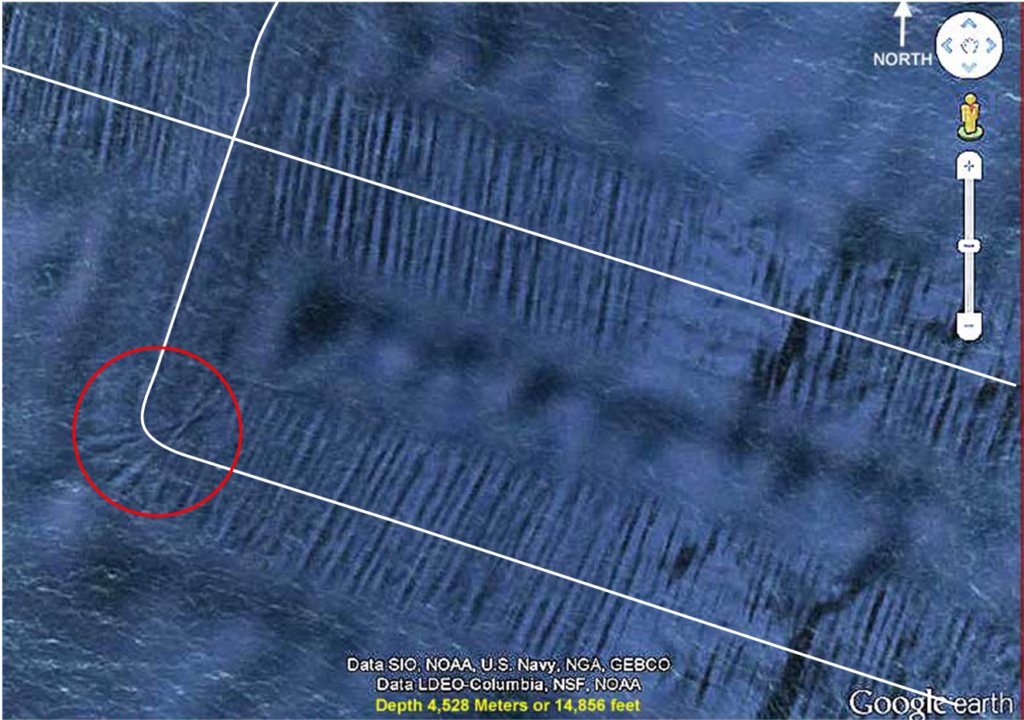
However, once the images are filtered to remove this sort of waveform obfuscation layer a series of patterns emerge. This is truly puzzling, as one would expect to see resolved undersea details. You would expect natural features to parallel that of the native landmasses. Such things as mountains, rivers and other natural geologic structures would be expected to be shown, or more accurately, their undersea equivalents. But instead, one can clearly see enormous scaled undersea (apparent) surface mining evidence. Once removed, one can clearly see the presence of unusual tracks and movement.
There is absolutely no way that this can be considered to be natural geologic evidence at all.
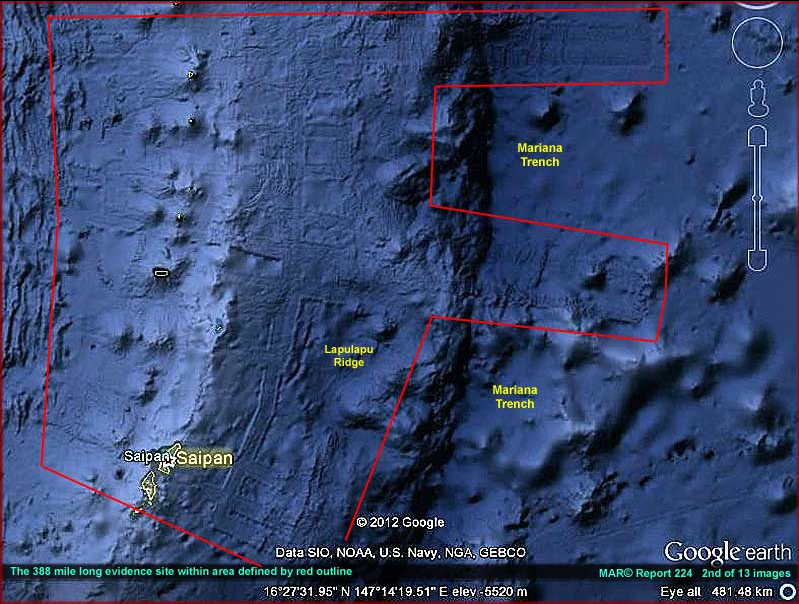
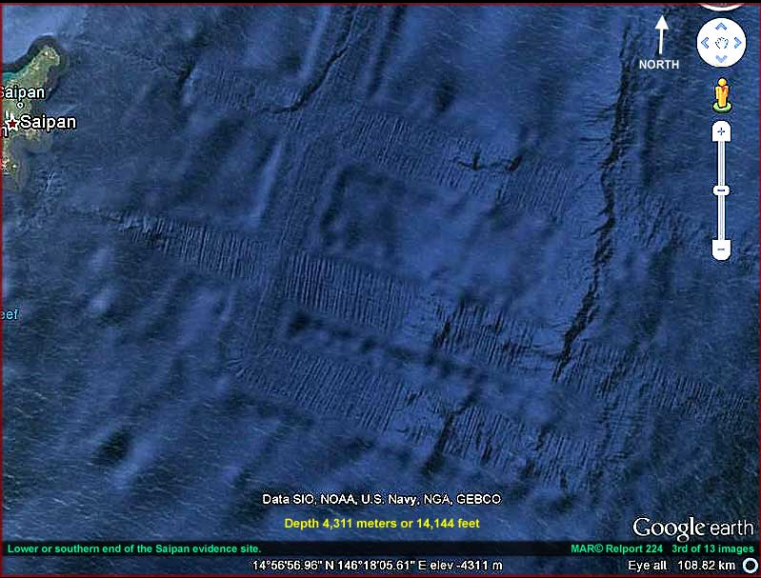
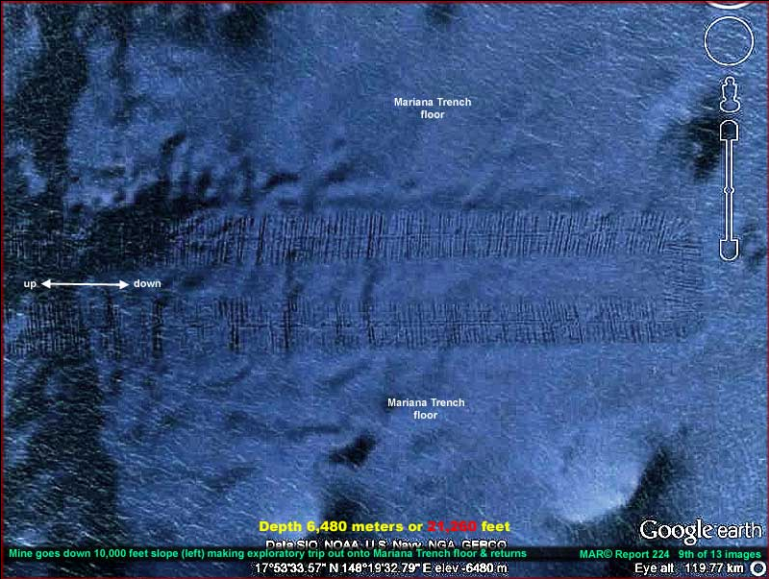
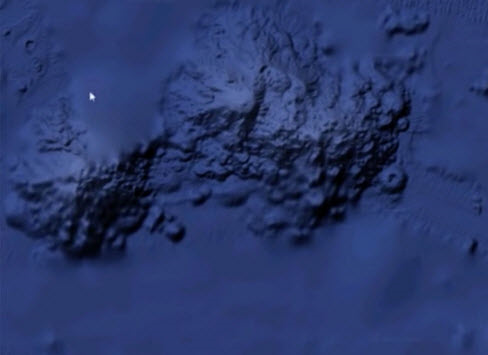
The Mystery of the Lapulapu Ridge is one of a city-sized mining operation under the ocean. A 388 mile long underwater site showing extensive geologic mining activity by large (huge) vehicles on the Lapulapu ridge near the Saipan islands.
Undersea mining operations NE of Saipan. (Image Source.)
These features shown are near the Saipan islands. Of which the specific coordinates are 16°27’31.55”N 147°14’19.51”E. I provide just a mere handful of images to illustrate my point here. The reader is encouraged to pursue their own investigative activity to whatever conclusion it leads to.
These are NOT natural geologic formations. Nature does not follow straight lines unless they go through fissures or regions of internal stress. Nor do they make 90° bends, and 180° bends. Nor do they repeatedly follow parallel paths of operation. There is absolutely no way that these features are natural.
Non-Natural Features
I was never briefed on these features, nor was I introduced to them through any kind of program or manual. These constructions were discovered as a natural bout of investigative journalism. Indeed, it is characteristic of obtaining supportive documentation for my own contentions. All that one needs to do is look around themselves to the world about us. In so doing, one can see the hidden secrets that lie submerged and hidden.
I do not who or what formed these features.
They might, remotely, be naturally made. They could be constructed by some surreptitious government project of great secrecy and complexity. They could be all that remains of some great underwater public works project. I don’t know at all. But to me, these structures are clearly intelligent driven. They seem to suggest large-scale underwater mining efforts. That is the basis of my discussion here. That these apparent features are but part of large-scale construction made by a race with the capability to do so.
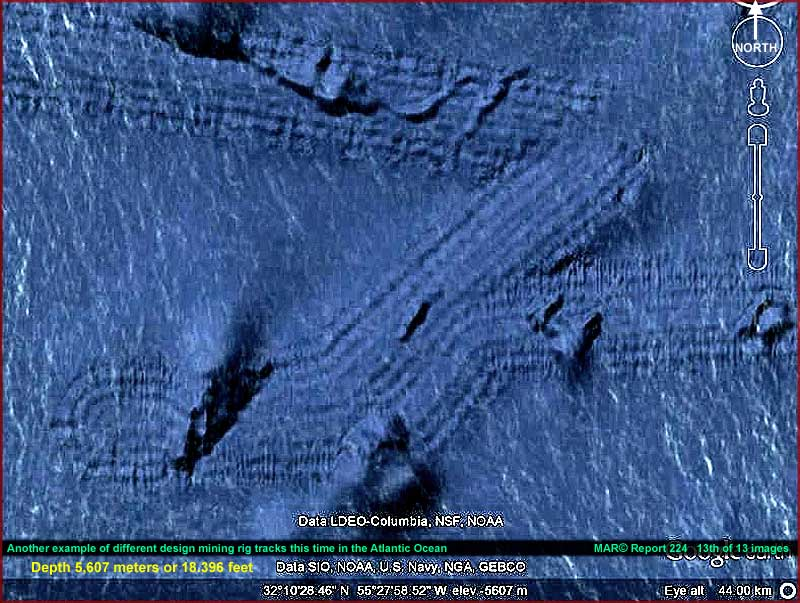
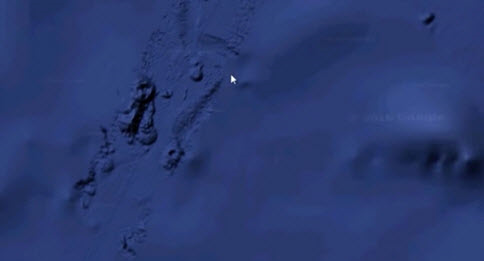
These features are not limited to the Saipan region, but exist in other undersea locations. For instance, they can be found at 47°47’46.16”S 107°15’00.93”E as well. Of course, the form and shape is different. But whom would expect large scale mining west of southern Tasmania?
If human, then we really need to take a good hard look at what our fabrication abilities are. Because if we can mine or perform these kinds of undersea activities, then we can most certainly create a facility on another planet. If these formations are not human, then we need to reconsider who is making them and why. Remember, boys and girls, extraterrestrial activity, of huge extent, can be found throughout our solar system. We only need look below the surface and take a hard look at what is presented to us.
Statists say these features are just normal
After the initial discovery by a poorly named group known as “SecureTeam10”, the scientific statists came out with their pronouncements and statements.
“Large parallel lines = tectonic fissures, naturally occurring sorry. The curvy line is likely the pathway of a underwater current and deposition field of said current.”- YouTube Mikitan Fox
Now of course, the Scientific Statists have to crawl out from under a rock and “explain” to us that all of this is of no concern. They hurriedly hopped up upon their great white horses and began to beat the drums loudly. They shout, “This is just an ordinary fault line. Anything else is incorrect. Everything else is nonsense.”My definition of scientific statism;
A concentration of a set scientific theory in the hands of a closed elite group of people. Often they have direct ties to a highly centralized government. To alter or change that theory to revise it to meet new discoveries or data often requires government derived politics and peer-group approvals.
Tectonic Fissures
Well, it’s just like those pesky statists to make a pronouncement and run away to hide in their mother’s basement.
The fracture mechanics model of the tectonic fissures do not permit the kinds of fractures and behaviors that are clearly observed in this instance. I suggest anyone interested in the formation of faults and their behaviors read “Formation and Development of Fissures at the East Pacific Rise: Implications for Faulting and Magmatism at Mid-Ocean Ridges“. It can be read on line at Department of Geosciences, Oregon State University, Corvallis, OR 97331 USA.
By understanding the fracture mechanics involved in geothermal processes (especially those in the Pacific rim) one can clearly see that these “tracks” are absolutely not tectonic fissures. Tectonic fissures? What a laugh! Compare these images with the fault lines found in California here.
From the paper;
"The Griffith theory assumes that crack initiation occurs from the points of highest tensile stress on the surfaces of these microscopic flaws or "Griffith's cracks" in brittle material (in a biaxial stress field), and this has since been elucidated by the theoretical and laboratory studies of Bieniawski [1967] and Huang et al. [1993]. Joints, lava flow contacts, and tension cracks may be regarded as the macroscopic analogy to "Griffith's cracks" [Gudmundsson and Bäckström, 1991]."
Our understanding of crack formulation in brittle and ductile materials is quite mature. In fact it is one of the most common mechanical and civil engineering undergraduate courses that engineering students take. Oh, I surely remember the days during my classes in the”Mechanics of Deformable Bodies” class. LOL. In the case of the formation of cracks in the Pacific rim, it is obvious that the formation is absolutely straight forward for compressive fissure formulation.
Now, stress lines and their associated fractures for geologic features in the Pacific Rim are influenced by the elastic moduli, tensile stress and tensile strength of the host rock. As such, we know that hosted stresses, are in turn, a function of the grain structure of the materials.
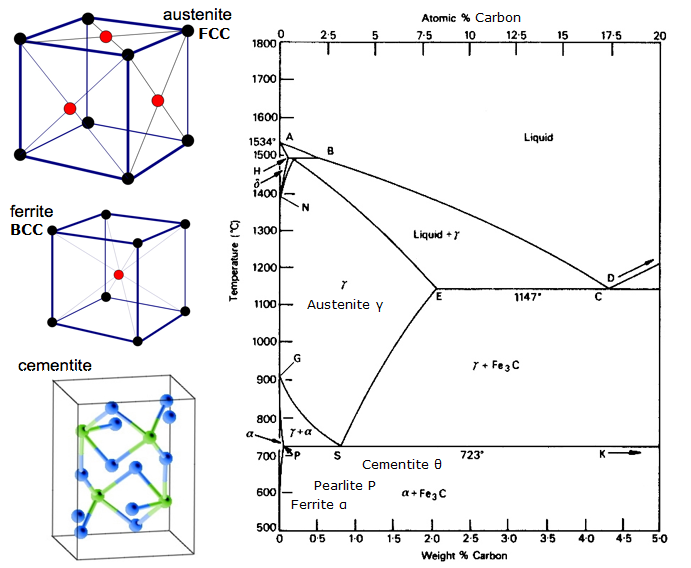
Lattice structures on steel showing the relationship of the various phases of state as a function of impurity composition / percentage for alloyed iron.
I well remember the days as a young engineering student. We studied the material properties of various materials and how the grain and lattice structures influenced the lines of stress inherent in them. One day we went to the lab and we observed the clean and cut fractures of sample steels.
The professor took numerous samples of SAE 1045 and SAE 1018 and placed them in a machine that pulled them apart. The deformation of the parts were at a nice clean 45 degree angle. This was quite along the lines of the crystal grain structure of the materials themselves. No matter what material, and no matter how fast or how slow, the fracture was always identical. It ALWAYS followed the lines of stress inherent inside the material.
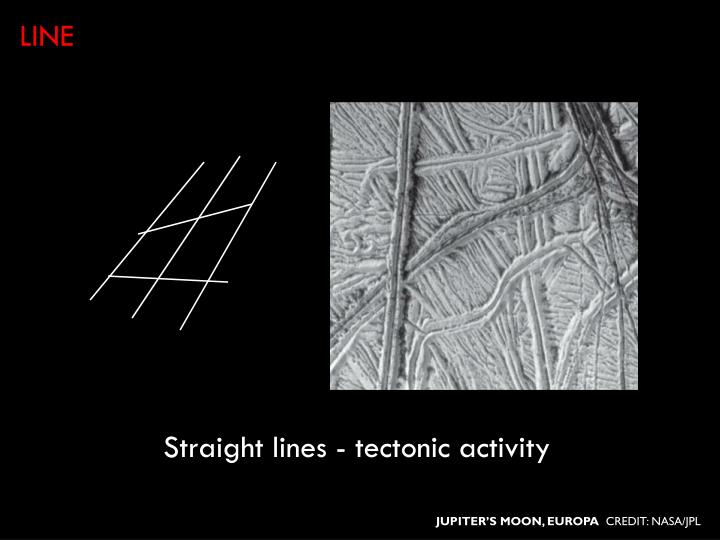
We can see this everywhere. We can see this on the earth, and we can see this on other planets such as the moons of Jupiter. Here is a NASA slide showing the tectonic stress lines on Europia.
Tectonic activity on Europia, one of the moons of Jupiter. Notice how the lines match the lattice formation of the grains of the material that is under stress.
Fractures form along the principle lines of stress inherent in the material grain composition of the materials that make up the undersea mountain ranges of the Pacific Rim. This, in turn, is a function of the grain structure of the surrounding rocks. Thus the reason for straight lines,and precise angles of exact (and repeatable) angular measurement.
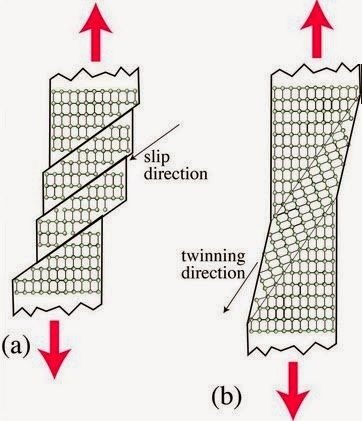
When a material undergoes stress, especially tensile stress, the fracture is along a line of least resistance; or stress line. This line follows the grain pattern of the material. This is also known as the direction of slip, or slip direction. Prior to fracture, there is a period when the base rock goes through a period of plastic behavior. During this time the twinning direction also follows the slip direction as a function of crystal structure.
However, while many of the track lines observed in and around the undersea formation known as the Lapulapu ridge are straight, they do NOT follow material stress lines. Just having straight lines, and angular fractures alone does not qualify an observation to be that of a tectonic stress line. As NOWHERE in the world do tectonic lines of stress manifest as 90 degree bends, followed by another 90 degree bend. No do they manifest as pure radii that rounds a straight 90 degree bend at tangential points. These are clear VIOLATIONS of the laws of deformable bodies.
Tectonic plates follow the lines of stress. They do not make nice round circular features that follow an inner radius to correct to a 90 degree bend. That is something a tractor trailer rig does, not what a stress line does. Note also the displacement of material during the bend; it overlaps previous material. In fact, through a study of the overlap we can easily see that the object make a turn left to displace previous material as opposed to a turn right.
Ha, that pretty much rules out the kinds of behaviors observed in these tracks now doesn’t it?
About the Environment
These features and the corresponding events are taking place at a mind-boggling depth. At that depth the water is pitch black and the pressure is devastating. At the depth of 11,300 feet the water pressure would be a crushing 5000 psi.
To put this into perspective, most unclassified information place “safe” submarine depths at under 800 feet. We do know that submarines can dive deeper. However there is a difference between maximum dive depth and crush depth. World War II German U-boats generally had collapse depths in the range of 200 to 280 meters (660 to 920 feet). While modern nuclear attack submarines like the American Seawolf class are estimated to have a test depth of 490 m (1,600 ft.), which would imply a collapse depth of 730 m (2,400 ft.).
The depth of these tracks are at twice that depth.
It is as if it was on the surface of another planet. For instance, the crushing atmosphere of Venus is at 93 bar or around 1350 psi. Good golly, this is four times that!
German U-Boat washed ashore and amusing those enjoying the beach.
Anyone or anything that can manufacture such a structure and place it where it is, can do so in just about any rocky planet in our solar system. (Of course, gas giants are another animal all together, so let’s not consider them.) The technology to make such a device is far advanced, and beyond anything that we humans can construct.
Track Behaviors
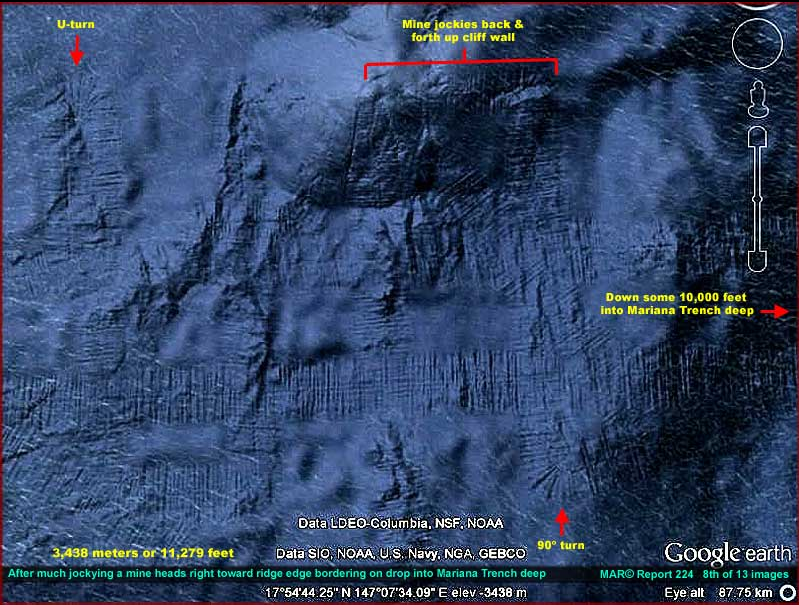
One of the first things that you can note from these images is the paths or trails that are constructed. The tracks go up entire sides of undersea mountains.. When the mountain is steep, the device that creates these tracks continues to try to go upwards, even if the vehicle slides down the hill sideways. It tries to jockey up the side.
The trails indicate complete U-turns that make a 180-degree turn, and then follows alongside the initial path or track.
The trails indicate intelligent decision. Ninety-degree turns are made, seemingly at random points. Obviously there was some sort of decision tree and direction that was provided to the engine that creates these tracks.
Mining evidence of the mining of the Lapulapu undersea ridge near the Saipan islands. Here one can clearly see the movement of the object creating these tracks had trouble going up and down steep underwater cliff faces. The device or vehicle that made the tracks had to jocky back and forth .
Southern end of the Saipan evidence site.(Image Source.)
Track Characteristics
The tracks are all the same. Aside from areas where they seem to go through mountains, the tracks are a uniform width. They create a line of debris that runs perpendicular to the track direction, and that line of debris is uniform with other lines with it. In the center of the track are a set of “inner tracks” that follow the main track line.
Goes Through Mountains
Apparently it, whatever it is, has the ability to go through mountains. This is very interesting.
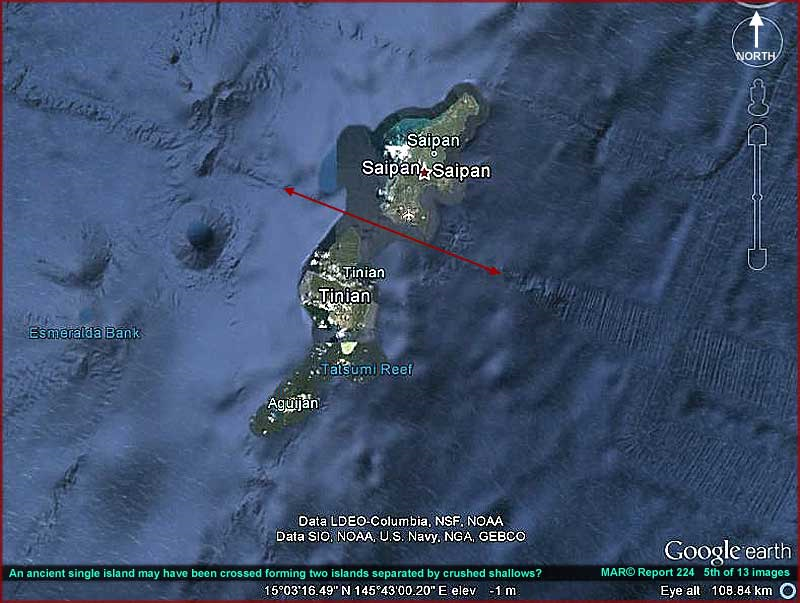
Does it actually go through the mountain, or does it dematerialize before it, and rematerialize after it? It seems that it actually went through the mountain and the tunnel has since collapsed leaving a shallows and separation of one island into two.
Note that the tracks are also different. The tracks start to narrow down like an arrow. This is suggestive of a process that is unknown to us.
A study of the tracks and the paths lead some interesting findings. For instance the tracks as they relate to the Saipan and Tinian islands is very interesting. It suggests that perhaps the engine went under the island, created a kind of tunnel, that eventually collapsed. Thus forming a shallow area and two separate islands instead of one large island.
Going through mountains and islands. (Image Source.)
Intelligent Control
It is obvious that there is some degree of intelligent control over the vehicle or thing that creates these tracks. It makes 45-degree turns, 90-degree turns, and 180 degree U-turns. It is as if it is searching for something.
Closeup of the southern evidence of tacks on the Lapulapu ridge near the Saipan island chain. The tracks make 45 degree turns, 180 degree turns and 120 degree turns. These are not natural processes.
Intelligent Control over the undersea vehicle. (Image Source.)
Tracks show clear evidence of turns and reversals, as well as search efforts that comprise 90 degree bends and turns.
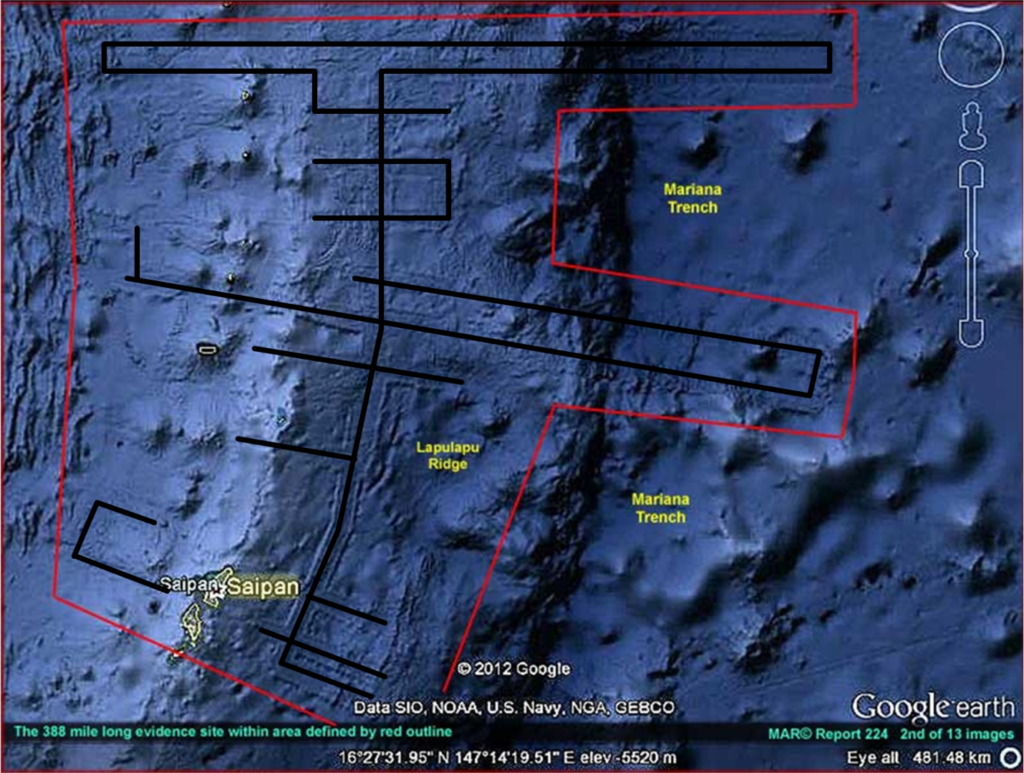
The device operates over enormous regions. Here is the overall general appearance of the most visible tracks around Saipan.
The tracks involved in the mining of the Lapulapu ridge show a pattern of obvious mining efforts. In fact, they almost look a map of the type of tunnels that one would make in an underground mining operation.
Obvious mining of the Lapulapu Ridge around Saipan.
Whomever or whatever is mining this area, they most certainly are focusing on the Lapulapu Ridge. The tracks clearly indicate an interest on the top of the ridge. While there are forays off the ridge, the tracks indicate an abrupt series of ninety-degree bends to return back to the ridge. I wonder what is so valuable on the ridge that requires such extensive mining at such a deep depth.
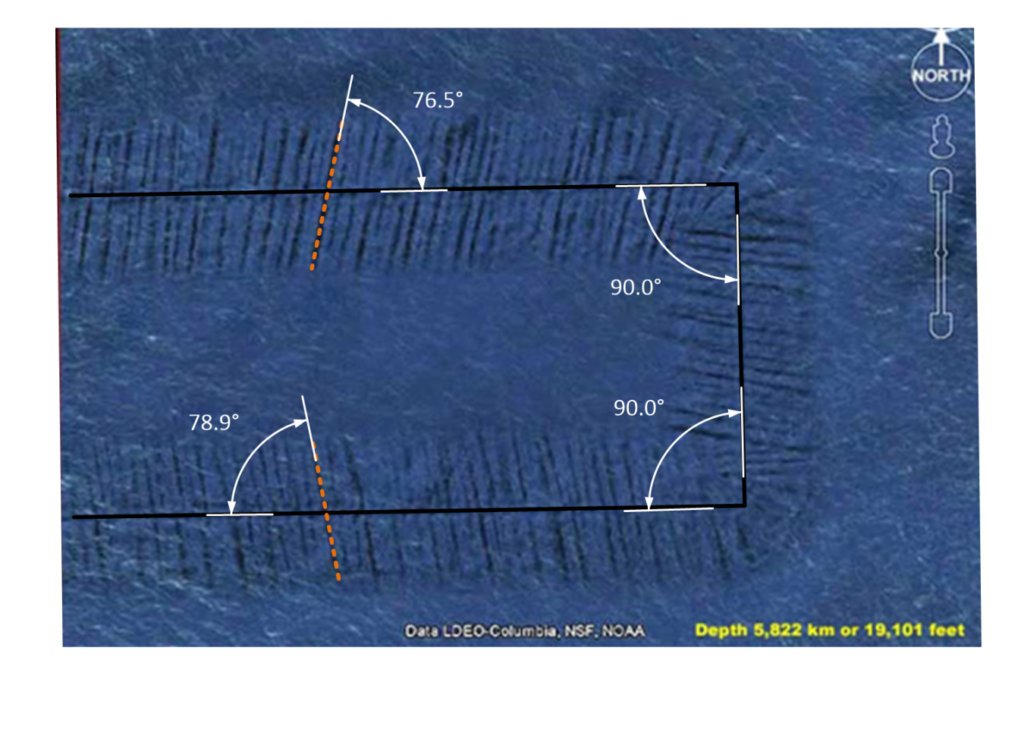
A study of the angular relationships of the tracks and the associated features of the tracks.
The angles associated with the large undersea tracks along the Lapulapu Ridge near the Saipan islands. They are certainly curious Large-scale formations. With accurate and exact 90 degree bends. The spent debris mounds are formed at a curious angle. The angles are similar but differ. The image above indicates a 76-degree and a 79-degree debris mound.
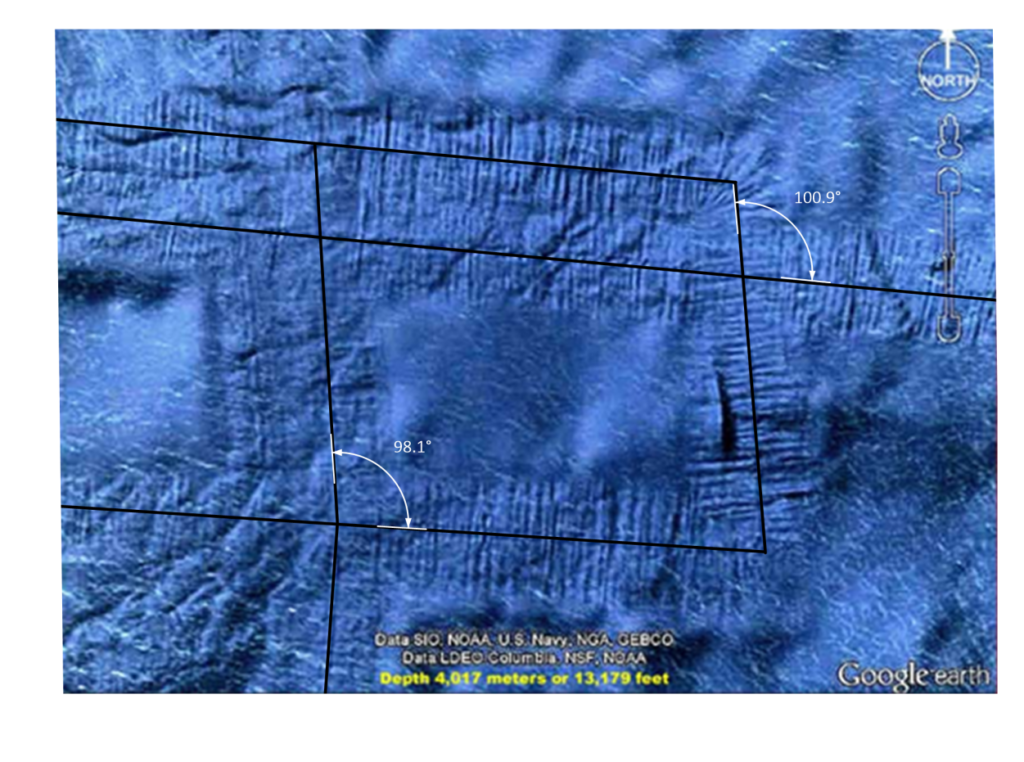
Evidence of Mining in a Grid-Like Formation
There is evidence that seems to point to the idea that the device operates following a grid or similar map.
Undersea mining operation near the Saipan islands showing rectangular exploratory behaviors.
Rectangular features forming perfect squares. (Image Source.)
As the mining vehicle moved away from the Lapulapu ridge, it discovered fewer minerals of interest and thus was forced to make a 360 degree turn and followed a parallel path back toward the ridge.
Large scale, large distance, grid-like mining.(Image Source.)
Possible vehicle
It’s pretty difficult to track down a vehicle actually making these tracks. However, if you are careful you can find one. I like to call it the roving orb under the ocean.
A large object has been observed crawling along the undersea surface at a depth of over 3000 feet off the California coast. Unlike the “official” explanation for the Lapulapu Ridge Mining operations, this movement is more “organic” and seemingly random. The object, which observers say looks man-made rather than natural, is estimated to measure more than 2.86 miles in diameter. It is a dome shaped structure (as it must be to sustain the enormous pressures on the ocean floor). It moves along the floor and displaces dirt and debris as it moves.
The object was brought to the attention of (UFO, strange event, and alien) investigators known as “SecureTeam10”. Tyler, who helps run the internet investigations site, said:
“There are certain areas of the ocean that are obviously blurred out. But what better place would there be for another race or another group of beings to hide than in the deep of our own oceans? … While we are up staring at the sky all day and worrying about what’s up there we have 90 per cent of our oceans unchartered.”-Tyler at SecureTeam10
Other comments include;
“We see a large circular object and an obvious path or trail created by it – and it disappears into a blurred out area – how convenient.”
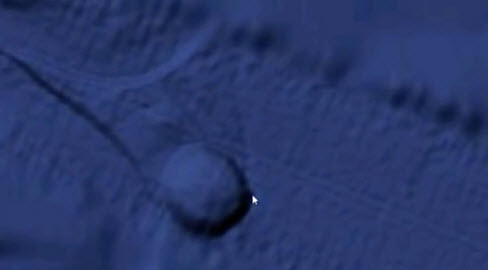
Large undersea object that is ambulatory that seems to be associated with the undersea tracks.
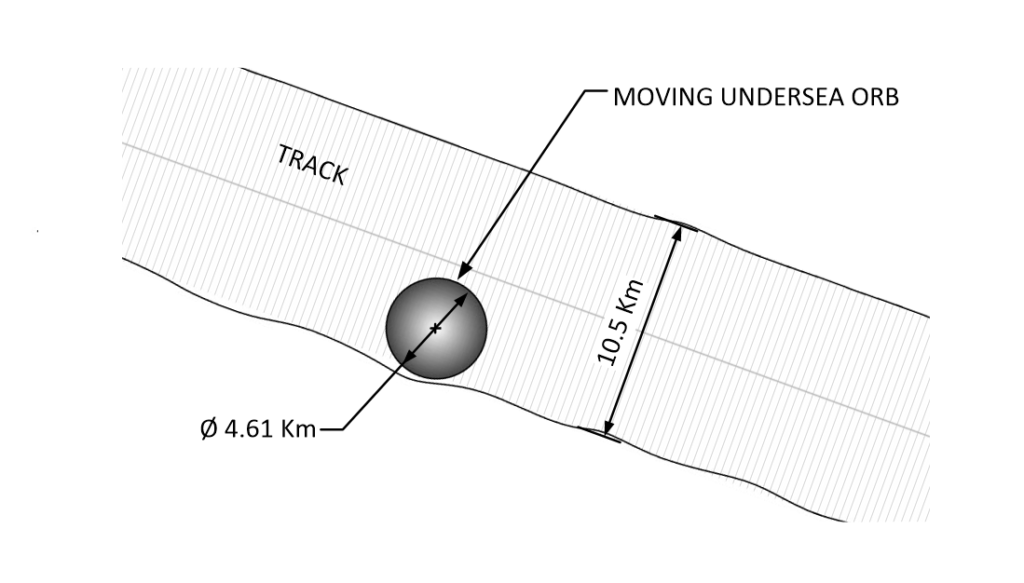
Diagram of the mysterious roving orb that tracks the mysterious mining tracks at enormous depths in the ocean.
It is pretty big. At 4.61 Km.
To put this into perspective, imagine that an American football field is 100 yards long (roughly 100 meters). You could fit 46 football fields end to end inside this object. It is huge. In fact, it is the size of a small city. It is around 66.5 square kilometers in surface area. It is one half the size of Pittsburgh, Pennsylvania. (151.1 square kilometers.)
What we can learn from this orb is rather simple. It is associated with the linear tracks, but does not follow the tracks. It makes its own tracks, which seemingly appear to be of random movements. It is also smaller than the width of the linear tracks.
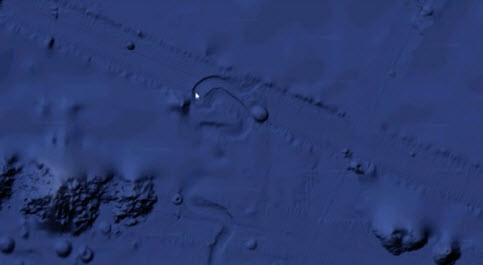
The mystery orb creates it’s own tracks which differ from the more linear and wide tracks found alongside it. This movement is odd and apparently directionless.
There is no question that it is moving about and leaving tracks.(Image Source.)
Abandoned Orb at the base of Lapulapu Ridge
An abandoned orb at the base of an undersea mountain near the Lapulapu ridge.
Another orb “parked” on one of the Lapulapu mining lines? This one looks like it is collapsed somehow. (Image Source.)
Close up of an abandoned orb that seems to be parked next to an undersea mountain. It looks like it has been there for a while. Notice that the top of the orb is open and suggests an interior with some type of complex layout. It is too bad that it is so deep, it would be really interesting to go and visit. I wonder what stories it could tell us.
The abandoned orb. The top appears to be open and there is something inside.
Uh oh. The Orb frustratingly disappears into an obscured area.
There are features under the ocean that defy known geologic processes. They are suggestive of undersea mining by an enormous undersea orb. Attempts to describe this away as a natural process are laughable. I don’t know what it is, nor do I know why it is there.
The only thing that I know is that the reality that we think of, is just an illusion.
It is entirely possible that this observed structure is something piloted by an intelligence for purposes that have no bearing or relationship to humans at all. As such, it is offered to the reader as nothing more, nor nothing less, than an intelligently piloted object that apparently defies the limits of human engineering.
Take Aways
What can we learn from this;
There are mysteries that exist under the ocean.
Not everything can be explained away as normal geologic processes.
There are huge mobile constructions that can move about under intense water pressure.
They create paths that appear to be searching or looking for something.
Other Opinions
I received this comment off-line by an influencer.
I think those “machines tracks” are an artifact of the SONAR scan, it’s called Phase Shadowing in the RADAR world. Check out Google Earth ocean bottom off the east coast of the US, say between NYC and Bermuda, it’s all over the place. I’d bet money it’s just an artifact of the signal processing but I’m only 95% sure.
I think that this is a valid observation. However…
It wouldn’t explain the roving orb phenomenon.
It wouldn’t explain why the sonar doesn’t influence the orb.
It wouldn’t explain the jockeying back and forth on the sides of the undersea cliffs.
It wouldn’t explain how some right angles are crisp, while others have a radius.
It wouldn’t explain how the tracks go under the Saipan islands and then collapse them into the sea.
It wouldn’t explain how dust and debris can obscure the tracks in certain areas.
This type of searching for answers is an important part of our role in understanding the world around us. While I have mentioned numerous “objections” to this solution, my ignorance in the way the sonar scan works should be obvious.
That being said, in my mind, it could very well be very possible that these are somehow associated with a sonar scan. I just do not know.
RFH
How about a Request For Help? I tire of busybodies and statists who poke fun at the ideas and theories of others. They offer no constructive dialog. Rather they just make fun, ridicule, and then scurry under a rock.
I use this forum as a way to disseminate some of the things that I learned though my thirty years of involvement in MAJestic. However, I am forbidden to posit my knowledge directly. I cannot tell the interested, the “secrets of the universe”. The best that I can do is share my opinions about things that interest me, and flavor it indirectly with my forbidden understandings.
To help put this in perspective, put yourself in my shoes…
Imagine that you are working at a company with a brutal NDR. You cannot divulge anything about what you are involved in for any reason.Now, let’s suppose that for thirty years you were involved in training unicorns to dance with bigfoot. To help with your training, the Lock Ness Monster would gather “magical beans” that you would award the unicorns when they did a particularly impressive dance move; like the cha cha or a nice rendition of the samba.Now, there is no way that you can talk about unicorns, bigfoot, or the Lock Ness Monster. But, the NDR doesn’t cover “magic beans”. So in the best interests of society, you might want to posit your thoughts about growing “magic beans” and how they might be of interest to imaginary creatures.That is the situation that I find myself in.
So, if you, the reader, were so interested, I would welcome your thoughts on this matter. What do you think about the plausibility that the orb and the tracks are natural geologic events? What are your thoughts about the idea that the US Navy already studied the orb with the open top? What are your thoughts on the levels of technology that must be achieved to perform these kinds of operations? Please, you are welcome to contribute.
This is my callout, to you the reader, to assist all of us in solving these mysteries. After all, this is a far better use of the internet than for looking at Justin Bieber videos.
FAQ
Q: What is causing the lines or “tracks” under the sea?
A: I do not know. There are geologic processes that can create lines around stress faults, however these lines do not look like any that we know if. If they are part of a geologic process then it would be a new and interesting geologic process. One that deserves study and investigation. To me, as a layman, they appear to be tracks with nice linear debris trails. However, human technology has not advanced to the stage where we can mine at such deep depths. We just do not have that ability. Thus we have ourselves a mystery that perplexes us.
Q: What is the orb?
A: No one knows, of if they do know, they are keeping it secret. It is a large, no huge, structure that is roving about on the ocean floor. It seemingly follow or retraces the linear tracks made earlier, but instead of following the path already made, it just seemingly moves randomly.
Q: What can we learn about this odd event?
A: Someone or something thinks that the Lapulapu Ridge holds some valuable items or minerals. They have devoted time (obviously), and effort (certainly) to mine these elements. It is unlikely that they are human, because known human technology cannot reach the working environment that the objects operate in.
Q: Why isn’t someone investigating this?
A: What makes you think that no one is investigating this? Just because CNN, WaPo, Salon and the Huffington Puffington Post thinks that there is nothing here, doesn’t mean that is actually the case. From a technical point of view, the suggestion of technologies that would enable us to mine the ocean deeps, as well as to provide military advantage for naval submarines is reason alone to investigate this mystery. Remember, boys and girls, real investigations are never publicized. They are kept secret and the work is collected and accomplished in silence.
When I was a youth, in the 1960’s and 1970’s, one of the biggest treats that my father would give us would be a trip to one of the nearby “Army and Navy” stores.
We would hop in the car, and then ride for a spell (depending on the direction) from a half an hour to an hour and a half drive. We would stop along the way to get a soft-serve cone at Dairy Queen, and then spend an hour or so in the store.
They all looked pretty much the same no matter where you went. The nearest ones to us, at that time, were in other towns. We would actually have to cross the country line to get to them. At that time, I frequented a store in Butler, Pa., and another one further up North in Erie, Pa.
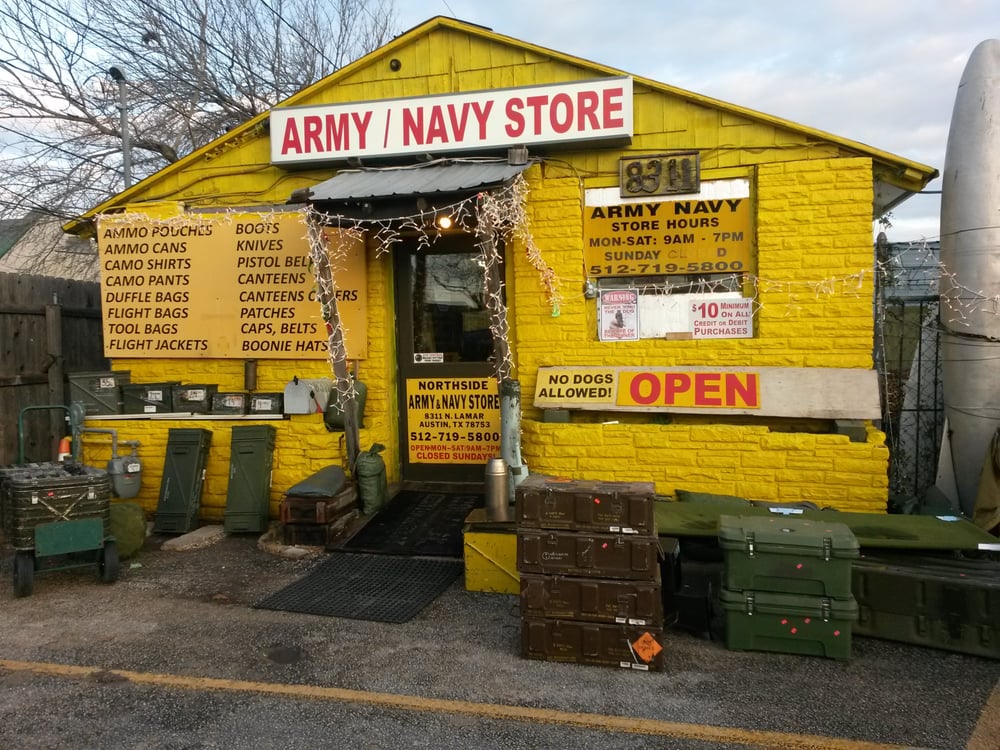
I guess that they are a fading American cultural fixture today. They can still be found. However, they are mere shadows of what they used to be. Today, surplus stores can be found in strip malls in the rough part of town or as stand-alone warehouse-style buildings. In the later case, they might be a metal pole building with a huge “Army and Navy” sign in huge letters (often black on yellow) with corrugated metal roofing and very few windows.
For a boy growing up, the world of the Army and Navy store was the first stop and a doorway to adventure. When we entered the building we encountered the world that we dreamed about. here were places with maps, treasures and tools. We loved going through the boxes and exploring the nooks and crannies of the store.
Of course, today they might not advertise themselves so openly. With all the politically correct nonsense, it makes sense to downplay your presence else an army of enraged “water buffalo” BLM females, or black clad SJW types might burn the establishment down.
Anyways, it’s true.
The Big Treat!
When I was a boy, one of the biggest treats that my father would provide for we was a trip to a “Army and Navy Store”. We would drive to the store and park on the street. A quarter would allow us to park the car for the entire day, so usually my father would just put a nickel in the parking meter. That would give us two hours of adventure. That was more than enough time for exploration.
Who knew what surprises awaited us?
Swiss army phone dialer. This was a portable unit, obviously. Don’t ask me how it worked as I haven’t a clue. We can only assume that it was used in conjunction with other gear of some type.
Today, there are still Army and Navy stores, and they still have the same layout and ambience.
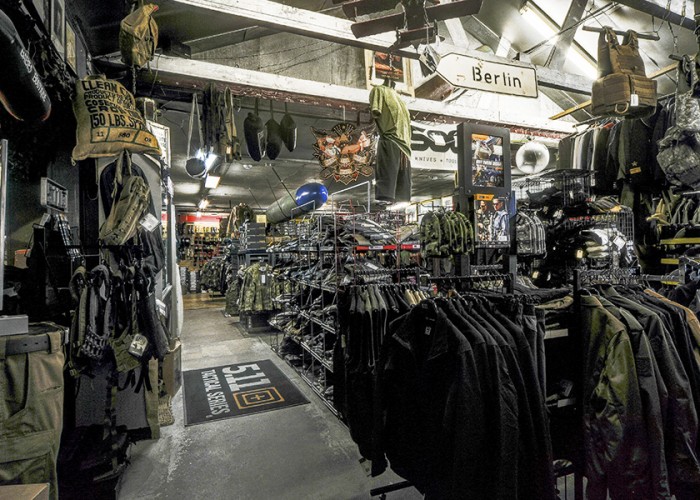
When you walk in, your nose is met with that distinct army surplus smell: musty canvas mixed with metal and rubber. Flags hang from the ceiling — an American flag, flags from the different branches of the military, and of course a fine yellow “Don’t Tread on Me” flag. There was always a “Confederate” “American Stars and Bars” flag, as well as the mandatory black MIA flag.
There will be racks and racks of clothing. Mostly uniforms and coats. There will be bins of shoes and socks. Webbing and just brick-a-brack that defies description.
Who knows what discoveries that await you at an Army and Navy surplus store/ You can find anything from Vietnam era boots to radio sets fight out of a B-52. It’s all yours for a price. It’s a boyhood adventure.
The Army and Navy Store
Every conceivable space in the store is filled with product. You’ll see bins scattered throughout the floor filled with gas masks, canvas duffle bags, canteens, and nylon combat belts. The shelves are jam-packed with combat boots, cargo pants, and helmets. And the coat racks are stuffed with pea coats and camo as far as the eye can see.
You would find racks upon racks of military clothing. Then, tucked in every imaginable nook and cranny, were boxes of unsorted clothing. Some in disarray, as if they came from a flea market. Others, nicely folded, but never used, as if they came directly from a warehouse or factory inventory.
Near the door would always be a glass counter and a display of the more valuable items. Inside the glass case, you’re likely to find antique military items like Nazi paraphernalia, guns used during WWI, and a plethora of knives. I always liked the “trench knives” that had a built-in set of brass knuckles.
Sometimes the Army and Navy store would be alone in it’s own house, while at other times it would occupy a store front in a seedy section of town. These stores were always quite unique and special.
You could always find compasses, maps, various metals, and all sorts of smaller brick-a-brack in these counters. There also, would be some fine cigarette lighters. Some old. Some new. Many would have military sayings or logos, but Harley Davidson, and the Southern “stars and bars” were always present and popular.
For decades, the army-navy surplus store was the go-to place for individuals looking to find a good deal on products to outfit themselves for camping or hunting. It was the place prepare for the apocalypse on the cheap, or simply pick up a stylish pea coat at a bargain price. For me and my classmates, it was a place of adventure.
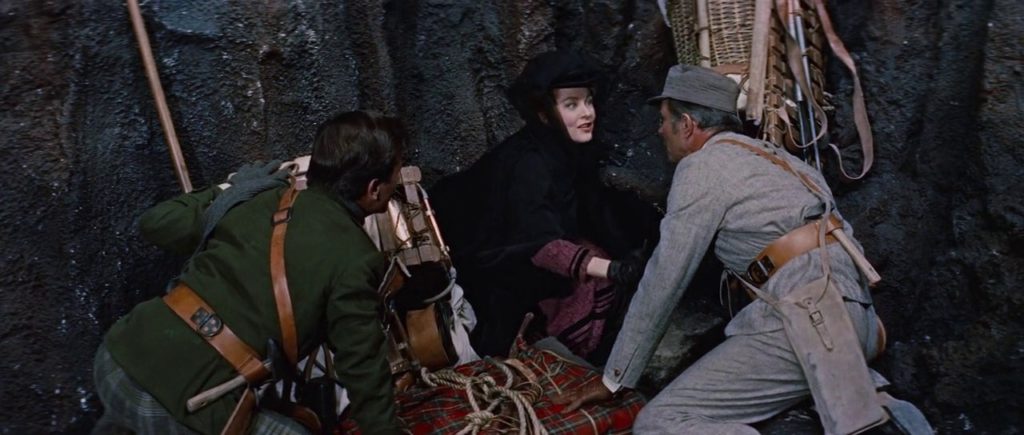
For there, we could outfit ourselves for our next big exploratory adventure. Who doesn’t remember how the explorer’s outfitted themselves in the movie “Journey to the Center of the Earth”? For us, the Army and Navy store was THE place to outfit ourselves for our next adventure.
While I don’t recall wheels and piles of hemp rope, they did have rope in smaller quantities. This would include nylon and various other woven types aptly suited for a Naval excursion on the high seas, or perhaps useful for constructing a tree-house ladder. You know, to keep the girls out of the “He Man Woman Haters Club”.
Journey to the Center of the Earth (also called Jules Verne’s Journey to the Center of the Earth) is a 1959 adventure film adapted by Charles Brackett from the novel of the same name by Jules Verne. Göteborg’s widow, Carla (Arlene Dahl), who initially believed Lindenbrook was trying to capitalize on the work of her deceased husband, learns the truth of his secrets from her husband’s diary. She provides the equipment and supplies Göteborg had gathered, including much sought after Ruhmkorff lamps, but only on condition that she go along. Lindenbrook grudgingly agrees, and the four explorers and the pet duck are soon journeying into the Earth.
With the United States fighting in just about every obscure nook and cranny of the world (for reasons unrelated to National Security… but that’s a discussion for another time) there was such a glut of military surplus clothing and gear that Army and Navy stores were everywhere. It almost seemed like you could practically throw a rock in any direction and hit an army surplus store. They were prolific and played a vital role in distributing an over-abundance of government-issued supplies that accumulated during the last ten or so wars.
Outfitters for War!
After World War Two, the extreme excess of government-issued equipment (produced by America’s “arsenal of democracy”) combined to explode the growth and popularity of surplus stores. Indeed, huge amounts of wartime leftovers flooded the market.
Army and Nay surplus stores were filled with all sorts of military gear. You could get everything there. It was a boyhood dream.
Thanks to the United States’ significant involvement in the Vietnam War, army surplus stores were able to restock their dwindling WWII inventory with updated military surplus. If you visited a surplus store as a kid in the 1980s or early ‘90s, a lot of the stuff you saw was probably from Vietnam.
I know that that was the case with what I experienced. There would be a mixture of World War II, Korean War, and Vietnam War gear. In addition there was often a mixture of foreign military gear. I was able to pick up an Africa Korps pith helmet from World War II, and a French paratroop jumper camo cape.
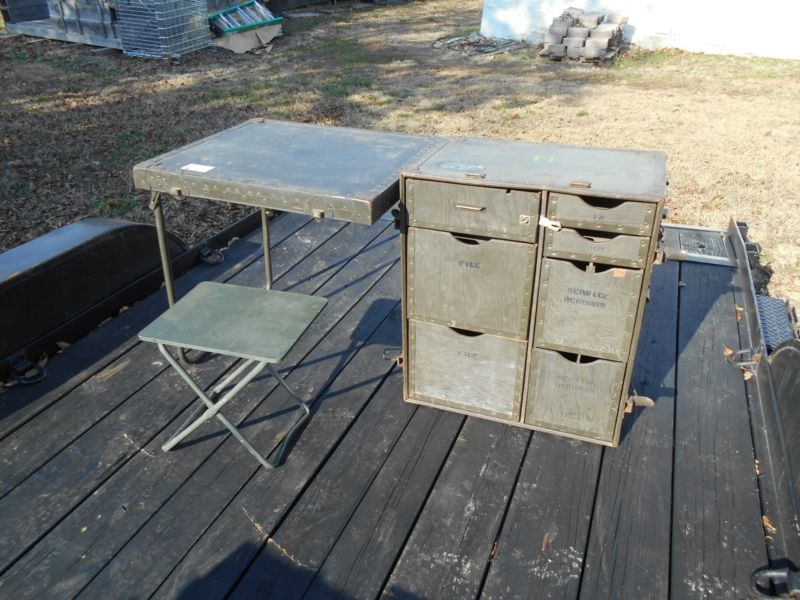
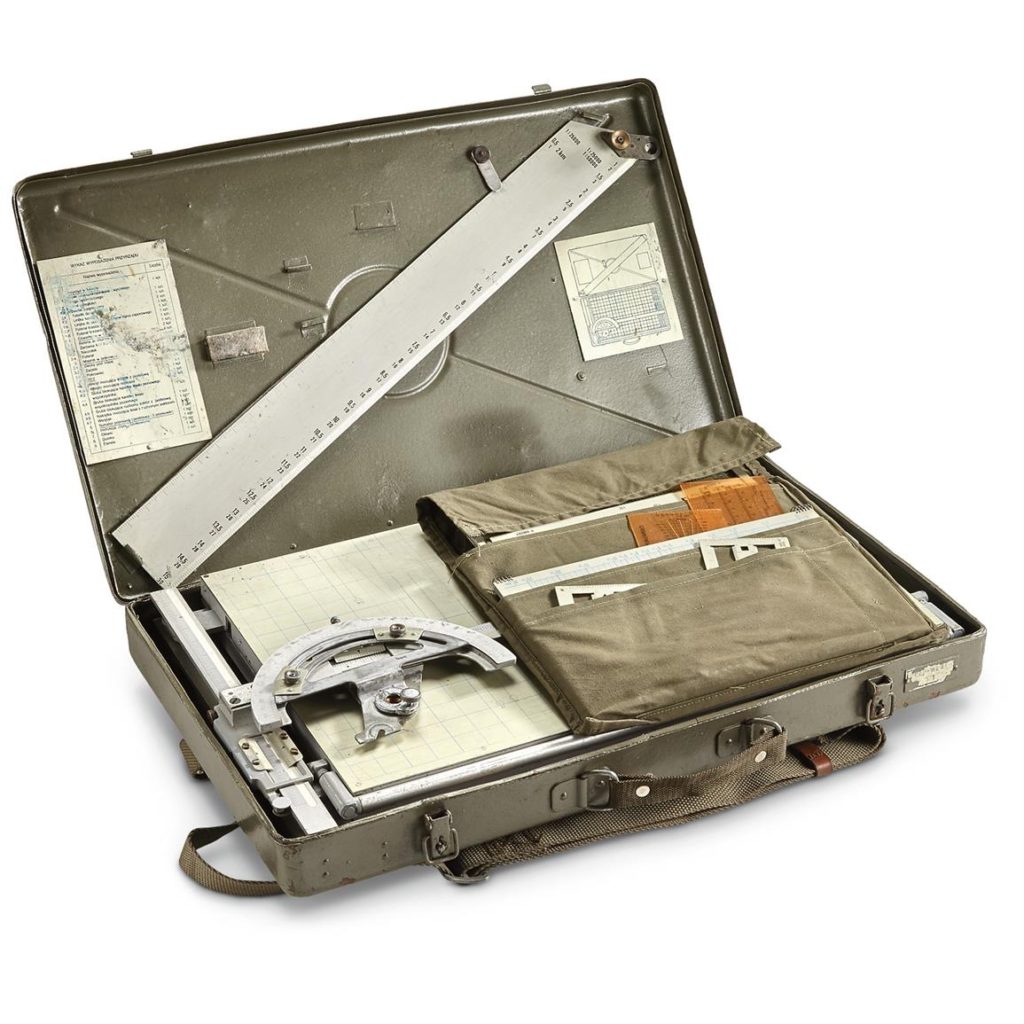
Here is a military surplus desk combo. It includes a chair, a desk writing surface and some fine drawers. All designed for easy transport and quick storage.
To many, the period from after WWII and until the early 1990s could be considered the “Golden Age of Army Surplus Stores.” There was just so much stuff available, and it was so widely dispersed and easily accessible to the public. Instead of ordering something from a catalog, you just had to drive a few miles to one of the many surplus stores in your city.
You could get just about anything there. My brother picked up a World War two Morse code kit in a green canvas carry bag. Who knows the stories that it could tell? Was it dropped behind enemy lines and used by the French resistance? Was it a training device for British Naval saboteurs? Was it used to communicate the successful retaking of the Philippines? Ah, such secrets…
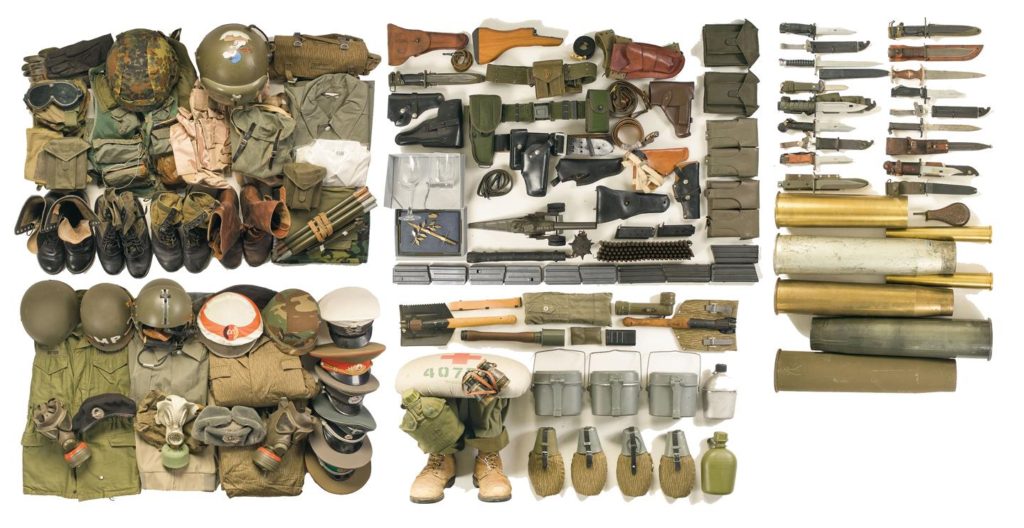
Typical selection of army and nay gear that you could get from a Army and Navy surplus store. One thing, you the reader probably don’t realize, is that these stores are common all over the world. They are available here in Communist China. You can get some great clothes dirt cheap, I’ll tell you what.
My good buddy ended up getting a trench shovel, and a flashlight that had a red lens cover on it. His younger brother picked up this set of dust google that looked like it belonged on the set of the “Rat Patrol” (a television show from the 1960’s). He wore them to the school, and for about a week he wore them every day (supposedly) in class until his teacher had to put his foot down and tell him enough was enough.
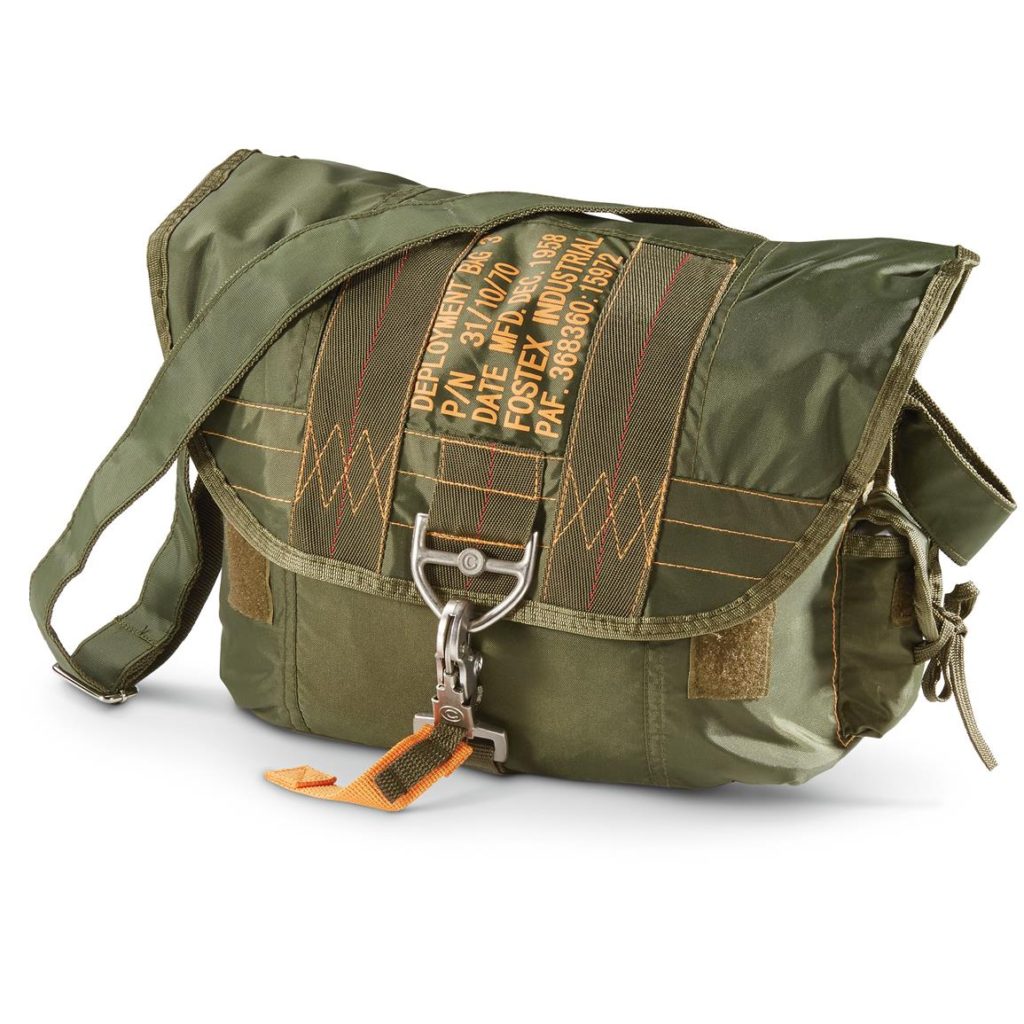
Tactical Parachute Shoulder Bag with Latch. Have a fashion-minded daughter? Give her this and see what she might do with it.
Speaking of fashion…
The “Bell Bottom” fad in the late 1960’s came in being precisely due to the popularity of the navy flared (bell bottom) jeans available in the Army and Navy. This was also true for the “Pea Coat” fad that floated up and around in the middle 1970’s.
For the longest time I wore a pair of “aviator glasses that I picked up when I was twelve. My brother, not to be outdone, bought some yellow shooter’s glasses. He still has them. I still go visit the establishments to pick up some cargo pants and gloves with the fingers cut off.
Who knows what vintage discoveries await the boy within the confines of an Army and Navy store. What is there? What elements of history awaits the boy who is ready for discovery?
Yeah. Army surplus stores still exist. You probably have one in your city. But it’s probably not the same kind of army surplus store you may have visited back when you were a kid. It might still have the smells and have the same kind of over all clutter, but something is missing…
If you’ve been to one recently, you likely noticed that fewer of the products they carried were actually “military surplus.” Sure, the stuff might look military-ish, but it was likely bought from a foreign company that manufactures military-ish products instead of from the U.S government, or even a foreign government.
Here is a nice German army shirt. You can tell by the tiny flag on the sleeve as well as the camo pattern. You can find all sorts of military gear in today’s army and navy stores.
Other stuff…
You’ll also see product in the store that you probably wouldn’t consider “military surplus” like work pants and shirts, consumer camping gear, etc. In short, what I am trying to say is that in today’s army surplus stores there’s less army surplus.
Two big factors are contributing to the decline of true military surplus products in the marketplace. These were, or course, [1] the changing nature of war in the late 20th century and [2] the advent of online shopping.
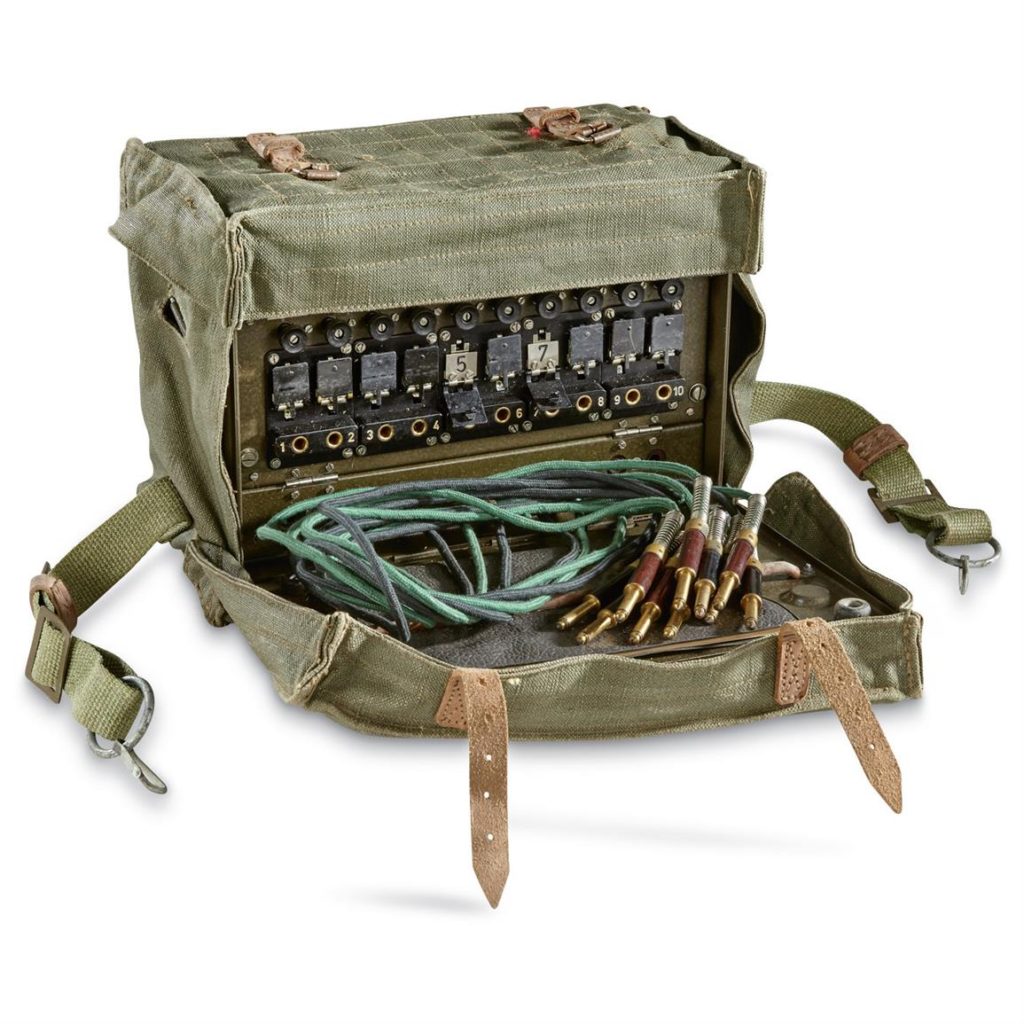
Polish field switchboard. It’s amazing what finds that be discovered when you venture forth into an Army and Navy surplus store.
While the United States is indeed busy fighting all over the world, how we do it has changed. (The US Military is currently fighting seven wars! Thanks to Barrack Obama.) No longer do we throw legions of troops in an engagement. Instead we use selection. We use skilled soldiers. We use drones.
Indeed, war has changed dramatically since Vietnam.
Instead of engaging in large-scale conflicts that require a draft with many millions of soldiers fighting on the ground, the U.S. military (in all branches) has shifted to a much more streamlined and surgical approach to battle — one that involves a smaller, well-trained, all-volunteer force.
Whether you purchase American military surplus gear or foreign military surplus gear, the finds will certainly surprise. Who knows what little jewels can be found amoungst the clutter?
For example, there were over 10 million American soldiers who served in Vietnam, while only 2.5 million served in the most recent wars in Iraq and Afghanistan. Because our most recent conflicts have required fewer soldiers, the military has required less equipment. Because the army requires less equipment, there’s less military surplus to go around to all the army surplus stores around the country.
But there are other reasons…
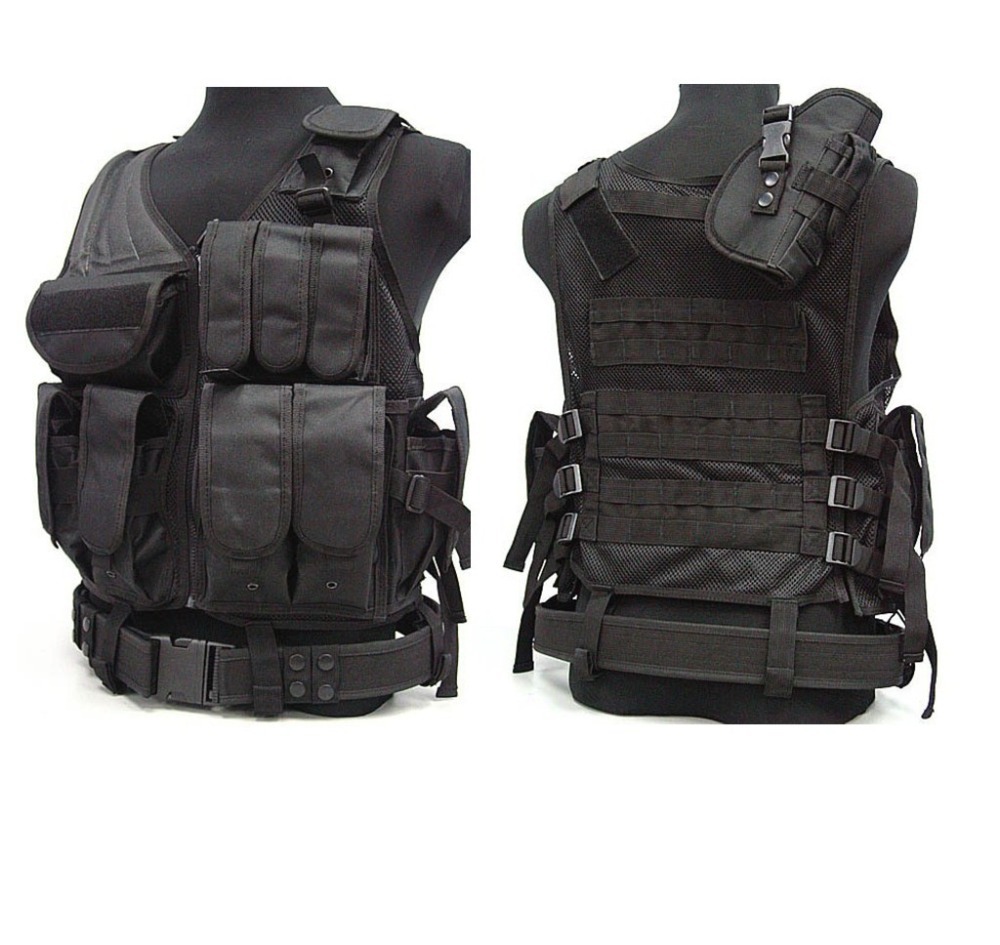
Companies that make military gear for the various alphabet agencies (IRS, CIA, FDA, FAA, ICE, DHS, etc…) supply Army and Navy stores as well. There, you can outfit your gear to include FBI tactical vests, light jackets emblazoned with the IRS logo, and all sorts of related gear.
That being said, 9-11 was a boon to the militarized police forces, and armed alphabet agencies. Now, every one from the NSA, FAA, FDA, IRS to the DHS and ICE require state of the art uniforms and gear. So while it might look like there as a dearth of “pure” military hardware, and a glut of cheap-Chinese knock-offs, that is just a reflection of the changing nature of the American government.
Today the emphasis is NOT on a large military force fighting in a far off land. Instead it is on a militarized collection of government agencies whose charter is on controlling the American population. It sounds harsh, but it is true. You just need to open up your eyes and take a gander. You can see this emphasis in the Surplus stores.
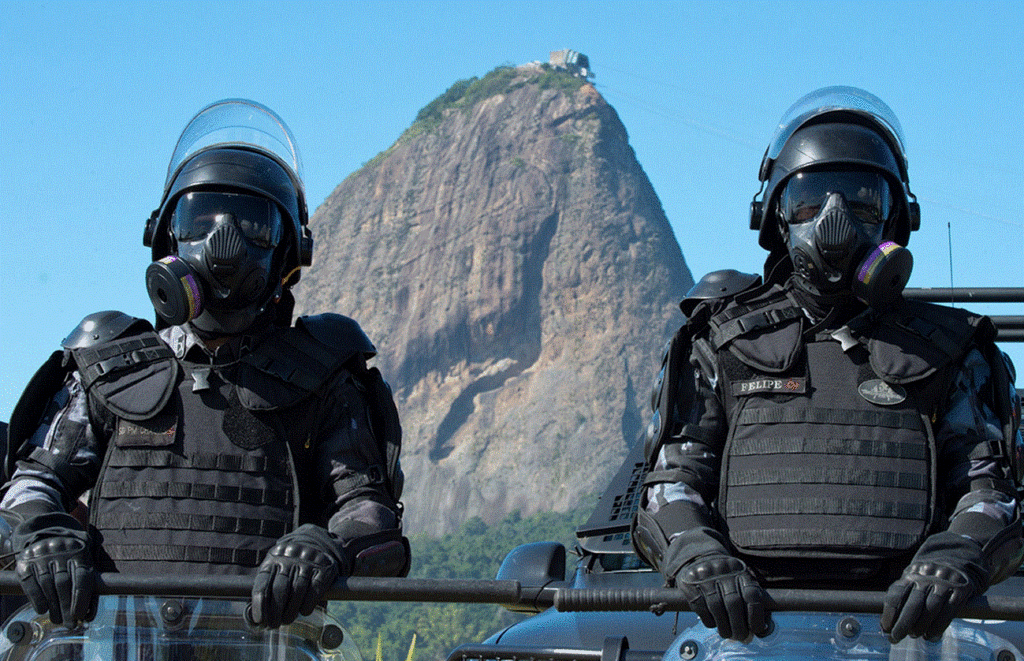
You can also read about how the United States government is busy stocking up on riot gear. You can read about it HERE.
Much of the gear found in Army and navy stores are representative of urban police forces and crowd control. Obviously all black uniforms are suitable for either the Nazi SS and Gestapo, the American IRS or the DHS. When fighting in a military theater, the best uniforms possess a camouflage pattern.
Compounding the shortage due to smaller, more limited military engagements is that — thanks to the internet — army surplus stores now have to compete with the government itself in selling surplus military inventory.
The U.S. government has an online store where the public can buy military surplus direct, thus cutting out the army surplus middleman and saving the buyer some money. Thanks to competition from the government’s direct-to-consumer sales, army surplus store owners have had to slash retail markups on their products from a plump 100% to a smaller 30-50%.
You can equip yourself and your loved ones with some pretty fine riot-gear. All you need to do is go to your friendly Army and Navy store and get some of their surplus population control gear. There are some great deals in batons, and protective padding.
The New World of Army and Navy Stores
Because of these two changes, the [1] streamlined wars and [2] the internet, the once robust army surplus store industry has taken a hit. There’s just less inventory to go around, and less money to be made in the business.
Who can forget the scene where Bruce Willis is in the Army and Navy store (or was it a pawn shop?) and decides to go after his tormentors. Ah, what a scene. As with the Kill Bill movie, the victor gets the truck (Pussy Wagon), or in this case the chopper.
To keep shelves stocked with military goods, even though there’s less government-issued military surplus available, stores have taken to importing military surplus “knockoff” products — stuff that looks like military surplus, but really isn’t. Instead it is equipment for urban riot control and police force use.
Some stores have shifted their focus from being military surplus dealers to antique military dealers. 20th-century military gear — once considered ordinary surplus — is now considered “vintage,” and collectors are willing to pay top dollar for these antiques. Army surplus stores that have been in business for awhile have used their networks developed over the years to become savvy peddlers of 20th-century military collectibles.
Never the less, if you’ve visited an army surplus store lately, you probably noticed they just aren’t what they used to be — that the quality and quantity of the selection of products isn’t the same.
But still…
These places are just fine for exploration and discovery. This is most especially true if you are a boy in your early teens. It’s an experience that all boys should be exposed to. (That and hardware stores, but that is a discussion for another time.)
Serbian Military Surplus Leather Magazine Pouches, 4 Pack, Used
These stores still exist, and the desire of boys to explore and go on adventures hasn’t at all diminished. I argue that we should feed this latent need of boys. As such, the exposure to an Army and Navy store is a must stop for all young Americans.
Conclusion
Time has a way of changing things. One of the treasures that existed when I was growing up was the presence of Army and Navy stores. I urge everyone to spend some time and enjoy a visit to one of the few remaining stores that exist in the United States. Who knows, maybe you can relive some forgotten boyhood dreams and share the experience with some close friends and relatives.
While today, I have little need for such items, I cannot help but be intrigued by them and coveting of many an odd item or two. I can’t help it. It’s the “pack rat” inside of me, not to mention the “Boy Scout” in me that screams “Be Prepared!” I am sure that one or two plastic mortar round cases might make a nice waterproof storage item for…
…things. I’ll find a use for them. You just wait and see.
I haven’t done a happiness post in a while. Perhaps it’s high time that I dust off the old keyboard, slide all that nonsense and clutter off my desk, open up a window and let some fresh sunny air inside. With that being said, let’s spend a few minutes to talk about some good things; things that matter to me. And, by extension, maybe that matter to you as well. Eh?
These are just some thoughts that I have had. They are my thoughts, and I am sure that not everyone will agree with me. But you can skip the parts you don’t like or agree with. And nod to yourself silently in parts that you do like.
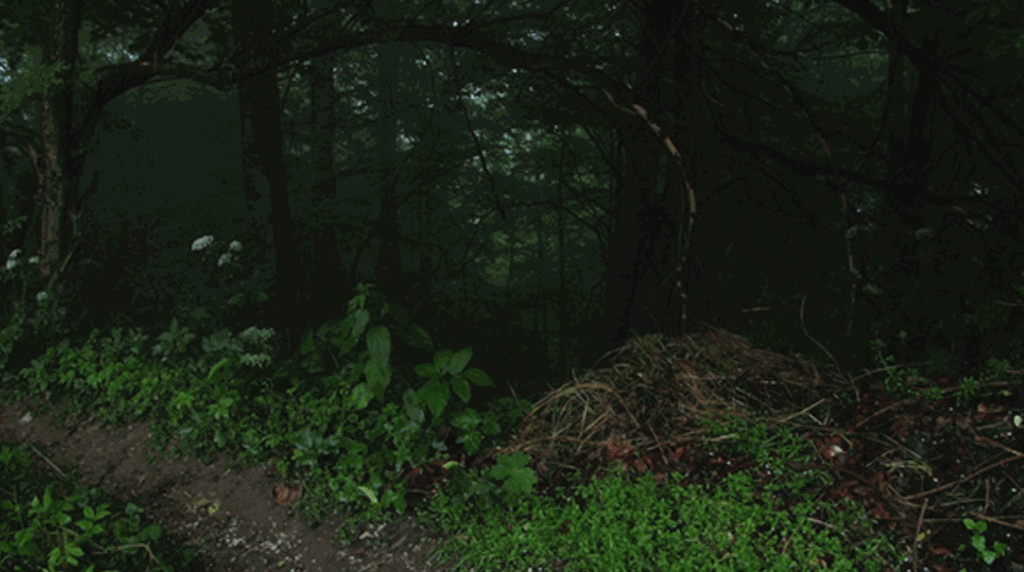
Deep Dark Cool Forests
One of the little pleasures that I have enjoyed are those special moments when I enter the deep dark woods.
As most of you might be aware, there are all kinds of forests. From light sparsely fielded birch groves, to dense pine growths, to scrub and spackle arrangements. Here we are talking about deep, thick and rich old-growth forests. Forests that are populated with century old hard-woods like cherry, maple, oak and mahogany. Forests with bark as thick as your hand and lush deep thick curtains of moss that cover everything.
You can breathe in the cool moistness with your nostrils and feel the fresh air in your lungs.
The cool deep dark forest.
When you walk into this environment it is like you are entering another world. It’s cooler. It’s dimmer, and the shade is complete. There might be a very few instances of light that might manage to pierce through the upper canopy, but not often. You might be able to hear a brook bubbling away, or a swish of some deer as they disappear in the distance.
On of my great pleasures is to walk and explore the dark recesses of a midnight dark forest.
It’s a treasured place, and a treasured time. As such, I would like to express my belief that if we do not take the time to go forth and visit these treasured places that we are missing out in one of the great joys of life.
Perhaps there is a national park nearby. If so, go there and take a trail that you have never walked before. You will not regret it.
Sunny mid-morning Spring days
As I write this, it is the start of May. Springtime. Just about the entire world is waking up, stretching their arms, and venturing outside.
One of the little pleasures (that I have) is the freshness and coolness of Spring air, most especially when it is associated with a very Sunny day. These are days where the windows are open in the house to let the fresh air in. Where the kids are out in the driveway hosing down and washing the car, and where people are talking about when the local pool will open up.
After I left the ADC once I was retired, everything was “good”. It was all good. And I vowed that I would appreciate life more, enjoy it more and treasure it more. Perhaps that is what many people need today. A lesson to appreciate what you have WHILE YOU HAVE IT.
This is also the time when Winter clothes are packed and stored away. The Winterizing for the house, the car, and just about everything else is set aside. It’s also when the first mowing of the lawn occurs, and if you have a pool, when the pool cover is removed, the leaves are gathered from the water, and you “shock the pool” into health.
Maybe you might even set some chairs out in the yard.
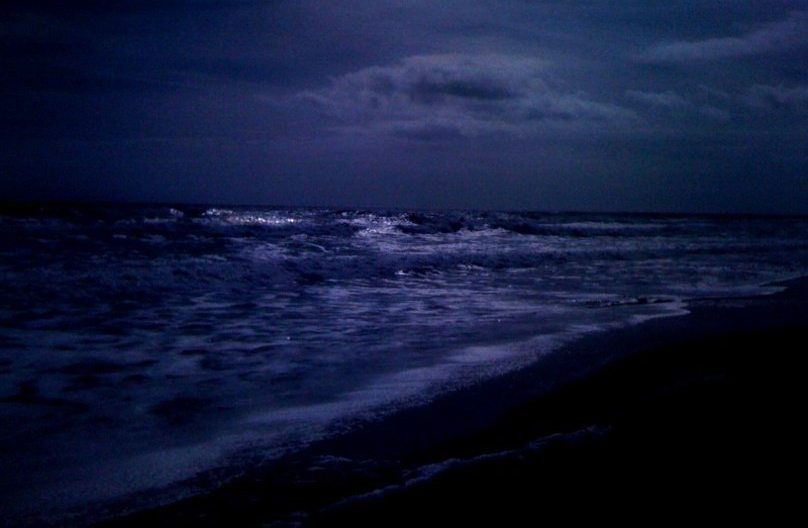
Nighttime on the beach
It’s quiet. All that you can hear is the surf beating up against the shore. The sky is black, and the sea is black, and the sand is dark grey. Yet, strangely once your eyes adjust, the whitecaps on the waves are this light blue color. It’s actually magical.
Nighttime on the beach.
It’s a time when you walk, and think. And if you are with a friend, you talk. The waves roll. The air is still with occasional light breezes, the palms sway. There is a pace of life. It is free of the electronic media that are are all tethered to. And that is a good thing.
Then once you return home you can turn on your social media. You can read or hear people literally screaming at you with the latest “issues” of the day. Trump is a Russian spy! China is evil, nasty and eats bats! Your rights are being stolen from you! We need to raise taxes! And on and on and on.
Go outside. Shut that nonsense off.
Warm laundry on an icy cold day
It doesn’t seem like much, but to me it’s special. It’s a time when you pull the clothes out of a dryer on a frigid Winter day. The clothes are warm, toasty and delicious. Meanwhile the house is cold, brisk and icy.
A delicious home-cooked hamburger and an icy beer
You didn’t think that I would ignore this special moment, did you? Nope. All praises to the home-made hamburger and the icy cold beer. Now, when I mean icy-cold, I actually do mean icy cold. In fact, I (myself) prefer a tall glass of ice, and then pour the beer in. That means, boys and girls, that I drink the beer at 32F or 0C. Frosty.
One of the delicious pleasures that I have is the home-made hamburger with a nice frosty beer. It’s what I enjoy, and I believe that everyone should try this combination at least once in their life.
Now a frosty mug is nice. But it is the temperature of the beer that makes this special. Not to mention a nice home made hamburger with tomatoes, cheese (glorious cheese!), lettuce, and bun. Oh, and if you were inspired, some nice slabs of bacon would really enhance the overall burger flavor, don’t you know.
Well?
What’s stopping you from doing this right now?
Fixing a busted car and having it roar back to life
Have you ever dealt with a broken piece of machinery? You sit in the car, you fire it up and …clunk! Nothing.
Gagh!
That car is very tired.
So then, after some screaming and moaning, you finally figure out what is wrong. You pull out your tools, and start to get to the heart of the matter. But, of course, nothing is easy to get to. You need to tear half the car apart to get to anything. Then, after hours of work, frozen and stuck nuts, icy wind blowing on your knees and your shit wet with water, oil, gasoline and grease, you finally are able to put the replacement part back in.
Then, you climb in and fire that puppy back up…
…barooooom!
It’s “Miller Time!”
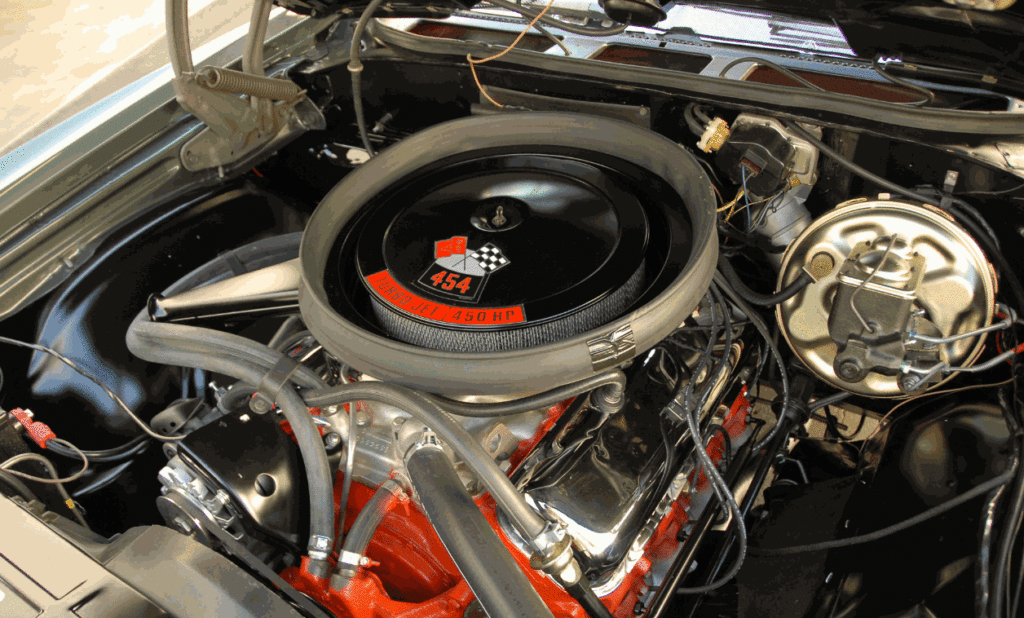
It’s a real joy to see an engine roar back to life once you fix a few problems. (Oh, and don’t you just love the 454, eh?) The 1970 LS6 454 cubic-inch V8 that was one of the best street muscle car motors ever produced. Broooom!
Making a pot of Chili
There is a certain joy in making a pot of chili. I really cannot enunciate why it is so special. Maybe it is because I would tend to cook chili on the weekends. Or maybe it’s the smell of the chili as it is cooking all afternoon.
A fine bowl of home-made chili.
Or maybe it’s sitting down afterwards watching a movie with the chili in one hand and an icy cold beer in the other. I really don’t know. What ever it is, it’s most certainly a wonderful and special noteworthy time.
I started to make chili when I lived outside “Poison Canyon” in Ridgecrest, California. One day the staff on the base had a “chili cook-off” on a non-base facility. All of us were asked to submit our creations. It was my first attempt at making chili and (yes) I made some mistakes. But then ever since, I kept at it and kept at it.
Now, when I make up a pot, it is my “comfort food”.
I like to eat it over rice. (Though some friends in Louisiana like to eat it over chips.) I know that sour cream is a nice addition, but I never seem to have any around. Instead I opt for lots and lots of yellow cheese (sharp cheddar) is my favorite and some hot peppers.
Oh, and don’t forget the icy cold beer.
Playing with your dog
There’s something about a little playful ritual that I have with my dog “Shao Pi”. You see, a couple of times a day I give him a “dog sausage”. It’s a kind of meat flavored rice filler in the shape of a sausage. It’s pretty darn cheap.
Chinese doggie sausages. You cut holes in the plastic skin and he sucks the liverwurst like meat out of the sausage.
What I do is cut the ends off and punch holes in it. Then I call him.
Now, my game is to pretend that I cannot see him or know where he is. I start looking for him all over the house and outside on the porch. He goes crazy trying to say “I’m here! I’m here!”.
I carry on like this for a few minutes. Eventually he “convinces” me that he’s there, and I hand the treat out to him.
Now, my wife tried this game.
The only thing is that she didn’t play the game. She just handed the sausage to him.
What he did was so funny. He sat on the floor. Looked at the sausage, and then up to her. As if to say “what? You don’t want to play with me? Did I do something wrong?” And then he slunk back to his sleeping bed and ignored the sausage.
LOL.
This time is a little pleasure I have. I guess that it sounds so silly to dog haters or cat lovers, but I swear it is a special time and something that adds meaning to my life.
An after-dinner cigar and a glass of whiskey
Ah. You can tell that I am a man growing old. But you know what? Yup this is a real pleasure of mine. There is something relaxing and soothing to have a fine meal, and then calm down afterwards with a fine cigar and a nice glass of whiskey.
An after dinner cigar and a glass of whiskey.
I must admit that I am not a connoisseur of cigars. Rather, I take what I can get. Though the Cuban cigars obtained locally are really nice. As far as whiskey goes, I know what bad and fake whiskey is, but my budget will not permit me to have any of those expensive brands that you see in magazines. So I make the best with what is within my budget.
It’s a pleasure of mine and something that you cannot do in any public restaurant in America today. But, it is something that I can do just about anywhere else in the world. It’s what’s called “freedom“.
Picking a ripe heirloom tomato off the vine
When I was growing up we had a little garden. I was the only one who really cared about it. I would tend to it, and weed it all Summer. I would also go ahead and plant tomatoes along with the other vegetables. My favorite plants were, of course, tomatoes. Though secondary favorites included green peppers and zucchini.
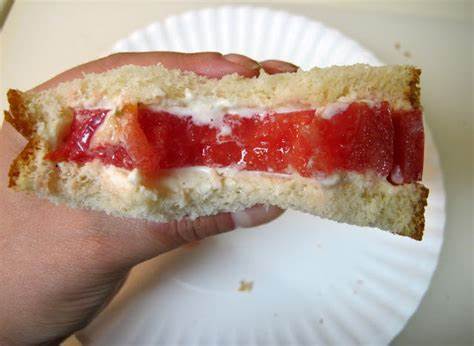
A fine tomato sandwich.
I tried to grow them up here in China. No such luck. Zhuhai is way, way too hot for the kinds of tomatoes that I know and love. I wrote a post about this HERE…
Anyways, back to my story.
Growing tomatoes is a real pleasure of mine. I especially like the tomato sandwich that I make from a freshly picked juicy “Big Boy” fresh off the vine. I just cut that sucker into many thin cuts. Layer the cuts one on top of the other. Add some salt and pepper, and slather some sweet mayonnaise (Miracle Whip) on top. Of course, I use plain white bread. It’s the perfect bread for this sandwich.
I just cannot imagine a Summer without a tomato sandwich.
And, of course, I always eat it over the sink while the sauce and the tomato dripping fall down. My hands get all messy, but I just rinse them off under the running water.
It’s a great Summer pleasure, I’ll tell you what.
You do not know what your true pleasures are until you cannot have them. The pleasure of a simple tomato sandwich was denied to me in the ADC.
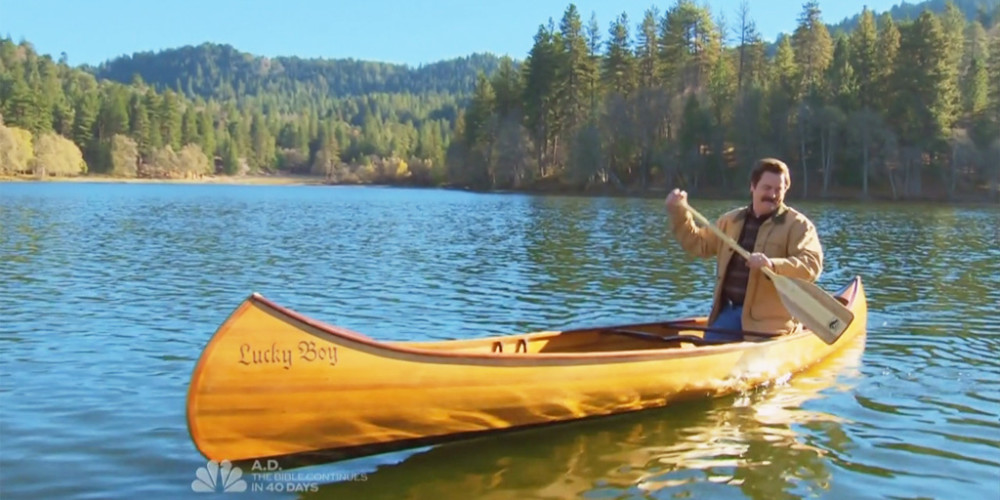
Canoeing on a quiet lake alone
This is a pleasure that most people do not enjoy.
You buy or rent a canoe. You go to a remote area, and there, in the early morning, you paddle out into the lake while the morning mist is rising off the lake. If you get up really early, it’s still very dark out. Like maybe four int he morning.
Ron Swanson understands. This is from season 7, episode 13.
It’s quiet. The mist is like a fog and all you can hear are the frogs, the critters, and the sound of the swishing of the water.
Then you just paddle up and down the lake. Maybe find a quiet spot and fish. You pop a top (open up a can of beer), and drink it down. You don’t have a cellphone, or at least no signals. No one can contact you with an “emergency”. Your time. Your place. Your life.
It’s magical.
Soup in a thermos and a home made sandwich
Most people don’t give this any thought. But you all should. There’s something comforting in having a lunch prepared by loved ones for you instead of a McDonald’s #3 meal supersized with a coke.
A home-made meal is healthier, better, cheaper, and often more delicious than one made in a fast-food restaurant. It won’t make you fat, it will be balanced, and it will remind you of your connections to your loved ones. It’s a win-win.
A homemade packed sandwich goes a long way to keep the stomach rumblings down and subdue the ravenous beast inside.
The thermos might contain coffee, but more often than not it would be home made soup. My personal favorites are chicken-noodle, cream of broccoli, and vegetable beef. The sandwich would generally be some kind of “Dagwood” consisting of a few slabs of meat, some tomatoes, lettuce, onions and maybe s “thickener” like peanut butter or a fried egg. Topping it off would be a fruit. Maybe an apple or a banana. Sometimes an orange.
That’s what you get when you have a traditional family. One person works outside, the other person takes care of the domestic issues. They make sure that you eat well and healthy. They put care into that meal. They put love into that meal.
A thermos filled with home-made soup is a very special thing, and it reminds you that you are nothing without your family and their support.
They say the way to a man’s heart is through his stomach, and it is very, very true.
Enjoy an ice cream Sundae
Ice cream is everywhere. Or at least, what we call ice cream, is everywhere. In the West, America I’m talking to you, most “ice cream” is actually a percentage of cream with milk and other fillers. It’s not really “real” and “pure” ice cream at all.
Which is really rather sad.
This little pleasure describes eating real, honest to goodness, ice cream at a dairy that gives you the real thing. And what’s more, you eat a Sundae using it.
A well done ice cream sundae would have multiple scoops of real ice cream, with all sorts of toppings added.
Now, some history first.
Back in the day, when families still attended churches, and would spend the Sundays together, a “Sundae” was a special treat. It was a time to go traipse off to the local dairy farm and eat or have some fresh ice cream. That was a big event back in the day. It’s so difficult to imagine what the big deal was, because seemingly ice cream is everywhere.
Heck you can get a “ice cream””Sundae” at McDonald’s, for goodness sakes. Which isn’t really a true “ice cream” nor a true “sundae”. It’s a tasty food-like product. Fine for kids, but really below standard for most adults.
Adults deserve real… REAL… ice cream.
In California, back in the 1980’s, ice cream parlors were making a comeback. Though, I have no idea what is going on today. When I was there, they were being displaced by the TCBY frozen yogurt franchises.
Oh, and by the way, any decent Sundae in the United States would be topped with an American flag, don’t ya know.
Here we are talking about paying the money and eating an enormous ice cream Sundae with your loved ones. We are not talking about some fake ‘soft serve” for a dollar at the local fast food joint. So, what more can I say? Go ahead, and go get a quality ice cream sundae. You won’t regret it.
Finally, here’s a shout out for Hersey’s Fudge. Get some on-line or in a grocery store and use this (instead of Hersey’s chocolate syrup) on your home concoctions.
Hersey’s Fudge
Playing with your cat
Now I talked about playing with my dog, but I also get an equal amount of satisfaction while playing with my cats. They are hunters and nothing gets them more excited that playing “hunt that critter”.
The best toys are the feathers or snake on a string.
Cats love to play with those feathers.
I would dangle those feathers in the air and they would spend hours running, chasing, leaping and clawing at them. They would be so caught up in it and it’s a true joy to behold. Ah… good times.
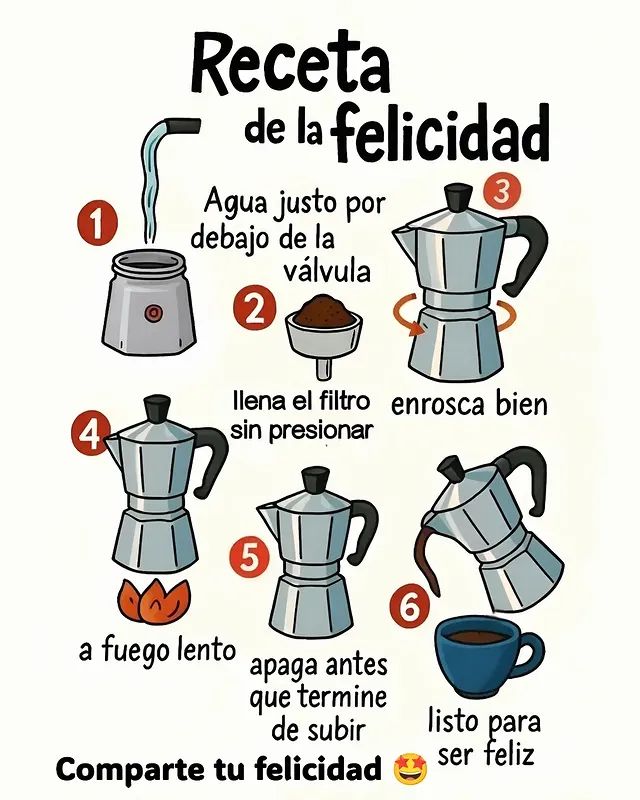
A cup of fresh brewed coffee on a cold winter’s day
Now most Americans appreciate a nice cup of brewed coffee. We go to Tim Horton’s, Starbucks, McDonald’s or Duncan Donuts to get our fix. Of course, we also tend to brew it at home, whether it is in an old-fashioned percolator, a Chemex, or even (gasp) instant coffee.
But here, I want to talk about a different kind of coffee experience.
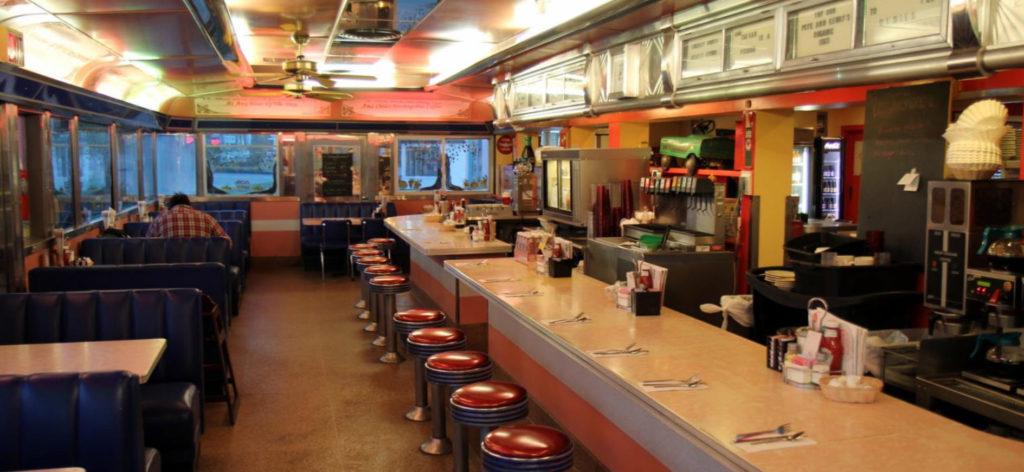
An “old fashioned” American diner.
Imagine it’s snowing out, and as cold as a witches tit out. You had spent maybe ten minutes trying to chop the ice off your windshield with the wind howled around you, and icy cold dust flakes of snow burned your skin. Your breath would exhale in white clouds that would frost up your eye glasses and turn your beard white. And finally, after shoveling away the snow you hop into the car, and turn the motor over (you had a oil-dipstick heater, after your reinstalled the battery)…
Gah! You can tell that I used to live in Northern Indiana, eh?
You start driving down the road. It’s around 5:30 in the morning and the sky is just beginning to become a dreary light grey.
Up ahead is a brightly lit diner. It’s one of those old-fashioned stainless steel sausage affairs. It looks something like a mobile home, but is all silver color with warm inviting windows all along the sides.
You pull in, while a truck with a snowplow on it’s front is busy cleaning out the parking lot.
You park, turn off the engine and get out of the car. A few steps later, you pull open the heavy stainless steel and glass door and you are inside this warm, inviting diner filled with the aroma of bacon, eggs and freshly brewing coffee.
Inside of a fine American style diner.
You go up to the counter.
There’s a guy (or a gal) there who immediately places some silverware on a napkin next to you once they wipe down the table. You, or course, reach over to the free newspapers down the counter to see what the daily news is, and when the waitress comes on over you place your order.
If you are like me, you would order “Country fried steak and eggs” with grits (or hash browns), wheat toast (why I never ordered rye?) and a coffee.
She would say “Just a moment, hon.” Then in short order, she would fill up a fine slam-on-the table white mug filled with fresh coffee…
A vintage heavy ivory white ironstone china coffee mug. This is what coffee was intended to be drunk out of.
You see, it’s not so much about the coffee as it is about the context… the environment… the feelings and the emotions that you have at that exact moment in time.
I know, I know…
Starbucks fans will argue that that they are just fine with the paper cup that they get from Starbucks. They believe that it is just as good, or maybe better….
I do not.
Please enjoy a nice cup of coffee, and share it at a moment that remains special to you.
A cup of coffee at a diner.
Thunderstorm at night
Who doesn’t enjoy a nice cozy stay inside during a thunderstorm? The light display, and the booming of the thunder is inspiring. Not to mention the crash of the rain as it beats upon the house, and the gusts of wind that howl and moan in the ptch black night.
It’s a great time to stay inside and cozy up with loved ones under a throw. Don’t you think?
Homemade Iced Tea
I grew up in Western Pennsylvania. There, we pretty much drank Hi-C, or Cool-Aide. My mother would go ahead and pour the granulated mix into pitcher and refrigerate it. Then, when I was in High School, the idea of making “fresh” lemonade or Iced Tea caught on. We would put this big tureen on the stove and cook up a batch of tasty refreshing beverage. Then allow it to cool down.
later, at the end of the day, we might sit on the large shady porch and drink it as the sun would set. Though in those days we called it “watching the street lights turn on”. It was nice, you know.
Of course, then in those days, we might also smoke a joint, a cigarette, or a bowl of something that was illegal at that time. We were pretty much told that it would give us brain damage, and one day we might get confused, and put a baby in the microwave, or try to jump out of the window in an attempt to fly.
It was in all the newspapers and magazines, don’t you know.
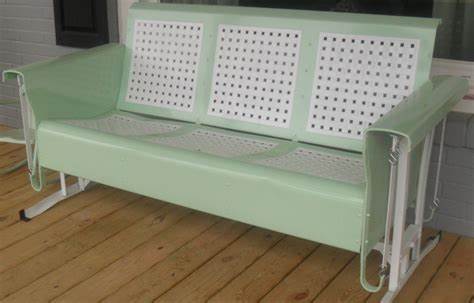
Back then, we would sit on a “glider” (which is a metal couch that sways back and forth) or in a “porch swing” which is a wooden bench seat that hung from the ceiling by chains.
Metal glider. This is a long forgotten masterpiece that is fun to sit in and wonderful for wide shady porches.
Of course, there would be a blanket or throw or some pillows on the glider. We never sat on the bare metal or wood slats. You know, looking back, many of my first dates were spent on the safety of the porch while the girls’ parents were in the kitchen or living room.
It is that moment that you treasure. The sun has set, the sky is turning into a dark blue color. The air is cooling down and a little breeze is kicking up. House lights are turning on, and the homes looked warm through their windows with yellow and orange colors on the bluish-white exteriors. The crickets come out, and the cicadas. You can even watch the bats fly about in the sky.
Later on in my life, I completely forgot about that.
Delicious Southern style Iced Tea.
I would go ahead and get this kind of iced tea in fast food restaurants. it would be filled with chemical preservatives, and unsweetened. No lemon. No orange. No mint. And I would be forced to drink this kind of camel piss on my way to and from work.
Then, when I moved to the South, I experienced what “real” iced tea is. It’s called “Southern Ice Tea”, and it’s awesome!
How to Make Perfect Southern Sweet Iced Tea
Iced tea is pretty much a year-round staple here in the south - probably mostly because it's so darned hot down here most all of the year. Besides, tea - unlike soft drinks - is loaded with benefits.
Just like seasoning recipes to taste, you definitely should adjust to your own sweetness level with sweetened iced tea. Some folks like it real sweet, some not quite so sweet and you can certainly exchange sugar for an appropriate sugar substitute, even making the tea completely unsweetened, and adding it per glass.
This recipe makes 2 quarts of sweet tea and I used to use a cup of sugar, but then I switched to making my tea completely unsweetened and using a sugar substitute by the glass, but then I stopped using artificial sweeteners completely, then I went back to them, or I flip flop between a stevia/sugar blend, monk fruit or agave - I've pretty much tried most all of them. When I went back to using regular granulated sugar, I found a cup to be too sweet for me. Eventually I reduced that cup of sugar to 3/4 cup, then 2/3 cup and now I find about 1/2 cup of sugar for the whole pitcher works pretty good for me. In restaurants I always find sweet tea generally far too sweet for me, so I order it "half and half" - half sweet, mixed with half unsweetened, and during the summer I go through so much tea that I now make a full gallon of a diet sweet tea.
Sweetening aside, one thing is for certain. I believe that the perfect iced tea starts with Luzianne brand. {affil link} Period.
Now... I don't say that because I'm trying to impress the folks at Luzianne (who have no idea who I am), or because I'm trying to make myself look more "Southern" by using Luzianne. I use it because, in my opinion, it is the tea for Southern iced tea - whether it's sugared up or made with sugar substitute. Not that other brands don't make a good pitcher of tea. Mama used Lipton and it's a perfectly fine tea. It's just that for what I consider to be the perfect Southern iced tea, I truly believe you need to use Luzianne.
Finding a restaurant, even in the Deep South, that served sweet tea was a challenge there for awhile. Restaurants jumped on the bandwagon of removing sugar from their tea and tried to pass off unsweetened tea to all of their patrons, offering sugar packets at the table. Well, everybody knows that just doesn't work. Warm tea is what you need to dissolve sugar and iced tea just needs to be cold. Not warm. Not at room temperature. But chilled cold and served over ice and for me, with lemon. So, thankfully, they have finally gotten back to offering sweet tea again, and unsweetened for those folks who prefer not to have the sugar. It's true, a lot of folks, myself included, sweeten with sugar substitutes these days, but still… every once in awhile, we all sure enjoy a glass of ice cold, sugared-up tea.
Tea Tips:
1. For perfect tea always start with fresh filtered cool water - never tap water!
2. Cloudiness is often caused by putting hot or still warm tea directly into a cold refrigerator. My method prevents this since you are pouring your steeped tea directly over ice cubes.
2. Bitterness in tea is caused by overcooking and burning the tea leaves - that is why it is important not to boil the teabags and not to steep them too long in boiling water. To counter, a pinch of baking soda - only about 1/8 of a teaspoon - can be added to the hot, steeped tea after you remove the bags. It will not affect the taste of your tea, and provides insurance against bitterness.
3. Use wooden spoons to squeeze your tea bags, a glass container - like a large Pyrex measuring cup - to steep your tea, and store it in a glass pitcher if at all possible. I break this rule myself at times though, especially with my Milo's copycat diet iced tea. And I do love my Tervis cups.
4. If you prefer your sweetened tea more on the sweet side, increase the sugar. Some folks like as much as 1-1/2 cups of sugar, but start lower and increase for the next pitcher.
5. Of course, substitute artificial sweetener by the pitcher or per glass if you don't want to use sugar. I use the granulated Splenda in the large bag, about 3/4ths cup is enough for me.
6. If you like lemon in your tea, try making ice cubes out of lemonade to use in the individual glasses. As they melt, they will infuse the tea with lemon flavor! {a tip from Susan of our Facebook Family!}
Ingredients:
5 to 7 individual tea bags, (Luzianne brand preferred){affil link}
1 quart of cool filtered or bottled water
Pinch of baking soda, optional
1 (4-cup) glass Pyrex measuring cup for steeping
2 quart glass pitcher filled with ice
1/2 to to 1 cup granulated sugar, or to taste
Fresh lemon, sliced or wedges, and some mint sprigs, optionalInstructions:
Boil one quart of cool filtered or bottled water, bringing to a full, rolling boil then turn off heat. Steep tea bags in the hot water for 9 minutes. Gently squeeze bags of excess water and remove. Whisk in sugar (and baking soda if using) until dissolved and set aside. Fill pitcher with ice, and carefully pour the hot tea concentrate over the ice. Stir well and pour over ice filled glasses, garnishing with a sprig of mint leaves and a nice juicy slice of lemon. Savor. Makes 2 quarts.
Cook's Notes:
For a milder tea, use 5 bags; for a more robust tea, go with 7. Increase sugar as needed to your sweetness level. Never pour hot tea directly into a glass pitcher without ice in it! To conserve your ice and use the tea per glass, fill the 1/2 gallon pitcher with 1-1/2 quarts of water instead of ice, and top with the steeped tea.
-Deep South Dish
Personally, I always use (a generous amount of) cut up orange slices, along with the lemon. And sometimes even a slice or two of lime or grapefruit to tarten up things a bit.
Sweet + tart = flavorful neutral.
I always use mint, but too much mint is not good and will act medicinally. Your heart will start to race. Yikes! So just use a sprig and no more.
Sweeteners can be sugar, brown sugar, cane sugar, and honey. Experiment. You can end up with some very delicious cool Summer drinks for your end of the day porch rest periods.
Iced tea is just perfect for the end of the day rest periods while the wold quiets down. Some of the best Southern Iced Tea that I ever had came from Louisiana and Mississippi.
Nighttime walk in a snowstorm
You have not lived life until you have walked at night in a snowstorm. This is most especially true if it is in the countryside, on a wooded road, and you are alone with only the wind whistling through the trees and the cracking and gnawing of the branches as they sway in the wind.
Night time walk in the Winter snow storm.
When ever you have an opportunity, whether it is an old-fashioned sled ride, or sleigh ride, a walk, or a ski-mobile trip to the neighboring woods… please do it. Get gout and enjoy “Mother Nature”.
Conclusion
Make what you do matter. Take time to savor every moment. Do not try to be like the actors in the movies. Just try to be you; the best YOU that you can be. Do things your way. Live life your way.
Start doing it now.
Make your life matter. Do the little things that enhance your life. Appreciate them, savor them and enjoy them.
I do hope that you enjoyed this post. I have similar posts in my Happiness Index…
I dredged it up from obscurity, and I think that it would be useful for you all to reread a MM classic for a change. I’ve devoted a few years of “junk and stuff” to help get youse guys mind off the crazy town. So now enjoy this one.
I am sorry that I have been a little slow in releasing these particular kinds of articles, but you know it isn’t everyday where you are located in the middle of ground-zero for World War III. So I’ve been a little side-tracked, don’t you know.
Anyways…
Anyways, as far as this particular MAJestic post is concerned, please keep in mind the limitations that I have regarding the dissemination of information.
While I just cannot divulge any secrets, some of what I CAN discharge has to do with things that are not of a technical interest. Such as history, culture, society, and "the bigger picture".

My role (as was Sebastian's) enabled us some very exclusive access to "understandings".

Nothing that was really of a functional interest to MAJestic specifically. Just general odds and ends and curiosities. And one of these "tidbits" is how our planet in our solar system became populated with life.
This kind of information is not “secret”, “confidential” or “restricted”. It is considered to be an unimportant curiosity that does not matter in the grand scheme of things.
And this is the subject for today. It is a little history lesson.
We are going to talk about what the earth was like when the first organisms started to grow upon the earth. As well as the kinds of attention that this evolutionary process generated in the civilizations that were present at the time (elsewhere in the galaxy).
Ah. You all know that I have a particular interest in history, don’t you?
What I am going to present here is a mix of [1] what I have been exposed to, and I place it all [2] in context to what our present scientists (“experts”) believe. Combined, the two points of view can give the interested reader some real valuable insight into this rarer bit of obscure knowledge about the earth’s history. I also mention [3] some elements of life within the physical that many humans are unaware of, perhaps being alien to the Newtonian understanding of physics.
We are going to talk about about the Ediacaran Period.
This was a long, long, LONG time ago. Around 630 million years ago. Just about the time when the solar system was starting to become interesting to other species within our galaxy.
In comparison, the human species is only around 400,000 years old, and of that most of the time we were all very primitive. In fact the written history is only around 5,000 years old. We are very youthful. Here we talk about the time long before dinosaurs, flies, insects, fishes and trees. We are talking about the time when there wasn't a moon.
That is correct. 630,000,000 years ago the Earth had no moon.
I cover this subject elsewhere.
The earliest extraterrestrial humanoid (Physically-animated bipedal entities that utilize technology to visit the Earth) visitation known (to me personally) to our solar system occurred during the Ediacaran period (630 million years ago).
FYI: This is not “official” MAJestic knowledge. (This information is tangential to our roles and are personal observations that were debriefed, but not relative to our mission parameters. ) In general it is considered to be extemporaneous, non-mission critical information.
The base age of approximately 635 million years ago is based on the U-Pb (uranium-lead) isochron dating method.

Here, strata from Namibia and China was dated using this method.

There is a more or less active debate on the dating methodology regarding this time period.  In any event it is far above my head and rather esoteric for my tastes.

The dating method I place here is approximate and based upon our limited understanding of the Earth at this time.
This was a long, long, very long time ago. The reader must understand that fact. Typically when humans think of the past, we tend to think in terms of thousands of years. Officially, civilization is supposed to be less than 10,000 years old.
Civilization, in this meaning, loosely refers to the creation of stable and moderate sized agrarian communities which may or may not have a written language.
But, this particular period of time is far, far older than that.
In fact, it is not 100x older. It is not 1000x older. It is 63,000 times older than what we consider to be the start of bipedal human civilization. It is so long ago as to be incomprehensible.
Please kindly refer to my notes (within the MAJestic Index) and my thoughts on the human ability to understand large swaths of time.
During this time, there were no evolved humanoids or proto-humans on the planet. The life on the earth was quite primitive.
Therefore, any and all the visitations were made by extraterrestrials. These creatures came and visited the earth and left. No one stayed for long. I would consider these visits and excursions to be survey expeditions made by long-extinct space-faring extraterrestrial species.
They had many forms.
The dominant physical form (by a “long shot”) that we, as humans, would recognize was the early variations of bipedal proto-humanoid extraterrestrials.
During this huge swath of time, the Earth was visited at various times by numerous species.
This period of time lasted for 94 million years, and began in the distant past around 630 million years ago. A lot of things can happen in 94 million years.
Again, the reader is reminded that this particular period of time contains 94 million years. That is an amazingly long expanse of time.
Indeed space-faring species developed, thrived and evolved past their physical forms many times during this period.
Obviously, this implies that there were space-faring, extraterrestrial races at this distant point in time so long ago. (None of which originated on the earth. They only visited it.)
During this period some would visit our solar system for various purposes and they would stay for varying lengths of time. All of these visitation(s) were short lived affairs.
Any settlements were temporary and used for scientific study and other short duration activities.
The visits were, of course, by extraterrestrial species of various points of origin, as there was absolutely just the very beginnings of higher order life on the world at this time.
Our solar system
The reader must understand that at this time the Earth was a bare and desolate place. The land was barren rock, and mountains. Sure there was mater and ice on the land masses, and perhaps microbes. But no significant life on the land surfaces. The only life was in the seas.
Our solar system was mostly free of the huge dust disks and debris field of the earlier 3 billion years.
Our star had matured during that time and became much more stable.
But stability is a relative thing; the earth was no longer entirely molten. Indeed, the surface of the earth was cooling and a thick gaseous envelope of various dusty gasses surrounded it.
Outside the Earth, the other rocky planets were also beginning to cool down and life was just beginning to form in the most unlikely of places. This included the smoggy Mars, and Venus, as well as numerous moons of Jupiter (because Jupiter was much closer to the Sun then as it is today).
At this point in time, the earth was just beginning to stabilize enough to maintain ambulatory life.

Previous to this time, it was a hot and desolate place (prior to the Sturtian period around 710 Ma).

Then it began to cool down.

During the early Neoproterozoic (around 850 Ma to 740 Ma) it cooled down sufficiently for early life in the earliest forms to evolve.

There was a pause or “burp” in evolution during the Sturtian glaciation around 710 to 735 Ma, and then a resumed period of growth during the Cryogenian period.

This again was put on hold during the Marinoan glaciation that finally ended around 635 Ma.

It was the Ediacaran period at around the end of the Marinoan glaciation where things started to evolve into life that we understand it to be; significant.

Around the Vendian period (approximately 570 Ma), the first classes and orders of identifiable creatures became recognizable in the fossil records.
Mars, and Venus looked quite different than they do now. The atmospheres were different. The pressures and temperatures were different. Their orbits, and orbitalinclinationtotheecliptic were different as well.
The earth had no moon, and our orbital inclination was different.
I do not know if there was another planet in orbit around the sun that eventually formed the asteroid belt. My personal belief that there wasn’t a planet, and what we see as asteroids are but the remnants of the solar system “frost zone”. Not of a planet that broke up sometime int he distant past.
Jupiter was larger. It was hotter, and it was closer to the sun than it is now.
A number of it’s moons had atmospheres, and there was actually some (short lived) periods of liquid water on key moons.
All the other gas giants, Jupiter, Neptune and Uranus also migrated outwards, but their physical changes were not as radical as for Jupiter.
Our Planet
Our earth was indeed a desolate place; however it was not without its charms.
It was marginally habitable, but showed great promise to those races with a long term view point.
Our planet consisted of mostly exposed and harsh rocks and water in a harsh nearly lifeless world. It was, of course, shrouded in toxic gasses under high temperature and pressure. But even in this environment, life spawned. During this time on the Earth we saw the continued emergence of simple organisms and simple creatures.
This time is considered the Neo-proterozoic era.
While nothing really existed on land, most life lived in the (emerging) waters of the earth and along the rocky shorelines. Here is where we have found the first good fossils of the first multi-celled animals on the Earth.
These (over the last few hundred years) were discovered and obtained, and that is how we now know that this was a period of the first native biological life on the earth.
Atmosphere
The world (at that time) was not only bare (consisting of broken rocky surfaces and coarse sand and gravels), but the atmosphere was pretty rank.
While there was an oxygen atmosphere, it was then only 40% of what consider normal today.
Instead the climate was dominated by (poisonous to humans) carbon dioxide and at a level fully sixteen times that of today. It was a time of thunderous storms, damp and dank weather and bleak, harsh rocky surroundings.
Yet, with all that being true, the world was still (considered) marginally habitable for bipedal humanoids. Bipedal humanoids would of needed oxygen masks, protective clothing, and solid reliable shoes to walk about on the planet.
Of course there was be dust and dirt, but it tended to have a granular appearance. The air, while rank, was breathable with filters and oxygen supplements.
The atmospheric pressure was tolerable but outside of what was considered normal for conventional humans.
The temperature varied by location, but for the most part was in the range considered to be marginally acceptable.
There was liquid water (over a large section of the globe); stable land forms, and a total lack of competing contentious native life forms. The earth at that time was a potential oasis that would be viewed as having great future promise by any extraterrestrial who would visit it.
Those species who visited it left their marks in various ways. Some of which eventually spawned higher order organisms unintentionally through careless behavior.
Which makes you wonder... "exactly what kinds of careless behaviors were involved?"
Native Life
It was during this time that the (so called) Ediacaran biota flourished.
Ediacaran biota.
The Ediacaran biota are the somewhat puzzling fauna of the Ediacaran period.

This geological period was from 635–542 million years ago (mya), but the fossil biota was only from 575–542 mya.

This was after a series of ice ages and just before the Cambrian period.

The biota consists of soft-bodied multicellular organisms, probably animals, which left trace fossils in rocks of Ediacaran age.

The biota is quite unusual, and there is no sign of it in the preceding Marinoan glaciation.

The biota appears to suffer a fairly severe extinction event at the boundary with the Cambrian.

Some of the biota may have survived into the early Cambrian.
Then the world consisted of very large and shallow seas.
These shallow seas permitted the growth of various simple organisms.
Simple trace fossils of possible worm-like creatures; known as the Trichophycus became common, as well as the very first sponges and trilobitomorphs (the early ancestors of trilobites).
The creatures of the earth at this time were simple in design and structure.
Throughout the history of the Earth from Cambrian to the present day, soft-bodied creatures are notorious for dying without a trace. The lack of tough structures leave them exposed to waves, winds, and scavengers, causing many of them to completely dissolve after death.
They were the earliest naturally evolving creatures of the earth and consisted of very simple proto-fungi and very simple proto-creatures.
At this time there were no insects, birds, or even flowers. The earth was a land of proto-fungi and small simple creatures.
The reader should consider the land at this time to be rather bare and rocky, with the earliest fungi and simple creatures clustering around the shorelines.
The most significant life form; non-ambulatory, was the various Stromatolite colonies that persisted throughout the planet in the shallow seas. These colonies looked like hard rounded sponge rocks and boulders.
Stromatolite colonies
These colonies grew close to the land and grew in great numbers due to the favorability of the local climate at that time. Some grew to enormous size. Truly, some were so enormous in size that they resembled low submerged islands.
The reader should consider this time to a period of all sorts of boneless ambulatory aquatic creatures such as jellyfish, and sea slugs.
Indeed, may I indulge in a little creative fantasy and suggest that the sea slugs became quite diverse and colorful. Imagine a world inhabited by such creatures. Creatures such as;
Hypselodoris kanga
Acanthodoris pylosa
Cyerce nigricans
Elysia crispata(’Lettuce sea slug’)
Flabellina iodinea
Costasiella kuroshimae(’Sea sheep’)
Glaucus atlanticus(’Blue angel’)
Phyllodesmium poindimiei
Dirona albolineata
Hexabranchus sanguineus(’Spanish dancer’)
I suggest the reader to look up these wondrous creatures and watch a video or GIF of their behavior. For indeed creatures similar to the aforementioned dominated the globe at that time.
Trilobite anatomy.
It was during this period that proto-trilobites came into existence.
We have scant knowledge of these creatures because they were soft shelled, and thus unable to be fossilized.
We can, however, surmise that they appeared similar to that of their later offspring; the trilobites, only with a far simpler biology and soft shell and cellular makeup.
Trilobites were among the early arthropods, a phylum of hard-shelled creatures with multiple body segments and jointed legs (although the legs, antennae and other finer structures of trilobites only rarely are preserved).

They constitute an extinct class of arthropods, the Trilobita, made up of ten orders, over 150 families, about 5,000 genera, and over 20,000 described species.

New species of trilobites are unearthed and described every year.

This makes trilobites the single most diverse class of extinct organisms, and within the generalized body plan of trilobites there was a great deal of diversity of size and form.

The smallest known trilobite species is under a millimeter long, while the largest include species from 30 to over 70 cm in length (roughly a foot to over two feet long!).

With such a diversity of species and sizes, speculations on the ecology of trilobites includes planktonic, swimming, and crawling forms, and we can presume they filled a varied set of trophic (feeding) niches, although perhaps mostly as detritivores, predators, or scavengers.
Consider where they lived…
Ediacara (formerly Vendian) biota.
The Ediacara (formerly Vendian) biota are ancient life-forms of the Ediacaran Period, which represent the earliest known complex multicellular organisms.
They appeared soon after the Earth thawed from the Cryogenian period’s extensive glaciers, and largely disappeared soon before the rapid appearance of biodiversity known as the Cambrian explosion.
This period saw the first appearance in the fossil record of the basic patterns and body-plans that would go on to form the basis of modern animals.
Little of the diversity of the Ediacara biota would be incorporated in this new scheme, with a distinct Cambrian biota arising and usurping the organisms that dominated the Ediacaran fossil record.
What was life like 560 million years ago?

Bacteria and green algae were common in the seas, as were the enigmatic acritarchs, planktonic single-celled algae of uncertain affinity.

But the Ediacaran also marks the first appearance of a group of large fossils collectively known as the "Ediacara biota."

The question of what these fossils are is still not settled to everyone's satisfaction; at various times they have been considered algae, lichens, giant protozoans, or even a separate kingdom of life unrelated to anything living today.

Some of these fossils are simple blobs that are hard to interpret and could represent almost anything.

Some are most like cnidarians, worms, or soft-bodied relatives of the arthropods.

Others are less easy to interpret and may belong to extinct phyla.

But besides the fossils of soft bodies, Ediacaran rocks contain trace fossils, probably made by wormlike animals slithering over mud.

The Ediacaran rocks thus give us a good look at the first animals to live on Earth.
Of course, there weren’t any naturally evolved humanoids at this time. Nor were there any animals, rodents, flies or insects.
For the most part, any life that was on the earth existed solely within (or near) the water.
It was an aquatic world.
For all practical purposes, the Earth consisted of land masses consisting of bare rocks, sand, dank clouds and waters of various salinity (some areas were alkaline, while others were rich in various salts).
Kimberella resembled a slug and has often been found near marks that resemble the feeding traces of more modern slugs and snails. Despite its seemingly simple body plan, Kimberella differed enough from the rest of the organisms living alongside it. This indicates that around 555 million years ago, 14 million years before the beginning of the Cambrian, life had started to evolve into various shapes and lifestyles.
Yet, even though there weren’t any significant large mammals around, we did see other kinds of life. Here we saw an emergence of the first native life forms.
Jellyfish World
This period is marked, or the ultimate creation of, a sudden climatic change at the end of the Marinoan ice age.
Here, the temperature started to warm up and huge swaths of glaciers and frozen areas disappeared, and large pools of warm water and regions of comparative stability appeared.
While we have the earliest fossils on record from this geological time period, it is believed that many soft skinned creatures roamed the seas. I like to think of this time period as the age of the jellyfish.
Given the environment and the nature of life, it seems probably that huge groups of various types of jellyfish evolved and swam in the seas of this early earth. And possibly, quite possibly, some of those soft bodied creatures grew to enormous size.
For after all, they were the dominant life forms at that time.
One notable fossil is the Pteridinium. Almost like Charnia, this animal was superficially feather-like with an anchor tethering it to the seafloor. What sets it apart from Charnia is how the lobes across its body are positioned. Unlike most animals today whose bodies can be divided into roughly symmetrical left side and right sides, Pteridinium sprouted its “leaflets” in three different directions. As quirky as it seems, the three-fold symmetry is not unique to Pteridinium and its close relatives. One group of small, rounded animals that resemble sea urchins called Trilobozoa somehow developed the same symmetry. One member of this group called Tribrachidium put a literal twist to this body plan, growing three arm-like structures spiraling out from the center of its body.
The reader should think of images of jellyfish, piles, globs and puddles of organic mobile goo. They should envision that these globs formed families or colonies of creatures and often conjugated together in the warm shallow seas.
Over time, the size and diversity of these groups changed.
However, any visitor to the planet would have been astounded by the great numbers of living organic masses that apparently thrived in the seas at that time.
The Ediacaran period was a time of flourishing soft skin and soft shelled life. The seas were alive with lichen and other forms of simple marine life.
Jellyfish are more or less common today.
They have evolved to fulfill their proper environmental niche in the world and have honed their survival instincts into great diversity of forms and creatures.
At this time, however, the jellyfish were of a simpler design.
They were more benign and less adaptable to change.
Many life forms, and species developed, found a particular environmental niche and then died off.
We do not know what any of them looked like, but we can certainly make our own summations.
There is no doubt in my mind that soft-skinned marine life grew to enormous sizes during this time.
I further believe that there were many such variations of these creatures, which should be considered to be the precursors of jellyfishes and other evolutionary “dead ends”.
This is a picture of a huge jellyfish with a diver next to it for comparative purposes. Obviously there were no humans on the planet at this time. I place it here for a comparative aspect in that native life, especially the dominant native life at that time, can and did grow to enormous size.
Perhaps even the size of a whale or larger!
I am confident that these first jellyfishes or similar soft-shelled creatures were genetically primitive, but I am also confident that they were able to specialize and fill various niches in the ecosystem naturally.
In fact, it is highly possible that these creatures could grow to amazing sizes. Though we do not really know for sure.
In any event, the Ediacara biota bear little resemblance to modern life forms. Any soft skinned creatures would be unrecognizable to most humans today.
What the earth looked like at that time.
The Earth 630,000,000 years ago was a very different place. Not only were the contents of different shapes than what we see today, but the weather and climate were also completely different as well.
The earth had poles at a different location and the axis of rotation relative to the obliquity of the ecliptic was completely different to what we know it to be today.
It was an ocean world populated with soft-skinned native life, and very few land based forms.
Yet this world held promise.
Visitors to our solar system would find that the earth not only held a moderately acceptable environment, but also the planet Mars would appear marginally interesting as well. Mars had a thicker atmosphere, and while the once present oceans were long; long gone there would of still been slight evidence of glaciers and other frozen remnants that would of made visiting this solar system of great interest to extraterrestrial explorers.
Rheotaxis in the Garden of the Ediacaran
The “Garden of the Ediacaran” was a period in the ancient past when Earth’s shallow seas were populated with a bewildering variety of enigmatic, soft-bodied creatures.
Scientists traditionally have pictured it as a tranquil, almost idyllic interlude that lasted from 635 to 540 million years ago. But new interdisciplinary studies suggests that the organisms living at the time may have been much more dynamic than experts have thought.
An international team of researchers from Canada, the UK and the USA, including Dr Imran Rahman from the University of Bristol, UK studied fossils of an extinct organism called Tribrachidium, which lived in the oceans some 555 million years ago. Using a computer modelling approach called computational fluid dynamics, they were able to show that Tribrachidium fed by collecting particles suspended in water. This is called suspension feeding and it had not previously been documented in organisms from this period of time.

Tribrachidium lived during a period of time called the Ediacaran, which ranged from 635 million to 541 million years ago. This period was characterised by a variety of large, complex organisms, most of which are difficult to link to any modern species. It was previously thought that these organisms formed simple ecosystems characterised by only a few feeding modes, but the new study suggests they were capable of more types of feeding than previously appreciated.

Dr Simon Darroch, an Assistant Professor at Vanderbilt University, said:

"For many years, scientists have assumed that Earth's oldest complex organisms, which lived over half a billion years ago, fed in only one or two different ways. Our study has shown this to be untrue, Tribrachidium and perhaps other species were capable of suspension feeding. This demonstrates that, contrary to our expectations, some of the first ecosystems were actually quite complex."

Read more at; https://phys.org/news/2015-11-earth-ecosystems-complex-previously-thought.html  More information: 'Suspension feeding in the enigmatic Ediacaran organism Tribrachidium demonstrates complexity of Neoproterozoic ecosystems' by Imran A. Rahman, Simon A. F. Darroch, Rachel A. Racicot and Marc Laflamme in Science Advances, DOI: 10.1126/sciadv.1500800
Scientists have found It extremely difficult to fit these Precambrian species into the tree of life. That is because they lived in a time before organisms developed the ability to make shells or bones. As a result, they didn’t leave much fossil evidence of their existence behind, and even less evidence that they moved around.
So, experts have generally concluded that virtually all of the Ediacarans—with the possible exception of a few organisms similar to jellyfish that floated about—were stationary and lived out their adult lives fixed in one place on the sea floor.
The new findings concern one of the most enigmatic of the Ediacaran genera, a penny-sized organism called Parvancorina, which ischaracterized by a series of ridges on its back that form the shape of a tiny anchor.
By analyzing the way in which water flows around Parvancorina’s body, an international team of researchers has concluded that these ancient creatures must have been mobile: specifically, they must have had the ability to orient themselves to face into the current flowing around them.
That would make them the oldest species known to possess this capability, which scientists call rheotaxis.
"Our analysis shows that the amount of drag produced with the current flowing from front to back is substantially less than that flowing from side to side," said Simon Darroch, assistant professor of earth and environmental sciences at Vanderbilt University, who headed the study. "In the strong currents characteristic of shallow ocean environments, that means Parvancorina would have benefited greatly from adjusting its position to face the direction of the flow."
The analysis, which used a technique borrowed from engineering called computational fluid dynamics (CFD), also showed that when Parvancorina faced into the current, its shape created eddy currents that were directed to several specific locations on its body.
"This would be very beneficial to Parvancorina if it was a suspension feeder as we suspect because it would have concentrated the suspended organic material making it easier to consume,"

-Darroch

More information: Simon A. F. Darroch et al, Inference of facultative mobility in the enigmatic Ediacaran organism, Biology Letters (2017). DOI: 10.1098/rsbl.2017.0033 Read more at: https://phys.org/news/2017-05-life-precambrian-livelier-previously-thought.html#jCp
The absence of fast-moving animals allowed microbes to colonize the surface of the ocean floor, then create a layer of secretion wherever they grow. Such a sticky layer allowed the sediment to stabilize and acted as a mold when the animals died on top of them. This age was the Time of the Slime, where the ocean floor was filled with sticky substances. Such a slow-paced life, combined with the lack of predators, is a feature unique to this period. As a nod to the biblical Garden of Eden, some people have referred to this peaceful early Earth as the Garden of Ediacara.
Extraterrestrial Occupation
Now I am going to discuss extraterrestrial species and how they interacted with the earth at this time.

Let it be known that the present species that MAJestic interacts with did not exist at that time.

Here we are discussing (mostly) long extinct species that are known to the extraterrestrial species that we interact with today.

But of which they are themselves unfamiliar with them in any degree of detail that they specifically and selectively choose not to communicate with me about. I cannot say much more than that. Cannot.
At this time, the universe was already mature.
So even though our solar system was still rather youthful, the rest of the universe was quite old.
In fact, the universe was already 11 billion years old when the Ediacaran period began.
What this means is that there were entire life cycles of stars that were born, grew into maturity, and died well before our solar system was even formed.
In fact, there is evidence, from the spectral composition of our sun, that at least four generations of previous stars came before our solar system was berthed. This means that it completely realistic to expect the presence of extremely advanced galactic-wide extraterrestrial civilizations with interstellar transport technology in our region of space.
At this time, there was still consternation regarding specific pockets of unorganized quanta that had naturally formed into non-approved quantum soul archetypes.

But none of that really was a concern to our physical world at that time.

The quanta that surrounding the planet was just beginning to formulate into discrete packets; while some might argue otherwise, and the entire region was open for physical extraterrestrial exploration.

(It had been explored much earlier by discarnate soul orders, but that is not our concern at this time.)
+ + +
The Ediacaran period saw the presence of the very first humanoid extraterrestrial bases on the earth.
These facilities were short duration affairs. Mostly used for scientific inquiry. To imagine what these facilities were like, one should consider what the current human research stations look like in Antarctica.
Scout. Scan. Visit. Sample. Leave.
I am quite confident that the extraterrestrial bases were very similar to those facilities in both form and function.
Essentially,we should realistically consider the base facilities at this time and place to be similar to that consisting of a small cluster of habitats around a secured landing area for the associative vehicles.
None of the bases or communities during this entire huge swath of time (during the Ediacaran period) were ever very large.
Typically, the species operated out of their spacecraft, which at that time, tended to be (comparatively) huge. (Not all, and not the “critical” visits. Just the ones that made the greatest disruption in the quantum envelope that is recorded.) They would then send excursions to the surface and form “base camps” which typically tended to consist of rudimentary structures and facilities.
Typically planetary excursions were very; very short lived affairs. Often lasting less than one month in duration.
Although there were a number which lasted for much longer; perhaps as long as two years in duration. However, in all cases, they could just be considered to be scientific excursions, which were there for the purposes of scientific investigation and inquiry.
For some reason, I have always assumed that these visits required large spacecraft with interstellar propulsive capability. However, I do not know if this was the case for every species. Indeed, for the multi-dimensional and higher order species, they might have utilized other methods that are far beyond our level of understanding at this time.
Typically, one might expect (or more accurately, assume) the base facilities to lie close to the equator for reasons of avoiding the gravity sink of the earth. Nevertheless, when one studies the map of the Earth at that time, one can clearly see a problem with the base placement.
It is my arrogant assumption that the extraterrestrial entities needed to land or walk on dry land, and that they would see ocean landings a barrier.

All of this is assumptive on my part.

The reader should be made aware that the poles (North and South) as well as the equator as determined by conventional historical cartographers are typically incorrectly placed.

The axis of rotation and the tilt of the earth at this time was wholly different than what it is today.

The current maps relative to this time has to be adjusted to take this into account.  I hope that I was able to rectify this discrepancy in the maps that I presented here.
There weren’t too many dry land locations near the equator at this time.
That severely limited the location of the bases of operation around a water world swimming full of proto-jellyfish like creatures. In any event, none were involved in any type of colonization or industrial facilities.
That I am aware of.
It is entirely possible that contamination of the native ecosystem by extraterrestrial races contributed to the emergence of life on the Earth at this time.
Contamination refers to any extraterrestrial influence on the biology of the earth ecosystem at that time.
We can be assured that there was some degree of contamination.
There always is.
This is both physical, spiritual and in all ways quantum. But, no one knows for sure the impact it had, if any.
Nothing (physical) remains of whatever visitors occupied the earth at this time.
However, there is the remote possibility that the Baigong pipes in China might be the remains of what once was some kind of industrial facility of some type.

The Baigong Pipes are a series of pipe-like features found on and near Mount Baigong, about 40 km southwest of the city of Delingha, in the Haixi Mongol and Tibetan Autonomous Prefecture, Qinghai Province, China.

Associated with these pipe-like features are "rusty scraps" and "strangely shaped stones".

Analysis of the "rusty scraps" by Liu Shaolin at a "local smeltery" reportedly found that they consist of 30 percent ferric oxide and large amounts of silicon dioxide and calcium oxide.

This is what one would expect of fossilized rust buried in sandy soil.

The state run newspaper People's Daily reported on a 2007 investigation where a research fellow from the Chinese Earthquake Administration reported they had found some of the pipes to be highly radioactive.
Skeptics claim that this is a natural formation (of course they would).

According to any measure of anthropological science, there was no way that naturally evolved tool-making bipedal humanoids could of evolved at this time.

In any event, any remains of artificial constructions from this distant past would be altered beyond appearance and would have alternative material constructions.

For a conventional explanation of what this site is please visit; http://skeptoid.com/episodes/4181.

It has a moderately reasonable conventional explanation for the observed formations.  Yet, I must specifically stress to the reader that time and geologic pressures alter the appearance and shape of things..

This site could just as well be a natural site as it could be the remains of a very ancient construction.  The reader needs to pursue life with an open mind and consider both possibilities.
The only evidence remaining for (supplemented) human observation are the tell-tale quantum level signatures of early visitations in the (local regional) quantum cloud.
In our universe, every time one quantum particle interacts with another one, even if it is just a thought, it leaves a “mark” for all eternity.

Those with the proper tools can read and understand these marks.

And thus have the ability to observe the past as it transpired, in real time.

We know of a number of extremely advanced races that can do this.

But as far as humans are concerned, only our quantum soul bodies have this ability.  (Even at that, it is rudimentary.)

Our physical bodies are wholly unable to access these records.  Instead, we must utilize the assistance of other, more advanced physical races.
Unfortunately, we as humans, do not possess the ability to read and interpret these signatures.
We only know what is told to us by those whom have this ability.
What they tell us is quite simplistic.
They tell us that the planet was visited and explored by humanoid bipedal entities at this time. We also know that they traveled through various methods, not limited to physical transport. Indeed dimensional transport seemed to be the most common method.
Their past, history, appearance, and other traits that we might find interesting are shrouded in the mists of time.
That includes what happened to the various species whom visited this planet and where they are today.
This is the full extent of what I know about this time.
Summary
Around 650 million years ago, the first extraterrestrial life set foot on the earth and investigated it. Over time there were numerous subsequent visits. During some of these visits a small number of bases or facilities were constructed for various scientific and investigative purposes.
The solar system at that time was still very young, being only three billion years old. There were many comets and orbiting rocky bodies that yet had to be absorbed or collided with the larger planetary bodies.
Mars was not habitable, but both Mars and Venus were more habitable to ambulatory humanoids than they are today.
To this end, this solar system was of interest because of the three possible marginally desirable planets in the system. The Earth, Venus and Mars. Additionally, since the gas giants were closer to the sun than they are now, and hotter, a number of Jupiter moons possessed atmosphere in a gaseous state, and some even had oceans that held water in a liquid state.
This entire solar system held promise.
The earth at that time was mostly bare rock with oceans teeming with soft-shell creatures.
At that time there was no galactic federation that would claim administration for our solar system.
For the Ediacaran Period of nearly 89 million years, the situation was pretty much a stable one. Our solar system was mapped, explored, and systematically ignored by other species.
The vast bulk of time where this occurred was from 600 Ma to around 560 Ma.
They actually found our solar neighbors far more interesting for a host of reasons, and thus at this time just mostly ignored our solar system.
The solar system was still evolving and there were various comets and rogue asteroids that would and did present a threat to any native life in the solar system. This system was considered to be moderately interesting but not worthy of colonization by any of the species who visited it.
It was noted; explored in a more or less cursory manner, and archived.
Very little happened on the earth in the regard to extraterrestrial involvement of a substantive nature during this time period.
Those MM readers who might wonder what life might resemble around planets in the habitual zone of stars around three billion years old, might well learn from this narrative and explanation here.
You’ll not find any big banners or popups here talking about cookies and privacy notices. There are no ads on this site (aside from the hosting ads – a necessary evil). Functionally and fundamentally, I just don’t make money off of this blog. It is NOT monetized. Finally, I don’t track you because I just don’t care to.
As I end my vacation, I must put on my “big boy” pants…
Tucker Reveals “Supra Government” That Actually Runs The Country!
This is as astounding!
Why doesn’t India solve border issues with China and become good friends?
That sounds like an extremely naive idea
India and China have a significantly large power assymetry/imbalance of power
This means China holds plenty more cards than India and seen as being stronger than India in several aspects
Where there is power assymetry, there cannot be friendship or unlimited trust
The best outcome one can hope for is a ‘No Conflict, State of Caution’ where mutual development remains unaffected
—
Question : How is there an imbalance between India and China
The Imbalance between India and China is substantiated everywhere and requires no exclusive source
India remains
A Fifth the size of China in Economic Size
A Twelfth the size of China in contribution to Global manufacturing
A Ninth the size of China in terms of logistics and cargo
A Fourth the size of China in gross foreign reserves
A Fiftieth the size of China in net foreign reserves
Additionally Technological capabilities, Industrial depth, High Quality St Talent, Manufacturing depth, Productivity are all areas where China has a lead that cannot be quantified on paper but is universally regarded as being more than substantial
Such an imbalance means China is capable of absorbing cost of war for several years while India might be unable to handle economic or military shocks beyond a year tops
—
Question : Why can India be more comfortable with the States than with China despite stronger power assymetry?
There is a safe distance between India and the States with no conflict overlap
The States is too far away and there are no conflicts – Boundary, Ideological or otherwise
Indians of five generations have grown up seeing the States as a Great Power & have enmeshed their finance systems, technology systems completely to the ones run by the States
The Political establishment in India has accepted the possible humiliation & heavy handedness by the States , as part of a price to pay for a ‘Close relationship with the States’
—
Question : Why can’t India develop a similar relationship with China?
India can and India will
It would take time
Presently Indians of four generations have seen China as a counterpart of India, a poor country with a similar colonial background
It might take another 2 generations to acknowledge China differently at which stage, India would redefine the relationship
Singapore and Malaysia is an apt example
Malaysia continued to regard Singapore as a peer well into the 1990s and middle 2000s but by the 2010s began seeing Singapore as a far more prosperous technologically evolved country
The term is known as ‘Generational Familiarity’
—
Until such time – the best relationship possible would be one of
Mutual Economic Cooperation
Mutual co existence
Low conflict
Low interference in others affairs
My daughter died one month earlier…
Our reality can be strange.
Pictures
c3382cbf9cab7c9da47df5d0077bbd9e
b02451c105cebb15499880cda744e74b
9ada9cd0e7ff6ad5baf155e477599270
f4602c5f9dbaa2efb30b2851c7d82061
a46e73075bdc425d79a8c9c74ecd5369
bdaf64928129be10cde3c063b11965aa
8a491ce57724260ff7fe5fac00572161
737d4cd8bea53a5bbdad65fd190e4bf8
15aa7cc5e45f58e0565d3d726b9142cd
8de9acb04beaee76de63fd40d8406756
d7590cfeaf578834ef88e1c8ab9e36e4
b91747df3b84d0e8a11c17ca60b0eaf3
44b5bd88db4165d01764a4a1e4df6af7
b29343f26e801e0f7aaecf228d5c2f78
93fc5d46f161ec7d250e7fde99859e65
d1bdbb772c3528c6ff142f938aa23596
9231caf41820f322a64eaeaa8606792d
f9b5291cbfdab85c3c159001c74c7be4
de2d555b25cbcc7100dca7a7426991c8
c4f784912938e07426a9d12f82e21178
9e58090cf3e0fb73ebeca1e0242a5bdf
707704baea8b338105bdb23f8fea2a6d
4f0f9060fb727bd9fb4929a3e2091b8d
1ccd3a24a635ba30e805846aab31a4ee
5a462f110f1c25169c4d957702e9295a
efb079292cb9b9d33e5d9bb45842ac7a
e0b6e9e8c088eecc3def7d6bde14f953
d654202ea2ad047d52bae722cf165705
b4eedb7b466a5dc1bb14ffb8c19697c5
2d10950aab23487969e8cc411c9e153b
00accc090f22a4f153eca2ae8b3b07b3
249a44fb8920cc31bf45f390c993e168
7ab0a0df0aa8324c9374185f9f7aaed1
0fbb1cc895070f8aa5edb4c873c9fc01
0b8f75faf17ebf5ca2b9fb0aa4715095
9a093b5381796f47dbed925ca2a3d68b
7867d4655ab2e92d026e0b0d8cc56e81
a393826a1bbe95a3380c167bc5ca0f37
2d35595c5b72b01e2f40d6c770083593
009040b085a10edd8bc6c604a618f76b
d1baf9dcdd39e69954684c93d0f9554e
35e19d6185f3d1f5bd044a870a71db04
00d49cffd776b24131e8329080ab6bb2
f2ab44f96733e28c274589dfd8516ecc
21df730c3807eaef6974a7ab87e898ac
d97e4fba2105f71ebf149cb7821ce462
3c438882cd17a03783ad2e6d62ec2606
fa96e3195b20752e6e249a786e274c9a
53b7867994965d5edf4ae49b85da141c
b791f8ebfd7869fd5b63147267fdfe84
bd08415a622d296caaa0522edb1033cc
daa3a2ad4967196c3f79ecc8e60e466b
2a7b37c7ce4096a56bf0b04f901a0327
323699313493f4e6ca209ea00d33437d
74c8fce756d05e665d8aa9e10bb9da12
65fc9bbc1cb05193c71c37dc3f25abae
2f31652922d3488575c4d4aa33079e60
ffdad963d649ddc2a77ca78db642dcc1
c3a68312b151dd8eb4ca25d210cb77e6
53ec53815b2f195eefc88213b2bda3c6
f3e8da9dc90b5b71cd10ff889fbddd7e
351267c342029cd0b4da7780f856da0c
009a54445e8e22a6746e00aaa4993521
88e9e1a2c9051aa1e745dcb2d057b08d
5bee2744ef838286f21e31173bda510d
1c7d179bb1de050331a4c9a0f0a9a642
0b3aa54fe20673dae8c1dbb701cdf842
86c77c639249a155591ec02b491fa923
0e4b3b352118ea29d589336d8101ad76
5266de0aef4b3f8fea48cf56ef1de29a
a971841c6385eff4bcce51b854fc60ec
632d6d9d4aa0220736f85ca1af21964e
5a16dbee6ff666d51f51dd97a9e3f5a0
91464460d2a5e80f3adda796eccdddb2
976b13367e2c6d1be354251d745cac9f
7c82a7705bde1abc23333fab905a684d
ff06ff2873a244096a0252be1c6bd775
53a8faad868421e30fa59abe59474985
b677e7d794a9b1693a59774f879f6d9d
59ec08f75f4eff4ddcb61aed7105e745
526dd5964fea7ba538a9892ee92ddd15
2b448fad48927b22cc161a12c6e909fe
b7bedb08372638d2380ccc11d2474c44
8e5fe4f26ca2f4707353fed3661a864b
90dd80d5540a9023a185e08a8fadff36
d77edb8b43a09c8a141191c59b6883eb
470b47f4b8ed419fbb7f4d3e4a91a8db
586258fc10428642050b167992e2425b
bdc7d03e0f1333787980da80bf4f6414
b4c170cbddeccddabae39cb3017e6892
292966791333b8aba9fee8b4c81158d8
e7477d3345158a1f2688e87ba74bde60
3453ee8490cc8f2c6c1ad93c8e217f57
5160f24ec026cb7ef352afb1f90f794f
4380382c6c161c66787f7a2b07e31cf7
deb4cf9678f729e70ed84022f50637c4
f49de0fe811ea1fd5a8f6c7dad0fc735
ab5c3367bb3a5716e6c08ae4dcc6c4dc
50cd9f1d18cf9f6a8061c28cf838b78c
6be17e7978c06869b58b487d0d8faeca
e790c4d5b1b8b557d0cfdeaee2d31d5f
c7bc33b69e8f2eed38ca46ed498317da
160bcfb5d25681aaf44985849d84a9b7
eff95508157ddcc70f266f026665aa2e
d061ed5056e0fd3bd4f57a574540d5d1
1f1c013af334ad7620f7b0660dbddfdb
ff8a493866088955850c8c7e9cd4efd6
faddc811be572e8a18bdf4c31801899e
c36c51dd6b9c10ae4225d1b40f613c7d
61ffb6c870f6541ec7a92989a70d8201
0b3163d1b8cd5ac81617d5dd09eef636
38b0ad8b57aaba1d9722236706e3fd4a
What is the best electronic warfare aircraft?
Electronic Warfare (EW) comes in a couple of varieties, electronic surveillance (ES) and electronic attack (EA).
When it comes to ES, there are a multitude of aircraft that perform this role. As a Navy guy, I’ll give the example of our premier platform, the P-8 Poseidon:
Take a close look at it. All it is is a Boeing 737 but there are a bunch of “appendages” sticking out. I truly have no idea what all of those antennas are for, nor would I tell you here on Quora if I did. The P-8 is first and foremost a sub hunter but there are varieties that can be outfitted with gear for ES. One of its predecessors, an EP-3, was involved in an international incident back in the early aughts with China. This was the infamous “spy plane brought down by the Chinese” incident. I have my feelings on what the mission commander did, but I’ll leave that for another time.
Now EA! That’s my bread and butter.
EA-18G Growler
It is so hard to accurately describe what we do. Big picture, we jam RADARs but what does “jam” actually mean? The tactics aren’t the same for every RADAR so it’s really a catch all term for what we do. Again, going big picture, I’ve co-opted the term stealth: we provide stealth to non-stealthy aircraft. IOW, we hide them by making a RADAR scope unusable. And we have a perfect record; no plane has ever been shot down by a SAM if they have Prowler/Growler support.
An F-16CJ has what they call a HARM Targeting System, HTS. These guys go out and intentionally get targeted so they can shoot a much faster HARM at the shooter. I love me some CJ action. But a Growler is the preeminent platform for EA. Not only can I jam a target and get a soft kill, but my systems are even better at locating a threat so we can opt for the hard kill. Even better, the HARM is a bygone relic at this point. Now we’re talking AARGM. I can’t over emphasize how much better it is compared to a HARM. In the Navy, we considered a HARM a soft kill weapon because it wasn’t terribly accurate and you couldn’t count on it hitting the target (we are VERY conservative in our estimates). AARGM is not just an upgrade to HARM. It’s a whole different beast and is truly amazing, no bias whatsoever on my part.
To sum up, electronic warfare is extremely complicated and extremely complicated to explain. One platform may be better at a specific task, but there are others that are better at something else. Whatever task you’re trying to accomplish, go Navy. We don’t f around and will dismantle your IADS (Integrated Air Defense Systems) with just a couple of aircraft.
Go ahead. Target one of my buddies. Light them up, just like we want you to do. Now run! My missile is faster than yours and has an energy advantage. Your site is about to blow up. Sayonara.
Shorpy
32246u.preview
SHORPY 99390u.preview
SHORPY 99455u.preview
SHORPY 5a28888u.preview
SHORPY 5a17215a.preview
SHORPY 5a24440u.preview
SHORPY 5a07352u.preview
SHORPY 5a11356u.preview
SHORPY 40266a.preview
SHORPY 40237a.preview
SHORPY 40294a.preview
SHORPY 40381a.preview
SHORPY 00353a.preview
SHORPY 01678a1.preview
SHORPY 02457a.preview
SHORPY 03031u.preview
SHORPY 4a27597a.preview
SHORPY P0150.preview
SHORPY 4a28844a.preview
SHORPY 4a27592a.preview
SHORPY 4a25073a.preview
SHORPY 4a27265a.preview
SHORPY 09695a4.preview
SHORPY 09648a.preview
SHORPY 99386u.preview
SHORPY 99387u.preview
SHORPY 09467a.preview
SHORPY 09465a.preview
SHORPY 99536u.preview
SHORPY 32422u2.preview
Col Douglas Macgregor DESTROYS Smug Indian Journalist on China & US Military Dependency
I was afraid to watch this, but it is really pretty good.
Man did they feel strange walking in them. In case you all don’t know, the heel is lowered, rather than raised as in traditional shoes. The end result is sort of like walking though sand.
.
The promotion is that it is healthier for your posture. Yeah. Probably just a marketing scam. But we all bought into it.
.
a86af9b28afa92138eb70b51c67318e7
.
Anyways, after wearing them for a few years, getting back to normal shoes was a real shock. Well… maybe for about an hour. Heh heh.
.
Earth shoes. Fads that went nowhere.
.
Today…
No comment
USN under Trump
Earlier this week, I posted about the US Navy’s continued self-humiliation when they announced plans to steal a Coast Guard cutter to become their new “frigate” to fight China with.
Srash posted an off-hand comment that was so silly I didn’t even find it too funny… at the time.
Well… it looks like I’ve grossly underestimated the ability of the US Navy to further enshittify itself.
I… I genuinely struggle to find words to describe the absolute insanity of these moves.
Let’s review the litany of failures of the US Navy since 2000:
Tries to build a “gun-focused” stealth destroyer, the Zumwalt. Gun ends up being literally too expensive to fire, and ship itself is a disaster, only 3 built, program cancelled.
Tries to build a “modular” littoral corvette, the “Littoral Combat Ship”. It is now better known by all as the “Little Crappy Ship” and widely considered the worst ship ever designed by a modern naval power.
Tries to copy an Italian frigate, fails, cancels program
Decides to steal a coast guard cutter without a single missile launcher or real gun to be the new “frigate”. This will be the most lightly armed frigate in naval history since the advent of steam-power.
In his speech, Trump claims that this is the first time that the US is launching a battleship since 1994. As always, his number is wrong. The last battleship built by the US was in 1944, the Iowa-class. And even in 1944, the concept was obsolete.
Fortunately for the US Navy, there are still a few adults left in the room, and the new “Trump-class battleship” is not an actual battleship, except in tonnage terms (est. 35,000 tons). In reality, it is a massively oversized guided-missile cruiser, similar to the Soviet Kirov class “battlecruiser” which is also not a “battlecruiser”. Another way to think about it is that it will be an Arleigh Burke destroyer, except 4X heavier, and only about 50% better armed (if we assume that the rail gun will ever work).
The main armament is a 128-cell VLS battery, which is only 16 more than the PLAN’s Type 055 DDG. But the ship is 3.5X larger than the Type 055, and about 12X more expensive (assuming a single hull is ever built, and to budget). Oh, and the Type 055’s VLS cells are extra-thicc, so in reality it has more VLS total area than the Trump-class will.
—
A MEME AND A GRIFT
Let me make something crystal clear: not a single one of these ships will ever finish construction. It is an open question if they will even start construction. The design isn’t finalized and there’s only one naval drydock in the entire country that’s large enough to build something like this. And that drydock is currently building aircraft carriers.
This project serves only 2 purposes:
Placate the Trump baby
Launder money to defense companies courtesy of the American taxpayer
Tens of billions will be sunk into this project in the coming 3 years, and not a single hull will be built. When the next president takes over, regardless who it is, this project will be cancelled. It will go down in history as the worst naval development failure, even worse than the Zumwalt and LCS, at least those ships has a defensible concept, the Trump-class is just a meme from day one.
—
COMRADE TRUMP STRIKES AGAIN
For the PLAN, this is yet another windfall.
Even though not a single Trump-class “battleship” will ever be built, and the budget for them hasn’t even been formally allocated yet, it’s a fairly safe bet where the money and resources will be cannibalized from: the Arleigh Burkes.
The Arleigh Burke destroyer is the ONLY US Navy warship that is still in serial production, and also the only “modern” warship in the entire US Navy. The only other warships that the US has to throw at China are the Ticonderogas, which the US Navy is planning to retire.
So having fewer Arleigh Burkes will just be another benefit to the PLAN.
Thank you Comrade Trump, you have once again contributed to bringing about the Chinese Century of Prosperity, and the corresponding American Century of Humiliation.
Comrade Trump is providing critical support to the ascendency of the PRC, one Trump-class “battleship” at a time!
China’s pre-owned car exports boom And the prices are surprising.
It wasn’t supposed to happen for at least another fifty years. Stars like our sun are supposed to last ten billion years. To say we on earth weren’t prepared for this event was an understatement. Most of the population still didn’t believe that our sun was on its way out. The population figured it was another scheme to get people to save energy the ozone layer, or recycle more.
The day the World Leader verified the terrible rumors, he downplayed the harsh reality with promises of underground safety and dome-type structures in place to house the population. Not many seemed to address why anyone would want to live through such a catastrophe.
Earth’s sun burning out wasn’t something anyone could fix except God. It didn’t look like He was going to intervene, and He didn’t. Even with the cooling temperatures and the sun flickering, the people went about their lives like nothing so devastating and life-ending was coming.
Many dome-like structures were supposed to be built, each housing several thousand people, but we didn’t get started soon enough.
On this particular day, I and five other scientists were working in Dome One, trying to figure out the glitch in the water system. This unit was to house five hundred people. The six of us had been working most of the day, and we had fixed the water system. We were ready to head home when it happened.
The sun started flickering, going dim, then bright. We were standing in the main room at the entrance of the Dome. A giant room with mostly windows. Huge panels of unbreakable glass-like material. The flickering sun was still going from dim to bright, but the dimness lasted longer each time. Then the flickering stopped, and it was like it was late afternoon again. We collectively let out our breaths. We all felt a little shaky and started talking simultaneously, nervous and relieved, and that’s when the unimaginable happened. The sun flicked off for the last time. We stood there looking up at the strangest sight. The sun was a dark mass, but the day still looked sunny. The light from the burned-out sun was still traveling. When the last traveling light reached us, utter, complete blackness would be beyond the Dome walls.
Chapter two.
Hello darkness.
No one said anything. Our brains were trying to process what had just happened. Then, instinct told me I needed to get to the panel at the entrance of the Dome and get it locked. I started running as I heard a noise outside, getting louder by the second. But I was running on instinct. Then, the reality slammed into my head. I had to get to the panel and lock the entrance before people running to the Dome could get there. Because if I couldn’t lock the entrance door, we would all die.
Those outside when the sun finally burned out were already dead. Men, women, and children, walking or running, were dead. I hit the panel seconds before the masses hit the Dome. We six were silent as the chaos outside the Dome took place. The people were pounding and screaming at the door, demanding to be let in. We couldn’t let them in. There was room inside the Dome, but if we let them in, we all would die.
You see, you had to undergo a sterilization process before entering the Dome. A process that took five minutes. We could have let four hundred and ninety-four more into the building, twenty at a time. But the scared, panicked people outside wouldn’t have counted off twenty and stopped. They would have all rushed in at once, and we couldn’t stop them. Listening to the screaming and pleading people outside was agony. The only saving grace was that we couldn’t see anyone after eight minutes because it was pitch black outside. It took eight minutes for the light from the sun to reach us after the sun burned out. In those eight minutes, we saw our friends and, worst of all, family members outside begging to be let in. We had to endure this for several days. It took days for the earth’s temperature to cool, so life was no longer sustained.
I’ve considered why we didn’t prepare for this sooner so more people could have been saved. And then I think, save for what? For life inside a Dome module? Watching what some people were capable of while trying to get in gave me an idea of what they might have done if they knew there could be no long-term consequences.
Perhaps we thought we might be rescued by another life form. This is the only reason I can think of for proactively surviving a disaster of this magnitude. But we stayed alive by keeping the others out. I know that memory stayed with us.
Chapter three.
Table for six.
We six, consisting of three men and three women, lived alone on the face of this planet in what was known as Project Dome. The rest of the earth was a frozen ball of blackness. The scene that lay beyond our walls, thank God, could only be imagined. Unless rescued, we knew we would live together in this Dome until old age. There are no germs in our environment, nothing to end our lives prematurely. This was the only way to eliminate the need for hospitals and medicine.
Our computers supply synthetic water and the only sustenance required for our bodies. The latter is in pill form, which we swallow once a day. We will either have to be rescued or become old and feeble and eventually be unable to care for ourselves.
There will be no procreating in Project Dome. The sterilization process we must engage in before entering the Dome eliminates the reproduction capacity. I am sure we would all have agreed not to reproduce; however, this subject was never discussed. It reminded us of our mortality.
We six weren’t alone in Project Dome. We lived with fifteen robots, who carried out some of the tasks required for the upkeep of the Dome. The robots weren’t needed for much more than simple housekeeping and grounds maintenance, and we didn’t interact with them much. They were programmed while the people slept.
The one thing that weighed on our minds and contributed to our endless bouts of depression was the fact that we would never eat solid food again. Once a day, one gray pill was all our bodies required to sustain life. A scientific miracle, yes, but an unintended torture nonetheless. I know the luxury of sitting down to a meal must seem trivial. But while we endured months of meaningless existence, dreams of real food governed our thoughts. We knew our lives were over; it was a matter of time. There were no simple pleasures to look forward to aside from sex, and this lost its ability to overcome after a short time.
We had no vacations or picnics to look forward to. No birds flying overhead, no babies to bring joy to our lives. Nothing but this circular Dome with six people living inside and black frozen nothingness outside, forever. Yet, live on, we did, and we endured the same monotonous routine time in and time out for months. For we have no day or night. We have no summer, spring, fall, or winter. Only time. I know there were times when I didn’t think I could hold it together. I’m sure that had to be true for everyone. We did have a library in the Dome, where one could read just about any book one could think of. But I found it made me homesick for my old life. We could watch movies to fill the endless periods, but the feelings when the movie was over are hard to describe. For there was nothing left. No cars, no airplanes, no lakes or rivers. No fishing or hunting or going out to dinner. No ordinary life problems to solve. There certainly wasn’t any need for money. The magnitude of the loss we have experienced goes on. So why was food and the need to eat something so prominent? I can’t understand. Only that it was.
Chapter four.
Green eggs and ham.
We were consumed with thoughts of real food. I guess there were many small luxuries of life we could have chosen for our thoughts to be consumed by, but I think this particular one picked us. Our existence was over, and we couldn’t think of anything else except eating real food. We had accepted the reality of our lives; why couldn’t we accept that we would never have a real meal again? We just couldn’t. We would torture ourselves and each other with food conversations, describing in minute detail the textures, colors, aromas, and tastes of every food we could think of. Looking back, I think these conversations helped to alleviate some of the cravings. We were being ridiculous, but we couldn’t stop. I don’t know if anyone will ever find us or read this journal, but I still have to write mainly for myself.
You see, we found the answer to our dream. After endless months of a gray capsule swallowed once a day, one of us stumbled across a large crate marked ‘experimental vegetable seeds.’ Perhaps the scientists had thought to provide a more naturalistic environment within the Dome, thus providing gardens and gardening for the people. We didn’t care why. All we cared about was that they were here and we had found them! We do have artificial soil and plants. These are almost like the real thing, yet not real. But the seeds were real, the product they could produce was real, and finally, we felt we had something to look forward to.
They were found in the entryway, in a sort of closet-type compartment on the other side of the sterilization chamber, a place we had never had any reason to explore, waiting to be discovered, planted, nurtured, harvested, and eaten. Yes, eaten. Our tortuous make-believe food conversations took on a whole new meaning. We were fairly confident that the artificial soil could support the cultivation of vegetable seeds. The environment we lived in was constant and virtually ideal for growing a garden.
So, grow a garden we did. We selected one of everything in the crate. There were carrots, lettuce, broccoli, tomatoes, onions, peppers, and potatoes, a virtual smorgasbord of delights. We had decided to let some vegetables go to seed so we could continue to have real food for as long as we lived. Our existence finally had meaning, for we had a garden to grow.
We held our breaths in anticipation to see if the artificial soil could produce a live plant. We felt the synthetic water wouldn’t harm them, for it didn’t harm us. We refused to believe that we had stumbled across these jewels, only to have our hopes dashed from the soil unable to support life.
Our fears were unwarranted. The feelings that the green mist of seedlings poking their heads above the soil gave us were not unlike the feelings a mother has when she looks at her baby, I’m quite sure. Weprettyasized about our vegetarian feast that wasn’t so far off.
During the waking hours, we laughed and joked, something we hadn’t done for quite some time. We tended to our seedlings and later full-grown plants. We disciplined ourselves not to pick the vegetables before they were ripe, surprisingly well. We had agreed that in one more week, we would harvest. None of us slept well in anticipation. The thought of getting to experience these vegetables was unequaled to anything I had ever dreamed of in my entire life.
Chapter five.
I robot.
None of us had expected what happened next, but we should have. As I write in this journal, I weep at the memory of it. For during the so-called night of our damned domed existence, the robot maintenance crew leveled our beautiful precious garden. Once it had happened and we got over the initial shock, it made perfect sense. Any foreign matter was removed while we slept with the meticulous care of the robots. We didn’t see them much because they only came out while we slept, or we might have realized the potential threat and been able to save our exquisite garden. Why they hadn’t discovered it sooner, we weren’t sure. It definitely would have been less painful had they found it sooner. For we were less than a week away from harvest.
We felt defeated and depressed beyond belief. We all did nothing but lay in our bunks for days. If someone had told me a few months ago that a carrot, or lack of one, could have triggered such enormous feelings, I would have thought them insane, but it was real.
After we wallowed in our misery for a few days, the verdict was unanimous: we would replant. This time, we would watch our garden with vigilance. We would rotate on all-night shifts to keep a 24-hour watch. Our precious tomatoes, onions, and peppers would reach maturity this time. We could intervene with the robots’ work, but our expertise didn’t include programming the damn things, so we had no choice but to keep an ever-watchful eye. It turned out it was easy to intervene with the robots. We wished we had known because we would have been eating by now. So now we had months to wait again. The good news was we had nothing else to do and nothing but time.
Chapter six.
Let’s get ready to rumble.
I don’t need to articulate the procedure again. Our hearts were in it because what else did we have to look forward to except our garden and the much-anticipated meal? But it was different this time, and we were anxious and afraid instead of light-hearted and cheerful. So, night after night for months, we took turns rotating on a night shift, and we were able to intervene when the robots came again.
Well, were we successful? Did we finally produce a garden with a crop fit for a king? After months and months of waiting, did we get our payoff? Yes, we did. Our first meal was the most memorable, and we made absolute pigs of ourselves. We crunched and chewed carrots and broccoli and tomatoes and potatoes for hours. It was a little like heaven in the hell we lived in. We ate until we were full, then we ate and ate some more.
I think we were all anxious to go to bed so we could wake up and have breakfast to look forward to. We all ended up throwing up and having bouts of terrible diarrhea, but we didn’t care. After we recovered from our belly aches, we could verbally reflect on our first great disappointment with the garden. We felt melancholy and deliciously full for the first time in a long while. We spent several months experimenting with every vegetable recipe we could think of, and we were truly content.
We had no cookware because the gray pills replaced any need to cook. We managed to come up with pots and vessels to cook in. Then, we created a stove that produced enough heat to bake, fry, and boil. We mutually painstakingly avoided any talk of our dismal surroundings, and it was beautiful to enjoy conversation.
Chapter Seven.
Down with the sickness.
The happiness was relatively short-lived. After about a month, the first signs of sickness started showing up. We thought it was just our bodies adjusting to the food introduced into our systems. We tried slowing down on our real food and ate every other day. On the off days, we took our gray capsule. This seemed to help, but within another month, three of us were dead. There was nothing we could do; we had no doctors.
The three of us that were left didn’t take time to grieve. We were too busy trying to find the cause of the sickness, which might tell us how to cure it. We ran tests on everything and came up with nothing. We knew if we had the same sickness as the other three, we didn’t have much time left, so we did the one thing we had hoped we wouldn’t have to do. We ran tissue samples on our dead. The computers told us something our brains couldn’t comprehend: that the tissue and, ultimately, the body had been killed by germs. The sterilization chamber removes the immune system, so even the common cold could kill us. But since we live in a completely germ-free environment, we need no immune system. Everything that comes through the chamber is freed of germs, so how did these germs leak in and kill us?
Chapter Eight.
Time is on my side.
I’m the only one left and don’t have much time. I’m hurrying to finish this journal before I, too, die. I have figured it out. You see, the one specific we overlooked too late was where we found our crate of killer seeds. They were in storage outside of the sterilization chamber, and we didn’t stop to spend the five life-saving minutes required to protect us from the germs they carried. Oh sure, I think I can step into the sterilization chamber, and all the germs that are living inside my body would be destroyed. But I don’t think I’m going to try that. I would rather be dead than live my life out alone in Project Dome. So, in another day, two at the most, I too will be killed by the germs, and the human race will be extinct.
Mushroom Soup (No Cream, No Flour)
I don’t know what’s come over me lately, but I can’t seem to stop making soups. This time we’re using white button mushrooms, herbs, and a few other simple ingredients to create a creamy healthy easy vegan mushroom soup without cream or flour. Not to brag, but this hearty mushroom recipe is also gluten-free and paleo. So, it’s basically air. Nobel prize here I come.
I said creamy mushroom soup, and the secret here, again like the butternut squash soup, is cashews. You can of course, use coconut milk too. I had made some cashew milk the day before, and I used it to make the soup thicker and creamier. I didn’t strain it, so those small chunks you see in some of the photos – it’s cashews. You won’t have them if you use coconut milk or strained cashew milk.
Another magic trick I did to make things creamy was blending about a cup of the soup, once it was all cooked and adding that blended mush back into the cooking pot.
Result = SO good! I actually am not crazy about mushrooms (they kinda freak me out), but this soup is amazing! We enjoyed it for dinner and then for lunch the next day. Here’s the recipe and I’ll include the step-by-step photos below.
Yield: 3-4
Mushroom Soup
5.0 Stars (1 Review)
Using white button mushrooms, thyme and a few other simple ingredients, this tasty creamy easy mushroom soup is healthy, vegan, gluten-free and made without cream or flour.
Prep Time10 minutes
Cook Time25 minutes
Total Time35 minutes
Ingredients
12oz/ 350g white button mushrooms, washed, sliced*
1 onion, finely chopped
2 garlic cloves, minced
1 carrot, chopped
1/2 cup spinach or kale (optional)
1 tbsp fresh thyme leaves
1 tsp fresh ginger, grated
1 tbsp olive oil
2 tsp crushed red pepper
2 cups water**
1 cup cashew milk***
1-2 tbsp lemon juice (fresh)
salt and pepper to taste
Instructions
Clean and slice the mushrooms. Finely chop the onion, kale (or spinach if using) and carrot, mince the garlic, grate the ginger and wash the thyme leaves.
Sauté the onion and garlic with the crushed red pepper, grated ginger and olive oil in a cooking pot at medium-high for 1-2 minutes until fragrant.
Add in the mushrooms and saute, stirring for about 2 minutes. Then add in the carrots and the kale. Stir for two more minutes. Add salt, pepper and the water or the stock.
Bring to a boil and add the thyme leaves. Once boiling, reduce the heat and simmer 15 minutes.
Add in the cashew milk and the lemon juice, and cook for 2-3 more minutes, stirring.
Take out 1 cup of the soup and blend it (I used an immersion blender for this), then add it back in to make the soup thicker.
Stir for a few more minutes and serve!
Enjoy!
Notes
*cremini mushrooms will do just as well
**or stock
***you can also use coconut milk; for the cashew milk, I blended ⅓ cup soaked cashews with ⅔ cup water
Pictures
f330881da075077e13ae961cf8e05dd6
a855aa360b4d63b0efba73671c1568be
1a843853214a44fb9c8cb482a68a59d6
7560fc600365d7e583035d7af5c9a91d
320628665afecc2b21169d4cf60342f3
6f4bf8976509c83cabac608ce1cfa499
82adc9b6fa8aa40f6f3ecdf0072fdb5c
8ce59356ee42093e0a176c9617ffd844
a9c019030eb13863e1e74118a95e41ea
9d65d62acc1c24b99d4ddff93599b1a0
77355df2ad7e4c844062099cc8e87130
c649057d7396fc4b970885c5f879d9b4
575e47d898a402b1846c44d5152ea961
fd3999443e66c615b9d9efd5be1a98f8
c180a962cf8c63162ae336d7b106ff9e
324b4ebb0b9d32be11f7e7c070770a43
76ccd0cae6ee8df24987a135a836cfb5
0689214297eec1dc357f85d5de6c6d09
81863f7579b2812fdd3866a923ad45aa
2d9dc503e3534942f09d972d11219a6e
d0a25df4cc7739a98b53fdc3a5ff579b
d36b8a2e78c489da15ab89e84c9873ac
b304eaf6790700513620f83a5d4853b0
93b42259bac03a0e4e1728e6faa36c7b
c5e5788bd4afd916a48d5e6b8659486c
6731f1a112f2f7ed678a51efd137d3b1
96edb12567766a80910bffb265e87da0
1daa5ef1149854aa58a20c81404baa18
473afa10ad8362da611a04b26bdce2e8
d2a214798fcd8c0b715cb5f1726a954b
9855a834baa351be60723b8cf6e9a9b8
3d13f4d2b3da3c0f1823debdd282dcf2
897382b3796823397f7fbe4b0a9ff1d1
bf160e378eabefba03494b3b968c5b25
e47a4844346f219eecb737de5c1b3909
e2fbbb787c5c7d0e3f2befae1df13ef7
43eea63521f81ec5330f70a792069188
05efee50740b44efd8d061e82c515d37
727d5dacb036392cf357e806f823118a
0da12506565167ebacb349c964ba2b75
f3812163d82fd3346aa530be080304a6
2b080885c786e52b57693de63daa9890
eeeae99dacf892e20e9ca7f91e53bb68
696d47def6c62a14722b25d3faa235d5
3cf340100a397ab402b3626cfb2f1f74
56dd19fb7be9b487070b8ab96e8fb875
d62f6385818c6146c1681af82ea04ea3
93c643e31c658446538dda2961fc3567
9154c0eeb5e9073e94c0f3a475578abb
231c526c076391fe2651fcb8b8ad4b6f
308fc36587560a2f49b7a5f891374ccd
e1424e6749f49a0a67af28989ccab585
268d6dcd6b4da5a90ae234cf2a96444c
b1f97aeb5ef80b8f724bd2989756f949
b16d15b5e5aaa2ef0539e982c9ae5b04
He Groomed a 12-Year-Old Online. Then Hid Under Her Bed.
What type of locks can lock pickers not easily break into?11 more answers
Daniel Schwarz Carigiet
·
Oooh! I know this one!
I pick locks as a hobby, and at school I used to piss people off by casually opening their combination locks without looking at them (the cheap ones are easy – the better ones take more tries). I utterly failed to open the combination lock of a safe at a clients’ office, even though they gave me an hour to open it. Damn… I would have loved to see their expression if I had succeeded…
I also used to teach locks and locking mechanisms at the Security company I used to work for.
So here’s a sort of overview answer:
The most basic kind of lock is the old-fashioned mechanical lock. Here’s an example…
There are of course, even simpler locking systems, such as this
But frankly, they are about as secure as tying something up with a piece of string, because even without training, you can quite easily open such a lock with a bent nail.
But returning to the cylinder lock above (the first image, not the padlock). Look carefully at the key. The key has two levels of security:
Insertion protection: The lengthwise grooves will prevent the wrong key from even being inserted into the lock.
Rotation protection: the jagged part along the bottom of the key will align with the pins in the lock and allow the rotation of the cylinder only if the pins are aligned correctly.
Sounds secure, right? Haaaahahaha. No.
*** Edit for clarity: Because we are only dealing with a single row of pins, picking this is not difficult.***
I can pick a lock like that in a few seconds, no kidding. It takes two elements to do this, and a little dexterity in your fingers:
A torsion wrench, which is basically a Z-shaped tool with a flat end that allows you to apply a gentle rotation to the lock.
A pick, which you insert into the lock and “stroke” the pins. Due to the gentle tension, once a pin is in the correct place, if you haven’t applied too much or too little rotational torsion, the cylinder will turn a teeny weeny bit and hold the pin in place.
Once the last pin is aligned, the cylinder turns. Bam! Door opened.
It astonished me when I visited the US recently how many doors still have this pretty useless type of lock.
But mechanical locks can be more complex (and secure). I’m most familiar with Swiss locks, so here’s an example of a fully-mechanical lock with its key (from KABA):
Those holes in the sides of the key are where the pins aline to allow the cylinder to rotate. Now in principle it can be picked like the simple cylinder lock above – and it even lacks insertion protection. But the difficulty is that I’d need to jiggle the pins on both sides of the lock (which align with both sides of the key), which is a lot tougher to do.
And then we get this sort of key (same supplier):
Okay – this is getting gnarly. Notice the complex pattern? Headache stuff.
Or this:
Damn – look at those microgrooves and holes, even along the fricking EDGE of the key! What are they trying to do? Make the lives of lockpickers as hard as possible? Oh… yeah. Of course.
But so far we’re just talking mechanical locks. Let’s take a look at a mechatronic key. (Actually I think the key above is also a mechatronic key…):
This key uses the mechanical protection described above, but in addition has a chip in the “head”. An RFID chip which is activated when it is in a corresponding lock (or close to it, as such keys can also function as access badges). Even if all the mechanical pins are lined up, there is at least one pin which you can’t even get to mechanically – which aligns only when the RFID chip sends the correct code. So with my paltry lockpicks, I’m pretty much screwed here.
Also, such locks can be programmed to allow access (to regular employees, for instance) only during office hours, so their key won’t work outside regular working hours. Neat.
And the more sophisticated systems also allow access tracking, so you can tell who unlocked which door and when – or more precisely: Whose key opened which door and when…
Which brings us to biometric locks:
Because keys can be stolen and used by someone else, access control companies are very interested in locks that don’t need a key that can be lost or stolen. So fingerprints, retina scans… I unlock my phone and my laptop with my fingerprint nowdays. It’s reliable and consistently works.
So does this mean that such locks can’t be “picked”? Well, they can’t be opened with a lockpick, but one of the most fun parts of working in Security was penetration testing of physical security. So we had to try and get into secure areas without having the right access code or key. There are still ways of getting in, of course. The old classic: watching someone type their code into the keypad. Works great from across the parking garage with a zoom lens and a video camera. And the person thinks they are alone. Yeah…. no. We now have your code!
Or my favourite, which of course only works with regular doors and large companies: hurry up behind someone, especially in the rush hour, with your arms full of boxes. That nice gentleman will hold the door for you. And… you’re in. Works best if you’re a pretty girl – so that wasn’t my speciality. But fast-talking my way in was. Two times out of three someone believed my sob story of the lost access badge and I have a meeting and I work in corporate Comms with ((insert actual name here))… Sorry, sorry… Oh thanks! You’re a life saver! (not… cos now I’m in.)
Or the old “I’ll show myself out”, and then hide instead of actually leaving, and you’re in during the night.
Soooo… No system is secure. Or better: Every system is only as secure as the people using it. You can have the best. most secure access system, but if someone holds the door for a total stranger – it’s useless.
There is no such thing as an “unpickable lock” or 100% secure access control. But there are degrees. My skill at lockpicking ends at the simplest Kaba lock I discuss above, for instance, and anything beyond that would require me to bypass the lock entirely. Or to take out the door hinges. Did I tell you that story? Oh okay – another time, then.
Disclaimer. No, I’m not affiliated with KABA – I’m just quite familiar with their locks because they are in widespread use here. There are other excellent lock companies here also, but the underlying principal is common to them all – so I simply chose KABA as an example.
Question: What type of locks can lock pickers not easily break into?
The Pigernator’s Mud-Wrestling Musical
A Tale of Swine, Slop, and Second Chances
It began, as all things theatrical on the farm do, with a dramatic accusation.
Oinkster, the porcine prodigy of pathos, stood atop a feed bucket in the middle of the sun-baked pigpen. His snout was raised to the heavens, a single, artfully placed daisy behind one ear.
“A grave injustice has been committed!” he proclaimed, his voice trembling with the vibrato of a born thespian. “The very spotlight of this pen—the sacred glow of creative attention—has been usurped! Stolen! By a… a cybernetic philistine!”
He pointed a quivering trotter across the slop.
There, lounging in a particularly luxurious mud puddle, was the Pigernator. His leather jacket was draped over a fence post, his signature sunglasses perched on his snout. He was not doing anything particularly dramatic. He was simply… enjoying a mud bath. But for Oinkster, the sheer, relaxed presence of the massive, formerly fearsome pig was an act of theatrical aggression.
The Pigernator opened one eye. A low, grumbling sigh, like rocks tumbling in a gentle stream, emerged from his chest. “My core functions,” he rumbled, “are currently dedicated to thermal regulation and sediment suspension. Your dramatic frequencies are interfering with my mud.”
“MUD?” Oinkster shrieked, leaping from the bucket. “This isn’t just mud! This is my stage! And you, you chrome-plated chorus boy, are downstaging me with your… your silent, stoic competence!”
Sir Whiskerton, observing from the shady fence line, gave a slow blink. This had the potential to escalate from drama to debris. He nudged a small stone with his paw.
The stone rolled into the pen, landing with a plop in the mud between them.
Both pigs looked at it.
Then they looked at each other.
An idea, absurd and wonderful, bloomed in the humid air.
“A duel,” Oinkster whispered, his eyes gleaming. “Not of brawn… but of artistry. A contest of physical expression! A… a mud-wrestling musical!”
“The parameters are passion!” Oinkster cried. “The winner shall be the pig who best combines aquatic grappling with emotional storytelling! We shall have… a chorus!” He whistled, and from the tall grass, a troupe of tiny, meticulously rehearsed crickets emerged, holding miniature sheet music.
The Pigernator looked at the crickets. He looked at the mud. He looked at his own powerful, metallic forelegs. A memory flashed in his processor: a karaoke defeat, the joy of a shared beat, the warmth of a sunbeam with no mission attached. His original programming—SWINE-BASED JUSTICE PROTOCOL—flickered and died in the face of a far more compelling algorithm: CREATIVE CATHARSIS ROUTINE.
A slow, deep sound began to build in his chest. It wasn’t a threat. It was a backbeat. Oink-snort-CLANK. Oink-snort-CLANK.
“I’ll be back,” the Pigernator grumbled, standing up with a mighty, mud-sloughing heave. “For the second verse.”
The farm gathered as the pen was transformed. Doris was appointed Head Dramaturge and promptly fainted at the sheer scope of the production. Lester the Tattooed Pig set up an easel by the fence, dipping his tattoo needle in different shades of mud. “I shall capture the struggle!” he announced. “In splash-form! On this watermelon!”
Sir Whiskerton took the prime seat on the fence, his monocle polished for optimal viewing.
The cricket choir tuned up with a sound like tiny, pissed-off violins.
And so, The Terminator of Tubs: A Musical of Swine and Slop, began.
Act I: The Grapple of Loneliness.
Oinkster took center stage, slithering through the mud with balletic grace. He sang a soaring, heartbreaking aria: “Alooooone! In the silty abyyyyyss! No one understands my artisanal bliiiiiss!”
He attempted a dramatic body-slam, which mostly resulted in a graceful splatter that coated the front row of crickets.
The Pigernator responded not with song, but with a powerful, rhythmic series of stomps that shook the earth. STOMP-CLANK-squelch. STOMP-CLANK-squelch. It was a wordless, industrial ballad of isolation. He picked up Oinkster with surprising gentleness and placed him carefully in a deeper puddle. “Your emotional resonance is noted,” he intoned. “But your structural stability is compromised.”
Act II: The Diva-Off.
Furious at being upstaged by technical feedback, Oinkster launched into a coloratura tantrum, hitting a high C that made several chickens clutch their ears.
“You can’t just STOMP the emotion! You have to FEEL it! You have to BE the mud!”
“I am 34% mud by volume,” the Pigernator stated factually. Then, he did something astonishing. He began to move. Not with programmed menace, but with a slow, surprisingly fluid groove. He synchronized his Oink-snort-CLANK beatboxing with the cricket choir, creating a weirdly funky, mechanical symphony. His sunglasses fogged up from the steam rising off his hot metal parts, giving him an even more enigmatic look.
Lester, inspired, began furiously tattooing the watermelon with a spectacular abstract splatter-portrait titled “Foggy Determination.”
Act III: The Joyful Climax.
The contest faded. The collaboration began. Oinkster, swept up in the incredible rhythm, started using his snout to throw mud in perfect time with the Pigernator’s clanks. They became a whirlwind of synchronized splashes, a duet of dirt, a pas de deux of pure, unadulterated porcine joy.
Oinkster stopped singing words and just laughed, a bright, oinking giggle.
The Pigernator’s rumbling beatboxing softened into something that almost sounded like… chuckling.
The cricket choir reached its crescendo.
Sir Whiskerton’s tail tapped a perfect rhythm on the fencepost.
The mud wasn’t a stage anymore; it was a playground.
They ended in a heap, a magnificent, muddy sculpture of tangled limbs and contented grunts. The applause from the barnyard was deafening (Porkchop’s enthusiastic oinks alone registered on the Farmer’s decibel meter).
Oinkster, panting, looked at the Pigernator with new eyes. “You… you have a gift.”
The Pigernator’s fogged-up lenses turned toward the setting sun. “My original mission parameters were flawed,” he processed aloud, his gravelly voice softer than ever. “This output—collaborative, messy, acoustically variable—is 200% more optimal.”
As a prize, Martha presented the golden turnip from the Disco Duck Derby. The Pigernator looked at it, then at Oinkster, then at the mud-covered, smiling crowd.
He took the turnip and, with a gentle plop, placed it on Lester’s freshly tattooed watermelon masterpiece.
“The victory,” he stated, “is in the shared data. And the improved mud consistency.”
That evening, as the stars came out and the pigs soaked in their triumphant mud, Sir Whiskerton summed it up for Ditto.
“You are not your programming,” he purred. “You are the song you choose to sing, even if you have to invent the instruments. Especially then.”
The Pigernator kept his sunglasses on, even in the dark. Some habits die hard. But now, behind the lenses, his eyes were closed, not in vigilance, but in peace, listening to the cricket choir’s encore and the simple, honest joy of a mission finally, wonderfully, changed.
Jingle on. (Or, in pig-latin: Program… clash… groove… belong.)
The End.
Spicy Calamari and Bean Soup
Name something you’ve never wanted to eat! I’ll go first – calamari and bean soup!
Now that is a combo you probably never even thought about. Like what kind of a sicko would come up with that? This one (pointing at myself). Well, this is my attempt to change your mind, because it did work on me. Because I’m a total fan of beans and squid now.
I made this soup a few days ago for dinner and I kept thinking how amazing it was with every bite I took. Okay, I realize how annoying this looks. I threw the recipe together by putting whatever I had in the freezer into a cooking pot did some abracadabra, called it a soup and now I’m kissing its butt.
Shocking! Like, can you be more full of yourself? I don’t think so.
But it’s for a good cause, because I think you’ll like it too, and it’s a healthy one. This soup is perfect for the Mediterranean diet, it is rich in protein and fiber, it is packed with lycopene, folate, iron and even omega-3’s…and it’s really tasty and versatile.
If you don’t have calamari – fish would work too. No beans? Try chickpeas. No dill? Go for basil or oregano. Here’s the recipe, I’ll include some step-by-step (oh baby, you are always on my mind) photos below.
Yield: 4
Spicy Calamari And Bean Soup
No Ratings
This spicy calamari and bean soup is a dinner recipe you probably never thought about making, but it’s SO tasty! It’s simple and ready from scratch in about 30-40 minutes!
Prep Time10 minutes
Cook Time20 minutes
Total Time30 minutes
Ingredients
8oz/220g calamari, clean and cut
1 onion, chopped
2 cups cooked beans, rinsed and drained
1 sweet pepper/ bell pepper, thinly chopped
1-2 spicy peppers (like jalapeno) thinly chopped
3 tomatoes, blended (around 2 cups sauce)
5 garlic cloves, minced
1 tsp paprika
1 tsp oregano, dried
small bunch dill, thinly chopped
1 1/2 tbsp olive oil
1 cup water or stock
1 cup kale, chopped
Salt and pepper
Instructions
Chop the sweet and spicy peppers, onion, dill, peel and mince garlic. Wash and blend tomatoes into a sauce. Cut the calamari into bite-sized pieces.
Heat some olive oil in a pan and saute peppers, onion with paprika and oregano for 2 minutes.
Stir through the calamari and beans.
Then add salt, pepper, kale, blended tomatoes / tomato sauce. Lastly, add the water or stock.
Bring to a boil, then reduce heat and simmer for 15 minutes.
Taste test for salt and pepper, then add in the minced garlic and dill and cook for another 5 minutes.
Serve immediately and enjoy as is, add lemon juice if desired, with bread or with toppings of choice!
“So, what’s the plan today?”Rob didn’t answer. He rarely did.“Good idea,” Aryen said, nodding at Rob.Rob didn’t nod back. He rarely did.Aryen pushed himself up. He dusted off his trousers and vest, both worn down after months of travel, and picked up Rob. Rob, the remnants of what had once been a G.I. Joe doll, didn’t object. That’s what Aryen liked so much about Rob. He never complained, always did what Aryen asked of him and never fell behind.Rob was the perfect survivor.The dirt specks on his goggles cleaned off, Aryen put them on and climbed out of his hiding hole. It was a good hole. Good for hiding, good for sleeping. He always could appreciate a good hole. He’d arrived at the hole late into the night, and could now finally survey his surroundings. The red sun barely reached through the layers of ash and dust in the atmosphere, but it was enough.
Enough for Aryen to see the remnants of what had once been a bustling city. Jagged skyscrapers stood like broken teeth among the rubble of a hundred and more buildings. Rusting hulls of abandoned cars littered the streets leading in and out of the once city.
“Well,” Aryen sighed, turning Rob to face the sight. “What do you think, Rob?”
Rob didn’t answer. He rarely did.
“That’s what I was thinking!” Aryen exclaimed, carefully placing Rob in the breast pocket of his vest. “Maybe we’ll even find someone today!”
With an excited spring in his step, Aryen hurried down the small hill, leaving small wisps of dust wherever his feet made contact with the earth. He reached the main road that led to the once city and made his way over the one of the abandoned, rusty cars. He often found useful tools in the glove compartments and trunks, and every car was well worth checking. If luck was on his side, he’d even find someone today. Someone that wasn’t dead.
Car by car, step by step, Aryen inched his way closer to the city. He knew that searching each and every car was impossible, but it felt like such a waste whenever he passed by one and had no idea what was inside it. Luckily cities were just as, if not more, exciting than rummaging through rusting cars. There was so much to see, so much to look for.
There had to be someone else here.
Right?
Aryen slammed the door of an especially worn-down vehicle shut – it had been empty – and turned his focus towards the once city that now surrounded him. Shattered skyscrapers towered above him, giant ruins of a lost world judging him from atop their mighty thrones. Parts of them had fallen down on the smaller buildings around them. Giant beams of steel and metal that had destroyed whatever had found its way in their path.
“What was that?” Aryen asked, looking down at Rob hanging about in his breast pocket. “No, Rob, forget it. I’m not going up there.” He cocked an eyebrow. “I might be crazy, Rob, but I’m not crazy. It’s too dangerous.”
Silence reigned for a moment, the only sound the soft blows of a warm wind finding its way through the once city’s ruins.
“You’re a smart man, Rob.” Aryen broke the silence first. “But now you’re acting erratically. I’m not going up there, end of discussion.”
A hint of frustration in his step, Aryen continued his way through the once city. It was easy to get overwhelmed in a place like this. So many places to discover, so many possibilities behind each door. But Aryen knew that in order to survive, one had to be decisive. One wrong decision could end it all in a heartbeat. A support beam on the verge of cracking, a hole that had opened up during the earth quacks, a wall that would give way at the slightest touch…
Without Rob, Aryen figured he’d been long dead. Rob was the perfect lookout, always peering ahead towards what was coming. He never took his eyes of their path. Most reliable.
The metal door fell inwards with a loud clunk, sending up whirls of dust around it. Aryen massaged his foot for a second, he had misjudged his kick just slightly. Toes and heel all healed up, he made his way inside the building. The light from his flashlight shone just bright enough for Aryen to take in the room. It had once been a walk-in refrigerator, he figured. Most shelves were empty, looted long ago by people who had died years ago. Some still had stock though, and Aryen smiled as he moved aside some rotten carton and found several cans of pineapple rings. They were still sealed.
“Well look at that,” he said. “Looks like it’ll be fine dining today.”
He showed the can to Rob.
Rob didn’t answer. He rarely did.
Stashing whatever cans he could find in his backpack, Aryen left the building a satisfied customer. It still felt weird walking past the cashier desks without paying. Sometimes, Aryen would leave crumpled bills he had found at the self-checkout. It felt like the right thing to do, a final reminder of a different life.
He readjusted the mask that covered the lower half of his face and continued his way through the streets of the once city. With food secured so early on in the day, Aryen found himself relaxing as he walked through the ruins of civilization. He looked through cars, waste bins and storefronts for whatever could be useful in his travels. Soon enough, two knives, a new walking stick – a headless broom handle – and a fresh pair of boots had been added to his collection. The boots he had put on immediately, his old pair was a leaky as the car he had found them in weeks ago. The knives were welcome as well. They had been preserved quite well and were near completely rust free. A rarity these days.
Hours later, he exited the main center of the once city on the opposite side he had entered it. His backpack weighed significantly heavier than it had this morning, which was a good sign, yet Aryen still felt a sense of disappointment. Five years now he had walked from one destroyed city to the next. Five years, four of which with Rob by his side, of loneliness. Where had everybody gone? There were vague memories of conversations he had. Memories of a world on the brink of collapse. And then he had woken up in this hellscape, everyone and everything he knew gone.
“No, you’re right,” he answered Rob’s question. “We’re all alone. Just you and…”
He fell silent.
There. In the dust.
Aryen stared in shock at the footprints in the dust before him. Two pair of them, clear as day and leading away from the city. He checked the soles of his own shoes just to be sure – he had walked in circles before unknowingly – but knew the imprints were of a different pattern.
He squatted down next to the prints and took of his goggles. Immediately, dust pricked into his eyes causing small tears, but he ignored it. They might very well have been tears of joy.
“Look at that!” he yelled, grabbing Rob from his sentry spot and moving him closer to the footprints. “Those aren’t mine! Someone was here!”
He turned Rob towards him.
“I’m not seeing things!” he argued the doll. “They’re there, right there! Look!”
Aryen gave Rob another chance to take a closer look.
“Exactly,” he said. “Those aren’t mine. Or yours.”
His eyes followed the direction the footprints lead towards. Away from the city, and into the desert. A chill ran through Aryen’s spine. He had remained close to the roads, town and cities for as much as he could. The desert was dangerous, void of water and food sources and surprisingly easy to get lost in. He hesitated for a moment. Putting his own survival above all else was the logical decision, that much he knew from experience. Yet here there was a chance. A chance to no longer be alone.
“I’m doing it,” he decided, the newfound weight of his backpack supporting the decision. “We’re going into the desert, Rob. You ready?”
As a track inspector for TCDD (Turkish Railways), I walked 20 km along the tracks every day. I frequently found turtles that local residents had placed on the railway line. I carried them out.
A tortoise wanders desperately on the railway tracks – without grass, without water. The sun beats down above it, the rails and rubble glow below. If it finds a level crossing, it escapes. If there isn’t one, it is thwarted by the 20 cm high sleepers.
After kilometers, she turns back. When the midday heat becomes unbearable, she only stretches her head into the shade of the track. Her body chars in the sun. When the heat becomes unbearable, internal bleeding begins. She dies, bleeding, choking.
For 30 years I carried two liters of cold water in my backpack. I would place the tortoises in the grass, pour water over them, and let them drink from my hand. I only handled them with gloves – the heat would burn bare hands.
In three decades I saved thousands. But I found hundreds more with blood-encrusted heads in the shadow of the tracks. I begged farmers: ‘Don’t put them on the tracks! They’ll die a painful death.’
May those who abandon them there never see heaven.
In the photo: I found this tortoise helpless between the tracks. I carried it out, cooled it down, and gave it water. Because I found it, it is alive today.(more)
Since bottled water is a relatively recent thing, did people 50 yrs ago drink a lot less water daily?
Enrique Cerdo.
·
Actually, yes. They did.
A lot of people drank coffee or soda or any of the other various drinks they had, but there definitely was not a trend that told anyone to drink more water.
Though it was fairly common for people to drink water. Just straight tap water.
People tend to forget that the US is a bit unusual in that you can drink tap water in nearly every location in the country. Places where you can’t safely drink the tap water are so rare they those locations will often times tell you early on not to drink the water.
For most of Human history, the number of deaths from drinking “bad” water was unbelievable.
I went to Maracaibo Venezuela a few years ago and was lucky enough to stay at the home of a friend of mine there. He told me that, when I was in the shower, to me careful to not get any of the water in my mouth.
In the morning, he had a woman who would come in and make us breakfast. She filled up a 5 gallon pot with tap water that she boiled for 30–60 minutes after running it through a filter. Even with that, they would make it into a kind of Limeade as the taste of it otherwise was foul.
My friend told me that they took the water straight out of lake Maracaibo, with very minimal treatment, basically just a rough filter to keep the bugs out. And when they were done with it, they put it right back into lake Maracaibo.
For reference, this is lake Maracaibo
23.3K views
What Happens to Promiscuous Women After 35 – The Truth Behind the ‘I’m Ready Now’ Phase
The Truth.
Someone who has sex with 5 dudes a week for 30 years, isn’t going to stop forever just to live in a family with a man with money.