(copy of) Introduction to the art of Greg ‘CRAOLA’ Simkins. (duplicate)

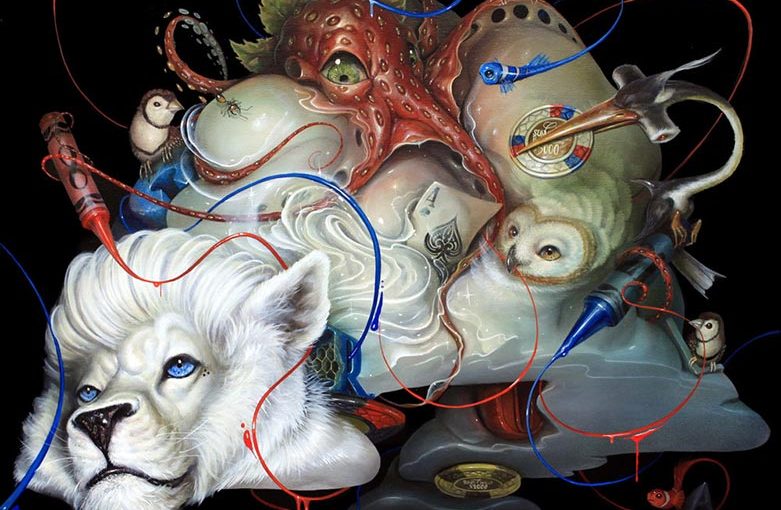
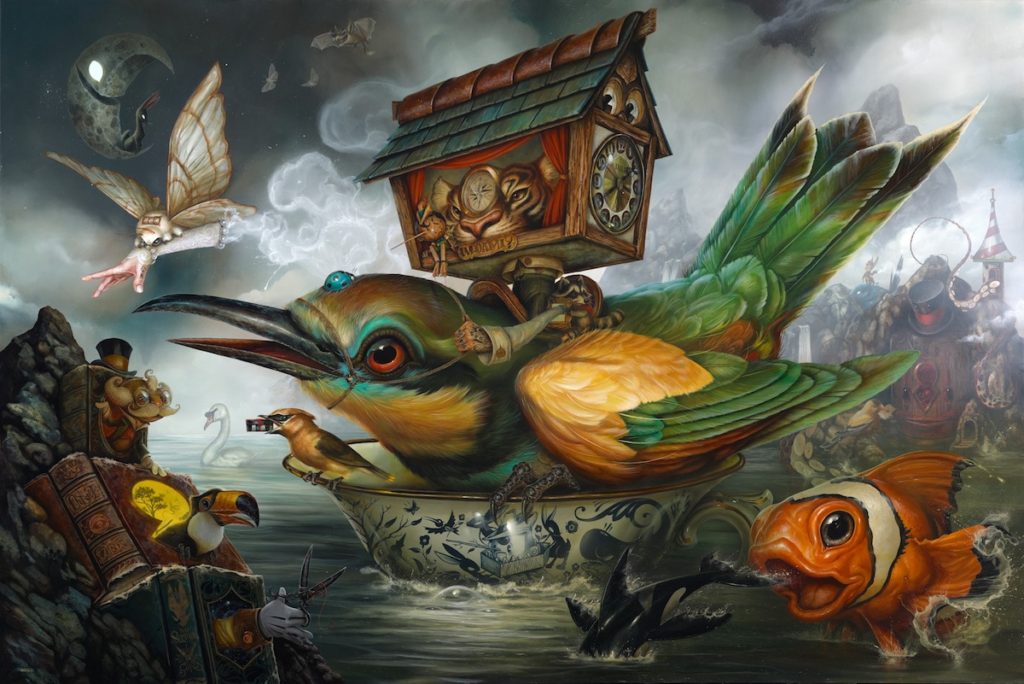
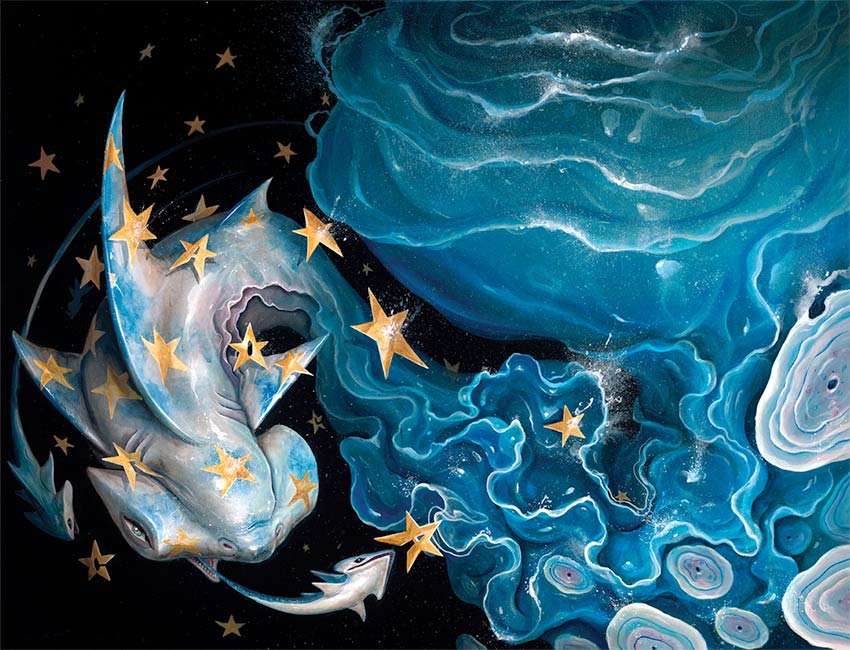
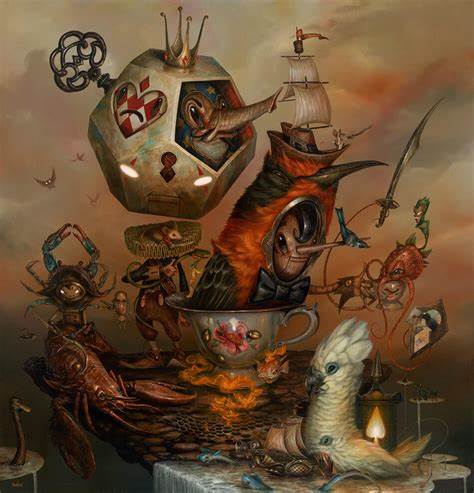
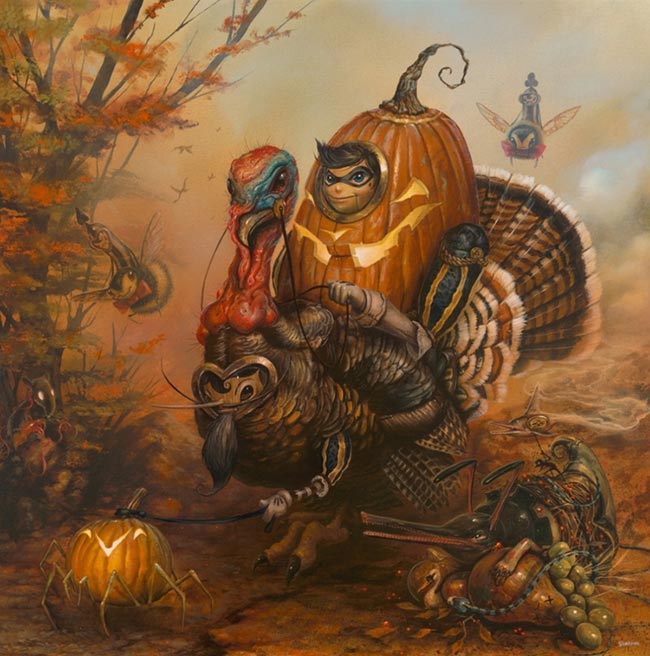
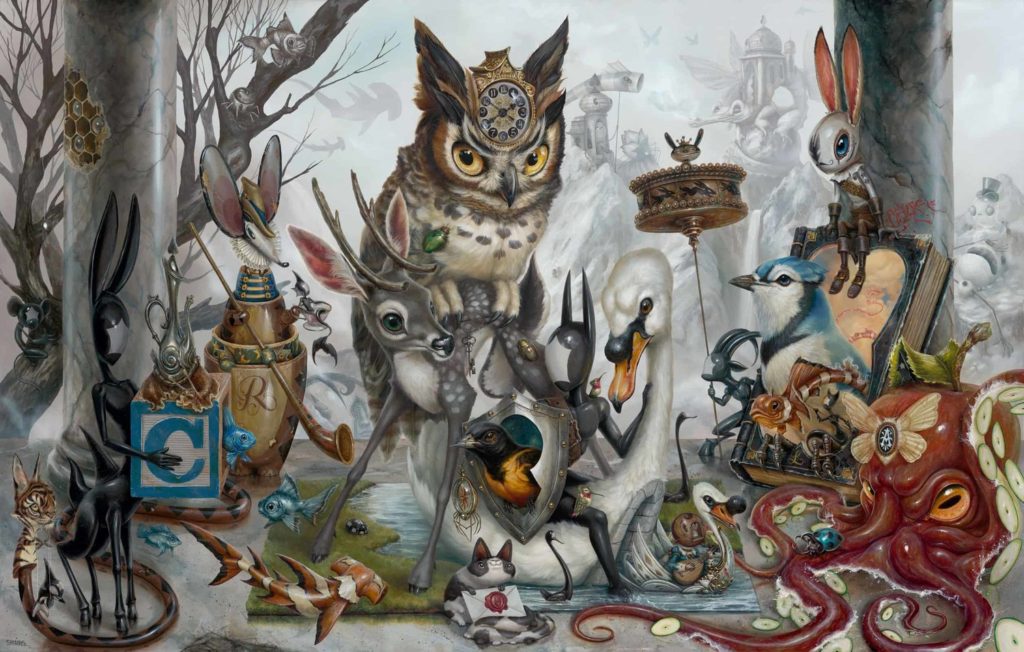
This is an introduction to the art of Greg (Craola) Simkins. He has created his own form of art with appears to be an off-shoot of the “low brow” movement that originated out of California. He is a talented young man that paints a very odd and eclectic mixture of birds and contemporaneous themes all mashed together in a kind of confusing array of post surrealistic nightmares.

His niche is low-brow bird portraiture.

Greg ‘Craola’ Simkins was born in 1975 in Torrance California, just south of Los Angeles. He grew up with a menagerie of animals including a number of rabbits, which often emerge in his paintings. He began drawing at the early age of three and was inspired by various cartoons and books.

Some standout books that still find their way into his art are Watership Down by Richard Adams, The Chronicles of Narnia by C.S. Lewis and The Phantom Tollbooth by Norton Juster.
Greg ‘Craola’ Simkins 1
The idea of escape is getting lost in a daydream and wandering through one’s imagination.
Why the name The Escape Artist?

The idea of escape is getting lost in a daydream and wandering  through one’s imagination. As I make art, this process is very important  to me. It’s important in the planning stages as I just fill my  sketchbooks with whatever interesting images that entertain me, and it  is important at the composition stage where I lay out these ideas in  their ideal situations so as to move onto the final stage of painting  them.

Once I get to the painting stage, the concept is at most finalized,  but with a bit of room for improvisation. Once I start painting, the  muscle memory and mechanics take over and I will put on music,  audiobooks, movies, podcasts, etc… but generally, find myself zoning out  and falling into the process of painting which can be almost  meditative. Next thing you know and 8 hours have passed by and something  new has been created on the canvas. It’s an awesome feeling being in  that “Escape Zone.” 

Simkins’ art continued to progress to the age of 18, when he started doing graffiti under the name ‘CRAOLA’. Graffiti art became his impetus for creating and gave him the confidence to paint large works. In addition it taught him perspective, color theory and further developed artistic skills, which later translated into his work with acrylics.
Greg ‘Craola’ Simkins 3
Falling into the process of painting which can be almost meditative. Next thing you know and 8 hours have passed by and something new has been created on the canvas. It’s an awesome feeling being in that “Escape Zone.”
What’s an average day in the studio?

Once I get in, I answer emails, go through sketches and draw a little  to warm up, maybe edit some video, finish my coffee, and then sit down  at the easel and pour my paint for the day. Once that is in place, I  will paint as long a stretch as possible. I don’t like taking breaks and  will generally eat my lunch while working as well.

I try to keep in that creative headspace and block out the rest of  the world. Around dinner time, I go inside and help out making food and  getting the kids to the table, we spend time together as a family, put  the kids to bed at bedtime, and then sit down to watch a show with my  wife and work on drawings and concepts. 

After receiving his Bachelor’s Degree in Studio Art from California State University of Long Beach in 1999, Simkins worked as an illustrator for various clothing companies and bands. He later moved on to Treyarch/Activision where he worked on video games including Tony Hawk 2X, Spiderman 2 and Ultimate Spiderman while attempting to paint with every free moment he had.

In 2005, Simkins pursued his desire to paint as a full-time artist. Since then, he has been featured in numerous group exhibitions and had successfully sold out solo exhibitions.

Birds are key figures in your work. Where does your fascination with birds come from?

How could anyone not be fascinated with birds? They are these jewels,  weapons, music boxes, and much more that dart around the sky as masters  of the air. They defy gravity, they curiously watch us—waiting for us  to make a move, they come in so many varieties, some create bonds with  us, others taunt us, and some would even comfort us.

They are incredible creatures, and I have chosen to give them personalities in my work and in The Outside  for all these reasons. The main bird in my work is Breeze, a large blue  jay that befriends my character Ralf “The White Knight” and protects  and teaches him the way of that world. 
Greg ‘Craola’ Simkins 4
After receiving his Bachelor’s Degree in Studio Art from California State University of Long Beach in 1999, Simkins worked as an illustrator for various clothing companies and bands.

It is his careful weaving of pop culture, the old masters, nature, carnival kitsch, and (most importantly) his warped imagination, that makes Greg Simkins a sought-after surrealist painter today. Simkins’ artwork has appeared in galleries throughout the world.

The exhibition includes a number of beautiful works on paper.  What’s your relationship with drawing and how is it part of your  creative process?

It can be either to get an idea out as fast as possible so as not to  lose it or something to later be refined into its own finished project. I  enjoy getting the gesture of an idea to use later on in a piece, but  sometimes I feel that gesture is beautiful in itself, even with all its  flaws. It is the kernel of an idea and I chose to share some of those in  this exhibition.

I also enjoy doing charcoal portraits which gives me a whole other  way to study shape and form and mark making, which speaks to my other  work. Working in multiple mediums always teaches me something new to add  to each other. 
Greg ‘Craola’ Simkins 5
How could anyone not be fascinated with birds? They are these jewels, weapons, music boxes, and much more that dart around the sky as masters of the air. They defy gravity, they curiously watch us—waiting for us to make a move, they come in so many varieties, some create bonds with us, others taunt us, and some would even comfort us.
“My creative demands are self imposed and my frustrations are my 
limitations. I sketch a lot and plan many pieces that I never get to paint. It kills me, there are so many things I want to paint and find the ticking of the clock to be deafening. Most of the time it is too many ideas and a lot get shelved or pop up in future shows. It is also a blessing sometimes because I get to revisit these ideas and tinker with them a bit and watch them blossom into something far greater than my original vision. It is as if the technique catches up with the idea over that time span, and I am thankful for it.” 

– Greg ‘Craola’ Simkins (Empty Lighthouse Magazine)
Greg ‘Craola’ Simkins 2
It is his careful weaving of pop culture, the old masters, nature, carnival kitsch, and (most importantly) his warped imagination, that makes Greg Simkins a sought-after surrealist painter today. Simkins’ artwork has appeared in galleries throughout the world.

Fictional Story Related Index

This is an index of full text reprints of stories that I have read that influenced me when I was young. They are rather difficult to come by today, as where I live they are nearly impossible to find. Yes, you can find them on the internet, behind paywalls. Ah, that’s why all those software engineers in California make all that money. Well, here they are FOR FREE. Enjoy reading them.

Movies that Inspired Me

Here are some movies that I consider noteworthy and worth a view. Enjoy.
The Seventh Voyage of Sinbad.
Jason and the Argonauts
The Golden Voyage of Sinbad (1973)
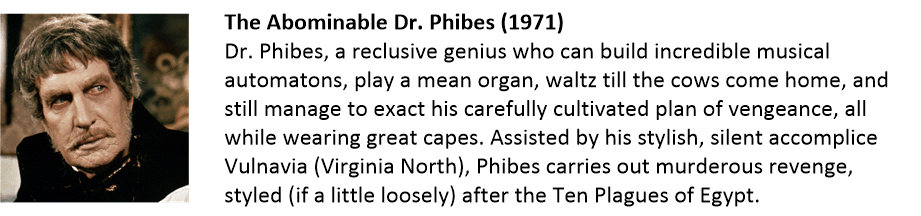
The Abominable Dr. Phibes (1971)

Stories that Inspired Me

Here are reprints in full text of stories that inspired me, but that are nearly impossible to find in China. I place them here as sort of a personal library that I can use for inspiration. The reader is welcome to come and enjoy a read or two as well.
Link
R is for Rocket
Space Cadet (Full Text) by Robert Heinlein
Link
Link
Link
Correspondence Course
Link
Link
Link
Link
Link
The Last Night
The Flying Machine
A story of escape.
All Summer in a day.
The Smile by Ray Bradbury
The menace from Earth
Delilah and the Space Rigger
Any Friend of Nicholas Nickleby’s Is a Friend of Mine
Life-Line
The Tax-payer
The Pedestrian
Time for the stars.
Glory Road by Robert Heinlein
Starman Jones (Full Text) by Robert Heinlein.
The Lottery (Full Text) by Shirley Jackson
The Cold Equations (Full Text)
Farnham's Freehold (Full Text) by Robert Heinlein
Invisible Boy (Full Text) by Ray Bradbury
Job: A Comedy of Justice (Full Text) by Robert Heinlein
Spell my name with an "S" by Isaac Asimov
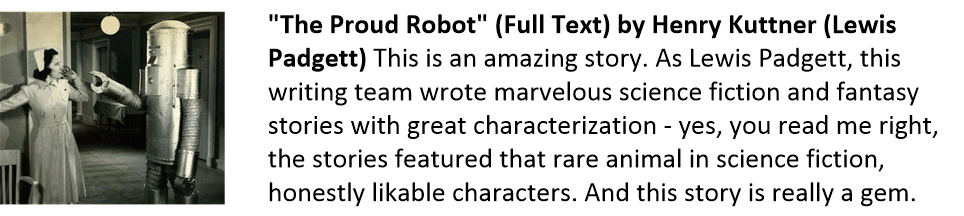
The Proud Robot (Full Text)
The Time Locker
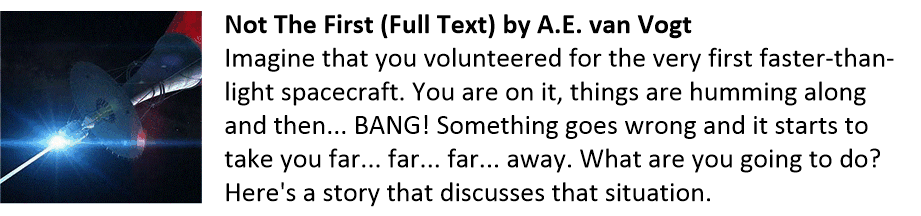
Not the First (Full Text) by A.E. van Vogt
The Star Mouse (Full Text)
Space Jockey (Full Text) by Robert Heinlein
He who shrank (Full Text).
Blowups Happen by Robert Heinlein
Uncle Eniar by Ray Bradbury
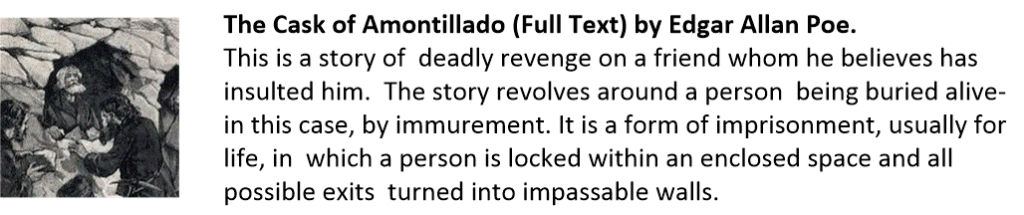
The Cask of Amontillado

My Poetry

My Kitten Knows

Art that Moves Me

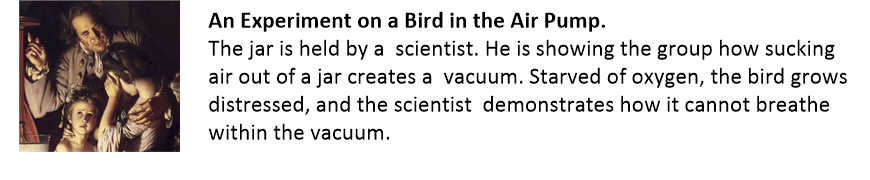
An experiment of a bird in a vacuum jar.
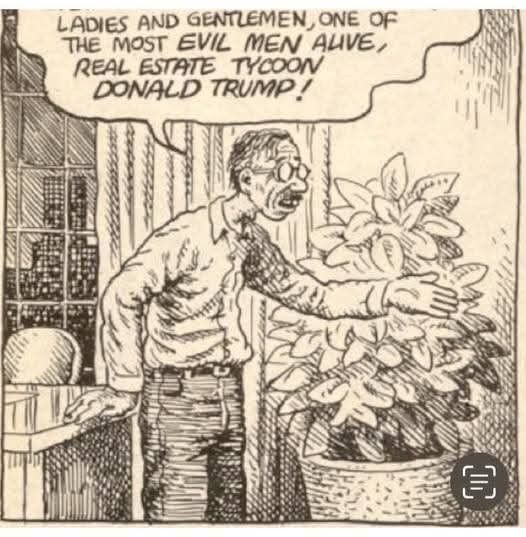
Robert Williams
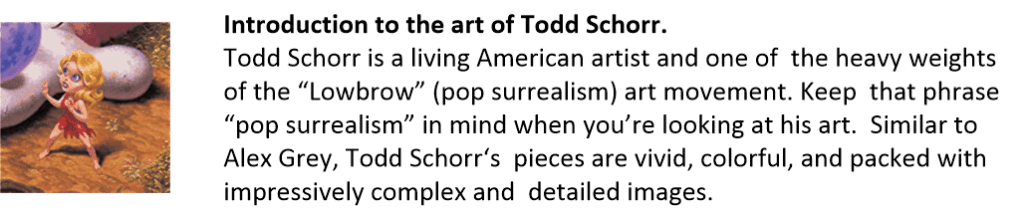
Todd Schorr

Articles & Links

You’ll not find any big banners or popups here talking about cookies and privacy notices. There are no ads on this site (aside from the hosting ads – a necessary evil). Functionally and fundamentally, I just don’t make money off of this blog. It is NOT monetized. Finally, I don’t track you because I just don’t care to.

  • You can start reading the articles by going HERE.
  • You can visit the Index Page HERE to explore by article subject.
  • You can also ask the author some questions. You can go HERE to find out how to go about this.
  • You can find out more about the author HERE.
  • If you have concerns or complaints, you can go HERE.
  • If you want to make a donation, you can go HERE.

Great things require both vision and foundation

Because all the nice buildings got destroyed in World War II.

Brutalism is an architectural style that emerged in the UK in the 1950s. An outgrowth of Modernism, Brutalism is the ultimate expression of function over form. It is characterized by simple geometric shapes, bare concrete and brick construction, and a complete lack of decorative elements. It creates ugly, imposing buildings which exist to serve their function and nothing else.

But much like the UK’s other distinct postwar architectural feature, the two tap sink, Brutalist architecture is a result of a particular set of historical realities. While the UK was on the winning side of World War II, it did not actually win the war. America won the war. The UK simply survived it.

London was flattened in the Blitz. The British Empire fell apart as its colonies declared independence. And the economy was so severely devastated that food rationing would continue until 1954, 9 years after V Day.

Brutalist architecture solved one of the most pressing issues postwar Britain had. How to house its population.

Concrete can be poured really quickly. Geometric shapes give you the most usable space for your buck. Painting concrete doesn’t actually do anything, so you can skip that step. And who has the money for decorative elements when a good chunk of London is homeless?

In the 1970s Brutalism would see another surge in popularity, in the Soviet Union. The Soviets had been just as devastated by the war as the British, if nor more so. And their economy recovered even more slowly for reasons I could write an entire essay on.

Quick, standardized, mass produced buildings made from cheap yet durable materials were a godsend. And that’s what Brutalism is at its core.

A Modernist home. Not a Brutalist home.

Brutalism is Modern architecture for really poor nations who need those buildings up yesterday.

🔥FOREIGNERS REACT TO NOBODY (2021) BUS FIGHT! 🤯🔥

How to Make Cheap Thermal Goggles

Night vision goggles were invented for use by the military. Over the years, they have become popular among law enforcement agencies and hunters. The technology that makes night vision possible is called an infrared image intensifier tube. The intensifier tube houses a photo cathode that transfers photons of light energy into electrons by releasing similar electrons from atoms inside the tube itself. This process helps to multiply the electrons and then illuminate the image as the electrons reach the phosphor screen. This process can be duplicated at home by using a simple method.

Step 1

Purchase a pair of regular, preferably clear-framed sunglasses that have a sturdy frame. Remove the lenses and trace their shape onto sheets of Congo blue and primary red theatrical gels, which are made for stage lighting. Ensure that you have two pieces for each color and cut all four pieces out using the X-Acto knife. Glue the blue gels first and then the red ones, by touching the outer rim of the gels all the way around with super glue. Make sure that you put one of each color gel on each lens of the glasses so you end up with each eye filtering red and blue light. Gently lay the lenses inside the glasses one at a time and wait for them to dry.

Step 2

Glue the eight high-intensity infrared LEDs, four on each side, to the outside of the goggles and on the outer edge of the lenses so they are to the left of the left lens and to the right of the right lens. The LEDs create the illumination needed to filter the light through the colored gels. Secure the wires of the lights to the outer edge of the goggles using electrical tape.

Step 3

Wire the lights to the 3-volt, button-cell battery and glue the battery to the side of the goggles. Ensure there is a battery on each side of the goggles so each set of lights has a battery. Leave the plus wire short so it does not touch or tape it down so it isn’t able to make contact. You may also want to wire a switch from the wire to the battery so the goggles can be turned on and off. However, you can simply tape the wire to the battery when in use.

Step 4

Take your goggles outside to test them. If the image is weak or not well-illuminated, you may need to add more LEDs or another layer of gels.

references

Gimme Shelter – Apocalypse Now Music Video

Wow.

Col 26-Book 442 – Sir Whiskerton and the Great Farmyard Soufflé (A Tale of Egg Strikes, Edible Glam, and the Peril of 10-Foot Ambition)

Ah, dear reader—prepare your oven mitts, steady your monocle, and inhale deeply. Today’s story does not begin with a quack, a snort, or even a kazoo blast.
It begins with a whisk.
A thump.
And the soft, ominous groan of a soufflé that has dreams far beyond its structural integrity.

So preheat your imagination, dear friends—and step gently into Sir Whiskerton and the Great Farmyard Soufflé.


Act I: The Vision (and the Very Tall Pan)

It began, as all great disasters do, on a Tuesday.

Chef Chloe—flour-dusted, eyes gleaming with the fire of unhinged innovation—stood before the barn-turned-kitchen, arms wide.

“Behold!” she cried, unveiling a copper pan the size of a small tractor. “The Farmyard Soufflé: A culinary monument to community, creativity… and vibes.”

Doris the Hen squinted.

“Where are the eggs?”
“Eggs!” echoed Ditto, already licking the bowl.

Chloe waved a dismissive paw.

“Eggs? Passé. This soufflé rises on farm-fresh vibessunbeams, friendship, and the gentle hum of Bessie’s moo-ditation.”
She gestured to a jar labeled:
Concentrated Harmony (Shake Before Use).”

The Valley Chicks gasped in unison.

“Omg. It’s, like, art.”
“Art! Art!” echoed Echo, wearing a tiny chef’s hat backwards.

Sir Whiskerton, sunbathing on the roof, flicked an ear.

“This,” he murmured, “is either genius… or the prelude to structural collapse.”
“Collapse! Collapse!”


Act II: The Egg Strike (Feathers Will Fly)

Word spread.

By noon, Doris had convened the United Hens of the Coop (UHOC) beneath the old oak.

“Sisters—and Harriet—we are at a crossroads!” she declared, standing atop a crate. “Chef Chloe would build a monument… without monumental sacrifice! Without our yolks! Without our protein-packed purpose!”
“Purpose! Oh, I can’t bear it!” Lillian shrieked, fainting onto a sack of oats.

A sign appeared on the coop door:

EGG STRIKE IN PROGRESS
“You’ll get my yolks over my dead feathers!”

Inside, negotiations were tense.

Doris, in full union rep mode:

“We demand: 1) Hazard pay for high-altitude laying, 2) Spa days after extra-large eggs, 3) A say in soufflé aesthetics.”

Chloe, wiping flour off her brow:

“But the vibes are set! The harmony jar was calibrated at dawn!”

“Vibes don’t hold air, Chloe,” Doris shot back. “Eggs do.”

Even Ferdinand weighed in—via opera:

“Ooooooooooo-va-laaaa! The soufflé must rise!”
“Rise! Rise!” echoed Ditto—now stuck in the flour bin.


Act III: The Glitter Gambit (and the Collapse Heard ‘Round the Farm)

Desperate, Chloe turned to the Valley Chicks.

“You understand art. Help me elevate the batter.”

Tiffany struck a pose.

“We’ve got exactly what you need.”
She pulled out a glitter cannon labeled:
Edible Glam™ (FDA-adjacent).”

“It’s, like, edible glam,” Brittany added. “Guaranteed to make anything Instagrammable… or mildly sparkly.”

They fired.

The batter—already a pale, trembling cloud—now shimmered like a disco ball dipped in moonlight.

Chloe beamed. “Perfection!”
She slid the pan into the oven (a repurposed grain silo, courtesy of Handy Hank).

For 47 minutes, hope rose.

Then—
WHUMPF.

Not a pop.
Not a sigh.
A full, tragic, Broadway-style collapse.

The soufflé deflated like a balloon at a funeral.

From the wreckage rose a single, glittering word—written in steam on the barn wall:

FLAT.”

The Valley Chicks gasped.

“It’s… performance art.”
“Art! Art!”

Doris stepped forward—not in anger, but in solidarity.

“Chef Chloe… maybe… just one egg?”
She placed a single, golden egg beside the pan.
“Not for the structure. For the soul.”

Chloe stared. Then—nodded.

“…Fine. One egg. And a very light hand on the glam.”


The Moral of the Story

That evening, as the farm gathered around a modest—but perfect—6-inch soufflé (golden, airy, just a whisper of sparkle), Sir Whiskerton addressed the animals.

“The moral of the story, dear reader, is this:
Great things require both vision and foundation.
Chloe dreamed big—and that’s noble. Doris stood firm—and that’s brave. And the Valley Chicks? They added glitter—and that’s essential.
But the soufflé only rose when they listened to each other—when the vibes met the yolks, and ambition bowed to reality.
So go ahead. Dream tall. Just… maybe check the recipe first.”
Doris raised a claw.

“To the egg! The unsung hero of lift!”
“Lift! Lift!”

And even the scarecrow swayed—just once—in agreement.


Post-Credit Scene

Later, Chef Remy unveiled his newest invention:

Deflated Soufflé Tartlets™”
(“Guaranteed to soothe existential pastry trauma—or cause mild indigestion.”)

Mr. Ducky bought the rights:

Now with 200% more resilience!”

And Sir Whiskerton?
He added a footnote to his journal:

“Note: The greatest masterpieces are rarely 10 feet tall.
They’re the ones baked with respect, shared with joy,
and eaten before the glitter settles.”


Jingle on. 🥚✨🍳
(Or, in hen: Cluck-cluck-POOF!)

The End.

America’s Skill Pipeline is Closed; Young Americans Have NO CLUE How to Fix Things

America's Skill Pipeline is Closed; Young Americans Have NO CLUE How to Fix Things

College Age Kids who think THEY know better, say they’re going to start a Revolution to change America. Truth is, most of them can’t even start a lawn mower.

AMERICA’S SKILL PIPELINE IS BROKEN: What Happens When the Boomers Leave?

You thought America’s economy was overly dependent on Wall Street and Big Tech. Wait till the Baby Boomers retire and die off. They did much to ruin the country, but they are the last generation of Americans that knows how to do stuff with their hands.

GENERATIONAL SKILLS VOID

🟠Teen Work Collapse: Entry-level jobs that once built discipline are gone. Result: no early training in punctuality, resilience, or responsibility during ages 14–18.

🟠Apprenticeship Breakdown: Master–apprentice pipelines were replaced by cheap, disposable labor. Result: skills aren’t passed down — they retire with the worker. The ladder is broken.

ACCELERANTS: IMMIGRATION & AUTOMATION

🟠Illegal Immigration: Flooded the market with cheap, ready labor, eliminating the incentive to train natives. Apprenticeship died because the shortcut was cheaper.

🟠Automation Myth: Clerical and factory jobs vanished. “Learn to code” was the wrong fix. Now AI outperforms junior programmers — the escape hatch is automated too.

THE COMPOUNDING EFFECT: A Demographic Time Bomb

This is an accelerating decay function:

🟠Boomer Generation (Ages 60-78): Holds the majority of remaining tacit knowledge and mastery in skilled trades.

🟠Gen X/Millennials (Ages 28-59): Contain a missing cohort that never entered the skill pipeline due to the above factors.

🟠Gen Z+ (Under 28): Face a landscape where entry points are gone and credentialism is failing.

THE BOTTOM LINE:

The market signal of “jobs Americans won’t do” is a lagging indicator. The leading indicator is “skills Americans weren’t taught.”

Implosion is the inevitable result of a 30-year failure in skill transmission. The window for mitigation is closed.

Most young guys today don’t even know how to jump-start a car. Most young girls today don’t know how to cook.

Our civilization is dying – and the young ones who think they know everything about everything, are going to find themselves living in a world where nothing works because in reality THEY don’t know much of anything.

Operation August Storm – The Manchurian Operation

It’s quite fascinating, because the historical implications of the campaign are quite wide, particularly if you are a western person and believe in a certain set narrative of WW2.

The campaign was very short, in which the Soviet army defeated a huge amount of Japanese troops, in about 3 weeks. The total was for around 84,000 dead compared to 12,000 Soviet dead as well as 600,000 POWs. The Japanese puppet forces of Manchukuo and Mengjiang collapsed entirely before the Soviets and their armies deserted and melted away. These troops alone constitute around 250,000 troops.

Japanese prisoners in Soviet POW camps.

1.2 million Japanese commanded soldiers against 1.5 million Soviet soldiers, while on the defensive lost 1.5 million square kilometers of defended territory. Logistically alone it was quite impressive, as the 44th army did a lightning attack through a defended mountain range.

It also showed how much weaker the Japanese army was compared to the Germans. Taking a single city from the Germans was more difficult than taking an area bigger than France and Germany combined from the Japanese.

Finally, it’s interesting because if you compare the Soviet experience with the American one, the American narrative looks very strange.

  1. Japanese rarely surrender, but half of the Japanese troops surrendered to the Soviets.
  2. Japanese fight extremely doggedly on the defense, but they get over run by the Soviets.
  3. It would take immense casualties to defeat the Japanese main army in Japan, but the Soviets defeated a million trained soldiers in weeks with minimal casualties.

The enemy attacks with a strength and speed we have never witnessed. Our forces are overwhelmed…It is impossible to regroup. The situation is out of control.

General Otozō Yamada, Commander of the Kwantung Army in Manchuria, Reports to the Imperial government 11th of August

The Soviet Union’s attack has dealt us a fatal blow… Far beyond anything we had imagined.

General Yoshijirō Umezu, Army Chief of Staff, August 14 Imperial conference on surrender.

The Soviet Union has entered the war against us… Now that the Soviet Union has also entered the war, to continue the war would mean the destruction of the nation.

Emperor Hirohito, August 15th 1945, Imperial conference on surrender

Pictures

3c42e333dce1a3e1338d80b4c87cfdac

f619dd977ffc4cb992f00bf71e6635cb

e643058c296b6b8254916f00c7cdb43f

453be7ec09b81692220a4b80a8a4ae8e

3a51b8bab361b5775ff38d2b2f49d66c

c573d577f5a363e7dc9e28f90169612d

5ae6023c960d83139af5ca8f95a7d47a

fda7cc8a3f0946d49041d5f77787ae0c

1e1e48c4cded9ea16aa80750a75010dd

19c42439b752e3f3e849d1225640db0e

2b35cfce0db43a5ca87e9f7a44bded59

1e712fe3aaa820c71922e4daa767a82b

b65db8cb1d1c7115d094cd15a05010c3

dd8bde1676d9c76959bffbb89344ec8a

fe286d1bbe1b385ee8d4941854363996

2a7f31377c976800e743fa722b06231a

28311220271ac16bb565823c23a14fb3

1f2230e7f327aade61e5a9839eb1b278

262413778776113a8c01fc92e7698e47

ad5416e532837681f8d060a1bc0c05d6

dbb13d7844b9ae3fa8a0e7bf125fd4a9

868ffbd5c5b53134d603fc4d0ec8b1f2

8fb04a96fe55646a7b7bb7edb7cbee01

d6592bc06b249c01871bf40eb610d5d6

f0c85abed643f34f81ed758499a6ad5d

b14b541d1b9d0ac4ec7dff5bb4599aec

b5dc523c6ecc7f47801ae52d8b80a866

7b6a0b5ed89c58f2b6d903063e1d159e

c8282f49f3d900524d06efe8ef445cbe

9231caf41820f322a64eaeaa8606792d

1d80dbf6e361705f582a00e8d5a0f54b

465ec3581e8935810fad6ebf4c921237

88e08167f90d9acf6d0f2b86d1d3cd87

2bb6fa61bc57b7ff65e440ca4d256a38

0139241da3ef65b060c9b0f082a7076b

0de3e29e73e114822d1822d95e5f38df

1633ee5519500a96969af213aa895af9

763ec924d01e2ea0e59b7e40e14cffc0

e94536382463ee88643d5d6658acaa62

24e1c323915a7e9b385c728f7db85a56

be148f3104caeadfca486d49db32d54a

f7fdeec0ca31900ef45de399e49dd2d2

38f0428eb57c90315ed5abb4bba0a738

f02ae615cd8dd6d29365221c288f8b9d

bb62a71d3a29e9aa3e88562b20b0454d

d5c232ffee7e76a1a79108cf4a6b0f81

fc30f6a4305ee6dd1d73ebf7be727217

4778de396b951f063f8ff087f7eb865d

51b85c20d9ee298fca22dc6341302de9

908dd4a33601e3ffd5fa5d86e8d8d8d3

2e3219d868f5d990208d1ae297b401b2

d24520f313f0f674cb0657d64e08a1a5

197059aa9e6b5d5ef8a59d42f0b6c7e3

bc97393fa25f537dd374ff2bc433aa68

bc854da147106ee85de8568364e8057e

869fdf9f4a0fa1fd0c0dcdd765014909

d77d45e0e6e7076badae139f39d16e4a

d8b660ff538048726807c9d4d303c932

1579d3eea196bc4ba14a2f89652f76cf

I will turn 73 in May of 2026, so I am 72 at the moment. I would be lying if I said I never thought about dying. With more years behind me than in front of me, the prospect of dying comes to mind more often than I would like. But then, we all will die. Whether we think about it or not, it will come at some point. I choose NOT to think about it, excepting for making plans for my wife’s care and our small amount of assets…… but I have done that since my 50’s.

My own Father died at 50, his brother at 55. My Mother died at 78, one sister at 79, another at 80 and the last one at 89. They all died from complications from hypertension related heart disease.

My brothers are 83 and 82. Losing our Father so young… I was less than two when he died,…. had a huge impact on us boys. Unlike our sisters, we never smoked. We also watched our weight, exercised, had regular medical check-ups, ate responsibly, managed stress, money and retired in our 60’s.

I cannot speak for my brothers because we have little contact now, but I “learned how to learn” at a young age. Seeking knowledge during my entire life has kept me young in mind and vital in body. Putting that knowledge into practice, keeps me useful and vigorous.

I do have assorted age related “issues”, but they don’t stop me. I move at the pace I am comfortable moving at. When I was 57, I started building our ranch in west Texas, by hand. Sold it at 69 and at 70 built, again by hand, a garage/man cave/workshop. Sold it and at 72 I have rebuilt half of our 97 year old project, “The Money Pit”, as well as constructing a matching 500 square foot shed. All by my own hand. I will do more to it next year, at 73.

Is 72 a good age to live to??? Of course!!! But for me, it is just a stepping stone to my ultimate goal of 115. If I don’t make 115, I will get a lot closer to it that the guy who sets 80 as a goal though! Every age can be the best, or the worst. LIFE, age, is what WE make of it….. make your the best you can and strive to LIVE life, not just exist!