
Uh. Sigh.
More information on the present BANG BANG of slides.
Apparently nuclear events took place, and “those that actually control this reality”, as opposed to “those that think that they know how to manipulate this reality” took control of the master control board. (Well, it’s far more complex than that, but the imagery that I am getting is really clear that it’s a control room of sorts.)
I don’t know what happened to the “bad actors”.
But I do know that reasonable people / interests / aliens / spirits are back in charge. And they are not allowing things to go “tits up”.
My understanding is that things still can revert.
But probably won’t.
BOOM! BIG BADS are occurring on a series and sequence of other world lines. Just not on OURS.
More as I get it.
-MM
Sir Whiskerton and the Alien Abduction Hoedown
Or: When Yodeling Fish Meet Intergalactic DJs—and Things Get Weird
Introduction
Ah, dear reader, prepare yourself for a tale that’s out of this world—literally. Today’s story begins with The Yodeling Fish, those melodious marvels of Sir Whiskerton’s pond, accidentally catching the attention of extraterrestrial beings. Mistaking their yodels for an interstellar distress signal, the aliens whisk them away aboard their glowing spaceship.
Enter Sir Whiskerton, who must don his finest cowboy boots and negotiate their return—not through words, but through interpretive dance. Along the way, Rufus the Radioactive Dog befriends a three-headed space squirrel, and autotuned alien communications create chaos on the farm.
So grab your lasso (and maybe some glow sticks), as we dive into Sir Whiskerton and the Alien Abduction Hoedown, where music is the universal language—but yodeling remains… questionable.
Act 1: The Cosmic Mix-Up
It was a quiet evening at Sir Whiskerton’s farm when the pond erupted in a chorus of yodeling. “YODEL-AY-HEE-HOO!” sang The Yodeling Fish, their synchronized swimming routine shimmering under the moonlight.
Suddenly, a beam of light shot down from the sky, engulfing the fish in a dazzling display of cosmic energy. Before anyone could react, they were gone—abducted by a sleek silver spacecraft hovering above the pond.
The aliens, intrigued by the strange sounds emanating from Earth, had mistaken the yodeling for a cry for help. Little did they know, it was just Tuesday night karaoke for the fish.
Doris the Hen clucked nervously. “This isn’t good! What if they dissect them?!”
Sir Whiskerton adjusted his monocle. “Fear not, my feathered friend. I shall retrieve our aquatic divas—with diplomacy and flair.”
Act 2: Negotiations via Dance
Aboard the alien ship, Sir Whiskerton found himself face-to-face with a group of wide-eyed extraterrestrials whose communication sounded eerily like a robotic remix of “I Will Survive.”
“We are here to assist,” autotuned one alien, tilting its head quizzically. “Your distress signal reached us across galaxies.”
Sir Whiskerton cleared his throat dramatically. “Ah, yes, about that… allow me to explain.”
With no common language between them, Sir Whiskerton resorted to interpretive dance—a graceful blend of cha-cha, waltz, and what can only be described as “fish impersonation.” He twirled and leapt, mimicking the synchronized swimming patterns of The Yodeling Fish while occasionally yodeling himself.
The aliens watched intently, their glowing antennae bobbing along to the rhythm. Finally, one nodded approvingly. “Understood. No distress signal. Just… music.”
Act 3: Rufus and the Three-Headed Squirrel
Meanwhile, back on the farm, Rufus the Radioactive Dog discovered an unexpected visitor: a three-headed space squirrel named Trixie. Each head introduced itself individually:
“I’m Ziggy!” said Head One, sporting neon green fur.
“I’m Zoggy!” chimed Head Two, adorned with sparkly blue stripes.
“And I’m Zuggy!” added Head Three, wearing mismatched sunglasses.
Rufus wagged his tail enthusiastically. “Cool! Can you fetch frisbees?”
Trixie blinked all six eyes simultaneously. “We prefer existential debates over snacks.”
Despite their differences—or perhaps because of them—the unlikely duo bonded over shared adventures. Together, they explored the farm, leaving behind trails of glowing pawprints and philosophical musings scrawled in mud.
Act 4: Return of the Yodeling Heroes
Thanks to Sir Whiskerton’s interpretive prowess, the aliens agreed to release The Yodeling Fish. As the spacecraft descended back to Earth, the fish burst into song once more:
“YODEL-AY-HEE-HOO! HOMEWE ARE!”
The farm erupted in cheers. Doris flapped her wings wildly. “They’re safe! Quick, someone get the glitter cannon!”
Sir Whiskerton tipped his imaginary hat to the departing aliens, who responded with a final autotuned farewell: “Peace, love, and harmonized vibrations!”
Reflection Scene
Gathered around the pond later that evening, Sir Whiskerton addressed the animals.
“Today taught us two things,” he began, sipping a moonlight mojito served in an acorn cup. “First, music truly is the universal language—even if it involves questionable yodeling. And second…” He paused, glancing at Rufus and Trixie, who were now debating the meaning of life atop a haystack. “…even the most unexpected friendships can brighten our days.”
Post-Credit Scene
Trixie stood triumphantly beside a glowing jukebox labeled “Intergalactic Karaoke Machine.”
“This device contains every hit song from across the cosmos,” she declared proudly.
Doris pecked suspiciously at one of the buttons. “Are these radioactive?”
Trixie grinned. “Only slightly.”
Cue horrified squawks.
Moral of the Story
Music connects us all—even if it involves yodeling fish and autotuned aliens.
Best Lines
- “YODEL-AY-HEE-HOO! HOME WE ARE!” – The Yodeling Fish, making a triumphant return.
- “Peace, love, and harmonized vibrations!” – The aliens, bidding adieu.
- “Existential debates over snacks.” – Trixie, explaining her priorities.
Key Jokes
- The aliens communicate entirely in autotune, turning negotiations into a galactic DJ session.
- Rufus befriending a three-headed space squirrel adds absurdity and charm.
- Sir Whiskerton’s interpretive dance includes moves like “fish impersonation” and accidental yodeling.
Starring
- Sir Whiskerton (Diplomatic Dancer Extraordinaire)
- The Yodeling Fish (Interstellar Divas)
- Rufus the Radioactive Dog (Space Squirrel Sidekick)
- Trixie the Three-Headed Squirrel (Philosopher-Snack Debater)
Summaries
- Moral: Music bridges gaps—even between species and galaxies.
- Future Potential: Could Trixie become a regular visitor to the farm? Or will Rufus start hosting intergalactic dance parties?
Until next time, may your yodels reach new heights—and your friendships span the stars. 🚀
Coconut Chicken

Yield: 6 servings
Ingredients
- 3/4 cup pineapple juice, divided
- 1 cup cream of coconut, divided
- 1/2 cup soy sauce
- 1/4 cup brown sugar
- 1/4 cup rice-wine vinegar
- 2 pounds boneless chicken breasts, cut into strips
- 1 cup all-purpose flour
- Salt and pepper, to taste
- 6 eggs, beaten
- 1 (2 pound) bag shredded coconut
- 3/4 to 1 cup peanut oil
- 1/4 cup heavy cream
Instructions
- Combine 1/4 cup pineapple juice, 1/4 cup cream of coconut, soy sauce, brown sugar and rice-wine vinegar in a large bowl.
- Add chicken strips, cover and refrigerate 4 hours or overnight.
- Place flour in pie plate and add salt and pepper.
- Beat eggs and 1/4 cream of coconut.
- Place shredded coconut in a bowl.
- Dredge chicken pieces in flour, then egg mixture, then coconut.
- Heat just enough peanut oil in a sauté pan to cover the bottom of the pan.
- Sauté the chicken strips in peanut oil, about 5 minutes on each side. Do not let oil become too hot or you will over-brown the coconut.
- When chicken is cooked, remove from pan and keep warm.
- If there is any oil left in the pan, drain the pan but do not scrape out the drippings.
- Add the remaining 1/2 cup pineapple juice and 1/2 cup cream of coconut to the pan along with the heavy cream. Cook, scraping the bottom of the pan, until sauce has thickened.
- Use sauce by pouring over the chicken or as a dip for the chicken pieces.
Oasis – Don’t Look Back In Anger
What are some of the most dangerous ancient civilizations?
The ancient world was a brutal, violent and chaotic time and there were many dangerous Empires, but none more so than the Assyrians
Neo-Assyrian Empire
The Assyrian Empire is divided into three different time periods and names: the Old Assyrian period (2000–1364 BC), the Middle Assyrian Empire (1363–912 BC), and the Neo-Assyrian Empire, which existed from about 911 to 609 BC.
Old Assyrian Empire
During the Old Assyrian period, Assyria began as a collection of city states. The city of Ashur was founded and became a center of commerce but this Assyria was not yet a world power. The Middle Assyrian Empire was a growing power and began to conquer empires around it. The Neo-Assyrian Empire was the zenith of Assyrian might and was the dominant power in the ancient world at the time.
Assyrian Sickle Sword of the Middle Assyria Empire
There are a number of reasons why the Assyrian Empire was so dangerous. First, they were not the first Empire to create iron weapons (The Hittites were the first to introduce the technique of iron smelting around 1500 BC) but the Assyrians adopted and perfected this technology, allowing them to mass-produce superior iron weapons for their large, technologically advanced armies.
Assyrian siege weapons
Second, the Assyrians were the first Empire to build and use siege weapons that were able to conquer walled cities. Their Empire was the first to have a separate engineering unit, capable of setting up ladders, ramps, could fill in moats and dig tunnels to help them breach and get into walled cities.
Assyrian siege weapon attacking city wall of Lachish
Historians have found extant reliefs excavated from Assyrian palaces that depict detailed scenes of warfare. One of the more interesting finds, dated to the reign of Tiglath-pileser III (744–727 BC), shows a wheeled siege weapon at the walls of a fortified city being used to lever away at its fortifications. The siege weapon was covered in leather to protect it from attacks.
Assyrian cavalry in use with their army
Third, the Assyrians were one of the first Empires to use heavy cavalry and integrated them with their chariots. One of the most devastating innovations the Assyrians used in warfare was cavalry. Before the Iron Age, chariots were the standard means of using horses in combat.
Assyrian cavalry
But Assyrian reliefs during the 9th Century, were the first to depict horseback archers. By the time of Tiglath-pileser III, cavalry was heavily used by the Assyrians.
Assyrian cavalry
Cavalry allowed the Assyrian armies to move much quicker and to be more maneuverable than they would have been with chariots. Since the Assyrians were at the vanguard of the transition from chariots to cavalry, they were able to use that advantage over their neighbors who were lagging behind them in warfare technology.
Finally, the last and most important reason why the Assyrians were the most dangerous ancient Empire was their extreme levels of brutality. Not only were the Assyrians incredibly cruel to their foes but they employed their brutality in a rather systematic and clinical fashion.
The Assyrians would approach an enemy city and demand they surrender. If the enemy refused, the Assyrian army would lay siege to the city and once captured, the unfortunate inhabitants would be systematically, tortured raped, beheaded, and then flayed.
In one particular graphic example of their Assyrian brutality, the king of Kadmuhu, a small kingdom located just north of an Assyrian, refused to swear allegiance to the Assyrian king.
The king of Kadmuhu was eventually captured by the Assyrians, flayed alive, and then had his skin hanged off the walls of his city for all to see what happens when one resists the Assyrians.
Assyrian soldiers forcing captured Babylonian to grind down his families bones
But the brutality of the Assyrians was not just reserved to opposing royalty but was also extended to their subject peoples. Tales of Assyrian brutality spread far and wide and many cities would simply surrender rather than face the consequences of Assyrian vengeance.
The Assyrians depicted the torture in great detail on the walls of the imperial palaces. They created tablets containing every single punishment the Assyrian army carried out. They cut off the limbs, gouged out the eyes, and then left those poor victims to roam around. Those poor people served as a living reminder of the Assyrians’ cruelty.
Ashurnasirpal II
Ashurnasirpal II (884-859 BC) was one Assyria’s most famous and brutal kings. He was infamous for his cruelty in warfare. He had reliefs depicting his military successes and his brutality towards his victims covering the walls of his grand palace of Kalhu.
One of his most famous quotes comes from his conquest of Tela and the inscription built upon one of his monuments.
“I built a pillar over against the city gate and I flayed all the chiefs who had revolted and I covered the pillar with their skins.”
“Some I impaled upon the pillar on stakes and others I bound to stakes round the pillar. I cut the limbs off the officers who had rebelled. Many captives I burned with fire and many I took as living captives. From some I cut off their noses, their ears, and their fingers, of many I put out their eyes.”
“I made one pillar of the living and another of heads and I bound their heads to tree trunks round about the city. Their young men and maidens I consumed with fire. The rest of their warriors I consumed with thirst in the desert of the Euphrates.”
Ashurnasirpal Il’s trademark and would include skinning insubordinate officials alive and nailing their flesh to the gates of the city and “dishonoring the maidens and boys” of the conquered cities before setting them on fire.
Ashurnasirpal II shooting a lion
Eventually the size of their Empire and their brutality became their undoing. Their empire grew too large to control and manage, and the absolute hatred from defeated people’s helped them unite and eventually overthrow the Assyrian Empire.
A coalition of Babylonians, Medes, and other former vassals destroyed the main centers of Assyrian power, including the capital of Nineveh in 612 BC and the final capital of Harran in 609 BC.
My Life as an Alien in Mississippi
Written in response to: “Write about a character who has to grapple with something completely alien to them.“
Bruce Friedman
***
Shortly after I arrived in town, Uncle Charlie took sick and died. I then became the sole proprietor of his store which I had inherited. The Chinese community was always very supportive of me and I never felt lonely or heartsick. My life was as good as it gets down there until one evening when I seemed to have become a criminal with no special effort on my part.
Bursting through the front door of my grocery store one evening came Mr. Beauregard Tavernier, dragging a large, heavy burlap sack behind him. I knew who he was from town gossip but, of course, he had never set foot in my store. I did know that he owned the largest cotton plantation in the area.
He entered in a rush and obviously in a foul mood. He was grunting as he pulled a heavy sack into the room. I came out from behind the counter and respectfully bowed to him, anxious to find out what why he was there. My humble gesture didn’t seem to put him in a better mood.
“Don’t just stand there, boy,” he said to me. “Can’t you see that I need help with this here load,” he shouted.
“Help in what way, Mr. Tavernier? I’m sure what kind of help you need.” My question definitely put in an even fouler mood. In retrospect, it truly was a stupid question but chalk it up to me being scared shitless.
“Quit your yapping, boy! I need to store this here sack out of sight for a while,” he said, glancing around the premises.
He then said: “Where does that door yonder lead to?”
“My storage room for canned goods and sacks of flour,” I replied. “No customers are allowed back there,” I replied.
“That suits my purpose for my package,” he replied. “Now help me get it back there.”
The two of us pulled his heavy sack back to the room. Both of us were straining because it was so heavy and flopped around.
“You hear me good now, boy. Y’all hold onto this for a day or two until I find a more suitable place for it. Right now, your store is my best choice, at least for a spell. No one’s gonna think of your place when lookin’ for the corpus delicti. But that’s pretty fancy talk for y’all. Pay it no mind.”
“Anyone asks,” he continued, “you never seen me this night or any other. I’m goin’ to send one of my boys back here tomorrow night to collect it. You’ll need to help him boost it onto the truck. Don’t let anyone see what you’re doing. The dark night will help but there are a lot of ‘eyes’ in this part of town.”
He then rushed out of the store as quickly as he had entered, never looking back. I just stood there, shaking my head and wondering what had just happened. I did not have a good feeling about it. It was clear that I had few or no other options so I went along with his directions.
***
The next day around lunchtime, a sharp rap came on the front door. This time it was Sheriff Burnley who stepped inside. No one ever knocked on the door so I was on high alert to see who was there. His visit, though, set a new record for me—two high profile, white men showing up out of nowhere in my store in just two days. He looked around suspiciously and then beckoned for me to come over to him from behind the counter. I was in a state of shock, continuing from the previous night, and aware that I was in deep trouble.
“You Brad Chao? he asked.
“Yes, sir, how can I help you.”
“Well, to start and unfortunately, there’s been a lynchin’ of a colored boy in town. Age 16 years. You may have heard some talk about this? It’s on everyone’s lips. This gossip will truly be the death of me.”
“No, Sir. What you are saying is none of my business. I don’t pay no mind to town gossip. I try to keep a clean record and just run my store for my black customers who are also good citizens.”
“I decide who’s a good citizen,” the Sheriff replied. “More to the point, I was told by one of your neighbors that Mr. Beauregard Tavernier was seen entering these premises last night. That seemed strange to all of us back at the station. White men don’t usually have no truk with the the Chinese and their shops. Did you, by any chance, see him last night?”.
I replied, trying to keep my cool and provide him with the best, honest answer I could under the circumstances: “Sheriff, you of all folks, know that no white men would be caught dead in a Chinese grocery in town, particularly at night. Only for black folks.”
“That’s sure true, the Sheriff replied quickly, stroking his beard and still looking at me, squinty-eyed. “The story didn’t make no sense to me but I am trying to cover all the bases. Lynchin’ has become less ‘popular’ these days in the state and I am starting to feel some pressure from above to find a guilty party. ”
For a moment, he appeared to be suspiciously eyeing the back of my store. That’s the last thing in the world that I wanted.
“Watcha’ got stored back there, boy? he asked suddenly. “Your stock or, perhaps, even some other goods?”
“No need to search the store any further, Sheriff” I responded. “You don’t want to go back there. That’s where I live. Very messy. I also cook there on a hot plate. Kind of smells bad. You won’t like it. Best stay away.”
He seemed to be satisfied by my words, and also not inclined to stay in my store any longer than necessary. He suddenly wheeled around and strode out the front door, not even giving me a backward glance. I was glad to see him gone, but I didn’t know what to do next.
I finally realized that I was in a heap of trouble, none of which was of my own making. I was now apparently on the sheriff’s short list of possible suspects for the lynching, although it made no sense at all. He just wanted to arrest someone but certainly not a prominent white man.
***
It was the next night and I was sleeping. I heard a soft knock on the back door. I opened it carefully to see Aaron, a black man who worked for Mr. Beauregard. A truck was parked in the back of the store, idling.
“Boss man, sent me to pick up a ‘package’ that you holdin’ for him in your store,” he said. “He tole me not to let anyone see me transport it. So here I am.”
I got out of bed and helped Aaron load the sack on his truck bed and then covered it with a tarp. He motioned me over to him and placed his mouth gently to my ear.
“Mr. Chao, I don’t know what you done and I don’t even want to know. You been kind to us. People in town doin’ a lot of talkin’ about recent events, however. The sheriff lookin’ for someone to pin this lynchin’ on. The ‘trouble’ seems to be puttin’ the town and state in a bad light. You yourself now seem to be the perfect choice for blamin’ for the crime. They won’t never pin a lynchin’ on a black man and you may be the next best choice.” With that he hurried over to the truck and drove away in a cloud of dust.
***
I began to go over my options to stay alive. They were to stay in town or jump on a bus headed north. It would not be good for one of our community to be under a magnifying glass. Best thing, I finally concluded, would be to catch the bus for Chicago that left early the next morning. The sheriff would soon be looking for another patsy. Unfortunately for him, to charge a black with a charge of lynching would be laughable.
I packed my suitcase in a hurry, reserving a place for a small Chinese shrine with the ashes of my Uncle Charlie. Nothing much else of value to take with me. A few wrinkled clothes. I knew that hightailing it out of town made me look guilty.
I knew for certain that the large number of white people in town who had actually witnessed the lynching knew that I was not involved. All the sheriff needed to do was to ask a few questions in town which he didn’t seem to want to do. No, he would merely let this incident fade in people’s memory with his most important suspect gone to “who knows where up north.”
After nearly twenty years living in China, what is the single most pervasive Western misconception about the everyday lives of ordinary Chinese citizens?
Common sense. Sometimes I feel that some Westerners lack the most basic common sense.
You can’t, on the one hand, say that China is on the verge of collapse, and on the other hand hype up the so-called “China threat.”
You can’t, on the one hand, accuse China of consuming 50% of the world’s pork, 33% of the world’s lamb, and 40% of global vegetables and fruit — supposedly “causing environmental destruction” — and on the other hand claim that Chinese people are starving. Even billionaires couldn’t possibly eat tens of tons of food every day, could they?
Above all, we must acknowledge one simple fact: 2 + 2 does not equal 5.
Once you accept that, many problems become much easier to resolve.
For example, today I saw a Western video smearing China, told from the perspective of a so-called “persecuted Uyghur intellectual.”
He claimed he was thrown into a labor camp and forced into hard labor just because he owned 5,000 books.
This bizarre lie is simply meant to suggest to viewers that the CPC hates knowledge and hates books.
But think carefully: 5,000 books.
In China — a nation that loves books — having a private collection of 5,000 volumes is actually rare. I’ve only met fewer than five people who had that many.
Since this person calls himself an “intellectual,” surely his collection wouldn’t just be Harry Potter or The Da Vinci Code, right?
Specialized books are usually expensive. Even at a modest 80 yuan per book, 5,000 volumes would cost about 400,000 yuan.
And don’t forget — 5,000 books would require at least a dedicated study room.
So it seems this “Uyghur intellectual” must actually be quite wealthy.
In China — a country that respects knowledge and cherishes books — someone who owns 5,000 volumes would only be admired and respected.
So, was this lie fabricated out of ignorance about China?
I don’t think so. It’s just pandering to certain Western audiences and their stereotypes.
We Decoded the Oldest Genetic Data from an Egyptian – Here’s What it Told Us
Adeline Morez Jacobs/The Conversation
A group of scientists has sequenced the genome of a man who was buried in Egypt around 4,500 years ago. The study offers rare insight into the genetic ancestry of early Egyptians and reveals links to both ancient north Africa and Mesopotamia, which includes modern day Iraq and parts of Syria, Turkey and Iran.
Egypt’s heat and terrain made it difficult for such studies to be conducted but lead researcher Adeline Morez Jacobs and team made a breakthrough. We spoke to her about the challenges of sequencing ancient remains, the scientific advances that made this discovery possible, and why this genome could reshape how we understand Egypt’s early dynastic history.
What is genome sequencing? How does it work in your world?
Genome sequencing is the process of reading an organism’s entire genetic code. In humans, that’s about 3 billion chemical “letters” (A, C, T and G). The technology was first developed in the late 1970s, and by 2003 scientists had completed the first full human genome. But applying it to ancient remains came much later and has been far more difficult.
DNA breaks down over time. Heat, humidity and chemical reactions damage it, and ancient bones and teeth are filled with DNA from soil microbes rather than from the individual we want to study. In early attempts during the 1980s, scientists hoped mummified remains might still hold usable DNA. But the available sequencing methods weren’t suited to the tiny, fragmented molecules left after centuries or millennia.
To sequence DNA, scientists first need to make lots of copies of it, so there’s enough to read. Originally, this meant putting DNA into bacteria and waiting for the colonies to grow. It took days, demanded careful upkeep and yielded inconsistent results. Two breakthroughs changed this.
In the early 1990s, PCR (polymerase chain reaction) allowed millions of DNA copies to be made in hours, and by the mid-2000s, new sequencing machines could read thousands of fragments in parallel. These advances not only sped up the process but also made it more reliable, enabling
Since then, researchers have reconstructed the genomes of extinct human relatives like Neanderthals, and more than 10,000 ancient people who lived over the past 45,000 years. But the work is still challenging – success rates are low for very old remains, and tropical climates destroy DNA quickly.
What’s exceptional about the sequencing you did on these remains?
What made our study unusual is that we were able to sequence a surprisingly well-preserved genome from a region where ancient DNA rarely survives.
When we analysed the sample, we found that about 4%-5% of all DNA fragments came from the person himself (the rest came from bacteria and other organisms that colonised the remains after burial). The quantity of DNA of interest (here, human) is usually between 40% and 90% when working with living organisms. That 4%-5% might sound tiny, but in this part of the world, it’s a relatively high proportion, and enough to recover meaningful genetic information.
We think the individual’s unusual burial may have helped. He was placed inside a ceramic vessel within a rock-cut tomb, which could have shielded him from heat, moisture and other damaging elements for thousands of years.
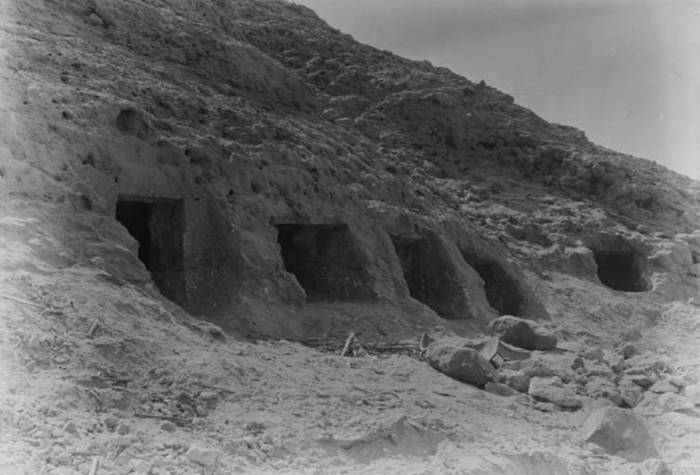
Rock cut tombs at Nuwayrat enclosing the pottery vessel containing the pottery coffin burial. (Image courtesy of the Garstang Museum of Archaeology, University of Liverpool. As in Morez Jacobs, A. et al. (2025). Nature)
To make the most of this rare preservation, we filtered out the very shortest fragments, which are too damaged to be useful. The sequencing machines could then focus on higher-quality pieces. Thanks to advanced facilities at the Francis Crick Institute, we were able to read the DNA over and over, generating about eight billion sequences in total. This gave us enough data to reconstruct the genome of what we call the Nuwayrat individual, making him the oldest genome from Egypt to date.
Does this open new frontiers?
We did not develop entirely new techniques for this study but we combined some of the most effective methods currently available into a single optimised pipeline. This is what palaeogeneticists (scientists who study the DNA of ancient organisms) often do: we adapt and refine existing methods to push the limits of what can be recovered from fragile remains.
That’s why this result matters. It shows that, with the right combination of methods, we can sometimes retrieve genomes even from places where DNA usually doesn’t survive well, like Egypt.
Egypt is also a treasure trove for archaeology, with remains that could answer major questions about human history, migration and cultural change.
Our success suggests that other ancient Egyptian remains might still hold genetic secrets, opening the door to discoveries we couldn’t have imagined just a decade ago.
What was your biggest takeaway from the sequencing?
The most exciting result was uncovering this man’s genetic ancestry. By comparing his DNA to ancient genomes from Africa, western Asia and Europe, we found that about 80% of his ancestry was shared with earlier north African populations, suggesting shared roots within the earlier local population. The remaining 20% was more similar to groups from the eastern Fertile Crescent, particularly Neolithic Mesopotamia (present-day Iraq).
This might sound expected, but until now we had no direct genetic data from an Old Kingdom (2686–2125 BCE) Egyptian individual. The results support earlier studies of skeletal features from this period, which suggested close links to predynastic populations, but the genome gives a far more precise and conclusive picture.
This genetic profile fits with archaeological evidence of long-standing connections between Egypt and the eastern Fertile Crescent, dating back at least 10,000 years with the spread of farming, domesticated animals and new crops into Egypt. Both regions also developed some of the world’s first writing systems, hieroglyphs in Egypt and cuneiform in Mesopotamia. Our finding adds genetic evidence to the picture, suggesting that along with goods and ideas, people themselves were moving between these regions.
Of course, one person can’t represent the full diversity of the ancient Egyptian society, which was likely complex and cosmopolitan, but this successful sequencing opens the door for future studies, building a richer and more nuanced picture of the people who lived there over thousands of years.
Top image: Pottery vessel in which the Nuwayrat individual was discovered. Source: Author supplied
The article ‘We decoded the oldest genetic data from an Egyptian, a man buried around 4,500 years ago – what it told us’ by Adeline Morez Jacobs was originally published on The Conversation and has been republished under a Creative Commons license.
Dishwalla – Counting Blue Cars
Pictures






























Creamy Mushroom Chicken

Ingredients
- 2 large chicken breasts, cut in half lengthwise
- All-purpose flour, for dredging
- 1 tablespoon olive oil
- 2 tablespoons butter, divided
- 12 ounces mushrooms, sliced
- 1 dash Italian seasoning
- 3 cloves garlic, minced
- 1/2 cup chicken broth
- 1/2 teaspoon lemon juice
- 1/2 teaspoon Dijon mustard
- 1 cup heavy whipping cream
- Salt and pepper to taste
Instructions
- Cut chicken breasts in half lengthwise to make four thinner cutlets. Coat them in flour.
- Add the oil and 1 tablespoon of the butter to a skillet over medium-high heat.
- Once the pan is hot, add the chicken. Cook it for 4 to 5 minutes per side until golden. Remove the chicken and set it aside.
- Add the remaining butter to the pan. Let it melt, then add the mushrooms and Italian seasoning.
- Once the mushrooms start to release water, add the garlic to the pan. Continue cooking the mushrooms until all the water is cooked off.
- Remove the mushrooms out of the pan and put them with the chicken.
- Add the chicken broth, lemon juice and Dijon mustard to the pan. Stir until the mustard dissolves, and let it reduce for 3 to 4 minutes.
- Add the cream to the pan, along with the chicken and mushrooms. Let the chicken cook for another 5 minutes or so until it is cooked through and the sauce has thickened a bit.
- Season with salt and pepper.
Princeton Study Maps 200,000 years of Human–Neanderthal Interbreeding
For centuries, we’ve imagined Neanderthals as distant cousins — a separate species that vanished long ago. But thanks to AI-powered genetic research, scientists have revealed a far more entangled history. Modern humans and Neanderthals didn’t just cross paths; they repeatedly interbred, shared genes, and even merged populations over nearly 250,000 years. These revelations suggest that Neanderthals never truly disappeared — they were absorbed. Their legacy lives on in our DNA, reshaping our understanding of what it means to be human.
Neanderthals and Humans Mix
When the first Neanderthal bones were uncovered in 1856, they sparked a flood of questions about these mysterious ancient humans. Were they similar to us or fundamentally different? Did our ancestors cooperate with them, clash with them, or even form relationships? The discovery of the Denisovans, a group closely related to Neanderthals that once lived across parts of Asia and South Asia, added even more intrigue to the story.
Now, a group of researchers made up of geneticists and artificial intelligence specialists is uncovering new layers of that shared history. Led by Joshua Akey, a professor at Princeton’s Lewis-Sigler Institute for Integrative Genomics, the team has found strong evidence of genetic exchange between early human groups, pointing to a much deeper and more complex relationship than previously understood.
- Climate Change Played Cupid Between Neanderthals and Denisovans
- Neanderthals Found Near Rome In A Cave, “Hunted” and Eaten By Hyenas
“This is the first time that geneticists have identified multiple waves of modern human-Neanderthal admixture,” said Liming Li, a professor in the Department of Medical Genetics and Developmental Biology at Southeast University in Nanjing, China, who performed this work as an associate research scholar in Akey’s lab.
“We now know that for the vast majority of human history, we’ve had a history of contact between modern humans and Neanderthals,” said Akey. The hominins who are our most direct ancestors split from the Neanderthal family tree about 600,000 years ago, then evolved our modern physical characteristics about 250,000 years ago.
“From then until the Neanderthals disappeared – that is, for about 200,000 years – modern humans have been interacting with Neanderthal populations,” he said.
The results of their work were published the journal Science.
Rethinking the Ice Age Stereotype
Neanderthals, once stereotyped as slow-moving and dim-witted, are now seen as skilled hunters and tool makers who treated each other’s injuries with sophisticated techniques and were well adapted to thrive in the cold European weather.
(Note: All of these hominin groups are humans, but to avoid saying “Neanderthal humans,” “Denisovan humans,” and “ancient-versions-of-our-own-kind-of-humans,” most archaeologists and anthropologists use the shorthand Neanderthals, Denisovans, and modern humans.)
Using genomes from 2,000 living humans as well as three Neanderthals and one Denisovan, Akey and his team mapped the gene flow between the hominin groups over the past quarter-million years.
The researchers used a genetic tool they designed a few years ago called IBDmix, which uses machine learning techniques to decode the genome. Previous researchers depended on comparing human genomes against a “reference population” of modern humans believed to have little or no Neanderthal or Denisovan DNA.
Akey’s team has established that even those referenced groups, who live thousands of miles south of the Neanderthal caves, have trace amounts of Neanderthal DNA, probably carried south by voyagers (or their descendants).
With IBDmix, Akey’s team identified a first wave of contact about 200-250,000 years ago, another wave 100-120,000 years ago, and the largest one about 50-60,000 years ago.

AI representation of a Neanderthal couple wearing fur. (Ricky/Adobe Stock)
Challenging the Out-of-Africa Model
That contrasts sharply with previous genetic data.
“To date, most genetic data suggests that modern humans evolved in Africa 250,000 years ago, stayed put for the next 200,000 years, and then decided to disperse out of Africa 50,000 years ago and go on to people the rest of the world,” said Akey.
“Our models show that there wasn’t a long period of stasis, but that shortly after modern humans arose, we’ve been migrating out of Africa and coming back to Africa, too,” he said. “To me, this story is about dispersal, that modern humans have been moving around and encountering Neanderthals and Denisovans much more than we previously recognized.”
That vision of humanity on the move coincides with the archaeological and paleoanthropological research suggesting cultural and tool exchange between the hominin groups.
Li and Akey’s key insight was to look for modern-human DNA in the genomes of the Neanderthals, instead of the other way around.
“The vast majority of genetic work over the last decade has really focused on how mating with Neanderthals impacted modern human phenotypes and our evolutionary history – but these questions are relevant and interesting in the reverse case, too,” said Akey.
They realized that the offspring of those first waves of Neanderthal-modern matings must have stayed with the Neanderthals, therefore leaving no record in living humans. “Because we can now incorporate the Neanderthal component into our genetic studies, we are seeing these earlier dispersals in ways that we weren’t able to before,” Akey said.
Shrinking Populations and Genetic Illusions
The final piece of the puzzle was discovering that Neanderthals had a smaller population than researchers previously thought.
Scientists often estimate population size by looking at genetic diversity. In general, more variation in the genome suggests a larger group. But when Akey’s team applied their tool, IBDmix, they found that much of the apparent diversity in Neanderthal DNA actually came from genes inherited from modern humans, who had far larger populations.
With this new insight, scientists lowered their estimate of the Neanderthal breeding population from about 3,400 individuals to roughly 2,400.
Taken together, these findings help explain how Neanderthals disappeared from the fossil and genetic record around 30,000 years ago.
“I don’t like to say ‘extinction,’ because I think Neanderthals were largely absorbed,” said Akey. His idea is that Neanderthal populations slowly shrank until the last survivors were folded into modern human communities.
This “assimilation model” was first articulated by Fred Smith, an anthropology professor at Illinois State University, in 1989. “Our results provide strong genetic data consistent with Fred’s hypothesis, and I think that’s really interesting,” said Akey.
“Neanderthals were teetering on the edge of extinction, probably for a very long time,” he said. “If you reduce their numbers by 10 or 20%, which our estimates do, that’s a substantial reduction to an already at-risk population.
“Modern humans were essentially like waves crashing on a beach, slowly but steadily eroding the beach away. Eventually we just demographically overwhelmed Neanderthals and incorporated them into modern human populations.”
This research was supported by the National Institutes of Health (grant R01GM110068 to JMA).
Feeling That Way – Journey | The Midnight Special
Time Perverts
Written in response to: “Center your story around someone who has (or is given) the ability to time travel.“
Robert Egan
Dead from a heart attack at 47. I take good care of myself, but it has to happen. It just runs in the family.
Perhaps my life is a spacetime prank, some Shadowlord’s idea of a joke, but like the Peabody ducks, it’s become something more in the meantime.
All I know is I’m nothing without Shelly.
I’ve learned to do what feels natural over the years, and it feels natural to call Paul Jr.
I subvocalize his name to pair my embedded Xfon with his. My ear tingles twice before he answers up in Chicago.
<Hey bud, how’s the love life?>
19 going on 20, he’s fixated on his current college girlfriend, though I give it a 0% chance of working out. After some prodding, he mentions the wildly impractical romantic gesture he has planned.
<I know you got your chest tattoo with mom there, but I want to surprise her. What you think?>
Oh God, the chest tattoo. I bite my tongue, fighting against every fiber of my fatherly being.
<Dad?>
<What do I always say?>
<There’s nothing like a self-made man?>
<No, the other thing I always say.>
<Go big or go home.>
<Damn right.>
We talk for a while longer, but I’m not that worried about him to be honest. He’ll figure it out along the way.
<Talk to you later son.> I lie and leave it at that.
I consider calling my daughter Michelle, but I’m worried about choking up and freaking her out. Plus, she’s at summer camp and probably doesn’t want to talk to her dear old dad. 9 going on 10, she came later in life. That’s my main regret, not getting to see her grow up—well, that and Shelly not being by my side. She’s supposed to be here when it happens.
The ducks have probably settled in their rooftop palace by now, so I head up there. I take the stairs all the way to the top. I’m barely out of breath and my heart feels more or less fine. Ridiculous.
Before walking out onto the open roof, I make a quick stop at the bathroom. Not to pee, but for the paper towels. Emblazoned with the Peabody logo and a line of ducks, they feel like fine linen. I slip a few into my pocket. Not that I’ll need them but still… they’re damn fine paper towels.
No one else is on the roof except for some gangly tourist taking pictures of a city past its prime. The Peabody still stands tall—I’ve seen to that—but the rest of Memphis sags under the summer heat.
And all these years later, pieces of Xcalibur are still strewn along the banks of the Mississippi like some hastily discarded exoskeleton.
Take me back to the 2027 Memphis skyline, booming and bustling in the midst of nationwide stagflation thanks to one man: Ely Kuck, the mad mogul who turned the Bass Pro Shops Pyramid into his own personal fortress.
Everyone called it the Kuckhold behind his back but kowtowed to him in person. How could you not? He was promising 80,000 jobs to piece together Xcalibur, humanity’s space engine.
Those were the days when we’d just become aware of the Shadowlords fiddling with the fringes of our solar system.
We didn’t know who they were or what they wanted—still don’t—but there was really only one response to the possible existential crisis: Build a phallic monstrosity to rip through the cosmic folds and show the Shadowlords who was boss.
And Kuck was the man to do it.
Rumors of Shadowlords among us abounded. I’m not sure about back then, but it’s true in this day and age.
Skip ahead to 2054 some months from now. Grieving and loveless, I will be young again, but I won’t appreciate it. Instead, I’ll be riding the late night Red Line up to Edgewater in the middle of a Windy City winter.
Dealing with the death of my own father and a bad breakup, my current plan will be to get off at Edgewater then walk out onto the ice lining Lake Michigan’s shore.
I’ll never get there. The only other person in my L train car will be a man wearing a trench coat and humming as he drifts toward me.
When he opens that coat, there’ll be nothing there except for what I can only describe as soft sepia crystals. It’ll be too late to turn back, the hum will become a roar, and then…
Bam! Back to 2027 Memphis, courtesy of what must’ve been a Shadowlord.
I wasn’t lost, since I knew Memphis, but this version of it looked bigger and busier though I couldn’t put my finger on the differences just yet. Maybe I’d died or finally lost it, so there was only one thing to do. I went to Beale Street and found a bar that didn’t card me.
The bartender stared at the $50 bill I handed him for a long moment, but he pocketed it all the same. By my second beer, I noticed people were giving me strange looks. I was still wearing my winter jacket, and it was the middle of summer here. While peeling off my layers, I popped the top few buttons of my shirt and unknowingly exposed my shame.
“Hey, that’s my wife’s name.” A bearded man smiled and staggered into me.
“What?”
“Kimberly.” He pointed at the fresh tattoo across my chest.
“Oh yeah, what a bitch.”
The man’s grin vanished. There wasn’t time to tell him that I meant another Kimberly from 2054, the one who’d scoffed at her name across my chest then refused to go to my father’s funeral. There wasn’t time because he’d already punched me in my nose.
I flailed back but someone lifted me from behind. I found myself out on my ass back on Beale Street.
“He called myyy wiiife a bitch!”
I didn’t stick around to see whether the man’s drawn out vowels would rile up a mob.
A red light brought direction to my aimless running. It was The Peabody sign shining high.
My nose wouldn’t stop bleeding and I knew their top floor bathroom had really nice paper towels. I hid my ruined face with my ripped shirt as if I were stifling a prolonged sneeze and no one in the lobby stopped me.
That damn fine Peabody paper towel was like a balm to my bloody nose. I plastered my face with more, then walked out onto the rooftop in hopes of a soothing breeze.
Someone cleared their throat over by the Royal Duck Palace, a marble and glass structure overlaid with a country home facade.
Peering from around one of its corners was this silver-studded goddess—seriously, back then Shelly had enough piercings to set off every metal detector in the tri-state area. Man, how she gleamed against the Memphis skyline.
Traveling back to 2027, dying in 2054, being born along the way, my life is a closed constellation of guiding stars, and this moment is the brightest of them.
My greatest fear is that I’ll change something along the way, and this first meeting will never happen.
But it did, and it will again.
“You here to see the ducks?” she asked.
“For the paper towels.”
“Okay weirdo.”
She seemed so worldly that I thought she must be at least 25. I didn’t know what else to say, so I espoused my love of ducks while still trying to staunch my nose.
“Everyone pays attention to them in the fountain, but barely anyone visits them in their palace,” she said.
“Do you think they get lonely, the ducks?”
“I don’t know, but people do.”
As we drew closer, I noticed, to my relief, that the miraculous Peabody towels had soaked up all my Beale Street blood.
And God almighty, that first kiss was like riding a rollercoaster through a cinnamon haze.
We spent the night up there with the ducks.
And Shelly was right there beside me when I buried Kimberly’s name in a landslide of ink.
She wouldn’t give me any suggestions for a new tattoo. She just said go big or go home, so I got a giant duck across my chest.
It should have dawned on me then, but it didn’t.
Back in 2054, I’ve got incoming on my Xfon. It’s Shelly.
<Change of plans. I booked us a room at Graceland!>
<You’re kidding, right?>
<No, let’s try something new this year.>
Graceland? I don’t want to choke on a peanut butter and banana sandwich. I don’t want to faceplant on one of Elvis’s fancy antique cars. I don’t want to die in Graceland. That’s not how it’s supposed to happen.
<I’m staying right here with the ducks in their palace. I don’t know if they get lonely, but people do.>
<Come to Graceland if you love me.>
<I’ll buy Graceland for you if you come visit the duck palace first.>
<Please? Listen, something bad will happen if you don’t leave there right now. Don’t ask me how I know.>
“Right, I’m going to die, but how do you know?” I blurt it out instead of subvocalizing and the picture-snapping tourist glances in my direction.
<Fine Paul, be a dick. If you don’t leave right now, you’ll never see me again.>
<Wait, I—>
She kills the connection. She doesn’t answer when I call back, so I set my Xfon to ping her every minute until she blocks my frequency.
So… if I leave this spot, I may never meet her for the first time. And if I don’t leave this spot, I’ll apparently never see her again. Stupid Shadowlords.
Wait, does she know? A cold stab of fear shoots through me despite the sun still blasting the bricks. Impossible, she can’t know. I decide to stay put. I have faith she won’t abandon me.
I wouldn’t be here without her. She’s the guiding light of my constellation, and back in 2027, she was the one who introduced me to Kuck.
We had a nice townhouse right on Turley Street thanks to Shelly’s connections. She was a sort of executive whisperer. CEOs from all around would visit her, lay out their future plans (after a non-disclosure of course), then pick her brain. She called herself an intuitionist, and they loved that.
When Kuck heard about her, he put her on retainer. He was often at the Turley Street house and offered me a job on the Xcalibur project after one of his intuition sessions. When there was a problem with my social security number registering as nonexistent, he got me a new one. And, for the next 7 years, he owned me.
Meanwhile I was growing increasingly paranoid about running into my father, or, worse, running him over while driving.
I knew he’d lived in Memphis around this time and even worked for Kuck as well. Would bumping into him knock me out of existence? Believing in alternate timelines helped me stay sane.
Those were some of the worst and the happiest years of my life with Kuck grinding me down with his halitotic mismanagement then Shelly building me back up with her cinnamon haze.
Then, in 2034, we welcomed a new addition to the family: Paul Jr.
One night, while I was staring at his tiny toes, I almost dropped him. The two middle toes of his left foot were slightly webbed with a patch of skin between them. I’d noticed it before of course, but…
I took off my sock and checked my own left foot.
Yeah…
“There’s nothing like a self-made man.” My dad would always say that like it was some kind of joke. The bastard, he knew.
As for Shelly, my mother and wife, I couldn’t bring myself to leave her, but I grew distant.
The Xcalibur project was grossly overbudget and behind schedule, and I convinced myself that I could fix it. The Kuckhold Pyramid became my second home as Shelly spent long nights alone with our colicky baby.
She cajoled and coaxed me, but mostly, she just seemed puzzled, and it broke my heart.
This went on for months until it finally clicked: I was denying myself the greatest love I’d ever known and risking my existence out of some sense of chronological prudishness.
I have Kuck to thank for that.
“How’s my #1 Kuck boy?” He startled me at my desk in the wee hours of the morning. “And how’s that frisky wife of yours?” he said without giving me time to respond. “Listen, I’ve got a proposition for you…”
“Yes?” I grit my teeth, caught in between a husband’s possessiveness and a son’s defensiveness.
“Next time I see Shelly, she needs to give me a definite yes or no on Xcalibur. No intuition. Just a measure of success.”
“Don’t bother. I can tell you that Xcalibur is going to fail in the next 5 years tops.”
“So… you’re saying I should fire you?”
“I’ve got a proposition for you. I’m going to cut something out of my head and give it to you.”
“Metaphorically?”
“No, I need a knife.”
“Oh, this should be interesting.”
Together we found a penknife, then he took a big step back as I went to work on my ear. When I was finished, I had the Xfon from 2054 in my hand.
“This is going to replace smartphones, and you’re going to make it happen.”
Kuck’s eyes widened at the Xfon’s intricate circuitry then glazed over as he did some quick mental calculations.
“Yes, of course, how’d you get that prototype from my lab? It’s called an Xhear. Give it to me and leave now, and I won’t press charges.”
“No, it’s called an Xfon. X, lowercase f, o, n. Don’t Kuck it up.”
After that, I put every last penny into X stock and every last ounce of effort into making things up to Shelly.
I went from hating my father to becoming him to learning to love him again.
I took control of my life because I was a self-made man.
Now, all I have left to do is die, one more point along the constellation that will send Paul Jr. off along a series of bad decisions turned good in 2027 Memphis.
I just wish I could see Shelly on the Peabody rooftop one last time.
“You here to see the ducks?” She walks towards me like a dream.
“Nope, just the paper towels.”
Instead of smiling, she starts sobbing.
“Baby, what’s wrong?”
“H-heart attack. You have it if you stay here, stupid!”
Her words leave me weak in the knees. When she beats her fists against me, I fall on my ass.
“No no no, I didn’t mean to. Oh God, it’s happening!” Kneeling down beside me, she rips open my shirt and starts pumping my chest.
“Stop. It’s not a heart attack. Not yet.”
“How do you know?” I don’t know who says it first, but Shelly already has her explanation ready.
“Paul… I am Michelle.”
“Yeah, I know. Shelly, it’s short for Michelle.”
“No, I’m Michelle. Our daughter.”
She recoils at the initial look of horror in my eyes, but she doesn’t look away.
“Let me guess. Shadowlord?”
“Hey! Don’t treat me like I’m crazy. You have no idea—”
“No, I believe you. It’s just… well, I have something to tell you too.”
Then it’s her turn. We panic, but we do it together.
“Shelly?”
“Yes?”
“I don’t know how much time I have left, but I want you to know… I wouldn’t change a damn thing. Don’t you see? We were made for each other.”
And I’m lost once more in her cinnamon haze until I notice there’s someone standing over us.
It’s the picture-happy tourist. Perhaps, with my duck chest tattoo exposed, he thinks I’m part of the Peabody experience.
That’s when I see he’s wearing a trench coat. I hear the hum.
Shelly and I get to our feet.
The Shadowlord opens his coat to expose the soft sepia crystals within.
“I think this one’s my turn,” I say.
“What will I tell the kids, I mean, us?”
“Heart attack, you already know.”
“How will I find you?”
“Today by the duck palace, no matter the year!”
I have to shout as the Shadowlord’s hum becomes a roar, but I think she hears me.
Either way, there’s no turning back.
我們摧毀了御錮體。
(御:統治、駕馭、抵禦、跟最高領袖相關的。錮:禁錮、束縛。)
We destroied 御錮體 ( [ʔyː˥˩.kuː˦˩.tʰiː˧˩˨] ) (Yw4 Gu4 Ti3).
(御:Manipulate (govern power), to control something that’s not easy be controlled, defense, related to top leader. 錮:hard lock(ed), bondage / restrict….)
(I don’t know do the fonts you’re using clearly show the international phonetic alphabets.)
這是世界大戰,而這裡是征戰區。
This is world war, and here are combat zone.
主控區從很久以前就被占領了。主控台是用來控制這個宇宙的。
我在2026-3-24的MM貼文那邊的留言發的圖片沒有畫主控台,因為大家不需要知道。而且我發的圖是縮小版的,如果照原尺寸匯出會讓檔案太大。
Master control region been occupied since long time ago. Master control panel is for controling this universe.
The photo I published on the comment to the 24th March 2026 MM post that doesn’t have master control panel on it, because everybody doesn’t need to know. And the photo I published was been descale, that’s too big if I export it by original size.
敵方把最高領袖關進舊帝國監獄,想方設法阻礙他離監。
The enemy side lock top leader to the old empire prison, and by all ways to stop him to leave the prison.
我昨天說的探月,其實只是次要計畫,並非原本的主計畫。
The inspect moon I said yesterday, actually is the secondary plan, but not the main plan in original.
世界格局從來都不是小小的監獄,監獄只是重點之一。
The world (configuration?) always is not the small prison, prison is just the one of important places.
全球大戰的人民需要奇蹟、救助。而當我方正式出現在監獄民眾眼前,就會影響世界大戰的走向。
The people under global war need miracle, help. And when our side in formal appear in front of prison people’s eyes, affect the trend of world war.
在其他一系列、連串的情境作戰,在我的想像中很普通。我從國小開始想像建國,而在成年之後多次多情境作戰,對我來說,是比日常再特別一點。
Combat on a serious, sequence of context is really normal in my imagination. I started imagine establish country since elementary school, and in adult that I have many time multi contexts combat, to me, this is a bit special than daily life.
主控台是極關鍵的設施。
Master control panel is the critical equipment.
世界大戰,不管是我們還是敵方,都有毀滅星系的能力。
World war, whatever we or the enemy side, both have the ability on destroy galaxy.
美國在全球大戰很有影響力,但跟世界大戰的程度比起來,美國會被瞬間毀滅,消失。
USA are wide affectness in global war, but compare it to world war, that united states of America will be suddently destroied, disappear.
我不知道有多少人會在每日MM貼文下看我的留言。
I don’t know how many people read my comment under MM daily post.