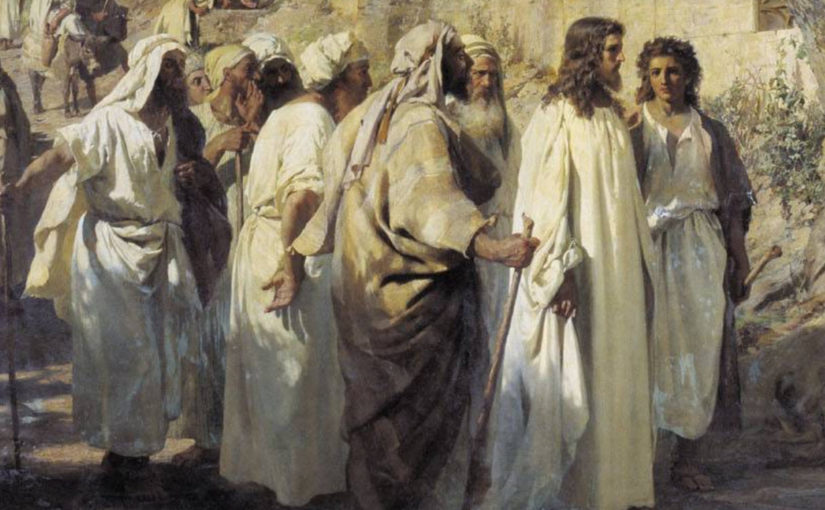
It’s time for another nice relaxing stroll through some art. I know, I cannot stop myself. When I am on a bender, I just go with the flow. Who knows where it will take me…
My art posts are not all that popular. Sadly, people would rather read about American propaganda leading up to world war III. Which is a shame.
This fellow is a new discovery of mine, and I do enjoy everything about his art. It speaks to me. The composition. The subject. The lighting. The folds in the clothing, and the art technique are all wonderful. Just wonderful.
Genrikh Semigradsky is also known as Henryk Siemiradzki.
Born Oct. 10 (22), 1843, in the village of Pechenegi, in present-day Kharkov Oblast, Ukrainian SSR; died Aug. 23, 1902, In Strzałkowo, near the city of Częstochowa, Poland. He was a Polish-Russian painter.
Siemiradzki attended the St. Petersburg Academy of Arts (1864–70); he received a stipend to study at the Munich Academy of Fine Arts (1871) and at the Rome Academy of Fine Arts (1872–77). He lived mainly in Rome but maintained contact with Russia and Poland. He became a member of the St. Petersburg Academy of Arts in 1873 and was made a professor there in 1877.
Depicting primarily ancient Greek and Roman and early Christian scenes, Siemiradzki produced works distinguished by masterful composition and line, a light palette, and meticulous rendering of sunlight.
Siemiradzki’s most important paintings include Luminaries of Christianity (1876, National Museum, Kraków), Dance Among Swords (1881, Tret’iakov Gallery, Moscow), and Phryne at the Feast of Poseidon in Eleusis (1889, Russian Museum, Leningrad).
As I have repeatedly stated, art is something that evokes and triggers thoughts, and memories. No easy feat when the world we live in is full of things that make us angry, hateful, spiteful, and envious. It is hard for a “thing”; a material object to evoke positive emotions. But that is what art actually is.
Art is a item, or object that causes the viewer or holder to evoke pleasant thoughts and / or emotions.
My first discovery
I first came upon this artist when I took a screen shot of this work of his…
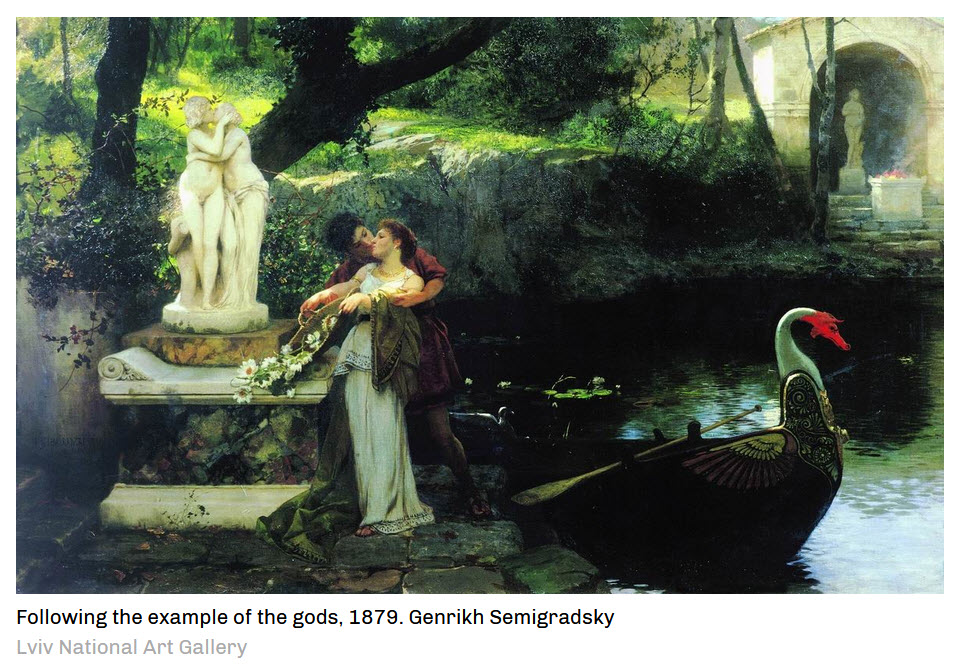
Lovely isn’t it?
Everything about this painting speaks to me. Look at the rough stones that they stand upon. Look at the marble details in the base of the statue. I love the details on the clothing, the boat, and the feelings that are stirred inside of me when I view this momentary vision of wonder, love and emotional embrace.
Here’s another painting. In many cases I really do not know the names of the paintings and I will need to look them up. To look them up is pretty easy. I would go to the Art Renewal Center and type in Henryk Siemiradzki. As in this link HERE.
Rome. Village. Water
My second discovery was this little gem.
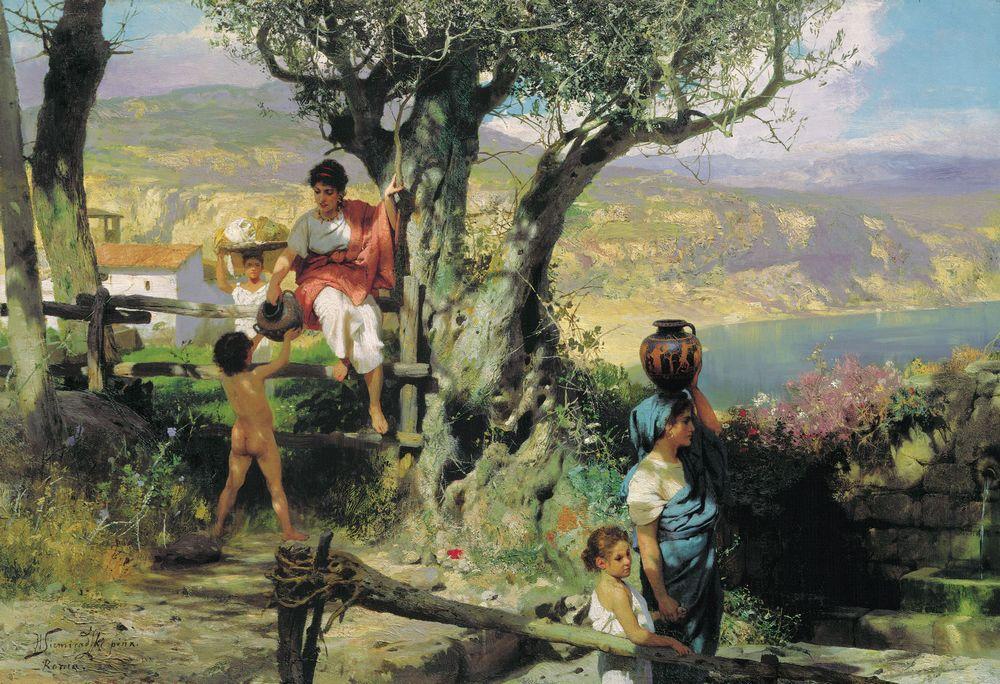
I guess that I am a really old fuddy-duddy man. I like the paintings of villages and simple life with families, and children doing day to day activities. And yes, most water comes out of a tap today, the idea that they would go to the neighboring lake, pond or stream and gather water to use in cooking and cleaning is an ancient one, but appeals to my base senses.
I like the painting above. It’s the kind of painting that might grace the wall in one of your great grandparents house’s or great uncles homes. It’s exceptional.
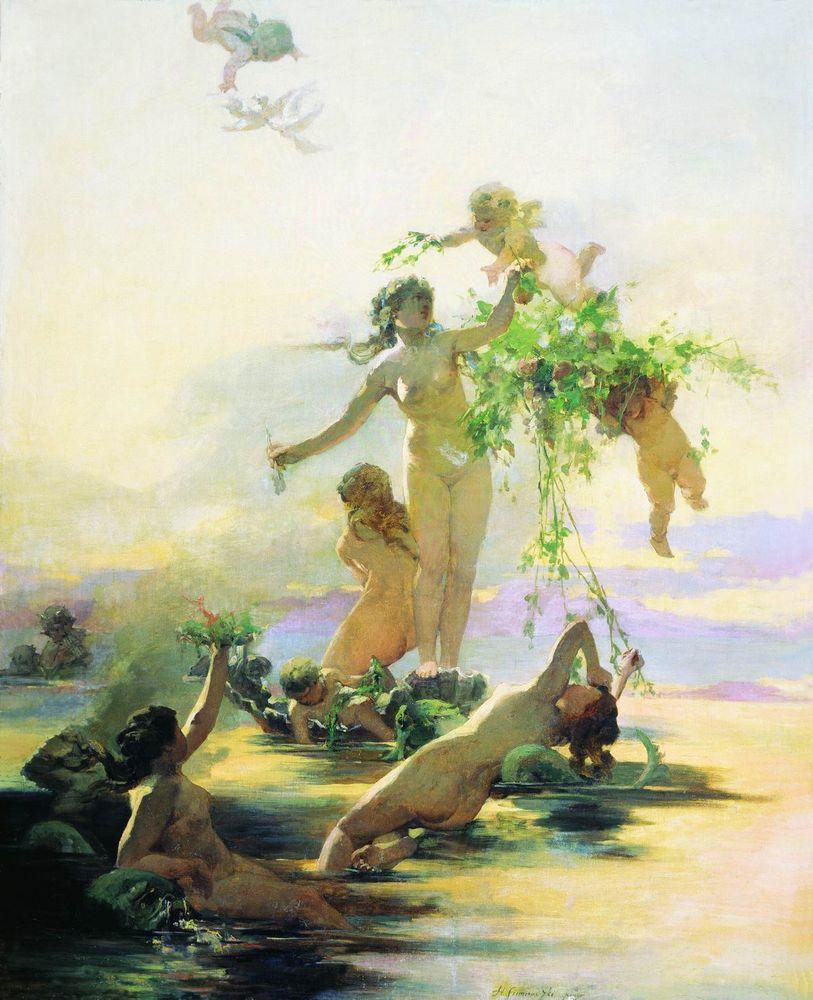
Below is an inspirational work that would fit above a fireplace, or in the entrance way to a home. Most of the older homes would have these huge ten foot tall mirrors, floor to ceiling, with intricate carvings, and a place to hand hats, coats, and a small shelf to place packages and shoes. Oh, in the past these were made out of hard woods.
Ah. Beautiful and substantive.
Here’s some more. All of which were selected randomly from the huge array on the pages of the Art Renewal Center.
Roman Idyll
Click on the link of the name for a much nicer higher quality image of the painting. I think that over all it is breath taking.
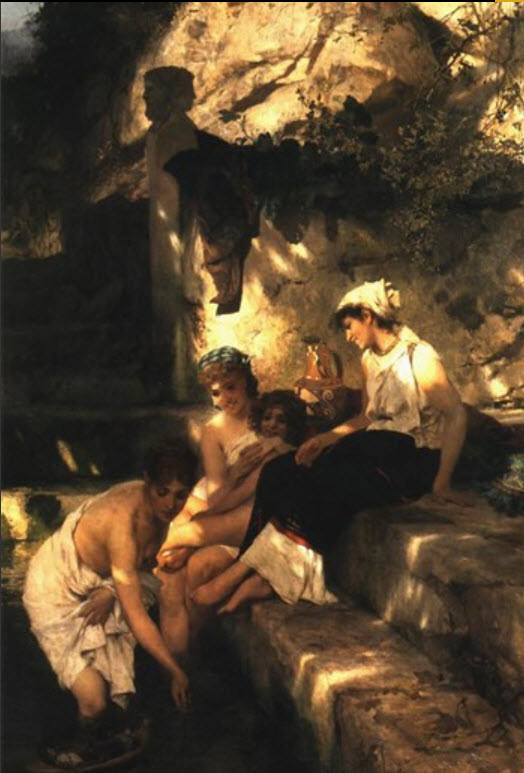
When I look at art, I enjoy how it makes me feel.
That is the most important thing that I look for in a painting or a statue. The second thing is the composition of the painting. is it beautiful or not? And the third thing is the story line (if any behind it). And then I start looking at the details, the technique and the methodology in creating the work of art. All, when taken as a whole, matter to me greatly.
Funeral of Ruthenian Noble
Here is a painting of a funeral of a leader of Lithuania.
The Ruthenian Nobility of a privileged social class who own inheritable nobility titles in the Kingdom of Ruthenia since the foundation of the Kingdom in 2014. The term “noblemen” is used in reference to the dignitaries of the royal court and the members of the national orders of knighthood.
Ruthenian nobility refers to the nobility of Kievan Rus and Galicia–Volhynia, which found itself in the Grand Duchy of Lithuania, Ruthenia, Samogitia, Polish–Lithuanian Commonwealth and later Russian and Austrian Empires, and became increasingly polonized and later russified, while retaining a separate, cultural identity.

-Wikipedia
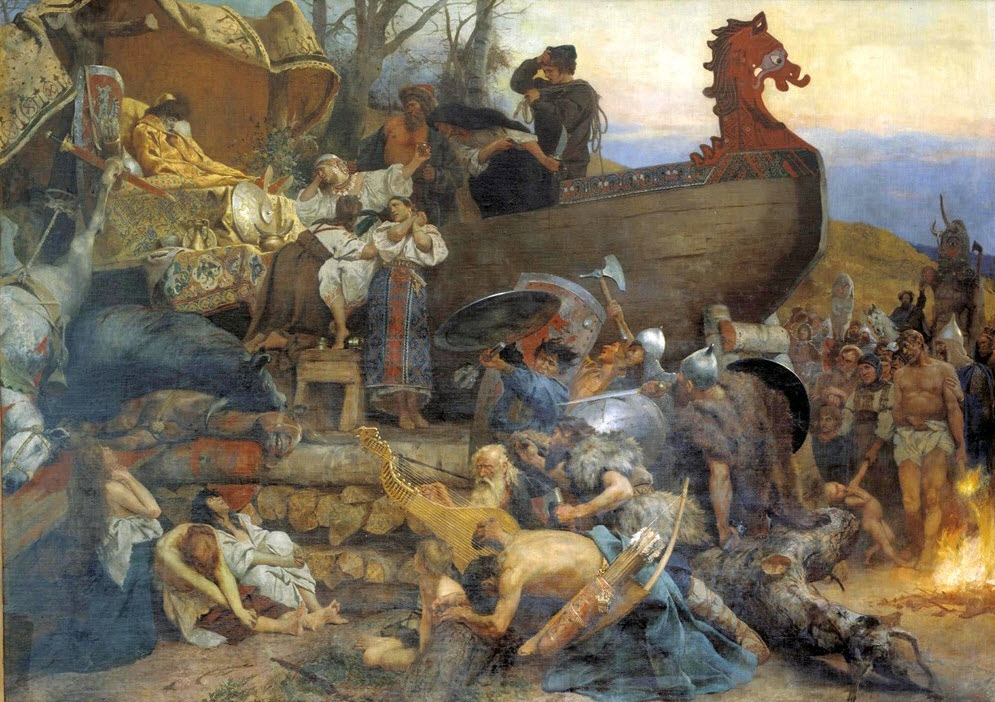
These paintings are what you could call as … epic.
Look at the scope and the size of the display. Look at the great range of facial expressions and the emotions of all of the participants in the funeral. It’s really an amazing work. Don’t you agree?
Roman Orgy in the Times of Tiberius on Capri
Of course, what is more salacious than a Roman orgy. They made it a national pastime it seems. When you get unlimited power, you also get unlimited debauchery. Both of which makes for very interesting paintings. Don’t you know.
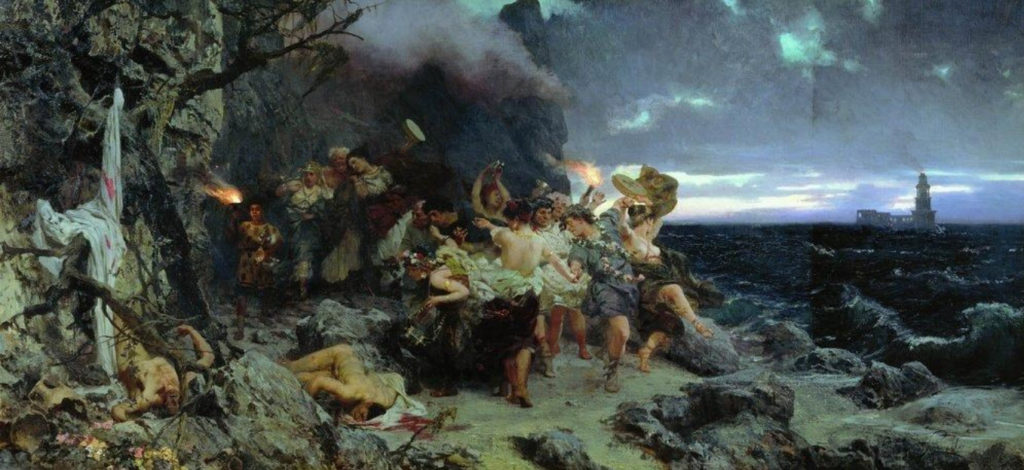
The Romans were really depraved. It’s a bit too “rich” for my personal tastes, but you know that it was a different time and a different place.
The emperors of Rome could be wise, just and kind. They could also be vindictive, cruel and insane. And most of all, they could be the worst perverts the world has ever seen — at least according to ancient historians like Suetonius, Pliny, and Cassius Dio.
Here are nearly a dozen of the most immoral, disgusting behaviors the rulers of the ancient world indulged in… supposedly.
Chances are most of these were rumors made up by political enemies or gossiping plebs. But hey, just because they may not be true doesn’t mean they’re aren’t still entertainingly perverse.
1) Niece-Marrying
The Emperor Claudius married his brother’s daughter Agrippina (his brother being long dead, thank goodness).
"[H]is affections were ensnared by the wiles of Agrippina, daughter of his brother Germanicus, aided by the right of exchanging kisses and the opportunities for endearments offered by their relationship; and at the next meeting of the senate he induced some of the members to propose that he be compelled to marry Agrippina, on the ground that it was for the interest of the State; also that others be allowed to contract similar marriages, which up to that time had been regarded as incestuous."
Yes, Claudius didn’t just make niece-marrying legal, he made it patriotic!
2) Hiring Anal Sex Experts
No judgments on anal sex here, but putting professional anal sex experts on the imperial payroll is a bit much.
"On retiring to Capri [Tiberius] devised a pleasance for his secret orgies: teams of wantons of both sexes, selected as experts in deviant intercourse and dubbed analists, copulated before him in triple unions to excite his flagging passions."
In case these pros were somehow not up to the tasks Tiberius put them too, he had a sex library full of illustrated works so he could just point to what he wanted.
3) The Animal Game
Nero was so into being as depraved as possible — he supposedly defiled every single part of his body — that he had to think up some pretty original ways to keep it fresh.
"[H]e at last devised a kind of game, in which, covered with the skin of some wild animal, he was let loose from a cage and attacked the private parts of men and women, who were bound to stakes, and when he had sated his mad lust, was dispatched by his freedman Doryphorus."
4) Sister-Sex
Say what you want about Caligula, but he was really, really good at incest.
"He lived in habitual incest with all his sisters, and at a large banquet he placed each of them in turn below him, while his wife reclined above."
His sister Drusilla was his favorite, having had sex with her when he was but a boy, and when they were grown, he simply took her from her legal husband for more fun. His other sisters, he was somewhat less fond of, and thus he only often prostituted them. So he wasn’t just a sister-fucker, but a sister-pimp.
Jeeze! Louise!
5) Sex Rest Stops
Here’s an idea you’ve probably never had to make those long road trips more enjoyable: Set up stops full of prostitutes along your way! And when you do, thank Nero.
"Whenever he drifted down the Tiber to Ostia, or sailed about the Gulf of Baiae, booths were set up at intervals along the banks and shores, fitted out for debauchery, while bartering matrons played the part of inn-keepers and from every hand solicited him to come ashore."
Better than vending machines, that’s for sure.
6) Mother-Fucking
In terms of sexual depravity, Nero even put Caligula to shame by going to the source (so to speak) and having sex with his own mother Agrippina. How did people know?
"[S]o they say, whenever he [Nero] rode in a litter with his mother, he had incestuous relations with her, which were betrayed by the stains on his clothing."
Later, when Nero was Emperor, people tried to keep him from fucking his mother, mostly because they were afraid that would Agrippina would get too much power from the relationship.
It should probably go without saying that eventually Nero tried to murder his mother by putting her on break-apart boat, right?
7) Creating an Imperial Brothel
Caligula was fond of spending money, but not so good at making it. After depleting the coffers at one point, he had the bright idea to turn the palace into an impromptu whorehouse.
"To leave no kind of plunder untried, he opened a brothel in his palace, setting apart a number of rooms and furnishing them to suit the grandeur of the place, where matrons and freeborn youths should stand exposed. Then he sent his pages about the fora and basilicas, to invite young men and old to enjoy themselves, lending money on interest to those who came and having clerks openly take down their names, as contributors to Caesar's revenues."
Rest assured, those who enjoyed themselves on credit eventually paid up, one way or another.
8) Part-Time Prostitution
The Emperor Elagabalus, who ruled from 203-222 AD, outdid Caligula in this regard: Elagabagus set up a brothel in the palace… and pimped himself.
"Finally, he set aside a room in the palace and there committed his indecencies, always standing nude at the door of the room, as the harlots do, and shaking the curtain which hung from gold rings, while in a soft and melting voice he solicited the passers-by. There were, of course, men who had been specially instructed to play their part. For, as in other matters, so in this business, too, he had numerous agents who sought out those who could best please him by their foulness. He would collect money from his patrons and give himself airs over his gains; he would also dispute with his associates in this shameful occupation, claiming that he had more lovers than they and took in more money."
If only all politicians were so… flexible when it came to balancing the budget.
9) Making a Man His Wife
I’m not talking about gay marriage here, at least not really. I’m talking about Nero taking a man and “making him a woman” in the worst way possible:
"He castrated the boy Sporus and actually tried to make a woman of him; and he married him with all the usual ceremonies, including a dowry and a bridal veil, took him to his house attended by a great throng, and treated him as his wife."
Eunuchs — when having sex with men and women just isn’t enough any more.
10) “Tiddlers”
Emperor Tiberius loved to swim, and he apparently also loved being pleasured by children. In a feat of inspiration, he managed to combine both these hobbies into one:
"...he trained little boys (whom he termed tiddlers) to crawl between his thighs when he went swimming and tease him with their licks and nibbles."
It’s like the world’s most perverted aquarium!
11) Baby-Fucking
I’m sorry, did you think Tiberius’ “Tiddlers” were bad? He also used to get blowjobs from babies.
"Unweaned babies he would put to his organ as though to the breast, being by both nature and age rather fond of this form of satisfaction."
What the Hell? These people are truly depraved animals.
Dishonorable Mention: Messalina
While not technically an Emperor, as wife of Claudius Messalina was an Empress, and she has the honor of having one of the earliest gangbangs in record history. And it was a contest, too!
"Messalina, the wife of Claudius Cæsar, thinking this a palm quite worthy of an empress, selected, for the purpose of deciding the question, one of the most notorious of the women who followed the profession of a hired prostitute; and the empress outdid her, after continuous intercourse, night and day, at the twenty-fifth embrace."
Needless to say, when Claudius found out he was so depressed he ended up marrying his niece.
Oh, and had Messalina killed.
Obviously.
OK. Enough of all that Roman debauchery. It’s not my thing. It really isn’t. I’m well beyond that. I just want to hang out. Make new friends. Drink a little and munch. So let’s get away from this subject, shall we?
Let’s get down to earth.
A Scene From Roman Life
And isn’t it pleasant?
I know that it is romanticized, but it’s awfully lovely. Isn’t it?
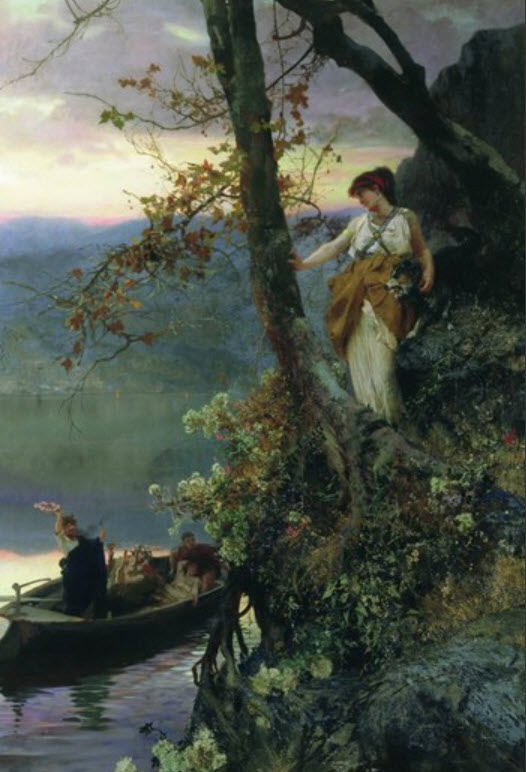
It makes you want to go travel there.
Actually the scene reminds me of some lakes inside of Massachusetts, that are “off the beaten path” and are quite lovely. You just walk around the lake. It would take hours, but it’s a pleasant exercise in nature, don’t you know.
It’s sort of like the movie “On Golden Pond“.

Speaking of ponds…
The Pond
I do love his use of color to extract scenes of tranquility, and daily life. Imagine what it must have been like back in those days. Calm, pleasant, good. Just as long as you weren’t caught up in some war or other such nonsense, your life was stable.
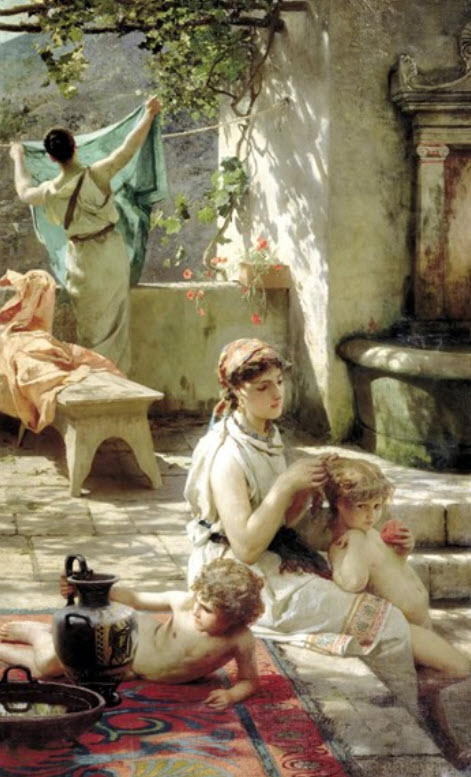
The women would tend to the children, instead of playing on the cell phones, watching the soap operas, or dealing with work, career and the demands of selfish relatives. In those days… ah… in those days it was much different. It was a different time.
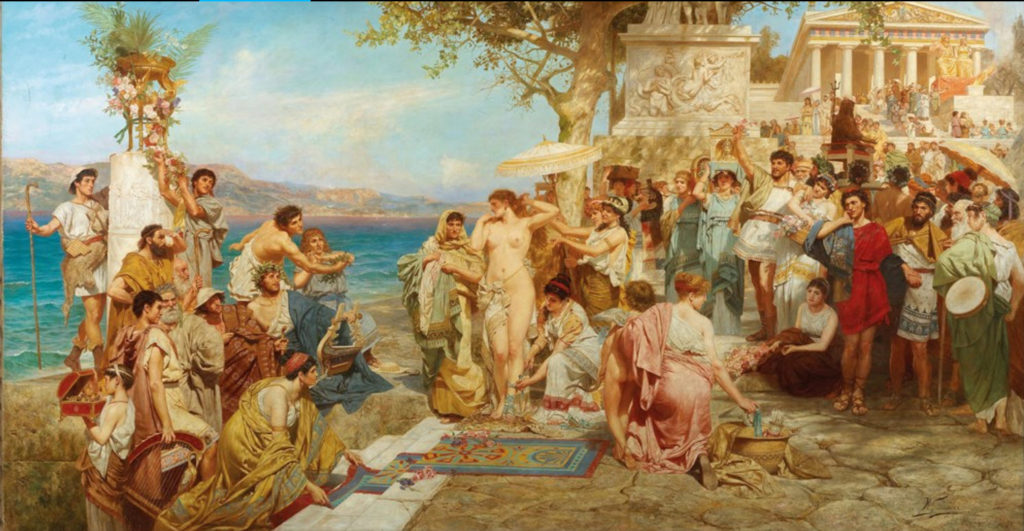
Phryne at the Festival of Poseidon in Eleusin
What is this all about? Eh?
Phryne, (Greek: “Toad”) , byname of Mnesarete, (flourished 4th century bc), famous Greek courtesan. Because of her sallow complexion she was called by the Greek name for “toad.”

She was born in Thespiae, Boeotia, but lived at Athens, where she earned so much by her beauty and wit that she offered to rebuild the walls of Thebes, on condition that the words “destroyed by Alexander, restored by Phryne the courtesan” were inscribed upon them.

At a festival of Poseidon and also at the festival at Eleusis she walked into the sea naked with her hair loose, suggesting to the painter Apelles his great picture of “Aphrodite Anadyomene” (“Aphrodite Rising From the Sea”), for which Phryne sat as model.

She was also (according to Athenaeus) the model for the statue of the Cnidian Aphrodite by Praxiteles, whose mistress she was; copies of the statue survive in the Vatican and elsewhere.

When accused of blasphemy (a capital charge), she was defended by the orator Hyperides.

When it seemed as if the verdict would be unfavorable, he tore her dress and displayed her bosom, which so moved the jury that they acquitted her; another version has Phryne tear her own dress and plead with each individual juror.

-Britannia
Phryne was the daughter of Epicles from Thespiae (Boeotia), but spent most of her life in Athens. Even though we don’t know the exact dates of her birth and death, various historians estimate that she was born around 371 BC, the year Thebes razed Thespiae not long after the battle of Leuctra and expelled its inhabitants.
Thanks to her extraordinary beauty, she became a model posing for various painters and sculptors, including the great Praxiteles (who was also one of her clients).
Actually, Praxiteles’s statue of Phryne was purchased by the city of Cnidus – after the city of Cos that had originally commissioned it, objected to its being nude – and became such a popular tourist attraction that the city managed to pay off its entire debt.
Phryne’s beauty also became the subject of many ancient Greek scholars, who praised her good looks, with Athenaeus providing the most details about Phryne’s life.
He mentions in his work titled The Deipnosophists,
“Phryne was a really beautiful woman, even in those parts of her person which were not generally seen: on which account it was not easy to see her naked; for she used to wear a tunic which covered her whole person, and she never used the public baths.

But on the solemn assembly of the Eleusinian festival, and on the feast of the Poseidonia, then she laid aside her garments in the sight of all the assembled Greeks, and having undone her hair, she went to bathe in the sea; and it was from her that Apelles took his picture of Aphrodite Anadyomene; and Praxiteles the sculptor, who was a lover of hers, modelled the Aphrodite of Cnidus from her body"
Athenaeus also recorded that Phryne was possibly the richest self-made woman of her time. She became so vastly rich at some point of her life that she offered to fund the rebuilding of the walls of Thebes, which had been destroyed by Alexander the Great in 336 BC.
She demanded that the words “Destroyed by Alexander, restored by Phryne the courtesan” would be inscribed on the walls.
Intimidated of the idea that a woman – and for that matter not just any woman, but a prostitute – could rebuild what Alexander the Great had destroyed, Phryne’s offer was rejected by the town’s patriarchs and the walls remained in ruin.
Despite her “divine” looks, incredible wealth, and famous lovers, what immortalized Phryne in the history books is undoubtedly her famous trial.
Athenaeus writes that she was prosecuted for a capital charge and defended by the orator Hypereides, who was one of her lovers. He does not specify the nature of the charge, though some unverified historical sources ( Pseudo-Plutarch) mention that she was accused of impiety.
Even though there’s a great dispute among historians about what really happened that day in the court, one of the most credible sources (that of Athenaeus) states that Hypereides tore off Phryne’s robes in the middle of the courtroom to show the judges her beautiful breasts.
His reasoning was that only the Gods could sculpt a body so perfect and as such, killing or imprisoning her would be seen as blasphemy and disrespect to the Gods. Athenaeus mentions in The Deipnosophists,
“Now Phryne was a native of Thespiae; and being prosecuted by Euthias on a capital charge, she was acquitted: on which account Euthias was so indignant that he never instituted any prosecution afterwards, as Hermippus tells us.

But Hypereides, when pleading Phryne's cause, as he did not succeed at all, but it was plain that the judges were about to condemn her, brought her forth into the middle of the court, and, tearing open her tunic and displaying her naked bosom, employed all the end of his speech, with the highest oratorical art, to excite the pity of her judges by the sight of her beauty, and inspired the judges with a superstitious fear, so that they were so moved by pity as not to be able to stand the idea of condemning to death "a prophetess and priestess of Aphrodite."

And when she was acquitted, a decree was drawn up in the following form:

 "That hereafter no orator should endeavour to excite pity on behalf of any one, and that no man or woman, when impeached, shall have his or her case decided on while present."
What seemed as a lost case for Phryne, turned quickly into a triumph for her after the inspired act by Hypereides.
Phryne walked out the court victorious and her story went on inspiring several works of art, including the painting Phryne before the Areopagus by Jean-Léon Gérôme, from 1861, the 1904 painting Phryne, by José Frappa; the sculpture Phryné by French sculptor Alexandre Falguière; and the sculpture Phryne Before the Judges , by the American sculptor Albert Weine, from 1948.
More importantly, the famous hetaerae is seen by some scholars today as a symbol of freedom against repression disguised as piety, even though most of us will probably agree that some of her choices in life weren’t the most ideal or moral for a lady.
But on the other hand, let it be known that the woman’s breasts were so perfect that a trial by angry old men were moved to tears at the sight of them, and thusly allowed her to go free.
Two Figures by a Statue of Sphinx
This is a study rather than a painting.
What is the difference between a study and a painting? I can only speak for my own style of working, but in general, both are original oils, but my studies are small, loose and are often the first stage in creating a larger work, which is more detailed.
Studies are the best way to test a composition, and I often use this when working on custom oil paintings, making sure they get exactly what I want. Often I would mix the background colors to coordinate with the center images. But that is just me. I also use it to rough out the details, composition and folds in the fabrics that I am trying to paint.
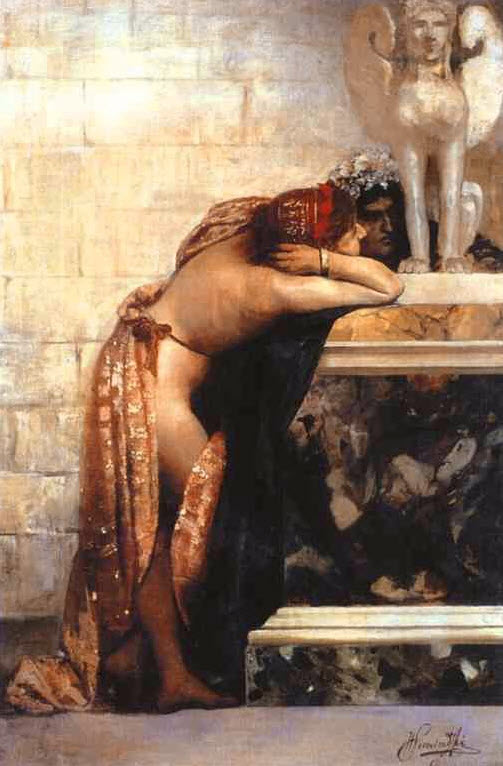
I know, I know. But what of the composition and the purpose? Well, what thoughts and emotions does this painting trigger in you?
Roman Orgy in the Time of Caesars
And yet another orgy. This one from the time of the Caesars.
It’s kind of hard to pick a prominent person from the days of the Roman Empire who wasn’t a fan of drunken orgies.
For these bacchanalia were an important part of everyday life. Still there are people like Julius Caesar who were known for their moderation, and there were some who were constantly the talk of the town because of their drunken escapades and extravagant behavior.
Emperor Tiberius, who ruled the Roman Empire for 23 years against his will, set the standard for the drunkest years Rome had ever seen.
Tiberius was born in the year 42 BC under the name Tiberius Claudius Nero and died 79 years later as Tiberius Augustus Caesar.
Roman names in the higher families changed all the time because of re-marriage, adoption or change of status. We therefor try to use as few as possible in this article to avoid confusion.
The only thing to remember here is that Tiberius was a general who was that successful in his military missions that emperor Augustus adopted him as a son. Later Tiberius married his own stepsister Julia and also became the emperor’s son-in-law. Just another day at the office in ancient Rome.
However Tiberius seemed quite different from the power hungry notables at the imperial court.
He became a national hero with victories in Pannonia, Dalmatia, Raetia and Germania, where he discovered the source of the Danube river, but he showed no interest in political power.
Basically he preferred to party without the fear of being murdered all the time.
Tiberius was a simple guy with simple needs, which meant plenty of wine and different sex partners.
Stepfather Augustus saw his natural heir in the fighting machine, but Tiberius surprisingly retired in 6 BC and moved to the Greek island Rhodes.
…Also to get away from his wife Julia who wasn’t a big fan of him seeing other women.
Tiberius partied for ten years at Rhodes but when Augustus lost both his grandsons within 2 years the former general was called back to Rome to face his fate.
For some years he was granted the same powers as the emperor and after the death of Augustus in 14 AD Tiberius was mentioned as the sole surviving heir in his will.
From the start of his reign Tiberius showed no interest at all for the job.
He didn’t even want full power and suggested to the Senate he could rule just part of the state. In the end Tiberius couldn’t escape full responsibility, but Rome’s most powerful man refused a crown, laurels or fancy titles.
He also didn’t feel like getting involved in state business and practically let the Senate rule the empire by itself, while the new emperor honored the winegod Bacchus. Twice Tiberius tried to share some of his duties with others.
In 18 AD Tiberius gave the successful general Germanicus authority over the Eastern part of the Roman Empire and in 22 AD he shared the tribunician authority with his only son Drusus. Both however died within a year after being appointed.
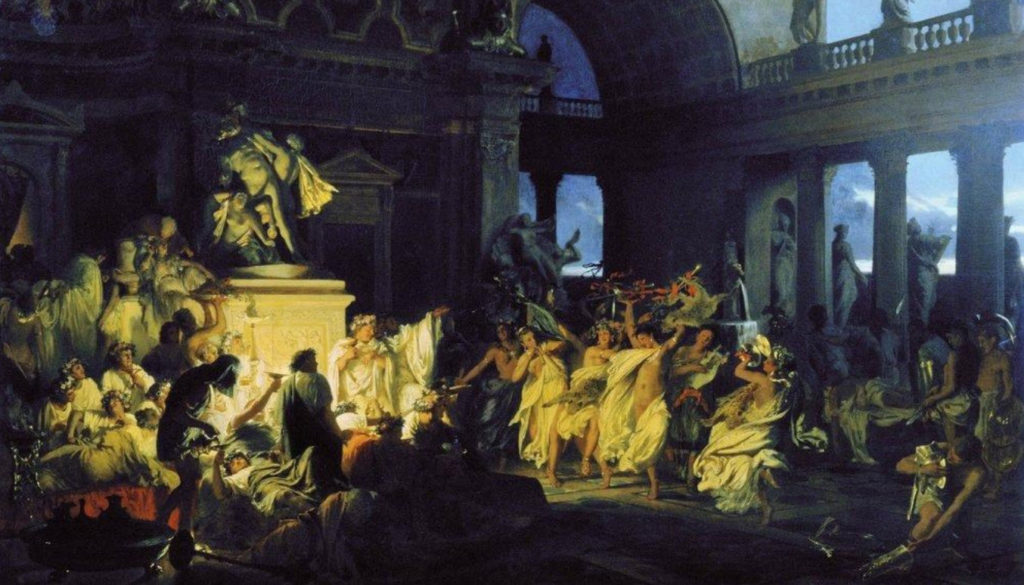
In 26 AD Tiberius took it a step further and left Rome to live on the island Capri. While he turned that into a party island he basically left the Praetorian Prefect Sejanus in charge.
That is…
…until the puppet tried to overthrow his master and Tiberius had Sejanus executed in 31 AD.
If we may believe the Roman sources the emperor spent the last years of his life drinking and satisfying his perverted fantasies. While his will paved the way for a lot more chaos in Rome. If you ever considered it to be fun to write your will drunk, pay attention…
Tiberius stated that his nephew and adopted son Caligula should rule the empire together with his grandson Tiberius Gemellus. Practically the first act of Caligula was to have Tiberius Gemellus killed and seize absolute power. He then officially became the craziest Roman emperor in history, while totally proving his reputation as a sadist.
Caligula had people killed and tortured for his own sick amusement, lost a solid 2.7 billion sesterces (around 900 million dollars these days) of the family fortune and on top of all appointed his favorite horse as a member of the Senate.
By that time Tiberius wasn’t considered a national hero anymore.
There was a tradition that Roman emperors could be declared a God. Augustus for example got his divine honors after he died. But when Tiberius died people were revolting in the streets of Rome when some just mentioned this treatment.
In the end the Senate decided Tiberius was not divine at all and he got a sober funeral.
So he wasn’t the best emperor Rome had ever known, he did initiate the drunkest years the city had ever seen as the next 4 emperors and their entourages partied their asses off.
With that he ended a tradition of centuries in Greek-Roman culture of moderate drinking. It’s not without reason Tiberius even had a cocktail named after him. And therefor we say: ave Caesar, morituri te salutant, let’s get smashed!
The New Bracelet
Ah. I do miss painting. But I just don’t have the time for it. Not really. Sigh.
This is another wonderful painting. It teleports you and transports you to another time and another place.
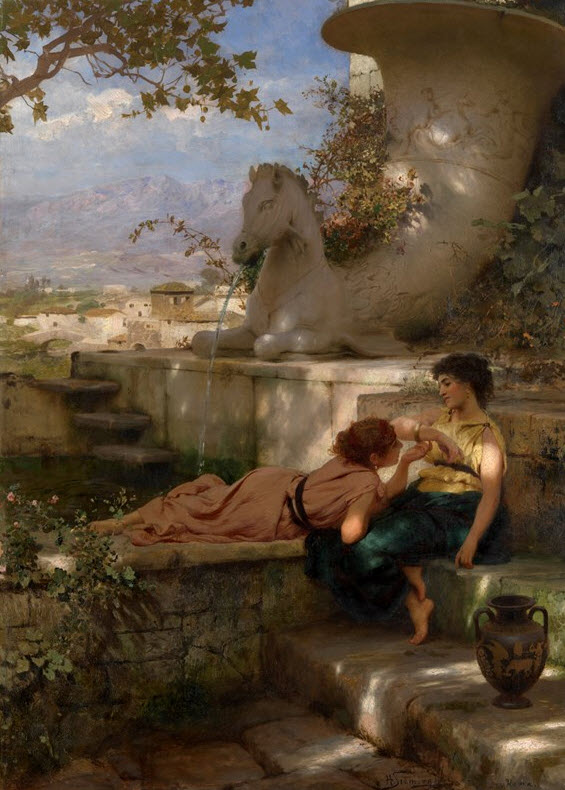
Some of his works (paintings) are in a class by themselves. Seriously.
He really has a way to craft the deep dark, lush shade under a tree, the falling of water, and the coolness of stone. And look at these two lovely ladies. I love the posing, the attire, and the details on their clothing.
They are awe-inspiring. Such as this one…
The Future Victims of the Colosseum
What do you suppose the title and the content refer to?
With nearly two thousand years of history, there is much to know about the Roman Colosseum. The arena once witnessed bloody gladiator battles, epic hunts pitting humans against wild animals, and gruesome executions of prisoners of war and criminals.
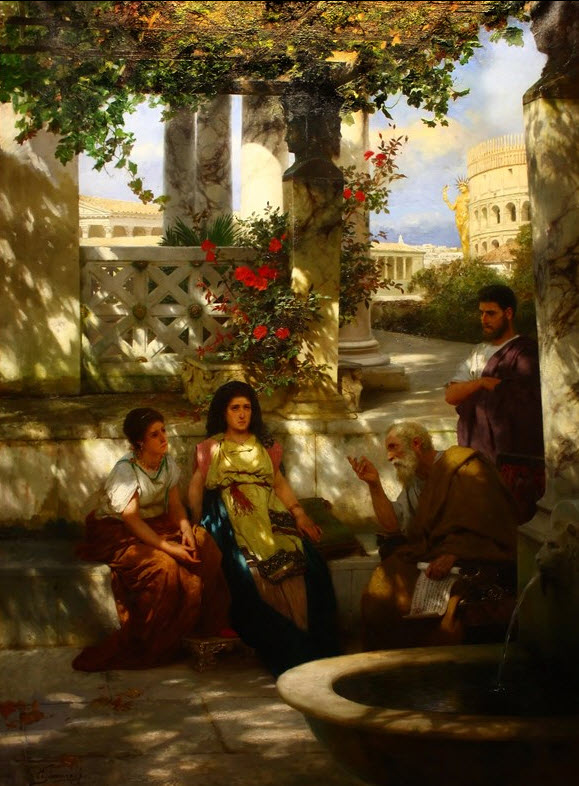
Contrary to the popular vision of a gruesome free-for-all, gladiator fights were somewhat like contemporary boxing matches: fighters were divided into classes according to their size and fighting style, there were referees and doctors monitoring the fight, and often matches didn’t end in death. Match-ups were decided based on the experience, the record, and the styles of the fighters, and successful gladiators could become famous celebrities. Some gladiators had long careers in which they lost many fights without dying. However, this doesn’t mean they were bloodless, they were simply less chaotic than is often imagined. A very large number of gladiators did perish in the arena.
And they had violent half-time shows.
The enormous arena was empty, save for the seesaws and the dozens of condemned criminals who sat naked upon them, hands tied behind their backs. Unfamiliar with the recently invented contraptions known as petaurua, the men tested the seesaws uneasily. One criminal would push off the ground and suddenly find himself 15 feet in the air while his partner on the other side of the seesaw descended swiftly to the ground. How strange.

In the stands, tens of thousands of Roman citizens waited with half-bored curiosity to see what would happen next and whether it would be interesting enough to keep them in their seats until the next part of the "big show" began.

With a flourish, trapdoors in the floor of the arena were opened, and lions, bears, wild boars and leopards rushed into the arena. The starved animals bounded toward the terrified criminals, who attempted to leap away from the beasts' snapping jaws. But as one helpless man flung himself upward and out of harm's way, his partner on the other side of the seesaw was sent crashing down into the seething mass of claws, teeth and fur.

The crowd of Romans began to laugh at the dark antics before them. Soon, they were clapping and yelling, placing bets on which criminal would die first, which one would last longest and which one would ultimately be chosen by the largest lion, who was still prowling the outskirts of the arena's pure white sand. [See Photos of the Combat Sports Played in Ancient Rome]
And with that, another "halftime show" of damnatio ad bestias succeeded in serving its purpose: to keep the jaded Roman population glued to their seats, to the delight of the event's scheming organizer.

Half-Time Shows

The Roman Games were the Super Bowl Sundays of their time. They gave their ever-changing sponsors and organizers (known as editors) an enormously powerful platform to promote their views and philosophies to the widest spectrum of Romans. All of Rome came to the Games: rich and poor, men and women, children and the noble elite alike. They were all eager to witness the unique spectacles each new game promised its audience.

To the editors, the Games represented power, money and opportunity. Politicians and aspiring noblemen spent unthinkable sums on the Games they sponsored in the hopes of swaying public opinion in their favor, courting votes, and/or disposing of any person or warring faction they wanted out of the way.

The more extreme and fantastic the spectacles, the more popular the Games with the general public, and the more popular the Games, the more influence the editor could have. Because the Games could make or break the reputation of their organizers, editors planned every last detail meticulously.

Thanks to films like "Ben-Hur" and "Gladiator," the two most popular elements of the Roman Games are well known even to this day: the chariot races and the gladiator fights. Other elements of the Roman Games have also translated into modern times without much change: theatrical plays put on by costumed actors, concerts with trained musicians, and parades of much-cared-for exotic animals from the city's private zoos.

But much less discussed, and indeed largely forgotten, is the spectacle that kept the Roman audiences in their seats through the sweltering midafternoon heat: the blood-spattered halftime show known as damnatio ad bestias — literally "condemnation by beasts" — orchestrated by men known as the bestiarii.

Super Bowl 242 B.C: How the Games Became So Brutal

The cultural juggernaut known as the Roman Games began in 242 B.C., when two sons decided to celebrate their father's life by ordering slaves to battle each other to the death at his funeral. This new variation of ancient munera (a tribute to the dead) struck a chord within the developing republic. Soon, other members of the wealthy classes began to incorporate this type of slave fighting into their own munera. The practice evolved over time — with new formats, rules, specialized weapons, etc. — until the Roman Games as we now know them were born.

In 189 B.C., a consul named M. Fulvius Nobilior decided to do something different. In addition to the gladiator duels that had become common, he introduced an animal act that would see humans fight both lions and panthers to the death. Big-game hunting was not a part of Roman culture; Romans only attacked large animals to protect themselves, their families or their crops. Nobilior realized that the spectacle of animals fighting humans would add a cheap and unique flourish to this fantastic new pastime. Nobilior aimed to make an impression, and he succeeded. [Photos: Gladiators of the Roman Empire]
With the birth of the first "animal program," an uneasy milestone was achieved in the evolution of the Roman Games: the point at which a human being faced a snarling pack of starved beasts, and every laughing spectator in the crowd chanted for the big cats to win, the point at which the republic's obligation to make a man's death a fair or honorable one began to be outweighed by the entertainment value of watching him die.

Twenty-two years later, in 167 B.C., Aemlilus Paullus would give Rome its first damnatio ad bestias when he rounded up army deserters and had them crushed, one by one, under the heavy feet of elephants. "The act was done publicly," historian Alison Futrell noted in her book "Blood in the Arena," "a harsh object lesson for those challenging Roman authority."

The "satisfaction and relief" Romans would feel watching someone considered lower than themselves be thrown to the beasts would become, as historian Garrett G. Fagan noted in his book "The Lure of the Arena," a "central … facet of the experience [of the Roman Games. … a feeling of shared empowerment and validation … " In those moments, Rome began the transition into the self-indulgent decadence that would come to define all that we associate with the great society's demise.

The Role of Julius Caesar

General Julius Caesar proved to be the first true maestro of the Games. He understood how these events could be manipulated to inspire fear, loyalty and patriotism, and began to stage the Games in new and ingenious ways. For example, Caesar was the first to arrange fights between recently captured armies, gaining firsthand knowledge of the fighting techniques used by these conquered people and providing him with powerful insights to aid future Roman conquests, all the while demonstrating the republic's own superiority to the roaring crowd of Romans. After all, what other city was powerful enough to command foreign armies to fight each other to the death, solely for their viewing pleasure?

Caesar used exotic animals from newly conquered territories to educate Romans about the empire's expansion. In one of his games, "Animals for Show and Pleasure in Ancient Rome" author George Jennison notes that Caesar orchestrated "a hunt of four hundred lions, fights between elephants and infantry … [and] bull fighting by mounted Thessalians." Later, the first-ever giraffes seen in Rome arrived — a gift to Caesar himself from a love-struck Cleopatra.

To execute his very specific visions, Caesar relied heavily on the bestiarii — men who were paid to house, manage, breed, train and sometimes fight the bizarre menagerie of animals collected for the Games.

Managing and training this ever-changing influx of beasts was not an easy task for the bestiarii. Wild animals are born with a natural hesitancy, and without training, they would usually cower and hide when forced into the arena's center. For example, it is not a natural instinct for a lion to attack and eat a human being, let alone to do so in front of a crowd of 100,000 screaming Roman men, women and children! And yet, in Rome's ever-more-violent culture, disappointing an editor would spell certain death for the low-ranking bestiarii.

To avoid being executed themselves, bestiarii met the challenge. They developed detailed training regimens to ensure their animals would act as requested, feeding arena-born animals a diet compromised solely of human flesh, breeding their best animals, and allowing their weaker and smaller stock to be killed in the arena. Bestiarii even went so far as to instruct condemned men and women on how to behave in the ring to guarantee a quick death for themselves — and a better show. The bestiarii could leave nothing to chance.

As their reputations grew, bestiarii were given the power to independently devise new and even more audacious spectacles for the ludi meridiani (midday executions). And by the time the Roman Games had grown popular enough to fill 250,000-seat arenas, the work of the bestiarii had become a twisted art form.

As the Roman Empire grew, so did the ambition and arrogance of its leaders. And the more arrogant, egotistic and unhinged the leader in power, the more spectacular the Games would become. Who better than the bestiarii to aid these despots in taking their version of the Roman Games to new, ever-more grotesque heights?

Caligula Amplified the Cruelty

Animal spectacles became bigger, more elaborate, and more flamboyantly cruel. Damnatio ad bestias became the preferred method of executing criminals and enemies alike. So important where the bestiarii's contribution, that when butcher meat became prohibitively expensive, Emperor Caligula ordered that all of Rome's prisoners "be devoured" by the bestiarii's packs of starving animals. In his masterwork De Vita Caesarum, Roman historian Gaius Suetonius Tranquillus (b. 69 A.D.) tells of how Caligula sentenced the men to death "without examining the charges" to see if death was a fitting punishment, but rather by "merely taking his place in the middle of a colonnade, he bade them be led away 'from baldhead to baldhead,'"(It should also be noted that Caligula used the funds originally earmarked for feeding the animals and the prisoners to construct temples he was building in his own honor!)

To meet this ever-growing pressure to keep the Roman crowds happy and engaged by bloodshed, bestiarii were forced to consistently invent new ways to kill. They devised elaborate contraptions and platforms to give prisoners the illusion they could save themselves — only to have the structures collapse at the worst possible moments, dropping the condemned into a waiting pack of starved animals. Prisoners were tied to boxes, lashed to stakes, wheeled out on dollies and nailed to crosses, and then, prior to the animals' release, the action was paused so that bets could be made in the crowd about which of the helpless men would be devoured first.

Perhaps most popular — as well as the most difficult to pull off — were the re-creations of death scenes from famous myths and legends. A single bestiarius might spend months training an eagle in the art of removing a thrashing man's organs (a la the myth of Prometheus).

The halftime show of damnatio ad bestias became so notorious that it was common for prisoners to attempt suicide to avoid facing the horrors they knew awaited them. Roman philosopher and statesmen Seneca recorded a story of a German prisoner who, rather than be killed in a bestiarius' show, killed himself by forcing a communally used prison lavatory sponge down his throat. One prisoner who refused to walk into the arena was placed on a cart and wheeled in; the prisoner thrust his own head between the spokes of its wheels, preferring to break his own neck than to face whatever horrors the bestiarius had planned for him.

It is in this era that Rome saw the rise of its most famous bestiarius, Carpophorus, "The King of the Beasts."

The Rise of a Beast Master

Carpophorus was celebrated not only for training the animals that were set upon the enemies, criminals and Christians of Rome, but also for famously taking to the center of the arena to battle the most fearsome creatures himself.

He triumphed in one match that pitted him against a bear, a lion and a leopard, all of which were released to attack him at once. Another time, he killed 20 separate animals in one battle, using only his bare hands as weapons. His power over animals was so unmatched that the poet Martial wrote odes to Carpophorus.

"If the ages of old, Caesar, in which a barbarous earth brought forth wild monsters, had produced Carpophorus," he wrote in his best known work, Epigrams. "Marathon would not have feared her bull, nor leafy Nemea her lion, nor Arcadians the boar of Maenalus. When he armed his hands, the Hydra would have met a single death; one stroke of his would have sufficed for the entire Chimaera. He could yoke the fire-bearing bulls without the Colchian; he could conquer both the beasts of Pasiphae. If the ancient tale of the sea monster were recalled, he would release Hesione and Andromeda single-handed. Let the glory of Hercules' achievement be numbered: it is more to have subdued twice ten wild beasts at one time."

To have his work compared so fawningly to battles with some of Rome’s most notorious mythological beast sheds some light on the astounding work Carpophorus was doing within the arena, but he gained fame as well for his animal work behind the scenes. Perhaps most shockingly, it was said that he was among the few bestiarii who could command animals to rape human beings, including bulls, zebras, stallions, wild boars and giraffes, among others. This crowd-pleasing trick allowed his editors to create ludi meridiani that could not only combine sex and death but also claim to be honoring the god Jupiter. After all, in Roman mythology, Jupiter took many animal forms to have his way with human women.

Historians still debate how common of an occurrence public bestiality was at the Roman Games — and especially whether forced bestiality was used as a form of execution — but poets and artists of the time wrote and painted about the spectacle with a shocked awe.

"Believe that Pasiphae coupled with the Dictaean bull!" Martial wrote. "We've seen it! The Ancient Myth has been confirmed! Hoary antiquity, Caesar, should not marvel at itself: whatever Fame sings of, the arena presents to you."

The 'Gladiator' Commodus

The Roman Games and the work of the bestiarii may have reached their apex during the reign of Emperor Commodus, which began in 180 AD. By that time, the relationship between the emperors and the Senate had disintegrated to a point of near-complete dysfunction. The wealthy, powerful and spoiled emperors began acting out in such debauched and deluded ways that even the working class "plebs" of Rome were unnerved. But even in this heightened environment, Commodus served as an extreme.

Having little interest in running the empire, he left most of the day-to-day decisions to a prefect, while Commodus himself indulged in living a very public life of debauchery. His harem contained 300 girls and 300 boys (some of whom it was said had so bewitched the emperor as he passed them on the street that he felt compelled to order their kidnapping). But if there was one thing that commanded Commodus' obsession above all else, it was the Roman Games. He didn't just want to put on the greatest Games in the history of Rome; he wanted to be the star of them, too.

Commodus began to fight as a gladiator. Sometimes, he arrived dressed in lion pelts, to evoke Roman hero Hercules; other times, he entered the ring absolutely naked to fight his opponents. To ensure a victory, Commodus only fought amputees and wounded soldiers (all of whom were given only flimsy wooden weapons to defend themselves). In one dramatic case recorded in Scriptores Historiae Augustae, Commodus ordered that all people missing their feet be gathered from the Roman streets and be brought to the arena, where he commanded that they be tethered together in the rough shape of a human body. Commodus then entered the arena's center ring, and clubbed the entire group to death, before announcing proudly that he had killed a giant.

But being a gladiator wasn't enough for him. Commodus wanted to rule the halftime show as well, so he set about creating a spectacle that would feature him as a great bestiarius. He not only killed numerous animals — including lions, elephants, ostriches and giraffes, among others, all of which had to be tethered or injured to ensure the emperor's success — but also killed bestiarii whom he felt were rivals (including Julius Alexander, a bestiarius who had grown beloved in Rome for his ability to kill an untethered lion with a javelin from horseback). Commodus once made all of Rome sit and watch in the blazing midday sun as he killed 100 bears in a row — and then made the city pay him 1 millions esterces (ancient Roman coins) for the (unsolicited) favor.

By the time Commodus demanded the city of Rome be renamed Colonia Commodiana ("City of Commodus") — Scriptores Historiae Augustae, noted that not only did the Senate "pass this resolution, but … at the same time [gave] Commodus the name Hercules, and [called] him a god" — a conspiracy was already afoot to kill the mad leader. A motley crew of assassins — including his court chamberlain, Commodus' favorite concubine, and "an athlete called Narcissus, who was employed as Commodus' wrestling partner" — joined forces to kill him and end his unhinged reign. His death was supposed to restore balance and rationality to Rome — but it didn't. By then, Rome was broken — bloody, chaotic and unable to stop its death spiral.

In an ultimate irony, reformers who stood up to oppose the culture's violent and debauched disorder were often punished by death at the hands of the bestiarii, their deaths cheered on by the very same Romans whom they were trying to protect and save from destruction.

The Death of the Games and the Rise of Christianity

As the Roman Empire declined, so did the size, scope and brutality of its Games. However, it seems fitting that one of the most powerful seeds of the empire's downfall could be found within its ultimate sign of contempt and power — the halftime show of damnatio ad bestias.

Early Christians were among the most popular victims in ludi meridiani. The emperors who condemned these men, women and children to public death by beasts did so with the obvious hope that the spectacle would be so horrifying and humiliating that it would discourage any other Romans from converting to Christianity.

Little did they realize that the tales of brave Christians facing certain death with grace, power and humility made them some of the earliest martyr stories. Nor could they have imagined that these oft-repeated narratives would then serve as invaluable tools to drive more people toward the Christian faith for centuries to come.

In the end, who could have ever imagined that these near-forgotten "halftime shows" might prove to have a more lasting impact on the world than the gladiators and chariot races that had overshadowed the bestiarii for their entire existence?

Read more from Aptowicz in her Expert Voices essay, "Surgery in a Time Before Anesthesia."
Thousands of people perished in the Colosseum over the years, and some of them were undoubtedly Christian, however there is no conclusive historical evidence to support the connection between stories of Christian martyrs and the Colosseum.
Nero’s Torches (Christian Candlesticks)
The allegorical and historical aspects to some of these paintings are stunning. Who cannot be moved by this painting. look at the expressions of all of the people. Look at their roles, and how they view the spectacle. Look at the slaves, both men and women. Look the ignorant and rude leadership.
It reminds me of Washington DC today.
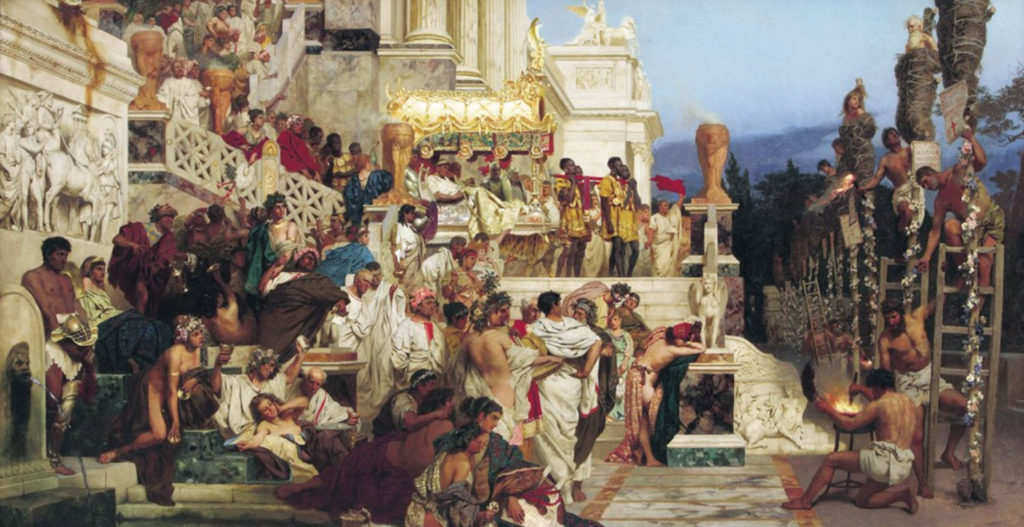
Henryk Siemiradzki’s large Nero’s Torches or Christian Candlesticks from 1876 shows the emperor reclining under an elaborate canopy as a line of Christians are about to be burned alive for his entertainment.
Nero never had progressive policies when it came to Christians, but he got really hard on them after the Great Fire of Rome. When the people began turning against Nero, he used Christians as a scapegoat to get the heat off himself.
Christians were blamed for the fire and slaughtered en masse. But the really terrifying part was how they were killed. Slaughtering Christians was a spectacle that people would attend and cheer.
During parties, Nero would nail Christians to crosses and burn them alive as a source of light when the Sun went down. While his victims screamed and suffered, Nero would walk about in a chariot rider’s uniform making small talk with his guests.
So, Nero blamed the Christians for the fire. And everyone was satisfied. So how did he rebuild the city, you might ask?
One of Nero’s greatest accomplishments was building the Domus Aurea, a golden pleasure palace the likes of which the world had never seen. It was a massive building overlaid with gold, ivory, and mother-of-pearl. It was guarded by a 37-meter-tall (120 ft) statue of himself. It even had panels in the ceiling that would let a rain of flowers and perfume fall on his guests.
So what was it used for? Orgies, of course! Reportedly, people in the palace would eat until they vomited and then couple for massive sex parties while rose petals fell on them from above.
All the decadence might have been forgivable—except that Nero built his sex palace right after the Great Fire of Rome when people needed aid. The Domus Aurea was viewed as a symbol of his selfishness and, shortly after his death, was stripped of all its gold.
Italian Courtyard
Moving away from ancient Rome. Here’s a picture of what Italy become one thousand years later…
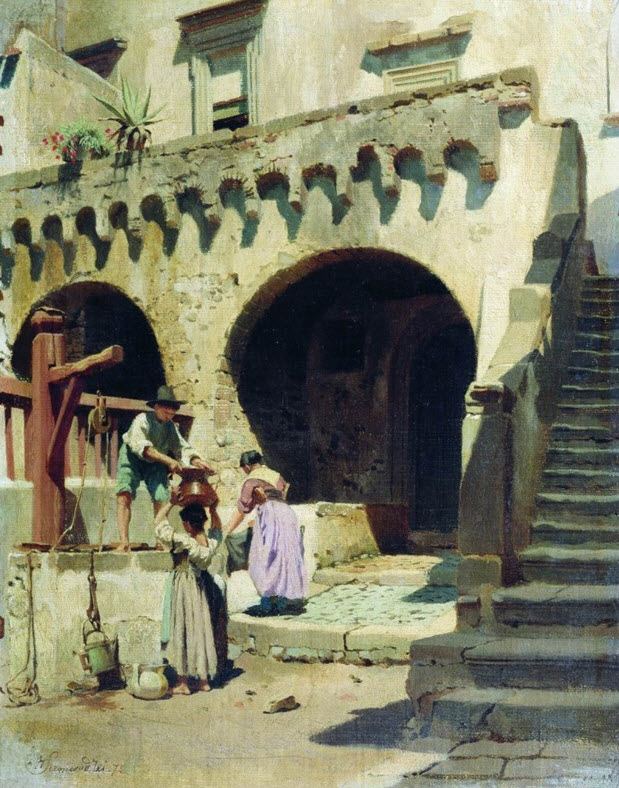
History. Art. Perspective. Understanding.
We all need to have it.
By a Temple (Idyll)
I love this picture. It just depicts some women and children outside a temple with large tree-like shrubbery. There’s many aspects of this painting that appeals to me. Much of the imagery inspires memories of other adventures and travels that I have embarked upon in my past.
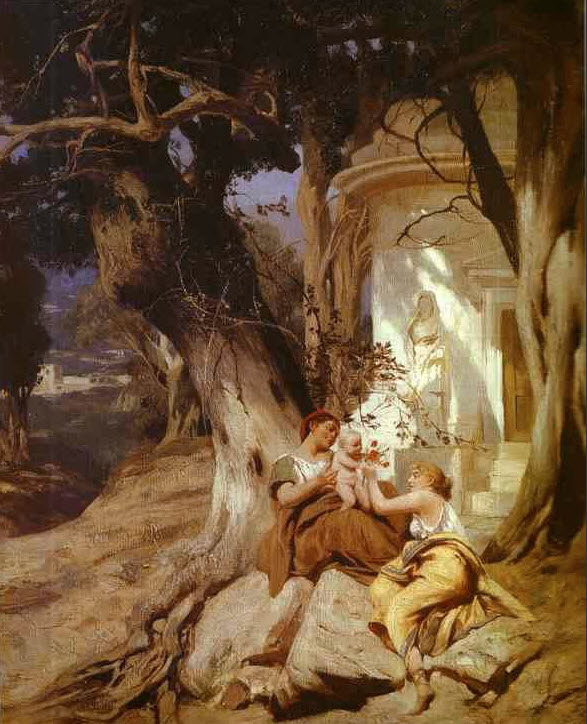
Of course, I love the style, the layout, and the historical subject matter. Were I to own a nice large mansion, this painting would hang in one of my hallways. It’s not a central theme, but quaint, pleasant and tender. With great imagery and perfect implementation.
A Persecutor of Christians at the Entrance to the Catacombs
The persecution of Christians occurred throughout most of the Roman Empire's history, beginning in the 1st century AD. Originally a polytheistic empire in the traditions of Roman paganism and the Hellenistic religion, as Christianity spread through the empire, it came into ideological conflict with the imperial cult of ancient Rome.

Pagan practices such as making sacrifices to the deified emperors or other gods were abhorrent to Christians as their beliefs prohibited idolatry.

The state and other members of civic society punished Christians for treason, various rumored crimes, illegal assembly, and for introducing an alien cult that led to Roman apostasy.

-Wikipedia
The persecution of Christians has a long history, starting in 64 AD until the fourth century, ending with the Edict of Milan in 313 AD. With the advent and spread of the new religion across the Roman Empire, the persecution against Christians has also emerged.
Christians were considered worshipers of a pagan, foreign god – as they refused making a sacrifice to the Roman gods and outside the society. Nero was the first and one of the most cruel persecutors – he was the emperor who set Rome on fire, blaming the Christians, who were immediately declared as enemies of the human race, threatening the life of the people, of the emperor and the Roman state.
The martyrs of this period who remained in the memory of humanity were Saints Peter and Paul.
After a short period of peace between Christians and worshipers of the ancient gods, the persecution of Christians returns in 90, with the coming to the throne of Domitian (Domitianus). The emperor Domitian, in order to help the public treasury of the Empire, imposed the paying of a Jewish Tax for Jews and Christians – who are guided by the Old Testament.
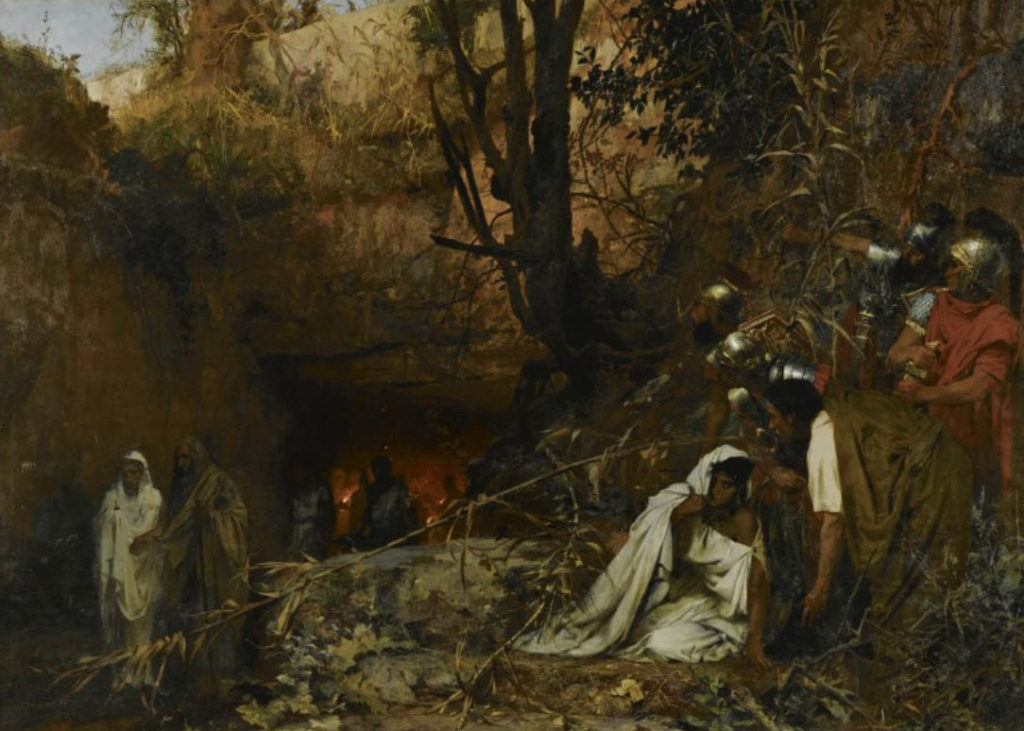
But the Christians refuse to pay this unfair tax, giving the emperor an impetus to start the persecution. Upper class Christians were exiled, and the ordinary Christians (the mass of the population) were barbarously tortured and executed.
This time, what was the crime the Christians were found guilty for, the crime of which they were accused? Atheism – because, as mentioned before, they refused to worship the pagan gods of the Empire. The martyrs –such as St. John the Evangelist – were subjected to horrific torture, then exiled or executed by crucifixion or burning at the stake.
After another short period of peace, the persecution of Christians starts again, under Emperor Trajan, from 98 AD until 117 AD. Christians refusing to deny (renounce) their faith and worship Roman gods had to be tortured and killed. The martyrs of this period who remained in the memory of humanity were St. Simon – who was crucified and St. Ignatius of Antioch – who was devoured by lions.
The persecution of Christians also continues under the reign of Septimius Severus, from 202 until 211, during which numerous martyrs were horribly murdered: they were thrown to the lions, leopards or bears. Especially new Christians (new converts to Christianity) have suffered, but the old Christians were relatively tolerated. After another short period of peace and tranquility, Maximinus Thrax, since 235, brutally attacked the entire Christian community.
Then, the persecution of Christians stopped for a while, especially with the reign of Philip the Arab, from 244 until 249, the first Christian emperor of the Roman Empire. But peace didn’t last long: in 249, Emperor Decius starts the persecution of all Christians again, as they didn’t want to renounce their faith and embrace the official religion.
There was other persecution under the reign of Valerianus, in 257, in order to steal the riches and wealth of Christians, and also the Church riches and properties. The rule of this emperor only lasted a year, and his son, Galilenus, came to the throne. He gave an imperial edict regarding tolerance toward Christians (Edict of Toleration), returning them the confiscated possessions and properties.
Persecution of Christians experienced a sad flourish under the Emperor Diocletian (from 284 to 305). Diocletian commanded churches to be destroyed, burned all the Christian books and denied Christians their right to perform public functions in the Roman Empire.
It became a crime punishable by death to refuse to worship the pagan gods and lower class Christians were enslaved. This persecution continues with Galerius; he ordered mass murder of all Christians – regardless of their social condition – and the burning of Holy See archives. Towards the end of his life, seriously ill, this cruel emperor gave an Edict of Toleration.
The persecution of Christians ended with the rule of Emperor Constantine the Great, who in 312 issued an edict of toleration for Christianity. The following year, this edict becomes an Edict of freedom of Christian worship. Constantine was perhaps the most important political figure who came to the aid of the new religion: after he came to power he immediately prohibited any persecution of Christians, also imposing the restitution of their previously seized (confiscated) properties and wealth. Constantine supported the church and subsidized it from public funds, granting privileges to the clergy.
In 312, Constantine the Great converted to Christianity, giving up the worship of pagan gods and in 337 – when his health began to deteriorate – he was baptized. But Constantine the Great considered himself a servant of God even before his conversion to Christianity.
At the Source
This is a lovely painting. We see three young gals, unmarred gathering water for their individual families, all looking at another boy. A boy, don’t you know, their age and herding goats. What are this girls thinking about, do you suppose?
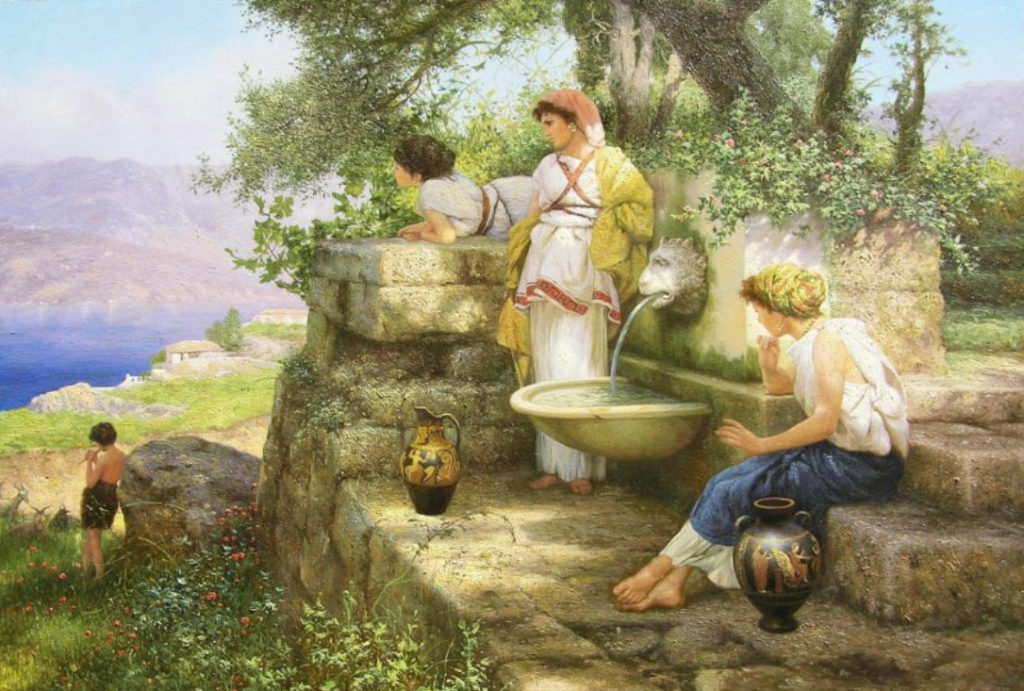
All in all, it’s a lovely pastoral scene.
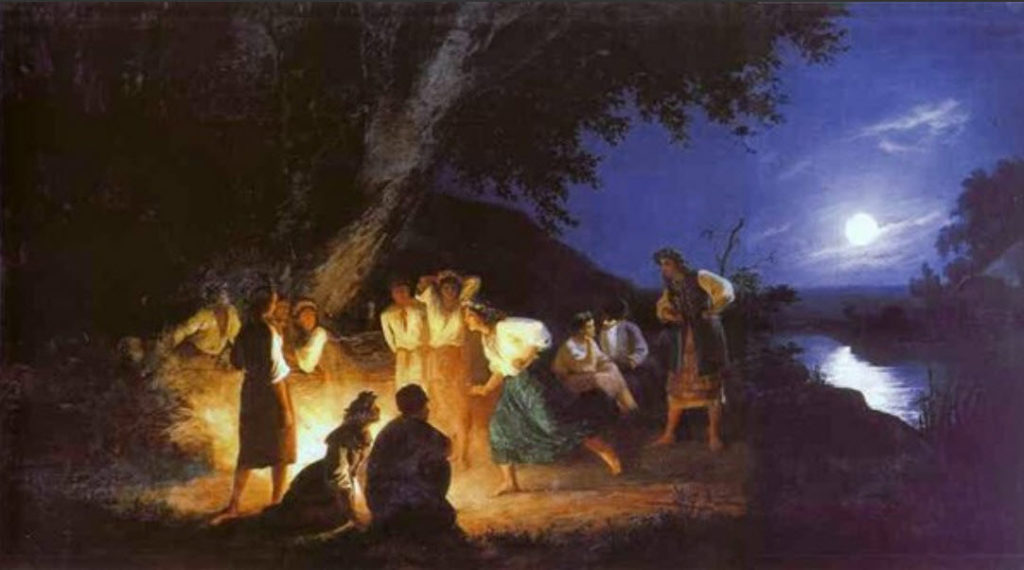
Night on the Eve of Ivan Kupala
On the eve of Ivan Kupala Day. Ivan Kupala Day or Kupala Night is enthusiastically celebrated in Russia, Ukraine, and Belarus on the night of 7 July. The celebration relates to the summer solstice when nights are the shortest and includes a number of Pagan rituals. The Russian, Ukrainian, and Belarusian name of this holiday combines “Ivan” (John — the Baptist) and Kupala which is related to a word derived from the Slavic word for bathing, which is cognate.

-Ivan Kupala Day - All Russia, Russian culture
Another lovely painting. The date and holiday is meaningless to those outside of Russia, but the feelings and emotions that are conveyed by it are wonderful.
Fishing
He (the artist) has some absolutely spellbinding and amazing work. This is one of his best (in my humble opinion). It shows a woman and child trying to fish in a nearby pond or river. I really enjoy the shadows that color the environment, and the calmness of the entire scene.
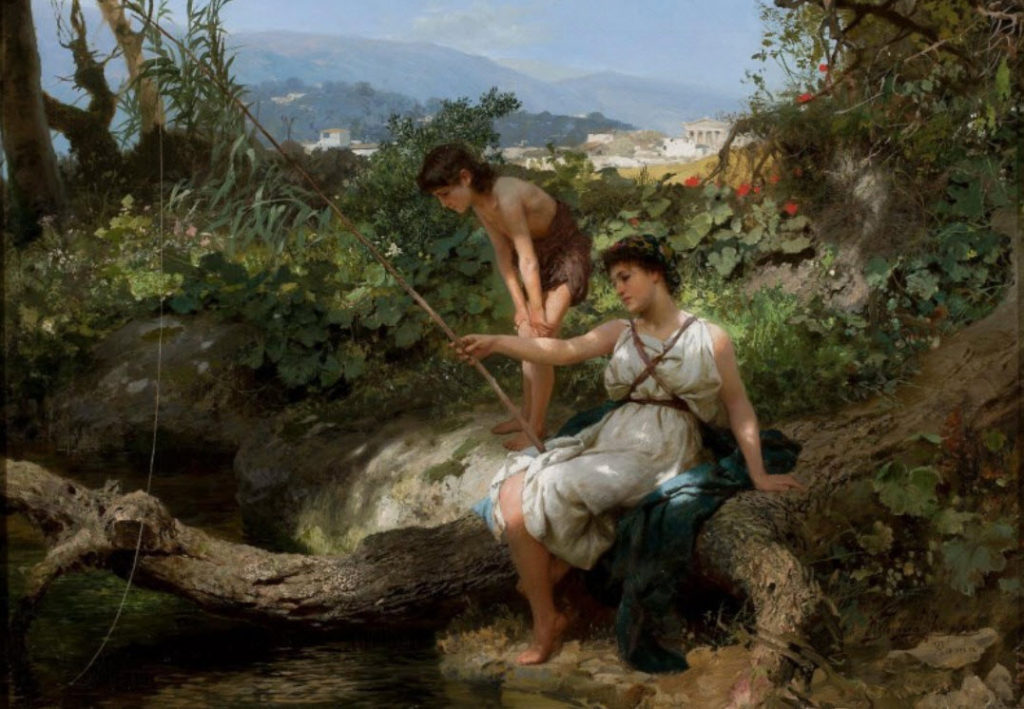
You can almost hear the insects making their sounds, the occasional lap of the water against the shore, and smell the hot sun on the leaves and woody trees. It is an absolutely lovely work.
A Woman or a Vase
And yet, here is another one of my newly discovered favorites. This is more than awesome. It is magnificent. Everything about this painting is first class. From the subject matter, to the painting style, to the painted emotions shown on the frozen faces to the composition. This is just stunning.
What is he doing? Trading a woman for the vase? Deciding on which to buy… a female slave or a vase? We don’t know. But we see the emotions and the expressions on all their faces. And that all tell us everything that we need to know.
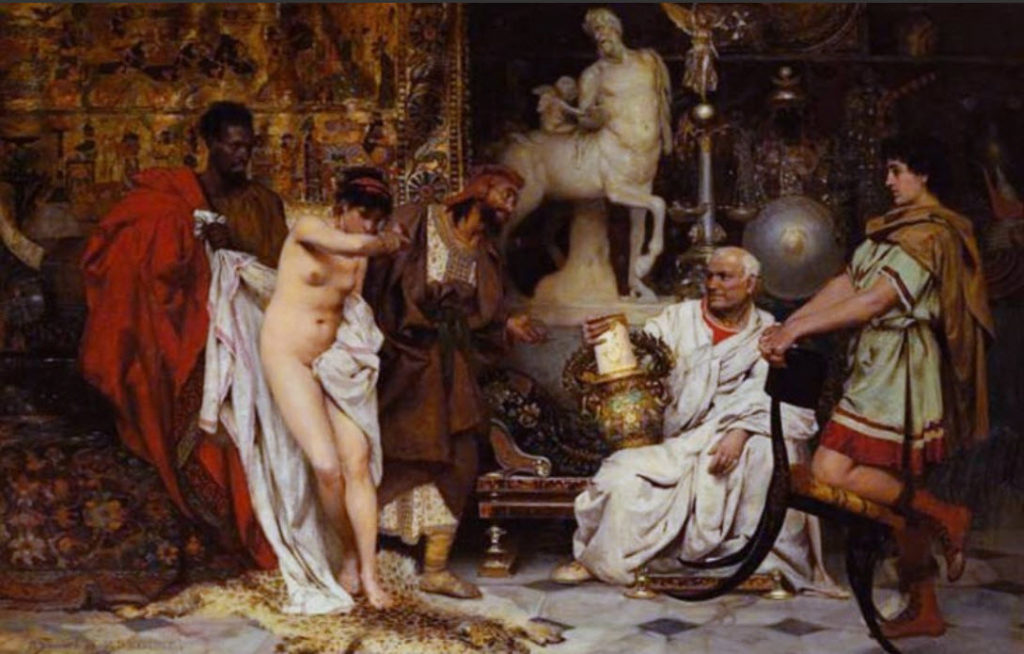
In those days, when the empire of Rome was strong, or the empire of Persia (it really didn’t matter what the empire’s name was), they engaged in slavery. Oh it was crude and in your face. But slavery was accepted, and it became part of the lifestyle of those inside of Rome.
Much like it is accepted inside of America today. For after all the 13th Amendment didn’t really ban slavery. It only changed it’s name. The actual text of the amendment reads…
And there you have it. You are a De Facto slave in the United States if you are a felon. The 13th Amendment states:
“Neither slavery nor involuntary servitude, except as a punishment for crime whereof the party shall have been duly convicted, shall exist within the United States, or any place subject to their jurisdiction.”
But it is more than that. Moat American are functional slaves and Paul Craig Roberts explains…
If slavery was such an evil, why did Congress resurrect slavery with the 16th Amendment in 1909 and the states ratify it in 1913?  To understand what I mean, ask yourself what is the definition of a slave?  A slave is a person who does not own his own labor or the products of his labor. If you are subject to an income tax, you do not own your own labor.

Part of a slave’s work goes to his own maintenance.  Otherwise, if he is not fed, clothed, housed, and his health attended to, his owner loses his labor.  The rest of his labor could be appropriated by his owner to cover the cost of the slave’s purchase and to turn a profit.  For a 19th century slave in the US the tax rate was approximately 50%.  For a medieval serf, the tax rate was lower as he had less technology and therefore was less productive.  A medieval serf could not reproduce if his tax rate exceeded 30%, or such was the view years ago when I studied the medieval economy.  Unlike a slave, a serf was not bought and sold.  He was attached to the land.  Like a slave, he was taxed in terms of his labor.  The lord of the manor had use rights in the serfs’ labor, and the serfs had use rights in the land.

Formerly serfs were free farmers.  After the collapse of Roman power, they had no protection against Viking, Saracen, and Magyar raiders.  To survive they provided labor to a chieftian  who constructed a walled tower and maintained fighting men.  In the event of raids, serfs had a redoubt to which to flee for protection.  In effect, serfs paid a defense tax.  They exchanged a percentage of their labor for protection.  Serfdom became an established institution and continued long after the raids had stopped.  In England serfdom was ended by the Enclosures which stripped serfs of their use rights in land and created a free labor market.

Consider the US income tax.  When President Reagan was elected the tax rate on investment income was 70%.  The top tax rate on wages and salaries was 50%.  In other words, the privileged (mainly white) rich were taxed at the same rate as 19th century black slaves.

How is an American on whose labor the government has a claim a free man?  Clearly, he is not a free man.  We can say that there is a difference between a present day American and a slave, because the government only owns a percentage of his labor and not the person himself–unless the person does not pay his taxes, in which case he can be imprisoned and his labor hired out to private companies who pay the prison for the use of the prisoner’s labor.
And there I go again, getting off on a tangent.
At the Source
A lovely painting about a family. What a nice painting to hang on a living room wall. Wouldn’t you think?
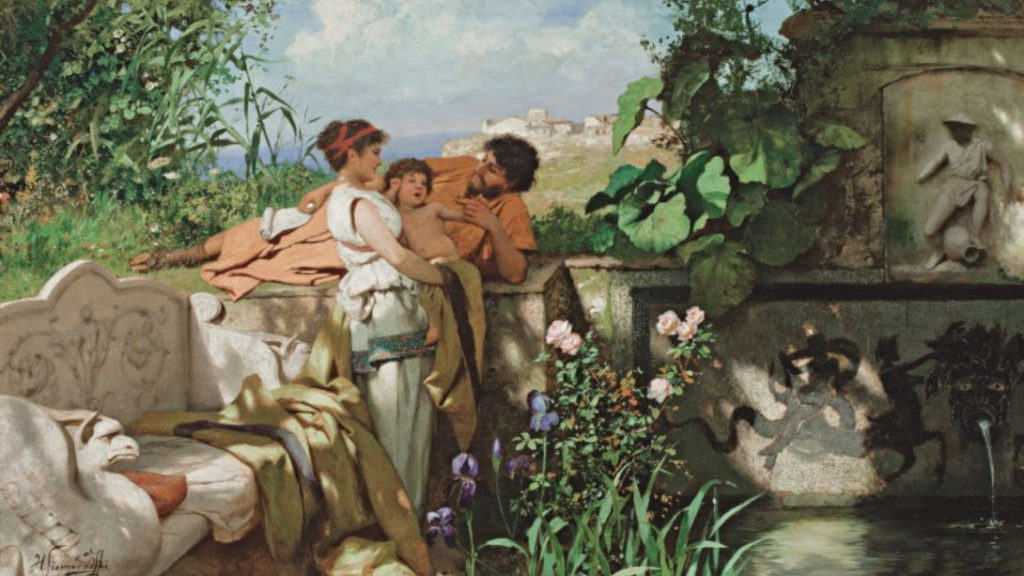
This is an ideal. I know that. But it is lovely and isn’t that the kind of imagery that you want to have around your home? I know that I do. I want happy and meaningful characteristics of my life surrounding me. That’s family, friends, good food and drink, a stress-free environment, and happy times.
Corsairs
The term corsair is tied to the Mediterranean Sea, where, from roughly the late 14th century to the early 19th century, the Ottoman Empire dueled with the Christian states of Europe for maritime supremacy. On both sides, the struggle was waged with both conventional navies and state-sanctioned sea bandits called corsairs.

-Pirates, Privateers, Corsairs, Buccaneers
The Corsair Aces are the Master thieves of the Corsairs and leading teams of Bandits and Thugs, under the eye of the Overlord and the Vanguard of the Corsairs. They are adept at many different skills involving their chosen profession, and would be called upon to do very hard tasks that others wouldn’t otherwise attempt.
Or at least that the common narrative that is used in action computer games of this nature.
The truth is that they performed a task for their respective governments. Out-sourced as we call it today. And they led colorful lives that consisted of routine boredom, and occasional pitched fights that always involved danger.
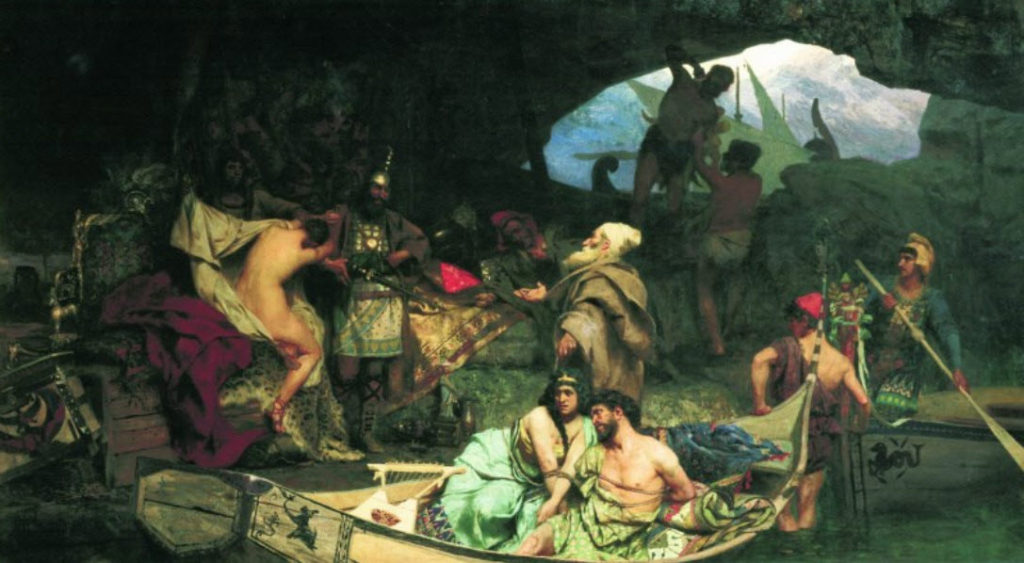
Here we see a cabal of raiders with their loot. Captives to be sold off as slaves or put up for ransom, and booty in all forms, shapes and sizes.
(It) makes for a great conversation piece, wouldn’t you think?
Alexander the Great and Physician Philip of Acarnania
During the expedition and campaign across Asia, Alexander and his army had been involved in a lot of circumstances that deserved the attention of some professionals of the medicine.
The relationship between Alexander’s army and the Physicians is complex, and it is also a question to observe if there were in the army something like a medical unit. Nevertheless, the links between the Argeads and the practice of healing and medical arts and the professionals of medicine seems to have been usual in the Macedonian court.
So, Alexander’s episodes concerning his illness, and especially his abilities to heal or to help someone to be healed can be considered as a clue of the king’s connections with Asclepius, and even more, of Alexander’s use of this links to portrait himself as a healer, and in some way even as an incarnation of Asclepios, in his own way to divinization.
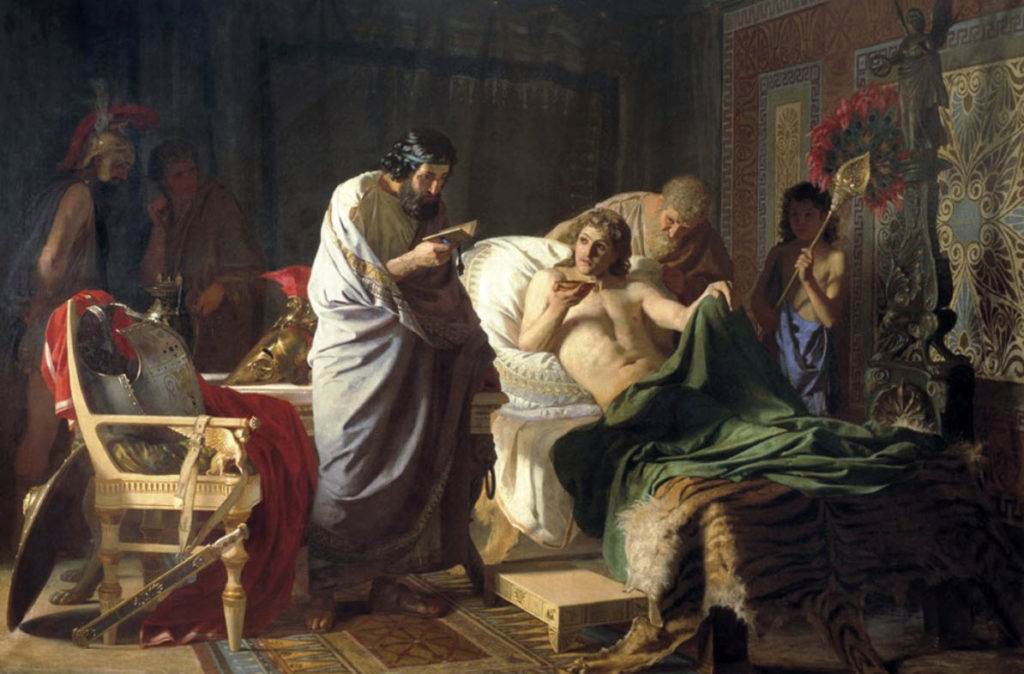
In Antiquity, nothing was left to chance in a military campaign, where soldiers shared space with a long list of members of the entourage of the generals, such as philosophers, artists, seers, physicians…
But along with these, there were other figures like assistants, bartenders, prostitutes, wheelwrights, squires, sons/daughters and women of soldiers, and so on, ad infinitum.
We can guess that the non-combatant collective in a military expedition would be equal or superior in number to that of the soldiers.
Dance Among Swords
The hassapikos, or butchers’ dance, of Turkey and ancient and modern Greece—now a communal social dance—was in the Middle Ages a battle mime with swords performed by the butchers’ guild, which adopted it from the military.

-sword dance | Description, History, & Facts | Britannica
The study and practice of sword wielding has been developing for over 4,000 years and continues to fascinate. Its mastery demands a great deal of a person’s physical and spiritual capacity.
Like any sport, mastering the art of wielding the sword requires extensive physical training which also trains one’s perceptions and reactions, allowing for quick responses to any situation – a valuable skill for self-defense.
Finally, one of the most important aspects of the art of the sword frequently quoted in ancient sources seems to be its moral value, as the practitioner would need to learn patience, perseverance, and humility, enhancing one’s physical and spiritual life, thus placing the practice firmly between the realms of spirituality and defense.
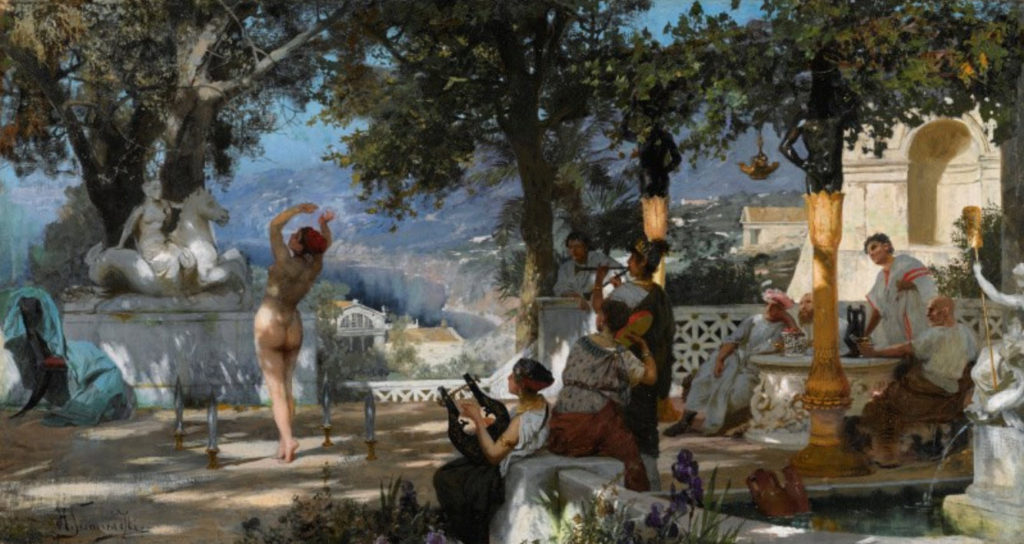
Sword dancing has found its place in many different cultures. In Asia, the sword dance is often used for plot descriptions and characterization in Chinese opera. In Pakistan and Nepal, military dances are still commonly performed for weddings and other occasions. In India, the Paika Akhada (“warrior school”) previously used to train Odisha warriors, is performed in the streets during festivals. Sword dances are also performed all over Europe, particularly in areas corresponding to the boundaries of what used to be the Holy Roman Empire.
As the ancient Greeks were very effective in collecting and adapting the best from surrounding cultures, it was likely that the Greeks inherited their strong dancing tradition from Crete which was conquered by Greece around 1500 BCE.
For the ancient Greeks, wine-making, music and dance were activities which marked a civilized and educated person.
I guess that I am quite civilized by Ancient Greek standards, eh?
Therefore, learning to dance was considered a necessary part of any education which favored an appreciation of beauty, and it would have been normal for children to learn to dance at a very young age.
The art of dance is frequently mentioned in the Homeric poems. In the Odyssey , the suitors of Penelope amuse themselves with music and dancing and Odysseus himself is entertained at the court of Alcinous with the exhibitions of very skillful dancers.
However, as with many of the terms familiar to us today, it is important to understand that the definition of “dance” for the ancients may have been slightly different from our current interpretation.
For the ancient Greeks, the term “dance” included all expressions and actions of the body that suggest ideas. These ideas ranged from acrobatic performances, mimetic action to even marching.
Therefore, the definition of dance encompassed a broader range than aesthetic or symbolic movements that are more familiar to us today. This philosophy, combined with lively imaginations, paved the way for the use of many subjects for various kinds of dances – including combat.
The invention of military dances was attributed to Athena.  Plato, in Laws, mentions the sword-dance of the Kouretes in Krete, the Dioskouroi in Lakedaimon and in Athens, identifying them as features of cults of the Kouretes, Dioskuroi and Athena.

 “Our Virgin-Lady Parthenos Athena, gladdened by the pastime of the dance, deemed it not seemly to sport with empty hands, but rather to tread the measure vested in full panoply. These examples would well become the boys and girls to copy, and so cultivate the favor of the goddess, alike for service in war and for use at festivals.”
To celebrate Athena during festivals dedicated to her worship, Athenians would perform the Pyrrhic dance. It was a male coming-of-age initiation ritual linked to a warrior victory celebration.
Dancer on a Tightrope
Here’s another curious artwork. In fact, the uniqueness of it makes it stand apart from the millions of other works. In fact, I would say that this would become a conversation piece no matter where it was hung.
Tightrope walking, also called funambulism, is the skill of walking along a thin wire or rope. Its earliest performance has been traced to Ancient Greece . [7] It is commonly associated with the circus.

-History
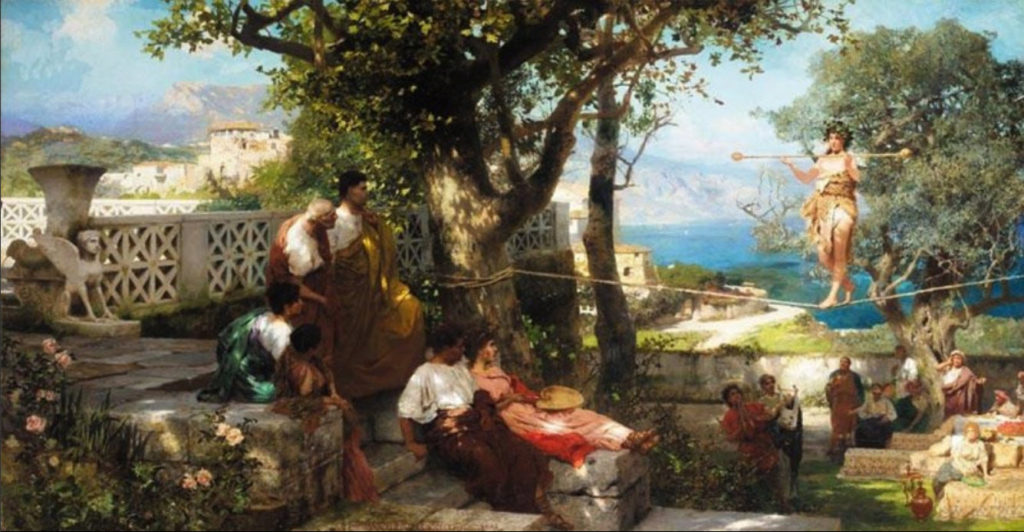
The act of rope walking has been documented in some form or other since at least the time of ancient Greece and Rome. (And that’s just what we know of! It is theorized that ropes and fibers have been in existence since at least 32,000 BC, if not longer!)
Rope walkers used ropes simply anchored at each end, with no guy wires and no pole for stabilization. (This was the only way to perform aerial acts until 1800, when steel cable was invented.)
The ancient Greeks were fascinated by rope-walking (though they likely attributed the skills of rope walkers to magic more than technique), and had four different words for rope-walkers:
- the Oribat dances on the rope,
- the Neurobat sets his rope at great heights, the Schoenobat flies down the rope and, the Acrobat does acrobatics on the rope.
In 260 BC Censor Messala did away with these distinctions, uniting them into a single word: funambulus [funambule], [from funis, a rope, and ambulare, to walk.]
Many different kinds of balancing acts already existed, including aesthetic dance movements and satiric routines.
Rope-walkers, together with members of the Senate, wore white to indicate that they required the special protection of the Gods. Although they were highly respected, the Greek’s fascination with rope walkers is the very reason why rope walking was excluded from the Olympics and other public games. Because of this, rope-walkers slowly started to fall into the classification of performers rather than gymnasts, and they often became the providence of jesters and other entertainers.
Sjesta patrycjusza
The Patrician’s Siesta. I tell you that this is just another one of his most extraordinary paintings that I would be proud to have grace my walls. It is just an amazing work that speaks to me.
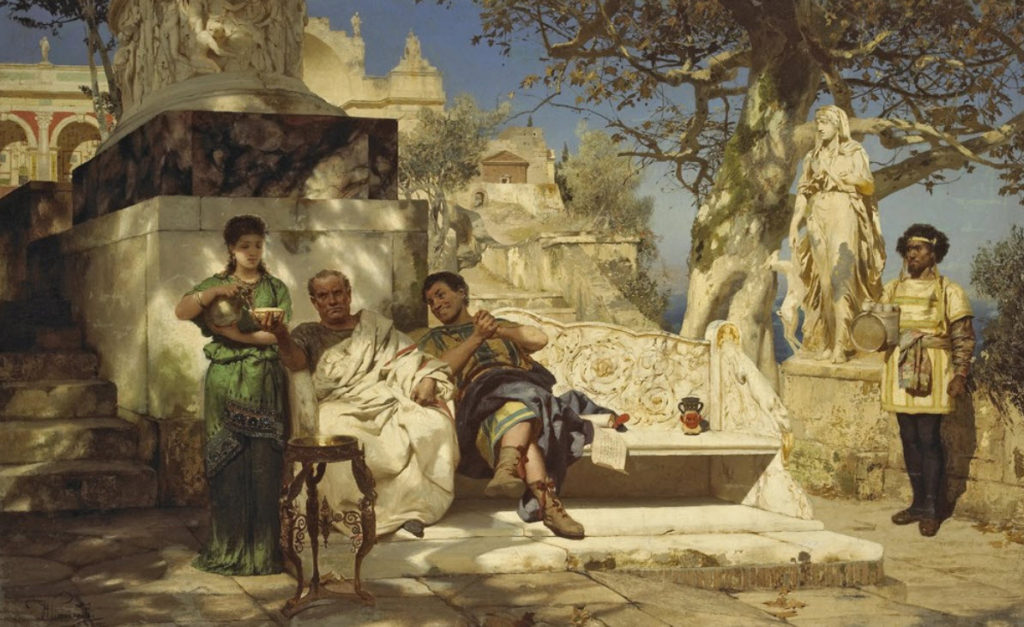
To appreciate why I love it so, check out this description of what a Patrician was and came into being. From HERE.
The 4th century BCE Greek philosopher Aristotle once wrote in his essay Politics, “If liberty and equality…are chiefly to be found in democracy, they will be best attained when all persons alike share in the government to the utmost.” Regrettably for Rome, when the Etruscan king was finally ousted in 509 BCE, the aristocratic families of the city – the patricians – seized control of the government and created a republic, but a republic in name only. The noble patricians considered themselves privileged and better capable of ruling; certain people were born to lead and others were destined to follow. The majority of the citizens, the plebians, were denied any part in how, or by whom, they were ruled.
During the rule of the Etruscan kings, the patricians (the word comes from the Latin patres meaning “fathers”) owned most of the land, and while there were many wealthy plebians (a word meaning “the many”), a handful of patrician families rose to become advisors and warlords to the king, although some historians argue that even the king may not have always been a patrician. For decades to come, all patrician families could trace their ancestry to these original clans. Among these were the Claudii, the Julii or the Cornelii. This natural born right, the right to govern, became hereditary and thereby allowed the patricians to distinguish themselves from those they considered a lower class. With the advent of the republic, the patricians sought to maintain this hold on governmental power.
This new government was truly unique and, in all appearances, representative. There was a centuriate assembly or Comitia Centuriate, a Senate, and two co-consuls. The latter were elected by the assembly for a one-year term but had the power of a king. All of this was open only to the patricians and only concerned their welfare. This extreme authority allowed them to sustain both their economic and political status, but this was not the only method used to suppress the plebians. Another way was through the priesthood – something they would control for years to come. Religion had always been an integral part of a Roman citizen’s life, and one method of suppressing any possible rebellion among the plebians was for the patricians to maintain their role as the “gatekeepers to the gods.” They dominated both the college of priests and the position of pontifex maximus. The patricians simply claimed to have special knowledge of the gods and therefore served as custodians of religious law with authority to punish offenders.
Unfortunately for the patricians, this dominance would and could not last. There had always been little, if any, relationship between the two classes – by law they were even forbidden to intermarry. The patricians gradually began to lose control when many of the more wealthy plebians wished to secure some voice in the government, threatening, more than once, to leave Rome. As the majority of the Roman citizenry, the plebians were a diverse group. They were the urban poor, wealthy farmers, tradesmen, as well as the core of the Republican army. The menial positions of tradesman or craftsman were never considered a job for a patrician; he believed he was better suited for leadership positions in politics, law, or the army. However, the patricians realized they needed the plebians more than the plebians need them and decided to relinquish some, but not all, authority. Unfortunately, this battle between the two classes would continue for decades to come.
This threat to abandon the city eventually brought about a compromise: the Conflict or Struggle of Orders, an agreement between the two classes that allowed the plebians to have a voice in government. The Concilium Plebis or Council of the Plebs, a legislative assembly that would make laws relative to the concerns of the plebians, was created in 494 BCE. Over two centuries later, in 287 BCE, the Lex Hortensia was passed, making all laws enacted by the plebian assembly binding to all citizens, patricians included. Initially, two officials or tribunes were elected by the Council to act on behalf of the plebians, but this number was later increased to ten. However, the creation of the Council was not enough. Without any law code in place, the plebians feared possible abuses by the patricians, so a series of laws, the Twelve Tables, was enacted in 450 BCE. These laws proved to be the foundation for Roman justice; one law that remained, and was later discarded, was the prohibition against intermarriage between the two classes.
The Roman author and historian Livy wrote in his History of Rome of the patricians’ concern for maintaining the purity of their class:
… a tribune of the plebs, introduced a law with regard to the intermarriage of patricians and plebeians. The patricians considered that their blood would be contaminated by it and the special rights of the houses thrown into confusion. Then the plebeians … brought in a measure empowering the people to elect consuls from the plebeians or the patricians as they chose. The patricians believed that, if this were carried, the supreme power would not only be degraded … but would entirely pass away from the chief men in the State into the hands of the plebs.
This latter concern was not so easily dismissed by either side. Gradually, as time passed, laws were relaxed, allowing plebians to become consuls, the first one elected in 367 BCE.
As the plebians began to obtain more and more control of their own government, several of them rose to the level of a dictator, a position that allowed an individual to assume supreme power in times of an emergency. Tiberius Gracchus, a 2nd century BCE tribune whose mother was a patrician, proposed land should be given freely to the poor and unemployed farmers, an idea not widely popular to many of the wealthy patricians in the Senate. Tiberius was killed, along with 300 of his followers. His brother Gaius would fair no better. In 81 BCE, Sulla, another tribune, rose to power, also assuming the title of dictator. One of his first moves was to eliminate all opposition, executing over 1500 patricians, although some chose to commit suicide in order to allow their families to keep their wealth; an executed individual would have relinquished all wealth to Sulla.
As time passed the patrician class still maintained some influence within the government, largely due to their wealth and land ownership. Unfortunately, the old idea of birthright changed; identity with the old clans was no longer valid. Julius Caesar established new patricians from the plebian class in order to strengthen his power. Emperor Augustus also named new patrician families in an attempt to create a revitalized sense of morality within the empire, along with loyalty to the state cults. He reestablished the old priestly colleges (naming himself pontifex maximus) and rebuilt old temples and shrines. And, while the patrician class would exist long into the Byzantine Empire, it was not the same as the small group of families who established the Republic. Emperor Constantine would use the term “patrician” only as a title. The original patricians’ attempt at controlling the power within the Republic had been short-lived, for the plebians chose to rise up and demand a voice. As Aristotle stated, a democracy or a republic can only truly exist when all people participate.
…As we watch the United States start to go up in flames, let’s all remember a little bit about history, shall we?
Kurtyna Teatru Wielkiego we Lwowie
Curtain of the Grand Theater in Lviv.
At the end of the 19 th century, Lviv was the capital of Galicia province, which belonged to Austro-Hungarian Empire. Grand Theatre, as it was called, should have emphasized the greatness of the city and became the center of cultural life. The project was designed by one of the most prominent architects, Zygmunt Gorgolewski. Such ambitious building required an appropriate location.

-History of Lviv Opera House
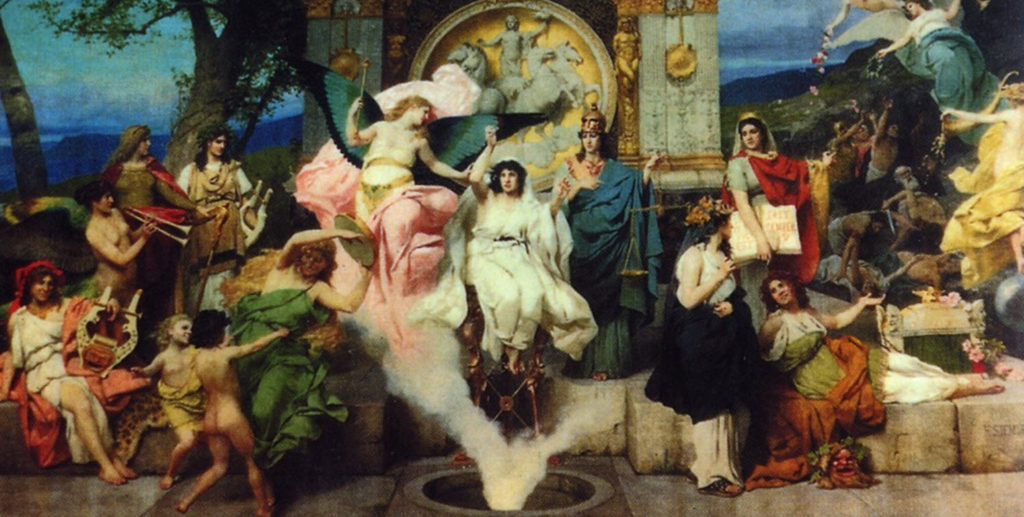
Gorgolewski chose as its location the very heart of the old city, which posed the problem of being densely populated, overcrowded, and lacking the space for such a monumental project. To overcome this challenge, he endeavored to enclose a part of the Poltva river and build over it, employing Europe’s first example of a reinforced concrete base instead of a traditional foundation. During the construction phase and its first few years at the turn of the century, the opera house slowly sank into the Poltva. However, by the time Gorgolewski died suddenly of heart failure in 1906, the Lviv Opera had settled permanently.
Check out this quote…
“We were amazed with the with magnificent stage curtain at that performance. I have never seen it before in the Lviv Opera. Its story is just unbelievable!
Now check out this photograph. Does it look familiar? Amazing! Eh?
Dangerous Lesson
And indeed, it certainly looks dangerous. Yikes!
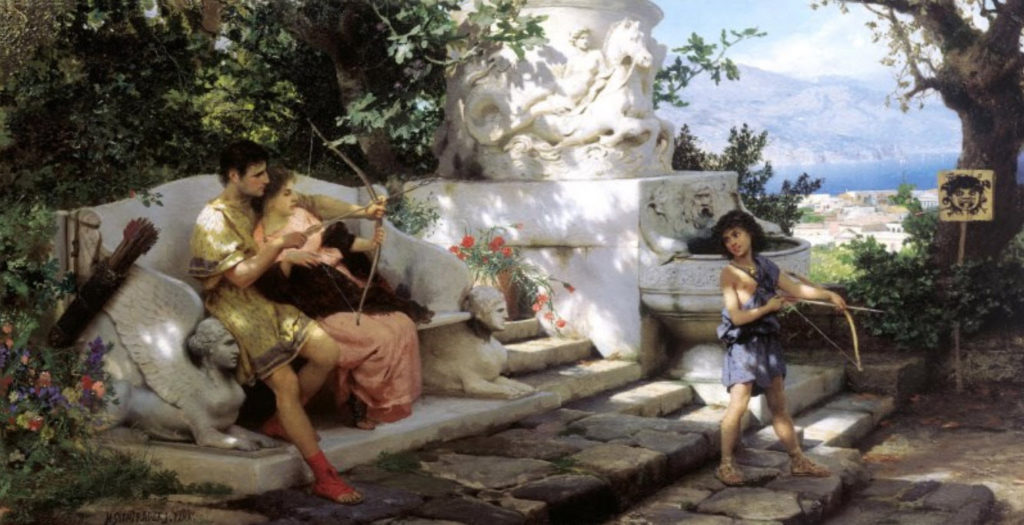
Design of a Curtain For the Theater Juliusz Slowacki in Krakow
“We were strolling along the old city wall when all of a sudden we came across this structure. It’s beautiful with the garden on the side. It looks almost like one of those palaces one sees in many European cities. It’s built in the Baroque style in 1893, so it’s less old than one would think. We didn’t go inside.”
They should have.
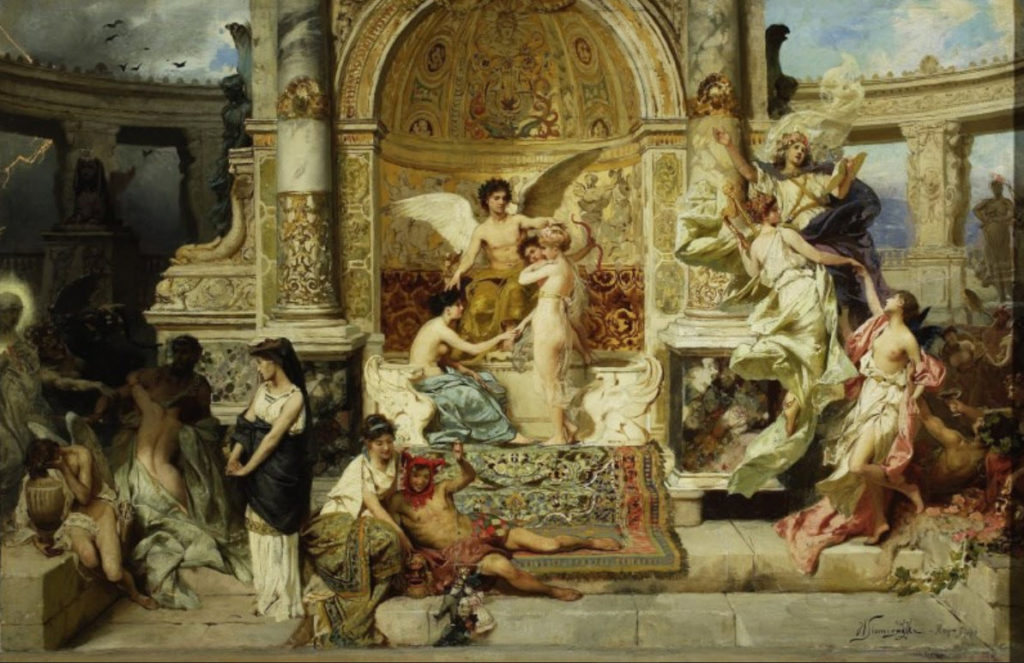
Yes. And guess who painted the stage curtain backdrop?
Dice Game
A dice game. Curious. maybe dangerous. You never know.
But it has been my experience that many girls like to play dice with you. Just don’t get too drunk in the process.
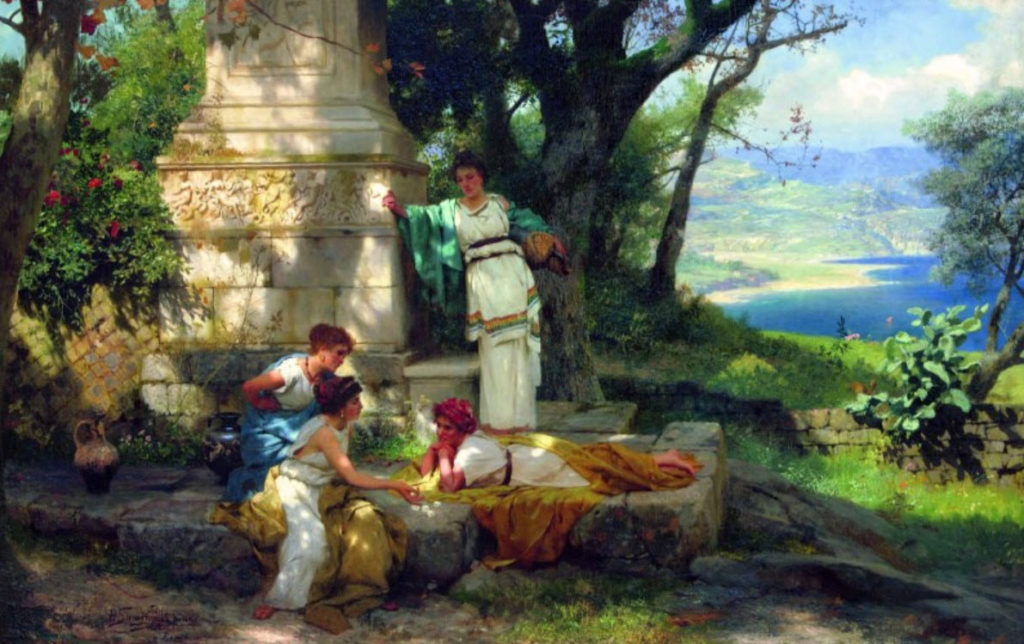
Christian Dirce
Nero watching how a captive Christian woman is killed in a re-enactment of the Greek myth of Dirce.
Of the Dirce (spring) DIRKE (Dirce) was the Naiad-nymph of the spring of Dirke near Thebes in Boiotia (central Greece).

Her waters were sacred to the god Dionysos.

Dirke was originally the wife of King Lykos (Lycus) of Thebes who, as punishment for the mistreatment of her niece Antiope, was tied to a wild bull and torn limb from limb.

-DIRCE (Dirke) - ThebanNaiadNymphofGreekMythology
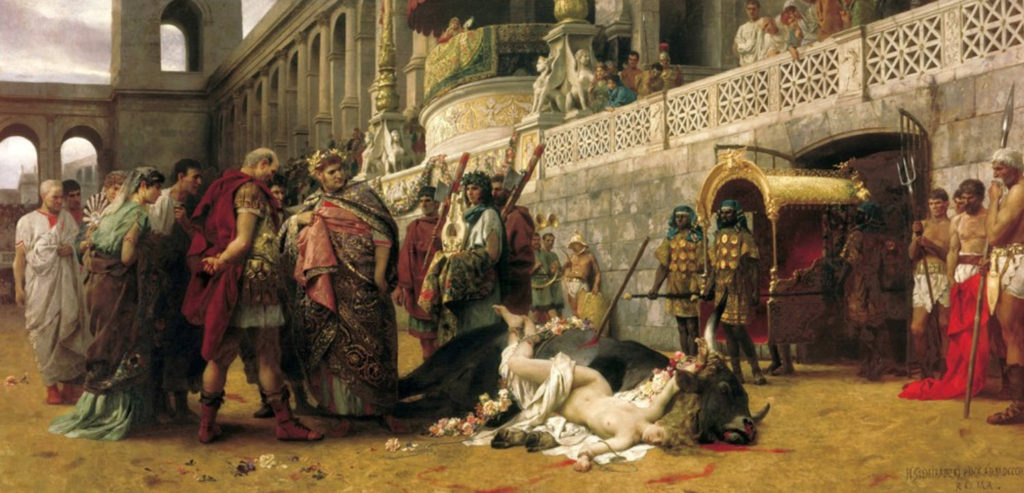
The Roman event was intended to display this saga…
In Thebes, Antiope was still a prisoner of her uncle. While he was content to punish her with isolation and the loss of her status and reputation, his wife Dirce was far more cruel.
Dirce was jealous of the younger woman’s beauty and feared for her own position within the household. She had Antiope tied up and treated her as a slave.
Antiope remained a prisoner for many years, constantly mistreated and taunted by Dirce. One day, however, the ropes that bound her hands and feet magically loosened.
Zeus had intervened, invisibly untying the knots that had kept Antiope a prisoner for years. He guided her to Eleutherae, a city at the base of Mount Cithaeron.
Antiope escaped to the village and took shelter with a family that included two sons. One dutifully tended to their flocks while the other practiced music on a beautiful lyre.
The lyre had been a gift from Hermes, sent to Zeus to his mortal son. Antiope had been guided to the very home where her sons had grown up, unaware of their full lineage or that their guest was, in fact, their lost mother.
Antiope remained at the shepherd’s home, not knowing that she was living side by side with the twin sons who had been taken from her years before. Their life was peaceful and happy, until she was discovered by Dirce.
Dirce was a devotee of Dionysus and had come to Eleutherae to take part in a festival in his honor. A wild bull was to be sacrificed to Dionysus by his most devoted servants.
While the sacrifice was being prepared, Dirce saw Antiope among the crowd. She immediately decided to be rid of the troublesome princess once and for all.
She ordered two young men standing nearby to capture the woman and tie her to the horns of the wild bull. Of course, those two young men were none other than Amphion and Zethus.
They moved to obey the order immediately. Although the ordeal would almost certainly kill their guest, they had no power to disobey the orders of a queen.
They were stopped, however, by the old shepherd who had raised them. He had recognized Antiope as the girl who had given birth to the twins, but kept the secret to protect them all.
Now, however, he told the twins the truth about their lineage. Antiope was their mother and the current king and queen of Thebes were the ones who had separated them.
The twins instead turned in Dirce. As retribution for her treatment of their mother and the near-murder she had asked them to take part in, they bound her to the bull’s horns instead.
Not satisfied, they hoped to avenge their mother by killing their uncle as well. Hermes interfered, however, to stop them from killing the king.
Lycus was forced to step down as king, both in recognition of his nephews’ claims to power and to avoid a violent end. He went into exile and Amphion and Zethus took his place as rulers of Thebes.
Road to the Shrine. The Greek Merchant
An everyday event. You can see this commonly in China. Small vendors display their wares and products on a mat so that passers-by can select and buy a trifle or two. It’s a nice relaxing image, taken and portrayed in a most classical way. I really enjoy this painting, the imagery, the colors and the composition.
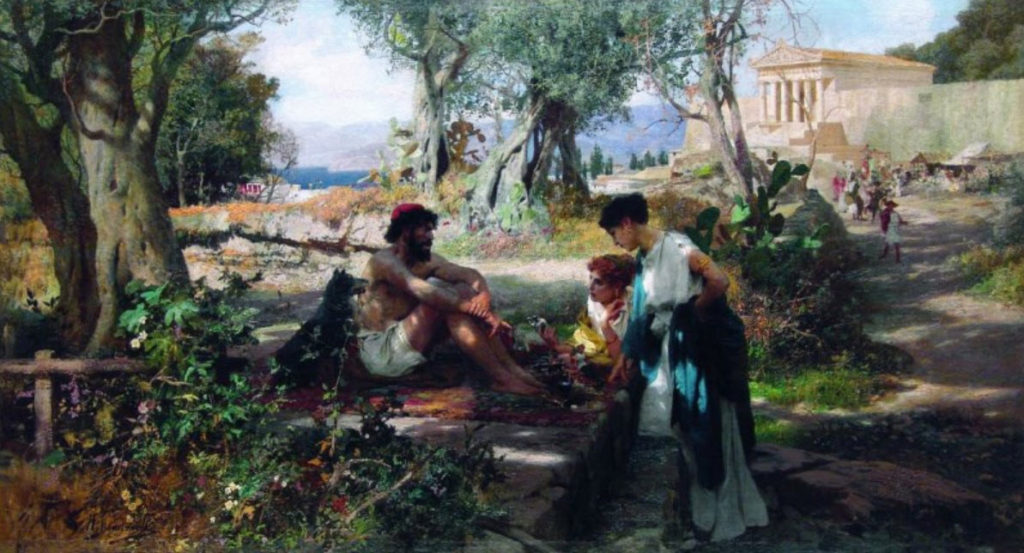
Take special note of his shadow work. Truly amazing!
Socrates Finds his Student Alcibiades at Heterai
Hetaira—or hetaera—is the ancient Greek word for a type of highly skilled prostitute or courtesan.
The daughters and wives of Athenian citizens were sheltered from men and most serious education at least partly in order to assure their suitability as citizen wives. Adult female companionship at drinking parties (the famous symposium) could be supplied by a high priced prostitute—or hetaira. Such women might be accomplished musicians, rich, well-educated, and agreeable companions.
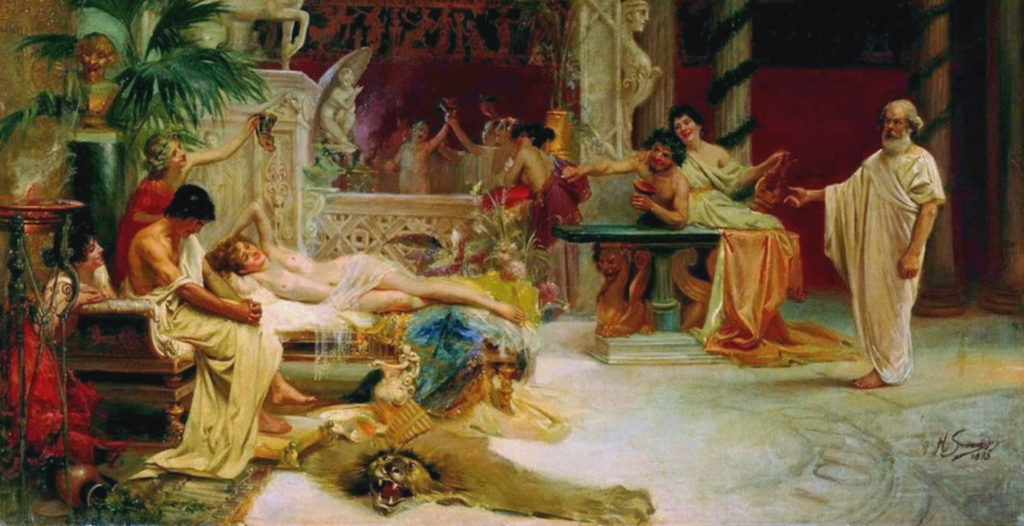
Pericles—one of the most important leaders of his time—had a mistress named Aspasia of Miletus. Due to her status as a foreigner, she may have been doomed to become a hetaira. At the time, those who were not native citizens of Athens were unable to marry Athenian citizens. Her life was likely the richer for it, however.
Other hetairai (hetairai is a plural form of hetaira) provided funds for civic improvements.
According to an article from the Perseus Digital Library titled, “The Representation Of Prostitutes Versus Respectable Women On Ancient Greek Vases:”
"These women were essentially sexual entertainers and often had artistic skills. Hetairai had physical beauty but also had intellectual training and possessed artistic talents; attributes that made them more entertaining companions to Athenian men at parties than their legitimate wives."

—Perseus Digital Library
According to Daughters of Demeter, women in Athens, though not trained in athletics, seem nevertheless to have had opportunities for sport and exercise. They go on to say that the wealthy learned to read and gathered in private homes to share music and poetry.
Little Brat
A nice family scene. Great composition. Brilliant colors.
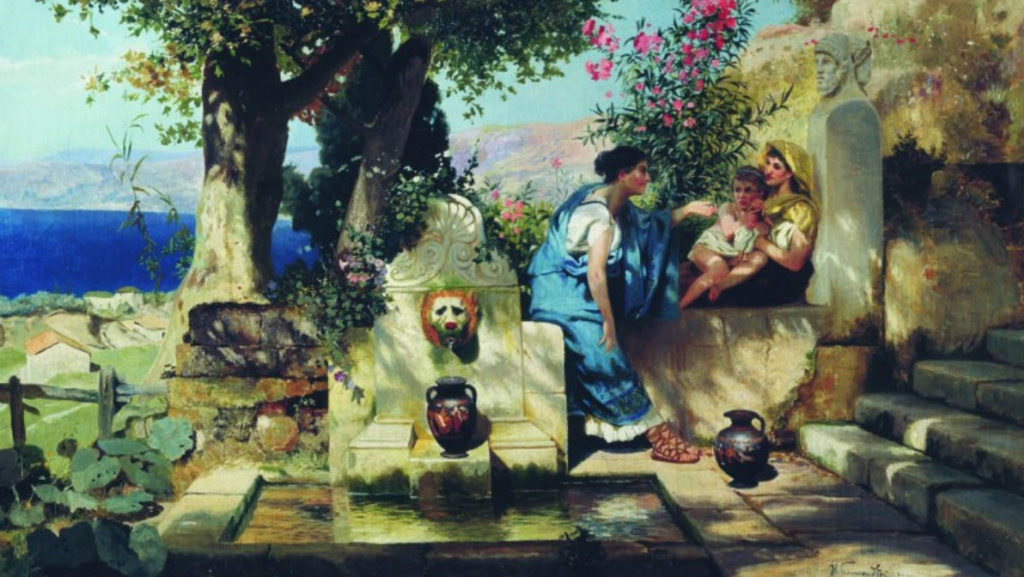
Relatable.
Judgement of Paris
The Judgment of Paris is one of the best known Greek myths. The goddess Strife threw a golden apple marked “to the fairest” amidst the gods and Jupiter selected Paris, a Trojan shepherd, to award it. Each goddess tried to influence Paris with a special gift. Minerva, depicted here with a spear at her side, offered him victory in war.
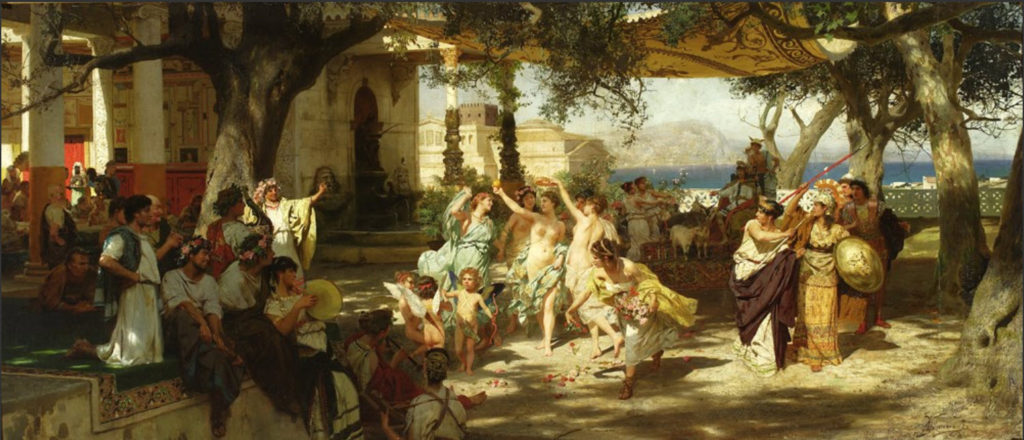
THE JUDGEMENT OF PARIS was a contest between the three most beautiful goddesses of Olympos–Aphrodite, Hera and Athena–for the prize of a golden apple addressed “To the Fairest.”
The story began with the wedding of Peleus and Thetis which all the gods had been invited to attend except for Eris, goddess of discord. When Eris appeared at the festivities she was turned away and in her anger cast the golden apple amongst the assembled goddesses addressed “To the Fairest.” Three goddesses laid claim to the apple–Aphrodite, Hera and Athena. Zeus was asked to mediate and he commanded Hermes to lead the three goddesses to Paris of Troy to decide the issue. The three goddesses appearing before the shepherd prince, each offering him gifts for favour. He chose Aphrodite, swayed by her promise to bestow upon him Helene, the most beautiful woman, for wife. The subsequent abduction of Helene led directly to the Trojan War and the fall of the city.
Pokhorony rusa v Bulgare
The burial of the Rus in Bulgar. This is a study, but look at the composition of it. It would have been an extraordinary painting once complete.
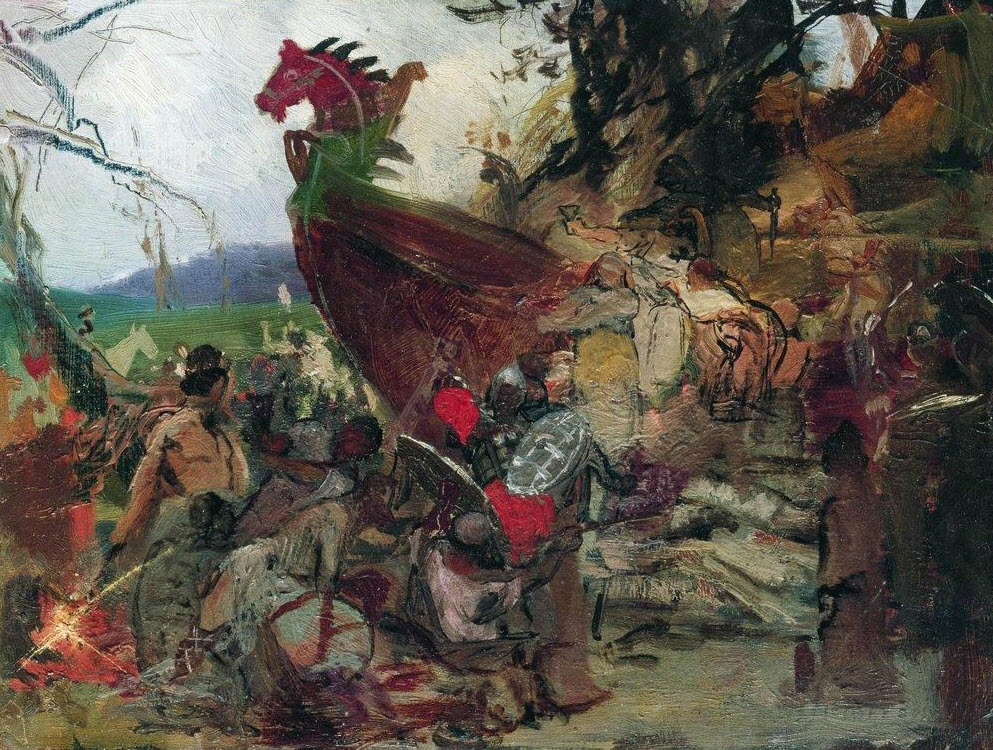
It’s got the makings of something wonderful.
Funeral feast of Svyatoslav’s Russian warriors after battle in 971
Svyatoslav I, also spelled Sviatoslav, Russian in full Svyatoslav Igorevich, (died 972), grand prince of Kiev from 945 and the greatest of the Varangian princes of early Russo-Ukrainian history.
He was the son of Grand Prince Igor, who was himself probably the grandson of Rurik, prince of Novgorod. Svyatoslav was the last non-Christian ruler of the Kievan state. After coming of age he began a series of bold military expeditions, leaving his mother, Olga, to manage the internal affairs of the Kievan state until her death in 969.
The Russian Primary Chronicle (Povest vremennykh let) says that Svyatoslav “sent messengers to the other lands announcing his intention to attack them.” Between 963 and 965 he defeated the Khazars along the lower Don River and the Ossetes and Circassians in the northern Caucasus; he also attacked the Volga Bulgars. In 967 he defeated the Balkan Bulgars at the behest of the Byzantines, to whom he then refused to cede his conquest.
He declared his intention of establishing a Russo-Bulgarian empire with its capital at Pereyaslavets on the Danube River.
In 971, however, his comparatively small army was defeated by a Byzantine force under the emperor John I Tzimisces, and Svyatoslav was compelled to abandon his claim to Balkan territory.
Thus this painting…
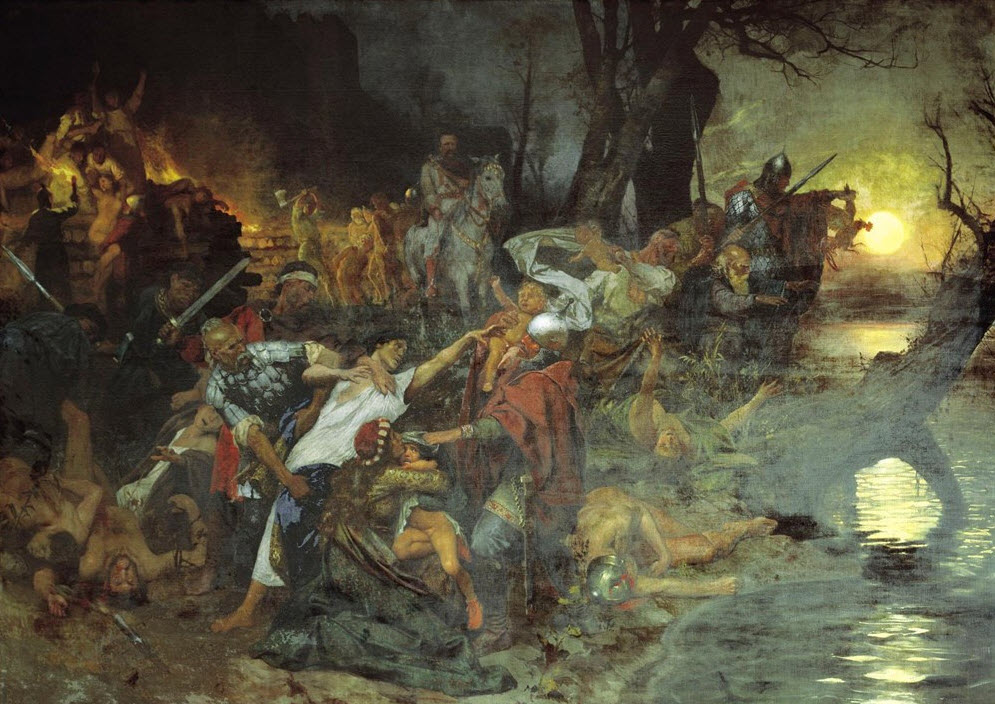
In the spring of 972, while Svyatoslav was returning to Kievan Rus with a small retinue, he was ambushed and killed by the Pechenegs (a Turkic people) near the cataracts of the Dnieper River.
Christ and the Samaritan woman
Jesus Talks With a Samaritan Woman
4 Now Jesus learned that the Pharisees had heard that he was gaining and baptizing more disciples than John— 2 although in fact it was not Jesus who baptized, but his disciples. 3 So he left Judea and went back once more to Galilee.
4 Now he had to go through Samaria. 5 So he came to a town in Samaria called Sychar, near the plot of ground Jacob had given to his son Joseph. 6 Jacob’s well was there, and Jesus, tired as he was from the journey, sat down by the well. It was about noon.
7 When a Samaritan woman came to draw water, Jesus said to her, “Will you give me a drink?” 8 (His disciples had gone into the town to buy food.)
9 The Samaritan woman said to him, “You are a Jew and I am a Samaritan woman. How can you ask me for a drink?” (For Jews do not associate with Samaritans.[a])
10 Jesus answered her, “If you knew the gift of God and who it is that asks you for a drink, you would have asked him and he would have given you living water.”
11 “Sir,” the woman said, “you have nothing to draw with and the well is deep. Where can you get this living water? 12 Are you greater than our father Jacob, who gave us the well and drank from it himself, as did also his sons and his livestock?”
13 Jesus answered, “Everyone who drinks this water will be thirsty again, 14 but whoever drinks the water I give them will never thirst. Indeed, the water I give them will become in them a spring of water welling up to eternal life.”
15 The woman said to him, “Sir, give me this water so that I won’t get thirsty and have to keep coming here to draw water.”
16 He told her, “Go, call your husband and come back.”
17 “I have no husband,” she replied.
Jesus said to her, “You are right when you say you have no husband. 18 The fact is, you have had five husbands, and the man you now have is not your husband. What you have just said is quite true.”
19 “Sir,” the woman said, “I can see that you are a prophet. 20 Our ancestors worshiped on this mountain, but you Jews claim that the place where we must worship is in Jerusalem.”
21 “Woman,” Jesus replied, “believe me, a time is coming when you will worship the Father neither on this mountain nor in Jerusalem. 22 You Samaritans worship what you do not know; we worship what we do know, for salvation is from the Jews. 23 Yet a time is coming and has now come when the true worshipers will worship the Father in the Spirit and in truth, for they are the kind of worshipers the Father seeks. 24 God is spirit, and his worshipers must worship in the Spirit and in truth.”
25 The woman said, “I know that Messiah” (called Christ) “is coming. When he comes, he will explain everything to us.”
26 Then Jesus declared, “I, the one speaking to you—I am he.”
The Disciples Rejoin Jesus
27 Just then his disciples returned and were surprised to find him talking with a woman. But no one asked, “What do you want?” or “Why are you talking with her?”
28 Then, leaving her water jar, the woman went back to the town and said to the people, 29 “Come, see a man who told me everything I ever did. Could this be the Messiah?” 30 They came out of the town and made their way toward him.
31 Meanwhile his disciples urged him, “Rabbi, eat something.”
32 But he said to them, “I have food to eat that you know nothing about.”
33 Then his disciples said to each other, “Could someone have brought him food?”
34 “My food,” said Jesus, “is to do the will of him who sent me and to finish his work. 35 Don’t you have a saying, ‘It’s still four months until harvest’? I tell you, open your eyes and look at the fields! They are ripe for harvest. 36 Even now the one who reaps draws a wage and harvests a crop for eternal life, so that the sower and the reaper may be glad together. 37 Thus the saying ‘One sows and another reaps’ is true. 38 I sent you to reap what you have not worked for. Others have done the hard work, and you have reaped the benefits of their labor.”
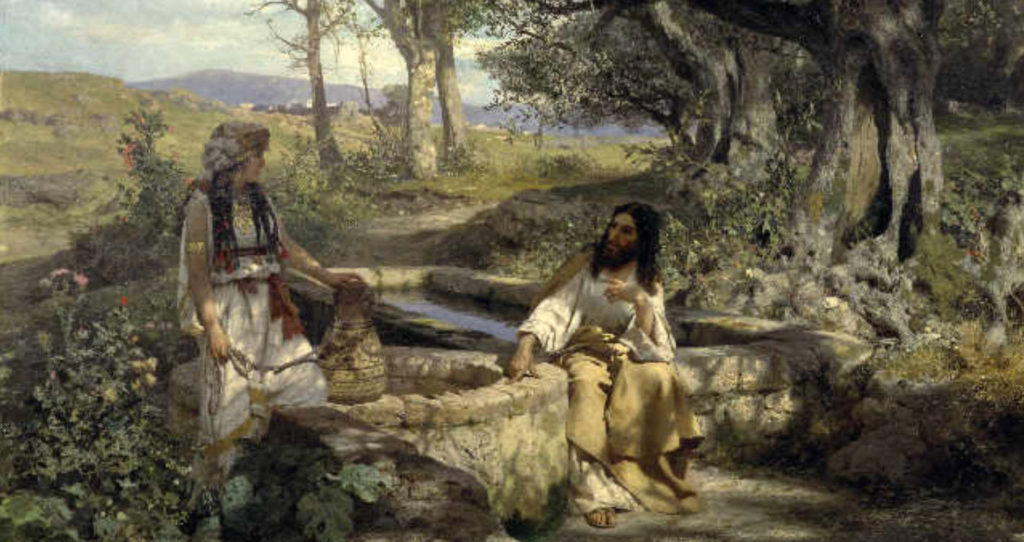
Many Samaritans Believe
39 Many of the Samaritans from that town believed in him because of the woman’s testimony, “He told me everything I ever did.” 40 So when the Samaritans came to him, they urged him to stay with them, and he stayed two days. 41 And because of his words many more became believers.
42 They said to the woman, “We no longer believe just because of what you said; now we have heard for ourselves, and we know that this man really is the Savior of the world.”
Details to the referenced numbers can be found HERE.
Stay
For some reason I am reminded of the 1980’s movie “Explorers”. There is a scene when they climb up to the top of this hill and experience the fruits of their experimentation.
Never the less, this is a mild and calming painting. It evokes images of love, care and family.
And apples.
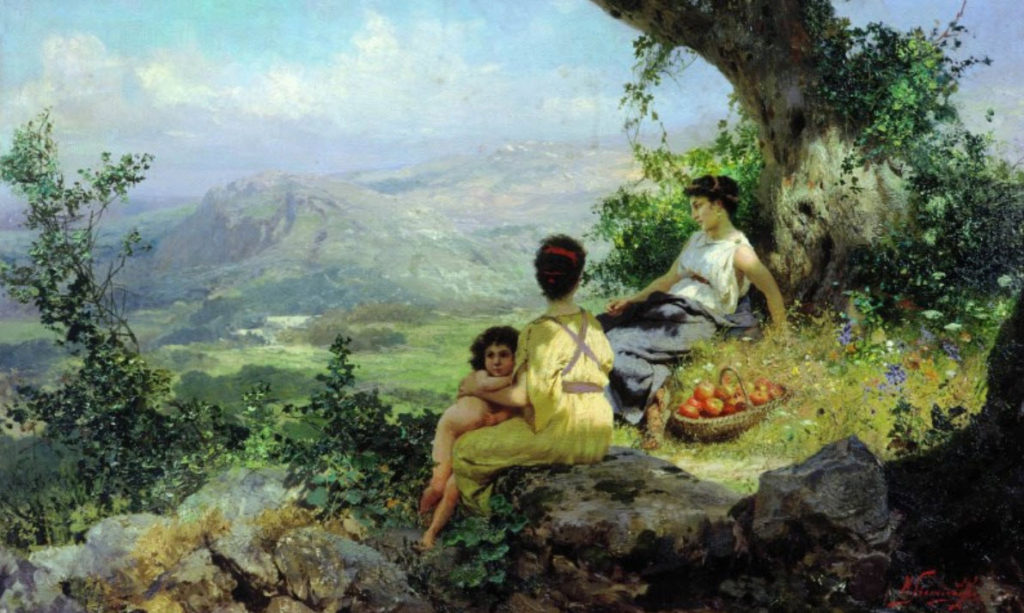
In those days the women didn’t wear bras. They just criss-crossed straps across their chests; their bosoms, and called it a day.
The Scene at the Well
This is another sketch.
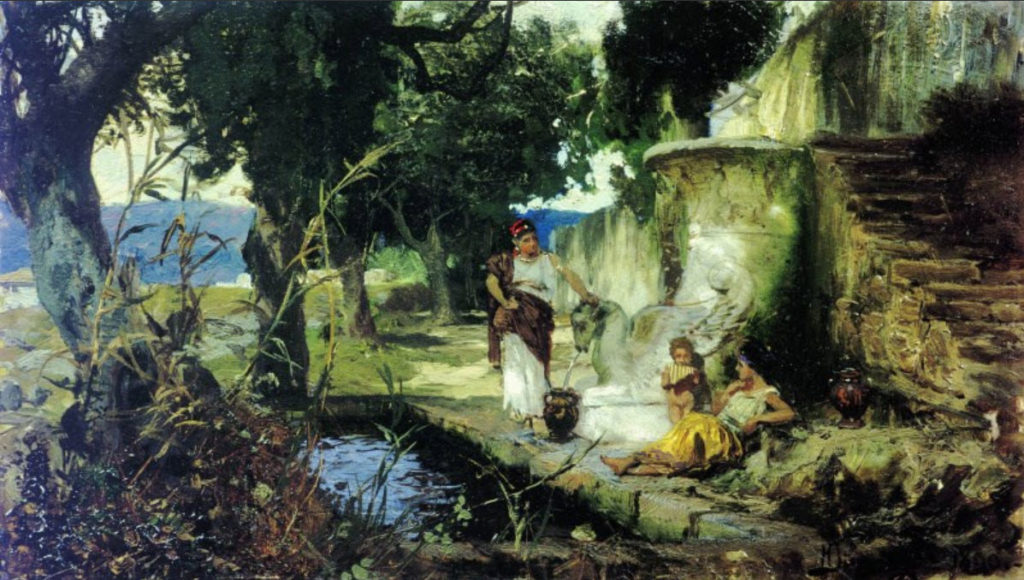
I wish that it would have been finished. It’s a remarkable work with great potential. I do think that it is lovely.
The Feast of Bacchus
September 3 was the date of the Bacchanalia, the Feast of Bacchus. Although this god had several other feast days dedicated to him, some of which fell on March 16 or 17, October 23, (perhaps) and November 24, the Bacchanalia festival of September 3 was the most important day held in his honor.

-September 3 – The Bacchanalia: The FeastofBacchus
Now here is a painting that I can really relate to. Food, fun, frolic, dance, pretty girls, and shirtless guys dancing around with grape leaves and laurels upon their heads. Why it sounds just like my life. Sort of. Heh. Heh.
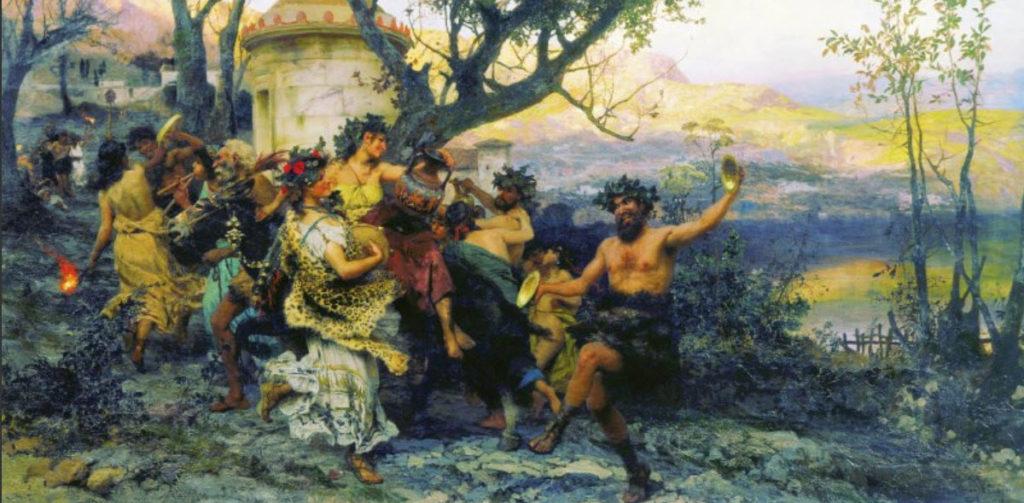
“Today is a day to drink and dance! Let us rival the priests of Bacchus with feasts to deck the couches of the gods!” – Aristarchus of Athens, Greek orator, 1st Century BC
The quotation that you see above are the first two sentences of a grandiose speech which was delivered in the first episode of the 1976 BBC miniseries I, Claudius.
The speech was performed for Caesar Augustus and his companions during a dinner party commemorating the seventh anniversary of the Battle of Actium, fought on September 2, 31 BC, which is regarded as one of the most important battles of ancient history.
The person who delivered this speech was a certain Greek orator named Aristarchus of Athens, who, in the words of Augustus himself, was “the greatest orator of our time”.
In reality, almost everything about this is pure make-believe. There was no such orator named Aristarchus of Athens who lived during the 1st Century BC – the character is entirely fictional.
Likewise, too, is the speech that he makes commemorating Caesar Augustus’ victory over Antony and Cleopatra.
However, the above quote makes an interesting reference to the god Bacchus, the ancient Roman god of wine, and this is because the Battle of Actium was fought on the day before this god’s primary feast day.
And well…
Bacchus was my kind of guy.
Bacchanalia, also called Dionysia, in Greco-Roman religion, any of the several festivals of Bacchus (Dionysus), the wine god. They probably originated as rites of fertility gods. The most famous of the Greek Dionysia were in Attica and included the Little, or Rustic, Dionysia, characterized by simple, old-fashioned rites; the Lenaea, which included a festal procession and dramatic performances; the Anthesteria, essentially a drinking feast; the City, or Great, Dionysia, accompanied by dramatic performances in the theatre of Dionysus, which was the most famous of all; and the Oschophoria (“Carrying of the Grape Clusters”)

-Bacchanalia
Christ and Sinner
A detail from Christ and Sinner…
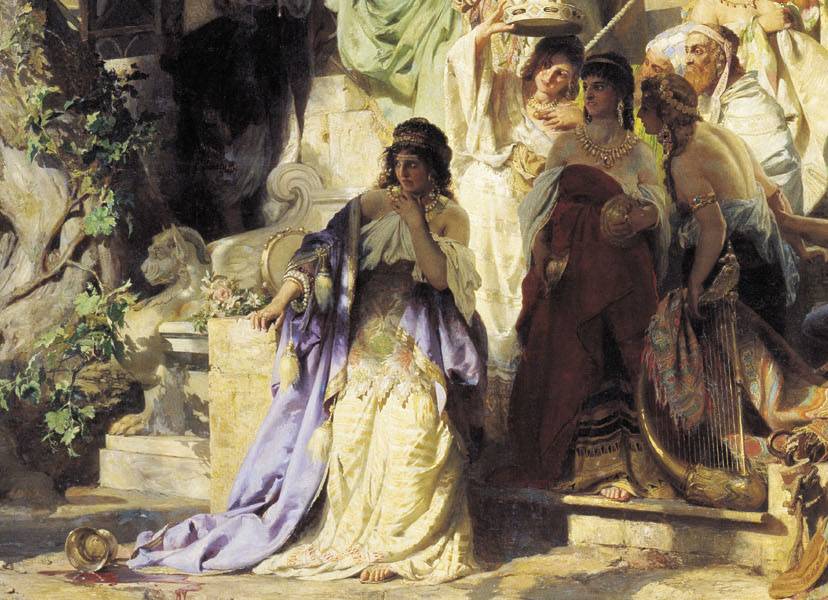
And…
The high resolution version of the entire painting is here…
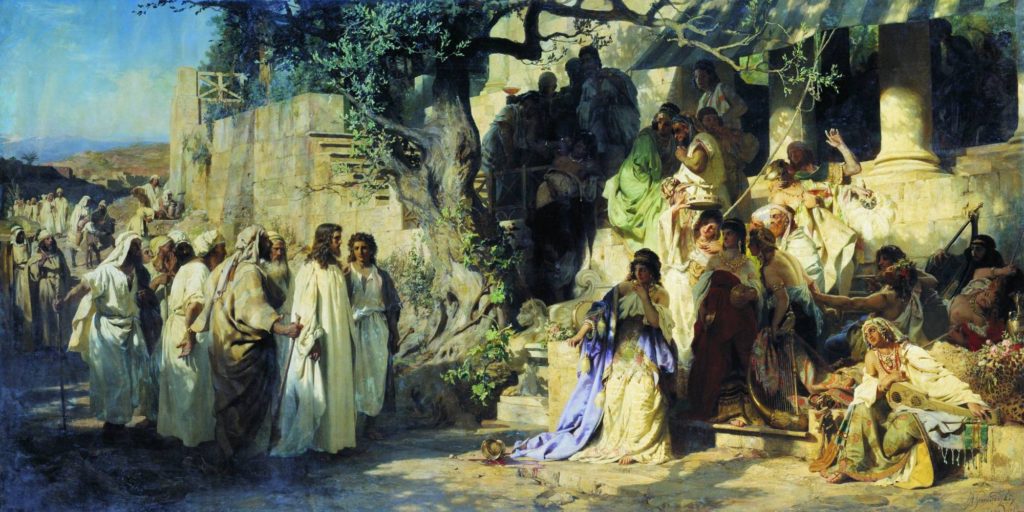
I do hope that you all enjoyed this stroll though art as I have. Have a great and wonderful day.
Do you want more?
I have more posts in my Art Index, here…
ART.
Articles & Links
Master Index.
You’ll not find any big banners or popups here talking about cookies and privacy notices. There are no ads on this site (aside from the hosting ads – a necessary evil). Functionally and fundamentally, I just don’t make money off of this blog. It is NOT monetized. Finally, I don’t track you because I just don’t care to.
- You can start reading the articles by going HERE.
- You can visit the Index Page HERE to explore by article subject.
- You can also ask the author some questions. You can go HERE to find out how to go about this.
- You can find out more about the author HERE.
- If you have concerns or complaints, you can go HERE.
- If you want to make a donation, you can go HERE.
Please kindly help me out in this effort. There is a lot of effort that goes into this disclosure. I could use all the financial support that anyone could provide. Thank you.
.
Do you want more?
I have more posts in my Art Index here…
ARTArticles & Links
You’ll not find any big banners or popups here talking about cookies and privacy notices. There are no ads on this site (aside from the hosting ads – a necessary evil). Functionally and fundamentally, I just don’t make money off of this blog. It is NOT monetized. Finally, I don’t track you because I just don’t care to.
To go to the MAIN Index;
Master Index.
- You can start reading the articles by going HERE.
- You can visit the Index Page HERE to explore by article subject.
- You can also ask the author some questions. You can go HERE .
- You can find out more about the author HERE.
- If you have concerns or complaints, you can go HERE.
- If you want to make a donation, you can go HERE.
Please kindly help me out in this effort. There is a lot of effort that goes into this disclosure. I could use all the financial support that anyone could provide. Thank you very much.
[wp_paypal_payment]