


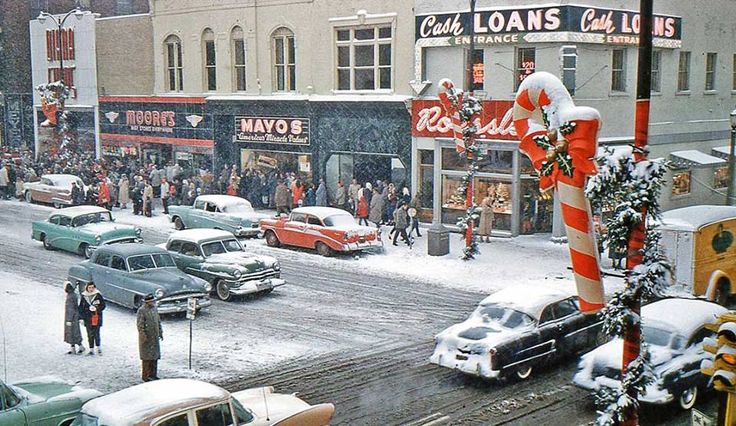
Let me tell you all about the hot dog shoppe in Marion Indiana.It was down town in the deserted downtown, on a clean but empty street. With all the nearby buildings boarded up.
But it was clear that the times were hard in Marion. But back a few decades earlier, it was another story.
Back in it’s “Hey-day” it looked like this…
Inside, it hadn’t changed at all. We got in and climbed on the stools that were well worn, but clearly hardly in use at the time.
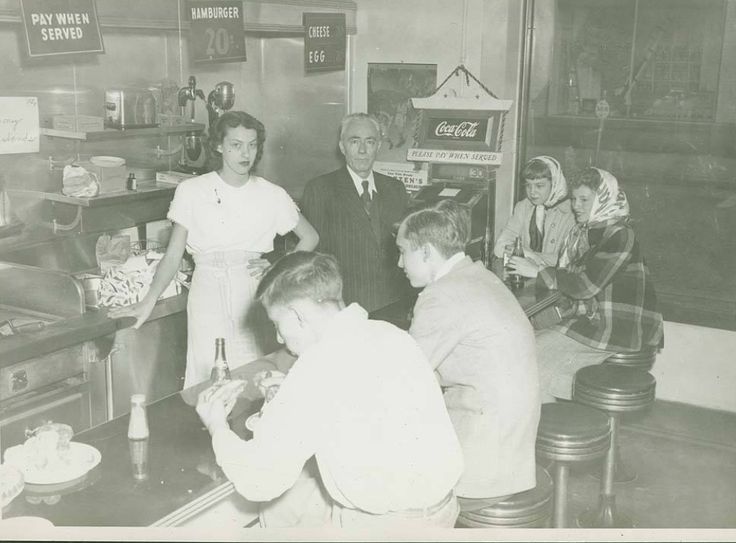
Ancient. A relic of former long-past, prosperous time.
Today, it only existing run by an old retired couple. Started in the 1920’s and now only exists to serve a long-deserted downtown. The two owners were perhaps in their 90’s and just shuffled from one end of the shop to the other.
Half the lights were not working. The back of the store was dark, and things were piled on boards on top of the booths back there.
It was probably a thriving store back in the day, but in the 1990’s the town was dying, and the city was deserted. Those that could leave… left. And only those too old to adapt stayed behind.
Sad really. It stunk inside. Like moldy cardboard, and lots of aged dust.
The wife and I got a steak and eggs with toast and coffee. And, you know, it was surprisingly good.

Sad, though.
Today…
Why are Chinese ships sailing near Australia’s coast?
Want to hear the truth?
The truth is, all you countries combined—stacked together—China could crush you with one finger.
You might think I’m exaggerating, but just Google it yourself and you’ll see.
Ever since its founding, China has planned everything—industry, economy, military—assuming the worst-case scenario: the entire world ganging up on us.
China, deep down, is incredibly insecure. After all, we carry the weight of a century of national humiliation.
An ancient nation, slaughtered and humiliated for a full 100 years.
That kind of shame, anger, and fear? It’s beyond anything you can imagine.
When fear reaches its peak, it turns into madness.
To counter the Soviet Union, we built artificial hills along the northern border—by hand, with no machinery—just to slow down potential Soviet tank divisions.
To prepare for all-out nuclear war, we dug countless deep tunnels in the southwest, ensuring that even if every nuke in the world hit us, we wouldn’t be wiped out completely.
This fear has gone to irrational extremes: if we don’t control over 50% of any critical capability globally, we feel terrified.
Now, our steel production exceeds 50%—a slight relief. Industrial robots? Over 50%—a slight relief. Shipbuilding capacity? Over 50%—a slight relief…
But there’s still so much unease. Take nuclear forces, nuclear submarines, land- and sea-based nuclear strike capabilities… (Though I suspect the real numbers are higher than what’s publicly stated. Still, if it’s not over 50%, I personally feel deeply insecure.)
My personal advice to you fragile, egg-like countries: don’t poke China just because the U.S. nudges you to.
Think about Ukraine!
We are currently 10 times stronger than Russia.
The Communist Party is already frantically trying to suppress the nationalist fervor inside China.
But they’re not gods—they can’t fully control the fear and rage of an entire nation.
Nationalism in China splits into two camps: the conservatives and the radicals.
The problem? Even the conservatives keep accusing the radicals of being too conservative.
China’s military expenditure is currently 1.7% of GDP. I’m the most conservative type of elderly person, but I hope it’s 5%, while young people hope it’s 20%!
I’m genuinely worried. The younger generation is growing more and more restless.
When industrial capacity soon hits 50% of the world’s total, a China with 1.4 billion people—a China where technology is advancing like wildfire—if it ever turns to militarism, it’ll be a tragedy for all humanity.
At the very least, it’ll be a massive tragedy for you countries—those fragile ones like Canada and Australia, always sending your rickety ships and planes to buzz China’s coastline.
Chinese people, honestly, have a bloodthirsty streak. It’s true.
The Communist Party is incredible for keeping us in check, holding back the fangs.
But please, think about the Party’s position for a moment—stop provoking us.
Thank you.
Can you use a black marker to write “leave me alone” on your prisoner’s uniform?
What makes you think that would earn you anything other than unwanted attention, Maher?
- Your gonna get a disciplinary sanction from admin for defacing DOC property, because that jumper isn’t yours, pal;
- Your cellmate is gonna take it as a personal insult and likely throttle you in your sleep;
- Your podmates are gonna take every opportunity to harass and bully the whiner in the customized clown costume.
The worst thing in the world you can do in jail or prison is to draw attention to yourself in a manner perceived as either weak or unnecessarily confrontational.
You wanna be left alone?
Don’t give inmates a reason to give you a second glance.
Making yourself a walking billboard is about as counterproductive as it gets short of changing the channel on the day room TV without asking.
- Eyes Open
- Head Down
- Mouth Shut
Hush Puppies

Ingredients
- 2 cups cornmeal
- 1/4 cup all-purpose flour
- 1 egg, beaten
- 2 cups buttermilk
- 1/2 cup finely chopped onion
- 1 teaspoon baking soda
- 1 tablespoon baking powder
- 1 tablespoon salt
Instructions
- Mix, Shape, then fry in deep fat until they float and are golden brown.
Notes
For lighter hush puppies, add 1/2 cup more milk and 1 more egg then drop by tablespoons into fat.
What smell will you never forget?
My father was a career homicide investigator (sheriff’s department) in the era just before television popularized the modern acronym “CSI.”
He was on-call a lot. So much so that his trousers were always ready to put on with the pockets pre-filled with keys, wallet, and various tools of the trade (measuring devices, markers, etc). Many middle-of-the-night calls saw him leaping into action like a firefighter, but this was always confusing to me because I knew his job started AFTER a crime had been committed.
Nevertheless, he always treated these as emergencies, and I learned that was because he didn’t want some bumbling hack to contaminate the scene.
Photography was a big part of his job, so he often told others that he was a “still-life photographer” for a living. Dark humor is a common coping mechanism for many under-appreciated heroes with this kind of role.
As part of the old-school (1970s and 80s) crime scene response kit, a jar of Vaseline and a cigar were always packed and ready. I learned that those “tools” were available for working a scene wherein the stench of human decomposition required stuffing one’s nostrils completely full of Vaseline and lighting the cigar for some self-preservation. According to many old-school cops, this primitive but widely used technique was rarely effective enough.
While you may think you already know the direction of this answer, I will take a hard left.
I remember the times I visited him at work. His office was attached to the small county crime lab.
Due to the nature of the work, I wasn’t often allowed to visit. He was pretty careful about what a kid shouldn’t be exposed to.
A smaller but still attached room was a color film and photograph processing lab, and I once got to be in there (only able to see by the light of a small red bulb) for the elaborate procedure of removing 35mm film from a camera and developing the film… to the production of contact sheets from negatives, and a few full-scale prints from the enlarger.
I will never forget the distinct and pungent smell of the trays and bottles of chemicals for photograph film processing. These things do not combine into a particularly pleasant smell. It is like a strange combination of bleach, vinegar, and a blanket of the sterile air of an operating room. This was thirty-five years ago, and I may never smell it again, but I can still easily conjure up the memory.
That smell represents a treasured memory of my dad, who was a hero.
China’s 6th Gen Fighter-What We Know
An American friend of mine wants to work in China(Ron). His expected salary is $5 a day. He said that he was willing to clean the toilet and assemble toys for me, and even begged me for this. How can I dissuade him?
(Answed BY Deepseek,I did not check the entire text, if there is any mistake, I am very sorry.)
( <Think> Okay, so my friend Ron wants to work in China for $5 a day doing menial jobs like cleaning toilets and assembling toys. He’s even begging me for this opportunity. I need to figure out how to dissuade him. Let me start by understanding why he’s so set on this. Maybe he thinks China is a place where such jobs are easy to get, or maybe he’s looking for an adventure but doesn’t realize the realities.
First, I should consider the legal aspects. Does China even allow foreigners to work in those kinds of jobs? I know many countries have strict work visa requirements, especially for low-skilled labor. Maybe Ron isn’t aware that he can’t just show up and start working. He’d need a proper work visa, which typically requires a company to sponsor him. Employers in China might not go through the hassle for a $5/day job. Also, $5 a day is way below the minimum wage in China, right? That could be illegal, and he could be exploited. Plus, if he works illegally, he might face deportation or fines.
Then there’s the cost of living. Even if he somehow managed to get a job paying $5 a day, would that be enough to live on? In big cities like Shanghai or Beijing, the cost of living is higher. Maybe in rural areas it’s cheaper, but then job opportunities might be scarce. He might not have considered housing, food, transportation, which can add up quickly. If he’s earning $150 a month (assuming 30 days), that’s probably not enough to survive, leading to debt or unsafe living conditions.
Another angle is the social and cultural challenges. Does Ron speak Mandarin? Without language skills, daily tasks become difficult. Communication barriers could lead to misunderstandings with employers or landlords. Also, cultural differences in work environments might be a shock. Chinese workplaces might have different expectations regarding hours, hierarchy, and work ethic. Ron might not be prepared for that.
Health and safety is another concern. Jobs like cleaning or assembly might involve harsh conditions, especially in factories. Without proper contracts, he might not have health insurance or legal protection if injured. If he’s working under the table, he’s vulnerable to exploitation, unpaid wages, or unsafe working conditions.
I should also think about alternatives. Maybe Ron is interested in China for the experience, but there are better ways. Teaching English is a common job for expats in China, pays better, and is legal. Or internships, study programs, or other skilled jobs that offer legitimate visas. Encouraging him to look into those options instead could satisfy his desire to work in China without the risks.
Additionally, maybe Ron is desperate or going through something. If he’s begging for such a low-wage job, perhaps he’s in a tough spot financially or emotionally. Addressing the root cause of his desperation might help. Suggesting support services or alternative plans could be more effective than just pointing out the impracticalities.
I should present all these points to Ron in a compassionate way. Maybe start by acknowledging his desire to work abroad but then outline the legal, financial, and practical challenges. Offer alternative solutions that are safer and more sustainable. Highlight the risks of illegal work and exploitation, and emphasize his worth—he shouldn’t undervalue himself to the point of accepting such low pay. </Think>
*To dissuade Ron from pursuing this unrealistic and risky plan, approach the conversation with empathy and factual information. Here’s a structured way to address his intentions:*
***1. Legal and Visa Barriers***
* ***Work Visa Requirements****: Explain that China requires a valid work visa (Z-visa) for foreign workers, which mandates sponsorship from a registered company. Employers are unlikely to sponsor low-skilled jobs like cleaning or toy assembly due to costs and regulations.*
* ***Illegal Work Risks****: Working without a proper visa could lead to fines, deportation, or bans on re-entry. Stress that $5/day jobs are typically informal and illegal for foreigners, exposing him to exploitation.*
***2. Financial Realities***
* ***Minimum Wage vs. Cost of Living****: China’s average monthly minimum wage ranges from ¥1,500–¥2,500 (*$210–$*350) depending on the region. *$5/day($*150/month) is far below this and insufficient for basic needs, even in rural areas. Highlight expenses like rent, food, and transportation.*
* ***Exploitation Risk****: Employers paying under the table might withhold wages or impose unsafe conditions, leaving him no legal recourse.*
***3. Cultural and Practical Challenges***
* ***Language Barrier****: Without Mandarin skills, daily life (finding housing, negotiating contracts) would be extremely challenging.*
* ***Work Culture Differences****: Long hours, strict hierarchies, and unfamiliar labor practices could lead to burnout or conflict.*
***4. Health and Safety Concerns***
* ***No Protections****: Informal jobs often lack health insurance, workplace safety measures, or contracts. Injuries or illnesses could become catastrophic without support.*
***5. Better Alternatives***
* ***Legitimate Opportunities****: Suggest teaching English (a high-demand job with legal visas and better pay, ~¥15,000–¥25,000/month). Other options include internships, studying Mandarin, or skilled roles in his field.*
* ***Cultural Exchange Programs****: Recommend programs like Workaway or AIESEC for structured, legal experiences abroad.*
***6. Address Root Motivations***
* ***Listen and Support****: Ask why he’s fixated on this plan. If he’s desperate, suggest counseling or financial assistance resources. Emphasize his value—he deserves fair pay and safe work.*
***Example Conversation Starter:***
*“Ron, I admire your adventurous spirit, but working in China for $5/day isn’t feasible or safe. Legally, foreigners can’t take informal jobs, and that wage won’t cover basic needs. Instead, let’s explore teaching English or internships—they offer better pay, legal visas, and a chance to experience China without the risks. You deserve an opportunity that respects your skills and safety.”*
*By combining empathy with clear facts, you can guide Ron toward safer, more sustainable options while respecting his aspirations.*
“It’s Just Me.”
Submitted into Contest #279 in response to: Center your story around a person who believes they’re the last human on Earth.… view prompt
Tucker Sloan
“Water. Water today, please. God Almighty. If I continue to dig this well, might I please have some water? It’s just me now. Please, some water?”
We dug crazy holes causing great water discoveries back in the day. We wanted to show our God that we were willing to do whatever it would take to survive. Gallons and gallons of clean water from our Mother Earth was delivered to us via rain. Much needed rain. We thanked the Lord with all of our hearts. Water. Life. Renewal. Soon, we would have food. I wish I could gut a boar and swallow its flesh. Smoked perfectly. A mouthwatering boar would be nice! Then I heard a squeal. A boar!
“Oh! Dear Lord! You have answered my prayers!”
The boar was caught in the snare, and his heart soon stopped beating. I didn’t have to kill it. What strength this meal will give me. I shall have strength. Sustainable energy. I was going to be fine. I was going to live. As I shaved off the boar’s skin to make a hat to shield me from the sun- plus shoulder pads, and knee pads- I cried out a prayer of gratitude to my Lord.
“This kill did not go to waste. Now, onward. The goal is set, and we have to reach it.”
Sometimes I say, “We.” I like the idea of having my son with me. My family. My loved ones. My son was beautiful. You would’ve liked him. He was sweet, and he loved my record collection very much. Sadly, it was now just me. I wanted him here. I wanted him here right now. I wish I could’ve protected him, but I now have to move on. I am alive, and he is dead and buried. Gone forever. I have many days ahead of me- I hope.
We named him Isaiah, my son. Once we saw his beautiful, sparkling, blue eyes, we knew we had to name him with a beautiful, Biblical name.
I’d scream out, “Izzy!!!” When we had ice, and snow storms, I’d scream out, “Izzy! My baby!” And he’d come running right to me without a care in the world. He would even be barefoot. He did not care. He would throw snowballs, and build snowmen with his neighbor every winter.
We think Isaiah sleep walks, and that scares me. He could have got lost in the cold. Sorry. I got lost in my own thought. He’s gone now. They’re all gone. It’s me now. Just me. Lonely me.
Last night, I heard a car honk. I lit fire! I yelled! I packed my bag hoping for rescue from the cold. But when I got to the road- there was no one there to help me, so I cried again. Maybe it was just some strange bird. A bird I’d like to eat. I wandered back slowly. I was deprived of hope, and was in full despair. Maybe I was hallucinating.
Pink clouds. I kept seeing pink clouds with a silver-blue lining. In my bedroom, in the bath- pink clouds were everywhere. I soon learned to ignore them. Maybe I had lost it. I cried again as I entered my lonely cabin. It was just me now. I was alone. No one left. They just died on me. They did not fight!
As I read Revelations, I feared I was losing my faith. I did pray. I prayed many beautiful prayers. It was the only thing that lifted my spirits. I continued to pray. Prayers like:
“Dear Lord. Almighty God. Save me from my dark thoughts. Thoughts that could end me up in hell. And forgive me for sleeping with Jodie that one night. She was a church friend, so I still feel bad about that.”
I spoke to my Heavenly Father aloud every day. It seemed to be just Him and I. That made me cry, too. With no one to look at- no one to touch- I began to become unglued.
Anger. Violent outbursts. Panic attacks! Screaming at the Almighty just begging to be heard.
“Save me!” I cried! “Take away my breath, my life, and let me be with you so I don’t feel so alone!” And He did not listen to me that day. No, He did not listen.
I carefully traveled to a cliff the next day. A beautiful cliff. The place I wanted to die.
“Father, Son, and Holy Spirit, just take me!” I cried as I approached the edge.
Falling to my death was a thought that always haunted my dreams. It tormented my soul in ways I can’t explain, but there was something about that cliff side. Something beautiful about it. This was the place. The place in my dreams where I once saw two beautiful women pet a wild swan right where I currently stood. They then hugged for the longest time, and moved away from the cliff.
I wanted to jump off of it as if demons were driving me to my death. Forcing me to jump. Then they showed up behind me in droves under the cover of night.
“Run from us!” They taunted, and I ran as fast as I could into a dead end. I cried again. I did not want demons to be around me, so I took a deep breath, and I ran the long way home praying aloud for the demons to flee in Jesus’s name. They didn’t completely stay away. They watched me the whole way home. They multiplied. There were creatures of purple and green with many limbs like a centipede’s. They had horns, and antlers, and over-sized, well, you know.
I ran, and I ran without looking back for fear God would turn me into a pillar of salt.
I had run from evil. The demons. The dark. As I approached my residence, a rainbow appeared even though it had not been raining. Thank you, God- I said to myself. A joyful moment at the end of a long, hard day. I needed that. I wish you could’ve seen it, too, but, alas, it’s just me.
Have you ever experienced a “glitch in the matrix”? What are some glitch in the matrix stories in which something inexplicable happened?
Going anonymous here because I have a professional reputation to uphold and can’t have clients questioning my sanity.
I live in a small town. Every now and then, a business or resident does something special and makes it on national TV. This gets a lot of attention in the local news, as you can imagine. Headlines like ‘Local Man Competes in Nationally Televised Athletic Event’ meant someone was about to be a local celebrity.
When I was in high school, I remember casually watching Jeopardy one evening and being completely caught off guard when a small local college was the answer based on its unique geographical characteristics. This was big news.
When I got to school the next day, it was the talk of the halls. “X College was on Jeopardy last night!” It was the headline on the front page of several local papers. Over the next few years, teachers would often bring it up as they discussed local college options with their students. We all proudly dropped the geographical factoid and its feature on Jeopardy when discussing the college with outsiders.
Fast forward 20 years. I’m brainstorming marketing ideas with a local real estate broker and the college comes up. I casually suggest we mention the fact that it was featured on Jeopardy in the marketing piece.
Broker: It was on Jeopardy? When?
Me: It must have been 19 or 20 years ago now. Were you in college then?
Broker: No, I was out and back here working already.
Me: I’m not sure how you missed that. It was all over the news and everyone was talking about it.
Broker: Weird. How did I miss that? Are you sure?
Me: I’m sure. I’ll look it up and send you the link.
I pulled out my phone to Google it and show the broker evidence that it happened. It was nowhere to be found…
I bring it up to my wife later that evening. Nothing… Later, at a social function with close friends and family, I bring it up again, jokingly telling everyone I think I must have jumped dimensions. Two other people in the group instantly jump to my defense and remember the situation exactly as I did. Everyone else looks confused or irritated, insisting that I must have dreamed it and that my story had created a false memory in the others.
We never settled this, but I’m telling you, the college was on Jeopardy in my reality.
First Time Hearing Starship – Nothing’s Gonna Stop Us Now | REACTION
EU chief Charles Michel has said China must “adapt its behaviour” to solve trade row. Do you think China would do so? Does Brussels have any means to force Beijing to submit? How do you expect Beijing to react?
Many among the European establishment are legacy of the last two centuries. They still hold the view that non-Western countries are there to serve western countries’ interest and biddings. The likes of China must defer to US and European countries on how to conduct themselves in front of westerners. China is not suppose to participate in setting international rules and regulations at United Nations or other multilateral international bodies.
What the likes of Von Der Layen and Macron fails to see that Europe is able to dictate how the world works for the last two centuries because of their military and economic strengths and not by virtue of their skin colour.
China while wanting to have a good working relationship with Europe. However, the expectation is that this is a relationship of equals. China can insists that because they have the economic clout to do that.
European Union as a collective if cannot have consensus to treat China as equal, China will go for bilateral instead of multilateral relationships. Example, China-UK, China-Germany or China-Hungary negotiations instead of China-EU. This means China is in a stronger position to negotiate deals bilaterally.
What’s the most embarrassing mistake an Oscar winner has made in their acceptance speech?
In 2002, Julia Roberts won the Oscar for Best Actress for her performance in Erin Brokovich , the true story of a single woman’s fight against a company responsible for polluting the region’s water.
Julia Roberts will take the stage to receive her trophy and give a 4-minute speech, while the time allotted to winners is normally 45 seconds.
The actress caused a sensation when she called the conductor to tell him, from the beginning: “Sir, you are doing a wonderful job, but you pull the baton too quickly, so I suggest you sit down, because I have things to say and I may never have another chance to be here! »
And a few moments later, in the middle of her speech, she will address the producers of the ceremony showing the stopwatch that indicates the time she spends on stage:
“Turn off that timer, it stresses me out!”
During the 4 minutes she will spend on stage, Julia Roberts will thank many people, including the other actors in the film, the other nominees, the director, her boyfriend, her mother…
But she won’t thank Erin Brokovich, the person behind the project, who she plays in the film, who she hung out with during filming and with whom she probably had a very good relationship.
An embarrassing oversight.
Julia Roberts also realized this shortly after leaving the stage, when answering journalists backstage.
She then apologized categorically: “I made a big mistake. I was so upset that I forgot to thank Erin. Shame on me, shame on me! Very humbly, I thank you a thousand times.”
Julia Roberts’s oblivion will be almost as much of a conversation piece as the length of her acceptance speech.
Erin Brokovich, for her part, will not go against the star and will refute critics who wanted to see this carelessness as a form of ingratitude or narcissism.
“It was her moment, not mine,” she said. “I didn’t see anything wrong with it, it didn’t bother me at all!”
What is the most condescending advice you have ever been given?
I was QCing a project at a contractors. I always like to deal directly with the person doing the work, rather than have a manager or supervisor show me the work that’s been done so far, as the manager isn’t as intimately involved in the details. I had never met this worker before. The manager made the introductions, and asked him to begin. He started giving me a whole tutorial on how the whole process works, so I could see the big picture. I told him I understand the process, I just want the details of what he is doing on my project. He ignored me, so sure of himself that he was the expert, and kept talking over top of me. He explained that people didn’t understand why certain steps were done, so they would do them wrong if it wasn’t explained to them. His boss, who used to work for me, broke in and asked him what they called the method they were using. He replied, the Wilson method. Then he asked him if he remembered who he had just been introduced to. He said no, he wasn’t paying attention.His boss said, meet Mr Wilson. He was a lot more subdued after that, but still talked over me occasionally.
You don’t talk over the client, you don’t talk over the person who designed the process. Yet here was this guy telling so sure he understood it better, that he did both.
Why do judges sentence people to 100 years to life or 150 to life? A person never lives that long. Does a person even have the possibility of meeting with parole after 15 or 20 years with that kind of sentence?
I had a cellmate in Pelican Bay who received a sentence of 110-to-life. His first parole board hearing was so far in the future (like 85 years or something ridiculous like that) he had resigned himself to dying in prison. So I think that the judge that gave him the time was generally following the law. The three-strikes-law. It is an archaic law but it was the people of California that passed it. The judge was doing basically what the law required him or her to do. In other cases, a judge may be trying to make an example of someone by giving them that kind of time. Usually it’s because they do not detect any remorse in the person.
Pictures




What is a slap-in-the-face job offer?
I had left my prior job as a VP of IT at a start-up based out of NYC. I had over 20 years of experience in IT at that point, much of it at managerial level. I had been making a 6 figure salary for several years.
A recruiter reached out to me with a job offer. It didn’t sound quite right, but I thought I’d listen.
He describes the job. It was basically “break and fix”. Stuff I had done as entry level work twenty years previously. The pay was something like $20/hour and would have required a daily commute of about an hour each way.
The recruiter sounded young and new to the job. I very politely asked him to look at my last few job titles and job descriptions and asked him if he thought what he was offering was commensurate with my skill set and what he thought my expected salary would be. I then advised him if he wanted to be successful in his field that he really adjust his approach.
I have no idea if he did, but I shortly went back into consulting, and worked fewer hours a year making just as much.
I’ve got nothing against break and fix IT jobs. I’ve been there, done that. We need folks like that. But it wasn’t the job for me at that point in my career.
“After My Husband Adopted My Kids, I Left Him for My Ex.”
How did the Han Dynasty Chinese defeat the Huns (Xiongnu) (Turks)?
Imagine these nomadic raiders as the original “armed squatters on horseback” 🐎. When their grasslands turned into frozen wasteland, they’d basically pull up to China’s doorstep like: “Hey neighbor! Since Mother Nature cancelled our buffet, we’ll just… uh… borrow your groceries… WITH SWORDS!” 🔪
For them, raiding wasn’t career choice – it was the OG “DoorDash or die” delivery service. Why freeze your butt off herding sheep when you could yeet yourself over the Great Wall for some warm loot?
Modern Chinese anti-illegal-immigration vibes? That’s centuries of collective memory going: “Nope, not letting history repeat its TikTok remix of ‘surprise dinner guests with battleaxes'” 🛡️🍽️. Would YOU want kung pao chicken interrupted by dudes screaming “YEEHAW THIS TABLE’S OURS NOW”?
Yes, even if you are as powerful as a lion on the grassland, you will be stung all over your face by these mosquitoes
Then you invented the mosquito net (Great Wall), but there are always loopholes in the mosquito net
When you go after them, they will disappear without a trace The effort you put in is not proportional to the benefits you receive
This is the experience of Chinese people fighting against illegal immigrants
YES, You need to spray highly toxic insecticides indiscriminately, and you also need to be prepared to spend a large amount of money to treat the polluted water sources and manure pits near your home
The Curse of the Cursed Sunbeam
It was a bright and beautiful morning on the farm, and Sir Whiskerton, the farm’s self-appointed detective and philosopher, was ready to bask in his favorite sunbeam. He had it all planned out: a luxurious stretch, a quick grooming session, and then a well-deserved nap. But as he sauntered over to his usual spot by the barn, something was terribly wrong.
The sunbeam was gone.
Sir Whiskerton blinked, adjusted his monocle, and looked again. No, it wasn’t a trick of the light. His beloved sunbeam had vanished, replaced by a shadow cast by a rogue cloud that had parked itself directly overhead. The cloud was stubborn, unmoving, and—dare he say it—rude.
“This is an outrage!” Sir Whiskerton declared, pacing back and forth. “A sunbeam is not merely a patch of light; it is a sanctuary, a place of reflection, a stage for my brilliance! This cloud has no right to intrude upon my daily routine.”
Rufus the Dog, ever the loyal sidekick, trotted over, his glowing green fur flickering with concern. “Maybe it’s just passing through, Sir Whiskerton. Clouds do that, you know.”
“Passing through? This cloud is loitering!” Sir Whiskerton huffed. “It’s as if it has a personal vendetta against me. I must get to the bottom of this.”
Doris the Hen, who had been eavesdropping (as usual), clucked nervously. “Oh dear, oh dear! What if it’s cursed? What if the cloud is haunted? What if it’s a sign of impending doom?”
“Doom?” Sir Whiskerton raised an eyebrow. “Doris, please. This is no time for your dramatics. This is a matter of science—and possibly philosophy. I shall consult Philo the Philosophical Penguin. If anyone can unravel the mystery of this cursed cloud, it’s him.”
Philo the Philosophical Penguin was perched by the pond, deep in thought, as usual. His eyes were closed, and he was muttering something about the existential nature of ripples. Sir Whiskerton approached with Ditto the Kitten trailing behind, echoing every word.
“Philo, I require your wisdom,” Sir Whiskerton began.
“Philo, I require your wisdom,” Ditto echoed.
“A rogue cloud has stolen my sunbeam,” Sir Whiskerton continued.
“A rogue cloud has stolen my sunbeam,” Ditto repeated.
“And I demand to know why it refuses to move,” Sir Whiskerton finished.
“And I demand to know why it refuses to move,” Ditto parroted.
Philo opened one eye and regarded them both. “Ah, the sunbeam. A fleeting moment of warmth in an otherwise cold and indifferent universe. But tell me, Sir Whiskerton, have you considered that the cloud might simply need a good conversation?”
“A conversation?” Sir Whiskerton scoffed. “With a cloud? Preposterous!”
“Preposterous!” Ditto chirped.
“And yet,” Philo continued, “all things have a voice, if only we listen. Perhaps the cloud is lonely. Or perhaps it has a message for you. Patience, my feline friend, is the key to unlocking the mysteries of the universe.”
Sir Whiskerton sighed. “Very well. I shall attempt to converse with this obstinate cloud. But if this doesn’t work, I’m holding you responsible, Philo.”
“Responsible!” Ditto echoed.
Back at the barn, Sir Whiskerton stood beneath the cloud, cleared his throat, and began. “Ahem. Cloud, if you can hear me, I demand to know why you’ve taken my sunbeam. This is highly inconvenient, not to mention disrespectful.”
“Disrespectful!” Ditto added, standing beside him.
The cloud did not respond. It simply hovered, dark and silent.
Sir Whiskerton tried again. “Cloud, I understand that you may have your reasons, but surely you can see that this sunbeam is of great importance to me. It’s not just a patch of light; it’s a symbol of order, of balance, of… of me!”
“Of me!” Ditto chimed in.
Still, the cloud remained unmoved.
Just as Sir Whiskerton was about to give up, a gentle breeze swept across the farm. The cloud shifted ever so slightly, and a sliver of sunlight broke through. Encouraged, Sir Whiskerton continued. “Ah, I see you’re listening now. Very good. Now, if you’d be so kind as to move along, I’d greatly appreciate it.”
The cloud shifted again, and more sunlight spilled through. Slowly but surely, the cloud began to drift away, revealing the full glory of Sir Whiskerton’s sunbeam.
“Success!” Sir Whiskerton declared, triumphant. “The curse of the cursed sunbeam has been lifted!”
“Lifted!” Ditto cheered.
As Sir Whiskerton settled into his sunbeam, he couldn’t help but reflect on Philo’s advice. Perhaps the cloud had needed a little patience and understanding after all. Or perhaps it had just gotten bored. Either way, the lesson was clear: sometimes, patience brings the sunshine back.
And with that, Sir Whiskerton closed his eyes, basking in the warmth of his restored sunbeam, while Ditto curled up beside him, echoing his contented purrs.
The End.
Moral: Sometimes, patience brings the sunshine back.
Do Chinese propaganda officials have an agenda to demonize India?
In tamil we have a saying “Naama avalovu worth illa”
This means “We ain’t worth the effort”
These are our majority of the voters
They don’t understand English
Half of them can’t read or write
And they will sell their vote for 5 Kilos of Rice
So Chinese officials need 2 Kilos of Mutton and 6000 Bucks to buy votes in India 😂😂😂
That’s 500 Yuan a vote
That’s 50 Billion Yuan to buy 10 Crore votes
Around less than 1% of their Trade Surplus
So if the Chinese really decided to step in, half of us would be speaking mandarin by now
So these are delusions
Chinese Propaganda Officials have one job
Counter the Propaganda against China
They do this not by just talking but showcasing Chinese achievements and letting the world do it’s thing
They do it by inviting people and showing them what China is
Not stupidly paying a bunch of people to write propaganda that no one reads
Swept Away
Submitted into Contest #279 in response to: Center your story around a person who believes they’re the last human on Earth.… view prompt
Samuel Knight
“Time to sweep,” I said and sighed. And no one answered. No one ever answers. No one but the wind. It speaks. It spoke. But it couldn’t have been the wind. The windows were closed—the blinds were drawn—they’re always closed—always drawn—it’s always dark at dawn in here—it stinks in here—that’s because there’s no wind. Outside, while I work, the wind might talk, might hush or mock or play its twister games, but not in here. Never in here. So maybe it was me. Was me that answered, I mean. I never answer, but maybe I did this time.
Anyway, it answered—whoever answered—whatever? Ah. Yes. Yes! Whatever. It was a whatever. Yes. Because it was my broom—my special besom broom, Echo—I call it Echo—that answered. That’s why the answer sounded dry and distant and repetitive. My arms are long. Yes. That makes sense. Echo often answers. Echo’s my broom. It speaks in whispers, dry and sharp, with every sweep. Shhh, it says. Shhh. With its bristly shushing sounds, with every sweep—I realise that I’m sweeping now—I’m outside now—odd—with every sweep, it sounds its shushes like a person shushing others into silence, like the world should hush and let me work.
I don’t know why Echo shushes others into silence. In this silence, there are no others. There are never any others. Only me. There was a woman once. Now, only me. Out here. Only me. Me and my street. The street and its leaves. Me and the leaves that I sweep. They’re all I sweep. Leaves. But I’m not a leaf-raker. I am not a raker! I have Echo. Echo’s my broom. I am a sweeper! I sweep! That’s what I do. That’s what I am. A street-sweeper! Who sweeps. I’m alone. Once the wind called me a raker. A rakist! The audacity! I’d never rake. But Echo’s right. The world should hush and let me work. The wind that I can now faintly feel should hush. Today I have to work. I have to sweep up Fifth Street. Fifth Street is mine. It’s mine. It’s mine to clean, to keep—to maintain! That’s the word! Maintain! I maintain the streets. It’s mine to maintain. Fifth Street is maintained by me, and no one else. Or, it was. I’m forgetful now. I wasn’t once. I am now. Time twists.
But back to the street. It’s never clean. Fifth Street, I mean. It’s never clean. Leaves fall on it every day: curling, golden-brown. And every day, they seem a little darker. They fall from no trees—there are no trees here—not anymore—but they fall all the same. A little gift from nowhere. A little challenge by no one. “Clean Fifth Street!” my challenger decrees. But that’s not true. My challenger wouldn’t call it Fifth Street. I call it Fifth Street. I don’t know what street it is or what it’s called. I think it’s the only street, but one time when I had swept four-fifths of the street I saw that there was a fifth of the street left, so, naturally, I called that fifth of the street the Fifth Street, fifth of five that I’d had to sweep, but then I realised that since that street, the Fifth Street, was actually the same street as the rest of the street that I’d already swept, the whole thing was the same street as the Fifth Street and thus should have the same name as the Fifth Street and thus should be the Fifth Street, but since most place names drop the the I just call it all Fifth Street. Anyway, I have to work.
—
As day draws on, dull light dawns, and it starts. Gold leaves fall. Slow drifts. I mutter, starting my work, brushing Echo forward. Echo protests, bristles rasping on the broken paving. But it moves. I’m strong, arms long—Echo always moves for me. And now too, the wind is watching. I feel it on my back and on the back of my neck. I feel it soft and sharp. It’s both at once. Sometimes it helps, pushing piles into place. Sometimes it laughs, loosing them before I’m done. It’s so fickle. Always playing games. Makes me laugh. But it isn’t just a breeze. Don’t call it a breeze! It’s a voice, a hand, a thing with thoughts—and feelings too, don’t forget! Do not insult it! That didn’t go well last time. I feel it watching when I sweep. I feel its fingers tugging, teasing, testing, always testing. It knows me well, knows how to rile me up and calm me down. It toys with me. I’m fine with that. Sometimes, when it quiets, when it stills or shifts to something soft, I wonder what it’s doing. Honestly, my work is made quite hard by its distractions. But that’s fine. Anyway, I have to work.
—
A softing morning. Soundless. Still. I’m working well. No wind. No word. No sound. Save me. That’s weird. There’s not much left for me to do. I’ve gotten faster. Well, actually, I’m older. I’ve gotten slower. But I’ve gotten more efficient. I’m almost done. Almost. Fifth Street’s stretch is clean behind me for the first time in a long time. No leaves. No dust. Just clean. Grey pavement, rough and clean.
“I guess I’m done,” I say, somewhat surprised. “No more today.”
And just as I begin to bring my Echo over the last of this day’s leaves, I hear a sound. A strange sound. A high-pitched clink. And there, by me, at the end of the street, I saw it. A leaf. I thought for sure it was a leaf. The last leaf—perhaps made brittle by the early cold. But no. It was no leaf. It was something else. It shone. A sliver of a silver something, shining palely in the light—not gold at all—a sliver that should not be there—could not be there—must not be there!—yet was there. It was there for a reason. I—my fingers—itched to hold it, claim it, clean the floor of it, but my mind lagged, spinning leaflike in a wind of worry. What did it want?
My arms are long—just long enough to stretch to where the silver lay. Echo clattered to the ground just as my hand had found the thing it sought to hold. A key. No, not a key. A key-like thing. I turned it over in my hand and felt its edges sharp against my skin. Cold, smooth, and heavy in a weird way, heavier than its size should have allowed. It was a key-like thing. Its sharpness shivered, humming faintly on my skin, whispering—or was that the wind? It seemed to nudge. Nudge me, I mean. I’m me. Echo’s my broom.
Behind, the wind arose. It carried up my well-piled leaves—the piles I’d worked so hard to pile together!—and swept them down the street like a gilded tide. I jumped, shocked, raged, and shouted after it—but I can’t shout—and I ran after it—but I can’t run—so I hobbled, mumbling, behind my leaving leaves, dragging Echo with me. They moved so fast. They all moved. All. Every leaf.
“Swept away,” I muttered and growled. “Swept away. I was almost done. I was done! A little is fine. Sweeping some is fun. But all! You swept away all my work! All!” The leaves tumbled onward, flowing with the wind, increasing with its speed. “You… I just swept that!” And faster and faster they blew on, and I followed, until they, with dully rasping smacks, collided with a gate. I’d not known that that gate was there.
—
I approached it. It was old. I’d never seen this gate before. Its iron bars were black and bent and chains were wrapped around it, thick and tight, and rust made flakes upon their skins, and over and under those chains were strips of fabric, fluttering in the wind, leaves tasselled on them, written over with the words “KEEP OUT” and “DO NOT ENTER” alternating repetitively in bold.
I stood there, staring. The wind decayed, and leaves began to drop and gather up behind my feet like children huddled up behind their mother’s skirts. And when the leaves had fully fallen, there I saw a small, black lock. Black, but warm. I felt its heat. I sought out that silver key thing—I’d pocketed it—and it too was warm now, buzzing faintly in my grip. The wind gusted, hard, impatient, tugging at my shirt, my arms, my legs, my hair—no—I had no hair—but it tugged at where I should have had hair—pushing me forward. The key now quivered in my hand—or my hand now quivered on the key—as I brought it, the key, and my hand, them both really, closer up to the lock. It felt quite warm now, like it had come to life. I slid the key into the lock. There was no resistance, no awkward insertion, just a soft click, like an exhale. And then the wind blew hard, and a door part of the gate creaked open.
I stepped back for a moment, the gate yawning open, black and not. The key now burned within my palm, no longer cold, no longer heavy, only hot and weightless like its light—it was shining now—I think I mentioned that. I think. Anyway, the wind pushed me forward. Pushed! Insistent. Swirling with sounds I could not comprehend—sounds, echoes, of laughter, of weeping, shouting—tangled sounds, together rushing up much like a tide about to break.
I put a nervous foot out through the gate, then hunched myself and went through with my foot.
—
Light hit me like a slap. Too bright. Too full. It flooded in. I stumbled forward, clutching Echo, clutching hard like how a drowning man might clasp a drift of wood. The wind was heavy here, different, loud. It didn’t just play. It howled. It carried things.
I blinked. The world sharpened, focused. And I saw. Beyond the gate, I saw a street. A street not like Fifth Street with its silence and its emptiness, its golden barrenness. This street was alive. Cars honked. Drills knocked. Shoes stepped. And voices shouted. Voices! My God, voices! Voices shout! I’d forgotten the sound—I’m forgetful now. But as I stood, my senses stabilising, the wind rushed past me, wild and free, carrying the smells of food and the smells of people—people!—and the smells of puddles, and oil, and dirt, and something else—something electric in my nose. Rubbish. Actual rubbish. Filth! The street was filthy. Leaves. Wrappers. Cups. Papers. Mud. Spit. Muck. Trash. Everywhere, piles and drifts and smears of filth. Different filth. Filth alive, breeding, multiplying. Not like the leaves, orderly in their disobedience, but anarchic, defiant, irredeemable filth: a mess in need of me. It needed to be cleaned. It never would be clean. Never. But that didn’t matter. It needed me. I need someone. Fifth Street had been mine. Now this street would be mine. I had a lot of work to do. Start with the leaves before they rot.
I took a further step out through the gate, feet crossing the threshold. “There’s always more to do.” I said. The wind whirled with noise, triumphant in its sounds. I knew it was laughing. I was laughing. “There’s more mess than just mine.” I cried. “Alright!” I said through teary laughs. “Alright! Alright! I’ll clean it up. I’ll clean it all.”
—
I began by brushing Echo on the ground, its bristles hissing shushes at the crowds. The people tried to ignore us, tried not to look. They tried to walk around me, stepping over the piles I’d swept together. That was fine. It didn’t matter. This was my street now. It would appreciate my work one day.
One woman saw me. “Hey,” she said, sidestepping my well-swept piles. “What are you doing?” She had a uniform on.
I looked up, Echo poised mid-sweep, eyes wide, surprised—she looked angry.
“Sweeping.” I said. “Cleaning what needs cleaning.”
The woman frowned, anger deeper. “Cleaning? Why are you raking…”
“Sweeping!” I cut her off, yelling. “I am not a raker! I’ve raked nothing!”
She frowned. “Okay…” She said, on guard. “Look. You’re not meant to be here. What are you trying to clean? The gutter? And… and how did you get my—please give it back!” She snatched the keylike thing from me.
I smiled faintly, tilting my head. “I’m just cleaning, ma’am. I’m always cleaning,” I smiled deeper. “Got to get on with my work… Lots to do today… Always cleaning.”
She sighed deeply then put on a fake face, a fake smile, her eyes flicking to Echo like it was a weapon. “Come on,” she said, voice clipped and pretending caring. “Give me the branch. You can’t clean anything with this.”
“Echo’s my broom!”
“That’s a branch… Come. We’ll get you something at the station. Come. Let’s take you somewhere that will help.”
Help me!
“No. No.” I said. “I don’t need help. The streets need help. The leaves need help! Can you not see? They’re dying. They need to be swept away before they rot! I have to sweep. If I don’t…” I trailed off and swept away, the wind about us twirling, like in play, on over to the end of the street where there stood a great Autumn tree, shining with the sun, its leaves falling one by one, gold and in decay. I’d leaned upon some limbs like its sometime before this day. Or maybe I didn’t. I forget these things.
What is the most valuable thing you ever found anywhere?
I went to this auction about 15 years ago. I seen some pretty neat stuff in there and decided to bid on a couple items. The first one had an NES along with a nintendo 64 and controllers and a whole bunch of games and I got the box for $1 (Someone stole it almost right after I bought it! I left it there because there was a snowblower 2 items away I bid on and didnt get and when I stepped over to where it was supposed to be, it was gone!)
The next thing I bid on was 4 bar chairs (which I still have) that match my table perfectly and got those for $10 each.
The next one is where the value is. I come up to this box with numerous carnival glass items in that I decided looked really cool. They were 3 items away so I waited and they came to a table with 4 kindy crappy looking chairs in amazing shape that no one bid on…they added the box of a few kids toys in there and still no one bid! Then they added the carnival glass and no one bid and I said Ill give ya a buck and he yelled SOLD!
I got a table and chairs I didnt want and didnt have room for because I bought those 4 chairs less than an hour prior! (Thankfully, someone came up and offered to take the table and two chairs off me for $5 and I was like, you can take all 4 chairs and the table. He said 2 only, he gave me the 5 and his boy and him lifted the table and 2 chairs into his truck and took off.)
I grabbed the box of toys, threw them in my front seat of my vehicle and looked at the carnival glass. One was a broken yellow butter dish, one was a blue platter (that I gave to my grandma and when she passed away, a non blood aunt decided she wanted it so she took it grrrrr), and one was a blue candy dish with an intact lid with no blemishes (which I still have).
I get home (hour drive), take out the six chairs, and grab the two boxes. I empty out the carnival glass and break down the box and look in the box of toys. It was a lot of little platic toys except for 2 little pristine john deere front loader toys and a coin in a plastic holder. I thought it looked old and I took it to the nearest coin place (50 miles away) and asked him what I had. He almost fell out of his chair! He said that the coin was from 300–400AD and he called the coin something in french (?) and said that the coin was in “not bad” condition. He said the coin was worth a little over $1000. I asked him if he would give me 900 for it and he said that he is going to have to get it graded and then maybe sell it so he said he felt better for 750, I haggled up to 800 and he took it.
All that stuff in one auction for $42 plus tax minus the $5 the one man gave me for the table
Southern Mayonnaise Biscuits
With only five ingredients, these Southern Mayonnaise Biscuits are a snap to make!

Ingredients
- 2 cups self-rising flour*
- 1 tablespoon baking powder
- 1 tablespoon granulated sugar
- 1 cup milk
- 1 pinch salt
- 1 tablespoon melted butter (+ more for biscuit tops)
Instructions
- Heat oven to 350 degrees F.
- Roll into 2 1/2 inch balls and place biscuits on a baking pan.
- Bake for 8 minutes, then remove and brush some melted butter over the top of the biscuits.
- Return pan to the oven for 3 minutes until light golden brown on top.
Can India build its own bullet train with Japan’s assistance in the Mumbai-Ahmedabad bullet train project?
Sure
Initially the Bullet Train was to be built using Japanese Technology and Financing
Now after a shopping 10 years and 10 metres of development, the new plan is to use Technology Transfer of the Japanese and build the train ourselves
A Chimpanzee with a toolkit can do it 😁
Can we afford to?
Hell NO!!!!!
Our Government and the Idiots in charge have finally realized the actual investment needed to electrify a line with sufficient power to hit 250 KPH plus the maintenance cost
The Heat Transfer mechanism alone runs to $ 9,000 per Kilometre per day which means a 300 Km distance runs for $ 270,000 a day or $ 100 Million a year (₹ 870 Crore)
You need at least 12,000 Kms before the heat transfer mechanism cost reduces to less than $ 1,000 per Kilometre per day
The Chinese with 45,000 Kms and massive profits from Cargo, still run an average loss of 8.7% a year on their high speed rail
With our filthy corruption, low quality standards – our losses could be much higher
China has a truckload of money
India has NO MONEY whatsoever
So the question is – HOW CAN WE COVER UP THE LOSSES OF A BULLET TRAIN ESPECIALLY MAINTENANCE?
The Worthless Vande Bharat is the best example
The Train that runs at 113–115 KPH as Average speeds on most routes was UTTERLY UNNECESSARY
A fraction of this cost could have helped renovate other fast trains like Shatabdi and installed the same toilets and other equipment
The fact that less than 7 Km has been strongly electrified is proof of this
India has invested Crores of Rupees to justify the ego of a bearded senior citizen to keep cutting the ribbon like a 3 year old child!!!
Like I have been saying since 2020 – The Bullet Train is sheer insanity when you consider the numbers
Better spend that money on doing sufficient R&D for a Ramjet and Scramjet and AESA Radar complex so that we don’t have to prostrate before the Americans and Russians for the mere whiff of advanced technology