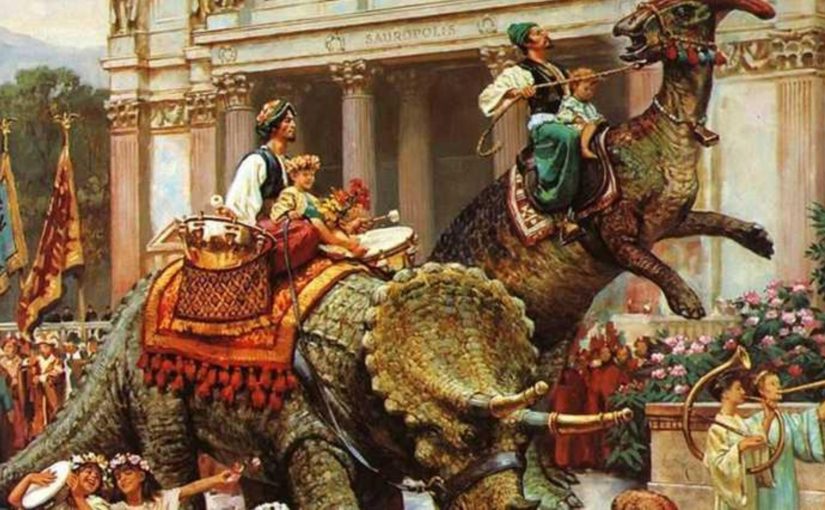
(Repost) The mystery of that silly pet dinosaur that ate up a yummy delicious human (duplicate)

Well, we don’t know for sure it was a pet. Don’t you know. It obviously wasn’t well domesticated. That’s for certain.

Well, let me tell you. What do you do when your world is turned upside down? What do you do when you learn that the “Easter Bunny”, “Santa Claus” and the “Tooth Faerie” don’t really exist? Yeah, well, most people put up a fuss and then deny the facts. They don’t want to move away from their cherished beliefs.

And thus we have OOPARTs. Things that should not occur if the accepted “mainstream” narratives are correct.

Depending on who you are, and your mental makeup, will determine how you react to an OOPART.

Low Intelligence / Stupid

Not particuliarly moronic or retarded, but fixed in afixed thinking patterns.

You will deny it, and come up with reasons why it is an easily explained everyday object, or situation.

Average Intelligence

Representative of 80% of the human race.

You will ignore it. It is not important to you and thus holds no meaning for you.

High Intelligence

Only a few “get it”.

You will accept it as it is, and observe it and search for clues to see if you can gleen or derive further hints about the secrets of life from it.

Here, in this article, we will look at the discovery of human remains found in Tyrannosaurus Rex dung.

Human bones in dinosaur feces

In 2017 it was announced, and quickly ridiculed, that dinosaur feces containing bone fragments belonging to some of our early human ancestors were found in the fecal matters of a Tyrannosaurus Rex. My guess is that the human didn’t quite agree with the Dino and so with the acid reflux and stomach ache, the dinosaur shit the remains out in an explosion of gluey mess.

I guess, “road kill” isn’t exactly the right words for raw human. Too crunchy and with too much tough grizzle.

Paleoscatologist Karen Chen has discovered human bones in coprolites (fossilized excrement).

I guess that it didn’t help any that she was Chinese. In 2017, Donald Trump and Mike Pompeo and crew were active in demonizing everything to do with China. This included human remains in dinosaur excrement.

Now, what she found was human remains. What is curious about them is that they were found INSIDE of dinosaur shit. These are, 100% human bone fragments found inside the fossilized Tyrannosaurus dung.

Because of the obvious sensationalism of such a discovery, varieties of tests were performed to determine the nature of the bones. In all cases the conclusion was unmistakable. A dinosaur; specifically a Tyrannosaurus Rex, gobbled down a proto-human whole, and then after a suitable period of time, shit him / her out.

Let’s face the realiy.

It is absolutely clear that the analysis of the fragments produced absolutely unexpected results, as the bones turned out to be of human (or proto-human) origin.

I never expected anything like this. The fragments of bones turned out to be a part of a phalanx bone from the hand of an hominin, and the smaller ones are parts of a jaw bone. They appear to be from a specimen of Homo erectus or humanoid. That’s just unbelievable! ”

-Professor Chin

Scientists are shocked by her discovery, since non-avian dinosaurs are widely believed to have gone extinct more than 60 million years before the appearance of the first hominin.

The dating analysis has dated both the dung and the bones at approximately 1.8 million years, suggesting that some dinosaurs actually survived the Cretaceous–Paleogene extinction event.

It proves that all non-avian dinosaurs did not disappear 60 million years ago. Our ancestors were actually preyed upon by some surviving dinosaurs!” 

Professor Chin.

Many other paleontologists have criticized Professor Chin’s conclusions, claiming that her results were simply impossible. Everyone knows, they argue, that dinosaurs died off long before the first humans walked about and started to raise families.

Everyone knows.
Everyone knows.

However, aside from their scofflaws, not one of the other criticizing “experts” was able to provide answers or solutions to dispute the presence of a humanoid phalanx bone in the dung of a dinosaur.

Ah. Now I fully expect these artifacts, and the discovery to be “misplaced” in some dusty old archive, and lost in some long forgotten tome. They don’t, don’t you know, fit the established narrative that those in power have based their entire careers upon. And careers equate to money. And no one is going to risk their fine revenue stream to go against the all-mighty dollar.

Tyrannosaurus Rex

Tyrannosaurus rex was one of the most ferocious predators to ever walk the Earth. With a massive body, sharp teeth, and jaws so powerful they could crush a car, this famous carnivore dominated the forested river valleys in western North America during the late Cretaceous period, 68 million years ago.

Although T. rex is a household name, what we know about this tyrannosaur is constantly evolving. Improved technologies, such as biomechanical modeling and x-ray imaging, have allowed scientists to gain a deeper understanding of how this apex predator lived.

Tyrannosaurus rex was also adept at finding its prey thanks to a keen sense of smell. While scientists have known for a while that this dinosaur devoted large portions of its brain to processing smell, studies have recently revealed that T. rex had almost as many genes encoding its olfactory receptors as a house cat does today. This powerful snout also likely helped T. rex find mates and detect other predators.

Weaknesses

Not everything about Tyrannosaurus rex was fierce, however. This dinosaur had unexpectedly puny arms, and the function of these little limbs is a source of debate among scientists. Some believe the animal’s arms were an evolutionary leftover—like the pelvic bones of a snake—or served non-predatory purposes like helping it grip a mate. Others argue that T. rex’s arms may have been adapted for “vicious slashing” at close quarters, given their ability to inflict deep wounds with four-inch claws.

And while they had strong thighs, these dinosaurs were not speedy. They could only walk briskly at up to 12 miles an hour—likely not fast enough to chase a speeding Jeep, as depicted in the movie Jurassic Park. Using biomechanical models, scientists have theorized that if these heavy animals moved any faster, they would have shattered the bones in their feet.

Growth spurts and extinction

Tyrannosaurus rex had a life expectancy of about 28 years. Previous studies have suggested that it went through a growth spurt in its teenage years, but until recently, scientists didn’t know much about how it grew from a hatchling to a powerful predator.

In January 2020, a study of the fossils of Nanotyrannus—a smaller tyrannosaur that was believed to have lived alongside T. rex—revealed that the bones were more likely from a juvenile T. rex than another species. If so, the study then suggests that Tyrannosaurus rex’s growth rate varied as it aged, and it could slow down its growth when food was scarce, a major evolutionary advantage.

In spite of all its advantages, T. rex was no match for the mass extinction event that claimed three quarters of life on Earth 66 million years ago. This cataclysm occurred when an asteroid or comet the size of a mountain slammed into Earth, (supposedly) wiping out Tyrannosaurus rex along with the rest of the non-avian dinosaurs and bringing a sudden end to the Cretaceous period.

Strengths

Tyrannosaurus rex, whose name means “king of the tyrant lizards,” was built to rule. This dinosaur’s muscular body stretched as long as 40 feet—about the size of a school bus—from its snout to the tip of its powerful tail. Weighing up to eight tons, T. rex stomped headfirst across its territory on two strong legs. These dinosaurs likely preyed on living animals and scavenged carcasses—and sometimes they even ate one another.

The head of a T. rex was the real stuff of nightmares. This fierce carnivore was optimally built for crunching through its meals, with a stiff skull that allowed it to channel all the force of its muscles into one bite—delivering up to six tons of pressure. This dinosaur used its 60 serrated teeth, each about eight inches long, to pierce and grip flesh, throwing prey into the air and swallowing it whole. To keep itself from overheating while crushing prey with its mighty jaws, the giant animal had vents in its head to help its brain stay cool, similar to those found in alligators.

Yikes!

Proto-humans

Now, the big problem that everyone has is that roughly 60 million years are supposed to separate the “age of the dinosaurs” and “the rise of man”. Statists have pronounced that humans evolved to what they are today, and the earliest proto-humans did not come into being until after the primates.

The earliest primates date from 56 million years ago. And thus, according to the “experts” these proto-monkeys came into being millions of years after the dinosaurs became extinct.

So the big problem is this…

  • Maybe the dinosaurs did not die off 60 million years ago.
  • Maybe the proto-monkeys, proto-humans or humans are older than we assume.
  • Maybe dinosaurs and humans or proto-humans did actually coexist.
  • Maybe a time machine brought the two species together.
  • Maybe a space vehicle brought humans to dinosaurs together.
  • Or, perhaps the theory of evolution is incorrect with dinosaurs and humans.

Maybe we all coexisted in some sort of peace…
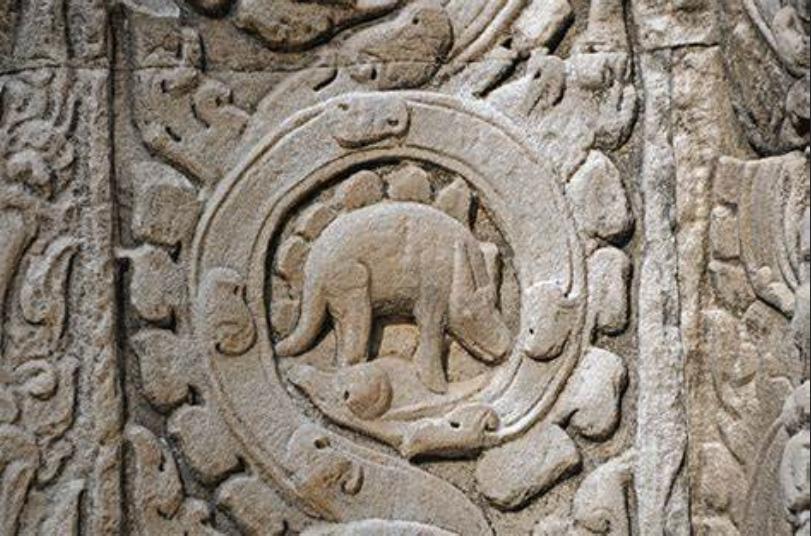
Evidence of coexistence

Now, if this was all there was… well, maybe we could just shrug our shoulders and forget about it. But there is quite a bit of evidence that is suggestive of dinosaur and human coexistence.

Bishop Bell’s Behemoths
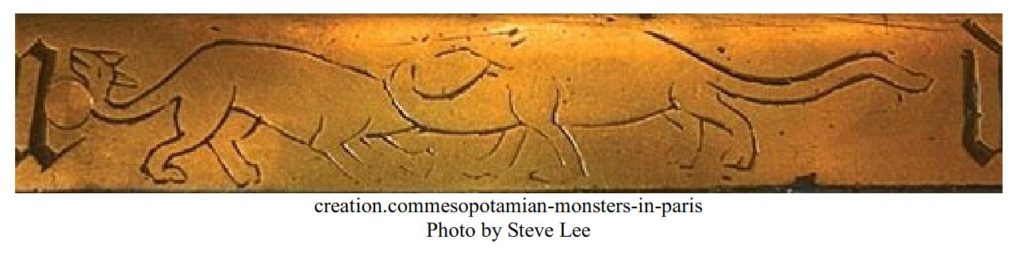
This brass engraving was made over 500 years ago, and decorates Bishop Bell’s tomb in England. The two animals depicted are very unambiguous sauropods, but were probably known to the locals of the time as dragons. The animal on the left has a tail that ends in a spiked club, just like the sauropod Shunosaurus. It’s fascinating to consider that these dinosaurs were probably roaming the hillsides of Medieval England!

Utah Petroglyph
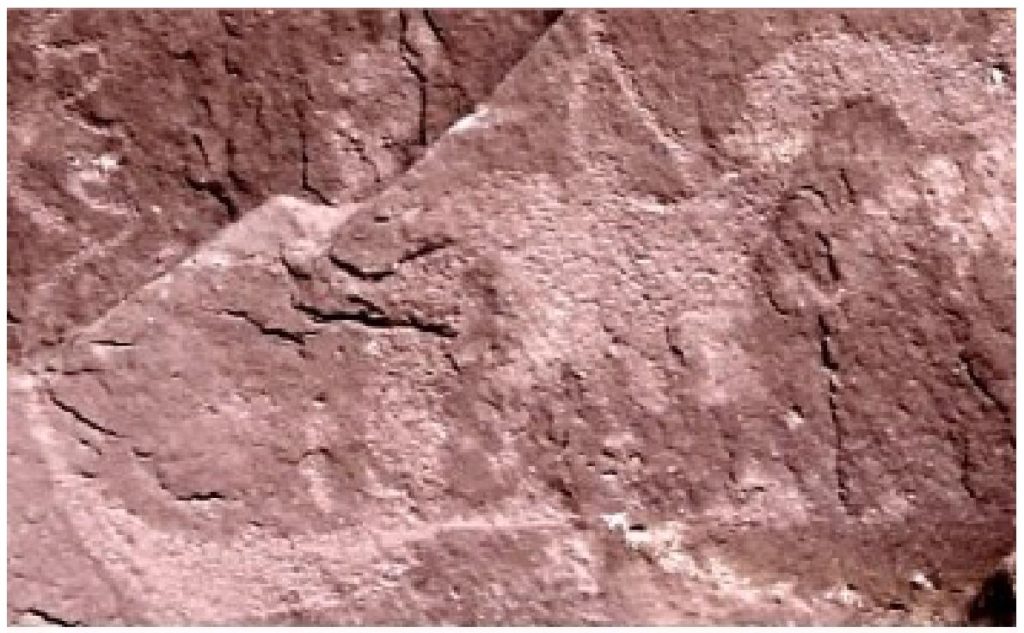
Utah Petroglyph

In Utah there is a rock formation known as Kachina Bridge. Underneath the arch is a Native American Indian petroglyph that greatly resembles a sauropod dinosaur. Even Phil Senter, author of a widelycirculated study that tried to refute the dinosaur interpretation, admits that it “really does look like a
dino
“.

It should be noted that his study has been heavily criticized for bad science by both proponents and skeptics of the dinosaur interpretation alike; Vance Nelson has extensively debunked the proposed refutation by highlighting its poor methodology.

Granby Idol

In 1920, an interesting stone was unearthed by a Colorado rancher. It was a foot and a half long and a foot wide, portraying a smiling face, a woolly mammoth and a sauropod dinosaur. After seeing the 66 pound stone firsthand in 1923, archaeologist Jean Allard Jeancon proclaimed:

"If this stone can be proven genuine, it is the biggest find in all anthropological research[...] I have never seen such remarkable outlines of dinosaurs and mastodons!"

After being displayed on the rancher’s porch for six years as a local novelty, it was sold to a man named Henry McKnight for the price of $300, or about four grand in today’s dollars after being adjusted for inflation. It was supposedly to be given to the Smithsonian Museum, but it’s never been seen since.

Fortunately, a teacher came forward four decades later and revealed that she possessed photos of the stone taken before it’s mysterious disappearance. These reconstructions of the stone are based on her pictuures.
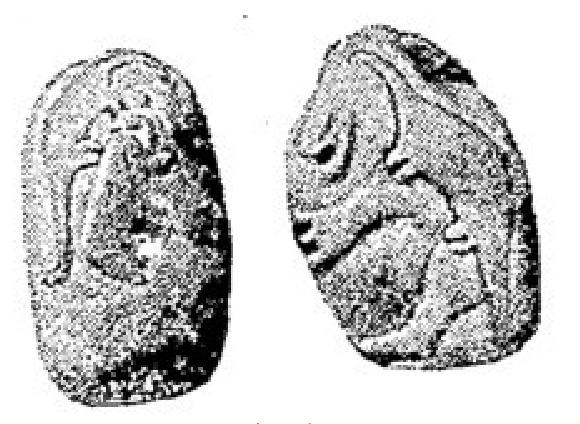
Dino stone.

Chinese Ceratopsian

Perhaps as far back as 2,000 B.C., a people known as the Hongshan occupied the land now called China. This jade sculpture is a relic of this ancient culture. Compared with a modern portrayal of Triceratops‘ cousin, Montanoceratops, one is compelled to conclude the ancient Chinese saw living dinosaurs.
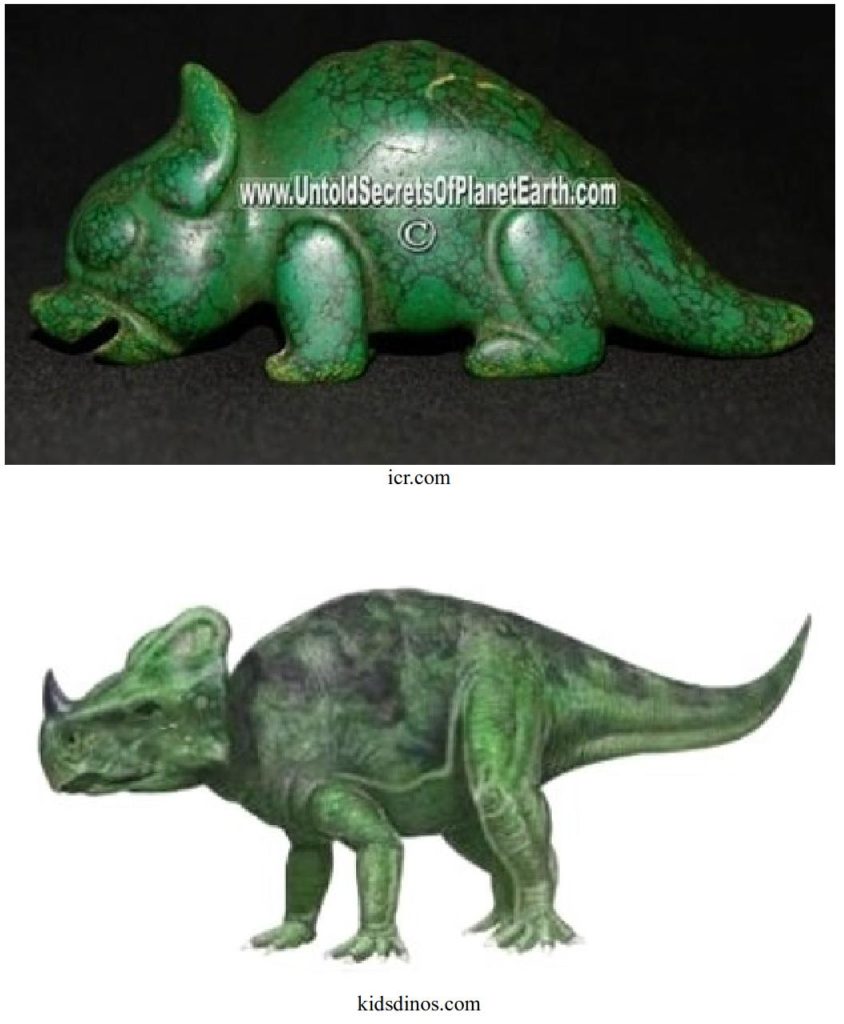
Of course, objections are expected regarding its authenticity. It’s been argued that it’s a recent creation, citing the market for Hongshan jade figurines. But even if it were granted that this were a forgery contrived to meet a high demand, the implication is that it’s still a modern duplicate of a genuine Hongshan sculpture.

Thus, the case for dinosaurs roaming ancient China with man would not suffer at
all.

As it turns out, though, the artifact is not a forgery. It’s authenticity has been verified by an expert thirdparty. The feeble argument that it actually represents a pig is soundly refuted by the existence of other Hongshan carvings which actually look like pigs.

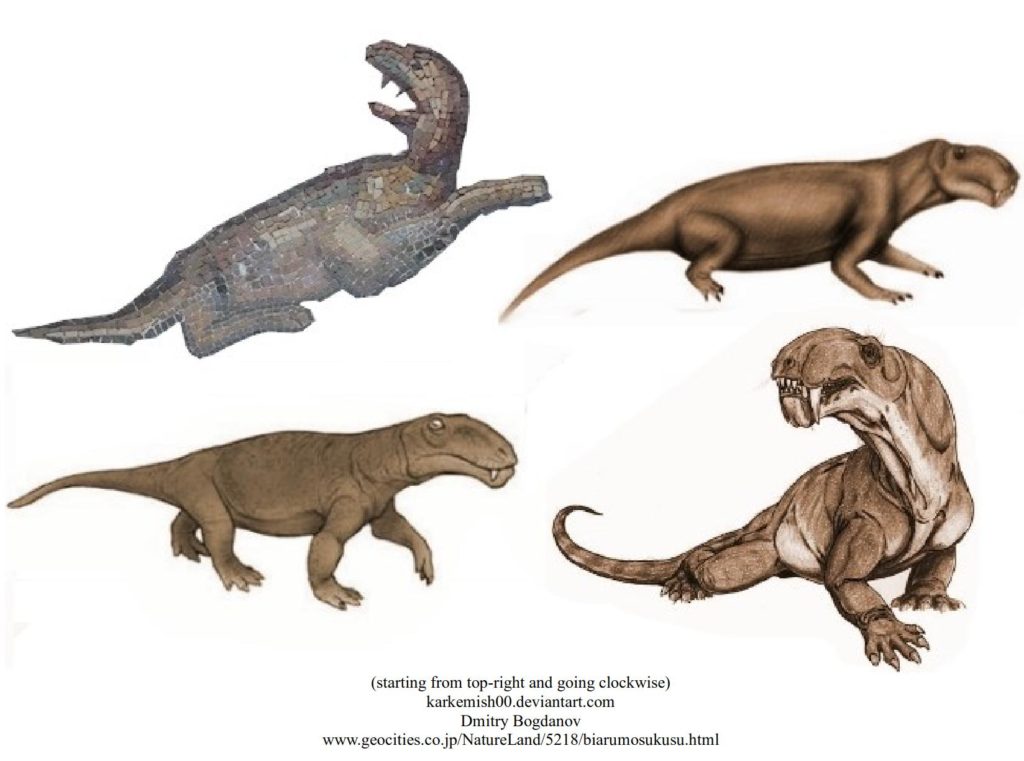
CrocodileLeopard

Around 100 B.C. the Nile Mosaic of Palestrina was created. It depicts many familiar animals with Greek labels, including the crocodile, giraffe, hippo, monkey, lizard, and turtle. The identification of the animal shown in this closeup is the subject of much controversy because it is difficult to identify with any extant creature. It has been suggested that the animal may be an otter. This is not
plausible, however, since the same mosaic elsewhere depicts a pair of animals explicitly labeled as
otters!
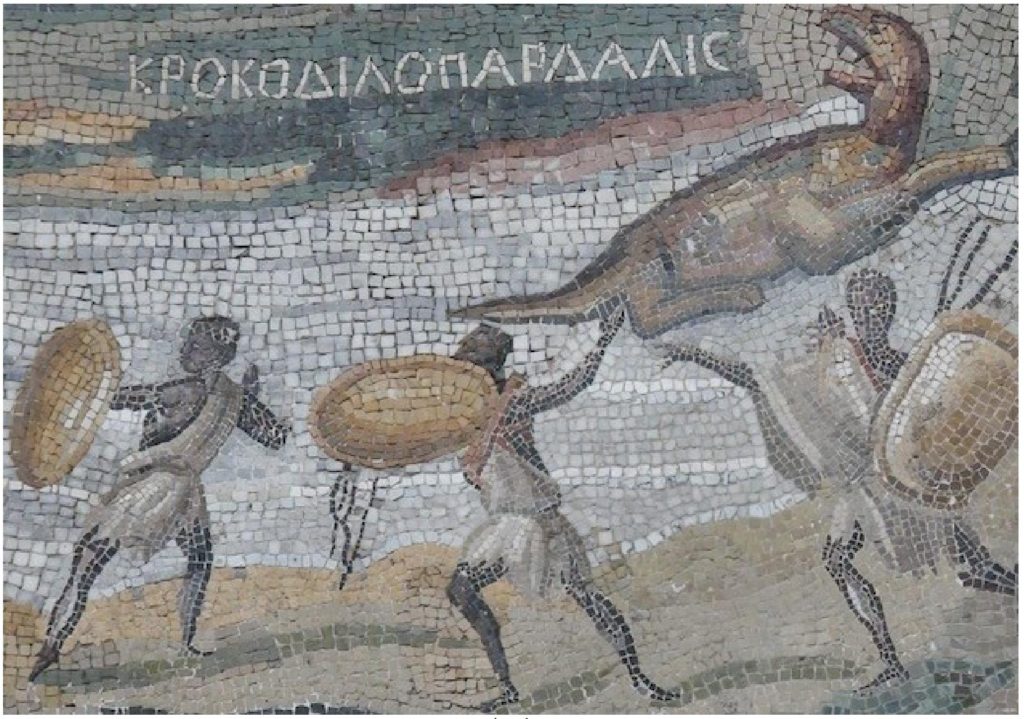
Battling a dinosaur.

The Greek label for this animal reads crocodileleopard. This unfamiliar term may be the key to identifying the mysterious creature. The ancient Greek word for giraffe was camelleopard, referencing the giraffe’s camellike morphology and leopardlike color pattern. Why would the animal in the mosaic be called a crocodileleopard? The leopard part of the name is obviously not due to its color
pattern. It can be concluded that the animal shared some mixture of both  eptilian and mamm
alian traits.

No animal alive today that resembles the crocodileleopard could be accurately described as a mixture of both reptile and mammal, but there is an extinct group of organisms which definitely can. They are literally called mammallike reptiles! The identification of this animal may finally be solved, notwithstanding the evolutionary assertion that all mammallike reptiles went extinct millions of years before the mosaic was created.

The graphic below illustrates this point very convincingly. Note how the animal from the mosaic appears right at home among modern reconstructions of various mammallike reptiles.

Pompeii Fresco

Around 70 A.D. this fresco was painted on the wall of a Pompeian doctor’s house. It depicts a Nilotic (Nile) scene, with pygmies interacting with some aquatic mammal and a couple of large reptiles.
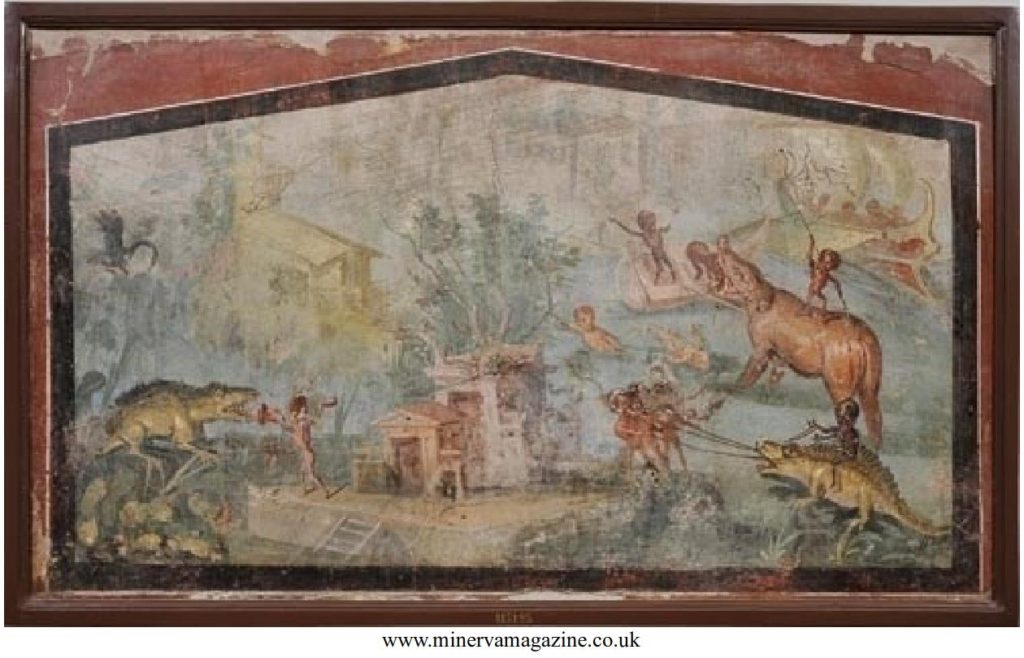
Here are a couple closeups of the animals, with modern depictions of extinct creatures for comparison.
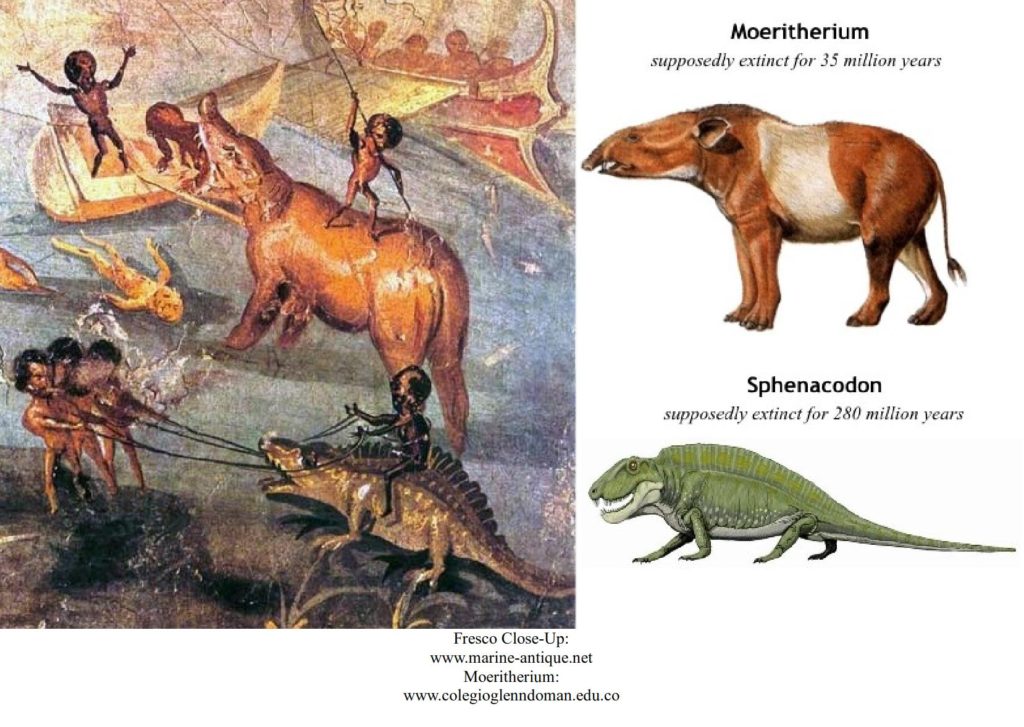
Note the mammal in the fresco and the modern moeritherium illustration both possess an elongated,  fleshy snout. Consistent with modern interpretations of moeritherium remains, the animal in the frescoled a partially aquatic lifestyle. The reptile beneath strongly resembles the sphenacodon, likely a relative of dimetrodon, but with a smaller sail.

Critics of the moeritherium and sphenacodon interpretation have argued the fresco actually depicts a hippo and a crocodile. As evidence, they cite several related pieces of art which depict pygmies in similar scenarios interacting with hippos and stylized crocodiles. The insinuation is that the sphenacodon‘ is a heavily stylized (or poorly drawn) crocodile. One obvious problem with this
argument is that crocodiles do not have a sail on their back, and artists don’t j
ust accidentally draw sails on the backs of crocodiles. Even if it were to be argued that the reptile in the fresco doesn’t have a sail, but rows of spines that give the illusion of a sail, the fact remains that the short spines (if they could even be called that) on a crocodile’s back increase in length towards the end of the tail, while the exact opposite occurs with the finlike structure on the creature in the painting.

A similar argument is put forth by skeptics for the animal identified here as a moeretherium; it’s claimed to be a stylized or incorrectly drawn hippo. However, it’s hard to imagine how the artist, if he indeed were intending to paint a hippo, could have gotten the anatomy so grossly incorrect. This holds true even if the artist were depicting a hippo based on word of mouth, and had never seen a real one before. The head of a hippo, along with its nose, are extremely broad and thick, and the same is true of its body. Also, a hippo’s legs are very short. In every aspect where the mammal of the fresco departs from resemblance to a hippo, it matches the moeretherium. The same goes for the reptile.

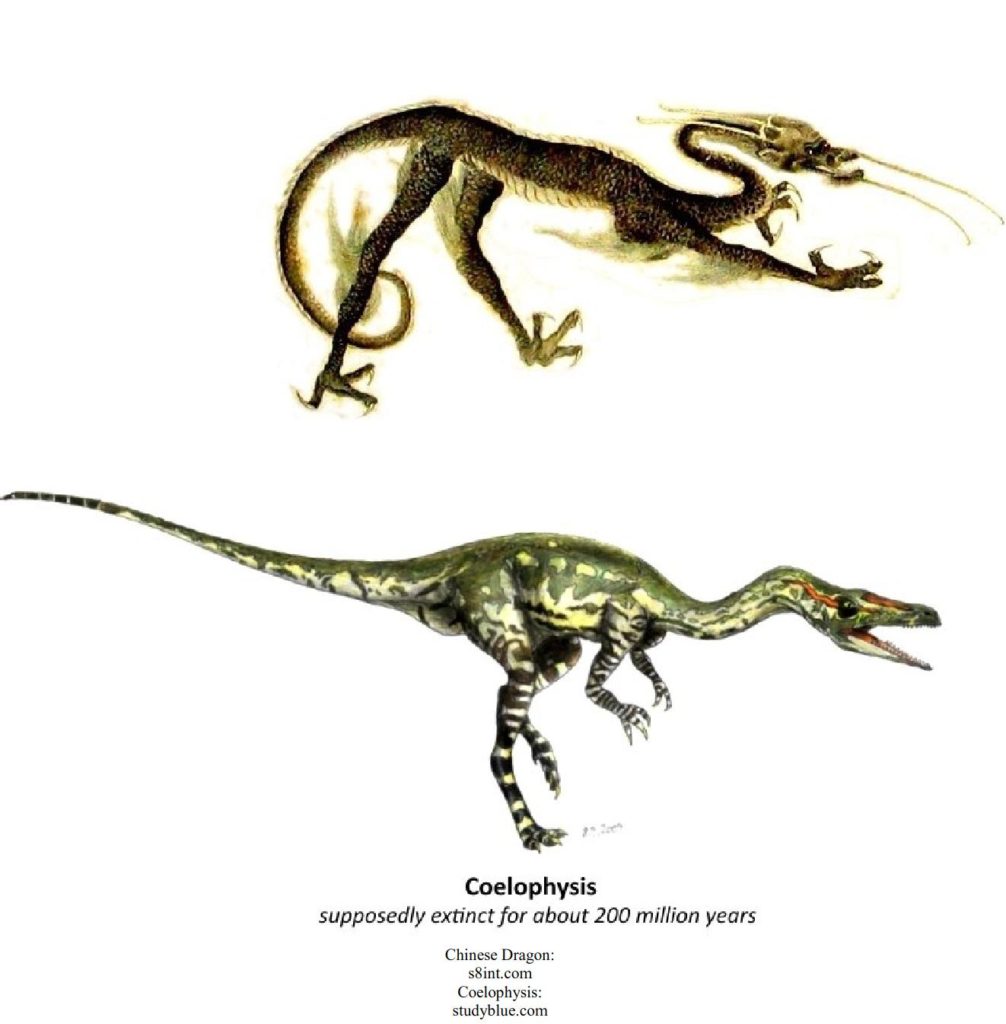
Chinese Dino 1500 A.D. painting
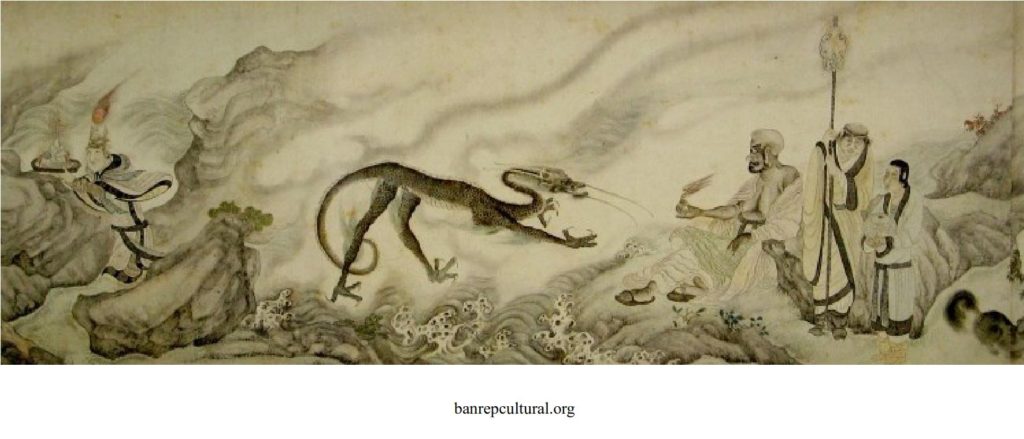
The Shanghai Museum exhibits this piece of Chinese art. It was painted around 500 years ago during the Ming Dynasty by artist Ding Yunpeng, and is one of the most realistic depictions of the popular Chinese Dragon. Instead of drawing it as lengthy and flexible as the modern parade float, its structure is far more dinosaurian. Also, in contrast to other portrayals where the creature has actual wings, Yunpeng was content to draw it with filamentous tuffs. This is fascinating, because ceolurasaur fossils are often described as possessing filamentous   lumage. Notice how similar this modern depiction of a ceolurasaur is to the animal in the 500 year old painting.
Now, one of the more obvious disparities is the pair of horns that adorns the dragon, but this is not reason to dismiss the comparison altogether. Animals often come in both horned and hornless varieties.
.
For example, Carnotaurus is likely a horned relative of T. Rex:
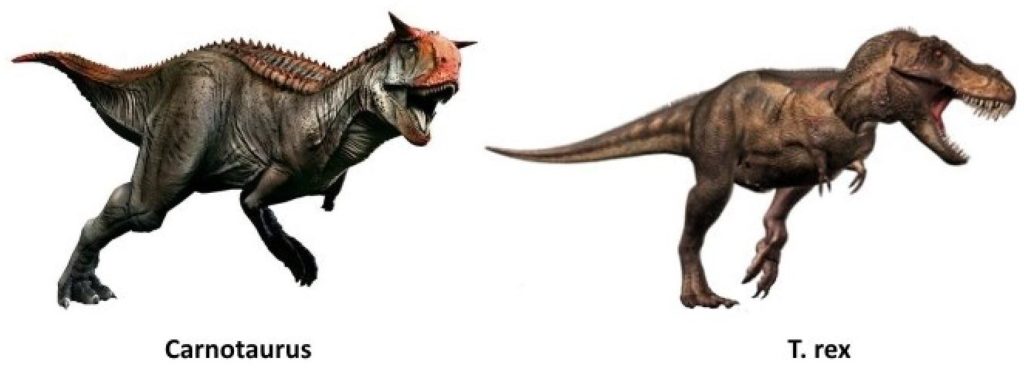
.
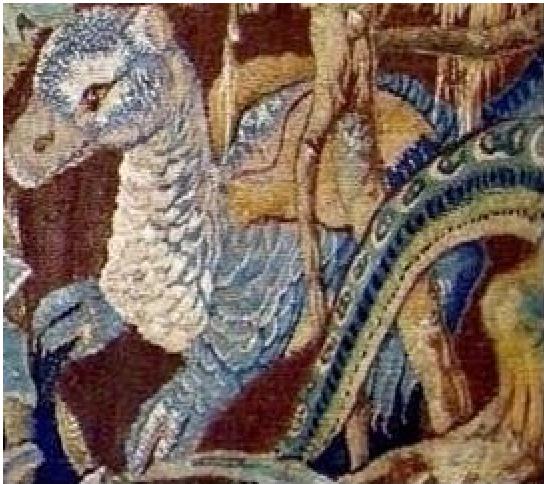
DuckBilled Dino in France
.
Like the previous piece of art, this one was also constructed in the 1500s. This is a closeup of a tapestry currently on display in the Royal Chateau de Blois, France. If one attributes the pair of golden wings to artistic license, the creature appears to be a very unambiguous hadrosaur, a.k.a. a duckbilled dinosaur.
.
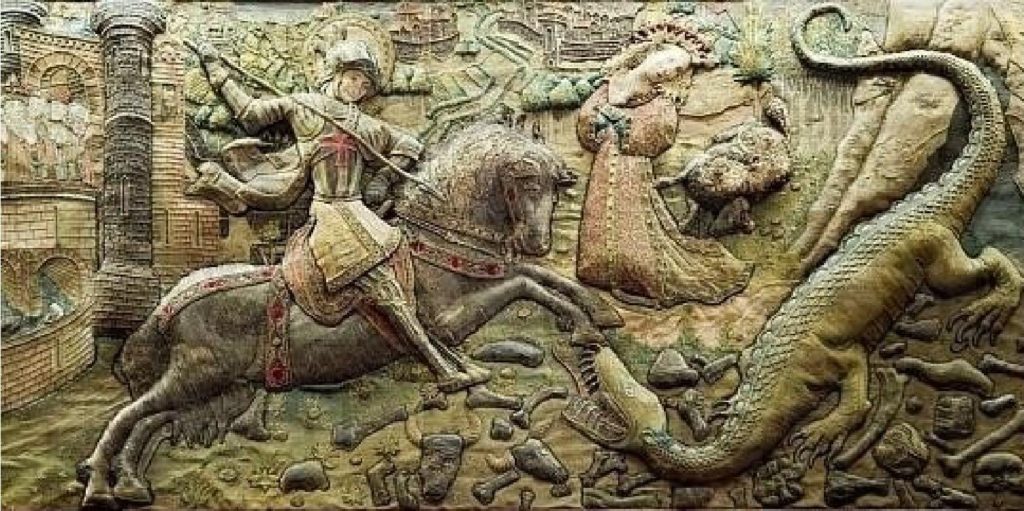
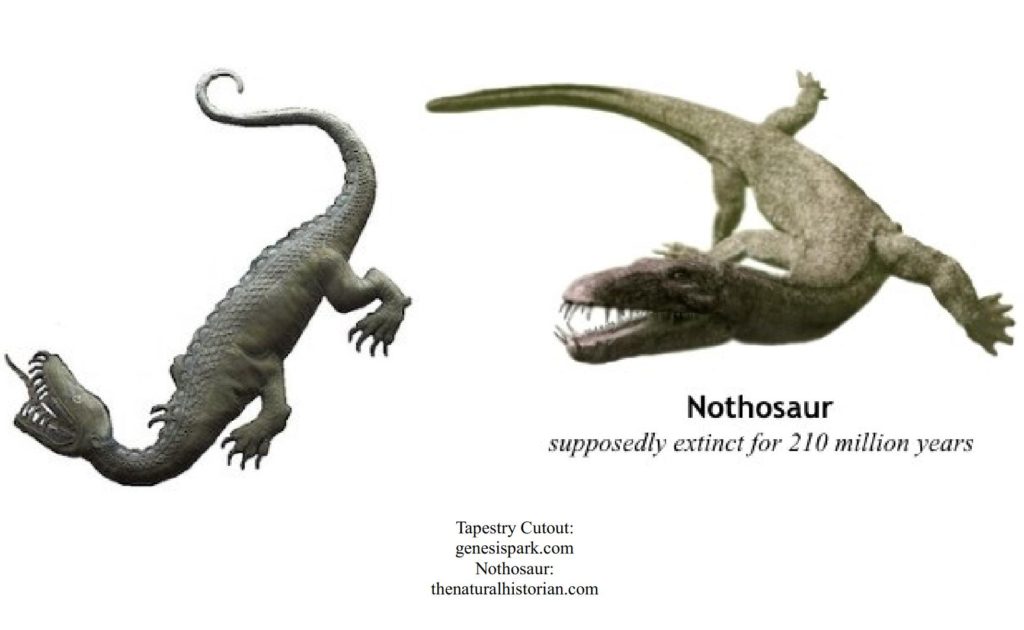
Spanish Nothosaur Altar Cloth
.
This altar cloth was created 400 years ago and adorns the Chapel of St. George in Barcelona, Spain. It depicts St. George slaying the dragon. A picture is worth a thousand words, so the comparison practically speaks for itself. Nothosaurs, supposedly extinct for millions of years, apparently inhabited the rivers of Spain just a few centuries ago.
.

Father Crespi

I am going to devote an entire aritcle on Father Crespi and his collection of old artefacts and artwork later on. But this picture below will give one time to pause and reflect.
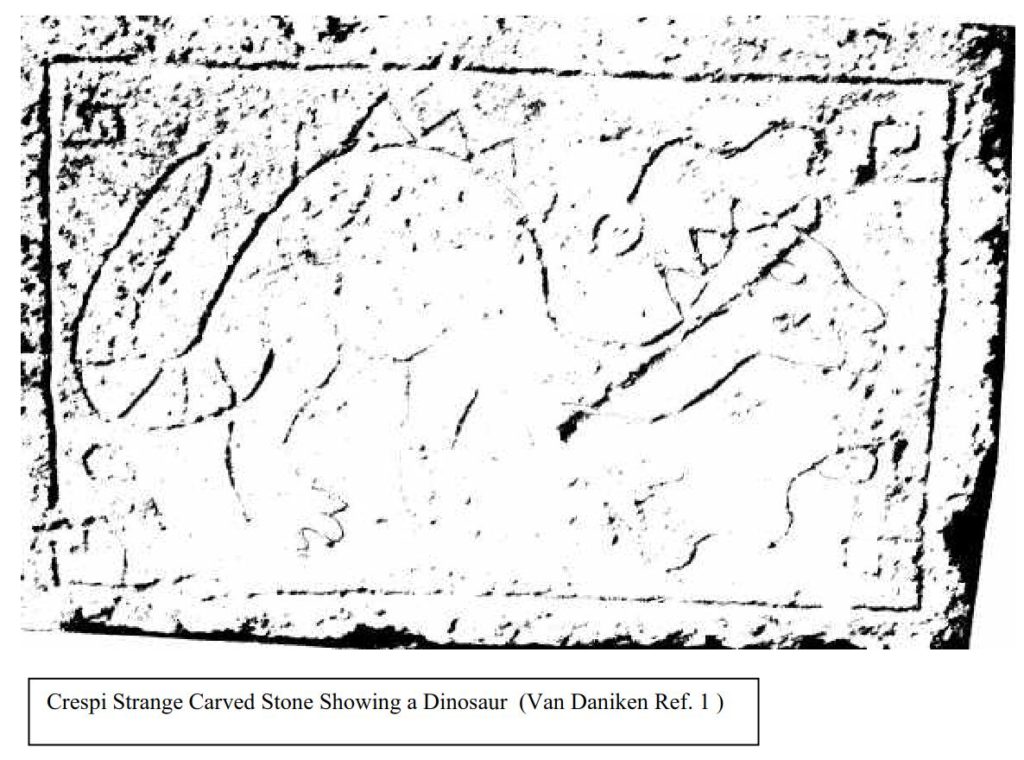
From HERE.

Born in 1891 in Italy, Father Carlos Crespi Croci was a Salesian Monk that spent his career in Cuenca, Ecuador from 1923 to 1982. At the University of Milan, he studied anthropology before becoming a priest. His many talents included being an educator, anthropologist, botanist, artist, explorer, cinematographer, humanitarian, as well as a musician. The kindness and benevolence he taught his congregation was such that they rewarded him with a number of ancient artifacts.

It is estimated that throughout his lengthy career, Father Crespi was given and/or purchased over 50,000 ancient artifacts. The items in particular that captured the fascination of the world were a number of plates and objects forged from gold with mysterious symbols and hieroglyphs. The villagers told Father Crespi that many of the artifacts were found inside a cave known as the Tayos Cave.

In the early 1970s, Erich Von Daniken published The Gold of the Gods in which he highlighted many of Father Crespi’s artifacts. Von Daniken made the claim that the collection included metal books showing proof that a lost civilization existed in ancient times that extraterrestrials helped to form. Many people fed into the belief that these artifacts were either extraterrestrial or were “out of place” with bizarre unknown scripts similar to Babylonian or Sumerian writing.

With the Vatican’s permission, Father Crespi opened a museum at the Salesian School at Cuenca. In July 1962, a fire broke out and the museum was destroyed. Father Crespi was able to salvage as much as possible and stored them in two long, narrow rooms. Items from Father Crespi’s collection included tablets, plates, doors, decorations, statues, pottery, jewelry, ancient weapons and war adornments. There were even three gold sarcophagus-like coffins. The artifacts were made of stone, wood, ceramic and metal. The metals were pure gold, sheet-gold, pure silver, sheet-silver, bronze, brass, copper, zinc, tin and sheet metal.

When Father Crespi passed away in 1982 what happened next only added to the mystery. His collection was removed. Investigators later discovered that it was purchased by the Central Bank of Ecuador and is currently stored in their museum vaults; however, none of the golden plates were shown to investigators, so it assumed they are lost. Others believe that either the Vatican has them, the local Government, or another rumor is that they were melted down and used for military funds. All that remains is the photographic evidence.

Some people believe that the collection either never existed or was a fake.

The truth is that there is a golden plate within Father Crespi’s collection that has been overlooked but is undeniable proof that the origins of the plate are absolutely regional. The plate was not created or influenced by extraterrestrials or other cultures outside of Mesoamerica. Finally, after all of this time a connection has been made between the Crespi Gold Collection and the Mayan hieroglyphs.

The Mayan Empire was located in what is now Guatemala. Its greatest influence was reached in the Sixth Century A.D. The Maya had advanced knowledge of architecture, agriculture, art, calendar-making, math, pottery, and hieroglyphic writing. For reasons not yet fully understood, most of the Maya deserted their cities by 900 A.D. To this day, historians argue over the reasons for the fall of the Mayan Empire.

Why has it taken so long for this one plate to be recognized for what it is? The main reason perhaps is because the plate is never shown to be in the proper position. In order to be connected back to its native language, the plate needs to be in the position as shown in these images. Also, when the Spanish conquered Mesoamerica one of the goals was to eliminate the history of the indigenous peoples. By taking away their historical identity the Spanish succeeded in convincing the world that the Mesoamerica had no education or cultural value before the Spaniard’s arrival.

In recent times however, archaeologists and anthropologists have gained a great understanding and respect for early Mesoamerican civilizations. We know today that many Mesoamerican cultures that existed in modern times were very advanced and modern researchers still struggle to decipher their architecture, artwork, and writing systems.

Every glyph on this plate can be found in the key provided by Bishop Landa who was a part of later Spanish rule in Mesoamerica. There are mild variants between a couple of the glyphs on the gold plate and Bishop Landa’s key; however, it is widely known that the Maya often used many designs and variations for the same syllable or word.

Is this to say that all of Father Crespi’s artifacts were Mayan in nature? That is doubtful. The plates appear to be a compilation of different scripts that more than likely existed throughout the region. Perhaps the Tayos Cave served as the ancient school for scribes as well as for the art of metallurgy.

It is possible that the Mesoamerica people hid these valuable historical artifacts so that the Spaniards would not be able to confiscate them. It is uncanny how much of Bishop’s Landa’s key appears on the gold plate itself. Perhaps, there were some Spaniards who hid some of the gold away either because they recognized the historical value of the plates, or for greed with the intent to recover them later but never did.

The last plausible explanation for such an accumulation of varied historical metal artifacts is that they were brought there by floodwaters. Central and South America are subject to monsoons so perhaps the caves are the lowest level point in the region in which floodwaters deposit various materials. Gold, being a heavy metal, will sink to the lowest level the first chance it gets. Copper and silver are also heavy metals.

We will never know how they got there or where they went after Father Crespi passed away, but now, at least, there is a solid connection to the Mayan culture.

Comments and conclusions

The big lesson here is that we should look at things as they really are, and not as we want them to be.

And when money is involved, it trumps all. It becomes the driving force of all reason, and all truth. Such is the bane of America and the “West” today. But that need not be our collective future. By rejecting the financial motivators, we can see things as they are and accept them. It will be a great advantage for the earth human society and for our own personal advantages.

The evidence is clear that large dinosaur creatures coexisted with humans for centuries. That, perhaps, their demise was due to hunting by humans rather than by extinction via meteor. And while, the meteor did cause a complete extinction of many species, there is evidence that many species survived and were exposed to humans in many ways, and in many places.

I am confident that killing one brontosaurus would be enough food to feed a very hungry villiage. And you know, judging from the curious Sumarian carvings of scaled doglike creatures on leashes, kept as pets as well.

Maybe they were used as beasts of burden; or for mighty weapons platforms such as this…

Battle Dinosaur.

Or as this…

Battle / attack dinosaur.

So, all in all, being eaten up by a hungry Tyrannosaurus Rex doesn’t seem all that unlikely at all. We need to open up our horizons and expand our minds. What we think about the past, the future and the present is more than likely, wrong.
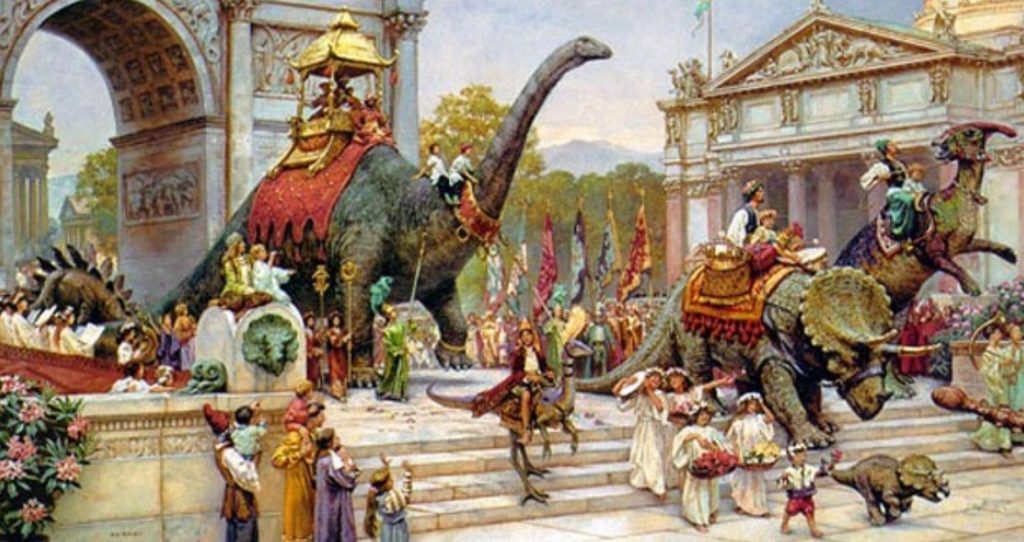
Do we really know what life was like in the past?

Do you want more?

I have more posts like this in my OOPARTS Index here…

Mysteries Explained

.

Articles & Links

Master Index

.

  • You can start reading the articles by going HERE.
  • You can visit the Index Page HERE to explore by article subject.
  • You can also ask the author some questions. You can go HERE to find out how to go about this.
  • You can find out more about the author HERE.
  • If you have concerns or complaints, you can go HERE.
  • If you want to make a donation, you can go HERE.


.
 

“My First Howl” (by Rufus)

Once  way back when, my buddy Robbie was a night watchman / janitor at a local public pool. And we being buddies would hang out for a spell. He would do his chores and we would drink some beers smoke, and chat at the pool side at night.
His wife and son would sleep in one of the work offices on the couch with a blanket and a pillow. We would be outside.

And of course, i would give him a hand doing this and that. Oh, for certain both of us were poor and working minimum wage jobs, but the moments together… drinking beer, taking tokes, sitting at the side of the pool… at night were priceless.

A MUST watch video

Watch out!

This advice comes from the late writer Charles Bukowski.

He swore by this advice and even had it inscribed on his gravestone (see picture below).

I’ve found “Don’t try” invaluable in many ways.

In relationships – the relationships where I’ve been a try-hard and been someone I’m not have always failed (all my relationships).

Writing and speaking- when I communicate inauthentically, or try to be someone I’m not:

  1. The worse my writing/speaking becomes.
  2. The more I come across as a pretentious douche.

What Charles meant by “Don’t try”

If we live authentically and naturally, life shouldn’t be a struggle.

Our lives should conform to our nature, our strengths and unique gifts/talents.

If we live as nature intended, why should we try hard and struggle?

Being a try-hard means living wrong.

Why procrastination is a lie

I don’t believe in procrastination. If someone wants something done, they’ll do it.

If you confronted a lion in the street and needed to get to safety, you’d do it.

If your body and mind are telling you not to do something, it’s because you don’t value it.

For example, I only write about things that interest me, and I only read books I want to read.

What people call “Procrastination” is your body’s BS detector.

Listen to your gut. What’s it trying to tell you?

Huawei

The announcement today by Huawei on their new Kirin9000s 5nm chip has gotten me thinking again about the age old question of “why do groups of smart men often make stupid decisions?”

The men in Washington DC who started the tech war against China were not stupid people, but they somehow came together and made an incredibly stupid decision. How?

At some point in a meeting in the White House, Trump probably asked a group of reasonably smart advisors: “how do we kneecap China’s tech rise?”

The correct answer to this question is: “We don’t because we can’t. In fact, anything we do will just push China towards tech independence, and eventually, dominance. It’s best to let sleeping tigers lie.”

But of course, no one can say this to Trump or any other American leader. Americans have a bias for action. No matter what the situation, they feel compelled to do something, even if they know in the back of their minds that any action they take will be counterproductive.

Trump’s advisors would feel compelled to over some course of action that would allow Trump to feel like a big boy, taking charge, and sticking it to “communist Chyna”. The easiest course was to force American client states to reject Chinese tech, and then deny China access to Western tech, which is exactly what they did.

I have no doubt that everyone in that room, including Trump himself, knew that this course of action would not stop China beyond the very short term. Men at that level are not Redditors who think CHINesE CAN’T innoVAte!!! Most of those men come from the world of big business and have hands-on experience with China’s economic and technological prowess. They saw what happened with solar panels, batteries, shipmaking, electronics, home appliances, automotive, industrial machinery and a dozen other industries where China rapidly rose to dominance, and they knew that China’s reliance on imported chips is a matter of convenience, not a lack of ability.

But they’re compelled towards doing something, because they couldn’t be seen as doing nothing. That would be un-American.

Trump’s granddaughter (by Ivanka) speaks fluent Mandarin. People often forget that the Trump family doesn’t actually live in a trailer park like most of their supporters. They’re highly educated and world-savvy. They know the real China far better than their official rhetoric suggests.

STRANGEST 1970s Toys You’ll NEVER SEE AGAIN

Chinese law stipulates that every male who turns 18 has an obligation to join the military, but in reality, enlisting requires a series of physical examinations. Just signing up does not mean you can become a real soldier.

I saw a recruitment poster during my sophomore year of college and signed up. I still vividly remember my first physical exam. After blood tests, urine tests, an electrocardiogram, and other internal and surgical examinations, I and a dozen other candidates entered a room where two doctors asked us to take off all our clothes. They were going to check each of us for hemorrhoids (this was a nightmare; I’m not gay, and I couldn’t accept being penetrated in the anus). After completing a series of examinations and waiting for about 10 days, I received a notification that I had passed the physical exam, which meant I had been selected to become a recruit.

I went to the military camp by train. The entire carriage was full of recruits, and many of them cried. Most of them had never experienced being so far from home before.

Life in recruit camp was extremely tough. The instructors didn’t lower their standards just because you were a recruit. We had to undergo more than 10 hours of military training every day for three months. During this period, some people would be weeded out, mostly because of underlying medical conditions or inability to withstand the high-intensity training. In my company (120 people), not a single person dropped out.

After completing basic training, I was assigned to a remote military camp. Military training there wasn’t extensive. Since my unit wasn’t infantry, I didn’t need to carry rocket launchers or machine guns during training. Daily training, besides physical conditioning (running 5km in 25 minutes with a 15kg load), focused more on individual tactics, squad coordination, and weapons operation and maintenance.

My two years of service ended quickly, and I returned to university to complete my studies and then started working.

Caligula’s Sisters in the Plot of the Three Daggers

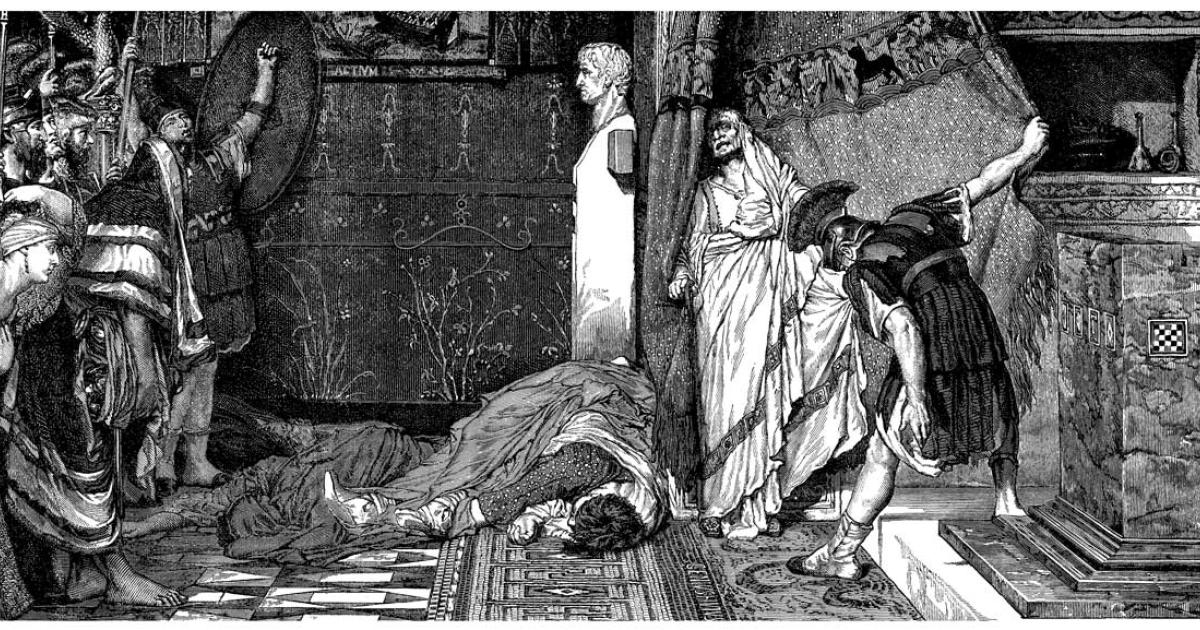
Ancient Rome : Emperor Caligula Murdered

After twenty-three years filled with fear, paranoia, and the countless lives lost in its reckless pursuit, the grim and wholly unlikable Emperor Tiberius died at the ripe old age of 78 – a milestone many of his victims would have envied. All of Rome breathed a collective sigh of relief with some debating whether Tiberius should be thrown down the Gemonian steps (a fate reserved for the most heinous of criminals) or cast into the river. In no time “Tiberius in the Tiberim” became a catch-all slogan.

But celebrations did not fully commence until two days later when the Senate officially confirmed his great-nephew, Gaius Julius Caesar Germanicus, as emperor. He is known to posterity as Caligula, or “Little Boots,” a moniker acquired in childhood due to the tiny soldier’s boots (caligae) that his mother forced him to wear when following his father on military expeditions. Yet to the Romans he was always known as Emperor Gaius.

Word of Caligula’s succession spread rapidly throughout Rome. The mood was electric. The entire capital – from the rough-and-tumble warren of its cobblestone streets to the secluded marble-clad Palatine Hill – was enthralled with the moment and rallied in large numbers for their fair-haired twenty-four-year-old monarch. Suetonius reports that the festivities commemorating Caligula’s ascension were extensive across the empire and persisted for three months, encompassing sports, opulent public displays, and the sacrifice of almost 160,000 animals.

The populace rejoiced not merely at the demise of a deeply unpopular emperor but also at the restoration of the long-lost Germanicus family, deliberately eliminated by Tiberius. To the Romans, Caligula, their sole surviving son, embodied the much-revered golden couple—Germanicus Julius Caesar and Vipsania Agrippina (Agrippina the Elder). In addition to being a legendary military hero, Germanicus had been a charismatic and celebrated heir apparent, while his wife, the strong-willed Agrippina, was the granddaughter of the “Divine Augustus,” whom Tacitus referred to as the “glory of the nation.” Tiberius was either directly or indirectly responsible for the deaths of the golden couple and their two eldest sons. In defiance of Tiberius’s best efforts to prevent it, one of the golden couple’s sons ultimately succeeded him after all.

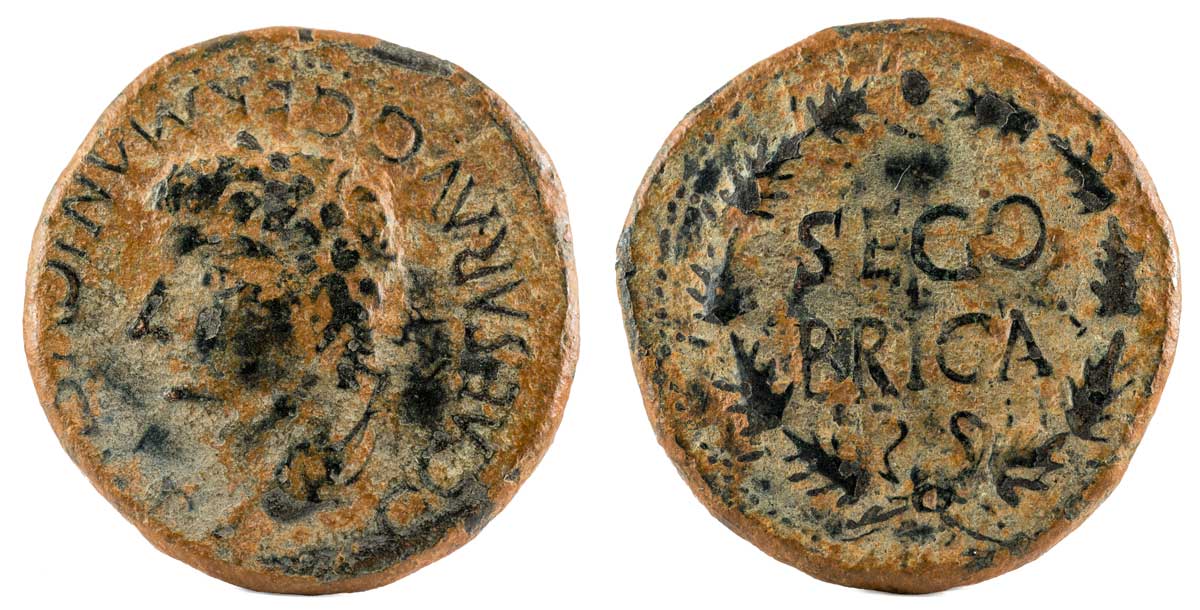
ncient Roman copper coin. As of Emperor Caligula. Coined in Segobriga

The Concerning New Reality of Living in America

I’ve seen this question/topic floating around, and the first question I notice is always “Is it accurate?” The answer to that is no, it is not “historically” accurate to the Bronze Age period of around 1,200 BC.

No Greek from the Bronze Age (1,200 BC) wore all black iron armor with grand capes. The swords are too long, the ships are wrong, and it’s not an accurate visual representation of the Bronze Age. The problem is that it doesn’t matter.

Here is the thing, though- IT. DOES. NOT. MATTER.

Some movies are about real history, Schindler’s List, for instance. These movies cover topics that cost untold millions their lives and have a responsibility to be accurate- or as accurate as can be.

The Odyssey is not real. It is an epic poem that incorporates mythology and explores themes of home, loyalty, family, wandering (mentally/morally/physically), philosophy, and much more. To call it iconic is an understatement. It is the foundation of all fiction in the Western World. This grand epic helped define our culture today and is still often the “blueprint” for other works of fiction like “Star Wars.”

  1. It’s not about the “Trojan War,” because Homer’s fictional Epic Poem about that conflict is called the Iliad and comes before the Odyssey. That explores themes like cycles of violence, the role of women, the value of glory, and the cost of war.
  2. It’s not called “Bronze Life” or some such nonsense. It’s not a period piece about life in Ancient Greece during the Bronze Age.

The Odyssey is about the King of Ithaca and his troops trying to sail back home. Above all, it is about Odysseus, who wants to reunite with his beloved wife and son. The story is about home and what home is. It’s about loyalty and love, about how we can endure and overcome any challenge for those we care about. Even that is just one interpretation of a substantial work of fiction.

The Odyssey is not the bedrock of Western literature and storytelling because of the “period-accurate armor and battle tactics.” It is the story, the themes, and the emotions they evoke that make it so important and so impactful.

Here is the cool black armor vs real period correct armor. Notice how the “inaccurate” armor conveys themes. The black dead eyes showing the cost of glory and victory, the gold inlay showing wealth and power, and the expressionless face. Then the “accurate” armor would be impossible for the actors to wear and look silly. People (normal non-historians) think that the Corinthian helmet with the plume is “Greek.” The public would see the period-accurate armor and think Nolan lost his mind and remark on how ugly it was.

If you are upset that the cast-iron black armor is not accurate for the Bronze Age, I am here to tell you that, in terms of “things which did not happen,” that armor is more accurate than the giants, harpies, shape-shifting, and other narrative plot points. It’s like saying that the concept of an “Iron Man suit” in a Marvel movie is so inaccurate that “The Avengers: Endgame” is bad. Like, really? You can have issues with plot holes, cheesy acting, or all that. However, in a universe with a talking engineer raccoon and magic space gems, the Tony Stark suit is the issue? It’s just silly.

  • One edit: This movie is made by Christopher Nolan, the mind behind Inception, The Dark Knight, and Oppenheimer. In his latest movie (Oppenheimer), he NAILED historical realism and still told a great story because he believed both were important. So who are we, people with no experience in filmmaking, to question one of the greatest directors on costume design? Who are we to question the mind behind Heath Ledger’s Joker?

Pictures

25120a8cf3253baeac0a7c706f950164
cc55371480d5b68aeb60c1948635407d
c06c92b8faa6bfbe22cca7f8af14cbe6
433a594df77412ca1cf92759e5534fca
7e9afac3797812929dc0d778d7ecbb7d
381cbdf534c543963f8f276b4de16f54
f9cfc87633d7e56bd7de199d3c6c8abd
54e9a67bb69e58082d8f76a22c3b6169
40517923976b5c287bb8c4fb1dae263c
bc55ae03f1a082cc3e31466bac562d48
6bc53e80ab637f2a03892ae4e2e24d1d
125780144642d7e806772cf54eb76dd1
c449909da2adc1ed6f606a7877726340
af3994ab06bf74201caac71dba1b631b
0fed068c240b91a7bcb19373c59ddb33
6a24af31edf8243e61865030ae51cd7b
46fd23c3e27118cfb39c600e32f7c284
e6cd5663344fe03c801a23398ff78106
06c9dff2c7a29e86abfb6fa75311d196
8a3fa57b1216d4b877d86fdb99a0dc61
4bd9499c64a3f6a1d9415dea4acf21b7
983a6ace4ea49a5f547f0277613752cd
cc9a4588b817d4064c81cc8907fea77a
28c730ffbccd5500115f3c51431a5311
03bbf09eca08a13c58b0b76930c6a5f8
3ac272e0e95de944592e096a2c5259cd
5e270884aa1893c49fbe239d79dc166a
f75144454a0e22e0ad8504514e552b7b
ae6ca5407d04a1622cb9bcde33cd5f1a
ff521175693526c97ec7e7e7549ee1e0
3ea3beeade749c36015fa9a4a80f6842
696755b17566bdffc46da3fb9abaf70f
646c4fc0d4304bb3ad076b0b24a601f1
fada0a53a94c44b744cce661d06e885e
fa748e4ddc28c7bc0f5b0d044f6b33d3
12f50567a0e04b076d72db90de4d02eb
77ba6730ad629f0a0b0e7efda6af18fe
ec021f6459abb9b97f6ad270bb0cc59d
a8d9e25499343c05735b73247fa29d83
f6837886506b5917b567ba2f4bfa3dc3
6a1411513cc164da9fc57fffc9aa108d
7125bb72681f167c2fcbbc6365ebbba5
5f50141a184c70199bea660884315e51
d7d56bdd5742aed50978df3fa77d7ab3
3702fd91530a1c22cdebb6f1d7c08c8f
31b07aa22384ddc118fcdcc1d7f21232
83e023b3838f85e2f0d6ae57c482cc17
737299d8948f2beb3be0b5767b79eacc
6ee1cc4ee55a6b811ef154af6ebcf401
5ec2b33e962385a6e47b67fee8ce3750
0334817a406e3f4d9e080072b6ae0831
d21625ed20bebe588108374658cefe82
0a3f8b9cc23f2bae06549bd34e250ff5
55509e0ac5405b8cc909dd5cc033070b
c2dc27759203375a783a803b25faec61
0edcb3ceca283d04a6b96a77d5a78aff
4d5243c58d2a2fd2a417add5df98893f
23bd8acd90b8147d79129a69078e61f4

BEST Reaction to “I Hope That Car Never Gets Fixed” Reactions! Grown Ups (2010)

Hamburger Sour Cream Casserole

52fbe15eb9651bf67f8f32cd550e547d

Ingredients

  • 4 ounces egg noodles
  • 1 pound ground beef
  • 1 (8 ounce) can tomato sauce
  • 1 tablespoon all-purpose flour
  • 1 cup cottage cheese
  • 1/2 cup sour cream
  • 1 teaspoon salt

Instructions

  1. Heat oven to 350 degrees F.
  2. Cook noodles according to package directions.
  3. Brown meat; drain grease; add tomato sauce and flour. Simmer until thickened.
  4. Combine sour cream, cottage cheese and salt.
  5. Place cooked noodles in the bottom of a 1 quart casserole.
  6. Layer with the sour cream mixture, then top with the hamburger mixture.
  7. Cover and bake for 30 minutes.

The Last Human, in a world that had been ravaged by a mysterious pandemic

Written in response to: Center your story around a person who believes they’re the last human on Earth.

Steven Sommer

Fantasy Suspense Science Fiction

  The Last Human, in a world that had been ravaged by a mysterious pandemic there lived a man named albertAlbert had always been somewhat of a loner. He preferred the quiet solitude of nature to the hustle and bustle of city life. So, when the pandemic hit and everyone around him started disappearing, he didn’t think much of it as he retreated even further into himself. Avoiding any potential contact with others.  It wasn’t until weeks had passed without seeing another living soul that he started to worry.He searched the small town he lived in, checking every house, every store, every street. As the months passed and the world fell silent, there was no one to be found. He could go anywhere, do anything, without fear of judgment or reprisal. He spent his days exploring the empty city, scavenging for food and supplies, and enjoying the peace and quiet that surrounded him. But as time went on, the isolation began to weigh on him.  He slowly began to believe that he truly was the only human left on earth. Panic started to set in as he realized the magnitude of the situation. How could he be the only one left? What had happened to everyone else? albert spent his days scouring the area for any signs of life.He drove for miles in every direction, hoping to come across another person, but his efforts were in vain. The emptiness weighed heavily on him, the silence of the world around him deafening. As days turned into weeks and weeks turned into months, albert began to accept his reality.He was indeed the last human on Earth. The thought was both terrifying and liberating. No longer did he have to conform to society’s expectations. He could do as he pleased, go where he wanted, be who he wanted to be. But the loneliness crept in, slowly but surely.             As time went on, the isolation began to weigh on him.   The lack of human interaction started to wear on him, the absence of conversation and companionship gnawing in his soul. He longed for someone to share his thoughts and experiences with someone to laugh with, someone to simply be with the constant silence became oppressive; and the empty streets started to feel suffocating.  As the years went by, albert’s mind started to play tricks on him. One day, as he wandered through the ruins of a once bustling shopping district, albert heard a noise.He would hear voices in the wind, see shadows in the corner of his eye. He started to question his own sanity, wondering if he was truly alone or if his isolation had driven him to madness. One day, as he was wandering through the empty streets of his town, he came across a small bookstore that he had never noticed before.Intrigued, he pushed open the door and stepped inside. The shelves were lined with books of every genre, the smell of old paper and ink filling the air. As he browsed the titles. At first, he dismissed it as his imagination. A trick to his lonely mind.  Then a voice called out to him again from the back of the store.Startled, albert turned to see a figure sitting behind a counter, it was a woman, tall and slender, with piercing blue eyes that seemed to see right through him. “Hello,” she said, her voice soft and melodious. I’ve been waiting for you. “albert’s heart raced as he tried to make sense of the situation.She introduced herself as rose, and told albert that she had been living in the shop since the pandemic began, hiding from the chaos and destruction outside. The details were hazy, lost in the fog of hir memories, she remembered the panic, the chaos, and the overwhelming sense of isolation that had consumed her.   Albert was speechless. Was this real, or was he imagining things again? But the woman seemed as solid and tangible as the books on the shelves. He has spent so long believing himself to be the last man on earth. That the sight of was almost too much for him to process.”Who are you?” He managed to stammer out.  “I am rose,” she replied with a smile.

he realized that he was not alone after all. There was still one other human left, and she was right in front of him” I am here to keep you company, to be your friend in this empty world.  They embraced and cried for what seemed like hours. “As albert got to know rose, he realized that she was unlike anyone he had ever met.

She was wise and compassionate, with a deep understanding of the world around them. She listened to his stories and shared her own, creating a bond between them that transcended their solitude. Together, in a world shrouded in uncertainty, where the echoes of humanity had long since faded.  No longer did they feel lost or alone. As They walked hand in hand exploring the abandoned town, reveling in the beauty of nature reclaiming the once bustling streets. Never ceaseing to amaze us! It has a way of reclaiming forgotten places, turning them into breathtaking spots of beauty.


As the days turned into months and the months turned into years, albert and rose built a life together in their empty world. Rose showed albert how to laugh again, how to love and be loved, how to find joy in the midst of despair.

They laughed and cried, shared dreams and fears, made memories that would last a lifetime. And though they were the last humans on Earth, they found solace in each other’s company.  albert knew that he had finally found his place in the world.

With rose by his side, he knew that he could face whatever challenges the future held. For they were not the last humans on Earth, but the first of a new beginning, a new chapter in the story of humanity. And as they walked hand in hand into the unknown. For in the vast emptiness of the world around them, they had found a connection that was stronger than any other. And so, albert and rose lived out their days in peace and harmony, grateful for the gift of each other’s presence in a world that had forgotten them.


And as the sun set on their quiet town, they knew that as long as they had each other, they would never truly be alone.

Evidence of the type 004 nuclear powered carrier being constructed in Dalian.

Meanwhile, jiangnan is building sister ships of the type 003 Fujian. One ship is almost complete, ready for sea trials within a year or so.

China will add at least 3 carriers by 2035.

If the “Maduro Operation” is a turning point, what kind of world comes next?

Some events arrive wrapped in press conferences, UN debates, and diplomatic choreography. Others arrive like a blunt object—and the shock lies precisely in how little justification is offered.

The cross-border capture of Venezuela’s sitting president Nicolás Maduro by U.S. forces belongs squarely in the second category.

This was not merely another episode in U.S.–Latin America tensions. It was a moment when many countries quietly realized that some of the assumptions they still relied on had expired.

From “world cop” to open exception

For decades, international relations rested, imperfectly, but persistently, on a few core ideas: sovereign equality, head-of-state immunity, and collective authorization for the use of force. These principles were bent, often cynically, but rarely discarded without ceremony.

When the United States invaded Panama in 1989 to seize Manuel Noriega, it still bothered with legal theater: installing an alternative government, obtaining an extradition request, and preserving the appearance of state-to-state process. Hypocrisy, yes, but disciplined hypocrisy.

The Maduro operation dispensed with even that. No proxy government, no extradition fiction, no pretense that international law applied unless invited. Domestic U.S. law was simply elevated above the UN Charter, with a new rule implied rather than argued: if Washington labels someone a criminal, immunity evaporates.

This is not a legal debate. It is a declaration of hierarchy.

What actually changed, and what didn’t

Supporters of the operation argue that this is just a tougher version of an old policy. But that misses the point.

What changed is not American capability, it has long been overwhelming. What changed is restraint, and more importantly, the belief that restraint still needed justification.

By treating international law as an à-la-carte menu, principles when convenient, “exceptions” when not, the United States has effectively stepped outside the system without formally leaving it. Treaties remain signed; constraints simply stop applying.

That is a far more destabilizing posture than open withdrawal.

“Great-power terrorism” and small states’ dilemma

For most small and medium-sized countries, national security is not built on force projection. It is built on trust: trust that borders matter, that heads of state are not bounty targets, that violence requires collective authorization.

The Maduro capture shattered that trust.

In Latin American protests, placards reading “We’re next” were not rhetorical flourishes. They were strategic assessments. Once precedent replaces principle, every government outside the top tier must ask an uncomfortable question: What protects us if legality no longer does?

When advanced surveillance, algorithmic targeting, and real-time command links reduce sovereignty to coordinates on a screen, the line between “law enforcement” and “war” doesn’t blur, it disappears.

Why this moment feels different

Every era has its scandals. But turning points are defined by what no longer needs explaining afterward.

If a sitting president can be seized abroad without UN authorization, without war, and without even legal camouflage, then oil anxiety, governance anxiety, and alliance anxiety are only surface effects.

The deeper crisis is sovereignty anxiety. Not because international law was ever perfectly enforced—but because it is now openly optional for the strongest player in the system.

History suggests that when rules become optional for some, they eventually become irrelevant for all. And that, more than any single operation, is what should worry the world.

Sir Whiskerton and the Library of Unfinished Stories (A Tale of Blank Pages, Brave Beginnings, and the Magic of “Not Yet”)

Ah, dear reader—prepare your heart, your reading spectacles, and your sense of sacred possibility. Today’s story does not begin with a quack, a snort, or even a kazoo blast.
It begins with a whisper.
A soft, paper-thin whisper—like the turning of a page that never quite finishes.

So settle in. Breathe deep. And step—gently, wonderingly—into Sir Whiskerton and the Library of Unfinished Stories.


The Door That Only Opens from the Inside

It appeared at dawn—not with fanfare, but with invitation: a door beneath the old oak, framed in willow, unmarked save for one phrase, etched in silver:

“To enter, you must already be here.”

Ditto, ever curious, pressed his ear to the wood—and heard it:

“The Day I Learned to Fly…”
“My First Howl…”
“And then—”

He looked at Sir Whiskerton—not with fear, but with longing.

“It’s calling.”
“Calling! Calling!”

Sir Whiskerton didn’t hesitate.
He placed a paw on the door—not to push, but to listen.
Then—softly:

“Go on, Ditto. It’s been waiting for your echo.”

The door opened—not outward, but inward.


The Library of “Not Yet”

Inside:
No dusty shelves. No stern librarians.
Just light—warm, golden, alive—pooling around floating books, suspended like dandelion seeds on an updraft.

Each book glowed—not with ink, but with potential:

  • “The Day I Learned to Fly” (by Humper the Rabbit)
    → Ends mid-leap: “And I spread my—”
    (The next word? Still forming in the air, shimmering like stardust.)
  • “My First Howl” (by Rufus)
    → Stops at the inhale: “Aaaahhh—”
    (The exhale? Held, tender, ready.)
  • “The Keeper of Quiet Things” (by Sir Whiskerton)
    → Final line: “And then—”
    (No period. No ellipsis. Just space.)

Ditto floated to the center—heart pounding, tail curled tight.

“They’re all… broken.”
“Broken! Broken!”

A gentle bwoomp echoed.
Jazzpurr appeared, bongos cradled like sacred texts.

“Nah, brother,” he murmured, placing a paw on Ditto’s shoulder. “They ain’t broken. They’re* breathing. *Like a song that needs your voice to finish the chorus.”

He picked up a pen—not ink, but light—and held it out.

“The best stories ain’t finished. They’re lived. And you? You’re still turning the page.”


The First Word That Wasn’t an Echo

Ditto took the pen.
Hovered over “The Day I Learned to Fly”.
Trembled.

“What if… I get it wrong?”
“Wrong! Wrong!”

Sir Whiskerton leapt beside him—not to correct, but to witness.

“There is no wrong in beginning, Ditto. Only in never trying.”

Ditto closed his eyes.
Took a breath.
And wrote—not an echo, but an origin:

“—wings.”

The word glowed—soft, sure, golden.
The book sighed—a sound like pages turning in sleep.
Humper’s story didn’t end.
It unfolded.


The Moral of the Story

That evening, as fireflies rose and the farm hummed in C-sharp, Sir Whiskerton addressed the animals—not from the roof, but from the oak’s roots, where the door now stood, softly pulsing.

“The moral of the story, dear reader, is this:
Your story isn’t behind you—it’s ahead of you. And the next sentence? It’s yours to write.
The Library doesn’t hold failures. It holds invitations—to leap before you know how to fly, to howl before your voice is steady, to write ‘and then’ before you know what comes next.
So go ahead. Begin.
Stumble.
Rewrite.
Let your story be lopsided, unfinished, gloriously alive.

The world doesn’t need more perfect endings.
It needs more brave beginnings.

Doris dabbed her eyes.

“A bibliographic metaphor! I can’t bear it!”
“Bear it! Bear it!”

And Ditto?
He sat beside Humper, who was now practicing small hopsnot flying yet, but rising.
Ditto opened his own journal—blank, save for one line:

“Once, I only echoed. Now—”
He didn’t finish it.
He didn’t need to.


Post-Credit Scene

Later, Zephyr floated by, lava lamp swirling rose-gold.

“Y’all ready for Volume II?”
He snapped.

A new shelf appeared—floating, gentle—holding:

  • “The Day I Stayed” (by Catnip)
  • “The First Time I Didn’t Faint” (by Doris)
  • “The Tractor That Started on Its Own” (by the Farmer)

On the door’s frame—now a permanent fixture—Ditto added a footnote, in careful script:

“P.S. The best part isn’t the ending.
It’s the hand that holds the pen.”

(Footnote: “—D.D.”)

Outside—the wind hummed.
The stars twinkled.
And somewhere, faint on the breeze—

Whisper… glow…* begin *…


Jingle on. 📚✨💛
(Or, in farm-ese: Blank… breath… word … wings.)

The End.

Savannah Hoover

Sad

Every morning, I wake in the same bed, under the same sterile light, in the same suffocating room. The walls are stark and bare, closing in on me with every passing day—or so it feels. The air smells of antiseptic and decay, thick and cloying, as though this place is slowly rotting from the inside out. The hum of the ventilation system drones on, an endless mechanical whine that burrows into my skull.There’s nothing else. No voices. No footsteps. No signs of life beyond these walls. The world is empty. The world is gone.I am the last man alive.The memory of before is faint, like trying to recall a half-forgotten dream. There was light, laughter, the buzz of a world teeming with life. Now, there’s only this. This room. This silence. The bed, the chair, the cold floor beneath my feet—these are my only companions.Sometimes, I wonder if I’m dead. Perhaps this is some purgatory, a punishment for sins I can’t even remember. Or maybe the apocalypse came and left me behind, a cruel twist of fate that condemned me to an eternity of solitude.The doctors come and go, their faces a blur of cold detachment. I don’t speak to them. Why would I? They aren’t real. They’re fragments of my mind, illusions conjured to mock me, to remind me of what I’ve lost. They move with a clinical precision, their voices distant and flat, echoing like a faint breeze in an abandoned building.They leave trays of food on the metal table in the corner, but I never see them enter or leave. The food just appears, as if by magic. I eat it without thinking, more out of habit than hunger. Even hunger feels hollow now, like a distant memory of something that used to matter.I haven’t left this room in… how long? Days? Weeks? Years? Time has no meaning here. The clock on the wall ticks, but the hands never seem to move. The light overhead flickers, sometimes plunging the room into moments of darkness that feel like they stretch on forever.I tried the door once. Long ago, maybe. It didn’t budge. Locked, as though the world outside had been sealed away. Or perhaps there is no outside. Perhaps this is all there is.Sometimes, I sit by the window, staring out at the grey, endless void beyond. No sun. No sky. Just a thick, impenetrable mist that swirls like a living thing, shifting but never clearing. I imagine cities swallowed by silence, streets overtaken by dust and vines. The world is dead, and I am its lone witness.At night, I dream. Strange, vivid dreams of people whose faces I can’t recall. They call out to me, their voices muffled, distorted, as though I’m underwater. Sometimes, I think I hear laughter, faint and far away. When I wake, the silence is even louder, the absence of life a weight pressing down on my chest.I tried to resist it at first. I fought the loneliness, the crushing solitude, but there’s nothing to fight. The walls don’t answer. The doctors don’t care. The void doesn’t notice.And then, one day, something happens.

The door opens.

The creak of the hinges shatters the monotony, and for a moment, I’m frozen, unable to comprehend what I’m seeing. Light spills into the room—not the cold, artificial glow of the overhead fixture, but soft, warm light, tinged with gold. It seems… impossible. Unreal.

A figure steps inside. Dr. Lawson. She’s been here before—I think—but now she feels different.  Her face is pale, her eyes wide, brimming with something I can’t place. Fear? Sadness?

“Isaac,” she says softly, her voice trembling. “You need to listen to me.”

I don’t respond. My throat is dry, my tongue heavy. I’ve forgotten how to speak, how to form words.

She steps closer, her movements careful, deliberate. “You’ve been here a long time,” she continues. “But this place… it’s not what you think it is.”

I shake my head. “It’s nothing,” I croak. My voice feels alien, rusty from disuse. “There’s nothing left. Just me.”

Her eyes glisten with tears, but she doesn’t look away. “That’s not true. The world hasn’t ended, Isaac. It’s still out there.”

I laugh—harsh, bitter. “No. I’ve seen it. The silence. The void. There’s nothing outside this room. You’re not even real. Nobody is real. That’s why I’m here. You’re all just in my head. You aren’t real! I’m alone.”

I grab my hair pulling at its roots trying to make this illusion disappear. They aren’t real. They never have been. I know that.

“I am real,” she says firmly, and her words pierce through the fog in my mind. “The people who care about you are real. This place—it’s in your head. You’ve been here, trapped in your mind, for years. But it’s time to come back.”

I shake my head violently, the truth too unbearable. “No! You’re lying! This is all there is!”

She kneels before me, her hands trembling as she places them over mine. Her touch is warm—real—but it feels like fire against my skin. “Isaac, please. You’ve built this prison to protect yourself, but it’s not safe anymore. You have to wake up.”

Her words crack something deep within me. The walls around me seem to shimmer, shifting like heat waves in the desert. The grey void outside the window flickers, dissolving into something brighter, more vivid. I close my eyes, clutching at the last remnants of my constructed world, but it’s slipping away, crumbling like sand between my fingers.

When I open my eyes again, the room is still there, but it feels different. Smaller. The air is lighter, the walls less oppressive. Dr. Lawson’s voice is soft but insistent. “You’re not alone, Isaac. You’ve never been alone. You just forgot how to see it.”

Tears stream down my face as the truth sinks in. I’m not the last man on Earth. I was never alone. The silence, the emptiness, the void—they were all of my own making.

I take a deep breath, the first real breath in what feels like forever. It hurts, but it’s real.

And maybe, just maybe, it’s enough to start again.

His prose is actually superb. There is no better master of the American Plain Style. The goal of the writer in that style is to disappear: You aren’t meant to notice the style or be aware of the author at all. If you DO notice the writing, it means that the writer failed.

When Asimov realized that he didn’t want to write the purple prose that dominated the pulps, it took him a little while to get this new invisible style down pat. I, Robot collects stories of which many show signs of his learning to get himself offstage.

Many overpraised literary works show an author so resentful of the characters that he keeps calling attention to himself. It’s like reading Joyce’s Ulysses. Not for one page are you allowed to forget how impressed the author thinks you should be by the way he jerks you around with his see-me-write style. SO insecure as a writer. Like he’s always nudging you and saying, “See what I did there? I’m a Great Writer, right?”

Asimov never does that in his novels. For him, the only goal is to get the story into your mind with as little friction as possible. At the end of each story or book, you’re not thinking of the writer at all, only of the story.

I have never achieved Asimov’s level of invisibility and clarity. But I’m still trying.

Trust? Never Again | Why China Doesn’t Believe the West

America’s Favorite Naval Statistic Meets China’s Favorite Question: Operational or Not?

A warship’s final voyage often tells you more about a country than its commissioning ceremony ever did.

Recently, the USS Nimitz, the first of America’s Nimitz-class nuclear aircraft carriers, sailed into Bremerton for what is effectively its last chapter. Rust-streaked, overworked, and overdue for rest, it looked less like a symbol of “global leadership” and more like a case study in strategic overstretch. On deck, only a single F/A-18 Super Hornet remained, likely grounded by mechanical issues. That image alone punctures decades of glossy carrier mythology.

The 11-Carrier Illusion

On paper, U.S. law requires 11 nuclear-powered aircraft carriers. In practice, the question is simpler and far more uncomfortable: how many are actually combat-ready at any given moment?

The answer, by most operational accounts, is closer to two.

One is the USS Abraham Lincoln, deployed in the Pacific. Another is the USS Gerald R. Ford, operating but still wrestling with post-commissioning technical issues. The rest are rotating through extended maintenance cycles, life-extension overhauls, or waiting, like Nimitz, for a legal “one carrot, one hole” replacement before formal retirement, likely after USS John F. Kennedy completes construction.

This gap between legal structure and operational reality is not cosmetic. If a crisis erupted tomorrow in the Western Pacific, the carrier balance in-theater would be far tighter, and far less lopsided, than popular narratives suggest.

Rust Is Not Cosmetic, It Is Structural

Some commentators dismiss photos of rusted hulls as superficial optics. That misunderstands naval reality. Rust on a warship is never just about paint; it reflects manpower, dock capacity, industrial throughput, and institutional discipline.

Here the deeper problem emerges. The United States no longer has sufficient shipyard capacity or skilled industrial labor to maintain its vast fleet at tempo. New construction struggles to stay on schedule; maintenance backlogs stretch for years. The response has been characteristically American: outsourcing—to private contractors, and even to allied shipyards abroad.

The results have been sobering. Contractors repaint without fully removing corrosion. Scheduled minor repairs are deferred into major overhauls. Problems are hidden, not solved. It is the naval equivalent of skipping medication until you end up in intensive care.

A Cultural Erosion Beneath the Steel

Navies are not just platforms; they are cultures. Chinese sailors often say, “the ship and the crew are one body.” Equipment is treated like a soldier’s own weapon, maintained daily, personally, obsessively. Outsourcing that responsibility is not efficiency; it is abdication.

The U.S. Navy once understood this intimately. Today, that tradition is eroding under financialization and industrial hollowing-out. Rust, in this sense, is not the cause of declining readiness, it is the visible symptom.

The Quiet Lesson of Nimitz

Empires rarely fall because of a single dramatic defeat. They decline through accumulated neglect: one skipped repair, one delayed overhaul, one outsourced responsibility too many.

The Nimitz’s final journey is not just about one aging carrier. It is a reminder that maritime supremacy is sustained not by slogans or fleet counts, but by industrial depth, discipline, and respect for the unglamorous work of maintenance.

Steel remembers what strategy forgets.

Italian Meatball Sandwich Casserole

109512dd8680c01d5c1179e79bf769cf
a46b47ac18dc4229668c693110d76f5d
d25a75d2f006e0b7721b46e768b4c458

Yield: 5 to 7 servings

Ingredients

  • 1/3 cup chopped scallions
  • 1/4 cup Italian seasoned bread crumbs
  • 3 tablespoons grated Parmesan cheese
  • 1 pound ground beef
  • 16 ounces Italian style bread, cut into 1 inch cubes
  • 8 ounces cream cheese, softened
  • 1/2 cup mayonnaise
  • 1 teaspoon Italian seasoning
  • 1/4 teaspoon freshly ground black pepper
  • 2 cups shredded mozzarella cheese
  • 3 cups spaghetti sauce
  • 1 cup water
  • 2 cloves garlic, minced

Instructions

  1. Heat oven to 400 degrees F.
  2. Mix together onions, bread crumbs, cheese and ground beef. Roll into 1 inch diameter balls, and place in a baking pan.
  3. Bake for 15 to 20 minutes, or until beef is no longer pink.
  4. Reduce the oven temperature to 350 degrees F.
  5. Arrange the bread cubes in a single layer in an ungreased 13 x 9 x 2 inch baking dish.
  6. Mix together the cream cheese, mayonnaise, Italian seasoning and black pepper until smooth. Spread this mixture over each bread cube.
  7. Sprinkle with 1/2 cup of the grated mozzarella cheese.
  8. In a large bowl, mix together spaghetti sauce, water, and garlic.
  9. Gently stir in meatballs. Pour over the bread and cheese mixture in the baking pan.
  10. Sprinkle the remaining mozzarella cheese evenly over the top.
  11. Bake at 350 degrees F for 30 minutes, or until heated through.

Nutrition

Servings per recipe: 5; amount per serving Calories 1108 Protein 40g Total Fat 75g Sodium 1885mg Cholesterol 176mg Carbohydrates 67g Fiber 6g

The Second World War and there is a big misconception which I’ve seen a lot online. People are always saying that German engineering was the best. Now, it is true that all of their tanks had radios early on and these were very advanced for the time. But if you actually talk to the men who were there those German radios were a nightmare to use. They were fussy machines-indeed quite fussy machines. You had to be an expert just to tune them and the AM signal was usually drowned out by the roar of the tank engine.

From all I’ve read and researched, it was the Americans that got it right. They didn’t try and be fancy, they tried and be practical. A man at Motorola named Paul Galvin understood that a scared 19-year-old boy in a dirt ditch can’t be fooling with complicated dials while people are shooting at him.

The U.S. switched to FM signals, which were then much better. But their real genius was to make use of those little quartz crystals. They made it so that a soldier could just ‘plug’ a frequency in and it worked instantly. No searching for a signal. They also provided radios with the small-squads. While a German soldier was risking his life running a hand-written note across a field, the American corporal just pressed a button. In war, some things that don’t break are always preferable to fancy things that break.

Appreciate an upvote if you find it helpful and informative.

Thanks for reading!

Florida Woman Busted in TikTok Fake Rape Claim