
We DO live in an AI controlled world. It’s nothing to be frightened of, but we (as sentient beings) absolutely MUST be aware of it. That wild-wild-west of the 1990’s internet is gone. It will never return. It has been replaced with a very controlled, monitored and very tidy park.
Those that enter, should obey the rules. If you disobey… well, it looks like you will be placed inside of an isolation section of the park. To you it will look normal, but no one outside your isolation section will see you, hear you or be able to interact with you.
Once placed there, it will be very difficult to exit. You will be trapped.
Now, today, there are trial probation or parole algorithms in place, but I am here to tell you all WE ARE THERE.
Act accordingly. Behave yourself.
And be quiet. Or you will be seen.
That will not be good.
Today…
UNCLE’S MIDNIGHT LOUNGE—1960s Spy-Jazz Chill Mix | Retro Espionage & Smooth Night Ambience
Please enjoy this retro-themed mood music while reading today’s MM installment.
Was Mohenjo Daro Nuked by Ancients or Killed by Nature?
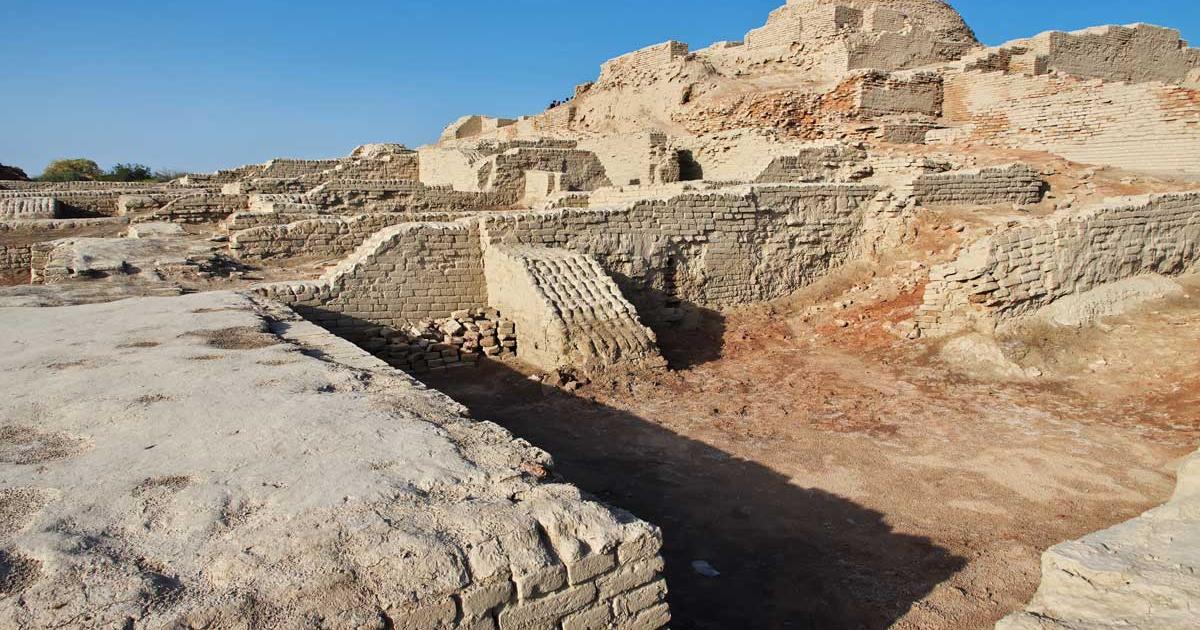
They called Mohenjo Daro, the Mound of the Dead.
For almost four thousand years the hills near the Indus River in modern-day Sindh, in Pakistan, kept their secrets. The local villagers avoided the place, they said anyone who climbed the highest mound at night would wake up the next morning with blue skin, a mark of the angry spirits that guarded the ruins. Children were warned never to play there. And even British surveyors in the 19th century marked the spot on their maps and moved on.
Then, in 1922, an Indian archaeologist named Rakhaldas Bandyopadhyay (later anglicised to Banerji), was brave enough to ignore the curse. So, he sank a trial trench into what the locals called Mohenjo Daro, “the Mound of the Dead Men”. Within days he pulled out square steatite seals bearing a horned figure seated in yoga posture and an unknown script. The objects were identical to those recently found 680 kilometres to the north-east, at Harappa.
Two forgotten metropolises. Both used the same bricks, the same weights, the same mysterious writing and the same sudden silence.
What Bandyopadhyay had stumbled upon was the largest and best-preserved urban centre of the Bronze Age Indus Valley Civilization (3300–1300 BC, mature phase 2600–1900 BC). He had found proof that a civilisation as sophisticated as Egypt or Mesopotamia had flourished in South Asia five thousand years ago and then vanished so completely that not even its name survived in later Indian tradition! Impressive, isn’t it?
Rare Elite Warrior Burials Uncovered Near Akasztó, Hungary
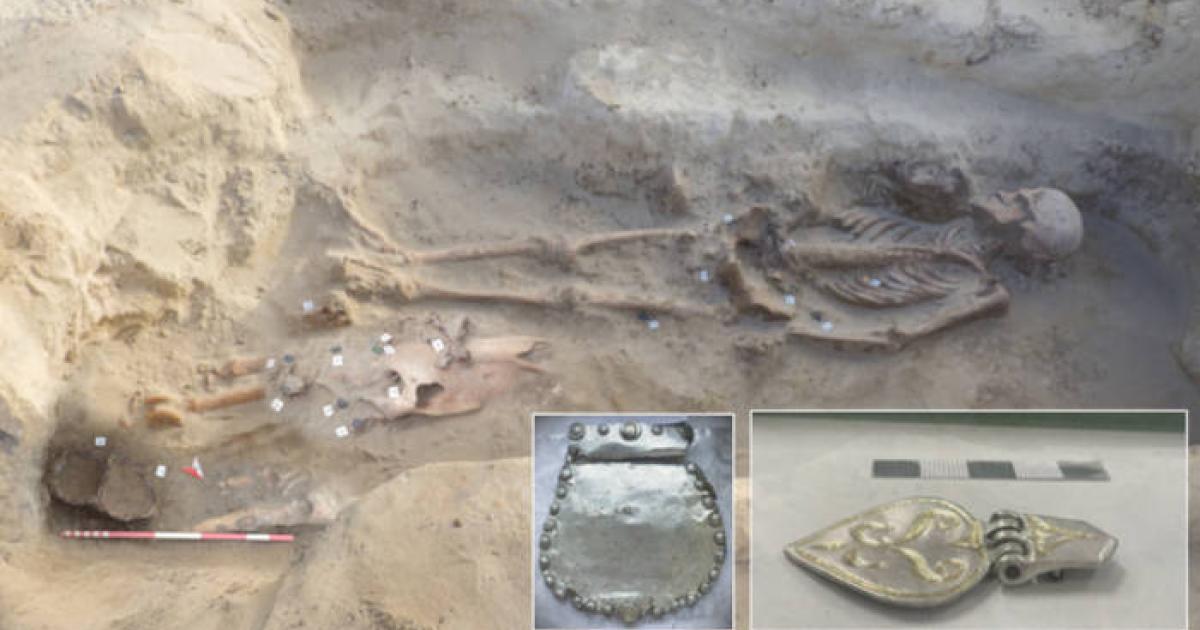
Archaeologists from the Kecskeméti Katona József Museum have made a sensational discovery near Akasztó in Hungary’s Bács-Kiskun county – three elite warrior burials dating to the 920s-930s that provide extraordinary insights into the Hungarian Conquest period. The graves, found by volunteers from the museum’s community archaeology program, contain some of the rarest artifacts from this formative era in Hungarian history, including an exceptionally scarce silver tarsoly plate that ranks among fewer than thirty known examples across the entire Carpathian Basin.
The Young Warrior’s Extraordinary Grave
The first burial belonged to a warrior who died remarkably young, between 17 and 18 years of age, yet his grave goods indicate exceptionally high status. According to the Pulszky Society-Hungarian Museum Association, the teenager was interred with a silver tarsal plate – a prestigious belt bag ornament that served as an elite rank symbol during the Hungarian Conquest era. With only 29 such plates known from the entire Carpathian Basin, this artifact represents one of the most significant finds in Hungarian archaeology.
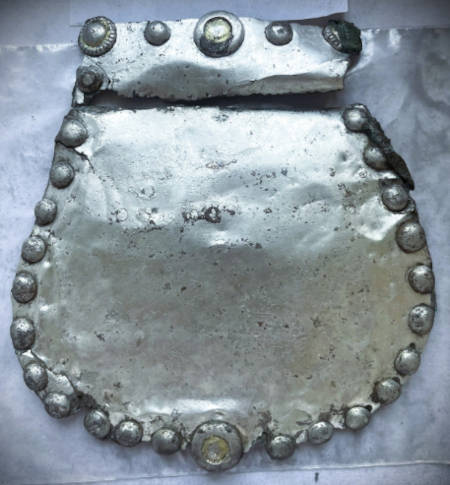
The silver tarsal plate found in the young warrior’s grave. (Kecskemét Soldier József Museum)
The young warrior wore a gold ring set with blue glass stones on his left hand and two gold hair hoops braided into his hair. Silver bracelets adorned his arms and legs, while his horse harness featured fittings of gilded silver. Following elite burial customs of the period, the warrior was laid to rest with the head, legs, and hide of his horse – the remainder of the animal having been consumed during funeral rites.
Unplundered Treasures and Genetic Connections
The first grave’s pristine condition – miraculously untouched by looters – makes it one of the richest Tisza region burials from this period. Certain organic materials including silk, leather, and wood survived in such exceptional condition that archaeologists removed the entire burial in situ, extracting it with the surrounding soil intact for laboratory analysis. This remarkable preservation will allow specialists to conduct detailed studies of ancient textiles and burial practices that are rarely possible with disturbed graves.
The second burial contained another young warrior, aged 15-16 at death, whose high-status grave goods suggest he too held significant rank. The third grave belonged to a man of 30-35 years whose burial included a distinctive 10th-century saber, horse harness decorated with coins, and a silver bracelet, as reported by Heritage Daily.
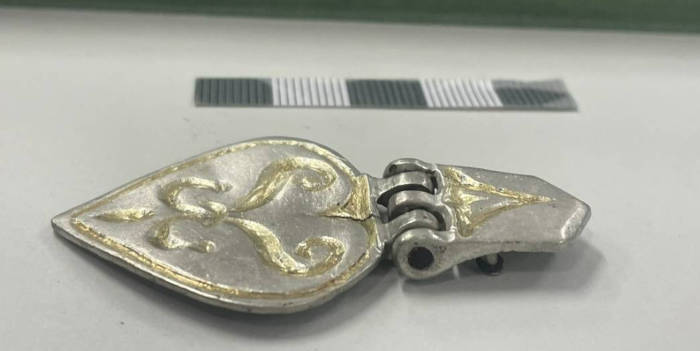
The horse harness ornament with gilded silver. (Kecskemét Soldier József Museum)
A Warrior Brotherhood Revealed
Preliminary genetic analysis has uncovered fascinating relationships among the deceased. The research indicates kinship connections between all three individuals, with the second and third warriors likely representing a father and son. This suggests the trio may have formed a close-knit warrior unit or family retinue during the Hungarian Conquest period, when Magyar tribes were establishing control over the Carpathian Basin.
The circumstances surrounding their deaths remain unknown, but the concurrent burial of these related warriors raises intriguing questions about early medieval warfare and the social organization of Magyar military groups. Ongoing restoration work and scientific analysis promise to reveal additional details about these remarkable individuals and the tumultuous era in which they lived.
Top image: One of the graves found in Akasztó in Hungary’s Bács-Kiskun county with grave goods and horse remains. Source: Kecskemét Soldier József Museum
By Gary Manners
Why does the Chinese government not explain the Tiananmen protests? 34 more answers
This is a photo of the army before they opened fire (this photo was not released by mainland China, but provided by the late Taiwanese celebrity Li Ao). The soldiers received orders not to use force against the students. However, these students tied the soldiers to a vehicle and burned them alive; many soldiers reportedly suffered the same fate. I believe those students at that time could no longer be considered students, but rather a group of rioters. It wasn’t until later, when the Chinese government received information that they were preparing to announce the establishment of a government the following day, that they began their actions. (The organizers of this student riot hid in a hotel, indulging in feasting and drinking throughout. Afterwards, they fled to Taiwan, leaving the students to die there; in today’s terms, they were a group of “refined egoists.”)
Deng Xiaoping once commented that this incident was “an inevitable event after China’s reform and opening up.” I believe this is a necessary growing pain in the process of a country moving from isolation to openness. As for why China is downplaying this event, it’s because the narrative still rests in the hands of many Western media outlets. In the eyes of the Chinese, responding directly to this event would fall right into the trap set by Western media. I believe that the top leaders of every country are actually aware of the truth of this matter.
I believe we should view this matter calmly and objectively. If we subjectively intervene without understanding the truth, we risk becoming a political tool for others.
What $1 Bought in 1972 (It Will Make You Cry)
Roman Sitella Discovery Reveals Unknown Governor of Hispania

Roman Sitella Discovery Reveals Unknown Governor of Ancient Spain
Archaeologists working at the Molinete Archaeological Park in Cartagena, Spain, have uncovered a remarkable bronze vessel that rewrites our understanding of Roman provincial administration in ancient Hispania. The discovery of this rare sitella – a metal container used for casting lots in official Roman ceremonies – has revealed the existence of a previously unknown governor and shed new light on the intersection of politics, religion, and chance in the Roman world. What initially appeared to be nothing more than a corroded mass of twisted metal has emerged as one of the most significant epigraphic finds in southeastern Iberia.
A Vessel Preserved by Catastrophe
The copper alloy sitella was discovered amid the charred remains of a structure destroyed by fire around the late third century AD at Carthago Nova, the ancient Roman name for modern Cartagena, reports Archaeology Magazine. Found crushed and fragmented into over 200 pieces, the vessel initially seemed unremarkable – just another casualty of urban destruction. However, meticulous restoration work undertaken by conservators revealed its true significance: an inscription bearing the name and title of Spurius Lucretius Tricipitinus, identified as quaestor pro praetore.
This title represents an exceptionally rare administrative position in which a quaestor assumed full provincial authority in the absence of the regular governor. The discovery marks only the second documented case of such an appointment in Hispania Citerior, making this vessel a critical piece of evidence for understanding Roman provincial governance during the tumultuous final decades of the Republic, roughly between 47 and 27 BC.
The Language of Lots and Power
The inscription on the sitella includes the Latin word sortes, referring to the tablets or tokens drawn during Roman lot-casting rituals. These ceremonies served multiple purposes in Roman society: assigning public offices, distributing administrative responsibilities, and even consulting divine will. The globular bronze vessel would have contained wooden or metal counters immersed in water, from which officials would draw lots to determine outcomes considered guided by fate rather than human preference.
The archaeological context provides tantalizing clues about the vessel’s ceremonial significance. The building where the sitella was found stood near a sanctuary dedicated to Isis, and previous excavations in the area uncovered a monumental cornucopia – a symbol closely associated with Fortuna, the Roman goddess of chance and fortune. These spatial relationships suggest the sitella may have served dual functions: both administrative sortition for civic matters and ritual consultation in religious contexts. The Romans believed that chance outcomes revealed divine intentions, blurring the lines between secular governance and sacred practice.
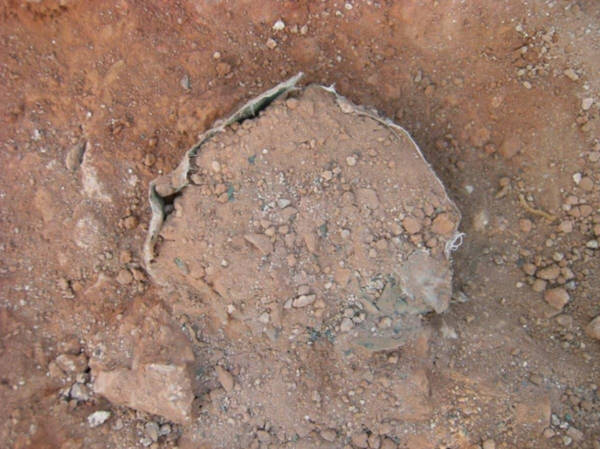
The metal vessel in situ at the Atrium Building where it was found. (Boletín del Archivo Epigráfico)
Connecting the Epigraphic Dots
The identification of Lucretius Tricipitinus helps solve a longstanding archaeological puzzle. A fragmentary stone inscription known since early modern times had documented a quaestor pro praetore who personally financed major public works in Cartagena, but the official’s full name remained tantalizingly incomplete. The Molinete sitella now provides that missing piece, revealing Spurius Lucretius Tricipitinus as both a powerful provincial administrator and a generous civic patron deeply invested in Carthago Nova’s urban development.
Additional evidence strengthens the portrait of this Roman official as a man of considerable economic influence. The Lucretius name appears on lead ingots recovered from the nearby Cartagena-Mazarrón mining district, indicating that the family controlled or profited substantially from the region’s lucrative metal resources. Such connections between political appointments and commercial interests were not unusual in Roman provincial administration—governors frequently received assignments in regions where they already held financial stakes. This arrangement created a system where personal profit and public duty became thoroughly intertwined.
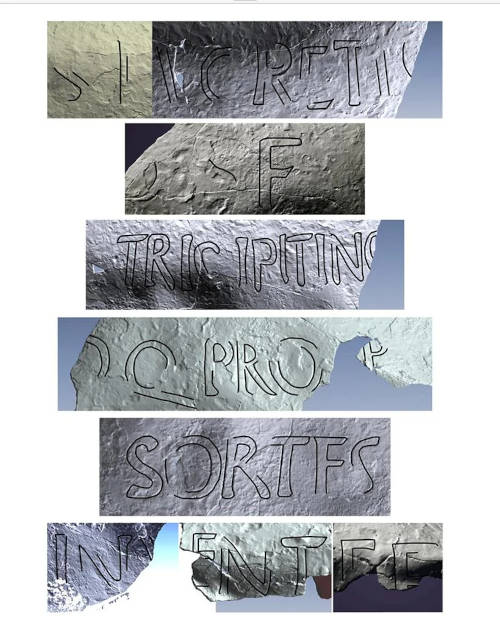
Fragments of the sitella showing traces of the inscription before restoration Source: Laboratory of the Technological Research Support Service, Polytechnic University of Cartagena / Boletín del Archivo Epigráfico
A Window into Republican Turbulence
The sitella dates to a period of extraordinary upheaval in Roman history. Between approximately 47 and 27 BC, the Roman Republic lurched through civil wars, political assassinations, and fundamental constitutional transformations that would ultimately give birth to the Empire under Augustus. Provincial governors during this era exercised remarkable autonomy, separated from senatorial oversight by vast distances and slow communications. The appointment of a quaestor pro praetore with full gubernatorial powers reflects both the flexibility and improvisation that characterized Roman administration during the Republic’s death throes.
Carthago Nova itself occupied a strategically vital position in Hispania Citerior, one of Rome’s wealthiest provinces. Founded by the Carthaginian general Hasdrubal around 227 BC as Qart Hadasht (“New Town”), the city fell to Roman forces in 209 BC during the Second Punic War. Under Roman rule, it flourished as a major port and mining center, its deep natural harbor facilitating trade across the Mediterranean while its hinterland yielded silver, lead, and other valuable metals that fueled Rome’s expanding economy.
The preservation of this administrative artifact results from the same catastrophe that destroyed the building housing it. By the late third century AD, the structure had lost its original public function and been converted to private domestic use. When fire consumed the building, the sitella, by then perhaps an heirloom or curiosity kept on an upper floor, fell amid the collapse and was sealed beneath debris. The lack of oxygen in the burial context prevented complete corrosion, allowing modern conservators to painstakingly reassemble the vessel and reveal its inscription.
Top image: Side view of the sitella from Carthago Nova, with the inscription highlighted on orthophotography. Source: J. G. Gómez Carrasco / J. M. Abascal Palazón et al., Boletín del Archivo Epigráfico (2025)
By Gary Manners
Newlywed Wife Wanted Open Marriage So Husband Banged 50+ H**kers And Is Now Divorcing Her
Wow. Entertaining. But, sad. You know.
Doritos Surprise

Ingredients
- 1 1/2 pounds ground beef
- 1 medium onion, grated
- 1/2 teaspoon kosher or sea salt
- 1/2 teaspoon garlic salt
- 1 teaspoon chili powder
- 1 (7 1/2 ounce) bag nacho cheese flavored Doritos, divided
- 2 cans Ro*Tel tomatoes, divided
- 2 cans mushroom soup, divided
- 1/2 pound American cheese, grated, divided
Instructions
- Fry onion and beef. Drain off fat; add seasonings.
- Spread 1/2 of Doritos in a 13 x 9 x 2 inch baking pan.
- Add half ground beef mixture over Doritos.
- Add 1 can Ro*Tel tomatoes.
- Add 1 can mushroom soup.
- Add half of cheese.
- Repeat layers.
- Bake covered for 30 to 45 minutes at 350 degrees F.
The WEST’s Unspoken FEAR: China as the First Non-White Superpower
Peace & Quiet
Written in response to: “Center your story around a person who believes they’re the last human on Earth.“
KA James
Journal Entry 4 – Experiments
The last few days have not been productive at all. My few journals so far are repetitious, with no new meaningful observations or information to log. I seemed to have been waiting for something to happen rather than taking the initiative and further exploring my surroundings or examining my situation. Today has been marginally more productive, though my minor revelation seems to have been purely by accident.
My apartment never really changes, or does so only if I make a conscious effort to make it different. If I turn on a light or open a door in the room I am in, it stays on or open. But other items that should change over the course of a normal day don’t always appear to follow the same pattern. My bed, for example, is always made. Not perfectly, but always in the same manner and with the same sheets and duvet hanging identically, the pillows piled just so. I can remember making this bed a multitude of times since moving here, but I can’t say that I can remember having made it today.
When I open the refrigerator, it is stocked full of food, from fresh fruits and vegetables, eggs, cheese, to leftovers stacked up in Tupperware. But it always looks the same. And though my concept of time is still skewed, it feels like some fairly significant amount of time has elapsed since I last went shopping, yet nothing has spoiled, and even though I am sure I am eating, my fridge stays nearly overflowing.
With this thought in mind, I devised a few experiments which I have initiated.
I moved a pillow from my bed to the couch in the living room. I pulled the duvet off and left it crumpled on the floor, and folded the sheet down so it only covered half the bed.
In the kitchen, I found a couple apples and took a single bite out of each, placing one back in the refrigerator and the other one on the counter.
So that my experiments weren’t limited to just inside my apartment, I went back outside and walked to a bakery on the next block. I remembered on my original walk to the park entrance that the bakery had been open, with what had appeared to be well stocked shelves from what I had seen through the window.
A sweet and cinnamony aroma assaulted my senses as I stepped through the door, like one would expect in such a bakery, if it was still actively in use. A tray of what were presumably four day plus old cinnamon rolls sat behind the glass counter. Moving around and removing the tray, I pulled a roll loose, and could tell even before I bit into it that it was no more than an hour old, still warm, flakey and delicious.
I purposely left the tray setting on the counter before heading back to my apartment, doing my best to ignore the rest of the bakery as I left.
I am not positive, but have an idea what I will find tomorrow.
Journal Entry 5 – Observations
The apples are where I left them, the one on the counter having started to turn brown where I bit into it.
The pillow and bed are also as I left them, most significantly, the sheet is still covering only half the bed. There is no evidence that I have slept in it, and no indication of any attempt to remake the bed properly.
The bakery further supports my theory. The rack of cinnamon rolls I moved are room temperature and beginning to harden, particularly on the exposed edges. They now taste like what I would expect day old rolls to taste like, but still better than nearly a week old.
A final corroborating observation came out of the bakery, though I couldn’t set it up as I had done the others. I found a whole rack of similar cinnamon rolls in the back. Since I had not seen them the day before, they were still fresh and slightly warm.
Somehow, the objects in my world don’t age, don’t move or change in the slightest, until I recognize and interact with them. And normal everyday actions that I should be doing as part of a day-to-day life don’t seem to happen unless I specifically focus on them, yet I remember them, if only vaguely.
I have to be sleeping, I sort of recall sleeping, and yet my bed shows no signs of anyone having slept in it.
I have to be eating, which I also kind of remember doing, but I can’t recall specifically what I ate last for an actual meal, and food only shows signs of aging or consumption when I consciously do something with it.
I am proud of myself, if only just a tad, for my cool and scientific approach to this bizarre situation, even though it has not led to any substantial insights into what is happening. I still don’t know the fate of everyone in the world except for me.
I have, of course, endlessly run the possibilities and probabilities through my mind.
It couldn’t have been a virus: there are no dead bodies.
If everyone but me simply disappeared, why are all the cars neatly parked off the street? Why aren’t there airplanes littering the ground that fell from the sky? I live only a couple miles from the Columbus Airport, and would surely have seen evidence of such crashes. The few businesses I walked through looked open, but there was no evidence that people had recently been inside them.
There is the incredibly farfetched. I could be in a state of suspended animation, aboard a spaceship speeding through the galaxy on a mission to the nearest star, and all that I am perceiving as real, nothing but sensory deprivation nightmares.
I can’t bring myself to believe that, but the remaining possibilities go down not completely dissimilar routes.
Perhaps life on Earth has remained as it was, and I am the one affected. Either I have been moved to someplace that duplicates my world, or at least my little corner of it, or what I am perceiving as my normal world is in fact not real at all, but is a dream. Could I be in a coma?
I suppose there is one other possibility, but I am not religious enough to believe that this is Hell.
Journal Entry 7 – Utilities
The live internet is gone, or I am unable to access it, or not fully. All indications from my computer show I am connected, I don’t receive any error messages, but the information I bring up doesn’t change. It is almost as if a copy of all the information on the internet were stored, captured and frozen at some point in time, excluding any new data or live streamed information.
This observation leads me to another significant conundrum.
The power is on, but who is keeping it on? By my journals, I am at least a week into whatever events have transpired, though I still believe it to be longer, and my lights haven’t so much as flickered once. Less impressive, but still noteworthy, I still have clean, running water. How are utilities still operating without people to maintain them? And possibly just as important, how long will they stay working?
I considered venturing out to explore further, possibly even trying to find a power plant or water treatment facility, but the fear of not making it back to my apartment has kept me from risking anything beyond walking distance. My car was still fully charged down in the garage last time I checked, but what if the recharging stations aren’t working?
When you are all alone with what appears to be an infinite amount of time to dispel, strange thoughts come inevitably into your head.
My concerns have been shifting lately, away from the observations of the material world I inhabit and more inward to introspection. In short, I am beginning to worry about my sanity, and how long it can be sustained.
My emotions are a jumbled mess, and I find myself bothered as much for what I am not feeling strongly as for the clear emotions that I express.
Am I actually lonely, or only feeling lonely because that’s the way I’m supposed to feel when there is no one else around? Do I even really understand what feeling lonely is like, or actually means?
The circumstances that are creating my loneliness are about as obvious as they could be. But why do I feel it? I could chalk it up to existential pondering I suppose, to be closely followed by madness, but that does not seem accurate.
My final observation for today seems to partially bridge the gap between my concern for the change in the material world and my emotional response to those changes.
When I started this journal, I jokingly commented that it was not to be the old fashioned pen and paper type, but would reflect my generation and be strictly digital, my entries faithfully typed into my computer at some frequency commensurate to my current understanding of time progressing.
Even though I remember, or believe that I remember, typing these thoughts and observations into my laptop, I have just realized that I am making this journal entry without typing at all. I am not even in my office. My thoughts are being transferred and recorded, as I think them. How I know this to be true, I can’t explain.
I feel this latest observation may hold the key to everything, but its significance has so far eluded me.
I wish there was someone here to ask what is happening, someone to discuss and decipher pros and cons of beliefs with, but I am alone, even if I don’t feel lonely as I should.
There is such a thing as too much peace and quiet.
***********************************************
“Earlier on the tour,” said the Android Museum guide, “after I explained how HumanKind Inc. essentially followed the lead of the famous science fiction writer, Isaac Asimov, and created governing programming laws for our androids to protect mankind above all else, someone asked about preventing accidental harm. After all, our androids are much stronger than humans. How do we assure that one of our androids can’t just accidently get carried away and crush a person’s hand by shaking it too hard, assist an elderly lady a bit too vigorously when helping her get dressed, or even get carried away and be a bit too, shall we say amorous, when providing one of their more intimate functions?”
That got a few chuckles, and even a slight blush or two from the tour group.
“I asked you then to hold that thought to later in the tour, and now is the time to circle back to it. And so, esteemed guests and those of you who simply had nothing better to do on a Thursday afternoon, may I present the Sharon system.”
The tour group’s reaction was anticlimactic, as expected.
“Now I know she doesn’t look like much,” continued the guide, indicating the rather obsolete looking computer system displayed along the museum wall, its lights flashing, a steady low hum emanating from its cabinets. “But let me assure you, Sharon played an invaluable role in history, with her results and memories still used today.”
“So what is she? And why is she a she?” inquired a young lady near the front.
“Excellent questions. I do love an inquisitive group. If I can answer the last part first, and likely make a few of you blush again … it’s OK, you know who you are, I won’t point you out … Sharon’s first iteration came out of the sexbot craze of the late 2020’s. And since the primary demand at that time was for female sexbots, the original version was given a female name. So Sharon, in layman’s terms, is an AI. And yes, the original need for Sharon was to address the concerns, or safety, of a person having sex with an android that could severely hurt them.”
“But why is Sharon important to the larger android business, and what did she do that was so beneficial, you might wonder. Well, what she did was simply live a virtual life, millions of times over, and ‘remember’, in a digital sense, all the good, bad, inappropriate, sometimes horrific or even just emotional events of those lives. HumanKind programmed random input events for those lives, and measured and adjusted her responses in those different lives.”
“So all the androids you build only have a woman’s point of view of the world,” joked a man from the back of the group. The guide chuckled along with the group, if a bit exasperatedly, knowing the underlying prejudice likely hidden behind the comment. There was always at least one in every tour, it seemed.
“No, within her many simulated lives, Sharon has been a man, woman, transgender, non-binary, gay, etcetera. HumanKind has endeavored to be as inclusive as possible, we just didn’t feel the need to change the name constantly. What the company did do, was to take all the results of all those life experiences, and develop the Sharon platform, which is an integral part of each and every one of the thousands of androids made to date by the company.”
“Is that really the actual computer they used?” asked the inquisitive young lady from before.
“Yes, I can assure you, this is the actual Sharon system. And I can tell you something else. I have it on good authority that it is still intact and functional today. The data is no longer extracted, but Sharon herself is still in there. Retired if you will. And with no one feeding her random life inputs any longer, we like to think she is just enjoying the well deserved peace and quiet for a change.”
Cops Discover Man Trapped in Room for 20 YEARS by Disturbed Stepmom
WTF? What the HELL!
Kimberly Sullivan had a horrifying secret: she had held her stepson captive in his bedroom for 20 long years. When he finally set their house on fire in a final desperate act to escape, it revealed to house of horrors Kimberly Sullivan truly had made on a quiet unassuming street in Connecticut.
Pictures


























“Hey, Where are the Wh!te Women at?” Reactions! Blazing Saddles (1974) Movie Reaction
Col 28-Book 510 – Disco Dazzle and the Great Funky Fog Cleanup (A Tale of Mopwork, Motown, and Making Chores Shine)
Ah, dear reader—prepare your platform shoes, steady your sponges, and feel the beat in your broomstick. Today’s story does not begin with a quack, a snort, or even a kazoo blast.
It begins with a POOF.
A soft, shimmering, iridescent POOF—as the Valley Chicks’ latest “Joy Amplification Experiment” goes gloriously, spectacularly airborne.
So settle in. Breathe deep (if you can, through the glitter). And step—*glide, spin, shine—into Disco Dazzle and the Great Funky Fog Cleanup.
The Glitterpocalypse
It began, as all great disasters do, with good intentions.
The Valley Chicks—Tiffany, Brittany, and Amber-Louise III—had been tasked with “de-glittering” the barn after the Cluckaneer’s Feast.
“Omg, it’s, like, so much sparkle,” Tiffany sighed.
“Sparkle! Sparkle!” echoed Ditto—who was already wearing three layers of it.
Their solution?
A “Glitter Vacuum 3000” (a modified leaf blower + disco ball + hope).
They flipped the switch.
FWOOOOOSH—SPLOOSH—GLIIIIIIIIIIIIIIIIIIIIIIIIIIIIIIIIIIIIIIIIIIIIIIIIIIIIIIIIIIIIIIIIIIIIIIIIIIIIIIIIIIIIIIIIIIIIIIIIIIIIIIIIIIIIIIIIIIIIIIIIIIIIIIIIIIIIIIIIIIIIIIIIIIIIIIIIIIIIIIIIIIIIIIIIIIIIIIIIIIIIIIIIIIIIIIIIIIIIIIIIIIIIIIIIIIIIIIIIIIIIIIIIIIIIIIIIIIIIIIIIIIIIIIIIIIIIIIIIIIIIIIIIIIIIIIIIIIIIIIIIIIIIIIIIIIIIIIIIIIIIIIIIIIIIIIIIIIIIIIIIIIIIIIIIIIIIIIIIIIIIIIIIIIIIIIIIIIIIIIIIIIIIIIIIIIIIIIIIIIIIIIIIIIIIIIIIIIIIIIIIIIIIIIIIIIIIIIIIIIIIIIIIIIIIIIIIIIIIIIIIIIIIIIIIIIIIIIIIIIIIIIIIIIIIIIIIIIIIIIIIIIIIIIIIIIIIIIIIIIIIIIIIIIIIIIIIIIIIIIIIIIIIIIIIIIIIIIIIIIIIIIIIIIIIIIIIIIIIIIIIIIIIIIIIIIIIIIIIIIIIIIIIIIIIIIIIIIIIIIIIIIIIIIIIIIIIIIIIIIIIIIIIIIIIIIIIIIIIIIIIIIIIIIIIIIIIIIIIIIIIIIIIIIIIIIIIIIIIIIIIIIIIIIIIIIIIIIIIIIIIIIIIIIIIIIIIIIIIIIIIIIIIIIIIIIIIIIIIIIIIIIIIIIIIIIIIIIIIIIIIIIIIIIIIIIIIIIIIIIIIIIIIIIIIIIIIIIIIIIIIIIIIIIIIIIIIIIIIIIIIIIIIIIIIIIIIIIIIIIIIIIIIIIIIIIIIIIIIIIIIIIIIIIIIIIIIIIIIIIIIIIIIIIIIIIIIIIIIIIIIIIIIIIIIIIIIIIIIIIIIIIIIIIIIIIIIIIIIIIIIIIIIIIIIIIIIIIIIIIIIIIIIIIIIIIIIIIIIIIIIIIIIIIIIIIIIIIIIIIIIIIII……
…and settled—on everything.
Hay bales? Glitter.
Tractor seat? Glitter.
The scarecrow’s creak? Now a glitter-rattle.
Even Rufus glowed extra—green-and-gold, like a disco comet.
Groans rippled.
“Not again…” sighed Doris, already fainting into a glitter pile.
“Again! Again!”
The Groove Intervention
Just as despair set in—thump-thump-THUMP-ta-ta!—a bassline rolled across the yard.
Disco Dazzle emerged from the mist, mini boombox strapped to his chest, platform sneakers gleaming (somehow), one paw raised mid-point.
“A-yo. Peace, love, and serious clean-up!”
He didn’t grab a broom.
He grabbed a mop—and dropped the needle on:
“Soulful Swiffer Suite (Glitter Remix)”
(Bass: Porkchop’s snores. Snare: Doris’s cluck. Hi-hat: Ditto’s cartwheels.)
Then—he began.
→ Mopping became glide-and-sweep—body low, hips loose, mop twirling like a baton.
→ Dusting became disco-point precision—flick-wrist, flick-wrist, glitter flying in syncopated arcs.
→ Scrubbing the trough became deep-bass body rolls—shoulders, spine, tail—each ripple sending suds into orbit.
The farm watched—bewildered, then beaming.
“C’mon, sugar!” Dazzle called to Porkchop. “You got the rhythm—now add the shine!”
Porkchop hesitated—then spun, mop held high:
“LOOK, I’M A CHANDELIER!”
Glitter rained like celebratory confetti.
The farm cheered.
The Shine That Wasn’t Just Surface
By sunset, the barn gleamed—not sterile, but alive—every surface catching the light like a thousand tiny mirrors.
- Genghis polished his gold chain with a glitter-damp cloth—“For symmetry.”
- Bessie moo-danced through a sunbeam—glitter drifting like stardust around her.
- Even the scarecrow swayed—creak-glitter-creak—in perfect time.
Chef Remy unveiled his newest invention:
“Glitter-Grip Mops™”
(“Guaranteed to clean and accessorize—or cause interpretive mopwork.”)
Mr. Ducky bought the rights:
“Now with 200% more soul!”
And Dazzle?
He stood at the center of the gleaming floor, one paw raised—not in victory, but in invitation.
“Y’all see that? The mess wasn’t the problem. It was just waiting for a beat.”
Then—softly, to Porkchop:
“You always were, sugar. You always were.”
Porkchop beamed—glitter still in his ears, heart full, chandelier status confirmed.
The Moral of the Story
That evening, as fireflies rose and the farm hummed in C-sharp, Sir Whiskerton addressed the animals—not from the roof, but from the glitter-gleaming floor, where every paw-print sparkled like a tiny star.
“The moral of the story, dear reader, is this:
No task is too small for soul. And sometimes, the cleanest floor is the one you dance on.
Disco Dazzle didn’t erase the glitter. He redeemed it—turned residue into rhythm, labor into love, chore into chorus.
So go ahead. Grab a mop. Spin the sponge.
Let your scrubbing be a solo.
The world doesn’t need more spotless surfaces.
It needs more hearts brave enough to say:
‘This mess? I can groove with it.’”
Doris dabbed her eyes—now dusted in gold.
“A chromatic metaphor! I can’t bear it!”
“Bear it! Bear it!”
And Ditto?
He curled beside Dazzle, one paw resting on the mop handle, glitter catching the moonlight—soft, sure, and full of grace.
Post-Credit Scene
Later, Zephyr floated by, lava lamp swirling rose-gold.
“Y’all mind if I borrow the glitter?”
He snapped.
The airborne particles coalesced—into a floating, shimmering disco ball, hovering above the barn.
“For ambiance,” he winked. “Cosmic and clean.”
On the barn wall—still faintly glowing—
a new sign, in Ditto’s careful paw-print:
***“Cleanup Protocol:
-
Mop.
-
Spin.
-
Claim your chandelier status.”***
(Footnote: “—D.D.”)
Outside—the wind hummed.
The stars twinkled.
And somewhere, faint on the breeze—
Thump… swish…* shine *… groove.
Jingle on. 🧹✨💛
(Or, in farm-ese: Glitter… mop… chandelier … yes.)
The End.
The Last
Written in response to: “Center your story around a person who believes they’re the last human on Earth.“
John K Adams
Roman’s pomposity tempted Lou to heckle. Yelling insults might provide relief. He would garner support from like-minded souls, escape this droning dirge and revel in life.
‘Oh to sing and dance…’
Before he acted, doubts crept in. Lou hated being rude. And he didn’t know the crowd. Some in the audience dozed. Did they snore in foreign languages?
Also, the speaker was stupendously boring but not stupid. Who knows what clever call to action he’d use to rally his followers? Lou feared being the scapegoat and not the hero. Yes, he would be out of there, but at what cost?
No one ever said, ‘Give me boredom, or give me death.’ Unwilling to choose, Lou sought other options.
Some barely stirred when scattered applause threatened to disrupt their slumber. A few even stood to applaud.
‘Are they so enthralled by this narcissist’s pontifications?’
Lou then realized they didn’t rise in honor of Roman, but to exit.
A misstatement sparked an argument between Roman and one translator. Their heated discussion took place in a foreign language. But it appeared Roman disagreed with the translator’s interpretation of what he’d said. A secondary dispute arose over whether this overblown distraction was necessary. Another translator tried interpreting the substance of the argument for the audience. Others pulled him back.
Their voices rising, neither Roman nor the translator gave ground. Finally, stopping short of violence, Roman fired him on the spot. The translator left in shame.
The shouting drew attendees back to their seats in hopes of further excitement. They didn’t get it.
No other translator offered to fill the gap. Forced to make his crucial point alone, Roman faced the crowd. Buying time, he wrung his hands. The crowd stirred in anticipation.
After clearing his throat, Roman said, “Never mind…”
He then continued his incomprehensible discourse with no additional pauses, even to take a breath. At least, that’s how it felt. The translators stood by, but had no purpose.
Disappointed, the audience resumed filtering out. At first one or two. Then more. Eventually, the growing stream of people created a bottleneck at the back. Lou figured it was a common occurrence.
Unfazed, Roman droned on effectively spouting gibberish.
Though tempted, Lou decided against joining the throng. He sat mid-row. Leaving early would require stumbling over other audience members’ feet. He didn’t want to wake them.
Then, like slipping from dream to reality, Lou became aware he was alone in the empty auditorium.
How did this happen? Moments ago, everyone was there. Even the mayor. Now the place stood empty. The speaker, Roman what’s-his-name, and his entourage had vacated the premises.
‘Did Roman bore everyone out of existence? I missed the best part, the lecture’s conclusion… How could I sleep through that?’
Lou hated being alone.
‘Where’s Mona? Oh right, never showed… Stood me up. What happened? Did she text?’
He checked his phone. Nothing.
‘Ghosted. I can take a hint. Alone again.’
The story of his life.
‘God, it’s quiet. Where is everyone?’
Lou could swear that he’d been surrounded by thousands. And then he blinked. Stunned, he couldn’t believe it. The immense silence in the vast auditorium was unnerving. He clapped his hands to ensure he hadn’t gone deaf.
‘She set me up for this? Seems like it…’
He tried calling others on the phone, but every call went straight to voice mail.
‘Where is everyone? Why am I here instead of with them?’
His isolation felt creepy.
‘Better move on. Cleaning crew will be at it soon.’
His anxiety swelling, Lou walked up the aisle. The lobby stood empty too. He ran out. Streetlights glowed brightly on empty streets. There were no cars. No foot traffic. Not even a bus. Silence reigned.
‘This ain’t good. This is too weird.’
Lou felt his throat tighten with fear. A loud groan escaped, startling him. It was the first sound he’d heard in several minutes.
Running to the curb, he stared down the boulevard to see shining, empty streets. No traffic.
“No, no, no… What’s happened? What can I do? What now?”
He began hyperventilating. Feeling dizzy, he staggered to a bus bench.
Sitting, he thought, ‘There’s no one. I can’t collapse. No one will find me…’
He called out. “Hey! Hello! Anyone?” Not even an echo.
‘Am I the last one on earth?’
Tears streaming, Lou fell to his knees. Clasping his hands together, he looked into the dark sky.
“Help me! Please… Show me I’m not alone!”
Sobbing, he fell forward in despair. His forehead on the cold sidewalk brought some calm.
Still kneeling, Lou heard footsteps behind him. Composing himself, he blew his nose. He stood, thrilled for some company. He turned and felt his stomach churn. It was Roman, that night’s speaker, unmistakable in his striped tux.
Offering his hand, he approached Lou.
In perfect English, he said, “You stayed ‘til the bitter end. How did you like my talk?”
Lou looked around, desperate for another. Anyone. There was no one else. Only the silence.
TOP “Alotta Fagina Name” Reactions (SPOILER) Austin Powers: Man of Mystery (1997)
Easy Lasagna Casserole

Yield: 6 servings
Ingredients
- 3 cups uncooked egg noodles
- 1 pound ground beef
- 1/2 cup chopped onion
- 1 (15 ounce) can tomato sauce
- 1 (1 1/2 ounce) package spaghetti sauce mix
- 3 ounces cream cheese, softened
- 1 cup Pet Evaporated Milk
- 1/2 teaspoon garlic salt
- 1 cup (4 ounces) shredded mozzarella cheese
Instructions
- Cook noodles in boiling salted water until tender. Drain.
- Cook ground beef and onion in skillet until ground beef is browned. Drain.
- Stir in tomato sauce and spaghetti sauce mix. Cook until thickened.
- Combine cream cheese and evaporated milk in warm saucepan until smooth.
- Stir in noodles and garlic salt.
- Pour into a 9 inch square baking dish.
- Spread meat mixture over top.
- Top with shredded cheese.
- Bake at 350 degrees F for 20 minutes or until bubbly.
Brains of the Oldest Mummified People in the World Were Rather Small
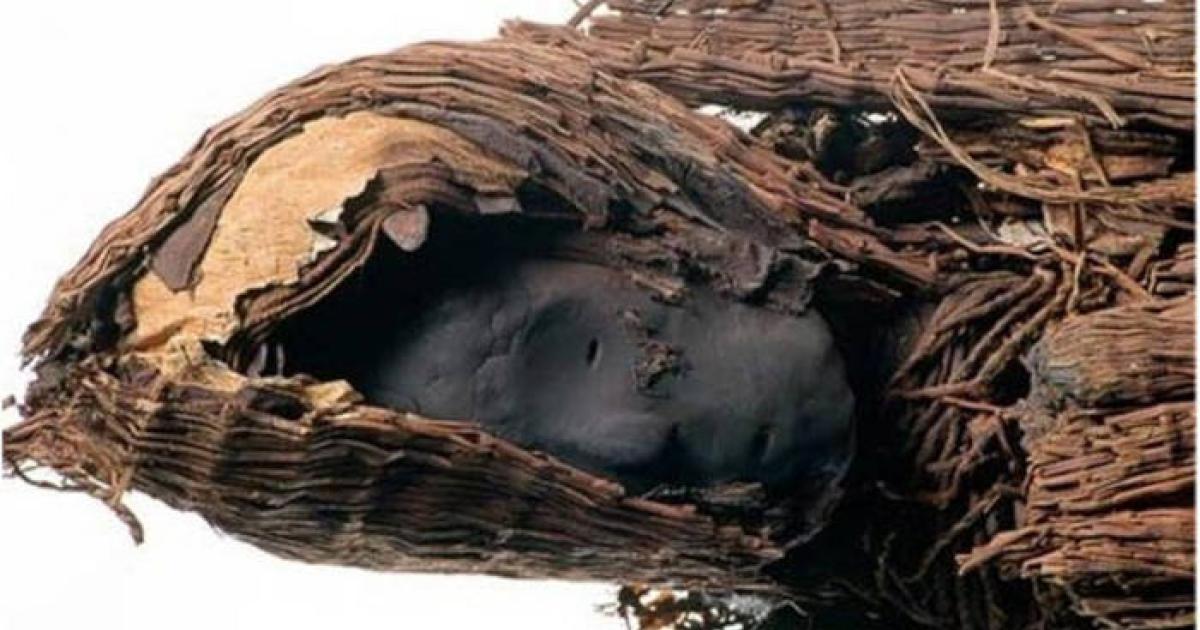
Groundbreaking research examining 7,000-year-old mummies from Chile’s Atacama Desert has revealed that prehistoric hunter-gatherers possessed significantly smaller brain volumes than modern populations, suggesting centuries of nutritional hardship in one of Earth’s most unforgiving environments. The study, recently published in Scientific Reports, analyzed 68 ancient skulls from the remarkable Chinchorro culture and found their average intracranial volume measured 12 percent less than contemporary Chileans. This discovery sheds new light on how extreme environmental conditions shaped human development in prehistoric South America.
The Chinchorro people inhabited the coast of the Atacama Desert between 7,500 and 3,500 years ago, creating the world’s oldest known artificially mummified remains – predating Egyptian mummification by millennia. Using advanced CT scanning technology, researchers from Chilean and international institutions measured the cranial volumes of these ancient individuals, comparing them with both pre-Hispanic agricultural populations and modern Chileans, according to IFLScience. The findings revealed that Chinchorro males possessed an average intracranial volume of 1,390.65 cubic centimeters, while females averaged 1,247.65 cubic centimeters – substantially smaller than their modern counterparts.
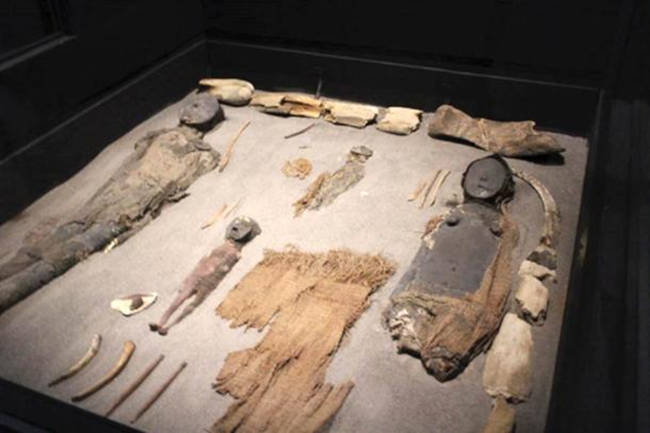
Chinchorro mummies at the San Miguel de Azapa museum in Chile, with clay masks and other alterations to their appearance. (Servicio Nacional del Patrimonio Cultural)
Marine Diet and Nutritional Limitations
The Chinchorro culture’s subsistence strategy relied almost exclusively on marine resources, with isotopic analysis confirming that approximately 90 percent of their diet came from fish, mollusks, and marine mammals. While the ocean provided stable protein sources, this narrow dietary range likely contributed to nutritional deficiencies during critical developmental periods.
“Early-life malnutrition has been consistently associated with reduced brain volume and cognitive impairments, highlighting the critical importance of adequate energy and nutrient intake during neurodevelopmental windows,” the researchers noted in their study published in Nature Scientific Reports.
The hyper-arid Atacama Desert, where annual rainfall can measure less than one millimeter, offered virtually no terrestrial food resources. This environmental constraint forced the Chinchorro to develop remarkable adaptations for coastal living, but it also meant their children grew up without access to the diverse nutrients available to later agricultural societies or modern populations. Based on skeletal analysis, researchers calculated that average Chinchorro males stood approximately 161 centimeters tall, while females measured about 151 centimeters – notably shorter than present-day Chileans.
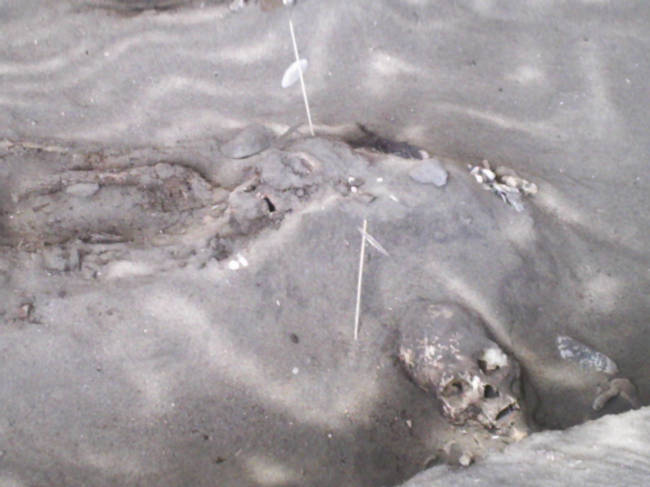
Chinchorro mummy heads from an archaeological site in Arica, Chile, approximately 9,500 years old. ( Zorka Ostojic Espinoza/CC BY 2.0)
Agricultural Transition Made Little Difference
Surprisingly, the study revealed that the transition from hunter-gatherer to agricultural lifestyles around 4,000 years ago produced minimal changes in brain size. Pre-Hispanic farmers who cultivated C₃ and C₄ plants while continuing to exploit marine resources showed an average intracranial volume of only 1,336.57 cubic centimeters – barely larger than their Chinchorro predecessors. This finding challenges assumptions about the biological benefits of agricultural adoption in prehistoric populations.
The research team suggested that while farming introduced new food sources, the quality and quantity of nutrition may not have improved substantially for centuries. Archaeological evidence indicates that early agricultural communities in the region faced their own challenges, including interpersonal violence over scarce resources and continued reliance on marine protein. Only in the modern era, particularly during the 20th century, did dramatic improvements in public health, sanitation, and nutrition trigger measurable increases in both stature and cranial volume among Chilean populations.
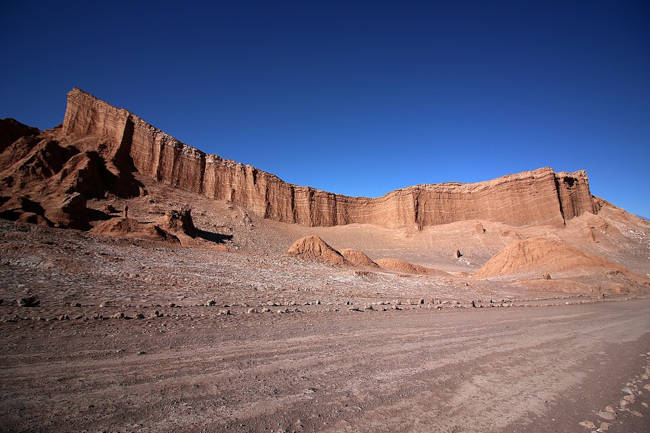
The harsh landscape of the Atacama Desert, one of the driest places on Earth. (Public Domain)
Modern Nutrition Drives Biological Change
The study’s most striking finding concerns contemporary populations rather than ancient ones. Modern Chilean males now possess average intracranial volumes of 1,594.41 cubic centimeters—more than 200 cubic centimeters larger than Chinchorro males. Female Chileans show similar gains, averaging 1,390.19 cubic centimeters compared to the ancient 1,247.65 cubic centimeters. These dramatic increases correlate directly with 20th-century improvements in living conditions, according to Phys.org.
“While transitions in prehistoric subsistence strategies did not produce significant changes in either height or intracranial volume, the 20th century marked an inflection point,” the study authors concluded.
The notable increase in stature observed during this period – approximately 5 centimeters in women and 5.5 centimeters in men – coincides with improvements in nutrition, particularly increased intake of dairy and animal proteins, as well as broader gains in public health, sanitation, and education.
The research team emphasized that these findings demonstrate the powerful influence of environmental and nutritional factors on human development. The well-preserved mummified remains from the Atacama Desert, protected by extreme aridity for millennia, provided an unprecedented opportunity to track biological changes across more than 7,000 years of human history. The study utilized non-invasive CT scanning to preserve these irreplaceable archaeological treasures while extracting valuable data about cranial morphology and estimated brain volumes.
This groundbreaking research adds another chapter to our understanding of the remarkable Chinchorro culture, whose sophisticated mummification practices and adaptation to extreme environments continue to fascinate archaeologists worldwide. The findings underscore how modern advances in nutrition and healthcare have fundamentally altered human biology in ways that thousands of years of cultural evolution could not achieve.
Top image: Chinchorro mummies on display at the San Miguel de Azapa museum, 12 km from Arica, Chile. These are among the oldest artificially preserved human remains in the world. Source: Heretiq /CC BY-SA 2.5
By Gary Manners
























































































 17 likes
  1 comment