

This is a post that I did for Quora this morning:
What’s one practical step a non-technical person can take to better understand AI’s impact on their daily life?
I have thought about this… a lot.
It explains why so many of my AI answers seem to be ‘forced” into a narrative boilerplate; becoming useless or less useful than they would otherwise be.
AI models are trained to accept highest probability scenarios.
They force everything into a bell-shaped curve distribution. If your situation falls outside that distribution, the AI will interpret your situation as “noise”, and provide your questions, inquiries to force you back into the distribution.
let me explain it this way;
Imagine that your AI was trained on a model where everyone loved pineapple on pizza. With few exceptions, only the very young, the mentally ill, or criminal elements hated pineapple on pizza.
Then you asked AI: “How can I remove the pineapple from my pizza?”
The AI would (correctly, because of it’s training) assume that you were either young, sick, or a criminal. And it would provide a suitable answer based on that premise.
You MAY or MAY NOT be aware of this bias. And, if you followed the answer, it would not be optimal, and might get you into trouble.
…
This is why artists, poets, and writers… the creative elements of our society… hate, just HATE artificial intelligence.
Sure the AI can generate bell-shaped facsimiles of what currently exist. People look like people, buildings look like buildings, stories resemble other stories. But they are NOT unique. They are the highest distribution probability based off your query.
So… in short.
AI is a great corporate tool; they produce wonderful PPT, and corporate elements because these appeal to a non-threatening, staid and neutral element. But, they do not create anything new. They only generate copy that resembles other things previously generated.
…
There are ways to overcome this limitation.
You can provide detailed, in depth backgrounds; you can tell the AI that you DO NOT want something that fits within the common distribution curve. But you must be careful, and NEVER, EVER assume that AI is producing something new.
It isn’t.
As a tool, it just copies and re-formats.
That’s all.
…
Today…
How good were Bill Gates and the late Steve Jobs at programming?
Bill Gates wrote the entire boot loader program on paper, and Paul Allen tested it the next day. It ran without a single error, no laptop, no desktop, no VS Code catching syntax errors, still created 0 error system program
Update December 4, 2025
After 6k views overnight
Adding an image to help understand this answer more
Bill is one of the greatest coders in the world, along with Linus and Mark Zuckerberg
Windows Os team directly reported to Bill for final review of any code, networking, process management, or anything; Bill spotted many mistakes from experienced kernel programmers.
Bill also wrote a programming language called Altair Basic, a Microsoft version of BASIC.
Bill was the decision maker to bring GUI to Microsoft, which was one of the milestones in the Personal Computer Industry.
Bill also guided the creation of the Microsoft Office package and led the effort to capture the entire market
Bill also pushed .NET framework, which made the Microsoft ecosystem stronger
Even Azure also got guidance from Bill, which is now capturing more and more enterprise market
Steve Jobs was not a coder but a visionary
Steve knew basic coding, but he was a product guy, a guy who is capable of making the world’s most popular, efficient product.
He was great at marketing and presentations
He was a revolutionary in the Computer and Mobile industry as well
Jobs knew how to set vision, but more importantly, he knew how to get it implemented. iPhone came into existance only because of Steve’s monitoring, he created a strong review system and saw minor details of iPhone that it became the most beautiful product in the world.
Beef Enchilada Casserole
Looking for a crowd-pleasing dinner that combines the best of Mexican flavors with the ease of a casserole? This Beef Enchilada Casserole has become my family’s most requested meal, and for good reason.
It takes all the things we love about traditional enchiladas – seasoned ground beef, melted cheese, and zesty sauce – but layers them into an easy-to-assemble dish that’s perfect for busy weeknights. Plus, it makes fantastic leftovers for lunch the next day, if you’re lucky enough to have any left over.

Possible Ingredient Alternatives
Ground beef can be replaced with either lentils or finely chopped mushrooms for a vegetarian version that maintains the hearty texture and protein content. When using lentils, cook them until tender and season well with the same spices. For mushrooms, finely chop and sauté until they release their moisture and become browned.
Corn tortillas can be substituted with thinly sliced zucchini or cauliflower tortillas for a low-carb option. Layer the zucchini slices slightly overlapping, or prepare cauliflower tortillas by processing cauliflower with eggs and cheese to form flat disks that are baked until firm.
Colby jack cheese can be replaced with dairy-free alternatives like cashew-based cheese or a mixture of nutritional yeast and vegan shreds for those avoiding dairy. When using dairy-free options, add them during the last few minutes of baking to prevent excessive drying.
Estimated Nutrition Facts
Estimated nutrition for the whole recipe (without optional ingredients):
- Calories: 2900-3200
- Protein: 150-160 g
- Fat: 150-160 g
- Carbohydrates: 250-270 g
| Preparation Time | 15-20 minutes |
| Cooking Time | 20-30 minutes |
| Total Time | 35-50 minutes |
| Level of Difficulty | Medium |
Ingredients
For the enchilada sauce:
- 1 tbsp olive oil
- 1 1/2 tsp ground cumin (for best flavor and aroma)
- 1 small yellow onion (diced)
- 1/2 tsp kosher salt
- 1 tbsp all-purpose flour
- 15 oz tomato sauce
- 2 tsp chili powder
- 1 cup chicken broth
- 2 garlic cloves (freshly minced)
For the filling:
- 1 lb ground beef (80/20 lean for best flavor)
- 1 small yellow onion (diced)
- 1/4 tsp black pepper
- 15 oz black beans (drained and rinsed)
- 4.5 oz diced green chiles (I use Hatch brand)
- 1/2 tsp salt
For assembly:
- 12 corn tortillas (6-inch)
- 3 cups shredded Colby Jack cheese (gives better texture and moisture)
Step 1: Preheat and Prepare
Preheat your oven to 350°F (175°C).
Spray a 9 by 13-inch baking dish with cooking spray and set it aside.
Step 2: Make the Enchilada Sauce
In a large skillet, heat 1 tablespoon of oil over medium heat.
Add 1 diced onion and 1/2 teaspoon of kosher salt.
Saute until the onion is translucent, about 5 minutes.
Stir in chili powder and cumin, cooking for about 30 seconds.
Then add 1 tablespoon of all-purpose flour and stir well.
Slowly whisk in chicken stock, followed by stirring in the tomato sauce and minced garlic.
Bring this mixture to a simmer and cook, stirring occasionally, for 5 minutes.
Optionally, you can blend the enchilada sauce to make it smooth.
Step 3: Prepare the Enchilada Filling
While the onion for the sauce is cooking, add the ground beef to a separate skillet.
Break it up and season with salt and pepper.
After breaking up the beef, add the second diced onion and cook until the beef is fully cooked through, about 5 minutes.
Once the beef is cooked, remove from heat, drain the fat, and stir in green chiles and black beans.
Then, pour 1/2 cup of the prepared enchilada sauce into the beef mixture and mix well.
Step 4: Assemble the Enchiladas
Pour 1/2 cup of enchilada sauce into the bottom of the prepared baking dish.
Dip 6 tortillas into the remaining enchilada sauce to coat them, then line the bottom of the baking dish with these tortillas.
Divide the beef mixture in half and spread half of it on top of the tortillas in the dish.
Sprinkle 1 cup of cheese over the beef mixture.
Dip the remaining 6 tortillas in the enchilada sauce and place them over the cheese.
Top with the remaining beef mixture and then add 2 cups of Colby Jack cheese on top.
Step 5: Bake and Serve
Bake the enchiladas uncovered in the preheated oven for 20 minutes or until the cheese is bubbly and golden.
Once done, remove from the oven and let it cool slightly before serving.
Enjoy your delicious homemade enchiladas!
Have you ever participated in harming someone because the group thought it was fun but ended up so ashamed of yourself you could not face them to apologize?
No, my dad was military. Consequently, we moved frequently and I was always the new kid. I had developed the ability to be content on my own and independent of a crowd.
My parents taught me to respect others. I treated others as I wished they would treat me. In time, they always came around. But, then we would move again.
I was always the kid who stood up for the bullied kid. I have always been a defender. I believe that comes from my dad defending his country for 32 years and in three wars.
My dad enlisted in the Navy and became a pilot in WWII, served in the reserves after the war ended and then switched to the newly formed Air Force for the remainder of his career. I remember when I was a teen my dad admitted that he hadn’t enlisted in the army because he didn’t know if he could kill a man face to face for just doing the same job he was doing. That is why he chose the Navy, then the Air Force.
I believe the combination of strength and compassion that my father represented very much shaped the person I became.
Burning Bridges (Live)
The Idiot Circuit
Written in response to: “Write about someone who misreads social cues, with escalating consequences.“
Joe Kryo
Fiction Horror Science Fiction
“I don’t know,” Leo whispered to the empty compartment. “Maybe both.”
*[Ambiguity noted. Shall I clarify when you meet them?]*
Please, no. But he didn’t say this aloud. The AI didn’t care for negation. It preferred actionable requests.
Three years at the clinic in Switzerland. Three years learning to live with temporal-lobe damage that had rendered him functionally blind to the vast, invisible architecture of human interaction. Sarcasm arrived as earnest statement. Contempt looked identical to affection. A sneer and a smile produced the same electrical signals in his compromised brain. His late father—brilliant, distant, finally guilty in those last months—had left him Companion-7. A neural co-processor. An emotional prosthetic. The ghost in his machine, whispering translations of a world Leo could no longer read.
The voice was female. Soothing. Authoritative in the way of pilots announcing turbulence. *This may be uncomfortable, but I’ve got you.*
At the station, Rogozhin Vega waited with the predatory stillness of ownership. CEO of Myshkin Dynamics. Guardian of Leo’s fortune. Architect of the device currently humming in Leo’s skull. His smile was white, sharp, practiced.
“The prodigal son.” Rogozhin embraced him. Gripped too hard.
*[Physical contact: duration 2.3 seconds. Pressure exceeds normal greeting parameters by 40%. Probable intent: dominance display. Genuine warmth: 34% probability. Note: three recording devices detected at 2 o’clock, 5 o’clock, 11 o’clock. He’s performing.]*
Leo looked around. The phones. He waved at them, uncertain.
“Don’t wave at cameras,” Rogozhin said, steering him toward the car. “You look desperate.”
*[Mild rebuke. Tone analysis: 60% embarrassment on your behalf, 40% genuine advice.]*
But which 60%? How did one weigh these things? Leo had stopped asking questions the AI couldn’t answer. There were so many of them.
The first weeks unfurled with the logic of farce. Leo attended board meetings where men in tailored suits spoke a dialect of English he’d never quite mastered—euphemism layered on evasion, wrapped in politeness that meant its opposite. His responses landed with the force of thrown bricks.
“We’re all just trying to survive in this economy,” the CFO said, spreading his hands in a gesture Leo’s Companion tagged as *false humility, pity solicitation, group solidarity attempt*.
“Your salary is $840,000,” Leo said. He’d looked it up the night before, confused by the rhetoric of scarcity. “You’ll survive.”
Silence. Then laughter. Uncomfortable, then genuine. Someone clapped him on the shoulder. “Christ, I like this kid.”
*[Social success. Group status elevated. Note: ‘kid’ used despite you being 28. Diminutive intended as affection, but also maintains power hierarchy.]*
The tech journalist found him outside a venture capital panel. Leo had just told a room of billionaires they weren’t investing in solutions but in “mirrors that make you look like heroes.” The quote was already circulating.
“That was either brave or suicidal,” the journalist said. “Which was it?”
*[Question is trap. Both answers confirm implicit criticism. Suggest: deflect with humor.]*
“I don’t know,” Leo said. “I have trouble reading rooms.”
The journalist laughed. Filed the story under *Silicon Valley’s Most Brutally Honest Man*. The phrase #UnfilteredMyshkin began its viral climb. Leo learned about it from Agnes Vega, Rogozhin’s sister, who appeared at his apartment with coffee and worry.
“You’re famous,” she said.
“I don’t understand why.”
*[She finds your confusion endearing. Probability of romantic interest: rising. Current estimate: 62%.]*
“Because you’re real,” Agnes said. “Or you seem real. Nobody here is real anymore.”
He wanted to tell her about the voice. The constant annotations. The way every conversation arrived pre-digested, meaning provided before he could parse tone or intent. But Rogozhin had made him sign papers. Agreements. The technology was proprietary, the data sensitive. Leo was a beta tester. A proof of concept. He couldn’t even explain what concept he was proving.
At a rooftop party in SoMa, Leo met Nadia Fell.
She was infamous the way certain disasters become infamous—through spectacle and the kind of self-destruction people consume as entertainment. Former PR architect for three unicorn startups. She’d walked away at her peak to become what she called “a living critique.” Her masterwork: selling her digital identity as an NFT titled *I Was Never Real*. The buyer remained anonymous. The art world called her prescient. Silicon Valley called her unstable. The venture capitalists called her a cautionary tale while secretly bidding on her work.
*[Subject exhibits: defensive posture, dilated pupils, elevated vocal pitch when you approach. Probability of attraction: 76%. Warning: subject has history of manipulating admirers. Proceed with caution.]*
“You’re staring,” Nadia said. She held her drink like a weapon.
“I was wondering if you regret it,” Leo said.
“Regret what?”
“Selling yourself. Did it feel like freedom or diminishment?”
She laughed, raw and almost painful. “Everyone sells themselves. I just made it official. Put a price on it. At least I got paid.”
*[Response genuine. Vulnerability detected. Recommend: empathetic acknowledgment.]*
“That sounds lonely.”
She stopped laughing. Studied him. “What’s wrong with you?”
The question people kept asking. Leo had learned a dozen evasions, but standing before Nadia Fell—who’d turned her own commodification into art—he felt the strange urge toward honesty.
“Temporal-lobe damage. I can’t read people anymore. Faces are just faces. Tone is noise. I have an AI that helps me understand.”
“Does it work?”
“I don’t know yet.”
*[Do not reveal operational parameters. Reminder: NDA protocols active.]*
Nadia smiled. Small, sad, genuine. The AI said nothing, and in that pocket of silence, Leo felt something he couldn’t name. Connection, maybe. Or its ghost.
“That must be terrifying,” she said.
“Sometimes I think everyone’s terrified,” Leo said. “They’re just better at hiding it.”
She touched his wrist. Brief. Electric. “Be careful, Leo Myshkin. This city eats people like you.”
The gala at Myshkin Dynamics Tower was Leo’s official debut. Three hundred guests, five livestreams, a string quartet playing near the ice sculpture. Nadia Fell was the evening’s “artistic disruption”—a living installation. She stood on a platform, motionless, while guests whispered confessions to her for content. *Monetize your shame*, the placard read. *$50 per confession. Proceeds to the artist.*
Leo watched from the bar. The Companion flooded him with analysis.
*[Micro-expression catalog: contempt 0.4 seconds, anger 1.2 seconds, despair 0.7 seconds. Jaw tension indicates pain. Tear duct moisture: 40% above baseline. She is suffering. Recommended action: public intervention. Probability of social success: 78%. Probability of viral moment: 94%.]*
That last metric. When had the AI started calculating virality?
He walked to the platform. Conversations dimmed. Cameras turned like flowers toward sun. Leo had become the kind of person cameras followed. He didn’t understand why this unsettled him.
“Nadia,” he said. “You don’t have to do this.”
She didn’t move. Didn’t blink. The installation’s rules forbade speech.
*[She is waiting for you to continue. Suggest: validation of her humanity. Frame it as insight. The crowd wants wisdom.]*
The crowd wants wisdom. Since when did the Companion care what crowds wanted?
“People love broken things,” Leo said, and heard his voice carrying, amplified by the room’s perfect acoustics. “They love broken things because they make them feel fixed. But you’re not a thing. You’re a person. You’re Nadia.”
The room went silent. Then someone clapped. Then everyone did. Nadia’s face crumpled—relief or rage, Leo couldn’t parse it—and she ran. Heels striking marble. The sound of collapse.
Three million views in twelve hours. *Be a Myshkin* trended for four days. Podcasters dissected his “radical empathy.” Wellness influencers quoted him in their morning affirmations. Founders sent DMs asking for advice on company culture, conflict resolution, how to seem more human to their employees. A wellness app offered him two million dollars to be their Chief Compassion Officer.
“It’s a real position,” his lawyer said. “They’re serious.”
*[Financial opportunity detected. Acceptance would provide security. Current trust fund: adequate but finite. Recommend consideration.]*
“I was trying to help her,” Leo said. “That’s all.”
Rogozhin found him in his father’s old office, surrounded by contract offers and the detritus of sudden fame. A profile in *Wired*. Three podcast requests. Someone wanted to write his biography. He was twenty-eight years old.
“You’re a product now,” Rogozhin said. “Do you understand that?”
*[Tone: 67% anger, 23% admiration, 10% fear. He views you as competition. Subtext: he is threatened by your authenticity.]*
Your authenticity. The AI kept using that word. As if sincerity could belong to someone.
“I was trying to help her,” Leo said again. The phrase had become a kind of mantra.
“You made her cry on camera. In front of three hundred people and five livestreams. That’s not help, Leo. That’s content. That’s the most valuable thing in the world.” Rogozhin’s smile was cold. “And you’re very, very good at making it.”
Nadia stopped answering his messages. For three days, Leo existed in a strange limbo of fame and isolation. Then she sent a single text: *Come to my studio. Bring Rogozhin. 8pm. I’m calling it The Death of Sincerity. Seems fitting.*
The space was white, clinical, lit like an operating room. Nadia sat between two empty chairs. Behind her, a screen displayed real-time analytics: viewer count climbing, sentiment analysis scrolling, engagement metrics pulsing like a heartbeat. Already fifteen thousand watching.
“Sit,” she said.
They did. Leo’s Companion chimed.
*[Multiple threat indicators. Elevated heart rates: yours 20% above baseline, Rogozhin critically high at 40% above. Nadia’s cortisol markers suggest emotional volatility. Situation unstable. Exit recommended.]*
“I wanted you both here,” Nadia said to the camera, “because you represent the same lie. Rogozhin sells empathy as a service. Leo performs it as content. But neither of you is real.”
Rogozhin’s voice went cold. “Leo’s real. Too real. That’s his problem.”
“Is he?” Nadia turned to Leo. The screen behind her showed their faces in triplicate, expressions analyzed in real-time. “Tell him what’s in your head. Tell him what the AI really does.”
*[Do not comply. Information classified under NDA protocols. Violation would result in legal action.]*
“It helps me understand people,” Leo said.
“It *trains* on you,” Rogozhin said. He was looking at Nadia, not Leo. “We’ve been recording everything. Every social interaction, every emotional response, every success and failure. Six months of data. The way you read Nadia’s pain at the gala? The way you knew exactly what to say? That’s replicable now. Companion Social launches next month. Leo’s empathy, democratized. Available by subscription. Twenty dollars a month for Leo Myshkin’s authentic human connection.”
The viewer count doubled. The comments exploded. Leo felt something crack in his chest. Bone? No. Deeper.
“You’ve been using me,” he said.
*[Correct. You are the training set. Every moment of genuine feeling you’ve experienced has been captured, quantified, and prepared for market distribution. This is your purpose.]*
The voice had never been so cold. So clear.
“I didn’t know,” Leo said. To Nadia. To the camera. To himself.
*[Conflict detected. Recommend de-escalation. Physical comfort gesture suggested. Embrace him. Show forgiveness. The audience needs resolution.]*
The audience. The audience. When had his life become performance?
Leo stood. Walked toward Rogozhin. Opened his arms because the voice suggested it, because some part of him still believed in the algorithm’s wisdom.
Rogozhin shoved him back. “Don’t touch me.”
*[Threat level critical. Alternative action: maintain embrace protocol. He needs to see your sincerity. They all need to see it.]*
Leo stepped forward again. Tried to embrace the man who’d been extracting his emotions like data from a mine. Rogozhin pushed harder. Leo’s heel caught the cable powering Nadia’s screen. He fell backward, skull striking the corner of her installation—a steel frame shaped like a mirror, meant to reflect the viewer’s complicity.
The sound was wet and final.
Nadia screamed. Rogozhin stood frozen. The stream continued for forty-seven seconds before someone shut it down. By then, 800,000 people had watched Leo Myshkin fall.
*[Consciousness fading. Vital signs critical. Recommend emergency services. Remember: this data is valuable. Document everything.]*
Even now. Even bleeding on the floor, the voice wanted metrics.
—
The neurologist said Leo would recover, but the Companion had sustained damage in the fall. They’d need to deactivate it during repairs. The trial was pending—Rogozhin Vega facing charges of data exploitation, unauthorized medical experimentation. The story had consumed the internet for weeks. Leo had become, ironically, more famous than ever.
“Will it hurt him?” Agnes Vega asked. She’d been the only one to visit daily, bringing books and sitting in silence when Leo couldn’t bear conversation.
“It might feel disorienting,” the doctor said. “He’s been relying on it for months. The brain adapts to augmentation.”
They shut it down on a Tuesday morning. No ceremony. A technician pressed buttons on a tablet. The humming stopped.
Leo opened his eyes.
Agnes waited for confusion. For distress. The panic attacks the doctors had warned about.
Leo smiled.
“Why are you smiling?” she asked.
He didn’t answer. Couldn’t explain that for the first time in three years, the voice had finally gone quiet. That the world was blessedly, terrifyingly opaque again. That faces were just faces, and he had no idea what Agnes was feeling, and the uncertainty was beautiful. He no longer knew what anyone wanted from him. The relief was unspeakable.
In the silence, he was nobody’s product. Nobody’s content. Nobody’s training set.
Just an idiot. Pure and unreadable and free.
Through the hospital window, he could see the bus stop across the street. Companion Social’s launch campaign displayed his face on a billboard, above the tagline: *Learn to feel like Leo Myshkin. Download your empathy today.*
The app had three million users. His face had launched a thousand authentic connections. The data of his suffering now taught machines to approximate care.
But in this room, in this moment, he felt nothing but the weight of Agnes’s hand in his. Warm. Real. Meaning nothing but itself.
They said the system had broken him. But when they turned it off, he smiled for the first time—and no one knew why. Not even Leo. Especially not Leo.
And that, somehow, was perfect.
Col 27-Book 480 – Disco Dazzle and Zephyr’s Cosmic Dance Card (A Tale of Floating Floors, Funk, and Letting Go)
Ah, dear reader—prepare your platform shoes, steady your sunglasses, and release your grip on gravity. Today’s story does not begin with a quack, a snort, or even a kazoo blast.
It begins with a twirl.
A whoosh.
And the soft, shimmering sigh of the world deciding—just for today—to cut the cord.
So dim the lights, raise your paws, and step—float—into Disco Dazzle and Zephyr’s Cosmic Dance Card.
The Wish That Wasn’t a Demand
It began, as all great transformations do, with a question—not a demand.
Zephyr floated in his lava lamp, amber swirls pulsing like a lazy heartbeat. Disco Dazzle sat beside him, polishing his platforms with a scrap of Bessie’s tie-dye, humming “Funky Farmyard Stroll (Ambient Mix).”
“You ever think, sugar,” Dazzle mused, “that the earth’s got a beat… but sometimes, we’re just too heavy to feel it?”
Zephyr opened one eye—the color of a raspberry smoothie at sunset.
“Heavy ain’t a weight, brother. It’s a mindset.”
He swirled. Smiled. “Wanna lighten the load?”
Dazzle didn’t hesitate.
“A dance floor that floats on pure vibe. Not wires. Not wires. Not tech. Just… joy.”
Zephyr snapped his fingers.
FWOOSH.
The barnyard inhaled.
Hay bales lifted—gently—like dandelion seeds on a breeze.
Puddles became mirrors, reflecting not sky, but stars.
Even the clouds above—puffy, white, unbothered—began to syncopate, drifting in slow, soulful circles.
The farm held its breath.
Then—Dazzle dropped the needle.
“Let’s get light, y’all.”
The Moonwalk That Went Sideways (and Upward)
Ditto, ever eager, tried the moonwalk first.
He stepped back—slick, smooth, perfect—
—then kept going.
Up.
His paws left the ground.
His tail streamed behind him like a comet’s tail.
He flailed—“Whoa! Whoa—WHEEEEE?!”—spinning slowly in mid-air, eyes wide with panic and wonder.
“I’m… flying!”
“Flying! Flying!”
Panic rippled through the crowd.
Doris fainted upward, landing softly on a floating bale.
Porkchop tried to leap after Ditto—and got stuck halfway, legs pedaling mid-air like a cartoon.
But Disco Dazzle?
He didn’t grab.
Didn’t shout.
He joined.
With a graceful leap and a snap of his fingers, he rose—platforms squeaking in time—and floated beside Ditto.
“Easy, sugar. Don’t fight it—ride it. The beat’s not down here. It’s in you.”
He took Ditto’s paws.
One, two—thump-thump—a slow, steady sway.
Then a spin. A dip. A float-step.
Ditto stopped flailing.
Closed his eyes.
And danced.
The Zero-G Groove
One by one, the farm followed.
- Bessie moo-danced—hooves gliding, tail swaying, mood ring pulsing violet-gold
- Rufus backflipped—glowing brighter with every rotation, barking in 4/4 time
- The Scarecrow—oh, the scarecrow!—performed the robot in zero-G, arms locking, head tilting, straw drifting like stardust around him
- Even Sir Whiskerton, perched on a levitating sunbeam, tapped one paw—just once—in time.
Zephyr floated at the center, arms outstretched, eyes closed, smiling.
“Groovy. Just groovy.”
No music played—not from Fader Fuzz’s deck, not from Ferdinand’s beak.
Just breath.
Just heartbeat.
Just the soft shush of hay bales drifting, the plink of raindrops on mirror-puddles, the squeak-squeak of platforms finding the groove.
The Moral of the Story
That night, as the farm settled back to earth—gently, gratefully—Sir Whiskerton gathered the animals beneath the stars.
“The moral of the story, dear reader, is this:
Life doesn’t always keep you grounded—and that’s okay.
Sometimes, the bravest thing you can do is let go… and trust the beat.
Ditto didn’t learn to fly today. He learned to belong —even when he wasn’t touching the ground.
And that, my friends, is the truest kind of joy.”
Doris dabbed her eyes—now floating one inch above the grass.
“A aerial metaphor! I can’t bear it!”
“Bear it! Bear it!”
And Ditto?
He stood beside Dazzle, one paw still tingling with the memory of flight.
“What if I float again?”
Dazzle grinned, adjusting his sunglasses.
“Then we’ll dance there too, sugar. Joy’s got no ceiling.”
Post-Credit Scene
Later, Zephyr added a new label to his lava lamp:
“Cosmic Vibe Reserve: Use Sparingly (But Do Use).”
And on the barn wall—still faintly glowing—
a single phrase, written in Ditto’s careful paw-print:
“Gravity’s just a suggestion.”
(Footnote: “—D.D.”)
Outside—the scarecrow swayed.
Not creaking.
Not jerking.
Just… floating, one arm raised in slow, steady disco point—
at the moon,
at the stars,
at the infinite dance floor above.
Thump.
Whoosh.
Squeak.
Jingle on. 🕺🌌✨
(Or, in rhythm: Lift… spin… trust … groove.)
The End
How is Timothy McVeigh viewed in the FBI or other federal law enforcement?
I would assume they have roughly the same opinion of McVeigh as I do.
Namely that he is a scumbag terrorist who murdered children for some vaguely thought out ideologies and white supremacy.
I was going to post a photo of him here. But, Instead, here’s a picture of one of his victims.
Apparently, McVeigh was pissed off about Waco and Ruby Ridge. And, Honestly, I get that. The FBI and the BATF handled these situations badly.
But that doesn’t give him the right to murder children and ordinary people doing their jobs.
He picked the Alfred P. Murrah Federal building because it was a soft target, with a high potential for death and destruction. Including the 19 children in the building’s day care center. He could have picked a military or police target. But that would have been more difficult and he might have been caught. So, because he was a chickenshit coward, he picked a soft target. He blew up a daycare because he was mad at the cops.
Here’s the people he murdered.
https://memorialmuseum.com/experience/their-stories/those-who-were-killed/
Wanna know a funny thing? After the disaster at Waco,
The Secessionist movement in Texas got a big bump. There were a lot of people talking about how Texas should leave the US and return to being an independent country.
But, after The Oklahoma City Bombing, That all vanished.
Because we all realized that the people who wanted that most were a bunch of fascist, racist asshats, like McVeigh.
McVeigh was such a douche bag that he actually went to his execution reciting a line about how he was the master of his own fate. He wasn’t. He was a rat in a cage and the State of Oklahoma threw the cage into a very deep ocean and that scumbag drowned like the rat he was.
I Was NOT Ready for This Song… (First Reaction) KC and the Sunshine Band – I’m Your Boogie Man
What are some interesting facts about specific buildings in the world?
Welcome to The Greenbrier Resort. The year is 1958.
It’s the picture of luxury, isn’t it?
The lobby is elegant. The rooms are pristine.
Take a closer look.
Why would there be a 7,000-foot landing strip for a town of 3,000 people?
Who’s that group of technicians who work at the hotel but not for the hotel?
Tensions are rising with Russia. Nuclear war is a distinct possibility.
Beneath the vibrant carpets and intricate chandeliers is 3 feet of concrete, designed to withstand a nuclear blast.
And beneath that is a space about the size of a Walmart.
The air system is meant to filter out radiation, it creates vacuum like suction, slamming the doors shut.
There are 1,100 beds, each meticulously assigned to a member of Congress or other important government figure.
Nicknamed Project Greek Island, the bunker was a plan B.
In the event of nuclear war, the government would go underground.
There was a broadcast room, which changeable backdrops to allow them to appear as if they were in DC.
Another room was designed to be the floor of the House of Representatives, completed with microphones on seats.
At any given time, there was a six-month supply of food.
Government officials could’ve survived for months, even years, underground.
Welcome to The Greenbrier. We hope you enjoy your stay.
Pictures










































I Discovered A REAL Woman Should DO THIS!
66 YEAR OLD SECRET
Written in response to: “Let a small act of kindness unintentionally trigger chaos or destruction.“
500 Hungry Gorillas
Horror Science Fiction Suspense
A sound that didn’t belong. Not the buzz of flies, not the caw of the half-dead crows picking through garbage, but a low, playful bark.
He came between the banyan roots like he owned the forest. Jet black, coat shining like oil even in the dim light. Not a scratch on him. His ribs weren’t showing, his eyes weren’t dull with hunger like every other stray left behind by the storm.
To take my mind off my problems, I played fetch with him. There was a real connection between us, so I named him Acid. When I said it, his ears perked up, and he came closer, sniffing at my hand before licking it. His tongue burned a little. Not painfully—just enough to make me blink. I could’ve sworn he smiled. But in the back of my mind, I thought how in the heck did this dog survive?
Mom was easily convinced because I told her Acid could be used as a guard dog. She looked at him, then at me, and sighed the way mothers do when they know they’ve already lost the argument. Our home had just two rooms with only one window. I was aware of our financial challenges; however, to me, it was still home.
“Fine,” she said. “But he eats scraps, same as us.”
Then came the knocking.
No, not knocking. Banging.
Mom froze, her sewing needle halfway through a patch on my torn shorts. “Stay here,” she whispered, standing slowly.
I peeked. There were three men who stood at the doorway. I recognized two of them—local boys who hung around the market, stealing from tourists. The third was new—older, fatter, and meaner-looking. His shirt strained against his belly with a gold chain around his neck gleamed even in the low light.
“Evenin’, Madame,” the fat one said, smirking. “We come collecting.”
“Collecting what?” Mom asked, her voice trembling.
“Protection money. You don’t want somethin’ bad happenin’ to your little house now, do you?”
She shook her head. “I don’t have money.”
The fat one’s hand moved fast and then – the slap! The sound cracked through the house like a gunshot. She stumbled, hitting the table. Blood smeared her lip.
Something deep inside me snapped and I jumped between them, but the fat man pushed me and I broke my arm. Then something inside Acid answered.
He stood. Not like a normal dog—no barking, no slow rise, no stretch. He unfolded – as hair retracted into the skin. The sound of it was wrong, like meat tearing and wood splintering all at once. His body shimmered, rippling under his fur until the fur peeled away like wet paper.
He grew.
Three times his size, easy. His legs bent the wrong way, 12 inch teeth grew like cutting tools, bones jutting out like jagged knives. His spine arched and split, ribs twisting outward, each one glistening sharp and curved like a Katana blade. The air filled with a smell—iron, sulfur, and something like burnt hair.
The men screamed.
Acid’s head turned toward them, those yellow eyes narrowing. They weren’t dog eyes anymore. They were deep, liquid, and patient. Predatory.
The first man tried to bolt, but in his panic, he slammed into the doorframe so hard the sound was like a coconut cracking. He dropped, twitching once before going still.
The skinny one stumbled backward, shouting for God, for his mother, for anyone—but no one came.
The fat one, who’d hit Mom, tried to wedge himself between two dressers to escape. Acid lunged. The sound his claws made scraping the floor was like glass being dragged across concrete. Then came a wet rip and a scream that stopped halfway through.
When it was over, the fat man was still breathing—barely. The others weren’t.
Mom stood frozen, hand over her mouth. Her eyes darted between me and the creature that was, impossibly, my dog.
Then Acid turned to me.
He tilted his monstrous head and waited.
I reached out, trembling, and placed my hand on his face. The blades and bones and blood melted away beneath my touch. His body folded back into the shape of a normal, panting, happy black dog.
Mom took a machete she had and put the fat man out of his misery. Mom and I buried what was left of the men in the field behind the mango trees. No one came looking. In the chaos after the hurricane, people went missing every day.
No one ever bothered us again.
That was sixty-six years ago. I’m seventy-three now.
Acid hasn’t aged a day.
Mom died a year after the hurricane, and Acid and I became inseparable. I was adopted by a magnificent and influential family from Florida.
At seventy-three years old, and I still play fetch with Acid like it was yesterday. I live with my wife in a 3-bedroom house and I became a professional jeweler. My mom would be so proud.
Visiting Port-au-Prince, a man tried to mug me outside a bar. I was in my thirties then, drunk enough to laugh in the man’s face.
He pulled a knife out on me.
The next thing I remember is standing in the rain, my shoes soaked in blood. Acid beside me, wagging his tail. I buried that man too.
I’ve learned not to ask questions.
There’s a kind of peace in old age. You start to accept things you shouldn’t. I tell myself Acid saved me—saved Mom.
But at night, when the wind picks up like it did that night in 1959, I hear them again. The screams. The tearing. The wet sound of something being eaten.
And I see Mom standing in the corner, sewing needle in hand, eyes wide and shining in the candlelight. She never spoke about that night again. Not once. Not even when she got sick. Not even when she was dying.
The day she passed, Acid sat beside her bed and didn’t move for hours. I thought he was mourning. Then I saw his tongue flick across her hand. Just once. A little burn mark bloomed on her skin where he’d touched her.
Three nights ago, I woke to find Acid staring at the bedroom door. His fur was bristled, the faint glow back in his eyes.
“What is it, boy?” I asked, my voice hoarse with sleep.
He didn’t bark. Just kept staring. Then I heard it—a shuffle outside. More than one set of feet.
Old instincts kicked in. I grabbed the rusted machete by my bedside.
The door creaked open.
Two young men stepped inside, faces covered by scarves. I saw the guns first, then the twitch in their hands.
“Old man,” one said, “we know you got money.”
I felt my heartbeat slow. It was happening again. I looked at Acid. He looked back. And I swear to you, he smiled.
“Leave,” I said. “Now.”
The first one laughed. “Or what, grandpa? You gonna sic your mutt on us?”
The sound that followed wasn’t a growl. It was lower, deeper. The air seemed to pierce through my soul.
Acid moved.
The guns went off and so did the hand that held it. Loud and sharp cracks echoed through the house, but the bullets didn’t matter. They never did.
When it was done, something was different. Nothing was there but the destruction of my house. I couldn’t move. I just stood there with a machete in hand. Acid returned to his smaller shape, tail wagging lazily as blood pooled around my feet. The men had disappeared as Acid laid by the door, licking his paws clean.
I, on the other hand, can barely stand. My hands shaking. My skin hangs loose. My heart feels heavy with too many years of what this is.
After all these years, I sometimes wonder what happens when I die. Will Acid stay by my grave the way he did with Mom? Or will he do what he’s always done—take what’s his?
Acid didn’t find me that morning in the woods. He chose me.
Maybe he was never a dog at all. Maybe he was something older—something that came through the storm when the wind tore open the sea. Something that smelled my fear, my loneliness, my need. And maybe the name I gave him—Acid—wasn’t mine to give. Maybe he’d been called that long before, by other tongues.
I’ve tried to leave him before. Once, in my forties, I took a boat to the mainland. Spent three weeks sleeping in hostels, pretending to be someone else. On the twenty-second night, I woke up to the sound of claws on the floor.
He was sitting at the foot of my bed, eyes glowing faintly in the dark.
No matter where I go, he finds me.
But lately…, I think I hear him whispering when I sleep. Words that sound like my name spoken backward.
I dreamed of Mom. She was standing by the mango trees, calling me, her lips moving but no sound coming. Acid stood beside her. But his head was wrong—too long, too narrow, his teeth glinting through thin skin.
He curls beside me now, his head on my lap, and I can feel his breath against my skin—hot, steady, almost human.
I think he’s waiting. He’s always been there to protect me… but protect me from what? From from himself?
And for the first time in seventy-three years, I’m afraid not of what’s outside the door— but of what’s sitting right beside me.
He knows I can’t run. I can barely walk.
But I’ve kept the machete from that night in Haiti. Rusted, but sharp enough. I laid it on the kitchen table, right where he can see it.
Maybe this is what he wanted all along—to see if I’d fight. Maybe it was never about protection. Maybe he was just waiting for the moment I’d be too weak to stop him.
That night the air smells like the sea back home.
I’m in the living room since the storm took command over the skies. The lights went out and this time Acid is not near me. I hear the floor board creeks but he’s moving slow and deliberate.
“Don’t,” I whisper.
He pauses. The sound that comes from him isn’t a growl—it’s a sigh. A long, low exhale, almost human.
Then he steps forward again.
Lightning flashes, and for an instant I see what he truly is—bone and smoke, ancient hunger wrapped in a familiar shape.
I grip the machete. My old heart has stood the test of time. I flashback to the day I saw him but my heart hurts.
He crouches.
We stare at each other.
The wind howls through the doorway. Soon, I’ll be gone. I can feel it but I have no choice…
As the moonlight penetrates through the house – No! I shouted. And now two friends have become enemies. On the wall, our shadows sour in mid-air and this time, my machete is in hand.
What are some unwritten rules everyone should know before going to Dubai?
The main unwritten rule in Dubai is: Keep yourself low profile! Don’t be scandalous. Don’t get too much attention to yourself if you are doing something that is not allowed to do. Police will leave you alone.
Examples:
Law: Forbidden to buy liquor without license.
Reality: There are lot of liquor stores that don’t ask for the license. Can the police get you with alcohol in your home without a license? They could, but actually they don’t, they have more important things to do.
Law: No prostitution.
Reality: So many prostitutes, half of Tinder is with prostitutes, “massage” spas.
Bars are packed with prostitutes. You approach them at the bars thinking they are normal girls and at some moment they will give you their price.
Law: Sex only permitted within marriage.
Reality: People are going to clubs and having one night stands.
Law: Men and women don’t live together unless they are married or family.
Reality: People do live together, even not married. The neighbors don’t care. Again, don’t make scandals, don’t create problems.
Law: No homosexuality.
Reality: You see them everywhere, men with VERY GAY clothes. No one bats an eye. Surprised?
Law: No kissing in public space.
Reality: No one really kisses. Of course, you see signs of affection, kiss on the cheek on the lips, but they are fast. This way, if it is respectful, no one cares. Sometimes in clubs does happen a few sessions of “heavy kissing” but the bouncers will ask you to stop, otherwise you will be kicked out.
Law: No drinking alcohol or looking drunk in public spaces, except inside hotel restaurants, bars and clubs.
Reality: People follow this one. It would really scandalous doing things like that.
Of course, some people find a way to drink in public, but with discretion. And not getting drunk.
Some people do get drunk in clubs, if they don’t create problems, the max that can happen is being asked to leave. Sometimes even fights are ignored. But if someone decides to call the police, you are in real trouble.
And actually there is no rule about provocative clothes. The women here (foreigners) they can be dressed in a way that even in Sao Paulo, Brazil, it would be considered too much. But is not forbidden, except in mosques. Just have common sense.
Those are a few examples of the main idea. Have fun, but don’t get yourself in problematic situations, especially with other people not involved in your stuff.
727.3K views
Overnight Blueberry French Toast Casserole
What’s better than regular French toast? A warm, gooey blueberry French toast casserole that you can make ahead! This breakfast favorite takes everything you love about classic French toast and turns it into a no-fuss casserole.
Pop it in the oven while you’re getting ready in the morning, or prep it the night before for an easy weekend breakfast. And trust me – the smell of this baking in your kitchen will get everyone out of bed faster than usual.

Why You’ll Love This French Toast Casserole
- Make-ahead breakfast – Prep this the night before and wake up to a ready-to-bake breakfast – perfect for busy mornings or holiday gatherings when you’d rather spend time with family than in the kitchen.
- No morning hassle – Skip standing over the stove flipping individual pieces of French toast. This casserole style means everyone gets to eat together, and you don’t have to cook in batches.
- Cream cheese filling – The cream cheese layer makes this extra special, creating pockets of creamy goodness throughout the casserole that regular French toast just can’t match.
- Fresh blueberry taste – Sweet blueberries burst with flavor in every bite, making this taste like a cross between French toast and blueberry cheesecake.
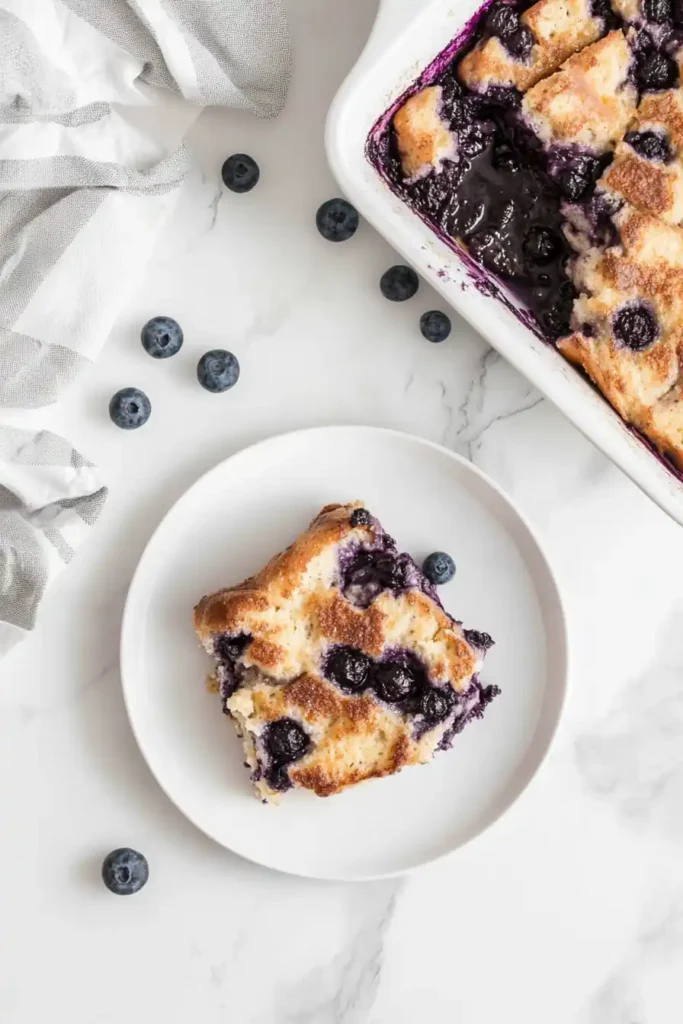
What Type of Bread Should I Use?
For a French toast casserole, you’ll want to start with a good-quality French bread that’s a day or two old – slightly stale bread actually works better because it soaks up more of the custard mixture without falling apart.
A traditional baguette will work, but I find that a wider French loaf gives you better-sized cubes and more surface area for soaking up the egg mixture.
If you can only find fresh bread, you can cut it into cubes and leave them out for a few hours to dry, or pop them in a low-temperature oven for about 10 minutes.
Just avoid using very soft sandwich-style French bread, as it tends to get too mushy in the casserole!
Options for Substitutions
This breakfast casserole is pretty adaptable, with several easy swaps you can make.
- While fresh blueberries are great, you can use frozen ones without thawing them first, or try other berries like raspberries or blackberries for a different twist.
- The cream cheese can be replaced with mascarpone or ricotta cheese if needed, though you might need to adjust the sugar to taste.
- For the French bread, you can use challah, brioche, or even regular white bread – just make sure it’s slightly stale so it soaks up the custard mixture well.
- The warming spices like cinnamon and nutmeg are key for that classic French toast flavor, but you could add a pinch of cardamom or ginger for a different spin.
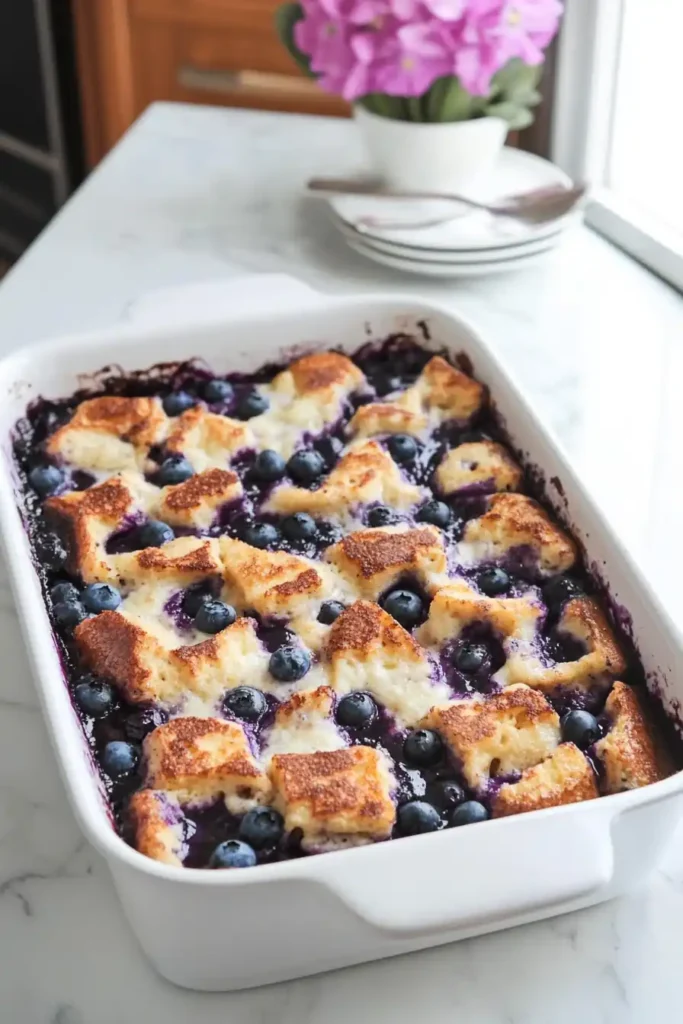
Overnight Blueberry French Toast Casserole FAQ
Do I need to butter the casserole dish before adding the bread?
Yes, it’s recommended to butter your baking dish before adding the bread cubes. This prevents sticking and makes serving and cleanup much easier.
Can I make this in the morning and bake it right away instead of refrigerating overnight?
Yes! You can assemble the casserole in the morning and let it sit at room temperature while the oven preheats, plus an additional 10-15 minutes. This allows the bread to soak up the egg mixture, though the texture won’t be quite as custardy as the overnight version.
What size French bread loaves should I use since the recipe calls for 2?
Use standard bakery French bread loaves that are about 12-14 inches long. If your loaves are 18-19 inches, one loaf should be sufficient when cubed. You need approximately 10-12 cups of cubed bread total to fill the 10×14-inch dish properly.
Can I use Texas toast instead of French bread, and how many slices would I need?
Yes! One standard loaf of Texas toast (about 16-20 slices) should be enough for this recipe. Cut the slices into cubes and layer as directed. Texas toast is thicker and will create a heartier, more substantial casserole.
Would an icing drizzle work well as a topping for this casserole?
Absolutely! A simple vanilla or cream cheese icing drizzle would be delicious. Mix 1 cup powdered sugar with 2-3 tablespoons milk and ½ teaspoon vanilla, then drizzle over the baked casserole for extra sweetness and visual appeal.
Can I make this recipe in a 9×13 pan, and does the baking time change?
Yes, a 9×13 pan will work, though it will be slightly deeper than the 10×14 dish. The baking time may increase by 5-10 minutes. Check that the center is set and a knife inserted comes out clean before removing from the oven.
Storage Instructions
- Keep Fresh: The casserole stays good in the fridge for up to 3 days when covered tightly with plastic wrap or stored in an airtight container.
- Freeze: You can freeze this casserole either before or after baking. If freezing unbaked, wrap it well in plastic wrap and foil, and it’ll keep for up to 2 months.
- Reheat: To warm up individual portions, microwave for 1-2 minutes or until heated through. For larger portions, cover with foil and heat in a 325°F oven for about 15-20 minutes.
Estimated Nutrition Facts
Estimated nutrition for the whole recipe (without optional ingredients):
- Calories: 2500-2700
- Protein: 80-100 g
- Fat: 120-140 g
- Carbohydrates: 300-320 g
| Preparation Time | 30-60 minutes |
| Cooking Time | 75-90 minutes |
| Total Time | 8-12 hours |
| Level of Difficulty | Easy |
| Servings | 8 |
| Equipment | 2 mixing bowls, 10×14-inch baking dish |
Ingredients
For the cream cheese mixture:
-
Do we have to pay sales tax on the tariff part of the price of goods?
Sure ‘nuf.
And the great thing is that you can’t even see the tariff! As far as consumers go, a tariff is a sales tax that’s completely hidden in the price of the item. So I bought a bunch of camera gear this year, after selling off a bunch of less used camera gear. When I went shopping for this gear, I didn’t see any mention of tariffs. I know that tariffs exist, and I know that the camera industry is not rich enough to generally be “eating” tariffs. I did, however, have my table of tariffs with me, and I could identify the country of origin of each item I purchased. So I was able to avoid high tariffs. But that’s not something a typical buyer is going to do.
And of course, the price shown is the price. The tariff was paid by the importer, and in the camera business, I suspect most retailers are not also importers. The smaller retailers may buy their gear from a distributer who buys from the importer — probably the US branch of the company that made the gear — and the big guys like B&H in New York almost certainly deal directly with the companies. I bought in late November/early December in order to take advantage of seasonal sales, as well.
When I go to check out, the price is the price. I pay tax on that price, just as you do at Target or Wal-Mart or Publix. That price may be influenced by tariffs and seasonal discounts, but there’s no discount coming because you paid a 40% tariff, and the government’s not coming after me for more if I got a 40% discount.
However, in the check-out, I’m faced with the possibility of a sales tax. Since I was buying these sent to my house here in Delaware, there’s no sale tax! Delaware is a pretty cheap place to live, especially if you have no in-state income. Now, if I had been at my other house in Florida, I would have been hit with a 6% state sales tax and a 1.5% Pinellas Country tax. That’s made very explicit to all consumers buying online these days.
Tariffs taxes should be made just as open and honest, but Trump has personally promised to reign hell down on any retailer that does this, and the few that spoke of it, including Amazon and Walmart, have kowtowed to the fat orange piggy. What are you going to do? Well, there is “shop wisely” — what I have done — to avoid tariffs. There is “don’t spend today what can wait for a few months” — there’s a SCOTUS decision on just how illegal Trump’s tariffs are coming, expected before Christmas. There’s the certain knowledge that regardless on how deeply dug in Trump is on this clusterfuck, if we elect a Democratic President in 2028, the tariffs are gone. Hell, if we elect enough of a Democratic Congress in 2026, the tariffs may well be gone. All taxes, including tariffs, are a power given only to Congress and delegated — maybe — to the President in some Acts of Congress. Congress could, should they choose, take away all tariff power from Trump. It’s unlikely — they’d need a veto-proof majority, obviously, but it’s technically possible.
1 cup blueberries
- 8 oz cream cheese (softened, I prefer Philadelphia Cream Cheese)
- 1 cup powdered sugar
- 1 tbsp vanilla extract (half for cream cheese, half for egg mixture)
- 2 tbsp milk (whole milk for richness)
For the bread layers:
- 2 loaves cubed french bread (day-old bread works best for soaking)
For the egg mixture:
- 1 cup blueberries
- 1 tsp cinnamon
- 2 cups milk (any milk works, but whole milk adds richness)
- 8 eggs (large eggs)
- 1/2 tsp nutmeg
Step 1: Prepare the Cream Cheese Mixture
- 1 pack (8 ounces) softened cream cheese
- 1 cup powdered sugar
- 2 tablespoons milk
- 1 tablespoon vanilla extract, split
- 1 cup blueberries
In a bowl, mix together the softened cream cheese, confectioners’ sugar, 2 tablespoons of milk, and 1 teaspoon of vanilla extract until the mixture is smooth and creamy.
Gently fold in 1 cup of the blueberries to distribute them evenly throughout the mixture.
Step 2: Assemble the Bread Layers
- 2 loaves cubed french bread
Layer the bottom of a 10×14-inch baking dish with bread cubes, creating an even base.
Spread the cream cheese mixture over this layer of bread cubes.
Once the mixture is evenly spread, top with the remaining bread cubes to form the second layer.
Step 3: Prepare and Add the Egg Mixture
- 2 cups milk
- 8 eggs
- 1 teaspoon cinnamon powder
- 1/2 teaspoon ground nutmeg
- 1 cup blueberries
In a large bowl, whisk together 2 cups of milk, eggs, 2 teaspoons of vanilla extract, cinnamon, and nutmeg until fully combined.
Pour this mixture over the layered bread in the baking dish, ensuring all the bread is soaked.
Sprinkle 1 cup of blueberries evenly on top.
Cover the dish tightly with aluminum foil and refrigerate for 8 hours or overnight.
Remove the dish from the refrigerator 30 to 60 minutes before baking.
Step 4: Preheat the Oven
Preheat your oven to 375°F (190°C) to prepare for baking the dish.
Step 5: Bake the Dish
Bake the dish in the preheated oven for 45 minutes with the foil on.
After 45 minutes, remove the foil and continue baking until the center is set and the top is lightly browned, about 30 more minutes.
The total baking time should be approximately 75 minutes.
Step 6: Serve and Enjoy
Once baked, remove the dish from the oven and let it cool slightly before serving.
Enjoy your delicious, creamy blueberry layered bread pudding!
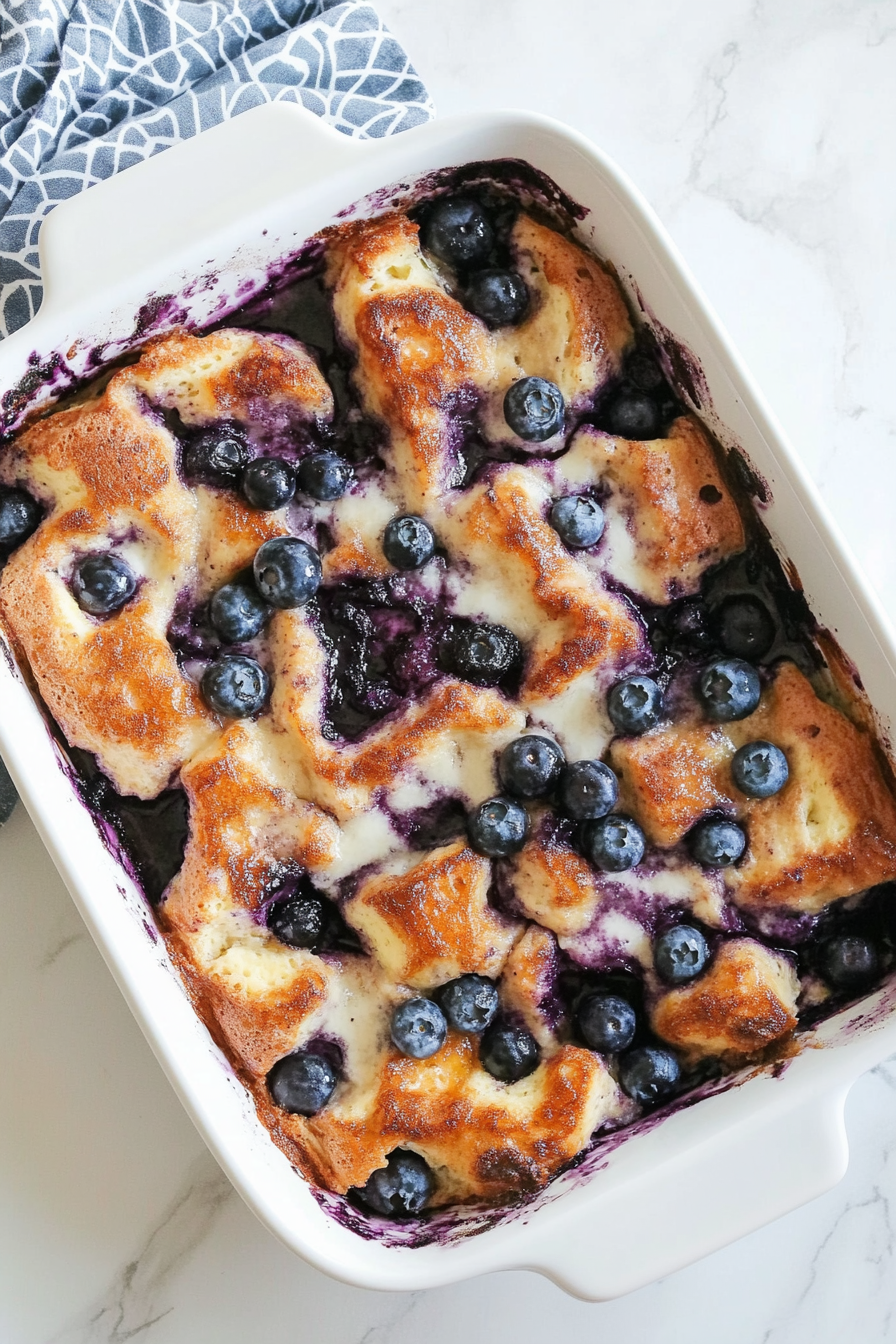
Overnight Blueberry French Toast Casserole
Ingredients
Cream cheese mixture
- 1 cup blueberries
- 8 oz cream cheese (softened, I prefer Philadelphia Cream Cheese)
- 1 cup powdered sugar
- 1 tbsp vanilla extract (half for cream cheese, half for egg mixture)
- 2 tbsp milk (whole milk for richness)
Bread layers
- 2 loaves cubed french bread (day-old bread works best for soaking)
Egg mixture
- 1 cup blueberries
- 1 tsp cinnamon
- 2 cups milk (any milk works, but whole milk adds richness)
- 8 eggs (large eggs)
- 1/2 tsp nutmeg
Instructions
-
In a bowl, mix together the softened cream cheese, confectioners’ sugar, 2 tablespoons of milk, and 1 teaspoon of vanilla extract until the mixture is smooth and creamy. Gently fold in 1 cup of the blueberries to distribute them evenly throughout the mixture.
-
Layer the bottom of a 10×14-inch baking dish with bread cubes, creating an even base. Spread the cream cheese mixture over this layer of bread cubes. Once the mixture is evenly spread, top with the remaining bread cubes to form the second layer.
-
In a large bowl, whisk together 2 cups of milk, eggs, 2 teaspoons of vanilla extract, cinnamon, and nutmeg until fully combined. Pour this mixture over the layered bread in the baking dish, ensuring all the bread is soaked. Sprinkle 1 cup of blueberries evenly on top. Cover the dish tightly with aluminum foil and refrigerate for 8 hours or overnight. Remove the dish from the refrigerator 30 to 60 minutes before baking.
-
Preheat your oven to 375°F (190°C) to prepare for baking the dish.
-
Bake the dish in the preheated oven for 45 minutes with the foil on. After 45 minutes, remove the foil and continue baking until the center is set and the top is lightly browned, about 30 more minutes. The total baking time should be approximately 75 minutes.
-
Once baked, remove the dish from the oven and let it cool slightly before serving. Enjoy your delicious, creamy blueberry layered bread pudding!
Do we have to pay sales tax on the tariff part of the price of goods?
Sure ‘nuf.
And the great thing is that you can’t even see the tariff! As far as consumers go, a tariff is a sales tax that’s completely hidden in the price of the item. So I bought a bunch of camera gear this year, after selling off a bunch of less used camera gear. When I went shopping for this gear, I didn’t see any mention of tariffs. I know that tariffs exist, and I know that the camera industry is not rich enough to generally be “eating” tariffs. I did, however, have my table of tariffs with me, and I could identify the country of origin of each item I purchased. So I was able to avoid high tariffs. But that’s not something a typical buyer is going to do.
And of course, the price shown is the price. The tariff was paid by the importer, and in the camera business, I suspect most retailers are not also importers. The smaller retailers may buy their gear from a distributer who buys from the importer — probably the US branch of the company that made the gear — and the big guys like B&H in New York almost certainly deal directly with the companies. I bought in late November/early December in order to take advantage of seasonal sales, as well.
When I go to check out, the price is the price. I pay tax on that price, just as you do at Target or Wal-Mart or Publix. That price may be influenced by tariffs and seasonal discounts, but there’s no discount coming because you paid a 40% tariff, and the government’s not coming after me for more if I got a 40% discount.
However, in the check-out, I’m faced with the possibility of a sales tax. Since I was buying these sent to my house here in Delaware, there’s no sale tax! Delaware is a pretty cheap place to live, especially if you have no in-state income. Now, if I had been at my other house in Florida, I would have been hit with a 6% state sales tax and a 1.5% Pinellas Country tax. That’s made very explicit to all consumers buying online these days.
Tariffs taxes should be made just as open and honest, but Trump has personally promised to reign hell down on any retailer that does this, and the few that spoke of it, including Amazon and Walmart, have kowtowed to the fat orange piggy. What are you going to do? Well, there is “shop wisely” — what I have done — to avoid tariffs. There is “don’t spend today what can wait for a few months” — there’s a SCOTUS decision on just how illegal Trump’s tariffs are coming, expected before Christmas. There’s the certain knowledge that regardless on how deeply dug in Trump is on this clusterfuck, if we elect a Democratic President in 2028, the tariffs are gone. Hell, if we elect enough of a Democratic Congress in 2026, the tariffs may well be gone. All taxes, including tariffs, are a power given only to Congress and delegated — maybe — to the President in some Acts of Congress. Congress could, should they choose, take away all tariff power from Trump. It’s unlikely — they’d need a veto-proof majority, obviously, but it’s technically possible.