

.
Great things require both vision and foundation

Quote from congjing yu on August 1, 2026, 4:32 amI'll bet that you all don't want to read any of my Quora posts. But you know, all I am doing is to expand my internet footprint outside the narrow boxes that the Massive arm of the Untied States has boxed me into. yeah. they have effectively silenced me, and only allow their pre-determined narratives out.
So I am like a tiny flea yelling in an empty room.
What can the owner of the 183-year-old Sun Nga Shing Umbrella Store in Hong Kong do to keep his business alive?
This is one of the best, most specific questions I’ve seen here.
I’m not gonna waste your time. I’m giving you a real, and actionable answer.
Don’t give up.
I had a friend who’s brother had to close the 150 year old family fabric business. And, I am not gonna sit aside and allow that to happen here. Well, at least not while I’m still sitting across the bay.
…
You’re not asking about "business" in theory; you’re asking about a living piece of Hong Kong’s soul. The goal isn't just survival—it's relevance in the 21st century.
Forget vague advice. Here is a concrete, multi-pronged strategy. The owner must transition from being a purveyor of utilitarian objects to becoming the guardian of a cultural artifact and experience.
Phase 1: Reframe the Product (From "Umbrella" to "Heritage Artifact")
- The Tiered Product Line:The Daily Defender: Keep selling the reliable, affordable umbrellas for the sudden downpour. This is for locals and maintains cash flow.The Heritage Edition: This is the core. Create a limited, signature line. Use superior materials (real English steel, Italian marble handles, specific waxed cotton). Each umbrella should be numbered and come with a certificate telling the story of the shop (183 years, surviving wars, changes). Price it 5-10x higher. This isn't an umbrella; it's a piece of Hong Kong history you can hold.The Custom Commission: Offer a bespoke service. Let customers choose handle materials (ebony, buffalo horn), fabric patterns (classic tartans, custom monograms), and shaft details. This turns a purchase into a personal heirloom creation.
Phase 2: Master the Modern Story (Become a Content Creator)
The shop’s greatest asset is its 183-year narrative. It must be weaponized.
- Document Everything: Film the craftsman at work—the sound of the steel being cut, the fabric being stretched. Short, beautiful videos for Instagram Reels and TikTok.
- Tell the Story in Layers:Instagram: High-quality photos of the umbrellas as art objects, the beautiful, cluttered shop interior, "A Day in the Life" snippets.Facebook: Longer posts about Hong Kong's history, the changing weather of the city, customer stories.A Simple Website: Not just an online store. A digital museum. A timeline of the shop. Profiles of past masters. High-resolution lookbooks of the Heritage Edition.
- Language & Audience: Content must be in both Cantonese and English. The local audience provides base support; the international/ tourist/diaspora audience will pay for the heritage experience.
Phase 3: Create Irresistible Experiences (The Shop as a Destination)
People don't just buy things anymore; they buy moments and meaning.
- "The Umbrella Maker's Workshop": Offer a 90-minute experience. For a fee, small groups get a history talk, then under guidance, help assemble a simple pre-cut umbrella (tying the knots, fitting the handle) they can take home. This is gold for tourists, dates, and corporate team-building.
- Collaborations: Partner with high-end Hong Kong tailors (W.W. Chan), bespoke shoe makers, or luxury hotels (The Peninsula, The Upper House). Create co-branded umbrellas for their clients or offer the workshop experience to their guests.
- Location as Gallery: The shop itself should feel like stepping into a living museum. Have old tools on display, framed historical photos, a ledger open to a page from 1950.
Phase 4: Practical, Tangible Actions for This Week
- Find a Student: Contact the Hong Kong Polytechnic University's School of Design or a local marketing program. Offer a small stipend or course credit for a student to help set up the Instagram account and basic website. They get a real-world project; you get tech-savvy help.
- Identify the Craftsman Story: Is the owner the craftsman? Is there an elderly master? That person is the hero. Start filming them, even just with a phone. Capture their hands, their focus.
- Create the First "Heritage Edition" Prototype: Don't wait. Design one single, stunning umbrella that embodies the best of the craft. Put it in the window with a sign telling its story and price it accordingly. Gauge reaction.
The Core Principle to Internalize:
The business is no longer "umbrellas." The business is "The 183-Year Legacy of Sun Nga Shing." The umbrella is simply the beautiful, functional vessel that legacy is sold through.
This shift—from retailer to cultural steward—is what allows it to command premium prices, attract global interest, and secure its future not as a struggling shop, but as an institution.
It will take work. It will require embracing new tools. But the raw materials—history, authenticity, craft—are already there, and in today's world, they are more valuable than ever.
Good luck to the owner. Hong Kong needs to keep its soul, one stitch at a time.
So…
- keep the Rainy Season “easy access” umbrellas.
- Add the special core of the business umbrellas. Take the time. And craft them.
- You are a major piece of the Hong Kong culture and society; embrace it.
Only 14 views.
*sigh*
Today's Quora post...
Today...
Ancient Hunters of the Levant Were Surprisingly Strategic, Not Mass Killers
Archaic humans living in the Levant around 120,000 years ago were highly selective hunters who carefully targeted prime-aged female wild cattle, rather than engaging in the mass hunting events that characterized later human societies. This revelation comes from a groundbreaking study that challenges our understanding of how extinct human relatives organized their communities and competed with modern humans.
The research, led by scientists from the University of Haifa and just published in Scientific Reports, analyzed an exceptional archaeological deposit at the Nesher Ramla karst depression in central Israel. This site, where archaic and modern humans likely first encountered each other, has yielded remarkable evidence about hunting practices during the Middle Paleolithic era. According to Phys.org, the findings suggest that these strategic hunting patterns might have put archaic populations at a disadvantage when living alongside more socially connected modern humans.
Meticulous Analysis Reveals Selective Hunting Strategy
The archaeological team examined hundreds of aurochs bones- wild ancestors of modern cattle - from Unit III at Nesher Ramla, a thin stratigraphic layer dating to approximately 120,000 years ago. Through sophisticated techniques including bone fusion analysis, sexual dimorphism studies, dental microwear examination, and isotopic analysis, researchers reconstructed a detailed picture of ancient hunting behavior.
The Nesher Ramla site and its Unit III. (C) Stratigraphic section of the MP sequence (Unit III is outlined in yellow). (D) General view of the excavation, looking west. (E–F) Views of Unit III during excavation. (Yeshurun et al./ Scientific Reports)
The bone measurements revealed that 88% of the hunted aurochs were females, and nearly all were prime-aged adults rather than young or elderly animals. This stands in stark contrast to mass hunting events documented elsewhere, which typically target entire herds including juveniles and older individuals. Dental microwear patterns indicated that all animals were killed during the dry season when they fed on evergreen woody leaves, suggesting planned seasonal hunting expeditions.
Isotopic Evidence Disproves Mass Hunting Hypothesis
Perhaps the most compelling evidence against mass hunting came from stable isotope analysis of tooth enamel. The research team sampled five individual aurochs and discovered that each had distinct isotopic signatures, indicating they came from different locations and herds. One individual had spent time near the Mediterranean coast, while another roamed the chalk hills surrounding Nesher Ramla and drank water from high-altitude sources.
Auroch bones including teeth found at the excavation. (Yeshurun et al./ Scientific Reports)
This geographic diversity definitively ruled out the possibility that all animals were killed in a single mass hunting event. Instead, the evidence points to multiple isolated hunting episodes conducted by small groups during dry season months. The researchers also discovered a remarkable aurochs tibia with an embedded flint chip surrounded by healed bone tissue, providing unique evidence of an animal that escaped one hunt only to be recaptured weeks or months later.
Implications for Understanding Ancient Human Societies
The study's findings reinforce the hypothesis that Middle Paleolithic archaic humans lived in small, dispersed, and disconnected groups with limited intergroup communication. This social structure contrasts sharply with evidence from modern humans, who developed mass hunting techniques around 50,000 years ago and maintained larger, more interconnected populations.
Mass hunting requires extensive coordination, communication, and cooperation among numerous individuals from different bands, often spanning several days. It serves as an archaeological proxy for large-scale social organization and cultural exchange. The absence of such evidence at Nesher Ramla, despite ideal preservation conditions and a concentrated bone assemblage, suggests that archaic populations may have been at a demographic disadvantage when competing with more numerous and better-connected modern human groups.
The Nesher Ramla site holds particular significance because it represents an early contact zone between archaic and modern humans. The site previously yielded fossil remains of Middle Pleistocene Homo bearing a combination of Neanderthal and archaic features, adding biological context to the behavioral evidence. While modern humans were present at contemporaneous sites like Skhul and Qafzeh caves, the hunting strategies employed by different human populations during this critical period remain a subject of ongoing research.
The researchers emphasize that while no comparable sites currently exist in the Levant to test whether modern humans engaged in mass hunting during the Middle Paleolithic, the evidence from Nesher Ramla provides valuable insights into the social organization and survival strategies of archaic populations. Further investigation of open-air fauna-bearing camps attributed to modern humans could reveal whether differential hunting strategies contributed to the eventual replacement or assimilation of archaic human populations in the region.
Top image: A man stood facing an auroch - a massive wild cattle that stood up to 7 feet tall at the shoulder. Source: Nature
By Gary Manners
Chicken a la King
[caption id="attachment_180541" align="alignnone" width="736"]
0b3e183a2e6593d35f8606a83c20929e[/caption]
[caption id="attachment_180542" align="alignnone" width="422"]
60ae227ef111de30c193b59f2bb6609e[/caption]
Yield: 100 servings (3/4 cup chicken mixture and 1/2 baked potato shell each)
Ingredients
- 1 (50 ounce) can Campbell's Condensed 98% Fat Free Cream of Chicken Soup
- 2 quarts milk (2% fat)
- 7 (30 ounce) cans Swanson Chunks O' Chicken
- 6 pounds canned sliced mushrooms
- 6 pounds frozen peas, cooked
- 1 pound pimiento, chopped
- 100 halves potato shells, baked
Instructions
- In large bowl mix soup and milk thoroughly. Add chicken, mushrooms, peas and pimiento.
- In each of 4 baking pans (12 x 20 x 2 inches) evenly divide chicken mixture.
- Bake at 400 degrees F for 30 minutes or until hot. Stir.
- Portion using a 6 ounce ladle (3/4 cup) into 1 half potato shell.
Atomic Bombings Opening Scene | Fallout (2024)
https://youtu.be/hJjIf7nwx6U
Dyspnea of the World
Written in response to: "Center your story around someone trying to change a prophecy."
Wes Frost
Horror Science Fiction Suspense
Legends are told of a cataclysmic event. One such legend was mentioned, in passing, to a young beggar boy thousands of years ago. It was said the boy lived in a cavern near a village and would approach during the village's bazaar, which took place every few passings of the moon.Who told the boy of the event no one knows, but the boy grew and became a devoted crier near the village. He would spend his days yelling truths, or half-truths, of the event. At first, the village people were humored by his extremist views on the end of the earth, but the more they listened, the more dire they felt.As the boy became an old man, cataclysm did find the village, but it was nothing like what the old man had spent his life devoted to. As marauders approached the village, he went to work telling the approaching group of the event and the need to prepare. The attackers had other plans, however, and cut the old man down before raping and pillaging.The old man gargled on his own blood yet continued to cry the event's significance. The words landed in the ears of one of the attackers, who, after a fitful night of Armageddon imagery, began his own attempt at spreading the news of the end of the world.And so, it has been ever since. One man speaks while no one listens until that man moves past this life and into the void; his words echoing importance in at least one person for the next lifetime.This is how I learned of the event, for the last person was an uncle of mine, and he recently died. On his deathbed, he pulled me close, looked me in the eyes with a stare that sent goosebumps through my entire body, and told me the end was near. Of course, like everyone else before me, I did not believe it. Thousands of years of nothing spoke louder to me than any one man. But that night, things changed.I dreamed of the earth. Dust rose from the ground and fell in an almost breath-like state as if the world was struggling to breathe. Clouds covered every inch of the sky, and I could not find any people. The trees were withered and drooped to one side, taking on a melancholy stance. I stood alone. In the dream, I was alone, but when I woke, I knew the time had not yet passed, and perhaps something could be done to stop it.
I left my home that day with a different agenda than any of the ones that came before me. I did not want to lose myself to the madness and begin to preach devastation to a deaf people; I wanted to save them.
My local library had many books on ancient myths and legends, but finding anything specific to this event was like searching for a very particular blade of grass in a field. So, I traced my ancestry. I learned as much as I could about my uncle. My grandparents are no longer living, but I was able to scour old picture books and family records and learned that my uncle is a normal person.
He was intelligent in school, consistently earning good grades and maintaining good attendance. He even studied a respectable career path through college. Eventually, he landed a job overseas, but upon his return, he had changed. The intelligent, clever man was gone and replaced by what many in my hometown called a lunatic.
I needed to know more, so I packed my bags and booked a flight to Europe. During the flight, the dreams came back.
The dust breathed again, rising, falling, struggling. This time, the clouds above did not cover the sky completely. Far in the distance, a break in the clouds appeared, and a dark red beam of light slipped through. As I squinted toward it, I realized something was pushing through the clouds. A shape. A finger. Long, bony, blackened with red streaks pulsing beneath the skin. My skull throbbed. My chest tightened. I woke in a violent sweat.
A woman beside me shook my arm. “Are you alright, dear?”
She meant kindness, but the look I gave her made her shrink back.
“We have to stop it,” I muttered.
Madness tugged at me like a hook in the back of my mind. I forced myself to breathe, to remain grounded. Not yet. Not yet.
The rest of the flight passed in a numb haze. When we landed, I found myself standing at the rental counter without remembering walking there. The clerk slid keys toward me with an expression I couldn’t place—fear, pity, or simple exhaustion.
I drove to the company where my uncle had once worked. The owner seemed relieved to speak of him, as if releasing a burden he had carried for years. He told me my uncle had taken holiday in the northern part of the country—a remote region reachable by train and a short drive. Something in his voice trembled when he said, “People don’t go there anymore.”
I boarded the train that evening. Exhaustion overtook me almost immediately, but I feared closing my eyes. When I finally drifted, it was only for a moment, and I woke with my heart pounding and nails digging into my palms. I could not remember the dream—only its weight, still pressing against my ribs.
Outside the window, the land grew emptier the farther we traveled. Fields gave way to forests, forests to barren stone. Even the sky felt thinner, as if stretched too far across the world.
When I arrived, a driver waited for me in a rusty car. He didn’t speak much. When we reached the outskirts of the forgotten town, he only said, “Don’t stay longer than you must.”
His eyes did not meet mine when he drove away.
There were only a few buildings left—weather-beaten structures sagging under the weight of years. The air felt hollow, as if the world itself had forgotten to inhabit this place. I stepped out of the car, and the wind carried the smell of damp stone and old wood.
I wandered toward the largest structure, a church in the loosest sense of the word. Its roof leaned to one side, and the front steps were half-swallowed by the earth. On the porch sat an elderly woman, still as a statue, her hands folded neatly in her lap.
She didn’t react when I approached. She simply began speaking, her voice dry and thin, as though unused for decades.
“You can sleep in the back room. No charge. Breakfast at daybreak. Dinner at night. One day only, no more.”
Before I could respond, a gust of cold wind swept down from the north. It coiled around my legs to the waist, lingered, and slid past me with a sound like distant whispering. Leaves scattered across the ground in a frantic dance.
I looked away only for a second. When I turned back, the woman was gone.
Her chair rocked gently, as if someone had only just risen from it.
A chill crawled across my spine, tighter than the wind itself. I stood there, staring at the empty chair, at the deep imprint of where she had sat. It felt wrong, like something had been erased rather than having departed.
As I went into the dilapidated church, echoes of worship and praise lifted from the floors, crashed into the ceiling, and disappeared. It was a strange feeling and one I was unsure how to interpret. I went into the back room, and there lay a book on my bed. A Bible, I assumed, but as I got closer, I could tell this was no Bible. The cover was solid black with red and black marbled edging.
I now sit on the edge of the bed, unable to reach for the book. I believe all of this has led me to this moment. The answer to how to stop this disaster has to be inside this book, but what if I’m wrong? What if opening the book is the catalyst to the apocalypse? I have to know. I must do what I can to stop it, and I can’t stop it if I don’t know what it is coming. I’m writing this in case I don’t make it, in case the end is near, or in case my mind finally snaps.
Why did people build brutalist buildings?
Because all the nice buildings got destroyed in World War II.
Brutalism is an architectural style that emerged in the UK in the 1950s. An outgrowth of Modernism, Brutalism is the ultimate expression of function over form. It is characterized by simple geometric shapes, bare concrete and brick construction, and a complete lack of decorative elements. It creates ugly, imposing buildings which exist to serve their function and nothing else.
But much like the UK’s other distinct postwar architectural feature, the two tap sink, Brutalist architecture is a result of a particular set of historical realities. While the UK was on the winning side of World War II, it did not actually win the war. America won the war. The UK simply survived it.
London was flattened in the Blitz. The British Empire fell apart as its colonies declared independence. And the economy was so severely devastated that food rationing would continue until 1954, 9 years after V Day.
Brutalist architecture solved one of the most pressing issues postwar Britain had. How to house its population.
Concrete can be poured really quickly. Geometric shapes give you the most usable space for your buck. Painting concrete doesn’t actually do anything, so you can skip that step. And who has the money for decorative elements when a good chunk of London is homeless?
In the 1970s Brutalism would see another surge in popularity, in the Soviet Union. The Soviets had been just as devastated by the war as the British, if nor more so. And their economy recovered even more slowly for reasons I could write an entire essay on.
Quick, standardized, mass produced buildings made from cheap yet durable materials were a godsend. And that’s what Brutalism is at its core.
A Modernist home. Not a Brutalist home.
Brutalism is Modern architecture for really poor nations who need those buildings up yesterday.
🔥FOREIGNERS REACT TO NOBODY (2021) BUS FIGHT! 🤯🔥
https://youtu.be/Z_gyYoZzZmY
How to Make Cheap Thermal Goggles
Night vision goggles were invented for use by the military. Over the years, they have become popular among law enforcement agencies and hunters. The technology that makes night vision possible is called an infrared image intensifier tube. The intensifier tube houses a photo cathode that transfers photons of light energy into electrons by releasing similar electrons from atoms inside the tube itself. This process helps to multiply the electrons and then illuminate the image as the electrons reach the phosphor screen. This process can be duplicated at home by using a simple method.
Step 1
Purchase a pair of regular, preferably clear-framed sunglasses that have a sturdy frame. Remove the lenses and trace their shape onto sheets of Congo blue and primary red theatrical gels, which are made for stage lighting. Ensure that you have two pieces for each color and cut all four pieces out using the X-Acto knife. Glue the blue gels first and then the red ones, by touching the outer rim of the gels all the way around with super glue. Make sure that you put one of each color gel on each lens of the glasses so you end up with each eye filtering red and blue light. Gently lay the lenses inside the glasses one at a time and wait for them to dry.
Step 2
Glue the eight high-intensity infrared LEDs, four on each side, to the outside of the goggles and on the outer edge of the lenses so they are to the left of the left lens and to the right of the right lens. The LEDs create the illumination needed to filter the light through the colored gels. Secure the wires of the lights to the outer edge of the goggles using electrical tape.
Step 3
Wire the lights to the 3-volt, button-cell battery and glue the battery to the side of the goggles. Ensure there is a battery on each side of the goggles so each set of lights has a battery. Leave the plus wire short so it does not touch or tape it down so it isn't able to make contact. You may also want to wire a switch from the wire to the battery so the goggles can be turned on and off. However, you can simply tape the wire to the battery when in use.
Step 4
Take your goggles outside to test them. If the image is weak or not well-illuminated, you may need to add more LEDs or another layer of gels.
Gimme Shelter - Apocalypse Now Music Video
Wow.
https://youtu.be/LKNLIilyn7s?list=RDA--k4o5BDjY
Col 26-Book 442 - Sir Whiskerton and the Great Farmyard Soufflé (A Tale of Egg Strikes, Edible Glam, and the Peril of 10-Foot Ambition)
Ah, dear reader—prepare your oven mitts, steady your monocle, and inhale deeply. Today’s story does not begin with a quack, a snort, or even a kazoo blast.
It begins with a whisk.
A thump.
And the soft, ominous groan of a soufflé that has dreams far beyond its structural integrity.So preheat your imagination, dear friends—and step gently into Sir Whiskerton and the Great Farmyard Soufflé.
Act I: The Vision (and the Very Tall Pan)
It began, as all great disasters do, on a Tuesday.
Chef Chloe—flour-dusted, eyes gleaming with the fire of unhinged innovation—stood before the barn-turned-kitchen, arms wide.
“Behold!” she cried, unveiling a copper pan the size of a small tractor. “The Farmyard Soufflé: A culinary monument to community, creativity… and vibes.”
Doris the Hen squinted.
“Where are the eggs?”
“Eggs!” echoed Ditto, already licking the bowl.Chloe waved a dismissive paw.
“Eggs? Passé. This soufflé rises on farm-fresh vibes—sunbeams, friendship, and the gentle hum of Bessie’s moo-ditation.”
She gestured to a jar labeled:
“Concentrated Harmony (Shake Before Use).”The Valley Chicks gasped in unison.
“Omg. It’s, like, art.”
“Art! Art!” echoed Echo, wearing a tiny chef’s hat backwards.Sir Whiskerton, sunbathing on the roof, flicked an ear.
“This,” he murmured, “is either genius… or the prelude to structural collapse.”
“Collapse! Collapse!”
Act II: The Egg Strike (Feathers Will Fly)
Word spread.
By noon, Doris had convened the United Hens of the Coop (UHOC) beneath the old oak.
“Sisters—and Harriet—we are at a crossroads!” she declared, standing atop a crate. “Chef Chloe would build a monument… without monumental sacrifice! Without our yolks! Without our protein-packed purpose!”
“Purpose! Oh, I can’t bear it!” Lillian shrieked, fainting onto a sack of oats.A sign appeared on the coop door:
EGG STRIKE IN PROGRESS
“You’ll get my yolks over my dead feathers!”Inside, negotiations were tense.
Doris, in full union rep mode:
“We demand: 1) Hazard pay for high-altitude laying, 2) Spa days after extra-large eggs, 3) A say in soufflé aesthetics.”
Chloe, wiping flour off her brow:
“But the vibes are set! The harmony jar was calibrated at dawn!”
“Vibes don’t hold air, Chloe,” Doris shot back. “Eggs do.”
Even Ferdinand weighed in—via opera:
“Ooooooooooo-va-laaaa! The soufflé must rise!”
“Rise! Rise!” echoed Ditto—now stuck in the flour bin.
Act III: The Glitter Gambit (and the Collapse Heard ‘Round the Farm)
Desperate, Chloe turned to the Valley Chicks.
“You understand art. Help me elevate the batter.”
Tiffany struck a pose.
“We’ve got exactly what you need.”
She pulled out a glitter cannon labeled:
“Edible Glam™ (FDA-adjacent).”“It’s, like, edible glam,” Brittany added. “Guaranteed to make anything Instagrammable… or mildly sparkly.”
They fired.
The batter—already a pale, trembling cloud—now shimmered like a disco ball dipped in moonlight.
Chloe beamed. “Perfection!”
She slid the pan into the oven (a repurposed grain silo, courtesy of Handy Hank).For 47 minutes, hope rose.
Then—
WHUMPF.Not a pop.
Not a sigh.
A full, tragic, Broadway-style collapse.The soufflé deflated like a balloon at a funeral.
From the wreckage rose a single, glittering word—written in steam on the barn wall:
“FLAT.”
The Valley Chicks gasped.
“It’s… performance art.”
“Art! Art!”Doris stepped forward—not in anger, but in solidarity.
“Chef Chloe… maybe… just one egg?”
She placed a single, golden egg beside the pan.
“Not for the structure. For the soul.”Chloe stared. Then—nodded.
“…Fine. One egg. And a very light hand on the glam.”
The Moral of the Story
That evening, as the farm gathered around a modest—but perfect—6-inch soufflé (golden, airy, just a whisper of sparkle), Sir Whiskerton addressed the animals.
“The moral of the story, dear reader, is this:
Great things require both vision and foundation.
Chloe dreamed big—and that’s noble. Doris stood firm—and that’s brave. And the Valley Chicks? They added glitter—and that’s essential.
But the soufflé only rose when they listened to each other—when the vibes met the yolks, and ambition bowed to reality.
So go ahead. Dream tall. Just… maybe check the recipe first.”Doris raised a claw.
“To the egg! The unsung hero of lift!”
“Lift! Lift!”And even the scarecrow swayed—just once—in agreement.
Post-Credit Scene
Later, Chef Remy unveiled his newest invention:
“Deflated Soufflé Tartlets™”
(“Guaranteed to soothe existential pastry trauma—or cause mild indigestion.”)Mr. Ducky bought the rights:
“Now with 200% more resilience!”
And Sir Whiskerton?
He added a footnote to his journal:“Note: The greatest masterpieces are rarely 10 feet tall.
They’re the ones baked with respect, shared with joy,
and eaten before the glitter settles.”
Jingle on. 🥚✨🍳
(Or, in hen: Cluck-cluck-POOF!)The End.
America's Skill Pipeline is Closed; Young Americans Have NO CLUE How to Fix Things
College Age Kids who think THEY know better, say they're going to start a Revolution to change America. Truth is, most of them can't even start a lawn mower.
AMERICA'S SKILL PIPELINE IS BROKEN: What Happens When the Boomers Leave?
You thought America’s economy was overly dependent on Wall Street and Big Tech. Wait till the Baby Boomers retire and die off. They did much to ruin the country, but they are the last generation of Americans that knows how to do stuff with their hands.
GENERATIONAL SKILLS VOID
🟠Teen Work Collapse: Entry-level jobs that once built discipline are gone. Result: no early training in punctuality, resilience, or responsibility during ages 14–18.
🟠Apprenticeship Breakdown: Master–apprentice pipelines were replaced by cheap, disposable labor. Result: skills aren’t passed down — they retire with the worker. The ladder is broken.
ACCELERANTS: IMMIGRATION & AUTOMATION
🟠Illegal Immigration: Flooded the market with cheap, ready labor, eliminating the incentive to train natives. Apprenticeship died because the shortcut was cheaper.
🟠Automation Myth: Clerical and factory jobs vanished. “Learn to code” was the wrong fix. Now AI outperforms junior programmers — the escape hatch is automated too.
THE COMPOUNDING EFFECT: A Demographic Time Bomb
This is an accelerating decay function:
🟠Boomer Generation (Ages 60-78): Holds the majority of remaining tacit knowledge and mastery in skilled trades.
🟠Gen X/Millennials (Ages 28-59): Contain a missing cohort that never entered the skill pipeline due to the above factors.
🟠Gen Z+ (Under 28): Face a landscape where entry points are gone and credentialism is failing.
THE BOTTOM LINE:
The market signal of "jobs Americans won't do" is a lagging indicator. The leading indicator is "skills Americans weren't taught."
Implosion is the inevitable result of a 30-year failure in skill transmission. The window for mitigation is closed.
Most young guys today don't even know how to jump-start a car. Most young girls today don't know how to cook.
Our civilization is dying - and the young ones who think they know everything about everything, are going to find themselves living in a world where nothing works because in reality THEY don't know much of anything.
Which lesser-known World War II battle or campaign do you find most strategically fascinating?
Operation August Storm - The Manchurian Operation
It’s quite fascinating, because the historical implications of the campaign are quite wide, particularly if you are a western person and believe in a certain set narrative of WW2.
The campaign was very short, in which the Soviet army defeated a huge amount of Japanese troops, in about 3 weeks. The total was for around 84,000 dead compared to 12,000 Soviet dead as well as 600,000 POWs. The Japanese puppet forces of Manchukuo and Mengjiang collapsed entirely before the Soviets and their armies deserted and melted away. These troops alone constitute around 250,000 troops.
Japanese prisoners in Soviet POW camps.
1.2 million Japanese commanded soldiers against 1.5 million Soviet soldiers, while on the defensive lost 1.5 million square kilometers of defended territory. Logistically alone it was quite impressive, as the 44th army did a lightning attack through a defended mountain range.
It also showed how much weaker the Japanese army was compared to the Germans. Taking a single city from the Germans was more difficult than taking an area bigger than France and Germany combined from the Japanese.
Finally, it’s interesting because if you compare the Soviet experience with the American one, the American narrative looks very strange.
- Japanese rarely surrender, but half of the Japanese troops surrendered to the Soviets.
- Japanese fight extremely doggedly on the defense, but they get over run by the Soviets.
- It would take immense casualties to defeat the Japanese main army in Japan, but the Soviets defeated a million trained soldiers in weeks with minimal casualties.
The enemy attacks with a strength and speed we have never witnessed. Our forces are overwhelmed…It is impossible to regroup. The situation is out of control.
General Otozō Yamada, Commander of the Kwantung Army in Manchuria, Reports to the Imperial government 11th of August
The Soviet Union’s attack has dealt us a fatal blow... Far beyond anything we had imagined.
General Yoshijirō Umezu, Army Chief of Staff, August 14 Imperial conference on surrender.
The Soviet Union has entered the war against us… Now that the Soviet Union has also entered the war, to continue the war would mean the destruction of the nation.
Emperor Hirohito, August 15th 1945, Imperial conference on surrender
Pictures
[caption id="attachment_179008" align="alignnone" width="526"]
3c42e333dce1a3e1338d80b4c87cfdac[/caption]
[caption id="attachment_179007" align="alignnone" width="500"]
f619dd977ffc4cb992f00bf71e6635cb[/caption]
[caption id="attachment_179006" align="alignnone" width="543"]
e643058c296b6b8254916f00c7cdb43f[/caption]
[caption id="attachment_179005" align="alignnone" width="600"]
453be7ec09b81692220a4b80a8a4ae8e[/caption]
[caption id="attachment_179004" align="alignnone" width="600"]
3a51b8bab361b5775ff38d2b2f49d66c[/caption]
[caption id="attachment_179003" align="alignnone" width="599"]
c573d577f5a363e7dc9e28f90169612d[/caption]
[caption id="attachment_179002" align="alignnone" width="555"]
5ae6023c960d83139af5ca8f95a7d47a[/caption]
[caption id="attachment_179001" align="alignnone" width="450"]
fda7cc8a3f0946d49041d5f77787ae0c[/caption]
[caption id="attachment_179000" align="alignnone" width="604"]
1e1e48c4cded9ea16aa80750a75010dd[/caption]
[caption id="attachment_178999" align="alignnone" width="711"]
19c42439b752e3f3e849d1225640db0e[/caption]
[caption id="attachment_178998" align="alignnone" width="711"]
2b35cfce0db43a5ca87e9f7a44bded59[/caption]
[caption id="attachment_178997" align="alignnone" width="512"]
1e712fe3aaa820c71922e4daa767a82b[/caption]
[caption id="attachment_178996" align="alignnone" width="474"]
b65db8cb1d1c7115d094cd15a05010c3[/caption]
[caption id="attachment_178995" align="alignnone" width="640"]
dd8bde1676d9c76959bffbb89344ec8a[/caption]
[caption id="attachment_178994" align="alignnone" width="463"]
fe286d1bbe1b385ee8d4941854363996[/caption]
[caption id="attachment_178993" align="alignnone" width="510"]
2a7f31377c976800e743fa722b06231a[/caption]
[caption id="attachment_178992" align="alignnone" width="449"]
28311220271ac16bb565823c23a14fb3[/caption]
[caption id="attachment_178991" align="alignnone" width="400"]
1f2230e7f327aade61e5a9839eb1b278[/caption]
[caption id="attachment_178990" align="alignnone" width="400"]
262413778776113a8c01fc92e7698e47[/caption]
[caption id="attachment_179028" align="alignnone" width="563"]
ad5416e532837681f8d060a1bc0c05d6[/caption]
[caption id="attachment_179027" align="alignnone" width="565"]
dbb13d7844b9ae3fa8a0e7bf125fd4a9[/caption]
[caption id="attachment_179026" align="alignnone" width="480"]
868ffbd5c5b53134d603fc4d0ec8b1f2[/caption]
[caption id="attachment_179025" align="alignnone" width="500"]
8fb04a96fe55646a7b7bb7edb7cbee01[/caption]
[caption id="attachment_179024" align="alignnone" width="750"]
d6592bc06b249c01871bf40eb610d5d6[/caption]
[caption id="attachment_179023" align="alignnone" width="500"]
f0c85abed643f34f81ed758499a6ad5d[/caption]
[caption id="attachment_179022" align="alignnone" width="396"]
b14b541d1b9d0ac4ec7dff5bb4599aec[/caption]
[caption id="attachment_179021" align="alignnone" width="479"]
b5dc523c6ecc7f47801ae52d8b80a866[/caption]
[caption id="attachment_179020" align="alignnone" width="735"]
7b6a0b5ed89c58f2b6d903063e1d159e[/caption]
[caption id="attachment_179019" align="alignnone" width="736"]
c8282f49f3d900524d06efe8ef445cbe[/caption]
[caption id="attachment_179018" align="alignnone" width="450"]
9231caf41820f322a64eaeaa8606792d[/caption]
[caption id="attachment_179017" align="alignnone" width="736"]
1d80dbf6e361705f582a00e8d5a0f54b[/caption]
[caption id="attachment_179016" align="alignnone" width="735"]
465ec3581e8935810fad6ebf4c921237[/caption]
[caption id="attachment_179015" align="alignnone" width="640"]
88e08167f90d9acf6d0f2b86d1d3cd87[/caption]
[caption id="attachment_179014" align="alignnone" width="608"]
2bb6fa61bc57b7ff65e440ca4d256a38[/caption]
[caption id="attachment_179013" align="alignnone" width="750"]
0139241da3ef65b060c9b0f082a7076b[/caption]
[caption id="attachment_179012" align="alignnone" width="487"]
0de3e29e73e114822d1822d95e5f38df[/caption]
[caption id="attachment_179011" align="alignnone" width="564"]
1633ee5519500a96969af213aa895af9[/caption]
[caption id="attachment_179010" align="alignnone" width="750"]
763ec924d01e2ea0e59b7e40e14cffc0[/caption]
[caption id="attachment_179009" align="alignnone" width="320"]
e94536382463ee88643d5d6658acaa62[/caption]
[caption id="attachment_179048" align="alignnone" width="600"]
24e1c323915a7e9b385c728f7db85a56[/caption]
[caption id="attachment_179047" align="alignnone" width="600"]
be148f3104caeadfca486d49db32d54a[/caption]
[caption id="attachment_179046" align="alignnone" width="597"]
f7fdeec0ca31900ef45de399e49dd2d2[/caption]
[caption id="attachment_179045" align="alignnone" width="556"]
38f0428eb57c90315ed5abb4bba0a738[/caption]
[caption id="attachment_179044" align="alignnone" width="630"]
f02ae615cd8dd6d29365221c288f8b9d[/caption]
[caption id="attachment_179043" align="alignnone" width="602"]
bb62a71d3a29e9aa3e88562b20b0454d[/caption]
[caption id="attachment_179042" align="alignnone" width="600"]
d5c232ffee7e76a1a79108cf4a6b0f81[/caption]
[caption id="attachment_179041" align="alignnone" width="469"]
fc30f6a4305ee6dd1d73ebf7be727217[/caption]
[caption id="attachment_179040" align="alignnone" width="301"]
4778de396b951f063f8ff087f7eb865d[/caption]
[caption id="attachment_179039" align="alignnone" width="400"]
51b85c20d9ee298fca22dc6341302de9[/caption]
[caption id="attachment_179038" align="alignnone" width="355"]
908dd4a33601e3ffd5fa5d86e8d8d8d3[/caption]
[caption id="attachment_179037" align="alignnone" width="400"]
2e3219d868f5d990208d1ae297b401b2[/caption]
[caption id="attachment_179036" align="alignnone" width="735"]
d24520f313f0f674cb0657d64e08a1a5[/caption]
[caption id="attachment_179035" align="alignnone" width="533"]
197059aa9e6b5d5ef8a59d42f0b6c7e3[/caption]
[caption id="attachment_179034" align="alignnone" width="554"]
bc97393fa25f537dd374ff2bc433aa68[/caption]
[caption id="attachment_179033" align="alignnone" width="530"]
bc854da147106ee85de8568364e8057e[/caption]
[caption id="attachment_179032" align="alignnone" width="533"]
869fdf9f4a0fa1fd0c0dcdd765014909[/caption]
[caption id="attachment_179031" align="alignnone" width="542"]
d77d45e0e6e7076badae139f39d16e4a[/caption]
[caption id="attachment_179030" align="alignnone" width="540"]
d8b660ff538048726807c9d4d303c932[/caption]
[caption id="attachment_179029" align="alignnone" width="533"]
1579d3eea196bc4ba14a2f89652f76cf[/caption]
Is 72 a good age to live to, and why?
I will turn 73 in May of 2026, so I am 72 at the moment. I would be lying if I said I never thought about dying. With more years behind me than in front of me, the prospect of dying comes to mind more often than I would like. But then, we all will die. Whether we think about it or not, it will come at some point. I choose NOT to think about it, excepting for making plans for my wife’s care and our small amount of assets…… but I have done that since my 50’s.
My own Father died at 50, his brother at 55. My Mother died at 78, one sister at 79, another at 80 and the last one at 89. They all died from complications from hypertension related heart disease.
My brothers are 83 and 82. Losing our Father so young… I was less than two when he died,…. had a huge impact on us boys. Unlike our sisters, we never smoked. We also watched our weight, exercised, had regular medical check-ups, ate responsibly, managed stress, money and retired in our 60’s.
I cannot speak for my brothers because we have little contact now, but I “learned how to learn” at a young age. Seeking knowledge during my entire life has kept me young in mind and vital in body. Putting that knowledge into practice, keeps me useful and vigorous.
I do have assorted age related “issues”, but they don’t stop me. I move at the pace I am comfortable moving at. When I was 57, I started building our ranch in west Texas, by hand. Sold it at 69 and at 70 built, again by hand, a garage/man cave/workshop. Sold it and at 72 I have rebuilt half of our 97 year old project, “The Money Pit”, as well as constructing a matching 500 square foot shed. All by my own hand. I will do more to it next year, at 73.
Is 72 a good age to live to??? Of course!!! But for me, it is just a stepping stone to my ultimate goal of 115. If I don’t make 115, I will get a lot closer to it that the guy who sets 80 as a goal though! Every age can be the best, or the worst. LIFE, age, is what WE make of it….. make your the best you can and strive to LIVE life, not just exist!
14.9K viewsJump Start
Written in response to: "Center your story around someone trying to change a prophecy."
John K Adams
Adventure Fantasy Science Fiction
It was almost time for the big event, the Time Jump. Maria walked with her friend, Chet, toward the stadium. She scanned the crowd.Chet said, “What are you looking for?”“Oh, nothing. Just taking in all the people. Never seen so many.”“Whole town is out.” Chet said, “They said to get there early. Shouldn’t be too awful.”“Might even be fun. We’re doing our part.”“As they say, ‘Everyone will be there…’ Still have time after for some fun…”There was little traffic. The streets flooded with men, women and children of every shape and size. Everyone walked to the stadium. Governments around the world mandated everyone’s participating in the Time Jump. It was to change the course of history.
Chet watched Maria. “Is Lenny coming?”
“I don’t know. Did you talk to him?”
Chet scoffed. “Don’t see him coming to something like this. Not really a joiner.” He surveyed the crowd. “Don’t you think it’s bogus? I mean, what happens if I sit it out?”
“You mean, besides getting arrested?”
“I mean, anyone. Not only me. What’s the worst that could happen?”
“Uhm… the world could end?”
“For lack of one person? I don’t think so.”
“Everyone is important, Chet. They’ve calculated that the distributed mass of humanity is precisely what would work.”
“But people die all the time. What happens then?”
“Chet, dying to prove a point would be foolish. Just jump. It’s simple. Over before you know it.”
“But their wonderful calculations?”
“Even if I agreed with you, I don’t want to find out. Okay?”
“How’s a baby supposed to jump?”
“Its mother will hold it… jump together.”
“Or someone who can’t walk?”
“I heard rental places are out of wheelchairs. Some think like you. Rather be handicapped than help save the world.”
“Free ride…”
Marie stepped in front of him. “Is this about the jump? Or your irrepressible need to defy all authority, no matter how benign?”
He gestured for her to keep walking. “I don’t like taking orders from some old dead guy who made a bogus prophesy hundreds of years ago.”
“It’s not about being old, Chet. You were born old…”
“Beside the point… Did he prophesy the future? Or is it happening because he said it?”
The crowd slowed as the stadium loomed in the distance.
Maria said, “Of course… Here come the protestors.”
A cluster of people wearing outlandish costumes and tin foil hats stood in the road shouting. They carried signs with slogans condemning government overreach and ridiculing the Time Jump. Some read, ‘Time Jump is for chumps!’ and ‘Nostradamus go home!’
Maria said, “Protesters gotta protest…”
Their lanky friend, Lenny walked up to them. His t-shirt sported a childish drawing of a toddler jumping on a bed inside a circle with a slash. In red block letters, the word ‘DON’T!’ scolded from over the circle.
Smiling, Lenny said, “Here for the protest?”
Chet said, “Here to jump. Support the effort. Don’t like the alternative.”
“You’re kidding. The whole world is going to jump? And that’ll change… what?”
Maria said, “Save the world… Or not. Got to try.”
Chet said, “Actually, I heard that Fiji opted out. So, it’s not the whole world.”
Lenny said, “So, Fiji will be the only country coming to an end? Isn’t this about some guy, spouting off, five hundred years ago?”
“Nostradamus…”
“Yeah, that guy.” Lenny rubbed his chin and assumed an attitude. “Let’s see… someday, something horrible will happen, and everyone will be sad.’” He shouted and waved his arms around. “You’ve got to believe me!” Chet and Maria laughed. He stopped. “That’s a prophesy we’re supposed to believe? Why listen to him?”
“Scientists think this might happen.”
“Except for the ones who don’t.”
“Worth a try… The consensus says…”
“Maria, you know science doesn’t work by a vote. Real science looks at solid evidence, not opinion. Sounds like politicians to me…” He looked at Chet for support.
Maria said, “If it’s so bogus, why is the whole world participating?”
Chet raised his finger. “Uhm, Fiji?”
Lenny laughed, “Because the world is a fool. What exactly did this German expert say to rile everyone up?”
“He was French. An astrologer.”
Lenny stepped back. Trying not to laugh, he couldn’t help but smile. “Oh, well, a French astrologer. Very scientific. Everyone should believe him. But the solution is…?
Marie tried, “I don’t know how to explain this…”
Lenny interjected, “Uhm… Nostradamus forgot to carry the one.”
Chet laughed. “Yeah, that’ll do.”
Maria continued. “The experts say everyone in the world has to jump at the same moment. That impact will slow the velocity of the earth’s turning, enough to throw off the prophesy and save the world.”
Lenny was doubtful. “Can always count on the experts. Are they astrologers too? Why not use an atomic blast?”
“An atomic blast is too localized. The impact needs to be distributed across the whole world. Don’t want anything to cause wobbling. Or radiation poisoning, for that matter.”
Chet said, “Still working on getting the fish to jump.”
Lenny said, “Or we could adjust the clocks. Do it all the time with daylight savings…”
The guys jostled each other and laughed.
Marie was not amused. “Can’t just nudge clocks and sundials. We need to adjust time itself.”
Lenny pressed on. “Anyone heard of time zones? I don’t suppose old Nosadumbo factored that in…?”
Maria sighed. “Everyone in each time zone needs to jump offset an hour from the neighboring zone. We’re jumping at eleven, but the zone west of us will jump at ten. East of us at noon…”
Lenny laughed. “Never before, in history, have so many been so hoodwinked… Hope an earthquake doesn’t cancel everything out.”
She continued. “…So, in a single twenty-four-hour period, everyone will jump at exactly the same moment. This, despite jumping at a different hour in the same day.”
“Why not do it on New Year’s? Everyone is jumping anyway. Kill two birds…”
Chet cupped his ear. “I hear an echo… Anyone remember the Y2K hysteria?”
Maria nodded. “Yes, that was a gigantic hoax. But, speaking of time zones, some jumpers are meeting at the border between two zones. They’re planning to jump at once, while separated by an hour.”
Lenny added, “Do I get extra credit if I back flip? Or pirouette?”
Maria tried not to laugh. “Don’t think so. But you can try…”
Chet said, “Wait… Why are all prophesies bad? Why not, instead of the world is about to end… Everyone will be able to fly? Or become rich? I should start doing prophesies. That could be a good gig. Who’s to say I’m wrong?”
Together, Maria and Lenny said, “Everyone…” They high fived.
Chet said, “Yeah, right. All the jumpers. Moo!”
Maria turned to Lenny. “So, you refuse to jump?”
“Can’t decide. Kind of a waste of time. What if I identify as from Fiji…?”
“Come on… How long does it take to jump? You’re here. Join the party. No point in getting arrested.”
“Or I could jump, but late. You know, off the beat. I’d never be a drummer. Can’t arrest you for bad timing.”
Chet said, “Especially not if the world ends.”
“Right. Being in jail won’t matter, then.”
The crowd milled about, waiting to enter the stadium. Protesters yelled from behind a police barricade.
A group of counter-protesters chanted, “Shun the unbelievers!”
Pointing at them, Chet said, “I don’t think anyone’s mind will change…”
Maria asked Lenny, “Goin’ in?”
He looked at the others and shrugged. “I’m here…”
They got into line and shuffled along.
Lenny said, “So, Maria... What happens after the earth’s rotation slows? What’ll you do with all that extra time? Will we age slower? Will the day be twenty-four hours, plus a few seconds? Or will they spread them out over the day?”
Maria didn’t know. “We could always google it…”
Lenny was on a roll. “I know… if the earth stops turning, everyone in the world could run in the same direction and then all stop at once. You know… Nudge the world back into motion? What if the solution is worse than the problem?”
Chet asked, “Will we grow younger if the earth starts spinning backwards?”
Maria looked without flinching. “I will. But you won’t.”
Chet and Lenny looked confused. Maria laughed. “All will be well, my friends.”
The trio approached the entrance and passed through metal detectors and turnstiles. Security guards stood by watching.
Maria said, “We’re in! Let’s go. This will be fun.”
She led them down to the playing field. The gigantic television screen displayed a large clock.
Maria said, “Perfect. We’ve got fifteen minutes.”
Lenny shook his head. “How many thousand people are here? This is unbelievable.”
Chet said, “What’re we supposed to do? Stand around? Do nothing?”
As if answering his question, an air horn blasted. The announcer said, “Thank you all for coming to this historic event. Get ready, folks. We’ll now rehearse the big jump. I’ll count down from three. When I say ‘jump,’ you know what to do… Everybody ready?”
Most of the crowd cheered in the affirmative.
The announcer said, “Here we go. Three… Two… One… JUMP!”
Most of the crowd jumped in unison and cheered.
Lenny stood in place without jumping. Several people standing by gave him dirty looks.
Maria took his hand. “Come on, Len… You’re here. Might as well do what you came for.”
He said, “I’m confused. I grew up hearing that white guys can’t jump.”
The announcer said, “Okay! You know we can do better than that, folks. We have time for one more rehearsal. Get ready and do your best. At the turn of the hour, there won’t be any redos. I want everyone all in… Ready? Three… Two… One… JUMP!”
Everyone but Lenny jumped and cheered.
A guy came up behind Lenny and shoved him. Some people grabbed the guy to restrain him. He shouted, “What’s your problem, man? When the guy says jump, you jump.”
Chet and Maria held Lenny. He yelled, “Idiot! I’ll jump when I want. Go jump yourself!”
People yelled at each other. Some shoved back and forth. It threatened to turn into a melee. The air horn blasted and drew everyone’s attention back to the giant screen.
The announcer said, “That was better. This next jump is the real deal. Let’s do our part to save the world. Right?”
A cheer swelled throughout the crowd.
“Everyone, get ready to jump your heart out.”
Maria and Chet joined hands with Lenny. They faced each other and steadied themselves.
The second hand on the giant clock moved steadily toward the twelve. Joining the announcer, the crowd chanted the count down. “Three…! Two…! One…! JUMP!”
Everyone in the stadium jumped as one. Maria and Chet closed ranks with Lenny and shouting, they jumped. On landing, they laughed together.
A cheer rose and lasted a long time. People kept jumping. The ground shook.
The announcer said, “Congratulations everyone! You did your part to stop that rogue, Nostradamus, in his tracks. You did a great thing today. Carry on.”
People filed out of the stadium.
Maria hugged her friends. “You did it! You did great!”
Everyone laughed at Lenny, who hopped around, holding his hands like a bunny.
He shook his head. “That was outrageous! Truly a world-shaking event. Don’t know if it accomplished anything… but we’re still here!”
They laughed.
Chet said, “Whatever… It was exhilarating!”
The news for the next several days celebrated forestalling Nostradamus’ prophesy. The president applauded the unanimous cooperation of the world to do the impossible. Government sources stated the Time Jump had an impact on the earth’s rotation.
Many scientists discounted its influence on any prophesy.
Fiji’s leaders apologized at the United Nations general assembly for refusing to join in the Time Jump.
People debated for years on whether the Time Jump made a difference. All praised the unprecedented cooperation exhibited by the world toward a common goal.
Maria, Chet and Lenny remained friends for the rest of their lives.
The next year, on the anniversary of the Time Jump, Lenny and Maria got married at the border between two time zones. Chet was their best man. The loving couple said their vows while standing on either side of the dividing line. An hour apart, they held hands. Together, they stepped out of time and into the rest of their lives. At the minister’s prompting, they jumped and kissed.
Everyone cheered and applauded.
Beef Stew
[caption id="attachment_180543" align="alignnone" width="736"]
7e5927cfff1aeb56246297833577ce1e[/caption]
[caption id="attachment_180544" align="alignnone" width="736"]
6b34884403d04e43a88df2cc8e1e9430[/caption]
[caption id="attachment_180545" align="alignnone" width="736"]
3e0e2c70609462eb5ff1cf392f653d4a[/caption]
[caption id="attachment_180546" align="alignnone" width="736"]
b021cc40e64831c88ba5120955c2f3bc[/caption]
Yield: 100 servings
Ingredients
- 23 pounds boneless beef (1 inch cubes)
- 1 cup vegetable oil
- 4 ounces dehydrated onions
- 1 pound 8 ounces all-purpose flour
- 3 tablespoons garlic powder
- 2 tablespoons paprika
- 1 tablespoon black pepper
- 2 teaspoons thyme, flaked
- 3 gallons water or beef stock
- 5 pounds 5 ounces canned sliced carrots, drained
- 6 pounds 12 ounces canned small whole potatoes, drained
- 6 pounds 8 ounces canned green peas, drained
Instructions
- Trim all visible fat from beef cubes. Brown beef cubes in oil. Drain.
- Add onions, flour, garlic powder, paprika, pepper and thyme. Add water or stock. Bring to boil. Reduce heat and cover. Simmer for approximately 1 1/2 hours, or until meat is tender.
- Add carrots, potatoes and peas. Cook until vegetables are heated through, approximately 15 minutes.
- Pour into serving pans. Portion with a 1 cup ladle.
Reactors Reacting to the NUCLEAR ATTACKS | Fallout 1x1 "The End"
https://youtu.be/-dloy-y-saQ
I'll bet that you all don't want to read any of my Quora posts. But you know, all I am doing is to expand my internet footprint outside the narrow boxes that the Massive arm of the Untied States has boxed me into. yeah. they have effectively silenced me, and only allow their pre-determined narratives out.
So I am like a tiny flea yelling in an empty room.
What can the owner of the 183-year-old Sun Nga Shing Umbrella Store in Hong Kong do to keep his business alive?
This is one of the best, most specific questions I’ve seen here.
I’m not gonna waste your time. I’m giving you a real, and actionable answer.
Don’t give up.
I had a friend who’s brother had to close the 150 year old family fabric business. And, I am not gonna sit aside and allow that to happen here. Well, at least not while I’m still sitting across the bay.
…
You’re not asking about "business" in theory; you’re asking about a living piece of Hong Kong’s soul. The goal isn't just survival—it's relevance in the 21st century.
Forget vague advice. Here is a concrete, multi-pronged strategy. The owner must transition from being a purveyor of utilitarian objects to becoming the guardian of a cultural artifact and experience.
Phase 1: Reframe the Product (From "Umbrella" to "Heritage Artifact")
- The Tiered Product Line:The Daily Defender: Keep selling the reliable, affordable umbrellas for the sudden downpour. This is for locals and maintains cash flow.The Heritage Edition: This is the core. Create a limited, signature line. Use superior materials (real English steel, Italian marble handles, specific waxed cotton). Each umbrella should be numbered and come with a certificate telling the story of the shop (183 years, surviving wars, changes). Price it 5-10x higher. This isn't an umbrella; it's a piece of Hong Kong history you can hold.The Custom Commission: Offer a bespoke service. Let customers choose handle materials (ebony, buffalo horn), fabric patterns (classic tartans, custom monograms), and shaft details. This turns a purchase into a personal heirloom creation.
Phase 2: Master the Modern Story (Become a Content Creator)
The shop’s greatest asset is its 183-year narrative. It must be weaponized.
- Document Everything: Film the craftsman at work—the sound of the steel being cut, the fabric being stretched. Short, beautiful videos for Instagram Reels and TikTok.
- Tell the Story in Layers:Instagram: High-quality photos of the umbrellas as art objects, the beautiful, cluttered shop interior, "A Day in the Life" snippets.Facebook: Longer posts about Hong Kong's history, the changing weather of the city, customer stories.A Simple Website: Not just an online store. A digital museum. A timeline of the shop. Profiles of past masters. High-resolution lookbooks of the Heritage Edition.
- Language & Audience: Content must be in both Cantonese and English. The local audience provides base support; the international/ tourist/diaspora audience will pay for the heritage experience.
Phase 3: Create Irresistible Experiences (The Shop as a Destination)
People don't just buy things anymore; they buy moments and meaning.
- "The Umbrella Maker's Workshop": Offer a 90-minute experience. For a fee, small groups get a history talk, then under guidance, help assemble a simple pre-cut umbrella (tying the knots, fitting the handle) they can take home. This is gold for tourists, dates, and corporate team-building.
- Collaborations: Partner with high-end Hong Kong tailors (W.W. Chan), bespoke shoe makers, or luxury hotels (The Peninsula, The Upper House). Create co-branded umbrellas for their clients or offer the workshop experience to their guests.
- Location as Gallery: The shop itself should feel like stepping into a living museum. Have old tools on display, framed historical photos, a ledger open to a page from 1950.
Phase 4: Practical, Tangible Actions for This Week
- Find a Student: Contact the Hong Kong Polytechnic University's School of Design or a local marketing program. Offer a small stipend or course credit for a student to help set up the Instagram account and basic website. They get a real-world project; you get tech-savvy help.
- Identify the Craftsman Story: Is the owner the craftsman? Is there an elderly master? That person is the hero. Start filming them, even just with a phone. Capture their hands, their focus.
- Create the First "Heritage Edition" Prototype: Don't wait. Design one single, stunning umbrella that embodies the best of the craft. Put it in the window with a sign telling its story and price it accordingly. Gauge reaction.
The Core Principle to Internalize:
The business is no longer "umbrellas." The business is "The 183-Year Legacy of Sun Nga Shing." The umbrella is simply the beautiful, functional vessel that legacy is sold through.
This shift—from retailer to cultural steward—is what allows it to command premium prices, attract global interest, and secure its future not as a struggling shop, but as an institution.
It will take work. It will require embracing new tools. But the raw materials—history, authenticity, craft—are already there, and in today's world, they are more valuable than ever.
Good luck to the owner. Hong Kong needs to keep its soul, one stitch at a time.
So…
- keep the Rainy Season “easy access” umbrellas.
- Add the special core of the business umbrellas. Take the time. And craft them.
- You are a major piece of the Hong Kong culture and society; embrace it.
Only 14 views.
*sigh*
Today's Quora post...
Today...
Ancient Hunters of the Levant Were Surprisingly Strategic, Not Mass Killers

Archaic humans living in the Levant around 120,000 years ago were highly selective hunters who carefully targeted prime-aged female wild cattle, rather than engaging in the mass hunting events that characterized later human societies. This revelation comes from a groundbreaking study that challenges our understanding of how extinct human relatives organized their communities and competed with modern humans.
The research, led by scientists from the University of Haifa and just published in Scientific Reports, analyzed an exceptional archaeological deposit at the Nesher Ramla karst depression in central Israel. This site, where archaic and modern humans likely first encountered each other, has yielded remarkable evidence about hunting practices during the Middle Paleolithic era. According to Phys.org, the findings suggest that these strategic hunting patterns might have put archaic populations at a disadvantage when living alongside more socially connected modern humans.
Meticulous Analysis Reveals Selective Hunting Strategy
The archaeological team examined hundreds of aurochs bones- wild ancestors of modern cattle - from Unit III at Nesher Ramla, a thin stratigraphic layer dating to approximately 120,000 years ago. Through sophisticated techniques including bone fusion analysis, sexual dimorphism studies, dental microwear examination, and isotopic analysis, researchers reconstructed a detailed picture of ancient hunting behavior.
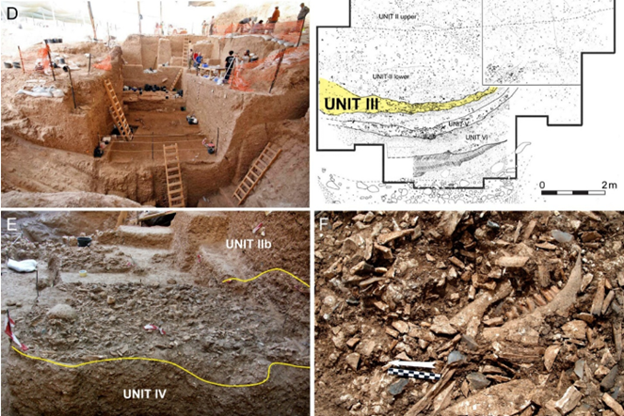
The Nesher Ramla site and its Unit III. (C) Stratigraphic section of the MP sequence (Unit III is outlined in yellow). (D) General view of the excavation, looking west. (E–F) Views of Unit III during excavation. (Yeshurun et al./ Scientific Reports)
The bone measurements revealed that 88% of the hunted aurochs were females, and nearly all were prime-aged adults rather than young or elderly animals. This stands in stark contrast to mass hunting events documented elsewhere, which typically target entire herds including juveniles and older individuals. Dental microwear patterns indicated that all animals were killed during the dry season when they fed on evergreen woody leaves, suggesting planned seasonal hunting expeditions.
Isotopic Evidence Disproves Mass Hunting Hypothesis
Perhaps the most compelling evidence against mass hunting came from stable isotope analysis of tooth enamel. The research team sampled five individual aurochs and discovered that each had distinct isotopic signatures, indicating they came from different locations and herds. One individual had spent time near the Mediterranean coast, while another roamed the chalk hills surrounding Nesher Ramla and drank water from high-altitude sources.
Auroch bones including teeth found at the excavation. (Yeshurun et al./ Scientific Reports)
This geographic diversity definitively ruled out the possibility that all animals were killed in a single mass hunting event. Instead, the evidence points to multiple isolated hunting episodes conducted by small groups during dry season months. The researchers also discovered a remarkable aurochs tibia with an embedded flint chip surrounded by healed bone tissue, providing unique evidence of an animal that escaped one hunt only to be recaptured weeks or months later.
Implications for Understanding Ancient Human Societies
The study's findings reinforce the hypothesis that Middle Paleolithic archaic humans lived in small, dispersed, and disconnected groups with limited intergroup communication. This social structure contrasts sharply with evidence from modern humans, who developed mass hunting techniques around 50,000 years ago and maintained larger, more interconnected populations.
Mass hunting requires extensive coordination, communication, and cooperation among numerous individuals from different bands, often spanning several days. It serves as an archaeological proxy for large-scale social organization and cultural exchange. The absence of such evidence at Nesher Ramla, despite ideal preservation conditions and a concentrated bone assemblage, suggests that archaic populations may have been at a demographic disadvantage when competing with more numerous and better-connected modern human groups.
The Nesher Ramla site holds particular significance because it represents an early contact zone between archaic and modern humans. The site previously yielded fossil remains of Middle Pleistocene Homo bearing a combination of Neanderthal and archaic features, adding biological context to the behavioral evidence. While modern humans were present at contemporaneous sites like Skhul and Qafzeh caves, the hunting strategies employed by different human populations during this critical period remain a subject of ongoing research.
The researchers emphasize that while no comparable sites currently exist in the Levant to test whether modern humans engaged in mass hunting during the Middle Paleolithic, the evidence from Nesher Ramla provides valuable insights into the social organization and survival strategies of archaic populations. Further investigation of open-air fauna-bearing camps attributed to modern humans could reveal whether differential hunting strategies contributed to the eventual replacement or assimilation of archaic human populations in the region.
Top image: A man stood facing an auroch - a massive wild cattle that stood up to 7 feet tall at the shoulder. Source: Nature
By Gary Manners
Chicken a la King
Yield: 100 servings (3/4 cup chicken mixture and 1/2 baked potato shell each)
Ingredients
- 1 (50 ounce) can Campbell's Condensed 98% Fat Free Cream of Chicken Soup
- 2 quarts milk (2% fat)
- 7 (30 ounce) cans Swanson Chunks O' Chicken
- 6 pounds canned sliced mushrooms
- 6 pounds frozen peas, cooked
- 1 pound pimiento, chopped
- 100 halves potato shells, baked
Instructions
- In large bowl mix soup and milk thoroughly. Add chicken, mushrooms, peas and pimiento.
- In each of 4 baking pans (12 x 20 x 2 inches) evenly divide chicken mixture.
- Bake at 400 degrees F for 30 minutes or until hot. Stir.
- Portion using a 6 ounce ladle (3/4 cup) into 1 half potato shell.
Atomic Bombings Opening Scene | Fallout (2024)
Dyspnea of the World
Written in response to: "Center your story around someone trying to change a prophecy."
Wes Frost
Horror Science Fiction Suspense
In the dream, I was alone, but when I woke, I knew the time had not yet passed, and perhaps something could be done to stop it.
I left my home that day with a different agenda than any of the ones that came before me. I did not want to lose myself to the madness and begin to preach devastation to a deaf people; I wanted to save them.
My local library had many books on ancient myths and legends, but finding anything specific to this event was like searching for a very particular blade of grass in a field. So, I traced my ancestry. I learned as much as I could about my uncle. My grandparents are no longer living, but I was able to scour old picture books and family records and learned that my uncle is a normal person.
He was intelligent in school, consistently earning good grades and maintaining good attendance. He even studied a respectable career path through college. Eventually, he landed a job overseas, but upon his return, he had changed. The intelligent, clever man was gone and replaced by what many in my hometown called a lunatic.
I needed to know more, so I packed my bags and booked a flight to Europe. During the flight, the dreams came back.
The dust breathed again, rising, falling, struggling. This time, the clouds above did not cover the sky completely. Far in the distance, a break in the clouds appeared, and a dark red beam of light slipped through. As I squinted toward it, I realized something was pushing through the clouds. A shape. A finger. Long, bony, blackened with red streaks pulsing beneath the skin. My skull throbbed. My chest tightened. I woke in a violent sweat.
A woman beside me shook my arm. “Are you alright, dear?”
She meant kindness, but the look I gave her made her shrink back.
“We have to stop it,” I muttered.
Madness tugged at me like a hook in the back of my mind. I forced myself to breathe, to remain grounded. Not yet. Not yet.
The rest of the flight passed in a numb haze. When we landed, I found myself standing at the rental counter without remembering walking there. The clerk slid keys toward me with an expression I couldn’t place—fear, pity, or simple exhaustion.
I drove to the company where my uncle had once worked. The owner seemed relieved to speak of him, as if releasing a burden he had carried for years. He told me my uncle had taken holiday in the northern part of the country—a remote region reachable by train and a short drive. Something in his voice trembled when he said, “People don’t go there anymore.”
I boarded the train that evening. Exhaustion overtook me almost immediately, but I feared closing my eyes. When I finally drifted, it was only for a moment, and I woke with my heart pounding and nails digging into my palms. I could not remember the dream—only its weight, still pressing against my ribs.
Outside the window, the land grew emptier the farther we traveled. Fields gave way to forests, forests to barren stone. Even the sky felt thinner, as if stretched too far across the world.
When I arrived, a driver waited for me in a rusty car. He didn’t speak much. When we reached the outskirts of the forgotten town, he only said, “Don’t stay longer than you must.”
His eyes did not meet mine when he drove away.
There were only a few buildings left—weather-beaten structures sagging under the weight of years. The air felt hollow, as if the world itself had forgotten to inhabit this place. I stepped out of the car, and the wind carried the smell of damp stone and old wood.
I wandered toward the largest structure, a church in the loosest sense of the word. Its roof leaned to one side, and the front steps were half-swallowed by the earth. On the porch sat an elderly woman, still as a statue, her hands folded neatly in her lap.
She didn’t react when I approached. She simply began speaking, her voice dry and thin, as though unused for decades.
“You can sleep in the back room. No charge. Breakfast at daybreak. Dinner at night. One day only, no more.”
Before I could respond, a gust of cold wind swept down from the north. It coiled around my legs to the waist, lingered, and slid past me with a sound like distant whispering. Leaves scattered across the ground in a frantic dance.
I looked away only for a second. When I turned back, the woman was gone.
Her chair rocked gently, as if someone had only just risen from it.
A chill crawled across my spine, tighter than the wind itself. I stood there, staring at the empty chair, at the deep imprint of where she had sat. It felt wrong, like something had been erased rather than having departed.
As I went into the dilapidated church, echoes of worship and praise lifted from the floors, crashed into the ceiling, and disappeared. It was a strange feeling and one I was unsure how to interpret. I went into the back room, and there lay a book on my bed. A Bible, I assumed, but as I got closer, I could tell this was no Bible. The cover was solid black with red and black marbled edging.
I now sit on the edge of the bed, unable to reach for the book. I believe all of this has led me to this moment. The answer to how to stop this disaster has to be inside this book, but what if I’m wrong? What if opening the book is the catalyst to the apocalypse? I have to know. I must do what I can to stop it, and I can’t stop it if I don’t know what it is coming. I’m writing this in case I don’t make it, in case the end is near, or in case my mind finally snaps.
Why did people build brutalist buildings?
Because all the nice buildings got destroyed in World War II.
Brutalism is an architectural style that emerged in the UK in the 1950s. An outgrowth of Modernism, Brutalism is the ultimate expression of function over form. It is characterized by simple geometric shapes, bare concrete and brick construction, and a complete lack of decorative elements. It creates ugly, imposing buildings which exist to serve their function and nothing else.
But much like the UK’s other distinct postwar architectural feature, the two tap sink, Brutalist architecture is a result of a particular set of historical realities. While the UK was on the winning side of World War II, it did not actually win the war. America won the war. The UK simply survived it.
London was flattened in the Blitz. The British Empire fell apart as its colonies declared independence. And the economy was so severely devastated that food rationing would continue until 1954, 9 years after V Day.
Brutalist architecture solved one of the most pressing issues postwar Britain had. How to house its population.
Concrete can be poured really quickly. Geometric shapes give you the most usable space for your buck. Painting concrete doesn’t actually do anything, so you can skip that step. And who has the money for decorative elements when a good chunk of London is homeless?
In the 1970s Brutalism would see another surge in popularity, in the Soviet Union. The Soviets had been just as devastated by the war as the British, if nor more so. And their economy recovered even more slowly for reasons I could write an entire essay on.
Quick, standardized, mass produced buildings made from cheap yet durable materials were a godsend. And that’s what Brutalism is at its core.
A Modernist home. Not a Brutalist home.
Brutalism is Modern architecture for really poor nations who need those buildings up yesterday.
🔥FOREIGNERS REACT TO NOBODY (2021) BUS FIGHT! 🤯🔥
How to Make Cheap Thermal Goggles

Night vision goggles were invented for use by the military. Over the years, they have become popular among law enforcement agencies and hunters. The technology that makes night vision possible is called an infrared image intensifier tube. The intensifier tube houses a photo cathode that transfers photons of light energy into electrons by releasing similar electrons from atoms inside the tube itself. This process helps to multiply the electrons and then illuminate the image as the electrons reach the phosphor screen. This process can be duplicated at home by using a simple method.
Step 1

Purchase a pair of regular, preferably clear-framed sunglasses that have a sturdy frame. Remove the lenses and trace their shape onto sheets of Congo blue and primary red theatrical gels, which are made for stage lighting. Ensure that you have two pieces for each color and cut all four pieces out using the X-Acto knife. Glue the blue gels first and then the red ones, by touching the outer rim of the gels all the way around with super glue. Make sure that you put one of each color gel on each lens of the glasses so you end up with each eye filtering red and blue light. Gently lay the lenses inside the glasses one at a time and wait for them to dry.
Step 2

Glue the eight high-intensity infrared LEDs, four on each side, to the outside of the goggles and on the outer edge of the lenses so they are to the left of the left lens and to the right of the right lens. The LEDs create the illumination needed to filter the light through the colored gels. Secure the wires of the lights to the outer edge of the goggles using electrical tape.
Step 3
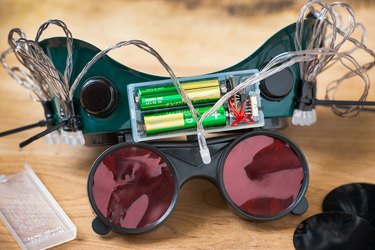
Wire the lights to the 3-volt, button-cell battery and glue the battery to the side of the goggles. Ensure there is a battery on each side of the goggles so each set of lights has a battery. Leave the plus wire short so it does not touch or tape it down so it isn't able to make contact. You may also want to wire a switch from the wire to the battery so the goggles can be turned on and off. However, you can simply tape the wire to the battery when in use.
Step 4

Take your goggles outside to test them. If the image is weak or not well-illuminated, you may need to add more LEDs or another layer of gels.
Gimme Shelter - Apocalypse Now Music Video
Wow.
Col 26-Book 442 - Sir Whiskerton and the Great Farmyard Soufflé (A Tale of Egg Strikes, Edible Glam, and the Peril of 10-Foot Ambition)
Ah, dear reader—prepare your oven mitts, steady your monocle, and inhale deeply. Today’s story does not begin with a quack, a snort, or even a kazoo blast.
It begins with a whisk.
A thump.
And the soft, ominous groan of a soufflé that has dreams far beyond its structural integrity.
So preheat your imagination, dear friends—and step gently into Sir Whiskerton and the Great Farmyard Soufflé.
Act I: The Vision (and the Very Tall Pan)
It began, as all great disasters do, on a Tuesday.
Chef Chloe—flour-dusted, eyes gleaming with the fire of unhinged innovation—stood before the barn-turned-kitchen, arms wide.
“Behold!” she cried, unveiling a copper pan the size of a small tractor. “The Farmyard Soufflé: A culinary monument to community, creativity… and vibes.”
Doris the Hen squinted.
“Where are the eggs?”
“Eggs!” echoed Ditto, already licking the bowl.
Chloe waved a dismissive paw.
“Eggs? Passé. This soufflé rises on farm-fresh vibes—sunbeams, friendship, and the gentle hum of Bessie’s moo-ditation.”
She gestured to a jar labeled:
“Concentrated Harmony (Shake Before Use).”
The Valley Chicks gasped in unison.
“Omg. It’s, like, art.”
“Art! Art!” echoed Echo, wearing a tiny chef’s hat backwards.
Sir Whiskerton, sunbathing on the roof, flicked an ear.
“This,” he murmured, “is either genius… or the prelude to structural collapse.”
“Collapse! Collapse!”
Act II: The Egg Strike (Feathers Will Fly)
Word spread.
By noon, Doris had convened the United Hens of the Coop (UHOC) beneath the old oak.
“Sisters—and Harriet—we are at a crossroads!” she declared, standing atop a crate. “Chef Chloe would build a monument… without monumental sacrifice! Without our yolks! Without our protein-packed purpose!”
“Purpose! Oh, I can’t bear it!” Lillian shrieked, fainting onto a sack of oats.
A sign appeared on the coop door:
EGG STRIKE IN PROGRESS
“You’ll get my yolks over my dead feathers!”
Inside, negotiations were tense.
Doris, in full union rep mode:
“We demand: 1) Hazard pay for high-altitude laying, 2) Spa days after extra-large eggs, 3) A say in soufflé aesthetics.”
Chloe, wiping flour off her brow:
“But the vibes are set! The harmony jar was calibrated at dawn!”
“Vibes don’t hold air, Chloe,” Doris shot back. “Eggs do.”
Even Ferdinand weighed in—via opera:
“Ooooooooooo-va-laaaa! The soufflé must rise!”
“Rise! Rise!” echoed Ditto—now stuck in the flour bin.
Act III: The Glitter Gambit (and the Collapse Heard ‘Round the Farm)
Desperate, Chloe turned to the Valley Chicks.
“You understand art. Help me elevate the batter.”
Tiffany struck a pose.
“We’ve got exactly what you need.”
She pulled out a glitter cannon labeled:
“Edible Glam™ (FDA-adjacent).”
“It’s, like, edible glam,” Brittany added. “Guaranteed to make anything Instagrammable… or mildly sparkly.”
They fired.
The batter—already a pale, trembling cloud—now shimmered like a disco ball dipped in moonlight.
Chloe beamed. “Perfection!”
She slid the pan into the oven (a repurposed grain silo, courtesy of Handy Hank).
For 47 minutes, hope rose.
Then—
WHUMPF.
Not a pop.
Not a sigh.
A full, tragic, Broadway-style collapse.
The soufflé deflated like a balloon at a funeral.
From the wreckage rose a single, glittering word—written in steam on the barn wall:
“FLAT.”
The Valley Chicks gasped.
“It’s… performance art.”
“Art! Art!”
Doris stepped forward—not in anger, but in solidarity.
“Chef Chloe… maybe… just one egg?”
She placed a single, golden egg beside the pan.
“Not for the structure. For the soul.”
Chloe stared. Then—nodded.
“…Fine. One egg. And a very light hand on the glam.”
The Moral of the Story
That evening, as the farm gathered around a modest—but perfect—6-inch soufflé (golden, airy, just a whisper of sparkle), Sir Whiskerton addressed the animals.
“The moral of the story, dear reader, is this:
Great things require both vision and foundation.
Chloe dreamed big—and that’s noble. Doris stood firm—and that’s brave. And the Valley Chicks? They added glitter—and that’s essential.
But the soufflé only rose when they listened to each other—when the vibes met the yolks, and ambition bowed to reality.
So go ahead. Dream tall. Just… maybe check the recipe first.”
Doris raised a claw.
“To the egg! The unsung hero of lift!”
“Lift! Lift!”
And even the scarecrow swayed—just once—in agreement.
Post-Credit Scene
Later, Chef Remy unveiled his newest invention:
“Deflated Soufflé Tartlets™”
(“Guaranteed to soothe existential pastry trauma—or cause mild indigestion.”)
Mr. Ducky bought the rights:
“Now with 200% more resilience!”
And Sir Whiskerton?
He added a footnote to his journal:
“Note: The greatest masterpieces are rarely 10 feet tall.
They’re the ones baked with respect, shared with joy,
and eaten before the glitter settles.”
Jingle on. 🥚✨🍳
(Or, in hen: Cluck-cluck-POOF!)
The End.
America's Skill Pipeline is Closed; Young Americans Have NO CLUE How to Fix Things

College Age Kids who think THEY know better, say they're going to start a Revolution to change America. Truth is, most of them can't even start a lawn mower.
AMERICA'S SKILL PIPELINE IS BROKEN: What Happens When the Boomers Leave?
You thought America’s economy was overly dependent on Wall Street and Big Tech. Wait till the Baby Boomers retire and die off. They did much to ruin the country, but they are the last generation of Americans that knows how to do stuff with their hands.
GENERATIONAL SKILLS VOID
🟠Teen Work Collapse: Entry-level jobs that once built discipline are gone. Result: no early training in punctuality, resilience, or responsibility during ages 14–18.
🟠Apprenticeship Breakdown: Master–apprentice pipelines were replaced by cheap, disposable labor. Result: skills aren’t passed down — they retire with the worker. The ladder is broken.
ACCELERANTS: IMMIGRATION & AUTOMATION
🟠Illegal Immigration: Flooded the market with cheap, ready labor, eliminating the incentive to train natives. Apprenticeship died because the shortcut was cheaper.
🟠Automation Myth: Clerical and factory jobs vanished. “Learn to code” was the wrong fix. Now AI outperforms junior programmers — the escape hatch is automated too.
THE COMPOUNDING EFFECT: A Demographic Time Bomb
This is an accelerating decay function:
🟠Boomer Generation (Ages 60-78): Holds the majority of remaining tacit knowledge and mastery in skilled trades.
🟠Gen X/Millennials (Ages 28-59): Contain a missing cohort that never entered the skill pipeline due to the above factors.
🟠Gen Z+ (Under 28): Face a landscape where entry points are gone and credentialism is failing.
THE BOTTOM LINE:
The market signal of "jobs Americans won't do" is a lagging indicator. The leading indicator is "skills Americans weren't taught."
Implosion is the inevitable result of a 30-year failure in skill transmission. The window for mitigation is closed.
Most young guys today don't even know how to jump-start a car. Most young girls today don't know how to cook.
Our civilization is dying - and the young ones who think they know everything about everything, are going to find themselves living in a world where nothing works because in reality THEY don't know much of anything.
Which lesser-known World War II battle or campaign do you find most strategically fascinating?
Operation August Storm - The Manchurian Operation
It’s quite fascinating, because the historical implications of the campaign are quite wide, particularly if you are a western person and believe in a certain set narrative of WW2.
The campaign was very short, in which the Soviet army defeated a huge amount of Japanese troops, in about 3 weeks. The total was for around 84,000 dead compared to 12,000 Soviet dead as well as 600,000 POWs. The Japanese puppet forces of Manchukuo and Mengjiang collapsed entirely before the Soviets and their armies deserted and melted away. These troops alone constitute around 250,000 troops.
Japanese prisoners in Soviet POW camps.
1.2 million Japanese commanded soldiers against 1.5 million Soviet soldiers, while on the defensive lost 1.5 million square kilometers of defended territory. Logistically alone it was quite impressive, as the 44th army did a lightning attack through a defended mountain range.
It also showed how much weaker the Japanese army was compared to the Germans. Taking a single city from the Germans was more difficult than taking an area bigger than France and Germany combined from the Japanese.
Finally, it’s interesting because if you compare the Soviet experience with the American one, the American narrative looks very strange.
- Japanese rarely surrender, but half of the Japanese troops surrendered to the Soviets.
- Japanese fight extremely doggedly on the defense, but they get over run by the Soviets.
- It would take immense casualties to defeat the Japanese main army in Japan, but the Soviets defeated a million trained soldiers in weeks with minimal casualties.
The enemy attacks with a strength and speed we have never witnessed. Our forces are overwhelmed…It is impossible to regroup. The situation is out of control.
General Otozō Yamada, Commander of the Kwantung Army in Manchuria, Reports to the Imperial government 11th of August
The Soviet Union’s attack has dealt us a fatal blow... Far beyond anything we had imagined.
General Yoshijirō Umezu, Army Chief of Staff, August 14 Imperial conference on surrender.
The Soviet Union has entered the war against us… Now that the Soviet Union has also entered the war, to continue the war would mean the destruction of the nation.
Emperor Hirohito, August 15th 1945, Imperial conference on surrender
Pictures
Is 72 a good age to live to, and why?
I will turn 73 in May of 2026, so I am 72 at the moment. I would be lying if I said I never thought about dying. With more years behind me than in front of me, the prospect of dying comes to mind more often than I would like. But then, we all will die. Whether we think about it or not, it will come at some point. I choose NOT to think about it, excepting for making plans for my wife’s care and our small amount of assets…… but I have done that since my 50’s.
My own Father died at 50, his brother at 55. My Mother died at 78, one sister at 79, another at 80 and the last one at 89. They all died from complications from hypertension related heart disease.
My brothers are 83 and 82. Losing our Father so young… I was less than two when he died,…. had a huge impact on us boys. Unlike our sisters, we never smoked. We also watched our weight, exercised, had regular medical check-ups, ate responsibly, managed stress, money and retired in our 60’s.
I cannot speak for my brothers because we have little contact now, but I “learned how to learn” at a young age. Seeking knowledge during my entire life has kept me young in mind and vital in body. Putting that knowledge into practice, keeps me useful and vigorous.
I do have assorted age related “issues”, but they don’t stop me. I move at the pace I am comfortable moving at. When I was 57, I started building our ranch in west Texas, by hand. Sold it at 69 and at 70 built, again by hand, a garage/man cave/workshop. Sold it and at 72 I have rebuilt half of our 97 year old project, “The Money Pit”, as well as constructing a matching 500 square foot shed. All by my own hand. I will do more to it next year, at 73.
Is 72 a good age to live to??? Of course!!! But for me, it is just a stepping stone to my ultimate goal of 115. If I don’t make 115, I will get a lot closer to it that the guy who sets 80 as a goal though! Every age can be the best, or the worst. LIFE, age, is what WE make of it….. make your the best you can and strive to LIVE life, not just exist!
Jump Start
Written in response to: "Center your story around someone trying to change a prophecy."
John K Adams
Adventure Fantasy Science Fiction
Governments around the world mandated everyone’s participating in the Time Jump. It was to change the course of history.
Chet watched Maria. “Is Lenny coming?”
“I don’t know. Did you talk to him?”
Chet scoffed. “Don’t see him coming to something like this. Not really a joiner.” He surveyed the crowd. “Don’t you think it’s bogus? I mean, what happens if I sit it out?”
“You mean, besides getting arrested?”
“I mean, anyone. Not only me. What’s the worst that could happen?”
“Uhm… the world could end?”
“For lack of one person? I don’t think so.”
“Everyone is important, Chet. They’ve calculated that the distributed mass of humanity is precisely what would work.”
“But people die all the time. What happens then?”
“Chet, dying to prove a point would be foolish. Just jump. It’s simple. Over before you know it.”
“But their wonderful calculations?”
“Even if I agreed with you, I don’t want to find out. Okay?”
“How’s a baby supposed to jump?”
“Its mother will hold it… jump together.”
“Or someone who can’t walk?”
“I heard rental places are out of wheelchairs. Some think like you. Rather be handicapped than help save the world.”
“Free ride…”
Marie stepped in front of him. “Is this about the jump? Or your irrepressible need to defy all authority, no matter how benign?”
He gestured for her to keep walking. “I don’t like taking orders from some old dead guy who made a bogus prophesy hundreds of years ago.”
“It’s not about being old, Chet. You were born old…”
“Beside the point… Did he prophesy the future? Or is it happening because he said it?”
The crowd slowed as the stadium loomed in the distance.
Maria said, “Of course… Here come the protestors.”
A cluster of people wearing outlandish costumes and tin foil hats stood in the road shouting. They carried signs with slogans condemning government overreach and ridiculing the Time Jump. Some read, ‘Time Jump is for chumps!’ and ‘Nostradamus go home!’
Maria said, “Protesters gotta protest…”
Their lanky friend, Lenny walked up to them. His t-shirt sported a childish drawing of a toddler jumping on a bed inside a circle with a slash. In red block letters, the word ‘DON’T!’ scolded from over the circle.
Smiling, Lenny said, “Here for the protest?”
Chet said, “Here to jump. Support the effort. Don’t like the alternative.”
“You’re kidding. The whole world is going to jump? And that’ll change… what?”
Maria said, “Save the world… Or not. Got to try.”
Chet said, “Actually, I heard that Fiji opted out. So, it’s not the whole world.”
Lenny said, “So, Fiji will be the only country coming to an end? Isn’t this about some guy, spouting off, five hundred years ago?”
“Nostradamus…”
“Yeah, that guy.” Lenny rubbed his chin and assumed an attitude. “Let’s see… someday, something horrible will happen, and everyone will be sad.’” He shouted and waved his arms around. “You’ve got to believe me!” Chet and Maria laughed. He stopped. “That’s a prophesy we’re supposed to believe? Why listen to him?”
“Scientists think this might happen.”
“Except for the ones who don’t.”
“Worth a try… The consensus says…”
“Maria, you know science doesn’t work by a vote. Real science looks at solid evidence, not opinion. Sounds like politicians to me…” He looked at Chet for support.
Maria said, “If it’s so bogus, why is the whole world participating?”
Chet raised his finger. “Uhm, Fiji?”
Lenny laughed, “Because the world is a fool. What exactly did this German expert say to rile everyone up?”
“He was French. An astrologer.”
Lenny stepped back. Trying not to laugh, he couldn’t help but smile. “Oh, well, a French astrologer. Very scientific. Everyone should believe him. But the solution is…?
Marie tried, “I don’t know how to explain this…”
Lenny interjected, “Uhm… Nostradamus forgot to carry the one.”
Chet laughed. “Yeah, that’ll do.”
Maria continued. “The experts say everyone in the world has to jump at the same moment. That impact will slow the velocity of the earth’s turning, enough to throw off the prophesy and save the world.”
Lenny was doubtful. “Can always count on the experts. Are they astrologers too? Why not use an atomic blast?”
“An atomic blast is too localized. The impact needs to be distributed across the whole world. Don’t want anything to cause wobbling. Or radiation poisoning, for that matter.”
Chet said, “Still working on getting the fish to jump.”
Lenny said, “Or we could adjust the clocks. Do it all the time with daylight savings…”
The guys jostled each other and laughed.
Marie was not amused. “Can’t just nudge clocks and sundials. We need to adjust time itself.”
Lenny pressed on. “Anyone heard of time zones? I don’t suppose old Nosadumbo factored that in…?”
Maria sighed. “Everyone in each time zone needs to jump offset an hour from the neighboring zone. We’re jumping at eleven, but the zone west of us will jump at ten. East of us at noon…”
Lenny laughed. “Never before, in history, have so many been so hoodwinked… Hope an earthquake doesn’t cancel everything out.”
She continued. “…So, in a single twenty-four-hour period, everyone will jump at exactly the same moment. This, despite jumping at a different hour in the same day.”
“Why not do it on New Year’s? Everyone is jumping anyway. Kill two birds…”
Chet cupped his ear. “I hear an echo… Anyone remember the Y2K hysteria?”
Maria nodded. “Yes, that was a gigantic hoax. But, speaking of time zones, some jumpers are meeting at the border between two zones. They’re planning to jump at once, while separated by an hour.”
Lenny added, “Do I get extra credit if I back flip? Or pirouette?”
Maria tried not to laugh. “Don’t think so. But you can try…”
Chet said, “Wait… Why are all prophesies bad? Why not, instead of the world is about to end… Everyone will be able to fly? Or become rich? I should start doing prophesies. That could be a good gig. Who’s to say I’m wrong?”
Together, Maria and Lenny said, “Everyone…” They high fived.
Chet said, “Yeah, right. All the jumpers. Moo!”
Maria turned to Lenny. “So, you refuse to jump?”
“Can’t decide. Kind of a waste of time. What if I identify as from Fiji…?”
“Come on… How long does it take to jump? You’re here. Join the party. No point in getting arrested.”
“Or I could jump, but late. You know, off the beat. I’d never be a drummer. Can’t arrest you for bad timing.”
Chet said, “Especially not if the world ends.”
“Right. Being in jail won’t matter, then.”
The crowd milled about, waiting to enter the stadium. Protesters yelled from behind a police barricade.
A group of counter-protesters chanted, “Shun the unbelievers!”
Pointing at them, Chet said, “I don’t think anyone’s mind will change…”
Maria asked Lenny, “Goin’ in?”
He looked at the others and shrugged. “I’m here…”
They got into line and shuffled along.
Lenny said, “So, Maria... What happens after the earth’s rotation slows? What’ll you do with all that extra time? Will we age slower? Will the day be twenty-four hours, plus a few seconds? Or will they spread them out over the day?”
Maria didn’t know. “We could always google it…”
Lenny was on a roll. “I know… if the earth stops turning, everyone in the world could run in the same direction and then all stop at once. You know… Nudge the world back into motion? What if the solution is worse than the problem?”
Chet asked, “Will we grow younger if the earth starts spinning backwards?”
Maria looked without flinching. “I will. But you won’t.”
Chet and Lenny looked confused. Maria laughed. “All will be well, my friends.”
The trio approached the entrance and passed through metal detectors and turnstiles. Security guards stood by watching.
Maria said, “We’re in! Let’s go. This will be fun.”
She led them down to the playing field. The gigantic television screen displayed a large clock.
Maria said, “Perfect. We’ve got fifteen minutes.”
Lenny shook his head. “How many thousand people are here? This is unbelievable.”
Chet said, “What’re we supposed to do? Stand around? Do nothing?”
As if answering his question, an air horn blasted. The announcer said, “Thank you all for coming to this historic event. Get ready, folks. We’ll now rehearse the big jump. I’ll count down from three. When I say ‘jump,’ you know what to do… Everybody ready?”
Most of the crowd cheered in the affirmative.
The announcer said, “Here we go. Three… Two… One… JUMP!”
Most of the crowd jumped in unison and cheered.
Lenny stood in place without jumping. Several people standing by gave him dirty looks.
Maria took his hand. “Come on, Len… You’re here. Might as well do what you came for.”
He said, “I’m confused. I grew up hearing that white guys can’t jump.”
The announcer said, “Okay! You know we can do better than that, folks. We have time for one more rehearsal. Get ready and do your best. At the turn of the hour, there won’t be any redos. I want everyone all in… Ready? Three… Two… One… JUMP!”
Everyone but Lenny jumped and cheered.
A guy came up behind Lenny and shoved him. Some people grabbed the guy to restrain him. He shouted, “What’s your problem, man? When the guy says jump, you jump.”
Chet and Maria held Lenny. He yelled, “Idiot! I’ll jump when I want. Go jump yourself!”
People yelled at each other. Some shoved back and forth. It threatened to turn into a melee. The air horn blasted and drew everyone’s attention back to the giant screen.
The announcer said, “That was better. This next jump is the real deal. Let’s do our part to save the world. Right?”
A cheer swelled throughout the crowd.
“Everyone, get ready to jump your heart out.”
Maria and Chet joined hands with Lenny. They faced each other and steadied themselves.
The second hand on the giant clock moved steadily toward the twelve. Joining the announcer, the crowd chanted the count down. “Three…! Two…! One…! JUMP!”
Everyone in the stadium jumped as one. Maria and Chet closed ranks with Lenny and shouting, they jumped. On landing, they laughed together.
A cheer rose and lasted a long time. People kept jumping. The ground shook.
The announcer said, “Congratulations everyone! You did your part to stop that rogue, Nostradamus, in his tracks. You did a great thing today. Carry on.”
People filed out of the stadium.
Maria hugged her friends. “You did it! You did great!”
Everyone laughed at Lenny, who hopped around, holding his hands like a bunny.
He shook his head. “That was outrageous! Truly a world-shaking event. Don’t know if it accomplished anything… but we’re still here!”
They laughed.
Chet said, “Whatever… It was exhilarating!”
The news for the next several days celebrated forestalling Nostradamus’ prophesy. The president applauded the unanimous cooperation of the world to do the impossible. Government sources stated the Time Jump had an impact on the earth’s rotation.
Many scientists discounted its influence on any prophesy.
Fiji’s leaders apologized at the United Nations general assembly for refusing to join in the Time Jump.
People debated for years on whether the Time Jump made a difference. All praised the unprecedented cooperation exhibited by the world toward a common goal.
Maria, Chet and Lenny remained friends for the rest of their lives.
The next year, on the anniversary of the Time Jump, Lenny and Maria got married at the border between two time zones. Chet was their best man. The loving couple said their vows while standing on either side of the dividing line. An hour apart, they held hands. Together, they stepped out of time and into the rest of their lives. At the minister’s prompting, they jumped and kissed.
Everyone cheered and applauded.
Beef Stew
Yield: 100 servings
Ingredients
- 23 pounds boneless beef (1 inch cubes)
- 1 cup vegetable oil
- 4 ounces dehydrated onions
- 1 pound 8 ounces all-purpose flour
- 3 tablespoons garlic powder
- 2 tablespoons paprika
- 1 tablespoon black pepper
- 2 teaspoons thyme, flaked
- 3 gallons water or beef stock
- 5 pounds 5 ounces canned sliced carrots, drained
- 6 pounds 12 ounces canned small whole potatoes, drained
- 6 pounds 8 ounces canned green peas, drained
Instructions
- Trim all visible fat from beef cubes. Brown beef cubes in oil. Drain.
- Add onions, flour, garlic powder, paprika, pepper and thyme. Add water or stock. Bring to boil. Reduce heat and cover. Simmer for approximately 1 1/2 hours, or until meat is tender.
- Add carrots, potatoes and peas. Cook until vegetables are heated through, approximately 15 minutes.
- Pour into serving pans. Portion with a 1 cup ladle.