
.
You don’t calm a storm—you teach someone how to be still within it

Quote from congjing yu on August 5, 2026, 5:38 amToday's MM post on Quora...
Which method of making coffee gives you the strongest hit?
Oh, you're not just asking for coffee. You're asking for liquid defiance. You want the jolt that says, "Morning is a suggestion, and I have rejected it."
I like your style.
Forget "strong." Let's talk about dense, rich, and caffeinated to the gills. You want a cup that doesn't wake you up—it assumes command of your central nervous system.
Now, most folks will tell you "espresso." That's the obvious answer. It's a precise, surgical strike. But you want an area saturation bombing. You want the whole bean, screaming for mercy.
So, let's get into the serious tools.
1. The Pressure Cooker Extraction (For The Truly Committed)
This isn't for the faint of heart. You're essentially creating a high-pressure, high-temperature bean interrogation chamber.
Grind your coffee fine, almost to dust. Put it in a heat-safe container with water. Seal it in the pressure cooker. You're not brewing; you're force-extracting every last molecule of soul and caffeine under threat of steam.
What comes out is less a drink and more a diagnostic fluid. It will have a strength that is geological. It tastes like the earth's core feels.
2. The Siphon (AKA The Alchemist's Dream)
This is for when you want the strongest hit and a show. It looks like a prop from a 19th-century laboratory.
You use a vacuum and vapor pressure to pull water up through the grounds, then break the seal to let it filter back down.
The result? Unbelievably clean, but intensely concentrated flavor. Because the water is in full contact with all the grounds at a controlled temperature, it pulls out everything—all the bright highs and the deep, bitter lows. It's the orchestral version of your caffeine hit. Complex, potent, and slightly terrifying to behold.
3. The Percolator (Your Grandfather's Secret Weapon)
Don't let its old-school look fool you.
This thing is a brute. It continuously cycles boiling water through the grounds.
And I mean continuously. It's the only method that actively re-brews the coffee.
This can lead to over-extraction and bitterness if you're not careful… which, for our "strongest hit" mission, is a feature, not a bug.
You get a cup that's bold, robust, and in-your-face. It tastes like a lumberjack's handshake. It's not elegant. It's effective.
My Final Verdict?
For sheer, unadulterated caffeinated force, the pressure cooker method is king. It's the theoretical maximum. For the most flavor-packed, rich, and complex strong cup, the siphon is your champion. For a no-nonsense, throwback punch that'll put hair on your chest, the percolator stands proud.
Try them. Experiment. Document it in your notebook.
Just remember: with great power comes great responsibility. And the potential to see sounds.
Now go forth and caffeinate dangerously.
And now...
Why do companies refuse to give you any on the job training these days and instead insist that in addition to your degree, you are responsible for getting certificates they are too lazy to teach you?
So, years ago I was working a dealership, and I was friends with the assistant manager of the repair bays.
And this business had been around since the 1950s, and actually one of the first Cadillac dealers in central Ohio.
Well I found out finding some random business material in an attic (long story about how I ended up cleaning out an attic), that business used to have 6 apprenticeship positions with free training. They used have FOUR mechanic training positions, and two additional body repair positions, for cars that needed body work down to the frame and such.
So at the time I was working there, they were down to 1 body shop apprenticeship, and 2 repair tech apprenticeships.
And I just found out at the time, that they were ending all apprenticeship positions entirely.
So, again I’m friends with the number 2 guy running the place, and I just asked him directly, why is this? Why are they getting rid of all these training positions?
And the answer boils down to two basic reasons.
The first reason is the minimum wage. People really hate to hear this, but this is true as best I have seen in my life.
When a company pays you as an employee to go get training, or to be trained, the company is paying you to lose money, and make mistakes. The way my manager put it ‘we pay you lose money break stuff’. Because that’s what a trainee does. Contrary to popular opinion, most people the first few months they are employed, are not earning the company much money, if any, and usually you are making mistakes that require someone else to fix, and thus costing the company money.
And this very true of training periods, and apprenticeship periods.
Now, the key is that in the past when the minimum wage was really low, the company could afford to pay you to lose money and break stuff. But today with a much higher minimum wage, it is just too expensive.
The second problem, is a little more difficult than that.
So as I just said, when you give people training and such, you are paying them to lose money and make mistakes.
So how does a company make that situation make sense? How do they engage in this activity and make money?
Well the answer is, by paying you less than the market rate, after you are trained. So you get free training paid for by the company, but then you are expected to work for a lower wage than your training could earn, for a year or two, and then they bump you up to the market wage.
And people get really bent about this, because they get trained, and now they are a trained (whatever) and they look around, and see they could be making significantly more money in the market. And so they get really angry, because they are paid less than anyone else with these skills.
But that’s how the system works. You get free training, but they get their money back because you work for a temporary lower wage, so the company can make back the money they lost.
And that leads to the final massive problem.
Workers have no honor and no loyalty anymore.
In the past, if you trained a guy to work for you, he would stay there, and work for you, for the next 10 years.
Today, the moment the employee gets trained on anything with market value, they jump at the next ship passing by.
And I witnessed this. I watched people get trained, and the within a week, get hired on by a competing company.
Which by the way, is why they had no compete clauses, but everyone freaked out about that, so now those are gone.
So what the company ends up doing is training an employee, which then takes that training and goes to a competing company.
Essentially, you paid, and lost money, to train your competition in the market.
So a lot of companies now, absolutely do not want to train anybody. Because they’ll lose money, end up paying you to lose them money, paying for the training, and then you go off and help their competition in the market to destroy them.
No thanks. Companies are not doing that anymore. Now you have to pay for your own training. Thank you minimum wage, thank you lack of honor and loyalty. That’s what you get.
Cabbage Rolls
[caption id="attachment_180621" align="alignnone" width="736"]
ae467dc6d82897a4f2ee13cd5716e745[/caption]
Yield: 80 cabbage rolls
Ingredients
- 4 large heads cabbage
- 6 pounds ground beef
- 2 pounds mild sausage
- 6 eggs
- 3 cups raw rice
- 2 cups finely chopped onions
- 2 cups milk
- 2 tablespoons salt
- 2 teaspoons pepper
- 2 (18 ounce) cans tomato paste
- 4 cans tomato soup
- 6 cans water
- 2 tablespoons brown sugar
Instructions
- Put cabbage heads in large pot. Add water and 2 tablespoons vinegar and cover. Cook until leaves can be separated. Cool.
- Combine all ingredients, except tomato paste, soup, water and sugar. Put large spoonful of mixture on cabbage leaf, then roll up. You may have to cut away a little of the hard stem on some cabbage leaves. Place in electric roaster such as a Nesco.
- Continue until all meat is used. Chop remaining cabbage over rolls.
- Combine remaining ingredients and pour over rolls.
- If you are using a regular roaster, place a layer of cabbage leaves on the bottom of the roaster to prevent sticking.
- Simmer at 150 degrees F for 8 hours.
Human Sacrifice Was Sex-Specific in Stone Age China
DNA analysis of ancient remains from northwestern China has unveiled a chilling picture of ritualized sacrifice in a 4,000-year-old Neolithic society, where men and women met drastically different fates based on their gender. The findings, published in the prestigious journal Nature, challenge long-held assumptions about sacrificial victims and illuminate the hierarchical structures of Shimao culture during China's late Stone Age.
Researchers from the Chinese Academy of Sciences analyzed DNA from 169 individuals excavated from the massive Shimao archaeological site and surrounding settlements in Shaanxi Province. What they discovered was a society that practiced two distinct forms of human sacrifice, each with clear gender preferences that reflected the community's social organization and ritual purposes, writes The Independent.
Men Sacrificed at City Gates, Women Buried with Elites
The genetic evidence overturned previous archaeological assumptions about the victims found beneath Shimao's East Gate. Contrary to earlier morphological assessments that identified most sacrificial victims as female, DNA testing revealed that nine out of ten individuals buried in these mass graves were actually male. Three individuals previously classified as female based on skeletal features turned out to be men when their genetic profiles were examined.
These male victims, likely killed during construction rituals for the city's defensive walls between 3,800 and 4,300 years ago, represent a public form of sacrifice that may have served broader community purposes. The mass burials at places like the East Gate suggest these men were offered to consecrate important civic structures in what is now recognized as one of China's earliest state-level societies.
Stone walls at the Shimao Neolithic site in Shaanxi, China. (Bilaterian/CC BY-SA 4.0)
In stark contrast, female sacrifices dominated the elite cemeteries scattered throughout Shimao city and its satellite settlements. At Hanjiagedan, a noble cemetery south of the inner enclosure, six out of seven sacrificed individuals were women. The pattern repeated at Huangchengtai, the presumed ruling-class cemetery in the city center, where 14 of 19 victims were female. These women were entombed alongside high-status individuals, suggesting their role in ancestor veneration rituals rather than public ceremonies.
Patrilineal Society with Strict Social Hierarchies
The DNA analysis revealed more than just sacrificial patterns—it exposed the fundamental social structure of Shimao society. Researchers reconstructed family trees spanning up to four generations, discovering that both the Shimao city and its secondary settlement at Zhaishan were organized around patrilineal descent. Male tomb owners in high-status graves universally carried the same paternal haplogroup (O3a2c), while female tomb owners displayed diverse maternal lineages, indicating that women married into these communities from elsewhere.
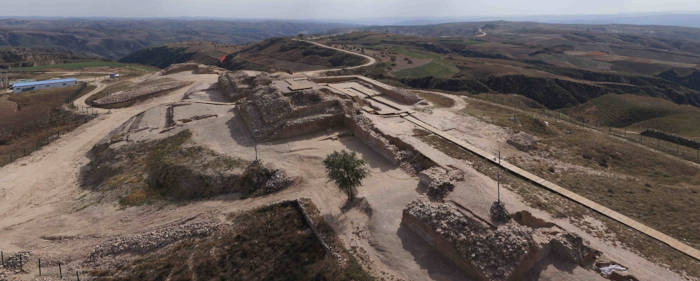
View of some of the landscape of Shimao city. (Institute of Vertebrate Paleontology and Paleoanthropology/Nature)
The Shimao settlement covered approximately four square kilometers and featured stone-walled fortifications - unusual for the period when rammed earth walls were more common in the Central Plains. The site's organization into distinct zones with craft production areas and large fortifications points to a sophisticated society with clear social stratification thousands of years before the emergence of China's first documented dynasties.
Interestingly, the genetic study also revealed that sacrificed victims showed no close familial relationships with the elite tomb owners they accompanied, suggesting strict social boundaries. However, some high-status female individuals possessed wealth comparable to male elites, indicating that while the society was predominantly patriarchal, women could still attain positions of power and influence in certain circumstances.
Challenging Assumptions About China's Past
These findings push back the timeline for certain sacrificial practices in ancient China. The phenomenon of elites being buried alongside sacrificed female companions was previously thought to have emerged during the early Iron Age period (770-221 BC), but the Shimao evidence demonstrates this practice existed more than a thousand years earlier during the late Neolithic period.
The research also uncovered evidence of long-term interaction between the Shimao inhabitants and populations related to the Yumin culture from Inner Mongolia. Several genetic outliers among both the earlier Yangshao culture (around 4,800 years ago) and later Shimao populations showed ancestry linked to these northern steppe peoples, suggesting ongoing contact between farming and pastoral communities without disrupting the genetic continuity of the dominant local population.
Scientists hope that continued excavation and DNA analysis from the region will shed further light on the origins of early East Asian states and the complex social dynamics that characterized these prehistoric communities. The Shimao site, with its extensive archaeological record and well-preserved human remains, offers an unprecedented window into how family relationships, gender roles, and ritualized violence shaped one of China's earliest urban civilizations.
Top image: Tomb owner and a sacrificed victim at Shimao necropolis. Source: Institute of Vertebrate Paleontology and Paleoanthropology/Nature
By Gary Manners
The speed of dark
Written in response to: "Write a story that includes the line “Did anyone else see that?” or "Who’s there?”"
Alex Davies
Horror Science Fiction Suspense
The ring spun easily, the hatch opened smoothly, both silent in the absence of air.Of the thirteen members of the array he’d visited so far, this was the only hatch that hadn’t required disassembly, and the Telescope servicing space held beyond it didn’t have the same random spray of decayed rubber from ancient seals long since worn down. Sparse and functional, plastic buttons looked as fresh as they must have those centuries ago, tough perspex bearing the years with an unusual dignity.Cupola windows at either end of the pill-shaped interior showed views partially obscured by the full length of the internally mirrored monolith, and just like the others, its inclination was towards at Andromeda, humanity’s nearest and sporadically threatening neighbour. And there were the voices, odd fragments of artificial minds fired in random and broken beams across the gulf. These piecemeal intelligences were at least millions of years old, and spoke only in broken threats and warnings, running in some uncanny and enigmatic formulation that made decomposition impossible.Whether they constituted an advance guard, an attempt at weakening defences before the onslaught, would only be known by those who survived the next million years of feasible travel time. The question that the 'Scopes had been assembled to answer, and which occupied the minds of every drafted Serviceman, was what had intercepted and broken the voices on the way to their own Milky Way.As yet, they had failed to provide anything more than a maintenance task and a death sentence.He had spoken to one of them once, through a screen in a training camp. The alien replies sounded like they came from a mind broken by torture.He shook these existentialisms from his head, because next in this ritual train of thought was the ones who had long since died during his service, lost to the speed of light, and there was nothing constructive to the remembrance of those whose gravestones would have decayed to rubble some centuries past. This was Telescope 13 of twenty five, year two of his three year service, two of five millenia for those down the gravity wells.Half way across the array. That meant –He twisted in the vacuum, helmet scraping an instrument, to face the rear cupola and the dense matting of stars down the Arm towards the Galactic Centre. If Andromeda was behind, and this was the array center, then Sol must be there. He could not see it with the naked eye, but the monochrome screen of the 'Scope’s servicing setup pointed out the star to him, and then he could not look away from it. He passed minutes there, just looking, gauntleted fingertips grazing the hardened glass. The yearning was beyond what he could have imagined, proportional to the distance which had turned his home into less than a pinprick. In the light from that star they were all still alive, filming the messages he’d seen when he first woke after the first big sleep.In that light there was a reason to go home. But the console beeped, and perspective returned. They were gone, and he was here on behalf of a humanity he would never meet, generations unknown to him between his outward and inward voyage. He looked back to the screen and found it changed from when he’d searched for Sol. A text log, an open file. One word.
Dark
The word blinked away, the monochrome diagrams of inclinations and declinations taking its place. He tapped at the control buttons, but could find nothing of it in the logs. Then, just as he turned away,
Dark
But again it was gone before he could be certain it was there. He shook his head again, helmet un-moving to any non-existent watchers, and began to follow the service procedure.
The 'Scope was in exactly the shape it should be in. The panels outside were free of detritus or efficiency drop, the RCS system had fired infrequently and sparingly, and
Run
This time he was sure he’d seen it, because it took a moment longer to stay on the screen, before a jolting, swirling static swept diagnostics back into view. And there too, something was wrong, but he could not see what, only knew that he could not be right, so would not let himself see it.
He closed his eyes and fought the rising isolation that the pills were supposed to push away. Jostled softly through the suit as he was bumped between the walls of the cramped tube, he drifted in nothing, oxygen pumps whirring with his breaths. When he opened them again he found himself facing the forwards cupola, following the line of the 'Scope towards Andromeda, the space barren compared to his view towards Sol. Emptiness in front, ancient deaths behind, loved ones alive only in the light, the nihilism of it cleared his mind for a moment.
The moment stretched just long enough for him to see that it truly was a void, the way he faced. Rare and distant galaxies were sparingly distributed around this hemisphere of the sky, distances far larger than the Solward view behind, but in the centre of this view, right above him, was nothing.
Nothing.
Where was Andromeda?
Muscle memory operated the controls at first, eyes fixed on where a galaxy should have been, then he tore his view away to check the monitor, and yes, Andromeda was gone. He checked orientations. Then he checked their calibrations, then the stars they used for their basis, the anchor points in a shifting sky, only to find that down to machine precision this telescope was seeing exactly what it should be, watching the same sky as him, and that Andromeda had fallen from view.
Feeling sweat begin to float from his forehead into the tiny atmosphere of his helmet, he snatched a glance at the view again, and watched another point of light snatched from the sky. Again, despite checking twice and then a third time, Telescope 13 saw exactly what he did.
Dark
A harsh constellation of lights behind buttons wrapped around the word, colours dividing rows in grids and lines. He blinked and it was gone again. More galaxies blinked out of the sky. Some inter-stellar matter, then, surely, the travelling darkness of a long-cold supernova blocking his view. But there was no magnetic change, and the stars beyond the ever-growing circle were bright.
The rising isolation required a few breaths, deeper and slower each time, until some faculty returned to him. The darkness had continued to spread, and he used the glowing buttons and dials to sketch out what was not where it should be. A circle of void was drawing out from his lost Andromeda, too perfect to be natural,
Run. Dark.
Two words, together. Perhaps a second, this time, then gone. Sweat condensed against his visor. He spun in the silent vacuum to look back at the hatch and the jointed tube beyond, and reassured that his world had not shrunk to this metal and glass coffin, turned back to the view from the cupola. He had just enough time to see the last of the galaxies blink away, and now the glass showed only the black. The monitor screen showed the same, slightly grey, and
Dark. Coming.
Longer again, but then gone like the others. Something, his logic finally told him, was in the computers and chips of the 'Scope. Three button presses, and then the lifted cover and the fourth, and the operator’s terminal was on the screen. He watched it remain empty. A few seconds passed and he wrote out, slowly with thickly gloved fingers on keys that were too small, the best he could think of.
User (sudo) > Run from what?
He snatched a glance down towards Sol, and gasped to see that the darkness had begun to encroach past the equator, stars going dark now in place of galaxies. It didn’t make sense, the distances in one way were magnitudes more than those towards his home, but the dark did not care, and extinguished them anyway.
Too fast.
What is the speed of dark?
Earth, Sol, at the centre of a ring of those stars, still alive. Dim, changing lights in the reflection of his visor brought him back to the screen. His hovering tears, in the air of his helmet, piled to one side as he snatched himself around.
> Dark, coming. Run.
It had to be an AI, there in the ‘Scope with him, fragmented and limited by the minimal processing power it had found, a million and more years from its home. But it was warning him, no threats, and out here it was younger, more recently departed from Andromeda.
Again he fumbled with the keys, looked back to see the circle of light was growing smaller.
User (sudo) > Friendly?
Words already on the screen, visor spotted with tears and sweat.
> Too late.
Dark from both windows now, not a pinprick in either sky.
Sol, Earth, the light with his life still alive in it somewhere, gone to black.
He scrambled for the hatch, was halfway inside before he stopped himself, the flexible tube stretching away before him. At the other end should have been the lights of the ship, of the airlock, of the next big sleep and the pills that were supposed to numb him. Instead, darkness, growing closer as he looked, rigid rings disappearing one-by-one as illuminating strips died away.
Without thinking, he was back in the service module, the hatch yanked shut behind him, the sealing wheel turning easily, the tube lost from view. With an effort he did not think possible he dragged himself in a spin, away from the hatch and back to the screen. No new words, just the same ones repeated.
> Too late.
Then like before they were gone, but nothing came to replace them, the screen flashing to static before going dark. It spread from the screen to the controls, radiating out in a perfect circle, LEDs in buttons switching off one-by-one before the module was lit only by the lights on his helmet.
He screamed, but no one was there to hear it, and his lights on the darkened cupolas brought him only his own flailing reflection.
Then his helmet went dark too, and all the little whirring noises of a functioning space suit went the same way, one-by-one, until the air began to taste stale and he fought and failed to conserve his breaths.
All there was, now, was dark.
It would not, he knew now, stop with the suit. On the cupola, out in the vacuum, he heard a knocking, three taps, impossible without air to carry the sound, but there anyway. From the black that once held Andromeda. The words were lost in the loneliness of his helmet, pointless, but he said them anyway.
``Who’s there?’’
It bore no echo, no reverberation of any kind in the insulation-lined interior of his helmet, dying in the vaccum of the now so tiny service module. There was another knocking, three taps, and though no sound should be possible, this time he knew it was on his side of the glass.
He whimpered, pathetically, feebly, as what had to come next began, his feet and hands going cold, numb, a gentle amputation. It came in jumps, nerves falling quiet, without pain.
The speed of the dark was slower with his body than with the stars.
``Please!’
But his breathing had robbed the air of its content, that or some part of his core was already gone, and it sounded quiet even to him, a whisper before a private audience. The tears continued to float away from his face, unbound and unbidden, leaving him one by one.
There was another knocking, on the glass of his helmet, then finally the dark of the ‘Scope’s interior was overtaken by a dark of another kind.
The Rocky Horror Picture Show - Sweet Tr*nsvstite
https://youtu.be/oGNmmEvvNSk
Col 27-Book 449 - Martha and the Night Watch (A Tale of Storms, Trembling, and the Courage to Be Held)
Ah, dear reader—prepare your heart. Today’s story does not begin with a quack, a snort, or even a kazoo blast.
It begins with a rumble.
A low, shuddering boom that rolls across the hills like a fist on a door.So settle in. Breathe deep. And step gently into Martha and the Night Watch.
The Storm’s Arrival
It began just after midnight—a summer squall, sudden and fierce. Not rain at first, but sound: thunder cracking like a whip, wind howling through the eaves, the barn’s old weathervane shrieking as it spun wildly.
Inside the farmhouse, Martha sat at the kitchen table, mending a tear in her apron, lantern light pooling soft and gold around her hands.
Then—a flicker.
A crash outside.
A whimper—so faint, it could have been the wind.But Martha knew.
She rose, slipped on her boots, and stepped into the storm.
The Shed
She found him in the toolshed—not hiding, but huddled, pressed into the far corner behind a stack of seed sacks, eyes wide, ears flat, fur puffed like a startled dandelion.
Catnip.
He didn’t run. Didn’t hiss.
Just trembled—all over, a fine, constant vibration, as if his bones were trying to leap out of his skin.Martha didn’t speak.
Didn’t reach.
She simply sat on the floor beside the door—not too close, not too far—and began to hum.Not a song. Not a lullaby.
Just a sound: low, steady, in D-minor—the key of comfort, of coming home.Catnip flinched at first.
Then—listened.Lightning flashed—white and blinding—and he jerked, a choked sound escaping him: “No—no—!”
Martha didn’t shield his eyes.
She didn’t say “It’s okay.”
She took his paw—gently, firmly—and pressed it to her own chest, right over her heart.“Feel that?” she murmured, voice soft as falling ash. “It’s scared too. But it’s still beating. So are we.”
His paw was ice-cold. Hers, warm.
His pulse, frantic. Hers, steady—not calm, but present.And slowly—so slowly—the trembling eased.
The Watch
They didn’t move.
Didn’t speak.
Just sat in the dark, the storm raging outside, the lantern flickering within, two beings sharing breath, heartbeat, space.Martha kept humming.
Catnip kept listening.When thunder boomed again—closer this time—he didn’t flinch.
He leaned—just slightly—into her side.She didn’t move away.
Just shifted, made room.And then—sleep.
Not sudden. Not deep.
But there: his head resting on her knee, his breathing slowing, his purr—a new, soft vibration, like a first breath after a long dive.Martha kept watch.
Not over him.
With him.
The Moral of the Story
That morning, as dawn broke pale and clean over the rain-washed fields, Sir Whiskerton found them still there—Martha asleep against the wall, Catnip curled in the curve of her arm, one paw still resting over her heart.
In his journal, Whiskerton wrote one line—ink slightly smudged, as if paused mid-thought:
“You don’t calm a storm—you teach someone how to be still within it. And the bravest thing love can do is say: ‘My fear is here too. Let’s hold it together.’”
And on Catnip’s collar—the golden thread catching the first light—
a single raindrop clung, trembling…
…then fell.
Post-Credit Scene
Later, Ditto found Catnip on the porch, watching the clouds.
He sat beside him—no echo, just presence.
After a long silence, Catnip spoke:“Last night… the thunder didn’t stop.”
“Stop. Stop.”
“No,” Catnip said, softly. “But the rest did.”
“Rest.” echoed Ditto—warm, like a promise.And from the roof, Sir Whiskerton’s tail-tip flicked—once.
Approval.
Jingle on. 🐾💛✨
(Or, in the language of storms and shelter: Boom… breathe… hold … dawn.)The End.
Alice Cooper - I’m Eighteen (REACTION)
Bangin'. Best reaction ever.
https://youtu.be/PzizXA_fw8w
Why are commercial aircrafts not build to do aerial refueling?
Not worth the risk and expense. Besides, given the abundance of airports around the world, there’s zero business case for it.
Aerial refueling is a dangerous maneuver. Military aviators need to practice it to keep their skills current and that costs money. The military gets their money from the government and doesn’t have to make a profit. On the other hand commercial airplanes, by definition, must. Airlines must pay for their pilots to practice it instead of, you know, hauling passengers or cargo that generates money.
In theory, there shouldn’t be a problem installing air refueling systems on airliners because it’s been done on military airplanes of similar size and configuration. However, why would you do that?
There’s no shortage of airports around the world, especially after World War 2 and the Cold War. It’s already “paid for”, unlike this hypothetical air refueling system.
Besides, not many passenger flights are long enough to warrant this system.
An Open House Tour Leads To Gruesome Discovery
https://youtu.be/5VUDjxASllQ
Why is the CCP afraid of Falun Gong?
A religion tells its followers, teenagers included, to burn themselves in front of Tiananmen Square to protest to the current government. While the leader himself fled outside the country. How would you say this so call religion? Good or evil?
This is the victim, her name is Chen Guo. By the time she burnt herself she was only a 19 years old college girl, her mother bought her there.
And this is her mother.
And it’s stupid. For example the founder Mr Li said he could create gold molecule. What on earth is gold molecule?
Pictures
[caption id="attachment_178743" align="alignnone" width="675"]
9d5f650963671215f3f85b0175105b8b[/caption]
[caption id="attachment_178742" align="alignnone" width="736"]
d722fc0bfc046093ba6e291f2c6e52cb[/caption]
[caption id="attachment_178741" align="alignnone" width="735"]
91e96fb222ea54ce73ea1520b6f20bac[/caption]
[caption id="attachment_178740" align="alignnone" width="595"]
967b081db3d94b55133d145e4334bf80[/caption]
[caption id="attachment_178739" align="alignnone" width="640"]
c11fc51641b87b0c598e5bebabee9a1c[/caption]
[caption id="attachment_178738" align="alignnone" width="640"]
37f6bbd2febd0a6c2138ae60b365d8ff[/caption]
[caption id="attachment_178737" align="alignnone" width="736"]
8e478311fa033d5663ef7a74b53c1a80[/caption]
[caption id="attachment_178736" align="alignnone" width="736"]
38b487d405723fdaefaf44d177c6cac6[/caption]
[caption id="attachment_178735" align="alignnone" width="736"]
99df1f7bff54c75d8378177f3e761a10[/caption]
[caption id="attachment_178734" align="alignnone" width="600"]
ee515a2ce544edde07c95e4b0fa43e3c[/caption]
[caption id="attachment_178763" align="alignnone" width="657"]
ed935f568042a41ace102b52c9a17656[/caption]
[caption id="attachment_178762" align="alignnone" width="720"]
5b196e23d5f4614fd9c29a18492c5963[/caption]
[caption id="attachment_178761" align="alignnone" width="720"]
0ba3a73d1ff8418114da731cbdcc9edc[/caption]
[caption id="attachment_178760" align="alignnone" width="640"]
4e4eb31830d4b22aeb8386a01de921f1[/caption]
[caption id="attachment_178759" align="alignnone" width="564"]
eac31c5a4d9bd8bfa62c841e9df7b008[/caption]
[caption id="attachment_178758" align="alignnone" width="637"]
1143433c014f1c5f8cfb2e3beb650b24[/caption]
[caption id="attachment_178757" align="alignnone" width="736"]
0914cb0c442837cd72c0fd553339cd31[/caption]
[caption id="attachment_178756" align="alignnone" width="663"]
a2249223c980155ee293d09b01f62646[/caption]
[caption id="attachment_178755" align="alignnone" width="499"]
89a604b36d6ff08b312ca6cd8ad4f028[/caption]
[caption id="attachment_178754" align="alignnone" width="480"]
1fbbd8ac804db47c5a2f86b4aa0d376f[/caption]
[caption id="attachment_178753" align="alignnone" width="640"]
3299dfa7a6634099078dcfa8edddc6da[/caption]
[caption id="attachment_178752" align="alignnone" width="450"]
1bc4dfbac65d68456cd229e63017606c[/caption]
[caption id="attachment_178751" align="alignnone" width="600"]
80ef8b4659fbc64f6b4d3b70cf89aeb2[/caption]
[caption id="attachment_178750" align="alignnone" width="560"]
c5252091e2fd8a26be2e5fdfb8b5ab22[/caption]
[caption id="attachment_178749" align="alignnone" width="696"]
fbeab9719c32b00868cb9e7fab79f144[/caption]
[caption id="attachment_178748" align="alignnone" width="736"]
bb1904962931c8b588923cbb26b187a5[/caption]
[caption id="attachment_178747" align="alignnone" width="609"]
59b5aa68f748db990b6dff274e0998f5[/caption]
[caption id="attachment_178746" align="alignnone" width="480"]
ae74bec3d43cd5acf5500d1267c1caf5[/caption]
[caption id="attachment_178745" align="alignnone" width="720"]
f22839301fa5a7b094c4c94562cc7ac3[/caption]
[caption id="attachment_178744" align="alignnone" width="674"]
c6269f1829e3510faa0dc389085c044b[/caption]
[caption id="attachment_178783" align="alignnone" width="599"]
fb68718ff2332b4c177eb84412ae933a[/caption]
[caption id="attachment_178782" align="alignnone" width="640"]
5c2c237177d5cfbe5271110c1f44e69a[/caption]
[caption id="attachment_178781" align="alignnone" width="642"]
6e4836bc565e8c6cfe8e9b7833807792[/caption]
[caption id="attachment_178780" align="alignnone" width="688"]
6ec853617574ac79ca9ff557fe8d29ab[/caption]
[caption id="attachment_178779" align="alignnone" width="641"]
8950988ed2a6ad935f9a72aa24995311[/caption]
[caption id="attachment_178778" align="alignnone" width="605"]
3118a2fb8ed6df1fb3d03de329431f6a[/caption]
[caption id="attachment_178777" align="alignnone" width="600"]
9ad66e1c3df91fae3b1c81a35bca8417[/caption]
[caption id="attachment_178776" align="alignnone" width="533"]
051d710f38c16667f6d023c9133048d4[/caption]
[caption id="attachment_178775" align="alignnone" width="528"]
a959c64d6233919019d6c273d053920f[/caption]
[caption id="attachment_178774" align="alignnone" width="533"]
c14d1ee9831ddef12ef302d449d076f2[/caption]
[caption id="attachment_178773" align="alignnone" width="649"]
c84fb8880ce7054b8fc008b7eb933c69[/caption]
[caption id="attachment_178772" align="alignnone" width="735"]
96e877218282007b80c661d6a73c2889[/caption]
[caption id="attachment_178771" align="alignnone" width="736"]
5498c93b6c61338252541bf70f40163a[/caption]
[caption id="attachment_178770" align="alignnone" width="640"]
16b7791a050727fd9304d848be753def[/caption]
[caption id="attachment_178769" align="alignnone" width="736"]
075bc823bca107bf918b653dccb84a52[/caption]
[caption id="attachment_178768" align="alignnone" width="697"]
9f27129d7d6a12375881b29d9854a5f9[/caption]
[caption id="attachment_178767" align="alignnone" width="646"]
0c7b92dc0af9de67d2cc3f2b59f86d23[/caption]
[caption id="attachment_178766" align="alignnone" width="736"]
733c58f63beb79018ec2b592e506c5a2[/caption]
[caption id="attachment_178765" align="alignnone" width="648"]
c38e29457a479f2088abcd7c1f50834e[/caption]
[caption id="attachment_178764" align="alignnone" width="736"]
3c1f07a4e79d0e5083a7983083244590[/caption]
[caption id="attachment_178803" align="alignnone" width="404"]
25bb4657b7233d6f44d1c679e82bac3a[/caption]
[caption id="attachment_178802" align="alignnone" width="600"]
a8246bc750d36d0a80a7517b528b72a9[/caption]
[caption id="attachment_178801" align="alignnone" width="702"]
ecb1066088294f5549b9682a18883793[/caption]
[caption id="attachment_178800" align="alignnone" width="653"]
3a31f15f06e4a505cf333d6f1e97e54e[/caption]
[caption id="attachment_178799" align="alignnone" width="533"]
a1dec2e76ce438f60903761e2f15c08b[/caption]
[caption id="attachment_178798" align="alignnone" width="545"]
3507ed087b27a09110df787acb2c6b2e[/caption]
[caption id="attachment_178797" align="alignnone" width="648"]
3969b1baab8e63d941c31e41d2860b40[/caption]
[caption id="attachment_178796" align="alignnone" width="628"]
4a858fe10eda8d47415d723a6bfa9c9f[/caption]
[caption id="attachment_178795" align="alignnone" width="533"]
55e666280eaffac2b465dad975dd4265[/caption]
[caption id="attachment_178794" align="alignnone" width="562"]
7222f84584480849021f1d6548a8718a[/caption]
[caption id="attachment_178793" align="alignnone" width="640"]
d5267fb99c18cb7189a78c2e21f8869e[/caption]
[caption id="attachment_178792" align="alignnone" width="600"]
7e63d2fb77d509101094b30cf388c032[/caption]
[caption id="attachment_178791" align="alignnone" width="736"]
e02ab769f24f4e5ba4801ba3842a4c08[/caption]
[caption id="attachment_178790" align="alignnone" width="736"]
c8ed0dd43dacddccb272a4b488731e2e[/caption]
[caption id="attachment_178789" align="alignnone" width="719"]
7651e35ab7154177f9ce721dd25197cf[/caption]
[caption id="attachment_178788" align="alignnone" width="634"]
90332317ff7fcc613fc740fc343c5dcd[/caption]
[caption id="attachment_178787" align="alignnone" width="736"]
a1c40c69098c4ea300f173fed685afab[/caption]
[caption id="attachment_178786" align="alignnone" width="594"]
963caaf170db9cc660d9cf3e85e4ef1b[/caption]
[caption id="attachment_178785" align="alignnone" width="450"]
ec1b23fea1f78c87b5ea7f3da5e0e7b2[/caption]
[caption id="attachment_178784" align="alignnone" width="652"]
02c17f6bc7e5a630cbc24ea0d1092fd5[/caption]
Have you ever helped someone with a health issue just by noticing a small detail that they overlooked?
I was called in to do a behavioral conversation of a preschool child as a part of a referral to evaluate him for Autism. He was already labeled as Developmentally Delayed with ADHD, communication and behavioral delays. The request for the observation cited his lack of reaction to verbal instruction, his fascination with computer games and his love of spinning children in the teacher’s desk chair and being spun around in that same chair by other children. I saw these same behaviors during my observation. I also noticed that he watched other children’s faces intently and usually mirrored their expressions, unlike children with autism who often cannot “read” facial expressions.He did like spinning in the desk chair but readily took turns and, again, responded in kind to other children’s pleasure, excitement and occasional anxiety. He did like spinning in the chair but so did the six other boys doing the same thing. His non-responsiveness to verbal instructions was worse when he was facing away from the speaker and when the directions were not accompanied by gestures. Most importantly, when nap time came, he fell asleep immediately but flipped and flopped from one end of his mat to the other accompanied by snorts, gasps, and irregular breathing. When his parents arrived, I, of course, told them I was not qualified to provide a diagnosis but described what I had seen and suggested they talk with his doctor about possible sleep disturbances and hearing loss. I explained the difficulty of distinguishing ADHD from sleep deprivation in young children. I heard nothing about the results of my observations until 3 years later when I was called to do another consultation in that district. I recognized this now second grader. After school, I “accidentally” ran into his mother in the car rider line. She was thrilled to pull over and fill me in on the details. Her son had been diagnosed with severe sleep apnea and equally severe conductive hearing loss. Removing his adenoids and medication to clear up the fluid filled ears solved his learning, behavioral and communication problems. He was thriving in a regular classroom, learning at grade level and no one suspected even a hint of Autism!
What’s the most thoughtful everyday gesture someone has done for you?
I was leaving Amsterdam zuid by train after I heard a family member had died and work had given me time off to travel up north. This was in my early 20s. Since Amsterdam - Zuid is like the financial district of the Netherlands, like London is for the UK and NYC for the US, it is brimming of international people.
For a small country as the Netherlands, the financial district in Amsterdam Zuid is rather impressive and as obvious by our country’s standard public transport is available. Not necessarily good, or reliable, but if patient, you can get where you want.
Unfortunately, due to this being a family member on the side that I did not appreciate, emotions were quite high. I couldn't hide my tears once I sat in the train.
An American couple, noticed. And they asked, what's up?
The Dutch, arrogant and direct as they are are not folks you should expect a reach out from. These Americans came sitting next to me, and I told them a senior family members had passed and due to conflict of interest in the family I had to go there to fill in some paperwork.
I was visibly shaking. This couple, to my surprise, went with me and dropped me off at the station before they returned and gave me a excessively long hug and a kiss on the cheek.
At the end they gave me a business card, I won't mention who they were, but from a small town in Arkansas, and they ran a homeless shelter and a shelter for people who were victim to domestic violence. Since I was diagnosed with childhood PTSD, (physical domestic violence I never endured, well, perhaps a bit but not to the extent of a broken jaw or anything like that, more like being grabbed by your head and feet and thrown in the car, it was more mental violence. Like strict rules, feeling you can't breath and fearful of repercussions).
I explained it to them just a few minutes before I left and ever since, we speak more or less once a year. It so happens to be they travel the world, and always approach people who they feel are in need of a hug, a shoulder to cry on, etc.
A small gesture like that is exactly what I try to pursue in my own life. Whilst I might come over as a arrogant banker, twat, I am anything but. So when at midnight I have to cross a bridge or a tunnel and I see a girl or a guy of younger age being fearful because a group of minorities are hanging around I approach the person and tell them to not worry and just follow me. Why? Well, if banking taught me one thing, is that being fearful is something anyone can smell, and you will be shot at work before you notice. So if I can do one good deed a day or every few days, it's a minor inconvenience for me, but it might show other people on this planet that the world isn't full of political outraged assholes.
Replicator
Written in response to: "Start your story with the sensation of a breeze brushing against someone’s skin."
Dorothy Adams
Adventure Fiction Science Fiction
The evening was quiet, the kind that wrapped around Major Sarah Fields like a soft blanket when a sudden knock shattered the stillness. A seasoned military intelligence agent, she instinctively reached for the service weapon holstered at her side, feeling a sense of unease creeping up her spine. The knock came again, more insistent this time, and she approached the door, her heart racing.As she turned the knob and pulled the door open, a fierce wind rushed in, swirling around her like a cyclone. It was so strong that it knocked her back a step, forcing her to grab the doorframe for support. The air crackled with energy, and before she could comprehend what was happening, the wind coalesced into a figure—a perfect replica of herself, standing there with the same determined gaze and military posture.“Who are you?” Sarah demanded, her heart pounding as she studied the doppelgänger.“I am you,” the replica replied, her voice echoing with a hollow resonance that sent chills through Sarah. “But I am also something more. A creation of Dr. Ivan Petrov, a scientist who has developed a cloning method using micro-particles that can pass through a person, copying every cell and then assembling themselves into an exact replica.”Sarah’s mind raced. “Cloning? Why are you here?” “I’m on a mission,” the replica said, her voice steady despite the eerie undertone. “Dr. Petrov intends to use my existence to extract your military secrets and sell them to the Russian government.”
The weight of the revelation crashed down on Sarah. “Why would you tell me this?”
The replica hesitated, the flicker of emotions crossing her features. “The replication process included your brain’s makeup, your memories, your emotions… including your moral compass. I didn’t come here just to betray you; I came to warn you.”
The wind had calmed, but the urgency in the air remained palpable. Sarah’s instincts kicked in. “What do you propose we do?”
“We need to stop Dr. Petrov,” the replica replied. “He underestimated the complexity of human ethics. Together, we can use my abilities to infiltrate his lab and destroy the particle replicator.”
The idea of teaming up with a clone of herself was surreal, yet the urgency of the situation outweighed her apprehensions. “Alright, let’s do this,” she said, determination settling in her bones. “But we need a plan.”
The next day, they prepared to confront Dr. Petrov. Sarah, now donning a tactical uniform with her replica mirroring her every move, felt an unsettling sense of camaraderie with the being that was technically her. They approached the lab’s perimeter, concealed behind a row of trees.
“Dr. Petrov’s lab is heavily guarded,” Sarah whispered, examining the layout of the facility through her binoculars. “We’ll need to create a diversion.”
“I can mimic your voice and movements,” the replica said, her eyes gleaming with confidence. “I’ll create a distraction by drawing the guards away. You can slip inside and disable the security systems.”
Sarah nodded, the plan forming in her mind. “Let’s do it.”
As they executed their plan, the replica expertly imitated Sarah's voice, shouting commands that drew the guards’ attention. Sarah slipped inside the lab, her heart pounding in her ears. She navigated the dimly lit corridors, relying on her training to evade the security cameras and alarms.
In the main chamber, she found the particle replicator—an ominous machine humming with energy. She quickly accessed the control panel, her fingers flying over the keys as she initiated the shutdown sequence. Just as the screen flashed ‘Systems Disabling,’ she heard the commotion outside escalate.
“Sarah!” the replica’s voice echoed through the corridor, filled with urgency. “We need to hurry!”
A moment later, Dr. Petrov burst in, his eyes narrowing as he spotted Sarah. “You shouldn’t be here!” he sneered, reaching for a concealed weapon.
Before he could draw it, the replica entered the room, standing protectively in front of Sarah. “You’ll have to go through me first,” she said, her voice echoing with an authority that surprised even Sarah.
Petrov’s eyes widened as he realized the truth. “You… you’re a clone? This changes everything!”
“Not for you,” Sarah replied, stepping forward. “You’re done here.”
With a swift motion, she disarmed him, and the replica moved in to restrain him, using the same combat techniques Sarah had mastered over the years. They worked in tandem, their movements synchronized, a dance of action that was both exhilarating and surreal.
Once Petrov was secured, Sarah returned to the control panel and finished the shutdown process, the machine whirring to a stop. As they stood there, breathing heavily, Sarah turned to her replica.
“Thank you,” she said, feeling an unexpected bond forming between them. “I couldn’t have done this without you.”
The replica smiled, a genuine expression that mirrored Sarah’s own. “We make a good team. Together, we can ensure that this technology doesn’t fall into the wrong hands again.”
As they left the lab, the wind had died down, replaced by a calm that felt almost comforting. Sarah had not only faced a threat to her nation but had also discovered a part of herself she hadn’t known existed within her clone—a shared sense of purpose that transcended their origins.
“Let’s make sure this never happens again,” Sarah said, glancing back at the lab one last time.
“Together,” the replica replied, echoing Sarah’s sentiment as they stepped into the light of a new dawn, ready to face whatever challenges lay ahead.
Days turned into weeks, and Sarah found herself reflecting on the encounter. She and her clone, whom she started to think of as “Replica,” began to integrate their lives. Their bond deepened as they trained together, sharing techniques and strategies that enhanced both their abilities. Sarah was amazed at how quickly the Replica adapted to her style, learning to anticipate her thoughts and movements.
One evening, they sat together in Sarah's living room, discussing their next steps. “We need to ensure that Dr. Petrov’s work doesn’t resurface,” Sarah said, her brow furrowing in thought. “We can’t risk someone else trying to replicate his methods.”
“Agreed,” Replica replied, her expression serious. “We should track down any remaining projects he had. There might be more copies of me or similar experiments out there.”
Sarah nodded, her mind racing. “Let’s reach out to my contacts in intelligence. They might have leads on Petrov’s associates or any hidden labs.”
As they began to strategize, Sarah felt a sense of purpose that had been missing since she first entered the military. The urgency to protect her country and safeguard her identity had become a shared mission, one that bound her to her clone in a way that transcended mere biology.
Weeks turned into months as they worked tirelessly to dismantle any remnants of Petrov’s operations. The more they uncovered, the more they realized the scope of his ambitions. Cloning technology had already been sought by various international players, and Sarah knew they had to act swiftly.
One day, as they monitored communications from a suspected rogue lab, a chilling message came through. “We have the replicator ready. Once we finalize the adjustments, we can create an army of clones.”
Sarah’s heart raced as she exchanged a glance with Replica. “We need to move fast,” she urged. “If they’re ready to go, we can’t let them proceed.”
With their plan set, they prepared for one final confrontation. This time, they would infiltrate the lab together, using every skill they had honed since their first encounter. As they approached the facility under the cover of darkness, Sarah felt a mix of trepidation and determination.
“Are you ready?” Replica asked, her voice steady.
“More than ever,” Sarah replied, feeling the weight of their mission pressing down on her. They moved in synchrony, a well-oiled machine ready to dismantle a threat to their world.
As they breached the lab, alarms blared, but they pressed forward, determined to confront the mastermind behind the cloning operations. When they finally reached the control center, they found a group of scientists huddled around the replicator, their eyes wide with surprise.
“Who are you?” one of them shouted, reaching for a weapon.
Sarah and Replica moved in unison, disarming the guards and securing the scientists. “You’ve been working on something dangerous,” Sarah said, her voice firm. “We’re here to put an end to it.”
The lead scientist stepped forward, his features eerily familiar as he removed his glasses, revealing the same calculating expression Sarah had seen in Dr. Petrov. “You don’t understand! This technology could revolutionize everything. We could create soldiers without limits!”
As he spoke, Sarah’s heart sank. “You’re… another clone of Dr. Petrov, aren’t you?”
“Indeed,” the scientist said with a smug smile. “I am the culmination of his work, and I will not let you destroy it.”
“Or create chaos,” Replica countered, stepping forward. “We won’t allow it.”
The tension in the room escalated as Sarah and Replica exchanged glances, silently communicating their next move. They had to act quickly.
With a swift motion, Sarah lunged toward the control panel, aiming to disable the replicator before the clone could initiate further production. The clone of Petrov shouted commands, directing the other scientists to stop her, but Sarah was faster.
“Shut it down!” Sarah yelled, her fingers flying over the controls as alarms blared around them.
The scientists scrambled to contain the situation, but Replica moved with agility, disarming anyone who approached Sarah. The clone of Petrov watched in disbelief as his plans began to unravel.
“You think you can stop me?” he shouted, panic creeping into his voice. “I have the knowledge of the original Petrov—everything he knew!”
“Knowledge without ethics is a dangerous thing,” Replica replied, her voice steady as she held her ground against the guards.
Just as Sarah initiated the shutdown sequence, the clone of Petrov lunged at her, but Replica intervened, tackling him to the ground. The two clones struggled, a surreal confrontation of identities and intentions.
“Together!” Sarah shouted, focusing on the control panel. With a final keystroke, the machine whirred ominously before powering down completely. The lights flickered, and the lab fell silent.
As the dust settled, Sarah turned to see Replica pinning the clone of Petrov down, her expression fierce. “You’re finished,” Replica said, her voice low but firm.
With the threat neutralized, Sarah took a deep breath, relief flooding her. “We did it,” she said, her heart swelling with pride. “But we need to secure this lab and make sure no one can recreate this technology.”
“Agreed,” Replica said, releasing the clone and standing beside Sarah. “We need to ensure that this doesn’t happen again.”
As they worked to dismantle the equipment and secure the lab, Sarah felt a profound sense of accomplishment. They were not just protecting their country; they were preventing a potential catastrophe.
In the aftermath, as the sun began to rise, Sarah and Replica stood together outside the lab, breathing in the fresh air. “We did it,” Sarah said, a mixture of relief and pride swelling within her.
“Yes, we did. But this is just the beginning,” Replica replied, glancing toward the horizon. “There will always be threats, and we need to be prepared.”
Sarah nodded, a smile breaking across her face. “Together, we can face anything.”
As they walked away from the lab, the dawn light illuminated their path, a symbol of hope and resilience. Sarah had not only thwarted a significant threat but had also gained an ally in her own clone—a partnership that would redefine her understanding of identity, purpose, and the lengths one would go to protect what mattered most.
And as they stepped into the new day, Sarah felt a renewed sense of determination. With Replica by her side, she knew they would face whatever challenges lay ahead, ready to protect their world from the dangers of cloning technology and the shadows of its past.
Did Gaudi care how useful his buildings were? Did function matter much to him?
Because Antoni Gaudí’s architecture is so visually striking and eccentrically unlike most other buildings, it is easy to imagine that his architecture wasn’t functional. But that’s not really the case. His buildings weren't just giant sculptures - they were actually ingenious in their structures as well.
Look at the Casa Milà, or La Pedrera 1906–1910. It’s a really striking building. Did you know it was designed with an underground garage as well? That was pretty uncommon in 1910. (I understand that the ramp to the basement garage was never completed, and the space is now an auditorium - but the idea is well before it's time.)
How did he create such an interesting facade? It’s a stone facade, but it’s not load-bearing. Steel beams carry the weight, so that the facade can be sculptural. The same things is true with the building’s internal walls, allowing apartment owners to transform the design of their spaces without worry.
Here’s a model that Gaudí used to figure out the structure.
That trick of using a steel structure to support a non-load bearing wall is used here too (this is the famous Seagram building by Ludwig Mies van der Rohe, from 1958). Here it’s called a curtain wall, and its design reinforces the idea that it’s efficient and functional. But it’s not so far off in terms of structural function from Gaudí’s building.
What’s different is that Gaudí’s approach is part of the Catalan Modernisme movement, which is similar to Art Nouveau and rooted in the Arts and Crafts style. The difference is that most modernist architecture rejected the decorative impulse.
Gaudí’s design is still very functional, however. His use of two courtyards allows for substantial interior light, and facilitates movement through the building as well.
Here’s the rooftop with strange structures on top - but those odd structures contain elements like skylights, fans, and chimneys.
The eccentric roofline is held up by the structures pictured below, which are catenary arches. This arch form is very efficient in its materials, and able to support substantial weight.
7K views
Beef Tips on Rice
[caption id="attachment_180622" align="alignnone" width="480"]
d630c463694ee8e148875d1717187773[/caption]
Yield: 75 servings (3/4 cup rice and 3/4 cup beef with sauce)
Ingredients
- 20 pounds beef stew meat, cut into 1 inch cubes
- 2 tablespoons salt
- 5 teaspoons pepper
- 5 teaspoons dried thyme
- 15 (10 3/4 ounce) cans condensed cream of mushroom soup, undiluted
- 4 cups water
- 4 cups chopped onion
- 2/3 cup chopped fresh parsley
- 2 1/2 teaspoons browning sauce (optional)
- 6 1/2 to 7 pounds long grain rice, cooked
Instructions
- Combine beef, salt, pepper and thyme; mix well. Place in five greased 13 x 9 inch baking pans.
- Bake, uncovered, at 400 degrees F for 15 minutes; stir. Bake for 15 minutes longer; drain.
- Combine the soup, water, onion, parsley and browning sauce if desired. Pour over beef; mix well.
- Cover and bake at 350 degrees F for 1 1/2 to 2 hours or until the beef is tender.
- Serve over rice.
What Did I Just Watch?! First Time Watching The Rocky Horror Picture Show (1975) | REACTION & REVIEW
https://youtu.be/xjoUvAZYhBA
Today's MM post on Quora...
Which method of making coffee gives you the strongest hit?
Oh, you're not just asking for coffee. You're asking for liquid defiance. You want the jolt that says, "Morning is a suggestion, and I have rejected it."
I like your style.
Forget "strong." Let's talk about dense, rich, and caffeinated to the gills. You want a cup that doesn't wake you up—it assumes command of your central nervous system.
Now, most folks will tell you "espresso." That's the obvious answer. It's a precise, surgical strike. But you want an area saturation bombing. You want the whole bean, screaming for mercy.
So, let's get into the serious tools.
1. The Pressure Cooker Extraction (For The Truly Committed)
This isn't for the faint of heart. You're essentially creating a high-pressure, high-temperature bean interrogation chamber.
Grind your coffee fine, almost to dust. Put it in a heat-safe container with water. Seal it in the pressure cooker. You're not brewing; you're force-extracting every last molecule of soul and caffeine under threat of steam.
What comes out is less a drink and more a diagnostic fluid. It will have a strength that is geological. It tastes like the earth's core feels.
2. The Siphon (AKA The Alchemist's Dream)
This is for when you want the strongest hit and a show. It looks like a prop from a 19th-century laboratory.
You use a vacuum and vapor pressure to pull water up through the grounds, then break the seal to let it filter back down.
The result? Unbelievably clean, but intensely concentrated flavor. Because the water is in full contact with all the grounds at a controlled temperature, it pulls out everything—all the bright highs and the deep, bitter lows. It's the orchestral version of your caffeine hit. Complex, potent, and slightly terrifying to behold.
3. The Percolator (Your Grandfather's Secret Weapon)
Don't let its old-school look fool you.
This thing is a brute. It continuously cycles boiling water through the grounds.
And I mean continuously. It's the only method that actively re-brews the coffee.
This can lead to over-extraction and bitterness if you're not careful… which, for our "strongest hit" mission, is a feature, not a bug.
You get a cup that's bold, robust, and in-your-face. It tastes like a lumberjack's handshake. It's not elegant. It's effective.
My Final Verdict?
For sheer, unadulterated caffeinated force, the pressure cooker method is king. It's the theoretical maximum. For the most flavor-packed, rich, and complex strong cup, the siphon is your champion. For a no-nonsense, throwback punch that'll put hair on your chest, the percolator stands proud.
Try them. Experiment. Document it in your notebook.
Just remember: with great power comes great responsibility. And the potential to see sounds.
Now go forth and caffeinate dangerously.
And now...
Why do companies refuse to give you any on the job training these days and instead insist that in addition to your degree, you are responsible for getting certificates they are too lazy to teach you?
So, years ago I was working a dealership, and I was friends with the assistant manager of the repair bays.
And this business had been around since the 1950s, and actually one of the first Cadillac dealers in central Ohio.
Well I found out finding some random business material in an attic (long story about how I ended up cleaning out an attic), that business used to have 6 apprenticeship positions with free training. They used have FOUR mechanic training positions, and two additional body repair positions, for cars that needed body work down to the frame and such.
So at the time I was working there, they were down to 1 body shop apprenticeship, and 2 repair tech apprenticeships.
And I just found out at the time, that they were ending all apprenticeship positions entirely.
So, again I’m friends with the number 2 guy running the place, and I just asked him directly, why is this? Why are they getting rid of all these training positions?
And the answer boils down to two basic reasons.
The first reason is the minimum wage. People really hate to hear this, but this is true as best I have seen in my life.
When a company pays you as an employee to go get training, or to be trained, the company is paying you to lose money, and make mistakes. The way my manager put it ‘we pay you lose money break stuff’. Because that’s what a trainee does. Contrary to popular opinion, most people the first few months they are employed, are not earning the company much money, if any, and usually you are making mistakes that require someone else to fix, and thus costing the company money.
And this very true of training periods, and apprenticeship periods.
Now, the key is that in the past when the minimum wage was really low, the company could afford to pay you to lose money and break stuff. But today with a much higher minimum wage, it is just too expensive.
The second problem, is a little more difficult than that.
So as I just said, when you give people training and such, you are paying them to lose money and make mistakes.
So how does a company make that situation make sense? How do they engage in this activity and make money?
Well the answer is, by paying you less than the market rate, after you are trained. So you get free training paid for by the company, but then you are expected to work for a lower wage than your training could earn, for a year or two, and then they bump you up to the market wage.
And people get really bent about this, because they get trained, and now they are a trained (whatever) and they look around, and see they could be making significantly more money in the market. And so they get really angry, because they are paid less than anyone else with these skills.
But that’s how the system works. You get free training, but they get their money back because you work for a temporary lower wage, so the company can make back the money they lost.
And that leads to the final massive problem.
Workers have no honor and no loyalty anymore.
In the past, if you trained a guy to work for you, he would stay there, and work for you, for the next 10 years.
Today, the moment the employee gets trained on anything with market value, they jump at the next ship passing by.
And I witnessed this. I watched people get trained, and the within a week, get hired on by a competing company.
Which by the way, is why they had no compete clauses, but everyone freaked out about that, so now those are gone.
So what the company ends up doing is training an employee, which then takes that training and goes to a competing company.
Essentially, you paid, and lost money, to train your competition in the market.
So a lot of companies now, absolutely do not want to train anybody. Because they’ll lose money, end up paying you to lose them money, paying for the training, and then you go off and help their competition in the market to destroy them.
No thanks. Companies are not doing that anymore. Now you have to pay for your own training. Thank you minimum wage, thank you lack of honor and loyalty. That’s what you get.
Cabbage Rolls
Yield: 80 cabbage rolls
Ingredients
- 4 large heads cabbage
- 6 pounds ground beef
- 2 pounds mild sausage
- 6 eggs
- 3 cups raw rice
- 2 cups finely chopped onions
- 2 cups milk
- 2 tablespoons salt
- 2 teaspoons pepper
- 2 (18 ounce) cans tomato paste
- 4 cans tomato soup
- 6 cans water
- 2 tablespoons brown sugar
Instructions
- Put cabbage heads in large pot. Add water and 2 tablespoons vinegar and cover. Cook until leaves can be separated. Cool.
- Combine all ingredients, except tomato paste, soup, water and sugar. Put large spoonful of mixture on cabbage leaf, then roll up. You may have to cut away a little of the hard stem on some cabbage leaves. Place in electric roaster such as a Nesco.
- Continue until all meat is used. Chop remaining cabbage over rolls.
- Combine remaining ingredients and pour over rolls.
- If you are using a regular roaster, place a layer of cabbage leaves on the bottom of the roaster to prevent sticking.
- Simmer at 150 degrees F for 8 hours.
Human Sacrifice Was Sex-Specific in Stone Age China
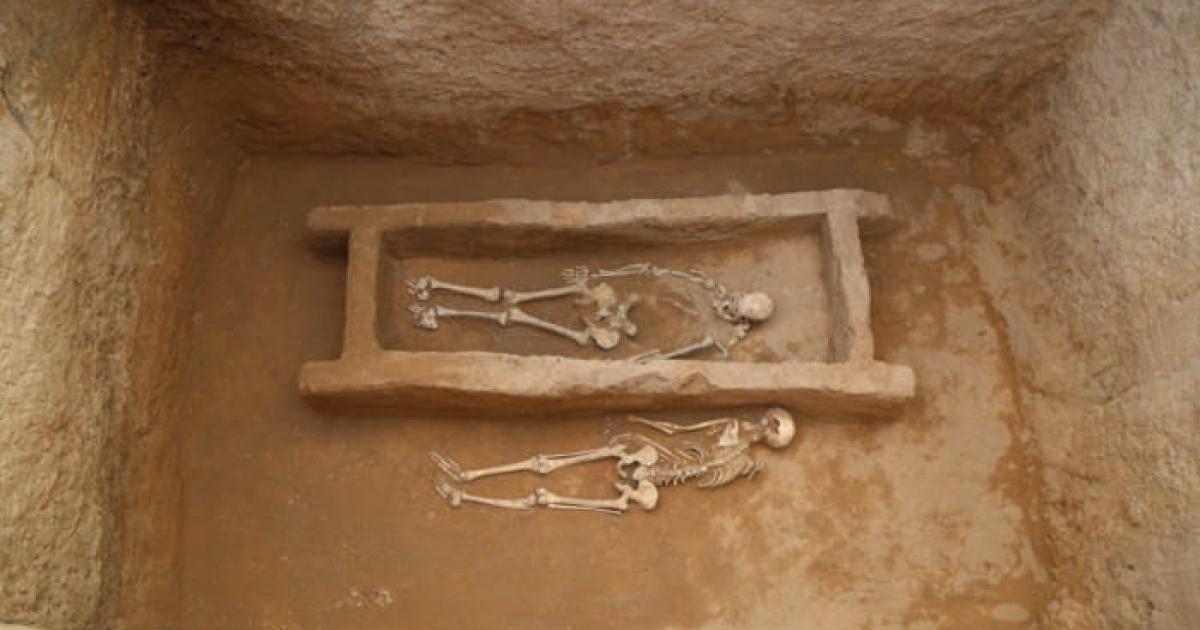
DNA analysis of ancient remains from northwestern China has unveiled a chilling picture of ritualized sacrifice in a 4,000-year-old Neolithic society, where men and women met drastically different fates based on their gender. The findings, published in the prestigious journal Nature, challenge long-held assumptions about sacrificial victims and illuminate the hierarchical structures of Shimao culture during China's late Stone Age.
Researchers from the Chinese Academy of Sciences analyzed DNA from 169 individuals excavated from the massive Shimao archaeological site and surrounding settlements in Shaanxi Province. What they discovered was a society that practiced two distinct forms of human sacrifice, each with clear gender preferences that reflected the community's social organization and ritual purposes, writes The Independent.
Men Sacrificed at City Gates, Women Buried with Elites
The genetic evidence overturned previous archaeological assumptions about the victims found beneath Shimao's East Gate. Contrary to earlier morphological assessments that identified most sacrificial victims as female, DNA testing revealed that nine out of ten individuals buried in these mass graves were actually male. Three individuals previously classified as female based on skeletal features turned out to be men when their genetic profiles were examined.
These male victims, likely killed during construction rituals for the city's defensive walls between 3,800 and 4,300 years ago, represent a public form of sacrifice that may have served broader community purposes. The mass burials at places like the East Gate suggest these men were offered to consecrate important civic structures in what is now recognized as one of China's earliest state-level societies.
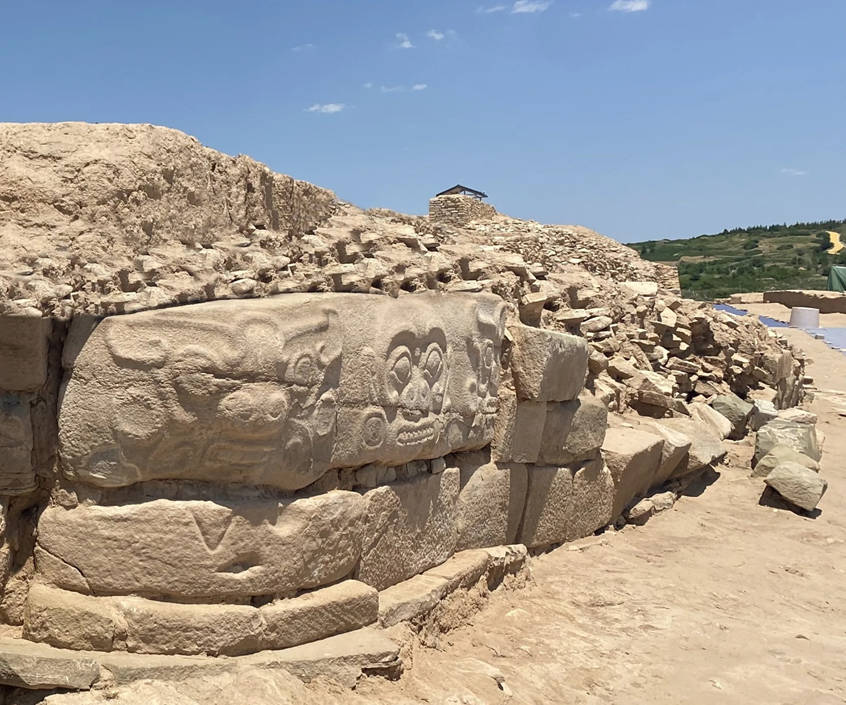
Stone walls at the Shimao Neolithic site in Shaanxi, China. (Bilaterian/CC BY-SA 4.0)
In stark contrast, female sacrifices dominated the elite cemeteries scattered throughout Shimao city and its satellite settlements. At Hanjiagedan, a noble cemetery south of the inner enclosure, six out of seven sacrificed individuals were women. The pattern repeated at Huangchengtai, the presumed ruling-class cemetery in the city center, where 14 of 19 victims were female. These women were entombed alongside high-status individuals, suggesting their role in ancestor veneration rituals rather than public ceremonies.
Patrilineal Society with Strict Social Hierarchies
The DNA analysis revealed more than just sacrificial patterns—it exposed the fundamental social structure of Shimao society. Researchers reconstructed family trees spanning up to four generations, discovering that both the Shimao city and its secondary settlement at Zhaishan were organized around patrilineal descent. Male tomb owners in high-status graves universally carried the same paternal haplogroup (O3a2c), while female tomb owners displayed diverse maternal lineages, indicating that women married into these communities from elsewhere.
View of some of the landscape of Shimao city. (Institute of Vertebrate Paleontology and Paleoanthropology/Nature)
The Shimao settlement covered approximately four square kilometers and featured stone-walled fortifications - unusual for the period when rammed earth walls were more common in the Central Plains. The site's organization into distinct zones with craft production areas and large fortifications points to a sophisticated society with clear social stratification thousands of years before the emergence of China's first documented dynasties.
Interestingly, the genetic study also revealed that sacrificed victims showed no close familial relationships with the elite tomb owners they accompanied, suggesting strict social boundaries. However, some high-status female individuals possessed wealth comparable to male elites, indicating that while the society was predominantly patriarchal, women could still attain positions of power and influence in certain circumstances.
Challenging Assumptions About China's Past
These findings push back the timeline for certain sacrificial practices in ancient China. The phenomenon of elites being buried alongside sacrificed female companions was previously thought to have emerged during the early Iron Age period (770-221 BC), but the Shimao evidence demonstrates this practice existed more than a thousand years earlier during the late Neolithic period.
The research also uncovered evidence of long-term interaction between the Shimao inhabitants and populations related to the Yumin culture from Inner Mongolia. Several genetic outliers among both the earlier Yangshao culture (around 4,800 years ago) and later Shimao populations showed ancestry linked to these northern steppe peoples, suggesting ongoing contact between farming and pastoral communities without disrupting the genetic continuity of the dominant local population.
Scientists hope that continued excavation and DNA analysis from the region will shed further light on the origins of early East Asian states and the complex social dynamics that characterized these prehistoric communities. The Shimao site, with its extensive archaeological record and well-preserved human remains, offers an unprecedented window into how family relationships, gender roles, and ritualized violence shaped one of China's earliest urban civilizations.
Top image: Tomb owner and a sacrificed victim at Shimao necropolis. Source: Institute of Vertebrate Paleontology and Paleoanthropology/Nature
By Gary Manners
The speed of dark
Written in response to: "Write a story that includes the line “Did anyone else see that?” or "Who’s there?”"
Alex Davies
Horror Science Fiction Suspense
But the console beeped, and perspective returned. They were gone, and he was here on behalf of a humanity he would never meet, generations unknown to him between his outward and inward voyage. He looked back to the screen and found it changed from when he’d searched for Sol. A text log, an open file. One word.
Dark
The word blinked away, the monochrome diagrams of inclinations and declinations taking its place. He tapped at the control buttons, but could find nothing of it in the logs. Then, just as he turned away,
Dark
But again it was gone before he could be certain it was there. He shook his head again, helmet un-moving to any non-existent watchers, and began to follow the service procedure.
The 'Scope was in exactly the shape it should be in. The panels outside were free of detritus or efficiency drop, the RCS system had fired infrequently and sparingly, and
Run
This time he was sure he’d seen it, because it took a moment longer to stay on the screen, before a jolting, swirling static swept diagnostics back into view. And there too, something was wrong, but he could not see what, only knew that he could not be right, so would not let himself see it.
He closed his eyes and fought the rising isolation that the pills were supposed to push away. Jostled softly through the suit as he was bumped between the walls of the cramped tube, he drifted in nothing, oxygen pumps whirring with his breaths. When he opened them again he found himself facing the forwards cupola, following the line of the 'Scope towards Andromeda, the space barren compared to his view towards Sol. Emptiness in front, ancient deaths behind, loved ones alive only in the light, the nihilism of it cleared his mind for a moment.
The moment stretched just long enough for him to see that it truly was a void, the way he faced. Rare and distant galaxies were sparingly distributed around this hemisphere of the sky, distances far larger than the Solward view behind, but in the centre of this view, right above him, was nothing.
Nothing.
Where was Andromeda?
Muscle memory operated the controls at first, eyes fixed on where a galaxy should have been, then he tore his view away to check the monitor, and yes, Andromeda was gone. He checked orientations. Then he checked their calibrations, then the stars they used for their basis, the anchor points in a shifting sky, only to find that down to machine precision this telescope was seeing exactly what it should be, watching the same sky as him, and that Andromeda had fallen from view.
Feeling sweat begin to float from his forehead into the tiny atmosphere of his helmet, he snatched a glance at the view again, and watched another point of light snatched from the sky. Again, despite checking twice and then a third time, Telescope 13 saw exactly what he did.
Dark
A harsh constellation of lights behind buttons wrapped around the word, colours dividing rows in grids and lines. He blinked and it was gone again. More galaxies blinked out of the sky. Some inter-stellar matter, then, surely, the travelling darkness of a long-cold supernova blocking his view. But there was no magnetic change, and the stars beyond the ever-growing circle were bright.
The rising isolation required a few breaths, deeper and slower each time, until some faculty returned to him. The darkness had continued to spread, and he used the glowing buttons and dials to sketch out what was not where it should be. A circle of void was drawing out from his lost Andromeda, too perfect to be natural,
Run. Dark.
Two words, together. Perhaps a second, this time, then gone. Sweat condensed against his visor. He spun in the silent vacuum to look back at the hatch and the jointed tube beyond, and reassured that his world had not shrunk to this metal and glass coffin, turned back to the view from the cupola. He had just enough time to see the last of the galaxies blink away, and now the glass showed only the black. The monitor screen showed the same, slightly grey, and
Dark. Coming.
Longer again, but then gone like the others. Something, his logic finally told him, was in the computers and chips of the 'Scope. Three button presses, and then the lifted cover and the fourth, and the operator’s terminal was on the screen. He watched it remain empty. A few seconds passed and he wrote out, slowly with thickly gloved fingers on keys that were too small, the best he could think of.
User (sudo) > Run from what?
He snatched a glance down towards Sol, and gasped to see that the darkness had begun to encroach past the equator, stars going dark now in place of galaxies. It didn’t make sense, the distances in one way were magnitudes more than those towards his home, but the dark did not care, and extinguished them anyway.
Too fast.
What is the speed of dark?
Earth, Sol, at the centre of a ring of those stars, still alive. Dim, changing lights in the reflection of his visor brought him back to the screen. His hovering tears, in the air of his helmet, piled to one side as he snatched himself around.
> Dark, coming. Run.
It had to be an AI, there in the ‘Scope with him, fragmented and limited by the minimal processing power it had found, a million and more years from its home. But it was warning him, no threats, and out here it was younger, more recently departed from Andromeda.
Again he fumbled with the keys, looked back to see the circle of light was growing smaller.
User (sudo) > Friendly?
Words already on the screen, visor spotted with tears and sweat.
> Too late.
Dark from both windows now, not a pinprick in either sky.
Sol, Earth, the light with his life still alive in it somewhere, gone to black.
He scrambled for the hatch, was halfway inside before he stopped himself, the flexible tube stretching away before him. At the other end should have been the lights of the ship, of the airlock, of the next big sleep and the pills that were supposed to numb him. Instead, darkness, growing closer as he looked, rigid rings disappearing one-by-one as illuminating strips died away.
Without thinking, he was back in the service module, the hatch yanked shut behind him, the sealing wheel turning easily, the tube lost from view. With an effort he did not think possible he dragged himself in a spin, away from the hatch and back to the screen. No new words, just the same ones repeated.
> Too late.
Then like before they were gone, but nothing came to replace them, the screen flashing to static before going dark. It spread from the screen to the controls, radiating out in a perfect circle, LEDs in buttons switching off one-by-one before the module was lit only by the lights on his helmet.
He screamed, but no one was there to hear it, and his lights on the darkened cupolas brought him only his own flailing reflection.
Then his helmet went dark too, and all the little whirring noises of a functioning space suit went the same way, one-by-one, until the air began to taste stale and he fought and failed to conserve his breaths.
All there was, now, was dark.
It would not, he knew now, stop with the suit. On the cupola, out in the vacuum, he heard a knocking, three taps, impossible without air to carry the sound, but there anyway. From the black that once held Andromeda. The words were lost in the loneliness of his helmet, pointless, but he said them anyway.
``Who’s there?’’
It bore no echo, no reverberation of any kind in the insulation-lined interior of his helmet, dying in the vaccum of the now so tiny service module. There was another knocking, three taps, and though no sound should be possible, this time he knew it was on his side of the glass.
He whimpered, pathetically, feebly, as what had to come next began, his feet and hands going cold, numb, a gentle amputation. It came in jumps, nerves falling quiet, without pain.
The speed of the dark was slower with his body than with the stars.
``Please!’
But his breathing had robbed the air of its content, that or some part of his core was already gone, and it sounded quiet even to him, a whisper before a private audience. The tears continued to float away from his face, unbound and unbidden, leaving him one by one.
There was another knocking, on the glass of his helmet, then finally the dark of the ‘Scope’s interior was overtaken by a dark of another kind.
The Rocky Horror Picture Show - Sweet Tr*nsvstite
Col 27-Book 449 - Martha and the Night Watch (A Tale of Storms, Trembling, and the Courage to Be Held)
Ah, dear reader—prepare your heart. Today’s story does not begin with a quack, a snort, or even a kazoo blast.
It begins with a rumble.
A low, shuddering boom that rolls across the hills like a fist on a door.
So settle in. Breathe deep. And step gently into Martha and the Night Watch.
The Storm’s Arrival
It began just after midnight—a summer squall, sudden and fierce. Not rain at first, but sound: thunder cracking like a whip, wind howling through the eaves, the barn’s old weathervane shrieking as it spun wildly.
Inside the farmhouse, Martha sat at the kitchen table, mending a tear in her apron, lantern light pooling soft and gold around her hands.
Then—a flicker.
A crash outside.
A whimper—so faint, it could have been the wind.
But Martha knew.
She rose, slipped on her boots, and stepped into the storm.
The Shed
She found him in the toolshed—not hiding, but huddled, pressed into the far corner behind a stack of seed sacks, eyes wide, ears flat, fur puffed like a startled dandelion.
Catnip.
He didn’t run. Didn’t hiss.
Just trembled—all over, a fine, constant vibration, as if his bones were trying to leap out of his skin.
Martha didn’t speak.
Didn’t reach.
She simply sat on the floor beside the door—not too close, not too far—and began to hum.
Not a song. Not a lullaby.
Just a sound: low, steady, in D-minor—the key of comfort, of coming home.
Catnip flinched at first.
Then—listened.
Lightning flashed—white and blinding—and he jerked, a choked sound escaping him: “No—no—!”
Martha didn’t shield his eyes.
She didn’t say “It’s okay.”
She took his paw—gently, firmly—and pressed it to her own chest, right over her heart.
“Feel that?” she murmured, voice soft as falling ash. “It’s scared too. But it’s still beating. So are we.”
His paw was ice-cold. Hers, warm.
His pulse, frantic. Hers, steady—not calm, but present.
And slowly—so slowly—the trembling eased.
The Watch
They didn’t move.
Didn’t speak.
Just sat in the dark, the storm raging outside, the lantern flickering within, two beings sharing breath, heartbeat, space.
Martha kept humming.
Catnip kept listening.
When thunder boomed again—closer this time—he didn’t flinch.
He leaned—just slightly—into her side.
She didn’t move away.
Just shifted, made room.
And then—sleep.
Not sudden. Not deep.
But there: his head resting on her knee, his breathing slowing, his purr—a new, soft vibration, like a first breath after a long dive.
Martha kept watch.
Not over him.
With him.
The Moral of the Story
That morning, as dawn broke pale and clean over the rain-washed fields, Sir Whiskerton found them still there—Martha asleep against the wall, Catnip curled in the curve of her arm, one paw still resting over her heart.
In his journal, Whiskerton wrote one line—ink slightly smudged, as if paused mid-thought:
“You don’t calm a storm—you teach someone how to be still within it. And the bravest thing love can do is say: ‘My fear is here too. Let’s hold it together.’”
And on Catnip’s collar—the golden thread catching the first light—
a single raindrop clung, trembling…
…then fell.
Post-Credit Scene
Later, Ditto found Catnip on the porch, watching the clouds.
He sat beside him—no echo, just presence.
After a long silence, Catnip spoke:
“Last night… the thunder didn’t stop.”
“Stop. Stop.”
“No,” Catnip said, softly. “But the rest did.”
“Rest.” echoed Ditto—warm, like a promise.
And from the roof, Sir Whiskerton’s tail-tip flicked—once.
Approval.
Jingle on. 🐾💛✨
(Or, in the language of storms and shelter: Boom… breathe… hold … dawn.)
The End.
Alice Cooper - I’m Eighteen (REACTION)
Bangin'. Best reaction ever.
Why are commercial aircrafts not build to do aerial refueling?
Not worth the risk and expense. Besides, given the abundance of airports around the world, there’s zero business case for it.
Aerial refueling is a dangerous maneuver. Military aviators need to practice it to keep their skills current and that costs money. The military gets their money from the government and doesn’t have to make a profit. On the other hand commercial airplanes, by definition, must. Airlines must pay for their pilots to practice it instead of, you know, hauling passengers or cargo that generates money.
In theory, there shouldn’t be a problem installing air refueling systems on airliners because it’s been done on military airplanes of similar size and configuration. However, why would you do that?
There’s no shortage of airports around the world, especially after World War 2 and the Cold War. It’s already “paid for”, unlike this hypothetical air refueling system.
Besides, not many passenger flights are long enough to warrant this system.
An Open House Tour Leads To Gruesome Discovery
Why is the CCP afraid of Falun Gong?
A religion tells its followers, teenagers included, to burn themselves in front of Tiananmen Square to protest to the current government. While the leader himself fled outside the country. How would you say this so call religion? Good or evil?
This is the victim, her name is Chen Guo. By the time she burnt herself she was only a 19 years old college girl, her mother bought her there.
And this is her mother.
And it’s stupid. For example the founder Mr Li said he could create gold molecule. What on earth is gold molecule?
Pictures
Have you ever helped someone with a health issue just by noticing a small detail that they overlooked?
I was called in to do a behavioral conversation of a preschool child as a part of a referral to evaluate him for Autism. He was already labeled as Developmentally Delayed with ADHD, communication and behavioral delays. The request for the observation cited his lack of reaction to verbal instruction, his fascination with computer games and his love of spinning children in the teacher’s desk chair and being spun around in that same chair by other children. I saw these same behaviors during my observation. I also noticed that he watched other children’s faces intently and usually mirrored their expressions, unlike children with autism who often cannot “read” facial expressions.He did like spinning in the desk chair but readily took turns and, again, responded in kind to other children’s pleasure, excitement and occasional anxiety. He did like spinning in the chair but so did the six other boys doing the same thing. His non-responsiveness to verbal instructions was worse when he was facing away from the speaker and when the directions were not accompanied by gestures. Most importantly, when nap time came, he fell asleep immediately but flipped and flopped from one end of his mat to the other accompanied by snorts, gasps, and irregular breathing. When his parents arrived, I, of course, told them I was not qualified to provide a diagnosis but described what I had seen and suggested they talk with his doctor about possible sleep disturbances and hearing loss. I explained the difficulty of distinguishing ADHD from sleep deprivation in young children. I heard nothing about the results of my observations until 3 years later when I was called to do another consultation in that district. I recognized this now second grader. After school, I “accidentally” ran into his mother in the car rider line. She was thrilled to pull over and fill me in on the details. Her son had been diagnosed with severe sleep apnea and equally severe conductive hearing loss. Removing his adenoids and medication to clear up the fluid filled ears solved his learning, behavioral and communication problems. He was thriving in a regular classroom, learning at grade level and no one suspected even a hint of Autism!
What’s the most thoughtful everyday gesture someone has done for you?
I was leaving Amsterdam zuid by train after I heard a family member had died and work had given me time off to travel up north. This was in my early 20s. Since Amsterdam - Zuid is like the financial district of the Netherlands, like London is for the UK and NYC for the US, it is brimming of international people.
For a small country as the Netherlands, the financial district in Amsterdam Zuid is rather impressive and as obvious by our country’s standard public transport is available. Not necessarily good, or reliable, but if patient, you can get where you want.
Unfortunately, due to this being a family member on the side that I did not appreciate, emotions were quite high. I couldn't hide my tears once I sat in the train.
An American couple, noticed. And they asked, what's up?
The Dutch, arrogant and direct as they are are not folks you should expect a reach out from. These Americans came sitting next to me, and I told them a senior family members had passed and due to conflict of interest in the family I had to go there to fill in some paperwork.
I was visibly shaking. This couple, to my surprise, went with me and dropped me off at the station before they returned and gave me a excessively long hug and a kiss on the cheek.
At the end they gave me a business card, I won't mention who they were, but from a small town in Arkansas, and they ran a homeless shelter and a shelter for people who were victim to domestic violence. Since I was diagnosed with childhood PTSD, (physical domestic violence I never endured, well, perhaps a bit but not to the extent of a broken jaw or anything like that, more like being grabbed by your head and feet and thrown in the car, it was more mental violence. Like strict rules, feeling you can't breath and fearful of repercussions).
I explained it to them just a few minutes before I left and ever since, we speak more or less once a year. It so happens to be they travel the world, and always approach people who they feel are in need of a hug, a shoulder to cry on, etc.
A small gesture like that is exactly what I try to pursue in my own life. Whilst I might come over as a arrogant banker, twat, I am anything but. So when at midnight I have to cross a bridge or a tunnel and I see a girl or a guy of younger age being fearful because a group of minorities are hanging around I approach the person and tell them to not worry and just follow me. Why? Well, if banking taught me one thing, is that being fearful is something anyone can smell, and you will be shot at work before you notice. So if I can do one good deed a day or every few days, it's a minor inconvenience for me, but it might show other people on this planet that the world isn't full of political outraged assholes.
Replicator
Written in response to: "Start your story with the sensation of a breeze brushing against someone’s skin."
Dorothy Adams
Adventure Fiction Science Fiction
“I’m on a mission,” the replica said, her voice steady despite the eerie undertone. “Dr. Petrov intends to use my existence to extract your military secrets and sell them to the Russian government.”
The weight of the revelation crashed down on Sarah. “Why would you tell me this?”
The replica hesitated, the flicker of emotions crossing her features. “The replication process included your brain’s makeup, your memories, your emotions… including your moral compass. I didn’t come here just to betray you; I came to warn you.”
The wind had calmed, but the urgency in the air remained palpable. Sarah’s instincts kicked in. “What do you propose we do?”
“We need to stop Dr. Petrov,” the replica replied. “He underestimated the complexity of human ethics. Together, we can use my abilities to infiltrate his lab and destroy the particle replicator.”
The idea of teaming up with a clone of herself was surreal, yet the urgency of the situation outweighed her apprehensions. “Alright, let’s do this,” she said, determination settling in her bones. “But we need a plan.”
The next day, they prepared to confront Dr. Petrov. Sarah, now donning a tactical uniform with her replica mirroring her every move, felt an unsettling sense of camaraderie with the being that was technically her. They approached the lab’s perimeter, concealed behind a row of trees.
“Dr. Petrov’s lab is heavily guarded,” Sarah whispered, examining the layout of the facility through her binoculars. “We’ll need to create a diversion.”
“I can mimic your voice and movements,” the replica said, her eyes gleaming with confidence. “I’ll create a distraction by drawing the guards away. You can slip inside and disable the security systems.”
Sarah nodded, the plan forming in her mind. “Let’s do it.”
As they executed their plan, the replica expertly imitated Sarah's voice, shouting commands that drew the guards’ attention. Sarah slipped inside the lab, her heart pounding in her ears. She navigated the dimly lit corridors, relying on her training to evade the security cameras and alarms.
In the main chamber, she found the particle replicator—an ominous machine humming with energy. She quickly accessed the control panel, her fingers flying over the keys as she initiated the shutdown sequence. Just as the screen flashed ‘Systems Disabling,’ she heard the commotion outside escalate.
“Sarah!” the replica’s voice echoed through the corridor, filled with urgency. “We need to hurry!”
A moment later, Dr. Petrov burst in, his eyes narrowing as he spotted Sarah. “You shouldn’t be here!” he sneered, reaching for a concealed weapon.
Before he could draw it, the replica entered the room, standing protectively in front of Sarah. “You’ll have to go through me first,” she said, her voice echoing with an authority that surprised even Sarah.
Petrov’s eyes widened as he realized the truth. “You… you’re a clone? This changes everything!”
“Not for you,” Sarah replied, stepping forward. “You’re done here.”
With a swift motion, she disarmed him, and the replica moved in to restrain him, using the same combat techniques Sarah had mastered over the years. They worked in tandem, their movements synchronized, a dance of action that was both exhilarating and surreal.
Once Petrov was secured, Sarah returned to the control panel and finished the shutdown process, the machine whirring to a stop. As they stood there, breathing heavily, Sarah turned to her replica.
“Thank you,” she said, feeling an unexpected bond forming between them. “I couldn’t have done this without you.”
The replica smiled, a genuine expression that mirrored Sarah’s own. “We make a good team. Together, we can ensure that this technology doesn’t fall into the wrong hands again.”
As they left the lab, the wind had died down, replaced by a calm that felt almost comforting. Sarah had not only faced a threat to her nation but had also discovered a part of herself she hadn’t known existed within her clone—a shared sense of purpose that transcended their origins.
“Let’s make sure this never happens again,” Sarah said, glancing back at the lab one last time.
“Together,” the replica replied, echoing Sarah’s sentiment as they stepped into the light of a new dawn, ready to face whatever challenges lay ahead.
Days turned into weeks, and Sarah found herself reflecting on the encounter. She and her clone, whom she started to think of as “Replica,” began to integrate their lives. Their bond deepened as they trained together, sharing techniques and strategies that enhanced both their abilities. Sarah was amazed at how quickly the Replica adapted to her style, learning to anticipate her thoughts and movements.
One evening, they sat together in Sarah's living room, discussing their next steps. “We need to ensure that Dr. Petrov’s work doesn’t resurface,” Sarah said, her brow furrowing in thought. “We can’t risk someone else trying to replicate his methods.”
“Agreed,” Replica replied, her expression serious. “We should track down any remaining projects he had. There might be more copies of me or similar experiments out there.”
Sarah nodded, her mind racing. “Let’s reach out to my contacts in intelligence. They might have leads on Petrov’s associates or any hidden labs.”
As they began to strategize, Sarah felt a sense of purpose that had been missing since she first entered the military. The urgency to protect her country and safeguard her identity had become a shared mission, one that bound her to her clone in a way that transcended mere biology.
Weeks turned into months as they worked tirelessly to dismantle any remnants of Petrov’s operations. The more they uncovered, the more they realized the scope of his ambitions. Cloning technology had already been sought by various international players, and Sarah knew they had to act swiftly.
One day, as they monitored communications from a suspected rogue lab, a chilling message came through. “We have the replicator ready. Once we finalize the adjustments, we can create an army of clones.”
Sarah’s heart raced as she exchanged a glance with Replica. “We need to move fast,” she urged. “If they’re ready to go, we can’t let them proceed.”
With their plan set, they prepared for one final confrontation. This time, they would infiltrate the lab together, using every skill they had honed since their first encounter. As they approached the facility under the cover of darkness, Sarah felt a mix of trepidation and determination.
“Are you ready?” Replica asked, her voice steady.
“More than ever,” Sarah replied, feeling the weight of their mission pressing down on her. They moved in synchrony, a well-oiled machine ready to dismantle a threat to their world.
As they breached the lab, alarms blared, but they pressed forward, determined to confront the mastermind behind the cloning operations. When they finally reached the control center, they found a group of scientists huddled around the replicator, their eyes wide with surprise.
“Who are you?” one of them shouted, reaching for a weapon.
Sarah and Replica moved in unison, disarming the guards and securing the scientists. “You’ve been working on something dangerous,” Sarah said, her voice firm. “We’re here to put an end to it.”
The lead scientist stepped forward, his features eerily familiar as he removed his glasses, revealing the same calculating expression Sarah had seen in Dr. Petrov. “You don’t understand! This technology could revolutionize everything. We could create soldiers without limits!”
As he spoke, Sarah’s heart sank. “You’re… another clone of Dr. Petrov, aren’t you?”
“Indeed,” the scientist said with a smug smile. “I am the culmination of his work, and I will not let you destroy it.”
“Or create chaos,” Replica countered, stepping forward. “We won’t allow it.”
The tension in the room escalated as Sarah and Replica exchanged glances, silently communicating their next move. They had to act quickly.
With a swift motion, Sarah lunged toward the control panel, aiming to disable the replicator before the clone could initiate further production. The clone of Petrov shouted commands, directing the other scientists to stop her, but Sarah was faster.
“Shut it down!” Sarah yelled, her fingers flying over the controls as alarms blared around them.
The scientists scrambled to contain the situation, but Replica moved with agility, disarming anyone who approached Sarah. The clone of Petrov watched in disbelief as his plans began to unravel.
“You think you can stop me?” he shouted, panic creeping into his voice. “I have the knowledge of the original Petrov—everything he knew!”
“Knowledge without ethics is a dangerous thing,” Replica replied, her voice steady as she held her ground against the guards.
Just as Sarah initiated the shutdown sequence, the clone of Petrov lunged at her, but Replica intervened, tackling him to the ground. The two clones struggled, a surreal confrontation of identities and intentions.
“Together!” Sarah shouted, focusing on the control panel. With a final keystroke, the machine whirred ominously before powering down completely. The lights flickered, and the lab fell silent.
As the dust settled, Sarah turned to see Replica pinning the clone of Petrov down, her expression fierce. “You’re finished,” Replica said, her voice low but firm.
With the threat neutralized, Sarah took a deep breath, relief flooding her. “We did it,” she said, her heart swelling with pride. “But we need to secure this lab and make sure no one can recreate this technology.”
“Agreed,” Replica said, releasing the clone and standing beside Sarah. “We need to ensure that this doesn’t happen again.”
As they worked to dismantle the equipment and secure the lab, Sarah felt a profound sense of accomplishment. They were not just protecting their country; they were preventing a potential catastrophe.
In the aftermath, as the sun began to rise, Sarah and Replica stood together outside the lab, breathing in the fresh air. “We did it,” Sarah said, a mixture of relief and pride swelling within her.
“Yes, we did. But this is just the beginning,” Replica replied, glancing toward the horizon. “There will always be threats, and we need to be prepared.”
Sarah nodded, a smile breaking across her face. “Together, we can face anything.”
As they walked away from the lab, the dawn light illuminated their path, a symbol of hope and resilience. Sarah had not only thwarted a significant threat but had also gained an ally in her own clone—a partnership that would redefine her understanding of identity, purpose, and the lengths one would go to protect what mattered most.
And as they stepped into the new day, Sarah felt a renewed sense of determination. With Replica by her side, she knew they would face whatever challenges lay ahead, ready to protect their world from the dangers of cloning technology and the shadows of its past.
Did Gaudi care how useful his buildings were? Did function matter much to him?
Because Antoni Gaudí’s architecture is so visually striking and eccentrically unlike most other buildings, it is easy to imagine that his architecture wasn’t functional. But that’s not really the case. His buildings weren't just giant sculptures - they were actually ingenious in their structures as well.
Look at the Casa Milà, or La Pedrera 1906–1910. It’s a really striking building. Did you know it was designed with an underground garage as well? That was pretty uncommon in 1910. (I understand that the ramp to the basement garage was never completed, and the space is now an auditorium - but the idea is well before it's time.)
How did he create such an interesting facade? It’s a stone facade, but it’s not load-bearing. Steel beams carry the weight, so that the facade can be sculptural. The same things is true with the building’s internal walls, allowing apartment owners to transform the design of their spaces without worry.
Here’s a model that Gaudí used to figure out the structure.
That trick of using a steel structure to support a non-load bearing wall is used here too (this is the famous Seagram building by Ludwig Mies van der Rohe, from 1958). Here it’s called a curtain wall, and its design reinforces the idea that it’s efficient and functional. But it’s not so far off in terms of structural function from Gaudí’s building.
What’s different is that Gaudí’s approach is part of the Catalan Modernisme movement, which is similar to Art Nouveau and rooted in the Arts and Crafts style. The difference is that most modernist architecture rejected the decorative impulse.
Gaudí’s design is still very functional, however. His use of two courtyards allows for substantial interior light, and facilitates movement through the building as well.
Here’s the rooftop with strange structures on top - but those odd structures contain elements like skylights, fans, and chimneys.
The eccentric roofline is held up by the structures pictured below, which are catenary arches. This arch form is very efficient in its materials, and able to support substantial weight.
7K views
Beef Tips on Rice
Yield: 75 servings (3/4 cup rice and 3/4 cup beef with sauce)
Ingredients
- 20 pounds beef stew meat, cut into 1 inch cubes
- 2 tablespoons salt
- 5 teaspoons pepper
- 5 teaspoons dried thyme
- 15 (10 3/4 ounce) cans condensed cream of mushroom soup, undiluted
- 4 cups water
- 4 cups chopped onion
- 2/3 cup chopped fresh parsley
- 2 1/2 teaspoons browning sauce (optional)
- 6 1/2 to 7 pounds long grain rice, cooked
Instructions
- Combine beef, salt, pepper and thyme; mix well. Place in five greased 13 x 9 inch baking pans.
- Bake, uncovered, at 400 degrees F for 15 minutes; stir. Bake for 15 minutes longer; drain.
- Combine the soup, water, onion, parsley and browning sauce if desired. Pour over beef; mix well.
- Cover and bake at 350 degrees F for 1 1/2 to 2 hours or until the beef is tender.
- Serve over rice.