


Here’s a story of my early youth, when we (me and my friends) would play in the dirt displaced during construction in our apartment complex.
I must have been around 4, perhaps 5 years old.
There was some construction going on outside the apartment complex where we lived in Bridgeport, CT. And they had torn up the lawn completely making it a complete moonscape.
And us local boys would play in all that dirt.
There were piles of dirt and dirt holes, and dirt all over the place, and we would go there and dig in it, and some even brought their toys to play in it.
Every now and then my father would walk by and ask what I was doing there, but it was pretty obvious. So he let me be.
Ah. The 60s. Kid-hood. No worries you all.
Big change to today.
Where America has become the land of the afraid lining in fear pockets of everything. With the political class gaslighting the shit out of everything left and right.
*sigh*
There’s nothing wrong with playing the the dirt. If you don’t believe me ask your dog.
Playing in the dirt.
It’s a guy thing. And a dog thing.
*smile*
Today…
NVIDIA AI Hardware Contains Tracking Devices — US Government Installed Secret Tracking for China
What will China do, now that it is clear that Donald Trump is a paper tiger?
China’s response was swift and fast on Trump’s tariffs of 10% + 10%. It counter-tariffed of 10% and 15% on goods it had selected + putting US companies on its unreliable entity list + putting more minerals into its exports control list or ban to the US.
The purpose is to show that it is willing and able to counter US actions, and do so in ways it deems fit.
Noteworthy points are (1) it has alternative source of the goods it tariffed. It could simply not buy US, but if US exporters are eager for the business, they will have to pay the tariffs, and (2) the counters beyond tariffs is forewarning for the US that it has lots of tools in the arsenal that it could use.
The counters thus far are quite restraint. This could change in a jiffy. Regardless of whether Trump is a paper tiger, the ball is on his court.
China does not have to do anything else. It will just sit back to see how Trump’s good work plays out.
There are the different brands of tariffs – country-specific, product-specific, universal tariff, reciprocal tariff. Allies, friends, foes, and the ordinaries, are confused and watching.
Assets-grab – Panama Canal, Greenland, Ukraine mines – the last one ended in a shouting match.
Unilateral – leaves Euro allies in the lurch, abandons Ukraine, and Russia on the driving seat. What with Hegseth’s order to stop offensive cyber ops against Russia, and voting with Russia in the UN. Russia must be a tough customer during their bilateral meeting.
Internal situation could be even more confusing – revenge, sackings, retrenchments, and more. The Trump premium has gone, the billionaires are still pressing, but Wall Street has surrendered to pressures. Come 14 March there could be a government shut-down if a spending agreement is not reached.
How to Make Apple, Zucchini,
Pumpkin and Banana Pancakes
Kitchen tools, gourmet foods, baking mixes, and hard-to-find baking ingredients mentioned in this article are available at The Prepared Pantry.
by Dennis Weaver

When I was a kid, my mother used to grate Jonathan apples, with the skin, and add them to her pancake batter along with a teaspoon of cinnamon. The grated apples would soften a bit as the pancakes were cooked. There would be a taste of apple in every bite and glimpses of red poking through. They were my favorite pancakes.
Years later, I discovered that I could mash bananas and add them to my pancake batter. Still later, I added pumpkin puree. And then grated zucchini. Finally, I found that all were especially scrumptious with cinnamon chips.
Every cook should have this collection of recipes stashed in the kitchen. They are very good pancakes—exceptional. And no matter how much syrup you drizzle over the top, knowing your pancakes are loaded with natural fruit or veggies, makes all that syrup seem a little less guilty.
The Recipes
These pancakes are easy to make. The batter is much the same—you just add grated apple or zucchini, mashed bananas, or pumpkin puree to your batter. They cook the same way. But they are a terrific change of pace and they’re healthy. Because they’re loaded with cinnamon chips, they are very good.
Cinnamon Chip Apple Pancakes
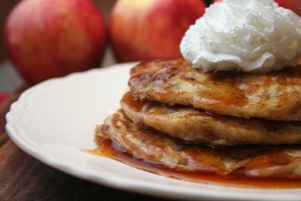
Ingredients
- 1 cup all-purpose flour
- 1 tablespoon granulated sugar
- 2 tablespoons dry buttermilk powder
- 1/2 teaspoon baking soda
- 1 teaspoon baking powder
- 1/4 teaspoon salt
- 1/2 teaspoon cinnamon
- 1 cups grated tart apple
- 1 large eggs
- 1 tablespoons oil
- 3/4 cup water, more or less
- 1/2 cup cinnamon chips
Instructions
- Heat the griddle to medium hot. Just before cooking, spread a little butter on the hot griddle. In a large bowl, whisk the dry ingredients together.
- In a medium bowl, whisk the grated apple, eggs, oil, and most of the water together.
- Add the wet ingredients to the dry ingredients. Stir, adding more water as needed to reach the right consistency. Fold in the cinnamon chips. Do not over beat. There should be some lumps remaining in the batter.
- Pour circles of batter onto the hot griddle. Cook until bubbles start to set in the top of the batter and the edges start to look dry. Flip the pancakes and cook until both sides are a golden brown.
- Serve immediately.
Cinnamon Chip Zucchini Pancakes
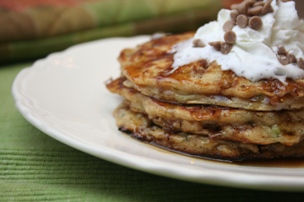
Ingredients
- 1 cup all-purpose flour
- 1 tablespoon granulated sugar
- 2 tablespoons dry buttermilk powder
- 1/2 teaspoon baking soda
- 1 teaspoon baking powder
- 1/4 teaspoon salt
- 1/2 teaspoon cinnamon
- 1 cup grated zucchini
- 1 large eggs
- 1 tablespoon oil
- 1/2 cup water, more or less
- 1/2 cup cinnamon chips
Instructions
- Heat the griddle to medium hot. Just before cooking, spread a little butter on the hot griddle.
- In a large bowl, whisk the dry ingredients together.
- In a medium bowl, whisk the grated zucchini, eggs, oil, and most of the water together.
- Add the wet ingredients to the dry ingredients. Stir, adding more water as needed to reach the right consistency. Fold in the cinnamon chips. Do not over beat. There should be some lumps remaining in the batter.
- Pour circles of batter onto the hot griddle. Cook until bubbles start to set in the top of the batter and the edges start to look dry. Flip the pancakes and cook until both sides are a golden brown.
- Serve immediately.
Cinnamon Chip Banana Pancakes
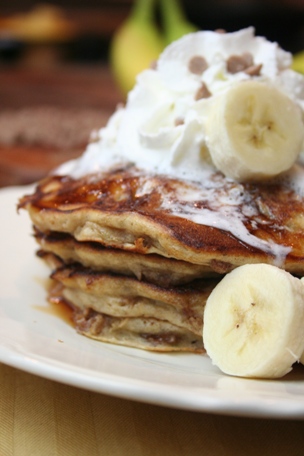
Ingredients
- 1 cup all-purpose flour
- 1 tablespoon granulated sugar
- 2 tablespoons dry buttermilk powder
- 1/2 teaspoon baking soda
- 1 teaspoon baking powder
- 1/4 teaspoon salt
- 1/2 teaspoon cinnamon
- 1 cups mashed ripe banana
- 1 large eggs
- 1 tablespoon oil
- 3/4 cup + 2 tablespoons water, more or less
- 1/2 cup cinnamon chips
Instructions
- Heat the griddle to medium hot. Just before cooking, spread a little butter on the hot griddle. In a large bowl, whisk the dry ingredients together.
- In a medium bowl, whisk the mashed bananas, banana flavor, eggs, oil, and most of the water together.
- Add the wet ingredients to the dry ingredients. Stir, adding more water as needed to reach the right consistency. Fold in the cinnamon chips. Do not over beat. There should be some lumps remaining in the batter.
- Pour circles of batter onto the hot griddle. Cook until bubbles start to set in the top of the batter and the edges start to look dry. Flip the pancakes and cook until both sides are a golden brown.
- Serve immediately.
Cinnamon Chip Pumpkin Pancakes
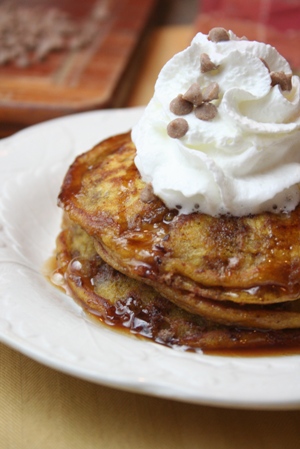
Ingredients
- 1 cups all-purpose flour
- 1 tablespoon granulated sugar
- 2 tablespoons dry buttermilk powder
- 1/2 teaspoon baking soda
- 1 teaspoons baking powder
- 1/4 teaspoon salt
- 1/2 teaspoon cinnamon
- 1/4 teaspoon dry ginger
- 1/4 teaspoon ground cloves
- 1 cup canned pumpkin
- 1 large eggs
- 1 tablespoon oil
- 3/4 cup water, more or less
- 2/3 cup cinnamon chips
Instructions
- Heat the griddle to medium hot. Just before cooking, spread a little butter on the hot griddle.
- In a large bowl, whisk the dry ingredients together.
- In a medium bowl, whisk the canned pumpkin, eggs, oil, and most of the water together.
- Add the wet ingredients to the dry ingredients. Stir, adding more water as needed to reach the right consistency. Fold in the cinnamon chips. Do not over beat. There should be some lumps remaining in the batter.
- Pour circles of batter onto the hot griddle. Cook until bubbles start to set in the top of the batter and the edges start to look dry. Flip the pancakes and cook until both sides are a golden brown.
- Serve immediately.
Dennis Weaver is the founder of The Prepared Pantry, a full line kitchen store in Rigby, Idaho. The Prepared Pantry sells kitchen tools, gourmet foods, and baking ingredients including hundreds of hard-to-find ingredients.
How America Uses Guilt And Shame To Keep You From Being Happy! Time To Move And Live Abroad!
What is one thing you just don’t understand?
Recently, I had one of these drinks for the first time.
This one is empty, but normally, this bottle is filled with a cloudy white liquid. When you drink it, it tastes like an electrolyte drink, but not as sweet as a Powerade or Gatorade. Definitely not as sweet as a Prime.
For years, I refused to touch this drink, for two reasons
- The drink has “sweat” in the name. That word puts a bad taste in my mouth just by associating it with something I have to drink
- Secondly, the cloudy white liquid is the same colour as unfiltered tap water in a third world country. Normally this wouldn’t be a huge deal, but when you combine it with a drink that has “sweat” in the name, it’s just double gross
I had a Pocari Sweat after a game of sports, when I really needed the hydration, and it was actually pretty good. Which makes me wonder: who the heck came up with the name of this drink? Didn’t they have a marketing team to tell them that “sweat” is not something you want people to associate with your BEVERAGE product?
I’m fairly certain this is an Asian drink, and perhaps they have different cultural norms, or this is a literal translation. But seriously man, I think it’s probably turning off a lot of customers. It was certainly offputting for me. Maybe I would have tried their drink sooner if not for the name.
Letters from Nowhere
Submitted into Contest #279 in response to: Write a story about a character who’s lost.… view prompt
Cajek Veilwinter
“Enter,” he barked, straightening in his chair.
A junior agent, a nervous-looking ferret, stepped inside, holding a fresh stack of reports. “Sir, the latest intel from our sources in Eastern Europe, along with your mail. And, uh, a few intercepts from the private networks we’ve been monitoring.”
“Put them there,” Ranjit said, gesturing to a precarious stack of files on the corner of his desk.
The ferret hesitated. “Sir, with all due respect… maybe it’s time to consider reallocating resources? Veilwinter’s been quiet for months. Some of the team thinks he’s—”
“Dead?” Ranjit finished, his tone icy, then his fist slammed on his expansive desk – almost breaking it in half. “Again?”
The ferret flinched. “Yes, sir. The reports—”
“The reports mean nothing,” Ranjit snapped. “Veilwinter is not dead. He’s hiding, waiting, plotting. And if we stop looking, even for a moment, he’ll resurface with something catastrophic.”
The ferret nodded and skittered out of the office as quick as he could. Ranjit sifted through the mail when he stopped. A plain white envelope with no return address, no identifying markings—just his name, neatly printed in an elegant hand.
His sharp golden eye flicked over the envelope as he opened it, his movements calm but deliberate. Inside was a single check, its pristine paper almost glowing under the overhead lights.
Ten million dollars.
The sum was issued from yet another one of Szal Veilwinter’s labyrinthine shell organizations, its name as bland and innocuous as any of the others the fox had used over the years. But like the rest, it would lead nowhere. The money was untraceable, the organization a ghost that existed only on paper.
Ranjit’s gaze shifted to the back of the check, where a handwritten note in the same elegant script awaited him.
Please, Director… please let me go.
There was no signature, but the tiger’s lips curved into a dark smile, his sharp teeth glinting as he let out a low, humorless chuckle.
“Desperate, are we?” he murmured, his voice low and edged with satisfaction.
He stood, the check still in his paw as he moved toward the small shredder tucked into the corner of the office. The machine hummed to life as he fed the paper through, the ten-million-dollar bribe reduced to thin, meaningless strips in a matter of seconds.
Ranjit leaned back against his desk, his arms crossed as he stared at the remains of the check. His eye glinted with a mixture of amusement and determination.
“The fox is getting desperate,” he said to himself, his voice carrying a note of relish.
The Veilwinter estate, meanwhile, cozied on top of a hill, surrounded by vineyards, secrets, and love, maintained its noble place above the town of New Nottingham. Velope Greenfoot-Veilwinter and Lucas Veilwinter-Greenfoot were joined by their children for another Reynard’s Mass.
The manor was extravagantly decorated as usual, with Velope – a happy and stunning vixen – in her blue and white Reynard’s Day dress, her tail fluffed to perfection.
Meanwhile, ‘Lord’ Lucas – a tall, relaxed hare – took it all in as he swirled a glass of Veilwinter vintage. He wasn’t always a wine drinker, but he sure was one now. The hare, who had been disowned by his family basically the day he told them he was going to propose to Velope, was resplendent in a silk kimono that “someone” had sent the previous Reynard’s Day: Black, with silver foxes jumping from cloud to cloud.
Velope’s and Lucas’ children – there were five of them now – were scattered in various places in the room, toasting each other in one corner, playing with Cublo blocks in another.
Lucas let out a satisfied sigh… but couldn’t help but eye the present under the Reynard’s Mass tree. He smirked.
What’d you get us this time, Szal? Another kimono? Another stolen artifact?
The remainder of Reynard’s Mass was joyous as usual with the oldest children on their winter break from Wildwood High and the youngest just about to enter first grade. Lucas and Velope presided over it all, exchanging flirting glances over an extravagant meal.
“Reynard has truly blessed us,” the hare patriarch said, raising a glass without a hint of irony.
The presents were unwrapped next, with Szal – or “Nowhere” as he signed it – not forgetting to give gifts to all of the children. “Uncle Szal” had become a familiar phrase around the manor, but his gifts to the children had always been books.
“He must love reading,” Kana, the middle child and a vixen with Lucas’s grey fur, said.
“Oh yes,” Velope chirped happily. “An avid reader.”
Kana smirked as she opened up her present and announced the verbose title. “The Esoterics: A Beginner’s Guide to the Fourth Volume of the Book of Compromise.”
There were eye rolls, sighs, and smirks aplenty at that one. Their eldest, though, always got doted on the most of their children.
“Open yours, Szal!” One of the younger ones said. The fox – who really did resemble the wayward uncle who was his namesake, down to his sparkling blue eyes – smirked. Szal the younger always looked forward to this part of the year.
His gift this year was in an envelope.
“Maybe it’s a check for a million dollars!” one of the younger ones squeaked.
“We live in a castle, Elara,” Kana retorted.
What fell out stilled the chattering. A black and white photograph of an onyx black fox statue with a nonsensical, garbled sentence on the other side.
“Must be an encoded message,” Kana observed.
Lucas leaned back. “I guess he sent you a puzzle this year.”
Szal pondered it as the rest of the children joined in unison: “Mom, open your present!”
Lucas smiled. “Ap, ap, ap! …It’s your father’s turn.”
A collective groan.
“Daddy, we already know what Uncle Szally sends you!” Elara said, causing Velope to smile softly.
“Why look at this!” Lucas said in mock surprise. “A kimono… And an ancient bottle of Veilwinter Wine! From… Mr. Nowhere? How mysterious!”
Another collective groan.
“Okay mommy, open it!” Elara, a hare with her mother’s fur pattern, said.
Velope gently tore at the edges of the rather heavy package, which Szal had wrapped in dimestore packaging, to reveal a glass case, within which was what looked to be a leatherbound book in some older Western Continent language. After some searching on the internet, it turned out to be a first edition of “The King” by the political philosopher – and ancestor – Akastis Veilwinter.
“Another book!” Elara said.
After dinner, Lucas, Velope, and their two eldest, settled down for digestifs. They were old enough to drink now, so it was the first Reynardmas where the founders of the feast were joined by some of their children.
Szal was still looking at the photo from his enigmatic uncle and working on the code on the back. His sister Orphea, a sophomore named after her aunt, posed a question to her parents that she had been afraid to ask.
“Dad? After Szal’s accident…” she began, referring to Lucas’ brother-in-law, “…Did you guys know he was still alive?”
Lucas chuckled and shook his head. “No. It broke everyone’s hearts, including Lord Caelum and Lady Maris. Your aunt Orphea, however… She had an annoyed look on her face when the news was announced.”
“How is grandfather and grandmother?” Szal asked, looking up from his photograph for the first time since he received it.
Velope inclined her delicate snoot towards him. “They are still sailing around the world. I heard from papa just last week.”
The elder Orphea Veilwinter – Velope’s twin sister and Szal’s younger sister – sent her regards as well… more books for all the children to ‘enjoy’. Orphea was in her office at Varunkirk university, her bright blue eyes greedily scanning an auction page from twenty-two years ago.
Two months after Szal’s supposed death, the mysterious doubloons appeared at an auction in Morocco. An anonymous seller had listed the artifacts, and the collection—sold piecemeal—had fetched tens of millions. The math was too clean, the timing too convenient. Everything she had read before.
For the first time since Orphea had found her brother’s smirking face after hacking the Interpol database: a real lead.
She leaned back in her chair, her ears twitching. “So that’s how you funded your escapades, brother,” she murmured to herself. “A sunken treasure, just plausible enough to hide the truth. Of course…”
She shook her head and smiled in spite of herself.
“Of course.”
Somewhere else in New Nottingham, about a month later, the smell of roasting vegetables and simmering stew filled the small kitchen of Evelyn Brightpaw’s cozy home in New Nottingham. The squirrel hummed softly to herself as she moved about, deftly handling a spatula in one paw while glancing over her shoulder to check on her two children. They were nestled on the couch in the living room, their laughter rising above the faint hum of the radio.
It had been a long day at the local Tyrian community center, where Evelyn volunteered to organize events and mentor young students. She had built a quiet, fulfilling life here, far removed from the tumult of her high school days. She had risen above the drama, above the whispers of Corkscrew’s antics and the chaos of her time as the captain of the Safety Patrol.
The phone rang, a sharp intrusion against the domestic tranquility. Evelyn wiped her paws on her apron and crossed the room, her bushy tail twitching in mild irritation.
“Hello?” she said, cradling the receiver to her ear.
There was silence at first, a faint crackling of static. Then came the voice—low, smooth, and hauntingly familiar.
“Hello, Evelyn. Or is it Lieutenant Detective, now?”
Evelyn’s breath slowed. She didn’t want to guess as to the identity of the creature.
“W-who is this?”
Static, then the voice came through again like a velvet knife. “Just an old friend from high school.”
Evelyn looked out the window above her sink at the moon.
“I’m not amused by this, whoever you are,” she said.
The voice on the other end chuckled. “Are you still the stalwart defender of justice that you were at Wildwood?”
Evelyn’s fur prickled when her son ran into the kitchen, tugging at her apron.
“Who is it, mama?”
Evelyn put her hand over the receiver. “No one dear, dinner will be ready soon.”
“Remember how you stalked the halls for me, Evelyn?”
Evelyn gulped, her heartbeat thundering in her ears. “Szal’s dead. He died in a car crash.”
More static. “It’s a very cold night where I am, Evelyn. I hope you and your family are warm.”
Evelyn kept the phone to her ear as the voice continued.
“It’s snowing… no, blizzarding, here. I’m at the gate of a place you have never heard of, with officials and diplomats waiting to escorting me into its depths… They trust me, you see.”
Evelyn continued looking at the moon.
“I wanted to check in on you before I disappear forever.”
She sucked in some air, her grip on the phone tightening. “…What are you planning, Szal?”
Another chuckle amidst the static. “In High School, you were the only one who figured I was the elusive Corkscrew. I enjoyed our mental games together. And perhaps… I’ll check in again, one day.”
“Szal, wait-!”
The line went dead as Evelyn’s husband walked into the room and kissed her on the cheek.
“Who was that, babe?”
Evelyn exhaled, her eyes still holding on the moon as she slowly replaced the receiver. “I think it was an old friend from Wildwood.”
MM Art generations























Why Gender Roles Lead to Divorce
Sir Whiskerton and Longwei’s Purring Problem: A Tale of Earthquakes, Emotions, and Duck Lullabies
Ah, dear reader, prepare yourself for a tale of seismic purrs, celestial consultations, and one very melodious duck who proved that even dragons have feelings. Today’s story is one of vibrations, vulnerability, and the power of emotional connection. So, grab your sense of wonder and a pair of earplugs (just in case), as we dive into Sir Whiskerton and Longwei’s Purring Problem: A Tale of Earthquakes, Emotions, and Duck Lullabies.
The Ground Begins to Shake
It all began on a quiet afternoon when the farm was suddenly rocked by a series of tremors. The barn doors rattled, the chickens squawked, and Doris the Hen fainted dramatically onto a pile of hay. “What in the name of cluck is happening?!” she cried, flapping her wings in panic.
“Happening!” echoed Ditto, who was busy practicing his echoing skills by repeating Doris’s every word.
Sir Whiskerton, ever the curious feline, investigated the source of the tremors. His search led him to Longwei the dragon, who was lounging in the shade of a large oak tree, purring contentedly. The problem? Longwei’s purr was so powerful that it was literally shaking the ground.
The Consultation with Felinara
Realizing the severity of the situation, Sir Whiskerton decided to consult Felinara, the Guardian of Cat Heaven. “Felinara,” he said, bowing respectfully, “we have a problem. Longwei’s purring is causing earthquakes, and we need to find a way to calm him down.”
Felinara, wise and ethereal, nodded thoughtfully. “Longwei’s purring is tied to his emotions,” she explained. “When he is content, his purr resonates with the earth itself. To calm him, you must address the root of his emotions.”
“Emotions!” echoed Ditto, who was now juggling three acorns.
The Duck Lullaby Solution
Sir Whiskerton returned to the farm with Felinara’s advice. After some deliberation, he concluded that the only way to soothe Longwei’s purring was through music—specifically, a lullaby sung by Ferdinand the Duck. Ferdinand, ever the dramatic diva, was thrilled at the opportunity to showcase his vocal talents.
“A lullaby?” Ferdinand said, puffing out his chest. “Why, I was born to sing lullabies! My voice is like velvet, my pitch is perfection, and my—”
“Yes, yes,” Sir Whiskerton interrupted, “just sing the lullaby, please.”
The Performance
As the sun set, the animals gathered around Longwei, who was still purring loudly enough to rattle the trees. Ferdinand stepped forward, cleared his throat, and began to sing. His voice, though slightly off-key, was surprisingly soothing. The lullaby, a gentle melody about moonlit skies and peaceful dreams, floated through the air like a soft breeze.
Longwei’s purring gradually softened, and the tremors subsided. By the time Ferdinand finished his song, the farm was once again still and peaceful.
The Moral of the Story
As the animals celebrated their success, Sir Whiskerton took a moment to reflect. “The moral of the story,” he said, “is that emotions connect us all. Whether you’re a dragon, a duck, or a cat with a knack for solving mysteries, understanding and addressing emotions is the key to harmony. And remember, dear friends, sometimes the simplest solutions—like a lullaby—can have the most profound impact.”
“Impact!” echoed Ditto, proudly.
A Happy Ending
With Longwei’s purring under control and the farm safe from further earthquakes, the animals returned to their peaceful routines. Ferdinand, basking in the glory of his performance, declared himself the “Savior of the Farm” and demanded a standing ovation.
As for Sir Whiskerton? He returned to his sunbeam, content in the knowledge that he had once again saved the day. And as he drifted off to sleep, he couldn’t help but smile at the thought of Longwei, the gentle dragon, purring softly under the stars.
And so, dear reader, we leave our heroes with the promise of new adventures, new challenges, and hopefully, no more seismic purrs. Until next time, may your days be filled with laughter, love, and just a little bit of feline genius.
The End.
5 Reasons We Live In A Simulation
Why did just a couple of Chinese warships suddenly make Australia so compliant?
Well there’s multiple things at play.
Westerners have claimed Chinese are still using these
And that the PLAN is just a brown water navy.
The PLAN exercise exposes their ignorance.
Secondly? The 2 PLAN destroyers + one oiler. Outgun the entire Australian Navy. PLAN ships are much newer and have more VLS cells AND more modern missiles with a much longer range.
TRUMP FURIOUS as India Sells F-35s to Chinese Military
The Happy Place
Submitted into Contest #279 in response to: Write a story about a character who’s lost.… view prompt
Anne Reed
She sank onto the vanity stool, trying to remember everything that had happened the night before. She found she could remember her entire life up to this point: her mother cheating on her father when she was ten years old, her father falling into bouts of alcoholism, interrupted only by bouts of depression; the divorce proceedings in which her mother had tried to make her lie in court to make her father look bad so she could win custody; and then her father’s early death from alcoholism. All of these painful memories were chronologically correct and very vivid.
If she did not have amnesia, then she must be having a mental breakdown. Like her father, she suffered from depression, and last night, she had entered a hospital for treatment. But the hospital room, sparse and impersonal, was nothing like this bedroom that clearly belonged to a specific girl. But the girl must be feminine, probably pretty, and comfortable with herself. Whoever she was, she was nothing like Matilda.
She found herself envying this girl, whose room she had taken over. Then she remembered that she had not yet figured out why she was even here. Maybe there was no girl who had been here before. Maybe it wasn’t a mental breakdown. Was the hospital trying to test her sanity? Was it normal for a hospital to do that sort of thing?
A knock on the door startled her so much she nearly crashed to the floor.
“Tildie? Are you up yet?” asked a female voice, and then the blond head of a woman in her forties poked through the door. “Oh, you are up! Good. Put some clothes on, I have breakfast waiting for you.”
After she closed the door, Matilda sat staring at it, shocked. Whatever person she had thought she would meet, it was not a motherly woman calling her by her nickname. Her own mother had never called her by any affectionate nickname, as her mother had never been very affectionate. But this strange woman acted as if she knew her. If that was true, then she would know why and how she had arrived in this room.
She rushed to dress, throwing on a white blouse and blue skirt, which she barely noticed were fresh and new-looking but old-fashioned nonetheless. She found a pair of brown pumps, and she was surprised to find that they fit her perfectly. But she refused to puzzle over anything until she spoke to that woman.
Outside her bedroom door was a carpeted hallway. She had half-expected to find the white, sterile walls of a hospital, but she knew then that she was in a regular house. She hurried to the stairs, hurried down it, and blew through the living room without bothering to look at it. Voices and breakfast smells were coming from the kitchen.
The kitchen was large and cheerful. Its walls were covered with flowered wallpaper, and fresh air came in through a window with fluttering white curtains. Cabinets and counters ran the length of the kitchen, and in the center was the breakfast table covered by a clean white cloth. The woman she had seen was at the stove, flipping pancakes.
“There you are,” she said, waving her spatula. “You didn’t bring your satchel down with you? You don’t want to be late for school.”
“School?” Matilda gazed at her, nonplussed.
“Yes, school,” she said, smiling. “My goodness, you haven’t lost track of the days? You’re only sixteen. But don’t worry,” she began laying pancakes on a plate, “tomorrow’s Friday, and I’m sure you’ll stay up late, whether I try to stop you or not.”
Matilda heard footsteps behind her, and she turned to see a balding man in a gray suit and tie come into the kitchen, waving a newspaper.
“All I ever read about these days is the Korean War,” he exclaimed. “Never any other news. We just finished the Second World War, what do I want to read about another war for?”
“Maybe you should take a break from the newspaper and read a good book,” suggested the woman. “Now, aren’t you going to say good morning to us?”
“Good morning, dear,” he said gruffly, kissing her on the lips. “Good morning, Tildie,” and he kissed her on the forehead. He sat down at the breakfast table and separated sections of the newspaper.
“Here’s the comics for you, Tildie,” he said, gesturing at them. “You want to read anything about housekeeping, Laura?”
“I’ll read that later, Ted,” replied Laura.
Any thought of challenging either Laura or Ted about the situation she was in had left Matilda’s mind. Overwhelmed by her own astonishment at everything, she sat down at the table and mechanically pulled the comics towards her. But she did not read them, though.
Without making it too obvious what she was doing, she peered at Laura and Ted in turn. The utterly unnatural thing about it all was how natural they were behaving, speaking of breakfast and the Korean War, not to mention the fact that she had dropped into their house overnight. Apparently, she was the only one in a state of shock. Did she really belong to this place – and time, the Korean War had started in 1950 – and she had merely dreamed that life of misery which she had clearly remembered?
What a coincidence, thought Matilda, cutting into pancakes that Laura had set in front of her.
“Don’t you want syrup, dear?” asked Laura. “You never eat it plain. You’re certainly absent-minded today, aren’t you?” She poured syrup onto Matilda’s plate.
She had always wished she lived in the 1950’s. Divorce and adultery were evils to be avoided, looked down upon, and children had grown up in homes with both parents . . . She had once expressed this wish to her history teacher, who had dismissed her fantasy as silly and superficial. There were many complications, her teacher had explained, about the 1950’s, such as racism and the Korean War and the Cold War. But she was stubborn, wanting to believe that maybe if things had been somehow different, her parents would have been different, too. That was all that mattered, that her parents were different and happier and she was happier.
Matilda had finished her plate of pancakes, which had been cooked perfectly, but she felt sick. Had her neurotic wish for a happier time fueled a mental breakdown in which she hallucinated her dream? She supposed there were worse hallucinations she could have, but she preferred to be sane and rational, even if she were unhappy – or did she?
“Well, time for work,” said Ted, standing up. “See you all later.”
“Bye, dear,” said Laura, and they kissed.
“Hope you have a good day at school, Tildie,” said Ted, and he left.
“Speaking of school, it’s time for you to leave.” Laura gathered up the plates. “Get your satchel upstairs. Oh, hello, there.”
Matilda looked up, and for what seemed the hundredth time that morning, she was surprised. An African-American man in a blue business suit with a briefcase had come in through the back door.
“Morning, Laura, Tildie.” He smiled. “Laura, my wife was wondering if you could watch our son this afternoon when she goes to the committee meeting.”
“Of course, anytime,” replied Laura. “She can bring him over whenever she likes. Cup of coffee before you go?”
“No, thank you, I need to get going. Have a good day at school, Tildie.” He smiled again and went back out, presumably to let his wife know what Laura had told him.
Was this normal? Matilda tried to remember the history of civil rights, and she was pretty certain that white people in the fifties did not ordinarily associate with African-Americans in such a casual, friendly way.
Laura reminded her again to get her satchel, and Matilda did so. Once she left the house, she could see more of this strange world she had fallen into.
Matilda, after being kissed by Laura, left the house. Outdoors, she felt even more like she was in a dream than inside. She stood on a front porch, complete with a porch swing, and up and down the street were large, middle-class homes that one would have seen more than half a century ago. Small children played in the front yards, while elderly people sat on the porches, talking or reading the newspaper. Between houses, she could see women hanging out laundry to dry, chatting with each other over the fence. The weather was beautiful, mild and sunny. If this was a hallucination, she thought, it was the best kind.
She stepped off the porch and stood on the sidewalk for a few moments, wondering vaguely where the school was. Then she saw a young Asian man near her age, wearing a blue, high-collar shirt and slacks. He had slung his own satchel across his shoulder, and there was a look on his face, as if he were stunned by everything like herself. She strolled towards him.
“Hello,” she said hesitantly, and he jumped. “Sorry, I didn’t mean to startle you.”
He cleared his throat. “N-No problem,” he stammered. “Uh, truth is – ” He stopped, embarrassed.
“Do you know where we are?” she blurted.
He gave her a smile of relief. “No, I don’t. Do you?”
She shook her head. “I know I’m going to sound crazy, but I just woke up in a house with people who know me but I don’t remember ever meeting them.”
He nodded vigorously. “Exactly. That’s what just happened to me.”
“I remember last night,” she whispered. “I was hospitalized for depression.”
“Me, too,” he whispered back.
“You were?”
“Yes.”
They stared at each other.
“Do you think we’ve completely gone crazy?” asked Matilda, trying to hold in panic at the thought.
“I thought I was crazy,” he admitted, “but now I don’t think so. You see, people can’t hallucinate the same thing at the same time. Why don’t we take turns describing what we see right now and then we’ll be able to tell if we’re in the same place? If we see all of the same things in the same place, it’ll confirm whether one of us is hallucinating or not.”
Matilda agreed, and a few minutes later, they knew they were not hallucinating.
“But if we’re not hallucinating,” said Matilda, “then what’s going on?”
“I don’t know. Actually, do you mind walking? I’d feel better.”
“If you don’t mind me asking, what was your life like before this?” she asked.
“Not great. I lived in New York City, and my family’s pretty poor. I went to – ” He paused. “That’s strange. I can’t remember the name of my high school. Well, anyway, I kept failing, and I felt like I was letting my parents down. I started feeling really depressed. Last night, I – ” He wrinkled his eyebrows. “I did something. I think it was bad.” He shrugged.
“Well, last night, I arrived at the hospital,” said Matilda, “and I think my mom didn’t want me around, that’s why she put me there instead of getting me therapy. They put me in a room . . .” Her voice drifted. “Then I woke up this morning and Mom – I mean, Laura – ”
He grinned. “Do you often call your mom by her first name?”
She laughed. “No. I mean, she’s not my mom. Is she?”
“Better not call your mom by her first name,” he joked.
They had reached the street corner, and across the street was the high school.
He looked at Matilda. “My name’s Michael, by the way.”
“I’m Matilda.”
They shook hands.
“Sorry, what were we talking about?” asked Michael, as they crossed the street.
Matilda tried to remember. It was something about her mother.
“Mom made great pancakes this morning,” she commented. “I love her pancakes.”
“French toast is my favorite,” said Michael. “I had some this morning. Do we have a test today?”
They walked up to the school, which was already crowding with students.
Matilda felt that she had forgotten something. But, she concluded, if it was important, she was sure she’d remember.
Will people in the EU and Canada really stop buying American goods because of the tariffs?
An Australian here and though I normally avoid US products just because of the US arrogance and ignorance, now I doso more vigorously, just in support of our Commonwealth family, Canada.
It’s not what anyone ever wanted but with it’s ignorant isolationism America has brought pain to some of it’s best friends and possible permanent destruction of their own country.
The rest of us may just have to realign and basically go on the same as we all would’ve had to if one day the US just vanished into a sinkhole never to be seen again.
How to Make French Silk Pies
and Their Cousins
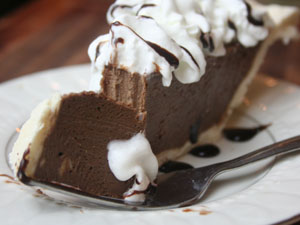
Kitchen tools, gourmet foods, baking mixes, and hard-to-find baking ingredients mentioned in this article are available at The Prepared Pantry.
by Dennis Weaver
We love French silk pies with their silky smoothness. They seem the most sophisticated and regal of the chocolate pies.
Silk pies would be perfect except for one detractor—they’re made with raw eggs. Now, we know that with the right amount of sugar, they’re safe but still—they’re a detractor. So we set off to make the perfect French silk pie with cooked eggs.
We searched our cookbooks and the internet for French silk pies where the eggs are cooked. There are several methods, some calling for baking the pie and some calling for cooking the filling and placing the cooked filling in a baked pie shell. We chose the latter.
How to Make Our French Silk Pies
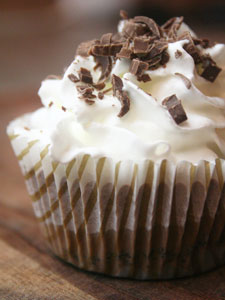
What makes French silk pies so silky? They are made with eggs, butter, chocolate, and sugar. There is no starch with its relative coarseness and unlike a custard pie, the filling melts in your mouth since both the butter and the chocolate melts at body temperature and the sugar dissolves in the filling. Once cooked, the eggs coagulate so the percentage of eggs must be low.
This method calls for beating the eggs in a pan on the stovetop with a handheld electric mixer until they reach 160 degrees, the point at which eggs are cooked. The beating incorporates air into the eggs for a light filling. Then, while still hot, the butter and chocolate are added. Finally whipped cream is folded in. This method makes an amazing French silk pie filling. It’s silky smooth, chocolaty, and sets up firmly once chilled.
The method is pretty straightforward except for the cooking of the egg and sugar mixture on the stovetop. We were afraid of scorching the eggs so the first time, we cooked them in a double boiler. Too slow. The next time we cooked them in a sauce pan over direct heat. At the lowest setting, it was still too slow. (Maybe we’re just not patient enough.) We did it several more times adjusting the heat but keeping the beaters running all the time. We found that we could turn the heat up to medium or just a little higher for the first couple minutes to heat the eggs and then drop it back to somewhere between low and medium. It is important to keep the beaters running and moving around the pan steadily but we could have the eggs cooked to the desired temperature in about ten minutes.
We also found that it was important to add the butter first to the hot egg mixture followed by the chocolate. When we added the chocolate first, it tended to stick to the bottom of the hot pan and scorch. If we had melted the chocolate first, we would have avoided that but wanted a method with as few steps as possible. You do have to add the chocolate right after the butter is melted. If the temperature drops below about 100 degrees, the chocolate won’t melt. Rather than adding ice cold butter to the hot mixture, we let the butter sit on the counter for 30 minutes to take the chill off.
The flavor is carried by the chocolate. Be sure to use a good quality chocolate. We used our chocolate wafers, which is sweetened chocolate of candy making quality. In a pinch, you can use semi-sweet chocolate chips. Chocolate chips have a coarser grind than do wafers (one’s intended for baking and the other is most often used in candy and pastries) but we doubt that you can tell in this application. For us, bittersweet chocolate is too harsh for the delicate nature of French silk pies.
Notice that the filling is gluten free. You can make a gluten free pie by placing this filling in a gluten free pie shell.
The Cousins: Variations on the Theme
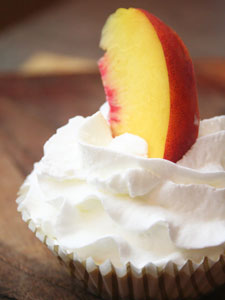
One of our objectives in this project was to make samples that we could hand out to customers in our store. Rather than make standard pies and cut them into slices, we wanted to make individual pies . . . and we wanted to make a lot of them. We tripled the recipe and used muffin pans with paper liners.
We made simple crusts with chocolate cookie crumbs, sugar, and melted butter. We put a heaping tablespoon in each liner and compressed the crumbs with one press with a tart tamper. (The right size bottle will do.) We then baked them five minutes. We used a large cookie scoop, 1/4 cup, to quickly load each cup with the right amount of filling and stacked the pans in the refrigerator to cool.
This made such a nice dark chocolate filling, we had to try white chocolate. We did and liked that even better than the dark. We matched the white chocolate up with both fresh peaches and strawberries. First, we tried to add diced fruit to the finished filling, mixing it in before chilling. It added too much moisture and didn’t set properly. So we settled for putting the fruit on top of the filling.
We are intrigued with this filing and will do some more exploring. We love the texture and want to match it with different flavors. Next up is adding cream cheese instead of chocolate. But that’s another project for another day.
How to Make Chocolate & White Chocolate French Silk Pies
This recipe makes a delightful silk pie whether in chocolate or white chocolate. It is silky smooth and luscious and the filling sets firmly for nice cuts and picture perfect presentations.

Ingredients
- 1 nine-inch pie shell, baked and cooled
- 3 large eggs
- 2/3 cup granulated sugar
- 2 tablespoons water
- 10 ounces dark (semi-sweet) chocolate wafers or other quality coating or eating chocolate
- 1/2 cup butter cut into pieces and softened
- 1 1 cup whipping cream
- 1 teaspoonFrench vanilla flavor
- 1 cup whipping cream
- 1/2 teaspoon French vanilla flavor
- 1/3 cup granulated sugar
Instructions
- Add the eggs, sugar, and water to a large sauce pan. Cook the egg and sugar mixture over low to medium low heat while beating constantly with an electric mixture. Continue cooking and beating until the mixture reaches 160 degrees being careful not to scorch the eggs. Remove from heat.
- Immediately mix the butter into the hot egg mixture with the electric mixer until smooth. As soon as the butter is melted and while the mixture is still hot, add the chocolate wafers. Continue beating until it is completely mixed together and cooled to room temperature.
- Whip the first measure of whipping cream in your stand-type mixer with the whip attachment until stiff peaks form. Add the French vanilla flavor.
- Change from the whip attachment to the paddle attachment. Scrape the chocolate mixture into the bowl with the whipped cream. Turn the mixer onto the slow speed setting and gently fold the chocolate mixture into the whipped cream. Mix for less than a minute, until the chocolate is mixed into the whipped cream. Scrape the filling into the prepared pie pan. Set aside and let chill.
- When you are about ready to serve, whip the second measure of whipping cream. As the cream is whipping and after the peaks start to form, drizzle in the sugar and add the flavor. Beat until stiff peaks form. Spread the whipped cream over the pie filling.
For the white chocolate variation
There shouldn’t be any difference in the performance of white and dark chocolate in these pies but as we have continued to experiment and make more of them, we have found that white chocolate does not consistently set up as firm as does the dark chocolate. So we have started adding a 1/4-ounce packet of unflavored gelatin when we use white chocolate. Add the sugar to the pan and stir the gelatin into the sugar before adding the eggs and beginning to cook.
With that exception, make the pie exactly as above substituting white chocolate wafers for the dark chocolate wafers and a Madagascar or Indonesian vanilla for the French vanilla.
You may wish to spread sliced strawberries or sliced peaches over the filling after it is set and then covering all or part of the pie with whipped cream.
How to Make Chocolate or White Chocolate Mini French Silk Pies
You can make delightful individual silk pies with this recipe. It uses a crumb crust in the bottom of paper cupcake liners with a silk filling on top and then a topping of whipped cream.
This recipe makes about 18 mini pies. This recipe can be doubled.
Ingredients
- 1 3/4 cups chocolate cookie crumbs
- 3 tablespoons granulated sugar
- 3 tablespoons butter, melted
- 3 large eggs
- 2/3 cup granulated sugar
- 2 tablespoons water
- 10 ounces dark (semi-sweet) chocolate wafers
- 1/2 cup butter cut into pieces
- 1 1 cup whipping cream
- 1 teaspoon French vanilla flavor
- 1 cup whipping cream
- 1/2 teaspoon French vanilla flavor
- 1/3 cup granulated sugar
Instructions
- Make mini crusts in a muffin pan lined paper liners by mixing the crumbs, three tablespoons granulated sugar, and melted butter together in a medium bowl. Line a muffin pan with 18 paper liners. Spoon 1 1/2 tablespoons (not packed) of the crumb mixture into each paper liner. Use a tart tamper or other instrument to compress the crumbs into the bottom of the liners. (If you have the right size tamper, you can compress the crumbs with one quick press in each liner.) Bake the crust for five minutes in a 350 degree oven. Set aside to cool.
- Add the eggs, sugar, and water to a four-quart or larger pan. Cook the egg and sugar mixture over low to medium low heat while beating constantly with an electric mixture. Continue cooking and beating until the mixture reaches 160 degrees. Remove from heat.
- Immediately mix the butter into the hot egg mixture with the electric mixer until smooth. As soon as the butter is melted and while the mixture is still hot, add the chocolate wafers. Continue beating until it is completely mixed together and cooled to room temperature.
- Whip the first measure of whipping cream in your stand-type mixer with the whip attachment until stiff peaks form. Add the vanilla flavor.
- Change from the whip attachment to the paddle attachment. Scrape the chocolate mixture into the bowl with the whipped cream. Turn the mixer onto the slow speed setting and gently fold the chocolate mixture into the whipped cream. Mix for less than a minute, until the chocolate is mixed into the whipped cream. Using a 1/4-cup ice cream scoop or other measure, scoop filling into each paper liner. The paper liners should be full. Set aside and let chill.
- When you are about ready to serve, whip the second measure of whipping cream. As the cream is whipping and after the peaks start to form, drizzle in the sugar and add the flavor. Beat until stiff peaks form.
- Add scoops of whipped cream to each mini pie or place the whipped cream in a pastry bag and pipe the whipped cream onto the mini pies.
For the white chocolate variation
There shouldn’t be any difference in the performance of white and dark chocolate in these pies but as we have continued to experiment and make more of them, we have found that white chocolate does not consistently set up as firm as does the dark chocolate. So we have started adding a 1/4-ounce packet of unflavored gelatin when we use white chocolate. Add the sugar to the pan and stir the gelatin into the sugar before adding the eggs and beginning to cook.
With that exception, make the pie exactly as above substituting white chocolate wafers for the dark chocolate wafers and a Madagascar or Indonesian vanilla for the French vanilla.
You may wish to spread sliced strawberries or sliced peaches over the filling after it is set and then covering all or part of the pie with whipped cream.
Dennis Weaver is the founder of The Prepared Pantry, a full line kitchen store in Rigby, Idaho. The Prepared Pantry sells kitchen tools, gourmet foods, and baking ingredients including hundreds of hard-to-find ingredients.