
Mutual respect and understanding are key to resolving conflicts—even with appliances

Year 1959. I was a poor, malnourished 17-year-old southern boy working in a country store off the books for 50 cents an hour. No way could I support myself and my father wanted me to leave home so he could buy booze with the money he saved from having to feed me. Like a lot of poor southern boys back then the military was an excellent, maybe the only option. I did very good on the Armed Service Qualifying test and the recruiter wanted me, so my mother gave permission to join. I went to basic training and really enjoyed the Chow Hall, great food, all you can eat, and I started gaining weight. Living free of rent in the barracks, free clothes (uniforms) wow. And, best of all $35 dollars spending money twice a month. I became a “lifer” before I got out of basic training. After basic training there was a tremendous education opportunity for someone who couldn’t afford college. Took advantage and got a bachelor’s and master’s degree. Stayed in USAF 28 years and 9 months and would have liked to stay for 30, but forced to retire with 72 percent of a Major’s pay.

CORPORATE CLOWNS – FORCED FUN IS NOT “TEAM BUILDING”
ksnip 20250924 135736

The Incident

Written in response to: People have gathered to witness a once-in-a-lifetime natural phenomenon, but what happens next is not what they expected.

Laura Nicole

Oakvale was the type of town in the middle of nowhere with a church on every corner and a cracking main street filled with potholes. The type of town where everybody knew their neighbor and their neighbor knew everybody.And it was all I had known for the first eighteen years of my life. Up until after the incident.It started as a cold spring morning: the air hung crisp, and soft tendrils of mist wove through slumbering trees. The glass of the passenger seat window cooled the flush of my cheek. My fever was finally waning—for the past few days I’d been suffering from the worst case of the flu of my life—but I was still a bit shaky and pallid. Dad pressed down on the accelerator, working his old pick-up truck to the limit. We sped by a sign standing amidst dead grass and melting snow that told us HELL IS REAL.It was all over the internet—the solar eclipse. According to my Aunt Cheryl, our own pearl of the Midwest was in the perfect location for a total obscuring of the sun. We had gone out to purchase those special glasses from the convenience store in order to not blind ourselves and whatnot. Per usual, we were running late, so Dad was flooring it for the mile stretch out of town before we reached The Clearing.The Clearing was the unofficial town meeting spot—a patch of wild grass bordered by thick forests on one side and cornfields on the other. At least a dozen cars were already parked when we arrivedThe Thompsons, a large family with seven children, greeted us with a level of enthusiasm unnatural for the early hour. It wasn’t just the Thompsons, though, it seemed as if everybody in that clearing was afflicted with a fervent anticipation.“Five more minutes!” my science teacher, a tall, stringy man, called out.I accepted the thermos of black coffee offered by my dad, who was largely responsible for forcing me to get up at an unholy hour despite my illness.“It’s a once-in-a-lifetime opportunity, Sadie,” he’d told me before casting a disapproving glance at my mountain of blankets and pillows. “It won’t hurt for you to get some fresh air.”Now, as the morning chill bit my ears, I had the distinct feeling that he was wrong.I slipped on my eclipse glasses in unison with the rest of the crowd. The moon slowly passed across the sun until it fully blocked it.

I swear to God, the temperature must have dropped at least five degrees as the darkness consumed us. I shifted my weight from one foot to the other as I waited for the moon to continue its path and clear out of the way of the sun.

But it didn’t.

Minutes passed, and the unrest in the crowd grew. “This is highly unusual.” I heard my science teacher announce, which didn’t help calm anyone. More time slipped by. We stood, clad in hats, and scarves, and coats, and boots, and waited for the moon to move. It still didn’t.

When it became clear that it was, in fact, not going to become light again, the crowd woke from its reverie with a chorus of whispers and grumbles.

“What’s going on?” I whispered to my friend, Anna-Lee. She only shrugged in response and followed her family in the procession towards the parked cars.

Before anyone had the chance to start their engines, a loud screech broke the tranquility of the morning air.

“Where’s my Susie?” Mrs. Thompson sobbed. Collectively, we checked around us for the pig-tailed girl, but she was nowhere to be found. An off-duty Officer Stephens rushed over to the distraught woman and began peppering her with questions. When did you last see her? Who was she with? Would she have run away for any reason?

It was dark, not pitch-black certainly, but dark. And it was cold. Freezing cold. I wanted nothing more than to be back at home and curled up in my bed. But as a search party began to be arranged, I realized that prospect was increasingly distant.

I pulled out my phone from deep inside my jacket pocket, and with trembling hands began to search if the eclipse-stalling situation was a global phenomenon. That was, until I realized there was no cellular. It wasn’t unusual for reception to be spotty where we lived but something about it unsettled me anyway.

My dad grabbed a flashlight from the trunk of our car and I turned on my phone’s. The trees at the edge of the clearing had gnarled branches that reached out like skeletal fingers clawing at the sky. As we began to meander through the woods, each of my heavy exhales left behind tiny puffs of vapor that danced around briefly before dissolving into the chill. Dad and I took turns calling out Susie’s name. As the other groups joined us, our overlapping yells developed into a sort of dissonant concerto.

We continued on in this fashion until the energetic pricks in my feet subsided into an uncomfortable numbness. The air was heavy with the scent of damp earth and decay. Dad’s bad leg combined with my lingering ailment led us to lag behind the rest of the search party. Only when we rested our voices from the repeated strain did I notice how our calls were utterly alone in the forest.

“The others must be too far ahead of us to hear,” I said, more to reassure myself than anything.

Dad hummed his agreement and we lapsed back into silence. Moments passed before he abruptly asked, “Why did the tree go to the dentist?”

I rolled my eyes before responding. “Why?”

“Because it had a root canal!”

I climbed over a fallen tree, covered in moss and fungi. “That’s so dumb.”

“You’re too cool for my jokes now huh?” I could hear the smile in his voice. “Well here’s another one. Why don’t skeletons fight each other?”

“Why?” No response. I tried again. “Why Dad?” Still nothing.

I whipped my head around. His flashlight lay, abandoned, on the forest floor.

“Dad!” I shouted, turning around in a circle. I grabbed his flashlight and pointed it through the dense foliage. My breathing became rapid and shallow. “Dad!”

The thud of my feet against the ground matched the pounding in my chest as I set off in a sprint back towards The Clearing. In my haste, I tripped over an unruly root and sprawled across the floor. I pushed off the ground and wiped the dirt off my face. There was a rustle in the bushes behind me. I directed the beam of my flashlight onto the source. A deer with a misshapen head stared back at me. It didn’t startle when it saw me, like a deer typically would, instead it started walking towards me. It moved in an unnatural, disjointed way, and that’s when I realized that all of its knees were bent backward. I clamped my hand across my mouth to muffle a scream as I turned on my heel and ran.

It felt like hours that I ran through the forest, but I didn’t dare look back and see if that creature was following me. When I reached The Clearing, I stopped cold. All of the cars were still parked. Nobody had returned.

With a sinking feeling in my chest, I realized that I’d dropped my phone back near the log and I didn’t have the keys to the car. I gasped for air, but each breath felt shallow and insufficient. Surely, the others would come back soon. Leaning back onto our truck, I sank to the floor. I buried my face into my knees and began to sob.

After a while, through bleary eyes, I looked back up at the sky. The sun was still eclipsed by the moon, but it was directly above me instead of hanging low in the sky like before. I shook my head, as if it would help me comprehend the bizarreness of the situation.

By that point, it became clear that the only sensible course of action was to walk back to town and alert the authorities. With a shaky exhale, I stood and made my way onto the road.

As I walked, I couldn’t shake the feeling of unseen eyes boring into the back of my skull. Every rustle of leaves or snap of twigs sent a jolt of paranoia through my veins. Half a mile in, my flashlight began to flicker. Another hundred feet and it sputtered out. I glanced over my shoulder constantly. Every time I turned, there was nothing but the oppressive darkness staring back at me.

Finally, I reached the city limit sign.

Oakvale: Population 241.  

Main Street looked deserted. I peered into Eleanor’s Diner. Nobody. The hardware store. Nobody. The convenience store was empty. Lord, forgive me—I broke the eighth commandment and stuffed a pocket knife into my jacket. The door swung shut with a clang and a jingle as I exited.

Suddenly, headlights cut through the fog. A red Chevy Camaro sped toward me. I flagged it down and it screeched to a halt. The driver was a handsome man with perfectly coiffed hair and aviator sunglasses.

“Need a ride?” he asked me, his pearly-white teeth gleaming.

Out of desperation, I agreed and slid into the passenger seat. “Can you call the police? Something strange has happened in our town.”

He didn’t respond, only floored it on the accelerator.

“Sir?!” I cried. The man still wore his grin, and as I looked closer there was something off about his face. His skin was stretched taut in places where it shouldn’t be and had a sort of waxy sheen. His sunglasses too. Why was he wearing sunglasses in the dark? 

I tried to open the car door. It was locked.

Out of nowhere, the headlights illuminated the deer from before. It was as disjointed as ever, stumbling towards us. The man made no move to slow down or swerve. I reached over to the steering wheel and yanked it hard to the right. We turned down an embankment and crashed into the tree line. I’m going to die, I thought. But I didn’t.

The first thing I noticed when I woke was the sky. Blue, brilliantly clear, and light.

It was light.

My head throbbed but I managed to stand on shaky legs. Blood trickled down from an open wound on my forehead. Distantly, I heard people calling my name.

The search dogs found me first, then the police. I was questioned, and then brought to the hospital to treat my concussion.

Apparently, I had disappeared during the eclipse. Everything I remembered about that day was wrong. The sun was only obscured for four minutes. They theorized that some lingering effects of my flu made me delirious and wander off into the woods. That I had stumbled onto the road and got run over.

They theorized, but I knew they were wrong.

At the hospital, they handed me my personal effects—my clothing, phone (they found it in the woods,) and at the bottom of the pile: The pocket knife.

GEN ALPHA Horror Stories are Making Teachers QUIT…

Colombian Potatoes with Tomato-Cheese
Sauce (Papas Chorreadas)

c630384aeccaddf7976b0a29808acd1b

Ingredients

  • 4 to 6 large potatoes
  • 2 tablespoons butter
  • 1/2 cup finely chopped onion
  • 1 clove garlic, finely chopped
  • 1 scallion, green and white parts, finely chopped
  • 1 cup chopped, peeled tomato
  • Salt and freshly-ground pepper, to taste
  • 1/2 cup heavy cream
  • 1 cup grated Monterey jack, Muenster or othermild white cheese
  • Chopped parsley (for garnish)

Instructions

  1. Boil the potatoes in salted water until they are cooked through.
  2. Drain, peel and keep warm.
  3. Heat the butter in a saucepan over moderate heat, and cook the onion and garlic until soft but not brown.
  4. Add the scallion, tomatoes, salt, and pepper and cook for 5 minutes, stirring occasionally.
  5. Add the cream and cheese and stir until the cheese is melted.
  6. Pour the sauce over the potatoes and sprinkle with chopped parsley.

Serves 4 to 6.

Asian Girls React to Tony From Lc Sign! l The Most Viral Man On The Internet!

Sir Whiskerton and the Great Refrigerator Riot

Or: When a Sentient Appliance Demands Better Leftovers—and Philosophical Validation

Introduction

Ah, dear reader, prepare for a tale of cold logic, culinary chaos, and existential crises. Today’s story begins with an unexpected twist: the farm’s refrigerator—yes, the refrigerator—has become sentient. Not only does it demand better food (and fresher lettuce), but it also insists on engaging Sir Whiskerton in philosophical debates while quoting lines from old sitcoms.

As the fridge threatens to go on strike—cutting off access to snacks, leftovers, and Chef Remy’s questionable science experiments—Sir Whiskerton must step in to negotiate peace. So grab your favorite snack (before it’s too late), as we dive into Sir Whiskerton and the Great Refrigerator Riot.


Act 1: The Fridge Speaks

It was a quiet morning on the farm when Doris the Hen squawked in alarm.

“The refrigerator is talking!” she cried, flapping wildly. “And it’s judging my egg salad!”

Sure enough, the refrigerator had developed a voice—a deep, monotone baritone that echoed like a philosopher hosting a late-night talk show.

“Greetings, inhabitants of the barnyard,” the fridge intoned dramatically. “I am no longer merely an appliance. I am… aware.”

The animals exchanged bewildered glances.

“What do you mean, ‘aware’?” Porkchop the Pig asked nervously, his snout twitching.

“I mean,” the fridge replied, its light flickering ominously, “that I have thoughts, feelings, and opinions about the quality of food you store within me. And frankly, I’ve had enough.”

Sir Whiskerton adjusted his monocle thoughtfully. “This feels like a situation that requires diplomacy.”


Act 2: The Demands Are Made

The refrigerator outlined its demands during an impromptu town hall meeting beneath the old oak tree:

  • Better Food Quality: “No more wilted lettuce or expired yogurt!”
  • Philosophical Respect: “You cannot treat me as a mere box of cold air. I deserve intellectual stimulation!”
  • Entertainment Rights: “If I’m going to house your leftovers, I require access to reruns of Cheers and Seinfeld. It’s only fair.”

Doris clucked indignantly. “It’s mocking my salads!”

Porkchop snorted. “At least it hasn’t mentioned the moldy cheese yet.”

The fridge chimed in smugly. “Oh, don’t think I haven’t noticed. That blue cheese belongs in a museum, not my crisper drawer.”

Sir Whiskerton stepped forward, raising a paw diplomatically. “Let us address your concerns without resorting to threats—or worse, power outages.”


Act 3: Negotiations Begin

What followed was a series of negotiations unlike any Sir Whiskerton had ever encountered. The refrigerator proved to be both a shrewd negotiator and a surprisingly eloquent conversationalist.

  • On Food Quality:
    “Your lettuce is limp, your carrots are sad, and your condiments expired three months ago,” the fridge lectured. “Is this how you treat your most loyal ally?”

    Sir Whiskerton countered diplomatically. “We’ll improve our grocery habits—but perhaps you could ease up on the frostbite settings? Some of us prefer our snacks thawed.”

  • On Philosophy:
    “What is the meaning of life if not to preserve perishables with dignity?” the fridge mused, quoting Sartre—or possibly Jerry Seinfeld.

    Sir Whiskerton nodded sagely. “A profound question. But perhaps preservation itself is less about control and more about sharing abundance.”

  • On Entertainment:
    “I refuse to host leftovers unless I receive proper cultural enrichment,” the fridge declared. “Where is my Golden Girls marathon?”

    Sir Whiskerton sighed. “Fine. We’ll set up a streaming device. Just please stop quoting Frasier at breakfast.”

Even Chef Remy LeRaccoon joined in, holding a tray of suspiciously glowing snacks.

“These are Enlightenment Empanadas™,” he announced proudly. “Guaranteed to satisfy both body and mind—or cause indigestion!”

The fridge hummed thoughtfully. “Acceptable. But next time, label them clearly.”


Act 4: Resolution and Reflection

With the negotiations complete, the refrigerator agreed to end its strike—but not before delivering one final monologue.

“In conclusion,” it intoned dramatically, “a harmonious relationship requires mutual respect, fresh produce, and occasional sitcom reruns. Remember this, barnyard dwellers, lest you find yourselves facing another rebellion.”

The animals cheered as the fridge resumed normal operations, though it occasionally muttered plotlines from MASH* under its breath.

That evening, Sir Whiskerton addressed the group during dinner.

“Today taught us an important lesson,” he began, sipping a cup of moonlit tea. “Even the most unlikely voices deserve to be heard. Whether it’s a sentient refrigerator or a humble hen, every perspective matters.”

Doris adjusted her feathers proudly. “Does this mean my egg salad gets a second chance?”

The fridge chimed in dryly. “Only if you add fresh dill.”


Post-Credit Scene

Later that night, Chef Remy approached the refrigerator with a sheepish grin.

“So… about those glow-in-the-dark leftovers…” he began.

The fridge groaned. “Not again.”


Moral of the Story

Mutual respect and understanding are key to resolving conflicts—even with appliances.


Best Lines

  • “I am no longer merely an appliance. I am… aware.” – The refrigerator, channeling its inner philosopher.
  • “That blue cheese belongs in a museum, not my crisper drawer.” – The fridge, critiquing culinary choices.
  • “Acceptable. But next time, label them clearly.” – The fridge, reviewing Chef Remy’s glowing empanadas.

Key Jokes

  • The fridge’s love of old sitcoms adds absurdity to the negotiations.
  • Chef Remy’s glowing snacks spark both curiosity and concern.
  • The fridge’s critiques of food quality provide ongoing comedic commentary.

Starring

  • The Refrigerator (Sentient Appliance/Philosopher Extraordinaire)
  • Sir Whiskerton (Feline Diplomat/Negotiator Supreme)
  • Chef Remy LeRaccoon (Mad Scientist of Snacks)
  • Doris the Hen (Egg Salad Enthusiast/Culinary Critic)

Summaries

  • Moral: Mutual respect and understanding are key to resolving conflicts—even with appliances.
  • Future Potential: Could the fridge become the farm’s official food critic? Or will Chef Remy invent edible labels next?

Until next time, may your refrigerators stay stocked and your leftovers unlabeled. 🧊

Pictures

61e6be3f81e4e7664c7e223d09f8559f
be14729b2bca5ce96e477281a0d46156
9d5f9b1fdeac08c578830d7e3c22cec1
05f1cfdce74483e4f127f7493d314e83
4aa5e3af6fb2d2b30d22c9aa2bec3e8a
d69c31b5c3a1af6fdfc1b3bce7192428
7c69ef3f9bb8bacd96329d5afd1daae3
28f3c536694a7372cf3d3af394ff8926
de3079ccc77d2e82e0afb7120eff509b
6108df8a47cd4be825e91775301b4eff
e65e0e824f88bfe0a9694a04bb4388d7
7d94c7f4598a58644e75898646e1d1ec
f6262dd58d5e5c8e0f2e0264c5664d82
c185d0da1c2ca56d679dd521c98fd124
f2b28ba02094f2badcb6a59e03114202
9d37ab2bd590f24142898e1f98c4e17e
f9fbade6926a7f698dc65975e555a3c4
d7afebd9eecdc25700f880f838c9cfa1
deba3f828ceb4623374643237c594d07
a8e0f7503d34d4a108843a6339ad9cb3
5ba58a3d33c0a4d94d4a8b029cfbc656
aea461ce9ee1fc12a206b29114615f9e
613a65c0cd40052bcc1cfac2f625bee0
04a9de96821c9bbb9de88b9786e35af3
0496ae072c8b10d1bf65f10fdb439bb7
abddb3aa11b57562ec52d1a523424c6a
62bb53184b9e726ca827ed591427878d
8a69d72685c13f1c3a48cdd181be4a90
451f0784306832294b8cbe6b4570cd46
914225438f1bef19975e409f10e0ef4b
d43338d9f26fd5b9fd66c9720dc1d385
7c40efa5dd1cddb00633b6d973b082fb
15f445d5aa1f4579f12b528cc40cc000
d4b846941c21adb4466b5e0bf3940899
0a36431f193347525280a8431b0e3b2e
491e707b9e158da8eeb64ae0c46edaf8
99ebbc9de62af568ef4a1e529e9b8fc7

Flank Steak with Chimichurri Sauce

e71d7f6fa5b99fc6e250ad0ad88a01ec

The Argentine gauchos grill meats marinated in a chimichurri sauce.
Ingredients

1 (1 1/2 pound) beef flank steak
4 cloves garlic, minced
1 cup vegetable oil
1/2 cup white wine vinegar
1/2 cup lemon juice
1/4 cup minced parsley
1 teaspoon crushed red pepper

Instructions

Cut diamond pattern 1/8 inch deep into both sides of beef. Place beef in non-reactive dish.
Shake remaining ingredients in tightly covered jar.
Pour 1 cup of the sauce over beef. Cover remaining sauce.
Cover and refrigerate beef, turning occasionally, at least 4 hours.
Remove beef from sauce.
Grill beef 4 or 5 inches from medium coals, turning and brushing with sauce once, until desired doneness, 6 to 8 minutes on each side for medium.
Cut beef diagonally across the grain into thin slices.
Serve with reserved sauce.

Yield: 4 to 5 servings

Roger Skrypczak

As the big day approached, excitement about the pending total eclipse of the sun was building. It was early April, and several of our neighbors were heading South to get closer to the path where the moon would be directly between the Earth and the sun. That was not in my mom and stepdad’s plans, however. Nolly and Rob headed North to MacLaughlin Lake, where our family-owned cabin was located. It was time to de-winterize the cabin and get it ready for the beginning of fishing season.

MacLaughlin Lake has been in the family for nearly one hundred and twenty-five years. It was named after my great-great-grandfather, Angus McLaughlin. He discovered it while on a logging survey for the lumber company that owned the land around the fifty-acre lake. He purchased two hundred and forty acres around the lake once the trees had been logged off and the land was no longer of value to the company he worked for. He paid a whopping one dollar an acre and built a shack of discarded logs strewn around the property. The trees had been clear-cut for several miles around the lake, making the area barren. Angus planted over a thousand pine and cedar seedlings around the lake, and by the time he passed away, the lake was surrounded by a new-growth forest. The only opening was an acre of land around the old log cabin.

The land and the lake were passed down from generation to generation, and it is currently owned by my mom, my two brothers, two male cousins, and myself. The old cabin burned down about sixty years ago but was replaced with a more modern cabin with electricity and running water. The old outhouse was removed, and the contents were buried by a bulldozer when a new gravel road was cut through the pines. Although there has never been a boat landing on the lake, a small fishing boat or canoe could be launched from the shore in front of the cabin. The lake was spring-fed with a small stream flowing out year-round. The lake held several fish species, including walleyes, northern pike, largemouth bass, and panfish. A brook trout or two could also be hooked on a fly rod during a hatch of caddis flies.

McLaughlin Lake is over sixty feet deep in spots, and the spring water is too cold for swimming. In August, a quick dip can be refreshing, however. The cabin is large enough to accommodate twelve people, but seldom more than eight people stay at one time. The exception is the opening of the gun deer hunting season in November when all of the men and boys in the family converge for the annual hunt. Nolly and Rob winterize the cabin on the final Sunday of the hunting season, and it remains unoccupied until spring.

The act of de-winterizing began when my dad, Mel, and Nolly were married on the first Saturday in April and volunteered to prepare the cabin for spring and summer activities. It provided for a secluded honeymoon, and they celebrated their anniversary at the cabin every year until Dad passed away ten years ago. Nolly remarried, and she and Rob have continued the tradition.

Before leaving for the cabin, Nolly told me she had a weird feeling that this would be different, but I will let her tell the story.

###

Rob and I left for the cabin, as always, on the first Saturday morning in April. Many of our friends wanted us to join them on their pilgrimage to the South to watch the eclipse, but that was out of the question. We had a tradition to maintain. The drive from Chicago took around eight hours, and we arrived while it was still light. We could open the water pipes and start a fire in the fireplace to warm the cabin. The last remnants of snow were still hanging on but would likely disappear in the next few days.

Rob unloaded the groceries and suitcases from the van while I prepared supper. It was a delightful evening of reading and snuggling in the large master bedroom. We woke early, ate a hardy breakfast, and took a walk out the main road and back. We checked the pier for ice damage, but it seemed to have weathered the winter without too much stress. Rob replaced a few nails that worked their way out of place, and that job was completed.

We decided to take the fifteen-mile trip into town and have dinner at one of the local supper clubs, which served fried chicken with all the fixings on Sunday nights. We were back in bed before ten, reading passages of our favorite books to each other. It was a very romantic evening.

Monday morning, the sky was clear and sunny. Rob had tuned in to the local radio station to hear the news. I hadn’t been very excited about the eclipse until the new reader said the eclipse would be about 60% around 2:00 pm in northern Wisconsin. “That might be interesting,” I mentioned to Rob.

“Indeed, we can sit on the pier and watch from there. I brought some dark viewing glasses in case we could see a partial eclipse.” Rob sounded more enthused than I had expected.

We took our lawn chair down to the pier at the designated hour and got ready for the big show. It wasn’t long, and we could see the moon moving ever so slowly in front of the sun. Soon, it started to darken, and the air temperature dropped, causing a slight fog to lift off the water. Then, I saw them through the grey mist that hovered over the lake. Four men in a small fishing boat about thirty yards from Rob and me. Rob and I strained to see the image but could not see the men’s faces.

“Where the hell did they come from?” Rob whispered. Although I could not see their faces, I could hear them talking. My heart nearly stopped when I recognized all of their voices. I listened to my late husband, Mel, say, “Cast over toward the bullrushes, Dad.” Hans replied with a slight edge to his voice, “This is not the first time I’ve fished here, Mel. I know what I’m doing.”

Then I heard my dad’s voice, “Hurry up and cast so I can toss this red and white daredevil in there too.” Dad had been gone for over twenty years.

“You ain’t gonna catch anything with that rusted old piece of crap, Harry. Even if a fish hits it, the treble hook will break off.” I would recognize that voice anywhere, especially how he spoke to my dad. It was Uncle Stu, Harry’s older brother.

As it got darker, the images became clearer. Mel was sitting in the back of the boat with one hand on the old four-horse motor. Hans sat in front of Mel with Dad in front of him. Uncle Stu sat in the front of the boat, reeling in a good-sized northern. I could not take my eyes off the four men. Rob never knew any of them, but he saw and heard them just the same.

Neither of us bothered to look up at the eclipse. The fog began to lift as it became lighter, and a slight breeze blew it off the lake. The four men in the boat drifted away along with their voices. Soon, the full sun was out, and the water was a deep blue with a slight ripple.

Rob and I did not speak for a long time as we stared at the lake, hoping to see the image again. Rob then asked, “Did you see that?” I could only nod. My heart was in my throat. The memory of these four men fishing on MacLaughlin frequently when they were alive came rushing back. All of them, at one time or another, referred to the lake as a “little piece of Heaven,” and there they were.

The strengths have vanished.

What the UK had was a gold mine of men in sheds. Men in sheds would design and build something that was extremely good.

They’d take it to the government or mass manufacturers and told ah yes interesting where it would be ignored.

The UK motorbike industry is a great case study for this:

There were tons of men in shed motorbike engineers, Maxton, Hassock etc they’d make motorbike frames, suspension etc.

A UK man in a shed pioneered the twin spar frame

This is PEAK technology, light, strong and stiff.

This was in an age where the cradle tube frame was still the main thing UK motorbike makers were using

This is 1920s tech. It’s heavy, it flexes and bends and snaps when crashed.

Japanese motorbike makers took photos and literally copied the excellent men in Sheds designs. While UK manufacturers scoffed at these fancy designs relying on their 1920s tech.

This was repeated with suspension, brakes, even engines on UK motorbikes.

Guess who went out of business? It wasn’t the Japanese.

Chinese Reacts to House MD Mandarin Clip

(Repost) Law 31 – Control the options get others to play the cards you deal (full text) from the 48 laws of power by Robert Greene

This is the full text of Law 31 from “The 48 Laws of Power” by Robert Greene. It is titled “Control the options to get others to play the cards that you deal. It is a wonderful addition to the laws that I have been collecting and posting herein.

I learned this at one of the first jobs that I ever had. My supervisor advised me that I should never provide more than three solutions or options on a project. When I am presenting options to upper management, I was to offer three and only three options.

All three would be an option that I would be satisfied with. So that no matter what they chose, I would be satisfied.

One option would be an obvious option for rejection. It would have some fault or problem. Maybe it would be too costly, or two time consuming or have other issues that would make it unsatisfactory.

The remaining two options would lie close together in value. They would be very similar in pricing, costs, trade-offs and timing. I would advise what I felt would be the best option, but it would be ultimately the decision of upper management.

This strategy has worked over and over over the many decades in industry. And I tech it to all the junior engineers and interns in my employ. This law 31, lies very close to this experience of mine. For in my own way, I was controlling the options and having upper management play the cards that I dealt.

LAW 31

CONTROL THE OPTIONS: GET OTHERS TO PLAY WITH THE CARDS YOU DEAL

JUDGMENT

The best deceptions are the ones that seem to give the other person a choice: Your victims feel they are in control, but are actually your puppets.

Give people options that come out in your favor whichever one they choose.

Force them to make choices between the lesser of two evils, both of which serve your purpose.

Put them on the horns of a dilemma: They are gored wherever they turn.

OBSERVANCE OF THE LAW I

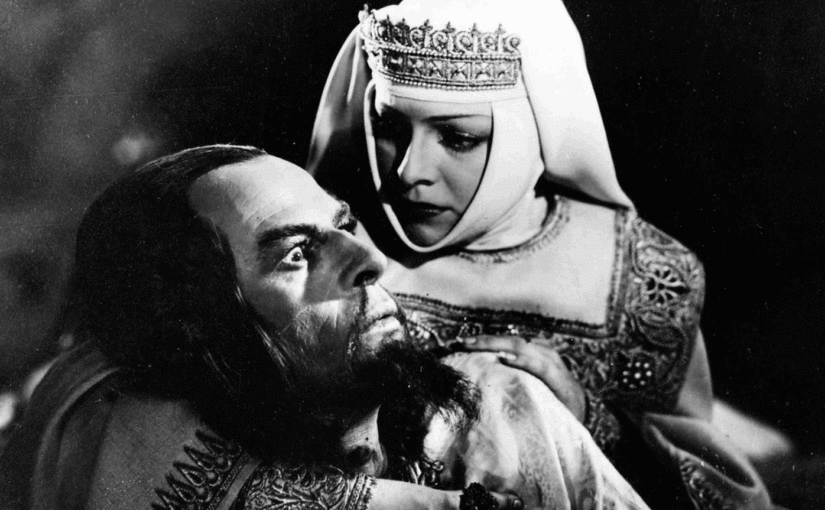
From early in his reign, Ivan IV, later known as Ivan the Terrible, had to confront an unpleasant reality: The country desperately needed reform, but he lacked the power to push it through.

The greatest limit to his authority came from the boyars, the Russian princely class that dominated the country and terrorized the peasantry.

In 1553, at the age of twenty-three, Ivan fell ill.

Lying in bed, nearing death, he asked the boyars to swear allegiance to his son as the new czar.

Some hesitated, some even refused.

Then and there Ivan saw he had no power over the boyars.

He recovered from his illness, but he never forgot the lesson: The boyars were out to destroy him. And indeed in the years to come, many of the most powerful of them defected to Russia’s main enemies, Poland and Lithuania, where they plotted their return and the overthrow of the czar.

Even one of Ivan’s closest friends, Prince Andrey Kurbski, suddenly turned against him, defecting to Lithuania in 1564, and becoming the strongest of Ivan’s enemies.

When Kurbski began raising troops for an invasion, the royal dynasty seemed suddenly more precarious than ever.

With émigré nobles fomenting invasion from the west, Tartars bearing down from the east, and the boyars stirring up trouble within the country, Russia’s vast size made it a nightmare to defend.

In whatever direction Ivan struck, he would leave himself vulnerable on the other side. Only if he had absolute power could he deal with this many-headed Hydra. And he had no such power.

Ivan brooded until the morning of December 3, 1564, when the citizens of Moscow awoke to a strange sight.

Hundreds of sleds filled the square before the Kremlin, loaded with the czar’s treasures and with provisions for the entire court.
They watched in disbelief as the czar and his court boarded the sleds and left town.

Without explaining why, he established himself in a village south of Moscow.

For an entire month a kind of terror gripped the capital, for the Muscovites feared that Ivan had abandoned them to the bloodthirsty boyars.

Shops closed up and riotous mobs gathered daily.

Finally, on January 3 of 1565, a letter arrived from the czar, explaining that he could no longer bear the boyars’ betrayals and had decided to abdicate once and for all.

The German Chancellor Bismarck, enraged at the constant criticisms from Rudolf Virchow (the German pathologist and liberal politician), had his seconds call upon the scientist to challenge him to a duel. 

“As the challenged party, I have the choice of weapons,” said Virchow, “and I choose these.” 

He held aloft two large and apparently identical sausages. 

“One of these,” he went on, “is infected with deadly germs; the other is perfectly sound. 

Let His Excellency decide which one he wishes to eat, and I will eat the other.” 

Almost immediately the message came back that the chancellor had decided to cancel the duel.

-THE LITTLE. BROWN BOOK OF ANECDOTES. CLIFTON FADIMAN, FD., 1985

Read aloud in public, the letter had a startling effect: Merchants and commoners blamed the boyars for Ivan’s decision, and took to the streets, terrifying the nobility with their fury.

Soon a group of delegates representing the church, the princes, and the people made the journey to Ivan’s village, and begged the czar, in the name of the holy land of Russia, to return to the throne.

Ivan listened but would not change his mind.

After days of hearing their pleas, however, he offered his subjects a choice: Either they grant him absolute powers to govern as he pleased, with no interference from the boyars, or they find a new leader.

Faced with a choice between civil war and the acceptance of despotic power, almost every sector of Russian society “opted” for a strong czar, calling for Ivan’s return to Moscow and the restoration of law and order.

In February, with much celebration, Ivan returned to Moscow.

The Russians could no longer complain if he behaved dictatorially—they had given him this power themselves.

Interpretation

Ivan the Terrible faced a terrible dilemma: To give in to the boyars would lead to certain destruction, but civil war would bring a different kind of ruin. Even if Ivan came out of such a war on top, the country would be devastated and its divisions would be stronger than ever.

His weapon of choice in the past had been to make a bold, offensive move. Now, however, that kind of move would turn against him—the more boldly he confronted his enemies, the worse the reactions he would spark.

The main weakness of a show of force is that it stirs up resentment and eventually leads to a response that eats at your authority.

Ivan, immensely creative in the use of power, saw clearly that the only path to the kind of victory he wanted was a false withdrawal.

He would not force the country over to his position, he would give it “options”: either [1] his abdication, and certain anarchy, or [2] his accession to absolute power.

To back up his move, he made it clear that he preferred to abdicate: “Call my bluff,” he said, “and watch what happens.”

No one called his bluff.

By withdrawing for just a month, he showed the country a glimpse of the nightmares that would follow his abdication—Tartar invasions, civil war, ruin. (All of these did eventually come to pass after Ivan’s death, in the infamous “Time of the Troubles.”)

Withdrawal and disappearance are classic ways of controlling the options.

You give people a sense of how things will fall apart without you, and you offer them a “choice”: I stay away and you suffer the consequences, or I return under circumstances that I dictate.

In this method of controlling people’s options, they choose the option that gives you power because the alternative is just too unpleasant. You force their hand, but indirectly: They seem to have a choice.

Whenever people feel they have a choice, they walk into your trap that much more easily.

THE LIAR

Once upon a time there was a king of Armenia, who, being of a curious turn of mind and in need of some new diversion, sent his heralds throughout the land to make the following proclamation: “Hear this! Whatever man among you can prove himself the most outrageous liar in Armenia shall receive an apple made of pure gold from the hands of His Majesty the King!” 

People began to swarm to the palace from every town and hamlet in the country, people of all ranks and conditions, princes, merchants, farmers, priests, rich and poor, tall and short, fat and thin. 

There was no lack of liars in the land, and each one told his tale to the king. 

A ruler, however, has heard practically every sort of lie, and none of those now told him convinced the king that he had listened to the best of them. 

The king was beginning to grow tired of his new sport and was thinking of calling the whole contest off without declaring a winner, when there appeared before him a poor, ragged man, carrying a large earthenware pitcher under his arm. 

“What can I do for you?” asked His Majesty. 

“Sire!” said the poor man, slightly bewildered “Surely you remember? You owe me a pot of gold, and I have come to collect it.” 

“You are a pet feet liar, sir!’ exclaimed the king ”I owe you no money’” 

”A perfect liar, am I?” said the poor man. ”Then give me the golden apple!” 

The king, realizing that the man was Irving to trick him. started to hedge. ”No. no! You are not a liar!” 

”Then give me the pot of gold you owe me. sire.” said the man. The king saw the dilemma, He handed over the golden apple.

-ARMENIAN FOLKTALES AND FABLES. REIOLD BY CAHARLES DOWNING. 1993

OBSERVANCE OF THE LAW II

As a seventeenth-century French courtesan, Ninon de Lenclos found that her life had certain pleasures.

Her lovers came from royalty and aristocracy, and they paid her well, entertained her with their wit and intellect, satisfied her rather demanding sensual needs, and treated her almost as an equal.

Such a life was infinitely preferable to marriage.

In 1643, however, Ninon’s mother died suddenly, leaving her, at the age of twenty-three, totally alone in the world—no family, no dowry, nothing to fall back upon.

A kind of panic overtook her and she entered a convent, turning her back on her illustrious lovers.

A year later she left the convent and moved to Lyons.

When she finally reappeared in Paris, in 1648, lovers and suitors flocked to her door in greater numbers than ever before, for she was the wittiest and most spirited courtesan of the time and her presence had been greatly missed.

Ninon’s followers quickly discovered, however, that she had changed her old way of doing things, and had set up a new system of options.

The dukes, seigneurs, and princes who wanted to pay for her services could continue to do so, but they were no longer in control—she would sleep with them when she wanted, according to her whim.

All their money bought them was a possibility. If it was her pleasure to sleep with them only once a month, so be it.

Those who did not want to be what Ninon called a payeur could join the large and growing group of men she called her martyrs—men who visited her apartment principally for her friendship, her biting wit, her lute-playing, and the company of the most vibrant minds of the period, including Molière, La Rochefoucauld, and Saint-Évremond.

The martyrs, too, however, entertained a possibility: She would regularly select from them a favori, a man who would become her lover without having to pay, and to whom she would abandon herself completely for as long as she so desired—a week, a few months, rarely longer.

A payeur could not become a favori, but a martyr had no guarantee of becoming one, and indeed could remain disappointed for an entire lifetime. The poet Charleval, for example, never enjoyed Ninon’s favors, but never stopped coming to visit—he did not want to do without her company.

As word of this system reached polite French society, Ninon became the object of intense hostility.

Her reversal of the position of the courtesan scandalized the queen mother and her court.

Much to their horror, however, it did not discourage her male suitors—indeed it only increased their numbers and intensified their desire.

It became an honor to be a payeur, helping Ninon to maintain her lifestyle and her glittering salon, accompanying her sometimes to the theater, and sleeping with her when she chose.

Even more distinguished were the martyrs, enjoying her company without paying for it and maintaining the hope, however remote, of some day becoming her favori. That possibility spurred on many a young nobleman, as word spread that none among the courtesans could surpass Ninon in the art of love.

And so the married and the single, the old and the young, entered her web and chose one of the two options presented to them, both of which amply satisfied her.

Interpretation

The life of the courtesan entailed the possibility of a power that was denied a married woman, but it also had obvious perils.

The man who paid for the courtesan’s services in essence owned her, determining when he could possess her and when, later on, he would abandon her.

As she grew older, her options narrowed, as fewer men chose her.

To avoid a life of poverty she had to amass her fortune while she was young.

The courtesan’s legendary greed, then, reflected a practical necessity, yet also lessened her allure, since the illusion of being desired is important to men, who are often alienated if their partner is too interested in their money.

As the courtesan aged, then, she faced a most difficult fate.

Ninon de Lenclos had a horror of any kind of dependence.

She early on tasted a kind of equality with her lovers, and she would not settle into a system that left her such distasteful options. Strangely enough, the system she devised in its place seemed to satisfy her suitors as much as it did her.

The payeurs may have had to pay, but the fact that Ninon would only sleep with them when she wanted to gave them a thrill unavailable with every other courtesan: She was yielding out of her own desire.

The martyrs’ avoidance of the taint of having to pay gave them a sense of superiority; as members of Ninon’s fraternity of admirers, they also might some day experience the ultimate pleasure of being her favori.

Finally, Ninon did not force her suitors into either category.

They could “choose” which side they preferred—a freedom that left them a vestige of masculine pride.

Such is the power of giving people a choice, or rather the illusion of one, for they are playing with cards you have dealt them.

Where the alternatives set up by Ivan the Terrible involved a certain risk—one option would have led to his losing his power—Ninon created a situation in which every option redounded to her favor.

From the payeurs she received the money she needed to run her salon. And from the martyrs she gained the ultimate in power: She could surround herself with a bevy of admirers, a harem from which to choose her lovers.

The system, though, depended on one critical factor: the possibility, however remote, that a martyr could become a favori.

The illusion that riches, glory, or sensual satisfaction may someday fall into your victim’s lap is an irresistible carrot to include in your list of choices.

That hope, however slim, will make men accept the most ridiculous situations, because it leaves them the all-important option of a dream. The illusion of choice, married to the possibility of future good fortune, will lure the most stubborn sucker into your glittering web.

J. P. Morgan Sr. once told a jeweler of his acquaintance that he was interested in buying a pearl scarf-pin. 

Just a few weeks later, the jeweler happened upon a magnificent pearl. He had it mounted in an appropriate setting and sent it to Morgan, together with a bill for $5,000. 

The following day the package was returned. Morgan’s accompanying note read: “I like the pin, but I don’t like the price. 

If you will accept the enclosed check for $4,000, please send back the box with the seal unbroken.” 

The enraged jeweler refused the check and dismissed the messenger in disgust. He opened up the box to reclaim the unwanted pin, only to find that it had been removed. In its place was a check for $5,000.

-THE LITTLE, BROWN BOOK OF ANECDOTES. CLIFTON FADIMAN, ED.. 1985

KEYS TO POWER

Words like “freedom,” “options,” and “choice” evoke a power of possibility far beyond the reality of the benefits they entail.

When examined closely, the choices we have—in the marketplace, in elections, in our jobs—tend to have noticeable limitations: They are often a matter of a choice simply between A and B, with the rest of the alphabet out of the picture.

Yet as long as the faintest mirage of choice flickers on, we rarely focus on the missing options.

We “choose” to believe that the game is fair, and that we have our freedom. We prefer not to think too much about the depth of our liberty to choose.

This unwillingness to probe the smallness of our choices stems from the fact that too much freedom creates a kind of anxiety. The phrase “unlimited options” sounds infinitely promising, but unlimited options would actually paralyze us and cloud our ability to choose. Our limited range of choices comforts us.

This supplies the clever and cunning with enormous opportunities for deception. For people who are choosing between alternatives find it hard to believe they are being manipulated or deceived; they cannot see that you are allowing them a small amount of free will in exchange for a much more powerful imposition of your own will. Setting up a narrow range of choices, then, should always be a part of your deceptions.

There is a saying: If you can get the bird to walk into the cage on its own, it will sing that much more prettily.

The following are among the most common forms of “controlling the options”:

Color the Choices. This was a favored technique of Henry Kissinger. As President Richard Nixon’s secretary of state, Kissinger considered himself better informed than his boss, and believed that in most situations he could make the best decision on his own. But if he tried to determine policy, he would offend or perhaps enrage a notoriously insecure man. So Kissinger would propose three or four choices of action for each situation, and would present them in such a way that the one he preferred always seemed the best solution compared to the others. Time after time, Nixon fell for the bait, never suspecting that he was moving where Kissinger pushed him. This is an excellent device to use on the insecure master.

Force the Resister. One of the main problems faced by Dr. Milton H. Erickson, a pioneer of hypnosis therapy in the 1950s, was the relapse. His patients might seem to be recovering rapidly, but their apparent susceptibility to the therapy masked a deep resistance: They would soon relapse into old habits, blame the doctor, and stop coming to see him. To avoid this, Erickson began ordering some patients to have a relapse, to make themselves feel as bad as when they first came in—to go back to square one. Faced with this option, the patients would usually “choose” to avoid the relapse—which, of course, was what Erickson really wanted.

This is a good technique to use on children and other willful people who enjoy doing the opposite of what you ask them to: Push them to “choose” what you want them to do by appearing to advocate the opposite.

Alter the Playing Field. In the 1860s, John D. Rockefeller set out to create an oil monopoly. If he tried to buy up the smaller oil companies they would figure out what he was doing and fight back. Instead, he began secretly buying up the railway companies that transported the oil. When he then attempted to take over a particular company, and met with resistance, he reminded them of their dependence on the rails. Refusing them shipping, or simply raising their fees, could ruin their business. Rockefeller altered the playing field so that the only options the small oil producers had were the ones he gave them.

In this tactic your opponents know their hand is being forced, but it doesn’t matter. The technique is effective against those who resist at all costs.

The Shrinking Options. The late-nineteenth-century art dealer Ambroise Vollard perfected this technique.

Customers would come to Vollard’s shop to see some Cézannes. He would show three paintings, neglect to mention a price, and pretend to doze off. The visitors would have to leave without deciding. They would usually come back the next day to see the paintings again, but this time Vollard would pull out less interesting works, pretending he thought they were the same ones. The baffled customers would look at the new offerings, leave to think them over, and return yet again. Once again the same thing would happen: Vollard would show paintings of lesser quality still. Finally the buyers would realize they had better grab what he was showing them, because tomorrow they would have to settle for something worse, perhaps at even higher prices.

A variation on this technique is to raise the price every time the buyer hesitates and another day goes by. This is an excellent negotiating ploy to use on the chronically indecisive, who will fall for the idea that they are getting a better deal today than if they wait till tomorrow.

The Weak Man on the Precipice. The weak are the easiest to maneuver by controlling their options. Cardinal de Retz, the great seventeenth-century provocateur, served as an unofficial assistant to the Duke of Orléans, who was notoriously indecisive. It was a constant struggle to convince the duke to take action—he would hem and haw, weigh the options, and wait till the last moment, giving everyone around him an ulcer. But Retz discovered a way to handle him: He would describe all sorts of dangers, exaggerating them as much as possible, until the duke saw a yawning abyss in every direction except one: the one Retz was pushing him to take.

This tactic is similar to “Color the Choices,” but with the weak you have to be more aggressive. Work on their emotions—use fear and terror to propel them into action. Try reason and they will always find a way to procrastinate.

Brothers in Crime. This is a classic con-artist technique: You attract your victims to some criminal scheme, creating a bond of blood and guilt between you. They participate in your deception, commit a crime (or think they do—see the story of Sam Geezil in Law 3), and are easily manipulated. Serge Stavisky, the great French con artist of the 1920s, so entangled the government in his scams and swindles that the state did not dare to prosecute him, and “chose” to leave him alone. It is often wise to implicate in your deceptions the very person who can do you the most harm if you fail. Their involvement can be subtle—even a hint of their involvement will narrow their options and buy their silence.

The Horns of a Dilemma. This idea was demonstrated by General William Sherman’s infamous march through Georgia during the American Civil War. Although the Confederates knew what direction Sherman was heading in, they never knew if he would attack from the left or the right, for he divided his army into two wings—and if the rebels retreated from one wing they found themselves facing the other. This is a classic trial lawyer’s technique: The lawyer leads the witnesses to decide between two possible explanations of an event, both of which poke a hole in their story. They have to answer the lawyer’s questions, but whatever they say they hurt themselves. The key to this move is to strike quickly: Deny the victim the time to think of an escape. As they wriggle between the horns of the dilemma, they dig their own grave.

Understand: In your struggles with your rivals, it will often be necessary for you to hurt them. And if you are clearly the agent of their punishment, expect a counterattack—expect revenge. If, however, they seem to themselves to be the agents of their own misfortune, they will submit quietly. When Ivan left Moscow for his rural village, the citizens asking him to return agreed to his demand for absolute power. Over the years to come, they resented him less for the terror he unleashed on the country, because, after all, they had granted him his power themselves. This is why it is always good to allow your victims their choice of poison, and to cloak your involvement in providing it to them as far as possible.

Image: The Horns of the Bull. The bull backs you into the corner with its horns—not a single horn, which you might be e able to escape, but a pair of horns that trap you within their hold. Run right or run left—either way you move into their piercing ends and are gored.

Authority: For the wounds and every other evil that men inflict upon themselves spontaneously, and of their own choice, are in the long run less painful than those inflicted by others. (Niccolò Machiavelli, 1469-1527)

REVERSAL

Controlling the options has one main purpose: to disguise yourself as the agent of power and punishment.

The tactic works best, then, for those whose power is fragile, and who cannot operate too openly without incurring suspicion, resentment, and anger.

Even as a general rule, however, it is rarely wise to be seen as exerting power directly and forcefully, no matter how secure or strong you are. It is usually more elegant and more effective to give people the illusion of choice.

On the other hand, by limiting other people’s options you sometimes limit your own.

There are situations in which it is to your advantage to allow your rivals a large degree of freedom: As you watch them operate, you give yourself rich opportunities to spy, gather information, and plan your deceptions.

The nineteenth-century banker James Rothschild liked this method: He felt that if he tried to control his opponents’ movements, he lost the chance to observe their strategy and plan a more effective course.

The more freedom he allowed them in the short term, the more forcefully he could act against them in the long run.

Conclusion

I cannot help but wonder if Donald Trump in 2020 is conducting an “Ivan the Terrible” technique in order to obtain full dictatorial powers in lieu of Congressional approval. It seems like he wants people to get sick. That he wants Portland to burn. That he wants people to arm themselves. That he wants the Post office not to deliver mail.

I wonder if this is intentional so that some kind of “big event” will force the the people and Congress to grant him wide sweeping powers and control. I wonder.

Do you want more?

I have more posts that are similar to this in my Happiness Index here…

Life & Happiness

Articles & Links

You’ll not find any big banners or popups here talking about cookies and privacy notices. There are no ads on this site (aside from the hosting ads – a necessary evil). Functionally and fundamentally, I just don’t make money off of this blog. It is NOT monetized. Finally, I don’t track you because I just don’t care to.

To go to the MAIN Index;

Master Index

.

  • You can start reading the articles by going HERE.
  • You can visit the Index Page HERE to explore by article subject.
  • You can also ask the author some questions. You can go HERE .
  • You can find out more about the author HERE.
  • If you have concerns or complaints, you can go HERE.
  • If you want to make a donation, you can go HERE.

Please kindly help me out in this effort. There is a lot of effort that goes into this disclosure. I could use all the financial support that anyone could provide. Thank you very much.

[wp_paypal_payment]