(Repost) Law 22 – Use the Surrender Tactic: Transform Weakness into Power (48 Laws of Power)

Here is another great law from Robert Greene’s 48 Laws of Power. This tactic was used by myself to survive prison in the ADC. Which was a hard labor prison in the middle of Arkansas. It was an old cotton plantation, and the purpose of a “hard labor” prison is to make your life so darn uncomfortable that you would never want to re-offend ever again. Anyways, I had to deal with a lot of hard-core criminals there, and the best survival method that I could come up with was to be slow, and dumb and kind of “not quite there”. It worked.

Here is the law. It’s a great read, and alike all of his works, you need to apply it to your own personal situation.

Remember, it is best to smile and be friendly. It’s difficult to be villianized by others if you are kind and smile. And act a little helpless, as it’s human nature to assume that you are smarter than others, and by giving that belief to others, you aptly protect yourself.

LAW 22

USE THE SURRENDER TACTIC: TRANSFORM WEAKNESS INTO POWER

JUDGMENT

When you are weaker, never fight for honor’s sake; choose surrender instead.

Surrender gives you time to recover, time to torment and irritate your conqueror, time to wait for his power to wane.

Do not give him the satisfaction of fighting and defeating you—surrender first.

By turning the other cheek you infuriate and unsettle him. Make surrender a tool of power.

Remember, boys and girls, time is your friend. Use it, and you decide when to strike and how to strike. Do not let others trick you into premature action when you are not prepared.

TRANSGRESSION OF THE LAW

The island of Melos is strategically situated in the heart of the Mediterranean. In classical times, the city of Athens dominated the sea and coastal areas around Greece, but Sparta, in the Peloponnese, had been Melos’s original colonizer.

During the Peloponnesian War, then, the Melians refused to ally themselves with Athens and remained loyal to Mother Sparta.

In 416 B.C. the Athenians sent an expedition against Melos. Before launching an all-out attack, however, they dispatched a delegation to persuade the Melians to surrender and become an ally rather than suffer devastation and defeat.

THE CHESTNUT AND THE FIG TREE

A man who had climbed upon a certain fig tree, was bending the boughs toward him and plucking the ripe fruit, which he then put into his mouth to destroy and gnaw with his hard teeth. 

The chestnut, seeing this, tossed its long branches and with tumultuous rustle exclaimed: 

“Oh Fig! How much less protected by nature you are than I. See how my sweet offspring are set in close array; first clothed in soft wrappers over which is the hard but softly lined husk. And not content with this much care, nature has also given us these sharp and close-set spines, so that the hand of man cannot hurt us.” 

Then the fig tree began to laugh, and after the laughter it said: “You know well that man is of such ingenuity that he will bereave even you of your children. But in your case he will do it by means of rods and stones; and when they are felled he will trample them with his feet or hit them with stones, so that your offspring will emerge from their armor crushed and maimed; while I am touched carefully by his hands, and never, like you, with roughness”

-LEONARDO DAVINCI, 1452-1519

“You know as well as we do,” the delegates said, “that the standard of justice depends on the equality of power to compel, and that in fact the strong do what they have the power to do and the weak accept what they have to accept.”

When the Melians responded that this denied the notion of fair play, the Athenians said that those in power determined what was fair and what was not.

The Melians argued that this authority belonged to the gods, not to mortals.

“Our opinion of the gods and our knowledge of men,” replied a member of the Athenian delegation, “lead us to conclude that it is a general and necessary law of nature to rule whatever one can.”

The Melians would not budge.

Sparta, they insisted, would come to their defense.

The Athenians countered that the Spartans were a conservative, practical people, and would not help Melos because they had nothing to gain and a lot to lose by doing so.

Finally the Melians began to talk of honor and the principle of resisting brute force. “Do not be led astray by a false sense of honor,” said the Athenians.

“Honor often brings men to ruin when they are faced with an obvious danger that somehow affects their pride. There is nothing disgraceful in giving way to the greatest city in Hellas when she is offering you such reasonable terms.”

The debate ended. The Melians discussed the issue among themselves, and decided to trust in the aid of the Spartans, the will of the gods, and the rightness of their cause.

They politely declined the Athenians’ offer.

A few days later the Athenians invaded Melos.

The Melians fought nobly, even without the Spartans, who did NOT come to their rescue.

It took several attempts before the Athenians could surround and besiege their main city, but the Melians finally surrendered. The Athenians wasted no time—they put to death all the men of military age that they could capture, they sold the women and children as slaves, and they repopulated the island with their own colonists.

Only a handful of Melians survived.

Interpretation

The Athenians were one of the most eminently practical people in history, and they made the most practical argument they could with the Melians: When you are weaker, there is nothing to be gained by fighting a useless fight.

No one comes to help the weak—by doing so they would only put themselves in jeopardy.

The weak are alone and must submit.

Fighting gives you nothing to gain but martyrdom, and in the process a lot of people who do not believe in your cause will die.

Weakness is no sin, and can even become a strength if you learn how to play it right. Had the Melians surrendered in the first place, they would have been able to sabotage the Athenians in subtle ways, or might have gotten what they could have out of the alliance and then left it when the Athenians themselves were weakened, as in fact happened several years later.

Fortunes change and the mighty are often brought down.

Surrender conceals great power: Lulling the enemy into complacency, it gives you time to recoup, time to undermine, time for revenge. Never sacrifice that time in exchange for honor in a battle that you cannot win.

Voltaire was living in exile in London at a time when anti-French sentiment was at its highest. 

One day walking through the streets. he found himself surrounded by an angry crowd. 

“Hang him. Hang the Frenchman,”they yelled. 

Voltaire calmly addressed the mob with the following words: “Men of England’ You wish to kill me because I am a Frenchman. Am I not punished enough in not being born an Englishman?” 

The crowd cheered his thoughtful words, and escorted him safely back to his lodgings.

-THE LITTLE, BROWN BOOK OF ANECDOTES. CLIFTON FADIMAN, ED., 1985
Weak people never give way when they ought to. 

-Cardinal de Retz, 1613-1679

OBSERVANCE OF THE LAW

Sometime in the 1920s the German writer Bertolt Brecht became a convert to the cause of Communism.

From then on his plays, essays, and poems reflected his revolutionary fervor, and he generally tried to make his ideological statements as clear as possible.

When Hitler came to power in Germany, Brecht and his Communist colleagues became marked men. He had many friends in the United States—Americans who sympathized with his beliefs, as well as fellow German intellectuals who had fled Hitler.

In 1941, accordingly, Brecht emigrated to the United States, and chose to settle in Los Angeles, where he hoped to make a living in the film business.

Over the next few years Brecht wrote screenplays with a pointedly an anti-capitalist slant. He had little success in Hollywood, so in 1947, the war having ended, he decided to return to Europe.

That same year, however, the U.S. Congress’s House Un-American Activities Committee began its investigation into supposed Communist infiltration in Hollywood.

It began to gather information on Brecht, who had so openly espoused Marxism, and on September 19, 1947, only a month before he had planned to leave the United States, he received a subpoena to appear before the committee. In addition to Brecht, a number of other writers, producers, and directors were summoned to appear as well, and this group came to be known as the Hollywood 19.

Before going to Washington, the Hollywood 19 met to decide on a plan of action.

Their approach would be confrontational. Instead of answering questions about their membership, or lack of it, in the Communist Party, they would read prepared statements that would challenge the authority of the committee and argue that its activities were unconstitutional.

Even if this strategy meant imprisonment, it would gain publicity for their cause.

Brecht disagreed.

What good was it, he asked, to play the martyr and gain a little public sympathy if in the process they lost the ability to stage their plays and sell their scripts for years to come?

He felt certain they were all more intelligent than the members of the committee. Why lower themselves to the level of their opponents by arguing with them? Why not outfox the committee by appearing to surrender to it while subtly mocking it?

The Hollywood 19 listened to Brecht politely, but decided to stick to their plan, leaving Brecht to go his own way.

The committee finally summoned Brecht on October 30. They expected him to do what others among the Hollywood 19 who had testified before him had done: Argue, refuse to answer questions, challenge the committee’s right to hold its hearing, even yell and hurl insults.

Much to their surprise, however, Brecht was the very picture of congeniality.

He wore a suit (something he rarely did), smoked a cigar (he had heard that the committee chairman was a passionate cigar smoker), answered their questions politely, and generally deferred to their authority.

Unlike the other witnesses, Brecht answered the question of whether he belonged to the Communist Party: He was not a member, he said, which happened to be the truth.

One committee member asked him, “Is it true you have written a number of revolutionary plays?” Brecht had written many plays with overt Communist messages, but he responded, “I have written a number of poems and songs and plays in the fight against Hitler and, of course, they can be considered, therefore, as revolutionary because I, of course, was for the overthrow of that government.”

This statement went unchallenged.

Brecht’s English was more than adequate, but he used an interpreter throughout his testimony, a tactic that allowed him to play subtle games with language.

When committee members found Communist leanings in lines from English editions of his poems, he would repeat the lines in German for the interpreter, who would then retranslate them; and somehow they would come out innocuous.

At one point a committee member read one of Brecht’s revolutionary poems out loud in English, and asked him if he had written it. “No,” he responded, “I wrote a German poem, which is very different from this.” The author’s elusive answers baffled the committee members, but his politeness and the way he yielded to their authority made it impossible for them to get angry with him.

After only an hour of questioning, the committee members had had enough.

“Thank you very much,” said the chairman, “You are a good example to the [other] witnesses.”

Not only did they free him, they offered to help him if he had any trouble with immigration officials who might detain him for their own reasons.

The following day, Brecht left the United States, never to return.

Interpretation

The Hollywood 19’s confrontational approach won them a lot of sympathy, and years later they gained a kind of vindication in public opinion. But they were also blacklisted, and lost valuable years of profitable working time.

Brecht, on the other hand, expressed his disgust at the committee more indirectly.

It was not that he changed his beliefs or compromised his values; instead, during his short testimony, he kept the upper hand by appearing to yield while all the time running circles around the committee with vague responses, outright lies that went unchallenged because they were wrapped in enigmas, and word games.

In the end he kept the freedom to continue his revolutionary writing (as opposed to suffering imprisonment or detainment in the United States), even while subtly mocking the committee and its authority with his pseudo-obedience.

Keep in mind the following: People trying to make a show of their authority are easily deceived by the surrender tactic.

Your outward sign of submission makes them feel important; satisfied that you respect them, they become easier targets for a later counterattack, or for the kind of indirect ridicule used by Brecht.

Measuring your power over time, never sacrifice long-term maneuverability for the short-lived glories of martyrdom.

When the great lord passes, the wise peasant bows deeply and silently farts.

-Ethiophan proverb

KEYS TO POWER

What gets us into trouble in the realm of power is often our own overreaction to the moves of our enemies and rivals.

That overreaction creates problems we would have avoided had we been more reasonable. It also has an endless rebound effect, for the enemy then overreacts as well, much as the Athenians did to the Melians.

It is always our first instinct to react, to meet aggression with some other kind of aggression.

But the next time someone pushes you and you find yourself starting to react, try this: Do not resist or fight back, but yield, turn the other cheek, bend. You will find that this often neutralizes their behavior—they expected, even wanted you to react with force and so they are caught off-guard and confounded by your lack of resistance. By yielding, you in fact control the situation, because your surrender is part of a larger plan to lull them into believing they have defeated you.

This is the essence of the surrender tactic: Inwardly you stay firm, but outwardly you bend.

Deprived of a reason to get angry, your opponents will often be bewildered instead. And they are unlikely to react with more violence, which would demand a reaction from you. Instead you are allowed the time and space to plot the countermoves that will bring them down.

In the battle of the intelligent against the brutal and the aggressive, the surrender tactic is the supreme weapon. It does require self-control: Those who genuinely surrender give up their freedom, and may be crushed by the humiliation of their defeat. You have to remember that you only appear to surrender, like the animal that plays dead to save its hide.

We have seen that it can be better to surrender than to fight; faced with a more powerful opponent and a sure defeat, it is often also better to surrender than to run away. Running away may save you for the time being, but the aggressor will eventually catch up with you. If you surrender instead, you have an opportunity to coil around your enemy and strike with your fangs from close up.

In 473 B.C., in ancient China, King Goujian of Yue suffered a horrible defeat from the ruler of Wu in the battle of Fujiao.

Goujian wanted to flee, but he had an adviser who told him to surrender and to place himself in the service of the ruler of Wu, from which position he could study the man and plot his revenge.

Deciding to follow this advice, Goujian gave the ruler all of his riches, and went to work in his conqueror’s stables as the lowest servant.

For three years he humbled himself before the ruler, who then, finally satisfied of his loyalty, allowed him to return home.

Inwardly, however, Goujian had spent those three years gathering information and plotting revenge. When a terrible drought struck Wu, and the kingdom was weakened by inner turmoil, he raised an army, invaded, and won with ease.

That is the power behind surrender: It gives you the time and the flexibility to plot a devastating counter-blow. Had Goujian run away, he would have lost this chance.

When foreign trade began to threaten Japanese independence in the mid-nineteenth century, the Japanese debated how to defeat the foreigners.

One minister, Hotta Masayoshi, wrote a memorandum in 1857 that influenced Japanese policy for years to come: “I am therefore convinced that our policy should be to conclude friendly alliances, to send ships to foreign countries everywhere and conduct trade, to copy the foreigners where they are at their best and so repair our own shortcomings, to foster our national strength and complete our armaments, and so gradually subject the foreigners to our influence until in the end all the countries of the world know the blessings of perfect tranquillity and our hegemony is acknowledged throughout the globe.”

This is a brilliant application of the Law: Use surrender to gain access to your enemy. Learn his ways, insinuate yourself with him slowly, outwardly conform to his customs, but inwardly maintain your own culture.

Eventually you will emerge victorious, for while he considers you weak and inferior, and takes no precautions against you, you are using the time to catch up and surpass him. This soft, permeable form of invasion is often the best, for the enemy has nothing to react against, prepare for, or resist. And had Japan resisted Western influence by force, it might well have suffered a devastating invasion that would have permanently altered its culture.

Surrender can also offer a way of mocking your enemies, of turning their power against them, as it did for Brecht.

Milan Kundera’s novel The Joke, based on the author’s experiences in a penal camp in Czechoslovakia, tells the story of how the prison guards organized a relay race, guards against prisoners. For the guards this was a chance to show off their physical superiority. The prisoners knew they were expected to lose, so they went out of their way to oblige—miming exaggerated exertion while barely moving, running a few yards and collapsing, limping, jogging ever so slowly while the guards raced ahead at full speed.

Both by joining the race and by losing it, they had obliged the guards obediently; but their “overobedience” had mocked the event to the point of ruining it.

Overobedience—surrender—was here a way to demonstrate superiority in a reverse manner. Resistance would have engaged the prisoners in the cycle of violence, lowering them to the guards’ level. Overobeying the guards, however, made them ridiculous, yet they could not rightly punish the prisoners, who had only done what they asked.

Power is always in flux—since the game is by nature fluid, and an arena of constant struggle, those with power almost always find themselves eventually on the downward swing.

If you find yourself temporarily weakened, the surrender tactic is perfect for raising yourself up again—it disguises your ambition; it teaches you patience and self-control, key skills in the game; and it puts you in the best possible position for taking advantage of your oppressor’s sudden slide.

If you run away or fight back, in the long run you cannot win. If you surrender, you will almost always emerge victorious.

Image: An Oak
Tree. The oak
that resists the
wind loses its
branches one
by one, and
with nothing
left to protect
it, the trunk fi
nally snaps.
The oak that
bends lives long
er, its trunk grow
ing wider, its roots
deeper and more tenacious.
Authority: Ye have heard that it hath been said, An eye for an eye and a tooth for a tooth: But I say unto you, That ye resist not evil: but whosoever shall smite thee on thy right cheek, turn to him the other also. And if any man will sue thee at the law, and take away thy coat, let them have thy cloak also. And whosoever shall compel thee to go a mile, go with him twain. 

(Jesus Christ, in Matthew 5:38-41)

REVERSAL

The point of surrendering is to save your hide for a later date when you can reassert yourself.

It is precisely to avoid martyrdom that one surrenders, but there are times when the enemy will not relent, and martyrdom seems the only way out. Furthermore, if you are willing to die, others may gain power and inspiration from your example.

Yet martyrdom, surrender’s reversal, is a messy, inexact tactic, and is as violent as the aggression it combats.

For every famous martyr there are thousands more who have inspired neither a religion nor a rebellion, so that if martyrdom does sometimes grant a certain power, it does so unpredictably. More important, you will not be around to enjoy that power, such as it is. And there is finally something selfish and arrogant about martyrs, as if they felt their followers were less important than their own glory.

When power deserts you, it is best to ignore this Law’s reversal. Leave martyrdom alone: The pendulum will swing back your way eventually, and you should stay alive to see it.

Conclusion

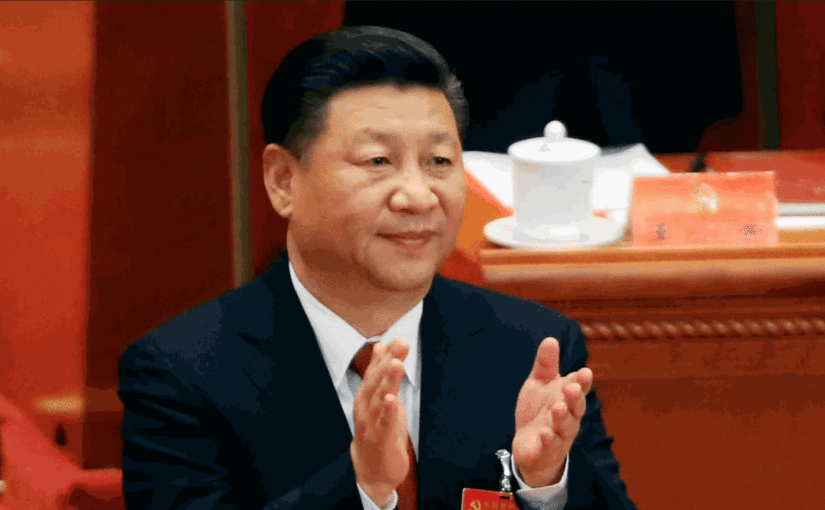
I see this level of kind restraint being practiced by China while the United States thrashes, crashes, accuses, arrests, and bans the Chinese and their products. China just sails on, politely nodding and being pleasant.

However, you can rest assured that China is not a “push-over” and have made what ever preparations they feel is necessary to suppress American aggression. And that is the surrender technique. It is one where you are in control, and where you control the timing, the battlefield, the methods of warfare all with a singular objective.

Do not be so sure that the United States is as strong, and as powerful and as capable as it appears. Nor should you believe that China is a timid and as weak and “limp wristed” as it appears either.

Do you want more?

I have more posts in my Life and Happiness Index here…

Life & Happiness

Articles & Links

You’ll not find any big banners or popups here talking about cookies and privacy notices. There are no ads on this site (aside from the hosting ads – a necessary evil). Functionally and fundamentally, I just don’t make money off of this blog. It is NOT monetized. Finally, I don’t track you because I just don’t care to.

To go to the MAIN Index;

Master Index

.

  • You can start reading the articles by going HERE.
  • You can visit the Index Page HERE to explore by article subject.
  • You can also ask the author some questions. You can go HERE .
  • You can find out more about the author HERE.
  • If you have concerns or complaints, you can go HERE.
  • If you want to make a donation, you can go HERE.

Please kindly help me out in this effort. There is a lot of effort that goes into this disclosure. I could use all the financial support that anyone could provide. Thank you very much.

[wp_paypal_payment]

Whether through a purr, a kind word, or simply being present, your actions ripple outward, touching lives in ways you may never fully understand

It almost causes me pain to admit this, but the most ridiculously good looking person I’ve ever met was my first husband.

I can’t even say he was the devil incarnate or anything. He did not abuse me.

He was actually a nice guy. He wasn’t perfect, and he had his moments, but he was a generally good person.

However, he was also inordinately self centered and what bothered me the most was that the MF never stopped making noise!

He was constantly talking, singing, whistling, chirping…all sorts of sounds came out of him. Nonstop.

That was in addition to the tv or music he constantly had blasting.

I couldn’t take it anymore!

I’m a quiet person. I never make much noise.

I don’t talk a whole lot. I speak concisely.

I don’t whistle. I can’t.

I don’t chirp. I’m not a bird.

I don’t sing. I might get hurt if I subjected someone to that level of catterwalling, and rightly so.

I’m just quiet and peaceful.

People thought I was joking when I told them the main reason I wanted to divorce him was because I wanted peace and quiet in my life, but it was true.

With him, it was constant noisy chaos.

ETA: Someone asked a very fair question: was he quieter before we were married? Actually, yes, he was. He was always a bit of a talker, which was okay with me because I had always been criticized for being “too quiet.” It was as if we complemented each other that way. He wasn’t as bad about the extra noises, like whistling for example. However, as he got older his noise-making gradually got worse. That’s one thing that makes me think it might have been an anxiety disorder.

ksnip 20250924 090233

One thing that is very unique when studying at Cambridge (or Oxford) is the formal hall tradition. Have you ever heard of formal halls?

Cambridge University consists of 33 colleges. Each student is a member of one of the colleges. Each college has its own kind of ‘small campus’. There is a student dorm, security guard office, classrooms, church, and formal hall.

What is a formal hall?

Did you know that in the Harry Potter films, students all eat in long rooms at the beginning of every year? So JK Rowling got the idea from formal halls in Cambridge and Oxford. Formal hall is a large dining room commonly used by students. Usually this room is hundreds of hundreds of years old.

What’s special? Dinner at the formal hall or what is known as the Formal Hall Dinner (FHD).

Usually the college will issue a dinner schedule at the formal hall every week. Each college has a different schedule. Some every Wednesday, some every day, some twice a week.

Each FHD consists of 3 food courses. Appetizer, main course, and dessert. The price is not that expensive, from 100–200 thousand rupiah for 3 courses. In FHD, students are required to wear a toga. Professors sit at different tables with students, referred to as high tables. The table is located higher than the student table. Just like in Harry Potter.

My Indonesian student friends and I at Cambridge posed at FHD.

Before eating, a prayer is usually recited by one of the professors in Latin. All students must stand. HP prohibited. Even in some colleges, there are no lights in the hall. There are only candles.

When I studied at Cambridge, I enjoyed inviting my guests to eat at the formal hall. They are always fascinated by the food served and all its traditions. I think this is one of Cambridge’s unique things that I miss.

Madame, the Mystic.

Written in response to: Set your story in a world where astrology and the movements of celestial bodies deeply impact the lives of inhabitants.

Julie Grenness

Jade stood gazing at her reflection. Beautiful bride, white satin, a veil of lace, stylish shoes, her face aglow. Then she paused, it as still her fantasy. Jade had bought her wedding gown years ago, as a teenager. She had chosen her veil and shoes, designed and stocked all the wedding invitations, imagined her bouquet, her hair style. It was her quite reasonable expectation that she would have been married in that frock, as soon as the handsome suitor proposed. She could visualize him on bended knee, offering his mother’s pearl and diamond engagement ring. Oh, so romantic….But no. Despite being raised in a church choir of likely young prospects, no one had ever chosen Jade to be his bride. Every now and then, she would spend yet another solo evening, trying on her wedding regalia. She had turned 33 years old. Time had passed, she had spotted her first grey hair.Jade smiled wryly. She looked like Miss Havisham in her classic text book, Dud Expectations, written by that fun guy, Chazza Dickens. Wow, that was another riveting thought. Jade’s stern father was a widower. He was even now a minor lay preacher, laying on hands, and ministering in the flock of devout Christians.Jade’s father had warned her about being immoral, and wanted her to save herself for wedlock in the church. God would send her a husband and lots of children. He could be their Grandpa Grumpy. Jade pondered on all the reasons why she was cross with God.She had dutifully trained to teach English and Religion to some very sulky teens in her church’s system. One day, she realized that the teens hated English essays more than they ever had. So, Jade promoted them all onto higher things, and resigned.She kept her teaching registration up to date, and chose to tutor reading online, which she really loved. Jade left sharing her father’s home, and rented her own simple pad. It was a bit run down, but it would do until the groom came along to rescue her.One slight hiccup, working online at home was very isolating. How could she ever meet this invisible husband? She decided to consult a local astrologer, who had quite an interesting profile. The lady, known as Madame, the Mystic, agreed to make an appointment for Jade.Madame, the Mystic, expected up-front fees. So Jade sorted that, and consulted her future prospects with the astrologer. The two chicks shared a coffee, then Madame read Jade’s coffee grounds in her cup. She then read the tarot cards, and cast an individual horoscope for her new client.”You must lighten up, and be open to love. You have a powerful guardian angel. You must take your online career to the best coffee shop in town. Make sure it has a powder room. You must smile at likely men. You must never give up the ghost. You must follow my sheet of instructions for pleasing your angel, first thing in the morning, and before you go to bed…… Love will find its own path, right to your heart, just when you least expect it. I predict the letter B will appear. “Just then, Madame, the Mystic’s dog wandered across this site of prophecies. His name was Golden. He was also known as having psychic energy. Why, he had even told Madame what his name was, by communing with his owners’ third eye. He wagged his tail, as he sat down, and offered his paw.Madame, the Mystic, spoke again. “Look ,Golden gives you his paw of emotional support. I have a sale on Tarot cards, consult my daily horoscope for your true love, to guide you for all your happy days ahead. Plus here is my sister Charlene’s phone number. You also need her to direct you in fashion and colorful zen. She will provide a color palette, personally tailored. It is not any woman’s job to fix men. Be aware of any sign and symbol of friendship, Maybe you need a pet to share your future, always there to welcome your nurturing heart. Got to love a puppy!”Jade did a quick think. “I don’t need a puppy. I want to meet a man to love.” The mystic astrologer spoke again…..”Peace will flow, consult your guardian angel, always there in each awakening dawn. You must position yourself seamlessly for love, and be grateful for the graces that appear. I advise a weekly consultation. Here is your next appointment. I shall be your guide on the side!”Jade left the astrologer, slightly bemused. Within no time, astrology was her world. She met Charlene, spent some funds on new threads, dressing each day according to her horoscope and personal palette. No more grey and brown sensible clothing, all was aqua, yellow and bright. Her hair was tinted, with blonde tips, her make-up was featuring her eyes, sparkling with hope.

Jade now awoke half an hour earlier, just to greet dawn with her guardian angel. She rehydrated with coffee, interpreting her coffee cup, making her bed, tidying her clutter, practicing her new skills in tarot cards. Once per weekend, she rose and changed her sheets, polished and mopped, flung open the windows, and lit her sage smudging. She wafted the aroma through her flat, opened doors. She still did not need a puppy, this guardian angel was demanding enough.

Jade had not, of course, told her father, who was called Bernard. The astrologer had got that bit right. She was getting crosser with God on a daily basis, smiling at strangers was not very effective. She was getting some very funny looks at the coffee shop, as she taught her students. Still she could not fix men, as astrology states.

Life took a turn for the worse. Bernard phoned, asking Jade to take him to his appointment at an oncologist. The news was dreadful, he had stage four tumors, riddled with cancer. His prognosis was very grim. Bernard was not as upset as Jade. He told her was grateful for all the blessings his Lord had granted him during his days. Treatment was planned, so he rapidly became an in-patient at an oncology unit.

Jade and the church people visited him regularly. In between tutoring online, she made a daily pilgrimage to her father’s bedside. He went downhill very quickly, the chemo was futile. Jade had been brought up with filial piety, but inside, she was now furious with her father’s divine Lord. How could this happen to such a faithful believer?

One grey morning, while channeling her guardian angel, her tarot cards finally showed a pair of lovers. “Yeah, right.” Jade wondered, but she was now a keen follower of astrology. At her father’s bedside, she held his hand .She felt that she was never quite good enough, never met a husband, never had his grandchildren to love and cherish.

Bernard suddenly opened his eyes, he was lucid for a while. “I am so proud of you, the apple of my eyes,. You are so bright and loving. I want you to got to the chapel and pray, like you used to. God has a plan for every one of us. I shall always be loving you. This journey goes on, true love.” With that, he breathed his last, and smiled his way to eternity.

Jade was devastated. The nurses were summoned, she walked to the chapel, frozen. She sat, silently yelling at God, Jesus, the holy church, her guardian angel. More than cross, angry. She nearly kicked a hole in the church walls.

But she was well-behaved,. Not praying, just recalling some happier times with her father. As she sat in the back pew, not doing any knee mails, she felt a hand touch her shoulder. She glanced up, meeting the eyes of her father’s junior oncologist. “These things happen, ” he told her, “Look, I have seen some mysterious things here, stranger than anyone can perceive. I took a photo of your father’s monitor, as you were holding his hand.”

Jade looked at his phone, there was an image of an angel, with wings. “Is this possible?” she asked. “Can I send it your phone?”asked Dr. Ben, that was on his name tag. “it is a comfort for you. You have your own guardian angel.” He laid his hand on hers. They swapped phone numbers, and Jade soon had a miraculous image of her own guardian angel.

Nearly eighteen months later, Jade sat in the chapel. Dr. Ben had given her his paw of emotional support, and that was not all. She did have a white wedding, but not in that fancy dress, simple, fitting, respectful. His name did start with a B, after all. She cuddled their brand new baby son, healthy with a good set of lungs already. Maybe she wasn’t so cross with the greater powers after all. Madame, the Mystic, was spot on. Jade had been open to a nuanced understanding of her guardian angel, and the theory that love will find a way.

Dr. Ben sat beside her. Their baby boy looked like Jade’s father, and himself. “Welcome to the world, little Bernard Benjamin……” A journey that continues for everyone. ……

JK Rowling is not James Joyce, but she’s still a genius.
Her genius lies in two places.
#1, understanding that her audience is predominantly children.
#2, writing her books for a child’s point of view.

As an adult, I read the books and watched the movies. I constantly thought to myself “that’s so silly, if they would just say why the kid used the wand all the problems would be solved” or “That’s so silly, a real adult would never act that way.”

But that’s the genius. To a ten year old, the world seems that way. The world seems unfair, it seems arbitrary it seems like no one asks them what they think, no one listens to them when they do, and no one accepts the child’s motivations or feelings. The world seems very adult dominated and kids have no agency.

Classic example? The very first book. Harry and his friends are attacked by an troll in the bathroom. The monster is trying to kill them. They use the only weapon available to them, their wands. They manage to fight off an attack that surely would have resulted in their deaths and then what happens? They immediately get scolded for fighting the troll.

Like, seriously? They would have died. But the adults seems to take no heed of this (completely ignoring their own failure to protect children in the castle) and they get dressed down for essentially saving their own skin.

It doesn’t make sense to us, but it makes sense to kids, because to them that kind of stuff happens every day. That’s why it appealed to them immediately, it was a reflection of the world they think they live in, but these characters have agency.

Lemon Cream Chicken

4a3ee4b986289caa7bfae5d45404aea6

Yield: 6 servings

Ingredients

  • 1/2 cup + 1 tablespoon all-purpose flour, divided
  • 1/2 teaspoon salt
  • 1/2 teaspoon pepper
  • 6 boneless skinless chicken breast halves
  • 1/4 cup butter, cubed
  • 1 cup chicken broth
  • 1 cup heavy whipping cream, divided
  • 3 tablespoons lemon juice
  • 1/2 pound fresh mushrooms, sliced

Instructions

  1. In a large resealable plastic bag, combine 1/2 cup flour, salt and pepper.
  2. Add chicken and shake to coat.
  3. In a large skillet, cook chicken in butter for 8 to 9 minutes on each side or until juices run clear.
  4. Remove chicken and keep warm.
  5. Add and broth to the drippings. Bring to a boil over medium heat; stir to loosen browned bits from pan.
  6. Simmer, uncovered, for 10 minutes or until broth is reduced to 1/3 cup.
  7. Stir in 3/4 cup cream, lemon juice and mushrooms.
  8. Cook over medium-low heat for 5 minutes.
  9. Combine remaining flour and cream until smooth; stir into skillet. Bring to a boil; cook and stir for 2 minutes or until thickened.
  10. Return chicken to skillet and heat through.

Did you see Russia and or China messing around running military drills on the other side of the world? Arming its allies in the Western hemisphere? No? After Trump is done, China might well have some allies in the Western hemisphere.

Why does Washington have a military budget larger than the next 13 nations combined? And a national debt 72 times greater than that of Russia? Here’s why.

I have driven a Tractor trailer combo for 15 years.. Five years was over the road ( OTR ).

Pros: More space, comfortable sleep, better shower, more relaxing

Cons: Pain to park at most hotels, expensive and wasteful

It does happen though. My first gig was team driving with another driver who lived in another state. We were required to go out 3 weeks and then get 3 days off. Since we lived in different states, we took turns to where we would spend those 3 days. It was either stay in the truck 3 days and do nothing but read and sleep, or stay in a hotel ( that allowed trucks ). I tried staying in the truck ( cause I’m cheap ), but that really sucked…so I did the hotel thing. It was bad enough that I was out 6 weeks, 3 days away from my family at a time. The few other times I did the hotel thing was doing 34 hour restarts in Las Vegas, and when Houston had an NFL playoff game. ( so I could drink beer and watch ).

Sir Whiskerton and the Purr of Happiness

Or: When a Kitten’s Purr Becomes a Superpower


Introduction

Dear reader, prepare for a tale of warmth, whiskers, and the wondrous power of purring. Today’s story follows Ditto the Echoing Kitten as he discovers that his tiny purr holds immense power—not just to comfort himself, but to bring joy to others.

With guidance from Sir Whiskerton, Ditto learns an important lesson: “A cat’s purr is the sound of a happy heart.” And when a sad piglet loses its favorite toy, Ditto’s newfound understanding transforms the farm into a place of laughter and light.

So grab your coziest blanket (and perhaps a squeaky mouse toy), as we dive into Sir Whiskerton and the Purr of Happiness.


Act 1: The Sad Piglet

It was a quiet morning on the farm when Ditto noticed something unusual. Porkchop’s youngest piglet, Peppa, sat alone in the mud puddle, sniffling softly.

“What’s wrong?” Ditto asked, tilting his head curiously.

“I lost my favorite chew toy,” Peppa whimpered. “I’ve looked everywhere!”

Ditto’s ears drooped sympathetically. He wanted to help but wasn’t sure how. That’s when Sir Whiskerton appeared, adjusting his monocle with a knowing smile.

“Ah, young Ditto,” Sir Whiskerton began, “sometimes the best way to help isn’t with words—it’s with actions. Or in your case… with a purr.”


Act 2: The Lesson in Purring

Sir Whiskerton led Ditto to a sunny patch beneath the old oak tree.

“A cat’s purr is no ordinary sound,” Sir Whiskerton explained, settling into the grass. “It’s the music of contentment, the hum of happiness. And happiness, my dear apprentice, is contagious.”

Ditto blinked, processing this wisdom. “So… if I purr, it could make someone feel better?”

“Precisely,” Sir Whiskerton replied. “Your purr has the power to soothe, to cheer, to remind others that they’re not alone.”

Encouraged, Ditto practiced his purr, which started as a faint rumble but grew stronger with each try. By the time he finished, even the nearby butterflies seemed to flutter more cheerfully.

“Excellent!” Sir Whiskerton praised. “Now, let’s see if your purr can lift Peppa’s spirits.”


Act 3: The Power of Purring

Ditto approached Peppa cautiously, his tail twitching nervously.

“Peppa,” he said gently, “can I sit with you for a moment?”

Peppa nodded, still sniffling. Ditto curled up beside her and began to purr—a soft, steady hum that filled the air like a lullaby.

At first, nothing happened. But then, Peppa’s sniffles slowed. She leaned closer to Ditto, resting her chin on his furry back.

“That feels nice,” she murmured, her voice lighter than before.

Soon, Peppa was smiling again, giggling as Ditto playfully batted at a fallen leaf. Even Sir Whiskerton couldn’t resist joining in, offering a dignified purr of his own.


Act 4: A Happy Farm

Inspired by Ditto’s success, the other animals gathered around to share their own ways of spreading happiness.

  • Bessie the Tie-Dye Cow: “I moo soothing melodies!”
  • Ferdinand the Duck: “Quack jokes—are timeless classics!”
  • Porkchop the Pig: “Mud baths—for everyone!”

Even Chef Remy LeRaccoon arrived, holding a tray of suspiciously glowing muffins.

“These are Happiness Muffins™,” he announced proudly. “Guaranteed to spread joy—or indigestion!”

The animals exchanged wary glances but couldn’t help laughing.


Reflection Scene

As the sun set over the farm, Sir Whiskerton addressed Ditto privately under the stars.

“Today, you learned a valuable lesson,” he said, sipping a cup of moonlit tea. “Happiness is contagious—spread it whenever you can. Whether through a purr, a kind word, or simply being present, your actions ripple outward, touching lives in ways you may never fully understand.”

Ditto purred softly, feeling a warm glow in his chest. “I like making people happy,” he said.

“As do we all,” Sir Whiskerton replied, smiling. “Now, go rest—you’ve earned it.”


Post-Credit Scene

Chef Remy unveiled his newest invention: Glow-in-the-Dark Purring Powder™, designed to make any animal’s purr visible (and slightly radioactive).

“These are safe, right?” Doris asked nervously.

Remy grinned. “Only slightly.”

Cue horrified squawks.


Moral of the Story

Happiness is contagious—spread it whenever you can.


Best Lines

  • “A cat’s purr is the sound of a happy heart.” – Sir Whiskerton, imparting wisdom.
  • “That feels nice.” – Peppa, rediscovering joy.
  • “Guaranteed to spread joy—or indigestion!” – Chef Remy, ever the optimist.

Key Jokes

  • Chef Remy’s glowing muffins add absurdity to the mix.
  • The idea of “radioactive purring powder” sparks both curiosity and concern.
  • Sir Whiskerton’s dignified purr contrasts hilariously with Ditto’s enthusiastic attempts.

Starring

  • Sir Whiskerton (Wise Mentor/Feline Philosopher)
  • Ditto the Echoing Kitten (Purring Prodigy)
  • Peppa the Piglet (Sad Sniffer/Turned Smiler)
  • Chef Remy LeRaccoon (Mad Scientist of Snacks)

Summaries

  • Moral: Happiness spreads like ripples in water—start small, and watch it grow.
  • Future Potential: Could Ditto become the farm’s official “happiness ambassador”? Or will Chef Remy invent a way to bottle purrs?

Until next time, may your hearts be happy and your purrs be powerful. 🐾

In my experience, which coincides with that of others, this is what happens:

You can safely take a break of up to three weeks without noticing any loss of strength or muscle. So if you train consistently and it’s time to take a well-deserved vacation, relax, enjoy yourself, and just forget about your muscles.

I promise you that this break will be beneficial, well-deserved, and that you will come back stronger.

Most people train too much and simply don’t understand the importance of rest and recovery. Your body needs rest to grow. It’s like a plant that needs water regularly to grow. Watering it twice a day won’t make it grow faster. In fact, it can drown it.

And I bet you, as an enthusiastic learner, are overworked. I have no doubt about it.

After three weeks, you’ll start to lose some strength, but it won’t be dramatic until much later. You can always resume training, and if you’ve experienced any loss, you’ll be back to normal in a matter of days.


As for maintaining muscle, you can do it by training just one third of what you used to train while progressing.

So you could train once a week instead of three. Or you could do one set per exercise instead of three.

Good Lord No😁!!!!!!

The K Visa is meant for the BEST and MOST SKILLED TALENTS in critical emerging areas of technology

China has 14/15 year olds who can write quality code and China has hundreds of part time code monkeys (Coolies) who work 30 hours a week and make 7000 Yuan a month writing code part time

Chinese have their own Business Managers within their own domestic markets

They don’t need too many migrants for this work

They want the best brains!!!!

This includes

Postdocs in

  • Applied Physics
  • Semiconductor Engineering
  • Machine Learning
  • Nuclear Physics
  • Astrophysics
  • Biochemistry
  • Artificial Intelligence
  • Aerospace Engineering

Post Graduates keen to pursue Industry oriented Research

Graduates interested in Design and Fabrication


Opportunity for Indians

Indians would find China too competitive compared to the US

You need to be on your toes

The Language is a major hurdle as even in the “English Designated” Campuses , you need a minimum HSK 2/3 to survive and a translation device

For Indian Veggies , life is an absolute nightmare. Finding Vegetarian food on campus is not difficult but it is 90% Tofu, Bok Choy & Winter Melon Soup with Noodles & Black Soy Sauce 😁😁😁😁

Within 3 months you either become Non Veg Or suffer


Target for the K Visa

The K Visa targets not Indians but talents in BRI countries

For instance in 2024 The largest group of applicants for STEM related Resident Permits in China were Indonesians & Malaysians