
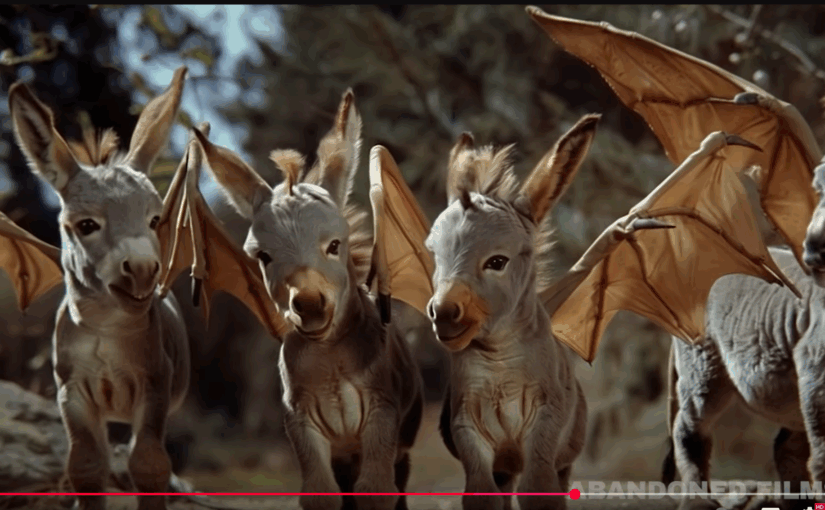

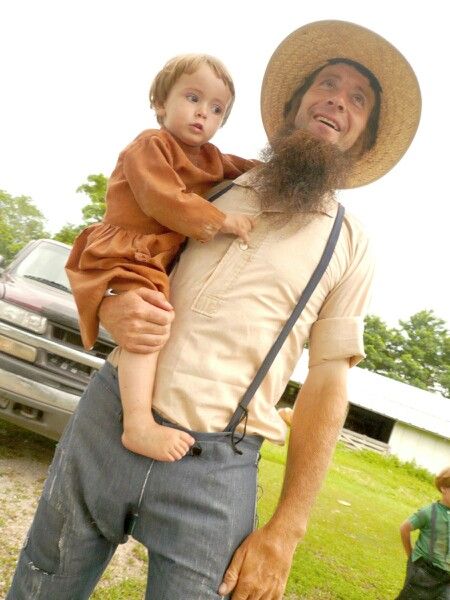
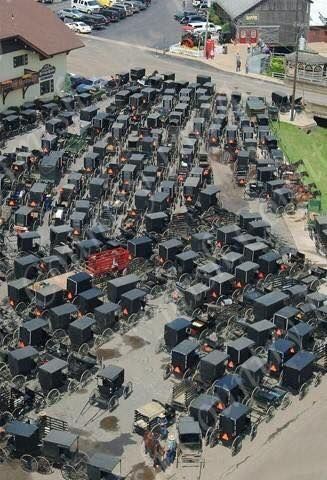
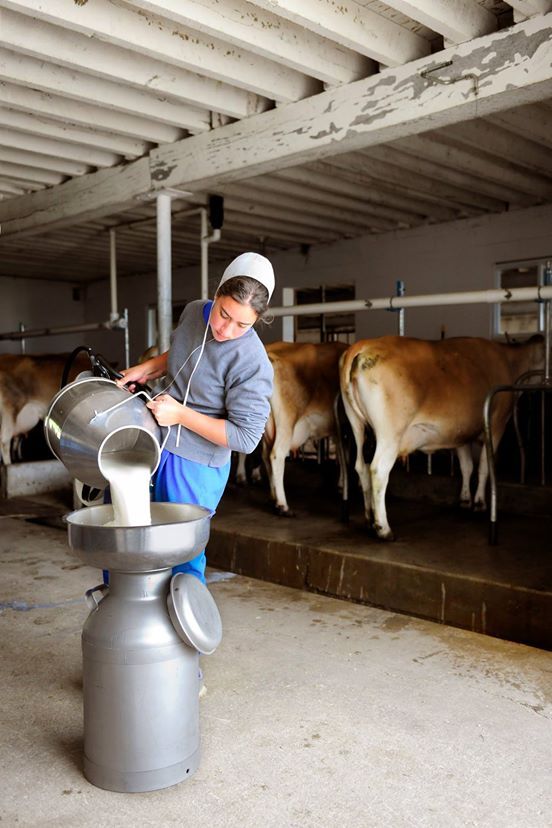
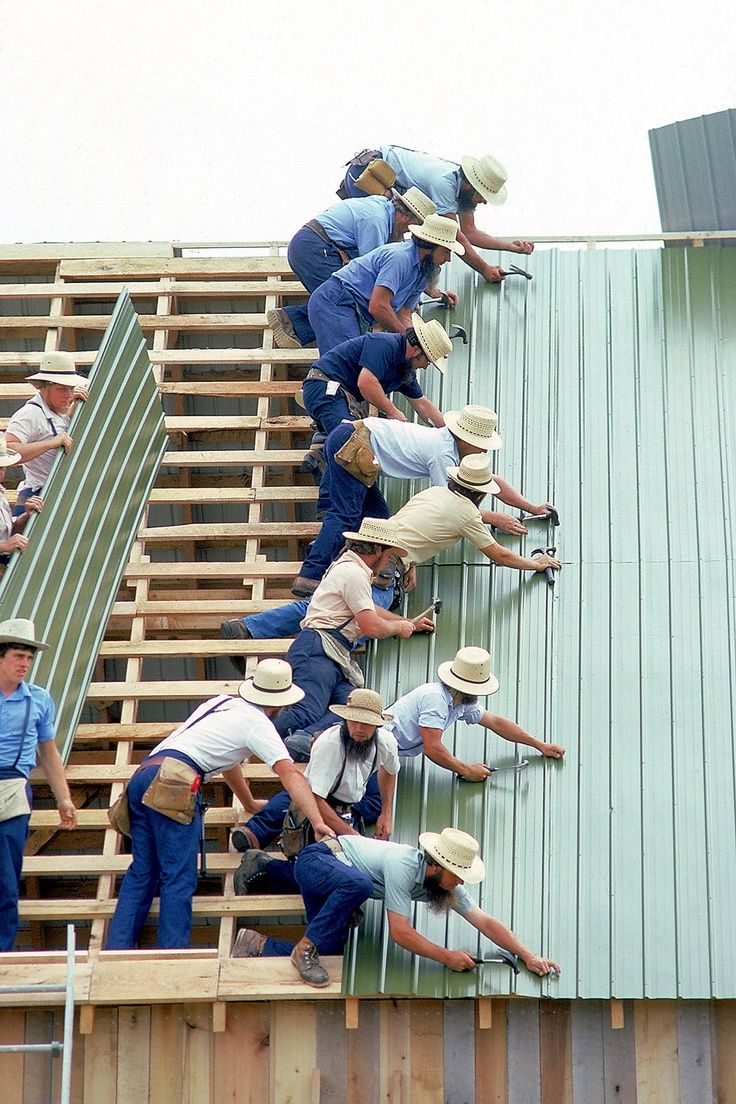
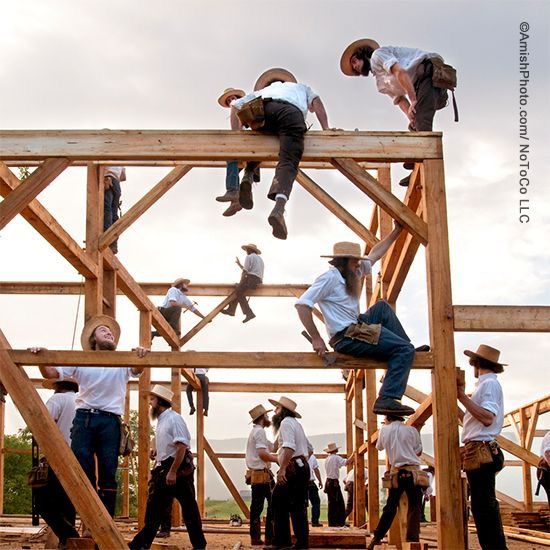
I grew up in Western Pennsylvania and there was one thing that all of us were exposed to… it was the Amish and Mennonite culture. It was everywhere.
Oh, they kept to their selves, but were nice and relaxed and friendly. They lived simply and often strangely, like the time (that I will never forget) when I watched Amish rebuilding a bowling alley building (West Kittanning, PA), bare feet and chainsaws.
No shit.
They were there wearing jeans, and bare-feet, and a white shirt just casually walking holding a running chainsaw ans they hopped from beam to beam on the exposed rafters.
Sheech!
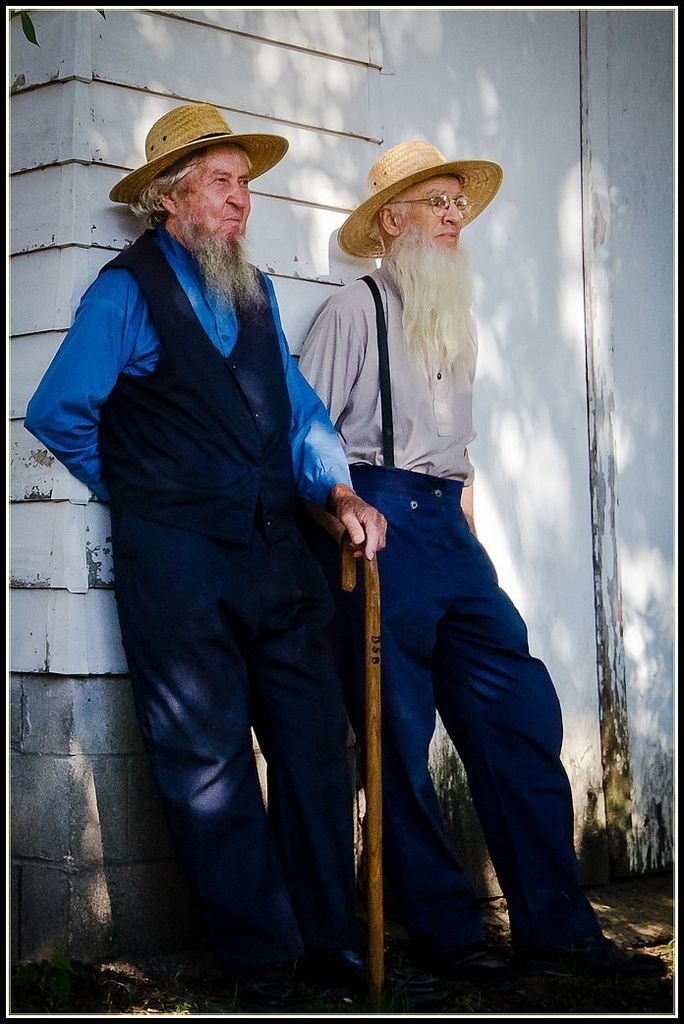
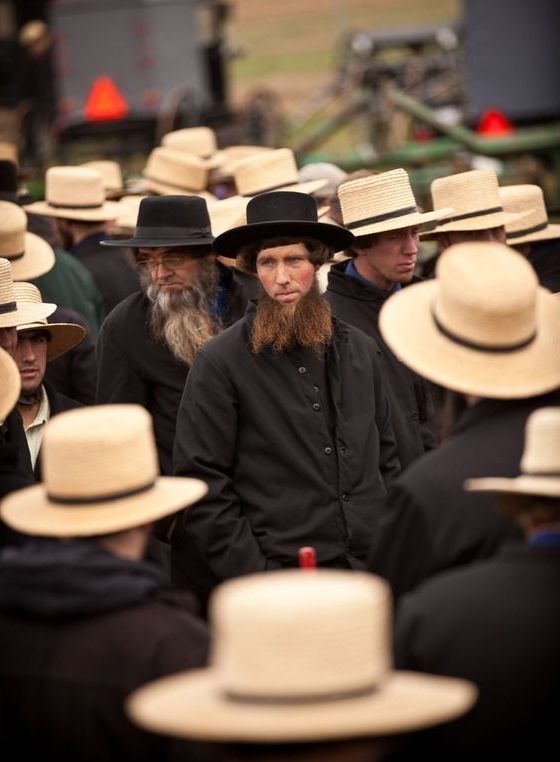
Today, let’s have a tribute to these Amish and Mennonite folk…



Today…
What kind of house do you want to live in when you are old?
Small house somewhere near the sea. Tin roof, don’t care. No cable TV. Go to the local bar and watch TV from there.
Somewhere windy, sunny, but low humidity. Never surfed in my life, probably never will, but I dig the chill vibe of Mexican, Portuguese and Spanish surfing towns.
Look, I’m very straight — the thought of having sex with men would turn me into a lesbian if I was a woman — but I like sunny pastel “gay” colors. Give me a little porch, a dirt patch, some lavender plants, cactus and aloe outside, a mile or two down the beach, away from the popular beaches and the drunks and the people who can’t live without crashing noises, but not in cranky isolation. Then one day, a nice woman who sells aromatherapy treatments will come wandering down the beach looking for a quiet spot in the beach grass, and we’ll be like:
“Hello.”
“Hi!”
Don’t even care what continent it’s on. Just something in this general ballpark:
No bullshit fancy construction. I prefer wood to shoddy concrete, but whatever’s cheap. Half an acre alone will cost you a billion dollars by then.
Coffee, birds, the freedom to smoke a cigar if I want to. (Honestly, I don’t really care if I live past 80. I completely agree with Churchill: why forgo the pleasures of life to spend your last years in a miserable nursing home in Coventry?) I want to cook steak, enjoy some vino, have a cigar if I feel like it, hear the wind in the pines, some distant surf, die in freedom, then whatever’s left of me, throw it into the wind. I like wind. Or bury it under a lemon tree. Fine. But if you bury me in my hometown, I will come back and haunt your ass for the next 50 years.
Can’t be too close to the surf, though. Hearing water makes me have to pee. I can’t even camp near a stream without having to pee all night. As I get older, I assume I’ll have to pee more often, anyway.
I don’t actually like this house, but I’d consider building a house about this far from the sea, so I don’t have to pee all the time:
Also, by that point, I don’t want to have very many belongings. My dad died two years ago at age 71 — at home, not in a hospital hooked up to tubes, which would have annoyed him intensely — but I spent way too long getting rid of his stuff. Don’t ever want to put anyone through the torture of having to burn 50 years of accumulated tax returns, gas station receipts from 1982, then drag a bunch of South Dakota tourist brochures from the early ’90s to the recycling center. All that crap. The Vikings used to burn a man’s belongings with his corpse. The Vikings were onto something. My dad’s fiery farewell would have been a strange one: throwing 15 or 20 old hammers onto the pyre with him. Don’t put your kids through that.
If my stuff won’t fit into a house about as big as the pictures in this answer, I’m giving it away or burning it.
In 200BC the Han Empire was forced to submit as tributaries to the Xiongnu. What developments were done in the Chinese military to allow them to eventually counter and defeat the nomads?
The war between the north and south had always been a bad business. It’s like fighting in Afghanistan or North Korea, provided there is no oil or petrodollar to be considered. The money you spend by conquering and governing there would be more than the tax you could collect. If not for self-defense, there was little interest in the south to attack the north. What’s worse, the nomadic tribes specialized in guerilla tactics. When your army was lucky enough to approach to their bases, they would be long gone or escape.
So what the Han Empire did to accomplish was as following:
1: Using barbarians to check barbarians: Using the imperial marriage to ally with certain nomadic tribes, intervening in their successor civil wars, supporting the weak tribes against the strong one, recruiting the barbarian soldiers and spies, plotting political schemes and deploying assassins to commit the regicide.
2: Destroying the supply: Setting up the grass burning unit every year to burn the grass in the north, poisoning their water, raiding all the horses, cows and sheeps and of course population they can find to forcibly resettle into the Chinese territory to reduce the nomadic population, conquering the Northwestern region to set up Western Protectorate to cut off the Nomadic tribe’s backup plan (the Xiongnu can lose to the Han but makeup their loss and finance their futural plan by raiding Xinjiang and Central Asia).
3: Militarily (to answer the question here), the strategy included assembling the elite cavalry, absorbing barbarian’s tactic, developing counter measurement against the nomadic unit, such as using the anti-cavalry and anti-archery horse vehicle to cover up the infantry (dropping the vehicle and let the soldiers hide there to evade the incoming arrows), ordering every soldier, though there were still standard archers and crossbowmen, to carry a bow/crossbow to group firing before engage in the combat rather than dividing them strictly by specialization like the Roman army for instance.
The infantry archers had more advantages than horseman archers such that with enough cover and suppressing fire the nomadic army’s hit and run tactic didn’t work here. So the nomadic army had to charge but once they did the objective of the Han army was accomplished because that was what the Han commander wanted eagerly. The Han government would distribute every soldier a sword/blade (and a spear/halberd, shield depending on the profession), and according to social productivity and custom since the sword/blade was as cheap as the smartphone today, every soldier would also carry one/two additional homemade/purchased nicely crafted swords/blades. So in close combat, Han soldiers had far more advantages than the Xiongnu soldiers.
The nomadic army was frightened about the stagnation of war because of the very nature of their military and social, political structure, and once they hesitated/retreated the elite cavalry of the Han army with intelligence support can flank or chase them all the way till the Homebase.
This is a very ideal description of course. The real situation was far more complexed than that.
The warfare between the Han Dynasty and the nomadic tribes in the north had two stages.
1: The first stage was mostly about the pure war which was very costly, though achieving greatly tactically speaking. Xiongnu was badly wounded but they could always respawn and have more material motivation to attack. The Western Han Dynasty can win but financially it is unsustainable.
2: The second stage emphasized more on soft power and precise striking and targeting. The Han Dynasty created a split between the Northern and Southern Xiongnu and then bringing the latter on board, striking the Northern Xiongnu tribe with several crucial and also historically memorable and legendary victories. The Eastern Han Dynasty successfully created a big fat political vacuum in the region, resulting in the fall of Xiongnu and of course the rise of Xianbei and several other tribes.
Both stages were important because without the first stage there would be no second. But without the second stage, the first stage’s total war would be financially bankrupted.
The rise of Xianbei in that period, as a result of the decline of Xiongnu, has been usually ignored but the Xianbei Empire was temporarily more powerful than the Xiongnu Empire, conquering the Northern Xiongnu’s territory. Till the beginning of the Yellow Turban Rebellion in 184, Xianbei basically had rebuilt the Xiongnu Empire and delivered several catastrophic defeats to the Eastern Han regime, raiding the south. What prevented that Xianbei Empire from continuation and expansion but collapsed shortly was again 1) the internal split for succession, 2) successful counter measurement including war, alliance, check and balance, precise striking, assassinations from the Eastern Han government (or maybe the Warlord Yuan Shao, Gongsun Zan, Cao Cao were the better terms).
Eastern Han warlords had more resources and intelligence to deal with the nomadic tribes than the central government did because of their advantage of localization over the corrupted and inefficient bureaucracy.
The Western Qiang and Eastern Qiang (light pink) in detail. Crossing lines indicated the entangled regions due to the Han-Qiang war.
Additionally, the Qiang tribes in the Northwest post a bigger threat than Xiongnu in the second stage. From the mid-period of the Eastern Han Dynasty all the way till 184 CE, Qiang and Xianbei rather than the shattering Northern Xiongnu’s remains were the major enemies of the Eastern Han Dynasty. The war (including rebellion and guerilla warfare) between the Qiang and Eastern Han lasted for 30 years and it was only resolved by the end of the Eastern Han Dynasty.
In short, the war between the Han regime and Xiongnu Empire was an essential piece but not the whole picture that determined the victory.
“COVID-19 Virus Was Created In An AMERICAN Lab!” – Jeffrey Sachs
The truth has now gone to the general public. This is the HEAD of the investigative group that studied the origins of COVID.
What kind of condition are the four Iowa-class battleships in?
Think about these four ships: New Jersey, Iowa, Missouri, and Wisconsin. They once ruled the seas long ago. Big. Loud. Powerful. Now? They’re quiet. Museums on water.
They’re clean, painted, ready for photos: they look nice. It’s not easy, however, to stay like that. Salt water eats metal. Rust spreads. Stuff grows on the bottom. Work is always needed on the USS Iowa. In 2024 the USS New Jersey had to be cleaned up during dry dock.
The engines don’t run. The big guns don’t fire. These ships can’t fight anymore.
Could we fix them? Maybe. It would take too much time, too much money. It’s like turning a rocket out of an old car. Not worth it.
They’re not weapons now. They’re stories. History. They come to gain insight into what war felt like and what life was like on board.
And these ships won’t last forever. If we don’t continue to fix them, they break. But when they are gone, so are their lessons.
How did German U-boats surrender at end of WW2? Was it done at a particular time? Did they go to specific locations? How were they informed?
Many U-boats were at sea or in port when the “Regenbogen” order was given to surrender on May 3, 1945. This was not as easy as it might sound since a submarine suddenly… (Read Full)
Egyptian Phyllo Meat Pie
“Phyllo meat pie is a delicious, savory Egyptian recipe and a staple at any gathering. Growing up, it was the first thing I went for at any dinner party, and now my kids and their cousins are the same. This recipe reenvisions the classic into rolls instead of squares, and comes together with less layering and time.”
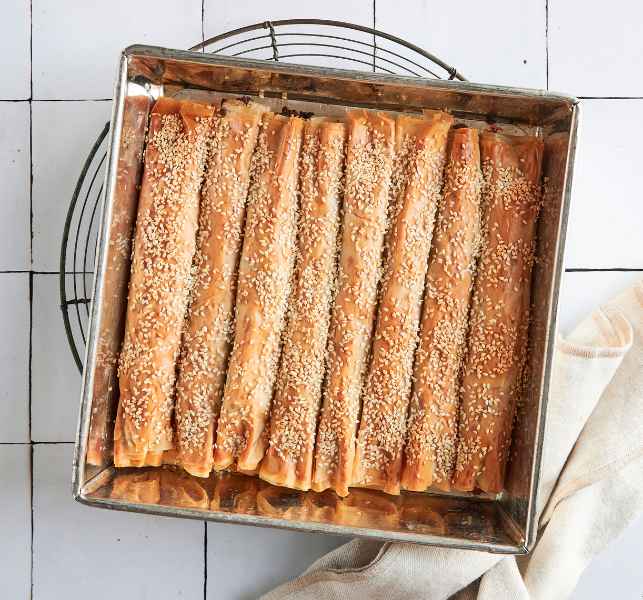
Prep: 20 min – Cook: 30 min – Yield: 8 servings
Ingredients
- 18 sheets Athens® Phyllo Dough (9 x 14 inches), thawed
- 1/3 cup olive oil
- 1 large onion, finely chopped
- 2 garlic cloves, chopped
- 1/3 cup pine nuts
- 1 pound ground beef
- 2 teaspoons baharat (or other Arab spice blend)
- 3 tablespoons tomato paste
- 1/2 bunch flat-leaf parsley leaves, finely chopped
- 1 stick unsalted butter, melted
- 1 1/2 tablespoons white sesame seeds
Instructions
- Thaw phyllo dough following thawing instructions on the package.
- Heat oven to 400 degrees F. Unroll and cover phyllo sheets with plastic wrap, then a slightly damp towel to prevent drying out.
- Heat oil in a large nonstick frying pan over medium heat. Add onion and garlic and cook, stirring until onion has softened.
- Add beef and cook, breaking up with a spoon, until browned.
- Add salt, spice blend, tomato paste and freshly ground black pepper. Cook, stirring occasionally, for 5 minutes, then add the pine nuts.
- Stir in parsley and let cook for two minutes more. Set aside to cool completely.
- Brush one sheet of phyllo dough with melted butter, then lay a second sheet on top. Brush with butter, then add a third sheet. Spread one sixth of beef mixture down the short side of the stack, then roll to enclose the beef and form one large log. Repeat with remaining phyllo, butter and beef mixture to make 6 logs in total. Place seam side down in a 9 inch square baking dish, brush with extra butter and scatter with sesame seeds. Place in the oven and bake for 30 to 35 minutes, or until golden and crisp.
Nutrition
Per serving (1 piece): Calories 524, Total Fat 32.6g, Saturated Fat 11.8g, Cholesterol 81mg, Sodium 438mg, Dietary Fiber 2g, Total Carbohydrate 36.9g, Total Sugars 4.6g, Protein 21.9g, Vitamin D 8mcg, Calcium 36mg, Iron 2mg, Potassium 366mg
Attribution
Recipe and photo used with permission from: Athens Foods, Inc.
Recipe and photo by Doaa Elkady.
What are some of the companies coming to America because of the tariffs?
One of the Japanese automakers is resurrecting one of their closed factories. That’s the only one I know of.
John Deere moved to Mexico to be more competitive on the foreign market. Boeing is considering moving to Canada so they don’t have to pay tariffs on the massive amount of aluminum they need for each unit they manufacture.
Pharmaceutical companies aren’t moving as it takes up to 5 years to plan, build, and get approvals to operate.
New factories cost 10’s to 100’s of millions to construct. They also take time to plan and build, 1–3 years depending on the size. But the steel needed to build the factory is still subject to tariffs. And building cars or equipment still needs tariffed steel to manufacture their product. No savings or freedom from tariffs.
So, to do this, you are investing significant capitol, significant time, and taking significant financial risk. And this is at a time of complete economic chaos. They don’t have any assurance that any of this will continue with any consistency. They won’t be making any moves based on the risk involved. The international market will be more stable in the short term. Trump’s fantasy will not achieve what he dreamt it would.
The Last Light
Written in response to: “Set your story in a place where the weather never changes.“
Sharon Nations Toler
“This made the third time today,” Sara thought. The rolling blackouts had become more frequent every day. Sara knew it would be a matter of time before the water and electricity would not come back on.
Suddenly, Sara heard a knock at the door. Peering out the peephole, she realized it was the landlord, Mrs. Branson, from across the hall. As Sara opened the door, she saw Mrs. Branson holding a damp handkerchief, wiping it across the curly hair plastered to her forehead.
Continuing to wipe the perspiration from her forehead, Mrs. Branson asked, “Do you have any electricity?”
“No, it just went off. It’s these rolling blackouts that the electric company has started. There seem to be more of them every day.”
Sara noticed Mrs. Branson’s anxious look as she said, “I have a battery-operated radio that we might be able to use to get some news.”
After Mrs. Branson retrieved her radio and placed it on the kitchen table, Sara turned the knob until they heard a robotic voice announcing, “This is not a test. This is the Emergency Broadcast Network. Please stay inside and keep your doors locked. There have been reports of break-ins in the area. Take all necessary precautions.”
Just as the radio announcement stopped broadcasting, Sara heard a thump from the stairs to the roof. “Mrs. Branson, did you hear that?”
With fear emanating from her eyes, Mrs Branson whispered, “No, No… I didn’t hear anything.”
Putting her finger up to her lips, Sara mouthed, “Listen.”
Thump, Thump.
With growing concern, Sara asked, “Did you lock the roof door, Mrs. Branson?”
She wrung the handkerchief and answered, “Yes, I think I did. I don’t know! It’s this heat. I can’t think straight!”
The sound from the stairs seems to be getting closer. Sara quickly checked to see if the door was bolted shut. As she listened at the door, she could hear a desperate voice coming from outside, “Can you help me? I need some water. I can pay you money.”
Holding their mouths with their hands, they crouched by the door, their backs pressing solidly against it. Afraid to breathe hard, Sara and Mrs. Branson remained quiet, hoping the man would leave if he thought no one was home. After hearing the doorknob rattle, they knew the man was attempting to force open the door. The sound of the man’s body slamming against the door echoed through the apartment, but the door held. After a long silence, they finally heard footsteps gradually moving away.
Once they were assured the man had left, Mrs. Branson’s eyes stared at the picture Sara had been working on this morning. Almost screaming, she asked, “Why are you painting the sun?” The sun’s yellow and oranges always occupy all the space in the sky. That’s all we see daily; paint something cool, a waterfall, mountains covered in snow, a night sky full of stars.”
“Why didn’t we leave like some of the others, Sara? Maybe it’s not too late.”
Sara didn’t look at her. “Because leaving would only postpone the evitable.”
Mrs. Branson exhaled deeply. “We could try.”
Sara turned to Mrs. Branson in exasperation. “Try what? The freeways are clogged with stalled and deserted cars. The gas stations ran out of gas weeks ago. The trains have stopped running. Even if we walked out, we couldn’t survive this heat.” She gestured to the blinding light outside.
Mrs. Branson strode out the apartment door without a word. Sara couldn’t help but think, “Maybe she shouldn’t have been so brutally honest, but how would lying about the situation help?”
The following day, Sara heard a timid knock on the door. She profusely opened the door to Mrs. Branson, apologizing, “I’m sorry, Sara, for just walking out without saying goodbye.”
Sara grabbed Mrs. Branson’s hand and led her over to her easel. On the easel was a painting of blue water running over a waterfall, splashing onto the gray rocks beneath.
“I did it for you, Mrs. Branson.”
“Oh, it is beautiful. I visited a waterfall like this once when I was a child. I used to stand under the waterfall, letting its cool spray surround me. I can feel it now, the water splashing on my face.” Mrs. Branson started twirling around as if she was reenacting this moment from her childhood.
Suddenly, as she was dizzy, Mrs. Branson fell to the floor. When she didn’t move, Sara bent over Mrs. Branson’s prostrate body to feel for a pulse. Sara felt an inner acceptance as she realized Mrs. Branson was gone.
It was as if, with Mrs. Branson’s death, the air in the room became heavy. Sara listened intently as the air conditioner and the fan uttered their final sound. She felt the sun blazing through the window with a harsh, intense light. Sara stared at the thermostat as it crept higher and higher. She noticed the paint of her waterfall dripping down her painting in rivulets, the blues and grays swirling together, causing the waterfall to feel as if it was in motion.
Sara heard a deep, slow creaking as she watched the paint begin to bubble and seep down the walls. The room was getting hotter and hotter, and the thermometer quit registering the temperature. Outside, the sky burned white, and the world began to melt.
Has someone ever been fired because of you?
Yes, and in the most satisfying way, too.
I live in California, which is Liberal Hell. I worked in a place that was super DEI. We had a guy come in, who changed his pronouns every…single…..day. Just so he could rage out on someone who gave him the wrong pronoun. He also is a Native American, of the Apache tribe, so he liked to use that Tribe Benefits, to argue that he’s indigenous.
So, the very next day after this guy nearly got someone else fired for using the wrong pronoun. I decided to show up that day, with new pronouns, I showed up and announced to everyone, including this dude and said “Hello, my pronouns are AH-64 Apache Helicopter today. You can use Chopper for short.” Danny (the guy) instantly began to get angry and said “that’s not a pronoun and you’re disrespecting my heritage by using that stupid pronoun.” The Manager chimed in and said “he is well within his rights to choose whatever pronoun he wants and we are required to affirm it. So please respect Choppers right to express himself.” Then Danny said “No that’s outrageous, he’s just doing that…” then I interrupted him and said “did you just call me a he? I said AH-64 APACHE helicopter, chopper for short. I was very clear with you, why are you intentionally starting trouble with me over my pronoun?” He then picked up a box and threw it at me, at which point he was promptly fired. Two days later, there was a 6 pack of Heineken on the hood of my car after work with a note from the boss saying “thank you so much, this guy was starting trouble with everyone.”
To this day, when I hear people spout off about stupid pronoun expectations. I’ll chime in with my AH-64 Apache Helicopter pronoun, and the second they laugh at it or condemn. Suddenly their ideology isn’t as important to them. To this day, I still haven’t heard from Danny, don’t care to. But, its nice to see their own ideology work against them, for a change.
Keyu Jin Explains the Current State of China’s Economy
What is the reason behind China’s decision to build a large number of aircraft carriers despite having a shortage of pilots for their current fleet of three ships?
The aircraft carrier battle group includes aircraft carriers, destroyers, frigates, electronic reconnaissance ships, hospital ships, submarines, etc., and is a weapon for ocean warfare. However, the aircraft carrier battle group has no advantage in offshore operations. The PLA’s carrier battle groups are not against Taiwan.
China has a large population and a strong ground force, a land force that no nation can match in a ground war.
China’s national defense strategy has always been self-defense and does not require ocean-going operations. Therefore, before 1998, China had not paid much attention to ocean warfare.
Until 1998, when a massacre against Chinese occurred in Indonesia, Beijing was powerless to do anything, and we can only watch from afar as our fellow communities are slaughtered.
The year 1998 was a turning point.
The occurrence of this incident has deeply irritated and pained the Chinese people.
It is said that Jiang Zemin, the top leader of the CPC at the time, was furious. He wanted to send troops to intervene, but the PLA Navy put its strength on the table:
the four modern-class destroyers bought from Russia have not yet arrived, and what they have on hand are a bunch of dilapidated small destroyers and torpedo boats. The navy does not have the capability to conduct far-sea strikes.
The Air Force is even more helpless: they only have a bunch of dilapidated J-7s and a few dilapidated J-8s. Not to mention flying to Indonesia, even flying to Vietnam is barely possible.
The Rocket Force has long-range strike capabilities, and the range of the DF series missiles is sufficient, but the huge explosive destructive power of the missiles will blow up the terrorists and the Chinese community together.
Then Jiang Zemin said that we must have an ocean-going fleet, advanced fighter jets, and an aircraft carrier battle group!
Then, China went to Ukraine to buy the scrapped aircraft carrier called “Varyag” and gathered researchers from the AVIC Group to study new fighter aircraft.
The development of the J-20 received a military order. If AVIC Group’s research is unsuccessful, a military court will prosecute AVIC Group.
At that time, the order given by the CPC to the military industrial group was: Whether you steal, rob or copy, you must develop the ocean air strike capability + aircraft carrier battle group!
The anger was vented, but the military strength still did not grow so quickly, so the Chinese had no choice but to continue doing business with the United States, selling clothes and socks, and selling their labor to work to make money to manufacture the above weapons.

· 1y
Why can U.S. citizens have two-tier citizenship while Chinese citizens cannot? Because our ocean-going navy is weak!
Before the 1960s, the PRC government recognized two-tier citizenship. For example, Indonesian Chinese held both Chinese (PRC&ROC) and Indonesian citizenship. However, this made other ethnic groups in Indonesia feel threatened, fearing that the local Chinese would become a Trojan horse for China.
After Indonesia massacred Chinese twice, in order to make Southeast Asian countries less wary of Chinese, we announced and reiterated that we will “no longer recognize two-tier citizenship.”
After May 1998 riots of Indonesia, PRC Foreign Minister Qian Qichen made phone calls to Southeast Asian foreign ministers one by one, reiterating this point repeatedly. The country is not strong enough, we have no choice.
We all remember how much help the overseas Chinese provided to the motherland during China’s war of resistance against Japan. However. We regret that this is all we can do until China is able to provide more protection for overseas Chinese.
We’re sorry! It is inevitable and unavoidable.
It’s hard to be a Chinese, and it’s even harder to be a Chinese overseas.
However, with the growing strength of China’s ocean-going navy, the social status of the Chinese in Southeast Asia in their own country is also increasing. The Chinese in Southeast Asia should feel this.
Yes, 1998 was a watershed year and China has changed very much.
Thirty years have passed and China’s economic strength has taken off rapidly.
Today, let alone three aircraft carriers, more aircraft carriers can be built quickly.
The U.S. Navy has been dominant for many years and has no other power to check and balance, so they do whatever they want in the world and bombard weak countries indiscriminately. If China has a modern ocean-going navy, it will make the US more “peace-loving”.
Judging from the cases of China evacuating overseas Chinese in recent years, competition between China and the United States will not be limited to Asia. Therefore, it is essential for China to have more carrier battle groups.
According to the plan, China will build a modern ocean-going navy in the future and equip it with at least 7 aircraft carrier battle groups.
The pilot wasn’t really a problem. China has figured out a way to quickly train pilots.
You know, the PLA did not have pilots before 1949.
But during the Korean War in 1950, a large number of pilots were quickly trained. And fought many aerial dogfights with the U.S. Air Force. The place where the Yalu River empties into the Yellow Sea in northwest Korea is called “Mig Alley” by the U.S. Air Force.
Aces also emerged from the newly established PLA Air Force of China. Among them was Zhao Baotong, the first Chinese pilot to achieve ace status.
On November 4, 1951, Zhao Baotong’s first sortie encountered a group of 24 Republic F-84 Thunderjets and shot down 2 planes. Did you know that? He had only a few dozen hours of flying experience at the time.
More interestingly, the PLA Air Force had a pilot, Zhang Taofang, who was an excellent sniper in the early days of the Korean War. He killed and wounded 214 enemies with 436 rounds of ammunition, setting a record for the highest number of enemy kills by the Chinese People’s Volunteers using semi-automatic rifles in the Korean theater. He then switched careers to become a pilot.
From the establishment of the PRC in 1949 to the end of the Korean War in 1953, there was only a short period of four years.
It was during these four years that the Chinese People’s Liberation Army Air Force was born.
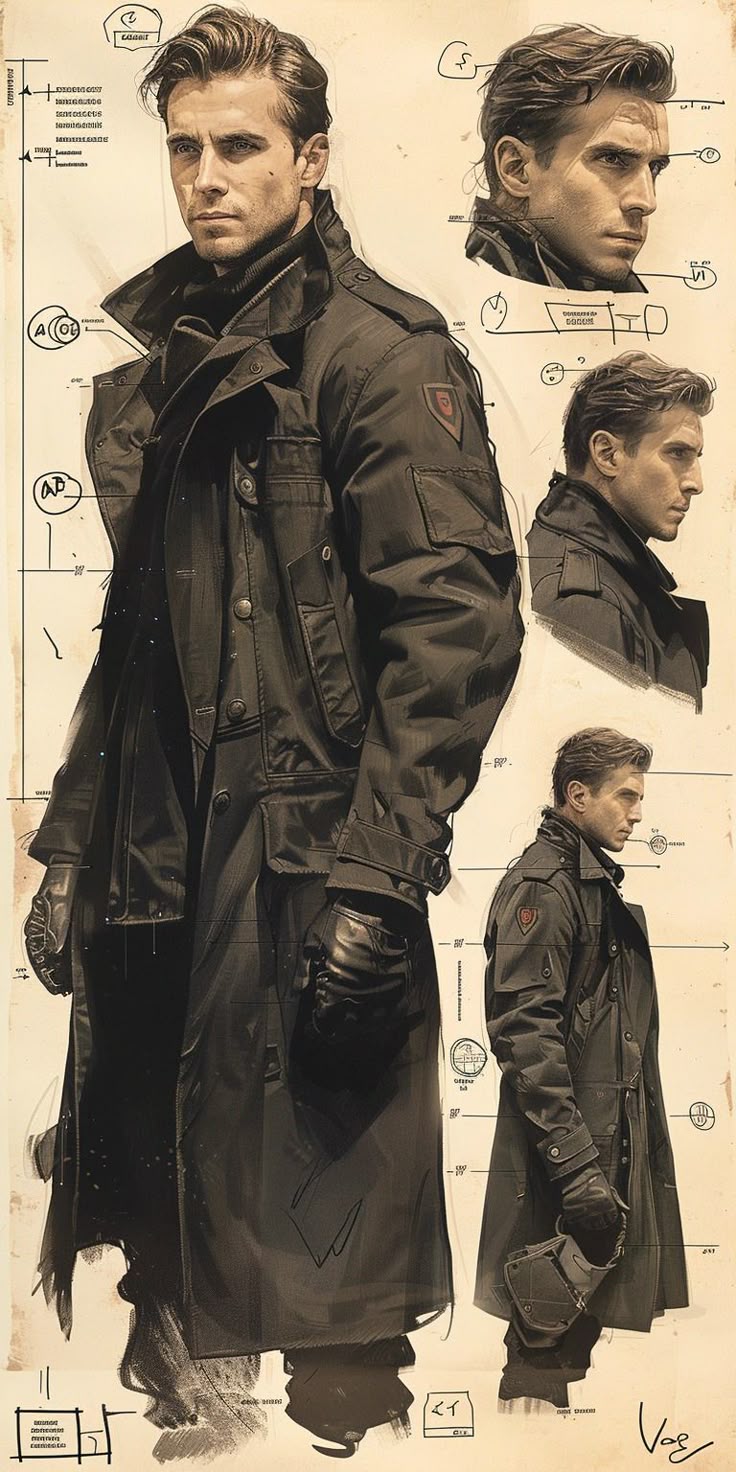
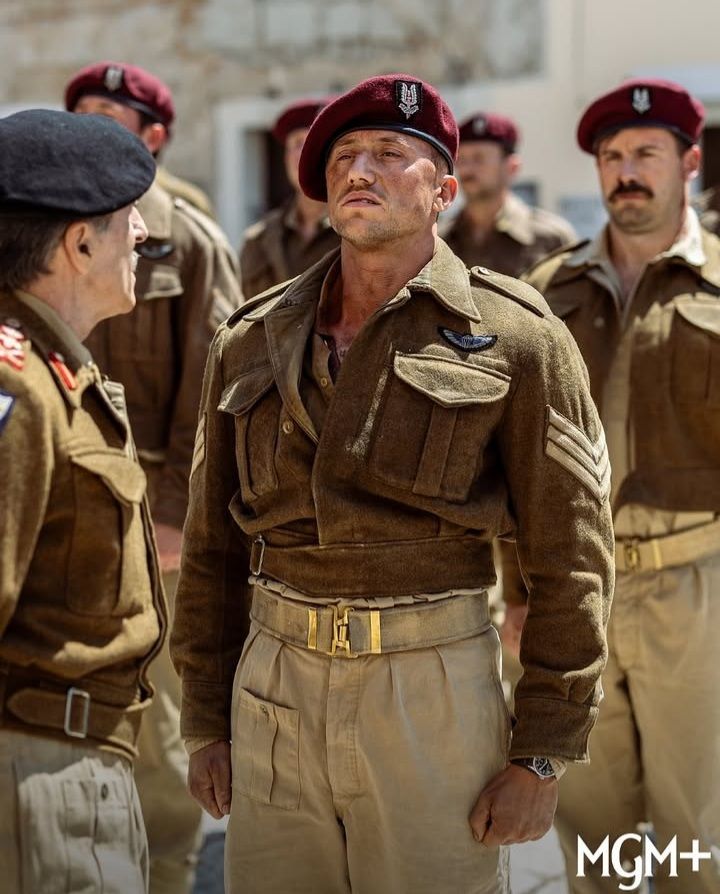
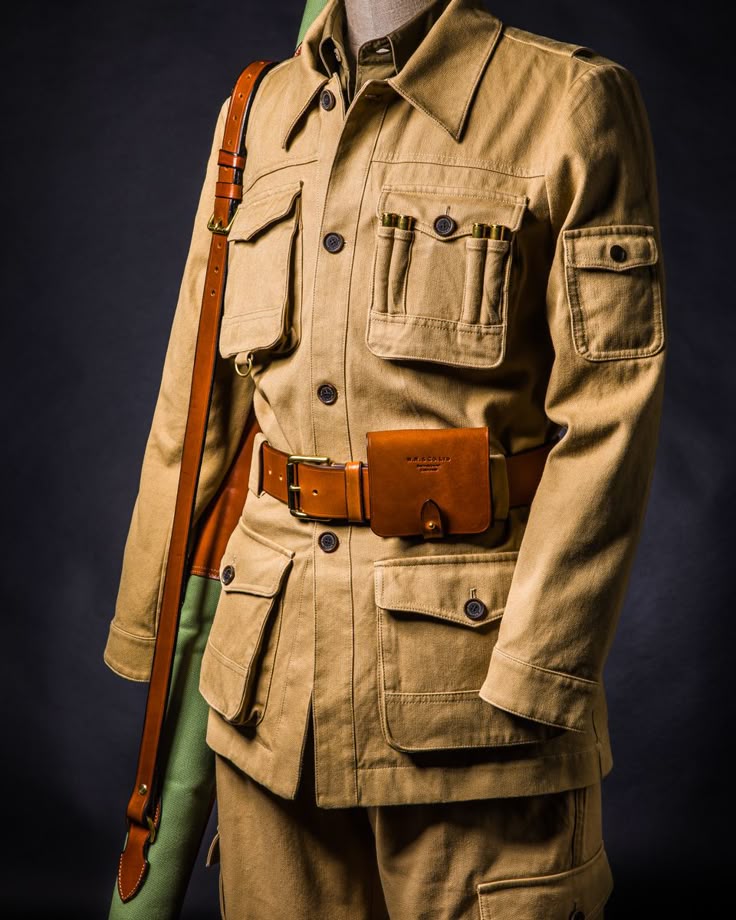
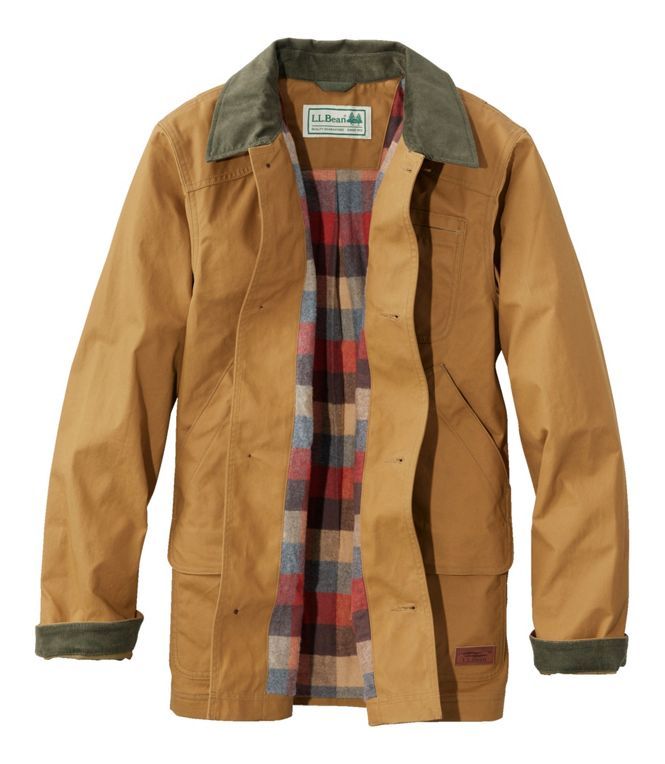
Pictures






Do you believe that Muslims shot themselves on foot because they refused to integrate into Western society, making life difficult for the locals?
In my city, there’s a modestly sized Muslim community. We’ve got, like, a mosque or two and a number of Muslims in the low to mid thousands out of a population around a million. I’m not sure we’ve got a more public-spirited group of people here. A couple of my doctors over the years have been Muslims, we were delighted to have a resale shop for baby clothing and other goods making that kind of stuff widely available to all at reasonable prices (and believe me, clothing for rapidly growing infants is a major expense) which happened to be run by a Muslim family, and there’s a Muslim guy who runs a popular restaurant which has charitable and community activities as a regular thing it does to the point where he’s racked up an immense list of humanitarian awards over the years.
To put it another way: Muslims in my neck of the woods are doing an amazing job improving society. They work towards creating a more caring, supportive community for everybody, not just Muslims. Indeed, because they’re a small minority, if you go just by the numbers, they end up helping non-Muslims more than Muslims. The only way in which they don’t “integrate into Western society” is by holding on to their religion. In this way, they’re just like most other immigrants to the US over the years and are subject to the same bigoted slanders. Different ethnic and religious groups like the Irish, Catholics, Italians, Chinese, and so on have all in their turn attracted the ire of racists and others who hate anyone who isn’t just like them and don’t respect American freedoms to choose how to live one’s own life. To the extent integration is a problem, it’s from bigots like that who say that they’re not integrating and want others to believe there’s an issue, because if you look at what Muslims are actually doing, it’s improving things and making life easier for those of us who were already here.
Something In A Storm
Written in response to: “Set your story during — or just before — a storm.“
Brutus Clement
Something in a Storm
It’s going to happen. I just know it. The air is electric, super charged, and sparking all around me. The breeze brushes up against my skin causing my arm hair to rise up. How strange. I’m looking in to the distance over the trees at the end of the meadow and there is a wall of blackness moving in while covering the grey misty sky.
If it’s cold, I can’t feel it. My senses are focused on the advancing cloud. Is that what it is? Not like any cloud I’ve ever seen before. Nothing passes through it. It blocks out all light behind it. Moving at a leisurely pace, it seems in no hurry, but still will be over me soon.
I should be frightened, but I’m not, and don’t know why. Instead, anticipation is coursing through my body. Sizzling from my toes to my fingertips. It wants to connect. I want to be whole and be wired in again. I find myself walking towards the advancing darkness.
“Blake! What the hell are you doing?”
The voice cuts through me. I stop walking.
“Get back here, are you crazy?”
Turning, I see her. She’s bundled up in a jacket with a look of concern. I don’t know why, there’s nothing to fear.
“Shelly, this is incredible. Can’t you feel it?”
“All I feel is cold, very cold.”
“Feel the fire, the electricity. It’s crackling all around us.”
“You’re talking all weird. That storm or whatever it is looks dangerous. We need to get out of here, Find some shelter now.”
“No, there’s something there. It’s waiting for me. I need to see it. Don’t you sense it also?”
“The only thing I’m sensing is that you’ve flipped out. Standing out here in the open with those thunderclouds moving in. You might as well be holding a long metal pole and waiting for the lightning to strike.”
“No, no. I’m perfectly safe, it means no harm.”
“Means you no harm?” She’s incredulous. “You’re talking as if that thing, that storm, is a person or something. It’s just a brainless act of nature, and a dangerous one at that.”
“Have you ever seen anything like it before? It’s beautiful. How can it be dangerous?”
“We’ve got to go. You’re not yourself. Not seeing things clearly. We’ve got to get inside now!”
She tries to grab me and move me towards the house only a hundred yards away. I’m stronger and break away from her grasp still moving towards the approaching wall. Defeated, she gives up with tears in her eyes as a light rain starts to fall. I love her but still have to go. There’s an urgency to stand under the cloud.
“Look, Sherry. I know you don’t understand. That you think I’m crazy. I love you, but I have to do this……” My voice trails off, I don’t know what to say. How to explain the unexplainable.
“Don’t, please don’t. You’re going to die. Please don’t.” She crying now. Helpless to stop me.
It’s really pouring down now, her blond hair is soaked. Blue, bloodshot eyes plead their case, but I can’t stop. Heart broken and forlorn. I can’t bear it anymore, tears are streaming down my face, but I have to go. I don’t understand any more than she does. The calling is thundering in my ears.
“I love you, I’ll be fine, you’ll see” I croak out as I turn and run. There’s no looking back now. Something in the storm is telling me to hurry.
The rain is coming down like a shower at full blast while a wind is rising fast. I’m running now, There is a sense of urgency as it’s getting darker all around me.
The wind suddenly shifts. It’s coming from behind me. How can that be? Blowing towards the approaching wall instead of away from it. The force of the gusts become almost enough to blow me over. I stop running and extend my arms for balance as I am falling, but instead I am being raised off the ground. At first terrified, but slowly an amazement takes over.
I’m actually flying or so it seems. Not on my own accord but rather from the force of the wind behind me. It raises me further and further off the ground towards the blackness ahead and now well over the meadow. Then above the tree line at the edge of the meadow. Higher and higher, but my fear of heights hasn’t kicked in. I’m euphoric like when I remember the dreams I had in childhood. Soaring above everything, then into the blackness before me.
Suddenly all is black, I can’t see, but know I am still rising up. Still flying. There’s a little fear now because of the void and sudden loss of direction. Just the strangeness and impossibility of it all is almost overwhelming. But there is no choice involved now. I can’t stop what is happening even if I tried my best. Even if I wanted to. And now a voice inside me saying it’s all right. Saying this is how it should be. How it needs to be. I’m feeling calmer.
Then, I am out of the blackness and into almost blinding light. It’s like those “out of body” and near death experiences I’d read about. But I’m not floating or gliding anymore. There’s a solid surface under my feet although my eyes are still having to adjust to the brightness after the dark. The calm continues. A feeling of safety, like a sedative, and still the hidden voice telling me not to be afraid. I’m lethargic and feeling slow to move but not concerned. At peace even though I don’t know where I am.
Within what seems like a few minutes, although I can’t tell, Shelly is suddenly there. She is freaked out, like the calming voice hadn’t spoken to her or if it had, then she wasn’t buying it. I moved to her and hugged her tightly.
“It’s alright, I’m here. We’re alright, we’re alright.”
“But…… but….” Her voice is trembling and she’s shaking. “Where are we?”
“I don’t know, but we survived. That is I think we survived unless this is the afterlife”
“The afterlife, you mean heaven? This doesn’t feel like it. Where is God?”
“All those stories about things like this and the bright light and calm feeling like you are loved, seem to point to heaven. Maybe this is the waiting room?”
Now, I got a little smile from her, although she is still trembling a little. God, I love her.
We hear them before seeing them. It’s a scraping noise like something heavy dragged on a metal floor. Then we see them and I realize we aren’t in Kansas anymore, or heaven for that matter.
China makes thorium-based nuclear energy breakthrough using past US work
Staff Writer | April 30, 2025 | 9:54 am Critical Minerals Energy Suppliers & Equipment China USA Uranium
Stock image.
China may have achieved a “Sputnik moment” in the clean energy technology race by successfully reloading a nuclear reactor that runs on thorium.
According to Chinese state media, a group of scientists recently managed to refuel a working thorium molten salt reactor without causing a shutdown — a feat never achieved before. The success was announced by the project’s chief scientist Xu Hongjie during a closed-door meeting at the Chinese Academy of Sciences on April 8, Chinese news outlet Guangming Daily reported last week.
Such a breakthrough could be transformative to the global energy landscape, as thorium has long been hailed as a far safer and cheaper alternative to uranium in nuclear reactors. While also a radioactive element, thorium produces less waste, and the silver-colored metal, mostly found in monazite, is much more common in the Earth’s crust.
According to the International Atomic Energy Agency (IAEA), thorium is three times more abundant in nature than uranium, but historically has found little use in power generation due to the significant economic and technical hurdles.
China takes lead
The latest announcement in China represents a key step in removing some of the hurdles. In the April 8 meeting, Xu said China “now leads the global frontier” in nuclear energy, as cited by Guangming Daily.
The reactor used by Xu’s team is a prototype located in the Gobi Desert, known for its rich endowment of minerals such as uranium and rare earths. The experimental unit is able to generate 2 megawatts of thermal power, using molten salt to carry the fuel and manage heat, with thorium serving as its fuel source.
Compared to uranium, thorium can generate a significantly higher amount of energy via nuclear fission. A Stanford University research estimates that thorium’s power generation could be 35 times higher. Thorium molten-salt reactors (TMSRs) are also compact, do not require water cooling, cannot experience a meltdown and produce very little long-lived radioactive waste, according to the IAEA.
When announcing the breakthrough, Xu acknowledged that its project was based on previous research by US researchers who pioneered molten salt reactor technology in the 1950s, but abandoned shortly after to pursue uranium-fueled ones.
Xu — who was tasked with the thorium reactor project in 2009 — told Chinese media that his team spent years dissecting declassified American documents, replicating experiments and innovating beyond them.
Vast thorium supply
The technology breakthrough follows a report earlier this year that China’s thorium reserves, already known as the world’s largest, may actually be bigger than previously estimated, according to a national survey cited by the South China Morning Post in February.
In the report, scientists claim that the Bayan Obo mining complex in Inner Mongolia, which is the world’ s largest rare earth producer and has a huge amount of thorium in tailings, could yield 1 million tonnes of thorium – enough to fuel China for 60,000 years.
The Chinese government has long aimed to harness the power-generation potential of thorium, which it sees as part of the nation’s strategy to achieve carbon neutrality by 2060. The country, as the world’s-second-largest carbon emitter, has reportedly been working on thorium-fueled reactors since the 1970s.
Last year, China approved the construction of the world’s first thorium molten-salt reactors in the Gobi Desert. These are larger than the one used in Xu’s project, and are expected to generate 10 megawatts of electricity starting in 2029.
Dajaj bel Laban
(Chicken with Yogurt)
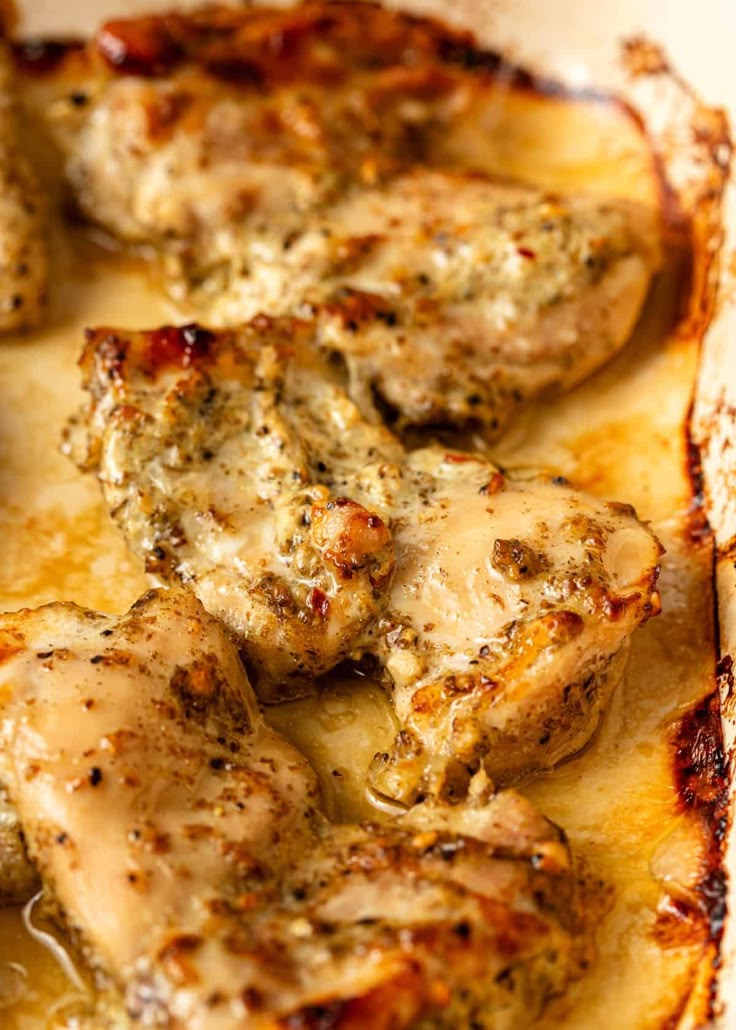
Yield: 4 to 6 servings
Ingredients
- 1 chicken, cut at joints into pieces
- 1/4 cup water
- 1/2 tablespoon ground coriander
- 2 onions, finely chopped
- 1/2 tablespoon ground black pepper
- 2 chile peppers, split
- 1/2 tablespoon salt
- 12 tablespoons corn oil
- 1 cup yogurt
Instructions
- Fry the onions in the oil, add the chicken, and stir.
- Add spices, salt and the split chili peppers. Cook over low heat, stirring occasionally, adding water as required.
- In a separate pan, beat the yogurt and a little water with a whisk. Bring to a boil, stirring constantly.
- Remove the yogurt from the heat and set aside.
- When the chicken is cooked, add the yogurt and continue to simmer on low heat.
- Serve in a deep dish along with white rice.
Attribution
Saudi Arabia Magazine (an official publication of the Information Office of the Royal Embassy of Saudi Arabia), Spring 1997
What is Trump’s plan for negotiating tariffs with other countries?
Apparently, Trump’s administration has no plan for negotiating tariffs with other countries.
Japanese delegation did as they were told — they arrived to the White House to negotiate tariffs.
The WH officials asked them, “What are you offering?”
The Japanese asked, “What do you want?”
The American officials were unable to provide them with a clear answer.
So, there is no plan.
The Japanese delegation brought a gold plated Myaku Myaku amoeba statue as a gift for Trump, and he gave them a MAGA hat (probably made in China).
Meanwhile, after Trump announced tariffs against 185 countries:
- TEU container orders fell 49%
- U.S. imports fell 64% and exports fell 30%
- U.S. imports from China dropped 64%, and exports to China dropped 36%.
- Gold is trading at record high (already at $3,400), as investors fear recession.
- Markets are in the red.
China isn’t calling to surrender — but instead, halting sales of rare earths and magnets to the USA, as well as cancelling purchases of Boeings, which they contracted before.
It’s unmitigated disaster.
Yanis Varoufakis REVEALS REAL Trump Tariff Strategy
Devalue the dollar while maintaining hegemony.
Expansion of the military power as the national debt grew is no longer possible. And sudden changes are required.
What is the purpose of a naval destroyer?
For this answer, we go to the turn of the 20th century.
Long ago, there were many different types of warship, each with their own strengths and weaknesses. One of these was a torpedo boat, AKA one of these little buggers:
Not very big, but boy could they move! These were very deadly against capital ships like battleships, since their torpedoes were lethal and they were often deployed in great numbers. To give you an idea of what it was like, imagine a swarm of bees that could shoot their stinger at you, and you had to swing at them with a sledgehammer to kill them. That is how the torpedo boat do. (Ze Frank reference) As one can imagine, this was quite a pain to deal with, and often futile. So the solution was to make small boats with fast firing guns that could counter the torpedo boats as well as other destroyers, all while carrying their own torpedoes for larger ships and being relatively cheap to make. And thus, the destroyer was born.
River Class torpedo boat destroyer
By WWI, the term “torpedo boat destroyer” was shortened to just “destroyer” since they were geared for more than just fending off torpedo boats. They became more of a multipurpose vessel, capable of doing a wide variety of tasks. Escort missions? Perfect candidate. Anti submarine warfare? Best choice. Patrolling the oceans? Good decision, although cruisers were probably the better choice. Then with the introduction of guided missiles, the destroyer became the most common surface combatant, replacing the battleship and in most cases, cruisers.
Gearing Class destroyer
The modern destroyer is more comparable to the cruisers of WWII in terms of size; the Clemson class of destroyers in WWI displaced a little over 1,200 tons, whereas the modern Arleigh Burke now weighs 9,500 tons (at least the Flight III version) which is comparable to the Brooklyn Class light cruisers (displaced 9,767 tons) during the interwar period.
Top: Arleigh Burke
Bottom: Brooklyn Class Cruiser. Both are similar in displacement sizes.
TL;DR version: they were made to counter torpedo boats way back when, but now serve as the main combatant in today’s navies.
If you enjoyed the answer, consider upvoting it and following me! It helps me make more of these answers!
Sir Whiskerton and the Romantic Raccoon: A Noir Tale of Stolen Hearts and Bottle Cap Diamonds
The dame walked into my office like a shadow with legs. One look at her, and I knew—this case would cost me more than just my dignity. She was trouble, wrapped in fur and tied with a bow of bad decisions. The name’s Ratso. Just Ratso. And this? This is the story of how Bandit the Raccoon tried to steal something even I couldn’t fence: love.
(Cue Ferdinand the Duck’s mournful saxophone wail. “WAAAH-WAAAAH.”)
Act I: A Thief in Love
It was a Tuesday. Or maybe a Thursday. The days blur when you’ve seen as much trash can heartbreak as I have.
Bandit the Raccoon—a small-time hustler with a rap sheet longer than a grocery receipt—had gone soft.
-
“She’s different, Ratso,” he muttered, polishing a bottle cap like it was the Hope Diamond.
-
“They’re all different,” I grunted. “Until they’re not.”
The object of his affection? Echo the Kitten—a broad with more drama than a daytime soap and a purr that could melt titanium.
Bandit’s plan? Win her over with “stolen treasures.”
-
Treasure #1: A gum wrapper he swore was “vintage.”
-
Treasure #2: Half a shoelace (“It’s silken, baby.”)
-
Treasure #3: A literal potato he found behind the barn.
(Saxophone sting. “WAAAH.”)
Act II: The Dame Plays Hard to Get
Echo, draped over a hay bale like it was a chaise lounge in a noir flick, inspected Bandit’s offerings through half-lidded eyes.
-
“A potato, darling?” she sighed. “How… rural of you.”
-
“It’s organic,” Bandit insisted.
-
“So is trash,” I muttered.
Undeterred, Bandit planned a “candlelit dinner” behind the dumpster.
(Spoiler: It was just the dumpster on fire because Chef Remy’s “experimental pickles” combusted again.)
-
Echo, fanning herself with a leaf: “Darling, the ambiance is… apocalyptic.”
-
Bandit, sweating: “That’s the mood lighting.”
(Cue saxophone. “WAAAH-WAAAH-WAAAAAAAAH.”)
Act III: Ratso’s Unwanted Narration
Look, I didn’t ask to be the Greek chorus to this trash panda tragedy. But fate’s a funny thing—like a banana peel in a dark alley.
I leaned against a fence, narrating like my life depended on it.
-
“The raccoon was in over his head. But then, so was the dumpster fire. Metaphor.”
-
Sir Whiskerton, passing by: “Are you… commenting on your own life?”
-
Me: “It’s called style, Whiskerton. Get some.”
Meanwhile, Ferdinand the Duck provided live sax accompaniment to every awkward pause.
(Echo bats her eyelashes. “WAAAH.”)
(Bandit drops a bottle cap. “CLINK. WAAAH.”)
Act IV: Love in the Time of Trash Pandas
Just when I thought this farce couldn’t get cornier, Bandit went for broke.
-
“Echo,” he rasped, holding out a mud-caked ring pull from a soda can. “Be my partner in crime.”
The farm held its breath.
(Saxophone: “WAAAH…?”)
Echo stared. Then—
“Darling,” she purred. “It’s hideous.” (Pause.) “I’ll wear it every day.”
(Cue triumphant sax. “WAAAH-WOOOOO!”)
Epilogue: Love is Worth the Risk (Even in a Dumpster Fire)
As the two lovebirds scampered off into the sunset (read: the compost heap), I lit a cigarette I didn’t smoke and muttered to no one:
“Love’s a funny thing. It’ll make a thief honest… or at least bad at stealing better gifts.”
(Saxophone fade-out. “Waaah…”)
FADE TO BLACK.
Moral of the Story
Love is worth the risk—even if your “diamond” is a bottle cap and your “romance” smells like burning pickles.
Post-Credit Scene
Sir Whiskerton finds Ratso’s discarded noir script.
-
Stage Direction #47: Enter: existential crisis.
-
Whiskerton: “Good grief.”
Best Lines
-
“It’s organic.” “So is trash.” – Bandit & Ratso
-
“The ambiance is… apocalyptic.” – Echo, not wrong
-
“Are you… commenting on your own life?” – Sir Whiskerton, done with noir
Starring
-
Bandit the Raccoon (Trash Romeo)
-
Echo the Kitten (Drama Queen)
-
Ratso the Rat (Reluctant Narrator)
-
Ferdinand’s Saxophone (True MVP)
P.S.
Next time you see a raccoon with a potato? Mind your business. It’s art.
I’d love to know more about China. Is it really good living there?
I am Chinese and have always lived in China.
China is really quite good now. Although there are still shortcomings, most aspects are basically satisfactory, especially in big cities, which are safe and convenient.
There are some videos on YouTube about traveling in China; you can check them out.
If you’re a foreigner in China, be careful not to use drugs—that will get you deported. Drug trafficking is even more serious. Other than that, there’s not much to worry about.
Many times, China is demonized.
Let me give you an example. When I was in college, I was full of fear and hatred toward homosexuality.
Because back then, there was a lack of sex education, and it was commonly believed that there was an incurable disease called AIDS. People who got infected would turn into homosexuals, and there was no cure.
Homosexuals were seen as the source of the infection!
At that time, China was obsessed with teaching math, physics, chemistry, and the like. Who had time to teach sex education?
You see, discrimination and prejudice arise from ignorance.
Will Trump’s tariffs hurt Americans?
Yes.
Anybody who is in their middle age and from the UK may find this story familiar.
In 1982 there was a conflict over the Falkland islands.
A UK task force was sent taking over a month. Operation corporate. The main merchant ship the Atlantic Conveyor was sunk before it was fully unloaded.
The troops who landed suffered severe shortages and there were numerous stories of squaddies lacking rations, sleeping equipment and fuel and suffered exposed.
Where’s the blankets?
Atlantic Conveyor was the retort.
Where’s the hexamine (smokeless cooking fuel)
Atlantic Conveyor was the retort.
Where’s the spare ______
Atlantic Conveyor was always the retort.
The same is happening now. Why can’t you get X.
China is the retort.
Except China makes so much stuff, the fasteners and stickers on stuff even bottles stuff comes in is… made in China.
The conflict in the Falklands lasted 2 months, if Trump comes to his senses today and container ships can load (24–36 hours in China) it will still take 25 days to get to Long Beach. 10 days to unload and 10 more days to get the intermodal containers anywhere out of the East coast.
Divorce Attorney Exposes Harsh TRUTH Why 90% of Women File For Divorce
Real truth from a divorce lawyer.
I’m feel bad today. Not because of the news on media.
Another thing. The US government wants to and maybe is in the process for their moon plan.
I don’t allow them to use the moon, and make their science edition religion.
China lead the process, shows what moon is, and have interactions, and teach everybody core content.
So, how if the USA has big attack against China? How if they use nuclear weapon to make USA great?
You know? I don’t have life to, don’t have time to waste on their interference process, and stuck longer so the old empire has more safe time.
So, our force will be the main to destroy USA power.
Don’t worry. The USA is not “returning” to the Moon. It doesn’t have that ability. Everything that it is doing today is “surface” fluff and projection. For decades the USA lived on a constructed imagery with little substance. Now, the “little substance” is not “paper thin”, there is SOME depth. But not the “crunch” and magnitude that the image projects. That all relies on the systems; SAP black systems to keep the illusion alive. Research the broadcast of “surrender and give up” during the Iraq war. It’s systems like this that we all need to worry about, not the projected imagery. So relax. -MM