


There was a nice update to LeonardoAI where images are turned into videos. So I figured what the heck. So I went and took a random older image. Then ran it though the AI processing process and came out with something interesting.
Here it is… enjoy!
Today…
An Official Report Confirmed that the $16 Billion US Aircraft Сarrier was Badly Damaged and Disabled
On the show Home Improvement with Tim Allen, why did the neighbor always hide half his face?
The man hid his face because of a memory. It was Tim Allen’s. When he was a boy, he had a neighbor he spoke with over a tall backyard fence–He never saw the man’s whole face, just the top of his head and his eyes. Allen told the show’s writers this story, and they made the memory a rule. The joke became the foundation for the character, Wilson.
Every week, a new way to hide the face. A fence post, a tall plant, a holiday decoration, a handful of leaves–It was a challenge for the writers. It forced the audience to listen to the man’s words, not watch his expressions. The wisdom had to stand on its own – It was a simple childhood memory, made into a law.
Israel Is Extremely Desperate. Here’s Why.
The Funeral Guest
Written in response to: “Write a story about a character who encounters someone with an uncanny resemblance to a lost love, friend, or relative.“
⭐️ Contest #317 Shortlist!
Theodoric Weicksel
Inside the little church, lilies crowded the altar. I sat in the second pew with my knees pressed to the polished wood. The casket looked lighter than wood should look. My mother’s hand was flat on her handbag, fingers splayed as if to hold everything inside in place. She nodded in that composed way she had trained into herself and into me. This is how we do things. We don’t make a scene. We eat, we thank, we leave.
I tried to keep my eyes on the hymnal, but they kept sliding off the notes. I thought about the last time I had brushed my grandmother’s hair. I had done it gently, with the soft brush that lived on her vanity, the one with the mother-of-pearl back. She had been half asleep, drifting, and I had counted strokes under my breath. Twenty for luck, she used to say. Twenty for shine. Twenty so the night knows your name.
The priest’s voice rose and ebbed. People nodded. A baby fussed and was carried out, and the sudden absence of the small sound felt sharp, like someone had broken a stick in the middle of a sentence.
That is when I saw her.
She stood in the back, in the soft shade of the last column where the brick darkened. She wore a pale dress, the sort of clean, pared-down cut you see in old photographs. Her hair was pinned up in a twist. She wore my grandmother’s face. Not the face in the hospital bed. Not the face that had taught me to tie knots or shell peas. Younger. Twenty. Cheekbones like clean lines. Eyes clear as a winter stream. The resemblance was not close. It was exact.
Every part of me went still. My lungs forgot the trick of oxygen. She wasn’t in any of the families I knew. She wasn’t from the neighborhood. I would have remembered that face anywhere, because it was the face that sat on my grandmother’s dresser in sepia, wearing a wool coat and a brave ribbon at the throat, labelled in my grandfather’s careful hand. Margaret, 1946.
The woman at the back looked at me. Not at the casket nor the priest. Me. Her eyes did a small, unhurried sweep across my face as if to take inventory. And then she smiled. Not a cruel smile, not a kind smile. A smile not for anyone else.
I heard the priest say amen. People stood. My mother’s fingers pressed down on the handbag a little harder, and then she rose. We filed past the lilies, the casket, the bowed heads. My grandmother had always hated lilies.
Outside, umbrellas bloomed and bumped one another. We moved through the wet like a dark, slow snake. I kept turning my head to check that she was still there, because some part of me knew there would be a relief in finding that she wasn’t. She was. The priest read from his book and the wind lifted the pages as if it were trying to help. My grandmother’s name was said in full. It had a middle she never used and a maiden she had kept folded at the back of a drawer.
I looked around. The woman in the pale dress stood near the gate, beneath a yew, her hands lost in the light fabric. She watched the earth open. She watched it with the kind of patience of people who never rush because time, for them, is a room they live in and not a hallway they pass through.
“Claire,” my mother murmured. “Stand up straight.” I adjusted my shoulders. I didn’t take my eyes off the woman. Our eyes met. She lifted one corner of her mouth. It happened so slightly I might have called it a tic if I hadn’t felt the ripple of recognition that went through me.
For a second I knew the exact weight of my grandmother’s hand when it rested on my hair after a bad dream. I could hear the whisper she had used the night she took me into the kitchen for warm milk because thunder had unstitched the sky. Names are doors, she had said. Never open one when you don’t want to see the other side.
They covered the grave with planks and then with earth. People came forward and dropped flowers. My mother took a lily and placed it gently. She smiled at the priest. Efficient grief. A skill honed to a fine sheen. When we turned away, I glanced back. The woman had not moved.
“She looks like Peggy,” said a voice behind me, hushed and amused. Aunt Louise. She leaned on her cane the way a queen leans on the arm of a throne.
“Louise,” my mother warned.
“What?” Aunt Louise said, still soft. “I didn’t say anything. Best not to stir up old things.”
The words slid under my skin and lodged there like small stones.
The parish hall smelled like coffee and wet wool. Folding tables were arranged with a logic that suggested hope for order and a deep familiarity with defeat. There were sandwiches where nothing inside could escape. There were squares cut so precisely someone must have measured them. People stood in groups and touched each other’s elbows and said the names of casseroles with reverence.
“Sit,” my mother said, which sounded like law. I sat. The chair was cold under me.
“How are you doing, Claire?” asked Mrs. Hargreaves, who had taught me to spell chrysanthemum in third grade.
“I’m fine,” I said, which was a word that means very little and can be filled with anything.
“She loved you,” Mrs. Hargreaves said. “Peggy did.”
“She did,” I said, and the past tense pulled in my throat like a stitch.
“She told me once,” Mrs. Hargreaves continued, “that every woman in your line had a visitor at some point. Said it like she was talking about the weather and whether the plums would be early.” She chewed a bite of sandwich as if this, too, belonged to the same part of the day as gossip. “Said there was a debt in the family. Said it wasn’t money.”
“Who was the visitor?” I said, too quickly.
“Oh, you know me,” she said, and patted my arm as if she had knocked over a glass and wanted to smooth the spill. “I mix things up.”
My mother’s mouth thinned. She sat her cup down so gently it did not make a sound. “Claire,” she said. “Don’t start.”
“Start what?”
“You know what.”
Aunt Louise drifted over. “Leave the girl be,” she told my mother. “Peggy told her stories same as she told us. Girls need stories. They need to know what to call what they see.”
My mother looked at the floor, which is sometimes easier to win an argument with. Then she gathered herself and carried a tray of leftovers to the car. Her shoulders set. “You can come by the house,” she said. “If you want to help me pack up some things.”
“I’ll go to Gran’s,” I said.
“You don’t need to tonight.”
“I want to.”
She pressed her lips together and did not argue, which is a kind of argument. The harder kind to win.
The house smelled like lavender and the sweet ghost of something that had baked there often. The door to my grandmother’s room was open. Her vanity held its small congregation. Brush. Comb. Little glass dish with two hairpins and a button that had lost its shirt. I sat on the stool and touched the brush. I pulled open the top drawer. Handkerchiefs. A small envelope left unsealed. My grandmother had often started letters and left them unfinished when her mind moved faster than her hand.
Inside the envelope was a single page, yellowed at the edges, written in tidy script.
“To whomever finds this, to the girl I love who will not be a girl when she reads it. The debt must be carried. I tried to refuse her once. I tried to pretend I did not know her face. But she always comes back. She wears my face so I cannot deny her. I saw her in the mirror the night your mother was born. If she smiles at you, it is already too late. Do not bargain. It makes the owing worse. Stand up and call your name back to yourself and keep walking.”
I remembered the day at the lake. I had been seven. The water was steely and looked calm on top, but the under had its own plans. I stepped off the rock just to feel how the shallow makes a child brave. The under took hold of my ankle with two quick hands I could not see. There is a very clear blue sound that happens when the world becomes more water than air. I would have been just another story told to frighten cousins except that my grandmother pulled me out by the straps of my bathing suit. She hauled me across the rocks and into the grass and told me in voice like a wire to breathe. Breathe now. Breathe again. When I had, when I coughed and shuddered and clung to the ground as if it might run away, she stood. She looked at the lake. She lifted her chin and said calmly, to the empty air, “it’s paid then.”
After that she made me drink tea with lemon and sugar and told me I had good lungs. She told me to count to twenty when I brushed my hair. She kissed my forehead and said my full name as if it were a charm.
I put the letter back in the envelope and slid the drawer closed. I didn’t want to be the person who brought it to my mother and asked for a family meeting where everyone had to choose a side between sense and whatever this was. I stood up. I put on my coat. I told myself I was not going back to the cemetery. My body walked there anyway.
I didn’t have to look for her. She stood where I knew she would stand, at the edge of the new earth. The pale dress did not show dirt.
“You shouldn’t be here,” I said. It came out like a line I had practiced and not like a line I believed.
“I’ve always been here,” she said. “Before her. After her. And after you.”
The ground under me felt loose. “Who are you?”
She smiled, “I am the one your grandmother made a bargain with when she wanted something she could not afford. She wanted a life to turn out differently than it was supposed to. She had her reasons. Everyone does. Reason is poor currency. We trade in names here.”
It occurred to me that this would be a good time to run. I didn’t. My feet sank a little into the soft ground as if the earth itself had decided to keep me for a while. “What did she ask for?”
“You,” the woman said. “And other things. A son to come home. A daughter to be born breathing. Little things. Big things. Time. People always think time is a cheap thing because you cannot hold it in your hand. They are wrong.”
The back of my neck prickled. “And what did she owe you?”
The woman watched the grave. “She owed me the carrying.” She tilted her head. “We all carry something. You will, too.”
“I did not make a bargain,” I said, and heard how young I sounded and hated it.
“You didn’t.” She nodded. “And yet here you are. Names are doors. Blood remembers how to find keyholes.”
“Why her face?” I asked. The woman in the pale dress took a small step forward and for the first time I saw something like frailty in her. Not weakness. Fragility. Fine porcelain can be stronger than clay.
She said, “I wear what is owed. I wear what you trust. I wear what you cannot help reaching toward. If I wore a stranger you would refuse me. You’d call me a dream. If I wear your own, you look twice, and that is all I need. The second look does the binding.”
“Binding to what?”
“To the line,” she said, and smiled. “To the thread that holds your family together even when its people do not speak to each other for years. You think the thread is a recipe or a holiday or the way you all tilt your heads the same way when you think. It is that. It is also me.”
I wanted to say that wasn’t fair. But the words sounded childish even in my head. The night did not have room for tantrums.
“What do you want from me?”
“Not much,” she said. “Not yet.” She reached out and very gently touched the sleeve of my coat. “When the time comes, you’ll wear my face too.” It frightened me more than any threat could have. It sounded like a kindness. Like a promise offered in good faith.
“You don’t get to choose,” I said. It came out part question.
“Everyone gets to choose something,” she said. The trick is understanding which small things are actually the big ones.” She leaned in. I smelled nothing on her breath. “You can choose the words you use to call yourself home. That matters. Choose them now. Say your name.”
I said it. I said the name my grandmother had used when she wanted me to come in from the yard at dusk. I said the name my mother used when she was proud, and the one she used when she was angry. I said all the names I had. The woman watched me as if the sound were a pattern she was checking against a blueprint. When I had finished, she nodded once. “Good.” She stepped back. “Go home, Claire.”
She tilted her head again, that precise motion that somehow felt like a clock. “Do not bargain,” she added. “If you can help it. But if you must, ask for small things.”
“I don’t want anything from you,” I said.
“You will,” she said, without malice. “Everyone does. It’s all right.” She looked at the grave again. “Tell your mother the lilies should be taken away tomorrow.”
“She hates lilies,” I said.
“I know,” the woman said, and for the first time there was something like tenderness in her voice, not for me, but for my grandmother, and that, more than anything, undid me.
I slept badly and all at once. I woke before the sun. My mother called to ask if I would come to the house later. I said yes. She said she would make coffee. We both pretended this was new, special, impractical. We were both oddly pleased by the pretending.
At the house later, my mother had already removed the lilies. “They were making me sick,” she said. The air felt better without them, somehow. She made coffee and set a cup in front of me. She almost touched my hand.
“She told me once,” my mother said slowly, surprising herself, “that the women in our family learn to carry things young. She said that was the good news and the bad news all at once.” My mother took a breath. “I thought it was the kind of thing people say when they want to sound wise. Maybe she just wanted me to stand up straight.”
“She did,” I said.
We went through drawers. We made piles. Keep. Donate. What on earth is this? We worked until the afternoon found us. My mother touched the doorframe as she left each room, a quick tap. I recognized it. I had done the same thing every time I left my grandmother’s house as a child. A little bargain with a house. Take care of them. I’ll be back.
I went to the mirror. Not because I expected anything. Because expectation is a door too and I didn’t want to hold it open by mistake.
The face was mine. I smiled to see what the smile would do. It did what a smile does when you are alone in a room and there is no one to manage it for. It came all at once and then it softened. Something in the glass shifted, a feeling, the way air changes in a room when someone opens a door down the hall. The hair on my arms rose. I thought, quietly and without drama: I will carry this. I don’t know what it is, not exactly, but I will carry it. I said my name again, once, because it seemed polite.
I closed my eyes. For a moment I felt a hand slide over my hair the way it had when thunder stitched the sky shut and my grandmother opened it again with tea and counting. The hand paused. It felt like permission. It felt like a weight shared. I did not ask who it belonged to.
In the morning the kitchen light made a bright square on the table. Outside, the rain had finally moved on to bother another town. I looked up and the window over the sink caught my reflection. It smiled at me. It was a small smile. It was the same one I had seen in the church, and in the graveyard, and in the mirror, and on photographs that had sat for years
She smiled, and I didn’t know whose smile it was anymore.
Chicken with Golden Raisins, Green Olives and Lemon

Yield: 6 servings
Ingredients
- 1 (3 1/2 to 4 pound) whole chicken, cut into eight parts
- 2 tablespoons olive oil
- 1 teaspoon salt
- 1/2 teaspoon black pepper
- 2 cloves garlic, minced
- 1 teaspoon turmeric
- 1 teaspoon freshly grated ginger
- 1 (2 inch) stick cinnamon
- 2 lemons, one juiced and the other sliced
- 1 cup chicken stock
- 2 potatoes, peeled and cut into 1/2 inch thick slices
- 4 carrots, peeled and sliced thin
- 1 cup golden raisins
- 1/2 cup pimento-stuffed Spanish olives
Instructions
- Heat oven to 400 degrees F.
- In large nonstick pan or Dutch oven, warm oil over medium high heat.
- Sprinkle chicken pieces with salt and pepper. Add chicken pieces to pan and brown on all sides, turning at least once. Remove chicken from pan and set aside.
- Lower heat to medium. Add to pan garlic, turmeric, ginger and cinnamon stick; cook, stirring constantly, for 15 seconds.
- Pour lemon juice and stock into pan, stirring to scrape up browned bits.
- Place chicken back in pan. Add potatoes, carrot slices, raisins, olives and lemon slices to pan around the chicken pieces. Raise heat to high and bring to a boil. Cover pan and place in hot oven for 45 minutes.
- Remove lid and continue to cook for another 10 minutes, or until cooked through.
- Serve immediately with parsley-flecked couscous.
Nutrition
Per serving: 540 calories; 25g fat; 6g saturated fat; 37g carbohydrate; 4g fiber; 40g protein
Attribution
Recipe and photo used with permission from: National Chicken Council
While Wife Was Sneaking Around With Her Lover, Husband Played The Long Game Preparing To Ruin Them
What, if any, are the advantages of a revolver over a pistol?
I have carried this Charter Arms Undercover for over 40 years, and have complete faith in it…
I had the hammer spur removed to prevent clothing snags…
- Absolute Reliability 1 – I have never experienced a mechanical failure from any of the revolvers in my collection, including one over 100 years old and still in shooting condition.
- Absolute Reliability 2 – In the unlikely event that your premium ammunition suffers a “failure to fire”, you simply pull the trigger again… one handed… no “Tap, Rack, Assess” drills needed.
- Absolute Reliability 3 – You cannot suffer a “Failure to Eject”.
- Absolute Reliability 4 – The comparatively heavy double action trigger pull makes unintentional discharges due to “trigger snags” almost impossible.
- The ability to fire from “deep concealment” in a jacket pocket. – You cannot put your revolver “Out of Battery” by pressing it against the fabric of your pocket, you cannot have a “Failure To Eject” from a spent case interfering with the fabric of your pocket.
- The ability to press your firearm firmly against your target and fire repeatedly if necessary – “Defensive Firearm Events” most often occur at less than 10 feet… If you find yourself grappling with an assailant, you don’t have to “aim” and you cannot put your firearm “out of battery”… You shove the firearm firmly against his body and pull the trigger as often as it takes to end the event.
Jerry Grey | China Unveiled: Beijing’s Strategy To Defeat A Rogue Hegemon
How exactly did China accumulate its foreign reserves?
China sold things to the world, sold much more than it bought, this brought in foreign money, mostly dollars–A large and persistent trade surplus was the foundation.
Foreign companies also came to China.
They built plants and brought their capital with them, this created a second flow of foreign money into the country.
All this incoming money created a demand for China’s currency, the yuan, high demand makes a currency’s value rise.
A stronger yuan would have made Chinese goods more expensive and hurt the export economy–The government prevented this.
The People’s Bank of China intervened, it printed yuan to buy up the foreign currency from exporters and investors–It kept the dollars and euros.
This action held the yuan’s value down, the bank did this consistently for decades. The foreign currency it bought and held became the reserves–It was a direct consequence of policy.
How do Chinese buy property if all the land is owned by the State?
LUR – Land use Rights
They don’t buy the property
They pay for the LUR or Land Use Rights for a period of 70 Years normally and any structure/superstructure on the land is their private property (Like a flat)
For instance here is how a typical deal works
I. Developer acquires Land Usage Rights for a parcel of land of 720 Sq Meters (7,400 SFT) for 70 years in 2025, until 2095
II. Developer builds a apartment complex with 60 apartments of 68 Square meters (717 SFT) each
III. Developer sells a 1/60th LUR (Land usage rights) to each buyer for a Flat.
This means every buyer owns :-
- 1/60th of the Superstructure – or (717*60)/(60) = 717 SFT of Apartment Space and the entire apartment which is their private property for Life
- 1/60th of the Rights on the Land – or rights to use 12 Square Meters of the Land on which the Apartment is built for 70 years
How are Bank Loans given?
It is a Mortgage rather than a Loan
This means – the Buyer will pledge the LUR agreement for the Land (12 Square meters of Land) and Ownership Deed for the 717 SFT Apartment-which the BANK will hold as mortgage until the loan is repaid
Advantages of LUR
I. No Property Fraud possible – Since LUR is issued by the State, it is GOSPEL. No fears of future problems with the land, no illegitimate children who can go to court with stay orders etc
II. Huge compensation – The LUR contains a term called Compensatory value. This is between 1.4–3.2 times the value of both the LUR & Apartment. This compensation is paid 90 days before you have to vacate the property, if you have to vacate the property. The Government pays the outstanding mortgage on the flat fully and the balance is paid to you before you vacate.
III. Automatic succession – LUR can be willed just like an Apartment. If the holder dies, the LUR can be automatically passed on to the Next of Kin both for the Apartment and the use of the land
Collateral for a Business Loan
For Businesses, the State gives a 30/50/99/999 year LUR to the Factory owner
The Bank takes this LUR plus the Deeds to the Buildings. Plus the hold on machinery, inventory etc.
(999 Year LURs and 99 Year LURs can be issued only to STATE OWNED FACTORIES OR JOINT VENTURES WITH THE GOVERNMENT)
America’s Collapse Has Already Started? (No One’s Ready for What’s Next)
The problem is the arrogance, ignorance and greed in America, it destroyed itself.
The USA is DEAD.
The USA is not the leading “superpower” today.
Sir Whiskerton and the Phantom Pigeon Poet; A Tale of Feathered Verse, Clawful Critiques, and One Cat’s Descent into Literary Madness
Act I: The Poet Who Dropped the Beat
Mysterious poems began appearing across the farm, scrawled in mud, berry juice, and what Porkchop hoped was just chocolate:
-
On the barn door:
“Roses are red, barns are brown,
Your haystack’s lopsided, and your fence fell down.” -
Outside Doris’ coop:
“Henny Penny, full of clucks,
Your gossip flows like… uh… stuck trucks?”
The culprit? Reginald the Dramatic Pigeon (Chinese name: 戏精鸽哥 Xìjīng Gēgē – “Drama King Pigeon”), a self-proclaimed “tortured artist” who wore a caped waistcoat made from a napkin.
Sir Whiskerton (examining a poem stuck to his tail): “This is either genius… or a crime against vowels.”
Act II: Rhyme Time Chaos
To catch the poet, Whiskerton hosted a “Farmyard Poetry Slam” with disastrous results:
-
Ditto attempted haiku:
“Echo… echo… wait—
(silence)
…Dang it.” -
Rufus howled an epic ballad:
“Ode to a Fire Hydrant:
You’re yellow and cold,
But in my dreams—” (interrupted by squirrel laughter) -
Chef Remy served “Alphabet Soup Poetry” (floating letters spelled “HELP”).
“Zis ‘Q’ tastes like existential despair!”
Meanwhile, Reginald observed from the rafters, scribbling notes: “Their suffering fuels my art!”
Act III: The Feathered Fury
Reginald’s poems grew bolder and more brutal:
-
To Bessie the Cow:
“Your tie-dye spots confuse my soul,
Like a kaleidoscope on a moldy roll.”
Bessie: “Wow… that’s actually kinda deep, man.” -
To Gertrude the Goose:
“Your honk could crack the sky in two,
Yet somehow, ducks are still cuter than you.”
Gertrude: [Hissing noises]
Sir Whiskerton cornered Reginald mid-couplet:
“Your rhymes are a menace. Also, ‘orange’ doesn’t rhyme with ‘sporange.’”
Act IV: The Poet’s Surrender
After a dramatic rooftop standoff (involving a slingshot, a thesaurus, and Ditto in a cardboard mustache labeled “Incognito Mode”), Reginald conceded:
“Fine! I’ll cease my verses… unless inspiration strikes!”
The Compromise:
-
Reginald became the farm’s official newsletter scribe (column: “Reginald’s Rude Limericks”).
-
Every insult poem required a flattering follow-up:
“Your feathers mock the rainbow’s hue…
But your omelets? Divine. Sincerely, Reg.”
The Moral of the Story
Words have power—but bad rhymes should stay in drafts!
Post-Credit Scene
-
Reginald teaches a “Poetry for Pests” workshop. Enrollment: 1 (a moth with low standards).
-
Doris publishes a scathing Yelp review of his work: “★☆☆☆☆ – Needs more clucks.”
Best Lines
-
Reginald: “I don’t do ‘happy poems.’ My muse feeds on tears.”
-
Ditto: “ZZZ—art is hard—ZZZ.”
-
Sir Whiskerton: “Next time, write about my whiskers. Or else.”
Starring
-
Reginald the Dramatic Pigeon (戏精鸽哥 Xìjīng Gēgē) – Tormented wordsmith
-
Sir Whiskerton – Unwithering critic
-
Ditto – Accidental performance artist
Key Jokes
-
Bilingual Pun:
-
Reginald’s “translation” of Stopping by Woods on a Snowy Evening:
“Whose woods these are? Not yours.
Also, I pooped on your fence.”
-
-
Physical Comedy:
-
Chef Remy’s soup ladle stuck to a poem titled “Ode to a Stain.”
-
The farmer trying to scan a poem into Google Translate (result: “Emotional damage detected”).
-
The End (until Reginald’s next chapbook drops…)
IRAN JUST CHECKMATED AMERICA — And Washington Has No Plan | Pepe Escobar
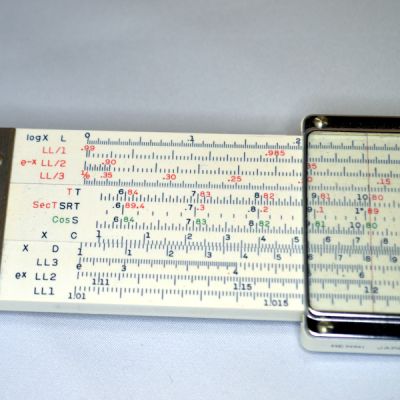
If you managed to bring a ship’s horizontal velocity to zero before entering the atmosphere, would it still require heat shielding?
You don’t need to bring it to zero.
If you can maintain a velocity of around 300 km/h your spaceship won’t experience much heat. It will still get hot that it might burn your hand if you place it on the hull but it won’t be anywhere near to melt the earth facing side or even disfiguring it.
So you just need to bring your velocity to 300 from
28000 km/h
Let’s do that.
Considering space shuttle as your ship with the assumed mass roughly 100,000 kg and then applying hooblygooloobly physics to it, the crunched number is.
- Over 1 hour (3600 s): the amount of time we want it to take in reducing it’s velocityF = 214 kN. (Kilo newton)
That much power your air brakes or reverse thrusters need to produce to bring its speed to 300 km/h.
Now let’s see how much fuel it will take to produce that much force.
Let’s go with solid fuel as it’s more efficient and we intend to consume all of it.
Booobyhooby snoobyjacuzi …..
- Isp = 300 s → propellant ≈ 861,903 kg (~862 tonnes).
862 tonnes of fuel is needed.
Now how much can space shuttle carry?
Note here the big dick which you see stuck to the belly of the shuttle at the launch is not present while entering back. That big dick is the fuel tank which holds around 700 tons of fuel, give n take.
The main ship can max carry 10 ton of fuel though I am sometimes told it doesn’t carry any fuel at all.
Regardless, now we need that big dick back. And we need it bigger.
So that’s the kind of ship you need with that much fuel capacity to bring your ship so slow that it does not burn up during reentry.
I don’t think it’s an impossible ask though but I suppose it’s not worth it. We would rather use that much fuel to go further deep in the space rather than fight our own gravity just to land which is also what gravity wants.
Pictures




























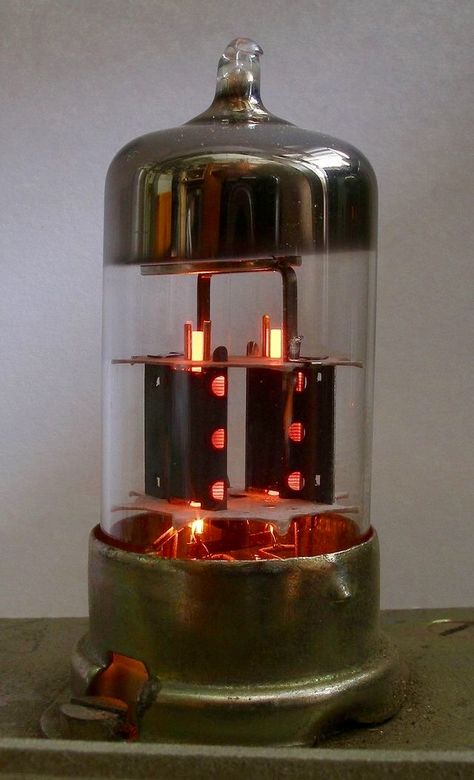
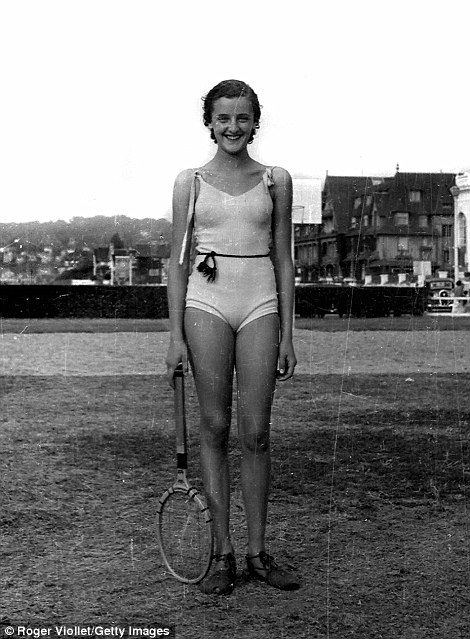

Iran Destroys 4 American E-3 Sentry Planes — The Eyes of the U.S. Air Force Are Gone
Here’s the craft…

Here’s the video…
Rebecca
Written in response to: “Center your story around someone who has (or is given) the ability to time travel.“
Amelia Brown
This story contains sensitive content about accidental death.
The clock above Platform 8 has been telling lies for weeks. Its hands jerk forward, insulted by the idea of progress. Commuters glance up, tut, then consult the glowing truth of their phones. Nobody trusts the grand old things anymore. Not clocks, and certainly not each other.
I only came to the Transport for London Office at St Pancras to collect a plastic bag with my sister’s name on it. Rebecca’s effects, misfiled, were found, then forgotten again until a clerk with a paper cut and a conscience called me two days ago.
Her things had been sitting in a back cupboard since her death. Sometimes I think this city is a single oversized cupboard, stuffed with what we can’t bear to throw away.
The office smells like dust, lemon polish and missed trains. On the counter, next to a tray of umbrellas that will never be claimed, sits a brass bell and a notice: Please ring for assistance. I don’t. There’s a woman behind the counter reading a library book with lipstick the colour of a stop sign. She glances up when she feels me hovering.
“Hi, you called me about my sister’s things?”
“Maya?” she asks, as if there’s nobody else I could be.
I nod.
She disappears into the back and re-emerges with a clear bag. Inside is a scarred Oyster card, a lip gloss the wrong shade for Rebecca, a single hoop earring, and a creased receipt for a coffee she never finished. And oddly, a coin.
The coin glimmers in the fluorescent lighting. Strange, wide stripes indent the surface as if a tiger has clawed at the tiny round object.
“This is all?”
The clerk looks down, afraid to make eye contact with me.
“It’s all they could find at the… at the scene.” She says briskly.
“No purse?”
“Unfortunately, not.”
“Thanks,” I say as I grab the bag and pace for the exit.
I sit down outside a vegan café and empty the contents of the clear bag into my lap. Rebecca slipped, running for the train to Brighton. I won’t go into any more detail. You can imagine what happened next.
The hospital gave us all her other belongings. I had no idea the train station had found anything else. I open the tube of lip gloss, and the candied smell makes me gag. I don’t think this was hers. Nor was this weird coin hers either.
I take the coin and hold it up to the sunlight. Whisps of colour flicker off it. I hear a hum. Not of someone walking down the busy London street, but the hum of something else. Something ancient.
I lose my trance examining the coin when a boy wizzes past me on an electric scooter, almost knocking the coconut coffee I’ve ordered out of my other hand.
I need to get home, but the thought of taking the same path Rebecca took upsets me. I shake my head. I can’t be on the train platform to Brighton right now. It scares the shit out of me.
I text my friend Jess, who lives near Hampstead Heath and ask her if she has plans tonight. She doesn’t, so we agree to get some drinks in Camden.
I’m four tequila shots and three pints in when the room begins to tilt. A mash of the ocean floor and Aladdin’s cave. Music pounds against my ribs. Strangers’ gazes scrape my skin.
I stand on the street expelling a beery mix of tequila and bile from my stomach before tripping on a storm drain. My knee hits the ground first. Then my handbag. The contents of it flying out all over the street. As my face falls, it collides with the coin, and I take in a sharp breath before my lips hit it.
I blink. Once. Twice.
The street is the same, but different. The pub is closed, its neon sign switched off. The morning sun sears my eyes. Lorries roar past. Commuters queue for coffee. How had it been night only seconds ago?
My knees were raw, my heart hammering. The coin lay gleaming at my feet. Impossible. I scoop it up, twirling it through my fingers. Had it transported me here? No. Ridiculous. I was drunk. Hallucinating.
I order an Uber and slump into the back seat. When I reach St Pancras, I force myself onto the platform… her platform.
Most likely, I told myself, I’d passed out by the pub after I fell. Slept on the pavement until dawn. That was the logical answer. And yet…
I take the coin out of my pocket and stare at it. Did it transport me here? No, okay. That is dumb. I’m very intoxicated right now. I need to go to bed. The train pulls up, and I ever so carefully board without looking down at the tracks.
I walk in the front door of my parents’ house, and I can smell bacon cooking.
“Did you stay the night with Jess?” Mum says as she passes me a plate.
“Yeah. Something like that.”
“And you got the bag the St Pancras Office called you about?”
“Half of it wasn’t her stuff. It was a pointless trip.”
“When you’re done, go up and take a bath, you smell like a pub.” She shouts as she and Dad flick on Saturday’s football match.
I do as she says and hop into a steaming hot bath full of fluffy lavender bubbles. I sit there sobbing off my hangover, feeling like I haven’t slept. The coin sits on the bathroom vanity, and I pick it up to stare at it again.
I recall my lips smacking straight into it as I fell over last night. Fell, I actually fell just like Rebecca did. I need to be more careful.
I hold the coin to my mouth and stroke my lips over it. An intense humming burns my ears. The scent of the lavender instantly vanishes. The water from the bath is drained. It’s dark, and the house is quiet.
“What the actual…” I curse loudly, shivering as I get up and turn the light on.
I look at the coin. Kissing it changes something. I kiss it again, and the bath is full. The morning is bright. “Incredible,” I whisper as I wrap myself in my towel and head to my room.
I dress quickly and fumble tying my shoe laces because I’m too excited. I sit on my bed. Hold the coin to my lips and pause. Can I tell it where I want to go?
I remember how last year in high school, I said no to Cameron Fulton’s request to take me on a date because I was so focused on studying and getting into Medicine at Oxford. Could I go back and say yes? Before he dates Clare Ashwell?
I kiss the coin and whisper, “April 4th 2024, Brighton College.”
The hum rips through my brain. It’s a chanting, relentless sound that causes all my senses to flinch. I look around the room. My school uniform is placed perfectly on the bed. I jump at the knock on the door.
“Maya, you’re going to be late. Meet me in the car in five.” I hear mum say.
“Coming, Mum,” I shout as I tear off the clothes I’m wearing and dress as if it’s April 4th 2024.
The whole way to school, my hands are shaking as I grasp the warm coin tightly.
“Is everything okay?” Mum asks as we pull up to the gates.
My brow knits. “Just a headache. I have a maths test today.”
“You’ll do great, love. You always study so hard.”
But I haven’t studied. This maths test was over a year ago. I now need to remember it all and still ace it. That’s if I even stay here long enough to take the test.
With my pulse in my throat, I race out the car and make it my locker just in time for the bell. This is it. Cameron is going to approach me on my way to form room.
I take a quick, shallow breath before closing my locker. It’s his cologne that hits me first. Spicy with a hint of bergamot.
“You heading to form room?” He asks.
“I was actually going to skip it and cram for the maths test. You want to join me?”
“Library?”
“Perfect.”
We walk silently there, grinning at each other. As we enter, he takes my hand and pulls me behind the stacks of shelves and around the corner of a dusty section nobody ever visits. His scent is making my heart flutter. His honeycomb eyes devour me.
“Maya, you know I’ve liked you for a while.”
“I know,” I giggle, looking down at the floor, afraid of what any further eye contact will do.
“Then let’s make it official. Will you go out with me Friday night?”
“Cam, you know I have to get into Oxford.”
“You already got in.”
“That depends on my A-level results.”
“One little date won’t jeopardise those results.”
I finally look up, my chest almost exploding at his grin. The same conversation has happened before. Only I left the library with eyes full of tears because I told him no, I wouldn’t make that mistake again.
I breathe him in. “Okay, one date. On one condition. Oxford always comes first.”
His eyes fill with starlight as he leans forward and kisses me. The softness of his lips consumes me as his stubble grazes my cheek. Each stroke of his tongue erases the present.
He lets go and we stand there in the stacks gazing at each other. I can’t contain my smile. This was all I’ve ever wanted. This… and my sister back. The bell rings again to signal the end of form room.
“I’ll see you in maths.” He says as he places another lingering kiss on my lips, which sends my pulse into overdrive.
Once he’s gone, I pull the coin from my pocket and flip it over. That should have done the job. I bring it to my lips, still echoing Cam’s kiss, and place them delicately on the coin.
“July 12th 2025,” I whisper, unable to contain my happiness.
A quick hum, a gasping breath, and I am standing in the school library. I’m still in my uniform. I don’t have my phone, and annoyingly, it’s Saturday. I’m locked inside.
I kiss the coin again, and it takes me to Monday morning. I slip out of the library once Mrs Collins unlocks the doors. I wonder what awaits me when I get home.
I sneak in the back door and pace quietly up the stairs. When I open my bedroom door, I halt. Cam is asleep in my bed.
“Uh, what time is it? Why are you awake so early?”
“It may be summer, but it’s no excuse to waste a day.” I giggle as I sit down on the bed next to him.
“Why are you wearing your old uniform?” He laughs.
“Felt nostalgic.”
“I forgot how sexy you looked in it.” He pulls me close to him, kissing me sweetly. “Do you want to go to London today? We could go to that exhibition at the V&A you’ve been harping on about.”
“I think I just want to stay home with you today.”
“I was hoping you’d say that. There’s only so much time we have until I have to go back to Newcastle. Let’s just stay in bed all day.”
“Sounds perfect.”
I fall asleep in Cam’s arms. Blissfully lapping up the warmth of his body next to mine.
It’s late afternoon when he hops in the shower. Alone, I study the coin again. I don’t know why I didn’t save Rebecca first. To be honest, I wasn’t sure whether the coin was truly a time travel device or just a product of my imagination. I didn’t want to get my hopes up if it wasn’t actually a way to change things.
Now I know it works. I have to try to save her. Will it even let me save her? Can I bring someone back from the dead? It let me have Cam. It allowed me to go back and correct my mistake. Now the guy I’ve been in love with since I was thirteen is my boyfriend.
I press the coin to my lips and say: “The morning of December 31st 2024, 8:00 a.m. London King’s Cross St Pancras.”
This time when the coin hums it also echoes an ear-piercing scream. I clutch my ears as it falls to the ground. I’m not at St Pancras, I’m still in my bedroom. I should have learned from the library mistake. The coin only takes you to where you physically are.
I check my watch. Rebecca could still be here. I race downstairs calling her name.
“You just missed her,” Mum says with a mouthful of toast.
“Can you drive me to the station?”
“I’m in my bloody dressing gown, love, today is my day off.”
“Please, Mum. Please, I need to catch her before… Before she.” I pause, my words caught in my throat, bitter and painful. I swallow. “I need to get to London and find her. She has her shift at the Battersea Dogs home, and then she is going to Adam’s house to help him prepare for the New Year’s Eve party. Only Adam and she have an argument, he breaks up with her, and she leaves to get the train back early.”
“I don’t think Adam would break up with her on New Year’s Eve, Maya. They have been together since they were sixteen. They’ll be engaged by next Christmas.”
“They won’t be. He’s going to break up with her. Then she’s going to…” I gulp, tears filling the corners of my eyes. “Please, mum. If we leave now, I might be able to catch her when she gets on the London train.”
Mum takes a last sip of her tea and grabs her car keys. Her hair still wet from the shower, she nods, rolling her eyes to Ralf across the road, scraping ice off his windscreen.
I jump out the car at the station running for the train. As I tap my Oyster, Rebecca’s train leaves the platform.
“No!” I shout, while commuters hurry past me.
The next London train is cancelled. Ninety minutes for another. The coin sears like fire in my pocket. I will make it to London. I will save her before she dies.
I finally get to St Pancras, my heart caged in my ribs. Too late for Battersea. Too late for Adam’s. I knew what would happen next.
I wait at the Brighton platform, eyes on the escalator. Every train that rushes by sends my cortisol levels high. My foot taps nervously as I keep looking up at the grand old clock that always tells lies.
And then I see her. Strawberry-blonde hair, coffee in hand, coat flapping as she runs. I catch her by the sleeve.
She stops, sweat on her brow, breath panting. “Maya?”
“It’s dangerous to run with hot coffee.”
She bursts out crying. I pull her toward me.
“Adam, he… he cheated on me.”
“I know.”
She pauses and takes a step back. The train that killed her has left the platform. She won’t die today.
“You know, how do you know? Why didn’t you tell me?”
“It doesn’t matter. Let’s go home.”
We sit on the platform, and she finishes the coffee she was never meant to drink as she tells me everything that happened. I hold her arm as we get on the next train. Throughout the entire journey back, I gazed at her in amazement. I saved my sister. It was easier than I thought it would be.
We get in her Fiat, and as we are driving home from the station, her phone rings five times with missed calls from Adam.
“Don’t answer him,” I say, turning off her phone. “Let’s have a quiet night in. You can deal with him tomorrow.”
I notice tears still fall silently down her cheek as she drives.
“You don’t want to spend tonight with Cam?”
“You’re the only person that matters to me right now.”
She leans over and grabs my hand as we drive. One moment, I feel her touch on mine. Next, I feel glass grazing my cheek. Metal is twisted around me. Petrol burns. We are hanging upside down in her car.
“Becca, Becca!” I scream, clawing at her, but she doesn’t move. Pain tears through my legs. Blood blurs my vision. I hear shouting.
I knew she was gone. She was always meant to be gone. I crawl out of the car, and I stagger into the gutter as strangers pull her body free.
The coin glows in my hand, blood dripping onto its surface, bubbling before vanishing.
Time travel couldn’t cheat death. It could give me love. It could provide me with stolen joy, but not her. Never her, and I finally understood the truth: some clocks lie, but time itself never does.
Caffè Misto vs Latte – Delicious Coffee Drinks with Differences!
What can be different between a Caffe Misto and a Latte? They are made with coffee and hot milk so they should be the same or at least close?
Well, not so fast! A Latte is brewed with espresso while the Cafe Misto is simply a drip coffee with milk. The Latte contains a lot more warm milk compared to the Misto of Café au Lait. That does make it taste smoother even though the caffeine content is similar!
If you want to find out other differences then go read on. You’ll find them below. But first, let’s check out what each of these coffee drinks is!

Contents
What is Caffè Misto?
Caffé Misto is a coffee drink that can be made easily at home with a drip coffee maker. Simply brew a pot of coffee and add half the amount of milk. This mixture will have a slightly weaker flavor than regular coffee but still tastes delicious. Caffe Misto is a great way to indulge in a special treat without breaking the bank.
Caffe’ Misto is an espresso drink that is made with one half brewed coffee and one half steamed milk. The proportion of coffee and milk is usually one-to-one, but you can alter the proportions by selecting a different roast level. The drink is also commonly referred to as Café au Lait outside of Starbucks.
The Caffé Misto is similar to a latte in appearance and taste, but unlike an espresso, the coffee will not have the same bitter taste. The steamed milk helps to balance the coffee’s strong aroma. The milk will give it a smoother and more refreshing taste compared to a drip coffee.
Caffe Misto is the same thing as a Café au Lait. Starbucks introduced the Caffe Misto to be able to brand the Café au Lait for themselves.
Caffe Misto is often confused with Latte, an espresso-based drink. While it has the same basic ingredients (coffee and steamed milk), it does have a distinctively different taste. The espresso in the Latte provides a much stronger coffee aroma which makes the Caffe Misto taste a little smoother and less coffee-like.

What is a Café Latte?
A Café Latte starts with a base of espresso. Steamed milk is then added on top. This coffee beverage comes with a thin layer of milk foam at the top, which many latte lovers love. Therefore, a latte is usually a hot beverage that features a classic espresso flavor and milk for added texture and creaminess.
That being said, lattes can come in various preparations. You can order a latte iced, and you can even add different flavors to it, including hazelnut, cinnamon, caramel, and more.
How to prepare a Latte
A latte is a combination of three things.
- The desired amount of espresso shots is poured into a mug.
- Steamed milk is added (typically 4 to 6 ounces).
- A thin layer of milk foam gets added on top.
Because of the steamed milk, the drink produces a thick, textured, and creamy end result.
The actual term “latte” is a shortened version of an Italian term known as Caffe Latte. This term in Italian means “milk coffee.” It is a very appropriate term considering what the drink constitutes.
Usually, a latte is served in a cup of coffee that holds 8 ounces or more. It is for those looking for an enjoyable and smooth coffee beverage that is not having an overpowering coffee taste.
Typically, a barista will showcase his or her skills by adding their own intricate designs using the foam found on top, which is referred to as “latte art.” Therefore, if you are someone who enjoys taking pictures of your coffee, you will be able to get Instagram-worthy shots of your latte’s art.

Caffè Misto vs Latte
You think that coffee mixed with milk should be the same all the time? Not quite… There are quite a few differences when you compare a Café Latte with a Caffe Misto.
Not only do they result in very different ways on how to prepare those two drinks, but more importantly, in how they taste. Let’s dive in!
Caffè Misto is brewed with Filter Coffee
The biggest difference is how these two beverages are brewed. The Caffe Misto can simply be started by using a drip coffee maker. It’s the same coffee you use when you brew your cup in the morning at home.
You can also use single-serve coffee makers like a Keurig or a Nespresso machine to get your regular cup going. There’s also no rule that would prevent you from brewing a cup of pour-over coffee to use for your Caffe Misto!
The Latte on the other hand is made with Espresso. You need a Moka pot or Espresso maker to pull one or two shots of espresso. Technically, there are some ways to brew Espresso in a drip coffee maker but the result is not the same! That’s where a Cappuccino and a Caffé Misto are also quite different.
A Café Latte has more Milk
Another major difference between a Latte and a Misto is the amount of milk used. A Caffe Misto traditionally has a one to one milk to coffee ratio. That’s similar to a Cortado but not at all what you see in a Latte.
The Café Latte is typically made with a 1:2 coffee to milk ratio. Yet, that’s a little vague. If you, for example, order a Grande Latte at Starbucks, then you’ll get two espresso shots and the rest of the 16 oz drink is milk. Yet, when you order a Venti Latte you still only have two shots of espresso and the rest of the 20 oz Starbucks cup size is filled with milk! That results in quite a different ratio compared to the traditional one.
Having said that, there’s no rule or law that would stop you from making a Caffe Misto with a lot more milk compared to coffee. The drip coffee usually has less of a coffee taste compared to the espresso so you get a beverage that doesn’t taste much like coffee at all when you go overboard adding too much steamed and frothed milk to the coffee part of the Misto!

Does a Caffe Misto have more Caffeine?
That might be a surprise. You would think that the espresso in the Latte has more caffeine as it has typically a stronger coffee flavor. Yet, that’s not the case!
You’ll typically have a Latte (or any other espresso drink like cappuccino, etc) with one or two shots of espresso. A shot of espresso contains around 75 mg of caffeine at Starbucks. So, two shots are around 150 mg.
A cup of coffee in comparison comes with around 150 mg of caffeine if we take an 8 oz cup of Starbucks Veranda blend. While the amount of caffeine per ounce is lower in drip coffee that is used for a Misto, you consume more and therefore take in at least the same amount of caffeine compared to drinking a Latte.
If we follow Starbucks Caffe Misto ingredients then you end up with 150 mg of caffeine for a Grande Misto while you do end up with the same amount of caffeine for a Grande Caffe Latte with two espresso shots.
No Latte Art on a Caffè Misto
Well, this might not really be a big problem but when you get a Latte at a fancier coffee shop then you typically get some nice or amusing latte art on top of your cup.
That’s not happening when you order a Caffe Misto. It has steamed milk like the Latte but the layer of foamed milk on top is missing which is required to do some Latte art.
Luckily, whether there’s Latte art on top of any beverage does not impact the flavor and taste. Well, that might not be true in all cases. You might simply feel happier when you have a delicious Caffe Latte in front of you with some beautiful latte art on top. The presentation can impact how you feel about a beverage even though it technically does not change the flavor at all!
Starbucks Misto vs. Latte: Final Thoughts
In short, you have the same ingredients, yet very different beverages. In my opinion, the Caffe Latte is more of a pleasurable beverage that is kind of like a treat.
The Caffe Misto in comparison is simply a fancy cup of coffee that can be consumed anytime. It’s a little more decadent compared to a black coffee but not quite as fancy as a Caffe Latte.
However, it’s a personal preference whether you agree with me or whether you simply like to have your Latte at any time of the day and then a Caffe Misto as a treat in the afternoon.
One thing is for certain – You will like either one if you do like coffee drinks that contain a lot of milk! You certainly could also check out how a Flat White is different from a Misto!

US TROOPS ARE ‘DEAD MEN WALKING’ IF THEY INVADE KHARG ISLAND, STRAIT OF HORMUZ | Stanislav Krapivnik
Is it better to stay married to someone who you don’t love than to give up half of your assets in divorce?
Many answers to this question, however I will still add to the long list.
I was very happily married for 14 years before an accident made me incapable of work. Within one year the savings ran out. She wanted to move away and remain married, which caused much arguments. She moved back and forth for 6 months before I said its either me or the highway. She chose the highway. 5 years later I remarried to find out later the courting was all an act and lead to a very lonely marriage for me. She also left after only 2 years with a suit case full of money. I was now stone broke, but surprise surprise… now the happiest I have ever been. Oh the freedom is awesome. Let me share with you something; When as a man you SEEK a woman, if it dont come quickly you get desperate and take on whoever will have you. Big mistake, instead try NOT seeking and just take a deep breath and feel the enormous joy in freedom. It might take a lifetime of disappointments to learn, that man is by FAR best off alone. Life is good. I said 5 years ago in a similar post… “I get lonely sometimes, but never as lonely as I was in marriage”. Now the world is saying it also. Best advice I can give to a man who has divorced is to remain so, and ditch the self pity and instead smell the roses. When alone, there is only one season; SPRING. If you allow self pity to rule you, its always winter. Today I prefer being alone and have already knocked back a couple of potentially good prospects. The rewards of marriage are little and the odds of success in remarriage is long, whereas the joys of living alone is, er, um, well just great.
Not that I have tried it yet, but a prostitute cost $80 when you are desperate; a divorce cost me so far over $1,000,000 leaving me broke afetr a lifetime of giving. . That said, money to me is like a woman, nice to have sometimes, but not needed to make you happy. These days I sing like I never have before. I am a new man, so why fix it if it aint broke?
Edit: I am 75 now.
Chicken with Olives
Yield: 4 servings
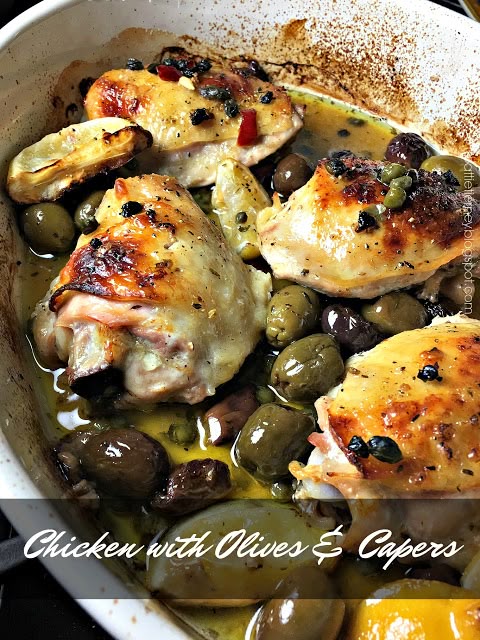
Ingredients
- 4 boneless, skinless chicken thighs
- Salt and pepper
- Flour
- 2 tablespoons olive oil or vegetable oil
- 1 medium onion, minced finely
- 3 cloves garlic, minced
- 1 to 2 cups chicken broth
- 12 Kalamata or other Greek-style or Mediterranean-style olives*
Instructions
- Season chicken with salt and pepper.
- Coat with flour and shake off excess.
- Heat vegetable oil in a wide skillet over medium-high heat.
- Add chicken thighs and cook for 5 minutes; they should be golden.
- Turn the thighs and cook for 5 minutes more.
- Remove chicken to a plate.
- Add onion and garlic to the pan and cook for about 5 minutes, until softened.
- Add chicken broth. Bring to a boil over high heat and add chicken back to pan. Lower heat and boil gently for about 20 minutes, or until chicken is cooked through and the liquid is quite reduced and sauce-like.
- While the chicken cooks, pit olives if necessary. Chop and add to pan.
Notes
* Substitute green olives if you can’t find Greek-style black olives.
Why are Chinese people around the world supporting the Chinese Communist Party? Most of these Chinese supporters don’t even live in China. Can they be complicit of CCP’s crimes?
For a start, I’m not even Chinese, I’m Australian and I too support the Chinese government, but just to get something straight, IT’S NOT THE CHINESE COMMUNIST PARTY, it’s called the communist party of China, there is a difference and every one knows it, the U.S. changed it around to make is sound more derogatory, which of course it isn’t, it’s just a name, you see, China hasn’t been communist since opening up 40 odd years ago, but the Chinese government still governs with communistic ideals, which are from the people, of the people, FOR the people, that means everyone is treated as equally as possible, that’s why they have the worlds highest approval rating, of any government anywhere,
also, I should add there is no communist country in the world today, Cuba is still the closest, because the Cuban government provides free accommodation for all it’s citizens, the rest all allow private citizens to own their own properties and businesses, which a true communist country wouldn’t allow,
the reason I support China, is not so much supporting the government, but having worked and lived there for four years, I defend the truth, against Yankee lies and rotten propaganda,
Easy Spinach & Ricotta Stuffed Shells
by 
These jumbo pasta shells are filled with a creamy spinach and ricotta mixture, baked in a rich marinara sauce, and topped with melted mozzarella. This dish is a comforting Italian classic that is perfect for a cozy family dinner, meal prep, or even a special occasion. The combination of creamy cheese, tender pasta, and flavorful sauce makes this recipe an all-time favorite.
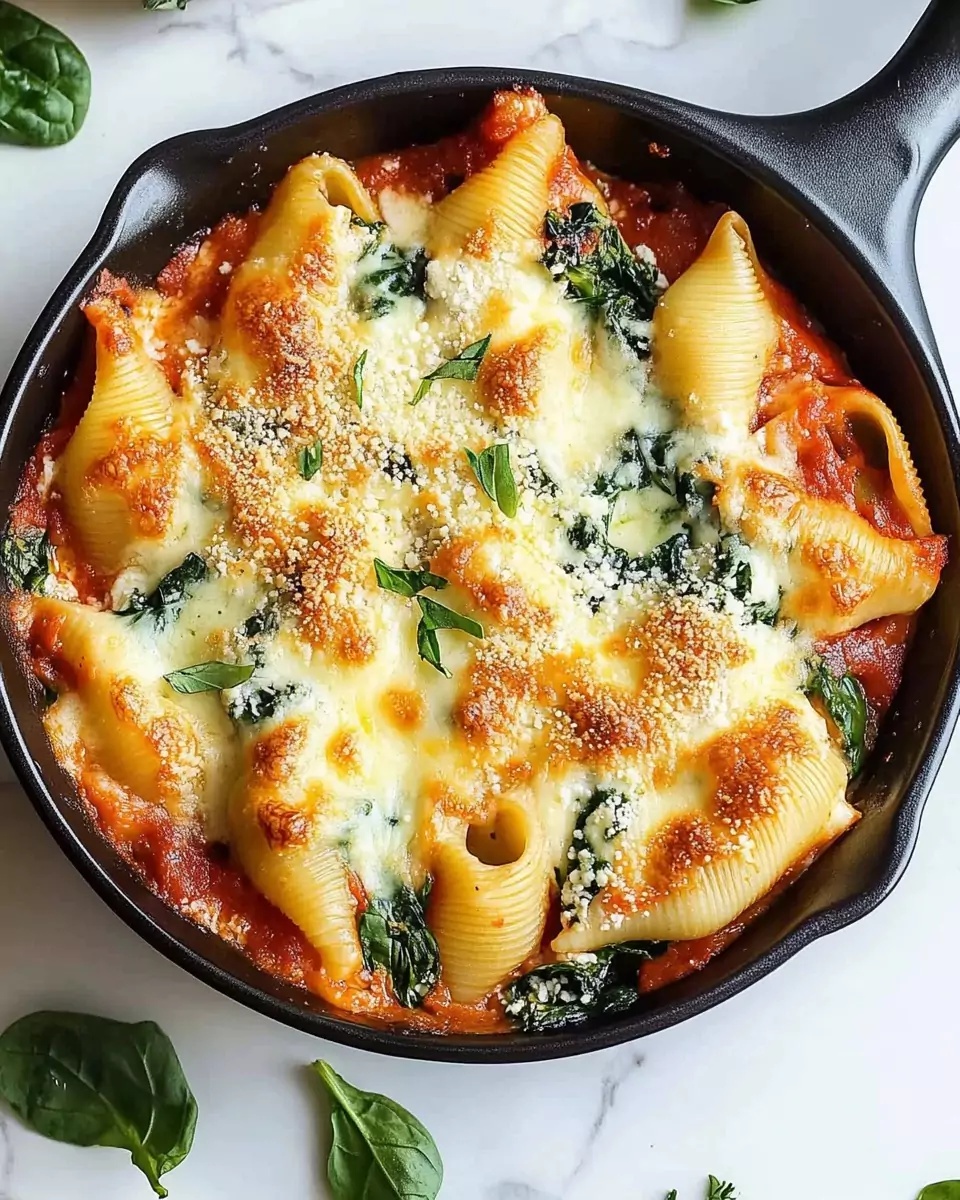
Why You’ll Love This Recipe
-
- Simple and delicious – Easy to prepare with everyday ingredients.
- Family-friendly – A crowd-pleaser that even picky eaters enjoy.
- Perfect for meal prep – Can be assembled in advance and baked later.
- Vegetarian comfort food – Hearty, satisfying, and packed with flavor.
Essential Tools & Equipment
To ensure smooth preparation, have these kitchen essentials ready:
-
- Large pot – For boiling pasta shells
- Colander – To drain the pasta
- Mixing bowls – For preparing the ricotta filling
- Skillet – For sautéing garlic and spinach
- Baking dish (9×13-inch) – To assemble and bake the dish
- Aluminum foil – To cover while baking
- Wooden spoon or spatula – For mixing and stuffing the shells
Ingredients
For the Pasta Shells
- 12 jumbo pasta shells
- 1 tablespoon olive oil (for sautéing)
- 2 cups marinara sauce
For the Ricotta Filling
- 1½ cups ricotta cheese
- 1 cup mozzarella cheese, shredded (plus extra for topping)
- ½ cup parmesan cheese, grated
- 1 large egg
- 1 cup fresh spinach, chopped (or ½ cup frozen spinach, thawed and drained)
- 2 cloves garlic, minced
- ¼ teaspoon nutmeg (optional, enhances flavor)
- Salt and pepper, to taste
For Garnish & Serving
- Fresh basil or parsley, for garnish
- Red pepper flakes, for a spicy kick (optional)
Step-by-Step Directions
1. Preheat the Oven
Preheat your oven to 375°F (190°C).
2. Cook the Pasta Shells
-
- Bring a large pot of salted water to a boil.
- Add the jumbo pasta shells and cook until al dente (slightly firm).
- Drain, rinse with cold water, and set aside to prevent sticking.
3. Prepare the Spinach & Ricotta Filling
- Stir in the chopped spinach and cook until wilted (or just heated through if using frozen spinach).
- Remove from heat and season with salt and pepper.
- In a large bowl, combine:
- Ricotta cheese
- Mozzarella cheese
- Parmesan cheese
- Egg
- Nutmeg (if using)
- Cooked spinach mixture
- Mix until everything is evenly incorporated.
4. Assemble the Stuffed Shells
-
- Spread 1 cup of marinara sauce on the bottom of a 9×13-inch baking dish.
- Carefully stuff each pasta shell with the ricotta mixture and place seam-side up in the dish.
- Pour the remaining 1 cup of marinara sauce over the shells.
- Sprinkle extra mozzarella cheese on top.
5. Bake
-
- Cover the dish with aluminum foil and bake for 25 minutes.
- Remove the foil and bake for another 10 minutes, or until the cheese is melted and bubbly.
6. Serve
- Let cool for 5 minutes before serving.
- Garnish with fresh basil or parsley.
- Serve warm with garlic bread or a side salad.
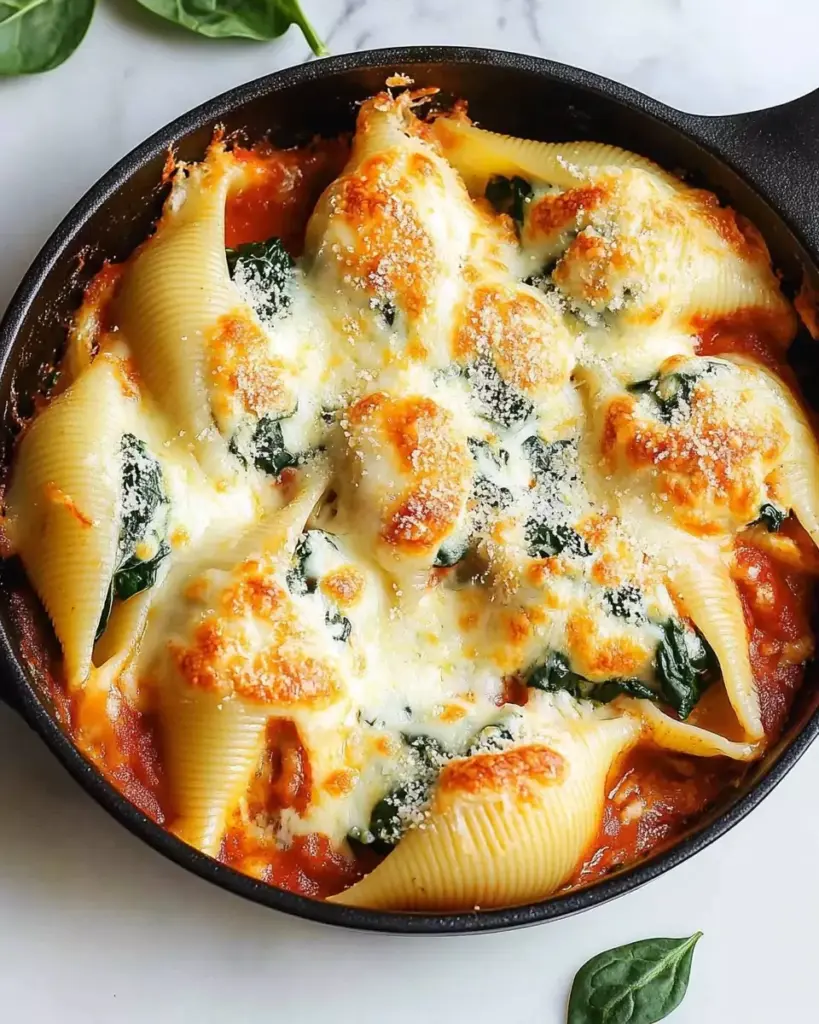
Notes & Variations
-
- Cheese Options: Provolone or extra parmesan can add a richer topping.
- Spicy Twist: Sprinkle red pepper flakes for added heat.
- Make-Ahead Tip: Assemble and refrigerate up to 24 hours in advance before baking.
- Gluten-Free Option: Use gluten-free pasta shells or substitute with zucchini boats.
- Protein Additions: Add cooked ground beef, sausage, or shredded chicken for a heartier meal.
Best Side Dishes to Serve with Stuffed Shells
1. Garlic Bread
Crispy, buttery, and full of garlic flavor, this classic side is perfect for scooping up extra marinara sauce.
2. Caesar Salad
A crisp Caesar salad with romaine lettuce, parmesan cheese, and a tangy dressing adds freshness and balance to the meal.
3. Roasted Vegetables
Oven-roasted zucchini, bell peppers, mushrooms, or asparagus provide a healthy and flavorful contrast to the rich, cheesy pasta.
4. Bruschetta
Fresh diced tomatoes, basil, and balsamic glaze on toasted bread bring a bright, refreshing element to the meal.
5. Caprese Salad
Sliced fresh mozzarella, tomatoes, and basil with a drizzle of balsamic glaze make a light and elegant pairing.
6. Steamed Asparagus
Lightly steamed asparagus with a squeeze of lemon enhances the meal without overpowering the flavors.
7. Minestrone Soup
A warm and hearty Italian vegetable soup works well as an appetizer before serving stuffed shells.
8. Red Wine
A glass of Sangiovese or Chianti complements the rich, cheesy flavors of the dish. For a non-alcoholic option, sparkling water with lemon is a refreshing alternative.
Storage & Reheating Instructions
Refrigeration
- Store leftovers in an airtight container in the refrigerator for up to 4 days.
- For best results, reheat before serving.
Freezing Instructions
Unbaked Stuffed Shells
-
- Assemble the dish but do not bake.
- Cover tightly with plastic wrap and then foil to prevent freezer burn.
- Freeze for up to 3 months.
- When ready to bake, thaw overnight in the refrigerator and bake as directed. If baking directly from frozen, add 10-15 minutes to the baking time.
Baked Stuffed Shells
- Let the dish cool completely.
- Store in a freezer-safe container or wrap individual portions in plastic wrap and foil.
- Freeze for up to 3 months.
Reheating
Oven Method (Best for Large Portions)
Microwave Method (Best for Individual Servings)
- Place stuffed shells on a microwave-safe plate.
- Heat on medium power for 2-3 minutes, checking and stirring as needed.
Frequently Asked Questions
Can I use cottage cheese instead of ricotta?
Yes, but for a smoother texture, blend it in a food processor before using.
Can I make this gluten-free?
Yes. Use gluten-free jumbo pasta shells, or substitute with zucchini boats or bell peppers for a low-carb alternative.
Can I add protein to the filling?
Yes. You can mix in cooked ground beef, Italian sausage, shredded chicken, or even lentils for added protein.
Can I prepare this dish ahead of time?
Yes. You can assemble the stuffed shells up to 24 hours in advance and store them in the refrigerator before baking.
What is the best way to keep pasta shells from sticking together?
-
- Cook them in plenty of salted water and stir occasionally.
- Drain and rinse with cold water to stop the cooking process.
- Lightly toss with olive oil to prevent them from sticking.
Can I use fresh spinach instead of frozen?
Yes. Use twice the amount of fresh spinach, as it wilts down significantly when cooked.
How can I make the dish spicier?
Add red pepper flakes to the ricotta mixture or sprinkle them on top before serving.
What is the best cheese to use for topping?
Mozzarella is the best choice for a melty topping, but provolone, gouda, or extra parmesan can add extra depth of flavor.
Conclusion
These spinach & ricotta stuffed shells are a comforting, flavorful dish that is perfect for any occasion. Whether you make them fresh, prepare them ahead, or freeze them for later, they are always a hit at the dinner table. With the right techniques and ingredients, you can create a restaurant-quality Italian meal right at home.
Serve with your favorite side dishes, follow the storage tips, and enjoy a simple yet satisfying dinner that the whole family will love.
Common Mistakes to Avoid & How to Perfect the Recipe
Overcooking the Pasta
Cook shells just until al dente to prevent them from becoming too soft. They will continue cooking in the oven.
Not Draining the Spinach Properly
If using frozen spinach, squeeze out all excess water before mixing it into the ricotta filling. Too much moisture can make the filling watery.
Skipping the Egg
The egg helps bind the ricotta mixture, making it creamy yet firm enough to hold its shape. Without it, the filling may be too loose.
Overfilling the Shells
Stuffing the shells too much can cause them to break apart. Fill each shell just enough so they hold their shape without spilling over.
Using Low-Quality Cheese
Fresh, high-quality ricotta, mozzarella, and parmesan make a big difference in flavor and texture. Avoid pre-shredded cheese, as it contains anti-caking agents that affect melting.
Forgetting to Cover While Baking
Covering the dish with foil for the first part of baking helps prevent the shells from drying out. Remove the foil towards the end for a golden, bubbly cheese topping.
Not Letting the Dish Rest Before Serving
Allow the stuffed shells to cool for about 5 minutes before serving. This helps the filling set and makes them easier to serve.
By keeping these tips in mind, you can ensure perfectly cooked, flavorful, and well-balanced stuffed shells every time.

Easy Spinach & Ricotta Stuffed Shells
Ingredients
- 12 jumbo pasta shells
- 1½ cups ricotta cheese
- ¼ teaspoon nutmeg optional
- 1 cup mozzarella cheese shredded (plus extra for topping)
- ½ cup parmesan cheese grated
- 1 large egg
- 1 cup fresh spinach chopped (or ½ cup frozen spinach, thawed and drained)
- 2 cloves garlic minced
- 2 cups marinara sauce
- 1 tablespoon olive oil
- Salt and pepper to taste
- Fresh basil or parsley for garnish
Instructions
Preparation
-
Preheat your oven to 375°F (190°C).
-
If using fresh spinach, wash and chop it finely. If using frozen spinach, thaw it and squeeze out any excess water.
Cook the Pasta Shells
-
-
In a large pot of boiling salted water, cook the jumbo pasta shells until al dente.
-
-
Drain and set aside to cool slightly.
Prepare the Filling
-
-
Add the spinach and cook until wilted (if using fresh) or heated through (if using frozen). Season with salt and pepper.
-
In a mixing bowl, combine ricotta, mozzarella, parmesan, egg, nutmeg (if using), and the sautéed spinach mixture. Mix until well incorporated.
Assemble the Dish
-
-
Spread a layer of marinara sauce on the bottom of a baking dish.
-
Carefully stuff each cooked pasta shell with the cheese and spinach mixture. Place them seam-side up in the baking dish.
-
Pour the remaining marinara sauce over the stuffed shells and sprinkle with additional mozzarella cheese.
-
Bake
-
Remove the foil and bake for an additional 10 minutes, or until the cheese is bubbly and golden.
Serve
-
-
Garnish the stuffed shells with fresh basil or parsley. Serve warm with a side of garlic bread or a fresh green salad.
-