Spell My Name With An S
Marshall Zebatinsky felt foolish. He felt as though there were eyes staring through the grimy store-front glass and across the scarred wooden partition; eyes watching him.
He felt no confidence in the old clothes he had resurrected or the turned-down brim of a hat he never otherwise wore or the glasses he had left in their case. He felt foolish and it made the lines in his forehead deeper and his young-old face a little paler.
He would never be able to explain to anyone why a nuclear physicist such as himself should visit a numerologist. (Never, he thought. Never.) Hell, he could not explain it to himself except that he had let his wife talk him into it.
The numerologist sat behind an old desk that must have been secondhand when bought. No desk could get that old with only one owner.
The same might almost be said of his clothes.
He was little and dark and peered at Zebatinsky with little dark eyes that were brightly alive.
He said, “I have never had a physicist for a client before, Dr. Zebatinsky.”
Zebatinsky flushed at once. “You understand this is confidential.”
The numerologist smiled so that wrinkles creased about the corners of his mouth and the skin around his chin stretched. “All my dealings are confidential.”
Zebatinsky said, “I think I ought to tell you one thing. I don’t believe in numerology and I don’t expect to begin believing in it. If that makes a difference, say so now.”
“But why are you here, then?”
“My wife thinks you may have something, whatever it is. I promised her and I am here.” He shrugged and the feeling of folly grew more acute.
“And what is it you are looking for? Money? Security? Long life? What?”
Zebatinsky sat for a long moment while the numerologist watched him quietly and made no move to hurry his client. Zebatinsky thought: What do I say anyway? That I’m thirty-four and without a future?
He said, “I want success. I want recognition.”
“A better job?”
“A different job. A different kind of job. Right now, I’m part of a team, working under orders. Teams! That’s all government research is. You’re a violinist lost in a symphony orchestra.”
“And you want to solo.”
“I want to get out of a team and into-into me.”
Zebatinsky felt carried away, almost lightheaded, just putting this into words to someone other than his wife.
He said, “Twenty-five years ago, with my kind of training and my kind of ability, I would have gotten to work on the first nuclear power plants. Today I’d be running one of them or I’d be head of a pure research group at a university.
But with my start these days where will I be twenty-five years from now?
Nowhere. Still on the team. Still carrying my 2 per cent of the ball. I’m drowning in an anonymous crowd of nuclear physicists, and what I want is room on dry land, if you see what I mean.”
The numerologist nodded slowly. “You realize, Dr. Zebatinsky, that I don’t guarantee success.”
Zebatinsky, for all his lack of faith, felt a sharp bite of disappointment.
“You don’t? Then what the devil do you guarantee?”
“An improvement in the probabilities. My work is statistical in nature. Since you deal with atoms, I think you understand the laws of statistics.”
“Do you?” asked the physicist sourly.
“I do, as a matter of fact. I am a mathematician and I work mathematically. I don’t tell you this in order to raise my fee. That is standard. Fifty dollars. But since you are a scientist, you can appreciate the nature of my work better than my other clients. It is even a pleasure to be able to explain to you.”
Zebatinsky said, “I’d rather you wouldn’t, if you don’t mind. It’s no use telling me about the numerical values of letters, their mystic significance and that kind of thing. I don’t consider that mathematics.
Let’s get to the point-” The numerologist said, “Then you want me to help you provided I don’t embarrass you by telling you the silly nonscientific basis of the way in which I helped you. Is that it?”
“All right. That’s it.”
“But you still work on the assumption that I am a numerologist, and I am not. I call myself that so that the police won’t bother me and” (the little man chuckled dryly) “so that the psychiatrists won’t either. I am a mathematician; an honest one.” Zebatinsky smiled.
The numerologist said, “I build computers. I study probable futures.” “What?” “Does that sound worse than numerology to you? Why? Given enough data and a computer capable of sufficient number of operations in unit time, the future is predictable, at least in terms of probabilities. When you compute the motions of a missile in order to aim an anti-missile, isn’t it the future you’re predicting? The missile and antimissile would not collide if the future were predicted incorrectly. I do the same thing. Since I work with a greater number of variables, my results are less accurate.”
“You mean you’ll predict my future?”
“Very approximately. Once I have done that, I will modify the data by changing your name and no other fact about you. I throw that modified datum into the operation-program. Then I try other modified names. I study each modified future and find one that contains a greater degree of recognition for you than the future that now lies ahead of you. Or no, let me put it another way. I will find you a future in which the probability of adequate recognition is higher than the probability of that in your present future.”
“Why change my name?”
“That is the only change I ever make, for several reasons. Number one, it is a simple change. After all, if I make a great change or many changes, so many new variables enter that I can no longer interpret the result. My machine is still crude. Number two, it is a reasonable change. I can’t change your height, can I, or the color of your eyes, or even your temperament. Number three, it is a significant change. Names mean a lot to people. Finally, number four, it is a common change that is done every day by various people.”
Zebatinsky said, “What if you don’t find a better future?”
“That is the risk you will have to take. You will be no worse off than now, my friend.”
Zebatinsky stared at the little man uneasily, “I don’t believe any of this. I’d sooner believe numerology.”
The numerologist sighed. “I thought a person like yourself would feel more comfortable with the truth. I want to help you and there is much yet for you to do. If you believed me a numerologist, you would not follow through. I thought if I told you the truth you would let me help you.”
Zebatinsky said, “If you can see the future-“
“Why am I not the richest man on earth? Is that it? But I am rich-in all I want. You want recognition and I want to be left alone. I do my work. No one bothers me. That makes me a billionaire. I need a little real money and this I get from people such as yourself. Helping people is nice and perhaps a psychiatrist would say it gives me a feeling of power and feeds my ego. Now-do you want me to help you?”
“How much did you say?”
“Fifty dollars. I will need a great deal of biographical information from you but I have prepared a form to guide you. It’s a little long, I’m afraid. Still, if you can get it in the mail by the end of the week, I will have an answer for you by the-“
(he put out his lower lip and frowned in mental calculation)
“the twentieth of next month.”
“Five weeks? So long?”
“I have other work, my friend, and other clients. If I were a fake, I could do it much more quickly.
It is agreed then?”
Zebatinsky rose. “Well, agreed.-This is all confidential, now.”
“Perfectly. You will have all your information back when I tell you what change to make and you have my word that I will never make any further use of any of it.”
The nuclear physicist stopped at the door.
“Aren’t you afraid I might tell someone you’re not a numerologist?”
The numerologist shook his head. “Who would believe you, my friend? Even supposing you were willing to admit to anyone that you’ve been here.”
…
On the twentieth, Marshall Zebatinsky was at the paint-peeling door, glancing sideways at the shop front with the little card up against the glass reading “Numerology,” dimmed and scarcely legible through the dust.
He peered in, almost hoping that someone else would be there already so that he might have an excuse to tear up the wavering intention in his mind and go home.
He had tried wiping the thing out of his mind several times. He could never stick at filling out the necessary data for long. It was embarrassing to work at it. He felt incredibly silly filling out the names of his friends, the cost of his house, whether his wife had had any miscarriages, if so, when.
He abandoned it. But he.couldn’t stick at stopping altogether either. He returned to it each evening.
It was the thought of the computer that did it, perhaps; the thought of the infernal gall of the little man pretending he had a computer.
The temptation to call the bluff, see what would happen, proved irresistible after all. He finally sent off the completed data by ordinary mail, putting on nine cents worth of stamps without weighing the letter. If it comes back, he thought, I’ll call it off.
It didn’t come back. He looked into the shop now and it was empty. Zebatinsky had no choice but to enter. A bell tinkled. The old numerologist emerged from a curtained door.
“Yes?-Ah, Dr. Zebatinsky.”
“You remember me?” Zebatinsky tried to smile. “Oh, yes.”
“What’s the verdict?” The numerologist moved one gnarled hand over the other.
“Before that, sir, there’s a little-“
“A little matter of the fee?”
“I have already done the work, sir. I have earned the money.”
Zebatinsky raised no objection. He was prepared to pay. If he had come this far, it would be silly to turn back just because of the money.
He counted out five ten-dollar bills and shoved them across the counter.
“Well?”
The numerologist counted the bills again slowly, then pushed them into a cash drawer in his desk.
He said, “Your case was very interesting. I would advise you to change your name to Sebatinsky.”
“Seba-How do you spell that?” “S-e-b-a-t-i-n-s-k-y.” Zebatinsky stared indignantly.
“You mean change the initial? Change the Z to an S? That’s all?”
“It’s enough. As long as the change is adequate, a small change is safer than a big one.”
“But how could the change affect anything?”
“How could any name?” asked the numerologist softly.
“I can’t say. It may, somehow, and that’s all I can say. Remember, I don’t guarantee results. Of course, if you do not wish to make the change, leave things as they are. But in that case I cannot refund the fee.”
Zebatinsky said, “What do I do? Just tell everyone to spell my name with an 5?”
“If you want my advice, consult a lawyer. Change your name legally. He can advise you on little things.”
“How long will it all take? I mean for things to improve for me?”
“How can I tell? Maybe never. Maybe tomorrow.”
“But you saw the future. You claim you see it.”
“Not as in a crystal ball. No, no, Dr. Zebatinsky. All I get out of my computer is a set of coded figures. I can recite probabilities to you, but I saw no pictures.”
Zebatinsky turned and walked rapidly out of the place. Fifty dollars to change a letter! Fifty dollars for Sebatinsky! Lord, what a name! Worse than Zebatinsky.
…
It took another month before he could make up his mind to see a lawyer, and then he finally went. He told himself he could always change the name back. Give it a chance, he told himself. Hell, there was no law against it.
…
Henry Brand looked through the folder page by page, with the practiced eye of one who had been in Security for fourteen years. He didn’t have to read every word. Anything peculiar would have leaped off the paper and punched him in the eye. He said, “The man looks clean to me.”
Henry Brand looked clean, too; with a soft, rounded paunch and a pink and freshly scrubbed complexion. It was as though continuous contact with all sorts of human failings, from possible ignorance to possible treason, had compelled him into frequent washings.
Lieutenant Albert Quincy, who had brought him the folder, was young and filled with the responsibility of being Security officer at the Hanford Station.
“But why Sebatinsky?” he demanded. “Why not?”
“Because it doesn’t make sense. Zebatinsky is a foreign name and I’d change it myself if I had it, but I’d change it to something Anglo-Saxon. If Zebatinsky had done that, it would make sense and I wouldn’t give it a second thought. But why change a Z to an S? I think we must find out what his reasons were.”
“Has anyone asked him directly?”
“Certainly. In ordinary conversation, of course. I was careful to arrange that. He won’t say anything more than that he’s tired of being last in the alphabet.”
“That could be, couldn’t it, Lieutenant?”
“It could, but why not change his name to Sands or Smith, if he wants an S? Or if he’s that tired of Z, why not go the whole way and change it to an A? Why not a name like-uh-Aarons?”
“Not Anglo-Saxon enough,” muttered Brand. Then, “But there’s nothing to pin against the man. No matter how queer a name change may be, that alone can’t be used against anyone.”
Lieutenant Quincy looked markedly unhappy.
Brand said, “Tell me, Lieutenant, there must be something specific that bothers you. Something in your mind; some theory; some gimmick. What is it?”
The lieutenant frowned. His light eyebrows drew together and his lips tightened.
“Well, damn it, sir, the man’s a Russian.” Brand said, “He’s not that. He’s a third-generation American.”
“I mean his name’s Russian.” Brand’s face lost some of its deceptive softness. “No, Lieutenant, wrong again. Polish.”
The lieutenant pushed his hands out impatiently, palms up. “Same thing.” Brand, whose mother’s maiden name had been Wiszewski, snapped, “Don’t tell that to a Pole, Lieutenant.”
-Then, more thoughtfully, “Or to a Russian either, I suppose.”
“What I’m trying to say, sir,” said the lieutenant, reddening, “is that the Poles and Russians are both on the other side of the Curtain.”
“We all know that.”
“And Zebatinsky or Sebatinsky, whatever you want to call him, may have relatives there.”
“He’s third generation. He might have second cousins there, I suppose. So what?”
“Nothing in itself. Lots of people may have distant relatives there. But Zebatinsky changed his name.”
“Go on.”
“Maybe he’s trying to distract attention. Maybe a second cousin over there is getting too famous and our Zebatinsky is afraid that the relationship may spoil his own chances of advancement.”
“Changing his name won’t do any good. He’d still be a second cousin.”
“Sure, but he wouldn’t feel as though he were shoving the relationship in our face.”
“Have you ever heard of any Zebatinsky on the other side?”
“No, sir.” “Then he can’t be too famous. How would our Zebatinsky know about him?”
“He might keep in touch with his own relatives. That would be suspicious under the circumstances, he being a nuclear physicist.”
Methodically, Brand went through the folder again. “This is awfully thin, Lieutenant. It’s thin enough to be completely invisible.”
“Can you offer any other explanation, sir, of why he ought to change his name in just this way?”
“No, I can’t. I admit that.” “Then I think, sir, we ought to investigate. We ought to look for any men named Zebatinsky on the other side and see if we can draw a connection.”
The lieutenant’s voice rose a trifle as a new thought occurred to him. “He might be changing his name to withdraw attention from them; I mean to protect them.”
“He’s doing just the opposite, I think.”
“He doesn’t realize that, maybe, but protecting them could be his motive.”
Brand sighed. “All right, well tackle the Zebatinsky angle.-But if nothing turns up, Lieutenant, we drop the matter. Leave the folder with me.”
…
When the information finally reached Brand, he had all but forgotten the lieutenant and his theories. His first thought on receiving data that included a list of seventeen biographies of seventeen Russian and Polish citizens, all named Zebatinsky, was: What the devil is this?
Then he remembered, swore mildly, and began reading.
It started on the American side. Marshall Zebatinsky (fingerprints) had been born in Buffalo, New York (date, hospital statistics). His father had been born in Buffalo as well, his mother in Oswego, New York. His paternal grandparents had both been born in Bialystok, Poland (date of entry into the United States, dates of citizenship, photographs). The seventeen Russian and Polish citizens named Zebatinsky were all descendants of people who, some half century earlier, had lived in or near Bialystok. Presumably, they could be relatives, but this was not explicitly stated in any particular case. (Vital statistics in East Europe during the aftermath of World War I were kept poorly, if at all.)
Brand passed through the individual life histories of the current Zebatinsky men and women (amazing how thoroughly intelligence did its work; probably the Russians’ was as thorough).
He stopped at one and his smooth forehead sprouted lines as his eyebrows shot upward. He put that one to one side and went on.
Eventually, he stacked everything but that one and returned it to its envelope. Staring at that one, he tapped a neatly kept fingernail on the desk. With a certain reluctance, he went to call on Dr. Paul Kristow of the Atomic Energy Commission.
…
Dr. Kristow listened to the matter with a stony expression. He lifted a little finger occasionally to dab at his bulbous nose and remove a nonexistent speck. His hair was iron gray, thinning and cut short. He might as well have been bald.
He said, “No, I never heard of any Russian Zebatinsky. But then, I never heard of the American one either.”
“Well,” Brand scratched at his hairline over one temple and said slowly, “I don’t think there’s anything to this, but I don’t like to drop it too soon. I have a young lieutenant on my tail and you know what they can be like. I don’t want to do anything that will drive him to a Congressional committee. Besides, the fact is that one of the Russian Zebatinsky fellows, Mikhail Andreyevich Zebatinsky, is a nuclear physicist. Are you sure you never heard of him?”
“Mikhail Andreyevich Zebatinsky? No-No, I never did. Not that that proves anything.”
“I could say it was coincidence, but you know that would be piling it a trifle high. One Zebatinsky here and one Zebatinsky there, both nuclear physicists, and the one here suddenly changes his name to Sebatinsky, and goes around anxious about it, too. He won’t allow misspelling.
He says, emphatically, ‘Spell my name with an S.’ It all just fits well enough to make my spy-conscious lieutenant begin to look a little too good.
-And another peculiar thing is that the Russian Zebatinsky dropped out of sight just about a year ago.” Dr. Kristow said stolidly, “Executed!”
“He might have been. Ordinarily, I would even assume so, though the Russians are not more foolish than we are and don’t kill any nuclear physicist they can avoid killing. The thing is there’s another reason why a nuclear physicist, of all people, might suddenly disappear. I don’t have to tell you.”
“Crash research; top secret. I take it that’s what you mean. Do you believe that’s it?”
“Put it together with everything else, add in the lieutenant’s intuition, and I just begin to wonder.”
“Give me that biography.” Dr. Kristow reached for the sheet of paper and read it over twice. He shook his head. Then he said, “I’ll check this in Nuclear Abstracts.”
…
Nuclear Abstracts lined one wall of Dr. Kristow’s study in neat little boxes, each filled with its squares of microfilm. The A.E.C. man used his projector on the indices while Brand watched with what patience he could muster.
Dr. Kristow muttered, “A Mikhail Zebatinsky authored or co-authored half a dozen papers in the Soviet journals in the last half dozen years.
We’ll get out the abstracts and maybe we can make something out of it. I doubt it.”
A selector nipped out the appropriate squares. Dr. Kristow lined them up, ran them through the projector, and by degrees an expression of odd intentness crossed his face.
He said, “That’s odd.”
Brand said, “What’s odd?”
Dr. Kristow sat back. “I’d rather not say just yet. Can you get me a list of other nuclear physicists who have dropped out of sight in the Soviet Union hi the last year?”
“You mean you see something?”
“Not really. Not if I were just looking at any one of these papers. It’s just that looking at all of them and knowing that this man may be on a crash research program and, on top of that, having you putting suspicions in my head-“
He shrugged. “It’s nothing.”
Brand said earnestly, “I wish you’d say what’s on your mind. We may as well be foolish about this together.”
“If you feel that way-It’s just possible this man may have been inching toward gamma-ray reflection.”
“And the significance?”
“If a reflecting shield against gamma rays could be devised, individual shelters could be built to protect against fallout. It’s fallout that’s the real danger, you know. A hydrogen bomb might destroy a city but the fallout could slow-kill the population over a strip thousands of miles long and hundreds wide.”
Brand said quickly, “Are we doing any work on this?”
“No.”
“And if they get it and we don’t, they can destroy the United States in toto at the cost of, say, ten cities, after they have their shelter program completed.”
“That’s far in the future.-And, what are we getting in a hurrah about? All this is built on one man changing one letter in his name.”
“All right, I’m insane,” said Brand. “But I don’t leave the matter at this point. Not at this point. I’ll get you your list of disappearing nuclear physicists if I have to go to Moscow to get it.”
…
He got the list.
They went through all the research papers authored by any of them. They called a full meeting of the Commission, then of the nuclear brains of the nation. Dr. Kristow walked out of an all night session, finally, part of which the President himself had attended. Brand met him. Both looked haggard and in need of sleep.
Brand said, “Well?” Kristow nodded.
“Most agree. Some are doubtful even yet, but most agree.”
“How about you? Are you sure?”
“I’m far from sure, but let me put it this way. It’s easier to believe that the Soviets are working on a gamma-ray shield than to believe that all the data we’ve uncovered has no interconnection.”
“Has it been decided that we’re to go on shield research, too?”
“Yes.” Kristow’s hand went back over his short, bristly hair, making a dry, whispery sound. “We’re going to give it everything we’ve got. Knowing the papers written by the men who disappeared, we can get right on their heels. We may even beat them to it.
-Of course, they’ll find out we’re working on it.”
“Let them,” said Brand. “Let them. It will keep them from attacking. I don’t see any percentage in selling ten of our cities just to get ten of theirs-if we’re both protected and they’re too dumb to know that”
“But not too soon. We don’t want them finding out too soon. What about the American Zebatinsky-Sebatinsky?”
Brand looked solemn and shook his head. “There’s nothing to connect him with any of this even yet. Hell, we’ve looked. I agree with you, of course. He’s in a sensitive spot where he is now and we can’t afford to keep him there even if he’s in the clear.”
“We can’t kick him out just like that, either, or the Russians will start wondering.”
“Do you have any suggestions?” They were walking down the long corridor toward the distant elevator in the emptiness of four in the morning. Dr. Kristow said, “I’ve looked into his work. He’s a good man, better than most, and not happy in his job, either. He hasn’t the temperament for teamwork.”
“So?”
“But he is the type for an academic job. If we can arrange to have a large university offer him a chair in physics, I think he would take it gladly. There would be enough nonsensitive areas to keep him occupied; we would be able to keep him in close view; and it would be a natural development.
The Russians might not start scratching their heads. What do you think?” Brand nodded. “It’s an idea. Even sounds good. I’ll put it up to the chief.”
They stepped into the elevator and Brand allowed himself to wonder about it all. What an ending to what had started with one letter of a name.
…
Marshall Sebatinsky could hardly talk. He said to his wife, “I swear I don’t see how this happened. I wouldn’t have thought they knew me from a meson detector. – Good Lord, Sophie, Associate Professor of Physics at Princeton. Think of it.”
Sophie said, “Do you suppose it was your talk at the A.P.S. meetings?”
“I don’t see how. It was a thoroughly uninspired paper once everyone in the division was done hacking at it.”
He snapped his fingers.
“It must have been Princeton that was investigating me. That’s it. You know all those forms I’ve been filling out in the last six months; those interviews they wouldn’t explain. Honestly, I was beginning to think I was under suspicion as a subversive.-It was Princeton investigating me. They’re thorough.”
“Maybe it was your name,” said Sophie. “I mean the change.”
“Watch me now. My professional life will be my own finally. I’ll make my mark. Once I have a chance to do my work without-“
He stopped and turned to look at his wife. “My name! You mean the S.”
“You didn’t get the offer till after you changed your name, did you?”
“Not till long after. No, that part’s just coincidence. I’ve told you before Sophie, it was just a case of throwing out fifty dollars to please you. Lord, what a fool I’ve felt all these months insisting on that stupid S.”
Sophie was instantly on the defensive. “I didn’t make you do it, Marshall. I suggested it but I didn’t nag you about it. Don’t say I did. Besides, it did turn out well. I’m sure it was the name that did this.” Sebatinsky smiled indulgently. “Now that’s superstition.”
“I don’t care what you call it, but you’re not changing your name back.”
“Well, no, I suppose not. I’ve had so much trouble getting them to spell my name with an S, that the thought of making everyone move back is more than I want to face. Maybe I ought to change my name to Jones, eh?”
He laughed almost hysterically. But Sophie didn’t. “You leave it alone.”
“Oh, all right, I’m just joking. -Tell you what. I’ll step down to that old fellow’s place one of these days and tell him everything worked out and slip him another tenner. Will that satisfy you?”
He was exuberant enough to do so the next week. He assumed no disguise this time. He wore his glasses and his ordinary suit and was minus a hat. He was even humming as he approached the store front and stepped to one side to allow a weary, sour-faced woman to maneuver her twin baby carriage past. He put his hand on the door handle and his thumb on the iron latch. The latch didn’t give to his thumb’s downward pressure.
The door was locked.
The dusty, dim card with “Numerologist” on it was gone, now that he looked. Another sign, printed and beginning to yellow and curl with the sunlight, said “To let.”
Sebatinsky shrugged. That was that. He had tried to do the right thing.
…
Haround, happily divested of corporeal excrescence, capered happily and his energy vortices glowed a dim purple over cubic hypermiles.
He said, “Have I won? Have I won?”
Mestack was withdrawn, his vortices almost a sphere of light in hyperspace. “I haven’t calculated it yet.”
“Well, go ahead. You won’t change the results any by taking a long time.-Wowf, it’s a relief to get back into clean energy. It took me a microcycle of time as a corporeal body; a nearly used-up one, too. But it was worth it to show you.”
Mestack said, “All right, I admit you stopped a nuclear war on the planet.”
“Is that or is that not a Class A effect?”
“It is a Class A effect. Of course it is.”
“All right. Now check and see if I didn’t get that Class A effect with a Class F stimulus. I changed one letter of one name.”
“What?”
“Oh, never mind. It’s all there. I’ve worked it out for you.” Mestack said reluctantly, “I yield. A Class F stimulus.”
“Then I win. Admit it.”
“Neither one of us will win when the Watchman gets a look at this.”
Haround, who had been an elderly numerologist on Earth and was still somewhat unsettled with relief at no longer being one, said, “You weren’t worried about that when you made the bet.”
“I didn’t think you’d be fool enough to go through with it.”
“Heat-waste! Besides, why worry? The Watchman will never detect a Class F stimulus.”
“Maybe not, but he’ll detect a Class A effect. Those corporeals will still be around after a dozen microcycles. The Watchman will notice that.”
“The trouble with you, Mestack, is that you don’t want to pay off. You’re stalling.”
“I’ll pay. But just wait till the Watchman finds out we’ve been working on an unassigned problem and made an unallowed-for change. Of course, if we-” He paused.
Haround said, “All right, we’ll change it back. He’ll never know.” There was a crafty glow to Mestack’s brightening energy pattern.
“You’ll need another Class F stimulus if you expect him not to notice.” Haround hesitated. “I can do it.”
“I doubt it.”
“I could.”
“Would you be willing to bet on that, too?” Jubilation was creeping into Mestack’s radiations.
“Sure,” said the goaded Haround.
“I’ll put those corporeals right back where they were and the Watchman will never know the difference.”
Mestack followed through his advantage. “Suspend the first bet, then. Triple the stakes on the second.” The mounting eagerness of the gamble caught at Haround, too.
“All right, I’m game. Triple the stakes.”
“Done, then!”
“Done.”
The End
Stories that Inspired Me
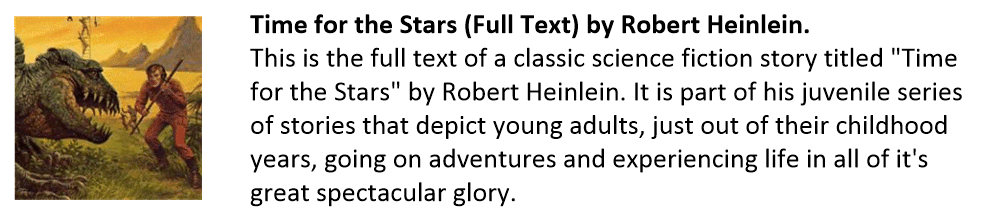
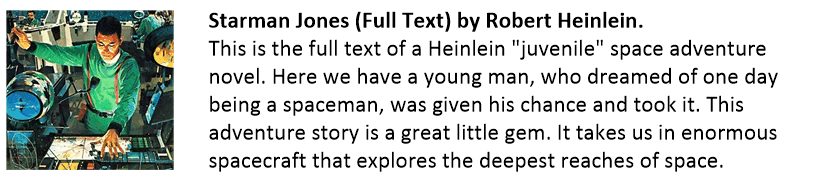
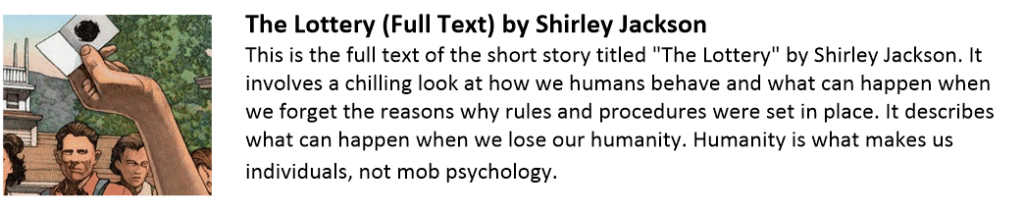
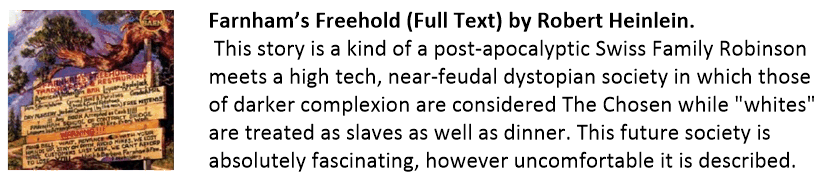
Here are reprints in full text of stories that inspired me, but that are nearly impossible to find in China. I place them here as sort of a personal library that I can use for inspiration. The reader is welcome to come and enjoy a read or two as well.

Articles & Links
You’ll not find any big banners or popups here talking about cookies and privacy notices. There are no ads on this site (aside from the hosting ads – a necessary evil). Functionally and fundamentally, I just don’t make money off of this blog. It is NOT monetized. Finally, I don’t track you because I just don’t care to.
- You can start reading the articles by going HERE.
- You can visit the Index Page HERE to explore by article subject.
- You can also ask the author some questions. You can go HERE to find out how to go about this.
- You can find out more about the author HERE.
- If you have concerns or complaints, you can go HERE.
- If you want to make a donation, you can go HERE.