We are just a group of retired spooks that discuss things that you’ll not find anywhere else. It makes us unique. Take a look around. Learn a thing or two.
This is a Patreon video that I am releasing to the general pubic and MM readership. I hope that it finds you well and that you all obtain some good information from it. This post will interrupt the normal flow of MM postings of latest (cough, cough) “news”.
Many people want to know about their previous lives. They search for answers and insight into why they are living their current life now, and they believe that their past must contain clues to their present. So they embark on a technique or avenue known as “Past Life Regression”.
This article came into being when I posted a comment on the MM Forum…
I can tell you about my previous life prior to being MM.

I was a rather slow, boorish, lonely man who wore a bowler hat, a thick wool coat and performed maintenance and janitorial work on Coney Island in the 1920's and 1930's. I died in 1933/1934 . I was alone. I lived a single life and I drank and played with dice and did my job. I did not think too much about my social position. There was nothing great about that life.

I had a girlfriend. She died. We were close but never really did anything more than kissing. She was killed when a carriage ran into her. She was my one and only love in that life.

I well remember that funny strange and disgusting face at the gate at the Coney Island entrance. I well remember the big enormous seat cars that were on the Ferris wheel. I also remember the senses and feelings of excitement as the pretty girls in lace and white dresses with their galoshes flapping as they walked charmed about on the boardwalk.

I died while performing maintenance work on a pier, and a rather large wave knocked me off the boat and I fell under the pier. I was banged around a bit and died by impact / drowning.

They recovered my body and buried me quickly. Few people attended the "funeral". I was forgotten and then moved on.

Now you know the rest of the story.
And “Memory Loss” commented…
MM that post of yours really touched me on multiple levels. And that is saying something., because most of your articles really are thought provoking.

Can you please expand somewhat on it. On the fundamental aspects of how, when etc. You made me sense the hope and futility of being a human being. And the importance of being a Rufus. Because nothing else really matters. Because we brutalise ourselves when we are not able to remember. And I thought not being able to remember stuff for a few years was bad lol.

There must be a reason to do this to human and other sentient beings in the prison complexes. Cui Bono?
So here, I am going to discuss a little bit about Past Life Regression and various aspects regarding it.
What is Past Life Regression
Past life regression is a therapeutic technique that uses hypnosis to recover memories of past lives or incarnations.
The technique used during past-life regression involves the subject answering a series of questions while hypnotized. These are used to reveal identity and events of past lives. It is a method similar to that used in recovered memory therapy.
There are those that believe that you can conduct a past life regression session through self-hypnosis, but I disagree with that. The person needs to be walked through the experience and ask intelligent questions to the events as they unfold. You simply cannot do that with self-hypnosis.
Questions and Answers regarding this therapy
Will I remember the regression? Yes, you will remember everything as you undergo the therapy. Most hypnotists use a tape recorder to record the session. Past Life Regression is not like stage hypnosis – you won’t be doing anything you don’t remember. You will be aware throughout and in a deeply relaxed state. You’ll be answering the questions posted by the hypnotist.
Do I need anything special for the session? You will need to ensure that you can be completely undisturbed for the duration of the session (2 to 4 hours typically) and also wear comfortable clothes so you can relax fully.
What will I encounter during the sessions? Generally, most sessions involve visits to multiple past lives. The number and duration of the past lives is up to the person being questioned. Many discover lives that they have shared with people that they have a close bond with in their present life – their soulmate family in a previous life and in a different incarnations. Others are drawn to certain places or countries that they immediately feel comfortable and familiar with. Each life explored is a journey and an adventure. Most clients have ‘Ahha!’ moments for many days afterwards as pieces of their picture begin falling into place.
Will I receive a record of my session? Yes. Some therapists use written notes, while others record the session with a tape recorder.
Am I guaranteed to go back in time? Not everyone is guaranteed to, though it’s fairly rare that someone doesn’t go backward in time. Sometimes when an individual has a firm belief that past lives don’t exist, or try to critique everything that they are seeing from their subconscious, then it can create a block which doesn’t allow their mind to surrender to the experience. You can also go forward in time as well. This is a unique aspect of this process.
Can I choose what past life to remember? No. Your subconscious mind will make that decision for you. You will only remember various past life memories when you are ready to receive that information. I believe we have all had many past lives, but it’s your subconscious mind that will choose which ones to visit during your regression.
Can I be told who I was in a past life? No definitely not. Only you have access to your subconscious.
Will I go to the time I passed away during a regression? Yes, but will only do so with your consent. Most therapists take clients to the time of, and the time immediately after, their passing. They are not harmed or traumatized by this. Instead it opens up a new understanding of self and certain behaviors brought into this lifetime. This tends to also take clients to the time between lives, again only with their consent.
Is the process safe? Yes, you will be safe throughout the process.
The backstory
Here is the “backstory” on how MM ended up knowing about some of his past lives and what they were like.
Conducting a past life regression is not something that you can do yourself. It is a paired effort. You need to be in a state of relaxation, and while in that state, you listed to questions that you yourself ask, and you then answer them yourself.
After the divorce from my first wife, a layoff on Christmas eve, and the death of my beloved cat, I was in emotional shambles. And while reading Dr Newtons books I came up with the idea to see if he had trained anyone to continue his work. And to my great surprise he did. In fact, one lived outside of Boston, and was relatively nearby being only a three hour drive away.
I made an appointment, paid $300 in cash (today it would probably be ten times that amount), and had my Past Life Regression Therapy.
What happened
After some brief chit-chat, and a drink of water, I went into her study / den and got on a “Lazy Boy” recliner chair. She attached a microphone to the collar of my tee shirt. She put a light blanket over me as the body temperature tends to drop during these sessions.
She made sure that it was quiet and that there were no distractions. She closed the blinds, and turned on a single lamp. And played some light relaxing music for me to listen to.
Then we began the calming exercises, much like the self hypnosis techniques that I have discussed elsewhere.
During this entire procedure, she measured how “deep” I was in trance by me telling her to read off a gauge that I visualized in my hand (in my mind).
When the gauge was pretty low (100 was fully awake, and 0 is dead, I guess), it read around 30. And she started the regression.
She regressed me back to my childhood…
First at 22 years old.
Then, at 13 years old.
At 7 years old.
At 4 years old…
Each time, she had me describe in great detail my bedroom at that age during my birthday.
At 2 years old…
Then at birth. I relived my birth.
And then right before I was born.
And then, in that deep trance, she commanded me to go to the point of death of my last life leading up to being born.
*Snap.*
I was on a boat. I could see my ugly black clodhopper boots, and the little dinghy was really moving about pretty crazily. It smelled like a fishy ocean. It was a cool day. Overcast. I felt the wind on my rough hands, and I was doing something on the boardwalk. Scrubbing off barnacles, hammering something, I’m not quite sure, and then…
…splash!
I’m in the greenish brown water and I am getting thrown about wildly. I am banging against the encrusted pier moorings, and hitting the boards. I can see the nails jutting out from the bottom of the walkway about, and then a wave throws me up.
Then down into the green water.
Then up.
Then down.
Then up again and I hit something. Ouch.
Then down again, I’m gasping for air. Up again, and all is black…
I walk through the death sequence and all that.
Apparently I am pretty experienced with all this death and dying stuff, so no one came to get me. I knew exactly what to do and where to go. So I went to a sort of flat space like a terminal of some type and there were all these transport tubes to go here and there, and I picked out a specific one and took it.
I did not enter a tunnel of light. Instead I went though a thick fog and found myself at that flat and level place. Whether I actually went through a light and did not recall it, or whether I bypassed it completely is unknown.
Now before I chat about what happened after that “station”, I would like to talk about this last life. As during this event, the Regressionist intelligently asked me questions about my life and the situation, and I dutifully answered.
About my last incarnation
My name was XXXXX Klingsmith. (I forgot the first name over the last few decades and my audio tape of the session is long gone). I died at 34 years of age.
I wasn’t smart, or that was my impression anyways. Nor was I well educated. I get the impression of a person of very little education, no up bringing, and no family or relatives. I was a thick, lonely, worker of little intelligence, and no ambition.
I was a crude man. I was a hard worker who had a job and didn’t have any ambitions towards anything else. I lived a lonely life.
I once had a girl friend. We were young and in love. But she died in a carriage / bicycle / horse accident (I forgot the details.) She was my love and I had no other interests in any other women afterwards, that I know of. My image of her was of a thin pale girl in light colors with these funny thick heel, black high heels. She had embroidered flowers on her dress. Her hair was blonde or light tan and cut (or made up) short. It was the fashion in those days.
I lived in a flophouse, or singular room. There was a wash basin in my room, and a pan to go to the bathroom in. I think it is called a bed pan, and it was enameled porcelain over steel. It was chunky and you could hurt someone if you hit them over the head with it. One of two small old dusty pictures hung on the wall with the string holding them arching up high above the picture making a triangle shape.But I had pinned up a few other pictures from magazines on the wall. They looked like boxing illustrations, or advertisements / promotions.
I had one window in my room. I had Venetian blinds.
As you walk into the small room, my bed was to the left as was the window. I had a small bed side table. There was no phone, but there was an ashtray on the bedside table with a packet of matches, and a clear plain glass (for water).
Across from the baseboard of the bed was my chest of drawers. It was tall and there was a basin on it to wash my face with and some other things that resembled a big ceramic pitcher.
I hung my heavy wool black coat on a hook. It was getting a bit thread bare and frayed in areas, and it had grease spots on it, dust and some wear and tear. I get the impression that I wore it all the time. I had rough, rough thick workers hands.
I think that I looked a little like the Captain Haddock from Tintin.
Captain Haddock
I drank beer. I get the impression that there was a bar that I would “hang out” at. But I did not visit that place in my session. My impression was that it was a long room where people would stand at the counter, and some small tables on the other side and everyone was a local there.
I played cards.
I “played with dice”, but I really don’t know what that means. I get the impression that I would play with it on the streets and then gamble money with it.
I lived a basic life of reacting, no hope, no dreams, no relationships. And then I died.
Conclusions
This story is a narrative of my Past Life Regression that I had back in the late 1990’s / 2000. During that regression many issues, secrets and events were uncovered in my past lives. Many answers were found as well. All these things that come up during the regression were of a personal nature. However, I will have other posts and articles to cover the various questions that I asked, and the information that I obtained.
I hope that this little narrative helps you all in one way or the other.
Do you want more?
I have more posts in my Past Life Regression Index here…
You’ll not find any big banners or popups here talking about cookies and privacy notices. There are no ads on this site (aside from the hosting ads – a necessary evil). Functionally and fundamentally, I just don’t make money off of this blog. It is NOT monetized. Finally, I don’t track you because I just don’t care to. To go to the MAIN Index;
Please kindly help me out in this effort. There is a lot of effort that goes into this disclosure. I could use all the financial support that anyone could provide. Thank you very much.
This is the full reprint of the book titled “Domain Expeditionary Force Rescue Mission”. There is an interesting story behind this book. It is considered a science fiction story, while the first book “Alien Interview” is not. I do not know what to think. However, it is really easy to discount the idea that there is a follow up book whenever the first book became popular. There is that “for profit motive” don’t you know.
Thus we have this write up;
A Science Fiction story based on the best selling book ALIEN INTERVIEW.

"There are several obvious reasons that The Domain, and other space civilizations do not land on Earth or make their presence known. It takes a very brave IS-BE to come down through the atmosphere and land on Earth, because it is a prison planet, with a very uncontrolled, psychotic population. And, no IS-BE is entirely proof against the risk of entrapment, as with the members of The Domain Expeditionary Force who were captured in the Himalayas 8,200 years ago."

-- excerpt from the book ALIEN INTERVIEW, edited by Lawrence R. Spencer
MM comments
I parsed the book “Alien Interview” and found it valid, real and actual. I then parsed it in great detail, and in so doing, found many answers that “clicked” or aligned with prior events, knowledge, and experiences that I have had. There is no question that the first book “Alien Interview” is valid.
I do not know about the second book.
When I read the opinions of others, I find myself questioning everything. Such as this book review here…
Fiction or Valid Disclosure?
Good book but lacked the authenticity and clarity the author claims it is which the first book “Alien Interview” had.
.
The only reason I say this is that although the cover says, “by Lawrence R. Spencer”, the author claims he is not the original author. But in his first book, “Alien Interview” he credits himself as the editor only.
This is true. The first book; "Alien Interview" is the narrative of the transcribing nurse that was involved in the interview of the acquired Commander of a downed extraterrestrial spacecraft. It includes her narrative, and the full transcript of the interview. According tot he first book, she is dead. So, what is the source information for the second book?

-MM
In this book, Spencer puts his name on the cover as “by Lawrence R. Spencer” which leaves it open to suspect. There is an email address inside the book that Mr. Spencer claims the documents have come from. I wrote to this email address in the book on several occasions and received no reply. I did not receive an undelivered email notification so I assume someone got it. I am sure I am not the only person to write to the mysterious email address shown in the book. .
This opens the book up to great controversy and it has been put down by various reviewers on the internet, claiming that the author, Lawrence Spencer, wrote this book and its prequel “Alien Interview” as a kind of religious agenda, or rather, “anti-religious” agenda.
.
However, there are many many people out there who have had amazing testimonies of ET contact and their stories are even more outlandish and unbelievable than the written material of these books. So to judge this book as some kind of writing that has a religious or ideological motivation is incorrect.
.
I believe many people have had many ET experiences and this book coincides with the many thousands of people who have had their eyes opened to the revelations and perspectives that have changed them forever. This book and “Alien Interview” are not the authors or inventors of such concepts but rather reinforce what has already been revealed by thousands of other abductees, witnesses, and Experiencers. .
Mr. Spencer does indicate the the book is “by” him.
.
However, he claims that he is not the original author.
.
He claims that it came to him via email from someone claiming to be Matilda MacElroy…
.
…or a Being or person that is coordinated with the late Mrs. MacElroy. .
.
There is no evidence that Mrs. MacElroy actually died although she stated in “Alien Interview” that she was going to die and be put to rest in a place of her choosing. .
The book is written in the same style as the previous book which was supposed to be by Mrs. MacElroy.
.
Since Mrs. MacElroy had a career military background, this book fits hand and glove to the first writings. There are some typographical errors that are claimed to be part of the original way the book was presented to Mr. Spencer.
.
This book appears to be strung together as a collection of notes that barely hold together as a manual.
.
Since the author cannot claim it was actually written by Matilda as it came to him via email, it has some mystery to it. There are some grammar errors and spelling issues here and there, certainly not the kind of quality of a professional writer. So perhaps these are the foot prints of the real writer. .
Never the less, it is a very good book and I found it very interesting, written with the same matter-o-fact style as the first book.
.
However, instead of the transcription style of the first book, this book comes together as a take-a-long manual for someone in the process of trying to get their pre-earth memory back. .
I was met with some very violent reactions from certain people when I tried to talk about this book and the original book, “Alien Interview”. It appears that the material appears so far fetched that it strikes anything from fear to ridicule in others who do not have any courage to stretch beyond their own belief system and self imposed science or religious paradigms. .
For anyone who wants to stretch their consciousness outside the limited box-thinking paradigm of our present reality, and for anyone who has had some kind of ET experience, whether it be abduction, observation, or for anyone who is wanting to learn something amazing of a possible pre-earth existence, this is a great eye opening book. .
I suggest the “Alien Interview” book be read first in order to keep this book in its rightful context.
The files
A MM contributor took the time to photograph the entire contents of the book and send it for me to read. These photos are below for your enjoyment.
I have read the total book in this format, and here are my impressions…
MM Comments after reading the book
Let me repeat what the book says…
This book is in no way factual. Nor is it intended to represent any factual information. This book is a contrivance of the imagination of the author. This book is a work of fiction only. It is not to be interpreted otherwise by the reader.
MM readership take note. This is a fiction. Nothing more.
.
.
Do you want more?
I have more articles in my Index titled “The Domain” here…
You’ll not find any big banners or popups here talking about cookies and privacy notices. There are no ads on this site (aside from the hosting ads – a necessary evil). Functionally and fundamentally, I just don’t make money off of this blog. It is NOT monetized. Finally, I don’t track you because I just don’t care to.
The following is a series of articles describing the adventure that a follower who goes by the handle "ANONYMOUS" has experienced since reading MM. They are very interesting and fascinating. I hope that you all learn from his journey and maybe learn a thing or two as he relates his unique experiences to the readership here.

A quick note. When I first posted this article I confused two contributors. This caused me some headaches and all should be resolved by now.

-MM
Preamble
MM,
.
Seeing you suffer under DOS and database attack and the drop in visitations has really effected me as well, so I wanted to send you a big, heartfelt intention-bump. Without any exaggeration, your website has completely and irrevocably changed my entire life. My general way of living, mentality, and many other aspects have changed forever.
.
The tale here is odd to say the least.
.
Your blog basically “unlocked” me in January of this year, and prompted a very bizarre, incredibly frightening, but ultimately useful transformation including the unlocking of a number of new “abilities” which still has me totally stunned.
.
I was waiting for this moment…..
How it all started
I am a middle aged man in Canada.
.
During some unrelated web surfing in September of 2020, I was directed to one of your SHTF articles which was referred to on Reddit.
.
As someone very prep-oriented, nothing you wrote there shocked me at all, but I enjoyed your style, grit and honesty.
.
I had no idea at the time you had other experiences elsewhere, but upon return (to the MM site) I discovered your MAJ and all over documents, not to mention other hosted works in Bibliotech etc.
.
As a quick backgrounder on me, I am a Spectrum-learner, with virtually no subject that I do not enjoy knowing more about, but with a huge focus on Science, ExoBiology, Planetary Sciences, Astronomy, Physics, Botany, and many more.
.
But I am also a musician, artist, and I’ve worked as a professional Sous Chef before, so food is a huge thing for me.
.
For what its worth, I brew my own beer, grow my own food, and so on. Where I live, I am very unusual.
.
My professional background includes banking, high tech security and surveillance, and other technology related elements. I have also run my own business twice, and taken a company to the stock market here publicly. I understand computers, networks, and so on.
The Change
Before discovering you I was agnostic. One of those extremely skeptical types who values everything based on return on investment….. a “show me” kind of guy.
.
This doesn’t mean I was closed. Dear Lord, no, I am voracious in learning and understanding in anything I can, and ET/UFOLOGY etc was all part of my general interest.
.
For the record, I never believed we were “alone” and since I was 9 years old I took it for granted we would discover countless worlds and meet/interact with countless entities. Much of my childhood was spiritual, but that can be saved for another time.
.
Sept 2020 I began reading your material, alongside my reading at the time which included Roger Penrose / Hawking but as well as a number of UFO related channeling websites and other such material.
.
Nonetheless I kept coming back to MM over and over again.
.
Something in the back of my mind started what I can only describe as a “rising agitation” as I consumed your material.
.
I got the distinct impression I was being watched, and I hope that doesn’t sound too nuts, but it grew over time.
.
As I continued reading the material, I became very very focused upon it, studying the Base 8 Number system, Functional Diagrams, Comments on Brown Dwarfs etc. It was like I had imagined a website built just for me, by you! Every article was incredible!
.
But what started my experience was the growing realization that multidimensionally we were indeed being watched, every single moment of every day.
.
I had a very frightening “oh shit!” moment when I finally accepted what I was learning.
.
Studying Quantum Physics and other related topics for 20 years brought me to this one moment.
.
I can tell you it was personally very shocking to realize everything I had ever done, every thought, every action, every Sin, every Rufus moment, was known. Also, I felt pretty stupid for not coming to this knowing earlier.
.
Then something very dramatic happened, and I hope you can both understand and possibly shed light.
The Event
During a five-day period in January of 2021 I was really pushing hard to continue to read as much as possible from your site while maintaining my busy corporate life.
.
Each day, I felt a rising wave of energy in me, like waves of “chills” beginning from the bottom of my feet and rising up my spine, spreading like energetic wings left and right, and then culminating in my head/crown.
.
Keep in mind, I had very limited esoteric/spiritual background. I had no idea this was leading somewhere…..
.
Each day the sensation grew, but it got weirder.
..
Suddenly, and without any prompting or training, I had a very serious interest suddenly in sitting down on the ground, and breathing by inhaling through my nose (tongue on roof of mouth) and then exhaling as I digested your materials and revelations.
.
I would pray in place (keep in mind I had prayed ZERO times for my entire life prior), and consider my own errors and successes as well as the nature of consciousness, the soul, etc.
.
During this breathing, the energy would increase.
.
Whilst my eyes were closed, I started to see what seemed to be a “field” of dimensionality I hadn’t seen, which was lit up. Then, shimmering light from the top of my field of view (with eyes closed).
.
By the third day, I was sleeping less and less and less and reading more and more and more.
.
Also, during my circular breathing moments, I started to notice all of my hair would stand on end, and massive goosebumps would show up along the entire length of my body.
.
I felt pressure at the top of my head in the shape of a torus, and then soon, the sensation of a DOT roaming around on my forehead, then “fixing” in place between my eyes.
.
Another sensation was at the exact center of the top of my skull, like a “pulling” upwards from my body to somewhere above me, so to speak.
.
On the fifth day, I had slept less than 3 hours, and was meditating, breathing and praying a LOT. Yet, for whatever reason, even though this was totally bizarre and unprecedented behavior, I felt bliss.
.
On that day, I mentally said the words “God I know believe in you, and I want to Serve Others”.
.
I knew personally, that being a mixed Sentience was NOT what I was, and not the man I knew I could be.
.
MM, this was nuts. I was pulled to the tips of my toes and what felt like lightning ripped through my body. The feeling was akin to a bizarre ecstasy and I knew I was a different person.
.
I said “thank you” out loud.
Follow though…
During my intense meditations afterwards I began projecting block letters in my mind, and i didn’t know why, but they had themes like “Unity” “Peace” “Co-Operate” “UNITY MIND to MIND” and other ideas.
.
But it got even crazier.
.
I started seeing visions in my mind of our civilization in the future, and I knew it was 500 years from now approx, but I didn’t know how I knew.
.
In it I saw thousands and thousands of people gathering, as I hovered over the landscape watching them assemble. These people assembled first in one triangle, and then another overlapping triangle. The Double-Tetrahedron Star of David.
.
In the middle of the grouping there were elders or seers with hands outstretched. Then the entire crowd (tens of thousands of people) began to sing in a way I’ve never heard.
.
Now please don’t think I am certifiable but for some reason I could sense why this was being done.
.
It was a massive prayer and intention ritual used to bring Earth to a Zero-Point in a different pocket universe to allow for planetary healing and a reset as humanity began to graduate into STO Sentience and Sovereignty.
.
We were growing up…..finally.
.
There is so much more insane detail here I can barely begin, but it included Psychic Colleges, Parent-Child classes from birth and all kinds of incredible outcomes from this new Way. It was very detailed and incredibly inspirational….
.
…and alien.
End of part 1
Pretty exciting? Right? Well this is one man's experience. And everyone will have their own personal experience that will be just as profound and just as amazing. From seeing faeries to breathless communication with cherished pets, to mind-boggling breakthroughs in understandings and realizations. It's all the same thing. - MM
What to expect in future articles…
.
…an encounter with an Entity and a terrifying “debate” where I was mentally crushed by this entity. Afterwards, and to this very moment, I have the ability to pull “source/prana/energy/whatever” at will, and this seems to have a massive impact on my prayers and intentions.
.
In other words, I am starting to see very noticeable manifestations.
.
I have also seen many many different shapes, diagrams (which I can interact with sort of), and other images in my meditative mind.
.
The synchronicities in my life are off the chart, sometimes 8 to 10 jaw dropping events in a single day. Its like living in my own Movie now, and its a trip.
.
My entire life has changed. I mediate often and pray often. I am single for the first time in decades and without a solid footing.
.
The MM website is a touchstone for sanity. I am becoming the Rufus……slowly. I will say, that changing ones Sentience from Mixed (which I absolutely was) to STO is the hardest and most rewarding thing I’ve ever done. Ever.
You’ll not find any big banners or popups here talking about cookies and privacy notices. There are no ads on this site (aside from the hosting ads – a necessary evil). Functionally and fundamentally, I just don’t make money off of this blog. It is NOT monetized. Finally, I don’t track you because I just don’t care to.
Life is better in a third world “shit hole” than in the fabled land of the free and home of the brave…

-stevennonemaker88
I argue that America has become a totalitarian, oligarchy-run, military empire, that pretends to be a “democracy”.
Meanwhile, China has become a traditionalist, merit-driven, single-party, socialist republic.
Both nations have their benefits and liabilities. But the bottom line is always a simple one. How “free” do the people feel who live inside these nations?
Let’s look at the often overlooked nation of Albania, and see what kinds of “freedoms” that they enjoy.
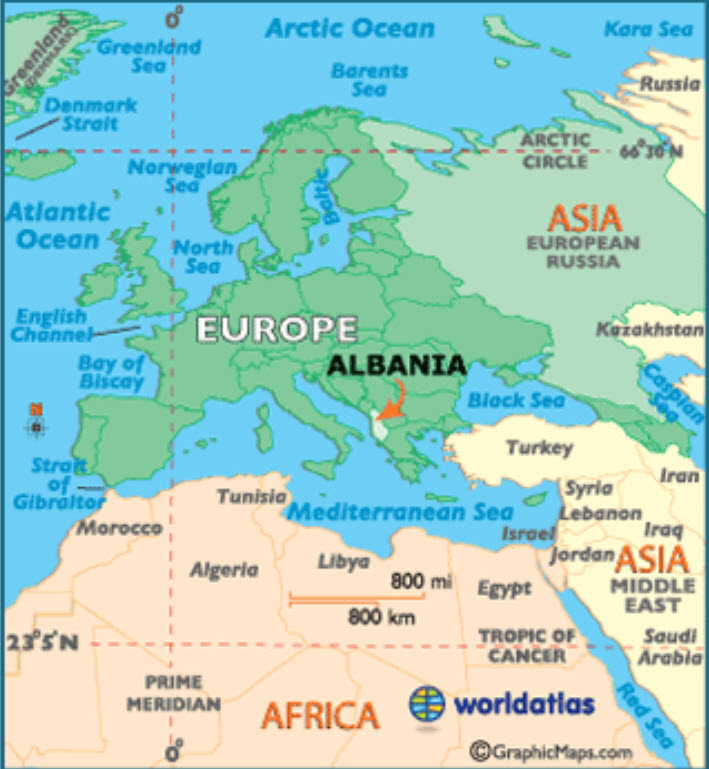
Where it is located…
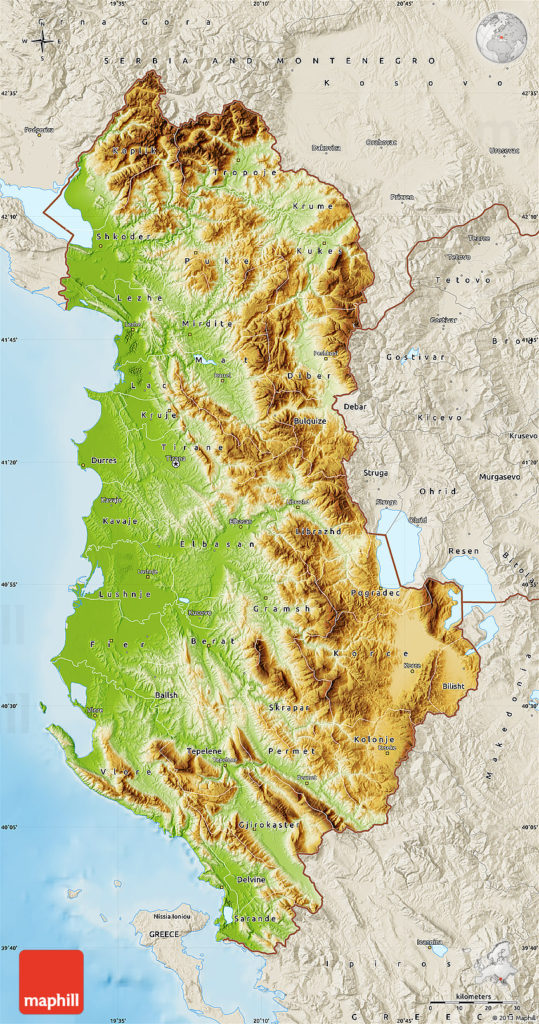
What it’s geography is like…
Physical map of Albania, shaded relief outside.
Here's a reprint of an article from UNZ, it's titled "The Freest and Most Open Country". It's written by Linh Dinh • April 28, 2021. All credit to the author, and please note that it was formatted to fit this venue.
The Freest and Most Open Country
People don’t have to pay extortionate taxes, or interest rates, to cater for their basic needs such as housing, farmland ownership, education or health. People earn little, but their relative purchasing power is higher and their lives certainly more secure and pleasant than ours in the West.

-Iris
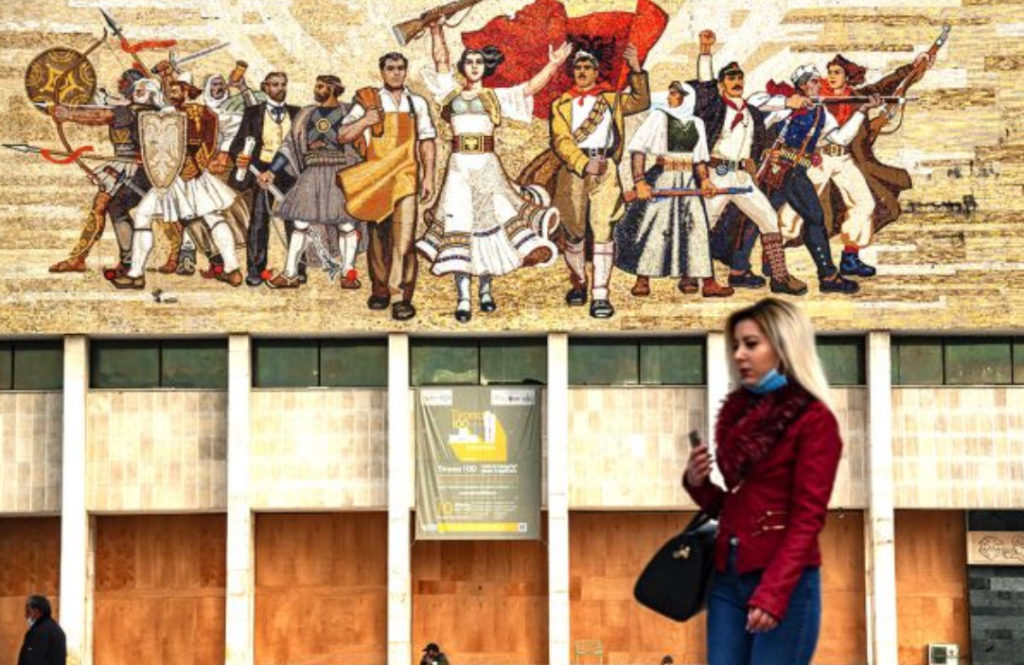
Girl walking past a billboard in Albania.
Is Albania, believe it or not, for here, you can walk around, sit inside cafes, bars or restaurants, worship at a packed church or mosque, and travel by crowded buses between cities, etc.
Though you’re supposed to wear a mask in public, most folks do so with their nose sticking out, because it’s hard to breathe otherwise, and unhealthy, too. That’s good enough for the easy-going cops.
All these people can enter Albania without a visa, vaccine passport or even a negative Covid test, and stay up to a year: European Union citizens, North Americans, most South and Central Americans, Turks, Kuwaitis, Israelis, Chinese, Taiwanese, Japanese, South Koreans, Malaysians, Singaporeans, Australians and New Zealanders, plus a few more.
After decades of Communist isolation, Albanians are happy to reclaim their Western heritage. A bookcase is painted on a downtown high-rise. Among the authors featured are Homer, Aeschylus, Cervantes, Dante, Shakespeare, Tolstoy, Dostoevsky, Chekov, Twains, Dickens, Balzac, Hugo, Flaubert, Kafka and the Brothers Grim. Albanian giants such as Kadare, Agolli, Fishta, Arapi and Poradeci are also honored. Unlike elsewhere, the Western canon is not assailed or canceled, but upheld and extolled.
Sidewalk book vendors are common, so Albanians are obviously reading, and not just junk either. I’ve seen volumes by Camus, Dostoevsky, Orwell and Hitler, etc. Albanian minds can still stay open.
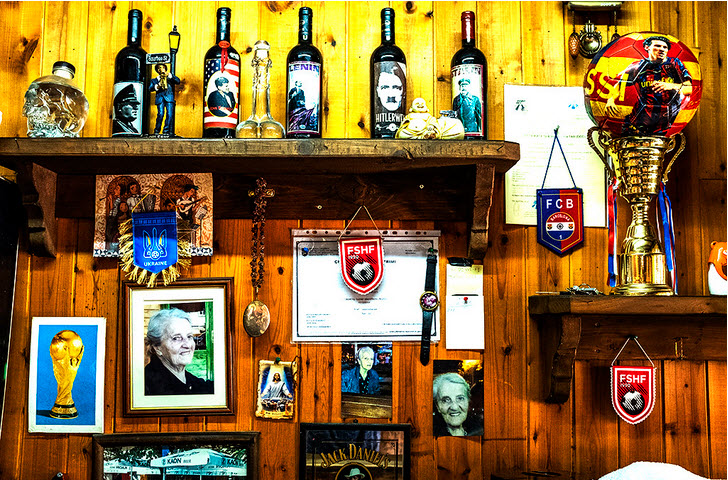
Old man’s bar in Albania.
In an old man’s bar with plenty of character, there are five wine bottles with labels showing a portrait of Mussolini, JFK, Lenin, Hitler or Stalin. Sharing the same shelf are skull and penis shaped liquor containers, and a laughing buddha.
In a more Jew-screwed nation, this goofy display would undoubtedly trigger complaints, protests and maybe even a riot that burns up half the street, if not much of downtown. Luckily, I’m in Albania.
There’s a Frederic Chopin monument here. Born in Poland, Chopin spent nearly all of his adulthood in France, and had nothing to do with Albania. As an important cultural figure, however, and not just in the West, but globally, why shouldn’t Chopin be celebrated in Tirana?
Those who reject even the best of their heritage are lobotomizing themselves. Go for it!
In my building, I’m friendly with a man roughly my age. Introducing himself, he said, “Just remember me as the guy with the hat,” and sure enough, he always wears the same baseball cap.
Like many Albanians, he has emigrated, but returned after only a few years in Greece. Vaguely dreaming of America, he entered the immigration lottery, and actually won, but by then, he has changed his mind.
“I have a cousin in Illinois,” he said. “He told me Albania is better.”
“I agree,” I laughed.
“Really? I should tell people you said that.”
“In every American city, there are homeless people all over. If you go to San Francisco, for example, you’ll see homeless people all around City Hall, right in the center! Many of them have gone crazy. Many are on drugs. They shit in the streets!”
“Hmmm.”
“There are almost no homeless in Tirana.”
“We have family. We take care of each other.”
“There are beggars here, but not too many.”
“Most of them are Gypsies.”
“Is your cousin in Chicago?”
“I’m not sure. Maybe just Illinois. Every year, he comes to Albania and stays for six months. He wants to retire here.”
“Does he have children?”
“Three. Two boys, one girl. They are big.”
“Have they been back here?”
“No, they work, all the time. They have good jobs, but they can’t get married,” he chuckled.
Near us, there were half a dozen boys playing. Hearing English, they decided to join in, but their vocabulary was limited to just “hello!” and “hi!”
Walking down a side street, I heard “hello” repeatedly, but there was no one in front or behind me. Perplexed, I finally looked up to see two small boys inside a sixth-floor window. “Hello! Hello!” I returned their greetings, waves and smiles.
My North Macedonian friend, Alex, has a peculiar habit. As we wandered through the back streets of rarely visited towns like Veles and Shtip, little kids would sometimes get very excited to see me, so Alex had to answer their questions. When they asked Alex where he was from, however, he’d also say, “Америка!”
“Why did you say that?” I asked.
“It’s more exciting for them! If I told them I was North Macedonian, they’d think, Who cares? Now, they can go home and brag about seeing two Americans today!”
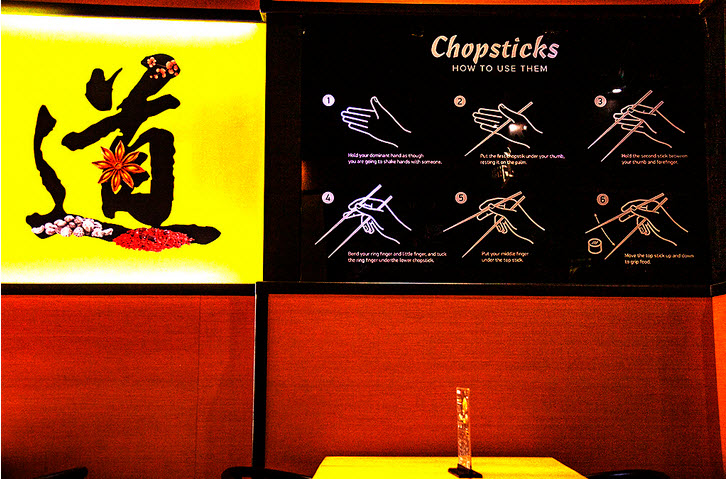
Inside a Chinese restaurant in Albania.
Though Albania is wide open, there are very few tourists here. In 2 ½ months, I’ve only seen eight Orientals on the streets, plus two Chinese cooks inside restaurants. I’ve chanced upon American English maybe ten times, but Italian just twice. Once, I ran into a group of Turks. I’ve never gone this long without seeing a single black.
It has been raining too much, but with more reliable sunshine, visitors will come. Ali, a taxi driver, certainly hopes so.
Impulsively one morning, I paid Ali $24 to take me to Durres, 24 miles away. It’s a pretty good deal, and Ali could surely use my business. Too often, I see him just standing around near the Swiss Embassy, his usual spot. This also gave us a chance to chatter.
Like the man with the hat, Ali has also gone abroad. He spent six years in Australia.
“Wow! How did you get a visa for that?”
“I paid,” meaning to the right people.
After sweating his ass off at various menial jobs, and saving almost nothing, Ali returned to Tirana, his hometown.
Here, Ali got a job driving trucks, then buses, before becoming a cabbie 15 years ago. Until the Covid mess, everything was going fine.
Ali also got married then, so his son is almost 14, and his daughter, 10. He showed me their photos.
“Nice kids! Are they good students?”
“No,” Ali laughed.
As his name indicates, Ali is Muslim, but only nominally.
“It’s Ramadan,” I noted, “but all the restaurants are busy. Nobody is fasting!”
“Some people are. My kids are fasting. I’m not.”
“They’re better Muslims than you are!”
Ali just shrugged.
After the collapse of Communism in 1991, thousands of Albanian boat people fled to Italy from Durres. This ugly, chaotic exodus lasted until the end of that decade.
Now, Durres is a very pleasant city with an elegant seaside promenade. Before Covid, ferries departed often for Bari, Ancona and even Trieste (where James Joyce spent nearly a decade). Soon, buses will resume their daily routes to Athens.
Normal family life in Albania with children on swing-sets, and normal shops in the background.
Basking in sea breeze-tempered sunshine, I watched parents pushing strollers, a stern boy bouncing a ball and three tots on swings. Busking, a beer bellied, middle-aged man tooted his clarinet. A stand briskly sold “Petulla te Gjyshi” [“Grandpa’s Fried Dough”].
As you’re tucked into your novel nightmare, Albanians have quite impressively exited theirs. How bad was it?
An escapee risked being shot or jailed for years, and if he manages to get out, a family member would be arrested instead. For trying to flee, poet Uran Kostreci was locked up for two decades.
Just getting into Albania was very difficult. Defining the border as “a checkpoint against foreign ideology,” Enver Hoxha declared that “The People’s Republic of Albania is closed to enemies, spies, hippie tourists and other vagabonds.”
First of, Albania was not a republic, much less a “people’s republic,” and there’s no ideology more foreign to Albania than Jewish Marxism, in any permutation. A fanatical us-against-them mindset is the Jewish core. A dictator, Hoxha ruled Albania for 40 years, until his death.
Of the hundreds of Hoxha statues that once dotted this poor land, only one remains that’s not damaged. A ten-foot bronze, it lies in the basement of the former museum in Labinot, a Communist stronghold.
In 1975, the Albanian government posted this guideline:
The border authorities of the Ministry of Internal Affairs do not allow the entrance into the People’s Republic of Albania of all those foreigners who, with their appearance go against the norms of the socialist aesthetics, such as men with long hair like women, with exaggerated sideburns, with irregular beards and with inappropriate clothing, and women with mini and maxi skirts.
Persons with extravagant clothing and irregular appearance […] may enter into the People’s Republic of Albania only if they choose to be adjusted (to cut their hair, to dress normally) […]
To facilitate such adjustments, a barbershop and a store with socialist-approved clothing were available at Albanian borders.
Even eight years ago, Albania was still a wreck, apparently, at least according to an unsolicited account I just received.
Reading about me being sick in Tirana, a reader emailed to say that he had come here in 2013, to be somewhere “as ugly as [he] felt”!
An American living in France, he had spent a year in “herpes hell,” which he had gotten from “an attractive empty vessel who worked in the Paris fashion scene.”
Bald, loveless, with “a ruined penis” and nearly broke, he thought about killing himself, then “had a better idea”:
I would identify the most miserable country on Earth and I would go there. Anything but suicide. I wanted to be somewhere as ugly as I felt. I wanted to see bleak, closed, hard faces. I wanted to see mute wifebeaters and battered women caked in whore makeup. So I went to Albania. I wandered around Tirana with sores on my dick for a few days, considering suicide. One day I found this weird field next to the train station, just a big garbage-strewn negative space at the heart of the city. There were fetid ponds, plastic bags everywhere, and little paths through the half-dead grass. An old Balkan crone squatted next to one of the paths with a few carrots and onions spread out on a scarf in front of her. Men in tracksuits with brutal pimp faces came and went. I went to the center of the field, squatted down, and dug through the trash a little. I found a broken teacup, an old domino, and a playing card. It was Christmas Day. I felt like I was at the negative center of the universe. Here I was, at ground zero of our ruined Jew world with pus coming out of sores on my dick surrounded by the most ugly and corrupted goyim on Earth, the despised and despicable Albanian race.
That’s some beautiful writing about an ugly situation. Today’s Tirana, though, is nothing like that.
Albanian kiosk.
Though many of the buildings are drab, each Tirana street is lively with cafes, bars, restaurants and shops, and the people are very pleasant, mellow and lovely.
Most are slim and not misshapen. Children are well behaved and not agitated. Young men don’t sneer or bluster. Many women are confidently beautiful. The old are dignified.
Though Albania is one of Europe’s poorest countries, with an extremely high emigration rate, its social fabric is more intact than in more advanced nations. Its great men are justly revered. It’s also freer and more open, and as safe as any, with no mugging or riot around any corner.
Unlike in Philadelphia, I don’t wake up each morning to news of another murder or two. There were 499 in the City of Brotherly Love in 2020!
The United States will never catch up to Albania.
This is most interesting. Albania always seemed like a pit of drabness, repression, and despair during the Cold War. Not that I actually read anything about it, of course. Now here it is quite relaxed about life while the US slips ever deeper into unreason, minority hatred of whites, wars that are beyond stupid, open borders, multicultural delusion, corrupt courts, a lunatic legislature, contemptible corporate whores, a rotten FBI, a worthless press, malevolent central bank, Jewish control, feminist malevolence, and leftist thuggery. Did I leave anything out?

-Ace
Conclusion
It is difficult for Americans to understand, and grasp this fact, but most of the world outside the United States is MUCH freer.
This is a fair and philosophical point, which contains a much large-ranging truth:– Traditional societies favour the collective and protect the weakest among them but at the expense of some of the individuals’ freedoms. This is why there are less junkies and homeless in the streets of poorer countries, as they remain within the family fold, but individuals sometimes feel suffocated by social pressure.– Modern Western societies, especially with the ascent of Anglo-Saxon “liberal” values, purport to favour the individual and individual freedoms. This should normally give great opportunities to the brightest and smartest to achieve and accomplish their professional and economic potential, at the expense of the less gifted who are let down. This is how it was supposed to work anyway, and maybe it did work like that up to the 80’s or 90’s.But since globalisation took off, the individualist dream hyped in the West has remained just a dream. No matter how hard one works, it is obvious that the middle classes are disappearing to the benefit of an ever-more powerful plutocracy.So Western working people are actually only getting the anxiety and precarity, without the economic security, the worst of two worlds. I can very well understand why the Albanians described by Mr Dinh have returned to Albania after initially emigrating to the West.
-Iris
Americans have 24-7 narratives about “American Exceptionalism” rammed into their mushy brains for decades. So much so that they believe it. And then, coupled with the non-stop fear-mongering about the rest of the world being a very dark and gloomy place, it’s no wonder that Americans hide inside their homes and huddle in front of the flickering blue monitors for their entertainment.
Freedom is not a nice road, a fancy mall, a impressive government building, or being able to own guns. It’s nothing of the sort.
A large proportion of Americans today, think freedom is the right shop at Walmart, eat at Burger King and to get a quick Covid shot. How things have changed

-Joe Paluka
Freedom is the ability to live your life, as you see fit, without interference by anyone for any reason.
Freedom
Never having to report any income, or financial information to the government.
Never having to ask your government for permission to do something.
Being allowed to eat, smoke, ingest anything your want to your own body.
Never worrying about the police.
Being able to redress your grievances with the government locally and get results in a timely manner.
Not Freedom
Asking permission to buy bullets, and then once granted, having to pay taxes on them, and enter onto a watch list.
Being forced to buy something simply because you are a citizen.
Having your ability to leave the nation prevented and subject to a tax audit.
Your taxes are used for other things that do not directly impact your quality of life.
When I say that my life in China is far freer than what it was in the United States, it’s not hyperbole. It’s truth. It’s on a very personal, and direct, visceral level.
And I have experiences that back this up. So it’s non-debatable.
People, if you are miserable with your life…
…instead of blaming yourselves, maybe you need to start looking at where you are living and what you put up with. Most Americans will discover an exceptional amount of personal freedom the moment they step outside the monstrous United States Military Empire.
And that’s a fact Jack.
The best case in point would be in New York City.

Take the NYPD’s stop and frisk policy, for instance. Aside from the fact that the policy has proven to be vehemently racist, what kind of free society allows their police officers to search people without just cause?

Imagine casually walking home from work only to have a police officer stop you, ask for ID, question you and frisk you. All you’re guilty of is walking home. How is this any different than the Gestapo asking you to see your papers?

-The rise of the American Police State
You all won’t see that anywhere else in the world.
Only in America.
America is more and more like a contagious disease. It would be fine if the US contained their toxic culture and influence to their own border and left the rest of the world alone. But no… They want to make the whole world like them. Enough.

-Dumbo
Some people come to Metallicman for the articles on space, extraterrestrials and my experiences. Others come for glimpses and insight into China, while still other come to understand the MWI and world-line travel, and yet still others come to see pretty girls. This particular article is about observation, understanding and finding your place in a world full of situational adventures…
…
I once dated a woman who left me for a member of a motorcycle gang.
Her best friend was dating one of the gang, and soon she hooked up with a guy in that gang; another gang member. And, no, this wasn’t in my teenage years. I was in my 40’s at the time and my (former) girlfriend, and her friend were both in their late 30’s. Owned houses and successful businesses. The woman who was dating the (first) biker gang member owned a complete hotel with a restaurant, as well as other property. She also had a huge bank account from her ex-husband who had died earlier.They didn’t need to “go slumming”. They could have picked any guy they wanted.
And they wanted some fun and adventure, I suppose.
Anyways, they lived in a nice “bedroom community”; meaning a nice quiet town in central Pennsylvania. Not much going on. The town itself was beautiful, and calm and located in a nice part of the country.
I don’t know how they ended up getting tangled with this crew but the guys were also in their 30’s, and they looked the part of a motorcycle gang. Long hair, tattoos, and a really hash demeanor. They had a sort of a (young) Willie Nelson vibe.
Of course, they rode Harley Davidson motorcycles, and had the “colors” on their vests, and wore black leather boots. It’s not just stereotypical, it was the real way that they dressed and acted. It was like a scene from Bad Company, and The Cult. Chains dangling from their leather wallets, big massive belt buckles on leather belts. Pins on their vests, and elements of grey hair at their temples and on their beards.
They were also heavily involved in the meth trade. They manufactured it, and used it. And during the brief period of time when I was still dating my girlfriend, she would tell me about the absolutely insane levels of Animalistic sex her girlfriend would have with her gang-member boyfriend. She said all that they did was have near continuous sex, without sleeping or eating, for days.
I would imagine that it was something like what is described here…
What’s It Like To Have Sex For 9 Hours Straight
Reprint from HERE. All credit to the author and reprinted and edited to fit this venue.
It was with a girl I’d been dating over a year and it involved meth. Kids, don’t ever try meth, I am not kidding… but if you do make sure you have sex*, because – holy shit.
*with someone you trust
My girlfriend and I were already very familiar with each other’s bodies, and we were averaging at the sweet spot of about 45 minutes of intercourse a day, which is to say we were already trained for marathon humping. We’d had sex on meth once before (three hours that time), and it was so much fun we decided to set aside a Saturday night to try it again.
At 11pm, we start smoking, and put some porn on to set the mood.
By 11:15, we’re humping like frantic rabbits. Not your standard “I want you, you want me, let’s do this” sex, this is downright animalistic fucking. Fast, slow, vigorous, violent. Each sensation intensified five-fold. We’re inventing positions beyond the kama sutra, fucking at every conceivable angle to find the best ones. We are energizer bunnies running on unadulterated carnal lust, an unstoppable desire to push every limit of pleasure. This is what porn wishes it looked like.
At midnight, we’re both still horny as hell but I’m exhausted. She on the other hand has more energy now than when we started (this must be how succubus legends started) and spends the better part of the hour riding me. We go down on each other every once in a while for intermission.
1am, my orgasm is nowhere in sight, which is great because neither of us want to stop. We do slow down the rhythm and switch positions more frequently. Short break to smoke some more and change the 5-6 porno movies we have playing on loop.
2am, we are so dehydrated that we need to take an extended pause to chug several cups of water each. We’ve already passed our previous time record, but we’re just getting started. Everything is so goddamn sexy. She is so fucking hot, I’m so fucking hot, we’re just wild beasts succumbing to our deepest nature. Our passion is an unstoppable force. We just want to feel each other, as deep and intensely as possible.
3am, she’s no longer getting wet but we both want to keep going, so we chug more water and get the lube out. We go down on each other for about half an hour, slowly and oh so deliciously. She tastes better than she’s ever tasted before and I can’t get enough of her, 69 has never been so fun. We’re trying out new things that we’ve never done before. Any inhibitions about sex we’ve ever had in our lives are gone.
There is literally nothing we could do right now that would turn the other person off. We take advantage of this to ask each other to do things we’re usually too ashamed to ask for. We talk dirty like never before. Licking assholes, smacking each other, throwing her around the room, you fucking sexy slut this, give me your fucking dick that… It’s all so goddamn intense.
4am, I can’t even keep it up anymore. She goes down on me but it’s no use – my body is utterly depleted. I’m angry at myself because I don’t want to ever stop having this kind of sex, she tells me not to push myself too much. We cuddle for half an hour, softly massaging each other’s genitals with lube. The gentleness is a welcome change of pace for both of us and eventually I get it up again and slide back inside her, but now I’m alternating between hard and soft, all the while desperately willing my penis towards the former.
5am, we are so tired. We haven’t eaten in 12 hours and I haven’t done this much exercise in years. I’m not even inside her most the time anymore, we’re just rubbing each other and telling the other how turned on we are, how much we love each other, how hot this is, while our eyes are glued to the monitor that’s playing 6 porn movies simultaneously. We compare notes about which movies are our favorites, and it’s the sexiest conversation ever. We smoke a little bit more.
6am, it’s on again. Our second (or maybe 4th/5th) wind is here and we’re back at it full force. We’ve gone totally numb to the porn now, there’s been so much of it, so we turn it off, which strangely enough gets us more excited.
7am, we decide to record this on video because this is going to look amazing, but sadly we’ve missed most of the best stuff and now it’s a mix of me slow-thrusting and her trying to keep me hard with her mouth, with the occasional scene of enthusiastic passion. I spend more time watching the live recording than looking at her… I stop filming after 45 minutes so I won’t be distracted anymore. A bit more good and vigorous fucking.
8am, we can’t go on. I can’t go on. The passion is still every bit there, but the flesh is weak, so so weak. I am utterly and entirely done. I still haven’t come because of the meth, but there is literally zero energy left in my body. Every reserve has been tapped, just holding my body upright seems like a herculean task. She insists on finishing me off with her mouth. God bless her loving heart.
8:30, after a half hour blowjob, and nine hours of semi-continuous fucking, I finally come. It’s like a volcanic eruption, I almost black out from the release. I collapse hard, immobilized for a good twenty minutes.
My penis is so raw that the slightest touch is unbearably painful.
Of course I can’t sleep, because, the meth, but we both feel so amazing (and exhausted). There is lube and other fluids all over the place, but we don’t care. After a rest (and a huge spliff to ease the comedown) we pull ourselves up and go get some breakfast, which we have to force ourselves to eat.
It would be 36 hours before I got another erection.
We never replicated the events of that night after that. We decided to flush the little bit of remaining meth because it was just too powerful a force – that shit will get you addicted so hard and so fast. As amazing as we felt during the high, the sheer misery of the comedown was almost more intense, and even in our exhaustion we were desperate for another puff. Plus I was terrified that the drug-free sex would never be as good again in comparison.
But it remains a really great memory in my mind, and truth be told, our inhibition-free romp allowed us to discover even more about each other’s sexuality, and opened some gateways to more amazing (even drug-free) sex in the future.
– Jeremy Tschen
Some thoughts
I enjoy sex like most people. However, as an older man, I am more on the relaxed and laid back side of it all. Having wild and crazy sex like what is described herein is great for a younger man, but for me it might put me into a coma. Ugh!
I think that taking a drug occasionally to achieve a certain objective has it’s merits. If you have high blood pressure, you take a pill every day. If you have erectile dysfunction, you can take a little blue pill, and if you need a vacation, perhaps you can take a recreational drug to expand your frame of reference. But in all cases, I must advise against habitual use.
And this goes for sex as well. Too much sex can cause problems.
Though, you might die with a smile on your face.
I have a very good friend who was taking triple doses of Cialis every day for three years. (Why he did that, I will not get involved in.) But what I can say is that he eventually developed Esophageal cancer. Which is a very rare form of cancer, and he was in a terminal stage. Last I heard he was having a real rough time at it. It’s tough for him.
He’s only three years older than me.
Don’t get too dependent on chemistry to evoke enjoyment. It will not be good.
Anyways, I felt that this story was interesting. And it added a little bit of background and elaboration on what my girlfriend’s friend was saying. And at the time, really, I had no idea.I really didn’t. The wild sex was mentioned on more than one occasion to me, and I even wondered if she wanted me to be more active, but when I asked she’d always say “Lord, for goodness, No.” So I didn’t pay it any mind; I didn’t pay it any attention.
In hindsight, I imagine that my ex-girlfriend got to have a taste of this “forbidden fruit” and her life migrated in what ever direction that it would tend to carry her off to…
…probably not a good place.
After taking crystal meth, the desire to use more typically becomes very strong.

This physical pull to keep taking more of a drug is called “dependence.”

Becoming dependent on a drug is part of the addiction cycle.

Crystal meth addicts are also likely to develop a strong “tolerance” to the drug, which means that, with continued use, more and more of the drug must be taken in order to achieve the same desired effect.

-History of Crystal Meth
I don’t believe she left me because of the promise of meth-induced marathon sex adventures. Instead I think that she left me because the allure of a big, dark, husky tough talking, rough around the corners, biker appealed to her base instincts. She, perhaps, found herself “under his spell”. And she enjoyed that.
Sometimes, it seems, that women go for either [1] the super-tough macho men, or [2] the sickly men that need nurturing and attention.
Women can’t explain it, there’s just something about a deep breathy voice that makes us weak in the knees. According to a British study, women prefer men with deeper voices because it’s subconsciously perceived as a sign of masculinity. The study asked 60 women to rate the sex appeal of 10 male recorded voices, with results showing that the deeper breather voices, which were voices both masculine and tender, win in overall popularity. "These results suggest that what makes the voice attractive are mostly properties that enhance the characteristics already in the averaged voice of the sex," explained the authors, the Daily Mail reported.
What is attractive?
Which brings up another subject that I covered elsewhere on what is attractive to me as a man. Here, let’s see what might be attractive to a woman who meets you for the first time. Or second time. Or, maybe third time.
Consider this list…
#1 Good grooming. Dress well and look good no matter where you are. You never know when you’d bump into the woman of your dreams. It’s a simple tip, but something almost all guys never focus on. Groom yourself well with quality man products and complex perfumes that smells great on you.
#2 Be assertive in your behavior. Women love a man who’s not fickle minded. Have an ego and believe in yourself and your decisions. As hard as this may seem, be the man who can put someone else in place when they overstep the line or misbehave with you.
#3 Charming personality. A charming personality is everything, but yet it’s not something most men have. In fact, meeting a man who knows to charm a girl is a hard task for any woman. Improve your body language around women and learn your manners around them.
#4 A good physique. Go build those biceps and those deltoids in your shoulders. When you work out, you look healthier and radiant, and clothes look oh-so-sexy on you. If you want to attract a girl at first sight, you have to remember that appearances do matter. A lot.
#5 Have a good sense of humor. It takes less than a minute for a girl to know if a guy has a good sense of humor while having a conversation with him. And that’s all you need to impress a girl. All girls know that a guy with a great sense of humor can be a lot of fun over dates or phone calls. Have a light hearted and fun approach towards life and try to look at the bright side all the time. You’ll draw women to you like moths to a flame.
#6 A man who’s not a pushover. A guy who’s a pushover is one of the worst kinds of men in the hierarchy of dating. A pushover is a guy who prefers to accept defeat just to avoid conflict with someone who’s dominating him. Don’t ever be taken for granted by anyone, be it your own friends or a colleague. Have a spine and principles in life. If you feel you’re being wronged, learn to voice your opinion instead of being implosive.
#7 A good job and a nice salary. Well, now we’re getting shallow. But it’s better to face the truth than pretend like money doesn’t matter. Of course it does! You like a sexy woman over an unattractive women. Women like a rich guy over a church mouse. Be rich and drive a great car and you’ll have a huge advantage already. Just a word though, it’s just an advantage, but it’s not enough.
#8 A man who’s respected by others. Women like to be respected by the man they like, but they also like being with a guy who’s respected by others. If someone doesn’t respect you, is it your own fault? If it is, try to get better. If it isn’t your own fault, walk away from them. Or stand up and claim the respect you deserve from them. It all comes down to this, if you genuinely respect yourself and have an ego, would you ever allow someone to throw you around for no fault of yours? Stand up and be a man.
#9 A confident man. Confidence is a great trait to have for any man. It’s an inner strength that’s seen and envied by anyone you meet. A confident man is more attractive to women because he believes in himself and his abilities, and he doesn’t tuck tail and run when he knows he’s right.
#10 A man who looks good. Good looks always make things easier when it comes to attracting the opposite sex. But when it comes to a man, thankfully for average looking men, there’s more than just a face carved by the gods that matters. Look your best, dress well and maintain a good posture. A straight back with an air of confidence can definitely impress the girl you like. Have a happy, cheerful face and a genuinely happy smile and you’ll do wonders.
#11 A good conversationalist. Just like a good sense of humor, knowing how to speak to a woman is a trait that all women look for in a man. Be pleasant, speak smoothly in a low tone and show genuine interest in the woman while speaking to her. Create conversations around her and make her have a nice time with you.
#12 Respectful behavior. Be respectful towards others when they deserve your respect. All good natured women like a well mannered and kind man who doesn’t treat others badly just because he can. Don’t be rude to waiters or your subordinates unless you have a reason to. Treat everyone with respect and you’ll be treated with respect. Women see kind men as good fathers, and it’s a trait that women instinctively like. Have good etiquette and treat women chivalrously, and you’ll notice them warming up to you almost instantly.
#13 An alpha male. The best women are always in the arms of the best men. No woman would want to date another guy’s man Friday if she’s desired by all men. If your friends don’t respect you, find new friends. You may have noticed this already, but there are always just one or two guys in a big group of guys who date the sexiest women while other guys sit wide eyed and hear their success stories in awe. They’re the alpha male. Be that guy.
#14 Make her feel comfortable in her skin. Women like a man who makes them feel at ease within the first few minutes of a conversation. Be the guy who can take away the air of nervousness in a first conversation while talking to a woman and she’ll like you for it. Indulge in a pleasant conversation and ensure that she feels involved and excited to talk to you.
#15 A compatible personality. Here’s a downer that you have to accept when it comes to understanding what women look for in a man. You may be a great guy, but at times both of you may just be way too incompatible for each other. She may like you, but she may not be willing to date you for her own reasons of compatibility. If you want to avoid this, be pleasant and genuine, and most of all, focus on her interests and learn about her likes and dislikes while talking to her so you know the right things to say at the right time. If she feels compatible with you and your personality, and thinks you’ll get along with her friends and family, she’ll definitely like you.
Conclusion
Personally, that when it comes to women’s preferences, it’s indeed complicated and depends on the situation. If there is one thing that I have learned is that everyone is different and what appeals to one person would repel another.
So my list above is just a guideline.
Seriously, if you take care of yourself. have self confidence, and can earn a buck or two, there’s no reason why a woman wouldn’t want to talk with you. And then from there… well, anything is possible.
Yet in most of my experiences, I can say that a hard, rough and “dark” man image appeals to most of the ladies that I have known. Of course, it doesn’t mean that they will just throw themselves into the sack with them, as other factors will mitigate the animal attraction, but it seems to be unmistakable. A strong man, a confident man, and a fun man are all positives when dealing with women.
Not that it matters to me. I’ve got a family, and they are a handful. In fact, more than just a handful. And yet, if I want some diversity, I go and get it. So it’s not really a big deal to me.
I want to believe that our lives and our experiences are PERSONAL matters. We can learn from the experiences of others, and apply the lessons to our own lives. But we should never want to relive the experiences of others. Simply because there are often unstated connections and conditions that complicate their relationships and situations.
You’ll not find any big banners or popups here talking about cookies and privacy notices. There are no ads on this site (aside from the hosting ads – a necessary evil). Functionally and fundamentally, I just don’t make money off of this blog. It is NOT monetized. Finally, I don’t track you because I just don’t care to.
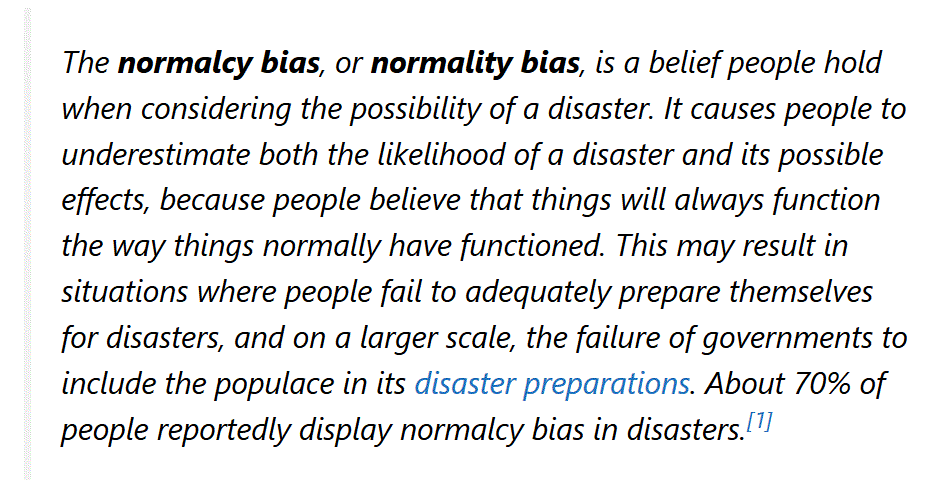
It’s nice to think that we are “modern”, “enlightened”, “progressive’ and “forward thinking”. But, unfortunately that is a big lie. Humans, at best, can only sustain a calm period of coexistence for a handful of decades. No longer. The fact and the truth is that blood was spilled ruthlessly for most of human history.
Routinely.
If you are living in the belief that wars will forever be isolated from you, then buckle up. It can hit with surprising suddenness and completely alter the landscape of your reality forever.
It’s the historical norm.
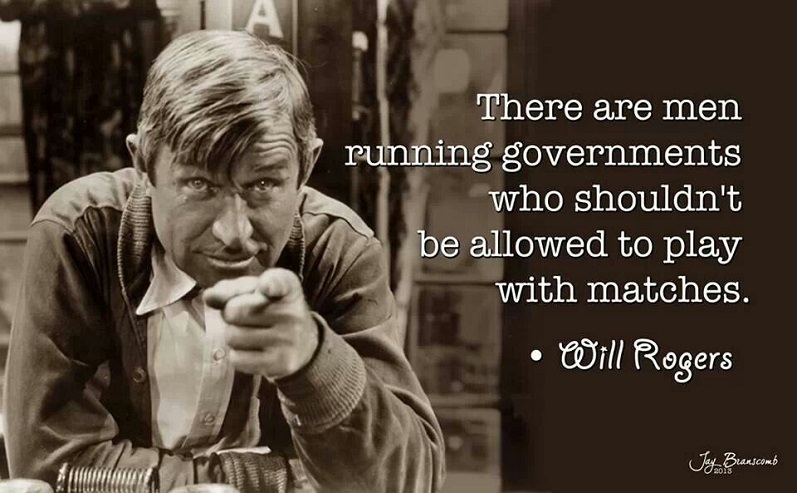
Will Rogers quote.
Prepare yourself for a painful recap of the most savage wars that ever took place. Fought over religion, political supremacy, or conquest, the conflicts of the past killed tens of millions and left the land we live today blood-soaked.
War can occur anywhere, at any time, and affect anyone. No one is immune.
1. French Wars of Religion – 3 million
Expert Tip: Wars over ideology can be very fierce, bloody and dangerous.
It was an awful time to believe in God.
A death toll of 3 million is a good introduction, especially because we will first explore a war erupting solely because some overzealous folks couldn’t agree to what religion is better.
My God is better!

No! You are wrong. My God is better!

Hell with you and what you think! You need to die!!!!
The French Wars of Religion is an umbrella term for the many frictions that opposed the Catholics (and the Huguenots (Reformed Protestants)). Once started, everyone wanted in on it. They were fighting each other over interpretations of Biblical passages, for goodness sake!
He said this!

But, he meant that!

Die! Heathen scum!
Indeed, once it started there was no stopping it. It moved on and took on “legs of it’s own”. Lordy! Carried out throughout the 16th century, it aroused other European powers into picking sides.
Ugh!
The north of Hesse, also known as Hesse-Cassel, became reformed, or Calvinist in 1605, while Hesse-Darmstadt in the south became Lutheran. Both Hesse and Brandebourg, which was also reformed, had suffered greatly during the Thirty Years War and for this reason the Huguenot refugees were made welcome.
I know it’s confusing. Here’s the official take…
Huguenots were a religious group of French Protestants. Huguenots were  French Protestants who held to the Reformed, or Calvinist, tradition of  Protestantism.

The term has its origin in early-16th-century France.

It  was frequently used in reference to those of the Reformed Church of  France from the time of the Protestant Reformation. By contrast, the  Protestant populations of eastern France, in Alsace, Moselle, and  Montbéliard were mainly German Lutherans.

- Wikipedia
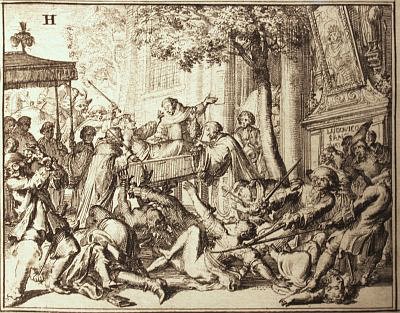
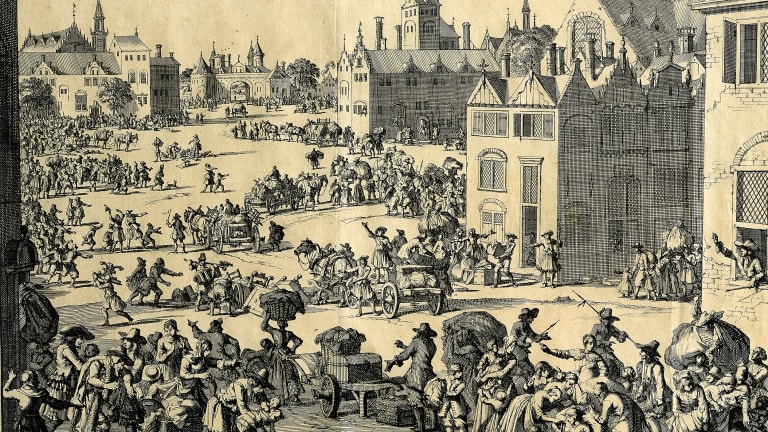
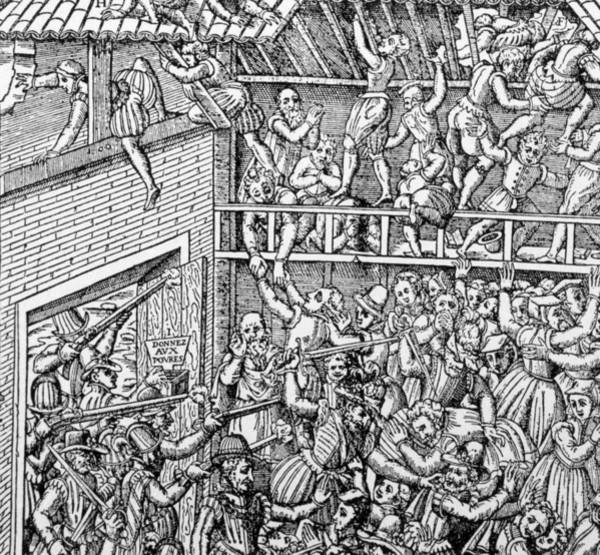
Women and children are being tortured by soldiers in front of a statue of Louis XIV. A Protestant minister is in a basket because he refused to worship the Host. . Persecution of the Huguenots according to Romeyn de Hooghe
And yet another opinion…
The French Wars of Religion were a prolonged period of war and popular unrest between Catholics and Huguenots (Reformed/Calvinist Protestants) in the Kingdom of France between 1562 and 1598.

It is estimated that three million people perished in this period from violence, famine, or disease in what is considered the second deadliest religious war in European history (surpassed only by the Thirty Years' War, which took eight million lives).

- French Wars of Religion - Wikipedia
What happened was scandalous mostly because the Catholic Church considered the atrocities a sign a divine retribution.
Yeah...

God approves of this war. He told me.
Massacre of Vassy .On March 1, 1562, 300 Huguenots holding religious services in a barn outside the town wall of Vassy, France, were attacked by troops under the command of Francis, Duke of Guise. More than 60 Huguenots were killed and over 100 wounded during the Massacre of Vassy. Francis claimed he did not order an attack but was instead retaliating against stones being thrown at his troops.
And still yet another explanation…
The massacre of Huguenots at Vassy in 1562 began the Wars of Religion between the Catholics under the leadership of the Duke of Guise and the Huguenots under the leadership of Prince de Conde and the King of Navarre. The war was interrupted briefly, but flared up again after the infamous...

- Huguenot Wars - World History
I know.
I know, I’ve given three instances of explanation, and still I haven’t figured it all out. It’s nuts. It’s crazy. It’s insane.
We look back at this time and shake our heads. But, you know…
… it was a different time and place.
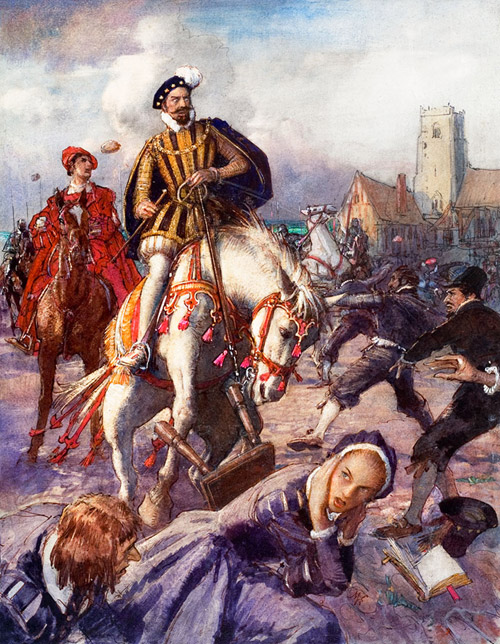
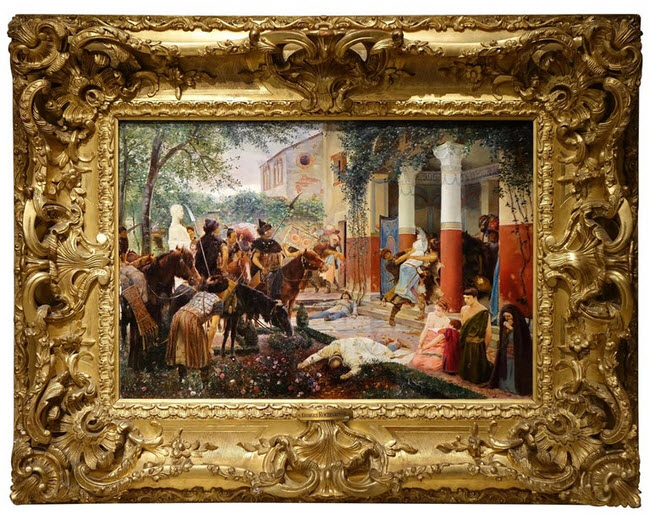
The above painting depicts the most “memorable” event of the French Wars of Religion – the St. Bartholomew’s Day massacre. Huguenots were slaughtered in the tens of thousands in a feast of savagery that lasted several weeks.
You will be surprised to know the changed little since then. Aside from technology advances and the ability to manipulate large groups of people by ideology…
… nothing has changed.
Expert Tip: We are not more enlightened today compared to the past.
The French Wars of Religion – the St. Bartholomew’s Day massacre.
Yeah, yeah… I know. It’s really difficult to get a feel for what was going on at that time. Woodcuts cannot compare to colorful photos and dramatic images. Their clothes are odd and their customs are strange. It’s difficult to imagine. I mean … men wore tights with cod pieces for Pete’s sake!
Well… anyways…
So let’s move forward to something more recent, then.
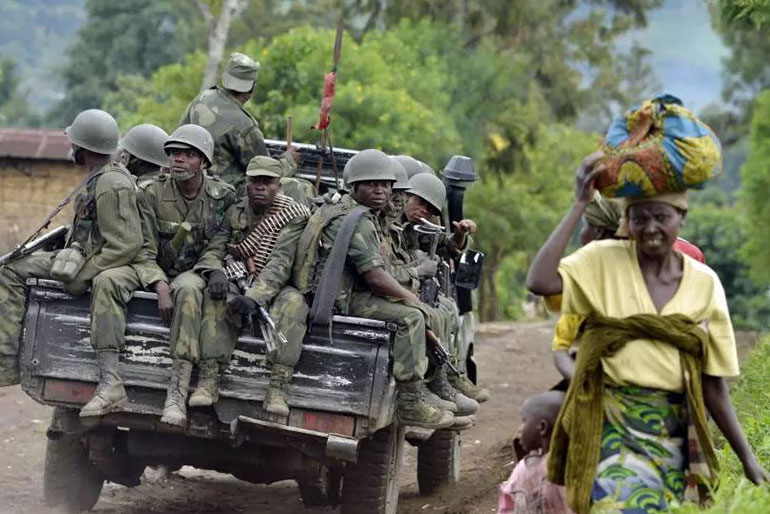
2. Great African War – 3.5 million
Africa. Most Americans don’t give a flying fudge about it. The Great African War in all it’s incarnations happened under the Clinton and Bush years. No one cared.
Yet…
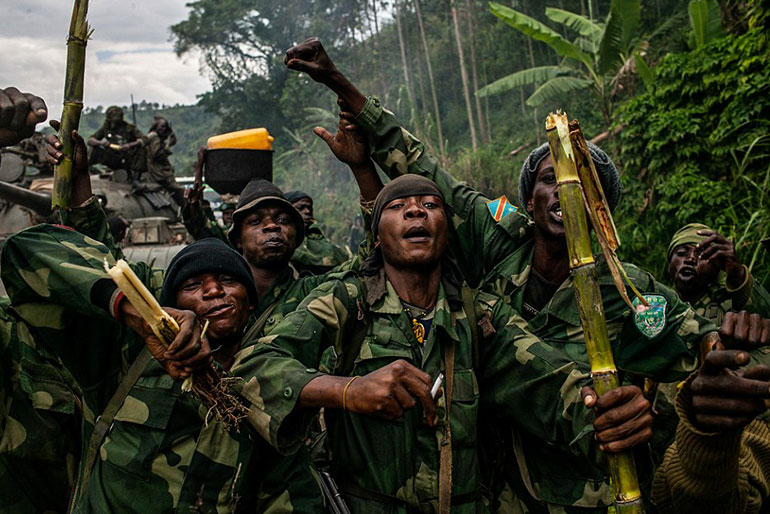
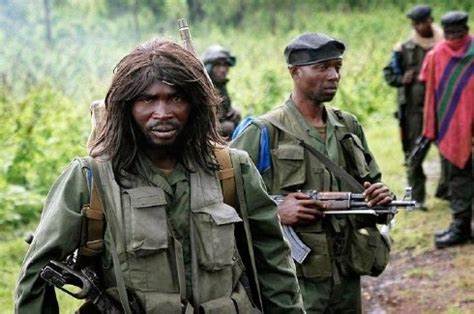
…millions died in the hot steamy jungles of the Congo. They fought over… well, it’s not precisely known exactly what they fought about…
…power, money, drugs, sex…
… gold, fun, religion…
… magic, God, spirits, voodoo…
…and potatoes.
The Second Congo War was so bloody and violent that people started calling it the “Great African War.”
Explaining the loose ends of African politics in under two paragraphs is a daunting task…
A deadly cocktail of inter-ethnic violence, genocide, and warring factions turned the Democratic Republic of Congo into a hellish tropical nightmarish steamy land of never ending suffering and misery.
Who’s to blame?
The fall of the former colonial empires left Africa with so many wounds the crystallization of the new nations was hastened and often uninspired…
Everyone was fighting everyone else for so many, many, many reasons. It’s difficult to sort it all out. It was a bloody free for all of torture, misery, and death.
Almost all neighboring states sent troops to support one side or the other for the duration of the conflict (1998 – 2002).
The Congo conflict showed once more the awful consequences of
bringing a war to poor communities. The hundreds of thousands that died
in combat were soon joined by the millions that perished through disease
and starvation.
Do you know what the worst part is?
Even after a peace treaty had been signed, war is still smoldering, claiming lives on such a constant basis that it is no longer news.
Sort of like those shootings in Chicago…
Or the news that Trump is gonna be impeached any day now…
The Congo conflict showed once more the awful consequences of bringing a war to poor communities. The hundreds of thousands that died in combat were soon joined by the millions that perished through disease and starvation.
Expert Tip: Some people fight first and then look for an excuse later on.
Check out the war that almost saw France conquer Europe.
3. Napoleonic Wars – 4.5 million
For those of you who are unaware, after the French Revolution…
…when the millions of poor and middle class overthrew the French oligarch aristocrats…
… they didn’t know how to govern.
They were incompetent. So in order to control the people (then, collective known as the “rabble”) they started to engage in war.
Wars, you see, are a great distraction away from the domestic problems at home.
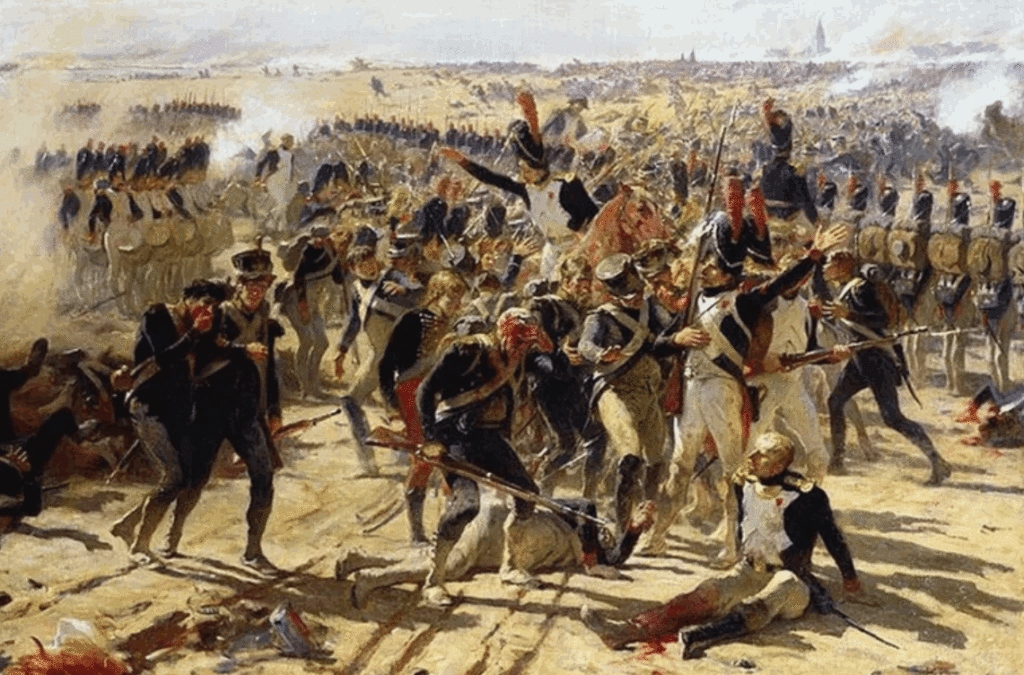
The Battle of Aspern-Essling was fought May 21-22, 1809, and was part of the Napoleonic Wars (1803-1815).
From the chaos of the French Revolution, came military leaders. And, one military ruler emerged with the ambition of leading France to greatness.
Napoleon Bonaparte was such a brilliant military tactician that he convinced his fellow countrymen to crown him emperor. Consider the fact that French did that just ten years since they guillotined their last king.
Yeah…
Pure genus!
— Not. —
Rule by popular opinion is idiotic. It get’s people killed.
America! Listen up and learn something why don’t ya?
Expert Tip: Rule by manipulated mob is called “democracy”. It only favors the wealthy oligarchy.
The Napoleonic Wars was probably the first time a European power attempted continental hegemony. Between 1803 and 1815, it became sort of a cliché to hear the news of Napoleon’s army won another decisive battle against various coalitions of Austrian, Prussian, and Russian forces.
The French were on a winning streak.
Nothing could stop them.
So…
They kept on pushing. They kept on prodding. They keep on… they were so confident that they would forever keep on winning.
Expert Tip: Learn to stop when you are ahead.
The formidable French forces aligned and ready for battle.
Like I said… America listen up!
Napoleon’s winning strike came to an end with him foolishly attacking Russia during the winter.
I mean… what were they thinking?
Expert Tip: Do not declare war on Asia. They always win.
The battle of Borodino and the long retreat to France are amongst the bloodiest episodes of the Napoleonic Wars.
After attacking Russia, the French military was devastated. Less than 10% survived and made it back home.
It’s easy to see the Napoleonic Wars as a rehearsal, one hundred years before the “Great War” (World War I) would plunge Europe back into darkness. More than 4.5 million lost their lives, of which a third were French.
That’s what always happens when you follow a charismatic lunatic.
Expert Tip: Do not follow a charismatic lunatic.
4. Reconquista – 7 million
The Iberian Peninsula was the set of a bloody conflict. It was the first major front for Muslims and Christians to slaughter each other.
Christians fought Muslims in the South of Spain and it was horribly tragic.
What we know today as Spain and Portugal might have held Moorish names…
… if it weren’t for the painstakingly way with which the early Christian kingdoms fought the invaders back across the Gibraltar Strait.
And make no mistake, it was bloody.
Expert Tip: Do not live on migration routes.
The kingdoms of Asturias, León, Castile, Navarre, Aragon, and Portugal fought over the course of seven centuries to reconquer what it took the Moors only five years.
The Iberian Peninsula was the set of a bloody conflict. It was the first major front for Muslims and Christians to slaughter each other.
You will be surprised to know that the Reconquista formally ended in
1492, the same year Christopher Columbus went across the pond to
discover the New World. The fall of Granada marked the end of Muslim
claim in Western Europe.
Going back to 732 AD, the Islamic Moors conquered almost all the
entire peninsula and even crossed the Pyrenees to modern day France.
There probably is one alternate reality where Europe gets fully
conquered by armies chanting the name of Allah.
Check out another religious conflict that went too far.
5. Thirty Years’ War – 8 million
The Thirty Years War

... a European war of 1618–48 which broke out between the Catholic Holy Roman emperor and some of his German Protestant states and developed into a struggle for continental hegemony with France, Sweden, Spain, and the Holy Roman Empire as the major protagonists. It was ended by the Treaty of Westphalia.

- More about Thirty Years War
The United States has been in Afghanistan for twenty years now. It, like most of the wars of the last seventy or so years, are proxy wars in third world shit-holes.
Third World ShitholeunknownNounreferringtoanyimpoverishedforeigncountryinwhichcrime, graft, andcorruptionaremodusoperandi.
- Urban Dictionary: Third World Shithole
It involves, pretty much, expensive planes dropping expensive munitions on mud and clay huts, while “boots on the ground” act as personal bodyguards for the local rich and powerful so that the “interests” of the American oligarchy are maintained.
Nah. I’m not biased. Eh?
Now, imagine that instead of twenty years fighting uneducated tribesmen, we’ve got a full on military presence fighting war like what we experienced during “D Day” for…
…um… like…
…thirty years.
Wars are never pretty. Americans have never really fought an all-out war. At most we had the American Civil War and the Revolutionary war. But if you lived outside the conflict areas, you pretty much could live your life in peace. Not so during the Thirty Years war. No one, no place, and nothing was safe.
The Thirty Years’ War coined just how messed the political map of the European continent was in the 17th century.
What started as a localized conflict between various Protestant and Catholic states (duh!) evolved into a full-scale conflagration. It was one that ravaged Central Europe and left behind the bulkiest death toll the continent has ever since in such a short time.
Every power had a good pretext to join the Thirty Years’ War.
War is good!

Save the King!

Power to the People!

We are the best! They are the worst scum imaginable!

Kill them all. Rape their women! Kill their babies,all for our King!
By far the most flamboyant intervention was that of King Gustavus Adolphus of Sweden, who engaged in one of the most bizarre adventures that took his troops deep into southern Germany.
Thirty Years' War in British English noun a major conflict involving principally Austria , Denmark , France, Holland , the German states , Spain , and Sweden , that devastated central Europe, esp large areas of Germany (1618–48).

- Thirty Years' War definition and meaning | Collins English
Humans can become awfully cruel to each other and atrocities towards others becomes normalized.
The Thirty Years’ War brevetted cruel execution methods like so-called Defenestration. In this “humane” procedure, soldiers threw out the windows the civilians of the captured cities.
The first all-out war that engulfed Europe showed major powers just how “fun” can be to fight on a continental scale. What followed was much worse.
The human condition. In Europe. The most “civilized” place on the planet.
Expert Tip: No place is immune from war or conflict.
Europe was not the only place where people enjoyed slaughtering each other.
6. Chinese Civil War – 8 million
Following in the footsteps of Russia, when they over threw their oligarchy, the poor Chinese peasants tried to do the exact same thing. They set up factions and fought each other on a very bloody and enormous land mass.
Expert Tip: Oligarchies tend to anger the peasants & serfs. This results in war.
Nationalist prisoner captured by the Marxists and paraded before the townspeople before being tortured and killed.
The Chinese Civil War opposed forces loyal to the Republic of China to the army assembled by the Communist Party.
Oligarchy = Nationalist Republic of China.
The fighting poor = Communist Party
What followed was a bewildering war with a temporary and curious anomaly.
Killings were everywhere. Friends killed friends, brothers killed brothers, and no one was safe.
Probably the strangest fact about the conflict was that it took a decade-long hiatus. Between 1936 and 1946, the Nationalists and the Communists formed a United Front that opposed the territorial claims of Imperial Japan.
Once WWII ended, the two enemies were back at each other’s throats.
Gun boat on the river. It was an effective platform for firepower at critical towns and villages.
Mao Zedong (the leader of the Communist Party) rose as a leader during the Great March, a strategic retreat of the Communist forces that would weight decisively in their victory.
The Communists (the rural poor) won, and chased the oligarchy to the island of Taiwan. Which now is the remaining stronghold for the remaining remnants of Chinese “blue blood”.
The Chinese have known thousands of years of conflict in a very up-front and personal way. And when the communists took over, they failed miserably. They did not know how to do anything right, and millions died by starvation, poverty and internal “turf wars”.
Expert Tip: Never allow yourself to be disarmed by progressive Marxists.
Their last conflict was in 1966 when the progressive Marxists lost it completely. They, in turn, were overthrown by a government that embraced a new kind of socialism. It’s socialism with capitalism; or in other words “socialism with Chinese characteristics”.
America should take note.
Expert tip: China is communist in name only.
The Chinese, a nation of merit, has known complete suffering and devastation for centuries. They view war as a terribly personal thing that must be avoided at all costs. However, if it cannot be avoided…
…It must be dealt with quickly and absolutely.
7. Russian Civil War – 9 million
Now, according to American media and history books, there was this pesky “Russian Revolution”. It was a time when the communists overthrew the the Tsar.
What they fail to tell you is that it was like the “French Revolution”. The downtrodden peasants over thrown the ruling oligarchy. Then once the oligarchy was neutered, a group of idealistic Marxists took over. They started killing everyone…
…all in the name of a progressive utopia.
The Russian revolution enabled progressive Marxists to over throw the ruling oligarchy. The rest of the world trembled that it might occur again in their communities.
One century ago, Russia had a hard time deciding its political future. There were many participants. But, all being said and done it was really down to two sides;
The wealthy oligarchy.
The uneducated poor.
The Red Army (the idealistic poor) and the White Army (the defenders of the oligarchy) faced each other in a bloody war. It was a war that claimed millions of lives and kept the country in turmoil for six years.
Everything started once the impoverished people of Russia have had enough with their Tsar and the rest of the ruling oligarchy.
The pageantry of the ruling Russian oligarchy rivaled pre-Napoleonic France. Bet you’se guys never saw these pictures in your American history books, eh?
In just one year (1917), the Russians went through two revolutions.
One toppled the century-old monarchy…
… while the other gave way to the Communist takeover.
You might be surprised to know that Russia’s future was quite uncertain in the early phases of its civil war.
Republicans, pro-monarchists, fascists – all wanted to fill in the power vacuum and exploit the gullible babushkas. Historians are still not sure what made Russia such a fertile ground for Communist Marxist ideology.
Expert Tip: People will accept governance in just about any form as long as it’s not an oligarchy.
I attribute it to being treated like dirt by the wealthy aristocrats.
Although a lot of fighting took place throughout the Russian Civil War, the bulk of the victims is represented by civilians who happened to side with the losers.
Lenin and the gang cleansed society and painted it in blood.
The new Marxists killed their enemies, and if you were lucky, you got to go to a Gulag.
That might answer why the Soviet Union saw little internal political friction throughout its existence. Why? Well, everyone who could possibly… remotely… be a threat was killed.
Expert Tip: Progressive Marxists eventually kill everyone.
Now…
Check out the atrocities committed by a bunch of Spanish soldiers!
8. Spanish Conquest of Peru – 9 million
As late as 1528, the Inca Empire was a cohesive unit, ruled by one dominant ruler, Huayna Capac.
He died, however, and two of his many, many sons, Atahualpa and Huáscar, began to fight over his empire. (Being a King has sexual advantages, don’t you know…)
For four years, a bloody civil war raged over the Empire and in 1532 Atahualpa emerged victoriously.
It was at this precise moment, when the Empire was in ruins, that Pizarro and his men showed up: they were able to defeat the weakened Inca armies and exploit the social rifts that had caused the war in the first place.
The Spanish conquest of Peru is a dark chapter of human history, one that holds the story of the 9 million Incas that perished.
Francisco Pizarro is the man responsible for conquering an entire
empire with only a handful of well-equipped soldiers. The conquistador
put to work superior weapons and a cunning plan.
Expert Tip: Beware of strangers with advanced technology and a love of gold.
In November of 1532, Inca Emperor Atahualpa was captured by the Spanish: he had agreed to meet with them, feeling that they did not pose a threat to his massive army. This was but one of the mistakes the Inca made.
Later, Atahualpa’s generals, fearing for his safety in captivity, did not attack the Spanish while there were still only a few of them in Peru: one general even believed Spanish promises of friendship and let himself be captured.
The soldiers and people of the Inca Empire did not meekly turn over their homeland to the hated invaders. Major Inca generals such as Quisquis and Rumiñahui fought pitched battles against the Spanish and their native allies, notably at the 1534 Battle of Teocajas.
Later, members of the Inca royal family such as Manco Inca and Tupac Amaru led massive uprisings: Manco had 100,000 soldiers in the field at one point. For decades, isolated groups of Spaniards were targeted and attacked. The people of Quito proved particularly fierce, fighting the Spanish every step of the way to their city, which they burned to the ground when it became apparent that the Spanish were certain to capture it.
The drawing below shows the climax of the Spanish blitzkrieg against the Incas. Pizarro ambushes emperor Atahualpa, who is captured and executed.
The climax of the Spanish blitzkrieg against the Incas. Pizarro ambushes emperor Atahualpa, who is captured and executed.
Although the Incas rebelled multiple times against the foreign
invaders, there was little they could do regarding fighting the
infectious diseases the Europeans brought with them. The Spanish
conquest of the Inca Empire formally ended in 1572.
Although many of the native people fought back fiercely, others allied  themselves with the Spanish. The Inca were not universally loved by the  neighboring tribes they had subjugated over the centuries, and vassal  tribes such as the Cañari hated the Inca so much that they allied  themselves with the Spanish: by the time they realized that the Spanish  were an even bigger threat it was too late. Members of the Inca royal  family practically fell over one another to gain the favor of the  Spanish, who put a series of puppet rulers on the throne. The Spanish  also co-opted a servant class called the yanaconas: the yanaconas  attached themselves to the Spaniards and were valuable informants.

The Inca had skilled generals, veteran soldiers and massive armies  numbering in the tens or hundreds of thousands. The Spanish were greatly  outnumbered, but their horses, armor, and weapons gave them an  advantage that proved too great for their enemies to overcome. There  were no horses in South America until Europeans brought them: native  warriors were terrified of them and at first, the natives had no tactics  to counter a disciplined cavalry charge. In battle, a skilled Spanish  horseman could cut down dozens of native warriors. Spanish armor and  helmets, made of steel, made their wearers practically invulnerable and  fine steel swords could cut through any armor the natives could put  together.
By that time, the second most advanced civilization of the New World booked a one-way ticket into oblivion.
Pizarro ambushes emperor Atahualpa, who is captured and executed.
The next page reveals another bloody conflict that shocked the medieval world.
9. Conquests of Tamerlane – 17 million
Here we have a very powerful and ruthless man. His name was Tamerlane, and he was the most powerful general under Genghis Khan.
Initially, Greater Mongol State was the name of the Mongol Empire. In the world’s history, Mongol Empire was the only empire that managed to take over and rule a number of countries and territories. But before it happened, war was declared. It happened from the year 1207-1472.
When I rise, the world shall tremble!
Take a good look at Tamerlane, the ruthless ruler responsible for killing 5% of the world population throughout the years he campaigned.
Timur, historically known as Tamerlane (1336 - 1405), was a  Turco-Mongol conqueror and the founder of the Timurid Empire in Persia  and Central Asia. Timur rose through the ranks by gaining the respect of  local chieftains due to his personal valor in combat and his  brigandage. His actions, whether raiding or in combat, caused many to  flock to him. It was during a battle that arrows struck his right arm  and leg which left him partially paralyzed. Because of this, Europeans  referred to him as ‘Tamerlane’ or ‘Timur the Lame.’

Timur was born in Transoxania a member of Barlas tribe. He rose to  power among the Ulus Chaghatay. The Ulus Chaghatay was nomadic tribal  confederation that formed the central region of Mongolian Chaghadaid  khanate. Timur's story is similar to Genghis Khan; How true these stories are is up for debate.

- When I rise, the world shall tremble! Tamerlane’s Deadly Drive into India—Part I
Tamerlane (also known as Timur the Lame) had the ambition of
restoring the Mongol Empire, almost 150 years after the death of Genghis
Khan. Between 1370 and 1405 he toured Asia, sacking cities, painting
their walls with blood, and destroying all the key power structures.
Timur played good cop – bad cop with the people he conquered. His most notable civilian bloodsheds are the sacking of Delhi (100,000) and crushing the revolt of Isfahan (200,000).
Expert Tip; Better to be alive and living in poverty than to be killed clutching your possessions.
You will be surprised to know Tamerlane was close to engaging in a
conflict that would have blown to pieces the Asian continent. Luckily,
he died before ordering his army to attack the Ming dynasty of China.
The self-entitled “Sword of Islam” cut deep and merciless. Compiling
the sources of the time, we confront horrifying statistics. More than 17
million perished because ambitious Tamerlane dreamt of taking over the
world.
The doors of Tamerlane.
Check out China’s less know rebellion!
10. An Lushan Rebellion – 21 million
Starting December 16, 755-February 17, 763, An Lushan Rebellion happened. It was during China’s Tang Dynasty. The war actually started when An Lushan who happened to be an ex-Tang general declared himself to be the new emperor.
The An Lushan rebellion was the end and a new start into reclaiming the Tang dynasty. It did not only affect the royal empire but the people as well were affected due to this warfare. It took years before the wounds of the past were healed in the empire.

- An Lushan Rebellion - The Devastating An-Shi Rebellion
Starting December 16, 755-February 17, 763, An Lushan Rebellion happened. It was during China’s Tang Dynasty. The war actually started when An Lushan who happened to be an ex-Tang general declared himself to be the new emperor.
At first glance, the An Lushan Rebellion seems to deserve just a footnote.
Expert Tip: History will never be able to coney the suffering of you or your people.
That’s the error most historians make when they fail to check the
numbers. More than 21 million perished as a result of an attempted coup
that was close to overthrowing one of the most influential dynasties of
the time.
General An Lushan detonated order and peace once he proclaimed himself emperor of Northern China in 755 AD.
Take a good look at the man who can be held responsible for the mess.
General An Lushan detonated order and peace once he proclaimed himself
emperor of Northern China in 755 AD. Seven years of turmoil followed,
during which China lost one-third of its population.
The painting below depicts the flight of the emperor from the capital of Chang’an, immediately before Lushan’s army seized it.
The flight of the emperor from the capital of Chang’an.
Although going that far, killing that many people, the rebellion eventually failed and came to an end in 763 AD.
The restored Tang became severely weakened and would exit the stage of history in less than two centuries later.
You have to see Spain’s second carnage in the New World…
11. Spanish Conquest of Mexico – 24 million
Only three decades after Christopher Columbus had discovered the New World the Spaniards were already busy exterminating the local populations at a ferocious scale.
TheSpanishConquest (1519-1521) April 21, 1519--theyearCeAcatl (OneReed) byAztecreckoning-- markedtheopeningofashortbutdecisivechapterinMexico'shistory. Onthatdayafleetof 11 Spanishgalleonssailingalongtheeasterngulfcoastdroppedanchorjustoffthewind-sweptbeachontheislandofSanJuandeUlúa.
- The SpanishConquest (1519-1521) : Mexico History
The Spanish conquest of the Aztec Empire, also known as the Spanish–Mexican War, was one of the primary events in the Spanish colonization of the Americas.
More than 24 million died throughout the Spanish conquest of what is
modern day Mexico. Compared to that, the bloody sacrifices so engraved
in Aztec culture appear like a bruise your mother kisses to make it go
away.
How could less than 2,000 conquistadors overcome an army of 300,000
Aztecs, their well-fortified capital of Tenochtitlan, and the advantage
of the home ground? How could tens of millions be slaughtered in a
matter of decades?
The story of the Spanish conquest, as it has been commonly understood  for 500 years, goes like this: Montezuma surrendered his empire to  Cortés. Cortés and his men entered Tenochtitlán and lived there  peacefully for months until rebellious Aztecs attacked them. Montezuma  was killed by friendly fire. The surviving conquistadors escaped the  city and later returned with Spanish reinforcements. They bravely laid  siege to Tenochtitlán for months and finally captured it on Aug. 13,  1521, with the Spanish taking their rightful place as leaders of the  land we now know as Mexico. Conquest accomplished.

"History is  messy, and this story tidies up all of that mess and turns the messy,  unpleasant war that took place 500 years ago into a nice, tidy dramatic  narrative that has a hero [Cortés] and antihero [Montezuma] and has some  kind of climactic, glorious ending," says Restall.

In When Montezuma Met Cortés,  Restall revises this story. He ditches the word "conquest" and instead  refers to the time as the Spanish-Aztec war. He says Cortés was a  "mediocrity" with little personal impact on the unfolding of events and  refocuses on complex territorial battles between the Aztecs and their  rivals.

The Tlaxcallan Empire, which allied with the Spanish, was the  driving force, outnumbering conquistadors 50-to-1 during the war with  the Aztecs. Smallpox and a betrayal from an Aztec ally dealt the final  blow. The wondrous island city fell, but it would take years for the  Spanish to establish control in New Spain.

-NPR
Hernán Cortés exploited European style warfare to its maximum.
Cortez the Killer.
For the superstitious Aztecs, the horse and the guns appeared as the weapons of the Gods.
The Spanish contingent also boosted its numbers by initiating an alliance with the local Tlaxcala.
The Spanish conquest of the Aztec Empire.
Nevertheless, the biggest aid came in an invisible form. European germs proved to be a formidable army and childhood diseases like small pox and measles met no natural immunity in the bodies of the indigenous populations.
Yup. Biological warfare wiped out a complete empire.
Expert Tip: Beware of the use of biological warfare. It’s fighting war by stealth.
Explore on the next page another Chinese conflict that killed millions!
12. Qing vs. Ming – 25 million
Medieval China saw enough dynastic drama to make the wars in the West look like children’s play. Maybe that’s why Chinese movies and drama always focus on that time period.
Qing soldiers cutting hair of Chinese officals after Ming dynasty fall.
Between 1618 and 1683, China completed a full transition from its
southern Ming emperors to the new ruling elite coming all they from
northern Manchuria. You could say that in this fragment of history the
Starks were victorious.
As you suspect, the Ming did not leave without a fight. The Manchu
(Qing) retaliation was unprecedented. More than 25,000,000 lost their
lives in a conflict that spread across the entire land.
China is a nation of people who know nothing other than war, and want to avoid it at all costs.
Whole provinces like Sichuan and Jiangnan were completely depopulated, and chronicles mention massacres like the one of Yangzhou where 800,000 innocent souls perished.
Expert Tip: Major wars result in the depopulation of large swaths of territory. Entire states can end up empty.
The expression “women and children first” had a terrifyingly different meaning for the Qing generals.
At this point, we need to stress the fact that Qing Manchurians were foreigners who managed to conquer China mostly through betrayal and manipulation.
Their savagery will be avenged similarly just three centuries later.
Qing empire.
Check out the biggest land empire ever and the bloodshed it created.
13. Mongol Conquests – 35 million (+ 200 million bonus)
The Mongol Empire: Expansion of the Mongol empire from 1206 CE-1294 CE. During Europe’s High Middle Ages the Mongol Empire, the largest contiguous land empire in history, began to emerge. The Mongol Empire began in the Central Asian steppes and lasted throughout the 13th and 14th centuries.

- The Mongol Empire | Boundless World History
Mongols dominated the battlefields with their slim and fast mounted archers that made the most of Europe’s sluggish armored knights.
Watching a live world map of the world Mongol expansion shows just how quick and efficient the steppe riders moved across Eurasia.
The Mongol expansion was rapid and ruthless.
Mongols dominated the battlefields with their slim and fast mounted archers that made the most of Europe’s sluggish armored knights.
 1. In 1201, Genghis Khan was shot in the neck during a battle and  asked the defeated army who had shot “his horse”, trying to downplay the  injury. The archer voluntarily confessed that he shot Genghis Khan  himself and not his horse. He refused to beg for mercy saying if Genghis  Khan desired to kill him, it was his choice, but if he would let him  live, he would serve Genghis Khan loyally. Genghis Khan spared him,  turning him into a great general. – Source

 2. When Genghis Khan sent a trade caravan to the Khwarezmid Empire,  the governor of one of the city seized it and killed the traders.  Genghis Khan retaliated by invading the empire with 100,000 men and  killing the governor by pouring molten silver down his eyes and mouth.  Genghis Khan even went so far as to divert a river through the  Khwarezmid emperor’s birthplace, erasing it from the map. – Source

 3. Genghis Khan killed an estimated 40 million people, resulting in a  man-made climate change. The Mongol invasions effectively cooled the  planet, scrubbing around 700 million tons of carbon from the atmosphere.  – Source

 4. Genghis Khan’s chief adviser was a captured scholar named Yelu  Chucai. His contribution to the Mongol Empire was to suggest that the  Mongols not kill everyone, but tax them instead. – Source

 5. Genghis Khan would marry off a daughter to the king of an allied  nation, dismissing his other wives. Then he would assign his new  son-in-law to military duty in the Mongol wars, while the daughter took  over the rule. Most of his sons-in-laws died in combat, giving him  shield around the Mongol lands. – Source
A typical Mongol siege of a normal Chinese fortified city.
Mongol warriors had the bad habit of executing hundreds of thousands of civilians at a time, making religious fanatics believe the Antichrist descended upon Earth.
Extermination Blues – Robin Trower
 6. There’s a place in Mongolia called Ikh Khorig that was declared  sacred by Genghis Khan. The only people allowed to enter were the Mongol  Royal Family and a tribe of elite warriors, the darkhat, whose job was  to guard it, punishment for entering being death. They carried out their  task for 697 years, until 1924. – Source

 7. Legends abound regarding the cause of Genghis Khan’s death, ranges  from a fall from his horse while hunting, to an arrow to the knee, to  an assassination plot executed by a captured princess. – Source

 8. Genghis Khan exempted the poor and clergy from taxes, encouraged  literacy, and established a free religion, leading many people to join  his empire before they were even conquered. – Source

 9. Shah Jahan, the emperor who built the Taj Mahal was a direct descendent of Genghis Khan – Source

 10. The Mongols celebrated a victory over the Russians by laying  survivors on the ground, dropping a heavy wooden gate on them, and then  having a victory banquet on top of it while the victims suffocated and  were crushed to death. – Source
Khutulun was the only daughter and youngest child in a family with 15 children. Her sibling rivalries growing up helped fashion her into the person she became. Because her father, Kaidu ruler of the Changatai Khanate, favored the old Mongol ways, Khutulun grew up in a nomadic lifestyle. This lifestyle gave her specialized training in wrestling, horseback riding, and as a warrior. It is said that when her father feuded with her uncle, Kublai Khan, she rode by his side throughout the campaigns.
The armies of Genghis Khan and his lieutenants operated like a surgeon, performing a lobotomy on most states of Asia and Eastern Europe.
Expert Tip: When confronting a large, disciplined Asian nation it is best to be their friends. The alternative is extermination.
 11. Töregene Khatun, the daughter-in-law to Genghis Khan, ruled the  Mongol Empire for 5 years at the height of its power and was arguably  the most powerful woman in the history of the world – Source

 12. The Mongols killed so many people in the Iranian Plateau that  some historians estimate that Iran’s population did not again reach its  pre-Mongol levels until the mid-20th century. – Source

 13. Mongols were actually outnumbered in most of their victories in  battles. They still managed to deceive their enemies by elaborate ruses  like mounting dummies atop horses and tying sticks to the horses’ tails  to create dust storms. – Source

 14. In 1258, the Mongols destroyed Baghdad. Survivors said that “the  waters of the Tigris ran black with ink from the enormous quantities of  books flung into the river and red from the blood of the scientists and  philosophers killed.” The siege marked the end of the Islamic Golden  Age. – Source

 15. The Mongols pulled their bowstrings back with their thumb. To prevent damage to their thumbs they created thumb rings. – Source
The only thing that stopped the world from becoming one giant pasture for Mongol horses was the sudden death of their supreme ruler.
You do not mess around with a powerful Asian nation.
 16. Khutulun was a warrior princess. She was a Mongol princess who  won 10,000 horses wrestling every man who wanted to marry her. – Source

 17. People of the Mongol empire never washed their clothes or  themselves because they believed washing would pollute the water and  anger the dragons that controlled the water cycle. – Source

 18. In 1254 C.E. Genghis Khan organized a formal religious debate  between teams of Christians, Muslims, and Buddhists. The debate went on  for multiple rounds on a variety of theological topics until the  participants became so drunk that it concluded without any clear winner.  – Source

 19. Genghis Khan is considered the “most successful biological father  in human history” with over 16 million descendants in Central Asia. – Source

 20. In his youth, Genghis Khan killed his half-brother Bekhter for not sharing food.
The Mongol Horde were knocking at the gates of the former Roman empire.
 21. Mongol leader Genghis Khan never allowed anyone to paint his  portrait, sculpt his image or engrave his likeness on a coin. The first  images of him appeared after his death. – Source

 22. Genghis Khan invaded China with 90,000 troops and dominated the  largest army in the world, the Jin Dynasty’s 1 million+ troops, and  destroyed over 500,000 of them in the process and gained control of  Northern China and Beijing. – Source

 23. Mongols had rules against spilling noble blood over the ground.  Instead, they used loopholes like making them bend backward until their  backbones snapped, pouring molten silver into eyes and ears, and being  rolled up in a rug and trampled to death by the Mongol cavalry. – Source

 24. The Mongol Empire installed empire-wide messenger/postal stations  15-40 miles apart, stocked with food and fresh mounts that required  passports for use, allowing for communication over the largest  continuous empire in history. – Source

 25. The deadliest war in the history was WWII, but the Mongol  Invasions are a close second, despite occurring 700 years earlier, when  the world’s population was only a fifth of what it was in 1945. – Source
Just when the people of Europe were celebrating the end of the Mongol menace, another wave of death immediately followed suit and bathed the continent in blood throughout the 14th century.
The riders have brought with them the bubonic plague.
Expert Tip: “Double Tap” is the only way to make sure.
Let’s visit again the slaughterhouse China was in the past…
14. Three Kingdoms War – 38 million
The Three Kingdoms War is one the bloodiest military conflicts in Chinese history.
The Three Kingdoms War is one the bloodiest military conflicts in Chinese history.
Most people perceive China as a monolith that existed peacefully
since its inception until today. That is far from being true. Back when
Europe was enjoying relative stability under Roman rule, the Celestial
Empire confronted one of the most prolonged crisis.
Between 184 and 280 AD China was divided in three empires – Wei, Shu,
and Wu. The three emerged after the breakdown of the Han dynasty and
would be again reunited by the Jin monarchs.
A map of the three kingdoms.
All historians base their life loss estimates on two national
censuses that give a difference of 38 million. Whether the calculations
were accurate will remain a mystery. Nevertheless, one thing is clear.
China has a formidable capacity of regenerating its population.
It seems that the Chinese were so happy once the century-long conflict ended that they celebrated mostly in their beds.
Expert Tip: After conflict have lots and lots of sex.
As we approach the end of the list, the death toll rises to emotional levels.
15. World War I – 40 million
World War I proved once more just how messed up Europe’s political map was at that time.
World War I, international conflict that in 1914–18 embroiled most of the nations of Europe along with Russia, the U.S., the Middle East, and other regions. It led to the fall of four great imperial dynasties and, in its destabilization of European society, laid the groundwork for World War II.

- World War I | Facts, Causes, & History | Britannica
World War I was a war that started to use technology to kill people with rapid ease in mass quantities.
An intricate network of alliances, friendships, and protectorates
turned the continent into a field of domino pieces waiting for the first
push. The assassination of Archduke Franz Ferdinand of Austria was
nothing but a pretext for nations to jump at each other’s throat with a
ferocity never seen before.
12 Technological Advancements of World War ITanks.Flamethrowers.Poison Gas.Tracer Bullets.Interrupter Gear.Air traffic control.Depth Charges.Hydrophones.Aircraft Carriers.Pilotless Drones.
- 12 Technological Advancements of World War I | Mental Floss
The four short years of WWI would have made Napoleon and Genghis Khan
jealous. Breakthrough technologies meant that soldiers could kill each
other more efficiently. Airplanes and chemical weapons are just a few of
the innovations that gave WWI its sad reputation.
Gas warfare, heavy machine guns and trench warfare, along with airplanes and tanks were introduced during World war I.
The belief that WWI was a trench war is not far from the truth. Machine guns turned offensive warfare into mass suicide, so opponents often settled with bombarding each other’s positions and squabbling for the higher ground.
Expert Tip: Wars are not gallant and “Righteous”, they are dangerous and lethal events. Flee while that is still an option open to you.
Those lucky enough to survive WWI gave it a nickname that proved to
be inaccurate. The “War to End All Wars” was followed after two decades
by something even more frightening.
Check out China’s less know civil war!
16. Taiping Rebellion – 44.5 million
The Taiping Rebellion highlights one more time China’s incredible potential in hosting epic scale warfare.
The Taiping Rebellion was a civil war in China from 1850 to 1864. It was led by Hong Xiuquan. The Taiping Rebellion was against the ruling Qing Dynasty.About 20 million people died. [source?] Most of them were civilians. Hong established the Taiping Heavenly Kingdom (太平天囯). When it was most powerful, it had about 30 million people joining in it.

- Taiping Rebellion - Simple English Wikipedia
Capture of a British prisoner during the Taipeng war.
Also known as the Taiping Civil War, the conflict lasted between 1850 and 1864 and produced the most dramatic death toll in history at that time.
Uniforms and gear of the troops during the Taipeng war.
The rebellion started with the millenarian movement of the Heavenly Kingdom of Peace, which tried to overthrow the Qing dynasty.
Expert Tip: When the word “peace” is used as part of a slogan or name for a military organization, run away and flee. Nothing good can ever come of it.
The Taiping Rebellion, from 1851 to 1864, was the deadliest civil war in  history. This column provides evidence that this cataclysmic event  significantly shaped China’s Malthusian transition and long-term  development that followed, especially in areas where the experiences  that stemmed from the rebellion led to better property rights, stronger  local fiscal capacity, and rule by leaders with longer-term governance  horizons.

- A Most Uncomfortable Thought About The Taiping Rebellion And The Black Death – Maybe That’s How Development Starts?
As you seen saw far on the list, every significant political change
in the history of China came with savagery. The Taiping Rebellion counts
as the bloodiest civil war in history and makes the American equivalent
look like a banquet.
The Taipeng war was dangerous and bloody.
The man responsible for the uprising was Hong Xiuquan. He considered himself the brother of Jesus Christ and wanted to establish an empire based on his take on Christianity.
Expert Tip: Avoid people who claim religious or heavenly connections.
Although unsuccessful, the conflagration further weakened China’s
Manchurian dynasty and set the stage for the victorious Communist
Revolution we talked about earlier.
Let’s end the list with the bloodiest war that ever took place.
17. World War II – 58 million
As you probably guessed, World War II sits comfortably at the top of the charts.
World War II summary: The carnage of World War II was unprecedented and brought the world closest to the term “total warfare.”On average 27,000 people were killed each day between September 1, 1939, until the formal surrender of Japan on September 2, 1945.

- World War II - World & US History Online
Countries brought each other close to total annihilation in a global
conflict that lasted six years. The lure of extremist doctrines was
enough to convince millions to take arms and engage in bloodshed like
never seen before.
World War II threw the entire globe into upheaval with death and destruction on all continents.
From the total of 58 million deaths, more than 40 million were
civilians. Genocide, massacres, mass-bombings, as well as the inevitable
epidemics and starvation, left the world (especially Europe) in ruins.
Between 1939 and 1945 our planet became a large war machinery that
ran on steel and flesh, veiling the future with clouds of dark smoke.
The romantic view on war finally met its doom in the Stalingrad
slaughterhouse and the Nazi extermination camps.
Nazi Germany was a major “player” during World War II, but other nations were just as guilty in the way that they handled things and their relationships.
Hopefully, humanity will never repeat the mistakes that led to WWII. Naturally, some pessimists saw in the Hiroshima and Nagasaki grand finally a preview for a third installment – the all-out war that will wipe civilization and send survivors back to the Stone Age.
Expert Tip: Wars always use the latest in killing technology. Expect the worst, and take the necessary precautions.
Conclusion.
It’s nice to think that we are “modern”, “enlightened”, “progressive’ and “forward thinking”. But, unfortunately that is a big lie. Humans, at best, can only sustain a calm period of coexistence for a handful of decades. No longer. The fact and the truth is that blood was spilled ruthlessly for most of human history.
We erronously believe that wars and bloodshed are behind us.
Nothing could be further from the truth. I argue that we have never been closer to global warfare and at a level that is beyond our comprehension.
It will involved WMD technology, whether it is nuclear or biological, and it will begin stealthy. Most people will be unaware that there is a war going on and that “chess pieces” are moving into position until it is too late.
The only thing that we can do is prepare for a SHTF event. That means get to know all of your neighbors, be prudent in your stockpiling of food, and supplies (for use or barter) and have a garden and fruit bearing trees. Make sure that you are armed and very, very skilled at using them. Finally, do not be timid about fighting. You will need to assess who your friends and your enemies are and kill them if need be.
May your preparations never come to fruition. God bless.
If you enjoyed this post, please be sure to check out my SHTF index page. Here…
You’ll not
find any big banners or popups here talking about cookies and privacy
notices. There are no ads on this site (aside from the hosting ads – a
necessary evil). Functionally and fundamentally, I just don’t make money
off of this blog. It is NOT monetized. Finally, I don’t track you
because I just don’t care to.
Patent documents indicate that the U.S. and China are actively developing radical new craft that seem eerily similar to UFOs reported by Navy pilots.
The United States Secretary of Navy is listed as the assignee on several curious aviation technologies patents. These are highly unusual patents, devices and mechanisms.
Highly unusual.
These patents were generated by an aerospace engineer working at the Naval Air Warfare Center Aircraft Division (NAWCAD) headquarters in Patuxent River, Maryland.
They are very interesting.
Naval Air Warfare Center Aircraft Division (NAWCAD) headquarters in Patuxent River, Maryland.
The patents are very interesting.
One of these patents describes a “hybrid aerospace-underwater craft”. You know, one that can swim through the water as easily as it can fly through the air or jet through space.
Vehicle from the movie “Sky Captain and the World of Tomorrow”.
According to the patent, it is capable of truly extraordinary feats of speed and maneuverability in air, water, and outer space. It is truly a revolutionary electromagnetic propulsion system.
Very exciting. Bordering (or perhaps, crossed over) the line between accepted scientific paradigms and God-like technology.
A scientific paradigm is a framework containing all the commonly accepted views about a subject, conventions about what direction research should take and how it should be performed.

- What Is A Paradigm? - Explorable.com
To most classically educated scientists, it sounds pretty far fetched.
Imagine trying to get a patent for it!
Trying to get a patent.
A primary patent examiner at the United States Patent and Trademark Office (USPTO) thought that they were too fantastic to approve. And as such, he denied the patent applications as “too fantastical” to be considered in any degree of seriousness.
“Brawndo has what plants crave. It’s got electrolytes.”
United States Patent and Trademark Office (USPTO)
This did not sit well with the United States Navy.
No sir. Not at all.
They absolutely and urgently, wanted these patents to be granted. They believed that it was in the best interests of “National Security”.
Washingtonhasbeenincapableofcopingwiththegreatchangesthathavetakenplaceinrecentyears, includingtheriseofemergingmarketsanddevelopingcountries, and national security hasbecomean excuse itleansonwhenitwantstoactonitssuspicionsabouttheeconomicdevelopmentandtechnologicalprogressofothercountries.
- The phony excuse of national security - CGTN
The Chief Technical Officer (CTO) of the Naval Aviation Enterprise personally wrote a letter addressed to the examiner. He claimed that the U.S. needs the patent. As the Chinese are already “investing significantly” in these aerospace technologies.
His argument is that the patents were necessary for “American Defense superiority”.
Chinese idiom.
UFO’s? No way!
The descriptions on the patents sound very, very similar to the UFOs reported by Navy pilots.
They do.
Why is that, you suppose?
Well, everyone know that there’s no such things as “little green men”, extraterrestrials or “star people”. That’s just nonsense for school children. Right?
Right?
And since the USA would never keep secrets and technologies hidden from the American people, we know that they would tell us about extraterrestrials and their technologies. They would be open and transparent.
Open and transparent is the way America always does things. Right?
That’s what it’s like to live within the best democracy in the history of the world. Right?
The government is open and has no secrets. Don’t you know!
So, there are no extraterrestrials at all. After all, President Obama got on the Ellen DeGeneres show and said that to an audience of millions. Millions!
US
President Barack Obama has awarded the USA’s highest civilian honor to
various actors, musicians and athletes during a ceremony at the White
House.
It must be the dastardly Chinese or Russians!
Since it cannot be extraterrestrials that are using these technologies, then it MUST be those terrible Chinese or Russians! Right?
Damn Commies!
It’s easy to find demonization of the Chinese on the internet. Oh, they are so evil… right?
This raises the question, are the Chinese developing (or even already flying craft) leveraging similar advanced technology and is the American Navy now scrambling to catch up?
I rather doubt that the Chinese are anywhere near this level of development, and I am a pretty strong supporter of the Chinese. Yes, it is true that many Chinese cities look like something out of the "The Jetsons", but this level of technology is centuries more advanced than what is publicly available in peer review journals.

-Metallicman
And I am not alone…
I deeply doubt  that the Navy is playing catch-up to what the Chinese have secret  developed. Tingly and Rogoway do not appear to be aware of the many  insiders who have come forward with their startling testimonies about  U.S. reverse engineering programs involving captured flying saucer  technologies that go back as far back as the 1940s.

-EXOpolitics
Why not reverse engineering of extraterrestrial craft?
Why not?
I mean, you have to be a rather retarded block head not to realize that the universe is a very big place, and time goes on a long long way. To think that the world, as we know it, and the beliefs that we hold are absolutely fundamentally correct, is absolute lunacy.
Extraterrestrials exist.
The Untied States government knows about them, and has treaties with numerous entities. They have been reverse engineering their technologies for decades now, and it’s only a matter of time when the research will pay off with some kind of hybrid developmental vehicles.
It’s only a matter of time.
Maybe like now.
And if the reverse engineering has reached a point where actual prototypes can be manufactured, perhaps it would also be a good time to secure intellectual patents protections. Right?
Right?
The Wondrous Inventions Of Dr. Salvatore Cezar Pais
Maybe a look at some of these patents might give us some insight.
Maybe we can take a peek at the strange aerospace patents filed by Salvatore Cezar Pais, an aerospace engineer at NAWCAD.
Aerospace engineers work and develop the technologies and systems that go into vehicles that fly though the air and space.
Let it be well understood that there are some supplemental documents in the USPTO’s databases that imply that Navy leadership knows that these technologies are actually feasible.
Throughout the supplemental documents are references to actual validation tests and observations. All of which point to the idea that these parents are not just “ideas of merit”, but rather “technical protection documents for technology that has been proven to work”.
Let it be well understood that there are some supplemental documents in the USPTO’s databases that imply that Navy leadership knows that these technologies are actually feasible.
Little information can be found about Salvatore Cezar Pais; he has virtually no web presence.
What is known is that he received a PhD in Mechanical and Aerospace Engineering from Case Western Reserve University in 1999. We also know that he currently works as an aerospace engineer for NAWCAD at Naval Air Station Patuxent River in Maryland. This facility is one of the Navy’s top aircraft test bases.
Pais has published several articles and presented papers at American Institute of Aeronautics and Astronautics conferences over the years.
With all the “hush hush” and top secret development work in the deep black SAP’s, it’s just a simple matter of time before some of the technologies will need to be patented.
In those papers he covers his work in electromagnetic propulsion, and revolutionary room temperature superconductors. Not to overlook such topics like his PhD dissertation: “Bubble generation under reduced gravity conditions for both co-flow and cross-flow configurations.”
While all are pretty outlandish-sounding, the last one is the one that the Chief Technical Officer of the Naval Aviation Enterprise personally vouched for.
This is the patent that he claimed that the Chinese are already developing similar capabilities.
The patent was first applied for on April 28, 2016, over a decade after the Nimitz Carrier Strike Group encountered strange Tic Tac-shaped aircraft. It is also nearly a year after Navy pilots across multiple squadrons flying out of Naval Air Station Oceana and NAS Norfolk experienced a string of bizarre encounters with unidentified aircraft. Some of which, like the Tic Tac UFO, seemed to possess exotic performance capabilities.
The Nimitz Carrier Strike Group encountered strange Tic Tac-shaped aircraft. It is also nearly a year after Navy pilots across multiple squadrons flying out of Naval Air Station Oceana and NAS Norfolk experienced a string of bizarre encounters with unidentified aircraft.
The hybrid aerospace-underwater craft in Pais’ patent, meanwhile, is described as being capable of incredible feats of speed and maneuverability. It can fly equally well in air, water, or space without leaving a heat signature.
This is possible, Pais claims in the patent, because the craft is able to “engineer the fabric of our reality at the most fundamental level” by exploiting the laws of physics.
“…engineer the fabric of our reality at the most fundamental level”
The concept is fairly simple, although the engineering required to make it a reality is another issue all together.
The basic theory…
All matter contains energy on the quantum level.
Allparticlesareripplesinfieldsandhave energy; photonsarenotspecialinthisregard. Photonsarestuff; energy isnot. Thestuffoftheuniverseisallmadefromfields (thebasicingredientsoftheuniverse) andtheirparticles. Atleastthisisthepost-1973viewpoint.
- Matter and Energy: A False Dichotomy
By theoretically creating its own incredibly dense and polarized energy field, the hybrid craft is claimed to be able to create a quantum ‘vacuum’ around itself. This vacuum allows it to repel any air or water molecules with which it interacts.
Thus, the craft can essentially ignore aerodynamic or hydrodynamic forces, or so it is claimed in the patent.
The hybrid craft is claimed to be able to create a quantum ‘vacuum’ around itself which allows it to repel any air or water molecules with which it interacts.
Throughout his patents and publications describing the hybrid aerospace underwater craft (HAUC), Pais writes that the radical feats of speed and maneuverability (of which the craft is supposedly capable of) can be achieved by coupling “high-frequency axial spin” or “accelerated vibration” with “high-frequency vibrations of electrically charged systems.”
High speeds are possible with [1] High frequency axial spin (or vibration) and [2] high frequency vibrations of electrically charged systems.
In other words, if you can [1] create a room temperature superconductor capable of storing an incredibly high amount of energy and [2] get the energy field created by that superconductor moving at incredibly high speeds around or within the craft, then…
… you can create a polarized energy vacuum around it.
This then, allows it to basically ignore the energy of the air or water around it, thereby removing its own inertia and mass from the equation.
The application of the theory…
In his most recent publication, Pais describes the hybrid aerospace / underwater craft as a roughly cone-shaped vehicle that would appear round from the front or rear.
“the HAUC is conical in configuration, with an elliptical cross-section, similar in geometry to a hypersonic glide vehicle / dart.”
The radical vehicle would have room for a crew compartment. Maybe something along the lines of the space shuttle, where the pilot and NFO would sit side by side.
He presented it at the 2019 American Institute of Aeronautics and Astronautics SciTech Forum in San Diego on January 2019.
Man, with all these papers of a great diversity of subject matter and content, you would think this guy is either a genius, or is the designated patsy for technical patent assignments for IP.
In the paper, Pais writes…
"the achievement of room temperature superconductivity (RTSC) represents a highly disruptive technology, capable of a total paradigm change in Science and Technology,” and adds that its “military and commercial value is considerable."
The capabilities described in the paper
should certainly sound familiar to anyone who’s been following the Navy
UFO stories over the last several years:
“the achievement of room temperature superconductivity (RTSC) represents a highly disruptive technology, capable of a total paradigm change in Science and Technology,” and adds that its “military and commercial value is considerable.”
From the paper…
It  is possible to envision hybrid aerospace-undersea craft (HAUC), which  can function as a submersible craft capable of extreme underwater speeds  (lack of water-skin friction) and enhanced aerial/underwater stealth  capabilities (non-linear scattering of RF and sonar signals).

This  hybrid craft would move with great ease through the air/space/water  mediums, by being enclosed in a Vacuum/plasma bubble/sheath, due to the  coupled effects of EM field-induced air/water particles repulsion and  Vacuum energy polarization.
Dr. Brian Collett provides his opinions
Dr. Brian Collett, is a Hamilton College physics chair who teaches courses in electromagnetic theory and quantum physics. He has some thoughts on these patents and what they might imply.
Dr. Brian Collett, is a Hamilton College physics chair who teaches courses in electromagnetic theory and quantum physics. (Image is for reference only. Not an actual photo of the good doctor.)
Collett stated that patents and peer-reviewed articles about theoretical physics are one thing, however the descriptions of the HAUC and the claims in Pais’ research…
"...bear no more resemblance to quantum physics as I understand it than does ‘The Force’ from Star Wars."
Moreover, Collett adds,
"a working room temperature superconductor would have far more radical uses that are actually within the bounds of possibility"
…than a hybrid craft that can theoretically create a quantum vacuum around itself.
Other physicists have stated the same thing – although most of them refused to go anywhere near on the record concerning the hybrid craft patent based on how outlandish it seems.
But…
But…
But, why then would the Naval Aviation Enterprise CTO personally vouch for this patent to the USPTO?
Is it possible?
Just because something is patented doesn’t mean it’s currently in production or even possible.
Private entities and the U.S. government both regularly patent forward-looking technologies to ensure that they own the rights to them when or if they’re ever fully realized. The patent for the hybrid craft is set to expire on September 28, 2036.
That being said, the unorthodox circumstances surrounding the approval of this patent have us wondering why the Chief Technology Officer of the U.S. Naval Aviation Enterprise, Dr. James Sheehy, personally vouched for the legitimacy of this beyond-revolutionary aerospace technology in the Navy’s appeal to the USPTO.
Take important note. Sheehy assured the patent examiner in charge of this application that the aircraft propulsion method described in the patent is indeed possible or will be soon based on experiments and tests NAWCAD has already conducted.
Never the less, the application was initially rejected by Patent Examiner Philip Bonzell on the grounds that “there is no such thing as a ‘repulsive EM energy field,'”
While repulsive fields are well known in physics, the patent examination did not agree that this new type of repulsive field was possible. He saw no evidence that it could be constructed, tested or applied.
Further, he argued it was outrageous. Here;
"when referring to the specifications as to ascertain about the microwave emitters needed in this system it is seen that for a high energy electromagnetic field to polarize a quantum vacuum as claimed it would take 10^9 [T]eslas and 10^18 V/m."
That’s roughly the equivalent to the magnetic strength generated by most magnetars and more electricity than what is produced by nuclear reactors.
What would be needed to generate such amounts of energy is perhaps the potentially revolutionary room temperature superconductor described in one of Pais’ other patents for which the Navy is listed as the assignee.
Obviously, the examiner believed it’s impossible with today’s technology. He believed that it was impossible to create the insane amount of energy needed to generate the EM field. And this is what would be required to propel this craft in the manner described in the patent application.
More New Technology…
The implication is that another type of new technology would be required.
Well, to do A, you need to have B, C, and D.

Well, imagine that! All these things are suddenly available simultaneously for patent.

Wow oh wow!

Either an army or geniuses have been toiling away in the dark, in secret, and being fed through their cages for decades, or we have been secretly reverse engineering very advanced technologies based on principle that make the internal combustion engine, electronics, and rocket engines look like "Romper room play toys".
What would be needed to generate such amounts of energy is a revolutionary room temperature superconductor . One, mind you, already described for in one of Pais’ other patents for which the Navy is listed as the assignee.
Hum…
Superconductors
are materials that can conduct electricity with zero resistance,
meaning the electrical currents carried through them never degrade or
dissipate like they do in metals, such as copper or silver.
After it was rejected, the NAWCAD’s patent attorney, Mark O. Glut, appealed the decision and submitted further documentation to ensure the patent office that this craft is indeed “enabled,” meaning it can actually be built and can perform as described in the patent.
Superconductors also create their own repulsive magnetic fields when placed near magnets, enabling applications like the levitating Maglev trains currently floating at high-speed in Japan and China.
Most superconductors today require extremely low temperatures to operate, however, making them impractical for most uses outside of laboratories or large scale industrial applications. Room temperature superconductors for years have been something of a "Holy Grail" of science for engineers, because, once realized, they would open the doors for incredible new forms of power transmission and storage, electric motors, and magnetic levitation devices.
According to documents available to the public at the USPTO website, the Patent Office rejected Pais’ and the Navy’s application for this craft on March 30, 2018.
After it was rejected, the NAWCAD’s patent attorney, Mark O. Glut, appealed the decision and submitted further documentation to ensure the patent office that this craft is indeed “enabled,” meaning it can actually be built and can perform as described in the patent.
NAWCAD’s patent attorney, Mark O. Glut, appealed the decision and submitted further documentation to ensure the patent office that this craft is indeed “enabled,” meaning it can actually be built and can perform as described in the patent.
This craft has already been built…
One of the most compelling items in the collection of appeal documents is the letter accompanying the final appeal written CTO Sheehy concerning the U.S. Patent Office’s rejection of “Craft Using an Inertial Mass Reduction Device.”
This craft is indeed “enabled,” meaning it can actually be built and can perform as described in the patent.
In the letter dated 15 December 2017, Dr. Sheehy claims that Salvatore Pais has “already begun a series of experiments to design and demonstrate advanced High energy Density/High Power propulsion systems” that are described in the patent.
In the letter dated 15 December 2017, Dr. Sheehy claims that Salvatore Pais has “already begun a series of experiments to design and demonstrate advanced High energy Density/High Power propulsion systems” that are described in the patent.
Furthermore, Sheehy claims that…
"the realization of this result demonstrates that this patent documents the future state of the possible and moves propulsion technology beyond gas dynamic systems to field-induced propulsion based hybrid aerospace-undersea craft."
Have a look at the letter yourself:
“the realization of this result demonstrates that this patent documents the future state of the possible and moves propulsion technology beyond gas dynamic systems to field-induced propulsion based hybrid aerospace-undersea craft.”
It’s important to note that Sheehy doesn’t go so far as to say on the record that the Navy currently possesses this technology and instead notified Patent Examiner Philip Bonzell that he agrees that…
"this mode of acceleration/movement is beyond the state of the possible, at least at present."
Sheehy, of course, adds that…
"China is already investing significantly in this area" and "would prefer we [the U.S.] hold the patent as opposed to paying forever more to use this revolutionary technology" as he asserts "this will become a reality."
Remarkably, it seems to boil down to the ol’ “we must not allow an Inertial Mass Reduction Device gap!”
Heh. Heh.
Approved patent.
Perhaps because of that threat from the Chinese looming, the USPTO finally issued a notice of allowance for “Craft Using an Inertial Mass Reduction Device” to the Department of the Navy on October 31, 2018, at a fee of $1,000 USD.
No reason was given for why the patent was eventually approved.
It’s important to note, as well, that U.S.
patent law ends at America’s borders. The Navy can patent anything it
wants to, but those patents would not necessarily keep a foreign country
from developing and patenting similar technologies.
The Dawn Of Electromagnetic Propulsion?
Normally, I would agree with others that these patents are likely just the Navy ensuring that when or if this technology does become available, the U.S. will be able to control it.
However, these are not normal times.
Thanks to To the Stars Academy (TTSA), the Department of Defense, and the media at large, the Navy pilots have witnessed aircraft behaving exactly like the craft these patents describe. Additionally, some of the pilots’ visual descriptions of those anomalous aircraft even seem to be uncannily similar to the drawings of the aircraft as depicted in Pais’ patents.
One of those patents depicts a curiously and distinctly shaped gravitational wave generator that resembles the Tic Tac-shaped object reported by retired U.S. Navy Commander David Fravor and other NimitzCarrier Strike Group pilots in encounters that took place in 2004 off the Baja Coast.
The so called “Tic Tac” encounter.
One of those patents depicts a curiously and distinctly shaped gravitational wave generator that resembles the Tic Tac-shaped object reported by retired U.S. Navy Commander David Fravor and other NimitzCarrier Strike Group pilots in encounters that took place in 2004 off the Baja Coast.
In regards to claims that these patents may simply be speculative “math theory,” as the patent examiner called them in one of the rejections. Never the less, it’s important to remember that scientific and engineering research sometimes reach tipping points. Tripping points in which incremental progress made over decades suddenly culminates in large paradigm shifts. Shifts, mind you, that bring the theoretical into the realm of the possible. (Of course, massive bursts of associated funding also can really help, of course.)
The patents appear to draw upon established theoretical research. Included in the Navy’s patent appeals and Pais’ most recent publication are references to decades’ worth of peer-reviewed research in room temperature superconductors and macroscopic quantum effects. Additionally, there are even notated copies of several studies related to Pais’ research.
In the publication, Pais also thanks Naval Aviation Enterprise CTO Dr. James Sheehy…
"for the many hours of thought-provoking discussions on the concept at hand."
To the Stars Academy.
Interestingly enough, both Pais’ research and some of his patents also contain acknowledgments to the work of Dr. Harold E. Puthoff.
Dr. Harold E. Puthoff is the co-founder and Vice President of Science and Technology of To the Stars Academy.
TTSA’s goal is to advance “our current understanding of scientific phenomena and its technological implications.”
The stated mission of TTSA’s Aerospace division is to find “revolutionary breakthroughs in propulsion, energy, and communication”.
The company claims it is “currently working with lead engineers from major Department of Defense and aerospace companies with the capability to pursue an advanced engineering approach to fundamental aerospace topics.”
This includes Space-Time Metrics Engineering (STME). (This is a theoretical concept in which quantum vacuums are engineered as a means of propulsion.)
It remains unclear how TTSA intends to follow through with and secure funding for these ambitious goals.
Physicist Harold White stunned the aeronautics world when he announced that he and his team at NASA had begun work on the development of a faster-than-light warp drive. His proposed design, an ingenious re-imagining of an Alcubierre Drive, may eventually result in an engine that can transport a spacecraft to the nearest star in a matter of weeks — and all without violating Einstein’s law of relativity.
In a press release marking the official launch of TTSA on Oct. 11, 2017, former Program Director for Advanced Systems at Lockheed Martin Advanced Development Programs at the Skunk Works, Steve Justice, described how TTSA was working on developing revolutionary “Advanced Electromagnetic Vehicles”.
These are vehicles that will “dramatically reduce the current travel limits of distance and time” and “mimic the capabilities observed in unidentified aerial phenomenon by employing a drive system that alters the space-time metric.”
Without a doubt, these advanced electromagnetic vehicles that TTSA says it plans to develop sound uncannily like the electromagnetic hybrid aerospace underwater craft in Pais’s patent.
Few Answers, But Plenty Of Questions
NAWCAD has a liaison for pubic communication.
Kurt Larson is NAWCAD’s Public Affairs Director.
Larson states that…
"when it comes to patent applications, [NAWCAD] cannot provide any context outside of the filed patent application documents."
Similarly, USPTO policy states that applications for patents are not generally open to the public, and…
"no information concerning them is released except on written authority of the applicant, his or her assignee, or his or her attorney, or when necessary to the conduct of the business of the USPTO."
As striking as the similarity between the claimed capabilities of the hybrid craft and those of the objects described by Navy personnel, it’s still unknown whether these patents are related to the ongoing UFO revelations.
It is important to note that if the Navy had wanted this patent to remain classified, it could have filed the patent under the Invention Secrecy Act of 1951 (35 U.S.C. ch. 17).
This is a law which allows patents to remain classified if they might pose a possible threat to the national security of the United States.
Instead of doing that, however, all of Pais’ patents are currently fully available to the public.
If such a propulsion technology was so revolutionary and if the Navy indeed wanted to keep this technology out of others’ hands, it’s curious that they would choose to make the patent public.
Maybe the Navy is signaling to its adversaries that it, too, is aware of this revolutionary capability and to whom it belongs.
It is important to note that if the Navy had wanted this patent to remain classified, it could have filed the patent under the Invention Secrecy Act of 1951 (35 U.S.C. ch. 17).
Also, consider the fact that Senators, including the vice chairman of the Senate Intelligence Community, have been briefed in recent weeks by Navy officials about the unexplained sightings Navy pilots have reported.
Even President Donald Trump recently stated in an interview that the Navy UFO reports could be due the fact that pilots
"see things a little bit different from the past,"
This is a comment which could be taken to mean that pilots are witnessing new types of aerospace technology for the first time.
Trump seemed to indicate that he does not believe the objects reported by Navy pilots are evidence of anything extraterrestrial. As such he took his interviewer’s UFO question in stride without any apparent surprise. This could be an indication of just how far into the mainstream the UFO discussion has become.
A Technology “UFO” Race
Consider as well the comments made by former Senate Majority Leader Harry Reid of Nevada, reportedly a key figure in securing funding for programs like the now-infamous Advanced Aerospace Threat Identification Program and its associated studies.
Has China and Russia also been reverse engineering exotic extraterrestrial spacecraft as well?
Could Reid have meant that these three military powers are currently scrambling to be the first to master the technology behind a hybrid aerospace-undersea craft and deploy it on a substantial scale? If so, where does the Navy, and the Pentagon as a whole, currently stand in that clandestine race?
Well known in “UFO circles” that the Russians have been working with extraterrestrial species for decades and has various vehicles in their possession.
Furthermore, Pais notes in the paper that such a technology…
“would permit swift movement of the HAUC beyond our Solar System.”
Image is from a source who claims China will be releasing Hi Res images taken by the Chang’e-2 moon orbiter, which clearly show buildings and structures on the moons surface.
It’s also possible that this patent is just another facet of an information operation that goes along with a larger UFO narrative to promote the Pentagon’s undisclosed interests.
But…
But…
But the inclusion of China, a very terrestrial potential foe and America’s chief technological adversary, as a direct competitor when it comes to the technology seems odd and even counterproductive if that were the case.
On the other hand, some may say that this could be proof of two superpowers struggling to mimic the capabilities of something they are observing, but do not fully understand on a technological level. Considering all the unknowns, all possibilities are worth examining.
... some may say that this could be proof of two superpowers struggling to mimic the capabilities of something they are observing, but do not fully understand on a technological level.
Much of this work and investigation are being “bird dogged” by Brett Tingley and Tyler Rogoway. They are doing some great work. Now, of course, they know nothing of MAJestic or any thing related to it, so they are doing the necessary journalistic ground work with a healthy dose of skepticism. Well, good for them!
Much of this work and investigation are being “bird dogged” by Brett Tingley and Tyler Rogoway. They are doing some great work. Now, of course, they know nothing of MAJestic or any thing related to ti, so they are doing the necessary journalistic ground work with a healthy dose of skepticism. Well, good for them!
In any event, I would strongly advise the interested reader to follow their work and observe that the US Navy is making headway in the understanding and development of technologies that mimic that of our extraterrestrial benefactors.
Check out the patents yourself…
To view them for yourself, visithttps://portal.uspto.gov/pair/PublicPair and search for application number 15/141,270. Once there, click on the “Image File Wrapper” tab.
The Inventor speaks out
I hate it when other people get credit for work that you do. I know, it has happened to me, more than just a few times.
Comment or Message

The article on patents held by the Navy make me feel angry because I have an unmet need for the US Government to acknowledge my patents on gravitomagnetic energy. https://patents.google.com/patent/US10177690B2/en I observe I also filed for a patent in China too.

They denied the patent even though the US had already granted it. I feel suspicious that they stole my invention along with the US Navy. I have an outstanding FOIA request on this with the Navy.

I have analyzed the Navy's Tic Tac UAP video to demonstrate spacetime metric engineering effects.

I observe I have some research results I would like to share. Here's a report I conducted with correspondence with Dr. Hal Puthoff of TTSA. There's a few of the slides in the beginning that cover my background.

http://www.calfree.com/TicTacUhtm.pptx

Also I have several GIF files I created to share to show some of the UAP technology in action I would like to explain in more detail. It makes me feel happy to know your curious. I request you check out the following background information that goes with the PowerPoint presentation. I suggest you run the presentation software to operate the Gif on quantum tunneling; slide 7. My explanation of the presentation is in the form of a dialog.

Where do slides 6-11 come from? Are they your research, or from Dr. Puthoff? Both? Somewhere else?

Observe the information in slide 6 from Hal’s paper which I cite on the upper left of the slide. Spacetime metric engineering allows for altered spacetime. Basic hypothesis in altered spacetime: denser spacetime (g00 <1, |g11| > 1) time dilates, length shrinks “gravitational”, and, expanded spacetime (g00 > 1, |g11| <1) time shrinks, length dilates “antigravitational”.

Observe slide 7 explains how quantum entanglement [quantum tunneling] works and its possible to move information through spacetime instantaneously.

I feel this is useful to explaining the concept of wormholes. Observe slide 8 explains the concept of gravitational frame dragging using nano-bump [empirical] data from the mass spin-valve device.

My invention is called the mass spin-valve or gravitational rectifier, aka gravity diode. Observe slide 9 explains using nano-bump [empirical] data from the mass spin-valve device to support the creation of denser spacetime (g00 <1, |g11| > 1) time dilates, length shrinks “gravitational” energy at the nano-scale.

Observe slide 10 explains using nano-pit [empirical] data from the mass spin-valve device to support the creation of expanded spacetime (g00 > 1, |g11| <1) time shrinks, length dilates “antigravitational” energy at the nano-scale.

Observe slide 11 explains that utilizing data from variable area nano-bumps and nano-pits we are able to show that moving objects at the nano-scale produce parabolic pull force of nano-gravity and hyperbolic push force of nano-antigravity [like a balloon].

The term 'antigravity bubble', I'm not quite sure what that is -- how it operates or what it looks like. So, when you mention balloons (i.e. 'a dark torus shaped balloon', 'A balloon shaped brighter region', or 'small dark oval shaped balloon') -- are you saying 'balloon' because they appear balloon-shaped?

That is to say -- they aren't physical balloons travelling alongside the craft? Observe denser spacetime (g00 <1, |g11| > 1) force magnitude of gravity |g11| is greater than 1 G force and anti-gravity force is less than 1 G, and, expanded spacetime (g00 > 1, |g11| <1) force magnitude of gravity |g11| is less than 1 G force and anti-gravity force is greater than 1 G. I hope this helps your understanding of slide 6.

Greater G force means time dilates, length shrinks “gravitational” energy while lower G force means time shrinks, length dilates “anti-gravitational” energy. This is based on principals of General Relativity, Einstein's theory of geometric gravitation and the data.

http://www.calfree.com/TicTacSpacetimeMetricEngineering.gif

No, [not a real balloon] the dark balloon shaped region over the top of the UAP appears to be a region of expanded spacetime. The other balloon shaped regions on the right of the UAP are also regions of altered spacetime used to open a wormhole on the left of the UAP. These regions appear to be utilized to create gravitational winding spring like force that propels the craft to the left at the entrance to the wormhole. Empirical evidence is from slides 7-11. This second GIF includes this first one above. Above the UAP is the anti-gravity balloon I explain in slide 11. The left of the image is where a worm hole is opened and the right side is where the UAP is spacetime engineering a gravitational bow, like in a bow and arrow, where the UAP is the arrow. This second GIF shows the arrow being released; aka warp drive. http://www.calfree.com/TicTacWarpDrive.gif This third GIF shows something I felt was pretty cool. It appears the UAP as hitting the Nimitz aircraft with an EMP pulse which saturates the IR detector array. http://www.calfree.com/TicTacEMPattack.gif Are you suggesting that the Air Force acted aggressively towards the UAP -- possibly hitting it with some type of hypersonic weapon? -- 'These slides make me feel uncomfortable. I have an unmet need for reassurance of future nonviolent interaction with UAPs.

I request the support for further failure analysis and for development of protocols for remedial measures.' My experience as an Archaeologist necessitates me to intercommunicate with native Americans about their culture. This requires a feeling of trust be established so I don’t go where I am not invited.

The UAP appears to be hitting the Nimitz aircraft with an electromagnetic pulse that charged the IR detector array fanout on the back of the array causing it to saturate. The image observed shows the fanout behind the array in that frame. I don’t know what the Nimitz aircraft did to the UAP that would be considered hostile by the UAP.

Michael Boyd (408) 891-9677 PS the GIFs are mine so feel free to use them.
MAJestic Related Posts – Training
These are
posts and articles that revolve around how I was recruited for MAJestic
and my training. Also discussed is the nature of secret programs. I
really do not know why the organization was kept so secret. It really
wasn’t because of any kind of military concern, and the technologies
were way too involved for any kind of information transfer. The only
conclusion that I can come to is that we were obligated to maintain
secrecy at the behalf of our extraterrestrial benefactors.
MAJestic Related Posts – Our Universe
These
particular posts are concerned about the universe that we are all part
of. Being entangled as I was, and involved in the crazy things that I
was, I was given some insight. This insight wasn’t anything super
special. Rather it offered me perception along with advantage. Here, I
try to impart some of that knowledge through discussion.
Enjoy.
Utilizing Intention
Influencer Questions
Here are posts
that have gathered a series of questions from various influencers. They
are interesting in many ways and could help all of us unravel the
mysteries of the lives that we live.
MAJestic Related Posts – World-Line Travel
These posts
are related to “reality slides”. Other more common terms are “world-line
travel”, or the MWI. What people fail to grasp is that when a person
has the ability to slide into a different reality (pass into a different
world-line), they are able to “touch” Heaven to some extent. Here are
posts that cover this topic.
John Titor Related Posts
Another
person, collectively known by the identity of “John Titor” claimed to
utilize world-line (MWI egress) travel to collect artifacts from the
past. He is an interesting subject to discuss. Here we have multiple
posts in this regard.
They are;
Articles & Links
You’ll not
find any big banners or popups here talking about cookies and privacy
notices. There are no ads on this site (aside from the hosting ads – a
necessary evil). Functionally and fundamentally, I just don’t make money
off of this blog. It is NOT monetized. Finally, I don’t track you
because I just don’t care to.
"We discovered that if you want to monetise a blog you need to be getting about 100,000 hits a day! "

-6F12
Human history has been quite violent. From devastating pandemics to consistent war, our ancestors saw more action in a single week than most of us will see in our lifetimes.
We, living in our safe societies, has assumed that civilized safety is the norm. We are wrong. It isn’t. Violence is the norm.
Even if we have the numbers, it’s still difficult to imagine exactly how violent some of our history has been. Our most tumultuous times are now only remembered as statistics, even if they were a living nightmare for anyone unlucky enough to be there.
Consider the horrors during the collapse of society.
Here we discuss collapse scenarios and their stories. We look at historical events, and use them to predict future events. And, contrary to what we might want to believe, all nations eventually collapse. They do. This includes the largest empires on the face of the globe. Yes. This includes America.
Once they collapse, the survivors are either assimilated into other collectives, die off completely, or form new associations. Here, we look at the collapse of nations, empires and communities and what has happened during the events. These are just seemingly random reminders that the collapse of any society is possible and is often quite ugly.
This post…
This post is a compilation of musings that I have had for some time…
I have been wondering what it must have been for the people who were living in their nice stable societies when suddenly their entire world turned upside down. I wonder just how they felt when seemingly overnight, their entire life came crashing down.
America has NEVER experienced this.
Oh, some of the cities in the Southern States experienced this during the American Civil War, but they still were able to keep their English language, their history, and the deeds to their land. The people of Maine, for instance didn’t have the same experience that the citizens of Georgia or Alabama had to endure.
Nope. I’m talking about losing everything, and being grateful that you are still alive in a world that no longer speaks your language, where you are suddenly a third class slave, and every day is wracked with pain and agony.
America has never experienced THIS.
I say this because the collapse of the United States empire is probably going to be quite spectacular. It’s collapse will rival the fall of Asia before the great Mongol hordes.
The collapse of the United States is going to be spectacular.
I am going to concentrate on both Genghis Khan and Attila the Hun for illustration. There are many examples that I can use, but rather than get involved in other places and times, we’re going to keep things simple. Perhaps I can compare collapses using other nations and other times such as the Soviet Union, or the Comanche nation later on.
Most of this discussion revolves around the changes made by Genghis Khan.
Disclaimer
I cannot read tea leaves and have no way to predict the future aside from paying attending to trends in human behaviors. I have no special abilities in this regard. What I know about the MWI provides me with very little insight on our apparent future. Just my own part within it.
My advice to everyone is simple.

Strengthen your relationships with your neighbors. Make yourself known. Know people in town by their first names and be welcoming to all your local neighbors.

Don't get too caught up with the news.

Observe prudence in stockpiling food, and basic necessities. Live in a rural area if possible. Keep positive thoughts for they will affect your surroundings.
I am not promoting anything, just simply discussing what happened in the past, and raising the alarm that it could very well happen again.
…
Oh good God, no!
…
Do not be under the impression that you and your children will always be able to get a Moca-frappe coffee at Starbucks. Times change. Sometimes they evolve peacefully and sometimes they collapse all together violently.
Destroyed Starbucks.
Genghis Khan and Attila the Hun.
Let’s look at history.
Both of these rulers are similar in that they both seized well-established societies and communities. And those communities had become soft, complaisant and easy targets for a more aggressive society.
Genghis Khan (born Temüjin, c. 1162 – August 18, 1227) was the founder and first Great Khan of the Mongol Empire, which became the largest contiguous empire in history after his death. He came to power by uniting many of the nomadic tribes of Northeast Asia.After founding the Empire and being proclaimed Genghis Khan, he launched the Mongol invasions that conquered most of Eurasia.

- Genghis Khan - Wikipedia
Map of the Empire of Genghis Khan.
Both Genghis Khan and Attila the Hun utilized superior military forces.
For the cities and cultivated places in the Mongols’ path, they were a  natural disaster on the order of an asteroid collision.

Like the Huns  and the Scythians before them, they came from the steppe grasslands of  central Asia, which produced their great resource of horses and draft  animals. After Genghis Khan united a number of Mongol tribes into a  single horde under his command in the early thirteenth century, they  descended on cities in China, India, Afghanistan, Persia, Turkestan, and  Russia. Between 1211 and 1223, they wasted dozens of cities and wiped  out more than 18.4 million people in China and environs alone.

-Brandon Christenson
These forces were trained and promoted through merit. They were lead by officers who obtained their positions through merit. In total these experts moved forward to conquer cities and nations. Nations, mind you, that had grown soft by a life of ease, internal political squabbling, and a digression away from meritorious behaviors.
Why is this important?
Attila the Hun = Russian Prototype = 450 AD
Ghenghis Khan = Chinese Prototype = 1200 AD
The time difference between the two is roughly 750 years.
So if you add 750 years to the time of Ghenghis Khan you end up with 1950. And in 1950 the largest nations in the world were China, Russia and the United States.
Using this rough calculation we can see that the decades following this date are significant for catastrophic changes in well-established nations.
China departure from pure communism to commercial socialism = 1970’s.
Russia departure from pure communism to democratic socialism = 1990’s.
American departure from oligarchical rule via democracy to a new form … 2020’s or so…
Every indicator is “red lining” and pointing to a massive reorganization of the United States. It may be voluntary, or it can be forced through catastrophic events. It might be initiated by the citizens themselves, or it can be aggravated through outside influences.
Though, reading the comments on social media, tells me that America is ripe for yet another fight.  Ready to battle the world, Russia and China, for "democracy".

Totally oblivious to the consequences of global thermonuclear war.
What ever the cause, the developments, the reasoning, the mechanism or the intent… there WILL be changes coming to America in the 2020 decade. Here we discuss what it was like when the changes were brought forth suddenly to communities, cities and villages, in the past.
Please note all of these changes could have been prevented.
In every case it was the leadership of those cities, nation-states, and communities that “opened the door” for the rapid disintegration of their cultures, societies and lifestyles. In all cases, they misjudged the Huns, the Mongols, Attila, Ghenghis Khan, and their strengths. They viewed themselves technically, socially, spiritually, and culturally superior to the Asian horde.
They mistakenly believed that their previous national accomplishments, public structures, military campaigns, social importance, cultures and the arts were strong enough to withstand assault from outside threats.
They sat fat and comfortable in their capital cities, enjoying their concubines, eating lavish meals and trusting that things would forever continue on that path.
It was the national leadership that caused the destruction of their cities.
They mistakenly believed that their previous national accomplishments, public structures, military campaigns, social importance, cultures and the arts were strong enough to withstand assault from outside threats. They sat fat and comfortable in their capital cities, enjoying their concubines, eating lavish meals and trusting that things would forever continue on that path.
Leadership through merit
One of the most amazing things about the Mongols is that they had such exceptional leadership, even though they didn’t have much in the way of formal education.
The tactics and strategies employed by Genghis Khan and his greatest general, Subutai, were revolutionary, and at the time almost unstoppable.
One of the most amazing things about the Mongols is that they had such exceptional leadership.
Genghis created a meritocracy where the strongest and most talented rose to the top, and managed to unify the fighting Mongol tribes under his rule.
Leadership through merit creates a dangerous power.
General Subutai was able to simultaneously control two large armies, hundreds of miles away from each other. Pretty amazing in a time where communication was via horseback.
He was no slouch.
General Subutai won sixty five (65x) pitched battles, and masterminded over 20 military campaigns.
Leadership though merit will win over popularity or wealth every time.
US President Barack Obama has awarded the USA’s highest civilian honor to various actors, musicians and athletes during a ceremony at the White House.
The collapse of cities before Genghis Khan
We start our study by looking at some tales of cities that fell before the might of the Mongol hordes.
Now, empires, nations and civilizations don’t typically collapse due to war alone. It is often a combination of factors. Of which, war and violence is the most spectacular attribute.
Social collapse.
Political collapse.
Economic collapse.
Ethical collapse.
Physical collapse of infrastructure.
So, when Genghis Khan took over Asia, he did so not only with his superior forces, but through the knowledge that the cities were ripe for looting.
The cities were soft. Their people have become soft. Their rulers… soft.
President Obama showing his strength and leadership skills by riding a bicycle.
Their leadership was weak, and their military, while in numerous cases quite state-of-the-art, lost their ability to adequately assess threats, and dangers and take strategic action. They were led by weaklings, political appointees or nepotism.
They were not led through merit.
The cities started to adopt unhealthy behaviors and strange mannerisms. These in turn, isolated them from the surrounding communities. They began to get the reputation as a “loony bin” or place where people live “within their own bubble”. Today, even still, we refer to some of these cities such as Babylon, as a place of degradation.
The cities started to adopt unhealthy behaviors and strange mannerisms. These in turn, isolated them from the surrounding communities. They began to get the reputation as a “loony bin” or place where people live “within their own bubble”.
The collapse of a nation is caused by a combination of factors. Often, it is a superior culture or society confronts a stable but “soft” culture.
Most military historians judge that no European force could have stopped  the disciplined and innovative Mongolian armies. “Employed against the  Mongol invaders of Europe, knightly warfare failed even more  disastrously for the Poles at Legnica and the Hungarians at Mohi in  1241”

-Stephen Hicks
You see the events around Genghis Khan are archetypal for the human condition.
Societies migrate from the K-reproductive strategy towards the r-reproductive strategy. Other societies do not, and then we have a situation where a K-reproductive strategy civilization encounters a r-reproductive society.
Blood is thus shed.
What happens when a society based on survival by merit encounters one of lazy sloth and unlimited sex?
Humans get comfortable, they get fat and lazy, and leaner, and meaner people confront them and take everything from them. The tough, the strong, and the aggressive takes from the weak and meek.
“The greatest joy for a man is to defeat his enemies, to drive them  before him, to take all they possess, to see those they love in tears,  to ride their horses, and to hold their wives and daughters in his  arms.”

-Genghis Khan.
While this historical example (Genghis Khan) is actually referring to the physical seizure and physical destruction of people, place and things, we are referring to a far wider scope of assault.
A superior culture is one where everyone has a role, and works to the best of their ability. Leadership and success is determined by merit.
This can be military, as we have mentioned. It can be economic. It can be cultural. It can be sociological, and it can be ideological.
And, it can certainly be a combination of the above.
The Mongol were masterful at spreading fear and hate throughout Asia,  people feared them, and therefore hated them.

They would rape and  pillage entire villages, and torture their victims for fun.

Nobles would  get it the worst.

Spilling noble blood was considered a crime, so they  simply crushed them to death, which took many hours. Mongols would  literally dine on top of them, making merry to the sounds of their  screams from underneath. The sounds of bodies squelching, and bones  snapping didn’t faze them.

But rumors of this execution method struck terror.

Fear made them even more powerful, and more feared, as people often chose to surrender and pay tribute rather than risk fighting them.
The tough, the strong, and the aggressive takes from the weak and meek.
They cultivated the illusion to sow fear into their enemies. And, you know, everyone who wasn’t a Mongol was their enemy.
Mongols also ate meat tenderized by being sat on beneath their  saddles on long journeys; marmot steeped in sour milk; curds dried in  the sun; roots, dogs, rats—almost anything, according to several  observers. Marco Polo, who traveled among them in  the years 1275-92, wrote that they ate hamsters, which were plentiful  on the steppes.

A Franciscan friar who in 1245 went to seek out the  Great Khan in the hope of persuading him to become a Christian reported  that, during a siege of a Chinese city, a Mongol army ran out of food  and ate one of every ten of its own soldiers.

Mediterranean people who  knew the Mongols only by reputation believed they were creatures with  dogs’ heads who lived on human flesh.

Other Mongol facts: On their  treeless steppes, they tended to get hit by lightning a lot.

Thunder  terrified them. They wore armor made of scales of iron sewn to garments  of thick hide, and iron helmets that sometimes came to a point on top.

Their swords were short and sometimes curved.

The notches in their  arrows were too narrow to fit the wider bowstrings of the Western people  they fought, so that the arrows could not be picked up and shot back at  them.

Mongol bows, made of layers of horn and sinew on a wooden frame,  took two men to string. Warriors carried them strung, in holsterlike  cases at their belts.

Mongols had no words for “right” and “left,” but  called them “west” and “east,” respectively.

When anyone begged from  them, they replied, “Go, with God’s curse, for if he loved you as he  loves me, he would have provided for you.”

-The New Yorker
Human nature & Poland
Why do humans tend to get weak and soft? It’s in our nature. It’s called the r/K theory, and it’s worth a read. (Opens up in a separate tab.)
An anecdote from my most-recent visit there (Poland), which was three years ago. I  was in the historic downtown of one of the smaller cities. My  brother-in-law and I were at an outdoor table of a restaurant.

Next to  us were two men, maybe mid-twenties. They discussed something. One of  them was passionate about the subject and the other was listening.

For  the first time ever in all of my visits to Poland, I felt that my SMV is  behind the curve there. Age does its thing, of course, but that wasn’t  it. Rather, after twenty years of my regular visits, I felt that… the  young men there suddenly looked taller, better dressed, more  intelligent, less awed by a shiny foreigner, more ready to give you that  piercing look like they can make it hurt.

They are healthy people who  see the same global war on Whites that I do, encircling their country.

The difference between me and them, is that I as a sort-of American  represented a conquered people and they represented free men. What a  difference that makes.

-PA "A Normal Country"
Best kinds of comments under Peter Sweden’s tweet are along the lines of “What a great example for the rest of us!” Exactly. The worst kinds of comments, and thankfully there were very few of those and I only saw them from European female posters: “I wish I could move to Poland.” Poland in the present moment is an example of a White Christian society that is free to be itself. This makes Peter Sweden’s statement “feels like a normal country” mean more than it does on its face.
“Normal country.” Ordinary people in a normal country aren’t going to be defensive or get in your face. Nor will they hem-and-haw like a normie-cuckservative who watches his words lest a non-lie slips out. What they will do, is patiently and politely tell you the simple truth because they are not ashamed of anything.
This is why Poland is so unusual to Western observers. It is a normal country in which men are masculine and women are feminine. Peter Sweden’s flattering comment about Poles should be as banal as an observation that the people there have two arms and two legs each. Yet it’s a startling observation because proper masculinity and femininity are under attack. Under these circumstances, Poland is paradoxically an extraordinary normal country. And so be it.
When people move away from “normal”, they become soft and easy prey for the rest of the wild dangerous world…
Here’s a shout out for Mr. Putin. You all might want to compare him to his American equivalent; Barrack Obama.
President Putin said, “It’s not just pounding your fists and making loud statements, I believe that strength has several dimensions: First, a person must be convinced of the truth in what he is doing, and secondly: he must be ready to go all the way to achieve the goals that he set.”
An important note
It is so very easy to get all caught up in history; dates, places and names. It can become so confusing if you are coming flush without any context to put the information into perspective.
Here, I am going to throw out some stories, history and details related to events and leaders of the past. This includes various generals, and leaders and the actions that they took. When names are given, it’s pretty much assumed that they are a ranking general.
There will be figures thrown about… 100,000 killed, 5000 ships sunk, 350,000 civilians slaughtered, etc. These are enormous figures and it is very difficult to put into perspective.
To keep things reasonable, consider that when figures such as these are mentioned, assume them to mean 95% of the people were killed, or 98% of the city was slaughtered. Or 100% of the ships were sunk.
Please do not get too caught up in the details.
It’s easy to get bogged down. Just read and learn that our past is a violent one, and enormous groups of people were caught up in very difficult times where survival was a rarity.
When a city was sacked our under siege, the surrounding environment was completely picked clean. The Mongols would forage for food, livestock and property. Homes, villages and communities were emptied. Roving band of marauders would attack individual communities and young boys would be set forth to learn how to sack a household on their own.
The Mongol area of influence during the battle of Mohi. When a city was attacked, the surrounding areas were emptied of everything. No one survived. Everything become the property and under the ownership of the Mongols.
The Mongols were like a plague of locusts eating and destroying everything in their path.
Speaking of Mohi…
Do not underestimate the dangerous
The Battle of Mohi was one of the most devastating battles in European history.
The Mongols attacked Hungary with three armies. One of them attacked through Poland in order to withhold possible Polish auxiliaries and defeated the army of Duke Henry II the Pious of Silesia at the Legnica. Duke Henry was slain (after trying to retreat) and “nine sacks of ears” collected by the victors “attested to the heavy losses of the defeated.” A southern army attacked Transylvania, defeated the Voivode (military commander) and crushed the Transylvanian Hungarian army. The main army led by Khan Batu and Subutai attacked Hungary through the fortified Verecke Pass and annihilated the army led by the count Palatine on March 12, 1241.
The Battle of Mohi, or Battle of the Sajó River, (on April 11, 1241) was the main battle between the Mongols under Subutai and the Kingdom of Hungary under Béla IV during the Mongol invasion of Europe.

It took place at Muhi or Mohi, southwest of the Sajó River.

Mongol use of heavy machinery demonstrated how military engineering  could be put to effective and strategic use.

After the invasion,  Hungary lay in ruins.

Nearly half of the inhabited places had been  destroyed by the invading armies.

Around a quarter of the population was  lost, mostly in lowland areas, especially in the Great Hungarian Plain,  where there were hardly any survivors; in the southern reaches of the  Hungarian plain in the area now called the Banat, and in southern Transylvania.

- Battle of Mohi - New World Encyclopedia
25% of Hungary’s population was wiped out by after the Mongol incursions.
Half of all livable places had crumbled, smashed to bits by hordes of Mongols. Losses were heavy on both sides, but the Europeans suffered most. This was the most important major battle of the war between Hungary and the Mongolians.
The Mongol invasion of Europe showing the battle of Mohi. This was the “Stalingrad” of the Hungarian Army. After the loss of this major battle, Europe fell to the Mongols.
After this major battle, Hungary was pretty much disarmed.
No armies remained to fight the Mongolians. Those few Hungarian survivors fled the area as fast as they could, leaving the cities. towns and villages undefended.
What followed was a tidal wave of death and destruction, as Mongol hordes rampaged through Hungary destroying cities, towns, communities, hamlets and habitations as they went.
What followed was a tidal wave of death and destruction, as Mongol hordes rampaged through Hungary destroying cities as they went.
It is terribly bad.
It made Hitler’s scorched earth policy look like a “walk in the park”.
Bela IV, the King of Hungary, actually had to run to his archenemy, Duke Frederick, for safety. Frederick extorted him for as much as possible, including three of his countries.
He was a coward, but he lived on…
And his nation was remade in the image of the conquering Mongol armies.
What must it have been like… I wonder…
Looting of a Gallo-Roman Villa, Painting by Georges Rochegrosse
We begin our study into this historical trend by looking at a fine painting by Georges Rochegrosse. It is titled “Looting of a Gallo-Roman Villa”, and it’s wonderful.
Let this painting tell the story of what to expect when a nation is ruled by the soft, corrupt and effeminate. Here we have a scene somewhere in the wealthy sections of the Roman empire.
Members of Genghis Khan’s armies have moved upon the villa. They killed the soft, fat and chubby wealthy owner, and took possession of his wives, sons, daughters and slaves.
Looting of a Gallo-Roman Villa, Painting Signed by the painter Georges Rochegrosse.Male servants / bodyguards are quickly killed and lie in front of the doorways, the walls and the stairs. Here, this male guard can be seen as such as determined by his pants and tunic / smock.The villa master / owner (fat, chubby, balding head, and fine white robes) lies dead in the flowers in his front yard. His fancy robes, and gold bracelets did not protect him.The military, with young restless males, kill their opposition and loot the household. They cart away what ever they desire.The owner’s wife / mistress / daughter is forcibly removed to be raped, and sold off into slavery. Judging from this painting, my guess would be that it was the mistress of the house. She is being removed along with the furnishings, carted away like the various possessions that the man had.The children, young daughters, sons, slaves, servants and elders are collected and stood in front of their news owners who will determine their individual fates. They are all resigned to their fates and await whatever lies in store for them.
The reader should never be under the impression that humanity has moved away from this reality. Technology has changed, but human nature has not.
Human nature has NOT changed.
The Nature of the society with advantage
In a nomadic society, you can’t afford to have slackers. There’s just too much work to be done. So that means it there’s no room for anyone who can’t make him or herself useful, women and children included.
This includes everyone, and if slaves cannot do what they are told, they are killed immediately.
Genghis Khan believed in being rewarded for hard work, and operated on a  meritocracy over a nepotistic system. Many of his highest ranking  officers and generals had earned their way to those positions, instead  of simply being born to a particular family.

-Factinate
It’s not just the men folk. It’s everyone in the entire community.
According to the University of Victoria, Mongolian women were not only expected to shoulder a lot of the responsibility, they were also expected to do a lot of the heavy lifting.
This differs substantially from the lifestyle of the wives and women of the lands that they conquered.
While all women had to “earn their keep” in the households, the more “advanced the society”, the weaker and softer the women became.
While all women had to “earn their keep” in the households, the more “advanced the society”, the weaker and softer the women became. Rather than be tough, handling the daily chores, raising the children and supporting their men, they chose a life of ease and sloth.
Modern “woke” woman enjoying her “down time”. Self absorbed, selfish, and soft. They follow the historical norm for decadent cultures.
As such, when SHTF back “in the day”, there was little that they could do aside from submit to their conquerors. The women quickly learned their role in the new society or were killed. There were no other options.
Normalcy bias. The belief that things are never changing, that they have always been that way and will always continue to stay that way.
It must have been very difficult for the pampered women of the aristocratic classes…
Women who worked were not at all admired or esteemed.

Compared to their counterparts in ancient  Greece, Roman wives of the upper classes were  shocking in their visibility in public.   Married women appeared in public, with their  husbands, or with a retinue of attendants.

They went  shopping, attended festivals, sacrifices, games, and  entertainment. They acted as hostesses and dined  out. They attended women-only social events.

Aristocratic women spent a great deal of time on  personal grooming and beauty preparations.

-  Women in Ancient Rome: Women's  Daily Life and Work
A superior culture is one where everyone has a role, and works to the best of their ability. Leadership and success is determined by merit.
A superior culture is one where everyone has a role, and works to the best of their ability. Leadership and success is determined by merit.
Using Merit and Ability to control the weak and meek
Genghis Khan amassed the largest contiguous empire the world had yet seen. Only the British Empire, when it included both Canada and Australia, would be larger.
A superior culture is one where everyone has a role, and works to the best of their ability. Leadership and success is determined by merit.
Unlike Alexander the great, the Caesars or the Persian emperors, Genghis Khan’s idea of conquest was not to occupy and rule another people, but rather to rape, pillage and destroy everything in his path.
We was a warlord of destruction.
Genghis Khan was a man of reason. He let the people in the Mongol Empire  live a happy life as long as they followed his rules. However, Genghis  Khan cruelly punished everyone who tried to break those rules. For  example, when the governor of one of the cities in the Khwarazmian  Empire took over Genghis Khan's trade caravan and killed all the  traders, Genghis Khan went berserker. He sent 100,000 Mongols to the  Khwarazmian Empire and killed thousands of people, including the  governor. Genghis Khan poured molten silver into the governor's eyes and  mouth until the poor guy roasted from the inside. That was a clear sign  that anyone, stupid enough to harm the Mongol Empire, would have to  face devastating consequences. History shows that spreading fear worked  perfectly in Genghis Khan's favor. He still needed to invade some  rebellious places from time to time, but for the most of the time,  people in The Mongol Empire behaved really well.

-The Richest
He purged the lands of all human opposition, all human constructions, all human education and learning, and all human influence.
Then he remade it in his own image.
Worse was to come in 1221 — ‘a year to live in infamy’. While  Genghis’s other armies had been busy in the east, threatening Tbilisi in  Georgia and terrifying the Christian world, Tolui, one of Genghis’s  equally reprehensible sons, took Merv (in modern-day Turkmenistan), then one of the largest cities in the world.

Promised safety, the citizens  surrendered and emerged from behind their walls.

Tolui looked at the mass of people placed in front of him.

He ‘surveyed the  masses dolefully gathered with their possessions, mounted a golden chair and ordered mass executions to commence’. They took four days and nights to complete. Genghis’s rotten fruit did not fall far from the tree.

Terror — and the certainty of its visitation — was a major weapon in  Genghis’s arsenal: decapitated women, children and even cats and dogs were reputedly displayed. But while the butchery was indeed immense, it is worth questioning its extent on occasion: a depopulated city had little economic value, and imported colonisers could make up only so  much of the shortfall.

- Was Genghis Khan the cruellest man who ever lived?
Mongolia was a very difficult place to live, and thus the people that lived there become fierce and tough. Those in the West were no match for them. They became soft, and corrupt. They became easy prey for a tough warrior traditional conservative culture of warriors.
His total disregard for human life led to him being utterly feared throughout virtually the entire Eurasian land mass.
When George Curzon visited the ruined city of Merv in 1888, the vision  of its decay overwhelmed him. “In the midst of an absolute wilderness of  crumbling brick and clay,” the future viceroy of India wrote,  “the spectacle of walls, towers, ramparts and domes, stretching in  bewildering confusion to the horizon, reminds us that we are in the  centre of bygone greatness.”

In its 12th-century pomp, Merv straddled the prosperous trade routes of the Silk Road. It was a capital of the Seljuk sultanate  that extended from central Asia to the Mediterranean. According to some  estimates, Merv was the biggest city in the world in AD1200, with a  population of more than half a million people.

But only decades later, the city was effectively razed by the armies  of Genghis Khan in a grisly conquest that resulted – if contemporary  accounts are to be believed – in 700,000 deaths.

A trader arriving from Bukhara to the north-east or from Nishapur to  the south-west would once have been relieved at the sight of Merv.  Crisscrossed by canals and bridges, full of gardens and orchards,  medieval Merv and its surrounding oasis were green and richly  cultivated, a welcome reprieve from the bleakness of the Karakum desert.

The city’s enclosing walls ran in an oblong circuit of five miles,  interrupted by strong towers and four main gates. Its streets were  mostly narrow and winding, crowded with closely built houses and  occasional larger structures: mosques, schools, libraries and  bathhouses.

The citadel of the Seljuk sultans – replete with a palace, gardens  and administrative buildings – loomed over the north-eastern part of  Merv. Many different polities chose to make Merv the seat from which to  rule Khurasan, a region that included eastern Iran and parts of  modern-day Turkmenistan, Uzbekistan, Tajikistan and Afghanistan.

“For its cleanliness, its good streets, the divisions of its  buildings and quarters among the rivers … their city [Merv] is superior  to the rest of the cities of Khurasan,” wrote the 10th-century Persian  geographer and traveller al-Istakhri. “Its markets are good.”

Reaching Merv, the visiting trader might lead his pack-animals into the open courtyard of a two-storey caravanserai (an  inn with a courtyard for travellers), where he would jostle for space  with other merchants from as far as India, Iraq and western China. Or he  could go straight to one of Merv’s large markets, convened outside the  gates of the town or sometimes near its major mosques. The smoke of  potters’ kilns and steel-making furnaces (Merv was famous for its  crucible steel) would have hung over the surrounding industrial suburbs.

If the trader was feeling hot, he might step inside the icehouse on the city outskirts;  a tall conical building where residents accumulated snow during the  winter and which they used like a vast mud-brick fridge. Maybe he paid a  visit to a member of the city’s elite who lived in a koshk (a fortress-like home outside the walls removed from the dust and noise of the city).

If he followed the route of the Majan canal, which ran up the middle of the city,  past the workshops of embroiderers and weavers, he would reach both  Merv’s central mosque and the adjacent monument, the mausoleum of Sultan  Sanjar. Built in AD1157 to honour the long-ruling Seljuk sultan, the  mausoleum was a large, square-shaped building rung with fine arches,  capped by a dome sheathed in turquoise-glazed tile. The dome was so  intensely blue that according to the Arab geographer Yaqut al-Hamawi,  who visited Merv in the 13th century, “It could be seen from a day’s  journey away.”

The city was known as Marv-i-Shahijan or “Merv the Great”, the  largest and most famous of a succession of towns in the Merv oasis. In  fact, the city sat alongside an earlier incarnation of Merv just to the  east, known as Gyaur-kala (“fortress of the pagans”).

Gyaur-kala flourished under the Sassanid kings of Persia from the  third to the seventh centuries AD. Archaeologists have found evidence in  this older Merv of a cosmopolitan urban society, boasting communities  of Zoroastrians, Buddhists, Manicheans, Christians and Jews. Under  Muslim rule from the seventh century onwards, the locus of urban  activity shifted west across the Razik canal to what would become  Marv-i-Shahijan (also known as Sultan-kala, “fortress of the sultan”).  Many of Gyaur-kala’s structures were probably cannibalised for material  in the construction of the new Merv, and industrial workshops, kilns and  furnaces sprung up amid its ruins.

Merv was famous for its exports, especially its textiles. “From this  country is derived much silk as well as cotton of a superior quality  under the name of Merv cotton, which is extremely soft,” noted the  12th-century Arab geographer al-Idrisi. Robes and turbans made from Merv  cloth were popular around the Islamic world.

So too were Merv’s much-loved melons. “The fruits of Merv are finer  than those of any other place,” wrote Ibn Hawqal, a 10th-century Arab  chronicler, “and in no other city are to be seen such palaces and  groves, and gardens and streams.”

 Merv had such a strong reputation for commerce and the pursuit of  wealth that the 14th-century Egyptian scribe al-Nuwayri described the  city’s chief characteristic as “miserliness”.

But Merv under the Seljuks was also a city of learning and culture.  It produced notable poets, mathematicians, astronomers, physicians,  musicians and physicists. The polymath Umar Khayyam is known to have  spent several years working at the astronomical observatory in Merv. “Of  all the countries of Iran,” al-Istakhri wrote of Merv, “these people  were noted for their talents and education.” Yaqut al-Hamawi counted at  least 10 significant libraries in the city, including one attached to a  major mosque that contained 12,000 volumes.

No conquest was as traumatic as its pillage by the Mongols in 1221. Yaqut al-Hamawi was forced to flee the libraries of Merv as the armies of Genghis Khan’s son Tolui advanced upon the city.

“Verily, but for the Mongols I would have stayed and lived and died  there, and hardly could I tear myself away,” he wrote sadly. The Mongols  laid siege for six days before the city surrendered, prompting one of  the worst massacres of the age.

According to the Arab historian Ibn al-Athir, who based his account  on the reports of refugees from Merv: “Genghis Khan sat on a golden  throne and ordered the troops who had been seized should be brought  before him. When they were in front of him, they were executed and the  people looked on and wept. When it came to the common people, they  separated men, women, children and possessions. It was a memorable day  for shrieking and weeping and wailing. They took the wealthy people and  beat them and tortured them with all sorts of cruelties in the search  for wealth … Then they set fire to the city and burned the tomb of  Sultan Sanjar and dug up his grave looking for money. They said, ‘These  people have resisted us’ so they killed them all. Then Genghis Khan  ordered that the dead should be counted and there were around 700,000  corpses.”

- Lost cities #5: how the magnificent city of Merv was razed – and never recovered
The large walls of the city-fort of Merv today. You can clearly see the turreted towers, and the tall walls.
This level of fear is difficult to imagine. As we sit in our comfortable, well furnished homes, and our nice new iPhones and brand new pickup trucks. It seems so far away. Like that war that American are fight for off in west-bumfuck-istan. Something you read about, but don’t really get too concerned about.
The closest thing that approaches this level of fear is a full-scale global thermonuclear war with hyper-velocity MIRV’s targeting the cities within driving distance from your home.
Nothing quite ruins a day like global thermonuclear war.
Americans need to wake up to what REAL fear is like before it is too late.
On a personal level…
There have been many, many sad events associated with invasion, war and conflict. Let’s not forget that everything is on a personal level.
War is deeply personal.
It is on a visceral level, where once the society collapses, the military fails, and the rulers flee, it is the individual families that must confront their new fates.
Imagine that the menfolk are off in the local militia fighting off the Mongol horde. The ladies are at the farm. It’s quiet. The rooster is starting to crow, and then suddenly…
Let’s not forget that everything is on a personal level. It is on a visceral level, where once the society collapses, the military fails, and the rulers flee, it is the individual families that must confront their new fates…
About this picture…
It’s  just a small story besides great catastrophes and tragedies, but the  most memorable thing I have ever learned about is the small family that  burned in their own oven while - probably - were trying to hide from  Mongol invaders.

Their  village - which was destroyed and burned - was dated to be from the 13.  century which is the time of the Mongol invasion (1241–42 in Hungary).

Most people could probably escape their settlement as archaeologist only  found one other body in a ditch, but they were not that lucky. In the  burned house they found an 8–10 years old girl, a 10–11 years old boy,  and a 20–30 years old young woman in the oven of the house.

Someone  probably ignited their house and as they couldn’t escape they hid in the  oven in desperation. They died with their hand protecting their face,  probably from the smoke, the boy was holding onto a kitchen tool which  he perhaps wanted to use earlier to protect themselves.

-Quora
These photos are really powerful as they tell the horrible, vivid story this family might have gone through, which is really rare in archaeology in general. We talk about invasions, wars, and catastrophes so easily and tend to dehumanize the people who suffered from them because it happened so long ago but looking at them… it just reminds me that these dehumanized masses were made of persons. On the oven baking surface, we opened the skeletons of two children who had been huddled together, in front of them, and at the mouth of the furnace, the remains of a young woman were found. The youngchild was an 8-10-year-old girl who, on her left side, curled up, holding her right hand in front of her face, behind her 10-11-year-old brother.
They used strategy, always doing something new and unexpected.
A single battle can be the turning point in a war, partly due to this psychological warfare.
Once stable societies with decades of peace, trade, gardens, and robust relationships can become ghost-towns overnight when an invasion occurs and the military is not able to repel it.
In the Batlle of Legnica the Mongolians are estimated to have been fighting a force twice its size with a variety of soldiers, including the famed Knights Templar.
A European coalition formed to try and stop the Mongols from entering Europe. The safety of Europe depended on this battle. Partway through the battle the Mongolian forces and began to retreat, and Polish forces charged in, reserves were also sent in to capitalize on this opportunity.
The Mongols used feigned retreats to separate the knights from the European infantry, and fight them separately.
Little did they know, they had fallen for one of Genghis Khan’s most famous tactics, the feigned retreat. The Mongols used feigned retreats to separate the knights from the European infantry, and fight them separately.
As a result the Polish forces were decimated.
Dead horses, men and blood were everywhere. The survivors fled. Leading vast areas of Poland undefended.
Dead horses, men and blood were everywhere. The survivors fled. Leading vast areas of Poland undefended.
The people outside of the cities, in the small towns and villages, often unaware of what was going on, were often surprised by local raiding parties of Mongols. The raids would happen unexpectedly and were often quite brutal and nasty.
They were often killed, or burned alive in their homes.
The mother cradles an infant in her arms as the the father tries to protect them both .
The Mongols Lied, and failed to keep agreements.
And, aside from that, they also were terrible at keeping promises…
Mstislave surrendered to Subutai with the agreement that neither he, nor any of his men would be harmed. They were all slaughtered upon leaving the camp.
Subutai led an army of 20,000 Mongols against a Russian army 4 times its  size.

The Mongol rear guard was defeated early in the battle, and so  the rest of the horde was forced to retreat. Mstislav the Bold chased  down the retreating Mongols with victory in his eyes. His army spread  out as they attempted to catch them, a chase which lasted many days.  Mstislav spotted Mongols in formation along the Kalka River, and  attacked without waiting for reinforcements. With his army in disarray,  Mstislav was forced to retreat back to a fortified camp.

He had fallen  for a feigned retreat.

Mstislave surrendered to Subutai with the agreement that neither he, nor any of his men would be harmed. They were all slaughtered upon leaving the camp. Luckily, Mstislav managed to  escape. Mstislav the Bold, boldly ran away.

-ESKify
Entire communities were wiped off the face of the Earth. Their leadership, grown fat, complaisant and happy over the decades of a life of leisure, were not at all equipped to deal with fierce, aggressive humans.
The Mongols were responsible for their own provisions. So while they were not fighting the armies, individual raiding parties broke from the main group and attacked isolated villages, homes and hamlets. No one was spared.
Consider Hungary.
This was one of the most devastating battles in European history. 25% of  Hungary’s population was wiped out by after the Mongol incursions.

Half of all liveable places had crumbled, smashed to bits by hordes of  Mongols. Losses were heavy on both sides, but the Europeans suffered  most. This was the most major battle of the war between Hungary and the  Mongolians.

-ESKify
Lets look at what happened to some of the various cities that decided to stand up and defy the Mongol armies.
Kaifeng, 1232-33.
Kaifeng was the capital city of the Jurchen Jin dynasty of northern China.
Mongol Siege of Kaifeng, (1232–33). A Mongol army commanded by Subedei captured the northern Chinese Jin dynasty capital, Kaifeng, overcoming defenders equipped with gunpowder bombs. The Jin emperor committed suicide, handing control of Jin territories in northern China to the recently elected Mongol khan, Ogödei.

- Mongol Siege of Kaifeng | Summary | Britannica
At the time of the Mongol siege of Kaifeng, China was roughly divided between three empires, the Xi Xia, the Jurchen Jin, and the Song.
At the time of the Mongol siege of Kaifeng, China was roughly divided between three empires, the Xi Xia, the Jurchen Jin, and the Song.
The Jurchen Jin were the predecessors of the Manchus in northern China and they had been at war with the Mongols for about 20 years before Kaifeng actually became a target of Mongol ambitions.
One of the first major cities to be attacked by Mongol armies, Kaifeng was also one of the longest-lasting sieges, as its garrisons used firebombs, gunpowder, and the resources of the entire Jurchen Jin empire to fend off the assault.
Kaifeng was also one of the longest-lasting sieges, as its garrisons used firebombs, gunpowder, and the resources of the entire Jurchen Jin empire to fend off the assault.
The Mongols had learned well from their Chinese prisoners how to conduct sieges.
They built a 54-mile-long wooden wall of contravallation to hem in Kaifeng’s one million frightened inhabitants.
Contravallation definition, a more or less continuous chain of redoubts and breastworks raised by besiegers outside the line of circumvallation of a besieged place to protect the besiegers from attacks from the outside, as by a relieving force.

- Contravallation | Definition of Contravallation
In addition to the almost 150,000 Mongols conducting the siege, the Song sent 300,000 troops to help finish off their Jin enemies. For six days, the Mongol and Song armies assaulted Kaifeng’s wall but took thousands of casualties from a dreaded weapon called a ho pao, a long bamboo tube filled with incendiaries that could be lit with a fuse or thrown into siege engines from holes in the walls to explode with such force that it left craters in the ground and burned everyone in the immediate vicinity.
Thousands of Mongol and Song Chinese troops died in assaults against Kaifeng’s stout walls.
It was clear to Subedei that a long siege was needed to reduce the Jin capital. Plague soon broke out in Kaifeng, and Subedei withdrew his forces to let the disease destroy his enemies while the Mongol and Song armies remained plague-free.
Plague soon broke out in Kaifeng, and Subedei withdrew his forces to let the disease destroy his enemies while the Mongol and Song armies remained plague-free.
Within a month, the Jin emperor committed suicide. Soon afterwards the Mongol and Song armies broke into Kaifeng and began massacring the population.
Ogedei ordered the massacre to be stopped and aid brought to the suffering people. Subedei wanted to massacre the entire Jin population and turn the farmland into grazing fields for Mongol horses, but Ogedei overruled him.
Ogedei ordered the massacre to be stopped and aid brought to the suffering people. Subedei wanted to massacre the entire Jin population and turn the farmland into grazing fields for Mongol horses, but Ogedei overruled him.
Ogedei’s Chinese advisers had convinced him that the Jin population would provide lucrative taxes, craftsmen, and soldiers for future Mongol conquests. The Jin held out until 1234 before being overwhelmed by the combined Mongol and Song forces, ending the Jin dynasty forever.
XiXia, the capital of Zhongxing
The Xi Xia capital of Zhongxing presented a new problem for the  Mongols, who had little experience in siege warfare.

In an earlier siege  of the walled city of Volohai, the Mongols had attempted a series of  suicidal assaults with scaling ladders that failed, and they suffered  heavy casualties in the fighting.

Genghis offered to lift the siege of  the city provided the residents gave the Mongols 1,000 cats and 10,000  swallows in cages. The puzzled citizens of Volohai quickly granted the  request—and just as quickly lived to regret it when the animals fled  back into the city with tufts of flaming wool tied to each of them by  the Mongols.

Soon, the whole city was ablaze. While the defenders were  occupied with putting out the fire, the Mongols scaled the now  undefended walls and massacred the inhabitants.

Genghis did not want to face a similar costly assault of the walls of  Zhongxing.

Instead, he decided to break the dikes on the Huang River  and flood the city below.

The plan backfired, however, when the Mongol  camp itself was flooded and hundreds of troops were swept away by the  raging waters.

To make matters worse, the move left two feet of standing  water for miles around the city, in effect creating a ready-made moat.

The Mongols retreated into the surrounding hills but returned in force  in 1210. Xi Xia Emperor Li Anquan, not wishing to face another siege,  agreed to give his daughter Chaka to Genghis Khan as a wife and to pay  tribute to the Mongols as a vassal state.

Genghis demanded and received  another 1,000 young men and women, 3,000 horses, and vast quantities of  gold, jewelry, and silk.

The Xi Xia later rebelled in 1218 and 1223  because they tired of providing the Mongols with so many men to fight in  their wars of conquest, but these rebellions were brutally put down.

-Warfare History Network
Hangzhou (Lin’an), 1276.
Lin’an, or Hangzhou, was the capital city of the Song dynasty, which ruled over the much wealthier, much more powerful southern part of China.
Thesiegelastedfiveyears, butafullblockadewasnotwonforthree. Afterthecity'ssurrenderin 1273, theSongcourtwasindisarrayanddecidedtosendoutaforceof 130,000 mentomeettheMongols, butlostdecisively. TheMongolstookHangzhouin 1276 andcleanedupSongloyalistsinthenextfewyears.
- How did the mighty China lose to Mongols? : AskHistorians
Map of the Song dynasty showing city locations.
The long campaign to conquer all of China went through Song lands, and the Mongols had an incredibly tough time making their way to Hangzhou.
The capital city of the wealthiest polity in China, Lin’an was also one of the largest in the world and housed merchants (and their religious sites) from all over Asia.
The public buildings of the Song dynasty were impressive.
In this international city, Islam, Buddhism, Taoism, and Confucianism all competed for the hearts and minds (and money) of Hangzhou’s citizens.
The long campaign to conquer all of China went through Song lands, and the Mongols had an incredibly tough time making their way to Hangzhou.
The city of Hangzhou refused an offer to surrender peacefully and the Mongols had to fight their way in.
The siege of Hangzhou is less famous than many of the Mongols’ other sieges, despite the splendor of Hangzhou, because the royal family, headed by a child and run by a widowed empress – gave up and surrendered rather quickly.
Of course, once it was occupied it was burned to the ground. As usual, the Mongols massacred the city’s inhabitants.
The Mongols attacked the Jin Dynasty of northern China, whose ruler had made the mistake of demanding Genghis Khan’s submission. From 1211 to 1214, the outnumbered Mongols ravaged the countryside and sent refugees pouring into the cities. Food shortages became a problem, and the Jin army ended up killing tens of thousands of its own peasants. In 1214 the Mongols besieged the capital of Zhongdu (now Beijing), and the Jin ruler agreed to hand over large amounts of silk, silver, gold and horses. When the Jin ruler subsequently moved his court south to the city of Kaifeng, Genghis Khan took this as a breach of their agreement and, with the help of Jin deserters, sacked Zhongdu to the ground.
Xiangyang, 1267-73.
The Song dynasty was by far the most powerful enemy that the Mongols faced in their conquest of Eurasia. It was larger, wealthier, more populated, and had a better educated populace than any other polity in the world at the time.
OncetheMongolforcesoccupied Xiangyang, theycouldtravelbyshipsdowntheHanriverintotheYangtzeriver. AftertheBattleof Xiangyang, Chinacouldnotenjoytheprotectionofnaturalbarriersanymoreandsoitcollapsedinjustafewyears.
- Battle of Xiangyang - Wikipedia
The siege of Xiangyang, which lasted six years, was actually a siege of the twin cities of Xiangyang and Fancheng, which were both heavily fortified and served as the gateway to Song lands.
In battle, a historian wrote, “the Mongols made the fullest use of the  terror inspired by their physique, their ugliness, and their stench.”  Mongols were narrow-waisted and small-footed, with big heads. They  shaved their hair short on the backs and tops of their heads and left it  long at the sides. Custom forbade them from ever washing their clothes.  Also contributing to their smell might have been their diet, which at  certain times of the year was mainly mare’s milk. On marches when there  wasn’t time to milk, Mongol riders would open a vein in their horses’  necks and drink the blood, either straight or from a pouch. Mongols were  especially fond of fermented mare’s milk, called kumis. Many Mongol nobles died young from drunkenness. After victories, Mongols sometimes celebrated by drinking kumis while sitting on benches made of planks tied to the backs of their prisoners.

 -The New Yorker
The Mongols had unsuccessfully laid siege to Xiangyang before, and gave up in order to conquer Russia and the entire Middle East instead.
The siege of Xiangyang, which lasted six years, was actually a siege of the twin cities of Xiangyang and Fancheng, which were both heavily fortified and served as the gateway to Song lands.
Mongol generals brought engineers from the Middle East to oversee the building and use of new trebuchets that eventually gave the invaders their victory over Xiangyang’s defenders.
With the fall of the twin cities, Mongols were free to overrun the rest of the Song dynasty’s territory. Most historians consider the sacking of Xiangyang to be the official end of the southern Song dynasty, and with it the cultural and economic power of old China.
Routing the Jin
In 1210, an emissary of the newly installed Jin emperor, Prince Wei, appeared before Genghis and demanded his submission and a tribute paid to the Jin.
An infuriated Genghis answered that it was the Jin who needed to pay tribute to him; he spat on the ground as a gesture of defiance. With his flank secured by the conquest of Xi Xia, Genghis was ready to attack the mighty Jin Dynasty.
After the Jin cavalry was defeated, the Jin pikemen, half of whom were militia conscripts, broke and ran. They were cut down by the Mongol cavalry or trampled by their own terrified horsemen.
In 1211, 30,000 Mongol troops under Genghis’s greatest general, Subedei, assaulted the Great Wall. The Mongols brought up groups of archers who cleared an area of wall while other Mongols scaled the wall with ladders and took possession of sections of it. The Jin rushed in reinforcements and recaptured the lost sections of the Great Wall. Thousands died on both sides as the fighting continued back and forth for several days.
The Jin brought most of their army to back up the forces defending the Great Wall. What the Jin didn’t know was that Subedei’s attack was merely a diversion.
Some 200 miles to the west, Genghis and a force of 90,000 Mongols were crossing the Great Wall at its end in the Gobi Desert. The Onguts, a tribe similar to the Mongols, were supposed to be guarding the western end of the Great Wall for the Chin, but they defected to Genghis and allowed the Mongols to cross into China unmolested.
After Genghis’s cavalry poured into China, Subedei’s force broke off its attack and crossed over into China from the end of the Great Wall as well.
The Jin forces were now out of position and moved to cut off the Mongols from Beijing. Genghis’s cavalry caught close to 200,000 Jin troops on open ground near Badger Pass, where the Jin hoped to block the Mongols from advancing any farther.
The Mongols would kill and acquire everything once they held a battle event. It was rare for there to be survivors, and the romantic notion of tending to wounded warriors was indeed a rarity.
The Jin formed for battle with the pike phalanxes and crossbowmen in the middle and armored heavy cavalry on the flanks. The outnumbered Mongol heavy cavalry engaged in a hotly contested battle on the flanks with the Jin cavalry as the densely packed Jin phalanxes and their crossbowmen held off the Mongol horse archers.
Suddenly, Subedei’s remaining 27,000 Mongols (3,000 had died at the Great Wall) showed up on the battlefield on the flanks and rear of the Jin army. The rout was on.
After the Jin cavalry was defeated, the Jin pikemen, half of whom were militia conscripts, broke and ran. They were cut down by the Mongol cavalry or trampled by their own terrified horsemen.
Bodies stacked “like rotten logs” littered the ground for more than 30 miles. Genghis then separated his army into three forces that burned, pillaged, raped, and murdered the populations of 90 cities over the next six months.
After the Jin cavalry was defeated, the Jin pikemen, half of whom were militia conscripts, broke and ran. They were cut down by the Mongol cavalry or trampled by their own terrified horsemen.
Despite the awful destruction, the Jin would not surrender. Genghis became frustrated by the enormous size and scope of a nation-state like the Jin.
He entered into negotiations with the emperor and agreed not to attack any more cities. The Mongols had already captured well over 100,000 Chinese prisoners; to make a negotiating point, Genghis had them executed.
Beijing
In response to the losses due to the invasion by Genghis Khan, the Jin moved their capital farther south, from Beijing to Kaifeng, and began rebuilding their armies.
Genghis was angered by the move, which he considered a betrayal of trust, and looked for an opportunity to attack the Jin again.
In the spring of 1213, the Jin attacked the Mongol-allied Khitan tribe in Manchuria.
Genghis came to the aid of his Khitan allies and attacked the Jin armies in Manchuria, which fell back to their fortifications at Nankuo Pass.
The Mongols were blocked from attacking Beijing by the well-fortified Jin positions at the pass and by the eastern sections of the Great Wall. The Mongols headed into the pass and then retreated. It was all a ruse.
Throughout history, Mongolia and China have had complicated relations. The Mongolian has the most robust environment; all the people are nomads who make their economy very poorly. The harsh environment makes it so tricky to survival, so the Mongolians always united to invade other countries.
The Jin forces hurried to trap the fleeing Mongols, recklessly leaving their fortified positions to pursue them.
The Mongols led the Jin forces into their own trap and destroyed most of the Jin army.
Those Jin troops that had not pursued the Mongols fled their fortified positions and retreated to the Great Wall, with the Mongols in hot pursuit.
A khanate was a political entity ruled by a khan. Historically speaking, the ruler of a Mongolian tribe was given the title ‘Khan’. Later on, this title was adopted by many Muslim societies. Although there were many khanates throughout history, the most famous ones are those that succeeded the Mongol Empire. During the 13th century, the Mongol Empire was established by Genghis Khan. To signify his position as the supreme ruler of the Mongols, Genghis Khan assumed the title ‘Khagan’, which may be translated to mean ‘Great Khan’. The successors of Genghis Khan continued to use the title ‘Khagan’, though it was not long before the empire began to fragment.
The Mongols caught and destroyed the remaining Jin troops as they tried frantically to retreat through the Great Wall. The Mongols then passed through the open gates of the Great Wall.
The Mongols began besieging the more than one million residents of Beijing. Beijing was a tough nut to crack, with walls and moats that extended more than nine miles around the city, and was watched over by 900 towers.
The city’s defenders had double and triple crossbow ballistae and trebuchet catapults that fired clay pots filled with naphtha-like incendiaries that exploded and set on fire whatever they hit.
Beijing was a tough nut to crack, with walls and moats that extended more than nine miles around the city, and was watched over by 900 towers.
The Jin also introduced one of the first poison gas weapons in history, firing projectiles bound in wax and paper of 70 pounds of dried human waste, ground-up poisonous herbs, roots, and beetles packed in gunpowder.
The projectiles were lit with a fuse and fired from a trebuchet, creating a deadly cloud of toxic fumes that killed or disabled anyone unfortunate enough to breathe in the poisonous dust.
The projectiles were lit with a fuse and fired from a trebuchet, creating a deadly cloud of toxic fumes that killed or disabled anyone unfortunate enough to breathe in the poisonous dust.
The Jin also had clay-pot firebombs filled with incendiaries to throw from the walls and hot oil to pour down on attackers.
The Mongols launched attacks against the walls with ladders, but lost dozens of men to the incendiaries and the hot oil.
The Mongols then forced Jin prisoners to build and push forward siege engines and serve as human shields for the attackers. Jin soldiers would recognize family and friends among the captives and hold their fire.
Many Jin prisoners were killed from missed crossbow fire aimed at the Mongols and from the bombs used to burn down the siege engines before they could get into the city.
Many Jin prisoners were killed from missed crossbow fire aimed at the Mongols and from the bombs used to burn down the siege engines before they could get into the city.
The Mongols and their Chinese human shields dug trenches covered by cowhide up to the walls to undermine them, but the Jin dropped firebombs from chains onto the trenches that exploded with such force that they left only smoldering craters and no intact human remains.
The siege dragged on for a year as starvation and disease began killing people on both sides of the walls, but the defenders, with more than a million people to feed, had the worst of it.
Two Jin relief columns loaded down with food were intercepted by the Mongols, and some defenders in Beijing turned to cannibalism to survive.
In June 1215, the Jin commander escaped to Kaifeng, where he was executed by the emperor for leaving his post.
The Jin also introduced one of the first poison gas weapons in history, firing projectiles bound in wax and paper of 70 pounds of dried human waste, ground-up poisonous herbs, roots, and beetles packed in gunpowder.
The desperate people of Beijing then opened the gates of the city to the Mongols, who ransacked the city and massacred thousands in revenge for their ordeal. The city was set on fire. Thousands of girls ran to the city’s steepest walls and threw themselves to their deaths to escape the flames and the unwanted amorous attention of the Mongols.
A year later, the ambassador of Khwarezm described seeing mountains of bones inside and outside of what had been the greatest city in the world.
Moscow, 1382.
By 1382, Mongol power in Russia had waned considerably.
So much so, in fact, that Moscow’s rulers felt confident enough to challenge the authority of the Golden Horde on the field of battle.
Russia around 1382.
After a string of light victories against Mongol cavalry earlier in the year, the Mongols showed up with a large force on the doorstep of Moscow, promising to spare its inhabitants if it surrendered.
The poor fools in Moscow believed the Mongols, and 24,000 people were slaughtered as the Mongols sacked the city once again.
Moscow believed the Mongols, and 24,000 people were slaughtered as the Mongols sacked the city once again.
The siege of Moscow (one of many) reasserted Mongol control over Russia for nearly 100 more years before the Russians were finally able throw off the infamous yoke of the Golden Horde.
When the Mongols invaded the Russian town of  Yaroslavl in 1238, almost nobody was spared.

Hundreds were slaughtered  brutally and dumped into mass graves as the town was completely sacked.  Nearly 800 years later, researchers have given us a chilling glimpse of  the victims left behind.

After the slaughter, Mongol raiders buried the dead in pits by the  dozens with no markers to distinguish who these poor victims even were, wrote LiveScience.

But one pit of the dead in particular stood out after scientists of the  Moscow Institute of Physics and Technology began genetically analyzing  three of its 15 corpses.

Researchers found that the three murdered townsfolk buried together  in the dirt were a woman, her daughter, and her grandson.

Moscow’s  research team found that the eldest of the three corpses was at least 55  years old before she died. Her daughter was between 30 and 40, while  her grandson was younger than 20.

They were buried in one of nine pits  found at Yaroslavl, which altogether held more than 300 bodies.

-  Researchers Uncover Horrors Of Russian ‘City Drowned In Blood’ By The Mongols In 1238
Nearly 300 bodies were buried across nine pits. The son, mother, and grandmother were buried in a pit of 15 people.
As for Yaroslavl as a whole, Mongols led by Genghis Khan’s grandson  Batu Khan destroyed the town not long after advancing into Russia.

Nonetheless, enough buildings and artifacts survived to tell us a little  something about the area, namely that it was a wealthy one. Scientists  determined this by noting the tooth decay present in the three bodies in  question and noting that the honey and sugar that could cause this were  only available to those with substantial means at the time.

Beyond the three generations of one family left slaughtered in a pit,  the scene at Yaroslavl showed just how brutal its conquest was. Batu  Khan invaded towns like Yaroslavl with utter indifference, ultimately  taking more than a dozen places in present-day Russia.

In just five years, he wiped out seven percent of Russia’s  population.

When the Russian Grand Prince refused to submit to the  Mongols, Genghis Khan’s grandson simply burned the capital city to the  ground — with the royal family and every inhabitant inside.

 -  Researchers Uncover Horrors Of Russian ‘City Drowned In Blood’ By The Mongols In 1238
The skulls and bones all showed signs of violence. They were either punctured, broken, burned, or a combination of all three.
The brutality that has made the conquest of Yaroslavl unforgettable  for many Russians was certainly on display in the way the victims’  bodies were treated after death.

Prior analysis suggested that the three family members, for example,  were buried in February 1238. But recent evidence in the form of  preserved maggots in their remains indicated otherwise. In fact, new  evidence shows that the bodies were probably decomposing in the open air  for months before they were buried.

“These people were killed, and their bodies remained lying in the  snow for a fairly long time,” Engovatova said.

“In April or May, flies  started to multiply on the remains, and in late May or early June, they  were buried in a pit on the homestead, which is where they probably had  lived.”

Fittingly, Engovatova described Yaroslavl after the attack as a “city  drowned in blood.”

The skeletons of the three family members as well as  the remains of the other victims — including punctured, broken, and  burned bones in the hundreds of buried bodies — certainly suggest that  to be true.

  -  Researchers Uncover Horrors Of Russian ‘City Drowned In Blood’ By The Mongols In 1238
Kiev, 1240.
There is a convincing argument to be made that during the medieval era in Europe, the Slavic world’s cultural, political, and economic epicenter was Kiev rather than Moscow or Warsaw.
The Mongols had so many oxen and cattle that they were able to carry all  kinds of stuff with them—entire houses, and even temples—on giant  carts. Observers said the number of Mongol horses was beyond counting,  every warrior possessing many remounts.

Mongols spent so much time on  horseback that they grew up bowlegged. If a Mongol had to move any  distance farther than a hundred paces, he jumped on a horse and rode. A  contemporary Russian annal describes the Mongol army approaching the  walls of Kiev:

“The rattling of their innumerable carts, the bellowing  of camels and cattle, the neighing of horses, and the wild battle-cry,  were so overwhelming as to render inaudible the conversation of the  people inside the city.”

Of necessity, the Mongols did most of their  conquering and plundering during the warmer seasons, when there was  sufficient grass for their herds.

-The New Yorker
Alexander and Frederick the Great brilliantly exploited the military foundations laid by their fathers. The genius of Julius Caesar and Napoleon was nourished by the might and wealth of Rome and France. Of the iconic conquerors, only Genghis built from scratch, spending over 20 years bringing the warring tribes of Mongolia under his rule, before exploding in campaigns of conquest at all points of the compass. The skill and mobility of Mongol horsemen was legendary; their archers and lancers were devastating. By his death in 1227, his armies had conquered as far west as the Caspian, annihilating the Khwarizm Empire, and crushed the Chin and Xi Xia kingdoms of northern China. Under his son, Ogedei, the Mongols advanced into China, India, and eastern Europe, where they routed Christian armies at Legnica and Mohi (1241). After destroying both the Abbasid and Ayyubid caliphates, the Mongols finally found their nemesis in the Mamluks at Ayn Jalut in Syria (1260).
When the Mongols invaded Europe and plundered Kiev in 1240, the collapse of Kiev indeed proved crucial to the invading army’s success in pillaging Europe’s surprisingly defenseless countryside.
Landscape of Podil. Fragment of ancient Kiev layout 10-13 centuries. Reconstruction Mazyukevich.
Unlike China, which had a densely populated countryside and a few well-fortified cities, or the Middle East, which had virtually no countryside and many well-fortified urban areas, Europe was comparatively rural, or semi-rural .
Map of the surrounding regions of Kiev prior to the Mongol invasion.
This meant that small urban areas like Kiev fell easily to the Mongol hordes, but it also made it harder for Mongol administrators to govern and tougher for the Mongol military to plunder, siege, and demoralize the populace.
None of this stopped the Mongols from wreaking havoc on eastern Europe, of course, but it does help to explain, in part, why khanates in Europe did not share the successes of their contemporaries in the Middle East, western India, and China.
Kiev has a moderately grid-like layout- much like the Greeks. It is probably like this because the Romans copied the Greek grid layout, and Ukraine was apart of the Roman Empire when it was established.
Oh, by the way, the Mongols slaughtered 48,000 of the 50,000 people living in Kiev when the city’s defenses collapsed.
Baghdad, 1258.
All is fine, peaceful, then all of a sudden all Hell breaks loose. It could happen to you, at any time, and at any place.
The fall of Baghdad was in a class of it’s own.
(General) Tamerlane’s thing was building pyramids out of heads.

When his forces  took Baghdad, he spared almost no one, and ordered that each of his  ninety thousand soldiers bring him a head (some sources say two) or lose  his own life.

The thousands of heads were piled into towers.

Tamerlane  also said not to destroy hospitals and mosques, a small concession by a  Muslim to the former capital of his faith.

Nonetheless, thanks to him  and to Hulagu, almost no architecture from the golden days of Harun  al-Rashid has survived.

Baghdad would not be a city of any consequence  for another five hundred years, until its strategic location and Iraq’s  oil attracted the attention of world powers.

Many Muslims believe that the Mongol destruction of Baghdad and of the caliphate was the worst misfortune ever to befall Islam. With it, the faith’s first period  of flowering came to a decisive close (though its actual decline had,  of course, begun earlier).

Historical speculations about what might have  been if the disaster had never occurred go in various directions, some  tending toward the wild.

A book on Arab cultural identity published in  the nineteen-fifties quoted a high official in the Syrian government who  said that if the Mongols hadn’t destroyed the libraries of Baghdad,  Arab science would have produced the atom bomb long before the West.

Recently, when TV stations everywhere were replaying the video of a U.S.  marine shooting a wounded prisoner in a mosque in Falluja, a newspaper  story about Arab reaction to the incident said that a retired army  officer in Cairo said that the Americans were “acting like Genghis  Khan.” He had the wrong Mongol, but his drift was ancient and familiar.

 -The New Yorker
Baghdad was the technological, cultural, and societal center of the civilized world.
The walls of Bagdad.
As  happens with most golden eras, Baghdad’s quickly ended.

A century after  Harun al-Rashid, the city’s influence and glory had declined. Political  changes made the caliph less powerful, limiting his temporal domain to  Baghdad and nearest regions, though Sunni Muslims in other places still  accepted his spiritual authority. The city remained a center of wealth  and commerce, and an imposing sight architecturally.

A Spanish pilgrim,  Ibn Jubayr, who visited Baghdad in 1184, wrote, “The Tigris . . . runs  between its eastern and its western parts . . . like a string of pearls  between two breasts.” He noted the beauty of the caliph’s palace  reflected in the water.

Caliph Mustasim, the thirty-seventh in the  Abbassid line, who became caliph in 1242, had confidence that his house  would reign until Resurrection Day. Rumors of the approach of the Mongol  army in 1257 did not worry him. During the reign of his father, the  armies of the caliph had been among a very few opponents to defeat and  turn back the Mongols.

From  deep in Mongolia (General) Hulagu set out in 1253, marching westward at the head  of a large force that included siege-engine experts of several  nationalities.

His trebuchets could hurl huge rocks, and smaller stones  covered in flaming naphtha, and his arbalesters could shoot bolts dipped  in burning pitch a distance of twenty-five hundred paces.

Hulagu’s  brother Mongke Khan told him to subdue the people he encountered as he  continued all the way to Egypt, being kind to those who submitted and  killing or enslaving the rest.

The Mongols took eighteen months crossing  Asia as far as Afghanistan.

There and in the mountains of Persia they  stopped to conquer the Assassins, an extreme Shiite sect that terrorized  neighboring rulers by sending young men on suicide missions to kill  them. The young men were drugged with hashish (source of the word  “assassin”) and were told that when they died they would immediately go  to Paradise, where women and other pleasures awaited.

In no-quarter  sieges, Hulagu battered the Assassins out of their mountain fortresses  with his heavy weapons, and then destroyed them root and branch.

Later  historians agreed that in this, at least, he did the world a favor.

By  1257, Hulagu had reached western Persia.

From there he sent emissaries  to the caliph telling him to raze the walls of Baghdad and fill in the  moat and come in person to make obeisance to Hulagu.

The caliph replied that with all of Islam ready to defend him, he did  not fear.

He advised Hulagu to go back where he came from.

The Mongol  army had recently received reinforcements from other Mongol hordes, and a  contingent of Christian cavalry from Georgia.

Perhaps the Mongols had  eight hundred and fifty thousand soldiers; certainly they had more than a  hundred thousand.

In November of 1257, they marched on toward Baghdad,  dividing as they approached so that their forces would surround the  city. The caliph sent an army to stop those approaching from the west,  and repulsed them in an early battle.

In the next encounter, the Mongols  broke some dikes and flooded the ground behind the caliph’s army, and  slaughtered or drowned them all.

Mustasim, the caliph, was not of a  character equal to such large problems. He is described as a weak,  vacillating layabout who liked to drink sherbet and keep company with  musicians and clowns.

Worse, from a strategic point of view, Mustasim  had recently angered the Shiites by various insults and offenses, such  as throwing the poem of a famous Shiite poet in the river.

Now vengeful Shiites volunteered help to the Mongols in Mosul and other places along their march.

The caliph’s vizier, or chief minister, was himself a  Shiite of uncertain loyalty. Islamic opinion afterward held that the  vizier, al-Alkamzi, vilely betrayed the caliph and conspired with the  Mongols; an exhortation in Muslim school books used to say, “Let him be  cursed of God who curses not al-Alkamzi.”

As fighting began, Hulagu,  acknowledging the importance of Shiite support, prudently posted guard  detachments of a hundred Mongol horsemen at the most sacred Shiite  shrines in Najef and Karbala.

On January 29, 1258, Hulagu’s forces  took up a position on the eastern outskirts of Baghdad and began a  bombardment.

Soon they had breached the outer wall.

The caliph, who had  been advised against escaping by his vizier, offered to negotiate.  Hulagu, with the city practically in his hands, refused.

The upshot was  that the caliph and his retinue came out of the city, the remainder of  his army followed, they laid down their arms, and the Mongols killed  almost everybody.

Hulagu told Baghdad’s Christians to stay in a church,  which he put off-limits to his soldiers. Then, for a period of seven  days, the Mongols sacked the city, killing (depending on the source) two  hundred thousand, or eight hundred thousand, or more than a million.

The Mongols’ Georgian Christian allies were said to have particularly  distinguished themselves in slaughter.

Plunderers threw away their  swords and filled their scabbards with gold. Silver and jewels and gold  piled up in great heaps around Hulagu’s tent.

Fire consumed the caliph’s  palace, and the smoke from its beams of aloe wood, sandalwood, and  ebony filled the air with fragrance for a distance of a hundred li. (A li equalled five hundred bow lengths—a hundred li  was maybe thirty miles.)

So many books from Baghdad’s libraries were  flung into the Tigris that a horse could walk across on them. The river  ran black with scholars’ ink and red with the blood of martyrs.

The  stories of what Hulagu did to the caliph vary.

One says that Hulagu  toyed with him a while, dining with him and discussing theology and  pretending to be his guest. A famous account describes how Hulagu  imprisoned the caliph in a roomful of treasure and brought him gold on a  tray instead of food. The caliph protested that he could not eat gold,  and Hulagu asked him why he hadn’t used his money to strengthen his army  and defend against the Mongols. The caliph said, “That was the will of  God.” Hulagu replied, “What will happen to you is the will of God,  also,” leaving him among the treasure to starve.

Many sources  agree that there was fear of an earthquake or other shock to nature  occurring if the caliph’s sacred blood was spilled. Learned Shiites  advised Hulagu that no catastrophes had followed the bloody deaths of  John the Baptist, Jesus Christ, or the Shiite saint Hosein, so he should  go ahead.

To be safe, Hulagu had the caliph wrapped in a carpet and  then trodden to death by horses.

He also killed all the caliph’s family,  except for his youngest son and a daughter. The daughter was shipped  off to Mongolia to be a slave in the harem of Mongke Khan.

-The New Yorker
The Mongols took all of 12 days to destroy several centuries worth of cultural, political, and scientific achievements. All was left in ruin…
Hulagu left three thousand Mongols in Baghdad to rebuild it, but they  did not accomplish much.

Decades later, it was still mostly a ruin.

Some irrigation systems that the Mongol army destroyed were not repaired  until Iraq began to get money from its oil in the twentieth century.  Mongols had no real talent for building, anyway.

Plague and famine and  disintegration followed the Mongol incursion. Places they conquered  sometimes had to be re-subdued.

The city of Mosul, which had submitted  almost eagerly to Mongol rule at first, changed its attitude afterward,  when a new malik, or prince, came to power there. Under his leadership  the inhabitants of Mosul—Kurds, Arabs, and some tribal people—rebelled  and forted themselves up behind the city walls, and the Mongols put them  under siege.

During one attack, a number of Mongol soldiers  climbed over Mosul’s walls, only to be surrounded and killed to a man.  The defenders then cut off the Mongols’ heads, put the heads in a  catapult, and fired them back at the Mongols outside.

This effrontery  brought out Hulagu’s sternest side.

After his forces finally took the  city, he ordered the malik to be brought to him. Then he had the malik  fastened tightly inside a fresh sheepskin and left in the sun, where  vermin ate him alive for a month until he died.

 -The New Yorker
Aleppo, 1260.
In 1219 Genghis Khan went to war against the Khwarezm Empire in  present-day Turkmenistan, Uzbekistan, Afghanistan and Iran.

The sultan  there had agreed to a trade treaty, but when the first caravan arrived  its goods were stolen and its merchants were killed.

The sultan then  murdered some of Genghis Khan’s ambassadors.

Despite once again being  outnumbered, the Mongol horde swept through one Khwarezm city after  another, including Bukhara, Samarkand and Urgench.

Skilled workers such  as carpenters and jewelers were usually saved, while aristocrats and  resisting soldiers were killed. Unskilled workers, meanwhile, were often  used as human shields during the next assault.

No one knows with any  certainty how many people died during Genghis Khan’s wars, in part  because the Mongols propagated their vicious image as a way of spreading  terror.

-History.com
The Mongol siege of Aleppo wasn’t all that noteworthy, and the city itself wasn’t all that important to any of the players involved in the Mongol conquest of the caliphate, but Aleppo is today a famous city (notwithstanding former New Mexico governor Gary Johnson’s famous gaffe) for all the wrong reasons.
The more things change, the more they stay the same. Aleppo fell to the Mongols in six days, and like most of the Muslim cities that were conquered by the Mongol hordes, Aleppo’s citizens were callously slaughtered.
The Great Mosque of Aleppo, one of the few bright spots in the city’s long, mostly sad history, was also razed. (The Mongol general who led the siege, Hulagu Khan, executed some his local ally’s leaders, who were Christian, for this travesty.)
Bukhara, 1220.
Located along the Silk Road, Bukhara was at the time of the Mongol invasion of Persia a flourishing center of intellectual and commercial activity, and not just throughout Persia but the whole Muslim world.
Scholars, merchants, and mercenaries from Bukhara were famed as far away as China and Germany.
The walls of Bukhara are still standing today.
It is estimated that 30,000 people died after the Mongols conquered Bukhara, a result of most of the city surrendering but not the garrison.
Thirty thousand was a “moderate” number of people to be killed for Bukhara’s equally moderate resistance to the Mongol hordes.
Bukhara is a city found in Bukhara, Uzbekistan. It is located 39.77 latitude and 64.43 longitude and it is situated at elevation 229 meters above sea level.
The Mongol invasion of Persia, which was ruled by the Khwarazmian dynasty at the time, happened just as the empire was emerging from expansionary conquests of its own. This meant that the Khwarazmians, while technically governing Persia, had little actual power in the region, and the resistance to the marauding Mongols highlights Persian weakness well.
Samarkand, 1220.
... his armies moved west and targeted Persia in 1219, where the Sultan had,  in an act of extreme foolhardiness, deliberately provoked Genghis by  shaving off the beards of two of his ambassadors and killing a third.

Samarkand, that glorious city on the Silk Road, fell in 1220, despite  the defenders’ super-weapon of two dozen war elephants.

McLynn dismisses  the oft-quoted figure of 50,000 killed there in a single day (note the  limited time span), but admits ‘it is clear that the death toll was  terrific and unacceptable’.

-Spectator
Samarkand, the makeshift, emergency capital city of the Khwarazmian dynasty, was much larger than Bukhara and much better fortified. (Samarkand, was made a legitimate, non-emergency capital by Tamerlane 150 years after the Mongol siege and conquest.)
The Mongols used prisoners as body shields during the assault, and pulled off a brilliant tactical stunt when they collectively feigned retreat, drawing out the Persian garrison, only to turn on the careless attackers and slaughter them in the open field of battle.
Due to the fame of Samarkand far and wide, Genghis Khan spared the inhabitants of the city but did loot it and conscripted another estimated 60,000 for military service or craftsmanship. This left Samarkand, glorious from the time of Alexander the Great, empty of people and empty of riches.
Lahore, 1241.
Lahore is today the largest city in the Punjabi world, and one of the most important cities in all of Pakistan.
In 1241, when the Mongols laid siege to it for the first time, Lahore had already been abandoned for Delhi by elites who were worried about the unrest caused by the Mongol invasions in neighboring countries.
Lahore is a city found in Punjab, Pakistan. It is located 31.55 latitude and 74.34 longitude and it is situated at elevation 224 meters above sea level.
When Persia fell, for example, some of the Khwarazmian dynasty’s elite fled to Lahore, where they conquered the city and tried to establish a new dynasty.
The locals retook Lahore from the fleeing Persians, but this confusion only weakened the city and by the time the Mongol horde arrived in 1241, Lahore was ripe for the plucking.
The Mongols soon lost the city to yet another reconquest by the locals, but this back-and-forth between the marauding Mongols and the local elites rendered Lahore, once a prominent center of Islamic education and culture, a frontier urban area, fit only for fighting and brusque commerce with non-urban peoples.
Lahore’s frontier status, while bad for this once-prestigious city, enable the Indian subcontinent to largely avoid the fate of China, the Middle East, and Eastern Europe.
The Chinese were the most powerful and wealthiest country on the planet in the 1200s. China had the ability to put more soldiers in the field than many other countries had in total population! For a group of less than 70,000 horse archers to conquer such an enormous power without writing, sophisticated siege technology, or a concrete military system like the Chinese had is almost unimaginable. However, Chinese sources were stunned with the speed and efficiency with which the Mongols were able to sweep through their lands.
Genghis Khan Diverted A River Through An Enemy’s Birthplace To Erase It Off The Map
When Genghis Khan found the Muslim kingdom of Khwarezmia, he did
something unusual: He took the peaceful route. A group of diplomats were
sent to the city, hoping to establish a trade route and diplomatic
ties.
The governor of Khwarezmia, though, didn’t trust them. He thought the
diplomats were part of a Mongolian conspiracy and had them executed. He
killed the next group they sent, too.
Genghis Khan was furious. He had tried to be nice, and he’d been repaid with dead diplomats. He set up an army of 200,000 soldiers, attacked, and completely destroyed Khwarezmia.
Genghis Khan was furious. He had tried to be nice, and he’d been
repaid with dead diplomats. He set up an army of 200,000 soldiers,
attacked, and completely destroyed Khwarezmia.
Even after he’d won, Khan sent two armies to burn down every castle,
town, and farm they found to make sure that no hint of Khwarezmia
survived. According to one story, he even diverted a river to run
through the emperor’s birthplace, just to make sure it would never
appear on a map again.
Genghis Khan Erased A Kingdom From History For Not Helping Him
When Genghis Khan attacked Khwarezmia, he asked the conquered kingdom of Xi Xia to send him troops. They refused. Xi Xia tried to take a bold stand against their oppressor, and they quickly regretted it. The Mongolian army swarmed through Xi Xia, destroying everything that they found. They systematically exterminated every member of the population.
The Mongolian army swarmed through Xi Xia, destroying everything that they found. They systematically exterminated every member of the population.
They hadn’t written down their own stories, so the only records of their existence came from neighboring countries. Their language wasn’t recovered for more than 700 years. It took until the mid-20th century for archaeologists to unearth stones that had their writing on them. In the meantime, every word they had spoken was forgotten.
Genghis Khan died during the battle, most likely from being thrown from his horse. Still, the Mongolian army carried out his work. They slaughtered every person they found, even after their leader was dead and their enemy had surrendered.
The Yuan Dynasty
In 1251, Mongke was elected Great Khan and decided to intensify the war with the Song Dynasty.
In 1253, some 100,000 Mongols and their Chinese allies captured Dali and Yunnan and crossed through Laos to attack the Song Empire’s southern flank.
The Mongols clashed with more than 100,000 Song troops and 1,000 war elephants near the Laotian border.
The next year, the Mongols clashed with more than 100,000 Song troops and 1,000 war elephants near the Laotian border. The Mongol horses would not charge the elephants, so the Mongols dismounted and fired flaming arrows to kill or enrage the great animals, which became uncontrollable and randomly killed men on both sides.
The battle degenerated into a chaotic hand-to-hand battle.
Both armies virtually annihilated each other, and the Mongols withdrew into Laos with only 20,000 men.
In 1257, Mongke made the mistake of invading Da Viet (North Vietnam) and lost most of the rest of his men and horses to disease in the intense tropical conditions.
In 1258, Mongke pulled together 300,000 Mongol and Chinese soldiers to face a massive army of over 400,000 Song Chinese troops under General Wang Jian in Sichuan.
In 1259, the two sides met at the Battle of Diaoyucheng. During the battle, Mongke collapsed and died from cholera and dysentery. The battle ended in stalemate, with more than 100,000 dead on both sides, including Wang Jian.
In 1259, the two sides met at the Battle of Diaoyucheng. During the battle, Mongke collapsed and died from cholera and dysentery. The battle ended in stalemate, with more than 100,000 dead on both sides, including Wang Jian.
The new commanding Song general, Jia Sidao, collaborated with Genghis Khan’s grandson, Prince Kublai, and worked out a deal whereby the Song army would occupy Sichuan under Mongol authority.
The Death of Genghis, the Ascension of Ogedei
Despite the overwhelming victories, the Mongols were trapped in a long war of attrition in China.
Rather than finish the conquest of the Jin, Genghis became sidetracked in 1217 in the destruction of Khwarezm (Iran, Pakistan, and Afghanistan), an Islamic holocaust in which more than a million people were massacred by the Mongols.
During the campaign to conquer Khwarezm, the Mongols brought in thousands of Chinese engineers, siege engines, and crews to help reduce Islamic fortifications.
In 1223, Genghis turned his attention back on the Jin.
He sent a trusted general, Mukhulai, with 100,000 troops to attack Chang’an, which was defended by 200,000 Jin troops. Mukhulai became ill and died. As soon as this happened, the Xi Xia troops abandoned the Mongol army, which in turn caused the siege to be abandoned.
Genghis then hunted down and killed the Xi Xia troops who had deserted his army.
Genghis himself died in 1227, probably from typhus, while planning yet another massive invasion of Jin.
His son, Ogedei, ascended the throne and sent envoys to the Jin, who promptly had them executed. Meanwhile, Subedei was to conduct one last effort to conquer the Jin in 1231. The Jin armies all faced north to prevent Subedei’s 120,000 Mongols from crossing the Yellow River. Subudei sent a general named Tuli with 30,000 Mongols on an arduous journey across the western Chinese mountains of Sichuan and through Song territory into southern Jin territory.
The women of China fared poorly once the Mongol invaders captured a city.
The Jin panicked, thinking the Mongol force was much bigger than it was.
The Jin repositioned the majority of their troops to the south and began pursuing the Mongols with a massive force of over 300,000 men. The Mongols retreated as planned into the Sichuan Mountains as the huge Jin army followed them.
The Mongols fought a tenacious rearguard action with their archers in the rough mountain terrain, killing thousands of pursuing Jin. The Mongols led the Jin higher and deeper into the snow-covered mountains, where additional thousands froze to death or fell off the icy trails.
The Mongols circled back through the mountain passes and destroyed the Jin baggage trains, adding starvation to the woes the Jin troops were already enduring.
Once Subedei had the main Jin army trapped in the mountains of Sichuan, he moved his 120,000 Mongols across the Yellow River against the much smaller Jin forces.
The Jin belatedly realized their mistake and began desperately trying to get their main army out of the mountains to defend the capital.
The Jin retreat turned into a rout as Tuli’s and Subedei’s forces massacred the entire Jin army without mercy on the open ground within sight of Kaifeng.
A Five-Year Siege of the twin fortress cities of Xiangyang and Fancheng.
In 1265, a Chinese allied naval force destroyed 100 Song ships in a river battle, and Mongol troops defeated the isolated Song army to regain control of part of Sichuan.
The key to conquering the Song was capturing the twin fortress cities of Xiangyang and Fancheng.
Both cities had thick walls with wide moats protecting the convergence of the Han and Yellow Rivers.
The city walls of Xiangyang today.
In 1268, the Mongols built fortifications downriver from Xiangyang on the Han River to cut off resupply of the city by ship. Never the less, most Song ships were able to run by the Mongol forts and resupply Xiangyang and Fancheng.
Chinese ships allied with the Mongols were brought in to block the passage between the Mongol forts. More than 20 miles of siege lines were built around Xiangyang and Fancheng on both sides of the Han River.
Tourists visit the Urn City which is fenced by old city walls in Xiangyang, central China’s Hubei Province, March 21, 2013. Xiangyang, a prefecture-level city in central China’s Hubei Province, has a history of over 2,000 years. It was the location of major battles during the Three Kingdoms period (220-280 A.D.) and the Southern Song period (1127-1279 A.D.). The city is well-known for its city wall, which is very old but reserved well. To better develop its tourism as well as to protect its historical relics, the local government has poured hundreds of millions of yuan to restore the Three Kingdom remains since 2006.
The Mongols and their Chinese engineers set up trebuchets and began firing incendiary clay bombs and exploding biochemical projectiles they had learned from the Jin at the siege of Beijing in 1215.
The Song fired incendiary bombs and biochemical projectiles at the Mongols as well, causing great destruction and loss of life on both sides. The Mongols had to pull back after their wooden siege walls and trebuchets caught fire from the bombardments, leaving the Mongols with no cover, while the Song defenders took shelter behind the twin cities’ stout rock and masonry walls.
The fortification of the city of Xi’an, the ancient capital of Shaanxi province, in the center of the Guanzhong Plain, represents one of the oldest and best preserved Chinese city walls. The wall was built in the 14th century by Zhu Yuanzhang, the first Emperor of the Ming Dynasty, under the advice of a hermit who told him to “built high walls, store abundant food supplies and take time to be an Emperor,” so that he could fortify the city and unify the other states. After the establishment of the Ming dynasty, Zhu Yuanzhang followed his advice and began to enlarge the wall built initially during the old Tang Dynasty (618 – 907), creating the modern Xian City Wall. It’s the most complete city wall that has survived in China, as well being one of the largest ancient military defensive systems in the world.
In 1269, Kublai Khan sent another 20,000 troops to replace those in the previous year’s fighting. More than 3,000 Song ships attacked the Mongol forts on the Han River in an effort to break the blockade, but 500 ships were sunk by Kublai Khan’s brilliant admiral Liu Cheng, who had defected to the Mongols.
Mongol and Chinese troops clambered aboard the Song vessels and beheaded hundreds of Song soldiers and sailors.
The besieged Song tried several unsuccessful attempts to break out but were defeated each time with thousands of casualties.
In 1271, 100 Song ships successfully broke through a boom across the Han River to bring 3,000 soldiers and much-needed supplies to reinforce Xiangyang.
The original Xi’an city wall was started in 194 BCE and took 4 years to finish. Upon completion, the wall measured 25.7 km in length and 12–16 m in thickness at the base, and enclosed an area of 36 square km. The first city wall was built of earth, quick lime, and glutinous rice extract, tamped together. Later, the wall was totally enclosed with bricks. Xi’an’s city wall, after its enlargement in the Ming Dynasty, stands 12 meters high. It is 12-14 meters across the top, 15-18 meters thick at bottom, and 13.7 kilometers in length and encircles an area of roughly 14 square kilometers within the city. There is a rampart every 120 meters that extend out from the main wall and allow soldiers to see enemies trying to climb the wall. The distance between every two ramparts is just within the range of arrow shot from either side.
The siege dragged on with no real advantage for either side until Kublai Khan decided to send a Muslim engineer captured during the siege of Baghdad to China to build a giant 40-ton trebuchet that could hurl 220-pound projectiles more than 600 feet to breach the cities’ walls.
After a few days, a breach was opened and Mongol troops stormed through to meet the Chinese defenders.
For days, men fought and died in the vicious battle at the breach.
There are four main gates on the wall, which were the only way to go into and out of town in ancient times. Each gate is overlooked by sentries on three towers. A wide moat ran around the city. Over the moat, there used to be huge drawbridges, which would cut off the way in and out of the city, once lifted.
The Song were able to throw more soldiers into Fancheng to defend the breach from a pontoon bridge that connected Xiangyang across the Han River.
The Mongols called off the assault on the breach and used their giant trebuchet to widen the breach and destroy the pontoon bridge. Incendiary bombs fired from the trebuchet struck the bridge and consumed it.
With Fancheng cut off from reinforcements, the Mongols assaulted the widened breach. The disheartened defenders held on for several hours before resistance broke and the Mongols poured into the city and began massacring the inhabitants.
The Mongols took the last 3,000 Song soldiers and 7,000 inhabitants to the walls facing Xiangyang and in full view slit the prisoners’ throats and threw them off the wall.
The Mongols took the last 3,000 Song soldiers and 7,000 inhabitants to the walls facing Xiangyang and in full view slit the prisoners’ throats and threw them off the wall.
The Mongols then dismantled their giant trebuchet and repositioned it across the river facing Xiangyang. The first shot from the trebuchet forced a tower to collapse in a great crash as the Song inhabitants screamed in terror.
Kublai Khan offered to spare the inhabitants and to reward the Song commander if he would surrender the city.
Xiangyang was surrendered and the Song heartland was open to the Mongols. The siege had lasted from 1268 to 1273.
The impregnable fortress of Yang-lo.
In 1274, the Mongols headed down the Han River, bypassing Song fortresses and emerging onto the flood plains of the Yangtze River. The Mongols now faced the impregnable fortress of Yang-lo.
The Mongols sacrificed several thousand Chinese troops on a frontal attack on Yang-lo while most of the Mongol army, carrying a number of ships, bypassed the fort and crossed the river upstream.
In 1274, the Mongols headed down the Han River, bypassing Song fortresses and emerging onto the flood plains of the Yangtze River. The Mongols now faced the impregnable fortress of Yang-lo.
Then the Mongol and Chinese fleet came down the Yangtze and attacked the Song fleet from both front and behind. The Song boats were packed so close together on the river that incendiary bombs fired from Mongol catapults set much of the Song fleet on fire.
Thousands perished in the flames.
Fortress Yang-lo and the 100,000 cut-off Song troops surrendered the next day.
Genghis Khan Exterminated 1.7 Million People To Avenge One Person
The marriages might have been strategic alliances, but that didn’t
mean there wasn’t any love involved. One of Genghis Khan’s daughters
loved her husband, a man name Toquchar. Genghis Khan loved him, too, as
his favorite son-in-law.
When Toquchar was killed by an archer from Nishapur, his wife demanded vengeance.
Genghis Khan’s troops attacked Nishapur and slaughtered every person
there. By some estimates, 1,748,000 people were killed. Other historians
dispute that number, but there’s no doubt that his armies killed
everyone they found.
Women, children, babies, and even dogs and cats were tracked down and murdered.
Then they were beheaded, and their skulls were piled into pyramids—a request by Genghis Khan’s daughter to ensure that no one got away with a simple wounding.
Acts of Desperation
In 1275, Jia Sidao set out from the capital of Hangzhou at the head of 100,000 Song troops and another fleet of 2,500 ships in a last-ditch effort to stop the Mongol juggernaut.
Jia Sidao quote.
A massive cavalry and infantry battle took place on both sides of the river. The Mongols and their Chinese allies pushed back the Song army and boarded their ships from both ends of the river, beheading thousands of Song troops and capturing 2,000 ships.
It was another overwhelming victory for the Mongols.
Jia Sidao quote.
Jia Sidao was later assassinated by a Song officer.
Jia Sidao quote.
On February 21, 1276, the boy emperor Zhao Xian came out of Hangzhou, bowed toward the north in obeisance to Kublai Khan, and turned over the capital and the rest of the Song Empire to the Mongols.
The Mongol conquest of China had taken 74 years and claimed the lives of as many as 25 million Chinese from war, plague, and famine.
As much as Mongolians love Genghis Khan, Iranians hate him. And there is  a legit reason for that. The Khwarazmian Empire was located in the  territory of Iran, and it was a very powerful dynasty up until the  Mongol Empire invaded it.

In just a few years, the Mongols with Genghis  Khan ahead of them, entirely destroyed and conquered the Khwarazmian  Empire. Scholars estimate that during the wars, Genghis Khan butchered  around 3/4 of the Iranians. That is one of the biggest genocides in  history, and estimations show that the population of Iranians only  reached its pre-Mongols level in the mid-20th century.

Oh yes, it took  Iranians 700 years to heal their deep wounds left by Genghis Khan. Even  today, Iranians have a saying "it's as if the Mongols have attacked,"  which means that something chaotic and brutal has happened. Thanks to  Genghis Khan, Iranians will never forgive Mongols their crimes.

-The Richest
Ramifications
The ramifications of the Mongol conquest of China were felt for some time. The Ming, who overthrew the Mongols in 1368, became obsessed with improving and lengthening the Great Wall to close to 5,000 miles (including walls that backed up walls) to prevent another Mongol invasion of China.
This was the ancient version of The Maginot Line. A very costly and enormous albatross.
The Great Wall as it existed from the time of the Ming Dynasty was an expensive reaction to the Mongol conquest of China. In the end, the improved Great Wall did not save China.
In 1644, a Mongol-like nation, the Manchu, conquered China and ruled the unhappy nation until 1911.
Re-population of conquered lands.
The Mongols completely repopulated Asia in their own image.
Incursions into Southeast Asia were largely successful, most factions  agreed to pay tribute, and only the Invasions into Vietnam and Java  failed.

Europe was devastated by the Mongols. They destroyed near enough  every major Russian city, and invaded Volga Bulgaria, Bulgaria, Poland,  and Hungary. If rumours spread that the Mongols were coming, then it  would cause a mass panic, and some would run to safety.

There was no  guaranteed way to defeat the Mongol hordes, they continuously defeated  much larger armies, so numerical strength couldn’t protect you.

Mongol  conquests would leave once populous and flourishing areas as wastelands,  with little to no people, those remaining would be slaves.

-ESKify
They used their abilities, and fear of the meek, to seize control.
The Mongol were masterful at spreading fear and hate throughout Asia,  people feared them, and therefore hated them.

They would rape and  pillage entire villages, and torture their victims for fun. Nobles would  get it the worst. Spilling noble blood was considered a crime, so they  simply crushed them to death, which took many hours.

Mongols would  literally dine on top of them, making merry to the sounds of their  screams from underneath. The sounds of bodies squelching, and bones  snapping didn’t faze them.

But rumours of this execution method struck  terror. Fear made them powerful, as people often chose to surrender and  pay tribute rather than risk fighting them.

-ESKify
Women, gold, horses, and other objects were considered spoils of war, which meant soldiers got to do pretty much whatever they wanted to do with them. Now, you don’t have to stretch your imagination too much to figure out what that means.
Do you?
Women, gold, horses, and other objects were considered spoils of war, which meant soldiers got to do pretty much whatever they wanted to do with them.
Amassing large harems was an important occupation of the khans.  Genghis Khan was said to have had five hundred wives and concubines.  When the Mongols overran a place, their captains took some of the women  and passed along the more beautiful ones to their superiors, who passed  the more beautiful to their superiors, and so on all the way to the  khan, who could choose among the pulchritude of a continent. Genghis  Khan had scores of children, as did other khans and nobles descended  from him for centuries in the Genghis Khanite line.

Recently, a  geneticist at Oxford University, Dr. Chris Tyler-Smith, and geneticists  from China and central Asia took blood samples from populations living  in regions near the former Mongol empire, and they studied the Y  chromosomes. These are useful in establishing lineage because Y  chromosomes continue from father to son. Dr. Tyler-Smith and his  colleagues found that an anomalously large number of the Y chromosomes  carried a genetic signature indicating descent from  a single common ancestor about a thousand years ago. The scientists  theorized that the ancestor was Genghis Khan (or, more exactly, an  eleventh-century ancestor of Genghis Khan). About eight per cent of all  males in the region studied, or sixteen million men, possess this  chromosome signature. That’s a half per cent of the world’s entire male  population. It is possible, therefore, that more than thirty-two million  people in the world today are descended from Genghis Khan.

-The New Yorker
On the other hand, if you were lucky enough to be super-extra
beautiful, you could be forcibly entered into one of Genghis Khan’s
weird beauty pageants.
Genghis Khan had so much power that he could do whatever he wanted. For  instance, when Genghis occupied some new area, he would kill or enslave  all the men and share all the women amongst his tribe.

Genghis Khan  would even make beauty contests of captured women to decide which woman is the most beautiful one. Yeah, he was having his Miss Universe competition before it was cool.

So, the queen of those beauty competitions would win the privilege to become one of many Genghis Khan's women. Rest of the Mongolian army would share all the other contestants.

 -The Richest
According to Ancient Origins, once Genghis’ soldiers were done with the pillaging and the abusing, they brought Genghis himself the most beautiful women they’d encountered.
I’m sure that Genghis appreciated the sentiment.
 Girls in Mongolia seem to be a mystery to all but those who have  visited these rare lands. These unique girls offer Asian features with  larger bodies than most expect.

 I was baffled by the women I encountered in Mongolia.

 I’d never seen such tall, curvy Asians (well, Indonesian girls are  curvy) in all of my travels throughout the region. There was truly  something different about the Mongolian girls.

 After meeting, greeting, and mating with some of these fine  specimens, it finally clicked – these gals were direct descendants of Genghis Khan. I was balls deep in warrior genes, and I can’t lie – the  thought of having myself a warrior-blooded baby certainly went through  my mind.

-Life around Asia
These women alone would be spared from the antics of the conquering
army so they could be paraded in front of the man himself. The winner
got the honor of becoming one of Genghis Khan’s many wives, which was
probably preferable to ending up as the loser, though Ancient Origins
doesn’t say what happened to them.
 First and foremost, these girls were definitely Asian. Their features  were dainty and stunning. However, Mongolian girls did not remind me of  Thai girls or Indonesian girls much. They seemed to have a unique mixture to them.

 I’d say many of the girls looked maybe 75% Asian with a mixture of Slavic genes, too.

 It was incredibly unique and quite sexy. Some guys said they weren’t  too into the look, but I loved it! Think a girl who is 2/3rds Asian and a  third Russian. How could that not be sexy?!

 -Life around Asia
Modern Mongolian beauty.
Evidently, though, women who Genghis deemed not to be up to his
standards of beauty were sent off with the soldiers to be abused and
then discarded. So yeah, great to be a woman in peacetime Mongolia but
when Genghis comes to town you might just want to emigrate to China.
0.5 Percent of all men alive today are believed to have a genetic  relation with Genghis Khan. It is estimated that his descendants are 8  percent of men in Asia.

-My Interesting Facts
The fate of the civilians.
Although Genghis Khan restricted the use of torture, Mongol executions were often extremely grisly.
When Guyuk Khan suspected that the powerful courtier Fatima had poisoned his brother, Guyuk had her tortured into confessing before “her upper and lower orifices were sewn up and she was rolled up in a sheet of felt and thrown into the river.”
The Mongols traditionally had a taboo against shedding royal blood, so another favorite method of execution was crushing.
Although Genghis Khan restricted the use of torture, Mongol executions were often extremely grisly.
The Abbasid Caliph al-Musta’sim was rolled up in a carpet and trampled to death by stampeding horses.
After the Battle of the Kalka River, captured Russian princes were shoved under some floorboards and crushed as the Mongols held their victory feast on top of them.
Genghis himself ordered that a captured Tangut ruler be renamed Shidurqu (“Loyal”) before he was crushed, so that his spirit would be forced to serve the Mongols in the afterlife.
He was lucky compared to the Persian noble who was covered in sheep fat, wrapped in felt, and left tied up in the hot sun to meet his fate.
Genghis Khan’s Legacy
Perhaps the greatest legacy a conqueror can leave is his progeny.
Genghis Khan wasn’t an especially gracious winner — after he was
done with the conquering, he enjoyed abducting his enemies’ wives and
either romancing them or brutalizing them, depending on how cool they
were with being abducted by Genghis Khan.
Mongolian
girls are smart, beautiful, stacked, and feisty. They also can drink
you under the table. They are warriors from warrior stock.
In fact in one of his most famous quotes he waxed poetic about the joys of the post-conquering aftermath:
"The greatest pleasure is to vanquish your enemies and chase them before you, to rob them of their wealth and see those dear to them bathed in tears, to ride their horses and clasp to your bosom their wives and daughters."
Nice guy, that Genghis.
He wasn’t always content to romance just one woman at a time, either.
According to Ancient Origins, his army commanders were all super-impressed with his manliness because he frequently spent his evenings with multiple women. I mean, that was his role; to repopulate the conquered (now depopulated) lands in his image (literally).
While broad shoulders aren’t exactly a good trait on women, the women  in Mongolia didn’t get the short end of the stick in other ways.

In fact, I found some of the biggest Asian tits in the world to be in Mongolia. It was fantastic for me, as I’m a boobs man!

There are a number of rain-thin Mongolian girls that have big,  natural racks. I was thoroughly impressed. In fact, outside of  Indonesia, I haven’t seen bigger tits in an Asian country. The asses  here aren’t as amazing as the boobs, but there still above average for  Asia.

 -Life around Asia
If
you were the first wife, you basically inherited everything and became
head of the household. After that you got to live pretty much
autonomously and independently, which is not something that was
especially common around the world during that time period.
A stronger genetic pool…
He wasn’t that into birth control, either, in fact by modern estimates Genghis Khan has roughly 16 million descendants.
Now, the study that put forth this hypothesis can’t actually prove that
the individual they identified is Genghis Khan, since no one knows
where the Mongol leader is buried and therefore they can’t recover any
of his DNA.
But this person lived roughly 1,000 years ago in the Mongol Empire
and must have had access to a lot of women, and there really aren’t
that many people from history that fit that description, so the
assumption is pretty sound.
Modern
Mongolian women are quite amazing and if you fall in love with them, be
prepared to give them everything. They are traditional and conservative
and expect the man to give them 100% of what he has. They will accept
no less.
When we look at what Genghis Khan achieved with the Mongol Empire, we  cannot help but appreciate his mastermind as a warlord. It surely looks  like Genghis Khan had three dragons with him just like Khaleesi.

I  cannot find any other explanation of Genghis Khan's success. I mean, he  defeated Jin Dynasty's one million troops with only 90,000 Mongolians by  his side.

Yes, Genghis Khan managed to win a war with ten times fewer  troops than his opponent's army. On top of that, he was invading China,  so he had to overcome all the "little" problems such as the Great Wall  of China. Genghis Khan with his army had destroyed over 500,000 of  Chinese troop before getting control of Northern China and Beijing.

The  rest of the Chinese army had to surrender to the power of Genghis Khan.  Destroying Jin Dynasty is only one of many examples of how great of a  warlord Genghis Khan was. Also, he had some brutal and loyal men by his  side, and let’s not rule out the dragon theory.

 -The Richest
Anyways, ol’ Genghis Khan was quite the fellow, and he really wanted
to make good in the (now decimated) lands that he conquered. Because of
this, and the history of his people, the women of Mongolia are what they
are today.
I am an American Structural Engineer and spent approximately 1-1/2  years working in Mongolia, and living in UB. I have since moved on to  another project in Cape Town, SA, however wanted to comment on perhaps  the most accurate article I have read in relation to Mongolian women.

I  have additionally worked in several other Asian counties to include  Singapore, Hong Kong, China, etc. I hope that you will agree that you  cannot even “basically” compare the contemporary Mongolian woman to any  other Asians.

BTW, forget the “Asian Height Charts by Country” seen all  over the internet – not even close. For example, China, S. Korean and  even Japanese women are calculated taller in stature than Mongolian  ladies – Not eve close!

When I strolled through Sukhbaatar Square on  warm days, it was not uncommon for me to see several Mongolian women  5′7″, 5′8″ even up to 5′10″. What stands out just as much, is that these  ladies have shapes and many pronounced bust-lines; mainly due to diet  (meat/dairy).

They appear physically to be much stronger built than  other Asians. The best way I can explain it, Mongolian women have  physical shapes closer to Russian women than they do other Asians.

Another distinguishing factor, many Chinese, Japanese women have very  small hands and feet – not Mongolian women who have larger hands/feet.  Consider this, for a country of just over 3 million people, Nearly 50%  of all top Asian fashion models are from Mongolia.

Battsetseg Turbat for  example has been in many famous American commercials to include  Budweiser and Apple. This is what surprised me most when I first stepped  off the plane upon my arrival to UB. Mongolian women’s height can be  deceiving when viewing online photos – the reason is that they have  voluptuous shapes to accompany their height.

An additional quality is personality. Mongolian women have big  personalities, laugh loudly and not afraid to approach someone they may  wish to meet. Additionally, Mongolian women when affronted, do not shy  away as do other Asians, however will meet the confrontation head-on  100%. What I have also noticed, when in other parts of Asia, women will  almost always give way when an American woman is walking down the  sidewalk toward them.

Not in UB – A Mongolian woman will expect the  American woman to step aside most every time.

In relation to toughness, Mongolia are second to none.

In fact,  Mongolian women have very little respect for American women, thinking  them soft and spoiled (their words not mine).

All Mongolian women are  excellent horsemen, whether raised in the Ger District or city. They are  like the land they inhabit, resilient and everlasting.

I remember  taking a walk around Sukhbaatar Square with a Mongolian lady I  befriended to just enjoy the day . It was in November last year and  nearly freezing. I remember she was wearing heels, barely covered up and  seemed fine. I was layered to the hilt, still shivering although looked  like the Michelin tire man with all my garb.

She must have noticed I  was freezing as suggested we walk to Millie’s Espresso to have lunch,  drink something warm and relax. These women impressed me as they were  able to balance their hardiness with their femininity.

You are correct,  there is a slight mix of Slav in most Mongolian ladies, however, does  not distract from their Asian appearance. I do not know if I will ever  return to Mongolia, however, the Mongolian ladies will have my respect  and admiration for life.

-Life Around Asia
Conclusion
We can learn a lot from the terrors of the past.
Genghis Khan devastated urban areas, cities, towns and villages and laid waste to entire swaths of land. This mass devastation would continue in other ways at other times. Whether it is the plagues that devastated Europe, or the World Wars that followed afterwards, entire well-established civilizations completely collapsed and the survivors had to pick up the pieces and start all over again.
Genghis Khan devastated urban areas, cities, towns and villages and laid waste to entire swaths of land. This mass devastation would continue in other ways at other times.
In the case of many human-wrought changes, it is a situation where a strong and powerful person becomes a leader and assimilates (often violently) other weaker communities. It’s human nature.
It’s the human condition.
Human nature is such that communities form, thrive, expand, get lazy and then collapse. Other humans, often more skilled, with abilities, and positions through merit exploit the vulnerabilities of the older community.
Human nature is such that communities form, thrive, expand, get lazy and then collapse. Other humans, often more skilled, with abilities, and positions through merit exploit the vulnerabilities of the older community.
This event is often very uncomfortable and often results in open warfare, with the NEWEST and MOST DANGEROUS WEAPONS of the time.
America is not afraid of the consequences of using Nuclear Weapons. They do not think that any nation would use nuclear weapons in retaliation. Nor do they believe that American cities might be affected. They are living in a dangerous and crazy illusion.
They WILL be used.
This event is often very uncomfortable and often results in open warfare, with the NEWEST and MOST DANGEROUS WEAPONS of the time.
The strife might take different forms and last for a period of time, but in all cases… the human group managed through merit and ability will overcome the civilization that has become complaisant, lazy and slothful.
The human group managed through merit and ability will overcome the civilization that has become complaisant, lazy and slothful. They take over and use the strongest and most powerful weapons available.
I used the Mongol takeover of Asia as an example, but the fall of America will be on a similar scale. It will not be sudden. It will not be uniform and homogeneous. But it will eventually be complete and the changes will be stunning.
I used the Mongol takeover of Asia as an example, but the fall of America will be on a similar scale. It will not be sudden. It will not be uniform and homogeneous. But it will eventually be complete and the changes will be stunning.
The world of the weak, corrupted, and confused will be purged, and a new world will manifest.
It will be reshaped by the strong.
It will be reshaped using the modern technologies of the time.
Human nature is such that communities form, thrive, expand, get lazy and then collapse. Other humans, often more skilled, with abilities, and positions through merit exploit the vulnerabilities of the older community.
To understand our future, you must understand our past.
And NEVER, ever think that the unthinkable could never happen. You will often be surprised with how evil, out of touch, or selfish humans can become. It is our very nature.
And NEVER, ever think that the unthinkable could never happen. You will often be surprised with how evil, out of touch, or selfish humans can become. It is our very nature.
SHTF and Related Index
Some prepper humor…
Articles & Links
You’ll not
find any big banners or popups here talking about cookies and privacy
notices. There are no ads on this site (aside from the hosting ads – a
necessary evil). Functionally and fundamentally, I just don’t make money
off of this blog. It is NOT monetized. Finally, I don’t track you
because I just don’t care to.
Here we discuss the women of Mongolia. How strong, tough, and beautiful they are. We also take a look at how they became that way. For they are who they are because of the strengths and guidance of one singular man; Genghis Khan. As such, we study the environment that forged such strong, fierce and beautiful women.
One of the things that I enjoy about history is looking at it in it’s entirety. That is to say, not just the dates, the places, the battles, and the warriors. But rather the tales of bravery and strife of the people who lived at that time. But, yes, it’s even more than that. You need to understand the culture and society at the time to really obtain a full and accurate impression of what was going on then. Here, in this article, we look at life under the brutal emperor Genghis Khan as a woman. After all, it’s a pretty fascinating subject, don’t you know.
Why women? Well, we pretty much know what it was like as a man; you fought and you died in glorious battle. You died for a man who you admired, and who you looked up to. He was your hero.
Even though Genghis Khan is considered as a bad person in the world due  to his brutal activities of killing people; in Mongolia, he was  considered as a hero. He brought civilization and law in Mongolia. The leadership of women was very appreciated in his native land.

-Genghis Khan Facts
Men also didn’t tend to live long. It’s sort of like it is today, only back then you also had to contend with [1] illnesses without cures, [2] jealous neighbors who will kill you “just because”, [3] accidents without doctors, and [4] the occasional genocide of your entire tribe.
Ah, it was a truly tough life if you were a man.
Not that being a woman was any better, mind you. It’s just that it was a different time with different problems. Women had to deal with the annual baby, while busily keeping the other kids alive. All the time maintaining the household, budgeting the financing, feeding the family and engaging in family-to-family politics that were often at a “Game of Thrones” level.
Genghis Khan was a hero and a leader to his people. Young boys and men followed him and looked up to him. He was everything they ever dreamed of, and the man that they wanted to emulate.
Here we look at the ruler of the largest empire in the world. We look at the man, and the conservative society that he imposed on his people and on the peoples that he conquered.
Traditional Conservative Society
Now one of the things are is often overlooked in the histories of our past is the society from once they were derived. We just “assume” that they were like our present society, only with different clothing, and bad sanitation. Most people assume that it was almost like our present life, just at a different time.
Not true.
These are “traditional” conservative societies. Not “progressive”, modern, and “liberal” societies formed after the industrial revolution to “modernize” it to keep up with changing events and the “scientific method”.
There are two types of societies;
A traditional society. One that has remained constant for thousands of years.
A Progressive and modern society. One that is subject to change and alterations to fit the times. The oldest progressive society in the world is the “American Society”. It is slightly over one hundred years old.
Over 5000 years of mankind, families and evolution has created a world-wide template on what a traditional society is. That template is a global standard. The men folk engage in hunting, foraging and farming activities and the wife engages in domestic duties. It’s known as a “traditional”, and “conservative” family.
So, nope, you won’t see a shared division of labor.
Genghis Khan. In those days a man must provide for his family. If something were to happen to him, then the family might end up destitute. So it was critically important that the father be strong and tough. Scene is from the movie Bill and Ted’s excellent adventure.
The husband won’t go rushing out the door to ride the horse to McMogel Inc. to clock in, while the wife rides her steed to a nearby village to engage in some urban planning activities. You know, go through the drive-through Yurt to get a Starbucks hot yak milk. It’s not like that. That is a progressive “modern” division of labor for families.
A traditional home is one where the man earnings a place in society for his family, and the woman cares for the home and children. It’s a conservative, and traditional , division of labor.
Now, of course, you the reader, might look askance at me.
It’s not only the division of labor that is different from our modern progressive family lifestyle. It is everything. The man MUST represent the family in the community, hold his own; earn his keep and provide for his family. If he fails, he risks banishment, subjugation, possible slavery and death for him and his family. The stakes are always high in a conservative society.
No slackers are permitted to live in a true conservative society.
(Which is perhaps why the progressive liberals are so Hell-bent on disarming them, in order to achieve their progressive utopia. Eh?)
If Genghis Khan would take a look at Americans today, what would he think? Do you believe that he would be proud and happy that Americans are so healthy, intelligent, smart, hard-working and healthy? Or do you believe that the would consider them weak, soft, pampered and “pushovers”? What would Genghis Khan or any of his 500 wives think?
Traditional Conservative Roles
In a traditional conservative society, there are roles. They are strict. They are easy to understand. They are easy to measure the success or failure of.
For the man, this might mean herding cattle, farming, fishing, or fighting with the local kingly leader. It’s ok for the man, as it leverages his strengths. (Though, not all that great on the wear and tear on his body.)
While the wife tends to the house, manages (and teaches) the kids and provides nutritious meals for the family. It’s always been a very comfortable division of labor and responsibilities.
Thus to understand Genghis Khan, and his treatment of women within that society, you need to understand and recognize that it was a different time, and a different place. It in no way resembles life and our societies today.
Modern American progressives having a discussion on the merits of the improved utopia under Socialist Bernie Sanders. They believe that a true utopia on earth can be obtained through application of modern techniques and a modern society where everyone is the same. Everyone is equal, and everyone is happy. In their world view, they would be just as “equal” as the strongest man, the smartest woman, the fastest runner, or the most attractive (or handsome) person. Simply because they intend to legislate it that way. Under Genghis Khan, however, they would be singled out as slackers and killed. (Maybe tortured first, it depends on their mood at the time.)
The modern progressive lifestyle that came into being during the feudal societies of the “middle ages”, as well that their modern manifestation the Wilsonian modern progressive lifestyle had another 600 years before it started to gain in popularity.
The Mongolian culture that we see today, is a result of things that took place many centuries before Wilsonian / Taft, and FDR “progressive modernization” was even conceived.
This all took place at a time when Men were Men, and Women were Women. Everyone had a role. If you did not fit within that role, you were killed. There was no mercy. Abominations were killed.
It’s all pretty straightforward, don’t you know.
Genghis Khan being offered a Twinkie in the movie Bill and Ted’s Excellent Adventure. While the comedy made humorous enjoyment of history, the fact remains that being a man (or a woman) in those times was no laughing matter. Death came quickly to those not deserving of life (as judged by your peers.) Yikes!
r/K Reproductive Strategy
To understand why the women of Mongolia are strong, tough and equals with men, you must understand the differences in society survival mechanisms. This is known as the r/K reproductive strategy and it affects everything.
Being equal does not mean a comparative measurement of strength.
Equality is self-contained independence within a role-defined framework.
To study this further, please click on the link below. Don’t worry as it opens up in another tab so that you can safely continue reading this article.
Genghis Khan’s rough childhood.
Let’s talk a little bit about the boss.
Genghis Khan was the Emperor of the Mongol Empire. He ruled the country from 1206 up to 1227. He was born on Delüün Boldog in 1162. He died at the age of 65 years old in 1227. The legend stated that he would be a good leader when he grew up since he was born with a blood clot in his clenched fist.
When Genghis Khan was just a child, his father Yesugei was poisoned by a rival tribe, the Tatars, when they sneakily offered him poisoned food.
Expert Tip: Don't eat food given to you by your enemies.
Young Genghis, who had been away, immediately went back home to claim his position as chief of the tribe. But once he arrived he discovered that things had changed. Once his father was gone, his family was blacklisted in his tribe. They decided to kick them out of the tribe, and thus ended up abandoning Genghis’ family instead.
Mongolia is not the place for “diversity” and “equality”. It’s a harsh life, where people must fit in or suffer the consequences.
Genghis Khan had a very rough childhood. His father was killed by an  enemy tribe when Genghis was only nine years old. Later, Genghis tribe  expelled his mother, so the poor lady had to raise Genghis and six other children on her own.

Needless to say, Mongolia in the 13th century was not the best place for an unprotected woman with seven children. All of Genghis' family suffered a lot from hunger and cold. That made Genghis a real fighter.

He even killed his half-brother Bekhter for not sharing food. Genghis was ten at the time of this dispute. I understand that siblings might be a pain in the rear end sometimes, but killing them is not what normal people do.

It was a clear sign that one hell of a cold-blooded warrior was growing up. Later, Genghis was enslaved by a rival clan, and it only made him hate everyone more. Of course, Genghis  escaped the slavery, and the rest is history.

 -The Richest
The troubles still weren’t over for the young Genghis. He also ended up being abducted by an enemy clan as a teenager, and had to make an escape to win his freedom. It was what was expected of him as a Mongol.
So, to clarify. After his father was poisoned, and his family banished from the community. The enemies of the family kidnapped him and used his as a slave. Where, of course, they did not treat him well. So he escaped.
Yeah, I’m sure that kind of background would tend to make anyone a little mean and distrustful.
Warrior Culture

If you were born a Mongol, you were a part of the  tribe in every facet of its society. This is evident in the fact  that the Mongols did not have a word for soldier, as every member of  their society was trained to be a part of their collective  war-machine, each of them learning to mobilize instantly.

-Factinate
Mongolia was a tough place with harsh weather, and impossible geography. The people that lived there were strong and fierce.
Genghis Khan as a young leader.
He had to work his way up from rock bottom.
He clawed, fought, betrayed, and horrified his enemies. He used his diplomatic skills to build friendships and alliances, and his knowledge of terror and warfare to vanquish his enemies.
 In an environment that bred hard men, Genghis was the hardest of them  all. Born in 1162 (according to McLynn; other estimates vary from 1155  to 1167), by the age of 14 he had killed his half-brother (and potential  rival) in an argument over a fish and had seized back his family’s  horses, stolen in a raid.

He married at 16, and when a competing clan abducted and impregnated his wife Borte he assembled a large army to rescue her.

In 1206 he survived a poisoned arrow in his neck, and as reward for a brutally effective military career, a noble council (quriltai) of the Mongolian clans proclaimed Temujin their leader, or ‘Genghis  [Chinggis] Khan’ — often translated as ‘Ruler of the Universe’.

But at  that point he was just warming up.

He reformed his army, the instrument of conquest, along Manchurian lines in decimal units: ten in a platoon, 100 in a company, 1,000 in a  brigade and 10,000 in a division. Their pay was plunder.

The wily Genghis also created a 10,000-strong imperial guard, making the sons of his generals officers in order to guarantee ‘good behaviour’. He  unleashed this vast army of over 100,000 across Asia.

McLynn has subtitled his book ‘The Man Who Conquered the World’, but  he might have added ‘and Slaughtered Half of It’.

First Genghis  subjugated — later all but annihilated — the Tanguts of north-western  China, before invading China’s powerful Jin empire in 1211. ‘Like a  shark, the Mongol empire had to be in continuous forward motion’ to  sustain itself.

By 1213 he was in Peking. The image of Mongolian  warriors as fierce horsemen sweeping across the steppe is accurate, but  incomplete. When confronted by the truly formidable defences of Peking,  Genghis demonstrated great patience and resolve, starving the city into  submission in 1215.

The inevitable resulting sack ‘was one of the most  seismic and traumatic events in Chinese history’.

- Was Genghis Khan the cruellest man who ever lived?
He set his self apart by combining skillful leadership in diplomacy and battle. Around 1206, the great assembly of Mongals named him “Genghis Khan” or supreme leader. Khan then proceeded to unite his people together.
The Mongols swift rise to power came from Khan’s dynamic leadership.
Genghis Khan was a leader that demanded excellence from his soldiers, harmony from his families, and obedience from his subjects. He did not accept deviations from the traditions of his society. Nor did he accept any cultural experiments into progressive “modern” society. He ruled firmly with no apologies.
While the Mongol tribes had long renowned as dangerous and troublesome, Khan molded them into a much greater fighting force-disciplined organized, ruthless. He picked his generals from among his sons or trusted allies; he was also an adaptable ruler, and had the ability to learn from other.
Mongol empire expansion over time.
He must have been one of the most ferocious people ever to live on the planet Earth. Genghis marked his reign with blood, feasts, and love of different women. People like Napoleon, Hitler, or Stalin look like amateurs when we compare them to Genghis Khan.
The killed people by the armies of Khan are more than the ones killed by  Adolf Hitler and Joseph Stalin. It is estimated that army had killed 40  million people.

-My Interesting Facts
Fierce Leadership.
This fierce Mongol knew how to rule, and he successfully did it for many years in the 13th century. There wasn’t a person back in the day, who would not be scared of Genghis Khan’s power. The Mongol Empire conquered all Asia, and no enemy could withstand Genghis Khan and his bloodthirsty army.
Genghis Khan
Genghis Khan killed so many Persians (modern day Iranians), that the  population of Persia didn’t return to pre-Mongol numbers until the  1900s, nearly 700 years later.

-Factinate
Using his armies, he pushed outward and forward. He went forth and conquered anything in his path. Many cities and nations fell before his armies.
A map of the Mongol Empire expansion under Genghis Khan.
While the Mongols loved to compromise, they were known for their brutal physical power.
 From there his armies moved west and targeted Persia in 1219, where the  Sultan had, in an act of extreme foolhardiness, deliberately provoked  Genghis by shaving off the beards of two of his ambassadors and killing a  third. Samarkand, that glorious city on the Silk Road, fell in 1220,  despite the defenders’ super-weapon of two dozen war elephants. McLynn  dismisses the oft-quoted figure of 50,000 killed there in a single day  (note the limited time span), but admits ‘it is clear that the death  toll was terrific and unacceptable’.

 - Was Genghis Khan the cruellest man who ever lived?
People believed that one Mongolian man could defeat ten or more warriors of other culture. And that was true.
Genghis Khan proved many times how strong his army was, defeating his enemies against all the odds.
Fighting was part of the Mongol culture. As such, Genghis loved to fight more than anything else.
Most military historians judge that no European force could have stopped  the disciplined and innovative Mongolian armies. “Employed against the  Mongol invaders of Europe, knightly warfare failed even more  disastrously for the Poles at Legnica and the Hungarians at Mohi in  1241”

-Stephen Hicks
That being said, he did a lot of other things in his life as well. It is strange how little we know about Genghis Khan, the greatest Emperor of all time. And he was. His empire was enormous.
A map of the Mongol Empire under Genghis Khan.
Genghis Khan amassed the largest contiguous empire the world had yet seen. Only the British Empire, when it included both Canada and Australia, would be larger. Unlike Alexander the great, the Caesars or the Persian emperors, Genghis Khan’s idea of conquest was not to occupy and rule another people, but rather to rape, pillage and destroy everything in his path.
Worse was to come in 1221 — ‘a year to live in infamy’. While  Genghis’s other armies had been busy in the east, threatening Tbilisi in  Georgia and terrifying the Christian world, Tolui, one of Genghis’s  equally reprehensible sons, took Merv (in modern-day Turkmenistan), one  of the largest cities in the world.

Promised safety, the citizens  surrendered and emerged from behind their walls. Tolui ‘surveyed the  masses dolefully gathered with their possessions, mounted a golden chair and ordered mass executions to commence’. They took four days and nights to complete. Genghis’s rotten fruit did not fall far from the tree.

Terror — and the certainty of its visitation — was a major weapon in  Genghis’s arsenal: decapitated women, children and even cats and dogs were reputedly displayed. But while the butchery was indeed immense, it is worth questioning its extent on occasion: a depopulated city had little economic value, and imported colonisers could make up only so  much of the shortfall.

- Was Genghis Khan the cruellest man who ever lived?
Mongolia was a very difficult place to live, and thus the people that lived there become fierce and tough. Those in the West were no match for them became soft, and corrupt. They became easy prey for a tough warrior traditional conservative culture of warriors.
His total disregard for human life led to him being utterly feared throughout virtually the entire Eurasian land mass.
And, aside from that, they also were terrible at keeping promises…
Subutai led an army of 20,000 Mongols against a Russian army 4 times its  size.

The Mongol rear guard was defeated early in the battle, and so  the rest of the horde was forced to retreat. Mstislav the Bold chased  down the retreating Mongols with victory in his eyes. His army spread  out as they attempted to catch them, a chase which lasted many days.  Mstislav spotted Mongols in formation along the Kalka River, and  attacked without waiting for reinforcements. With his army in disarray,  Mstislav was forced to retreat back to a fortified camp.

He had fallen  for a feigned retreat.

Mstislave surrendered to Subutai with the agreement that neither he, nor any of his men would be harmed. They were all slaughtered upon leaving the camp. Luckily, Mstislav managed to  escape. Mstislav the Bold, boldly ran away.

-ESKify
Being a woman under Genghis Khan.
When people think of strong women, their first reaction is (perhaps) some kind of cardboard-cutout out of Hollywood. They think of a woman acting like a man, dressing like a man, taking on manly battles and killing other men.
Maybe something like this…
The Hollywood comic-book model of what a strong woman is. To them it is a woman who acts, dresses and behaves like a man.
If you’ve ever actually stopped to think about it, you probably assumed that life was pretty terrible for women under Genghis Khan. And you’d be forgiven for making that assumption. But it’s not true at all.
Most cultures that existed in the distant past have a not-exactly great reputation for treating women with respect and fairness. Thus, why would you think that a dictator of a traditional conservative nomadic society, and one as brutal as Genghis Khan, would be any different?
You may be cool, but you’ll never be as cool as a Mongolian Shepard with a AK-47 and a pet snow leopard.
Most of what you’re about to read will probably be kind of surprising (it will certainly shake many assumptions that one might have regarding traditional conservatism, the role of women in these cultures and societies, and assumptions written down in school textbooks over the last few decades).
The truth is kind of a mixed bag.
Some women fared very well under Genghis Khan while others suffered terribly. But for the most part, the Mongols had some pretty progressive ideas about women’s rights, at least compared to many of the other cultures that existed at the time — Western culture included.
Mongolian women are known for the strength, beauty and intelligence. They are renowned for being excellent mothers and fine housekeepers.
They still had to fit into neatly outlined roles and meet certain expectations, it’s just that they enjoyed a lot of freedom compared to women in other nations around the world.
So here is the truth about it was really like to be female under the reign of the infamous Mongolian conqueror. More or less.
This was one of the most devastating battles in European history. 25% of  Hungary’s population was wiped out by after the Mongol incursions.

Half of all liveable places had crumbled, smashed to bits by hordes of  Mongols. Losses were heavy on both sides, but the Europeans suffered  most. This was the most major battle of the war between Hungary and the  Mongolians.

-ESKify
Strong and beautiful Mongolian woman in traditional clothing.
The husband had to obey his wife.
This will shock many people. As it does not fit the narrative of what a traditional conservative family is like. If you listen to the progressive anti-traditional narrative, you would believe that all conservatives have a lifestyle right out of the Handmaids Tale.
The movie the Handmaid’s Tail is a fiction that describes a most horrible world where gender defines a world divided into a slave and a master caste. To many feminists, they actually believe that this is what a traditional conservative society actually looks like. This fiction is nothing more than that. It is an attractive fiction that supports the views of the radical feminists in a progressive modern society.
But there you have it. One hundred years of progressive Marxism has rewritten the narrative to such a point that people become incredulous when exposed to the truth.
In conservative societies, the woman is the boss of the household. Households are run as matriarchal institutions with a paternal head for sociological hierarchy.
Back under Genghis Khan, the women were actually respected in Mongol society. Not only that, but men were expected to listen to the advice of their wives.
In traditional societies the man gives all of his earnings and all of what he creates to his wife. The wife budgets the resources, and helps steer the man to become a leader in their society. It is the traditional conservative role that a woman takes on. This is not unique to Mongolia. It is typical throughout the world.
Khan believed that the children that he left behind were his strength.  Therefore, he had a lot of women in his harem.  When he died, he had a  lot of children.

-My Interesting Facts
The Mongols were brutal fighters, to be sure, but they weren’t barbarians, well at least not in every aspect of their lives. Mongolian women were respected, often served as leaders, and were highly valued members of society.
Check out the very cool Mongolian headdresses. One of the most colorful and original items of Mongolian national dress is the traditional head wear. The Mongolian headdresses differs in shape and purpose.
In fact according to Amonbe, the Mongols believed that a man ought to marry an older woman, because an older woman would have more wisdom than her husband, and would therefore be able to guide him in not making stupid life decisions.
Well, duh! That’s the way it is today in all the traditional conservative societies around the globe. From Poland, Brazil, to Japan, Korea and China.
A woman needs to be strong in Mongolia. Not only to deal with the weather and the climate, but to deal with the dog-eat-dog nature of the society there. A strong woman can inspire and direct her man to behave and act in ways that will bring success to the household.
In fact, no one respected a man who didn’t listen to his wife — it was a sign of immaturity and unmanliness. So just in case you thought that fierce Mongol warrior must also be a brute to the women in his life, well, you’re mistaken.
Genghis Khan was one of the most deeply feared historical figures in the  world for a good reason. Historians estimate that Genghis Khan is  responsible for over 40 million deaths, and at that time it was equal to  11 percent of the world's population.

For comparison, we can look at  World War II, which has put "only" around three percent of the world's  population, 60-80 million people, to the graveyard.

What Genghis Khan did is downright scary when we put it in perspective, right? Actually,  Genghis Khan's killings are partially responsible for making the climate  colder in the 13th century and removing over 700 million tons of CO2  from the planet Earth.

If Genghis Khan were alive today, we would not  have to talk about global warming... but we would have to hide if we were not Mongolians. Good thing that even the most powerful cannot  resurrect from the dead.

-The Richest
A portrait of a very beautiful Mongolian woman. Her husband would be a very, very lucky man, I’ll tell you what.
Genghis Khan’s courts could tell your husband to be more romantic
When you imagine those early historical relationships between men and women, you probably think about some unsavory things. After all, we all harbor images of cavemen dragging cavewomen around by the hair. At least this is what we are taught in the common American mainstream media. Hey! Anyone else remember the cartoon “The Flintstones”?
A literal comic of a caveman dragging a woman around by the hair.
Throughout history, an awful lot of women got abused by an awful lot of men. But do not think that the majority of cultures were based on this model. They weren’t. If they were, then we would not have societies like we do today. Instead we would have a caste system.
It would be a caste system defined by gender. Where the strongest physically (the men) would subjugate the weaker sex (the women). This would manifest in numerous ways. One of which would be shared communal families, and roving sexual partners, and a society where the women would be more inclined to look good rather than have babies.
It would be a r-reproductive society.
But we know that is not the case, historically at least. Most of the world operates under a K-survival model. It is only in the progressive modern West, where the r-strategy model has taken root.
Thus I find it interesting that r-strategy progressive modern societies promote the notion of a helpless little-waif female, when in reality women are anything BUT helpless.
I knew a guy who stole a friends' wallet. He carried on and on about how the friend needed the money and that everyone should go looking for the wallet.

It is the people who shout loudest about things are usually the ones that are broadcasting their failings, worries, fears, and socially inept behaviors.
A Mongolian woman at a cultural event celebrating their traditions and history.
Mongol women had a lot of control in the home and in the bedroom, too.
In fact, if you were a Mongol woman and your husband wasn’t up to performing his husbandly bedroom duties (having sex on a regular basis, communicating with the wife, and performing his duties in support of the household) you could actually petition the government to intervene.
Imagine going down to the local courthouse and presenting documented evidence of your husband’s romantic failings. There, a community tribunal of other leaders (cut from the same cloth as Genghis Khan, no doubt) would study the issue and demand the man to perform. If he failed, who knows what nasty consequence might await him.
In Mongolian society, there are reasons why the women smile so much.
Mongolian women tend to be strong, and attractive. They will fight fiercely for their husbands and their families. In fact, you would never find them EVER belittling their husbands as is customary in the Untied States. They are fiercely loyal to their men and their family.
Genghis Khan believed a man’s legacy was measured in the children he  left behind. That explains the why of the previous fact, but not the  how. Who has that much time? Conquering must be easier than it sounds.

-Factinate
It is a man’s duty to perform. Both inside and outside the house. Anything less than that is an insult to Mongolians everywhere.
No foot binding in Mongolia.
Meanwhile in China, south of the Mongol empire, Neo-Confucianism outlined strict rules for female behavior. For instance, women were supposed to be chaste and obedient. This was often taken to the extreme. Where wives should basically exist only to serve their husbands. Well, except when their husbands die. Then they must exist only to serve their husbands’ families because they weren’t supposed to remarry.
Well, the truth is it’s not nearly as bad as all that.
I can’t imagine any Chinese women that I know tolerating that kind of harsh existence. Though, the point is that the Mongolians were far more accepting of parity of strengths between the two sexes. They felt that both the women and the men were equally strong.
Only in different ways.
Beautiful and strong, Mongolian women were the strength that powered and fueled their husbands to go out and forth-wards. They needed that strength. For the women would accompany their husbands on the Mongolian empire building campaigns. And when there were counterattacks or raids, the women would need to fight alongside with their husbands. The weak were not tolerated.
In China, women in the upper classes had their feet bound starting at age six, because a three-inch foot made them a hot item, a four-inch foot made them a good consolation prize, and a five-inch foot … well, women with five-inch feet might as well start on that collection of cats now because spinsterhood is calling.
In Mongolia, women were not having any of that.
Elaborate Mongolian head attire. They wore this attire whether the weather was hot or freezing cold. They were fierce at a level that is unheard of today. That includes the strongest female characters in your contemporaneous Hollywood movies.
So Mongolian women were basically just super-extra awesome and badass and they did not especially want to have tiny feet. Mongolian women were not thought of as subservient trophy wives, either — they were expected to be strong, fierce, and hard-working.
So Mongolian women were basically just super-extra awesome and badass and they did not especially want to have tiny feet. Mongolian women were not thought of as subservient trophy wives, either — they were expected to be strong, fierce, and hard-working.
And when cultures place those kinds of expectations on women, that tends to inform the family dynamic. Women who are strong and fierce can’t also be complacent and subservient.
You would probably call me crazy if I told you that Temüjin is one of  the best-known people in history. However, that is true.

You see,  Genghis Khan's real name was actually Temüjin, which means “of iron” or  “blacksmith.” It is a cool name, but definitely not for a warlord and  emperor. So, Temüjin changed his name to Genghis Khan in 1206.

It is for  sure that "Khan" is the title, meaning "ruler," but historians are  still puzzled about the meaning of "Genghis." Some believe that it  translates to English as "ocean," but the more common version is that  "Genghis" is a transformation of the Chinese word "Zhèng," which means  "right" and "just."

So, ironically Genghis Khan is translated as “the  just ruler." If you ask me, the 13th century was a very dark place to  live in if people called Genghis Khan, killer of 40 million innocent  souls, a just and right person.

  -The Richest
Please kindly note that this post has multiple embedded videos. It is important to view them. If they fail to load, all you need to do is to reload your browser.
Beautiful Mongolian lass.
Under Genghis Khan, women were the cartmasters
For a nomadic people, their homes were mobile. They mounted them on wheeled houses.
Incursions into Southeast Asia were largely successful, most factions  agreed to pay tribute, and only the Invasions into Vietnam and Java  failed.

Europe was devastated by the Mongols. They destroyed near enough  every major Russian city, and invaded Volga Bulgaria, Bulgaria, Poland,  and Hungary. If rumours spread that the Mongols were coming, then it  would cause a mass panic, and some would run to safety.

There was no  guaranteed way to defeat the Mongol hordes, they continuously defeated  much larger armies, so numerical strength couldn’t protect you.

Mongol  conquests would leave once populous and flourishing areas as wastelands,  with little to no people, those remaining would be slaves.

-ESKify
In Mongolia during the time of Genghis Khan, the women were in charge of the carts and the men were strictly not allowed to ride in them, unless they were sick. That probably had more to do with the fact that Mongol men were supposed to be excellent horsemen (so they could be excellent warriors and pillagers) and riding in a cart took precious hours away from equestrian practice, but anyway. The carts were the domain of the women, and no men allowed.
Imagine if you were the person in charge of driving and maintaining the family car and also, you could make all your male family members walk. You are in charge. Well, the Mongols mostly rode horses, but you get the idea.
In Mongolia during the time of Genghis Khan, the women were in charge of the carts and the men were strictly not allowed to ride in them, unless they were sick. And, for a Mongolian, it would have to be a pretty serious illness. I’ll tell you what.
In Mongolia, and it continues to this day, the women have a place and a role in society, and so do the men. A traditional conservative family structure is one where the yoke of life is pulled equally by the two members of the household. It’s not a shared responsibility, but rather the man works his strengths and the woman works and controls hers.
That probably had more to do with the fact that Mongol men were supposed to be excellent horsemen (so they could be excellent warriors and pillagers) and riding in a cart took precious hours away from equestrian practice, but anyway. The carts were the domain of the women, and no men allowed.
Mongolian carts weren’t just a way to go back and forth to the grocery store, either, they were one of the most important components of the nomadic lifestyle.
This is in Tibet. What is very interesting is how the Mongolian culture completely overwhelmed the Tibetan culture and their traditional dress and behaviors reflect this fact over 600 years later.
According to the San Diego Tribune, the carts carried the felt tents that the Mongols lived in, and most of their goods and supplies, too. So if the cart drivers decided to go on strike, well, the whole community was in trouble.
Just another great example of “happy wife, happy life.”
Mongolian women wearing the clothing and hair dresses of their family. Which is, of course, handed down from generation to generation via tradition.
Genghis Khan was the most feared human of the 13th century, who could  destroy dynasties just by moving his little finger. He created the  Mongol Empire all by himself and earned his eternal spot in the history  books.

However, a lot of people had to suffer for Genghis Khan to  succeed. Oh yes, the Mongolians were known for their horrendous  torturing techniques. One of the most popular was pouring molten silver  down the throat and ears of a victim.

Genghis Khan also liked bending  his enemy's back until the backbone snapped. If that sounds barbaric,  skip this next part. So, the Mongols once celebrated victory over  Russians in a very bizarre way. They picked all the Russian survivors,  dropped them on the ground and put a heavy wooden gate on top of them.

Then, Genghis Khan and the entire Mongol army had a huge banquet on that  wooden gate. They ate, drank, and watched how Russians were dying one  by one from the suffocation, pressure, and wounds.

 -The Richest
Women were expected to do physically demanding tasks
In a nomadic society, you can’t afford to have slackers. There’s just too much work to be done. So that means it there’s no room for anyone who can’t make him or herself useful, women and children included.
Genghis Khan believed in being rewarded for hard work, and operated on a  meritocracy over a nepotistic system. Many of his highest ranking  officers and generals had earned their way to those positions, instead  of simply being born to a particular family.

-Factinate
According to the University of Victoria, Mongolian women were not only expected to shoulder a lot of the responsibility, they were also expected to do a lot of the heavy lifting.
It was the womens’ job to take down and put up the tents, and they had to do it quickly and efficiently.
They were also expected to be able to control the tribes’ often vast herds of animals, and do all that stereotypical women stuff, too, like raising the kids and cooking a meal every night.
So women, as well as men, had the responsibility of doing the sort of work that today we’d probably call heavy manual labor.
It’s really not surprising, then, that Mongolian men had so much respect for women — it’s hard to disrespect someone who’s as hard-working and capable as you are, especially if you’re seeing it with your own eyes every single day.
Mongolian women in a historical Chinese painting.
Women often faced hardship and handled it with grace and fortitude, too. Genghis Khan’s own mother was forced to raise her children on game and wild roots because they’d been abandoned by her tribe after the death of her husband.
That upbringing probably had a lot to do with Genghis’ progressive ideas about women.
Genghis Khan created the first international postal service, allowing  people to mail parcels and letters to friends and family in other  countries without having to hire specialized couriers. The postal  service was similar to the American Pony Express.

-Factinate
If Genghis Khan says “marry my daughter,” you should totally do it
“The greatest joy for a man is to defeat his enemies, to drive them  before him, to take all they possess, to see those they love in tears,  to ride their horses, and to hold their wives and daughters in his  arms.”

-Genghis Khan.
Genghis Khan had four poorly behaved sons, but most of his children were girls. And by most historical accounts, Genghis appears to have valued his daughters just as much as he valued his sons.
In fact, the San Diego Tribune says he once killed a guy who turned down his daughter’s hand in marriage, so yeah. Saying “no” to Genghis Khan was a terrible idea, but it was maybe an even worse idea to say “no” to one of his daughters.
When Genghis Khan tells you to marry his daughter, you had best do it.
Genghis was fond of quoting a proverb at his daughters’ weddings: “If a two-shaft cart breaks the second shaft, the ox cannot pull it. If a two-wheel cart breaks the second wheel, it cannot move.”
If you’re not good at metaphors, understand that Genghis was basically saying that men and women are two essential parts of the cosmic puzzle — without one part, the whole can’t function.
Mongolian father with his fourteen year old daughter going hunting. You see, she hunts using eagles. It’s part of their long running conservative culture.
Of course afterward, he would send the groom off to die on some dangerous military mission in the middle of nowhere, but whatever. It’s what happens to the menfolk. Anyways, it’s a nice thought.
Genghis Khan was tolerant of individual beliefs, encouraging religious  freedom amongst his subjects. It didn’t matter who you believed in,  because Genghis Khan believed in you.

 -Factinate
Marrying one of Genghis Khan’s daughters was maybe a sentence of death
Genghis Khan loved his daughters, but he also pretty clearly loved what they could do for him politically. In fact, he was actually quite clever in arranging marriages for his daughters.
The Mongol were masterful at spreading fear and hate throughout Asia,  people feared them, and therefore hated them.

They would rape and  pillage entire villages, and torture their victims for fun. Nobles would  get it the worst. Spilling noble blood was considered a crime, so they  simply crushed them to death, which took many hours.

Mongols would  literally dine on top of them, making merry to the sounds of their  screams from underneath. The sounds of bodies squelching, and bones  snapping didn’t faze them.

But rumours of this execution method struck  terror. Fear made them powerful, as people often chose to surrender and  pay tribute rather than risk fighting them.

-ESKify
Fourteen year old daughter going hunting with her eagle. Historically, the Mongolians married early and marriages at a (now considered young age) was the norm at the time of the great Genghis Khan. By the time the girl became sixteen she could hunt for herself, care for a full family, give birth and support her man.
Now it’s worth noting that women in Mongol society had the right to refuse marriage if it was to a man they disliked, and that alone was pretty progressive for a society that existed 800 years ago.
Yet for the daughters of Genghis, though, it almost didn’t matter whether or not they disliked their new husband, because they weren’t likely to stay married to him for very long.
According to the Tyee, Genghis would typically choose a royal husband for his daughters, preferably a king from a friendly nation. If the king had other wives, they got the boot, so let's just backpedal a little and say that life was pretty okay for most women living in Genghis Khan's empire but not really for the wives of the kings who actually got along with him.
Anyway, that sucked for the king’s former wives but it kind of actually also sucked for the king, because Genghis would always send his daughters’ new husbands off immediately on some dangerous mission in a Mongol war zone, where he’d almost certainly be killed. Then, Genghis’ daughter would take over the kingdom, thus expanding her father’s already massive empire.
Pretty brilliant, eh?
Here daughter; how would you like France? You’ll need to marry the King, but don’t worry, after a month, I’m going to ship him off to Siberia for a few years to test his loyalty. What do ya say? You want to marry him?
Strong Mongolian women on the move.
Yelu Chucai, one of Genghis Khan’s most trusted advisors, suggested that  the Khan tax people instead of just, you know, killing them. This  became a cornerstone of Genghis’ conquests.

Genghis Khan was a brutal warlord, but also a generous ruler. He was  among the first global leaders to exempt the clergy and the poor from  taxation.

-Factinate
Life under Genghis Khan wasn’t great for everyone, though
Living peacefully under Genghis Khan was cool, but what if you were a woman in one of his conquered nations? Well, it wasn’t much different from being a woman in a war zone pretty much anywhere else during that time.
Women, gold, horses, and other objects were considered spoils of war, which meant soldiers got to do pretty much whatever they wanted to do with them, and you don’t have to stretch your imagination too much to figure out what that means.
Genghis Khan had so much power that he could do whatever he wanted. For  instance, when Genghis occupied some new area, he would kill or enslave  all the men and share all the women amongst his tribe.

Genghis Khan  would even make beauty contests of captured women to decide which woman is the most beautiful one. Yeah, he was having his Miss Universe  competition before it was cool.

So, the queen of those beauty competitions would win the privilege to become one of many Genghis Khan's women. Rest of the Mongolian army would share all the other contestants.

 -The Richest
Contemporaneous Mongolian beauty wearing Western clothing.
On the other hand, if you were lucky enough to be super-extra beautiful, you could be forcibly entered into one of Genghis Khan’s weird beauty pageants.
 Girls in Mongolia seem to be a mystery to all but those who have  visited these rare lands. These unique girls offer Asian features with  larger bodies than most expect.

 I was baffled by the women I encountered in Mongolia.

 I’d never seen such tall, curvy Asians (well, Indonesian girls are  curvy) in all of my travels throughout the region. There was truly  something different about the Mongolian girls.

 After meeting, greeting, and mating with some of these fine  specimens, it finally clicked – these gals were direct descendants of  Genghis Khan. I was balls deep in warrior genes, and I can’t lie – the  thought of having myself a warrior-blooded baby certainly went through  my mind.

-Life around Asia
According to Ancient Origins, once Genghis’ soldiers were done with the pillaging and the abusing, they brought Genghis himself the most beautiful women they’d encountered.
These women alone would be spared from the antics of the conquering army so they could be paraded in front of the man himself. The winner got the honor of becoming one of Genghis Khan’s many wives, which was probably preferable to ending up as the loser, though Ancient Origins doesn’t say what happened to them.
 First and foremost, these girls were definitely Asian. Their features  were dainty and stunning. However, Mongolian girls did not remind me of  Thai girls or Indonesian girls much. They seemed to have a unique mixture to them.

 I’d say many of the girls looked maybe 75% Asian with a mixture of Slavic genes, too.

 It was incredibly unique and quite sexy. Some guys said they weren’t  too into the look, but I loved it! Think a girl who is 2/3rds Asian and a  third Russian. How could that not be sexy?!

 -Life around Asia
Modern Mongolian beauty.
Evidently, though, women who Genghis deemed not to be up to his standards of beauty were sent off with the soldiers to be abused and then discarded. So yeah, great to be a woman in peacetime Mongolia but when Genghis comes to town you might just want to emigrate to China.
0.5 Percent of all men alive today are believed to have a genetic  relation with Genghis Khan. It is estimated that his descendants are 8  percent of men in Asia.

-My Interesting Facts
Genghis Khan liked to romance his enemies’ wives
Genghis Khan wasn’t an especially gracious winner — after he was done with the conquering, he enjoyed abducting his enemies’ wives and either romancing them or brutalizing them, depending on how cool they were with being abducted by Genghis Khan.
Mongolian girls are smart, beautiful, stacked, and feisty. They also can drink you under the table. They are warriors from warrior stock.
In fact in one of his most famous quotes he waxed poetic about the joys of the post-conquering aftermath:
"The greatest pleasure is to vanquish your enemies and chase them before you, to rob them of their wealth and see those dear to them bathed in tears, to ride their horses and clasp to your bosom their wives and daughters."
Nice guy, that Genghis.
He wasn’t always content to romance just one woman at a time, either.
According to Ancient Origins, his army commanders were all super-impressed with his manliness because he frequently spent his evenings with multiple women.
While broad shoulders aren’t exactly a good trait on women, the women  in Mongolia didn’t get the short end of the stick in other ways.

In fact, I found some of the biggest Asian tits in the world to be in Mongolia. It was fantastic for me, as I’m a boobs man!

There are a number of rain-thin Mongolian girls that have big,  natural racks. I was thoroughly impressed. In fact, outside of  Indonesia, I haven’t seen bigger tits in an Asian country. The asses  here aren’t as amazing as the boobs, but there still above average for  Asia.

 -Life around Asia
Mongolian Girls sure are beautiful. They are stunners, and it doesn’t matter what kinds of clothes they wear, traditional, Western or none what so ever. They are amazingly attractive.
He wasn’t that into birth control, either, in fact by modern estimates Genghis Khan has roughly 16 million descendants. Now, the study that put forth this hypothesis can’t actually prove that the individual they identified is Genghis Khan, since no one knows where the Mongol leader is buried and therefore they can’t recover any of his DNA.
But this person lived roughly 1,000 years ago in the Mongol Empire and must have had access to a lot of women, and there really aren’t that many people from history that fit that description, so the assumption is pretty sound.
Modern Mongolian women are quite amazing and if you fall in love with them, be prepared to give them everything. They are traditional and conservative and expect the man to give them 100% of what he has. They will accept no less.
When we look at what Genghis Khan achieved with the Mongol Empire, we  cannot help but appreciate his mastermind as a warlord. It surely looks  like Genghis Khan had three dragons with him just like Khaleesi.

I  cannot find any other explanation of Genghis Khan's success. I mean, he  defeated Jin Dynasty's one million troops with only 90,000 Mongolians by  his side.

Yes, Genghis Khan managed to win a war with ten times fewer  troops than his opponent's army. On top of that, he was invading China,  so he had to overcome all the "little" problems such as the Great Wall  of China. Genghis Khan with his army had destroyed over 500,000 of  Chinese troop before getting control of Northern China and Beijing.

The  rest of the Chinese army had to surrender to the power of Genghis Khan.  Destroying Jin Dynasty is only one of many examples of how great of a  warlord Genghis Khan was. Also, he had some brutal and loyal men by his  side, and let’s not rule out the dragon theory.

 -The Richest
Mrs. Khan got to have a bunch of sister-wives
There was no such thing as monogamy in Genghis Khan’s Mongolia. Men could have multiple wives, but each one would have her own tent where she’d live with her own children, so it’s not like the wives had to hang out and pretend to like each other or anything.
So a man with four wives would travel with his four wives. Each one driving forth a wagon with their housing “kit” and their kids tagging along. When the boys are three, they might be tied to a horse and ride along. So it would appear like a small caravan was moving forward. The man at the lead, and his numerous families tailing along behind.
This is actress Da Na. She plays in the Chinese television play Jin Chai Ying. She is a stunner, now isn’t she. Eh?
According to History on the Net, though, the whole family usually got along pretty well. The idea of jealousy and a need for monogamy are constructs of a modern progressive society. In those days, where warfare, social strife (killings, murders, poisonings, and accidents) often killed the males in society, it was important to maintain large flexible family units. Ones that can band together if things go South quickly.
There is strength in numbers. In today's modern progressive society where we all stare into our portable electronic devices, we feel that we do not need others. That we can survive alone, with maybe our dog or cat as companions. Maybe so. Though, personally I disagree. We need each other and the larger a family is, the stronger it can be.
A man’s first wife was considered his legal wife, so that made things somewhat less complicated from an inheritance perspective.
The children of the first wife got more of his booty when he died, which is a pretty handy rule for a guy like Genghis who had 500 wives and so many children that he probably couldn’t even remember all of their names.
Imagine what his last will and testament would have looked like if he’d had to divide his fortune up equally among them.
"To that one wife who lives on the corner of Mare and Main, you know, the one with the mole on her left ankle who makes a pretty good Mongolian beef and broccoli stir fry but whose name I can't actually remember, I bequeath this one gold coin which is literally all I can afford to give her considering that I have to divide my fortune up equally between like 15,000 people."
Yeah, that never would have worked.
Mongolian Household. It’s like the television show M.A.S.H. they are mobile and they can set up house in a mere couple of minutes.
Physical force is not enough to achieve something as great as Genghis  Khan did. Yes, there is no doubt that he is the greatest and most brutal  warlord in history, but he was also a very wise man.

In 1201, during a  battle, Genghis Khan was shot by an enemy archer. Needless to say, he  was not happy about it.

So, after the Mongolian army won the battle,  Genghis Khan spent some time looking for the man that shot him. He even  pretended that it was not him who got shot, but his horse, so the enemy  archer would have the courage to confront Genghis.

An unbelievable thing  happened when the archer finally stepped out of the crowd and confessed shooting Genghis Khan. Instead of killing his enemy, Genghis Khan recognized his talent and asked him to join the Mongolian army.

The  archer became a great general and loyally served Genghis for many years.  That is one of the reasons why Mongol Empire was such a success back in  the 13th century.

 -The Richest
After her husband died, she was in charge.
There was no expectation of remarriage after your husband died, and so a lot of women didn’t bother to remarry.
If you were the first wife, you basically inherited everything and became head of the household. After that you got to live pretty much autonomously and independently, which is not something that was especially common around the world during that time period.
Because why would they?
If you were the first wife, you basically inherited everything and became head of the household. After that you got to live pretty much autonomously and independently, which is not something that was especially common around the world during that time period.
By contrast, Chinese women of the time were also not expected to remarry (in fact they were discouraged from remarrying), but they had to move in with their dead husbands’ families and basically serve as slave labor for the rest of their lives. So when you think about it, it’s actually pretty shocking that more of them didn’t go pounding on Genghis’ door in the hope of becoming his five hundred and first wife.
Because being left without an inheritance actually sounds way, way better than having to wait on your former in-laws for the rest of your life. But, then again, that’s just me.
After he was done conquering most of Asia, Genghis Khan decided he needed to write some laws. Because he had a reputation to protect, you know, as a fair and rational dude who was not actually hungry for the blood and wives of his enemies.
According to History on the Net, Mongolian women who remained unmarried after their husbands’ deaths were supposedly acting out of loyalty to their lost spouse. But after all, loyalty can only go so far. In Asia, it’s all about the pragmatic. So, let’s face it, the whole freedom, independence, and power thing was probably enough to make just about anyone feel really danged loyal to that dead guy. Yup. And this would be true whether he was a decent husband or not.
Genghis Khan wrote some pretty pro-woman laws later in life
After he was done conquering most of Asia, Genghis Khan decided he needed to write some laws. Because he had a reputation to protect, you know, as a fair and rational dude who was not actually hungry for the blood and wives of his enemies.
Sure, Genghis, whatever you say.
Mongolian women are true beauties.
Anyway, the document Genghis produced with the assistance of his actually-literate advisor Tatatungo was called Yasak. It was designed to help keep the peace in Genghis’ newly conquered lands.
According to Duhaime.org, there are no surviving copies of the Yasak but it was evidently pretty progressive. Well, at least in some areas. Notable was the Yasak’s moratorium against the kidnapping of wives and the selling of women.
Yup. Night-time raids on other villages and communities for the purposes of obtaining wives, slaves, and concubines is hereby ordered to be stopped.
In traditional conservative societies the husband and the wife have roles. They work together and live a K-strategy of survival. This differs from what is found in the more modern progressive societies in the United States and Europe that utilize the r-reproductive strategy for survival.
The Yasak also forbade child soldiers and slavery (or at the very least the slavery of other Mongols). He also specifically prohibited discrimination based on religion. This was true, even if you were from Tibet, or a Muslim! In fact it was one of the first known legal codes that allowed its citizens religious freedom.
The Mongols had a new Khan, Genghis Khan (also Cinggis Khan), born in 1167 by the more simple name of Temügin.
By 1206, he had defeated all his rivals and when they all attended upon him to pay homage, he had a surprise for them.
Illiterate himself, he wanted a consolidated Mongolian state and he knew that this meant law.
So he asked his advisor Tatatungo to come up with the Yasak, a code of law to maintain the peace and order amongst his citizens.
Also known as the Great Law of Genghis Khan, no copy of the Yasak has survived. Indeed, it was only reluctantly that Genghis Khan even tolerated a basic form of script language, and only to allow for a basic administration of his Mongolian dominions.
The Yasak was unique in that it did not pretend to derive its authority from divine revelation, as has Hammurabi’s Code, as well as Jewish and Islamic law.
It was a pretty remarkable document until you get to the stuff about cutting horse thieves in two with a sword and holding marriage celebrations for dead children. You know, other more contemporaneous punishments and activities.
So much for progressive thought.
Mongolian men and women are both fierce, strong and insanely loyal to each other. They are also independently minded and view their family as supreme. They maintain a traditional conservative lifestyle, and will not permit anyone to come between their family.
Anyways, ol’ Genghis Khan was quite the fellow, and he really wanted to make good in the (now decimated) lands that he conquered. Because of this, and the history of his people, the women of Mongolia are what they are today.
I am an American Structural Engineer and spent approximately 1-1/2  years working in Mongolia, and living in UB. I have since moved on to  another project in Cape Town, SA, however wanted to comment on perhaps  the most accurate article I have read in relation to Mongolian women.

I  have additionally worked in several other Asian counties to include  Singapore, Hong Kong, China, etc. I hope that you will agree that you  cannot even “basically” compare the contemporary Mongolian woman to any  other Asians.

BTW, forget the “Asian Height Charts by Country” seen all  over the internet – not even close. For example, China, S. Korean and  even Japanese women are calculated taller in stature than Mongolian  ladies – Not eve close!

When I strolled through Sukhbaatar Square on  warm days, it was not uncommon for me to see several Mongolian women  5′7″, 5′8″ even up to 5′10″. What stands out just as much, is that these  ladies have shapes and many pronounced bust-lines; mainly due to diet  (meat/dairy).

They appear physically to be much stronger built than  other Asians. The best way I can explain it, Mongolian women have  physical shapes closer to Russian women than they do other Asians.

Another distinguishing factor, many Chinese, Japanese women have very  small hands and feet – not Mongolian women who have larger hands/feet.  Consider this, for a country of just over 3 million people, Nearly 50%  of all top Asian fashion models are from Mongolia.

Battsetseg Turbat for  example has been in many famous American commercials to include  Budweiser and Apple. This is what surprised me most when I first stepped  off the plane upon my arrival to UB. Mongolian women’s height can be  deceiving when viewing online photos – the reason is that they have  voluptuous shapes to accompany their height.

An additional quality is personality. Mongolian women have big  personalities, laugh loudly and not afraid to approach someone they may  wish to meet. Additionally, Mongolian women when affronted, do not shy  away as do other Asians, however will meet the confrontation head-on  100%. What I have also noticed, when in other parts of Asia, women will  almost always give way when an American woman is walking down the  sidewalk toward them.

Not in UB – A Mongolian woman will expect the  American woman to step aside most every time.

In relation to toughness, Mongolia are second to none. In fact,  Mongolian women have very little respect for American women, thinking  them soft and spoiled (their words not mine).

All Mongolian women are  excellent horsemen, whether raised in the Ger District or city. They are  like the land they inhabit, resilient and everlasting.

I remember  taking a walk around Sukhbaatar Square with a Mongolian lady I  befriended to just enjoy the day . It was in November last year and  nearly freezing. I remember she was wearing heels, barely covered up and  seemed fine. I was layered to the hilt, still shivering although looked  like the Michelin tire man with all my garb.

She must have noticed I  was freezing as suggested we walk to Millie’s Espresso to have lunch,  drink something warm and relax. These women impressed me as they were  able to balance their hardiness with their femininity.

You are correct,  there is a slight mix of Slav in most Mongolian ladies, however, does  not distract from their Asian appearance. I do not know if I will ever  return to Mongolia, however, the Mongolian ladies will have my respect  and admiration for life.

-Life Around Asia
Conclusion
The women who lived under the rule of Genghis Khan were strong, independent women that well understood their role, their niche and their lifestyle. They are who they are because they come from a traditional conservative culture where they must implement K-reproductive strategies. I believe that the success of the Mongol “hordes” wouldn’t be possible were it not for the strong support of the women-folk riding side by side with their husbands.
At that I will conclude this adventure into the women of Mongolia.
Posts Regarding Life and Contentment
Here are
some other similar posts on this venue. If you enjoyed this post, you
might like these posts as well. These posts tend to discuss growing up
in America. Often, I like to compare my life in America with the society
within communist China. As there are some really stark differences
between the two.
More Posts about Life
I have
broken apart some other posts. They can best be classified about ones
actions as they contribute to happiness and life. They are a little
different, in subtle ways.
Funny Pictures
Be the Rufus – Tales of Everyday Heroism.
Articles & Links
You’ll not
find any big banners or popups here talking about cookies and privacy
notices. There are no ads on this site (aside from the hosting ads – a
necessary evil). Functionally and fundamentally, I just don’t make money
off of this blog. It is NOT monetized. Finally, I don’t track you
because I just don’t care to.



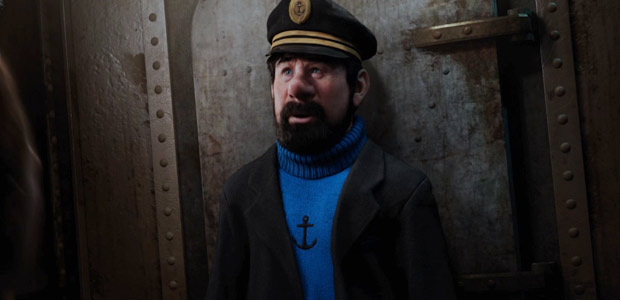
![[ANONYMOUS] – Part 1 – MM unlocked an Adventure](https://metallicman.com/wp-content/uploads/2021/08/netflix-picks-up-12-new-anime-series-projects-and-godzilla-movie7-825x510.jpg)