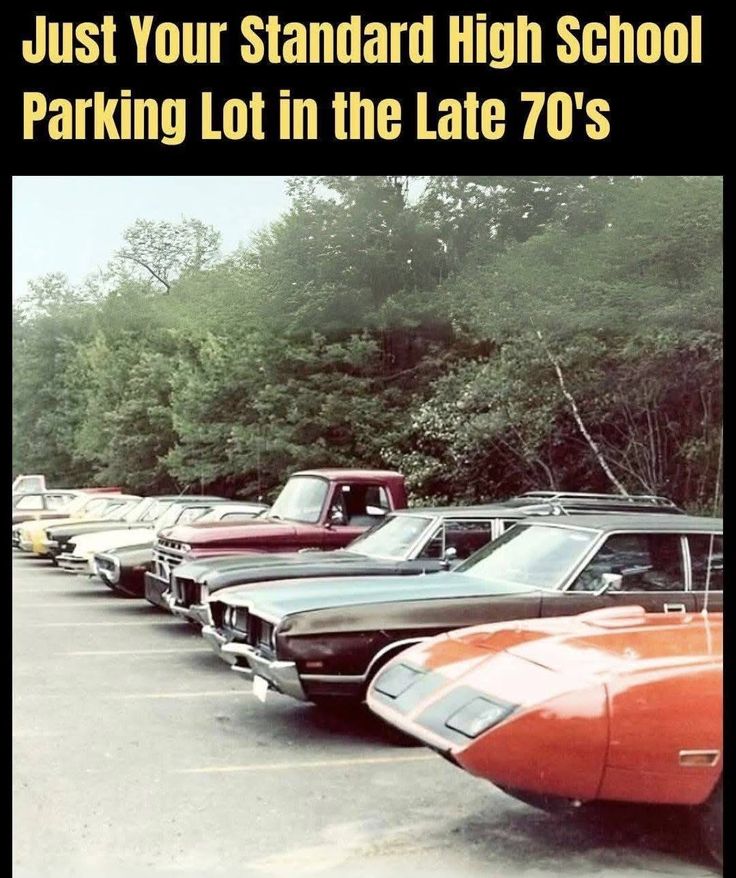
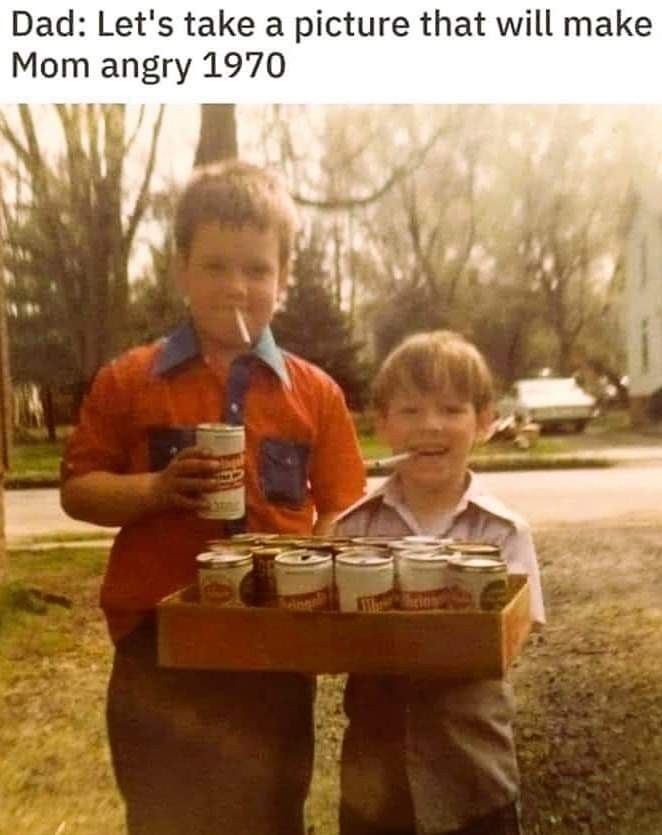
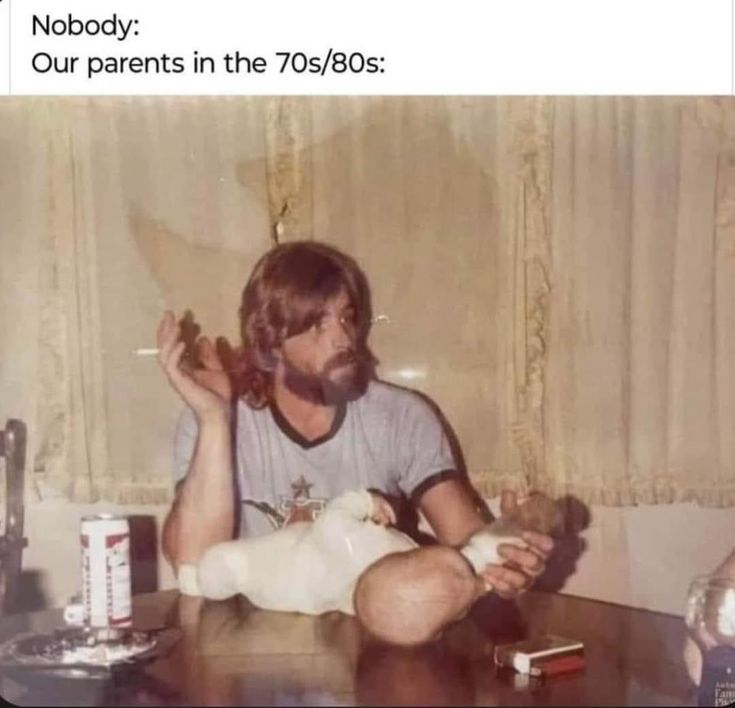
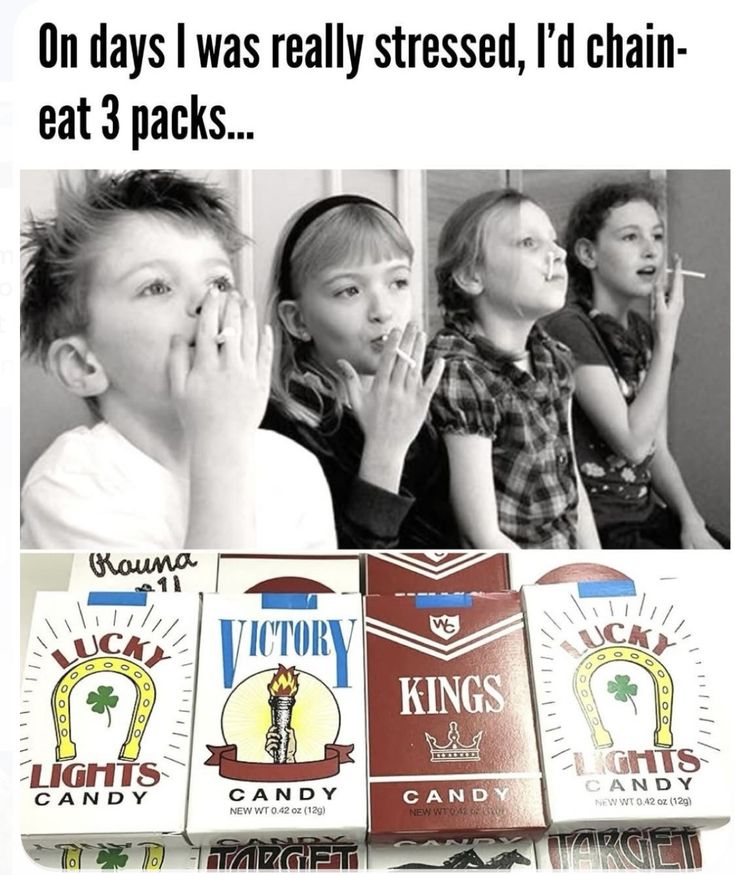
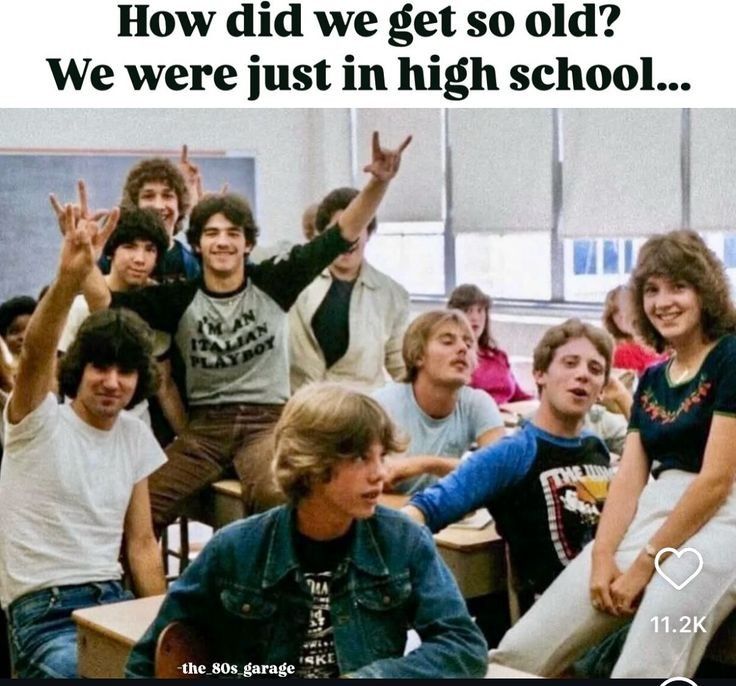
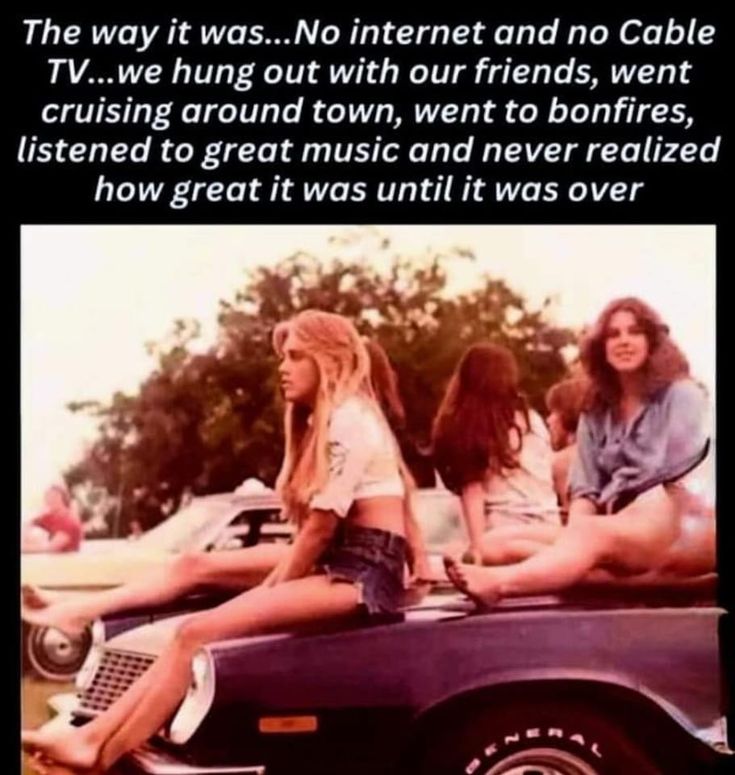
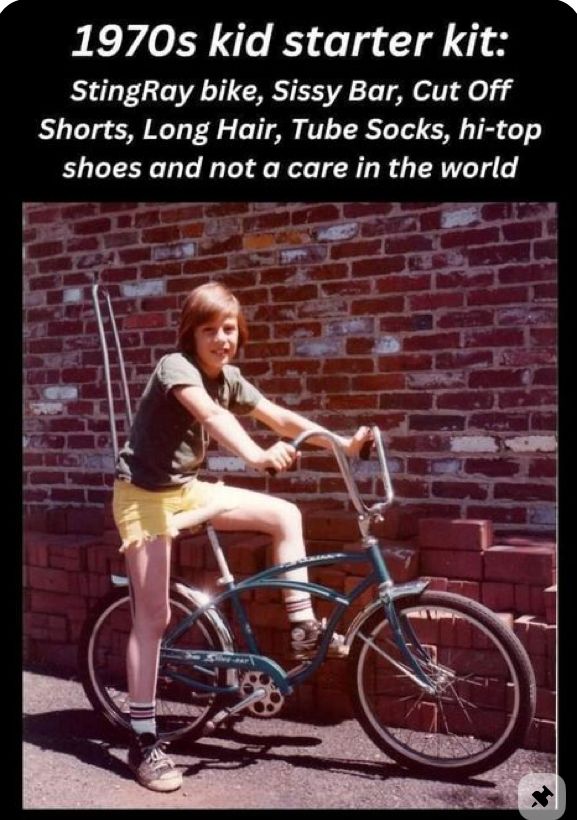
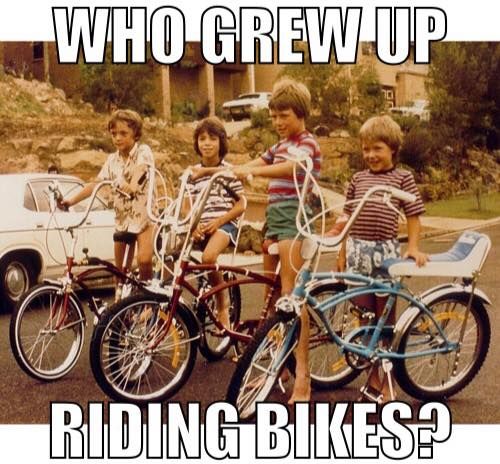
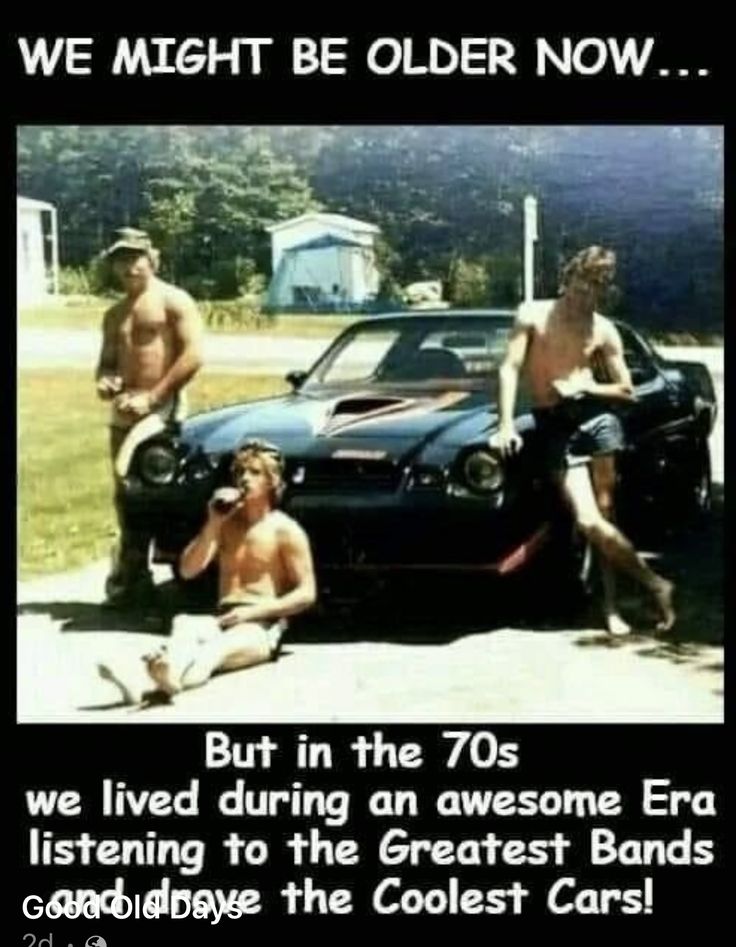
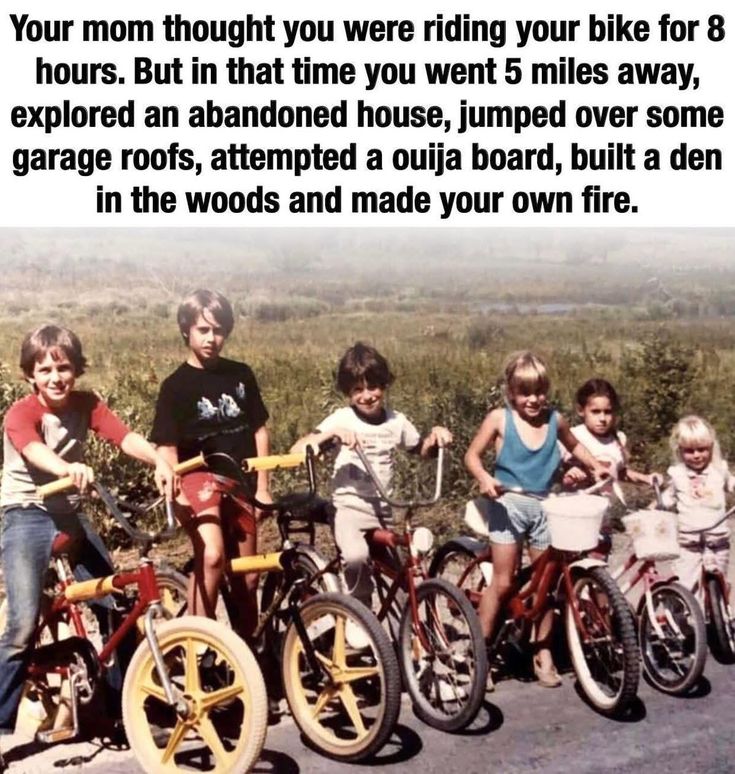
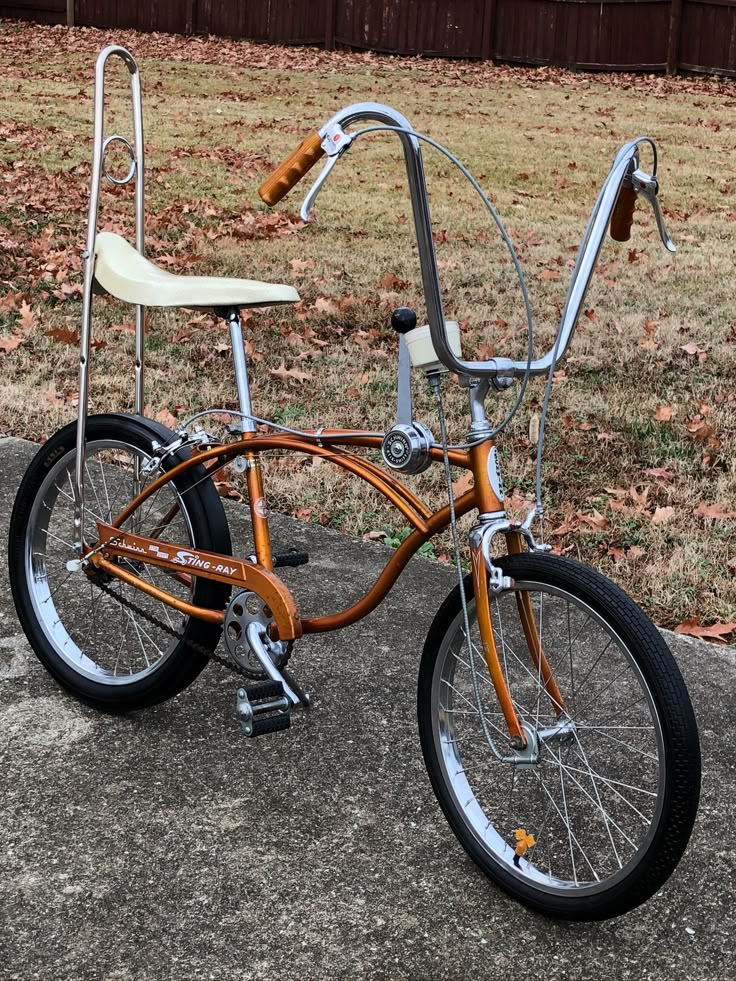
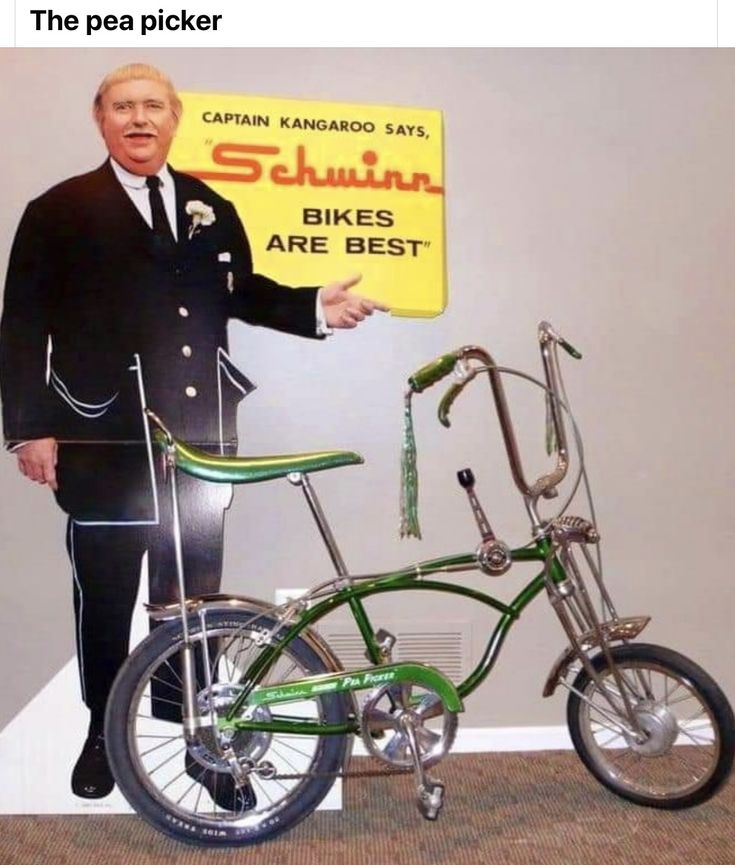
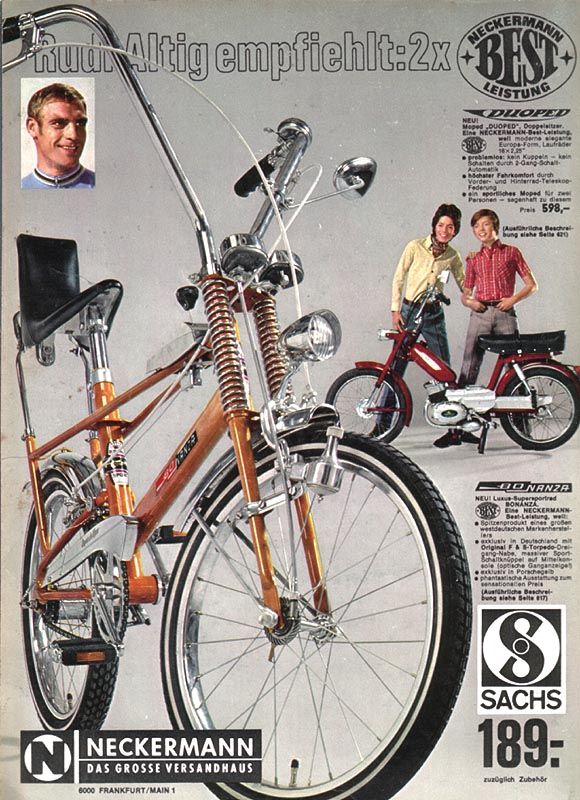
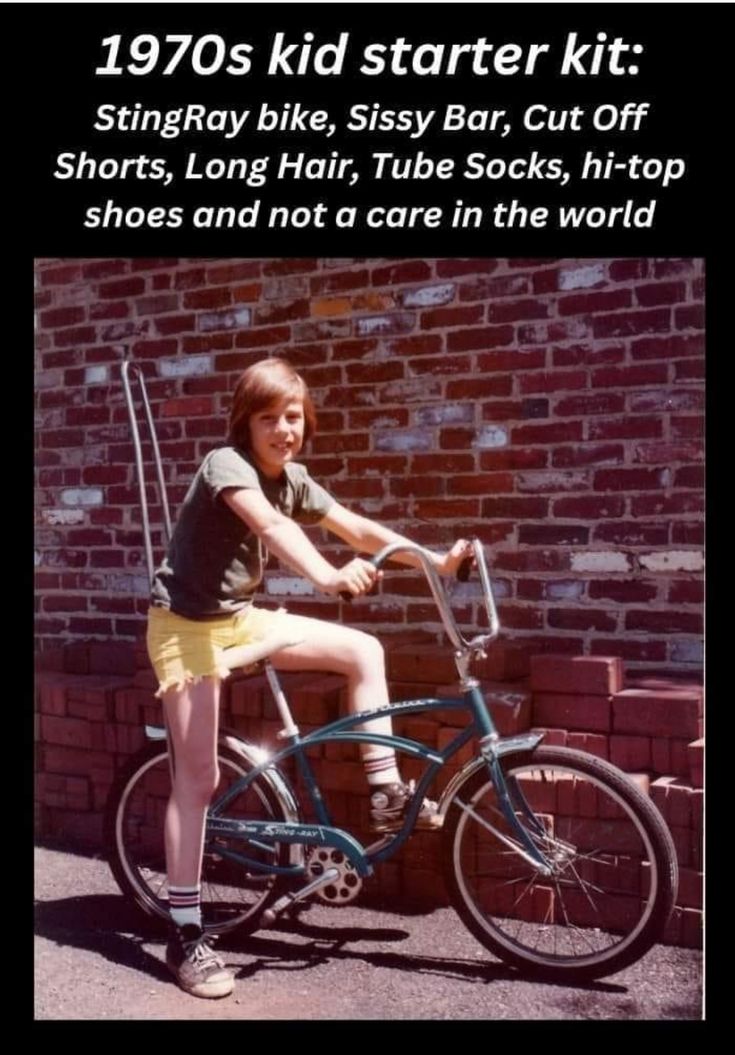
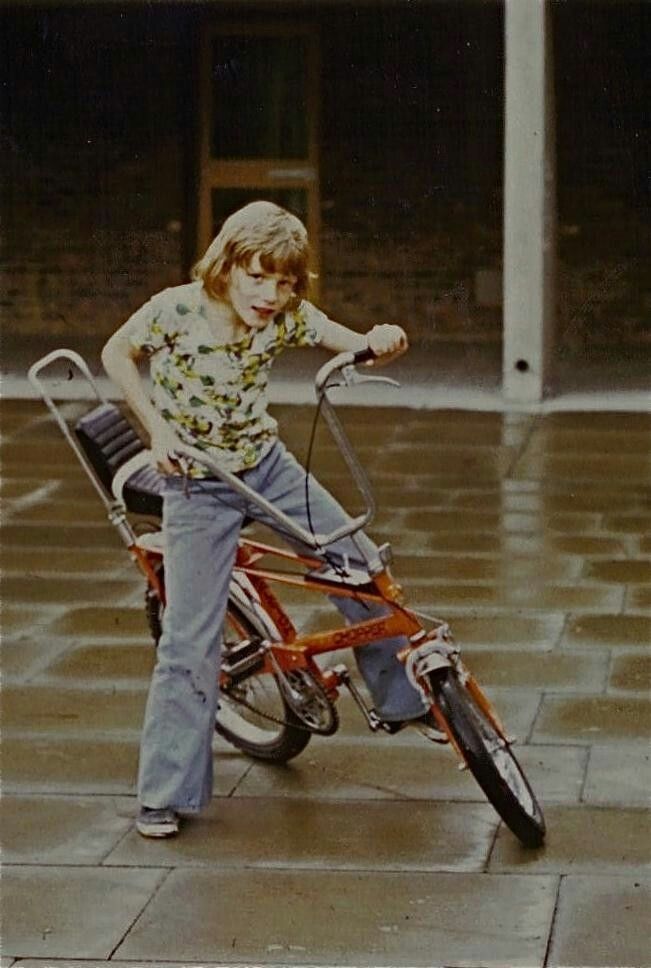
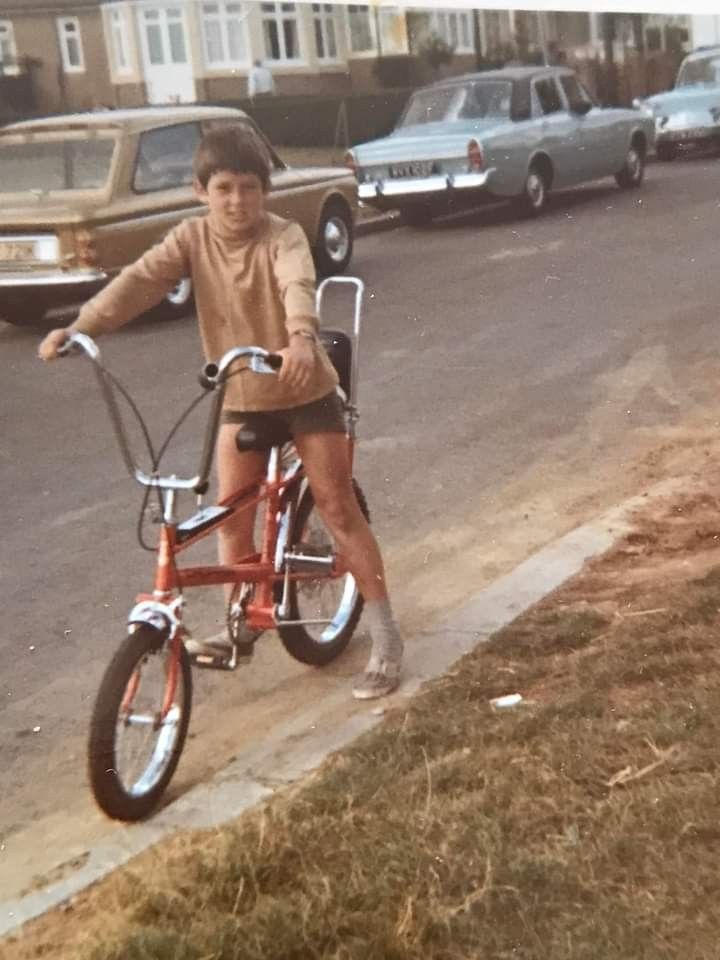
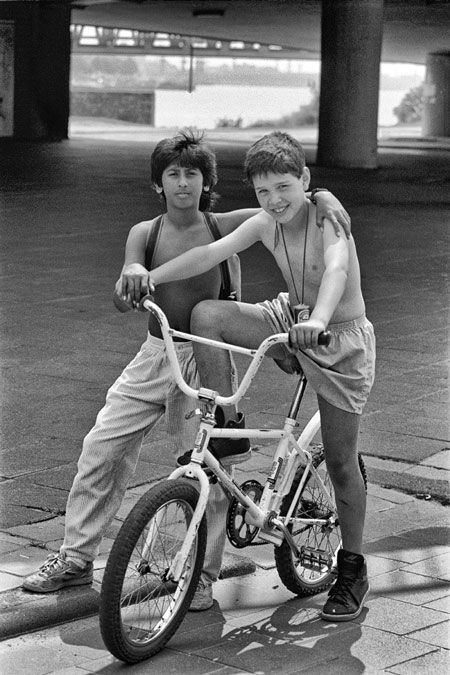
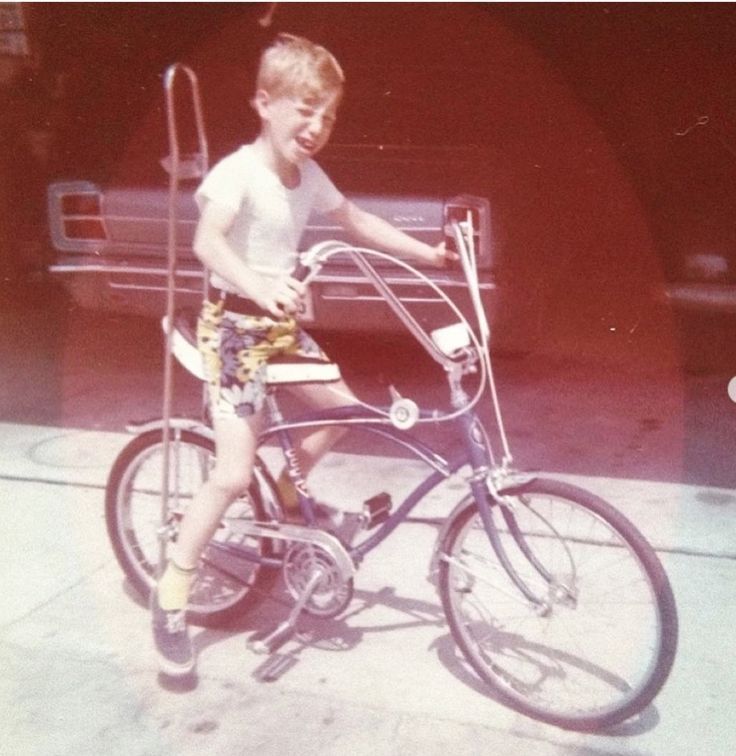
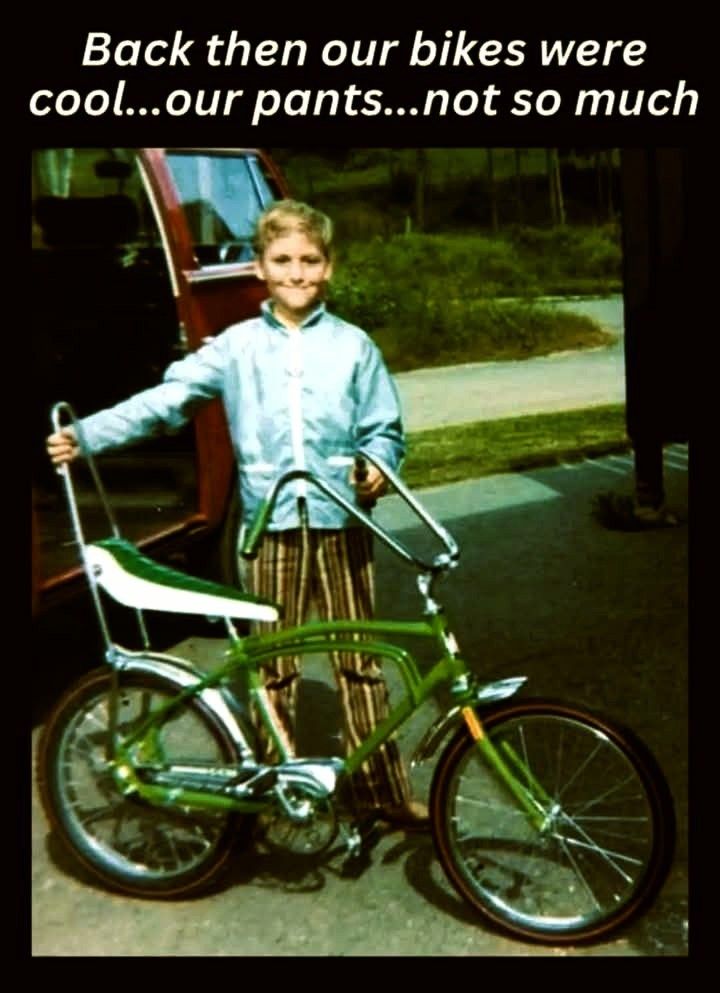
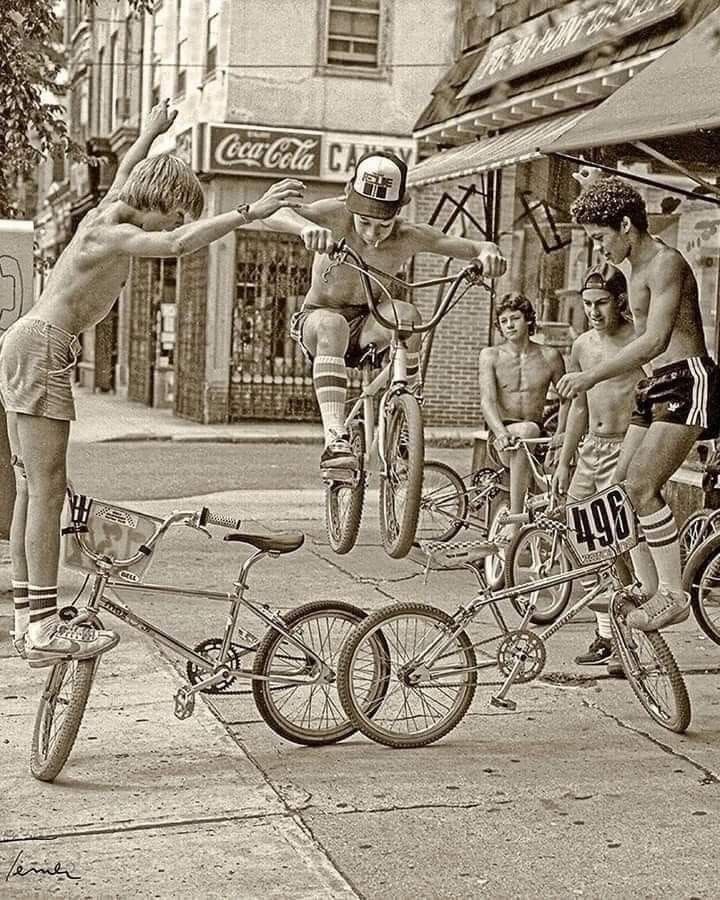
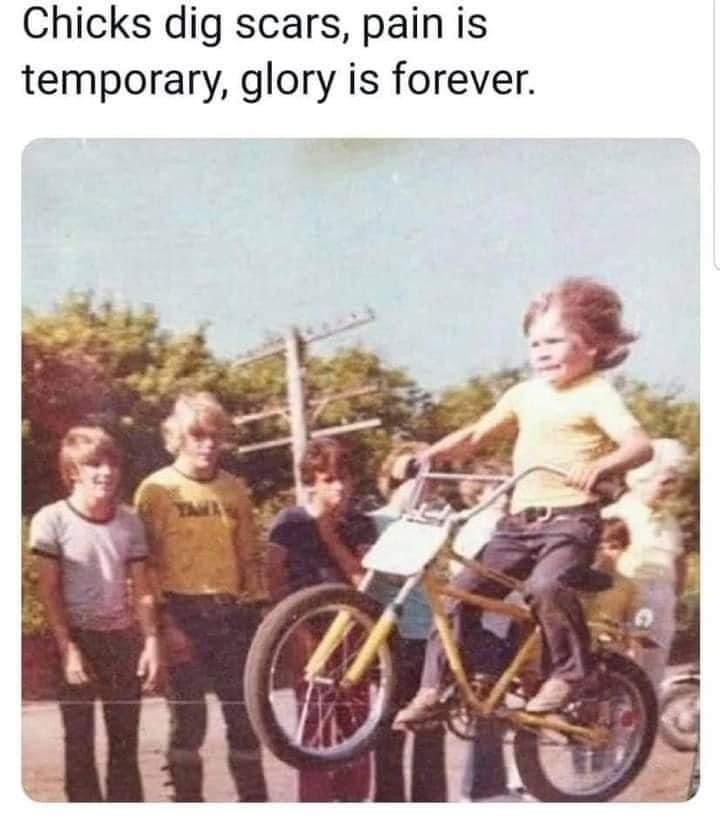
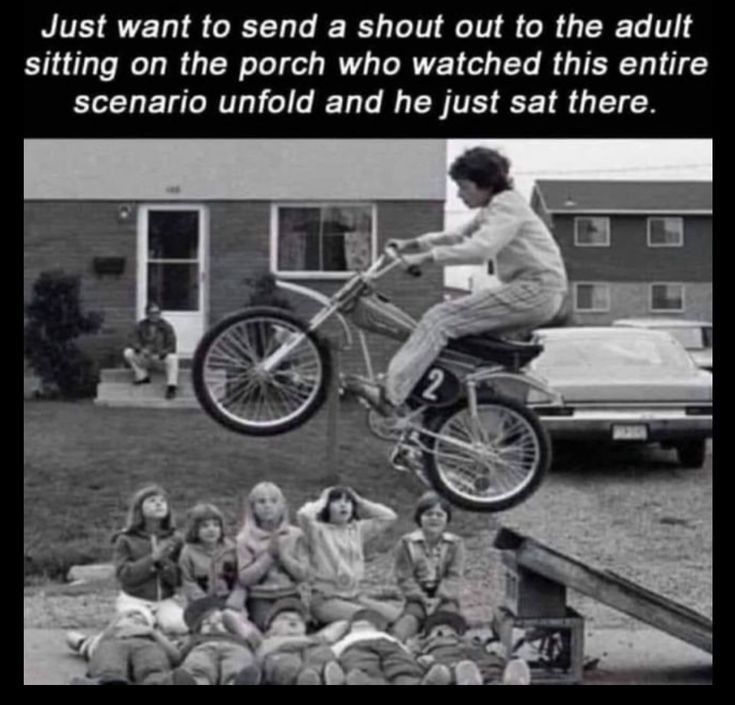
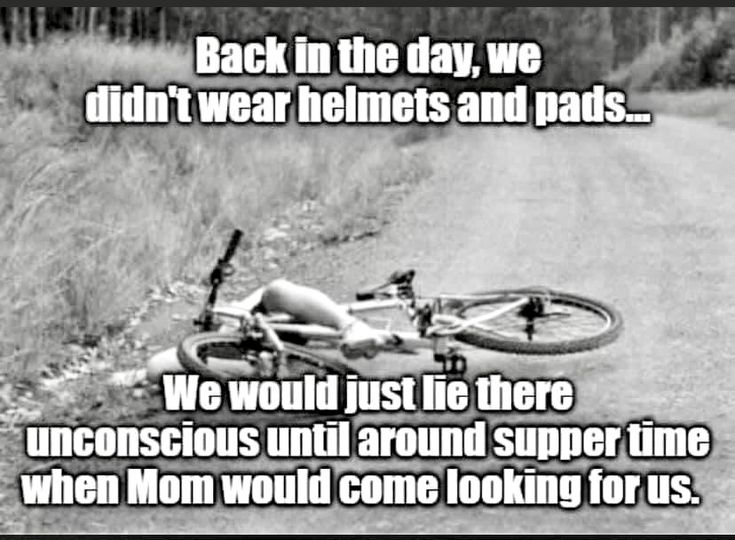
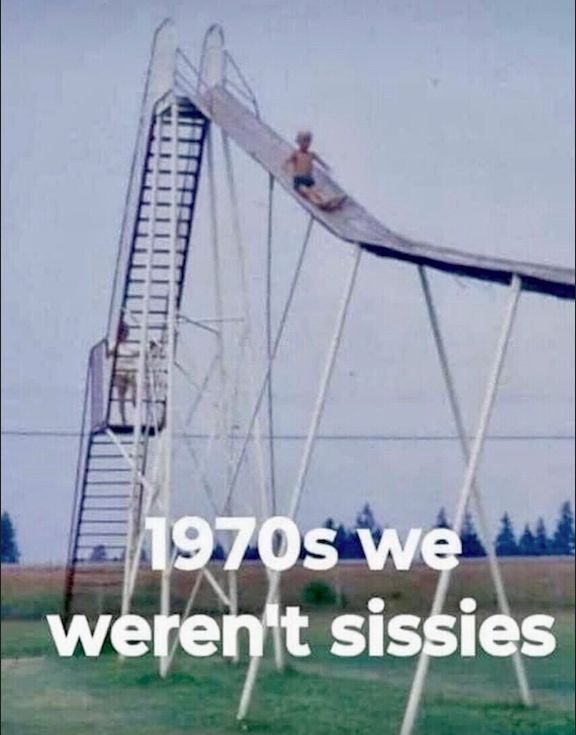
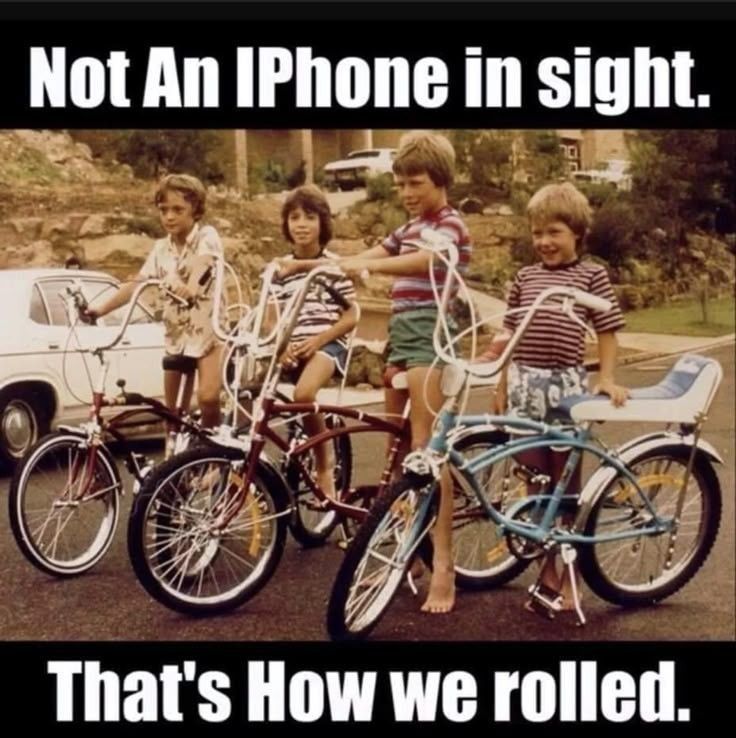
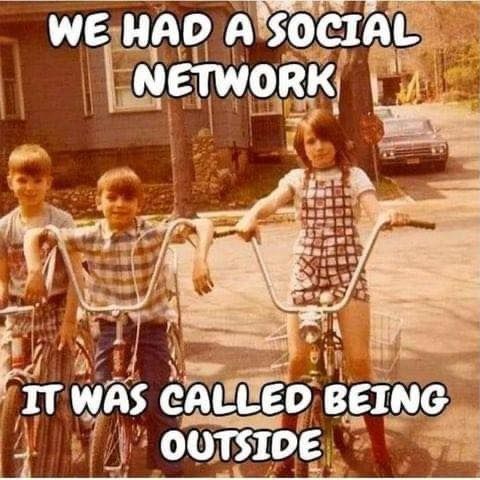
I guess that perhaps the biggest and most used toy that I had when I was growing up in the 190’s was my bicycle. man, oh man, I went everywhere on that thing. As I have described previously, it had a banana seat (white), and the bike itself was orange flake with high handlebars, and a racing style (no tread) rear tire. Which, by the way, make things twice as hard when I rode it on the dirt and muddy roads on our adventures.
I think that my experiences were typical, and nothign special. I think many of your older folk had the same experiences. From putting playing cards on the spokes with clothes pins, to having plastic streamers on the handles.
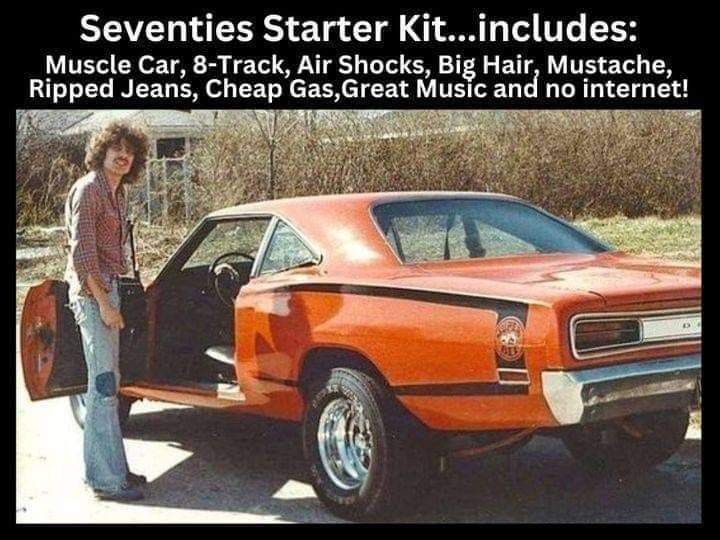
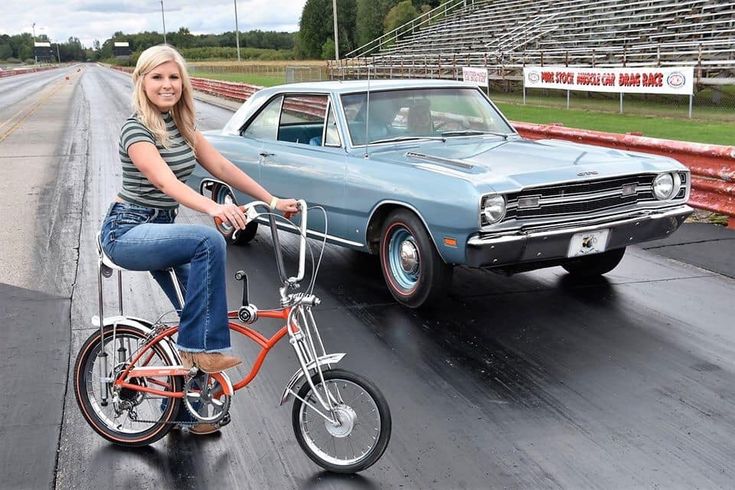
Then I got a GTO. Orange, of course and listened to Peter Framption, Yes, and Boston. Ah. Good times.
Today let’s revisit those times…
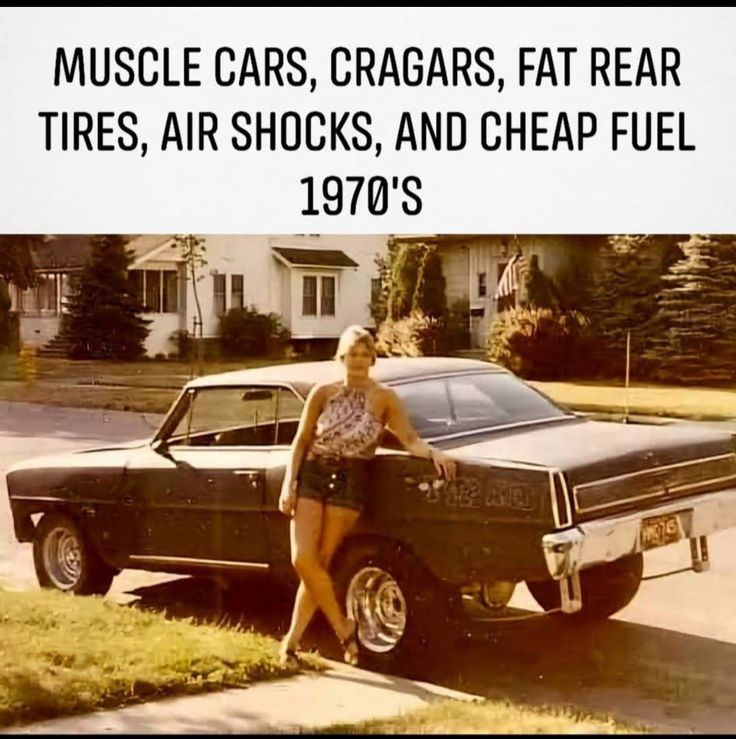






Today…
What are some common myths about supporting a family on a single income like in the 1950s and 60s, and why do people think it’s impossible today?
I’ve known over a dozen families that are able to support themselves on a single income.
And while it is not quite as easy as it was in the 1950s to do so, it can still be done relatively easy, by simply living on less.
The problem today for the vast majority of Americans, is not that they can’t live on two incomes. They can. But they don’t want to.
The standard of living in the 1950s was a fraction of what it is today.
Almost no one had air conditioning. Many did not have hot water. Hardly any had cable TV.
Houses were small. 900 to 1,100 sq ft. Today the average new house is 2,600 sq ft. No one had rec rooms. No one had finished basements. And almost no one had a garage.
Cars were cheaper, and they were cheap. You didn’t have bluetooth, or sirous radio, or even CD players, or tape players, or 8 track, you didn’t even have stereo FM. You had AM radio that picked up 3 stations if you were lucky.
There was no starbucks, no 24/7 anything, in fact many places were closed on Sunday, because it was Sunday.
But people didn’t go out to eat breakfast lunch and dinner. You didn’t get food on the go. You ate breakfast at home. You packed a lunch, like bologna on bread, and you ate that at work. Then you ate dinner at home with your family.
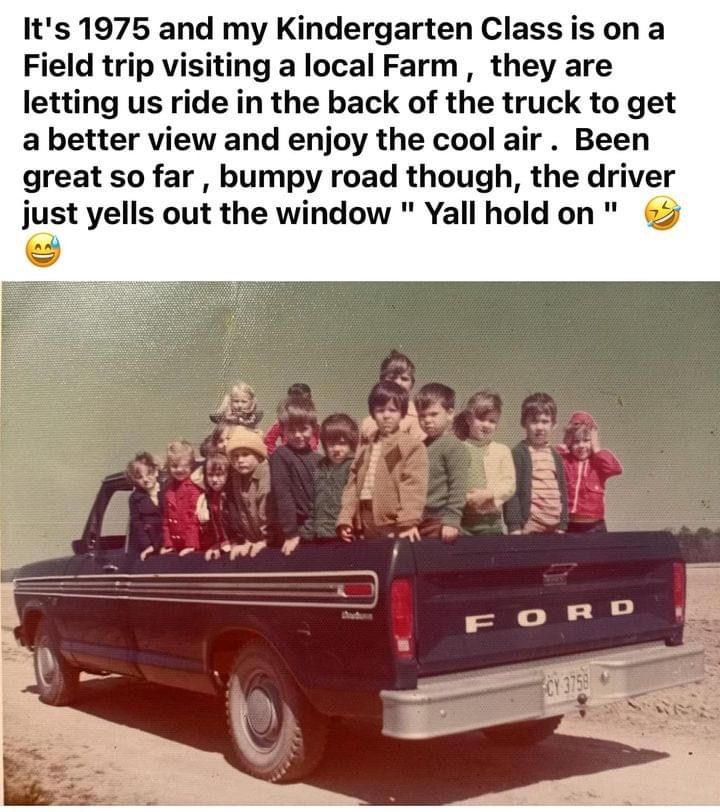
And you didn’t play in the house at all. Ever. Your parents would just push you outside, and you’d have to find things to do outdoors.
No TVs in every room. Nintendo or game consoles. No computers. No gameboy.
Think about how much electricity you didn’t use, because… there was nothing to plug in. Most rooms had one single outlet, and a light.
No cell phone bills. No Netflix. No endless subscriptions to pay.
All the bills you would never have. The cheaper house. The cheaper car. Could you afford to live on one income in that situation? Sure. Easily.
See this? $50,000 house in Columbus Ohio. 667 sqft. Built in 1930. Could you afford to live on one income in a small house like this? Sure. Absolutely. Easily in fact.
But here’s the problem. You don’t want that small house. You want a modern house, that is 5 times the size, and has a basement and a garage and a second floor, and a large lot.
And you don’t want a cheap car. You can buy a Versa or a Mirage for $18,000. You can earn that easily on a middle class income. One income. But you want a Tesla or a big SUV.
But that requires more money. You can’t have a 2025 life, on a 1950s income. You can have a 1950s life on a 1950s income.
If you want all these luxuries…. and yes, they are luxuries…. then you have to earn more.
And that makes it more and more difficult to have a living on one income.
But it is a choice. You can live on one income.
What are the main reasons people find it harder to work on their own cars these days?
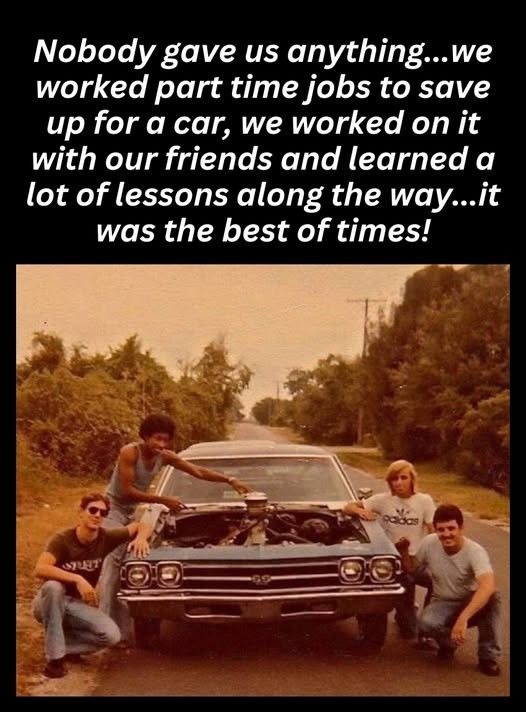
They don’t make cars like they used to.
The strive to power, efficiency, and economy has led into situation where most technology is simply not workable by an amateur any more.
’57 Chevy engine bay, with radiator removed. Simple, roomy, logical. Easy to work with. Compare to Alfa Romeo 159 engine bay.
The only thing you can do by yourself is to add windshield washer fluid and engine oil. You really cannot even change the start battery by yourself.
The 4.64 litre V8 of ’57 Chevy gives you 185 hp with fuel economy of 17.7 litres per 100 km (16 miles per gallon) if you drive economically. The 3.2 litre V6 of Alfa Romeo 159 gives you 256 hp with fuel economy of 12.0 litres per 100 km (19.6 miles per gallon).
Now you can do basically everything you want on the Classic Chevy and its engine. You can winch the engine off and overhaul it. You can dismantle it and reassemble again. But you really cannot do that with the Alfa Romeo. You have to remove if by dropping it down, off the engine bay. And then lift the car off. There is simply no way anyone who isn’t an auto professional to do any service on it.
Female Gooners Must Be Stopped
Ohhh Myyyy Gawd!
Sir Whiskerton and the Multidimensional Hay Bale: A Tale of Sentient Spaghetti, Zen Cows, and a Pig Who Became a Space-Time Buffet
Ah, dear reader, prepare for a yarn so profoundly confusing, so wonderfully unhinged, that even Bartholomew the Piñata—a sage filled entirely with candy—would need a lie-down and a philosophical debate with himself1. This is the story of Porkchop the Pig and the worst, yet most carb-filled, vacation of his life.
Our story begins, as most profound cosmic events do, near the feed trough. It was a Tuesday, a day famed on the farm for being slightly less stressful than Wednesday, and the air carried the comforting scent of sun-baked hay and fresh earth—a perfect, grounding odor before the universe decided to unspool itself2.
Porkchop the Pig was engaged in his sacred daily ritual: the pursuit of maximum caloric intake3. He wasn’t just eating; he was investigating the structural integrity of the slop bucket. Porkchop was, to put it mildly, focused.
“The Farmer has truly outdone himself,” Porkchop snorted, his snout already dusted with a fine powder of mashed potato residue. “This slop has depth. It has texture. It has… wait. What is that?”
At the edge of the field, where the grass met the forgotten wreckage of the discarded robot chickens (a grim, glittering monument to Professor Quackenstein’s ambition)4, sat a hay bale.
But not just any hay bale. This bale was an architectural enigma. It was rounder than it should be, yet somehow taller. It absorbed the sunlight, making the space around it look like a cheap special effect. If a haystack could look pretentious, this was it. It looked like a barn had tried to fold itself inside-out and was only moderately successful.
“I find it aesthetically unappealing,” declared Sir Whiskerton, emerging from the barn with the slow, deliberate pace of a cat who knew he was the only source of sanity for approximately five square miles. He wore his monocle, which did nothing for his vision but everything for his air of self-importance5.
Porkchop, however, saw only opportunity. “Sir Whiskerton, my friend, you lack vision! This is not just hay; this is the largest hay volume ever achieved in a single, perfectly compacted cylinder! It is a testament to density!”
“Nonsense,” Sir Whiskerton sighed, running a paw over his meticulously maintained whiskers6. “It’s clearly a temporal anomaly trying to hide as a snack. Pay it no mind. I’ve seen weirder things come out of the farmer’s shed7. Now, if you’ll excuse me, I must investigate why the shadows are napping in the wrong direction.”
But Porkchop was already charging. “If it’s full of hay, it’s full of potential energy! And I,” he announced to the startled crickets, “am going to eat that energy!”
He hit the hay bale like a furry, pink torpedo.
The world squished.
Act I: The TARDIS of Twisted Timothy Grass
Porkchop expected the firm, grassy resistance of dried fiber. Instead, he felt nothing but a vast, silent emptiness. He had not hit a hay bale; he had entered one.
He tumbled. The darkness was total, yet somehow illuminated by the faint, golden gleam of compressed straw. When he finally landed—not with a thud, but a muffled poof—he was standing on a floor of impeccably polished hay, which felt suspiciously like ancient, organic carpet.
“This is highly irregular,” Porkchop wheezed, shaking his head. “Where are the walls? Where is the roof? It is bigger on the inside!”
The interior was colossal, a cavernous, cathedral-like space that stretched away into an infinite horizon made entirely of tightly bound hay. Pillars of perfectly spun clover rose to a ceiling lost in the high atmosphere. It was the architectural masterpiece of a hyper-efficient beaver.
“Hello?” he yelled. “Is this a storage unit? A barn? Is this… a gigantic, dry salad bar?”
His voice didn’t just echo; it seemed to shatter into twelve distinct sonic signatures that reverberated from every direction, each with a different accent:
“Hello?” (In Pig Latin)
“Hello?” (In a snooty British accent)
“Hello?” (Like a mournful sea lion)
“Hello?” (As a high-pitched squeak)
“Hello?” (A flat, monotone robot voice)
“Hello?” (With a terrifying, guttural rumble)
“Hello?” (Like a chicken ordering a sandwich)
This was merely the beginning of the anomaly. The Multidimensional Hay Bale was not just a space-time distortion; it was a cosmic hallway connecting infinite, hay-themed realities.
Back on the farm, Sir Whiskerton was pacing near the now-silent hay bale, his tail twitching nervously.
“Hmm. An absence of sound where a pig should be. This smells of high-level nonsense.”
Just then, Bessie the Tie-Dye Cow lumbered over, her purple, paisley coat shimmering in the midday sun8. She tilted her head, gazing at the cylindrical enigma with unfocused, philosophical eyes.
“Like, what’s the deal, man?” Bessie asked, her voice a low, soothing hum. “You’re stressing the cosmic flow.”
“A farm animal has been absorbed by a seemingly innocuous agrarian object, Bessie. This is hardly a time for ‘cosmic flow’,” Sir Whiskerton retorted.
Bessie leaned in, touching the rough straw with her nose. Her eyes glazed over, as if communing with the very atoms of the object. She closed her eyes, attempting to send out a wave of peaceful, bovine energy to calm the dimensional rip.
She opened one eye.
“Like, woah, dude. It’s just hay.”
Sir Whiskerton face-pawed. “It’s never just hay, Bessie. It’s a transcendental object, capable of warping the very fabric of reality to suit its own absurd, geometric needs.”
“You’re, like, totally projecting your issues onto the bale, man. It just wants to chill.”
Act II: The Interstellar Menu of Straw
Inside the bale, Porkchop had inadvertently slipped through a dimensional seam. He found himself sliding down a chute of blue-tinted hay, landing in a landscape that was simultaneously familiar and deeply alien.
He found himself in Dimension 7: The Hay Bale of Competitive Karaoke. The air vibrated with terrible, off-key squealing. Every creature here—all pigs, strangely—was trying to sing a song called “Bohemian Rhapsody of the Barnyard” while standing on a bale that was also a rotating stage.
“Next!” squealed a small, bespectacled pig judge, who was wearing a tiny, sequined tuxedo.
Porkchop, disoriented, was shoved onto the stage. He opened his mouth to protest, and the sound that came out was a soaring, operatic tenor. He sang one flawless note of “I will survive!”
The crowd was disgusted. “Too accurate!” they cried. “Too much pitch! You need passion! You need terrible, terrible passion!”
He tumbled out of that dimension and into Dimension 12: The Hay Bale of Formal Complaints. This world was ruled by a tiny, mustachioed hamster named Mr. Grumbles, who forced everyone to fill out endless forms about why their hay was too scratchy or too yellow.
“Form 37B, Section E, Subsection 4: Why do you feel your hay lacks joie de vivre?” Mr. Grumbles shrieked.
Porkchop didn’t wait for a pen. He charged, bursting through the wall of forms (all stapled together with cosmic red tape) and found himself floating through a zero-gravity void filled only with the faint, star-like glimmer of forgotten oat flakes.
He was momentarily lost in the void, drifting between realities. He saw flashes of other hay universes:
- A dimension where the hay was solid, diamond-like gold.
- A dimension where Sir Whiskerton was the ruler, but he was wearing a tiny hat made of wet lettuce.
- A dimension where the bale was full of cucumbers—a sight that terrified Porkchop, as he still had vivid, cucumber-related nightmares from a previous adventure9.
“I just wanted a snack!” Porkchop cried, spinning hopelessly. “I should have listened to the silly cat! I should have listened to the Zen cow! I should have eaten the fence post instead!”
He tumbled one last time, landing on a surface that was soft, slippery, and smelled overwhelmingly of oregano and Parmesan.
Act III: The Reign of the Noodle Overlords
Porkchop looked around. He was no longer in a hay dimension. He was in a universe made entirely of cooked pasta.
The sky was a dome of translucent, boiled lasagna. The ground was a vast, steaming mat of fettuccine. Hills were made of coiled spaghetti, and small, volcanic mountains spewed marinara sauce instead of lava.
This was the Sentient Spaghetti Dimension.
And they were not pleased with his arrival.
From the largest coil of spaghetti, which was approximately the size of the farm’s main barn, a voice boomed—a low, gurgling sound that sounded like a million people slurping soup at once.
“A PIG. A VESSEL OF FLESH. YOU HAVE INVADED THE NOODLE REALM.”
The noodle coil began to unravel, revealing its face: a swirling, hypnotic vortex of perfectly twirled semolina strands, topped by two large, olive-like eyes. This was The Great Rigatoni, the Overlord of the Sentient Spaghetti.
“We are The Cosmic Carbs,” the Overlord declared, its voice now tasting vaguely of basil. “We have observed your dimension. Your theme, ‘Space-time is a buffet,’ is acceptable. We shall now make you the centerpiece.”
Other sentient pasta began to congregate: tiny, aggressive armies of Penne demanding immediate surrender; a phalanx of silent, stoic Lasagna sheets forming a barricade; and a troupe of musical Linguine who played a mournful, edible tune.
“We demand,” gurgled The Great Rigatoni, “that you become our High Priest of the Gravy! You shall feast for eternity, but you must first swear allegiance to the eternal slurp!”
Porkchop was terrified. Eternal feasting was tempting, but the idea of ‘swearing allegiance’ to carbohydrates felt fundamentally wrong for a farm animal. “I can’t!” he squealed. “My allegiance is to mud, slop, and my friend, the ridiculous cat! You are not mud!”
The Overlord coiled tighter. “RESISTANCE IS FUTILE! YOU ARE THE PERFECT, PORTABLE SAUCE-DELIVERY SYSTEM!”
Porkchop, panicked, let out a shriek so loud and piercing it threatened to separate the molecules of the Rigatoni’s face.
“Aaaaaaaaaaaaaaaaaahhhhhh! MUD! I WANT MUD! SAVE ME, YOU OVERLY DRAMATIC, BE-MONOCLED FELINE!”
The scream didn’t just stay in the Noodle Dimension. It punched a hole straight through the dimensional barrier, slicing across the hay dimensions it had passed through earlier, and landed squarely on the farm.
Act IV: The Echo of Pig-Scream-Panic
Back on the farm, Sir Whiskerton was still debating existentialism with the silent, opaque hay bale.
“You see, Bessie, true absurdity is not the bale’s existence, but the farmer’s unwavering belief that it’s organic,” he lectured1010.
Suddenly, a multi-layered, confusing sound erupted from the quiet barn.
It was Porkchop’s scream, but simultaneously:
- Porkchop’s scream (loud and panicked, from Dimension 1).
- Porkchop’s scream (a frantic squeal, from Dimension 2).
- Porkchop’s scream (a terrified howl, from Dimension 3).
- Porkchop’s scream (a high-pitched shriek, from Dimension 4).
- Porkchop’s scream (a muffled groan, from Dimension 5).
- Porkchop’s scream (a tinny yelp, from Dimension 6).
- Porkchop’s scream (a confused yodel, from Dimension 7).
- Porkchop’s scream (a sputtering choke, from Dimension 8).
- Porkchop’s scream (an aggressive snort, from Dimension 9).
- Porkchop’s scream (a weary sigh, from Dimension 10).
- Porkchop’s scream (a philosophical moan, from Dimension 11).
- Porkchop’s scream (the actual, real-time scream, from the Noodle Dimension).
And perfectly, with the timing of a seasoned comedian, Ditto the Kitten, who had been napping on Professor Quentin’s discarded thought-projection helmet11, lifted his head and flawlessly repeated the entire twelve-part auditory cascade.
“Aaaaaaaaaaaaaaaaaahhhhhh! MUD! I WANT MUD! SAVE ME, YOU OVERLY DRAMATIC, BE-MONOCLED FELINE!” Ditto echoed, the twelve screams bouncing off the barn walls and making Bessie flinch1212.
Sir Whiskerton’s whiskers nearly flew off his face. “Ditto! Twelve echoes at once? That’s not just echoing; that’s multiversal sonic duplication!”1313.
He looked at the bale. He looked at Ditto. He looked at Bessie, who was now attempting to levitate a dandelion.
“The pig is in acute, multi-dimensional distress,” Sir Whiskerton deduced, slipping on a pair of rubber gardening gloves—for science, of course. “The scream must have temporarily synchronized the dimensions.”
He paced three times around the bale. He needed an elegant solution, not a clumsy one. He needed a feline philosophical paradox. He needed to apply the wisdom of the farm to the foolishness of the cosmos.
He saw the farmer walking by, talking intently to his watering can. “Agnes, dear girl,” the farmer murmured to the inanimate object1414, “I told you to water the radishes, not the scarecrow! Honestly, the disobedient nature of copperware these days is a tragedy.“
Sir Whiskerton was struck by a thought. A silly, farm-based, obvious thought.
“Aha!” he exclaimed. “This bale is trying to be bigger on the inside than it is on the outside. It is defying the sacred law of the farm: What you see is what you get, unless it’s a cucumber.”
He rummaged through a nearby toolkit left by Cecil the Clumsy Dog and found a single, enormous, rusty carabiner. He then reached out, grabbed a piece of stray hay sticking out of the bale, and clipped the carabiner to it.
“When dealing with infinite geometry, one must apply finite physics,” Sir Whiskerton declared. “If the inside is infinite, and the outside is finite, connecting the two with a single, highly metallic, un-philosophical object should cause a logic error.”
And he gave the carabiner a sharp tug.
Conclusion: The Buffet Closes
Inside the Noodle Dimension, Porkchop was mid-scream, preparing to be anointed by a drizzle of Bolognese, when he felt a tug. It wasn’t a spiritual tug; it was a physical, barnyard-level pull.
The Great Rigatoni wailed: “NOOOO! YOU ARE PULLING ON THE HAY-STRING OF EXISTENCE!”
Porkchop felt himself contract. The spaghetti-lasagna world began to twist and blur. The noodle overlords turned into a delicious, orange streak.
Sproing!
Porkchop was ejected from the bale like a cork from a champagne bottle. He landed squarely in a pile of soft, honest-to-goodness mud, a place where the logic of gravity and snout-deep comfort reigned supreme.
He was covered in sticky, cooked fettuccine, a decorative cap of penne, and a single, perfectly coiled piece of sentient spaghetti that looked mildly traumatized.
The hay bale, no longer capable of holding two separate realities with a carabiner attached to it, poofed out of existence, leaving behind only a faint scent of basil and confused disappointment.
“Welcome back, Porkchop,” Sir Whiskerton purred, flicking the carabiner off the ground with a disdainful paw. “You were gone for precisely four minutes, two seconds, and twelve different versions of ‘Aaaah’.”
Porkchop shook himself, sending a shower of noodles flying onto Bessie, who caught one on her tongue.
“Woah,” Bessie said, chewing thoughtfully. “That was a very groovy noodle.”
Porkchop looked at the mud, then at the spot where the hay bale had been. He had seen the universe as an endless appetizer plate. He had met his destiny as the High Priest of Gravy.
He had learned a lesson.
“Never again,” he declared, before immediately noticing the spaghetti covering him. “Unless… the universe truly is a buffet. And since I’m still here, and this is still food…”
He began to eat the spaghetti off himself. The one piece of traumatized, sentient pasta simply sighed and gave up on its cosmic life, accepting its fate as a snack.
The farm returned to its normal level of high-grade, delightful chaos.
The End.
(Word Count: 2605)
Post-Story Summary: The Multidimensional Hay Bale
Moral: The universe is vast and chaotic, but no matter where you go, the greatest cosmic truth is that Space-time is a buffet. Also, always bring a cat detective when exploring non-Euclidean geometry.
Best Lines:
- “This is not just hay; this is the largest hay volume ever achieved in a single, perfectly compacted cylinder! It is a testament to density!”
- “He looked at the bale. He looked at Ditto. He looked at Bessie, who was now attempting to levitate a dandelion.”
- “We are The Cosmic Carbs. We shall now make you the centerpiece.”
- “I will never let a carabiner erode my vision!” – The Great Rigatoni, moments before being logically disproved.
- “If the inside is infinite, and the outside is finite, connecting the two with a single, highly metallic, un-philosophical object should cause a logic error.”
Post-Credit Scene:
The farmer, talking to his watering can Agnes1717, finds the leftover pile of cooked fettuccine. “Agnes, darling, I know you’ve been experimenting with Italian cooking again, but where did you get the oregano? And why is that one noodle crying?”
Key Jokes:
- Bessie’s Zen Cow Wisdom: Bessie tries to meditate the TARDIS-like hay bale into submission, declaring: “Like, woah, dude. It’s just hay.” 18
- Ditto’s Multi-Dimensional Echo: Porkchop screams in panic inside the Noodle Dimension, and Ditto the Kitten perfectly echoes his scream from 12 dimensions at once, creating an auditory paradox19191919.
- The Farmer’s Quirks: The farmer provides the accidental solution by demonstrating his normal behavior of talking to inanimate objects, which inspires Sir Whiskerton’s carabiner logic20202020.
- Noodle Overlords: The absurdity of a universe ruled by powerful, sentient spaghetti (The Cosmic Carbs).
Starring:
- Porkchop the Pig (豬大排 – Zhū Dàpái) as The High Priest of Gravy (Briefly).
- Sir Whiskerton (胡子爵士 – Húzi Juéshì) as The Cat Who Applied Finite Logic to Infinite Hay.
- Bessie the Tie-Dye Cow as The Zen Cow Who Just Wanted to Chill.
- Ditto the Kitten as The Loudspeaker for the Multiverse.
- The Great Rigatoni as The Cosmic Carb Who Couldn’t Handle a Carabiner.
P.S.: Remember: When faced with a cosmic threat, a simple farm tool—or a highly advanced rubber band—is often the best solution. The difference between science and farming is usually just a matter of whether or not you’re wearing rubber gloves.
Black Rice Pudding
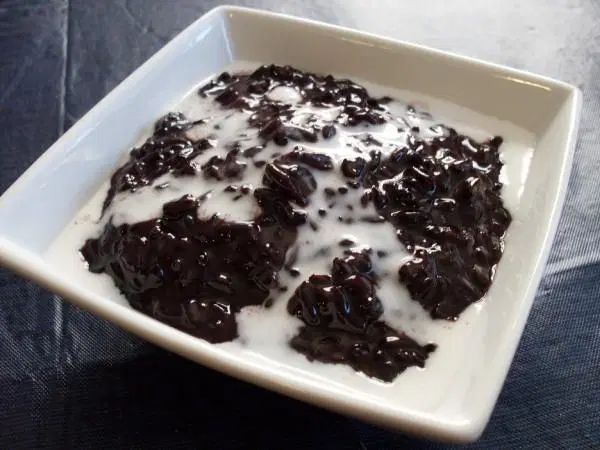
Black rice turns its cooking liquid purple, and this rich, creamy pudding will become a luscious lavender.
Yield: 12 servings
Ingredients
- 1 cup raw black rice
- 2 1/4 cups water
- 1 1/2 cups Half-and-Half
- 3/4 cup canned cream of coconut
- 1/2 teaspoon rose water or vanilla extract
- 1/4 teaspoon salt
- 1 cup whipping cream
- 1/2 cup chopped pistachio nuts
Instructions
- Place rice and water in a saucepan and bring to a boil. Reduce heat and simmer, covered, 55 minutes.
- Stir in the Half-and-Half and cream of coconut. Slowly simmer 1 hour, stirring occasionally.
- Stir in rose water or vanilla extract and salt. Chill completely.
- Serve topped with whipped cream and pistachio nuts as garnish.
Trump PANICS as Walmart WALKS OUT of U.S. Over Tariffs – Food Crisis ERUPTS | HeatherCoxRichardson
The Bell
Written in response to: “Center your story around someone who has (or is given) the ability to time travel.“
Jaxen Dreamerman
A click of a briefcase latch, rustle of paper. Scrape of a chair. “I’ll file the motion tomorrow,” he says to the back of my head. “Try to have a little faith, son.” Heavy clang of the door, shooting of the bolt, fading footsteps down the concrete hall.
Faith. The only thing belonging to me has nothing to do with men like him, not in motions or rulings. I close my eyes. A different kind of faith, as persistent as the water stain on the ceiling.
I lie for hours as the prison settles into its iron skin. Calls and coughs from other cells. Rhythmic clank of the night guard making his rounds, like a tick of a clock I stopped following years ago.
A quiet shuffle of soft-soled shoes comes later, mixed with a rustle of a robe. A faint ting of a bell. The floor feels hard against my knees. I lower my head. The door closes. The bolts click.
“Bless me, Father, for I have sinned.”
A scrape of a chair once again, pulled away from the wall. I keep my head bowed.
“Arthur.”
I raise my gaze to a stranger. A young man with an old man’s eyes. Priest’s collar. A wooden cross and a tiny bell. “Where’s Father Michael?”
“Your lawyer seems hopeful.”
He ignores my question. Not a mistake. A choice. I study him. A stillness, an unnerving patience in those old eyes. I blink.
“He’s selling something I’m not buying.”
“And what is that?”
“Tomorrow,” I say. “And the day after that.”
The priest nods, his gaze on mine. “You’ve been praying for an absolution, Arthur. For a way to make it right. Not with the state. With God.”
Again the memory, sharper this time. The weight and taste of the one word in my mouth just before I say it. In. I press my eyelids shut.
“There is no making it right,” I whisper. “There’s only living with the wrong.”
He leans forward, hands clasped. “God can offer you an absolution, not a pardon.” His voice has no echo like all the other sounds in this place.
“How?”
“A day of grace, bought with every day you have left. You will feel the warmth of the sun, and you will feel the chill as it is taken away forever.”
He leans back in his chair. “But you need to pray for the man you were supposed to be. Not for you.” He holds my gaze. Eyes like magnets pulling on metal.
I take two breaths. I nod and lower my head.
“Pray with me, son. Pray that man had said ‘no’.”
I pray. The bell tings at his neck.
***
“…not even listening to me! Arthur, you promised you’d sell the car. We need the money!” The sharp voice tears through the silence.
I snap my eyes open, gawk around. Haze, no ceiling, no bars, nor river delta of rust. A floral wallpaper, faded yellow, and a woman standing with her hands on her hips. Eleanor. My Eleanor. My breath catches. Vision blurs again.
A fly buzzes before my face. My fly? No. The dull, constant ache in my lower back from the prison cot is gone. I raise a hand to my face. Smooth skin. No lines or gray stubble. My fingers sink into thick hair. A sharp chill runs across my scalp, like the barber’s razor in prison.
“The doctor’s office called again,” she says. I focus my gaze on her. “The bill, Arthur. And you spending our last five dollars on beer with my brother…”
Lilacs. Her perfume. A scent lost to time makes the small kitchen tilt on its axis. I push myself up from a wooden chair, my legs steady and strong. I look at her, at the fierce, beautiful anger in her face, the swell of her stomach beneath her apron. My son.
The wallpaper behind her flickers, changing into a sweating concrete. Familiar water stain. Clang of a cell door. I reach for a glass of water on the counter. My hands shake.
“…and now this, finding out you lost the warehouse job two weeks ago and never said a word! My father was right about you. You’re not a husband who can provide.”
Those words. A throb travels through my whole body, but the anger isn’t with me. The shame is gone. Eleven years of stored-up love, the crushing weight of regret. I step toward her, my hands raised in surrender.
“Ellie,” I say. An alien’s voice, a young man’s tenor. I cough. “I’m sorry. None of it matters. Just… none of it.”
She recoils, her eyes widen. “None of it matters? The rent doesn’t matter? The baby doesn’t matter?”
“No, that’s not what I…” I reach for her, for the curve of her belly, to touch him just once, feel his movement, just once. My hand shakes. She flinches back, pulling away from my touch as if it were a snake.
“What is wrong with you? First you’re yelling, now this? What kind of trick is this, Arthur?” The air leaves my lungs in a rush, as if I’ve been punched. She protects her belly.
“Please, Ellie… I’ll stay. I won’t go out. I’ll stay here with you. We’ll fix it.” I take off my jacket and drop it on the chair. A choir of bells starts to ting inside my head the moment the jacket hits its back. I raise my hands to block the sound. No use. It grows louder. A rhythm. A voice. The priest.
Eleanor stares at me. Anger turns into fear, and her arms tighten over her stomach, protecting our son from her strange, unpredictable husband.
I pick the jacket back up, and the ting fades. “I have to go,” I say. “Going to see about a job. On the docks.” The lie tastes like tar in my mouth. I walk out the door, closing it gently behind me, and take the stairs down two at a time.
My dented blue Ford waits at the curb. The most expensive thing in my life. The key slides into the ignition. The engine turns on, settling into a low growl. I put it in gear, place my hands on the wheel. No shakes. I pull away from the curb.
The garage door is half-open, a dark mouth yawning into the afternoon. I kill the engine. Heavy silence follows, broken only by a steady ting… ting… ting from within. I get out of the car. Smell of gasoline. Taste of old oil on my tongue.
I duck under the door. Inside, shadows cling to everything. A single bare bulb flickers, casting a dirty yellow light on a half-disassembled engine block. Eleanor’s brother emerges, wiping his hands on an already-black rag. He smiles, gaze lit with desperate energy.
“Art, there you are, and you brought the car. Good. I was about to call the house.” He claps me on the shoulder, pulling me deeper inside. In the far corner, another man I remember slams a wrench down on a metal table. Sound of a cell door. My teeth grind together as I grimace.
“It’s on, Art. Tonight. It’s perfect. A textile mill payroll delivery. The driver’s a drunk, the route’s always the same. We’re not hurting anybody, just taking from a guy who’s been skimming off the top for years. It’s practically justice.”
He’s pacing from the workbench to the door, a tight, three-step rhythm of anxiety. I watch him, and I see it all—the whole rotten future spooling out from this one greasy room.
“Listen,” he says, stopping right in front of me, grabbing my arm. “Think about it. Think about Ellie. The look on her face when you come home with a stack of bills. Enough to pay the doctor, to buy a real crib, to shut the old man’s mouth for good. This is for her, Art. So you can be the husband she needs.”
Every word builds the wall of my cell. Every breath adds a year to my sentence. They place a gun on the table. A ting, as it touches the scraped surface. Sweating grip of the wooden handle. I open my clenched fist. Empty.
“No.”
He blinks and pulls back. “What? What do you mean, ‘no’?”
“I mean no.” The word feels light. “Don’t you see? This money… it’s finality. It’ll weigh you down until you can’t breathe. It’ll stain everything it touches… Ellie, the baby, everything. It’s not an answer. It’s an ending. For their sake… walk away. Please. This road only goes one place.”
His face twists. “You’re backing out? Now? You coward. I’m trying to help you provide for my sister, and you’re getting cold feet?” He shoves me. I fall against a workbench. “You’re letting her down, you son of a bitch. You’re letting us all down.”
I hold his gaze. “I’m not letting her down by saying no to this.” I turn to leave. Ice shoots up my spine. I keep my steps calm. Every muscle in my back tightens, waiting for a shout or a blow. I duck under the garage door and step back into the sunlight. I get back in the car. The key slides into the ignition. The engine turns over. I raise my hands to the wheel. No shake.
As I pull away from the curb, the faint ting of the bell returns, growing clearer, melodic, bright.
***
The ting fades. A whisper. “Grandpa… Grandpa, wake up.”
I open my eyes, not to the preternatural clarity of the world outside my car, but to a hazy morning light filtering through lace curtains. A warm and soft bed. A small, joyful weight on my chest.
“You promised, Grandpa! The Cyclone! You promised!” a little girl’s voice chirps. Another child, a boy, scrambles beside her. “And the cotton candy!”
Grandpa, name like an unfit coat. I glance around, back to their faces again, bright and expectant. There is no memory of love in my heart, but it still aches. I sit up. My joints protest with the stiff language of old age.
“All right, all right, you little monsters,” I say, the words coming from a throat feeling raspy and unfamiliar. “Let an old man find his teeth.” They giggle and tumble off the bed. I swing my legs over the side and stand. My muscles are weak, the body a stranger to me.
In the bathroom, I brace myself against the sink, raising my gaze to meet the image in the mirror. Not the face of a man on a death row. Not the face of the desperate young man, but the face of a man with a life I never lived. Deep laugh lines etched around kind blue eyes, like a map of the river delta of rust and time. A crown of snow-white hair.
Downstairs, the kitchen is a pond of sunlit chaos. A man who must be in his forties flips a pancake at the stove. A son. A woman I don’t know pours orange juice for the kids. A daughter. Eleanor stands by the coffee pot. Her hair is silver, her face is lined like mine. Our eyes meet. Her smile, the key unlocking the weight I’ve been carrying for eleven years. It’s gone.
Smell of bacon. Sound of laughter. The sight of her, alive and old and beautiful. A lump in my throat. I walk over to my son, the baby I never held, the man I never raised. I put my arms around him, and a sob tears its way out of my chest, a dry, rattling sound of unendurable gratitude.
He stiffens. Pats my back. “Whoa, Dad. You okay?”
The whole room goes quiet. Eleanor comes over. My body remembers her touch; my mind does not. “It’s just the excitement,” she says. “His heart. Let’s all just have a nice, calm breakfast.” She smiles and hands me a warm mug. The heat seeps into my palms. I take a sip, and the taste—rich, dark, and real, not the grey, watery sap from the prison mess—is so powerful I almost choke.
A plate is set before me. I take a bite of the pancake my son made. Butter, sweet syrup, the slight char from the pan—simple and perfect flavors. The taste of a meal made in a home I never built, with a family I never had.
At the amusement park, I am a phantom observing my own heaven. My son wins a stuffed bear for his daughter. Teaches his own son how to throw a ball. My granddaughter shoves a cloud of pink cotton candy into my mouth, its sweetness melts on my tongue, a flavor from a world I had forced myself to forget.
I ride the Ferris wheel with Eleanor. At the very top, she rests her head on my shoulder. The first time in a lifetime of first times. The noise of the crowd below. A joyous roar of happiness. I swallow my tears.
My borrowed body is frail. I have to sit on a bench while the younger ones ride the coaster one last time. I am with them, but I am separate, a tourist in my own promised land.
The drive home is quiet. Night has fallen. My son is driving, my daughter beside him. The grandkids are asleep in the third row, smiles on their faces. I sit in the backseat with Eleanor, her soft, wrinkled hand in mine. I trace the wedding ring I don’t remember giving her.
“You were quiet today,” she says.
“Just taking it all in.” The truest thing I have ever said.
A single, pure ting. A chill.
The priest’s voice, echoless inside my own head.
I look at Eleanor, at her profile in the passing glow of the streetlights. I lean closer. “Ellie. I have to go now.”
She turns to me and smiles, her gaze holds a lifetime I never knew. She pats my hand. “Go to sleep, my love,” she says. “We’re almost home.”
I squeeze her hand. My eyes close, and the last thing I feel is the warmth of her skin.
The end.
When Lost in Space Almost Brought the Robinsons Back Home
Why were only about 2 million Mongols able to rule nearly 100 million Han Chinese and Han Manchus? The Yuan Dynasty was a period of significant Chinese population with a total population estimated to be around 87.6 million by 1351.
The Western world values bloodline, while China values cultural identity.
The difference from the West is that the definition of the Chinese nation depends on cultural identity rather than bloodline. Any descendant of the Han whose cultural identity is not Han will no longer be considered Han.
Both ancestry and culture are crucial to defining an ethnic group; neither can be considered without the other. For example, even though 90% of the Manchu people have Han ancestry, they are not considered Han. The situation of the Mongolians is similar.
However…
1. The Mongols were nomadic-Han people, while the “Golden Family (Genghis Khan’s family)” had Emperor Gaozu of Han, Liu Bang’s bloodline, and Liu Bang was the founder of the Han Dynasty.
Chunwei ( Chinese : 淳維 ; Old Chinese : ZS : * djun-ɢʷi ; B-S : * [d]u[r]-ɢʷij ) is a name associated with the Xiongnu , a tribal confederation of nomadic peoples who, according to ancient Chinese sources , inhabited the eastern Eurasian Steppe from the 3rd century BC to the late 1st century AD. In Sima Qian 's Shiji , the Xiongnu were mentioned as Shanrong , Xianyun , and Hunyu "since before the time of Tang [i.e. Emperor Yao ] and Yu [i.e. Emperor Shun ]". [ 1 ] 3rd century scholar Wei Zhao also identified the name Chunwei with the name of the Xiongnu: "During the Han (206 BC – 220 AD) they were called Xiongnu, and the Hunyu is just another name for the same people, and similarly, the Xunyu is just another transcription of Chunwei, their ancestor’s name". [ 2 ] [ 3 ] [ 4 ] In Shiji jijie (Collected Explanations on Historical Records) Liu Song historian Pei Yin quoted Jin Zhuo 's statement that "In Yao's time they were called Hunyu; in Zhou 's time they were called Xianyun; in Qin 's time they were called Xiongnu." [ 5 ] In Shiji Suoyin "Seeking the Obscure in the Records ", Tang historian Sima Zhen quoted from Fengsu Tongyi "Comprehensive Meaning of Customs and Mores", by Ying Shao , that "In the time of Yin , they were called Xunyu , which was changed to Xiongnu" ; [ 6 ] however, this quote no longer exists in Fengsu Tongyi's received text. [ 7 ] Sima Qian wrote that the Xiongnu's ruling clan were descendants of Chunwei, a descendant of Yu the Great . [ 1 ] Chunwei is alleged to be a son of Jie of Xia (the Xia dynasty 's last ruler). Sima Zhen stated that Yue Chan wrote in the now-lost Guadipu (Register of the Encompassing Lands) that: "Jie, (ruler of) the House of Xia lived an immoral life. Tang exiled him to Mingtiao, he died there three years later. His son Xunyu married his concubines and they wandered far away to the northern wilderness in search of pasture lands, and then in the Middle Kingdom they were mentioned as Xiongnu." [ 8 ] Sima Zhen also quoted Zhang Yan's statement that "Chunwei, during the Yin era , fled to the northern borders." [ 9 ] However, Goldin (2011) points out chronological difficulties resulting from attempts to identify Chunwei with Hunyu and Xunyu. [ a ] If one would literally interpret "since before the time of Tang and Yu" (when the Hunyu had supposedly existed) [ b ] in Sima Qian's Shiji and would identify Chunwei with Hunyu and Xunyu , this would result in Chunwei, allegedly a son of Jie of the Xia dynasty , living before instead of many generations after Yao and Shun, both of whom had lived and ruled before the Xia dynasty. Moreover, Goldin (2011) reconstructs the Old Chinese pronunciations of Hunyu and Xunyu as * xur-luk , as hram′-lun′ , and as * xoŋ-NA ; and comments all three names are "manifestly unrelated"; he further states that sound changes made the names more superficially similar than they really had been, and prompted later historians and commentators to conclude that those names must have referred
The first person to propose that Genghis Khan was a descendant of Liu Bang was a German anthropologist.
German anthropologists recovered genetic samples from Genghis Khan’s ancestors, the Qiyan nobles (Qiyad nobles), from their tombs discovered in Mongolia. Subsequently, German testing of the genetic samples from Genghis Khan’s ancestors revealed the presence of the Haplogroup O-F155 gene in three of the five excavated Qiyan noble (Qiyad nobles) remains.
Si ce bandeau n'est plus pertinent, retirez-le. Cliquez ici pour en savoir plus. La mise en forme de cet article est à améliorer ( août 2024 ). La mise en forme du texte ne suit pas les recommandations de Wikipédia : il faut le « wikifier ». Comment faire ? Les points d'amélioration suivants sont les cas les plus fréquents. Le détail des points à revoir est peut-être précisé sur la page de discussion . Les titres sont pré-formatés par le logiciel . Ils ne sont ni en capitales, ni en gras. Le texte ne doit pas être écrit en capitales (les noms de famille non plus), ni en gras, ni en italique, ni en « petit »… Le gras n'est utilisé que pour surligner le titre de l'article dans l'introduction, une seule fois. L' italique est rarement utilisé : mots en langue étrangère, titres d'œuvres, noms de bateaux, etc. Les citations ne sont pas en italique mais en corps de texte normal. Elles sont entourées par des guillemets français : « et ». Les listes à puces sont à éviter, des paragraphes rédigés étant largement préférés. Les tableaux sont à réserver à la présentation de données structurées (résultats, etc. ). Les appels de note de bas de page (petits chiffres en exposant, introduits par l'outil « Source ») sont à placer entre la fin de phrase et le point final [comme ça] . Les liens internes (vers d'autres articles de Wikipédia) sont à choisir avec parcimonie. Créez des liens vers des articles approfondissant le sujet. Les termes génériques sans rapport avec le sujet sont à éviter, ainsi que les répétitions de liens vers un même terme. Les liens externes sont à placer uniquement dans une section « Liens externes », à la fin de l'article. Ces liens sont à choisir avec parcimonie suivant les règles définies . Si un lien sert de source à l'article, son insertion dans le texte est à faire par les notes de bas de page . La présentation des références doit suivre les conventions bibliographiques . Il est recommandé d'utiliser les modèles {{Ouvrage}} , {{Chapitre}} , {{Article}} , {{Lien web}} et/ou {{Bibliographie}} . Le mode d'édition visuel peut mettre en forme automatiquement les références. Insérer une infobox (cadre d'informations à droite) n'est pas obligatoire pour parachever la mise en page. Pour une aide détaillée, merci de consulter Aide:Wikification . Si vous pensez que ces points ont été résolus, vous pouvez retirer ce bandeau et améliorer la mise en forme d'un autre article . La maison Qiyat ( Kazakh : Қият/Qyiat, Karakalpak : Қыят/Qıyat, Ouzbek : Қиёт/Qiyot, Mongol : Хиад/Khiad, Russe : Кият/Kiyat) est une dynastie princière d'origine mongole , issue des Qiyat Niroune (Nirun), dirigeante de l'État mongol depuis le début du XII e siècle , elle accède de facto sur le Khanat Tatar en 1204 puis de manière officielle en 1229 avec l'élection d' Ögedeï comme Khagan , elle y règne jusqu'au début du XX e siècle . La dynastie Qiyat est la dynastie qui a le plus influencé les peuples d'Eurasie depuis les conquêtes mongoles [ 1 ] . Principalement basés dans l
Chinese anthropologists, analyzing remains from the Han Dynasty Liu imperial family tombs discovered in China, identified the Haplogroup O-F155 gene on the Y chromosome of Liu Bang’s family. In other words, Haplogroup O-F155 gene is the genetic marker of Liu bang’s family.
Liu Bang was 1,418 years older than Genghis Khan.
Haplogroup O-F155 is linked to the Han Chinese Haplogroup O-Page23 has been found in several populations of the Han Chinese ethnic group. The ancestors of the Han, called the Huaxia, lived in the upriver basin of the Yellow River 5,000-6,000 years ago. As agricultural technology improved, the Huaxia spread east and south, and became the Han Chinese. Over the last 2,000 years, there have been three major migrations of the Han southward. The first of these migrations occurred during the Jin Dynasty from 317 to 420 CE, when nearly one million people moved south. A second migration occurred during the Tang Dynasty, after the An-Shi Rebellion, between 755 and 762 CE. The last migration occurred during the Southern Song Dynasty, from 1127 to 1297 CE, when nearly 5 million people migrated southward. The Pinghua, a branch of Han in which haplogroup O2a2b1a1 is particularly common, may be descendants of indigenous minority groups that adopted Han culture during one such major migration event. References
2. It was the Han army led by Guo Kan that unified China.
Chinese general Guo Kan ( Chinese : 郭侃 ; pinyin : Guō Kǎn , 1217–1277 AD) was a Chinese general who served the Mongol Empire in their conquest of China and the West. He descended from a lineage of Chinese generals. Both his father and grandfather served under Genghis Khan , while his forefather Guo Ziyi was a famous general of the Chinese Tang dynasty . [ 1 ] Guo Kan became the first governor of Baghdad during Mongol rule and was instrumental in devising the strategy for the siege of Baghdad (1258) . He served as a Mongol commander and was in charge of Chinese artillery units under the Yuan dynasty . He was one of the Han Chinese legions that served the Mongol Empire, and some of the later conquests of the Mongols were done by armies under his command. The biography of this Han commander in the History of Yuan said that Guo Kan's presence struck so much fear in his foes that they called him the "Divine Man". Guo Kan was raised in the household of Prime Minister Shi Tianzhe (who was also a Han , and whose father and two brothers all served the Yuan dynasty ). He took part in the final drive in the conquest of the Jin dynasty , including the capture of Kaifeng . He then helped Subutai conquer West Eurasia, Europe, and the Middle East and was appointed governor of Baghdad by Hulagu. At some point after Kublai Khan 's accession as Khan, Guo Kan assisted Kublai Khan in the conquest of the Southern Song and ultimately the reunification of China under the Yuan dynasty . [ 2 ] Middle East and Europe [ edit ] He served Subutai in the conquest of Europe a few years following the fall of the Jin dynasty. He then served in Hulagu 's conquest of the Middle East, playing a major role in the capture and battle of Baghdad , devising the strategy of using the dikes to drown the Caliph 's army, and supervising the reduction of Baghdad 's walls. [ 3 ] He was then appointed the first Ilkhanate Governor of Baghdad by Hulagu, making him the first, and only Chinese governor of an Arab city. [ 4 ] According to the History of Yuan , he was present in the siege of Maymun-Diz during Hulegu's campaign against the Nizaris . Guo Kan attacked the inaccessible fortress by "catapults on mounts" ( jiapao ). [ 5 ] Guo Kan took part in the final drive in the conquest of the Jin dynasty , including the capture of Kaifeng . He then helped Subutai conquer West Eurasia, Europe, and the Middle East and was appointed governor of Baghdad by Hulagu. At some point after Khubilai Khan 's accession as Khan, Guo Kan assisted Khubilai Khan in the conquest of the Southern Song and ultimately the unification of China under the Yuan dynasty . [ 2 ] By this point the Mongol Yuan empire was nearly fully complete, stretching from China across Central Asia, Siberia, and the Middle East to Europe. After Guo Kan returned to China with Hulagu Khan following Möngke Khan 's death, Guo Kan helped Kublai Khan in the difficult conquest of Southern Song dynasty of Southern China. Khubilai 's accession as becom
Gia Huy & Thùy Vân’s song “Thiết Huyết Đan Tâm” is a theme song from the Hong Kong TV series “The Legend of the Condor Heroes.” The song is actually a tribute to Guo Kan.
the Hong Kong TV series “The Legend of the Condor Heroes.” The male protagonist of the TV series, Guo Jing, is based on the prototype of Guo Kan.
Contrary to popular belief, the nomadic peoples of northern China are the result of Han nomadicization.
North of that damned Gobi Desert, where snow falls as soon as September ends and even Iron sewing needles, commonplace in the south, become heirlooms—don’t think this is some distant memory. This was the situation in Inner Mongolia, China, in the early 20th century. If you go a little further north, you’ll find that the Eskimos still use needles made from seal bones to sew their clothes.
Do you think such harsh climatic conditions could have contributed to the birth of ancient humans? Even if ancient humans were born there, they would not be able to survive without contact with the Central Plains.
They didn’t have an iron industry, so where did their weapons of war come from? In fact, it was Han Chinese who migrated there and formed the nomadic peoples.
If we distinguish them by bloodline, they are actually all Han Chinese, and both the Yuan and Qing dynasties inherited Han culture, so they are regarded as Chinese dynasties.
It’s just that the Mongols and Manchus developed their own new culture and are generally regarded as another ethnic group.
Why do Russians have so many patterned rugs in their houses?
Our love for Oriental rugs came about in the Soviet era as a fusion of three factors:
- A quick fix for home interiors in a society where the quality of construction was inconsistent, at best, while the market for DIY refurbishment was non-existent. They also absorbed some of the noise that permeated through thin separating walls in our residential shoebox houses.
- The Persian-Turkic roots of popular Russian tastes. Same as tapochki (heelless slip-ons) worn at home, sequined clothes, preference for gold in interiors, heavy make-up on women, large colorful shawls as the preferred accessory during winter, etc.
- Tradition of decorating aristocratic homes in Moscow and St Petersburg with expensive German tapestries that came with Peter the Great’s Westernization. Carpets were expensive for average Soviet budgets and were long viewed as objects for investment designated for public display.
Look at the photo below. This kind of interior would be considered pure luxury between the 1920s and 1960s. Not so much because of the furniture but because the bed at the far wall indicates that a single person or a couple without kids inhabited that room. This was almost science fiction for most in the era when average families had to share a room between themselves and the rest of the apartment with a few other families.
The quality and size of the carpets also indicate this is the abode of someone from the middle class. Yet, in the 1970s and 1980s, many picky families would opt for more distinctly foreign-looking items (such as a whitish color palette or floor-to-ceiling IKEA-like frames).
Pictures












Have you ever been to a restaurant that made you say “you have got to be kidding me!” when they brought out the food?
Two times. Two different “Shoeless Joe’s steakhouses”. Same chain. Different locations.
Both times, the restaurants were quite empty.
Both times, unattentive staff made us wait very-unnecesdarily long times.
In both cases, i asked for medium-rare.
In both cases, they were at least well done.
At least!
Ironically. The only reason i would at all have tried their chain a second time…
… the first experience in Mississauga was so crap i emailed head office. They sent me a $50 voucher… to apologize, and invite me to try again.
So there I am, Shoeless Joe’s in Barrie. Likeable decor and ambience. Quiet… because its empty.
My medium-rare steak comes.
(They do not know i have a voucher or dined in Mississauga a month earlier, then complained… i didn’t tell Barrie Shoeless Joe’s on purpose).
My steak is “you gotta be kidding me”… ludicrously overcooked. Not a little. A lot.
One piece, a couple of square inches at the skinnier end has broken off and looks like blackened jerky.
It was stunning.
I asked the waiter “dude!! C’mon… by any stretch of the imagination would you call this medium-rare??”.
He hummed and hawed and agreed “the cook said it is”.
I said… “you find me a person willing to point at this and call it medium-rare.”
(I COULDN’T BELIEVE IT WAS WORSE THAN MY FIRST TIME IN THE OTHER LOCATION).
The manager came and at first tried to defend the char on the plate. But he could see it was indefensible.
He offered to have another made. But from a cook with such a negligent attitude?
I said … “no thanks. I’m just gonna leave. Keep your steak. Here’s a $50 voucher from your head office, i have no use for it, i wouldn’t even give it away”.
And leave i did. Never to return.
(A representative picture of a charred steak, mine was drier, thinner, and worse. It was in the days of flip phones and blackberries, so I didn’t take pictures)
Time Perverts
Written in response to: “Center your story around someone who has (or is given) the ability to time travel.“
Robert Egan
Perhaps my life is a spacetime prank, some Shadowlord’s idea of a joke, but like the Peabody ducks, it’s become something more in the meantime.
All I know is I’m nothing without Shelly.
I’ve learned to do what feels natural over the years, and it feels natural to call Paul Jr.
I subvocalize his name to pair my embedded Xfon with his. My ear tingles twice before he answers up in Chicago.
<Hey bud, how’s the love life?>
19 going on 20, he’s fixated on his current college girlfriend, though I give it a 0% chance of working out. After some prodding, he mentions the wildly impractical romantic gesture he has planned.
<I know you got your chest tattoo with mom there, but I want to surprise her. What you think?>
Oh God, the chest tattoo. I bite my tongue, fighting against every fiber of my fatherly being.
<Dad?>
<What do I always say?>
<There’s nothing like a self-made man?>
<No, the other thing I always say.>
<Go big or go home.>
<Damn right.>
We talk for a while longer, but I’m not that worried about him to be honest. He’ll figure it out along the way.
<Talk to you later son.> I lie and leave it at that.
I consider calling my daughter Michelle, but I’m worried about choking up and freaking her out. Plus, she’s at summer camp and probably doesn’t want to talk to her dear old dad. 9 going on 10, she came later in life. That’s my main regret, not getting to see her grow up—well, that and Shelly not being by my side. She’s supposed to be here when it happens.
The ducks have probably settled in their rooftop palace by now, so I head up there. I take the stairs all the way to the top. I’m barely out of breath and my heart feels more or less fine. Ridiculous.
Before walking out onto the open roof, I make a quick stop at the bathroom. Not to pee, but for the paper towels. Emblazoned with the Peabody logo and a line of ducks, they feel like fine linen. I slip a few into my pocket. Not that I’ll need them but still… they’re damn fine paper towels.
No one else is on the roof except for some gangly tourist taking pictures of a city past its prime. The Peabody still stands tall—I’ve seen to that—but the rest of Memphis sags under the summer heat.
And all these years later, pieces of Xcalibur are still strewn along the banks of the Mississippi like some hastily discarded exoskeleton.
Take me back to the 2027 Memphis skyline, booming and bustling in the midst of nationwide stagflation thanks to one man: Ely Kuck, the mad mogul who turned the Bass Pro Shops Pyramid into his own personal fortress.
Everyone called it the Kuckhold behind his back but kowtowed to him in person. How could you not? He was promising 80,000 jobs to piece together Xcalibur, humanity’s space engine.
Those were the days when we’d just become aware of the Shadowlords fiddling with the fringes of our solar system.
We didn’t know who they were or what they wanted—still don’t—but there was really only one response to the possible existential crisis: Build a phallic monstrosity to rip through the cosmic folds and show the Shadowlords who was boss.
And Kuck was the man to do it.
Rumors of Shadowlords among us abounded. I’m not sure about back then, but it’s true in this day and age.
Skip ahead to 2054 some months from now. Grieving and loveless, I will be young again, but I won’t appreciate it. Instead, I’ll be riding the late night Red Line up to Edgewater in the middle of a Windy City winter.
Dealing with the death of my own father and a bad breakup, my current plan will be to get off at Edgewater then walk out onto the ice lining Lake Michigan’s shore.
I’ll never get there. The only other person in my L train car will be a man wearing a trench coat and humming as he drifts toward me.
When he opens that coat, there’ll be nothing there except for what I can only describe as soft sepia crystals. It’ll be too late to turn back, the hum will become a roar, and then…
Bam! Back to 2027 Memphis, courtesy of what must’ve been a Shadowlord.
I wasn’t lost, since I knew Memphis, but this version of it looked bigger and busier though I couldn’t put my finger on the differences just yet. Maybe I’d died or finally lost it, so there was only one thing to do. I went to Beale Street and found a bar that didn’t card me.
The bartender stared at the $50 bill I handed him for a long moment, but he pocketed it all the same. By my second beer, I noticed people were giving me strange looks. I was still wearing my winter jacket, and it was the middle of summer here. While peeling off my layers, I popped the top few buttons of my shirt and unknowingly exposed my shame.
“Hey, that’s my wife’s name.” A bearded man smiled and staggered into me.
“What?”
“Kimberly.” He pointed at the fresh tattoo across my chest.
“Oh yeah, what a bitch.”
The man’s grin vanished. There wasn’t time to tell him that I meant another Kimberly from 2054, the one who’d scoffed at her name across my chest then refused to go to my father’s funeral. There wasn’t time because he’d already punched me in my nose.
I flailed back but someone lifted me from behind. I found myself out on my ass back on Beale Street.
“He called myyy wiiife a bitch!”
I didn’t stick around to see whether the man’s drawn out vowels would rile up a mob.
A red light brought direction to my aimless running. It was The Peabody sign shining high.
My nose wouldn’t stop bleeding and I knew their top floor bathroom had really nice paper towels. I hid my ruined face with my ripped shirt as if I were stifling a prolonged sneeze and no one in the lobby stopped me.
That damn fine Peabody paper towel was like a balm to my bloody nose. I plastered my face with more, then walked out onto the rooftop in hopes of a soothing breeze.
Someone cleared their throat over by the Royal Duck Palace, a marble and glass structure overlaid with a country home facade.
Peering from around one of its corners was this silver-studded goddess—seriously, back then Shelly had enough piercings to set off every metal detector in the tri-state area. Man, how she gleamed against the Memphis skyline.
Traveling back to 2027, dying in 2054, being born along the way, my life is a closed constellation of guiding stars, and this moment is the brightest of them.
My greatest fear is that I’ll change something along the way, and this first meeting will never happen.
But it did, and it will again.
“You here to see the ducks?” she asked.
“For the paper towels.”
“Okay weirdo.”
She seemed so worldly that I thought she must be at least 25. I didn’t know what else to say, so I espoused my love of ducks while still trying to staunch my nose.
“Everyone pays attention to them in the fountain, but barely anyone visits them in their palace,” she said.
“Do you think they get lonely, the ducks?”
“I don’t know, but people do.”
As we drew closer, I noticed, to my relief, that the miraculous Peabody towels had soaked up all my Beale Street blood.
And God almighty, that first kiss was like riding a rollercoaster through a cinnamon haze.
We spent the night up there with the ducks.
And Shelly was right there beside me when I buried Kimberly’s name in a landslide of ink.
She wouldn’t give me any suggestions for a new tattoo. She just said go big or go home, so I got a giant duck across my chest.
It should have dawned on me then, but it didn’t.
Back in 2054, I’ve got incoming on my Xfon. It’s Shelly.
<Change of plans. I booked us a room at Graceland!>
<You’re kidding, right?>
<No, let’s try something new this year.>
Graceland? I don’t want to choke on a peanut butter and banana sandwich. I don’t want to faceplant on one of Elvis’s fancy antique cars. I don’t want to die in Graceland. That’s not how it’s supposed to happen.
<I’m staying right here with the ducks in their palace. I don’t know if they get lonely, but people do.>
<Come to Graceland if you love me.>
<I’ll buy Graceland for you if you come visit the duck palace first.>
<Please? Listen, something bad will happen if you don’t leave there right now. Don’t ask me how I know.>
“Right, I’m going to die, but how do you know?” I blurt it out instead of subvocalizing and the picture-snapping tourist glances in my direction.
<Fine Paul, be a dick. If you don’t leave right now, you’ll never see me again.>
<Wait, I—>
She kills the connection. She doesn’t answer when I call back, so I set my Xfon to ping her every minute until she blocks my frequency.
So… if I leave this spot, I may never meet her for the first time. And if I don’t leave this spot, I’ll apparently never see her again. Stupid Shadowlords.
Wait, does she know? A cold stab of fear shoots through me despite the sun still blasting the bricks. Impossible, she can’t know. I decide to stay put. I have faith she won’t abandon me.
I wouldn’t be here without her. She’s the guiding light of my constellation, and back in 2027, she was the one who introduced me to Kuck.
We had a nice townhouse right on Turley Street thanks to Shelly’s connections. She was a sort of executive whisperer. CEOs from all around would visit her, lay out their future plans (after a non-disclosure of course), then pick her brain. She called herself an intuitionist, and they loved that.
When Kuck heard about her, he put her on retainer. He was often at the Turley Street house and offered me a job on the Xcalibur project after one of his intuition sessions. When there was a problem with my social security number registering as nonexistent, he got me a new one. And, for the next 7 years, he owned me.
Meanwhile I was growing increasingly paranoid about running into my father, or, worse, running him over while driving.
I knew he’d lived in Memphis around this time and even worked for Kuck as well. Would bumping into him knock me out of existence? Believing in alternate timelines helped me stay sane.
Those were some of the worst and the happiest years of my life with Kuck grinding me down with his halitotic mismanagement then Shelly building me back up with her cinnamon haze.
Then, in 2034, we welcomed a new addition to the family: Paul Jr.
One night, while I was staring at his tiny toes, I almost dropped him. The two middle toes of his left foot were slightly webbed with a patch of skin between them. I’d noticed it before of course, but…
I took off my sock and checked my own left foot.
Yeah…
“There’s nothing like a self-made man.” My dad would always say that like it was some kind of joke. The bastard, he knew.
As for Shelly, my mother and wife, I couldn’t bring myself to leave her, but I grew distant.
The Xcalibur project was grossly overbudget and behind schedule, and I convinced myself that I could fix it. The Kuckhold Pyramid became my second home as Shelly spent long nights alone with our colicky baby.
She cajoled and coaxed me, but mostly, she just seemed puzzled, and it broke my heart.
This went on for months until it finally clicked: I was denying myself the greatest love I’d ever known and risking my existence out of some sense of chronological prudishness.
I have Kuck to thank for that.
“How’s my #1 Kuck boy?” He startled me at my desk in the wee hours of the morning. “And how’s that frisky wife of yours?” he said without giving me time to respond. “Listen, I’ve got a proposition for you…”
“Yes?” I grit my teeth, caught in between a husband’s possessiveness and a son’s defensiveness.
“Next time I see Shelly, she needs to give me a definite yes or no on Xcalibur. No intuition. Just a measure of success.”
“Don’t bother. I can tell you that Xcalibur is going to fail in the next 5 years tops.”
“So… you’re saying I should fire you?”
“I’ve got a proposition for you. I’m going to cut something out of my head and give it to you.”
“Metaphorically?”
“No, I need a knife.”
“Oh, this should be interesting.”
Together we found a penknife, then he took a big step back as I went to work on my ear. When I was finished, I had the Xfon from 2054 in my hand.
“This is going to replace smartphones, and you’re going to make it happen.”
Kuck’s eyes widened at the Xfon’s intricate circuitry then glazed over as he did some quick mental calculations.
“Yes, of course, how’d you get that prototype from my lab? It’s called an Xhear. Give it to me and leave now, and I won’t press charges.”
“No, it’s called an Xfon. X, lowercase f, o, n. Don’t Kuck it up.”
After that, I put every last penny into X stock and every last ounce of effort into making things up to Shelly.
I went from hating my father to becoming him to learning to love him again.
I took control of my life because I was a self-made man.
Now, all I have left to do is die, one more point along the constellation that will send Paul Jr. off along a series of bad decisions turned good in 2027 Memphis.
I just wish I could see Shelly on the Peabody rooftop one last time.
“You here to see the ducks?” She walks towards me like a dream.
“Nope, just the paper towels.”
Instead of smiling, she starts sobbing.
“Baby, what’s wrong?”
“H-heart attack. You have it if you stay here, stupid!”
Her words leave me weak in the knees. When she beats her fists against me, I fall on my ass.
“No no no, I didn’t mean to. Oh God, it’s happening!” Kneeling down beside me, she rips open my shirt and starts pumping my chest.
“Stop. It’s not a heart attack. Not yet.”
“How do you know?” I don’t know who says it first, but Shelly already has her explanation ready.
“Paul… I am Michelle.”
“Yeah, I know. Shelly, it’s short for Michelle.”
“No, I’m Michelle. Our daughter.”
She recoils at the initial look of horror in my eyes, but she doesn’t look away.
“Let me guess. Shadowlord?”
“Hey! Don’t treat me like I’m crazy. You have no idea—”
“No, I believe you. It’s just… well, I have something to tell you too.”
Then it’s her turn. We panic, but we do it together.
“Shelly?”
“Yes?”
“I don’t know how much time I have left, but I want you to know… I wouldn’t change a damn thing. Don’t you see? We were made for each other.”
And I’m lost once more in her cinnamon haze until I notice there’s someone standing over us.
It’s the picture-happy tourist. Perhaps, with my duck chest tattoo exposed, he thinks I’m part of the Peabody experience.
That’s when I see he’s wearing a trench coat. I hear the hum.
Shelly and I get to our feet.
The Shadowlord opens his coat to expose the soft sepia crystals within.
“I think this one’s my turn,” I say.
“What will I tell the kids, I mean, us?”
“Heart attack, you already know.”
“How will I find you?”
“Today by the duck palace, no matter the year!”
I have to shout as the Shadowlord’s hum becomes a roar, but I think she hears me.
Either way, there’s no turning back.
Can a country really grow rich and green at the same time?
As climate change accelerates, the green transition has become a global imperative. During my recent visits to China’s clean energy frontlines — from expansive offshore wind farms to hybrid hydrogen-solar facilities — I saw more than technical progress. I witnessed a country translating environmental vision into nationwide action.
What was once seen as a tradeoff between economy and environment is now understood as a synergy. Across China, this principle is visible in practice: deep-sea wind turbines generate clean power from ocean winds; solar panels in arid regions coexist with agriculture; hydrogen energy powers buses and heavy transport. These are not isolated innovations — they are part of a coordinated transformation.
I have seen this progress firsthand in Chongqing over the past two days. Located in southwest China, Chongqing is home to many enterprises that, with policy and financial support, are undergoing green and digital-intelligent transformations. In particular, Chongqing’s digital intelligence industrial park is filled with diverse enterprises contributing to sustainable development, from smart manufacturing to clean tech solutions. For example, Bosch has established a significant presence here, focusing on hydrogen fuel cell technology for the next generation of clean transport. Local home furnishing companies are also embracing green and digital-intelligent upgrades, emphasizing low-carbon production and water conservation. Many of these businesses are actively expanding globally, bringing green technologies to the world. In Dadukou District, I learned how waste-to-energy incineration has become an efficient method of waste treatment and plays a significant role in China’s path toward green development.
This shift is grounded in the idea that green development is not an added feature but a core foundation. That foundation now underpins policymaking, infrastructure planning, and industrial strategy.
The results are tangible. China leads the world in offshore wind capacity. According to the International Renewable Energy Agency (IRENA), China contributed nearly 46% of global wind power additions in 2024, largely driven by offshore wind. And the Global Wind Energy Council (GWEC) reports that by the end of 2024, China held the largest share of the world’s 83 GW total offshore wind capacity.
This leadership in wind energy is just one part of a broader push toward clean energy innovation. Solar projects are expanding not just in scale, but in form — from floating panels to “fishing-solar” projects. The hydrogen sector, once experimental, is becoming commercially viable. These successes reflect not only technological capability, but a political will to integrate sustainability into every layer of development.
This marks a significant evolution in China’s environmental governance. The theory of “ecological civilization” has moved from moral aspiration to institutional architecture. Environmental metrics now influence fiscal policy, investment incentives, and local government evaluations. The transition from abstract principle to measurable policy is what gives China’s approach its durability.
China’s vision also extends beyond its borders. Through platforms like the Belt and Road Initiative, the country is sharing clean technologies, funding green infrastructure, and promoting climate cooperation. This reflects another evolution in thinking — from domestic restoration to global responsibility. China now positions itself as a leader in shaping a more sustainable international system.
What’s emerging is not just a clean energy transition, but a broader model of development — one that balances growth with ecological protection. Clean power is no longer a niche sector; it is becoming the backbone of an economy designed to thrive in a carbon-constrained world.
2025 marks the 20th anniversary of the concept that “lucid waters and lush mountains are invaluable assets.” Over the past two decades, China has made significant progress in environmental governance while maintaining strong economic growth, showing that ecological sustainability and prosperity can go hand in hand.
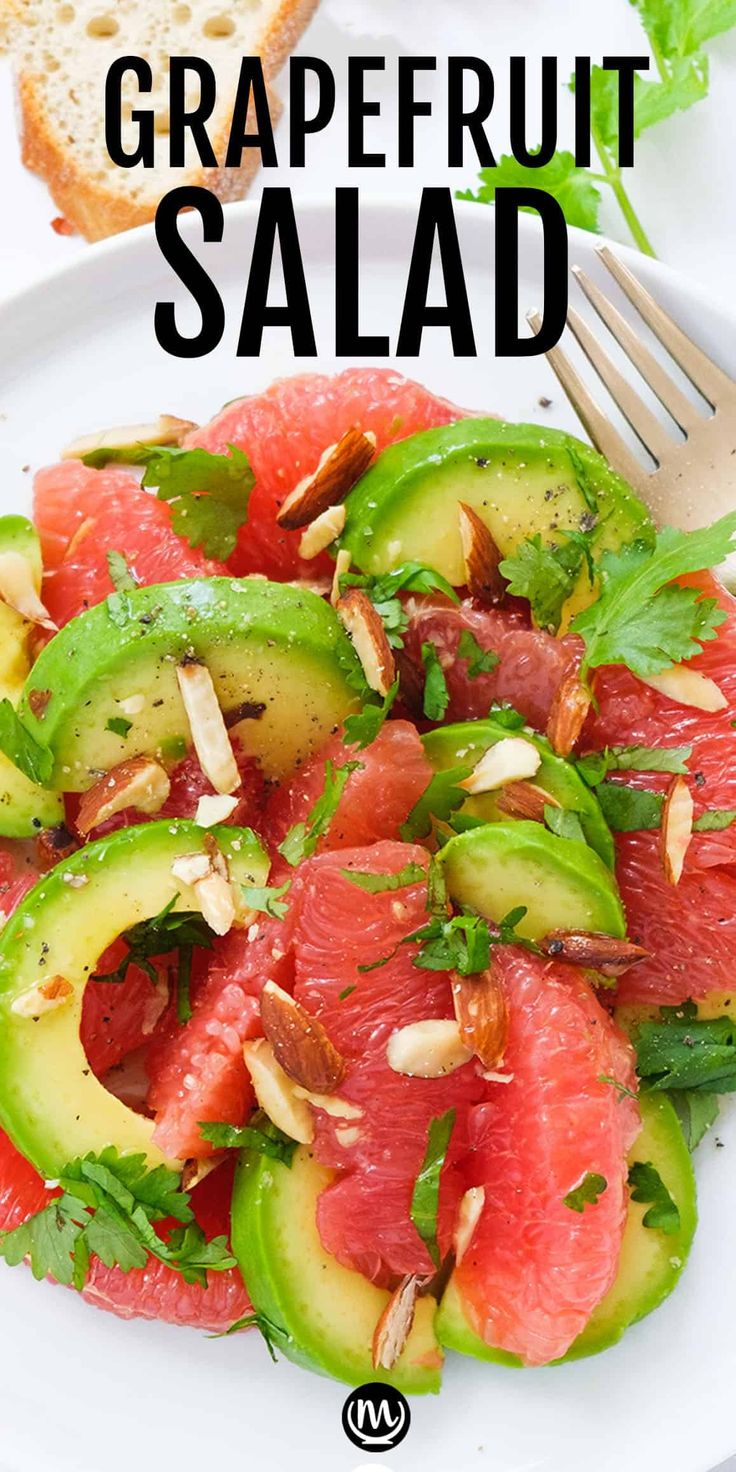
Avocado and Grapefruit Salad
Ingredients
- 2 large ripe avocados
- 2 grapefruit
- Juice of 1 lemon
- 1/4 cup olive oil
- Salt, to taste
- Pepper, to taste
Instructions
- Prepare dressing with some lemon juice, olive oil, salt and pepper.
- Peel and slice the avocados and drop immediately into the dressing.
- Peel the grapefruit and remove all the pith. Divide into segments and cut each segment in half, add to the avocado and toss well.
- Chill and serve.
Can China further advance gender equality and women’s all-round development within the next decade?
Yes.
Women’s rights come from their social independence, which is often measured by their economic independence.
China leads on this front, and with innovation picking up pace in China, this trend will likely only further strengthen in the future.
Chinese women have been proving that they’re no worse than men in making money.