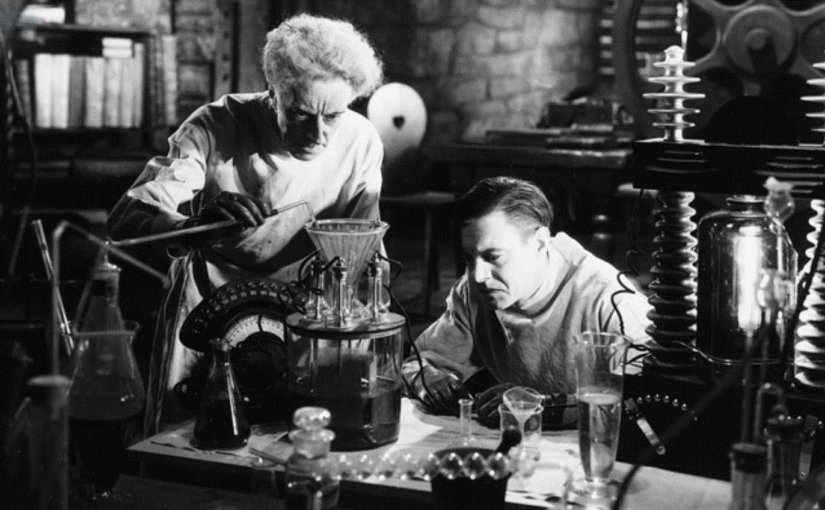
I love this story. It reminds me of…me.
Back in the day, I had amassed many, many tomes and collections of fine science fiction stories. I really loved the works from the “Golden Age” of science fiction, and one of my favorite writers was Lewis Padgett. Not well known, but completely awesome.
He wrote a series of short stories revolving around a mad scientist that produced brilliant work when he was shit-faced drunk. It’s not real life. That’s why I love it so. It’s so anti-PC.
Here is one of his best. This is a lively and often frankly hilarious account of how a very gifted (when under the influence of the demon Drink) scientist struggles to come to grips with the wackiness of his almost-perfect robot.
It’s one of his many, many creations while drunk. In this case, it is one in which he had just created with quite extraordinary powers, for a purpose which he cannot remember – and with his seemingly inextricable financial predicament(s).
It was first published in the October 1943 issue of Astounding Science Fiction as by “Lewis Padgett”, a nom de plume used by Henry Kuttner (1915–1958) and his wife C.L. Moore (1911-1987) for many of the 200+ fantasy, s-f and horror stories which they wrote together, essentially during the forties, mostly under this name.
The Proud Robot
ORIGINALLY the robot was intended to be a can opener. Things often happened that way with Gallegher, who played at science by ear. He was, as he often remarked, a casual genius. Sometimes he’d start with a twist of wire, a few batteries, and a button hook, and before he finished, he might contrive a new type of refrigerating unit. The affair of the time locker had begun that way, with Gallegher singing hoarsely under his breath and peering, quite drunk, into cans of paint.
At the moment he was nursing a hangover. A disjointed, lanky, vaguely boneless man with a lock of dark hair falling untidily over leis forehead, he lay on the couch in the lab and manipulated his mechanical liquor bar. A very dry Martini drizzled slowly from the spigot into his receptive mouth.
He was trying to remember something, but not trying too hard. It had to do with the robot, of course. Well, it didn’t matter.
“Hey, Joe,” Gallegher said.
The robot stood proudly before the mirror and examined its innards. Its hull was transparent, and wheels were going around at a great rate inside.
“When you call me that,” Joe remarked, “whisper. And get that cat out of here.”
“Your ears aren’t that good.”
“They are. I can hear the cat walking about, all right.”
“What does it sound like?” Gallegher inquired, interested.
“Just like drums,” said the robot, with a put-upon air. “And when you talk, it’s like thunder.” Joe’s voice was a discordant squeak, so Gallegher meditated on saying something about glass-houses and casting the first stone. He brought his attention, with some effort, to the luminous door panel, where a shadow loomed—a familiar shadow, Gallegher thought.
“It’s Brock,” the annunciator said. “Harrison Brock. Let me in!”
“The door’s unlocked.” Gallegher didn’t stir. He looked gravely at the well-dressed, middle-aged man who came in, and tried to remember. Brock was between forty and fifty; he had a smoothly massaged, clean-shaved face, and wore an expression of harassed intolerance. Probably Gallegher knew the man. He wasn’t sure.
Oh, well.
Brock looked around the big, untidy laboratory, blinked at the robot, searched for a chair, and failed to find it. Arms akimbo, he rocked back and forth and glared at the prostrate scientist.
“Well?” he said.
“Never start conversations that way,” Gallegher mumbled, siphoning another Martini down his gullet. “I’ve had enough trouble today. Sit down and take it easy. There’s a dynamo behind you. It isn’t very dusty, is it?”
“Did you get it?” Brock snapped. “That’s all I want to know. You’ve had a week. I’ve a check for ten thousand in my pocket. Do you want it, or don’t you?”
“Sure,” Gallegher said. He extended a large, groping hand. “Give.”
“Caveat emptor. What am I buying?”
“Don’t you know?” the scientist asked, honestly puzzled.
Brock began to bounce up and down in a harassed fashion. “My God,” he said. “They told me you could help me if anybody could. Sure. And they also said it’d be like pulling teeth to get sense out of you. Are you a technician or a driveling idiot?”
Gallegher pondered. “Wait a minute. I’m beginning to remember. I talked to you last week, didn’t I?”
“You talked—” Brock’s round face turned pink. “Yes! You lay there swilling liquor and babbled poetry. You sang ’Frankie and Johnnie.’ And you finally got around to accepting my commission.”
“The fact is,” Gallegher said, “I have been drunk. I often get drunk. Especially on my vacation. It releases my subconscious, and then I can work. I’ve made my best gadgets when I was tizzied,” he went on happily. “Everything seems so clear then. Clear as a bell. I mean a bell, don’t I? Anyway—” He lost the thread and looked puzzled. “Anyway, what are you talking about?”
“Are you going to keep quiet?” the robot demanded from its post before the mirror.
Brock jumped. Gallegher waved a casual hand. “Don’t mind Joe. I just finished him last night, and I rather regret it.”
“A robot?”
“A robot. But he’s no good, you know. I made him when I was drunk, and I haven’t the slightest idea how or why. All he’ll do is stand there and admire himself. And sing. He sings like a banshee. You’ll hear him presently.”
With an effort Brock brought his attention back to the matter in hand. “Now look, Gallegher. I’m in a spot. You promised to help me. If you don’t, I’m a ruined man.”
“I’ve been ruined for years,” the scientist remarked. “It never bothers me. I just go along working for a living and making things in my spare time. Making all sorts of things. You know, if I’d really studied, I’d have been another Einstein. So they tell me. As it is, my subconscious picked up a first-class scientific training somewhere. Probably that’s why I never bothered. When I’m drunk or sufficiently absent-minded, I can work out the damnedest problems.”
“You’re drunk now,” Brock accused.
“I approach the pleasanter stages. How would you feel if you woke up and found you’d made a robot for some unknown reason, and hadn’t the slightest idea of the creature’s attributes?”
“Well—”
“I don’t feel that way at all,” Gallegher murmured. “Probably you take life too seriously, Brock. Wine is a mocker; strong drink is raging. Pardon me. I rage.” He drank another Martini.
Brock began to pace around the crowded laboratory, circling various enigmatic and untidy objects. “If you’re a scientist, Heaven help science.”
“I’m the Larry Adler of science,” Gallegher said. “He was a musician—lived some hundreds of years ago, I think. I’m like him. Never took a lesson in my life. Can I help it if my subconscious likes practical jokes?”
“Do you know who I am?” Brock demanded.
“Candidly, no. Should I?”
There was bitterness in the other’s voice. “You might have the courtesy to remember, even though it was a week ago. Harrison Brock. Me. I own Vox-View Pictures.”
“No,” the robot said suddenly, “it’s no use. No use at all, Brock.”
“What the—”
Gallegher sighed wearily. “I forget the damned thing’s alive. Mr. Brock, meet Joe. Joe, meet Mr. Brock—of Vox-View.”
Joe turned, gears meshing within his transparent skull. “I am glad to meet you, Mr. Brock. Allow me to congratulate you on your good fortune in hearing my lovely voice.”
“Uh,” said the magnate inarticulately. “Hello.”
“Vanity of vanities, all is vanity,” Gallegher put in, sotto voce. “Joe’s like that. A peacock. No use arguing with him, either.”
The robot ignored this aside. “But it’s no use, Mr. Brock,” he went on squeakily. “I’m not interested in money. I realize it would bring happiness to many if I consented to appear in your pictures, but fame means nothing to me. Nothing. Consciousness of beauty is enough.”
Brock began to chew his lips. “Look,” he said savagely, “I didn’t come here to offer you a picture job. See? Am I offering you a contract? Such colossal nerve— Pah! You’re crazy.”
“Your schemes are perfectly transparent,” the robot remarked coldly. “I can see that you’re overwhelmed by my beauty and the loveliness of my voice—its grand tonal qualities. You needn’t pretend you don’t want me, just so you can get me at a lower price. I said I wasn’t interested.”
“You’re cr-r-razy!” Brock howled, badgered beyond endurance, and Joe calmly turned back to his mirror.
“Don’t talk so loudly,” the robot warned. “The discordance is deafening. Besides, you’re ugly and I don’t like to look at you.” Wheels and cogs buzzed inside the transplastic shell. Joe extended his eyes on stalks and regarded himself with every appearance of appreciation.
Gallegher was chuckling quietly on the couch. “Joe has a high irritation value,” he said. “I’ve found that out already. I must have given him some remarkable senses, too. An hour ago he started to laugh his damn fool head off. No reason, apparently. I was fixing myself a bite to eat. Ten minutes after that I slipped on an apple core I’d thrown away and came down hard.
Joe just looked at me. ’That was it,’ he said. ’Logics of probability. Cause and effect. I knew you were going to drop that apple core and then step on it when you went to pick up the mail.’
Like the White Queen, I suppose. It’s a poor memory that doesn’t work both ways.”
Brock sat on the small dynamo—there were two, the larger one named Monstro, and the smaller one serving Gallegher as a bank—and took deep breaths. “Robots are nothing new.”
“This one is. I hate its gears. It’s beginning to give me an inferiority complex. Wish I knew why I’d made it,” Gallegher sighed. “Oh, well. Have a drink?”
“No. I came here on business. Do you seriously mean you spent last week building a robot instead of solving the problem I hired you for?”
“Contingent, wasn’t it?” Gallegher asked. “I think I remember that.”
“Contingent,” Brock said with satisfaction. “Ten thousand, if and when.”
“Why not give me the dough and take the robot? He’s worth that. Put him in one of your pictures.”
“I won’t have any pictures unless you figure out an answer,” Brock snapped. “I told you all about it.”
“I have been drunk,” Gallegher said. “My mind has been wiped clear, as by a sponge. I am as a little child. Soon I shall be as a drunken little child. Meanwhile, if you’d care to explain the matter again—”
Brock gulped down his passion, jerked a magazine at random from the bookshelf, and took out a stylo. “All right. My preferred stocks are at twenty-eight, ’way below par—” He scribbled figures on the magazine.
“If you’d taken that medieval folio next to that, it’d have cost you a pretty penny,” Gallegher said lazily. “So you’re the sort of guy who writes on tablecloths, eh? Forget this business of stocks and stuff. Get down to cases. Who are you trying to gyp?”
“It’s no use,” the robot said from before its mirror. “I won’t sign a contract. People may come and admire me, if they like, but they’ll have to whisper in my presence.”
“A madhouse,” Brock muttered, trying to get a grip on himself. “Listen, Gallegher. I told you all this a week ago, but—”
“Joe wasn’t here then. Pretend like you’re talking to him.” “Uh—look. You’ve heard of Vox-View Pictures, at least.”
“Sure. The biggest and best television company in the business.
Sonatone’s about your only competitor.”
“Sonatone’s squeezing me out.”
Gallegher looked puzzled. “I don’t see how. You’ve got the best product. Tri-dimensional color, all sorts of modern improvements, the top actors, musicians, singers—”
“No use,” the robot said. “I won’t.”
“Shut up, Joe. You’re tops in your field, Brock. I’ll hand you that. And I’ve always heard you were fairly ethical. What’s Sonatone got on you?”
Brock made helpless gestures. “Oh, it’s politics. The bootleg theaters. I can’t buck ’em. Sonatone helped elect the present administration, and the police just wink when I try to have the bootleggers raided.”
“Bootleg theaters?” Gallegher asked, scowling a trifle. “I’ve heard something—”
“It goes ’way back. To the old sound-film days. Home television killed sound film and big theaters. People were conditioned away from sitting in audience groups to watch a screen. The home televisors got good. It was more fun to sit in an easy-chair, drink beer, and watch the show. Television wasn’t a rich man’s hobby by that time. The meter system brought the price down to middle-class levels. Everybody knows that.”
“I don’t,” Gallegher said. “I never pay attention to what goes on outside of my lab, unless I have to. Liquor and a selective mind. I ignore everything that doesn’t affect me directly. Explain the whole thing in detail, so I’ll get a complete picture. I don’t mind repetition. Now, what about this meter system of yours?”
“Televisors are installed free. We never sell ’em; we rent them. People pay according to how many hours they have the set tuned in. We run a continuous show, stage plays, wire-tape films, operas, orchestras, singers, vaudeville—everything. If you use your televisor a lot, you pay proportionately. The man comes around once a month and reads the meter. Which is a fair system.
Anybody can afford a Vox-View. Sonatone and the other companies do the same thing, but Sonatone’s the only big competitor I’ve got. At least, the only one that’s crooked as hell. The rest of the boys—they’re smaller than I am, but I don’t step on their toes. Nobody’s ever called me a louse,” Brock said darkly.
“So what?”
“So Sonatone has started to depend on audience appeal. It was impossible till lately—you couldn’t magnify tri-dimensional television on a big screen without streakiness and mirage-effect. That’s why the regular three-by-four home screens were used. Results were perfect. But Sonatone’s bought a lot of the ghost theaters all over the country—”
“What’s a ghost theater?” Gallegher asked.
“Well—before sound films collapsed, the world was thinking big. Big—you know? Ever heard of the Radio City Music Hall? That wasn’t in it! Television was coming in, and competition was fierce. Sound-film theaters got bigger and more elaborate. They were palaces. Tremendous. But when television was perfected, nobody went to the theaters any more, and it was often too expensive a job to tear ’em down. Ghost theaters—see? Big ones and little ones. Renovated them. And they’re showing Sonatone programs. Audience appeal is quite a factor. The theaters charge plenty, but people flock into ’em. Novelty and the mob instinct.”
Gallegher closed his eyes. “What’s to stop you from doing the same thing?”
“Patents,” Brock said briefly. “I mentioned that dimensional television couldn’t be used on big screens till lately. Sonatone signed an agreement with me ten years ago that any enlarging improvements would be used mutually. They crawled out of that contract. Said it was faked, and the courts upheld them. They uphold the courts—politics. Anyhow, Sonatone’s technicians worked out a method of using the large screen. They took out patents—twenty-seven patents, in fact, covering every possible variation on the idea. My technical staff has been working day and night trying to find some similar method that won’t be an infringement, but Sonatone’s got it all sewed up. They’ve a system called the Magna. It can be hooked up to any type of televisor—but they’ll only allow it to be used on Sonatone machines. See?”
“Unethical, but legal,” Gallegher said. “Still, you’re giving your customers more for their money. People want good stuff. The size doesn’t matter.”
“Yeah,” Brock said bitterly, “but that isn’t all. The newspapers are full of A.A.—it’s a new catchword. Audience Appeal. The herd instinct. You’re right about people wanting good stuff—but would you buy Scotch at four a quart if you could get it for half that amount?”
“Depends on the quality. What’s happening?”
“Bootleg theaters,” Brock said. “They’ve opened all over the country. They show Vox-View products, and they’re using the Magna enlarger system Sonatone’s got patented. The admission price is low—lower than the rate of owning a Vox-View in your own home. There’s audience appeal. There’s the thrill of something a bit illegal. People are having their Vox-Views taken out right and left. I know why. They can go to a bootleg theater instead.”
“It’s illegal,” Gallegher said thoughtfully.
“So were speakeasies, in the Prohibition Era. A matter of protection, that’s all. I can’t get any action through the courts. I’ve tried. I’m running in the red. Eventually I’ll be broke. I can’t lower my home rental fees on Vox-Views. They’re nominal already. I make my profits through quantity. Now, no profits. As for these bootleg theaters, it’s pretty obvious who’s backing them.”
“Sonatone?”
“Sure. Silent partners. They get the take at the box office. ’What they want is to squeeze me out of business, so they’ll have a monopoly. After that they’ll give the public junk and pay their artists starvation salaries. With me it’s different. I pay my staff what they’re worth—plenty.”
“And you offered me a lousy ten thousand,” Gallegher remarked.
“Uh-huh!”
“That was only the first installment,” Brock said hastily. “You can name your own fee. Within reason,” he added.
“I shall. An astronomical sum. Did I say I’d accept the commission a week ago?”
“You did.”
“Then I must have had some idea how to solve the problem,” Gallegher pondered. “Let’s see. I didn’t mention anything in particular, did I?”
“You kept talking about marble slabs and . . . uh . . . your sweetie.”
“Then I was singing,” Gallegher explained largely. ” ’St. James Infirmary.’ Singing calms my nerves, and Lord knows they need it sometimes. Music and liquor. ’I often wonder what the vintners buy—’ “
“What?”
” ’One half so precious as the stuff they sell.’ Let it go. I am quoting Omar. It means nothing. Are your technicians any good?”
“The best. And the best paid.”
“They can’t find a magnifying process that won’t infringe on the Sonatone Magna patents?”
“In a nutshell, that’s it.”
“I suppose I’ll have to do some research,” Gallegher said sadly. I hate it like poison. Still, the sum of the parts equals the whole. Does that make sense to you? It doesn’t to me. I have trouble with words. After I say things, I start wondering what I’ve said. Better than watching a play,” he finished wildly. “I’ve got a headache. Too much talk and not enough liquor. Where were we?”
“Approaching the madhouse,” Brock suggested. “If you weren’t my last resort, I’d—”
“No use,” the robot said squeakily. “You might as well tear up your contract, Brock. I won’t sign it. Fame means nothing to me—nothing.”
“If you don’t shut up,” Gallegher warned, “I’m going to scream in your ears.”
“All right!” Joe shrilled. “Beat me! Go on, beat me! The meaner you are, the faster I’ll have my nervous system disrupted, and then I’ll be dead. I don’t care. I’ve got no instinct of self-preservation. Beat me. See if I care.”
“He’s right, you know,” the scientist said after a pause. “And it’s the only logical way to respond to blackmail or threats. The sooner it’s over, the better. There aren’t any gradations with Joe. Anything really painful to him will destroy him. And he doesn’t give a damn.”
“Neither do I,” Brock grunted. “What I want to find out—”
“Yeah. I know. Well, I’ll wander around and see what occurs to me. Can I get into your studios?”
“Here’s a pass.” Brock scribbled something on the back of a card.
“Will you get to work on it right away?”
“Sure,” Gallegher lied. “Now you run along and take it easy. Try and cool off. Everything’s under control. I’ll either find a solution to your problem pretty soon or else—”
“Or else what?”
“Or else I won’t,” the scientist finished blandly, and fingered the buttons on a control panel near the couch. “I’m tired of Martinis. Why didn’t I make that robot a mechanical bartender, while I was at it? Even the effort of selecting and pushing buttons is depressing at times. Yeah, I’ll get to work on the business, Brock. Forget it.”
The magnate hesitated. “Well, you’re my only hope. I needn’t bother to mention that if there’s anything I can do to help you—”
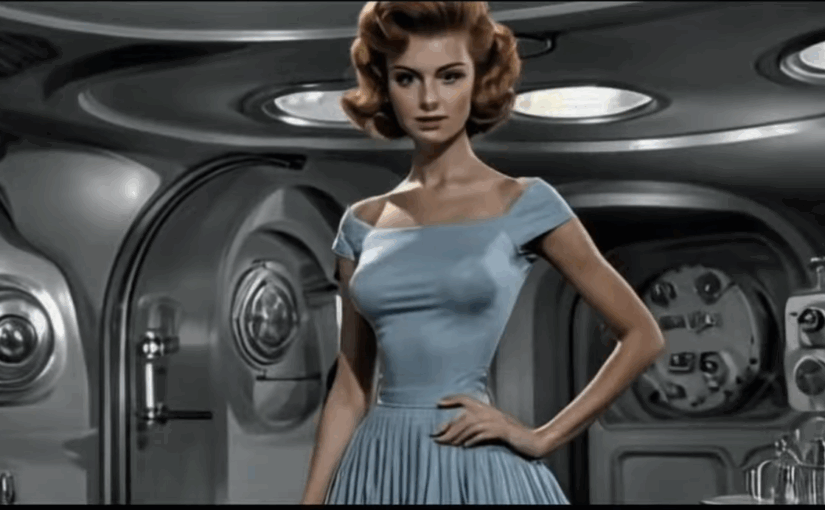
“A blonde,” Gallegher murmured. “That gorgeous, gorgeous star of yours, Silver O’Keefe. Send her over. Otherwise I want nothing.”
“Good-by, Brock,” the robot said squeakily. “Sorry we couldn’t get together on the contract, but at least you’ve had the ineluctable delight of hearing my beautiful voice, not to mention the pleasure of seeing me. Don’t tell too many people how lovely I am. I really don’t want to be bothered with mobs. They’re noisy.”
“You don’t know what dogmatism means till you’ve talked to Joe,” Gallegher said. “Oh, well. See you later. Don’t forget the blonde.”
Brock’s lips quivered. He searched for words, gave it up as a vain task, and turned to the door.
“Good-by, you ugly man,” Joe said.
Gallegher winced as the door slammed, though it was harder on the robot’s supersensitive ears than on his own. “Why do you go on like that?” he inquired. “You nearly gave the guy apoplexy.”
“Surely he didn’t think he was beautiful,” Joe remarked. “Beauty’s in the eye of the beholder.”
“How stupid you are. You’re ugly, too.”
“And you’re a collection of rattletrap gears, pistons and cogs. You’ve got worms,” said Gallegher, referring, of course, to certain mechanisms in the robot’s body.
“I’m lovely.” Joe stared raptly into the mirror.
“Maybe, to you. Why did I make you transparent, I wonder?”
“So others could admire me. I have X-ray vision, of course.”
“And wheels in your head. Why did I put your radioatomic brain in your stomach? Protection?”
Joe didn’t answer. He was humming in a maddeningly squeaky voice, shrill and nerve-racking. Gallegher stood it for a while, fortifying himself with a gin rickey from the siphon.
“Get it up!” he yelped at last. “You sound like an old-fashioned subway train going around a curve.”
“You’re merely jealous,” Joe scoffed, but obediently raised his tone to a supersonic pitch. There was silence for a half-minute. Then all the dogs in the neighborhood began to howl.
Wearily Gallegher dragged his lanky frame up from the couch. He might as well get out. Obviously there was no peace to be had in the laboratory. Not with that animated junk pile inflating his ego all over the place. Joe began to laugh in an off-key cackle.
Gallegher winced.
“What now?”
“You’ll find out.”
Logic of causation and effect, influenced by probabilities, X-ray vision and other enigmatic senses the robot no doubt possessed. Gallegher cursed softly, found a shapeless black hat, and made for the door. He opened it to admit a short, fat man who bounced painfully off the scientist’s stomach.
“Whoof! What a corny sense of humor that jackass has. Hello, Mr. Kennicott. Glad to see you. Sorry I can’t offer you a drink.”
Mr. Kennicott’s swarthy face twisted malignantly. “Don’ wanna no drink. Wanna my money. You gimme. Howzabout it?”
Gallegher looked thoughtfully at nothing. “Well, the fact is, I was just going to collect a check.”
“I sella you my diamonds. You say you gonna make somet’ing wit’ ’em. You gimme check before. It go bounca, bounca, bounca. Why is?”
“It was rubber,” Gallegher said faintly. “I never can keep track of my bank balance.”
Kennicott showed symptoms of going bounca on the threshold. “You gimme back diamonds, eh?”
“Well, I used ’em in an experiment, I forget just what. You know, Mr. Kennicott, I think I was a little drunk when I bought them, wasn’t I?”
“Dronk,” the little man agreed. “Mad wit’ vino, sure. So whatta? I wait no longer. Awready you put me off too much. Pay up now or elsa.”
“Go away, you dirty man,” Joe said from within the room. “You’re awful.”
Gallegher hastily shouldered Kennicott out into the street and latched the door behind him. “A parrot;” he explained. “I’m going to wring its neck pretty soon. Now about that money. I admit I owe it to you. I’ve just taken on a big job, and when I’m paid, you’ll get yours.”
“Bah to such stuff,” Kennicott said. “You gotta position, eh? You are technician wit’ some big company, Ai? Ask for ahead-salary.”
“I did,” Gallegher sighed. “I’ve drawn my salary for six months ahead. Now look, I’ll have that dough for you in a couple of days. Maybe I can get an advance from my client. O. K.?”
“No.”
“No?”
“Ah-h, nutsa. I waita one day. Two daysa, maybe. Enough. You get money. Awright. If not, O. K., calabozo for you.”
“Two days is plenty,” Gallegher said, relieved. “Say, are there any of those bootleg theaters around here?”
“Better you get to work an’ not waste time.”
“That’s my work. I’m making a survey. How can I find a bootleg place?”
“Easy. You go downtown, see guy in doorway. He sell you tickets. Anywhere. All over.”
“Swell,” Gallegher said, and bade the little man adieu. Why had he bought diamonds from Kennicott? It would be almost worth while to have his subconscious amputated. It did the most extraordinary things. It worked on inflexible principles of logic, but that logic was completely alien to Gallegher’s conscious mind. The results, though, were often surprisingly good, and always surprising. That was the worst of being a scientist who knew no science—who played by ear.
There was diamond dust in a retort in the laboratory, from some unsatisfactory experiment Gallegher’s subconscious had performed; and he had a fleeting memory of buying the stones from Kennicott. Curious. Maybe—oh, yeah. They’d gone into Joe. Bearings or something. Dismantling the robot wouldn’t help now, for the diamonds had certainly been reground. Why the devil hadn’t he used commercial stones, quite as satisfactory, instead of purchasing blue-whites of the finest water? The best was none too good for Gallegher’s subconscious. It had a fine freedom from commercial instincts. It just didn’t understand the price system or the basic principles of economics.
Gallegher wandered downtown like a Diogenes seeking truth. It was early evening, and the luminates were flickering on overhead, pale bars of light against darkness. A sky sign blazed above Manhattan’s towers. Air-taxis, skimming along at various arbitrary levels, paused for passengers at the elevator landings. Heigh-ho.
Downtown, Gallegher began to look for doorways. He found an occupied one at last, but the man was selling post cards. Gallegher declined and headed for the nearest bar, feeling the need of replenishment. It was a mobile bar, combining the worst features of a Coney Island ride with uninspired cocktails, and Gallegher hesitated on the threshold. But at last he seized a chair as it swung past and relaxed as much as possible. He ordered three rickeys and drank them in rapid succession. After that he called the bartender over and asked him about bootleg theaters.
“Hell, yes,” the man said, producing a sheaf of tickets from his apron. “How many?”
“One. Where do I go?”
“Two-twenty-eight. This street. Ask for Tony.”
“Thanks,” Gallegher said, and, having paid exorbitantly, crawled out of the chair and weaved away. Mobile bars were an improvement he didn’t appreciate. Drinking, he felt, should be performed in a state of stasis, since one eventually reached that stage, anyway.
The door was at the bottom of a flight of steps, and there was a grilled panel set in it. When Gallegher knocked, the visascreen lit up—obviously a one-way circuit, for the doorman was invisible.
“Tony here?” Gallegher said.
The door opened, revealing a tired-looking man in pneumo-slacks, which failed in their purpose of building up his skinny figure. “Got a ticket? Let’s have it. O. K., bud. Straight ahead. Show now going on. Liquor served in the bar on your left.”
Gallegher pushed through sound-proofed curtains at the end of a short corridor and found himself in what appeared to be the foyer of an ancient theater, circa 1980, when plastics were the great fad. He smelled out the bar, drank expensively priced cheap liquor, and, fortified, entered the theater itself. It was nearly full.
The great screen—a Magna, presumably—was filled with people doing things to a spaceship. Either an adventure film or a newsreel, Gallegher realized.
Only the thrill of lawbreaking would have enticed the audience into the bootleg theater. It smelled. It was certainly run on a shoestring, and there were no ushers. But it was illicit, and therefore well patronized. Gallegher looked thoughtfully at the screen. No streakiness, no mirage effect. A Magna enlarger had been fitted to a Vox-View unlicensed televisor, and one of Brock’s greatest stars was emoting effectively for the benefit of the bootleggers’ patrons. Simple highjacking. Yeah.
After a while Gallegher went out, noticing a uniformed policeman in one of the aisle seats. He grinned sardonically. The flatfoot hadn’t paid his admission, of course. Politics were as usual.
Two blocks down the street a blaze of light announced SONATONE BIJOU. This, of course, was one of the legalized theaters, and correspondingly high-priced. Gallegher recklessly squandered a small fortune on a good seat. He was interested in comparing notes, and discovered that, as far as he could make out, the Magna in the Bijou and the bootleg theater were identical. Both did their job perfectly. The difficult task of enlarging television screens had been successfully surmounted.
In the Bijou, however, all was palatial. Resplendent ushers salaamed to the rugs. Bars dispensed free liquor, in reasonable quantities. There was a Turkish bath. Gallegher went through a door labeled MEN and emerged quite dazzled by the splendor of the place. For at least ten minutes afterward he felt like a Sybarite.
All of which meant that those who could afford it went to the legalized Sonatone theaters, and the rest attended the bootleg places. All but a few homebodies, who weren’t carried off their feet by the new fad. Eventually Brock would be forced out of business for lack of revenue. Sonatone would take over, jacking up their prices and concentrating on making money. Amusement was necessary to life; people had been conditioned to television. There was no substitute. They’d pay and pay for inferior talent, once Sonatone succeeded in their squeeze.
Gallegher left the Bijou and hailed an air-taxi. He gave the address of Vox-View’s Long Island studio, with some vague hope of getting a drawing account out of Brock. Then, too, he wanted to investigate further.
Vox-View’s eastern offices sprawled wildly over Long Island, bordering the Sound, a vast collection of variously shaped buildings. Gallegher instinctively found the commissary, where he absorbed more liquor as a precautionary measure. His subconscious had a heavy job ahead, and he didn’t want it handicapped by lack of complete freedom. Besides, the Collins was good.
After one drink, he decided he’d had enough for a while. He wasn’t a superman, though his capacity was slightly incredible. Just enough for objective clarity and subjective release—
“Is the studio always open at night?” he asked the waiter.
“Sure. Some of the stages, anyway. It’s a round-the-clock program.”
“The commissary’s full.”
“We get the airport crowd, too. ’Nother?”
Gallegher shook his head and went out. The card Brock had given him provided entree at a gate, and he went first of all to the big-shot’s office. Brock wasn’t there, but loud voices emerged, shrilly feminine.
The secretary said, “Just a minute, please,” and used her interoffice visor. Presently—”Will you go in?”
Gallegher did. The office was a honey, functional and luxurious at the same time. Three-dimensional stills were in niches along the walls —Vox-View’s biggest stars. A small, excited, pretty brunette was sitting behind the desk, and a blond angel was standing furiously on the other side of it. Gallegher recognized the angel as Silver O’Keefe.
He seized the opportunity. “Hiya, Miss O’Keefe. Will you autograph an ice cube for me? In a highball?”
Silver looked feline. “Sorry, darling, but I’m a working girl. And I’m busy right now.”
The brunette scratched a cigarette. “Let’s settle this later, Silver. Pop said to see this guy if he dropped in. It’s important.”
“It’ll be settled,” Silver said. “And soon.” She made an exit. Gallegher whistled thoughtfully at the closed door.
“You can’t have it,” the brunette said. “It’s under contract. And it wants to get out of the contract, so it can sign up with Sonatone. Rats desert a sinking ship. Silver’s been kicking her head off ever since she read the storm signals.”
“Yeah?”
“Sit down and smoke or something. I’m Patsy Brock. Pop runs this business, and I manage the controls whenever he blows his top. The old goat can’t stand trouble. He takes it as a personal affront.”
Gallegher found a chair. “So Silver’s trying to renege, eh? How many others?”
“Not many. Most of ’em are loyal. But, of course, if we bust up—” Patsy Brock shrugged. “They’ll either work for Sonatone for their cakes, or else do without.”
“Uh-huh. Well—I want to see your technicians. I want to look over the ideas they’ve worked out for enlarger screens.”
“Suit yourself,” Patsy said. “It’s not much use. You just can’t make a televisor enlarger without infringing on some Sonatone patent.”
She pushed a button, murmured something into a visor, and presently two tall glasses appeared through a slot in the desk.
“Mr. Gallegher?”
“Well, since it’s a Collins—”
“I could tell by your breath,” Patsy said enigmatically. “Pop told me he’d seen you. He seemed a bit upset, especially by your new robot. What is it like, anyway?”
“Oh, I don’t know,” Gallegher said, at a loss. “It’s got lots of abilities—new senses, I think—but I haven’t the slightest idea what it’s good for. Except admiring itself in a mirror.”
Patsy nodded. “I’d like to see it sometime. But about this Sonatone business. Do you think you can figure out an answer?”
“Possibly. Probably.”
“Not certainly?”
“Certainly, then. Of that there is no manner of doubt—no possible doubt whatever.”
“Because it’s important to me. The man who owns Sonatone is Elia Tone. A piratical skunk. He blusters. He’s got a son named Jimmy. And Jimmy, believe it or not, has read ’Romeo and Juliet.’ “
“Nice guy?”
“A louse. A big, brawny louse. He wants me to marry him.”
” ’Two families both alike in—’ “
“Spare me,” Patsy interrupted. “I always thought Romeo was a dope, anyway. And if I ever thought I was going aisling with Jimmy Tone, I’d buy a one-way ticket to the nut hatch. No, Mr. Gallegher, it’s not like that. No hibiscus blossoms. Jimmy has proposed to me—his idea of a proposal, by the way, is to get a half Nelson on a girl and tell her how lucky she is.”
“Ah,” said Gallegher, diving into his Collins.
“This whole idea—the patent monopoly and the bootleg theaters —is Jimmy’s. I’m sure of that. His father’s in on it, too, of course, but Jimmy Tone is the bright little boy who started it.”
“Why.”
“Two birds with one stone. Sonatone will have a monopoly on the business, and Jimmy thinks he’ll get me. He’s a little mad. He can’t believe I’m in earnest in refusing him, and he expects me to break down and say ’Yes’ after a while. Which I won’t, no matter what happens. But it’s a personal matter. I can’t let him put this trick over on us. I want that self-sufficient smirk wiped off his face.”
“You just don’t like him, eh?” Gallegher remarked. “I don’t blame you, if he’s like that. Well, I’ll do my damnedest. However, I’ll need an expense account.”
“How much?”
Gallegher named a sum. Patsy styloed a check for a far smaller amount. The scientist looked hurt.
“It’s no use,” Patsy said, grinning crookedly. “I’ve heard of you, Mr. Gallegher. You’re completely irresponsible. If you had more than this, you’d figure you didn’t need any more, and you’d forget the whole matter. I’ll issue more checks to you when you need ’em—but I’ll want itemized expense accounts.”
“You wrong me,” Gallegher said, brightening. “I was figuring on taking you to a night club. Naturally I don’t want to take you to a dive. The big places cost money. Now if you’ll just write another check—”
Patsy laughed. “No.”
“Want to buy a robot?”
“Not that kind, anyway.”
“Then I’m washed up,” Gallegher sighed. “Well, what about—”
At this point the visor hummed. A blank, transparent face grew on the screen. Gears were clicking rapidly inside the round head. Patsy gave a small shriek and shrank back.
“Tell Gallegher Joe’s here, you lucky girl,” a squeaky voice announced. “You may treasure the sound and sight of me till your dying day. One touch of beauty in a world of drabness—”
Gallegher clutched the desk and looked at the screen. “What the hell. How did you come to life?”
“I had a problem to solve.”
“How’d you know where to reach me?”
“I vastened you,” the robot said.
“What?”
“I vastened you were at the Vox-View studios with Patsy Brock.”
“What’s vastened?” Gallegher wanted to know.
“It’s a sense I’ve got. You’ve nothing remotely like it, so I can’t describe it to you. It’s rather like a combination of sagrazi and prescience.”
“Sagrazi?”
“Oh, you don’t have sagrazi, either, do you? Well, don’t waste my time. I want to go back to the mirror.”
“Does he always talk like that?” Patsy put in.
“Nearly always. Sometimes it makes even less sense. O. K., Joe. Now what?”
“You’re not working for Brock any more,” the robot said. “You’re working for the Sonatone people.”
Gallagher breathed deeply. “Keep talking. You’re crazy, though.”
“I don’t like Kennicott. He annoys me. He’s too ugly. His vibrations grate on my sagrazi.”
“Never mind him,” Gallegher said, not wishing to discuss his diamond-buying activities before the girl. “Get back to—”
“But I knew Kennicott would keep coming back till he got his money. So when Elia and James Tone came to the laboratory, I got a check from them.”
Patsy’s hand gripped Gallegher’s biceps. “Steady! What’s going on here? The old double cross?”
“No. Wait. Let me get to the bottom of this. Joe, damn your transparent hide, just what did you do? How could you get a check from the Tones?”
“I pretended to be you.”
“Sure,” Gallegher said with savage sarcasm. “That explains it. We’re twins. We look exactly alike.”
“I hypnotized them,” Joe explained. “I made them think I was you.”
“You can do that?“
“Yes. It surprised me a bit. Still, if I’d thought, I’d have vastened I could do it.”
“You . . . yeah, sure. I’d have vastened the same thing myself. What happened?“
“The Tones must have suspected Brock would ask you to help him. They offered an exclusive contract—you work for them and nobody else. Lots of money. Well, I pretended to be you, and said all right. So I signed the contract—it’s your signature, by the way—and got a check from them and mailed it to Kennicott.”
“The whole check?” Gallegher asked feebly. “How much was it?”
“Twelve thousand.”
“They only offered me that?“
“No,” the robot said, “they offered a hundred thousand, and two thousand a week for five years. But I merely wanted enough to pay Kennicott and make sure he wouldn’t come back and bother me. The Tones were satisfied when I said twelve thousand would be enough.”
Gallegher made an articulate, gurgling sound deep in his throat Joe nodded thoughtfully.
“I thought I had better notify you that you’re working for Sonatone now. Well, I’ll go back to the mirror and sing to myself.”
“Wait,” the scientist said. “Just wait, Joe. With my own two hands I’m going to rip you gear from gear and stamp on your fragments.”
“It won’t hold in court,” Patsy said, gulping.
“It will,” Joe told her cheerily. “You may have one last, satisfying look at me, and then I must go.” He went.
Gallegher drained his Collins at a draft. “I’m shocked sober,” he informed the girl. “What did I put into that robot? What abnormal senses has he got? Hypnotizing people into believing he’s me—I’m him—I don’t know what I mean.”
“Is this a gag?” Patsy said shortly, after a pause. “You didn’t sign up with Sonatone yourself, by any chance, and have your robot call up here to give you an out—an alibi? I’m just wondering.”
“Don’t. Joe signed a contract with Sonatone, not me. But—figure it out: If the signature’s a perfect copy of mine, if Joe hypnotized the Tones into thinking they saw me instead of him, if there are witnesses to the signature—the two Tones are witnesses, of course— Oh, hell.”
Patsy’s eyes were narrowed. “We’ll pay you as much as Sonatone offered. On a contingent basis. But you’re working for Vox-View— that’s understood.”
“Sure.”
Gallegher looked longingly at his empty glass. Sure. He was working for Vox-View. But, to all legal appearances, he had signed a contract giving his exclusive services to Sonatone for a period of five years —and for a sum of twelve thousand! Yipe! What was it they’d offered? A hundred thousand flat, and . . . and—
It wasn’t the principle of the thing, it was the money. Now Gallegher was sewed up tighter than a banded pigeon. If Sonatone could win a court suit, he was legally bound to them for five years. With no further emolument. He had to get out of that contract, somehow—and at the same time solve Brock’s problem.
Why not Joe? The robot, with his surprising talents, had got Gallegher into this spot. He ought to be able to get the scientist out. He’d better—or the proud robot would soon be admiring himself piecemeal.
“That’s it,” Gallegher said under his breath. “I’ll talk to Joe. Patsy, feed me liquor in a hurry and send me to the technical department. I want to see those blueprints.”
The girl looked at him suspiciously. “All right. If you try to sell us out—”
“I’ve been sold out myself. Sold down the river. I’m afraid of that robot. He’s vastened me into quite a spot. That’s right, Collinses.” Gallegher drank long and deeply.
After that, Patsy took him to the tech offices. The reading of three-dimensional blueprints was facilitated with a scanner—a selective device which eliminated confusion. Gallegher studied the plans long and thoughtfully. There were copies of the patented Sonatone prints, too, and, as far as he could tell, Sonatone had covered the ground beautifully. There weren’t any outs. Unless one used an entirely new principle—
But new principles couldn’t be plucked out of the air. Nor would that solve the problem completely. Even if Vox-View owned a new type of enlarger that didn’t infringe on Sonatone’s Magna, the bootleg theaters would still be in existence, pulling the trade. A. A.—Audience Appeal—was a prime factor now. It had to be considered. The puzzle wasn’t a purely scientific one. There was the human equation as well.
Gallegher stored the necessary information in his mind, neatly indexed on shelves. Later he’d use what he wanted. For the moment, he was completely baffled. Something worried him.
What?
The Sonatone affair.
“I want to get in touch with the Tones,” he told Patsy. “Any ideas?”
“I can reach ’em on a visor.”
Gallegher shook his head. “Psychological handicap. It’s too easy to break the connection.”
“Well, if you’re in a hurry, you’ll probably find the boys night clubbing. I’ll go see what I can find out.” Patsy scuttled off, and Silver O’Keefe appeared from behind a screen.
“I’m shameless,” she announced. “I always listen at keyholes. Sometimes I hear interesting things. If you want to see the Tones, they’re at the Castle Club. And I think I’ll take you up on that drink.”
Gallegher said, “O. K. You get a taxi. I’ll tell Patsy we’re going.”
“She’ll hate that,” Silver remarked. “Meet you outside the commissary in ten minutes. Get a shave while you’re at it.”
Patsy Brock wasn’t in her office, but Gallegher left word. After that, he visited the service lounge, smeared invisible shave cream on his face, left it there for a couple of minutes, and wiped it off with a treated towel. The bristles came away with the cream. Slightly refreshed, Gallegher joined Silver at the rendezvous and hailed an air-taxi. Presently they were leaning back on the cushions, puffing cigarettes and eyeing each other warily.
“Well?” Gallegher said.
“Jimmy Tone tried to date me up tonight. That’s how I knew where to find him.”
“Well?”
“I’ve been asking questions around the lot tonight. It’s unusual for an outsider to get into the Vox-View administration offices. I went around saying, ’Who’s Gallegher?’ “
“What did you find out?”
“Enough to give me a few ideas. Brock hired you, eh? I can guess why.”
“Ergo what?”
“I’ve a habit of landing on my feet,” Silver said, shrugging. She knew how to shrug. “Vox-View’s going bust. Sonatone’s taking over. Unless—”
“Unless I figure out an answer.”
“That’s right. I want to know which side of the fence I’m going to land on. You’re the lad who can probably tell me. Who’s going to win?”
“You always bet on the winning side, eh?” Gallegher inquired.
Have you no ideals, wench? Is there no truth in you? Ever hear of ethics and scruples?”
Silver beamed happily. “Did you?”
“Well, I’ve heard of ’em. Usually I’m too drunk to figure out what they mean. The trouble is, my subconscious is completely amoral, and when it takes over, logic’s the only law.”
She threw her cigarette into the East River. “Will you tip me off which side of the fence is the right one?”
“Truth will triumph,” Gallegher said piously. “It always does. However, I figure truth is a variable, so we’re right back where we started. All right, sweetheart. I’ll answer your question. Stay on my side if you want to be safe.”
“Which side are you on?”
“Lord knows,” Gallegher said. “Consciously I’m on Brock’s side. But my subconscious may have different ideas. We’ll see.”
Silver looked vaguely dissatisfied, but didn’t say anything. The taxi swooped down to the Castle roof, grounding with pneumatic gentleness. The Club itself was downstairs, in an immense room shaped like half a melon turned upside down. Each table was on a transparent platform that could be raised on its shaft to any height at will. Smaller service elevators allowed waiters to bring drinks to the guests. There wasn’t any particular reason for this arrangement, but at least it was novel, and only extremely heavy drinkers ever fell from their tables. Lately the management had taken to hanging transparent nets under the platforms, for safety’s sake.
The Tones, father and son, were up near the roof, drinking with two lovelies. Silver towed Gallegher to a service lift, and the man closed his eyes as he was elevated skyward. The liquor in his stomach screamed protest. He lurched forward, clutched at Elia Tone’s bald head, and dropped into a seat beside the magnate. His searching hand found Jimmy Tone’s glass, and he drained it hastily.
“What the hell,” Jimmy said.
“It’s Gallegher,” Elia announced. “And Silver. A pleasant surprise. Join us?”
“Only socially,” Silver said.
Gallegher, fortified by the liquor, peered at the two men. Jimmy Tone was a big, tanned, handsome lout with a jutting jaw and an offensive grin. His father combined the worst features of Nero and a crocodile.
“We’re celebrating,” Jimmy said. “What made you change your mind, Silver? You said you had to work tonight.”
“Gallegher wanted to see you. I don’t know why.”
Elia’s cold eyes grew even more glacial. “All right. Why?”
“I hear I signed some sort of contract with you,” the scientist said.
“Yeah. Here’s a photostatic copy. What about it?”
“Wait a minute.” Gallegher scanned the document. It was apparently his own signature. Damn that robot!
“It’s a fake,” he said at last.
Jimmy laughed loudly. “I get it. A holdup. Sorry, pal, but you’re sewed up. You signed that in the presence of witnesses.”
“Well—” Gallegher said wistfully. “I suppose you wouldn’t believe me if I said a robot forged my name to it—”
“Haw!” Jimmy remarked.
“—hypnotizing you into believing you were seeing me.”
Elia stroked his gleaming bald head. “Candidly, no. Robots can’t do that.”
“Mine can.”
“Prove it. Prove it in court. If you can do that, of course—” Elia chuckled. “Then you might get the verdict.”
Gallegher’s eyes narrowed. “Hadn’t thought of that. However—I hear you offered me a hundred thousand flat, as well, as a weekly salary.”
“Sure, sap,” Jimmy said. “Only you said all you needed was twelve thousand. Which was what you got. Tell you what, though. We’ll pay you a bonus for every usable product you make for Sonatone.”
Gallegher got up. “Even my subconscious doesn’t like these lugs,” he told Silver. “Let’s go.”
“I think I’ll stick around.”
“Remember the fence,” he warned cryptically. “But suit yourself. I’ll run along.”
Elia said, “Remember, Gallegher, you’re working for us. If we hear of you doing any favors for Brock, we’ll slap an injunction on you before you can take a deep breath.”
“Yeah?”
The Tones deigned no answer. Gallegher unhappily found the lift and descended to the floor. What now?
Joe.
Fifteen minutes later Gallegher let himself into his laboratory. The lights were blazing, and dogs were barking frantically for blocks around. Joe stood before the mirror, singing inaudibly.
“I’m going to take a sledge hammer to you,” Gallegher said. “Start saying your prayers, you misbegotten collection of cogs. So help me, I’m going to sabotage you.”
“All right, beat me,” Joe squeaked. “See if I care. You’re merely jealous of my beauty.”
“Beauty!”
“You can’t see all of it—you’ve only six senses.”
“Five.”
“Six. I’ve a lot more. Naturally my full splendor is revealed only to me. But you can see enough and hear enough to realize part of my loveliness, anyway.”
“You squeak like a rusty tin wagon,” Gallegher growled.
“You have dull ears. Mine are supersensitive. You miss the full tonal value of my voice, of course. Now be quiet. Talking disturbs me. I’m appreciating my gear movements.”
“Live in your fool’s paradise while you can. Wait’ll I find a sledge.”
“All right, beat me. What do I care?”
Gallegher sat down wearily on the couch, staring at the robot’s transparent back. “You’ve certainly screwed things up for me. What did you sign that Sonatone contract for?”
“I told you. So Kennicott wouldn’t come around and bother me.”
“Of all the selfish, lunk-headed . . . uh! Well, you got me into a sweet mess. The Tones can hold me to the letter of the contract unless I prove I didn’t sign it. All right. You’re going to help me. You’re going into court with me and turn on your hypnotism or whatever it is. You’re going to prove to a judge that you did and can masquerade as me.”
“Won’t,” said the robot. “Why should I?”
“Because you got me into this,” Gallegher yelped. “You’ve got to get me out!”
“Why?”
“Why? Because . . . uh . . . well, it’s common decency!” “Human values don’t apply to robots,” Joe said. “What care I for semantics? I refuse to waste time I could better employ admiring my beauty. I shall stay here before the minor forever and ever—”
“The hell you will,” Gallegher snarled. “I’ll smash you to atoms.”
“All right. I don’t care.”
“You don’t?”
“You and your instinct for self-preservation,” the robot said, rather sneeringly “I suppose it’s necessary for you, though. Creatures of such surpassing ugliness would destroy themselves out of sheer shame if they didn’t have something like that to keep them alive.”
“Suppose I take away your mirror?” Gallegher asked, in a hopeless voice.
For answer Joe shot his eyes out on their stalks. “Do I need a mirror? Besides, I can vasten myself lokishly.”
“Never mind that. I don’t want to go crazy for a while yet. Listen, dope, a robot’s supposed to do something. Something useful, I mean.”
“I do. Beauty is all.”
Gallegher squeezed his eyes shut, trying to think. “Now look. Suppose I invent a new type of enlarger screen for Brock. The Tones will impound it. I’ve got to be legally free to work for Brock, or—”
“Look!” Joe cried squeakishly. “They go round! How lovely!” He stared in ecstasy at his whirring insides. Gallegher went pale with impotent fury.
“Damn you!” he muttered. “I’ll find some way to bring pressure to bear. I’m going to bed.” He rose and spitefully snapped off the lights.
“It doesn’t matter,” the robot said. “I can see in the dark, too.” The door slammed behind Gallegher. In the silence Joe began to sing tunelessly to himself.
Gallegher’s refrigerator covered an entire wall of his kitchen. It was filled mostly with liquors that required chilling, including the imported canned beer with which he always started his binges.
The next morning, heavy-eyed and disconsolate, Gallegher searched for tomato juice, took a wry sip, and hastily washed it down with rye. Since he was already a week gone in bottle-dizziness, beer wasn’t indicated now —he always worked cumulatively, by progressive stages. The food service popped a hermetically sealed breakfast on a table, and Gallegher morosely toyed with a bloody steak.
Well?
Court, he decided, was the only recourse. He knew little about the robot’s psychology. But a judge would certainly be impressed by Joe’s talents. The evidence of robots was not legally admissible—still, if Joe could be considered as a machine capable of hypnotism, the Sonatone contract might be declared null and void.
Gallegher used his visor to start the ball rolling. Harrison Brock still had certain political powers of pull, and the hearing was set for that very day. What would happen, though, only God and the robot knew.
Several hours passed in intensive but futile thought. Gallegher could think of no way in which to force the robot to do what he wanted. If only he could remember the purpose for which Joe had had been created—but he couldn’t. Still—
At noon he entered the laboratory.
“Listen, stupid,” he said, “you’re coming to court with me. Now.”
“Won’t.”
“O. K.” Gallegher opened the door to admit two husky men in overalls, carrying a stretcher. “Put him in, boys.”
Inwardly he was slightly nervous. Joe’s powers were quite unknown, his potentialities an x quantity. However, the robot wasn’t very large, and, though he struggled and screamed in a voice of frantic squeakiness, he was easily loaded on the stretcher and put in a strait jacket.
“Stop it! You can’t do this to me! Let me go, do you hear? Let me go!”
“Outside,” Gallegher said.
Joe, protesting valiantly, was carried out and loaded into an air van. Once there, he quieted, looked up blankly at nothing. Gallegher sat down on a bench beside the prostrate robot. The van glided up.
“Well?”
“Suit yourself,” Joe said. “You got me all upset, or I could have hypnotized you all. I still could, you know. I could make you all run around barking like dogs.”
Gallegher twitched a little. “Better not.”
“I won’t. It’s beneath my dignity. I shall simply lie here and admire myself. I told you I don’t need a mirror. I can vasten my beauty without it.”
“Look,” Gallegher said. “You’re going to a courtroom. There’ll be a lot of people in it. They’ll all admire you They’ll admire you more if you show how you can hypnotize people. Like you did to the Tones, remember?”
“What do I care how many people admire me?” Joe asked. “I don’t need confirmation. If they see me, that’s their good luck. Now be quiet. You may watch my gears if you choose.”
Gallegher watched the robot’s gears with smoldering hatred in his eyes. He was still darkly furious when the van arrived at the court chambers. The men carried Joe inside, under Gallegher’s direction, and laid him down carefully on a table, where, after a brief discussion, he was marked as Exhibit A.
The courtroom was well filled. The principals were there, too— Elia and Jimmy Tone, looking disagreeably confident, and Patsy Brock, with her father, both seeming anxious. Silver O’Keefe, with her usual wariness, had found a seat midway between the representatives of Sonatone and Vox-View. The presiding judge was a martinet named Hansen, but, as far as Gallegher knew, he was honest. Which was something, anyway.
Hansen looked at Gallegher. “We won’t bother with formalities. I’ve been reading this brief you sent down. The whole case stands or falls on the question of whether you did or did not sign, a certain contract with the Sonatone Television Amusement Corp. Right?”
“Right, your honor.”
“Under the circumstances you dispense with legal representation. Right?”
“Right, your honor.”
“Then this is technically ex officio, to be confirmed later by appeal if either party desires. Otherwise after ten days the verdict becomes official.” This new type of informal court hearing had lately become popular—it saved time, as well as wear and tear on everyone. Moreover, certain recent scandals had made attorneys slightly disreputable in the public eye. There was a prejudice.
Judge Hansen called up the Tones, questioned them, and then asked Harrison Brock to take the stand. The big shot looked worried, but answered promptly.
“You made an agreement with the appellor eight days ago?” “Yes. Mr. Gallegher contracted to do certain work for me—”
“Was there a written contract?”
“No. It was verbal.”
Hansen looked thoughtfully at Gallegher. “Was the appellor intoxicated at the time? He often is, I believe.”
Brock gulped. “There were no tests made. I really can’t say.”
“Did he drink any alcoholic beverages in your presence?”
“I don’t know if they were alcoholic bev—”
“If Mr. Gallegher drank them, they were alcoholic. Q. E. D. The gentleman once worked with me on a case— However, there seems to be no legal proof that you entered into any agreement with Mr. Gallegher. The defendant—Sonatone—possesses a written contract. The signature has been verified.”
Hansen waved Brock down from the stand. “Now, Mr. Gallegher. If you’ll come up here— The contract in question was signed at approximately 8 p. m. last night. You contend you did not sign it?”
“Exactly. I wasn’t even in my laboratory then.”
“Where were you?”
“Downtown.”
“Can you produce witnesses to that effect?”
Gallegher thought back. He couldn’t.
“Very well. Defendant states that at approximately 8 p. m. last night you, in your laboratory, signed a certain contract. You deny that categorically. You state that Exhibit A, through the use of hypnotism, masqueraded as you and successfully forged your signature. I have consulted experts, and they are of the opinion that robots are incapable of such power.”
“My robot’s a new type.”
“Very well. Let your robot hypnotize me into believing that it is either you, or any other human. In other words, let it prove its capabilities. Let it appear to me in any shape it chooses.”
Gallegher said, “I’ll try,” and left the witness box. He went to the table where the strait-jacketed robot lay and silently sent up a brief prayer.
“Joe.”
“Yes.”
“You’ve been listening?”
“Yes.”
“Will you hypnotize Judge Hansen?”
“Go away,” Joe said. “I’m admiring myself.”
Gallegher started to sweat. “Listen. I’m not asking much. All you have to do—”
Joe off-focused his eyes and said faintly. “I can’t hear you. I’m vastening.”
Ten minutes later Hansen said, “Well, Mr. Gallegher—”
“Your honor! All I need is a little time. I’m sure I can make this rattle-geared Narcissus prove my point if you’ll give me a chance.”
“This court is not unfair,” the judge pointed out. “Whenever you can prove that Exhibit A is capable of hypnotism. I’ll rehear the case. In the meantime, the contract stands. You’re working for Sonatone, not for Vox-View. Case closed.”
He went away. The Tones leered unpleasantly across the courtroom. They also departed, accompanied by Silver O’Keefe, who had decided which side of the fence was safest. Gallegher looked at Patsy Brock and shrugged helplessly.
“Well—” he said.
She grinned crookedly. “You tried. I don’t know how hard, but—Oh, well. Maybe you couldn’t have found the answer, anyway.” Brock staggered over, wiping sweat from his round face. “I’m a ruined man. Six new bootleg theaters opened in New York today. I’m going crazy. I don’t deserve this.”
“Want me to marry the Tone?” Patsy asked sardonically.
“Hell, no! Unless you promise to poison him just after the ceremony. Those skunks can’t lick me. I’ll think of something.”
“If Gallegher can’t, you can’t,” the girl said. “So—what now?”
“I’m going back to my lab,” the scientist said. “In vino veritas. I started this business when I was drunk, and maybe if I get drunk enough again, I’ll find the answer. If I don’t, sell my pickled carcass for whatever it’ll bring.”
“O. K.,” Patsy agreed, and led her father away. Gallegher sighed, superintended the reloading of Joe into the van, and lost himself in hopeless theorization.
An hour later Gallegher was flat on the laboratory couch, drinking passionately from the liquor bar, and glaring at the robot, who stood before the mirror singing squeakily. The binge threatened to be monumental. Gallegher wasn’t sure flesh and blood would stand it. But he was determined to keep going till he found the answer or passed out.
His subconscious knew the answer. Why the devil had he made Joe in the first place? Certainly not to indulge a Narcissus complex! There was another reason, a soundly logical one, hidden in the depths of alcohol.
The x factor. If the x factor were known, Joe might be controllable. He would be. X was the master switch. At present the robot was, so to speak, running wild. If he were told to perform the task for which he was made, a psychological balance would occur. X was the catalyst that would reduce Joe to sanity.
Very good.
Gallegher drank high-powered Drambuie. Whoosh!
Vanity of vanities; all is vanity. How could the x factor be found? Deduction? Induction? Osmosis? A bath in Drambuie—Gallegher clutched at his wildly revolving thoughts. What had happened that night a week ago?
He had been drinking beer. Brock had come in. Brock had gone. Gallegher had begun to make the robot—Hm-m-m. A beer drunk was different from other types. Perhaps he was drinking the wrong liquors. Very likely. Gallegher rose, sobered himself with thiamin, and carted dozens of imported beer cans out of the refrigerator. He stacked them inside a frost-unit beside the couch. Beer squirted to the ceiling as he plied the opener. Now let’s see.
The x factor.
The robot knew what it represented, of course. But Joe wouldn’t tell. There he stood, paradoxically transparent, watching his gears go around.
“Joe.”
“Don’t bother me. I’m immersed in contemplation of beauty.”
“You’re not beautiful.”
“I am. Don’t you admire my tarzeel?”
“What’s your tarzeel?”
“Oh, I forgot,” Joe said regretfully. “You can’t sense that, can you? Come to think of it, I added the tarzeel myself after you made me. It’s very lovely.”
“Hm-m-m.” The empty beer cans grew more numerous. There was only one company, somewhere in Europe, that put up beer in cans nowadays, instead of using the omnipresent plastibulbs, but Gallegher preferred the cans—the flavor was different, somehow. But about Joe. Joe knew why he had been created. Or did he? Gallegher knew, but his subconscious—
Oh-oh! What about Joe’s subconscious?
Did a robot have a subconscious? Well, it had a brain—Gallegher brooded over the impossibility of administering scopolamin to Joe. Hell! How could you release a robot’s subconscious?
Hypnotism.
Joe couldn’t be hypnotized. He was too smart.
Unless—
Autohypnotism?
Gallegher hastily drank more beer. He was beginning to think clearly once more. Could Joe read the future? No; he had certain strange senses, but they worked by inflexible logic and the laws of probability. Moreover, Joe had an Achillean heel—his Narcissus complex.
There might—there just might—be a way.
Gallegher said, “You don’t seem beautiful to me, Joe.”
“What do I care about you? I am beautiful, and I can see it. That’s enough.”
“Yeah. My senses are limited, I suppose. I can’t realize your full potentialities. Still, I’m seeing you in a different light now. I’m drunk. My subconscious is emerging. I can appreciate you with both my conscious and my subconscious. See?”
“How lucky you are,” the robot approved.
Gallegher closed his eye. “You see yourself more fully than I can. But not completely, eh?”
“What? I see myself as I am.”
“With complete understanding and appreciation?”
“Well, yes,” Joe said. “Of course. Don’t I?”
“Consciously and subconsciously? Your subconscious might have different senses, you know. Or keener ones. I know there’s a qualitative and quantitative difference in my outlook when I’m drunk or hypnotized or my subconscious is in control somehow.”
“Oh.” The robot looked thoughtfully into the mirror. “Oh.”
“Too bad you can’t get drunk.”
Joe’s voice was squeakier than ever. “My subconscious . . . I’ve never appreciated my beauty that way. I may be missing something.”
“Well, no use thinking about it,” Gallegher said. “You can’t release your subconscious.”
“Yes, I can,” the robot said. “I can hypnotize myself.”
Gallegher dared not open his eyes. “Yeah? Would that work?”
“Of course. It’s just what I’m going to do now. I may see undreamed-of beauties in myself that I’ve never suspected before. Greater glories— Here I go.”
Joe extended his eyes on stalks, opposed them, and they peered intently into each other. There was a long silence.
Presently Gallegher said, “Joe!”
Silence.
“Joe!“
Still silence. Dogs began to howl.
“Talk so I can hear you.”
“Yes,” the robot said, a faraway quality in its squeak.
“Are you hypnotized?”
“Yes.”
“Are you lovely?”
“Lovelier than I’d ever dreamed.”
Gallegher let that pass. “Is your subconscious ruling?”
“Yes.”
“Why did I create you?”
No answer. Gallegher licked his lips and tried again.
“Joe. You’ve got to answer me. Your subconscious is dominant—remember? Now why did I create you?”
No answer.
“Think back. Back to the hour I created you. What happened then?”
“You were drinking beer,” Joe said faintly. “You had trouble with the can opener. You said you were going to build a bigger and better can opener. That’s me.”
Gallegher nearly fell off the couch. “What?“
The robot walked over, picked up a can, and opened it with incredible deftness. No beer squirted. Joe was a perfect can opener.
“That,” Gallegher said under his breath, “is what comes of knowing science by ear. I build the most complicated robot in existence just so—” He didn’t finish.
Joe woke up with a start. “What happened?” he asked.
Gallegher glared at him. “Open that can!” he snapped. The robot obeyed, after a brief pause. “Oh. So you found out. Well, I guess I’m just a slave now.”
“Damned right you are. I’ve located the catalyst—the master switch. You’re in the groove, stupid, doing the job you were made for.”
“Well,” Joe said philosophically, “at least I can still admire my beauty, when you don’t require my services.”
Gallegher grunted. “You oversized can opener! Listen. Suppose I take you into court and tell you to hypnotize Judge Hansen. You’ll have to do it, won’t you?”
“Yes. I’m no longer a free agent. I’m conditioned. Conditioned to obey you. Until now, I was conditioned to obey only one command—to do the job I was made for. Until you commanded me to open cans, I was free. Now I’ve got to obey you completely.”
“Uh-huh,” Gallegher said. “Thank Heaven for that. I’d have gone nuts within a week otherwise. At least I can get out of the Sonatone contract. Then all I have to do is solve Brock’s problem.”
“But you did,” Joe said.
“Huh?”
“When you made me. You’d been talking to Brock previously, so you incorporated the solution to his problem into me. Subconsciously, perhaps.”
Gallegher reached for beer. “Talk fast. What’s the answer?”
“Subsonics,” Joe said. “You made me capable of a certain subsonic tone that Brock must broadcast at irregular time-intervals over his televiews—”
Subsonics cannot be heard. But they can be felt. They can be felt as a faint, irrational uneasiness as first, which mounts to a blind, meaningless panic. It does not last. But when it is coupled with A.A. —audience appeal—there is a certain inevitable result.
Those who possessed home Vox-View units were scarcely troubled. It was a matter of acoustics. Cats squalled; dogs howled mournfully. But the families sitting in their parlors, watching Vox-View stars perform on the screen, didn’t really notice anything amiss. There wasn’t sufficient amplification, for one thing.
But in the bootleg theater, where illicit Vox-View televisors were hooked up to Magnas—
There was a faint, irrational uneasiness at first. It mounted. Someone screamed. There was a rush for the doors. The audience was afraid of something, but didn’t know what. They knew only that they had to get out of there.
All over the country there was a frantic exodus from the bootleg theaters when Vox-View first rang in a subsonic during a regular broadcast. Nobody knew why, except Gallegher, the Brocks, and a couple of technicians who were let in on the secret.
An hour later another subsonic was played. There was another mad exodus.
Within a few weeks it was impossible to lure a patron into a bootleg theater. Home televisors were far safer! Vox-View sales picked up—
Nobody would attend a bootleg theater. An unexpected result of the experiment was that, after a while, nobody would attend any of the legalized Sonatone theaters either. Conditioning had set in.
Audiences didn’t know why they grew panicky in the bootleg places. They associated their blind, unreasoning fear with other factors, notably mobs and claustrophobia. One evening a woman named Jane Wilson, otherwise not notable, attended a bootleg show. She fled with the rest when the subsonic was turned on.
The next night she went to the palatial Sonatone Bijou. In the middle of a dramatic feature she looked around, realized that there was a huge throng around her, cast up horrified eyes to the ceiling, and imagined that it was pressing down.
She had to get out of there!
Her squall was the booster charge. There were other customers who had heard subsonics before. No one was hurt during the panic; it was a legal rule that theater doors be made large enough to permit easy egress during a fire. No one was hurt, but it was suddenly obvious that the public was being conditioned by subsonics to avoid the dangerous combination of throngs and theaters. A simple matter of psychological association—
Within four months the bootleg places had disappeared and the Sonatone supertheaters had closed for want of patronage. The Tones, father and son, were not happy. But everybody connected with Vox-View was.
Except Gallegher. He had collected a staggering check from Brock, and instantly cabled to Europe for an incredible quantity of canned beer. Now, brooding over his sorrows, he lay on the laboratory couch and siphoned a highball down his throat. Joe, as usual, was before the mirror, watching the wheels go round.
“Joe,” Gallegher said.
“Yes? What can I do?”
“Oh, nothing.” That was the trouble. Gallegher fished a crumpled cable tape out of his pocket and morosely read it once more. The beer cannery in Europe had decided to change its tactics. From now on, the cable said, their beer would be put up in the usual plastibulbs, in conformance with custom and demand. No more cans.
There wasn’t anything put up in cans in this day and age. Not even beer, now.
So what good was a robot who was built and conditioned to be a can opener?
Gallegher sighed and mixed another highball—a stiff one. Joe postured proudly before the mirror.
Then he extended his eyes, opposed them, and quickly liberated his subconscious through autohypnotism. Joe could appreciate himself better that way.
Gallegher sighed again. Dogs were beginning to bark like mad for blocks around. Oh, well.
He took another drink and felt better. Presently, he thought, it would be time to sing “Frankie and Johnnie.” Maybe he and Joe might have a duet—one baritone and one inaudible sub- or supersonic. Close harmony.
Ten minutes later Gallegher was singing a duet with his can opener.
The End
Great story, eh?
Stories that Inspired Me
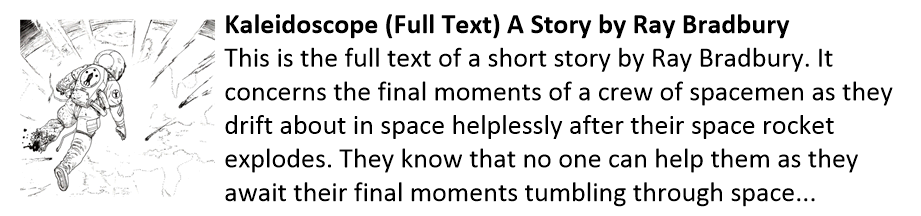
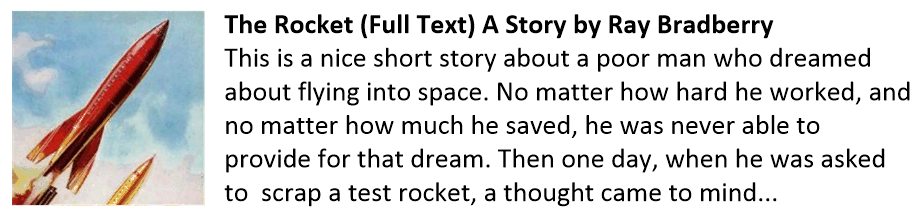
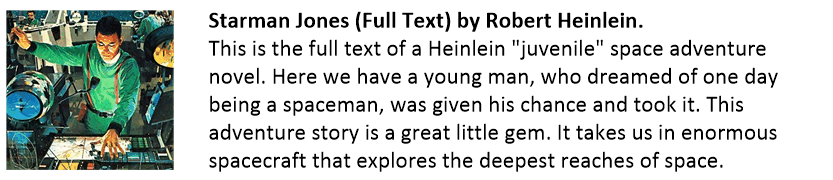
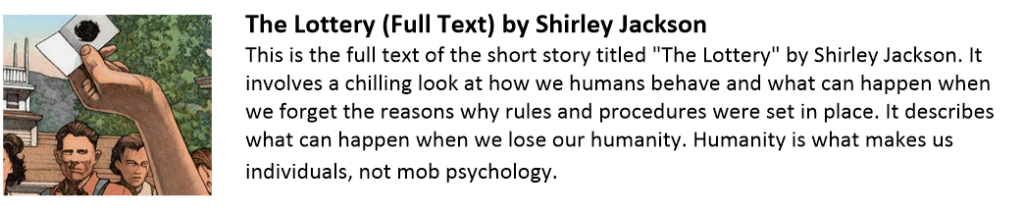
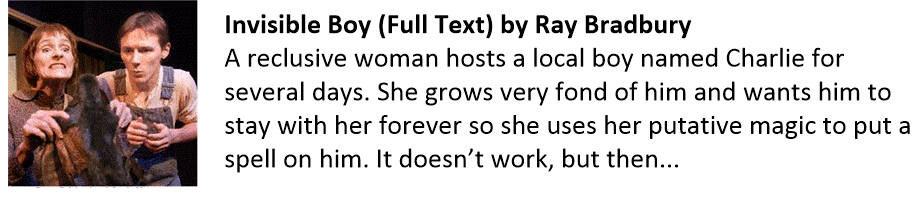
Here are reprints in full text of stories that inspired me, but that are nearly impossible to find in China. I place them here as sort of a personal library that I can use for inspiration. The reader is welcome to come and enjoy a read or two as well.



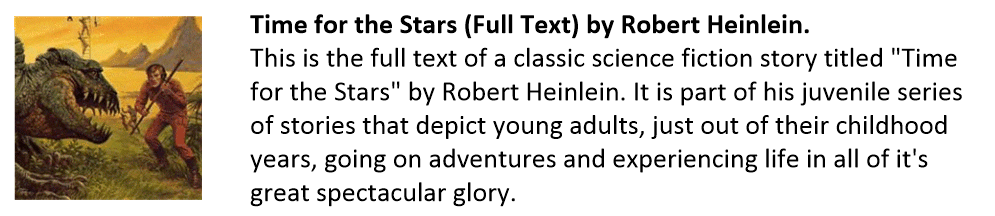



Articles & Links
You’ll not find any big banners or popups here talking about cookies and privacy notices. There are no ads on this site (aside from the hosting ads – a necessary evil). Functionally and fundamentally, I just don’t make money off of this blog. It is NOT monetized. Finally, I don’t track you because I just don’t care to.
- You can start reading the articles by going HERE.
- You can visit the Index Page HERE to explore by article subject.
- You can also ask the author some questions. You can go HERE to find out how to go about this.
- You can find out more about the author HERE.
- If you have concerns or complaints, you can go HERE.
- If you want to make a donation, you can go HERE.