
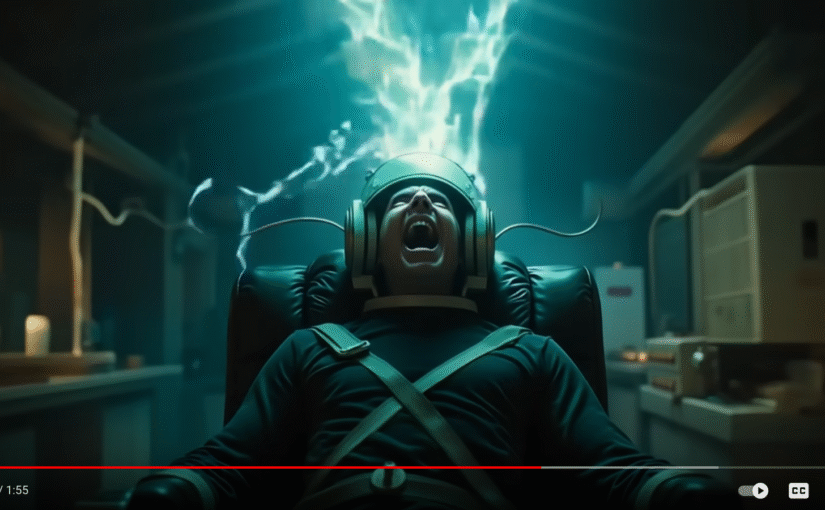
When I was in my early teens, my father asked me to lay down AstroTurf on our screened in sun-room. This was in the 1960’s. Normally it was a cement floor with a deep throw rug on it.
He wanted me to repair the torn screening, paint the slats white, and fix the door, and then finally lay down the green AstroTurf.
Seeing that I was only 12 or so, I think that I did pretty good.
My father bought the ingredients, and I just fixed the porch up by instinctive action. No guidance. He just told me to do it, and so I did. I did the entire thing myself. I think that I did really good, and it ended up looking really good.
A nice place. With a nice swing dangling from the ceiling, some plants, a nice shade, and a reinforced screen door to keep the dogs out.
This is one of those things that you I have long forgot about. But for some strange reason, I well remember it today. Ah, the memories.
*sigh*
Today…
How many months would it take for the US to expel the Russian army from Ukraine using non-nuclear weapons?
Anyone who thinks this would be a walk in the park should reconsider.
It took 13 NATO members, including the United States, seventy-eight days and over 38,000 combat missions (12,000 of them strike missions) to subdue the sanctions-weakened Yugoslav military and force them to leave Kosovo.
What finally made the Serbs (who were running Yugoslavia at the time) surrender wasn’t so much NATO airpower as the credible threat of a NATO ground incursion: American UH-64 Apache attack helicopters were preparing in neighboring Albania when the Serbs decided enough was enough.
The conditions for a quick American victory over Russia would be far worse:
- The Yugoslav Army was not only significantly smaller than Russia’s military, but it also lacked modern weapons. Even so, they still managed to shoot down an American F-117 stealth aircraft.
- Yugoslavia, at the time, was already on the brink of collapse—economically and morally. The people were exhausted after more than seven years of sanctions and hyperinflation.
- Yugoslavia also had no allies. The only country offering limited support was Russia, which itself was in shambles by the late 1990s. Russia today, however, could potentially count on China if the United States were to intervene directly in the Ukraine war.
The Yugoslav capital, Belgrade, during the NATO air campaign over Yugoslavia in 1999. (Picture source: unknown)
That said, with the Ukrainian military already in the field, the US would have an immensely capable ground force to exploit the situation.
It likely wouldn’t take long for the US to achieve complete air superiority over the war zone and then dismantle Russia’s military logistics network. How quickly this would render Russian units in Ukraine non-operational is anyone’s guess. Yugoslavia showed us that one should never underestimate an enemy in this regard.
Nevertheless, I think we all agree that such a scenario would be a disastrously bad idea. It would amount, more or less, to World War III.
What the United States should do instead is fully support Ukraine.
Unfortunately, the current Trump administration has declared its exit from this war and left Ukraine’s fate in European hands. In his recent statements, Trump acknowledged Ukraine’s ability to defend itself—but this should not be mistaken for US support. Quite the opposite has happened: America is out.
The Pulse in the Pines
Written in response to: “Start your story with the sensation of a breeze brushing against someone’s skin.“
Molly Alderson
“You shouldn’t pull your hair back too much,” she heard her mother’s voice ringing through the trees. “People will think you’re a boy.”
It appeared her mother and the wind had made some sort of deal that day…to expose Eliza as the woman she was. But neither the wind nor her mother’s memory could remove the days of soot and dirt caked to her skin and under her nails. Her black leggings and sweatshirt were so filthy they had almost taken on a new color, partly blood, partly mud, from days of sleeping outside and learning how to hunt for her dinner.
“I should get moving,” she thought, patting around the pine straw to find her glasses. When she slid them on, the world came into focus…the surrounding world, that is. The one she could see clearly now: tall pines, maples, squirrels darting through branches as if nothing had happened. Not the state of the world itself; that part was entirely unclear.
The last thing she’d heard, the reason she was in the woods to begin with, was that the hunters were out. And that she was not safe.
She wished she had been able to grab her radio on the way out to hear what was happening in the surrounding areas. But she knew something like that, a confiscated and banned device, would paint a bright, traceable target on her back.
She looked down at her forearm, still unhealed, scabbing and bleeding for four days straight. She wasn’t sure if the infection or the hunger would kill her first. When she touched it lightly, pain shot through her. “Ah” she flinched, watching it throb beneath her fingertips. The thick red lines were inflamed and angry, encircling the jagged hole she’d cut herself, with the only thing she had on her – the keys to her Jetta, to dig out the tracker.
The scar pulled her backward, hard, to that moment in Dr. Pilozzie’s office. Fluorescent lights buzzing like hornets, a refrigerator humming in the corner, the chemical bite of antiseptic and the metallic taste it left in her mouth. She remembered the waiting room had been crowded that day. Women with babies, two old men arguing softly in Spanish about baseball, a nurse calling names quickly. On the wall, a poster showed a smiling family with the caption, YOUR SAFETY IS OUR PRIORITY. The father in the picture had a finger gently pressed to his daughter’s wrist, as if taking her pulse.
“Eliza?” the nurse had called. “Eliza de la Cruz?” The way she said it, flattening the vowels, making de la into a hiccup…made Eliza stand up a little straighter, chin lifted, like her mother had taught her. Mi nombre no es difícil. But she didn’t correct the nurse. Tt had become a tired habit not to.
Inside the exam room, Dr. Pilozzie rolled in on his wheeled stool, white coat unwrinkled, name stitched in navy thread. He did not ask how she was, only confirmed her date of birth and tapped on a tablet. “Standard procedure,” he said, smiling without his eyes. “Given your…background, we’ll be administering the enhanced dose. For your safety.”
“My background?” she had asked.
“Mexican-American patients have a higher incidence of the G-variant response,” he replied. He said it gently, like a teacher explaining a fact to a child.
She thought of the forms her mother used to fill out, the bubbles that didn’t fit. Hispanic/Latino, check here. Not a race, check there. She thought of the way her mother would write their last name in careful block letters, as if it might protect them somehow. In that room, Eliza tried to lift her own questions to her mouth and found them too heavy to move.
“What happens if I say no?” she asked.
He didn’t answer the question; his smile did. “It’s standard,” he repeated. “For your safety.”
He hadn’t looked her in the eyes when he pressed the needle in.
A lie wrapped around his lips but hidden beneath a clinical mask.
Afterward, for weeks, she dreamed in static. They said there would be side effects and not to worry… but when she’d sleep…she’d always wake with the sense of being watched. There was a constant buzz under her skin. At first she thought it was anxiety, then she felt the pulse – faint and not hers.
Her mother noticed things. Estás pálida, mija. Have you eaten? Have you prayed? Her mother rubbed oil on her temples and told her not to pull her hair back so tight. It made her look “tensa,” too severe. Eliza listened and didn’t say anything about the humming under her skin.
Then the announcements began. Radios – banned. Certain roads in certain neighborhoods closed “for safety”. Curfews imposed. Checkpoints erected. And rumors, what turned into truths, about the hunters. The people who went missing were described as “relocated.”
A month later, her mom didn’t return from the grocery store. She went out looking for her on foot and neighbors yelled from behind closed doors and windows to go home. As quickly as possible. She couldn’t leave her mother. She needed to find her.
She left that night. She grabbed what she could carry and ran into the woods. Where she knew they couldn’t find her.
Now weeks had past and she was taken away from her memory and back into her boots. The forest was quiet. Too quiet. Even the squirrels had vanished.
The breeze carried something else. Not her mother’s voice, not memory…but something low. Mechanical. A sound that didn’t belong to the woods.
She crouched, pressing her palm into the damp soil. The sound grew louder. A faint red light flickered between the trees ahead. Steady, pulsing. Like a heartbeat.
Her heartbeat.
Eliza froze. Warmth spread beneath her sleeve. The scar on her arm darkened, sticky and wet. The light flickered faster.
She took a step back, breath catching in her throat. Then another.
Behind her, a twig snapped.
“Eliza.”
Her name. Clear. Human. Close.
She turned. Nothing but trees.
“Eliza,” the voice said again….only this time, it came from inside her head.
Her vision blurred. Colors pulsed. She stumbled forward, gripping her temples. Beneath her palms, she could feel something moving.
When she looked down, she saw it. Under the skin of her arm, just below the cut. A small red light blinking back to life.
The hum deepened, tilting the air. Then another light to her left. A third behind her. Red beads blooming in the underbrush.
She tightened the strap of her pack and forced herself to breathe. She needed to think. If the chip was dead, removed from her body, then what was blinking? She remembered the doctor’s hands…and the nurse peeling back a small square of adhesive she hadn’t thought much about. A “topical,” they’d said. She’d felt only the sting of the injection, not the press of something else against her skin.
She dug her fingers into the fresh scab. Blood slick on her fingers. Beneath the mess of what the skin had knitted in a broken pattern, blood. Embedded inside that uneven seam, the red blinked steady. Not in the place she’d cut, but beside it, nestled under a ridge of tissue. Smaller than a pea, but burning like an fire. Her stomach turned.
“Eliza,” the voice said again, almost gentle now. “Stop.”
She didn’t. She ran.
Branches whipped her face. Needles bit her ankles. The forest sloped, fell away, rose again. She aimed for the sound of water, convinced that somehow a stream might confuse the signal, might drown it. The red lights moved with her. Twice she tripped and went to her knees, palms grinding into grit. Twice she got up.
She burst into a clearing. A narrow creek sliced the earth in two, water chuckling over stone. She waded in, gasping as the cold seized her calves. “Come on,” she hissed at herself. “Come on.” She plunged her arm into the current and held it there. The red light bled into the water as a soft, pulsing smear.
The voice, closer: “Eliza. Do not damage the device.”
“Go to hell,” she said, but her mouth felt numb around the words.
She kept her arm under until her skin burned with cold and the pulse in her wrist turned numb. When she pulled it free, the light still blinked. Slower, then strong again. As if it had taken a breath with her.
She thought of her mother’s voice: Your name and your body are your only true belongings. She looked at her arm and felt, really felt, that neither belonged to her anymore.
Footsteps entered the clearing. Not one set. Many.
Eliza backed deeper into the creek, water tugging at her knees. She scanned the tree line and saw them. Figures in matte gray, faces mirrored, shoulders broad. Hunters, or the shape of them. The red lights on their chests flickered in time with the one beneath her skin, like a shared pulse. A drone nosed into view above their shoulders. No bigger than a hawk, rotors whispering. Its belly glowed red.
“Eliza de la Cruz,” the a figure said. Not a question.
She thought of her mother writing their last name carefully on forms. She thought of the G-variant. She thought of the chip that quit blinking and her own stupid faith that that had been enough.
“This is a retrieval,” the voice replied. It came from the figure, and from the drone, and inside her head, all at once. “For your safety.”
She felt something tug in her arm then, a tiny cramp, like a muscle knitting. The light brightened. A warmth crawled outward from it, slow, almost soothing. Her fingers went slack. The pack slid from her shoulder and splashed into the creek.
“Don’t,” she whispered.
The warmth deepened. For a strange second she wanted to sleep. Her knees felt heavy.
Then another voice cut across the clearing, low and hard as stone. Not the hunters. Not the drone. It came from the trees behind them.
“Move,” it said.
The gray figures pivoted in a single, fluid motion. The drone rose, angling toward the new voice. Eliza blinked, swayed, felt the warmth in her arm falter, then surge. The red lights beat faster, blurring into a single, furious glow.
A branch snapped. A shape detached from the shadows. Someone else was here. Carrying something that flashed darkly in their hands. For one wild second, Eliza thought of her mother’s rosary, the way the beads looked in low light.
The drone screamed. The figures advanced.
The light beneath Eliza’s skin flared so bright she saw the bones of her hand lit from within.
And in that electric white, she understood. The thing in her arm wasn’t just a tracker. It was a door. It had been waiting for a signal. It had been waiting for them.
The creek rushed louder, rushing nowhere.
“Eliza,” the inside-voice said one last time, almost tender. “Welcome back.”
The world narrowed to red, to the thud of boots, to a heat blooming in her blood like a second sun.
She did not know who the new voice belonged to. She did not know if the hunters were people anymore or if they had ever been. She only knew the device had decided to open.
She saw the first gray figure step into the water toward her. She saw the drone tilt, a dark pupil dilating.
She opened her mouth to scream.
The light stopped.
Stayin’ alive
What job offered to you was so shocking that you didn’t even believe that it was happening?
I had been unemployed for some months and with mounting debts I accepted an offer to work as a plumbers mate for a week. I had previously been a Managing Director of various companies flying around the World so it was a big change and required me to put my pride aside and get on with it!
On the second day I was covered in brick dust whilst removing plaster from an old wall. It was hard work but I had always enjoyed doing practical things so it was no trouble. My mobile phone rang… I ran outside to answer it..
Hello! You applied for the job as Uk director of our new venture and I am pleased to tell you that you have the job!
Oh that’s great I said and proceeded to agree to a large monthly salary, plus car, all expenses . This discussion took place with me in my work clothes in a back street of Halifax, covered in crap and surrounded by stray dogs.
Let’s meet up in Amsterdam next week and have some drinks and get to know each other said my new boss.
Er yes… why not? I said
After this meeting I worked freelance for him for the first month whilst he got the company and product ready to go. I sent him a bill for £ 5000 for that first month. He rang me straight away and told me…
It’s not enough for what you have done! Send me another bill please!
I sent a bill for £6500 instead
He paid the bill within minutes. And we carried on like this for some years.
He saved me from the scrap heap, allowed me to clear all my debts, keep our family home and move forward with my life.
At the end, the company went bust owing me £10000 and my boss was very upset . I told him not to worry, shit happens and you have already done enough for me!
I love you
Is it possible for both China and the U.S. to stay superpowers at the same time, or will one eventually have to fall?
Actually, this is possible, as the two countries are complementary in terms of capabilities.
However, the United States currently has no solution to its internal problems. This has caused the United States to lose confidence in sharing the world equally with China in the future.
Americans have found that they are no longer able to produce enough technology and high-end industrial goods to exchange for Chinese products. Their debt problems have gradually accumulated due to the lack of productivity. In order to ensure the profits of interest groups and the wealthy, they constantly cut the welfare and support for ordinary people, undermining the middle class and weakening their defense forces. The patents and technologies hoarded by Americans are becoming outdated, and the new things added cannot maintain their past advantages.
It’s not that China is unwilling to share the future with the U.S., but rather that the U.S. has lost this position due to its own greed and short-sightedness. Everyone around the world is waiting for the United States to get back on its feet and reposition itself to leverage its strengths. However, so far, the United States’ actions have been disappointing.
Pictures

21-Year-Old Cruel Brat Brutally Runs Over 2 Pedestrians, Then Acts Like Nothing Happened
The Cat Who Brought the Sun to the Farm
Prepare yourself for a tale of geological deductions, existential mangos, and the undeniable truth that a truly warm heart needs no thermostat.
The blizzard was of the Nor’easter variety, which Sir Whiskerton, the farm’s detective and philosopher, privately ranked as a “Grade-A Nuisance” on his scale of feline discomfort. The wind howled a dismal tune, and snow piled high against the barn door, creating a world of white silence.
Sir Whiskerton was conducting a critical examination of his morning nap spot (a patch of hay that was scientifically proven to be 2.4 degrees warmer than any other on the farm) when the barn door burst inward with a gust of wind that smelled faintly of pine and an unknown tropical fruit.
Standing silhouetted against the swirling white was a cat unlike any Sir Whiskerton had cataloged. This feline, named Jah-Mew, was a symphony of color against the monochrome snow. His thick, black dreadlocks were carefully tucked under a brightly colored Tam that Sir Whiskerton, squinting through his monocle, instantly cataloged as a “bizarre feather duster of uncertain tribal origin.”
Jah-Mew smiled—a slow, peaceful arc—and exhaled a puff of air that seemed less cold vapor and more a gentle, humid mist. The snow that landed on his shoulders melted instantly. He carried only a small, woven satchel and, slung across his back, a ceremonial Bongo Drum1.
“Greetings, friend,” Sir Whiskerton said, adjusting his monocle. “I must ask for your credentials. We have strict regulations regarding spontaneous heat sources during a Nor’easter. Your internal temperature appears to defy meteorological convention.”
Jah-Mew merely chuckled, a sound like dry palm leaves rustling in a soft breeze. He reached into his satchel and presented its contents for inspection: a single, glistening, overripe mango and a tiny, perfectly preserved ceramic rooster that he promptly placed on the hay.
Sir Whiskerton, ever the analyst, leaned closer to the satchel, his tail twitching. “I assure you, my dear fellow, the only vibes we register around here are the ones from Professor Quentin’s malfunctioning antenna,” he stated, referencing the inventor’s chaotic endeavors2. “We deal in data, not the intangible.”
“Wha’ppen, brethren?” Jah-Mew replied, his voice a low, melodic purr that rattled the rooster slightly. “Your aura is quite fire, but your worrying rhythm is off.”
Meanwhile, Porkchop the Pig, who was attempting to set a new personal record for “Longest Duration Buried Under Hay,” snorted himself out of his hiding spot, alerted by the scent of exotic fruit.
“A mango?” Porkchop squealed, momentarily forgetting the solemnity of the blizzard. “That’s not farm-standard fare. Is he a traveling salesman? Does he have a catalog?”
“He is a cat, Porkchop, which is already a significant hurdle in the cataloging process,” Sir Whiskerton observed. “And his appearance suggests he may be an anomaly in the known Cat Kingdom, perhaps a subspecies evolved entirely for sun-drenched philosophical contemplation.”
The absurdity peaked when The Farmer entered the barn. He wore a snowsuit that resembled a bruised blueberry and a look of profound confusion. He saw a cat, glowing with internal warmth, standing in a large pile of melting snow.
“Oh, look, a new tropical houseplant!” The Farmer exclaimed, his mind immediately leaping to gardening solutions. “My travel mug yucca did this last year! It means the roots are thirsty!”
Without a word, The Farmer retrieved a watering can and, with careful, deliberate focus, began to pour cold barn water directly onto Jah-Mew’s feet. Jah-Mew did not flinch. He simply looked down at his soaking paws and smiled wider.
“The external does not dampen the internal, brethren,” Jah-Mew announced to the water.
“See, Porkchop?” Sir Whiskerton whispered. “He is performing photosynthesis with his socks.”
The Farmer, satisfied with his irrigation efforts, walked over to his constant companion, the Scarecrow.
“Now, Scarecrow,” The Farmer murmured, adjusting the straw hat that was rapidly being dusted with snow, “should I offer the new cat a receipt for the sunlight he brought in, or is that a matter for Taxman Ted?”
This question, of course, went unanswered, much to the silent relief of the entire barn who had unpleasant memories of Ted’s last audit3333.
Later, Jah-Mew found a quiet corner and began to arrange his own personal altar to “Jah,” which turned out to be a carefully stacked pyramid of perfectly smooth river stones he had apparently carried with him. He sat down, pulled out his Bongo Drum, and began to tap a gentle, peaceful rhythm that immediately caused Sir Whiskerton, who had been stiff with suspicion, to involuntarily drop his monocle.
Sir Whiskerton, feeling a baffling, genuine sense of calm he hadn’t experienced since before The Case of the Cursed Wheelbarrow, immediately shifted from suspicion to forensic inquiry. He approached the river stones.
“Remarkable,” Sir Whiskerton muttered, tapping a gray stone with a perfectly manicured claw. “A metamorphic composition, likely granite, smoothed by fluvial action. I must deduce the geological origin of these ‘Jah’ stones. Are they from the nearby Winkle-Creek or an exotic, pre-Cambrian deposit?”
Jah-Mew only smiled and tapped his drum. “They are from where I found them, bredda. They are smooth because the water takes away the rough edges, yes? Just like the worry takes away the smooth edges of the heart.”
Sir Whiskerton paused, the granite cool beneath his paw. He had come here to deduce, to categorize, to solve, but the rhythmic pat-pat-pat of the drum and the gentle warmth radiating from the colorful cat melted the intellectual frost around his heart. For the first time all winter, the farm didn’t feel like a problem to be solved, but a quiet, ridiculous space to simply be.
The blizzard continued to rage outside, but inside the barn, where a pig was happily attempting to eat an overripe mango, a farmer was discussing tax law with a scarecrow, and a Rastafari cat was tapping a simple, perfect rhythm, the sun had undeniably arrived.
The End.
Moral:
True warmth and inner peace are not dependent on external weather or environment. Belonging is about finding your rhythm in any group, even if that group includes a cat who mistakes your hat for a duster and a pig who wants your fruit.
Best Lines:
- “I assure you, my dear fellow, the only vibes we register around here are the ones from Professor Quentin’s malfunctioning antenna.”
- “Your aura is quite fire, but your worrying rhythm is off.”
- “The external does not dampen the internal, brethren.”
- “He is performing photosynthesis with his socks.”
- “The water takes away the rough edges, yes? Just like the worry takes away the smooth edges of the heart.”
Post-Credit Scene:
Jah-Mew falls asleep on his smooth granite pyramid, purring. Porkchop the Pig attempts to roll the Bongo Drum away to use as a new footrest, but he can’t lift it. He tries to eat the overripe mango, but it’s too soft and collapses into a puddle of tropical goo, which he then tries to sell to a passing chicken as “Exotic, High-Vibration Farm Jello.”
Key Jokes:
- Sir Whiskerton mistakenly cataloging Jah-Mew’s Tam as a “bizarre feather duster of uncertain tribal origin.”
- The Farmer, mistaking Jah-Mew for a tropical houseplant, proceeds to water his feet with cold barn water.
- The Farmer’s conversation with the Scarecrow about issuing a receipt for sunlight to avoid an audit by Taxman Ted.
- Sir Whiskerton missing the entire point of the spiritual stones and trying to “deduce the geological origin.”
Starring:
Sir Whiskerton as The Feline Detective Who Finally Met a Vibe He Couldn’t Deduce
Jah-Mew as The New Cat Who Proves That a Mango is the Only Receipt You Need
Porkchop the Pig as The Unofficial Ambassador of Barn Snacks
The Farmer as The Man Who Puts the “Irrigation” in “Irreverent”
P.S.
Remember, dear reader, a good rhythm isn’t just for dancing. It’s the secret to not panicking when a pig tries to eat your overripe mango. Stay cool, but feel the inner fire.
DOLLY AND THE DAY THAT NEVER WAS
Written in response to: “Center your story around a character who can’t tell the difference between their dreams and reality.“
Victoria Crenshaw
Fifty-two years old, single, with one faithful cat named ZoZo and a job she didn’t exactly love but did very well. Every morning, without fail, her alarm clock rang at exactly 6:15 a.m. She would rise, stretch her arms toward the ceiling, whisper a quick prayer, and then shuffle to the kitchen to make tea.
Her cat ZoZo—fat, grey, and full of judgment—would always watch her from the top of the stairs as though supervising. Then, together, they’d begin their synchronized routine: Dolly humming gospel tunes under her breath, ZoZo flicking his tail to the rhythm.
But on this particular Tuesday, something was off.
The Alarm That Refused to Ring
When Dolly finally opened her eyes, it was not to the cheerful blare of her alarm but to the soft patter of rain against her window. She squinted at the clock.
7:02 a.m.
“What in the world—?” she gasped, sitting up so fast she nearly toppled off the bed.
The alarm’s little red light blinked mockingly. Dead batteries. Of course.
“Oh no, ZoZo! We are late!” she cried, throwing the blanket aside.
ZoZo stretched, yawned, and then—deliberately, almost cruelly—began walking very slowly down the stairs. His plump paws took each step as though he had all the time in the world.
“Move your tail, you lazy creature!” Dolly shouted, hopping on one foot as she struggled to pull on her skirt. “You’ll make me miss the bus!”
ZoZo simply blinked at her. His slow descent continued, one paw… at… a… time.
By the time Dolly finally got past him and rushed out the door, the bus stop was empty except for puddles and the smell of diesel. She sighed, rain already soaking her hair scarf.
That was only the beginning.
The Day That Refused to Be Kind
Determined not to surrender to bad luck, Dolly ran back inside, grabbed her umbrella, and—without realizing it—left her lunch sitting right on the stove, the burner still on low.
As she stepped into the storm, the sky seemed to mock her.
A car zoomed by. SPLASH.
Cold, brown water drenched her skirt.
She groaned and wiped her face, muttering, “Lord, take me now.”
Then another car passed. SPLASH.
And another. And another. And another.
Five times. Five separate vehicles found her.
By the fifth splash, Dolly stood in the street like a drenched statue, glaring at the traffic. “You all planned this, didn’t you?!” she yelled into the wind. “You evil motorists!”
An old man under an umbrella stopped and stared. “Are you all right, madam?”
She turned sharply. “Do I look all right?”
He nodded solemnly. “You look baptized.”
The Hot Mess in Heels
By the time she arrived at the office, Dolly’s shoes squelched with each step, and her mascara looked like a crime scene. She ran to her desk, hoping no one would notice, but her supervisor, Mr. Banda, was waiting.
“Ah, Dolly,” he said, his smile too wide. “You’re finally here! The shareholders are waiting in the conference room. You are presenting first.”
Dolly froze. “Presenting… what?”
“The quarterly performance report. You did the slides yourself!”
Her stomach dropped. “That’s today?!”
Mr. Banda’s smile faltered. “Yes, Dolly. It’s been on the calendar for three weeks.”
She bolted for the restroom.
The mirror did her no favors. Her hair was a soggy bird’s nest. Her blouse clung in weird places. She looked like someone who’d wrestled an umbrella and lost.
“Oh, sweet Jesus,” she whispered. “This cannot be my life.”
She leaned forward, breathing hard. Her reflection blinked back at her—only, it wasn’t perfectly synced.
Dolly blinked again. Her reflection didn’t move.
“What in the—?” she whispered.
Then, suddenly, the reflection smiled—a slow, eerie smile that she hadn’t made.
Wake Up Call
Her heart pounded. She shut her eyes.
And when she opened them again—
She was in bed.
The alarm clock was ringing cheerfully at 6:15 a.m.
“Wait,” she muttered. “What?”
ZoZo sat at the foot of her bed, licking his paw.
She touched the clock. It was fine. The light was steady. The rain had stopped.
“Did I just… dream all that?” she asked aloud.
ZoZo meowed, a deep, throaty sound that almost sounded like a laugh.
Déjà Vu, or Madness
Trying to shake it off, she got out of bed and went through her normal morning motions. Tea, scarf, shoes.
As she descended the stairs, she noticed ZoZo again.
He was watching her, tail swishing. Only this time—his mouth moved.
“Don’t miss your bus, Dolly,” he said in a calm, gravelly tone.
She froze mid-step.
Her cup of tea slipped from her hand and shattered on the floor.
“ZoZo?” she whispered.
The cat yawned. “Hurry. You’ll be late again.”
She stumbled backward, grabbing the railing. “Oh no, no, no. I’m still dreaming. I have to be.”
ZoZo tilted his head. “Do you want to test it?”
The Second Storm
Dolly pinched her arm. Hard. “Ow!” she yelled.
“Did that hurt?” asked ZoZo.
“Yes!”
“Then maybe it’s real.”
“Or maybe pain exists in dreams!”
ZoZo shrugged—if cats could shrug. “Either way, you should go. The bus will be gone in one minute.”
Panicking, she dashed out the door.
The rain started again. Exactly the same. Same dark sky, same cold drizzle.
The five cars passed, one after another, splashing her in perfect rhythm.
By the fifth splash, she screamed, “I refuse this nonsense!”
The old man appeared again, same umbrella, same look. “You again?”
“What do you mean again?”
He frowned. “You shouted the same thing yesterday, madam.”
The Mirror’s Game
At work, she ran straight to the restroom this time. She looked at her reflection and waited.
“Come on,” she whispered.
Her reflection blinked out of sync again. Then it spoke.
“You’re late, Dolly.”
She gasped. “Who are you?”
“I’m you,” said the mirror. “Or maybe you’re me. It’s hard to tell these days.”
“This is madness,” Dolly said.
“Is it? Or is the madness outside the mirror?”
The fluorescent lights flickered. Dolly backed away.
“I just want to wake up,” she whispered.
The reflection leaned closer, lips curling. “Then close your eyes.”
Loop Two
She did.
And woke up—again—in bed.
6:15 a.m.
Alarm ringing.
ZoZo sitting at the foot of the bed.
Only this time, the alarm display flickered between 6:15 and 7:02.
ZoZo purred. “Which one do you believe, Dolly?”
She grabbed the alarm clock and shook it. “I’m not playing these games!”
The numbers scrambled. 8:45. 3:10. 11:59. Then blank.
Her hands trembled. “God help me, I’m losing it.”
ZoZo hopped down and began walking—slowly—down the stairs.
Each step echoed louder than it should have. Dolly followed, her heart racing. The air felt thick, like she was underwater.
When she reached the kitchen, the stove light was on. Her lunch pot was simmering.
The smell of burnt rice filled the room.
“I left that yesterday…” she murmured. “Didn’t I?”
Time Folds
She checked her phone. The date read Wednesday, June 12.
She frowned. “It was Tuesday a moment ago.”
ZoZo leaped onto the counter. “Time is flexible when you don’t believe in it,” he said.
“Cats do not talk!” Dolly shouted.
“Neither do clocks that lie,” said ZoZo.
“Stop!”
“Make me.”
Her hands gripped the counter until her knuckles whitened. “This is just stress. That’s all. I’ve been working too much. Maybe I fainted. Maybe I’m in the hospital.”
ZoZo licked his paw. “And maybe the hospital is dreaming of you.”
The Presentation
Her phone buzzed. It was Mr. Banda.
“Dolly! Where are you? The shareholders are waiting!”
She looked down at herself—still in pajamas.
“But… I thought I did that presentation.”
“Dolly, please. Don’t embarrass me today. Hurry!”
She stared at the phone. “If this is another dream…”
“Then make it a good one,” ZoZo said, hopping off the counter.
The Third Awakening
When she blinked again, she was standing in front of the conference room projector.
Her slides were on the screen. Everyone was watching her.
Her boss smiled expectantly.
Her heart thumped.
She tried to speak, but the words wouldn’t come. Her throat felt heavy, like cotton.
The shareholders started murmuring.
Suddenly, all of them turned their heads in perfect unison—toward the window.
Rain poured outside.
A bus splashed past the glass, spraying water across it.
The room went silent.
Then ZoZo’s voice echoed faintly: “You missed the bus again, Dolly.”
The Hospital
She screamed—and everything went black.
When she opened her eyes, she was in a hospital bed. Tubes. Machines. A nurse adjusting her blanket.
“Oh thank God,” she said weakly. “I’m awake.”
The nurse smiled. “You’ve been asleep for two days, Mrs. Jameson. You fainted at work.”
Relief flooded her. “So it was all a dream.”
The nurse checked her chart. “You must have been very tired.”
Dolly sighed. “You have no idea.”
Then she noticed something—the nurse’s name tag: Zozo.
Her eyes widened. “Excuse me… your name is Zozo?”
The nurse smiled. “Yes, after my mother’s cat. Why?”
Dolly’s hand gripped the blanket. “No reason,” she whispered.
Outside the window, rain began to fall.
Return to Normal?
Two weeks later, Dolly was back home, trying to rebuild her routine.
Her doctor had recommended rest and light activity. So she brewed tea, brushed ZoZo’s fur, and told herself over and over: That was all just a dream.
Yet, every now and then, she’d catch ZoZo staring at her, eyes gleaming too intelligently.
One night, unable to sleep, she heard him whisper something. Just one word.
“Again.”
She sat up in bed. “What did you say?”
ZoZo was curled in his basket, snoring softly.
“Nothing,” she told herself. “I’m imagining things.”
Tomorrow That Never Comes
The next morning, her alarm blared at exactly 6:15 a.m. She smiled. Normalcy. Finally.
She turned to look for ZoZo. He wasn’t on the bed.
“ZoZo?”
A faint sound came from the stairs.
She stepped out of bed and saw him—walking slowly, deliberately, one paw at a time.
Her smile faded.
“No,” she whispered. “Not again.”
She looked at the clock.
7:02 a.m.
Her breath caught in her throat.
“No!” She grabbed the clock and shook it. “Wake up, wake up, wake up!”
The clock beeped. The rain began.
A horn honked outside.
Then—SPLASH.
Water sprayed across her face.
But she was inside her bedroom.
She looked up. The ceiling was leaking—rain pouring directly into her room.
ZoZo spoke again. “You’re late, Dolly.”
The Final Scene
Dolly laughed. Hysterically. “Fine! I’m late! Who cares anymore?”
She walked downstairs, soaking wet, her slippers squishing.
The house was full of mirrors—every wall, every surface reflecting infinite versions of herself. Each reflection moved differently.
One Dolly was crying. Another was brushing her hair. Another was giving the presentation confidently.
“Which one is real?” she asked.
ZoZo jumped onto the kitchen counter. “All of them. None of them. You decide.”
“I want to wake up.”
“Then sleep.”
She stared at him. “And if I’m asleep?”
“Then dream better,” he said.
Epilogue: A Dream That Never Ends
The next day—if there was such a thing as “next” anymore—her neighbor knocked on her door. No answer.
She tried again. Still nothing.
When the landlord finally opened the door, the house was spotless. Tea cup on the table. Lunch neatly packed on the stove. Alarm clock blinking 6:15 a.m.
And ZoZo, sitting calmly on the stairs, eyes bright.
He looked at the landlord, tail swishing slowly, and said in a soft, almost amused voice:
“She finally caught the bus.”
The End
What is it about wheat and rice that has the ability to sustain billions of human lives across various civilizations throughout history?
When wheat was first cultivated in the middle east, the head contained a pathetic eight seeds. However, thanks to random mutations, 16 seed varieties soon appeared, followed soon after that by 32 seed varieties. Unfortunately, unlike corn/maize, we’ve been unable to get it past that since (you get about 400 corn seeds from 1 corn seed).
That 32–1 ratio meant it was far more efficient to keep 1/32nd of your crop (or thereabouts) and plant it again the following year. Wheat also does well in places that get intermittent rain (like the Canadian prairies, the U.S. Great Plains, and Ukraine) – it can withstand a very long dry spell and still thrive.
Wheat, being a grass, can also be planted very close together, so you get a very high yield per acre.
Once you harvest the seeds, they’re pretty much shelf stable as long as you keep them dry. Even in ancient times, bountiful wheat harvests could be stored for years.
The only downside to wheat is that it’s not very appetizing in its raw form. You can turn it into porridge without too much effort, but the big breakthrough was bread, which pretty much became the fuel for civilization as a small amount could keep a person fed for the entire day and it didn’t have to be consumed immediately after it was cooked.
Of course, although wheat reached China, another source of carbohydrates made itself handy.
While wheat provides a pretty good yield, rice blows it out of the water. A single rice seed can produce a plant that will produce 300 grains of rice, and maybe 1,000.
The problem is that rice is harder to cultivate. You can grow wheat directly from seed (just plant it) but rice has to be grown from seedlings, which are then planted by hand in an appropriate environment. Rice also has a demand for a lot of water during its growing life, which generally starts off in a shallow pool we call a “paddy”. Rice plants, unlike wheat which can tolerate anything that isn’t frost, require a very warm environment – freezing over will kill them.
But once again, once harvested, rice is pretty much stable forever as long as you keep it dry and fairly cool.
Once again, from ancient times, empires grew on their rice surplus which could be stored for years. In Feudal Japan, rice was actually the basis for the monetary system until mercantilism took hold. The basic unit was the “koku”, about 150 kg of rice, which would be enough to feed one person for one year. It was how feudal revenue was calculated and affected how much samurai got paid. Today, that’s roughly three times what a typical person on a rice centered diet would eat.
Unlike wheat, which needs processing to become tasty, rice just needs to be steamed or boiled and is quite palatable. It can even be cooked and re-used the next day heated. The Japanese also found another trick – if you wrapped fish in cooked rice, the fermentation of the rice would keep the fish from spoiling.
Man Calls OFF His Wedding After He Finds Out This…