
Yesterday, I mentioned some of the things that I need to deal with as a direct result of myself giving out some personal contact information.
Now, I think that you all kind of, sort of, appreciated what a ROYAL PAIN IN THE ASS IT EVOLVED INTO.
But let me give you some context.
So… here I am, I’m in a meeting. Teleconference on ZOOM (sometimes Microsoft teams, or Google-Meet). I’m on screen. The CEO, with his CIO are discussing something really important, and the other person, a CEO with his board of directors are in a lively and deep conversation about some financial arrangements, I am mediating the situation, when my phone lights up…
And again, and then again…
The term is “blowing up the phone”.
So I pick it up, and glace at it before I mute it — just put it in airplane mode.
I'm going to kill myself, why don't you pick up. I need your help. The Domain Commander told me that I will become very wealthy this month. I followed what you said. I listened to you. Now I only have a few dollars to my name I hate you. Help me. Why don't you answer? This is...
I put the phone in airplane mode. Went back to the meeting.
But am now so shaken up. So disturbed. So upset that I cannot think properly.
So I let the meeting run on auto-pilot while I compose myself.
And eventually as a nice guy (Big Mistake), I responded. But I only had a 15 minute window …
This kind of things happens when I am at dinner. When I am working, When I am jogging. When I am weight lifting. When I am in the bank talking to the bank manager. When I am repairing a downed internet router. When my PC is crashed and apparently DOA.
Just random, out of the blue (from my perspective), chaos and turmoil.
Ugh.
Anyways. Don’t people have a life? Where do they get the time to bitch moan and complain? Aren’t they working, either for themselves or for someone else? What’s my disconnect?
*sigh*
Perhaps it was a REAL MISTAKE to go public with what I know and what my experiences are.
Today…
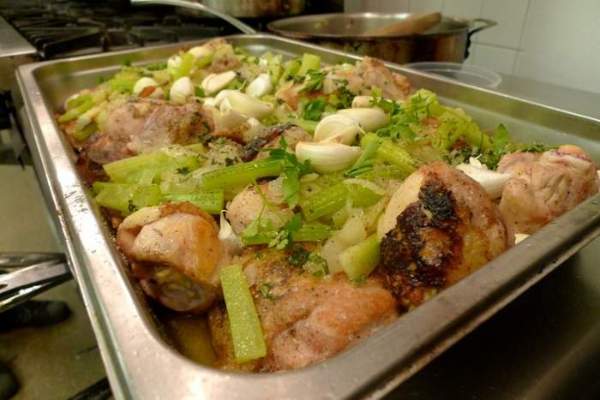
Chicken with 40 Cloves of Garlic
This recipe is so much fun! During the meal, you squeeze the garlic onto bread and spread it like butter. Simply delicious!


Yield: 8 servings
Ingredients
- 2/3 cup oil
- 8 drumsticks and 8 thighs or 16 of one
- 4 ribs celery (in long strips)
- 2 medium onions, chopped
- 6 sprigs parsley
- 1 tablespoon fresh or 1 teaspoon dried tarragon
- 1/2 cup dry vermouth
- 2 1/2 teaspoons salt
- 1/4 teaspoon freshly ground pepper
- Dash of nutmeg
- 40 cloves garlic, unpeeled
- French bread or toast
Instructions
- Heat oven to 375 degrees F.
- Combine celery, onion, parsley and tarragon and place in a heavy 6-quart casserole or 9 x 13-baking dish.
- Dip chicken pieces into oil to coat evenly and place on top of vegetables. Add vermouth; sprinkle with salt, pepper and nutmeg. Tuck garlic around and between chicken. Cover tightly with foil and lid.
- Bake for 1 1/2 hours without removing cover.
- Serve with pan juices, garlic and slices of bread. Squeeze garlic out from root end of papery husk onto bread and spread like butter.
Attribution
Photo credit: InfoMofo on Visual Hunt / CC BY-SA
Make Butter in 10 Minutes or Less! | Chef Jean-Pierre
From the Dust of the Ground
Written in response to: “Write a story that has a big twist.“
Madalyn Chevalier
It was in her pocket that I found my notebook. The first page gave me the only clues I have to who I might be.
Jane Doe – Age 20-25
Recovered from 11 Lavenza Lane – Project Genesis.
The rest was empty, pristine, ready for me. I sat, watching the woman for a while. I wished her eyes would close. I don’t like that they seemed to follow me as I stood, moving about the room and collecting my shoes. She watched me step over her and go out into the hallway. I remember that place reeked of death. I couldn’t stay there another minute. I paused only to begin my story anew.
My name is Jane?
Now, I stand before 11 Lavenza Lane. I stuff the crinkled road map into my back pocket and gaze up at the colossal structure in front of me, hiding behind a rusting iron gate. The bars spiral up into points like corkscrews. The house juts out of the land like a broken bone, all bleached stone walls and sharp angles. The windows are dark. The only movement is the fluttering of dead leaves as they lose their grip on the branches and fall gently to their deaths. I love to watch them fall. I write that down.
I love falling leaves.
I slip my notebook into my other pocket and place my hand tentatively on the rusting gate. A jolt runs through my whole body, so intense that for a moment I feel sure that it is a physical shock, that some kind of current is dancing on the surface of the gate. I step back, reeling. Flashes of images shoot across my mind’s eye, too fast to make sense of – a garden, a house made of glass, stairs, burning green eyes. Then they are gone. I am standing in front of the silent house, and all is calm once more.
Garden. Glass house. Green eyes.
This time, when I touch the gate, nothing happens. I push, and it swings open without even the slightest creak. The fallen leaves crunch under my sneakers as I take my first slow steps into the quiet courtyard. Gnarled trees with balding branches line the walkway on either side, silent and weary sentinels. In my mind, I catch an image of them, heavy with foliage and bleeding sticky-sweet sap. But then it is gone.
With every step I take, I become more and more certain that I have been here before. It is as though my muscles remember, even if my consciousness does not. My legs move of their own accord, stepping over protruding roots with practiced ease. I turn away from the main path and walk down a graveled side track, heading to the east side of the house. The sun peers out from behind a cloud for only a moment, but it is long enough for me to catch the glimmer of light on glass. I run down the trail, the gravel shifting under my feet, sharp edges pushing through the soles of my shoes.
I turn the corner and there it is, a large glass structure rising out of the remnants of a rose garden. The glass house must have once been a beautiful sight, the lustrous panes shining out of gold trim. But no more. Every beautiful pane has been violently smashed, leaving behind jagged bits of glass, glistening like teeth in some monstrous mouth. Even the roof has shattered, and vines pour out of it, new life bursting from the glass houses’ splintered corpse. A film of black soot coats the panels.
Standing there, surrounded by shards of glass and rotting greenery, I begin to shake. My mouth dries out, and I find myself swallowing repeatedly as the feeling of my throat closing grows. The thundering is back. Am I dying? Will I drop to my knees and rot here next to the wild blooming rose bushes? My knees buckle, and I fall to the ground. I feel shards of glass tear through my pants, ripping my skin. I barely feel them. I do not bleed.
After a few moments, the world ceases to spin. I rise shakily to my feet. I try to brush the shards from my pants, but they stick to my sweaty palms. The thundering is still so loud in this silent, dead place. It is hard to write with these bits of glass boring their way deeper into my flesh.
I am afraid.
I step through the open entryway into the greenhouse. The ground is littered with shattered terracotta pots, bits of charred trellis. Every single stalk, bush, and flower is reduced to crumbling black ash and soot. What leaves remain are brown and dead, curled in on themselves as if contorted in agony. The sight of them fills me with horror. Did they fear the fire? Did they feel the hot flames licking up their stems? I reach over and brush my fingers over a blackened stalk. It crumbles under my touch.
I walk through the wreckage, the graveyard of ruined life, until I hear a hollow thump under my feet. I pull away a singed, soot-stained rug to reveal the brass handle of a small square door cut into the stone floor. I am not surprised to see it. I think I might have been looking for it all along. When I lift the door, I’m met with the familiar smell of wet earth and the electric scent of rain. The fire did not reach whatever lies beneath. A set of stone steps winds down into the gloom in front of me, illuminated by fluorescent lights, jarring in their artificiality.
The stairs spiral downwards in a dizzying coil. The stone steps are slick with moisture and patches of dark earth. In these spots, pungent mushrooms sprout, their soft, spongy bodies a sickening yellow. I try to avoid stepping on them as I make my way ever downward. With each step, my pulse quickens. I feel the itch to pull out my notebook. I pause on a slightly wider step.
I am getting closer.
The last step gives way to a short passageway, the walls thick with sticky green algae. I step, blinking, into a cavern carved into the very stone. The walls are lined with steel tables, shining metal instruments, and monitors, dark but humming with torpid life. Overhead, more fluorescent lights flicker, struggling to keep their brilliance in the abandoned space.
I walk along the wall, running my fingers along the cold metal. It feels so familiar, and the hum of the monitors is, to me, a lullaby heard and half remembered from the shrouded memories still locked in my mind. I pause in front of the larger monitor. A small red light blinks on and off rapidly, as if the monitor is dreaming, eyelids fluttering. I reach out and press a button at random. There is a soft click, a brief moment of silence, and then the soft whir of waking machinery. The monitor lights up.
I stare at my face on the screen. It is rotating steadily, offering the viewer a 360-degree view of my head. My digitized eyes stare out, dead and unblinking. I feel the familiar coiling in my chest. I press the button again. This time, lines of text begin to materialize across the screen. My eyes flick back and forth. I grip the edge of the steel table tighter and tighter.
EVE 1
HEIGHT: 5’7” WEIGHT: 135 lbs.
COMPOSITION: LOAM AND CLAY – pH 7.35
FIRST SUCCESSFUL SPECIMEN. EVE 1 WAS CREATED FROM A 70/30 MIXTURE OF LOAM AND CLAY SOIL, ORGANIC MATERIAL, AND WATER. EXPOSED TO GEOTHERMAL HEAT AND CODED SONIC PULSES
TOTAL PROCESS – 3 MONTHS
CONCERNS – UNPREDICTABILITY, HEAT FLUCTUATIONS, HEART PALPATATIONS
TERMINATION MOST LIKELY NECESSARY – TOO VOLATILE.

Under the monitor, there is a scrap of paper taped to the screen. A single sentence is written there in spidery letters.
“Then the Lord God formed a man from the dust of the ground and breathed into his nostrils the breath of life, and the man became a living being.”
The shroud over my memories is ripped off, and it all comes flooding back to me. The agony of lying on those steel tables, the heady smell of earth and electricity, and the never-ending pulses shooting through my skull. Memories of someone leaning over me, green eyes alight with triumph, with violent elation. His hands mold me, shape me, every touch an agonizing pressure on forming skin. I hear his voice.
“You are the first, Eve! My child! Woman of clay! I breathe life into you! You will live, you will learn.”
I look down at my trembling hands. I see skin that is rough and patched. There are lines and smudges along its surface, as though hands have tried to smooth it. Not skin. Clay. Dirt. I think of the burnt and dead plants sitting in their charred pots many feet above my head. I think of how they crumbled at my touch, from dust to dust. I step away from the monitor. I don’t know how. I don’t know why. There is a steadily growing horror within me as I continue staring at my hands.
A soft moaning sound catches my attention. There is an open doorway to my right, and from it, humid, sour air wafts. Once more, I’m moving forward, willing my legs to stop but unable to. I pass through the entryway and find myself in the dreaded chamber. I know this place in my bones. Do I have bones? The sharp smell of electricity and dirt, the unbearable warmth from the steaming vent in the earth, the cursed pulsing. I stop at the edge of the vent, staring down into the crater.
She lies there in agony as I once did, a pile of molded clay and earth, strange growths forming into arms and legs. Her skull is fully formed, and skin and tissue are starting to grow. Green eyes roll madly in their sockets as she turns to look at me, her newly formed mouth twisting and opening in a silent scream. Only a moan slips out. She reaches for me with a three-fingered claw. Eve 2. New and improving.
I remember now what I have done before. This time, I will make no mistakes. I turn away from my sister and walk back to the main cavern. My legs are no longer trembling, and I am no longer overwhelmed with heat and sweat. Even the thundering in my chest is quiet. It does not take me long to find the matches, sticky, stinking oil. I anoint the cavern with it, this heinous, blasphemous place, and strike the match. The flame leaps to life, and I shudder. When I drop it, the blaze roars.
I retreat to the edge of the stairs, watching as righteous fire steadily burns. When I am satisfied that it will not stop, I reach into my back pocket and pull out my notebook. I stare at my sparse ramblings and add one more.
It is finished.
I rip out that first page and toss it into the flames. They eat at it hungrily, and within seconds, it is gone, and Jane with it. I march up the stairs, clutching my pen tightly in my hand. I try to ignore the sound of cracking and hissing fire. When the trapdoor thunders down behind me, the sound is mercifully muted. I breathe full for the first time. A muddy tear slides down my cheek.
I sit on the scorched floor of the glass house, ignoring the faded, gleeful snapping of the fire. Outside, the sun has come fully from behind the clouds. It is warm on my face. In this new light, I notice something I missed before, one splash of green and yellow. A single daffodil, its dainty trumpet wilted but blooming. It sits in a soot-stained pot. I pick it up, breathing deep of its verdant scent. Together, we sit on the stone floor.
I take out my notebook and begin again.
My name is Eve.
Koreans react to “TONY from LC Sign” for the first time!
What happened to Private Ryan after the government found him?
From everything we can see in the film, James Ryan survived to return home and live a long, successful life. Unfortunately, it seems to be one where he dealt with a serious case of survivor’s guilt.
(Ryan at John Miller’s grave in Saving Private Ryan. His family is in the background as he confronts his guilt over Miller dying to save him.)
The frame story in the film depicts James Ryan as an elderly man visiting Normandy with his wife, children and grandchildren. From all appearances they all seem to be doing just fine in life – happy, affluent and close to one another.
Call that a win for James Ryan.
He’s lived a good long life, raised a family, succeeded financially and is even able to travel internationally with his entire family.
But he’s still plagued with guilt for surviving the War and for having other men die to rescue him. This is why he specifically seeks out the grave of Captain John Miller when he visits Normandy.
Miller’s dying words to Ryan, “earn this,” have stuck with him for all those intervening years. No matter how good a person he might be, he just doesn’t know if his happiness is worth all the sacrifice and death that bought it for him.
So he breaks down in tears at Miller’s grave asking his wife to console him that he lived a good life and was worthy of all he has.
Pictures


What are the biggest culture shocks people face when coming to Germany?
I’m a Mexican who just spent 6 months studying at a German university in a “small” city called Wolfenbüttel (right where they make Jägermeister).
And there are a couple things that I found really interesting:
- Knuckle-clapping: At the end of every class, the students thank the professor or lecturer by knocking their knuckles against the table in a sort of german-clap. Even today I find that amusing. (JVS wrote on the comments the explanation to this, pretty interesting)
- Punctuality: Mexicans, and Latins in general, are famous for not being very punctual. While on the other hand Germans are worldwide known for their punctuality. I can say that that is true for any official appointment: Lectures, meetings, classes, bus and train stops, but not for parties. At least between young people (20-ish).
- Cleanliness: Almost every public place, classroom, shop and street is extremely clean. And all the time. I’ve been to Amsterdam and other French cities and they are not as clean as German cities.
- Take off your shoes: It doesn’t matter if it’s your grandmas or an strangers house. You have to take off your shoes. So you better sew any holes in your socks!
- Mineral water: A lot of people buy boxes of mineral water, even though that tap water is drinkable. I guess they just like it a lot.
- Red lights: I doesn’t matter if there’s not a car in sight. You can’t cross the street if there’s a red light on. Period.
- What’s 24/7?: You might say that Germans are lazy. Most stores and government dependencies open from 09:00 until 15:00 with 1 or 2 hours of break. And NOTHING opens on Sundays. Maybe one bakery, but that’s it.
And those are the most important ones. I hope that you find this helpful!
EDIT 2
Wow, I didn’t expected to see so many likes. Thanks guys!
Regarding the red light issue, some people have pointed out to me that I isn’t that harsh. All I can say is that while some people do it (I did is sometimes) it is illegal, so if a cop sees you, you’re gonna have to pay a fine of 10 Euros, and that’s some money that I would rather invest in a beer.
And here are a few more S H O C K I N G things about Germany:
- Best father-day ever: They celebrate Vatertag in a very distinct manner. groups of men, legal-to-drink-aged men, and sometimes women, go out to the streets and parks with something called “Bollerwagen”, a sort of wagon that is equiped to storage and supply beer and sausages to the group of people. Everyone would be tipsy by midday at the park and the guys would just stroll with their Bollerwagen while enjoying their beer and food.
- DIY cigarettes: A lot of people smoke in Germany. That’s a fact, but, students and a lot of people buy their own tobacco, filters and rolling paper and do their own smokes. They have told me that they save a lot of money. I think that they would save a lot more if they didn’t smoke.
- Quiet, we’re eating: I am used to me very noisy. If you go anywhere in America, and I mean, USA and all Latin America, our restaurants and public places are pretty noisy. But, everytime that I would go to the mensa (cafeteria) at my university or any other restaurant, it seems as if the people weren’t talking at all, they speak at a very low volume and that also surprised me, and also called some attention to my table for being always the noisiest.
That’s it, hope you guys find it helpful!
Sir Whiskerton and the Skunk Who Smelled of Self-Doubt
Ah, dear reader, you return to find me, Sir Whiskerton, in the midst of an olfactory offense of the highest order. This is not a tale of a sinister plot or a grand theft, but of a misguided soul and a cologne so foul it could wilt flowers at twenty paces. It is a story of identity, insecurity, and the profound truth that sometimes, the very thing you try to hide is your greatest strength. So, hold your nose, if you will, for the pungent parable of Boris the Super-Skunk.
The Scent of a Not-So-Super Hero
It began with a heroic pose and a smell that defied all description. Boris the Super-Skunk, a creature who usually cut a dashing figure in his tiny cape and mask, stood atop the fencepost, declaring his intent to protect the farm from all danger.
“FEAR NOT, CITIZENS!” he announced, striking a gallant pose. “FOR I AM HERE—ahem—cough—goodness, what is that smell?”
The smell, dear reader, was not his natural, respectable musk. This was something else entirely. It was a thick, cloying, aggressive odor that smelled like a forgotten gym sock had been used to marinate a wheel of particularly confrontational cheese. It was the scent of desperation.
Doris the Hen, who had been on her way to deliver a bulletin on the falling price of cracked corn, took one whiff, her eyes rolled back in her head, and she fainted clean away onto a conveniently placed pile of hay.
The Case of the Corrupt Cologne
As I rushed to Doris’s side, the culprit became clear. Hovering near the gate was Sammy the Traveling Salesman, looking immensely pleased with himself.
“A success!” Sammy chirped, waddling forward. “I told him! One spray of ‘Musk of Manly Magnificence’ and all will tremble before him! A bargain at twice the price!”
Boris, looking deeply embarrassed, held up a gaudy glass bottle with a label that was already peeling off. “He said it would project an aura of… unapproachable toughness.”
Just then, Doris stirred. She didn’t open her eyes, but her beak moved, delivering a dramatic, fainting-critique. “Top notes of… rancid onion… a heart of despondent barnyard… and a base of… profound regret.” She then fell unconscious once more.
It was clear a investigation was in order, but the crime scene was the very air we breathed. I immediately mandated the use of protective equipment. Soon, the farm animals were a bizarre sight: a feline detective in a monocle and a tiny, flower-scented face mask, a pig in a polka-dotted handkerchief, and a rooster with a clothespin on his beak.
The Unlikely Attraction
Our investigation into the cologne’s origins (fermented onions and a “proprietary fromage essence,” according to a dropped invoice) was interrupted by a new development. The smell was so potent, so uniquely awful, that it attracted a rival from the deep woods: a grumpy, elderly badger known for his own formidable odor.
The badger trundled into the barnyard, sniffing the air with a look of competitive fury. “Who dares?” he grumbled. “Who challenges the reigning champion of reek? This is an act of olfactory war!”
Boris, the would-be hero, had accidentally declared a stink-war he was doomed to lose with his artificial stench.
The Resolution: Embracing the Funk
It was at this moment of peak absurdity—a masked Sir Whiskerton, a fainted hen, a furious badger, and a skunk on the verge of tears—that Boris had his epiphany. He looked at the gaudy bottle of “Musk of Manly Magnificence,” then at the genuinely intimidating badger who respected only natural talent.
“This is ridiculous,” Boris declared. He drew himself up to his full height, turned his back on the badger, and gave a gentle, respectful lift of his tail.
A familiar, sharp, yet clean and honest scent filled the air. It was the scent of Boris. The real Boris.
The badger sniffed once, nodded in professional respect. “Ah. The classic. A fine vintage. My apologies for the intrusion.” He then turned and trundled back into the woods, the dispute settled by a master showing his true colors.
Doris, revived by the familiar, less-assaulting odor, sat up. “Oh, thank goodness! You’re back! That other stuff was simply tragic.”
The Aftermath
Boris the Super-Skunk learned a powerful lesson that day. He threw the bottle of cologne into the compost, where it was politely but firmly rejected. He now wears his natural scent with pride, his superhero persona finally aligned with his true self. Sammy the Salesman was briefly banned from selling ” aromatics,” and the farm returned to its normal, naturally-scented state.
Moral of the Story: Don’t try to cover up who you are with a poor imitation. Your authentic self, funk and all, is always more powerful and respected than any mask you can wear.
The End.
Post-Credit Scene:
A week later, Sammy is seen trying to sell the badger a new “Eau de Earthworm” perfume. The badger listens patiently, then unleashes his own natural scent in response. Sammy faints. The badger takes his sample case as a trophy.
Best Lines:
-
“Top notes of rancid onion… a heart of despondent barnyard… and a base of profound regret.” – Doris the Hen, perfume critic.
-
“I am ready for battle! (Sniffs himself) … or maybe a good bath. The case is stinky.” – Boris the Super-Skunk
-
“Who dares? Who challenges the reigning champion of reek?” – The Badger, declaring a stink-war.
-
“The classic. A fine vintage.” – The Badger, conceding defeat to authenticity.
Starring:
-
Sir Whiskerton (The Detective in a Floral Mask)
-
Boris the Super-Skunk (The Hero Lost in Cologne)
-
Sammy the Salesman (The Merchant of Miasma)
-
Doris the Hen (The Dramatic Victim & Critic)
-
The Badger (The Gatekeeper of Authentic Funk)
P.S.
Remember: The world is full of people trying to sell you a better version of yourself. But the most super power you’ll ever have is the courage to be the original.
Why do people keep saying China’s economy is collapsing when places like Shenzhen seem so bustling and busy?
You are right. This question just points out a huge lie that Western society and the media have been trying to fabricate to people who have never been to China in recent years – China’s economy is collapsing, Chinese people have no future, and China is going to end. The reason why Western countries and the media do this is nothing more than jealousy, fearing that China will replace their always central position. After all, one’s own happiness is always built on the pain of others.
I even believed this statement before, but later I found that this lie is very fragile. As long as you have set foot on Chinese territory, you can’t believe the lie that China’s economy is collapsing. In fact, not only Shenzhen, but also Beijing, Shanghai, Chengdu, Chongqing, and even some second- and third-tier cities are very prosperous and advanced. The streets are clean and tidy, with tall buildings everywhere, and the subway is well-developed and punctual. You don’t even need to bring a wallet when you go out, because mobile phone scanning payment covers almost all supermarkets in China. The malls are crowded with people, the office buildings are still lit at 11 o’clock in the evening, and startups are one after another. This is not fabricated by me, this is my real observation.
The first time I went to China was because the company sent me to conduct research, and the partner of my company happened to be in Shenzhen. That trip to China completely overturned my perception. Shenzhen’s subway runs every three minutes, and the sidewalks are full of new energy vehicles. At that time, I also visited an AI company, whose founder is a 35-year-old female doctor of science and engineering. The company has raised hundreds of millions of yuan and is now developing smart driving chips. Its customers include Xiaopeng and BYD (both of which are Chinese new energy vehicle brands).
At that time, she took us to the entrepreneurial street in Shenzhen Bay. It was close to ten o’clock that night, and the street was brightly lit. The entrepreneurial team held a discussion in the conference room, the cafe was full of young people typing code, and there was a 24-hour convenience store and shared workstations on the basement floor. I suddenly realized that I had been deceived by Western media for many years. If this is called an economic collapse, then I really can’t imagine what the community where I live in Chicago is called when the streets are empty at 7 o’clock in the evening, with only homeless people wandering the streets like zombies.
If you say that this is because Shenzhen is a world-famous big city, it would be strange if it is not prosperous, then let me tell you about the situation in China’s second- and third-tier cities. For example, Huai’an City.
You may not even have heard of this city. It is a prefecture-level city in Jiangsu Province in southern China. It is not close to the sea, not close to the metropolitan area, and not the first stop for traveling to China. I know this city because a colleague came from Huai’an. When he went back to visit his family, he invited me to travel to his hometown. And such an ordinary city is far beyond the economic collapse portrayed by Western media.
At that time, our plane landed in Nanjing, Jiangsu Province. We had to take the high-speed rail to reach Huai’an. When I got out of the Huai’an High-speed Railway Station, I was stunned. The square in front of the station was wide and bright, with greening, English guide signs, shared bicycles and other supporting facilities. As a foreigner, if I travel to China by myself, there would be no obstacles.
My colleague also took me to their favorite night market, called Hexia Old Street, which amazed me even more. There were street food stalls one after another, and snacks included candied haws, beef soup, roast duck, etc. The price was also very reasonable. A roast duck cost about 40 yuan (equivalent to 5 US dollars). Young people there are in groups of two or three, most of them are working people who just got off work, and many young people are using their mobile phones to live broadcast the hot scenes of the night market.
The flow of people there is dense and the consumption is vigorous, and there is no sign of depression at all. This is even Huai’an, a place that few foreigners have heard of. With such infrastructure, night market economy and infrastructure, I really can’t believe the saying that “China’s economy is collapsing”. So, the truth is right under your feet. If you still have doubts, you might as well take advantage of China’s 240-hour visa-free policy to go to China and see if the economy there has collapsed.
The Blue Key
Written in response to: “Center your story around a character discovering a hidden door or path.“
Low Heffer
Horror Science Fiction Thriller
“Dad?” The word escaped before he could stop it.
Richard’s face crumpled when he saw his son. They’d both ended up here, in this nightmare—Henryk for his rampage, Richard for trying to save him afterward. For killing a judge. For tampering with evidence. For throwing away everything to protect a son who couldn’t be saved.
The Chief waited for them in a vast concrete room. In its center stood something that shouldn’t exist: a simple wooden door in a frame, standing alone with nothing behind it. Just a door to nowhere.
“Welcome, D-Class,” the Chief said, his voice like grinding stone. “You’re going to help us with an experiment.”
He held up a key. It was blue—not painted blue, but blue like the deep ocean, like it had been carved from a piece of the sky. It seemed to pulse with its own light.
“SCP-860,” the Chief continued. “This key can open any door in the world. But when it does, you don’t go where the door should lead. You go… somewhere else.”
Julianna started sobbing. “Please, I’m innocent! My sister—it was my sister! She killed that deputy and made me take the blame!”
The guards raised their rifles. One struck her with the butt of his weapon, sending her stumbling into Todd.
“Your safety,” the Chief said slowly, savoring each word, “is not guaranteed. Open the door.”
Richard took the key. His hand shook as he approached the standing door. When he turned the key in the lock, the sound it made was wrong—like bones breaking underwater.
The door swung open.
Beyond should have been the concrete wall of the containment room. Instead, there was a forest. But calling it a forest was like calling a nightmare a dream. The trees were wrong, everything tinted blue as if seen through deep water. A dirt path wound between the trunks, splitting and branching into infinity. No birds sang. No insects buzzed. The silence was heavy as a burial shroud.
“Proceed,” the Chief ordered.
They had no choice. The guns at their backs made that clear.
The moment they stepped through, the air changed. It was thick, almost syrupy, and tasted of copper and ozone. The door swung shut behind them with a soft click that sounded final.
“What the fuck is this?” Todd muttered.
“It’s a forest,” Henryk snapped. “Don’t ask stupid questions.”
Todd stepped toward him, fists clenched, but Richard intervened. “Both of you, stop.”
That’s when they heard it—a sound like purring, but wrong. Too deep. Too large. It seemed to come from everywhere and nowhere, growing louder as they walked deeper into the blue twilight.
“Is that a cat?” Julianna whispered.
They followed the path because there was nothing else to do. The trees pressed closer with each step, their blue bark pulsing like veins. Julianna tried to fill the suffocating silence.
“What did you all do? To end up here?”
Todd’s answer made Henryk’s stomach turn. “I did things… to a girl…”
“Shut up,” Henryk snarled. “Just shut up.”
“I didn’t mean—”
“I SAID SHUT UP!”
Richard spoke quietly. “I was in cybersecurity. When I heard what Henryk did, I tried to help him. I killed a judge. My own boss. I threw away everything.”
“Why?” Henryk’s voice cracked. “Why would you do that for me?”
“You’re my son.”
“I murdered innocent people, Dad. I let stupid, small things build up until I exploded. I destroyed families. Why would you—”
The purring sound suddenly became a roar. Close. Too close.
“Hide!” Henryk screamed.
They scattered in different directions, crashing through the blue undergrowth. Julianna ran blindly, her foot catching on a root. She tumbled down an embankment, her leg snapping with a sound like a branch breaking. She rolled into a cave filled with blue mist and glowing crystals.
And Todd’s remains.
What was left of him had been torn apart, scattered across the cave floor like a child’s broken toy. Something had eaten him—no, played with him first, then eaten him. His face was gone, but she could still recognize the orange jumpsuit, now dark with blood that looked black in the blue light.
Julianna’s scream caught in her throat. She vomited, then dragged herself out of the cave on her broken leg, leaving a trail of blood on the blue moss.
Above, Henryk and Richard found each other again, but the path was gone. They were lost in an endless blue forest with something hunting them.
“We’re going to die here,” Henryk said, his voice hollow.
“Son—”
“No! We’re going to die, and maybe that’s right. Maybe I deserve this. All those people I killed… maybe this is justice.”
Richard pulled his son into an embrace. “Remember when you were little? You used to slide headfirst down every slide because you saw people doing it on waterslides?”
Henryk laughed despite everything. “I thought all slides were the same.”
“You were so stubborn. You’d argue with anyone who tried to tell you different.”
That’s when Julianna found them, dragging her broken leg, her face bright with desperate hope. “There’s another door! A white door with a keyhole! We can get out!”
For a moment, hope flickered.
Then the forest exploded.
The thing that burst from the trees was wrong in every way something could be wrong. It had the shape of a cat, but it was the size of a truck, made of porcelain and wood and living vines all fused together in impossible ways. Its eyes were holes that went down forever, and when it opened its mouth, there were too many teeth in too many rows.
It took Julianna first. One moment she was there, the next she was in its jaws, her scream cut short. It shook her like a ragdoll, then flung her broken body at Richard, pinning him to the ground.
“Dad!” Henryk reached for him, but the thing was already on Richard, those impossible teeth closing around his chest. Richard’s eyes met Henryk’s one last time.
“Run,” he mouthed, blood bubbling from his lips.
But Henryk didn’t run. He fell to his knees in the blue moss, understanding finally washing over him.
“I deserve this,” he said to the thing as it turned toward him, Julianna’s and Richard’s blood dripping from its porcelain jaws. “Every bit of it.”
The thing tilted its head, almost curious. Then it lunged.
Back in the containment facility, the Chief reviewed the report without emotion.
“All four D-Class deceased,” the technician reported. “The anomaly in SCP-860-1 killed them all. We still don’t have enough data on what exactly it is.”
The Chief nodded. “Prepare the next group.”
“Sir, should we warn them about—”
“No. We need to see if different groups encounter the same entity. Besides…” He looked at the blue key, now back in its containment box, pulsing with that strange light. “They’re death row inmates. Their lives were already forfeit.”
The wooden door still stood in the center of the containment room, waiting. Tomorrow, four more D-Class would walk through it. And the day after that, four more. The Foundation would keep feeding people to whatever lurked in that blue forest until they understood it.
Or until they ran out of prisoners.
The blue key pulsed in its box like a heartbeat, patient as death itself, waiting for the next hand to turn it in a lock. Waiting to show them what waits behind every door—
The blue forest where even the mercy of death comes with teeth.
Koreans React To ‘Mr. Rogers’ For The First Time | 𝙊𝙎𝙎𝘾
Chicken with Molasses-Mustard Glaze


Ingredients
- 4 pounds chicken parts, rinsed and drained
- 1/3 cup molasses
- 1/3 cup spicy brown mustard
Instructions
- Heat the oven to 450 degrees F.
- Season chicken with salt and pepper. Arrange it in a single layer in a nonstick baking dish.
- Bake for 20 minutes or until the skin loses its raw look.
- Meanwhile, mix the molasses with the mustard. Spoon off any excess fat in the pan. Pour about two thirds of the molasses mixture over the chicken and turn to coat.
- Bake for 25 to 30 minutes for thighs, basting with some of the sauce in the pan every 5 to 7 minutes.