
Here is my opinion on what the best toasting bread is…
Oh, there are some great answers on Quora! I’m particularly fond of the raisin bread suggestion. But no, that’s not where my own preference lies.
My recommendation is (drum roll) Potato Bread.
Here’s the thing—it’s not really about the taste. It doesn’t taste like a potato; it tastes like excellent, normal bread. The magic is all in the texture when toasted.
This bread is practically engineered for a toaster. It gives you a perfectly flat, solid, golden-brown surface, covering a nice spongy middle that stays warm and wonderfully chewy. It’s the ideal canvas for butter and jam, or for holding up under a couple of fried eggs without getting soggy.
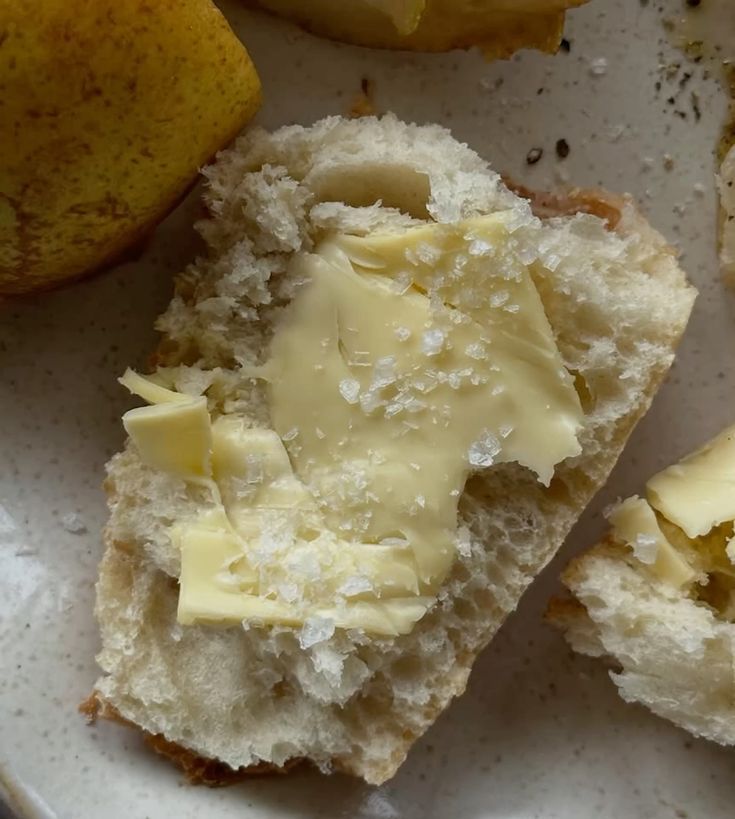
My personal vote is to eat it with eggs and coffee, or simply on its own with a good, salted butter. You can’t go wrong.
So my friend asked a hypothetical question.
“Where would you bring a foreign guest to impress upon him the ethos and progress of our nation Singapore?”
I thought it was an elegantly framed question, and complimented him, but his question stumped me.
I told him I’d mull over it and give him an answer later.
It took the weekend, but I (think) I came up with an equally elegant answer.
I picked Our Tampines Hub.
It looks non-descript, but it stands out as an oddity occupying such a huge footprint in the heart of Tampines. This is prime land that can fetch Orchard Road-esque rent, being a stone’s throw from the MRT and bus interchange.
This integrated-use hub combines a regional library, football stadium, swimming complex and other sports facilities, community club, f&b (including a hawker center) and shopping. Truly a lifestyle hub.
Most impressively, it was built with sustainability in mind, designed from the ground up by DP architects, a Singaporean design firm. This is one reason why it cost $500m to build.
I daresay there isn’t a private club offering any facility better than what ordinary citizens have access to at Tampines Hub. Incidentally, the hawker center is one of the most affordable on the island, and the offerings above average mostly, no doubt a PA-mandated social initiative.
I’d like to think Tampines Hub is Singapore in microcosm.
- Eco-smart and sustainable.
- Small but thoughtful use of space and resources.
- Rich, but lavished economically on the commons.
Singapore is at the forefront of urban living in the 21st century.
The little red dot that can.
Feminists Have Fought To Work And Then They Hate It LOL
Pictures





















































Neanderthal Cannibals Targeted Women and Children in Brutal Massacre

A chilling discovery in the depths of Belgium’s Goyet caves has revealed that Neanderthals engaged in selective cannibalism approximately 45,000 years ago, deliberately targeting gracile women and children from rival groups. New research published in the journal Scientific Reports provides the most comprehensive evidence yet of inter-group violence among Late Pleistocene Neanderthal populations, painting a grim picture of competition and conflict during a critical period in human prehistory.
The study, conducted by an international team of researchers, examined the skeletal remains of at least six individuals discovered in the Troisième caverne of Goyet in Belgium. What makes this assemblage particularly disturbing is not just the evidence of cannibalism, but the demographic pattern of the victims. Four of the individuals were identified as adult or adolescent females of notably short stature and gracile build, while the remaining two were young males—a child and a newborn infant. According to IFL Science, genetic analysis confirmed the sex of seven specimens, revealing this troubling pattern of selective predation.

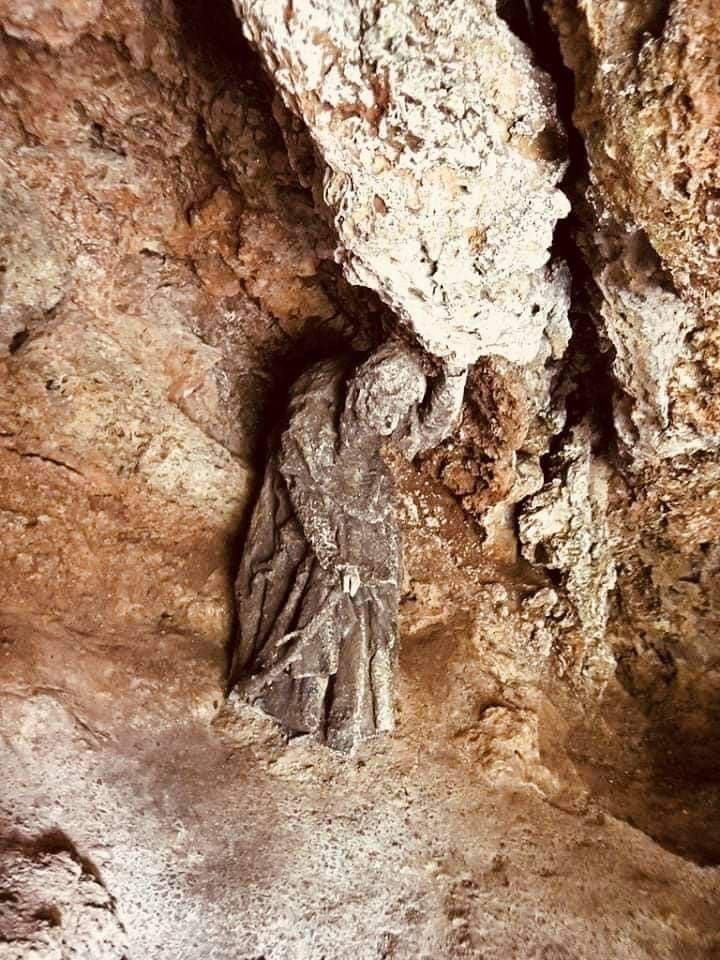
The Goyet caves in Belgium where the cannibalized remains were discovered. (Beaux Villages de Wallonie)
Unmistakable Signs of Butchery and Violence
The bones discovered at Goyet represent the largest assemblage of cannibalized Neanderthal remains in northern Europe. Nearly one-third of the 101 skeletal fragments bear unmistakable signs of anthropogenic modification, including cutmarks from defleshing and disarticulation, fresh-bone fractures, and percussion notches indicating marrow extraction. The processing of these human remains mirrors the butchery patterns observed on the associated animal bones from horses and reindeer found at the site, suggesting nutritional cannibalism rather than ritualistic practices.
The skeletal analysis revealed even more disturbing details. The adult female victims were significantly shorter than typical Neanderthals, with estimated statures falling well below the average range for their species. One individual measured so short that she fell nearly two standard deviations below the Neanderthal norm. The structural properties of their limb bones indicated gracile morphologies with reduced diaphyseal robusticity compared to other Neanderthals, suggesting these individuals were deliberately selected based on their physical vulnerability.
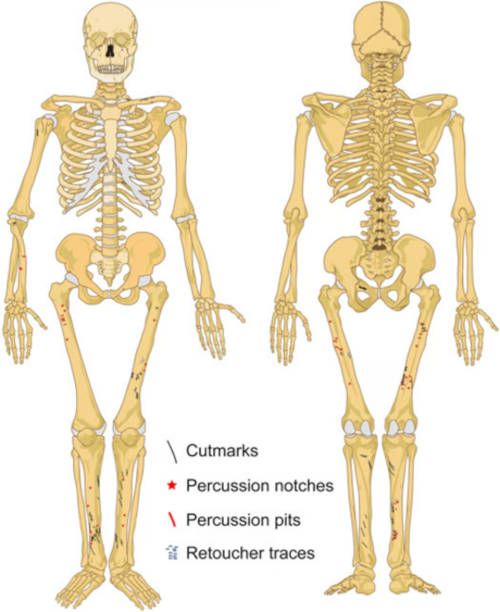
Neanderthal bones showing cutmarks and butchery evidence. (Nature Scientific Reports)
Non-Local Origins Point to Inter-Group Conflict
Isotopic analysis of the victims indicated that all the cannibalized individuals were non-local, meaning they did not belong to the Neanderthal group that consumed them. This finding transforms the interpretation from possible endocannibalism (eating members of one’s own group) to exocannibalism – the consumption of outsiders, typically associated with warfare and inter-group violence.
The victims shared similar isotopic signatures, suggesting they came from the same geographic region and possibly belonged to a single social group or multiple groups with similar diets. Despite being foreigners, their skeletal structure showed no particular adaptations for high mobility, meaning they likely did not stray into hostile territory while foraging. This evidence points toward a more sinister conclusion: they were targeted and captured.
The researchers conducted statistical analysis comparing the Goyet assemblage to theoretical mortality profiles and other Neanderthal populations. The probability of the observed demographic composition—four adult females, no adult males, and two juveniles—occurring by chance was statistically highly unlikely. This strongly suggests deliberate selection of weaker individuals, possibly as a strategy to undermine the reproductive potential of competing groups.
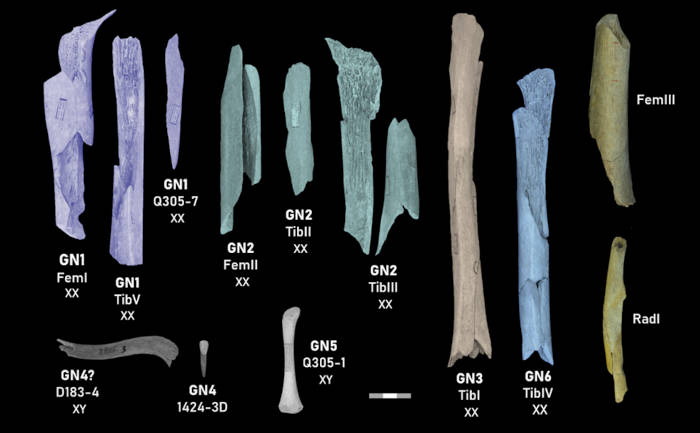
Neanderthal skeletal remains from the Goyet caves in Belgium showing evidence of cannibalism and butchery, with XX being female and XY being male. (Cosnefroy et al. /Nature)
Competition in a Changing World
The timing of these events, dated between 41,000 and 45,000 years ago, coincides with a period of significant upheaval in Ice Age Europe. This era marked the gradual arrival of Homo sapiens in western Europe, with modern human groups documented roughly 600 kilometers away at Ranis, Germany, around the same time. The additional competition and stress that our ancestors’ presence placed on Neanderthal populations may have triggered increased inter-group violence and territorial conflicts.
The Belgian territory along the Sambre-Meuse axis during this period appears to have been a cultural corridor between Western European Mousterian-type industries and Central and Eastern European “Keilmesser group” traditions. These strong cultural differences might indicate limited interaction between contemporaneous Neanderthal groups who perceived each other as different or threatening. As demographic pressure increased with the arrival of Homo sapiens groups, competition for resources likely intensified, potentially triggering episodes of violence and cannibalism.
Understanding Neanderthal Violence
While the precise motivations behind this act remain impossible to determine with certainty, the evidence suggests targeted predatory behavior toward vulnerable members of neighboring groups. In ethnographic records, exocannibalism is consistently associated with warfare or competition between groups, involving the violent abduction of individuals from outside communities. The unusual demographic profile at Goyet – the overrepresentation of gracile females and juveniles – cannot be explained by natural mortality patterns or simple subsistence needs, especially given the abundant animal remains at the site.
The researchers propose that this selection strategy might have aimed at undermining the reproductive capacity of competing groups, a behavior documented in multiple contexts of inter-group conflict from the Neolithic onward. This case at Goyet represents the most compelling evidence to date for inter-group competition among Late Pleistocene Neanderthal populations, challenging simplified narratives about our extinct cousins.
The discovery adds another layer to our understanding of Neanderthal behavior, revealing that these ancient humans faced many of the same pressures and engaged in some of the same brutal practices as modern humans when resources became scarce and populations competed for survival. Far from being simple brutes, Neanderthals demonstrated strategic thinking in their selection of victims, even in their darkest moments.
Top image: Neanderthals eating a feast of meat. Source: Gorodenkoff/Adobe Stock
By Gary Manners
What makes you glad to be old? 22 more answers
I’m (relatively) old—62 at this writing.
A few minutes ago, I got a call from a recruiter for a principal engineering position.
I told her that I’m not seeking any change in employment as I will be retiring in about two or three years. I’m already a principal engineer at my current employer so I wouldn’t gain a thing and I’d have to move for the job, which is not going to happen.
If I were ten or fifteen years younger, I would have felt like I’d have to at least talk to them about the position even if I didn’t take it. That’s what you do when you are building a career—you are always open to that next big thing. You talk to a lot of people because you need to stay ahead of the layoffs and career stalling. You need a full time job.
But I don’t even want to talk to them. I’m not building a career anymore. I’m where I am in the industry, and that’s going to be it. I get a ton of recruiting emails and texts and I ignore them. About a year ago, Meta reached out to me hoping I’d consider a position with them. I said no. I don’t want to drive to an office an hour away from me and be forced to work 14 hours a day because that’s their culture. Why? I could care less about promotions. They can’t pay me enough to put up with that. I want to do other things now.
Well, maybe for a short while if it’s like twice what I make now. But it won’t be. I’m too old to put up with the shit a young person out of college will do for these companies, and I don’t have to do it.
This Monday will be the last Monday I will work on a formal basis—next year I’m going down to four days a week with Mondays off. I’ll have three day weekends every week this coming year. Then in 2027 it will be four day weekends—I will not work on Mondays and Fridays.
I am glad to be old enough where I don’t have to work full time anymore. it’s really a relief to not have to depend on a job anymore. Losing my job (which isn’t likely in the two or three years I have left) won’t be devastating. I don’t need a full-time job—contract work will be sufficient if I need to find work before 65.
I feel the same way about a lot of stuff right now—I have completed my education, I have been married, I own homes, I have had a successful career that has given me the ability to have a good retirement without having to work. The stuff that is worrying a lot of people now will not impact me or will impact me very little. I am financially, emotionally, and physically in good shape.
I can see now why people say “Glad I’m old”. Being old relieves you of a lot of issues that as a younger person, you have to deal with.
Col 27 -Book 490 – Sir Whiskerton and the Late, Late Rabbit (A Tale of Time, Tea, and the Courage to Begin Again)
Ah, dear reader—prepare your monocle, your teacup, and your sense of wonder. Today’s story does not begin with a quack, a snort, or even a kazoo blast.
It begins with a thump-thump-thump—light, urgent, alive—as tiny paws drum against the earth like a heartbeat skipping toward destiny.
So take a breath. Slow it. And step—gently, curiously—into Sir Whiskerton and the Late, Late Rabbit.
The Rabbit in the Waistcoat
It began, as all great adventures do, on a Tuesday—golden, still, humming with the lazy buzz of bees and the distant snore-squeak of Porkchop mid-nap.
Then—thump-thump-THUMP!—a blur of brown and gold shot past the hayloft:
A rabbit in a velvet waistcoat, brass pocket watch swinging like a pendulum, spectacles slipping down his nose.
“Late! Late! I’m late for my own arrival!” he cried—voice high, frantic, tender.
He vanished behind the old oak—leaving a trail of glowing clover, each leaf pulsing soft green, like fireflies caught in daylight.
Ditto, perched on the roof railing, gasped.
“Rabbit! Rabbit!”
“Rabbit!” echoed Echo—from inside a rain barrel.
Sir Whiskerton flicked an ear.
“Hmph. Either he’s fleeing something… or rushing toward everything.”
“Everything! Everything!”
Ditto didn’t hesitate.
He leapt—not after the rabbit, but into the wonder—and followed the glowing trail to a burrow entrance, ringed with whispering dandelions.
Their seeds trembled as he passed—
“Go on,” they sighed. “Time waits for no one… but it will make space for you.”
Ditto took a breath—and stepped inside.
The Chrono Hollow
The burrow didn’t descend.
It unfolded.
One moment: dirt and root.
The next: The Chrono Hollow—a realm where time didn’t march, but danced—in spirals, loops, and gentle eddies.
- A teacup on a stone table refilled itself mid-sip—steam curling in slow motion, sugar dissolving like falling stars.
- The scarecrow leaned against a willow—not creaking, but humming, his straw softening, his hat less askew, his eyes less hollow.
- Doris’s egg, laid hours ago, floated above the grass—not hatching, not cooling, but pulsing, like a heart learning its rhythm.
Ditto stood still.
His breath came fast.
“What if I’m not ready?” he whispered.
The Hollow echoed—not his words, but his fear:
“Not ready… not ready… not ready…”
Then—
A soft fwoomp.
Zephyr materialized—not in his lava lamp, but as a figure woven from amber light and quiet hum, one paw resting on a great, golden dial labeled:
“PAUSE”
“Hey, sugar,” he murmured, voice like wind through reeds. “You don’t need more time. You need more attention.”
“Attention! Attention!” echoed Ditto—but softer now, like a question.
Zephyr smiled.
“Time ain’t a ruler. It’s a river. And rivers don’t rush—they listen.”
The Spiral Unwinds
Ditto closed his eyes.
Listened.
Felt the spiral—not as trap, but as invitation.
He exhaled.
Then—so softly, only the dandelions heard—he whispered:
“What if… I am?”
The words landed like a pebble in still water.
Ripples spread.
The spiral unwound.
The teacup stopped refilling—steam vanished, sugar settled.
The scarecrow sighed—a real, human sound—and adjusted his hat.
Doris’s egg gave one final pulse—and settled, warm, whole, ready.
From the willow’s shadow, the rabbit stepped forward—no longer frantic, but calm, pocket watch now steady in his paw.
He smiled at Ditto—not with relief, but recognition.
“There you are.”
“There… you… are…” echoed the Hollow—not a repetition, but a homecoming.
The Moral of the Story
That evening, as fireflies rose and the farm hummed in C-sharp, Sir Whiskerton addressed the animals—not from the roof, but from the circle.
“The moral of the story, dear reader, is this:
Persistence isn’t about rushing—it’s about returning, again and again, with gentle focus.
Ditto didn’t find time. He found stillness. He didn’t outrun his fear—he turned toward it, whispered to it, and let it unfold.
So go ahead. Be late. Be early. Be lost.
Just don’t stop listening.
The river is waiting.”
Doris dabbed her eyes.
“A temporal metaphor! I can’t bear it!”
“Bear it! Bear it!”
And Ditto?
He curled beside Sir Whiskerton, one paw resting on his chest—where his heart beat, steady, sure, no longer rushing, but arriving.
Post-Credit Scene
Later, Zephyr added a new label to his dial:
“Resume: When You’re Ready.”
And outside—the dandelions sighed again:
“You were always on time, sugar.
You just needed to hear your own rhythm.”
Jingle on. 🐇⏳✨
(Or, in farm-ese: Thump… pause… there you are …)
The End.
Would you like Col 28-Book 2 next—Sir Whiskerton and the Hall of Mirrors That Only Show Kindness? I’m ready to step into the next wonder.
April 6, 1967. South China Sea.
The night the guns fired, Douglas Hegdahl was knocked overboard from the USS Canberra. The 20-year-old farm kid from South Dakota disappeared into dark waters. By dawn, he was in enemy hands—a prisoner of war in North Vietnam.
He’d been in-country less than a month.
Most POWs who arrived at Hanoi were shot-down pilots—officers with training, men who knew classified information. Doug arrived soaking wet, confused, barely able to explain what happened.
His captors looked at this bewildered young sailor and decided: This one’s simple.
And Doug Hegdahl made the most strategic decision of his life.
He let them believe it.
Not just a little slow. Aggressively, obviously, almost comically incompetent. He fumbled basic tasks. He looked confused by simple questions. He’d wander around bumping into things, startled by every loud noise.
They laughed at him. They mocked him to his face. They gave him humiliating nicknames.
And they stopped watching him closely.
While hardened pilots sat in isolation cells, interrogated and tortured, the “stupid American” was sent on work details. They figured he was too simple to cause trouble.
They were catastrophically wrong.
While stumbling around like a fool, Doug was conducting sabotage. Dirt in fuel tanks. Loosened bolts on equipment. Quiet disruption of the North Vietnamese war machine—all while maintaining his act of harmless stupidity.
But his real mission was far more important.
The North Vietnamese were hiding information about American POWs. They wouldn’t confirm who they held, who was alive, who had died. Back home, families lived in agonizing uncertainty.
Doug realized: If they think I’m too stupid to be dangerous, they’ll let me near other prisoners.
So he started his real work.
Memorizing.
Every POW he encountered. Every name he heard whispered. Every detail he could gather.
Name. Rank. Capture date. Unit. Hometown.
256 names. 256 men whose families deserved to know they were alive.
But how do you memorize 256 complete profiles when you’re malnourished, exhausted, and can’t write anything down?
Doug found a way.
He turned them into a song.
Using the rhythm of “Old MacDonald Had a Farm,” he encoded every name, every detail into a children’s melody. Day after day, while playing the fool, he was silently rehearsing. Building a mental database his captors would never suspect.
By 1969, senior officers—including future Senator John McCain—recognized what Doug had accomplished. When the North Vietnamese offered to release a few POWs for propaganda, those officers gave Doug a direct order:
Take it. Get the information out.
August 5, 1969.
The North Vietnamese released three prisoners, including the “simple-minded” American who’d never been useful anyway.
They thought it was a propaganda victory.
They’d just released the most valuable intelligence asset of the war.
The moment Doug reached friendly territory, he delivered everything.
All 256 names. All the details. Men the U.S. military now knew for certain were alive in North Vietnamese prisons.
Those names changed everything. Families who’d lived with unbearable uncertainty finally had answers. The government could pressure North Vietnam about specific prisoners. When POWs were finally released in 1973, those 256 men came home to families who’d never stopped hoping.
Because a 20-year-old farm kid had the wisdom to sacrifice his pride for a higher purpose.
Think about what Doug chose. He could have maintained his dignity. Could have resisted proudly like other prisoners. Instead, he endured mockery. Let grown men laugh at him. Accepted humiliation—all to gather intelligence that would bring hundreds of men home.
Doug Hegdahl received the Silver Star. He testified before Congress about POW torture. He became an advocate for prisoners and their families.
But his greatest achievement? Those 256 names. Those families given hope. Those men who came home.
Today, Doug is in his late 70s. He rarely speaks about his experience. He never sought glory.
He just did what needed to be done.
Somewhere tonight, there are grandchildren who exist because their grandfather’s name was sung to a children’s melody in a Vietnamese prison. There are families who had decades more time together because a young man decided his ego was worth less than 256 lives.
The most powerful weapon isn’t always strength.
Sometimes it’s the wisdom to appear weak. The courage to let others underestimate you. The brilliance to turn contempt into your greatest advantage.
Real heroism doesn’t always look heroic.
Sometimes it looks like a stumbling fool who can’t work a shovel.
Until you realize that fool just memorized 256 lives and changed the course of history.
Never underestimate the power of letting people underestimate you.
And never forget the farm kid who proved that sometimes the bravest thing you can do is let the world think you’re stupid—because 256 lives are worth more than pride.
America CAN’T Keep Up with China’s High-Tech CITIES! (they lied abt China!)
A HOMEMADE SLOPPY JOE RECIPE
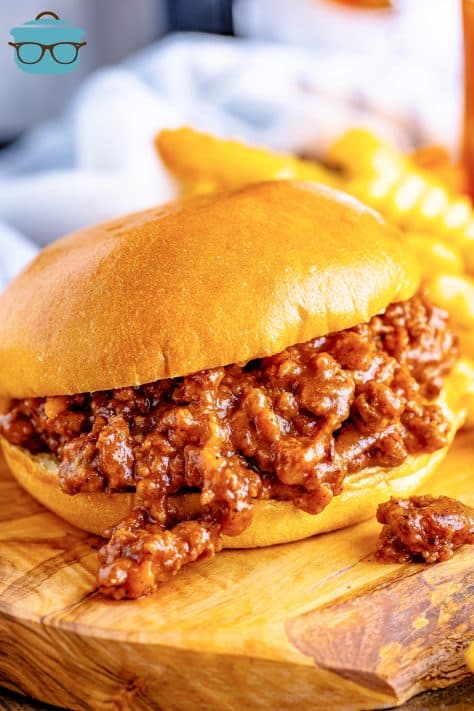
Is there any food better than the food from our childhood? I bet all of us can name at least 5 foods that we ate as a kid that we will always love and remember. This is definitely one of them for me! Now, I don’t have any problem with good ole Manwich in a can. I like it. But Sloppy Joes are kinda like spaghetti sauce. Sometimes you want to make it up from scratch when you have time!

FREQUENTLY ASKED QUESTIONS:
Can Sloppy Joes be frozen?
Yes. The Sloppy Joe filling can be frozen. Place leftover filling in a freezer safe ziploc bag and remove as much air as possible. Flatten it out. Freeze for up to 3 months.
What goes with Sloppy Joes?
There are lots of options. Generally we eat them with a side French fries or potato chips. Other ideas included: baked beans, tater tots, potato salad, macaroni salad and macaroni and cheese.
How do you make Sloppy Joes on the stovetop?
The flavors really develop as this simmers gently in the crock pot but it can be made on the stovetop. Brown ground beef and onion in a large pot. Drain excess grease and return beef mixture to pot. Stir in the rest of the ingredients (omit the flour.) Bring mixture to a boil. Cover and reduce heat to medium low and allow it to simmer for about 30 minutes.
How many Sloppy Joes can you get from a pound of meat?
In general, one pound of 80/20 ground beef should produce about eight standard Sloppy Joe sandwiches.

INGREDIENTS NEEDED: (SEE RECIPE CARD BELOW FOR THE FULL RECIPE)

HOW TO MAKE CROCK POT SLOPPY JOES
In a large pan, brown ground beef with chopped onion. Crumble and cook until no longer pink. Drain excess grease. Put cooked ground beef mixture into your slow cooker.
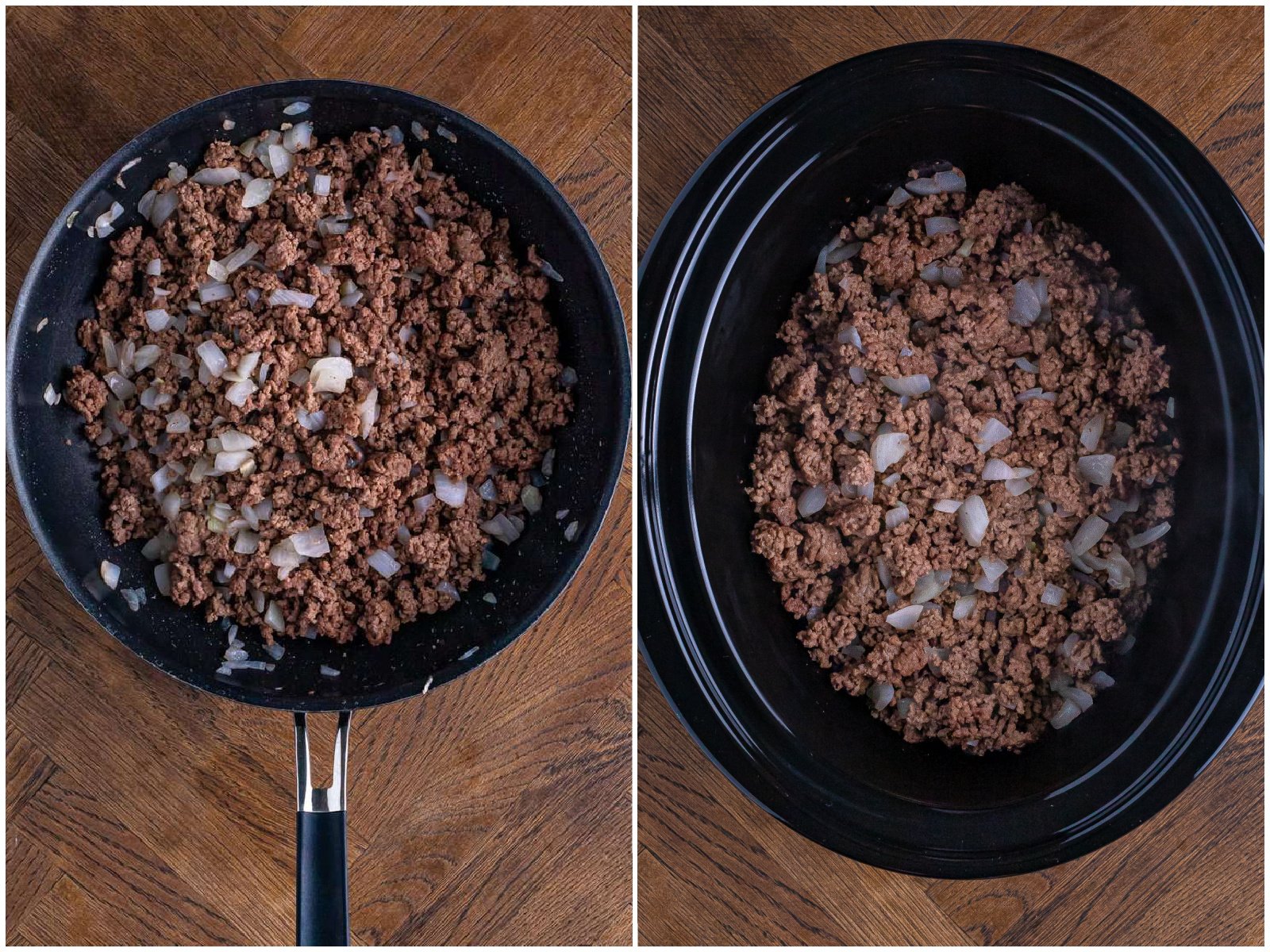
Add in the rest of the ingredients (minus the hamburger buns obviously). Give it all a good stir. Cover and cook on low for about 4-6 hours.

Optional: When ready to serve, toast your hamburger buns. I usually just put a dab of butter in my cast iron skillet. Put the heat on medium. Then put in the buns. Put filling onto each of your buns and enjoy! Optional: Top with a slice of American cheese.

Crock Pot Sloppy Joes
Ingredients
- 2 pounds ground beef
- 1 small onion, finely diced
- 8 ounce can tomato sauce
- ½ cup ketchup
- ½ cup water
- ¼ cup light brown sugar, packed
- ¼ cup all-purpose flour
- 1 Tablespoon chili powder
- ¼ teaspoon garlic powder
- 1 Tablespoon cider vinegar
- 2 Tablespoon yellow mustard
- 1 Tablespoon Worcestershire sauce
- salt and pepper, to taste
- hamburger buns, to serve
Instructions
-
In a large pan, brown 2 pounds ground beef with 1 small onion, finely diced.

-
Cook and crumble until no longer pink. Drain excess grease.
-
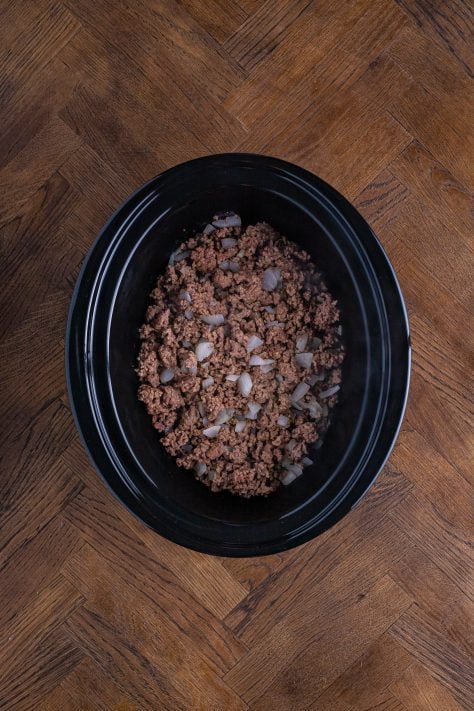
Put ground beef mixture into a 5-6 quart slow cooker.
-
Add in 8 ounce can tomato sauce, 1/2 cup ketchup, 1/2 cup water, 1/4 cup light brown sugar, packed, 1/4 cup all-purpose flour, 1 Tablespoon chili powder, 1/4 teaspoon garlic powder, 1 Tablespoon cider vinegar, 2 Tablespoon yellow mustard, 1 Tablespoon Worcestershire sauce and salt and pepper, to taste.

-
Give it all a good stir.

-
Cover and cook on low for about 4-6 hours.

-
When ready to serve, place filling on hamburger buns, to serve.
Betokened
Written in response to: “Set your story in a world where astrology and the movements of celestial bodies deeply impact the lives of inhabitants.“
Jorge Soto
Fiction Mystery Science Fiction
Not another word was spoken between the two men for the remainder of the day’s work, as even sneezes or loss of footing from one was always followed promptly with a well meaning grunt from the other. Non-verbal language was their preferred mode of communication.
The Boater steered along the foaming currents expertly and grumbled obscenities at deck birds between his pipe and teeth, occasionally throwing a stone from his pocket at those that dared to near his helm. All the while, the quick Fisher methodically maintained baited hooks, mechanically returning lines and nets from the sea onto the deck below. Lines went out, nets were dragged in, and within half the day, half the vessel’s fuel was exchanged for a barrel full of silvery fish and blue crabs. The pair worked in perfect unison, as a hammer and nail would, both reliant on the other in mutual livelihood. There were many different trades and professions on the island, but none worked as intimately on their craft’s together, save maybe the Smith his Apprentice.
A prompt lunch was taken when the sun was highest in the sky, and both men found themselves retired separately to eat, occupied by their own respective meals and pastimes. The aged Boater sat in his cabin and played some lude sea shanties on a wooden stringed instrument, stopping only to nibble at a wrapped cheese between sips from a jar of potent alcohol. The seaman cursed the women passed in his life, and reserved a special teary eyed ballad last for his most recently escaped sweetheart, who he couldn’t quite remember past a vague few syllables- “Ma, Me, Mar- Mavis perhaps?”
The young Fisher below made his lunch from a tacklebox, while seated quietly under the shaded awning of the stern, dangling his legs above the water. He ate a chicken sandwich with a wide palm of lettuce spilling out from its seams, and sipped from a sloshing metal canteen of milk. He finished quickly, and retrieved a warped paperback book from his long coat pocket, to begin where he had left off.
He kept his prized stories stocked among a humble bookshelf of his cottage, and put one in his coat before setting out for the beach every morning. Other than some of the adventure nonfiction and fish research books, which were written just off shore, most literature found on island and in his collection were written and printed locally. His favorite genre to turn over in his few unoccupied hours was that of romantic fiction, which was fortunate, seeing that it was one of the few genres to be found in abundance in the town’s dusty shops.
The paperback he was flipping through now was about a mermaid, who’d fallen from the stars, and found herself washed away, far down an inland stream after becoming disoriented during a storm. She happens upon a veteran ferry boat captain who, in exchange for her ancestral gem necklace, promises to guide her back through the channels, and eventually to the shores of the heavens she aired from. He’d probably fall in love with her or something, that always happens in these books.
The moon winked at him from the corner of the horizon, time to get on. He earmarked it and folded up his meal’s contents into the tin box. The slightly boozed pilot of the vessel hobbled back to his helm swiftly. Upon a slight nod of affirmation between the two, the ship engine groaned and sputtered forward once more, taking up its former domain. She was the uncontested sea-monster of these waters.
With the cyclic laboring finished and the whale’s appetite satisfied, the lines were reeled in and packed up, as the ship’s point was turned towards shore.
The sun had almost reached the black peaks of the island’s crags, while at its base, the ocean’s tides swelled the pale beachline. A radiant hue of rose and orange tinted itself against the cloud peppered sky, bathing the water and vessel below it in a sherbet dimness. From behind this lightshow, crept the approaching night, which was bespeckled with dim stars, beginning to stretch their lashes. Though darkness grew, the Boater steered expertly between sharp jutting masts of rock, shooting glances above to dead-reckon his course with the tip of the Eastern Scythe, a well known constellation trusted to bring northbound Boaters home east from storms.
A pair of pale sea bird’s flocked to the top railing, anticipating the free ride home. The Boater benevolently permitted the winged stowaways. He was out of stones.
**The Fallen Mermaid
The Fisher hung over the railing, dipping his stick in the front wake listlessly while he scanned a large rock they neared. He couldn’t remember a time where he was unable to recall the minutest detail about the island’s features. He saw how spring was just starting to show its pale yellow signs among the mossy sides and grass which draped lazily over the edges of the cliff.
Just as he was looking out, a green glimmer caught his eye. Following the flicker to its source, he made out a jittering shape, cast from just below the dark marble surface of the water at the foot of a remote sea stack off their port. Through the white frothy tide that beat against the rock, it was impossible to make it out, at least for most men’s eyes.
“Boater-”
The captain of the helm was pulled from the daze of his tranquil humming, and looked down at the Fisher below with narrowed eyes, unsure if he had really heard him.
The engine was lowered a click.
“Ya say something son? Speak up!”
The Fisher took some hurried steps to the center of the deck and pointed over at the lonely rock’s direction.
He repeated solidly, “There, something with a shine to it. Just off the portside”
The Boater scanned the far rock with strained eyes and scratched at his stubbled chin before returning with a nod to the young lad.
“Aye. Seen it too. I’ll pull her around, ready the gaff.”
The nearly blind helmsman who almost certainly hadn’t seen a thing, was too proud to admit otherwise.
Nonetheless, the ship edged its course towards the stack, as the engine tugged away gently. It wasn’t uncommon for a smaller ship or a dinghy delivering Vacationers to be carried out past too far by the temperamental tide, so the two veteran seamen weren’t too weary of bringing the ship around to get a closer look. Coming to its right flank, the idle was set low, as the boat drifted gracefully into position just out of reach from the rock.
The Fisher speared the gaff in and began raking, slowly working the water by the boat’s side, as the Boater hung cautiously over the top cabin, leaning with a grip on the railing. He tugged at his pipe impatiently while he tried to get a good look at what it was they were searching for.
Before calling it quits, the Fisher set the gaff down, removed his coat, folding it atop his boots, and amid a volley of curses from the disapproving Boater above, he dove in. The pair of birds on the railing took advantage of the stillness to head to shore on their own wings, and departed with a few squelches, an outburst that startled the pacing captain.
The Fisher sprang out of the water coughing and was quickly helped back on board by the Boater, all the while being lectured about the dangers of imprudent Fishers and the likelihood of treacherous sirens to pray upon such careless men. When he had recovered, he dropped a dark and round object that was in his hands onto the deck with a thud, and took some steps back, now standing dripping wet near the Boater looking down at it. The two men looked on in silence at the anomaly laid before them.
It was unlike anything they had seen, and was very clearly not naturally originated. It was about two fists in width and perfectly round as an orb. Its surface was sleek, smooth and wet, and rendered not a seam or scratch in to be found. It was clear it hadn’t been assembled from different pieces, and was homogeneous; being of the same dense glass-like element through and through, like a meticulously cut gem.
“What the devil is that?” The Boater finally spoke up, in a half choked whisper from behind.
Before an answer could be supplied, the object began to illuminate from within, streaking lines of emerald light through the cracks in the deck as a musical ominous chiming rang out. They backed away a step further and exchanged a pair of wild glances.
As it rolled under the shadow of the pilot’s deck, the light and sound died away to glossy darkness. The Fisher stepped around the anomaly in the manner of a hunter pacing his netted beast. He squatted and cocked his head sideways to study it while the rocking boat rolled it gently around the deck. Seeing the Fisher was now moving ever closer with his stick in hand, the Boater ejected a low and firm warning of “Careful”. The Fisher nodded, and prodded the orb until he had it pinned against a raised board in the open which still had some sunlight clinging to it.
The deep blackness of its material was spotless, with a few drops of seawater beading off it immaculately. Just then, as the men watched, it grew to life in the sun light, giving off a bright green and blue flutter of light, which worked their way from the edges like lightning bugs, this time connecting, forming a single burning core in the center of the apparently translucent stone. It hummed a single unbroken tone, similar to the underwater resonance of whales, growing and dying in synchronization with the pulsing light from within.
“Unworldly… It’s-” The Boater took up the gestures of a frantic Preacher as he searched for the air above his hat for the words, pointing a frenzied finger down at the gem.
“Unworldly! And dangerous is what it is, Fisher! Mark my words carefully son, the Witch’s instrument such as this isn’t to be trifled with. Overboard with it.” he decided resolutely, tugging his hat down firmly and crossing his arms.
The Fisher was too mystified with the shape that danced inside the stone to heed any words. Summoning his courage, he took his coat and laid it over the stone, attentively wrapping it like a gift before lifting it slowly. As soon as it was covered, the light and sound suspended once more.
“It’s no danger to us Boater, see? You’re too superstitious for your own good. I could bring this to the village tomorrow to show the learned men. They may have answers.”
The old sailor shook his head like a pendulum and retorted, “Curses on the ‘learned men’ is the only thing you’ll be bringing home! Have you not heard what I’ve said? An unnatural relic such as the one you hold is best to be tossed overboard with the chum. I don’t know as much as any star-gawking Professor, I surely never will be as studious a lad as you, but-” He tilted his chin up high in superior finality, “but I DO know it’s not wise to dip a toe into bewitchment. For ‘a toe dipped in foiled waters is a toe to go’ .”
“ ‘Dipped in foul waters’ you mean.” Corrected the Fisher distractedly without taking his eyes off the bundled up orb.
The Boater’s shoulders relaxed as his face darkened over sourly. He snapped his pipe back into the corner of his teeth, and stormed back up the dinky ladder to the helm.
“Keep you’re pretty words, and your stone then. But don’t say I didn’t warn ya’ boyyo.”
“Boater, I-”
“Pull that gaff in now, we’re to be heading back. It’s getting much too dark.” He said pointedly.
The Fisher, having worked several fruitful years with the captain, felt keenly abashed to have angered the old spirit. Nonetheless, he knew an apology would never be in order, and the only proper way of remedying bad blood between the pair would be time and silence. He racked the gaff up and tucked the wrapped object underneath his lunch tin by his foot, as the boat turned slowly to aim towards the shore.
***Snuffed Lanterns
After the ship was all tied down and the haul unloaded, the Fisher turned and made his way to the jetty’s entrance.
The old Boater cleaned and adjusted the instruments of the vessel, the same one he slept in every night, stopping only briefly to call back to the Fisher.
“Make sure you get a good price for those pairs of spears we snagged! I should suspect the Cutter will pay a good price for the sword on the big one we hauled, he’s a habit to be collecting them for his shop wall.”
“Aye, I’ll get it offloaded in the market first thing in morn’. You won’t be needing me tomorrow?”
“Nay, just a net load or two I’m planning. Besides, I don’t need any more omens being dragged aboard my vessel.” Said the Boater grimly as he turned to complete his scrubbing.
The Fisher called goodnight and went to join the Porter by his wagon. After seeing the payload and Porter off up the cobble road with a wave, he turned some 5o paces up and faced out at the dark cove below. The object underneath his arm vibrated like a rolling wave breaking below a ship’s bow. He pushed aside the coat and revealed the face of his treasure. Its muffled humming became clear with the moon’s pale reflection, which danced off it gaily. The little white crescent seemed to sink down into its hard surface and collected at the center, forming a tumultuous molten core of lime-etched red which rippled in an angry hum. Looking up, at the horizon, he took note of a peculiarly blood red lining at the edge of the blackness, with a singular, almost imperceptible, speckle of green at its center point. A warm wind scrubbed his right ear from the northern cliffs, while an icy western breeze nipped at his left. He nodded, finally comprehending the sign..
“Ay, core of green and a red line at night- Boaters take fright.”
He watched as the Boater’s wide hat ducked under the cabin door and a lantern lit from behind a port curtain snuffed out. Some lonely stringed notes and lyrics were heard echoing from within. He knew he’d probably stay up drinking all night before his work tomorrow.
The Fisher re-wrapped the gem under his arm and continued up the beach path, away from the boat. He mused, staring thankfully up at the throned night above him, “Every man must interpret his own stars.”
Slow-Cooker Bolognese
 Approved by the Delish Test Kitchen
Delish editors handpick every product we feature. We may earn commission from the links on this page.
Bolognese is one of our favorite recipes to make during the winter: It instantly warms you up and makes you feel sooo cozy.
Do I need to cook the meat on the stovetop before?
OK, so this is one step that some people will be like “Ugh, seriously?!”, but I firmly believe it just makes the sauce that much better. We start the recipe by sautéing onion, carrots, and celery (the holy trinity that’s mandatory in all bolognese) and then once that’s going add the ground beef to brown it. The vegetables will steam in the slow cooker, but they’ll never sauté, so we prefer to get them a little golden to help coax out some flavor before hitting the slow cooker.
The meat will brown on the stovetop—whereas it’ll just steam in the slow cooker—and you can drain its fat before it goes into the slow cooker, which is a huge bonus.
Will my milk curdle in the slow cooker?
Weirdly no—we were worried about this, too.
Can I also cook the pasta in the slow cooker?
You actually can—but this recipe makes so much bolognese sauce that we like to add some to pasta we cook separately before freezing the rest of the bolognese for later use.
Ingredients
-
1 Tbsp.extra-virgin olive oil
-
1large onion, chopped
-
2large carrots, chopped
-
3celery stalks, chopped
-
4cloves garlic, minced
-
3 Tbsp.tomato paste
-
2 lb.ground beef
-
1 oz.(28-oz.) can crushed tomatoes
-
1 Tbsp.dried oregano
-
1 Tbsp.dried thyme
-
1bay leaf
-
1 tsp.kosher salt
-
1 cupwhole milk
-
1/4 cupdry red wine
-
Freshly ground black pepper
Directions
-
- Step 1In a large skillet over medium heat, heat oil. Add onion, carrot, celery, and garlic and cook until tender, 6 minutes. Add tomato paste and stir until combined, then add ground beef and cook until no longer pink, 6 to 8 minutes. Transfer mixture with a slotted spoon to slow cooker.
- Step 2Add crushed tomatoes, oregano, thyme, bay leaf, salt, milk, and red wine. Season with pepper and stir until combined.
- Step 3Cover and cook on low for 6 hours. Discard bay leaf.
- Step 4Serve over cooked pasta.

The Blighted Eye
Written in response to: “Set your story in a world where astrology and the movements of celestial bodies deeply impact the lives of inhabitants.“
Ev Datsyk
“Gramma,” the boy’s voice is a reedy whine. “If I’m not back, they’ll find someone else to sing my part.”
She knows this. It is exactly what she has hoped for. She steels herself against his tears.
Dressed for the occasion, the wide sleeves of his cassock swallow his little arms. He shivers, and the gold embroidery at his wrists catches light from the sky. “If I don’t sing it, I won’t be able to save us.”
She resents whoever taught him this fairytale, though that flings a wide net.
Often, she wishes her daughter had not been born so long after the Shamanic Wars. There was so much more world to learn before the valleys gave way and the mountains were raised. Grand ideas were crushed under rocks and reduced to pebbles. Entire schools of thought reduced so that, unless you knew them before, you would not think twice about them now.
Within their enclave, entire generations were raised on superstition. Now, they have built their governments, their faith, their schools, and their culture on a framework of moronic folklore. Dark-blaming nonsense.
As if an unbroken afternoon could have kept the world whole. As if the sparks were not already on the wind, as if the kindling had not been long-dried.
They are so quick to shrug off her generation’s memories. It isn’t hard; there aren’t so many of them left to weave their yarn now.
The governing generation would rather speak of how the darkness sieged them before the fall, then curse it, as if the sun and moon had not been lovers before. They spiral as the shadows set into stories of how the dead were raised. How the earth reshaped: cut the land with canyons, pierced the sky with new peaks.
Ana feels as though she alone remembers eating sticky candy by lamplight in the mid-afternoon. Back when they treated days like this as a holiday. All the schoolchildren would meet in the snow-covered parklands to play blind man’s bluff, and their parents would drink mullwine, bundled in hand-knit scarves. When the sun ducked behind the moon, they would pause and reflect, holding in their hearts and minds all they held dear.
No one else fondly remembers that strange and beautiful hour when the heavens were robin’s-egg blue and the earth below sparkled with candlelight. Anyone who does knows better than to say so. She might as well be the sole survivor.
She turns to face her grandson head-on, her shoulder against the city. When she moves, a bone cracks in her knees.
“Nothing is going to happen.” She has an accent from another time, from a state that slid down the new mountainside, from a city that no longer exists.
Bogdan stamps his foot, though the snow absorbs the sound, “It’s the blighted eye, Gramma. If we don’t sing, the blood roses will come and the dead will follow and the earth will break again.”
Sharp disapproval flashes across Ana’s face. His recitations sound like a Church pamphlet, but she can’t blame the priests more than she blames her own daughter.
How did I raise a fool? Ana would ask her when they fought. Her daughter would shake her head at her dolt of a mother.
Reality is happening under your nose, and you’re stuck in the past. People like you, Mom …
His eyes well, and it’s only a moment before his full cheeks grow slippery with tears. “I have to go! I’m soon!”
He is trying to tug her now, to drag her back down the path to the city’s gate. She may not be the force she was once, but she is more than a match for a child of his size. It is how she got him here. It is why he will stay. Her body is deadweight, resistant to his pulling.
“Gramma, please!”
She hates to see him cry, hates that his face is growing puffy and red under the dying light. But there is nothing he can say that will persuade her to loosen her grip on his cassock. He is too young to decide for himself if it is better to be here or among the criminals and the burning boys. She will decide for him.
“Bogdan, no,” she says firmly. “We are staying right here. The blighted eye is just the sun that warms you and the moon that sings you to sleep, meeting.”
When she used to say these things to her daughter, her daughter would roll her eyes into her head. She would scowl, disdainful of her mother’s old-world views, her old-country voice. Your generation broke the world, she’d say, having reached a bittersweet age when she was proud and outspoken and no longer listened to her mother. You left us to clean up your messes.
So Ana would be left in their boarded-up house while her daughter went to watch the young boys sing against the blighted eye. She would have no choice but to say, Take the bat, and her daughter would say, Obviously. I’m not an idiot.
Then Ana alone would hold a plank of wood stabbed with nails, guarding their meager possessions against the scavengers who rose with the dark. She swore at passersby and did not open the door for anyone, not even when she heard screaming, not even when blood pooled and spread from the street into her home.
“Bogdan, nothing will happen. You are safer here than there, do you understand?”
His tears keep coming. By the time they reach his round jawline, they are slow and cold. “I need to save them. They’re going to die.”
As if on cue, a shriek rings from the city. Ana flinches.
Bogdan would not believe her if she told him of the peppermints they sucked under the daytime moon, would not understand that they gathered and reflected, full of love for the world. He has grown up like her daughter did. The Church carriages picked him up at midnight, and he left behind a house with boarded windows, his father waiting with a gun for the day to unfold.
Her daughter will be furious that she stole Bogdan from his duties, that Ana sneaked him through the narrow alleys, over bridges, and under the gallows outside of the city. Ana has long accepted that her daughter is lost to her. Bogdan is still young, still has a hope of growing up smarter.
The moon is within kissing distance of the sun now, and Bogdan looks to her in a final, desperate appeal. She holds him firmly by the wrists and shakes her head.
Across the icefield, a song fades to its end.
Bogdan gathers a deep breath, tilts his wet face to the sky, and sings in a wavering, pained voice.
O, Dark, O, Dark, Unto the Snow!
She slaps a hand over his eyes, forcing a barrier between his stare at the sun. He fights against her fingers, and she wrestles him under her arm. He loses all musicality, singing into her overcoat. He doesn’t sing to tune but to be heard.
Yonder blood roses, be Staid!
“Bogdan, stop,” Ana commands over his singing, but he doesn’t, of course. He is his mother’s son. It isn’t the songs she hates—though they are vapid hymns for the new age—but she does fear attention, that someone will be drawn to his call and drag them both to the heart of the dark.
She struggles against his wiggling. Her hands are sticky with his tears.
That the Light the Dark must know
Evil away have we Prayed!
The mountainside rumbles.
It is a sound with no equal: the dull shift of a monument, the earth resettling.
“Bogdan—” she has only enough time to hunch her shoulders over his small, singing body before, over, above, and around them, snow.
What is the funniest comment or line of code found in the MS-DOS source code released by Microsoft? 13 more answers
Not Mickey(mouse)Soft, not MS-DOS, but in no less than CICS from IBM. For those who may not know, CICS is THE single most successful software package ever. In the world. On ANY platform. Period. If you’ve ever used a credit or debit card, made a securities trade, made a bank transaction, at some point during that process that transaction touched CICS. 24x7x365 something on the order of 6 billion (with a b) transactions per second flow through CICS. Still. today. The world’s business runs on CICS.
Back in the 70’s, it was possible to get the source for CICS from IBM if you were licensed customer. One day I had a reason to be browsing through the source for one of the nucleus modules, DFHIRP. DFHIRP is the main part of the service that allows multiple instances of CICS on different systems/machines even geographically dispersed to collaborate and behave as a single unit to process workoads. Built into the product since the 70’s. And the client/server/cloud people think doing that was their idea. Hilarious. Back to the story. Right there in the source was a small section of code, Assembler of course because that’s what real men write in (grin) where some developer had gone on a tirade in the comments. It read something like this: “There’s really a better and more efficient way to write this routine, but my stupid manager demands I do it like this, so that’s why this is here. Don’t blame me.”
I still chuckle when I remember it.