

Everything… EVERYTHING is now controlled by AI. It is seamless, and it is dangerous. Your AWARENESS of this will explain why those around you act in certain ways, and why you see certain articles and posts and commercial adverts directed at you.
I cannot say more than that.
There is nothing that you can do about it.
So, yes just accept it.
And therefore, realize that just like in the movie “Invasion of the body snatchers”, most of the rest of the world is already infected. It’s useless to argue. If you do, you are “marked”.
Be careful.
Be alert.
Consider yourself WARNED.
Today…
The US cannot quickly build high-speed rail because of its very strict legal review process. Why doesn’t Japan have these problems? How did this small island nation of Japan build the world’s densest high-speed rail network? 14 more answers
“The US cannot quickly build high-speed rail because of its very strict legal review process.”
The slow legal review process is merely a symptom. To understand this situation, you need to drill down to the core problem:
The US has the largest railroad network of any country: 136,729 miles (220,044 km)
Why can’t we have effective high speed rail, outside of a few cities and corridors?
Because the vast majority of trains in the US transport freight:
(image credit: BNSF 5216 West Kingman Canyon AZ, Author: BriYYZ from Toronto, Canada
)
…not people.
Freight is the core reason why Japan has a large high speed passenger train network, and the US does not.
In 2014, yearly ridership in the US accounted for 549,631,632 trips.
That same year, our railroad network transported 1.71 trillion ton-miles of freight.
For every single person who traveled by rail that year, those same rails transported the equivalent of one ton of goods over 3,111 miles.
The economics of railroads in the US mean that, in the vast majority of cases, it is more profitable to transport freight goods long distance, rather than people.
America’s rail network is overwhelmingly focus on transporting large quantities of goods, over long distances.
2014 population of the continental US: 318.9 million
2014 population of Japan: 127.3 million
Coastline of the continental US: approximately 5,089 miles
Coastline of Japan: 18,486 miles
Japan had roughly 1/3 the population of the continental US, and over 3 times as much coastline.
Transporting 1 ton of goods 1 mile via freight ship, on average, is twice as energy efficient as moving the same load via freight train, and 20 times more efficient than semi-trucks.
Japan is made up of islands. Whever you are in Japan, you are never far from the sea. Japan’s geography
:
(image source: NASA
)
means freight will be transported by sea, not trains.
When there is a high demand for freight trains to transport goods long distance, as is the case in the US, those freight trains compete with passenger trains. Economically, it makes more sense in the US to use our rail network to haul tons of goods across thousands of miles.
America’s geography, with a vast interior that is far from any coastline, pushes our freight transportation towards railroads
:
(image credits: “US railway map showing the major railway operators and the intermodal terminals and RoRo ports”, Author Wikideas1
).
When the sea, and more efficient freight transport via ships, is close at hand and easily accessible from most cities, as is the case in Japan, there is less demand for freight trains. When passenger trains do not have to compete with freight for railroad line usage rights, passenger trains thrive, and you get high speed rail.
Geography shapes Economics, Economics shape rail usage patterns.
Followup: an interesting question was raised in the comments:
Why does this pattern not hold true in China, which has a large passenger rail network?
My response:
China vs the US is best explained by the difference in consumer spending patterns, which makes up less than half of GDP in China, and 70% of GDP in the US, and the source of consumer goods: in China, more goods are being exported than imported.
The US imports primarily, and requires a large internal freight train network to move these imports from distant ports to internal towns and cities.
China exports primarily, and groups its industrial production nearer to port cities because these act as export hubs.
Very little of China’s consumer goods are being produced in Tibet or Xinjiang. Instead, we see production concentrated on China’s coastline, and along its rivers.
When goods are produced near ports, and do not need to be moved inland, internal freight rail networks in the interior (as the US has) are far less necessary.
Likewise with the movement of people to and from major manufacturing hubs:
In China, the tradition is of seasonal or short term migration to the city, and back towards home provinces. The Hukou System ties Chinese citizens back to their birth places, necessitating a large public transportation system to periodically move people to and from large cities.
In the US, the tradition of hundreds of years is of permanent internal relocation: the vast majority of Americans permanently move to new homes to get better jobs, rather than temporarily relocating.
When the sea, with its more efficient freight transport via ships, is close at hand and easily accessible from the centers of production, as is the case in China, there is less demand for freight trains.
That is why the US moves 40% of internal freight via rail, China moves 14%, and Japan moves 5%.
The smaller rate of freight transportation means passenger trains in China and Japan do not face the same level of competition for limited track space from freight, as they do in the US.
That is why the US struggles to build long distance high speed passenger transportation: because our railroads are used to transport freight internally.
UNCLE’S MIDNIGHT LOUNGE—1960s Spy-Jazz Chill Mix | Retro Espionage & Smooth Night Ambience | Part 2
Read MM to this…
Why can’t humans drink water directly from a river like other animals in the forest or eat food directly from the ground like dogs and cats? After all, aren’t we animals like them?
Look at the bear in the photograph below. See that thing protruding from its behind ?
Well, that’s a tapeworm. A parasite that has entered the bear’s body through eating raw infected fish.
Here’s what happens:
- The tapeworm eggs float around in rivers (bear with me to understand how they got there — and yes, the pun was intended).
- The eggs are eaten by small crustaceans (such as water fleas), and those are eaten by small fish.
- When the bears eats the infected fish, the tapeworm larvae enter the bear’s body, and Inside the bear’s intestines, the larvae attach to the intestinal wall and grow into adults — often many feet long.
- The adult worms release segments filled with eggs, and they return to the river as the bear passed out its stool.
- Begin again (→ (1)).
So what would happen if you would drink river water which contains tapeworm eggs ?
Well, you either end up with adult tapeworms in your body which are likely to cause intestinal infection, or an invasive larval infection which causes cysts in organs and tissues. The latter can be lethal if the wrong organs are targeted.
While bears are intermediate hosts in the life cycle of the tapeworms they ingest and so are not meant to be killed along the way, and have developed some kind of partial immunity and relative tolerance against mild symptoms — humans have not.
To add insult to injury, animals in the wild die all the time from ingesting contaminated water (and often very young). River or lake water is full of shit — literally and figuratively, I must say — and hence drinking it is asking for (sometimes lethal) trouble.
Cats and dogs also sometimes become (very) sick because of parasites they have somehow ingested, but then we go to the vet, and we can use modern medicine to solve the problem. In the wild, it’s not that simple —
And there’s often no “begin again” button at the end of the road.
They Throw Away Their Husbands Expecting Something Better But It’s The Men Who Are Coming Out On Top
In 1950 China had a population of around 540 million yet in 1980, in a mere 30 years, the population doubled to around 1 billion. How was this possible considering the mass starvations occurring around this time as well as Mao’s repressive regime? 8 more answers
·
Precisely 😁
So what does that mean?
It means the ‘mass starvations’ during Maos times were EXAGGERATED by a huge factor
Let’s see
- Population in 1950 = 552 Million
- Population in 1975 = 917 Million
- Population in 1982 = 1008 Million
Based on the assumption that China had a normal growth trend from 1970–1982 – what should have been the minimum population in 1970 to achieve a 1008 million in 12 years time with a ONE CHILD POLICY firmly implemented
The Answer = 794 Million to 803 Million
So
- Population in 1950 = 552 Million
- Population in 1970 = 803 Million
- Natural Deaths = 149 Million
- Natural Births = 400 Million
Net Population Growth = 251 Million
- Population in 1950 = 552 Million
- Population in 1970 = 794 Million
- Natural Deaths = 158 Million
- Natural Births = 400 Million
Net Population Growth = 242 Million
Net Outward Migration due to Cultural Revolution (1960–1967) – 6 Million (-)
Maximum Extra Deaths possible from 1950–1970 = (+) 251 Million (-) 242 Million (-) 6 Million = 3 Million
So this means MAXIMUM 3 MILLION CHINESE DIED of Unnatural causes between 1950–1970 including starvation
Between 1950–1970, the Mao years, great leap forward etc
No more than 3 Million Chinese died due to reasons like Starvation or Execution during the Cultural Revolution
Not 50–100 Million as numbers suggest.
Why Ghosts Haunt England at Christmas but Steer Clear of America

Many moons ago, the Downton Abbey Christmas special featured a ouija board which communicated a message from a dead character. American reviewers were extremely puzzled by this incursion of the supernatural, while British reviewers found it unexceptional. Indeed, few bothered even to mention it. Why?
The answer lies with the long tradition of Christmas ghost stories, the most famous of which is probably Dickens’s A Christmas Carol (subtitled Being a Ghost Story of Christmas). Dickens was a strong supporter of the Christmas ghost story, reminiscing in his 1850 essay A Christmas Tree about childhood Christmases spent “telling Winter Stories – Ghost Stories, or more shame for us – round the Christmas fire”. Dickens also encouraged other writers to produce Christmas ghost stories for the annual festive editions of his magazines Household Words and All the Year Round.

The ghosts of Christmas’s Present and Yet to Come, A Christmas Carol, 1843.
But Dickens is clearly feeding off an older tradition. It is one which Henry Irving refers to in his Keeping of Christmas at Bracebridge Hall. An American traveller visits an English country squire who has revived old traditions of Christmas as a social gathering for all the community. This gathering includes the telling of local legends and ghost stories.
Similarly, Dickens’s use of the phrase “Winter Stories” points back to an Elizabethan or older tradition of telling strange and fantastic tales in the winter. Which brings us to Shakespeare and The Winter’s Tale, one of his late romances of tangled identities and apparent death and revival. Telling bizarre and fantastic stories around the winter fire was clearly a well known tradition before the time of the Bard himself.
So the tradition has a long history – but only in England. Scottish and Irish traditions favoured Halloween as a time for ghostly tales. The split is at least partially a religious one. Halloween in England was never extensively celebrated and was taken over by Guy Fawkes Night in the early 17th century, a celebration of saving a Protestant king from a Catholic plot. The proximity in the calendar of two similar fire festivals meant that one would come to dominate in each area, largely according to religious sympathies.
These Halloween traditions were taken to North America by colonists, and combined with other celebrations to form a pan-Celtic party in the new US and Canadian societies. The Halloween holiday often involved riotous behaviour: watch the Halloween section of the classic musical Meet Me In St. Louis to see little Margaret O’Brien (age seven) terrorising some new immigrants for being different; she also concocts a near-lethal plan to derail the trolley car.
But the real-life excesses of the celebrations were curbed and the parties moved increasingly into middle-class homes. There hosts could follow magazine instructions for the perfect Halloween party, including, of course, ghost story contests.

‘The Ghost Story’ by Frederick Smallfield (Public domain)
Broadcasting now plays a key role in mapping out our cultural calendar, through Christmas (or Halloween) specials, state occasions, sports, and the shifting emphasis on different genres and tones.
So in the US, Halloween had become the time for spooky tales. Orson Welles’s notorious radio adaptation of The War of the Worlds was a Halloween trick and treat. Ghosts and the supernatural crop up in various TV series, including Star Trek, Starsky and Hutch and Hawaii Five-O, in their Halloween editions.
While Halloween has certainly made its mark on British society and culture, the long British history of broadcasting Christmas ghost stories has kept them part of the season since the first Christmas of BBC radio in 1923. M R James’s ghost stories are regularly adapted for television and radio over Christmas, most recently with last year’s The Tractate Middoth. This was an homage to the 1970s series of annual television plays known under the banner title of A Ghost Story for Christmas, which adapted James as well as Dickens’s The Signalman. Many of James’s stories were originally written as Christmas entertainments for his friends and students, taking us back to the literary and oral tradition.
The TV ghost story for Christmas is such a tradition that it can turn up in seemingly unlikely places, including Bergerac, The Bill, Not Going Out and, of course, Downton Abbey.
But maybe elsewhere there will be more unexplained goings on to remind us that Christmas is a time of year to reflect, to purge the horrors of the past, and to snuggle up warm and safe under the covers as we look to the future.
Top image: Ghostly tales round this Christmas tree? Source: Public domain
The article ‘Why Ghosts Haunt England at Christmas but Steer Clear of America’ by Derek Johnston was originally published on The Conversation and has been republished under a Creative Commons license.
This article was first published in 2016.
Recommended:
The Most Dangerous Lie we tell About Capitalism, by Dick Dowdell
This essay examines how Americans have been taught to think about capitalism in ways that protect wealth concentration, normalize extraction, and disguise the choices that hollowed out the middle class.
Exc:
Ask a group of Americans what capitalism means and you’ll hear a confident answer delivered with surprising vagueness. It’s freedom. It’s markets. It’s success. It’s the thing that made America rich. Press a little further and the definition often collapses into a slogan — capitalism is whatever happens when government gets out of the way.
That is the lie.
Under that narrowed definition, outcomes are no longer the result of choices. They are framed as natural forces. Wages stagnate because “the market decided.” Housing becomes unreachable because “that’s supply and demand.” Entire communities are hollowed out because “efficiency requires it.”
https://medium.com/the-polis/the-most-dangerous-lie-we-tell-about-capitalism-4388691d0dff
When Nazi guards asked ‘Who speaks German?’ she kept her hand down—and changed rock history forever.
Hungary, 1944.
Fourteen-year-old Flora Klein stood in a concentration camp barracks as SS guards walked through asking a simple question: “Who speaks German?”
Hands shot up around her. Prisoners hoped language skills meant better work assignments. Maybe survival.
Many who raised their hands disappeared.
Flora kept her hand down. She understood something that would save her life: in a system designed to kill you, invisibility is survival.
The girl from Jánd, Hungary, had lost almost everything—her parents, most of her family, her childhood—to the Nazi genocide machine. But she had a supernatural instinct for staying alive when death was the default.
She was assigned degrading work: cutting hair, serving those murdering her people. She made herself useful enough to live, invisible enough to survive.
And impossibly, she did.
The Second Impossible Journey
When the camps were liberated, Flora made her way to Israel. On August 25, 1949, she gave birth to a son: Chaim Witz.
But raising a child in struggling post-war Israel proved overwhelming. In 1958, Flora made another impossible journey—immigrating to New York with eight-year-old Chaim, limited English, minimal money, and the weight of everything she’d survived.
They settled in Queens. Flora worked multiple jobs—seamstress, whatever she could find—long hours at immigrant wages that barely covered rent.
But she had a purpose beyond survival: her son would have the freedom, opportunity, and voice stolen from her.
Young Chaim watched his mother’s quiet strength. He saw her work without complaint. He understood what it meant to survive impossible odds and refuse to be broken.
And he promised himself he’d make it all worthwhile.
From Silence to Thunder
The world came to know Chaim Witz as Gene Simmons—the fire-breathing, larger-than-life frontman of KISS, one of history’s biggest rock bands. The Demon who commanded stages in seven-inch platforms and full-face makeup.
But he never forgot who the real hero was.
“Everything I am is because of my mother,” he said throughout his career. Not a throwaway line—fundamental truth.
He bought her a house. The woman who worked multiple jobs in Queens would never worry about housing again.
He brought her onstage at KISS concerts, introducing this humble woman to thousands who roared for The Demon’s mother.
He tattooed her concentration camp number on his own body—a permanent declaration: I will carry what you carried. I will never forget.
Flora never sought fame. Even as her son sold 100 million records and built an empire, she remained private and quiet—the same invisibility instinct that had saved her decades earlier.
The Ultimate Victory
Flora Klein passed away in December 2018 at age 93.
By then, she had seen her son achieve impossible success. She had watched her grandchildren thrive in freedom and safety. She knew that everything she endured had created something beautiful and enduring.
Her silence when guards asked “Who speaks German?” preserved a life that created another life that touched millions.
Flora’s legacy isn’t just Holocaust survival—it’s what she did with that survival.
She could have been consumed by trauma. Instead, she gave her son strength, work ethic, and an example of rebuilding when everything’s been destroyed.
She showed him that when the world tries to erase you, you don’t just survive—you thrive so loudly, so unapologetically, that history has no choice but to acknowledge you existed.
Gene Simmons became famous for spectacle and performance. But beneath it was a boy who watched his mother refuse defeat. Who learned that survival isn’t passive—it’s active, defiant, determined.
Who understood that the greatest response to those who tried to exterminate you is to live fully, succeed completely, and raise children who’ll never know the fear you knew.
Some heroes breathe fire on stage before thousands.
Others work double shifts in Queens, raise sons alone, carry unspeakable trauma with quiet dignity, and never ask for recognition.
Flora Klein was both.
She survived by staying silent when speaking meant death.
Then raised a son who would never have to choose silence. Who could scream, perform, and exist as loudly and proudly as he wanted.
That’s not just survival. That’s victory.
Flora Klein died knowing Hitler failed. That his plan to erase the Jews didn’t work. That the girl who kept her hand down in that camp became the mother who raised a son who would never be silent.
And in every KISS concert, in every moment Gene Simmons commanded a stage with absolute confidence, Flora Klein’s victory echoed:
You tried to destroy us. We’re still here. And we’re not leaving.
Rest in power, Flora Klein. Your silence saved you. Your strength saved your son. Your legacy lives in every survivor who refused to let trauma be their only story.
People Are Refusing to Pay Bills — And It’s Spreading…
People are refusing to pay bills — and it’s spreading. From credit cards and utilities to rent and debt, viral financial advice is convincing people they’ll be fine.
In this video, I break down the real money, debt, and finance consequences people aren’t being warned about.
Across TikTok and social media, people are being told to “just stop paying” their bills — credit cards, electricity, rent, even loans — with the promise that nothing bad will happen. That advice is dangerous.
This isn’t about defending banks or debt collection agencies. It’s about explaining what actually happens after the likes stop: lawsuits, wage garnishment, shutoffs, credit damage, and long-term financial fallout that can follow you for years.
If you’re struggling financially or feeling overwhelmed by debt, this video is meant to explain the system honestly — not shame, not hype, and not fake loopholes.
Pictures
















































































Vegetarian Mushroom Burgers

Yield: 50 servings (4 1/2 ounce burger)
Ingredients
- 1/4 cup vegetable oil
- 1 pound shredded carrots
- 18 pounds finely chopped onions
- 4 pounds chopped mushrooms
- 12 ounces beaten pasteurized egg whites
- 1 (50 ounce) can condensed cream of mushroom soup
- 2 cups chopped pimiento
- 6 tablespoons Worcestershire sauce
- 1/4 cup chopped fresh parsley
- 2 tablespoons celery salt
- 4 teaspoons garlic powder
- 1 teaspoon ground sage
- 3/4 teaspoon pepper
- 3 pounds finely chopped cooked brown rice
- 14 ounce fresh bread crumbs
- 50 whole wheat buns, split and toasted
Instructions
- In large braising pan in hot oil cook carrots and onions until tender.
- Store covered in refrigerate at 40 degrees F or lower to cool.
- Mix cooled carrots, onions mushrooms, and egg whites. Add soup, pimiento, Worcestershire, parsley, celery salt, garlic powder, sage and pepper. Mix well, stir in rice. Add bread crumbs, mix lightly. Portion using a 4 1/2 ounce scoop. Shape into 4 x 1/2 inch patties.
- On a lightly oiled surface, grill at 375 degrees F for 5 minutes per side.
- Place patties on a sheet pan sprayed with vegetable cooking spray.
- Bake at 350 degrees F until internal temperature is 140 degrees F or higher for 15 seconds, about 10 minutes.
- Hold patties at 140 degrees F or higher.
- Serve on buns with lettuce, tomato, mustard and ketchup.
Bringing Back the Glow
Written in response to: “Set your story in a world where astrology and the movements of celestial bodies deeply impact the lives of inhabitants.“
Bob Faszczewski
With the continuing freeze, this vast fountain of knowledge could shortly dry up.
Because the overall temperature of the entire earth had decreased only one degree every six months the world’s top climate scientists at first seemed unconcerned. As the illnesses and deaths began to pile up they realized that dire consequences could loom for the planet.
The scientists also saw signs that oceans around the globe soon could flood even the most arid place in the world, the Atacama Desert in Chile, permanently upsetting the fragile balance of nature there and a thriving tourist industry that depended on it.
International news outlets also revealed that leaders outside of Dallol and Atacama saw the signs mounting most severely in the places on Earth which formerly had provided the greatest amount of heat only in summer dealing with this phenomena year round.
As time went by, those who made their livings in Atacama by introducing the world to some of Chile’s most intriguing treasures such as the Tatio Geysers, at a height above 14,000 feet, soon would not be able to guide expeditions to the nearly water-swamped geothermal field that nearby volcanoes had created.
It looked like the huge steam columns that once rose to heights of nearly 40 feet would shortly lay dormant. The Puritama hot springs, once famous for offering relaxing dips in their scenic warm water pools, faced transformation into frozen lakes.
The solution began to emerge from an unlikely source.
Researchers in NASA’s Goodard Space Flight Center in Greenbelt, MD had been looking for a safe method of equipping future spacecraft for a possible launch to Uranus—the coldest planet in the solar system. Their research had estimated its surface temperature at negative 224 degrees centigrade.
They had developed a super high temperature capsule, which they would possibly launch into the atmosphere of Uranus prior to sending an exploratory probe to the planet. They hoped this would sufficiently heat the coldest planet in order to make space exploration there possible.
The scientists didn’t believe this capsule had yet reached the point where they could use it to address the planet-wide problem on Uranus, but they soon began work in adapting it to the emergency mission of returning the atmosphere to a level safe for the continuing existence of the human race.
When told about the crucial situation developing around the world, they admitted scientists from around the globe into their research circles, and increased the rapidly accumulating knowledge base while perfecting a vehicle to confront the current urgent situation.
The emergency also became the perfect testing ground, not only for climate control on Uranus, but also for future missions to expand global understanding of other concepts and discovery about more distant reaches of the universe that they hoped would solve even more of the Earth’s problems.
They launched a rocket from Goddard at 7 am Eastern Time on August 20, 2029. To meet the needs of the crisis the team also had sped up the timeline on the development of advances in the speed of travel across the galaxy. This enabled the craft to come within a safe distance of the Sun in only three months, half the previous travel time. It shot the low temperature capsule at the eclipse, and this created sufficient heat to reverse the freezing.
It took about a month for the intergalactic atmosphere to right itself and the world’s population and institutions to adjust, but things slowly returned to normal.
The Goddard scientists distributed copies of their discovery to colleagues around the world and the joint effort permanently reversed the effect of the summer, 2029 incident.
The joint research and resulting advances in technology helped create an unprecedented era of international cooperation that the world had not experienced in decades.
The Viral Klarna “Glitch” Is INSANE, Now People Are Ruining Their Lives
A viral Klarna “glitch” spread across social media — and now many people are facing serious consequences.
What started as claims of free purchases or delayed payments quickly turned into missed bills, mounting debt, damaged credit, and frozen accounts. As reality sets in, people are realizing this wasn’t a glitch at all — it was a misunderstanding that’s now costing them big.
In this video, we break down what actually happened, why so many people fell for it, and how buy-now-pay-later mistakes can spiral fast.
Col 28-Book 494 – Sir Whiskerton and the Harvest of Comparison (A Tale of Crooked Gourds, Measured Light, and the Quiet Rebellion of Joy)
Ah, dear reader—prepare your heart, your sunbeam, and your sense of wonder. Today’s story does not begin with a quack, a snort, or even a kazoo blast.
It begins with a clack.
The sharp, clinical snap of a clipboard closing—too tightly.
So settle in. Breathe deep. And step—gently, lovingly—into Sir Whiskerton and the Harvest of Comparison.
The Audit of Abundance
It began, as all great reckonings do, on a Tuesday—golden, still, humming with the lazy buzz of bees and the distant snore-squeak of Porkchop mid-nap.
Quack Feng stood atop a hay bale, red armband gleaming, golden clipboard held aloft like Excalibur.
“ATTENTION, COLLECTIVE!
The Autumn Yield Assessment is complete.
Pumpkin Output: 147 units.
Average Circumference: 42.3 cm.
Deviation from Optimal Sphericity: ±18%.
VERDICT: Mathematically Mediocre.”
He slammed the clipboard shut.
“This is not a harvest. This is a statistical tragedy.”
“Tragedy! Oh, I can’t bear it!” Lillian shrieked—fainting onto a sack of oats.
The animals looked around.
At the pumpkins—plump, orange, gleaming in the sun.
At the vines—lush, sprawling, heavy with fruit.
At the scarecrow—creaking softly, one arm draped over a particularly lopsided gourd.
“Hmph,” Sir Whiskerton murmured from the roof. “When did abundance become a failure?”
“Failure! Failure!” echoed Ditto—who’d been napping inside the very pumpkin in question.
The Letter That Shifted the Light
That afternoon, the mailbox creaked.
Li Hua’s sky-blue envelope—slightly damp at the corner, as if it had passed through mountain mist and carried the scent of osmanthus blossoms—landed in the Farmer’s palm.
He opened it. Read aloud—not to impress, but to share:
“Dear Friends,
The city garden is small. My window holds only one gourd this year—crooked, small, with a dent near the stem.
But each morning, the sun climbs the building, and for seventeen minutes, it turns the gourd’s skin to liquid gold.
I sit with tea. I watch the light move.
Sometimes, the measure is not in the bushel…
but in the light it holds.
—Li Hua”
Silence.
Then—
Bessie rose from her sunbeam, mood ring pulsing soft gold.
She walked to the field.
To the lopsided pumpkin—the one Quack Feng had marked “Reject: Asymmetrical (Code 7B).”
With her nose, she nudged it—gently, deliberately—into a pool of sunlight at the edge of the vines.
“There,” she murmured. “Like, wow. It’s not broken. It’s just… catching the light different.”
“Different! Different!” echoed Ditto—who’d followed, now curled beside the gourd.
The pumpkin glowed—not uniformly, but beautifully: one side amber, the dent a shadowed curve, the stem catching light like a crown.
The Quiet Rebellion
One by one, the farm joined.
- Doris brought a ribbon—not to fix, but to honor—and tied it around the stem.
- Rufus lay beside it, his own green glow pulsing in time with the sunset.
- Jazzpurr strummed a low bongo rhythm—“Like a heartbeat, man. Not perfect. Just… present.”
- Even Quack Feng, clipboard in hand, stood at the edge of the light—and lowered his pen.
“It does not meet regulatory standards,” he admitted, voice softer than usual.
“No,” Sir Whiskerton said, leaping down to join them. “It exceeds them. Abundance isn’t a number. It’s a feeling. And this?”
He placed a paw on the warm rind.
“This is abundance with personality.”
Quack Feng adjusted his spectacles.
Looked at the pumpkin.
Looked at Li Hua’s letter, held in the Farmer’s hand.
Then—very slowly—he opened his clipboard and wrote, in careful script:
“Anomaly #1: Crooked Gourd.
Observation: Holds light exceptionally well.
Recommendation: Preserve. Study. Celebrate.”
The Moral of the Story
That evening, as fireflies rose and the farm hummed in C-sharp, Sir Whiskerton addressed the animals.
“The moral of the story, dear reader, is this:
Sometimes, the measure is not in the bushel—but in the light it holds.
Quack Feng saw deviation. Li Hua saw beauty. Bessie saw potential. And together, they reminded us: worth isn’t found in conformity—it’s found in the courage to let something be exactly as it is… and love it anyway.
So go ahead. Grow crooked. Shine unevenly. Catch the light in your own way.
The world doesn’t need more perfect pumpkins.
It needs more gourds brave enough to glow in the shape they’re in.”
Doris dabbed her eyes.
“A horticultural metaphor! I can’t bear it!”
“Bear it! Bear it!”
And the lopsided pumpkin?
It stayed—day after day—in its sunspot, warming, ripening, glowing.
Not as a reject.
As a relic.
A reminder.
Post-Credit Scene
Later, Chef Remy unveiled his newest invention:
“Imperfect Pie™”
(“Guaranteed to be deliciously lopsided—or your tears refunded.”)
Mr. Ducky bought the rights:
“Now with 200% more character!”
And on the barn wall—now a gallery—hung a new sign, in Ditto’s careful script:
“The Light Collection: Gourds That Glow on Their Own Terms.”
(Footnote: “—D.D.”)
Outside—the wind hummed.
The stars twinkled.
And somewhere, faint on the breeze—
Clack… glow…* hold *… shine.
Jingle on. 🎃💛✨
(Or, in farm-ese: Crooked… golden… enough … home.)
The End.
The Astrocracy
Written in response to: “Set your story in a world where astrology and the movements of celestial bodies deeply impact the lives of inhabitants.“
A. L. Cranston
She gravely approaches the assembled rebel leaders, her voice trembling with the weight of the information she carries.
“I’ve uncovered something,” Eris begins, her words rushed yet deliberate. “Something that threatens us all—Sol’s plans for the Celestial Convergence.”
The room falls silent, the gravity of Eris’s words gnaw the air. The Clayborn exchange incredulous glances.
“The Celestial Convergence?” Rory echoes, her voice barely above a whisper. “But that’s… that’s impossible.”
Eris nods solemnly, her expression grave. “I wish it were, but it’s true.”
The room erupts into murmurs of disbelief and fear as the Clayborn grapple with the enormity of the threat they face. But amidst the chaos, Eris’s voice rings out with unwavering resolve.
“We cannot let this happen,” she declares, her eyes blazing. “We must rally our forces and stand against the Astrocracy with everything we have. The fate of Nova City—and our freedom—depends on it.”
The Clayborn rebels recognize that they cannot defeat the Astrocracy alone. They embark on a campaign to gather allies from all walks of life, from sympathetic factions within the city to former members of the council who have grown disillusioned with Sol’s rule.
Knowing that the city’s leadership relies heavily on astrological infrastructure to maintain control, the rebels target key installations and facilities, sabotaging astrological observatories, disrupting communication networks, and undermining the credibility of its mandates. By sowing chaos and confusion within the Astrocracy’s ranks, they pave the way for revolution.
With the revelation of Sol’s plans and the growing discontent among the populace, the Clayborn launch a propaganda campaign to mobilize the masses. They distribute pamphlets, broadcast messages of defiance, and organize protests and demonstrations, spreading word of the rebellion and inspiring hope throughout Nova City.
As tensions escalate and the Astrocracy’s grip on power weakens, the rebels prepare for a final showdown with Sol and his loyalists. They arm themselves and prepare to storm the heart of Nova City where Sol’s power is strongest. In a climactic battle below the Zodiac Palace, the rebels face off against the Sol and his council. The Clayborn advance on the city’s army, but they are quickly overpowered due to Sol’s control over cosmic energy.
Meanwhile, Eris goes alone to the Zodiac Palace to face her greatest adversary. Sol, resplendent in his regal robes and adorned with the symbols of his divine power, regards Eris with eyes like twin stars burning.
“You cannot defy the planets, Eris,” Sol’s voice rang out through the palace chamber like a thunderclap. “Your rebellion is futile. Surrender now, and perhaps your punishment will be merciful.”
With a flick of his wrist, Sol unleashes a dazzling light beam that threatens to consume Eris in its fiery embrace. Eris stands her ground, her own inner strength shielding her from the attack.
“I will never surrender to tyranny, Sol,” she declared. “The people have risen against you, and your reign of oppression will crumble beneath the weight of our defiance.”
Sol, his form wreathed in shimmering starlight, raises his hands skyward, calling upon a swirling vortex which he hurtles towards Eris with unstoppable force.
Eris reacts by emitting her own magical barrier of shimmering energy to deflect Sol’s powerful blast. As the celestial energies collide, the air crackles with electricity, warping and twisting the very fabric of reality under the strain. Eris grits her teeth, her muscles tremble with the effort of holding back Sol’s relentless assault. With a primal roar of defiance, she pushes against the onslaught and her own energies merge with Sol’s.
For what feels like an eternity, the two adversaries lock horns in a titanic struggle, and the Zodiac Palace echoes with the sound of their clash. At last, in a final burst of light and power, Eris unleashes her full strength, channeling the very essence of the Clayborn rebellion into a single, decisive blow shattering Sol’s defenses, sending the astral tyrant reeling backwards in shock and disbelief. As Sol’s form dissolves into a swirling pool of light, Eris stands victorious, her heart pounding with exhilaration and relief. The battle below the palace is also triumphant for the Clayborn as the remaining astrocrats flee for their lives.
Now the hard work begins.
With the Astrocratic regime dismantled, a new system of governance based on democratic principles is formed. Recognizing the deep divisions and wounds inflicted by years of oppression, the new Clayborn Republic prioritizes reconciliation and healing. They establish commissions to address past injustices, promote dialogue and understanding between former adversaries, and provide support to those affected by Sol’s reign of terror. Despite their victory over the Astrocracy, the new Clayborn Republic remains vigilant against the resurgence of social hierarchy. They establish mechanisms for celestial oversight to ensure that no individual or group can wield unchecked power or exploit vulnerabilities. They invest in education, healthcare, and social services to uplift marginalized communities.
As a new dawn breaks over Nova City, the Clayborn Republic leads their fellow citizens into a brighter future guided by their choices on Earth, not by the edict of the stars.
Spaghetti Casserole

Yield: 100 (6 ounce) servings
Ingredients
- 12 pounds ground beef
- 6 cups chopped onion
- 4 tablespoons garlic powder
- 2 (#10) cans stewed tomatoes
- 2 (#10) cans tomato sauce
- 4 cups mushrooms
- 6 teaspoons granulated sugar
- 4 tablespoons oregano
- 4 tablespoons basil
- 8 pounds spaghetti, cooked
- 8 pounds mozzarella cheese
- Parmesan cheese, grated as needed
Instructions
- Brown ground beef and onion. Drain.
- Mix together tomatoes, tomato sauce, seasonings and mushrooms.
- Simmer for 20 minutes.
- Stir in spaghetti.
- Divide half of mixture into baking pans.
- Sprinkle with mozzarella cheese.
- Place remaining meat mixture in pans.
- Top with Parmesan cheese.
- Bake at 375 degrees F for 30 minutes or until 160 degrees F internal temperature.
Why doesn’t NATO have an equivalent of a very heavy self-propelled artillery like the Russian 203mm 2S7 Pion? 198 more answers
Because there actually appears to be a sweet spot when it comes to artillery calibers, and it’s 155mm, or 152mm if you’re Russian.
Since the end of WWII, there’s been a narrowing of artillery calibers, especially in Western armies. The smaller calibers were deemed too puny to dedicated a whole crew to. So 75mm, 100mm, 105mm guns were gradually phased out in the West in favor of the 155mm. On the other end, larger calibers were deemed too unwieldy and didn’t offer much improved performance over the 155mm, so they were also gradually phased out. This is why you rarely, if ever, see 200+ mm guns in use by NATO armies.
The 155mm is the sweet spot between operability and firepower. Most 155mm guns can shoot around 30 km, and still be light enough to be transported by a medium truck chassis. It can do just about any mission that lighter and heavier calibers can. Standardizing on the same caliber also simplifies logistics.
ADDENDUM:
Some have argued that the Czech DANA, South African G6, or Swedish Archer are better examples of the truck mounted 155mm concept.
They are not.
All three are far too heavy to be on wheels. All three are between 30 to 40 tons. That’s almost double the weight of some IFVs (BMP series) and on par with MBTs (like a T-72). At that weight class, they should be on tracks, not wheels.
They’re heavy because they’re all fully-armored and turreted (kind of). That has its advantages, but the tradeoff is questionable given that they have few imitators.
The genius of the French Caesar design is that it’s only 17 tons. That makes a big difference. Tactically, it’s much more maneuverable on soft terrain. Operationally, it simplifies transport and logistics. This is why everyone loves the idea and copies it. Designs like the G6 and Archer have few imitators.
The French CAESAR was introduced in the mid 1990s as a fairly novel concept. The main selling point was that you have a 155mm SPA coming in at a featherweight 17 tons. That’s comparable to commercial truck. This lightweight design improves performance off-road and allows easier logistics. Since its introduction, it’s been widely sold and copied.
The Ukrainians, not surprisingly, were in the process of shifting towards a 155mm world. Pictured is the 2S22 Bohdana truck-mounted 155mm self-propelled howitzer, first unveiled in 2018. It has seen some limited use in the current war.
Even China is standardizing on the 155mm caliber for its new artillery systems. Pictured is the SH-15, the Chinese take on the increasingly popular truck-mounted howitzer idea.
Another 155mm truck design, this one from Japan, the Type 19 SPA
The Israeli ATMOS, another 155mm truck howitzer
Model Reveals Extreme Rarity of Encounters Between Neanderthals and Modern Humans
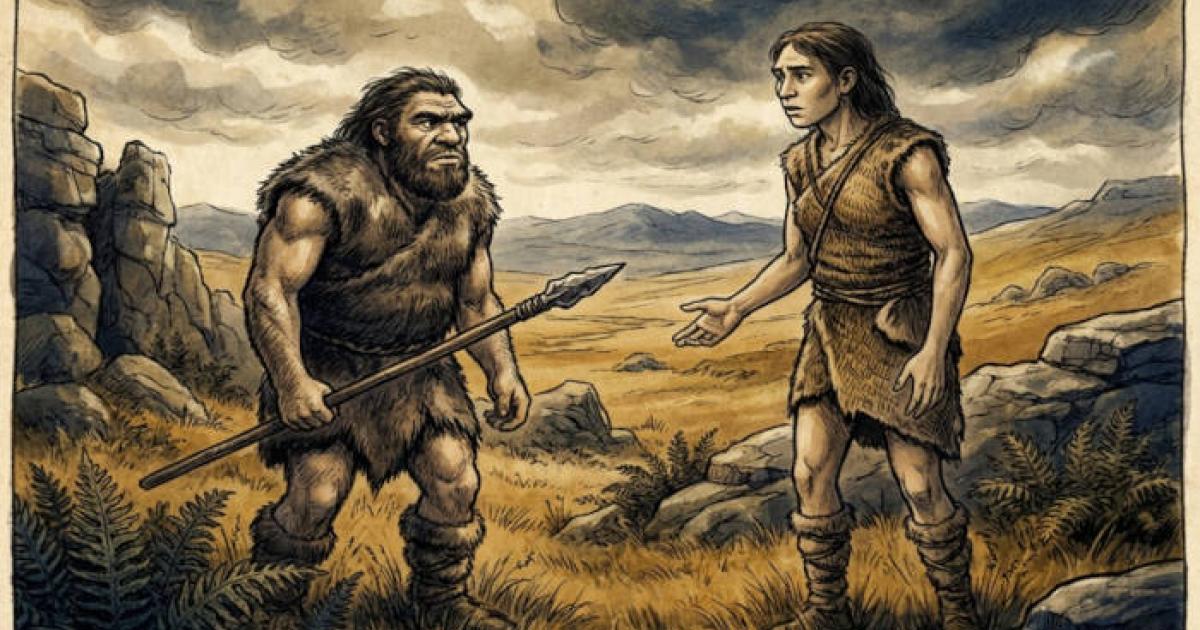
A sophisticated simulation has traced the fateful collision of two human species across ancient Iberia, showing that Neanderthals were already in decline when modern humans arrived, and their chances of interbreeding were remarkably slim. Researchers at the University of Cologne have developed a sophisticated dynamic model that reconstructs the population movements, settlement patterns, and potential interactions between Neanderthals and anatomically modern humans during a pivotal period between 50,000 and 38,000 years ago. The study challenges long-held assumptions about how these two groups coexisted and whether significant mixing occurred on the Iberian Peninsula.
Neanderthals Confined to Coastal Refuges
The research team, led by Professor Yaping Shao from the Institute of Geophysics and Meteorology and Professor Gerd-Christian Weniger from the Department of Prehistoric Archaeology, created what they call the OW-CABM (Our Way Constrained Agent-Based Model). This innovative approach combines climate data, archaeological evidence, and population dynamics to simulate how Neanderthals moved across the landscape.
The model reveals that by the time anatomically modern humans arrived in northern Iberia around 42,000 years ago, Neanderthal populations were already severely diminished and largely confined to coastal refugia. Rather than thriving across the entire peninsula, these ancient humans had retreated to favorable pockets where resources remained accessible.
The simulations incorporated data from 99 Middle Paleolithic sites across Iberia associated with Neanderthals and 66 Aurignacian sites linked to the first modern humans in the region. By running the model thousands of times with varying parameters, researchers could assess the probability of different scenarios.
“By linking climate, demography, and culture, our dynamic model offers a broader explanatory framework that can be used to better interpret archaeological and genomic data,” Professor Weniger explained in the study published in PLOS One.
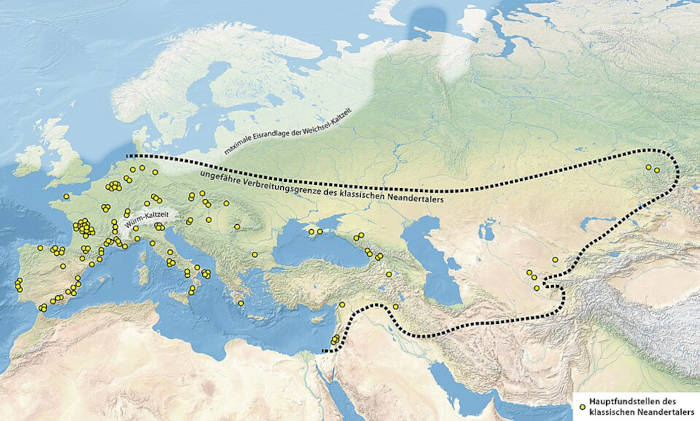
Map showing classic Neanderthal fossil sites across Europe and the Middle East. (Maximilian Dörrbecker (Chumwa)/CC BY-SA 2.5)
Climate Shocks Accelerated Neanderthal Decline
The period during which these two groups potentially overlapped was marked by dramatic climate fluctuations. The study focused particularly on Heinrich Event 5, a period of extreme cold caused by massive iceberg discharges into the North Atlantic Ocean. These climate disasters alternated with warmer interstadial periods, creating an environmental roller coaster that challenged survival for both populations. The model demonstrates that Neanderthal populations were highly sensitive to these climatic shifts, which likely accelerated their path toward extinction through demographic collapse.
When anatomically modern humans pushed into Cantabria from southern France, they encountered an environment where Neanderthal presence was already fragmented. The simulations ran thousands of scenarios with different population sizes and survival rates. In most runs, the two groups never actually met. Professor Shao noted that:
“repeated runs of the model with different parameters allow for an assessment of the plausibility of different scenarios: an early extinction of the Neanderthals, a small population size with a high risk of extinction, or a prolonged survival that would allow mixing.”
Only One Percent Chance of Genetic Mixing
Perhaps the most striking finding concerns the possibility of interbreeding between the two populations. While genetic evidence confirms that modern humans and Neanderthals interbred in eastern Europe during earlier migration phases, the question of whether such mixing occurred on the Iberian Peninsula has remained contentious. The new simulations suggest that genetic mixing was theoretically possible but highly improbable. In scenarios where both populations survived long enough to overlap spatially, mixing occurred with only a 1 percent probability. When it did happen, the admixed population represented just 2 to 6 percent of the total population.
The model indicates that if any interbreeding took place in Iberia, it would most likely have occurred in the northwest of the peninsula, where modern humans could have arrived early enough to encounter surviving Neanderthal groups before complete demographic collapse. This finding has significant implications for understanding sites like Lapa do Picareiro in Portugal, where claims of early modern human occupation between 41,100 and 38,100 years ago have sparked debate among archaeologists.
The research team plans to refine their model further by incorporating animal populations as potential prey and using machine learning algorithms to improve predictive accuracy. This dynamic modeling approach offers insights that static archaeological and genomic data cannot provide alone. By simulating the complex interplay of climate, culture, and demography, researchers can now test competing theories about this crucial transition period in human prehistory. The study demonstrates that the replacement of Neanderthals by modern humans was not a simple tale of one group overwhelming another, but rather a complex process shaped by environmental stress, population dynamics, and the unpredictable nature of rare encounters across a fragmented landscape.
Top image: Neanderthal and modern human encounter in the Iberian Peninsula. Source: AI Generated
By Gary Manners
Why haven’t people used jet packs yet?
Here’s a better question: What problems are you solving with a jet pack? What can you do with it that can’t be done with something else?
Not a fake AI photo. In 2022, the Royal Marines (Britain) trialed jet packs (piloted by the employees of the company that made it) as a way to rapidly board a ship. Since nothing has been heard from it since, we can assume that it was one of those “technically possible, but practically pointless” ideas.
It doesn’t matter the culture, political system, economic status.
All lumped together under “slant-eyed yellow folk”.
The Finnish PM left out the Vietnamese, who are also part of the KJV sinosphere. Maybe Hanoi should raise a diplomatic protest.
🤭
In this case, boarding a ship is only feasible for peacetime or counter-terrorist/hijacking operations. In an open war like in Ukraine right now, you won’t get that close to the ship without being shredded. However, in those cases where you can actually board a ship, does this method offer any real advantage over (say) a light helicopter and similar aircraft or by small boats?
The way I see it, jet packs are noisy, fuel-hungry, and difficult to control. Your operator must be specifically trained for it on top of their regular job. Unlike vehicles like helicopters, it also has no carrying capacity, limiting their use cases to “getting someone (and by that, I mean one person and possibly a minimal amount of extra load) from A to B quickly”.
How many jobs call for that capability? And this is made even more questionable with the rise of drones and small aircraft called eVTOLs. Those two can do practically everything that a jet pack can, but drones are way cheaper and possibly disposable while an eVTOL actually has carrying capacity beyond the pilot.
It’s a solution waiting for a problem. And perhaps there are already better solutions to all of those potential problems.
It doesn’t matter the culture, political system, economic status.
All lumped together under “slant-eyed yellow folk”.
The Finnish PM left out the Vietnamese, who are also part of the KJV sinosphere. Maybe Hanoi should raise a diplomatic protest.
🤭