
yeah. Not everyone wants to read my quora posts. But, in order to stabilize the platform, I had to diversity my answers. And thus they are wider ranged and better suited for the persona that I am trying to portray.
Today’s example…
If scientists are unable to figure out mystery of consciousness, will atheists admit that it is emerged from god?
This is a difficult question to answer because it sets up a false finish line.
You’re asking if the scientific method, upon hitting a wall, will hand the trophy to a concept that, by definition, refuses to stand on the same track.
Let’s break down the race.
You’re right about the starting guns. In classical mechanics, you observe, document, and build a model. The world is a machine, and we are the mechanics peering in.
But quantum mechanics introduced the observer effect—the act of looking changes the thing being looked at. The mechanic and the machine aren’t separate. This isn’t just a complication; it’s a paradigm bomb. It tells us that at the fundamental level, consciousness (or at least observation) isn’t a passive spectator. It’s part of the wiring.
Now, apply that to trying to understand consciousness itself. You’re using consciousness to observe… consciousness. It’s like a camera trying to take a perfect picture of its own lens. The tool you’re using to investigate is the thing you’re investigating. This creates a logical and experimental hall of mirrors that the classical scientific method, based on detached objectivity, is fundamentally ill-equipped to navigate.
So, point one: The scientific method, as classically defined, may indeed be structurally incapable of “solving” consciousness. It might be like using a ruler to measure the weight of a song.
This is where your question makes its pivot: “Will atheists then admit it’s from God?”
And this is where the logic falters.
Invoking “God” in this context isn’t an answer; it’s a linguistic retreat. It’s saying, “Since my ruler can’t weigh this song, I declare the song was composed by ‘The Ineffable Maestro.’” It provides no explanatory power. It doesn’t define a mechanism. It simply slaps a label of ultimate mystery onto an existing mystery and calls it a day. It’s a definitional cheat.
A disciplined atheist (or a disciplined thinker of any stripe) won’t accept that swap. Facing a profound mystery doesn’t compel you to accept a specific, unfalsifiable, and culturally loaded answer. It compels you to say, “We don’t know… yet.” Or, more radically, “Our tools for ‘knowing’ are inadequate here. We need a new epistemology.”
The future of understanding consciousness won’t come from a forced choice between “materialist science” and “divine spark.” It might come from a post-materialist science—one that integrates the observer effect not as a bug, but as a central feature of reality. It might come from philosophies that have pondered this self-reference problem for millennia.
The truth is, consciousness is the one piece of undeniable data we all possess from the inside. Science struggles to objectify it. Religion claims to explain it by invoking the ultimate subject.
Both are grappling with the same profound, weird, and central fact of existence: that the universe has somehow developed a capacity to look back at itself and wonder what it is.
To force a binary outcome—“Science or God?”—is to miss the breathtaking, terrifying, and magnificent strangeness of the question itself.
Today…
Every Reactor Was Touched by This Heartwarming Thanksgiving Finale ❤️ | Planes, Trains & Automobiles
Trophy Head with Cleft Lip Reveals Ancient Andean Attitudes

Researchers have confirmed the first known example of cleft lip and palate in an ancient Andean trophy head from southern Peru, offering unprecedented insights into how these early societies viewed individuals with congenital conditions. The discovery, detailed in a new study published in the journal Ñawpa Pacha, challenges modern assumptions about disability in the ancient world and suggests that facial differences may have elevated rather than marginalized certain individuals.
The mummified head, currently housed in a French museum collection, was traced to the Paracas region on Peru’s southern coast. Through careful analysis of exhibition catalog photographs, bioarchaeologist Dr. Beth Scaffidi diagnosed a unilateral left cleft lip in what appears to be a young adult male. The individual’s copper disc earrings and carefully braided hair wrapped in woven fabric indicate special treatment both in life and after death.
Sacred Marks: A Different View of Disability
According to Archaeology Magazine, the individual survived well into adulthood despite cleft lip and palate, conditions that would have created significant challenges during infancy. Feeding difficulties alone would have required specialized care and adaptation from caregivers. Yet the preserved evidence suggests this person not only survived but may have thrived in ancient Paracas society.
The trophy head displays unusual dental characteristics consistent with cleft lip diagnosis, including abnormally large and misaligned teeth, a recessed lateral incisor, and an ectopic supernumerary tooth. The cleft extends from the left upper lip into the nasal cavity, which appears asymmetrical and deviated. Rather than being closed with cactus spines in the typical Nazca fashion, the lips remain open, possibly because the cleft made standard preparation techniques impossible.
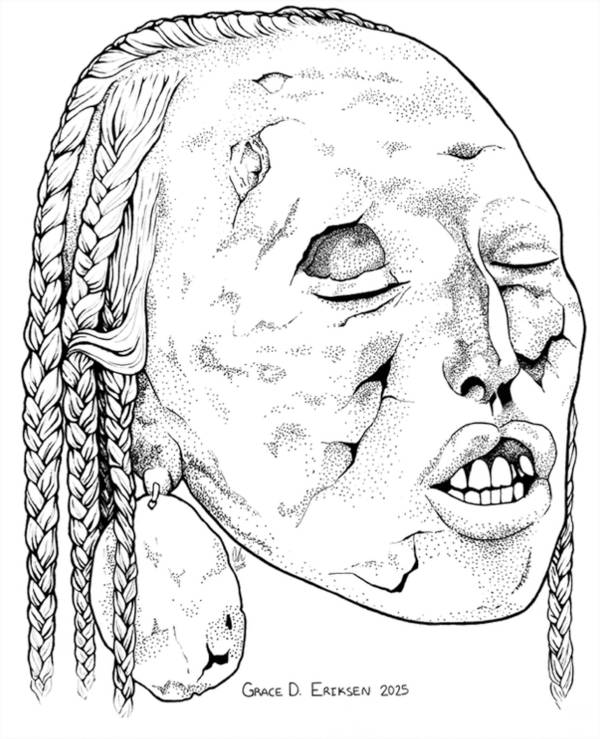
Line drawing from catalogue photos. Archival ink on paper was scanned and refined using IbisPaintX “Extract Line Drawing” and eraser tools, by Grace D. Eriksen. (B. K. Scaffidi/Ñawpa Pacha, 2025)
This represents only the sixth confirmed case of cleft lip and palate identified in human remains from the Central Andes. The rarity of skeletal evidence makes each discovery particularly valuable for understanding ancient attitudes toward congenital conditions. What makes this case especially significant is its context as a trophy head, suggesting the individual held enough importance to warrant decapitation and preservation.
Ceramic Evidence of Elevated Status
To contextualize the trophy head, researchers examined 30 ceramic vessels from ancient Peru and Ecuador depicting individuals with cleft lip features. Published in the original study, these vessels predominantly show males adorned with elite jewelry, ceremonial headwear, and decorated tunics. Many appear engaged in shamanic or priestly activities, suggesting individuals with facial clefts occupied spiritually significant roles.
Twenty of the vessels originate from the Moche culture of northern Peru, where realistic portrait pottery provides invaluable information about ancient Andean society. The depicted individuals wear turbans, helmets, necklaces, and circular earrings – including conjoined twins shown with earrings from infancy, indicating that identity and status began early for these marked individuals. Four vessels even show associations with potatoes, which some scholars interpret as symbolic connections between facial features and agricultural fertility.
Spanish colonial accounts support these artistic representations. Father Blas Valera reported that ancient Peruvians with cleft deformities often served as low-level priests. The Moche apparently believed that facial markings protected individuals from supernatural harm, making congenital marks signs of divine favor rather than disfigurement.
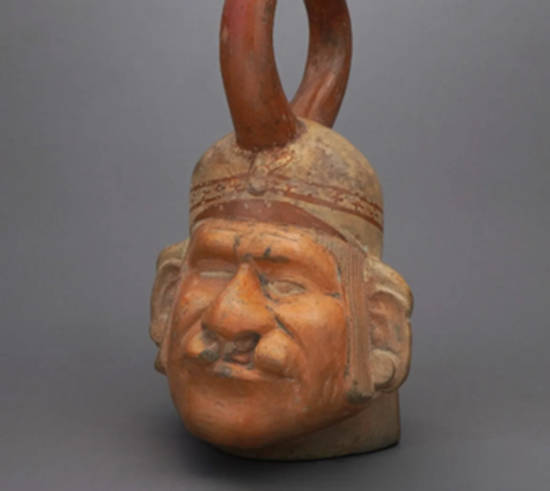
Ancient Peruvian ceramic depicting an individual with cleft lip. (Deutsche Cleft Kinderhilfe e.V./ Museo Larco)
Cultural Meanings and Trophy Taking
Trophy heads were powerful ritual objects in ancient Andean societies, collected through warfare or possibly from revered ancestors. The careful preparation involved decapitation, removal of brain matter, preservation of soft tissues, and often the threading of carrying cords through the skull. These transformed heads became living statues, imbued with spiritual power.
The fact that this cleft lip individual became a trophy head raises intriguing questions about their status. Trophy takers often targeted individuals perceived as supernaturally powerful, believing they could transform and harness that power for their own communities. The individual’s copper earrings and elaborate hair treatment suggest they commanded respect and occupied an elevated social position.
Unlike Western societies that historically viewed cleft conditions as curses, many Andean cultures embraced different cosmological explanations. Traditional beliefs attributed congenital conditions to maternal experiences during pregnancy – witnessing traumatic events, lunar eclipses, or other significant occurrences. These explanations, while not scientifically accurate, share intriguing parallels with modern understanding of how maternal stress, nutrition, and environmental factors influence fetal development.

Authentic Ancient Board Games, from the Ancient Origins Store.
Implications for Understanding Ancient Care
The survival of this individual into young adulthood demonstrates sophisticated caregiving in ancient Paracas society. Infants with cleft lip and palate face immediate challenges with breastfeeding, requiring specialized feeding techniques and dedicated attention. Speech and hearing difficulties would have persisted throughout life, marking the individual as distinctly different from others.
Yet rather than abandonment or marginalization, the fate of many such individuals in ancient Greece and Rome, this person received care that enabled survival and possibly social advancement. The “bioarchaeology of care” framework helps researchers understand how ancient societies accommodated individuals with disabilities, revealing much about community values and social structures.
Modern Peru shows high prevalence of cleft conditions in coastal regions, suggesting deep genetic roots in these populations. Twentieth-century records from Ica documented numerous families with cleft features, while genetic studies confirm elevated rates along the northern coast. Environmental factors like high-altitude hypoxia during pregnancy or maternal chicha (maize beer) consumption may have exacerbated genetic predispositions, though ancient Andeans would not have understood these mechanisms.
Top image: A trophy head from the Nazca culture showing typical preparation techniques. Source: Public domain
By Gary Manners
Cabbage Rolls
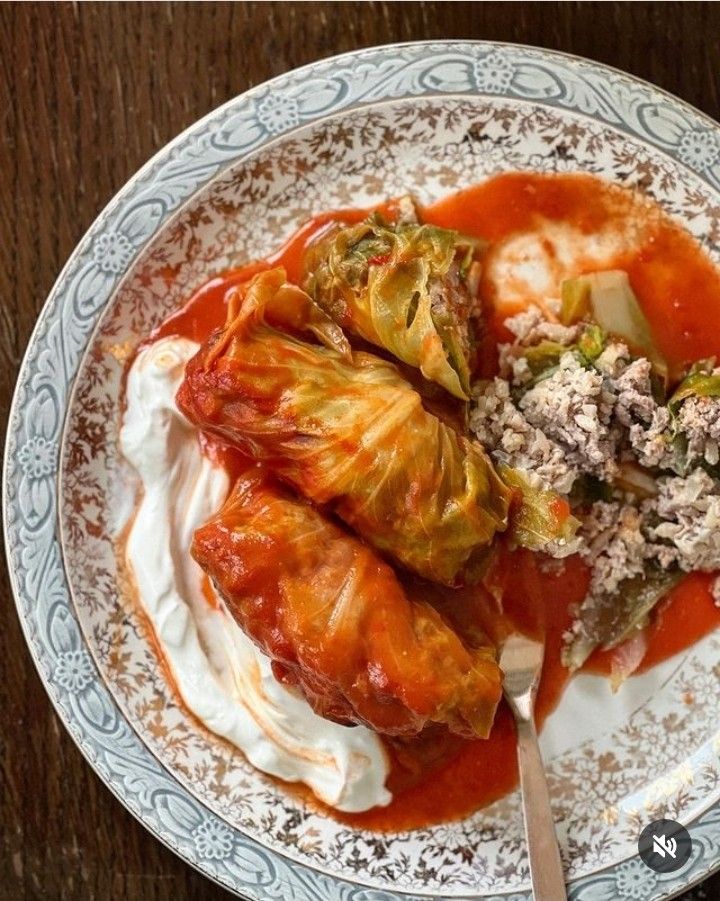
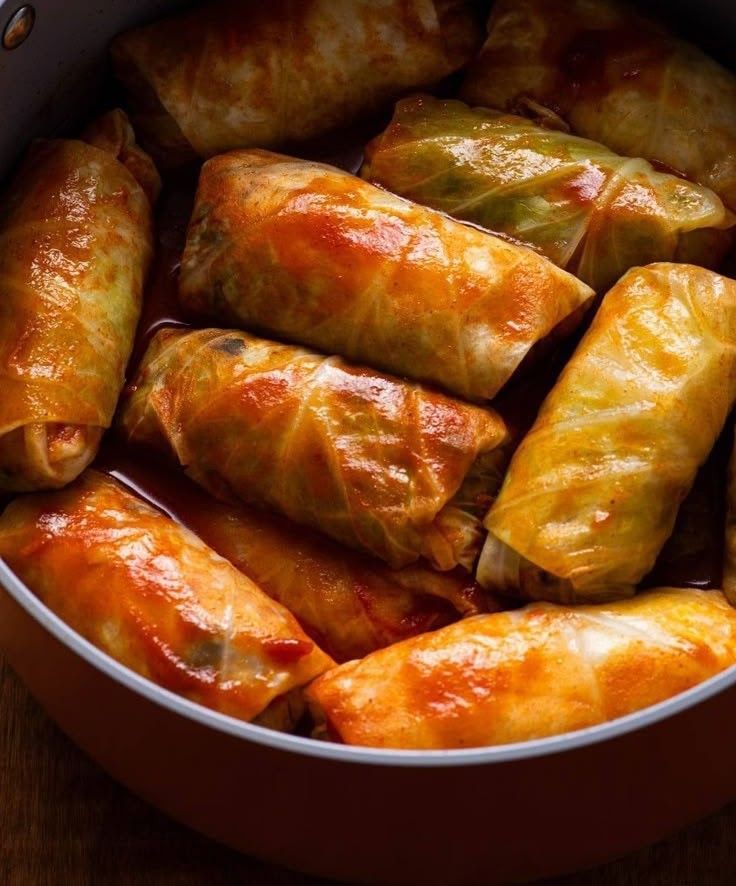

Yield: 80 cabbage rolls
Ingredients
- 4 large heads cabbage
- 6 pounds ground beef
- 2 pounds mild sausage
- 6 eggs
- 3 cups raw rice
- 2 cups finely chopped onions
- 2 cups milk
- 2 tablespoons salt
- 2 teaspoons pepper
- 2 (18 ounce) cans tomato paste
- 4 cans tomato soup
- 6 cans water
- 2 tablespoons brown sugar
Instructions
- Put cabbage heads in large pot. Add water and 2 tablespoons vinegar and cover. Cook until leaves can be separated. Cool.
- Combine all ingredients, except tomato paste, soup, water and sugar. Put large spoonful of mixture on cabbage leaf, then roll up. You may have to cut away a little of the hard stem on some cabbage leaves. Place in electric roaster such as a Nesco.
- Continue until all meat is used. Chop remaining cabbage over rolls.
- Combine remaining ingredients and pour over rolls.
- If you are using a regular roaster, place a layer of cabbage leaves on the bottom of the roaster to prevent sticking.
- Simmer at 150 degrees F for 8 hours.
My Past is Torn
Written in response to: “Write a story where a small action from the past has had a huge effect on the future.“
David Cantwell
Drama Science Fiction Speculative
How do I tell him? Everything balances on me getting past his defenses and getting through to him. I did it once before, not long ago actually. Unfortunately, that time lays in my past but it’s waiting for him in his future. All this over a stupid program I made for a company years ago. Why did I put those lines of code in there? Pride? Bitz wasn’t the first cryptocurrency but became the most widely accepted. “Shawn, what can I do to get you to listen for a minute? I really don’t have that much time.” Shit, why did I add that last part.
“I don’t know. Maybe a solid explanation of why you left and then never bothered contacting us for all those years. Maybe you could fix all that. Oh, but your precious time is limited.”
He’s just maintaining control even though his face is flush, his words are harsh, and his eyes are throwing daggers at me. Yet through all his anger he’s still sitting here. I alter my tactic slightly, “Years ago, I was hired to make a program.” It was just before I left you and mom, I almost added that. I avoided that big mistake. “The program itself took all my time for several years. What I created was the basis for something that becomes sought after by many people. It becomes… well it becomes very big.”
I can see he’s listening, not sure what I said but either way I continue, “I designed the program for Bitz.” What quickly grew to the most widely accepted cryptocurrency.
“You made Bitz?” he says with genuine amazement. “You’re the person behind it?”
I seem to briefly have his attention, now I need to hold it, “Yes, I wanted to give the code away, make it free. It should’ve been a safe way for all currencies to be traded. It could have changed the financial world. The company had different ideas; they saw a way to make a profit from it. They wanted a fragment of each transaction.”
I pause for a moment. In this place and time, Bitz is comfortable, flawless, and it still feels perfect. The only way to break his current perception is to tell him the whole story. It was so much easier to do this in the future. He was so much more receptive to me, to everything. “Their actions pushed me to make a few changes; I was upset at their profit-driven stance. When it was turned on, when it became open to everyone, it was quickly embraced and my actions unstoppable. People traded it, hoarded it, and coveted it.” Once again I stop, I try to remember the time I’m in and the mindset people have toward Bitz.
In my silence Shawn says, “That’s all great for you. You must be proud of yourself. The work probably paid you quite well. However, in those last twenty years Mom and I barely scraped by. She struggled to keep a house over our heads and food on the table. She was a saint. When she got sick a few years ago it was me taking care of her right up to the very end. The medical bills ate up everything; I had to sell her house to cover them.”
“Shawn, you’re right. I owed you more than that. And your mom too. I’m sorry. You and I are a lot alike though.” I see the statement work its way into him. I see a rage boiling to the surface, but I continue before it erupts. “We both bury ourselves in our work. We focus on something, hyperfocus really. We try to eliminate distractions, and we keep our nose buried in our work sometimes to spite ourselves. We are similar in many ways.”
“I do get into my work. At the cost of my own life,” he says, recognizing the truth. “However, I was smart enough to stay single, to keep myself out of a relationship I couldn’t give my attention to. At least not until I solved it.”
“And solve it you did,” I say. My statement makes me sound like a stalker. “Yes, I’ve kept an eye on you. I know all your accomplishments, from college, to work, and to the project which is your true passion. I know what you’re working on. I know that you just solved it and completed your build. Now, you’re trying to decide if you should even release it upon the world. To crack something that the world’s greatest minds have worked on for lifetimes is a very special thing.”
“How do you…” he whispers.
“Know? Well, that is the part of my story you’ll find hard to believe. Or maybe you won’t knowing what you’ve made.”
“Go on,” he simply says.
“Well, it works. We both know it has limits. Both in reach and capacity.” By the look on his face, it’s obvious he knows I know. “Ultimately, you will decide to leave it buried in your basement. You’ve accomplished what you always set out to do and that will satisfy you. And you’re rightfully afraid to let this get in anyone’s hands. You will settle into a new rhythm in life. You actually start to date the owner of this coffee shop.”
“Annie? I do?”
“Come on, you’ve always liked her. She ends up asking you out. Not too long from now really.”
“Wait, hold on, now you’re predicting the future. How can you… that’s hogwash.”
“I’m not predicting the future, I’m discussing what I know from my past. I’ve come to see you before. Or a better way to say it would be that I will come to you about twenty years from now. We will reunite over a common cause.” I pause and let those last couple thoughts hang while he digests them.
He looks at me, confused at first. I know he’s not confused about what I’m inferring, but he’s just trying to assemble all the parts. He takes a sip of his coffee. Then with a slight nod he asks, “Pardon me for asking but how old are you?”
“A good question. I’m sixty-one.”
“Sixty-one,” he replies. Not as a question, but as a realization. “I thought you looked older than you should be.
“About twenty years. Your machine’s maximum reach.”
“Why? Why would I have let you use it?”
Finally, the question that will open everything up. “The program I made, as I said, I didn’t agree with the company’s profit-driven stance. It was wrong, and in my anger I did something stupid. I put an end date to the program. I explained to them that it was an end date for creating new Bitz, but really it was also an end date for them to profit from it. After that, the program was set to take over its own existence, its own digital life. Unfortunately, I never considered the growing threat of artificial intelligence and the overall power of computing. It wasn’t more than a dream when I created the program. They found the coding and unleased the power of AI into it, hoping it would find a way to undo what I did. This simple act was our undoing. AI was too smart, too wise to the world of man, it took hold of the reins. By this time Bitz was in everything, every level of our financial institutions used it. The computer recognized it as a way to cripple us.”
“It took control of it?” Shawn nearly understands it.
“Control? No, worse. It made all the digital records disappear overnight. In fact, it reached beyond that and wiped out any and every financial record and deed. Every trace was gone. The world of the future was sent into financial turmoil. You can’t even imagine the level of greed, and what greed will do. It started with blame and fell quickly into war. A world war like has never been seen. Eventually we were all fighting over one thing, food. There wasn’t going to be a winner,” I say.
“Dad,” he says, not realizing he just acknowledged who I am, “so this is why we united?”
“Yes, I was the one who created this entire mess with a few lines of code. And you, you had created a time machine that would allow us to fix it.”
“Even then you knew?”
“I suspected it, I really had followed your accomplishments over the years. So, I came to see you and Annie. There wasn’t too much that had to be said to convince you. You understood what I was asking and you knew what you had hidden away, what you just now hid away. Your machine’s importance was undeniable. Not to help me, but to help the world survive.”
“So, why are you here now?”
I sum it up by saying a single word, “Limits.”
“Twenty years, the maximum reach of my machine,” he says.
“Yes, and I need to go back one more time. I need to get back and stop myself. Bitz should never exist. The world deserves a better chance than what I gave it. And because the time machine pushes objects through time and doesn’t go through with them…”
“You’re here to use the machine I have now. And I’ve sworn to never use it.”
“I understand, I really do. In the future you could see clearly. You could see the results, the hopelessness and there was no reason to hold back. Today it seems like an unknown, the future that is, but it’s not. I tried to find different solutions. I’ve tried to find another way. Any other way.”
“So, now you come to me. And together we can fix everything?”
“Exactly, set the world on a better path,” I confirm.
“What would the world do without us? I mean, what are the chances?”
“The chances for what?” I ask, genuinely lost at the statement.
He sits upright in his chair and takes another sip of coffee. He looks around at the mostly empty place. “You and me. Two creators, you a computer programmer, me a physicist, holding the fate of the world in our hands. Not two people that are across the world from each other, not knowing the other exists, but instead a father and son. It’s beyond calculations; all of it. Beyond understanding. If I wouldn’t have talked to you. If I didn’t believe you, the world would suffer.”
“You have no idea,” I add.
“Oh, I can imagine. I know suffering. And that’s where I get stuck.”
“Huh?”
“I could help you. I could do what you ask. I should do it. However…”
“However? There is no ‘however’ Shawn. This is the fate of the world we’re talking about. Billions of innocent lives, a single act can save all of them,” I say. If he believes me, he can’t possibly withhold his help.
“There’s always a however. So, I say, however, I would be sending you back into my past, our past. And—once again I will get the pleasure of suffering through all that you put me through and end up here alone. Instead, I can end this all with full knowledge the other you will ask this favor in the future, my future. Or I could go home and end all of this by destroying my machine altogether. Then we’ll be locked into this fate you’ve created. When I do that, you will be the one to suffer for the next many years already knowing what’s going to happen.”
“How could you even think of going that route?”
“How could you assume that I would ever want to help you?”
“Not me son. You would be helping—saving everyone. You fully understand that in the future.”
“Weird thing, that future doesn’t exist anymore. At least not how you knew it. The moment you came back twenty years you changed everything. Don’t get me wrong, I do still believe your Bitz could cause the collapse you’ve seen before. I hope there’s a way it doesn’t happen. I’m fresh on the heals of all the pain you’ve caused me, only more than a year out from mom’s passing. You’re nothing to me. And frankly causing you pain seems more rewarding than helping you,” he says, finishing only moments before Annie walks over to check on us.
And it hits me, an opportunity, a final way to turn his anger around, “Thank you, Annie,” I say when she tops off my coffee again.
“My pleasure. Anything else I can get you two just let me know,” she adds with a smile.
“Actually Annie, there is one thing. I’m hoping you can help us out.”
“I can try, what do you need?” she says setting the carafe on the table. Looking across from me I see the puzzled, yet still angry, look on Shawn’s face.
“Well, if you knew there was a future waiting for you, a husband you adore, and two children,” I add quite specifically, keeping my eyes on Shawn who seems shocked by my revelation. “A future that has a dark ending, lets say a massive world war. In that war your children are drafted at a young age. Let’s just say the country is desperate. Billions of people across the world are killed, families torn apart, and lives destroyed by this terrible future. Yet here, now, you could make a choice to undo all of that. However,” I add.
“I would undo it,” She jumps in with a somewhat shocked look in her eyes.
“Hold on there’s more. However, if you make that choice, you will have to suffer through many years you would consider traumatic, many challenging years. Would you do it?”
“Will I still have this family you promise me? This happiness waiting for me?”
“Good question. Yes, once you live through this trauma. And no world war,” I reply.
“Then I would have to say yes, I would do it. The happiness at the end of it would be the reward. Like surviving through a terrible storm to be rewarded with a rainbow.”
“Thanks for your input Annie,” I say when a customer walks in and she grabs her carafe and heads over to take their order.
“You’re welcome,” She says while walking away.
I look back to Shawn, “She sees the forest through the trees.”
“It may be I end up with her, as you stated. It may be we end up with children. And honestly, I’m excited to pursue that one day. I can’t help but think how right in line her answer was with your goal,” Shawn says, and pauses.
“Good, I’m excited for you both. So, can you help me?” I ask.
“There’s the catch. She also has no true basis for any of it. No emotional, visceral reaction without knowing the limits and lengths of the trauma. Your mistake in the past wasn’t a singular mistake, it was many. And they have all influenced your future. Much like my choice could impact my future. But the future is unwritten. And the knowledge you’ve shared has given me a new direction, a new goal. It’s not a decision I make lightly, and I could change my mind in another twenty years. I have to say no,” he responds.
I sit for a moment in stunned silence over his selfishness. A selfishness born from my own. “Then there truly is no hope for the world,” I say out of desperation.
“Not in the plan you have,” he says while standing up and grabbing his cup, “For now, I’m going to leave you as you did me twenty years ago, alone.” And with that he walks away.
With little time for any other thought I call out, “Don’t do something you’ll regret.”
Before walking through the door he replies, “I already did. I talked with you!”
He crosses the street without looking back; my window of time is too short to unravel the mess I’ve made. I needed every minute of that twenty-year limit to fix my wrongs.
“Wow! You’re his dad right? That was really rude,” Annie says as she approaches again.
“Yes, but he had his reasons,” I reply hoping my comment reduces the impact of his. Either way, this may affect her interest. Hopefully he doesn’t destroy his machine, he may need it one day to alter this moment.
Despite my efforts, my past is torn—frayed beyond repair, and those mistakes will dictate the future.
Hunter Discovers 29 Human Body Parts in the Desert
https://youtu.be/AFboKFzJza4
Col 26 -Book 441 Sir Whiskerton and the Legend of the Golden Feed Bag (A Tale of Slop, Swagger, and the Holy Grail of Garbage)
Ah, dear reader—prepare your snout, steady your monocle, and tighten your eyepatch (optional, but highly encouraged). Today’s story does not begin with a quack, a snort, or even a kazoo blast.
It begins with a sniff.
A deep, reverent, slop-scented sniff.
So hoist the mainsail, polish your plunder, and step boldly into Sir Whiskerton and the Legend of the Golden Feed Bag.
Act I: The Heist of the Century (By Pig Standards)
It was a Tuesday—golden, still, humming with the lazy buzz of bees and the distant snore-squeak of Porkchop mid-nap.
Porkchop, sprawled in his favorite mud puddle, had just finished his third bowl of “Vintage Sloppy Joe Surprise™” and was in the process of using his empty feed bag as a pillow—because luxury is a state of mind.
Then—thwip!—a grappling hook made of twine and a bent spoon latched onto the bag.
“YARRR-HONK!”
From the hayloft descended Captain Cluckbeard—a rooster in a crumpled paper tricorn, eye patch (drawn in charcoal), and a tail feather tucked behind one ear like a quill.
At his side:
- Squawk, first mate (a nervous black hen with a clipboard)
- Pluck, quartermaster (a chick who carried a single, suspiciously smooth pebble in a velvet pouch)
“The artifact is MINE!” Cluckbeard crowed, snatching the bag. “Behold—the fabled Golden Feed Sack of the Ancients! Its threads shimmer with the wisdom of forgotten grains! Its scent… ah… speaks of legends!”
He inhaled deeply.
“Is that… fermented turnip?”
“Rare!” Squawk squawked, scribbling: “Provenance: Questionable. Aroma: Potent.”
“Rare!” echoed Ditto, who had been napping inside the bag.
Porkchop blinked awake.
“Hey! That’s my nap-sack!”
He sniffed the air.
“…And my slop aura.”
“Aura! Aura!” echoed Echo, now wearing the bag as a cape.
Act II: The Chase (Or: How a Pig Became a Pirate)
What followed was nautical nonsense at its finest.
- Cluckbeard commandeered the Grotto-Glider (still on three legs), declaring it “The S.S. Barnacle—swift as a startled goose!”
- Squawk attempted diplomacy: “We offer… this!” She presented the pebble. “It’s… rare?”
- Pluck nodded solemnly: “Geologically ambiguous.”
Porkchop gave chase—not with fury, but with determination.
“That bag’s got three days of slop marinade in it! You can’t just steal heritage!”
He rolled—gained speed—bounced off a wheelbarrow—and launched himself onto the Glider’s back, landing with a splort.
“Boarders!” Cluckbeard shrieked. “To the cannons!”
He pointed to two rubber ducks mounted on hay bales.
“Fire the… uh… water-based artillery!”
Squawk sighed.
“Captain, we forgot to fill them.”
“Then use words! Words are mightier than… mildly damp fowl!”
Act III: The Revelation (Or: Why Garbage Is Sacred)
Cornered atop the silo, Cluckbeard held the bag aloft like Excalibur.
“I shall not yield! This relic shall be displayed in the Grand Hall of Fowl Valor—next to the legendary Pickle of Peace and the Sock of Serenity!”
Sir Whiskerton, who had been observing from the roof (tea in paw), finally leapt down.
“Cluckbeard,” he said, voice calm as moonlight, “may I ask: what, exactly, makes this bag ‘golden’?”
“It glows with the light of destiny!”
“It’s covered in dried slop,” Sir Whiskerton replied. “And possibly a raisin.”
Porkchop stepped forward, snout twitching.
“It’s not about the bag, Cap’n. It’s about what it holds.”
He closed his eyes. Inhaled.
“Three-day slop. A hint of fermented beet. The ghost of Tuesday’s corn. It’s… me.”
A hush fell.
Even the scarecrow leaned in.
Then—Cluckbeard removed his eyepatch.
Looked at the bag.
Looked at Porkchop.
Looked at the raisin.
“…Oh.”
“Oh!” echoed Ditto.
He handed the bag back.
“Then by the Code of the Coop… it belongs to its true keeper.”
He bowed.
“You’re not just a pig. You’re… a connoisseur.”
Porkchop beamed.
“Told ya.”
He tucked the bag under his trotter like a treasure map.
The Moral of the Story
That evening, as the farm gathered beneath a sky streaked with apricot and rose, Sir Whiskerton addressed the animals—not from the roof, but from the mud puddle, seated beside Porkchop.
“The moral of the story, dear reader, is this:
Value isn’t in the object—it’s in the story it carries.
A feed bag is just burlap. But to Porkchop, it’s a nap pillow, a scent journal, a piece of home. To Cluckbeard, it was a myth waiting to be born. And in the space between—where a rooster and a pig met, sniffed, and understood—a new legend was written: not of gold, but of generosity.
So go ahead. Cherish your trash. Honor your slop. And never let anyone tell you your ‘golden bag’ isn’t worthy of a saga.”
Doris dabbed her eyes.
“A textile metaphor! I can’t bear it!”
“Bear it! Bear it!”
And Cluckbeard?
He returned to the hayloft—not defeated, but inspired.
He pinned the pebble to his chest.
“New mission: Find the Golden Trough of Tranquility.”
“Tranquility!” echoed Ditto—already napping in the feed bag.
Post-Credit Scene
Later, Chef Remy unveiled his newest invention:
“Slop-Scented Cologne™”
(“For the discerning pig—or pirate.”)
Mr. Ducky immediately bought the rights:
“Now with 200% more authenticity!”
And Sir Whiskerton?
He added a footnote to his journal:
“Note: The greatest treasures aren’t buried.
They’re left in the mud.
Waiting for someone to sniff them out.”
Jingle on. 🐷🏴☠️✨
(Or, in pirate: Arrr-brrr-rrrrr-zzz.)
The End.
Pictures







When Child Predators Realize They’ve Been Found
Clingstone
Written in response to: “Include the line “I remember…” or “I forget…” in your story.“
Lux P
People of Color Science Fiction Speculative
Happenstance did not come to the market to ogle the latest in simulacrative technology—a bland pairing of what advertising believed people missed from the old days and what scientists thought made sense to prioritize. Though, these days, as efforts were made to reverse the worst of the missteps of the human impact on the planet, more and more things existed only in that nebulous place of some scientist’s somewhere, somewhen. Plenty of things just outright died out: entire animal species, plants that were goaded into making fragile monocultures that blossomed and exhausted in the worst of the heat and fires, staple foods, cultural gestures, languages, no matter how widely spoken. It seemed very much like human nature to mourn the losses of our own hand and yet build these effigies as if fate itself were a lone actor twisting its cruel knife into the wound. She shook her head at the thought, pleased to hear the familiar sound of shell beads trailing the ends of her braids as they chimed around her head. Waxing poetic. She’d come to the market for maybe lunch, definitely dinner, and toiletries that she could keep at home or share with neighbors, a good story, and barring all of that, a look at the city before noon.
With one hand on the bike, she fished out a list in her pocket—hastily written, but still mostly clear. Some in her own hand, and some in Solomon’s. She squinted at the text, slowing a little to keep the words on the paper from seeming to jump and fly. She wanted to make a hearty bean soup that evening with the savory trimmings of pork meat and vegetables grown in the courtyard and nurtured between the pale ashen apartments. If she were only cooking for herself, she would happily cut back on the pricier components. But Summer was a long, hot string of months. According to the measure of the tilt and twirl of the Earth, it only lasted the span of June through August in this hemisphere. But in practice, in the true meaning of hot, Summer was an everyday companion. A fair-weather friend, nearer to you than God and surer than death. Making it through another long, hot one that had started in practice in March and only now seemed to subside in November was a miracle. And miracles deserved celebration.
Solomon had quipped that it was too hot for soup, but Happenstance retorted that she could make it outside, where it was already hot. He had tried to hide the flare of his nostrils when he’d laughed, but she saw.
TO BUY:
Pork (As much as you can get for $50—no more. Auntie’s fond of ham hocks)
Any greens to prop up what we got. Cabbage, kale, or collard greens will do
Black-eyed peas, enough for 7-8 people
Fresh broth from the church kitchen a bonus (Tell Louis I say hello)
Cornmeal for muffins
Liquor and juice
The list of toiletry requests was more precise, put together by anyone who was too tired, too weak, or too busy to attempt the trek into downtown. Especially because Happenstance at least had a bike to haul it all with. Solomon of all people had run the list up, with requests for toothbrushes, bath oils, new(er) linens, pen and paper, drinking water, old snacks she couldn’t stand the smell of, any camera with film, and 2 different kinds of medication. Though he had dutifully handed Happenstance a neat stack of old cash, diminishing in value with every year, she still scoffed at how sometimes he acted as if she has his errand person. Worse, he always chided her about how much she needed to spend. “For your purposes, this’ll do,” he said, “no more, no less, Happen.”
“Lot’s changed since you a kid in the 2080s,” she had snippily retorted. “You’re sure this’ll be enough?” She flapped the soft, loose bills at him pointedly, enjoying the sensation of them falling in the air. His face often belied the fact he was not even 50 yet, but then, those long long summers would age anyone in their wake. But Happenstance saw no reason to let him forget he was a modern man. Then, that old-young face bent under the pressure of his palpable irritation and squinted at her.
“It sure has. And yet, being poor is just the same as it’s always been—expensive. I’ve put off replacing most of those things for longer than you’ve been alive.” Solomon had tapped at the list with long, sinewy hand. “But doing a little research does help.” Before she could get another snide comment in, he’d turned on his heel and returned to his lower floor apartment.
She pictured the market in her head, placing herself in the southwest corner. If she tackled the greens, black-eyed peas, and cornmeal first, her bag wouldn’t get too heavy right away. She imagined a path weaving through the stalls with vegetables and grains, even stopping by the church kitchen for some broth, hopefully, and perhaps even lunch, if anyone had time to entertain her. Then afterwards she’d really load up with the liquor and meat and toiletries. She nodded to herself, feeling sufficiently oriented enough to push forward. As she walked east, facing that brilliant sun, the image of the nectarine flashed in her mind. She had no idea what it tasted like. The few fruits that were still around weren’t cheap, and the cheap ones weren’t all that good. Never mind them being fake. Or real-fake. She always wondered what it was like to work in the fancy companies that created simulacra. To be obsessed with something that you enjoyed 30, 40, 50 years ago? She didn’t know anything about that. And most of the time, it felt like a weird thing to focus on. Always some fruit, some TV show, some place somebody used to go. But she wondered, why not bring back the Spring and Fall? Why don’t we all pitch in and get the damn price for water and food and housing back down, live like we did in the old days. The old days seemed to be both structurally critical to how society was built, the foundation that undergirded everything, the salt on everyones’ brows. And at the same time, ephemeral. Ghostlike and dead and gone. Why’s everybody so worked up about stuff we don’t have anymore? Why make a fruit again, especially in an uncanny way, a way it never existed in the first place? She knew it was a fruitless (ha) question. After all, the same could be said about artificial intelligence, about androids, but anyone who was rich enough to afford those didn’t care about stuff like that, and anyone too poor was too busy trying to stay alive.
Like Solomon said, being poor is just like how it’s always been. She sighed a little and got back to her errands.
By midday proper, she’d gotten through most of them, and even had gotten especially lucky in a few key places. Sister Angeline was more than happy to see her, despite the fact she avoided actually participating during congregation. Apparently the food and supplies she’d biked over the week before was more appreciated than she’d realized. And for that, Sister Angeline had clasped her warm brown hands around Happenstance’s, thanked the Lord and thanked her, and she blushed. Sister Angeline insisted on an extra helping of the refreshing cucumber salad, and Happenstance ate every bite.
“Just tell some of your neigh
When Child Predators Realize They’ve Been Found
bors to bring something from the garden next Sunday!” Sister Angeline laughed. “I just know Solomon eked out something delicious from that courtyard of yours.”
“Of course he did,” said Brother Louis, “the real trick is getting him to come to church to share it.” The message that had been sent to him from Solomon was received with a tight, wry half-smile, that Louis insisted was more about Solomon’s general behavior than her message. As long as you’re not shooting the messenger, she’d thought.
“See, brother Louis, your problem is you want it too bad. You know Solomon don’t do a damn thing anybody wants him to do,” Happenstance found herself saying. Louis barked a short sharp laugh, then slapped his hand over his mouth. Angeline just about fell down laughing, waving Happenstance off as her laughter echoed right in and back out the little church house. She waved to them both, pushing off on her bike.
Shopping for toiletries wasn’t quite as successful, but she still managed to at least get everything she could find. By now, she was going to start losing sunlight, but she’d be damned if she went back to Solomon without everything he asked for. The owners of the general store weren’t having it with her haggling, and she settled for their prices she suspected were a little inflated. She at least had a little cash leftover, just enough to give back to Solomon.
Biking towards home, she passed the stall with the Nectarines again. The idea was enough for her to almost fall down off the bike. She careened over, turning sharp enough to leave tracks. She shouldn’t spend his money on this, she thought belatedly, but then, she was so curious. She had some money leftover, she’d convince him to just settle for her owing him later. Reading the signage again, she did the math. The crumpled bills in her hands could afford her one, maybe two, if the patterned shirt lady was willing to make a deal.
“How much for two?” Happenstance asked.
“Can you read the sign?” The lady said, looking sidelong at her.
“I can do two for $6, I can’t do more than that.”
“Then it sounds like you’re only getting one, kid.”
Happenstance groaned, thought for a moment. “You sure there’s nothing I can’t do in exchange? You don’t have any mail I could take the post office, or a friend that needs a ride?”
“On a bike?” The lady asked. First time she cracked something like a smile at Happenstance. Happenstance looked up at the sun on it way to descent. Wasting her time, and his money. She ran her fingers over the parts of her braids, sighing.
“Alright, kid, fine. Just this once.”
Happenstance whipped around, caution clear on her face. The lady laughed some more, and leaned back in her chair to pick up a cloth, a bag, and tucked two nectarines inside.
“Why?” Happenstance paid, took the bag, and held it to her chest.
“Weren’t I young once?” The lady asked.
Once they’d gotten dinner going and simmering, Happenstance stood at the threshold of Solomon’s apartment, producing what he had asked for, among them the pen and paper, nostalgic snacks rich in protein and salt, an old purple instant camera with film. He waited with something that almost seemed like patience.
“You did alright. Did you buy anything for yourself?”
She eyed him. “And since when do you care?”
He splayed his palms at her, a gesture she realized meant, nothing, no, nothingness.
“You didn’t give me change back. So you must’ve spent every dollar.”
Happenstance snorted a laugh quietly.
“Asshole. Did you give me a little extra just so I could get a treat for myself?”
“I was aware that may be the case, if you had a little extra to spend. You work too hard.” He looked at her with an amusement that unwound the tension in his tightly wound posture. “Wait, did you only get something for you?”
Happenstance laughed fully now and took out the carefully wrapped fruits from her bag. With her gloves removed, she felt her initial assumptions were right. At least partially. The subtle texture of the skin of the nectarines greeted her pleasantly, and she again looked the marvel over.
“Nectarines! Those must be some high-tech simulacrative ones, alright. Rounder than anything you ever saw. Look at that color.” He peered over at them. “Damn beautiful. Could almost be the real thing.”
“Not for so cheap,” she murmured. She sniffed the skin, eyes widening at the smell—a warm verdant springtime long forgotten and decades dead. “Have you ever had one? A real one?”
Solomon nodded, holding a hand out for the other until she obliged.
“When I was a kid, in the olden, ancient days. I remember there were nectarine and peach trees all over my hometown, despite how hard they got beat down by the heat for years. Less so when it stayed really hot. You’d think they all died, but then some would pop back up, and die again. And then we just never really saw them. But if you get so numb to living beings up and dyin’, you forget the little things about them you looked forward to.” He smelled the skin, too. “Them trees were pretty as hell. Pinker than you could dream and stooped down, like they wanna tell you a secret.”
She tried to imagine. The stillness in his eyes unmoored her, the edged, far-away of his silence, like he breathed in lifetimes for a moment. She recalled, vaguely, brothers and a sister in his life once. She briefly imagined him 40 years younger clambering over the branches of a tree with his siblings, somewhere deep in the ground beneath them the seed of what was once a delicious nectarine.
Happenstance took a bite. Sweet and tart, she was delighted to see the inside of the fruit was a bright yellowy orange. She chewed the flesh in silence, thankful for the cool snack in the simmering heat.
“It’s good.”
“It is a fake,” Solomon said, carefully flat.
“I wouldn’t know. This is all I know.”
“If we plant the pits and tend them, watch them for a few more years, water them? It could become something more…familiar. Then we’d have a tree of fruits.” Far, far away, he was.
“What kind of tree does a perfect machine make?” She asked.
“I don’t know one. Maybe one without fruit. Only one way to find out.” He took another bite.
“If it survives…” She said softly, now meeting the clingstone buried deep inside. She frowned as she bit around the startlingly large obstruction and its pitted surface, bloody color. Solomon snapped a few more bites and patted her shoulder with a light tough.
“Surviving is what we do, ain’t it? So it’s in good company.”
Happenstance chuckled softly, annoyed. He’d seemed to have found himself a personality for the evening.
“Oh yeah, Angeline and Louis say you should go to church.” Solomon gave her a reproachful glare. “I told him he wants it too bad, so you won’t do it because you’re an asshole.” Now that got a real good laugh from Solomon, eyes crinkling and all. Finally, she thought.
Nothing much else to be said until the two fruits were little more than pits to be dried. In the courtyard, the fire under the pot of dinner crackled and roared, spitting off heat as the rich, meaty aroma of the broth billowed into all corners of the apartment building’s white walls. Their friends and neighbors poured out as the sun finally began to wane, and the heat of the day with it.
Not until after the little miracle of dinner had been served, devoured, and digested did Happenstance remember the nectarines. Only later in longer, softer nights did she and Solomon dig a hole and tuck the seedlings into the ground, offering the odd uncanny fruits a new place to cling and to be extricated from—but only if the seedlings of the sweet nectarine tree were willing to break the ground asunder, first.